

IEC 60079-11:2011
(Main)Explosive atmospheres - Part 11: Equipment protection by intrinsic safety "i"
General Information
- Abstract
IEC 60079-11:2011 is now available as IEC Standards+ 60079-11:2011 which contains the International Standard and its Redline version, showing all changes of the technical content compared to the previous edition.
IEC 60079-11:2011 specifies the construction and testing of intrinsically safe apparatus intended for use in an explosive atmosphere and for associated apparatus, which is intended for connection to intrinsically safe circuits which enter such atmospheres. This type of protection is applicable to electrical equipment in which the electrical circuits themselves are incapable of causing an explosion in the surrounding explosive atmospheres. This standard is also applicable to electrical equipment or parts of electrical equipment located outside the explosive atmosphere or protected by another Type of Protection listed in IEC 60079-0, where the intrinsic safety of the electrical circuits in the explosive atmosphere may depend upon the design and construction of such electrical equipment or parts of such electrical equipment. The electrical circuits exposed to the explosive atmosphere are evaluated for use in such an atmosphere by applying this standard. The requirements for intrinsically safe systems are provided in IEC 60079-25. This standard supplements and modifies the general requirements of IEC 60079-0, except as indicated in Table 1. Where a requirement of this standard conflicts with a requirement of IEC 60079-0, the requirements of this standard shall take precedence. This sixth edition cancels and replaces the fifth edition of IEC 60079-11 published in 2006, the first edition of IEC 61241-11 published in 2005, and partially replaces the second edition of IEC 60079-27 published in 2008 and constitutes a full technical revision. The significant changes with respect to the previous edition are listed below:
- Inclusion of non-edition specific references to IEC 60079-0.
- The merging of the apparatus requirements for FISCO from IEC 60079-27.
- The merging of the requirements for combustible dust atmospheres from IEC 61241-11.
- Clarification of the requirements for accessories connected to intrinsically safe apparatus; such as chargers and data loggers.
- Addition of new test requirements for opto-isolators.
- Introduction of Annex H about ignition testing of semiconductor limiting power supply circuits.
The contents of the corrigendum 1 (January 2012), the interpretation sheets 1 (October 2014), 2 (July 2016), 3 (July 2016), 4 (April 2019), 5 (August 2019), 6 (December 2019) and 7 (May 2024) have been included in this copy.
- Status
- Published
- Publication Date
- 28-Jul-2011
- Technical Committee
- SC 31G - Intrinsically-safe apparatus
- Drafting Committee
- MT 60079-11 - TC 31/SC 31G/MT 60079-11
- Current Stage
- DELPUB - Deleted Publication
- Start Date
- 13-Jan-2023
- Completion Date
- 30-Jun-2017
Buy Documents
IEC 60079-11:2011 - Explosive atmospheres - Part 11: Equipment protection by intrinsic safety "i" Released:6/30/2011

IEC 60079-11:2011 RLV - Explosive atmospheres - Part 11: Equipment protection by intrinsic safety "i" Released:7/29/2011
Overview
IEC 60079-11:2011 is the International Standard that specifies requirements for the design, construction, and testing of intrinsically safe equipment intended for use in explosive atmospheres. Intrinsic safety ("i") is a critical protection concept ensuring electrical equipment and associated apparatus cannot cause ignition in hazardous environments by limiting energy to safe levels. This sixth edition consolidates technical revisions, including apparatus requirements for combustible dust and the FISCO concept for fieldbus systems.
IEC 60079-11:2011 forms an essential part of the IEC 60079 series, regulating equipment used in environments with potentially explosive gases, vapors, or dusts. This standard augments and, where applicable, supersedes the general requirements outlined in IEC 60079-0, emphasizing intrinsic safety and ensuring electrical circuits themselves are incapable of causing explosions.
Key Topics
Scope and Application:
Applicable to intrinsically safe apparatus and associated apparatus connected to intrinsically safe circuits operating within explosive atmospheres (gas or dust). Also covers equipment outside the hazardous area if it influences intrinsic safety.Intrinsically Safe Apparatus Construction:
Specifies design principles to limit electrical and thermal energy such that ignition from sparks or heat is prevented.Electrical Circuit Evaluation:
Electrical circuits exposed to explosive atmospheres must be assessed for intrinsic safety-applying parameters such as voltage, current, capacitance, and inductance limitations.Incorporation of New Technologies and Concepts:
- Integration of FISCO (Fieldbus Intrinsically Safe Concept) apparatus requirements from IEC 60079-27.
- Inclusion of dust atmosphere protection requirements from IEC 61241-11.
- Addition of new test criteria for opto-isolators and semiconductor limiting power supply circuits.
Accessories and Connections:
Clarifies requirements for accessories connected to intrinsically safe equipment (e.g., chargers, data loggers) particularly when located outside hazardous areas.Marking and Documentation:
Provides guidance on clear marking of equipment to designate compliance with “i” type protection and relevant parameters.Safety Annexes:
Annexes offer detailed requirements on encapsulation, ignition testing, and FISCO-specific apparatus design.
Applications
Industrial Facilities with Hazardous Atmospheres:
Implements intrinsic safety in environments such as oil and gas refineries, chemical plants, mining operations, and grain processing facilities where explosive gases or dusts may exist.Process Automation and Control Systems:
Ensures safe integration of intrinsically safe sensors, actuators, and control devices connected to electrical circuits within hazardous locations.Portable and Fixed Equipment:
Applies to handlights, data loggers, battery chargers, and other portable tools designed for use in explosive atmospheres, guaranteeing energy limitation prevents ignition risk.Electrical Installations Beyond Hazardous Zones:
Covers equipment located in safe areas but connected to intrinsically safe circuits, ensuring overall system integrity in terms of intrinsic safety.Fieldbus and Networked Systems:
Addresses intrinsic safety in communication networks operating within or interfacing with explosive atmospheres through FISCO-compliant devices.
Related Standards
IEC 60079-0: General requirements for electrical equipment in explosive atmospheres; serves as the foundational reference for all other parts in the 60079 series.
IEC 60079-25: Outlines requirements for intrinsically safe system design, complementing apparatus-level standards like IEC 60079-11.
IEC 60079-27: Previously covered FISCO apparatus requirements, now merged into IEC 60079-11 for coherence.
IEC 61241-11: Addressed intrinsic safety in combustible dust environments; integrated within IEC 60079-11 to harmonize provisions for gas and dust atmospheres.
IEC 60079-14: Provides installation practices to ensure intrinsic safety in electrical systems, complementing the design focus of IEC 60079-11.
IEC 61558-2-6: Safety requirements for isolating transformers, relevant when equipment interfaces with non-intrinsically safe circuits.
Practical Value for Industry Stakeholders
Safety Assurance: Ensures electrical devices used within or connected to explosive atmospheres are safe by design, significantly reducing explosion risks caused by electrical ignition sources.
Regulatory Compliance: Facilitates meeting international regulatory requirements for intrinsic safety, easing market access and operational approvals.
Design Clarity: Provides clear guidelines for manufacturers and engineers on how to incorporate intrinsic safety into products and system designs.
Updates Reflect Technological Advances: Incorporates contemporary technological elements such as opto-isolators, semiconductor power limitation, and modern communication standards for hazardous areas.
Systemic Integration: Clarifies the interface of intrinsically safe apparatus with accessories and the wider electrical environment, including non-hazardous zones.
For companies and engineers involved in hazardous area equipment design and installation, adherence to IEC 60079-11:2011 ensures robust risk mitigation, supports innovation in intrinsically safe systems, and promotes operational safety in volatile industrial environments.
Relations
- Effective Date
- 05-Sep-2023
- Replaces
IEC 60079-27:2008 - Explosive atmospheres - Part 27: Fieldbus intrinsically safe concept (FISCO) - Effective Date
- 05-Sep-2023
- Effective Date
- 05-Sep-2023
- Effective Date
- 25-Aug-2026
- Effective Date
- 25-Aug-2026
- Effective Date
- 25-Aug-2026
- Effective Date
- 25-Aug-2026
- Effective Date
- 25-Aug-2026
- Effective Date
- 25-Aug-2026
- Effective Date
- 25-Aug-2026
- Effective Date
- 25-Aug-2026
- Effective Date
- 25-Aug-2026
- Effective Date
- 25-Aug-2026
- Effective Date
- 08-Jul-2026
- Effective Date
- 20-May-2026
Buy Documents
IEC 60079-11:2011 - Explosive atmospheres - Part 11: Equipment protection by intrinsic safety "i" Released:6/30/2011
IEC 60079-11:2011 RLV - Explosive atmospheres - Part 11: Equipment protection by intrinsic safety "i" Released:7/29/2011
Get Certified
Connect with accredited certification bodies for this standard

IMQ S.p.A. (Certification)
Italian electrical product certification.

SLG Prüf- und Zertifizierungs GmbH
German testing and certification body.

UL Solutions
Global safety science company with testing, inspection and certification.
Sponsored listings
Frequently Asked Questions
IEC 60079-11:2011 is a standard published by the International Electrotechnical Commission (IEC). Its full title is "Explosive atmospheres - Part 11: Equipment protection by intrinsic safety "i"". This standard covers: IEC 60079-11:2011 is now available as IEC Standards+ 60079-11:2011 which contains the International Standard and its Redline version, showing all changes of the technical content compared to the previous edition. IEC 60079-11:2011 specifies the construction and testing of intrinsically safe apparatus intended for use in an explosive atmosphere and for associated apparatus, which is intended for connection to intrinsically safe circuits which enter such atmospheres. This type of protection is applicable to electrical equipment in which the electrical circuits themselves are incapable of causing an explosion in the surrounding explosive atmospheres. This standard is also applicable to electrical equipment or parts of electrical equipment located outside the explosive atmosphere or protected by another Type of Protection listed in IEC 60079-0, where the intrinsic safety of the electrical circuits in the explosive atmosphere may depend upon the design and construction of such electrical equipment or parts of such electrical equipment. The electrical circuits exposed to the explosive atmosphere are evaluated for use in such an atmosphere by applying this standard. The requirements for intrinsically safe systems are provided in IEC 60079-25. This standard supplements and modifies the general requirements of IEC 60079-0, except as indicated in Table 1. Where a requirement of this standard conflicts with a requirement of IEC 60079-0, the requirements of this standard shall take precedence. This sixth edition cancels and replaces the fifth edition of IEC 60079-11 published in 2006, the first edition of IEC 61241-11 published in 2005, and partially replaces the second edition of IEC 60079-27 published in 2008 and constitutes a full technical revision. The significant changes with respect to the previous edition are listed below: - Inclusion of non-edition specific references to IEC 60079-0. - The merging of the apparatus requirements for FISCO from IEC 60079-27. - The merging of the requirements for combustible dust atmospheres from IEC 61241-11. - Clarification of the requirements for accessories connected to intrinsically safe apparatus; such as chargers and data loggers. - Addition of new test requirements for opto-isolators. - Introduction of Annex H about ignition testing of semiconductor limiting power supply circuits. The contents of the corrigendum 1 (January 2012), the interpretation sheets 1 (October 2014), 2 (July 2016), 3 (July 2016), 4 (April 2019), 5 (August 2019), 6 (December 2019) and 7 (May 2024) have been included in this copy.
IEC 60079-11:2011 is now available as IEC Standards+ 60079-11:2011 which contains the International Standard and its Redline version, showing all changes of the technical content compared to the previous edition. IEC 60079-11:2011 specifies the construction and testing of intrinsically safe apparatus intended for use in an explosive atmosphere and for associated apparatus, which is intended for connection to intrinsically safe circuits which enter such atmospheres. This type of protection is applicable to electrical equipment in which the electrical circuits themselves are incapable of causing an explosion in the surrounding explosive atmospheres. This standard is also applicable to electrical equipment or parts of electrical equipment located outside the explosive atmosphere or protected by another Type of Protection listed in IEC 60079-0, where the intrinsic safety of the electrical circuits in the explosive atmosphere may depend upon the design and construction of such electrical equipment or parts of such electrical equipment. The electrical circuits exposed to the explosive atmosphere are evaluated for use in such an atmosphere by applying this standard. The requirements for intrinsically safe systems are provided in IEC 60079-25. This standard supplements and modifies the general requirements of IEC 60079-0, except as indicated in Table 1. Where a requirement of this standard conflicts with a requirement of IEC 60079-0, the requirements of this standard shall take precedence. This sixth edition cancels and replaces the fifth edition of IEC 60079-11 published in 2006, the first edition of IEC 61241-11 published in 2005, and partially replaces the second edition of IEC 60079-27 published in 2008 and constitutes a full technical revision. The significant changes with respect to the previous edition are listed below: - Inclusion of non-edition specific references to IEC 60079-0. - The merging of the apparatus requirements for FISCO from IEC 60079-27. - The merging of the requirements for combustible dust atmospheres from IEC 61241-11. - Clarification of the requirements for accessories connected to intrinsically safe apparatus; such as chargers and data loggers. - Addition of new test requirements for opto-isolators. - Introduction of Annex H about ignition testing of semiconductor limiting power supply circuits. The contents of the corrigendum 1 (January 2012), the interpretation sheets 1 (October 2014), 2 (July 2016), 3 (July 2016), 4 (April 2019), 5 (August 2019), 6 (December 2019) and 7 (May 2024) have been included in this copy.
IEC 60079-11:2011 is classified under the following ICS (International Classification for Standards) categories: 29.260.20 - Electrical apparatus for explosive atmospheres; 31.040.10 - Fixed resistors. The ICS classification helps identify the subject area and facilitates finding related standards.
IEC 60079-11:2011 has the following relationships with other standards: It is inter standard links to IEC 61241-11:2005/COR1:2006, IEC 60079-27:2008, IEC 61241-11:2005, EN ISO 12643-1:2023, EN ISO 16923:2018, EN ISO 10440-1:2007, EN ISO 13705:2012, EN ISO 10437:2003, EN ISO 80601-2-13:2012, EN ISO 15970:2014, EN ISO 13631:2002, EN ISO 16904:2016, EN ISO 20257-1:2020, EN ISO 16315:2016, EN ISO/IEC 80079-20-1:2019. Understanding these relationships helps ensure you are using the most current and applicable version of the standard.
IEC 60079-11:2011 is available in PDF format for immediate download after purchase. The document can be added to your cart and obtained through the secure checkout process. Digital delivery ensures instant access to the complete standard document.
Standards Content (Sample)
IEC 60079-11 ®
Edition 6.0 2011-06
INTERNATIONAL
STANDARD
NORME
INTERNATIONALE
colour
inside
Explosive atmospheres –
Part 11: Equipment protection by intrinsic safety "i"
Atmosphères explosives –
Partie 11: Protection de l’équipement par sécurité intrinsèque «i»
All rights reserved. Unless otherwise specified, no part of this publication may be reproduced or utilized in any form or by
any means, electronic or mechanical, including photocopying and microfilm, without permission in writing from either IEC or
IEC's member National Committee in the country of the requester.
If you have any questions about IEC copyright or have an enquiry about obtaining additional rights to this publication,
please contact the address below or your local IEC member National Committee for further information.
Droits de reproduction réservés. Sauf indication contraire, aucune partie de cette publication ne peut être reproduite
ni utilisée sous quelque forme que ce soit et par aucun procédé, électronique ou mécanique, y compris la photocopie
et les microfilms, sans l'accord écrit de la CEI ou du Comité national de la CEI du pays du demandeur.
Si vous avez des questions sur le copyright de la CEI ou si vous désirez obtenir des droits supplémentaires sur cette
publication, utilisez les coordonnées ci-après ou contactez le Comité national de la CEI de votre pays de résidence.
IEC Central Office
3, rue de Varembé
CH-1211 Geneva 20
Switzerland
Email: inmail@iec.ch
Web: www.iec.ch
About the IEC
The International Electrotechnical Commission (IEC) is the leading global organization that prepares and publishes
International Standards for all electrical, electronic and related technologies.
About IEC publications
The technical content of IEC publications is kept under constant review by the IEC. Please make sure that you have the
latest edition, a corrigenda or an amendment might have been published.
Catalogue of IEC publications: www.iec.ch/searchpub
The IEC on-line Catalogue enables you to search by a variety of criteria (reference number, text, technical committee,…).
It also gives information on projects, withdrawn and replaced publications.
IEC Just Published: www.iec.ch/online_news/justpub
Stay up to date on all new IEC publications. Just Published details twice a month all new publications released. Available
on-line and also by email.
Electropedia: www.electropedia.org
The world's leading online dictionary of electronic and electrical terms containing more than 20 000 terms and definitions
in English and French, with equivalent terms in additional languages. Also known as the International Electrotechnical
Vocabulary online.
Customer Service Centre: www.iec.ch/webstore/custserv
If you wish to give us your feedback on this publication or need further assistance, please visit the Customer Service
Centre FAQ or contact us:
Email: csc@iec.ch
Tel.: +41 22 919 02 11
Fax: +41 22 919 03 00
A propos de la CEI
La Commission Electrotechnique Internationale (CEI) est la première organisation mondiale qui élabore et publie des
normes internationales pour tout ce qui a trait à l'électricité, à l'électronique et aux technologies apparentées.
A propos des publications CEI
Le contenu technique des publications de la CEI est constamment revu. Veuillez vous assurer que vous possédez
l’édition la plus récente, un corrigendum ou amendement peut avoir été publié.
Catalogue des publications de la CEI: www.iec.ch/searchpub/cur_fut-f.htm
Le Catalogue en-ligne de la CEI vous permet d’effectuer des recherches en utilisant différents critères (numéro de référence,
texte, comité d’études,…). Il donne aussi des informations sur les projets et les publications retirées ou remplacées.
Just Published CEI: www.iec.ch/online_news/justpub
Restez informé sur les nouvelles publications de la CEI. Just Published détaille deux fois par mois les nouvelles
publications parues. Disponible en-ligne et aussi par email.
Electropedia: www.electropedia.org
Le premier dictionnaire en ligne au monde de termes électroniques et électriques. Il contient plus de 20 000 termes et
définitions en anglais et en français, ainsi que les termes équivalents dans les langues additionnelles. Egalement appelé
Vocabulaire Electrotechnique International en ligne.
Service Clients: www.iec.ch/webstore/custserv/custserv_entry-f.htm
Si vous désirez nous donner des commentaires sur cette publication ou si vous avez des questions, visitez le FAQ du
Service clients ou contactez-nous:
Email: csc@iec.ch
Tél.: +41 22 919 02 11
Fax: +41 22 919 03 00
IEC 60079-11 ®
Edition 6.0 2011-06
INTERNATIONAL
STANDARD
NORME
INTERNATIONALE
colour
inside
Explosive atmospheres –
Part 11: Equipment protection by intrinsic safety "i"
Atmosphères explosives –
Partie 11: Protection de l’équipement par sécurité intrinsèque «i»
INTERNATIONAL
ELECTROTECHNICAL
COMMISSION
COMMISSION
ELECTROTECHNIQUE
PRICE CODE
INTERNATIONALE
CODE PRIX XG
ICS 29.260.20 ISBN 978-2-88912-520-3
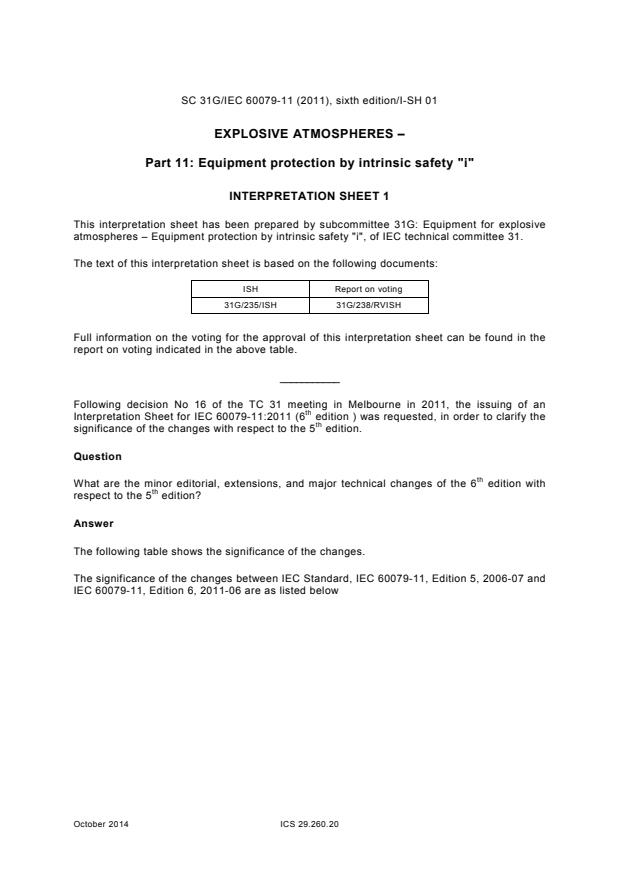
SC 31G/IEC 60079-11 (2011), sixth edition/I-SH 01
EXPLOSIVE ATMOSPHERES –
Part 11: Equipment protection by intrinsic safety "i"
INTERPRETATION SHEET 1
This interpretation sheet has been prepared by subcommittee 31G: Equipment for explosive
atmospheres – Equipment protection by intrinsic safety "i", of IEC technical committee 31.
The text of this interpretation sheet is based on the following documents:
ISH Report on voting
31G/235/ISH 31G/238/RVISH
Full information on the voting for the approval of this interpretation sheet can be found in the
report on voting indicated in the above table.
___________
Following decision No 16 of the TC 31 meeting in Melbourne in 2011, the issuing of an
th
Interpretation Sheet for IEC 60079-11:2011 (6 edition ) was requested, in order to clarify the
th
significance of the changes with respect to the 5 edition.
Question
th
What are the minor editorial, extensions, and major technical changes of the 6 edition with
th
respect to the 5 edition?
Answer
The following table shows the significance of the changes.
The significance of the changes between IEC Standard, IEC 60079-11, Edition 5, 2006-07 and
IEC 60079-11, Edition 6, 2011-06 are as listed below
October 2014 ICS 29.260.20
Significance of changes with respect to IEC 60079-11:2006
Type
Significant Changes Clause Minor and Extension Major
editorial technical
changes changes
General: Changes to remove specific clause references to General x
other IEC 60079 standards
Scope: Expansion to include Group III 1 x
Scope: Table 1 updated to include references to both 1 x
IEC 60079-0 Edition 5 and Edition 6
Normative references: Deletion of IEC 60079-27, and addition 2 x
of IEC 61158-2 and IEC 62013-1
Terms and definitions: Commonly used definitions moved to 3 x
IEC 60079-0. Energy limitation definitions moved from
IEC 60079-0.New definitions added
Spark ignition compliance: Group III ignition requirements 5.5 x
added
Temperature for small components for Group I and Group II: 5.6.2 x
Relocated to IEC 60079-0
Intrinsically safe apparatus and component temperature for 5.6.5 x
Group III
Enclosures for Group I or Group II apparatus 6.1.2 x
Apparatus complying with Annex F 6.1.2.3 c) x
Enclosures for Group III apparatus 6.1.3 x
Requirements for connections and accessories for IS 6.2.5 C1
apparatus when located in the non-hazardous area
Separation of conductive parts 6.3.2 x
Encapsulation 6.6.1 x
Encapsulation used for the exclusion of explosive 6.6.2 C2
atmospheres
Primary and secondary cells and batteries 7.4.1 x
Battery construction 7.4.2 x
Level of Protection “ic” 8.1 x
Filter capacitors 8.6.2 x
Wiring, printed circuit board tracks, and connections 8.8 c) x
FISCO apparatus 9.2 x
Handlights and caplights 9.3 x
Circuits with both inductance and capacitance 10.1.5.2 x
Electrolyte leakage test for cells and batteries 10.5.2 x
Spark ignition and surface temperature of cells and batteries 10.5.3 x
Determination of the acceptability of fuses requiring 10.6.2 x
encapsulation
Optical isolators tests 10.11 x
Marking 12.1 x
Encapsulation Annex D C2
Fieldbus intrinsically safe concept (FISCO) – Apparatus Annex G x
requirements
Ignition testing of semiconductor limiting power supply circuits Annex H x
October 2014 ICS 29.260.20
Explanation of the Types of Significant Changes:
A) Definitions
1. Minor and editorial changes:
• Clarification
• Decrease of technical requirements
• Minor technical change
• Editorial corrections
These are changes which modify requirements in an editorial or a minor technical way. They include changes of
the wording to clarify technical requirements without any technical change, or a reduction in level of existing
requirement.
2. Extension: Addition of technical options
These are changes which add new or modify existing technical requirements, in a way that new options are given,
but without increasing requirements for equipment that was fully compliant with the previous standard. Therefore,
these will not have to be considered for products in conformity with the preceding edition.
3. Major technical changes: • addition of technical requirements
• increase of technical requirements
These are changes to technical requirements (addition, increase of the level or removal) made in a way that a
product in conformity with the preceding edition will not always be able to fulfil the requirements given in the later
edition. These changes have to be considered for products in conformity with the preceding edition. For these
changes additional information is provided in clause B) below.
NOTE These changes represent current technological knowledge. However, these changes should not normally
have an influence on equipment already placed on the market.
B) Information about the background of ‘Major technical changes’
C1 – Requirements for external connections, other than battery charging connections, that are designed for use
only when an explosive gas or dust atmosphere is not present, for example when in a non-hazardous area or when
a gas-free permit is in force, have been added.
C2 – The requirements for encapsulation referenced in 6.6.2 and detailed in Annex D have been changed in terms
of the thickness to the free surface and are extended related to moulding. Annex D is changed from informative to
normative.
October 2014 ICS 29.260.20
IEC 2016
INTERNATIONAL ELECTROTECHNICAL COMMISSION
____________
IEC 60079-11
Edition 6.0 2011-06
EXPLOSIVE ATMOSPHERES –
Part 11: Equipment protection by intrinsic safety "i"
INTERPRETATION SHEET 2
This interpretation sheet has been prepared by subcommittee 31G: Intrinsically-safe
apparatus, of IEC technical committee 31: Equipment for explosive atmospheres.
The text of this interpretation sheet is based on the following documents:
ISH Report on voting
31G/252/ISH 31G/254/RVD
Full information on the voting for the approval of this interpretation sheet can be found in the
report on voting indicated in the above table.
___________
Interpretation of 6.2.5 – Requirements for connections and accessories for IS apparatus
when located in the non-hazardous area
Question:
Does the first NOTE of 6.2.5 imply that equipment which may be connected to non-intrinsically
safe connection facilities of intrinsically safe apparatus restricted to use in non-hazardous
area need to be assessed applying IEC 60079-11, if the value of U is less than 250 V a.c.?
m
Does this furthermore apply to equipment to be connected to non-intrinsically safe connection
facilities of associated apparatus, if the value of U is less than 250 V a.c.?
m
Background:
The first NOTE of 6.2.5 requires in cases were U is specified less than 250 V a.c. that this
m
should not be derived from unassessed equipment. This is sometimes read as if the
requirements of IEC 60079-11 should be applied for voltage limitation to guarantee U .
m
Terminological entry 3.13.13 defines that U is the maximum voltage that can be applied to
m
the non intrinsically safe connection facilities of associated apparatus without invalidating the
ICS 29.260.20
– 2 – IEC 60079-11:2011/ISH2:2016
IEC 2016
type of protection. NOTE 1 of 3.13.13, as an example, explains that this may apply to
connection facilities used for charging batteries.
In IEC 60079-11 there are no measures required for limiting the voltage of non I.S. circuits to
the specified U value, except for the use of a single Zener diode protected by a fuse as an
m
integral measure of an associated apparatus limiting the voltage which can appear at a
transformer (8.3) or a coupler (8.9.2).
IEC 60079-14: 2013, 16.2.1 states:
Where U marked on the associated apparatus is less than 250 V it shall be installed in
m
accordance with one of the following:
a) where U does not exceed 50 V a.c. or 120 V d.c., in an SELV or PELV system, or
m
b) via a safety isolating transformer complying with the requirements of IEC 61558-2-6, or
technically equivalent standard, or
c) directly connected to apparatus complying with the IEC 60950 series, IEC 61010-1, or a
technically equivalent standard, or
d) fed directly from cells or batteries.
Answer
No
IEC 60079-11 does not require measures to limit U where it is specified as 250 V a.c. which
m
is guaranteed by the public power supply using standards other than IEC 60079-11. Similarly,
IEC 60079-14 allows measures not compliant with IEC 60079-11 for limiting U to below
m
250 V a.c.
Therefore no assessment of the voltage supply according to IEC 60079-11 is necessary
where U is specified less than 250 V a.c. provided that one of the measures allowed by
m
IEC 60079-14:2013, 16.2.1 are applied.
rd
NOTE This does not alter the requirement of the 3 paragraph of 6.2.5 to assess, in accordance with IEC 60079-
11, any protective circuitry located in the non-hazardous area accessory.
IEC 2016
INTERNATIONAL ELECTROTECHNICAL COMMISSION
____________
IEC 60079-11
Edition 6.0 2011-06
EXPLOSIVE ATMOSPHERES –
Part 11: Equipment protection by intrinsic safety "i"
INTERPRETATION SHEET 3
This interpretation sheet has been prepared by subcommittee 31G: Intrinsically-safe
apparatus, of IEC technical committee 31: Equipment for explosive atmospheres.
The text of this interpretation sheet is based on the following documents:
ISH Report on voting
31G/253/ISH 31G/255/RVD
Full information on the voting for the approval of this interpretation sheet can be found in the
report on voting indicated in the above table.
___________
Question
Regarding IEC 60079-11:2011 Edition 6.0 (2011-06), some clauses specifically indicate
whether or not the requirement is applicable or not applicable to level of protection “ic”.
However, many other clauses include no indication one way or the other, resulting in potential
inconsistencies when applied. In the interest of improving consistency, what are the
requirements in IEC 60079-11:2011 Edition 6.0 (2011-06) that are applicable to level of
protection “ic”?
Answer
In answering this question, the following considerations were taken:
1) Requirements in IEC 60079-11 Edition 6.0 (2011-06) indicating that the requirements are
applicable to level of protection “ic” are considered “Applicable”;
2) Requirements in IEC 60079-11 Edition 6.0 (2011-06) indicating that the requirements are
not applicable to level of protection “ic” are considered “Not applicable”;
3) Regarding requirements in IEC 60079-11 Edition 6.0 (2011-06) other than those
referenced in 1) and 2) above:
• determine if the intent of these requirements for levels of protection "ia" and "ib" is to
address fault (abnormal) conditions; and
ICS 29.260.20
– 2 – IEC 60079-11:2011/ISH3:2016
IEC 2016
• if the intent is to address fault (abnormal) conditions, then the requirements are
considered not applicable for level of protection "ic".
Based on the above considerations, the following informative table (similar in concept to
Annex B of IEC 60079-0:2011 on Ex Components) provides guidance regarding which
requirements in IEC 60079-11 Edition 6.0 (2011-06) are applicable to level of protection “ic”.
Additional background
As additional background details, the following seven key issues of principle were taken into
account when developing the above answer:
1) Objective of the original transfer of type of protection “nL” to “ic”: The objective of the
original transfer of type of protection “nL” to “ic” (as first included in IEC 60079-11 Fifth
Edition) was not to substantially revise the applicable requirements, except where
the maintenance team MT 60079-11 made specific reference to level of protection “ic” in a
given clause. Examples of this include 7.1, which simplifies the rating requirements for
level of protection “ic” protective components from “nL” requirements; and 6.2.1, which
increases the separation distances for level of protection “ic” terminals (to align with
IEC 60079-14) from “nL” requirements. This objective approach is consistent with how the
transfer of other IEC 60079-15 types of protection have been handled, and are still being
handled in other IEC 60079 series standards.
2) Common applications of a level of protection “ic” circuit that protects an arcing part: The
following are common applications of a level of protection “ic” circuit that protects an
arcing part:
• The circuit does not exit the device.
• The circuit exits one device and is interconnected via a wiring method to another
device, with both devices and the interconnecting wiring method being part of a
system.
• The circuit exits a device via a receptacle, with entity parameters provided for field
connection to the receptacle.
• The circuit exits a device via a terminal block, with entity parameters provided for field
connection to the terminal block.
For all the above applications, the level of protection "ic" circuit does not begin until
after the last protective component that establishes the necessary voltage and current
limitation. For other circuitry in the device, another type of protection, such as “nA” or
“ec”, is applied. It is also possible for an entire apparatus to be only ”Ex ic”.
3) Remarks in the draft I-SH: In the draft I-SH, the intent is for all Remarks to only be for
issues specific to level of protection “ic”. The few exceptions to this are for Remarks
highlighting requirements that, while applicable to all types of protection “i”, represent a
significant change in requirements from type of protection “nL” to “ic”.
4) Transient effects on level of protection “ic” circuits: For level of protection “ic” circuits, the
effects of transients are only addressed for diode safety barriers. This is because
connection of such barriers is to unspecified equipment. For other level of protection “ic”
circuit applications, no additional evaluation is required regarding the effects of transients
based on the following considerations:
• the presence of an explosive atmosphere is only under abnormal conditions; and
• the circuit complies with the applicable safety requirements of the relevant industrial
standards.
5) Separation distances for level of protection “ic” circuits: Separation distances are only
applicable to the level of protection “ic” circuit and to the protective components that
establish the level of protection “ic” circuit. Where separation distances are required,
separations that do not comply with the values of Table 5 or Annex F are to be shorted as
part of the evaluation, if the shorting may impair intrinsic safety.
IEC 2016
6) Protective components for level of protection “ic” circuits: Voltage and current limiting
protective components comply with the applicable requirements for components on which
intrinsic safety depends (e.g. 7.1).
7) IEC/TC 31 MT 60079-15 support: The MT 60079-15 convener has been involved in the
development of the content of this I-SH, and supports it based on the current
IEC 60079-11 Edition 6.0 (2011-06) text.
– 4 – IEC 60079-11:2011/ISH3:2016
IEC 2016
The following informative table provides guidance regarding which requirements in
IEC 60079-11 Edition 6.0 (2011-06) are applicable to level of protection “ic”.
Informative guide for level of protection “ic” evaluations
NOTE 1 In some cases, where a clause is indicated as “Applicable” to level of protection “ic”, it is applicable in
its entirety. In other cases, the clause is only applicable in part. Remarks are provided to indicate which parts of a
given clause are applicable to level of protection “ic”, along with indicating general explanatory content regarding
the application of the clause to level of protection “ic”.
NOTE 2 Where a clause is indicated as being not applicable, in its entirety or in part, consideration is still given
regarding the applicability of other IEC 60079-11 and IEC 60079-0 clauses, including the applicable safety
requirements of the relevant industrial standards in accordance with IEC 60079-0.
Clause Requirement Applicability Remark
1 Scope Applicable
2 Normative references Applicable
3 Terms and definitions Applicable For “ic” circuits, Ui, Ii, Pi are maximum
values possible in normal operation. Uo, Io,
Po are determined in normal operation, but
with the most onerous rated load for each
case attached. Reduction of maximum
voltage from Um can be achieved with a
transformer that complies with the
applicable requirements of this standard.
The same equipment designed for “ic”, and
also designed for “ia” or “ib”, can have
different parameters for connection to “ic”
circuits versus connection to “ia” or “ib”
circuits. Even though these are all the
same “type of protection”, just with varying
EPLs, the requirements under “Multiple
types of protection” in IEC 60079-0 applies.
4 Grouping and Applicable While “nL” was only a Gc type of
classification of protection, “ic” is for both Gc and Dc.
intrinsically safe
apparatus and associated
apparatus
5 Levels of protection and ignition compliance requirements of electrical apparatus
5.1 General Applicable Opening, shorting and earthing of an “ic”
circuit at output terminals intended for field
wiring are considered normal operating
conditions.
5.2 Level of protection "ia" Not applicable Addresses safety factors and fault
conditions for "ia".
5.3 Level of protection "ib" Not applicable Addresses safety factors and fault
conditions for "ib".
5.4 Level of protection "ic" Applicable A safety factor of 1.0 with no fault condition
is applicable for "ic".
5.5 Spark ignition Applicable
compliance
5.6 Thermal ignition compliance
5.6.1 General Applicable Temperature testing is to be under worst
case normal operating conditions.
5.6.2 Temperature for small Applicable
components for Group I
and Group II
5.6.3 Wiring within intrinsically Applicable Requirement is addressed by testing
safe apparatus for Group according to 5.6.1, or addressed according
I and Group II to the applicable safety requirements of the
relevant industrial standards.
IEC 2016
Clause Requirement Applicability Remark
5.6.4 Tracks on printed circuit Applicable Requirement is addressed by testing
boards for Group I and according to 5.6.1, or addressed according
Group II to the applicable safety requirements of the
relevant industrial standards.
5.6.5 Intrinsically safe Applicable Temperature classification to be based on
apparatus and component the temperature of the surface exposed to
temperature for Group III dust.
5.7 Simple apparatus Applicable
6 Apparatus construction
6.1 Enclosures Applicable
6.2 Facilities for connection of external circuits
6.2.1 Terminals Applicable NOTE As with “ia” and “ib”, due to
IEC 60079-14 installation requirements,
circuits that exit a piece of equipment via a
terminal block, with entity parameters
provided for field connection to the terminal
block, maintain the following:
‒ at least 50 mm separation distance
between terminals for “ic” circuits and
terminals for non-intrinsically safe
circuits.
‒ at least 6 mm separation distance
between terminals for separate
intrinsically safe circuits.
‒ at least 3 mm separation distance
between terminals for intrinsically safe
circuits and earthed parts, if connection
to earth has not been considered in the
safety analysis.
This separation distance requirement is
different from previous Ex “nL”
requirements.
6.2.2 Plugs and sockets Applicable
6.2.3 Determination of Applicable
maximum external
inductance to resistance
ratio (L /R ) for
o o
resistance limited power
source
6.2.4 Permanently connected Applicable
cable
6.2.5 Requirements for Applicable Applicable except regarding protective
connections and circuitry for functions such as charging in
accessories for IS the non-hazardous area.
apparatus when located in
As there is no application of faults, the
the non-hazardous area
ratings of components may be ensured
without additional protection.
6.3 Separation distances
6.3.1 General Applicable Applicable to “ic” circuit and protective
components only. Where separation
distances are less than required, they are
to be shorted if the shorting may impair
intrinsic safety.
NOTE For example, an "ic" circuit is the
circuit after the last protective component
that establishes the necessary voltage and
current limitation.
– 6 – IEC 60079-11:2011/ISH3:2016
IEC 2016
Clause Requirement Applicability Remark
6.3.2 Separation of conductive Applicable Applicable to "ic" circuit and protective
parts components only.
Any use of an interposing insulating
partition or earthed metallic partition is only
required to comply with the safety
requirements of the relevant industrial
standard.
6.3.2.1 Distances according to Applicable Regarding transformers, only applicable
Table 5 between external connections. Remaining
construction features of transformers are
only required to comply with the applicable
safety requirements of the relevant
industrial standards.
6.3.2.2 Distances according to Applicable Regarding transformers, only applicable
Annex F between external connections.
NOTE Remaining construction features of
transformers are only required to comply
with the applicable safety requirements of
the relevant industrial standard. Through
solid insulation of conductors are required
to comply with Table 5.
6.3.3 Voltage between Applicable For “ic”, the effects of transients are only
conductive parts addressed for diode safety barriers
because connection is to unspecified
equipment. For other “ic” applications, no
additional evaluation is required regarding
the effects of transients based on the
following considerations:
• The presence of an explosive
atmosphere is not likely to occur in
normal operation.
• The circuit complies with the applicable
safety requirements of the relevant
industrial standards.
Where separation of conductive parts is
required, separations that do not comply
with the values of Table 5 or Annex F may
be shorted as part of the evaluation if it
may impair intrinsic safety.
6.3.4 Clearance Not Applicable Any use of an interposing insulating
partition or earthed metallic partition is only
required to comply with the safety
requirements of the relevant industrial
standard. See 6.3.2.
6.3.5 Separation distances Applicable
through casting
compound
6.3.6 Separation distances Applicable
through solid insulation
6.3.7 Composite separations Applicable Applicable, except regarding the 1/3
restriction for composite separations, as
this restriction is based on fault
considerations.
6.3.8 Creepage distance Applicable Applicable, except regarding the 1/3
restriction for composite separations, and
the partition restrictions above 1,575 V.
Any use of an interposing insulating
partition or earthed metallic partition shall
comply with the safety requirements of the
relevant industrial standard. See 6.3.2.
6.3.9 Distance under coating Applicable
IEC 2016
Clause Requirement Applicability Remark
6.3.10 Requirements for Applicable Applicable, except for consideration of the
assembled printed circuit body of a component as being an
boards uninsulated live part. For example, a
component mounted over or adjacent to
tracks as defined in c) is not considered as
connected to the track.
6.3.11 Separation by earthed Applicable Where separation distances to the earthed
screens screen do not comply with the required
separation distances to earth, the screen is
to be capable of carrying the maximum
possible current to which it could be
continuously subjected (such as a short to
earth).
6.3.12 Internal wiring Applicable
6.3.13 Dielectric strength Applicable Applicable, except for the additional
rd
requirement dielectric strength testing in the 3
nd
paragraph. Regarding the 2 paragraph,
only applicable to insulation or insulating
components. Additional dielectric testing is
not required between level of protection "ic"
and other circuits, or between separate
level of protection "ic" circuits. This aligns
with previous level of protection "nL"
requirements.
NOTE Dielectric test requirements of
other applicable standards may still apply
(such as the relevant industrial standards).
6.3.14 Relays Applicable Applicable only regarding requirement for
relay to be used within its rating.
NOTE Requirements for dielectric and
separation distances are still addressed,
along with applicable safety requirements
of the relevant industrial standards.
6.4 Protection against polarity Applicable
reversal
st
6.5 Earth conductors, Applicable
Earthing requirements in the 1 paragraph
connections and
are only applicable if earth is necessary for
terminals
"ic" circuit.
Requirements for earthing are suitably
addressed by the applicable safety
requirements of the relevant industrial
standards.
nd
Requirements in 2 paragraph only
applicable to level of protection "ia" and
level of protection "ib". A single connection
is sufficient for level of protection ‘ic’.
6.6 Encapsulation Applicable Applicable only if relying on encapsulation
to exclude the atmosphere so as to reduce
separation distances, or reduce the ignition
capability of hot components. No short
conditions are applied unless separation
distances are less than required values so
as to impair intrinsic safety (see Annex D).
7 Components on which intrinsic safety depends
7.1 Rating of components Applicable For voltage and current, this clause
simplifies the rating requirements for “ic”
protective components from “nL”
requirements.
NOTE The concept of a component
having a defined "failure mode such that
protection is maintained" as an alternative
to de-rating (as existed for "nL") does not
exist for "ic".
– 8 – IEC 60079-11:2011/ISH3:2016
IEC 2016
Clause Requirement Applicability Remark
7.2 Connectors for internal Applicable Applicable except for requirement
connections, plug-in cards regarding incorrect connection of internal
st
and components
plug-in connections in the 1 paragraph,
and the open circuit failure of a connection
nd
requirement in the 2 paragraph.
While interchangeability is a concern for
external connections due to field error, it is
not considered an “ic” concern for internal
connections. Production control and proper
service expectations can address internal
applications.
Open circuit failure of a connection
requirement is not applicable because
faults are not considered for ‘ic’.
Both are not considered a normal
operations condition (see 6.5).
7.3 Fuses Applicable Where an “ic” circuit depends upon a fuse
and where the fuse is directly connected to
the mains and where the fuse is also
directly connected to a circuit that is
considered normally subject to overloading
or shorting (such as output field wiring
receptacles or terminals), the breaking
capacity of such a fuse is based upon the
prospective short circuit current of the
mains supply. A diode safety barrier would
be a common example of such an
application involving output field wring
terminals. The prospective short-circuit
current of a 250 V mains supply is
considered to not be greater than 1 500 A.”
7.4 Primary and secondary Applicable For both apparatus and associated
cells and batteries apparatus, when such involves more than
type of protection “ic” (such as ‘ic nA’
apparatus or ‘nA [ic]’ associated
apparatus), connection of cells and
batteries in parallel for ‘ic’ is only permitted
in the ‘ic’ circuit provided that intrinsic
safety is not impaired.
7.5 Semiconductors
7.5.1 Transient effects Applicable For “ic”, the effects of transients are only
addressed for diode safety barriers
because connection is to unspecified
equipment. For other “ic” applications, no
additional evaluation is required regarding
the effects of transients based on the
following considerations:
• The presence of an explosive
atmosphere not likely to occur in normal
operation.
• The circuit complies with the applicable
safety requirements of the relevant
industrial standards.
NOTE Semiconductors serving as
protective components in "ic" circuits are
required to comply with the applicable
requirements elsewhere in this standard.
IEC 2016
Clause Requirement Applicability Remark
7.5.2 Shunt voltage limiters Applicable For “ic”, the effects of transients are only
addressed for diode safety barriers
because connection is to unspecified
equipment. For other “ic” applications, no
additional evaluation is required regarding
the effects of transients based on the
following considerations:
• The presence of an explosive
atmosphere is not likely to occur in
normal operation.
• The circuit complies with the applicable
safety requirements of the relevant
industrial standards.
For level of protection ‘ic’, a single
semiconductor is sufficient.
7.5.3 Series current limiters Applicable For level of protection “ic” a single
semiconductor is sufficient.
7.6 Failure of components, Applicable Applicable except for "ia" and "ib"
nd
connections and
requirements in 2 paragraph, and
th
separations
infallible connections requirements in 5
th
and 6 paragraphs.
7.7 Piezo-electric devices Applicable Applicable only if the piezo-circuit can be
directly shorted (for example due to non-
compliant spacings or sparking
components) (see 10.7).
NOTE The potential for the enclosure to
be impacted is a normal operating
condition, and therefore is applicable to
"ic".
7.8 Electrochemical cells for Applicable
the detection of gases
8 Infallible components, Not applicable According to 8.1, Clause 8, in its entirety,
infallible assemblies of does not apply for "ic" circuits.
components and infallible
connections on which
intrinsic safety depends
9 Supplementary requirements for specific apparatus
9.1 Diode safety barriers Applicable For “ic”, the effects of transients are
addressed for diode safety barriers
because connection is to unspecified
equipment.
NOTE Earthing requirements are
applicable to “ic” due to the earthing
requirements of intrinsically safe circuits in
IEC 60079-14.
9.2 FISCO apparatus Applicable
9.3 Handlights and caplights Applicable
10 Type verifications and type tests
10.1 Spark ignition test Applicable A safety factor of 1.0 with no countable or
non-countable fault conditions is applicable
for "ic".
10.2 Temperature tests Applicable Applicable except for non-linear concerns
st
in the last line of the 1 paragraph, which
would require mandatory testing of
components with non-linear aspects in the
actual rated ambient. Such an approach to
testing is not applicable for "ic" circuits,
and is only to be an option.
10.3 Dielectric strength tests Applicable See 6.3.13.
– 10 – IEC 60079-11:2011/ISH3:2016
IEC 2016
Clause Requirement Applicability Remark
10.4 Determination of Applicable
parameters of loosely
specified components
10.5 Tests for cells and Applicable Applicable except short circuit testing is
batteries only to be considered at points external to
the cell or battery where the required
separation distances are not met.
Where temperature rise testing of the cells
and batteries is required, only one sample
need be subjected to the testing.
10.6 Mechanical tests
10.6.1 Casting compound Applicable Force and impact testing is applicable to
casting compounds that complete
enclosures.
As such, this is a normal operating
conditions concern, and the testing is
therefore applicable to "ic".
10.6.2 Determination of the Applicable While encapsulation of fuses for “ic” is not
acceptability of fuses generally required, the concern regarding
requiring encapsulation encapsulation flowing within the chamber
of a fuse, and preventing the element to
open, does reflect a normal operating
conditions concern, and therefore is
applicable to "ic" circuits (also see 7.3).
NOTE One example of such a concern is
for glass cartridge fuses.
10.6.3 Partitions Not applicable Any use of an interposing insulating
partition or earthed metallic partition is only
required to comply with the safety
requirements of the relevant industrial
standard.
10.7 Tests for intrinsically safe Applicable Applicable only if the piezo-circuit can be
apparatus containing directly shorted (for example due to non-
piezoelectric devices compliant spacings or sparking
components)(see 7.7).
NOTE The potential for the enclosure to
be impacted is a normal operating
condition, and therefore is applicable to
"ic".
10.8 Type tests for diode Applicable For level of protection “ic”, the effects of
safety barriers and safety transients are to be addressed for diode
shunts safety barriers because connection is to
unspecified equipment. (See 7.5.1)
10.9 Cable pull test Applicable
10.10 Transformer tests Not applicable This testing is required by 8.2.4, which is
explicitly waived for "ic" circuits.
NOTE Applicable safety requirements of
the relevant industrial standards still apply.
10.11 Optical isolators tests Not applicable This testing is required by 8.9.2, which is
explicitly waived for "ic" circuits.
NOTE Applicable safety requirements of
the relevant industrial standards still apply.
10.12 Current carrying capacity Not applicable This testing is required by 8.8, which is
of infallible printed circuit explicitly waived for "ic" circuits.
board connections
11 Routine verifications and tests
11.1 Routine tests for diode safety barriers
11.1.1 Completed barriers Applicable NOTE Removable links are not generally
needed for level of protection “ic” safety
barriers.
IEC 2016
Clause Requirement Applicability Remark
11.1.2 Diodes for 2-diode "ia" Not applicable This testing is applicable only to "ia"
barriers circuits.
11.2 Routine tests for infallible Not applicable This testing is required by 8.2.5, which is
transformers explicitly waived for "ic" circuits.
12 Marking Applicable Where it is necessary to include marking
from one of the other methods of protection
listed in IEC 60079-0, the symbol “ic” shall
occur first.
13 Documentation Applicable Where “ic” live maintenance procedures
are specified by the manufacturer in the
instructions provided, the effects of this live
maintenance do not invalidate intrinsic
safety under both normal operating
conditions and under conditions that may
reasonably be considered to occur during
live maintenance.
Annex A Assessment of Applicable
(normative) intrinsically safe circuits
Annex B Spark test apparatus for Applicable
(normative) intrinsically safe circuits
Annex C Measurement of creepage distances, clearances and separation distances through casting
(informative) compound and through solid insulation
Annex D Encapsulation Applicable Applicable only if relying on encapsulation
(normative) to exclude the atmosphere so as to reduce
separation distances, or reduce the ignition
capability of hot components. No fault
conditions are applied unless separation
distances are less than required values
(see 6.6.2).
Annex E Transient energy test
(informative)
Annex F Alternative separation Applicable Regarding transformers, only applicable
(normative) distances for assembled between external connections.
printed circuit boards and
NOTE Remaining construction features of
separation of
transformers are required to only comply
components
with the applicable safety requirements of
the relevant industrial standard. Through
solid insulation of conductors are required
to comply with Table 5.
Annex G Fieldbus intrinsically safe Applicable
(normative) concept (FISCO) -
Apparatus requirements
Annex H Ignition testing of semiconductor limiting power supply circuits
(informative)
IEC 2019
INTERNATIONAL ELECTROTECHNICAL COMMISSION
____________
IEC 60079-11
Edition 6.0 2011-06
EXPLOSIVE ATMOSPHERES –
Part 11: Equipment protection by intrinsic safety "i"
INTERPRETATION SHEET 4
This interpretation sheet has been prepared by subcommittee 31G: Intrinsically-safe
apparatus, of IEC technical committee 31: Equipment for explosive atmospheres.
The text of this interpretation sheet is based on the following documents:
DISH Report on voting
31G/293/DISH 31G/296/RVD
Full information on the voting for the approval of this interpretation sheet can be found in the
report on voting indicated in the above table.
___________
The wording in the intrinsic safety standard, IEC 60079-11 (2011), with respect to the
enclosure requirements for intrinsically safe apparatus for Group III where the separation is
accomplished by meeting the requirements for clearance or creepage distances of Table 5 or
Annex F, according to Subclause 6.1.3a), is ambiguous. This observation may lead to
different interpretation by different test laboratories.
This issue was discussed at the Busan, Republic of Korea meeting of the MT in October 2018.
The MT agreed at that meeting that this interpretation should also be applied to
Because the title of Subclause 6.1.2.3 is “Apparatus complying with Annex F”, an
interpretation has been made that the additional tests required by 6.1.2.3a) only apply when
Annex F is used. The potential for compromising infallible creepage and clearance distances
exists when Annex F is applied, but also exist when Table 5 is applied.
– 2 – IEC 60079-11:2011/ISH4:2019
IEC 2019
The wording of IEC 60079-11 is:
6.1.3 Enclosures for Group III apparatus
Where the intrinsic safety of intrinsically safe apparatus can be impaired by ingress of dust or
by access to
...
IEC 60079-11 ®
Edition 6.0 2011-07
REDLINE VERSION
INTERNATIONAL
STANDARD
colour
inside
Explosive atmospheres –
Part 11: Equipment protection by intrinsic safety "i"
Atmosphères explosives –
Partie 11: Protection de l’équipement par sécurité intrinsèque «i»
All rights reserved. Unless otherwise specified, no part of this publication may be reproduced or utilized in any form or by
any means, electronic or mechanical, including photocopying and microfilm, without permission in writing from either IEC or
IEC's member National Committee in the country of the requester.
If you have any questions about IEC copyright or have an enquiry about obtaining additional rights to this publication,
please contact the address below or your local IEC member National Committee for further information.
Droits de reproduction réservés. Sauf indication contraire, aucune partie de cette publication ne peut être reproduite
ni utilisée sous quelque forme que ce soit et par aucun procédé, électronique ou mécanique, y compris la photocopie
et les microfilms, sans l'accord écrit de la CEI ou du Comité national de la CEI du pays du demandeur.
Si vous avez des questions sur le copyright de la CEI ou si vous désirez obtenir des droits supplémentaires sur cette
publication, utilisez les coordonnées ci-après ou contactez le Comité national de la CEI de votre pays de résidence.
IEC Central Office
3, rue de Varembé
CH-1211 Geneva 20
Switzerland
Email: inmail@iec.ch
Web: www.iec.ch
About the IEC
The International Electrotechnical Commission (IEC) is the leading global organization that prepares and publishes
International Standards for all electrical, electronic and related technologies.
About IEC publications
The technical content of IEC publications is kept under constant review by the IEC. Please make sure that you have the
latest edition, a corrigenda or an amendment might have been published.
Catalogue of IEC publications: www.iec.ch/searchpub
The IEC on-line Catalogue enables you to search by a variety of criteria (reference number, text, technical committee,…).
It also gives information on projects, withdrawn and replaced publications.
IEC Just Published: www.iec.ch/online_news/justpub
Stay up to date on all new IEC publications. Just Published details twice a month all new publications released. Available
on-line and also by email.
Electropedia: www.electropedia.org
The world's leading online dictionary of electronic and electrical terms containing more than 20 000 terms and definitions
in English and French, with equivalent terms in additional languages. Also known as the International Electrotechnical
Vocabulary online.
Customer Service Centre: www.iec.ch/webstore/custserv
If you wish to give us your feedback on this publication or need further assistance, please visit the Customer Service
Centre FAQ or contact us:
Email: csc@iec.ch
Tel.: +41 22 919 02 11
Fax: +41 22 919 03 00
A propos de la CEI
La Commission Electrotechnique Internationale (CEI) est la première organisation mondiale qui élabore et publie des
normes internationales pour tout ce qui a trait à l'électricité, à l'électronique et aux technologies apparentées.
A propos des publications CEI
Le contenu technique des publications de la CEI est constamment revu. Veuillez vous assurer que vous possédez
l’édition la plus récente, un corrigendum ou amendement peut avoir été publié.
Catalogue des publications de la CEI: www.iec.ch/searchpub/cur_fut-f.htm
Le Catalogue en-ligne de la CEI vous permet d’effectuer des recherches en utilisant différents critères (numéro de référence,
texte, comité d’études,…). Il donne aussi des informations sur les projets et les publications retirées ou remplacées.
Just Published CEI: www.iec.ch/online_news/justpub
Restez informé sur les nouvelles publications de la CEI. Just Published détaille deux fois par mois les nouvelles
publications parues. Disponible en-ligne et aussi par email.
Electropedia: www.electropedia.org
Le premier dictionnaire en ligne au monde de termes électroniques et électriques. Il contient plus de 20 000 termes et
définitions en anglais et en français, ainsi que les termes équivalents dans les langues additionnelles. Egalement appelé
Vocabulaire Electrotechnique International en ligne.
Service Clients: www.iec.ch/webstore/custserv/custserv_entry-f.htm
Si vous désirez nous donner des commentaires sur cette publication ou si vous avez des questions, visitez le FAQ du
Service clients ou contactez-nous:
Email: csc@iec.ch
Tél.: +41 22 919 02 11
Fax: +41 22 919 03 00
IEC 60079-11 ®
Edition 6.0 2011-07
REDLINE VERSION
INTERNATIONAL
STANDARD
colour
inside
Explosive atmospheres –
Part 11: Equipment protection by intrinsic safety "i"
Atmosphères explosives –
Partie 11: Protection de l’équipement par sécurité intrinsèque «i»
INTERNATIONAL
ELECTROTECHNICAL
COMMISSION
COMMISSION
ELECTROTECHNIQUE
INTERNATIONALE
ICS 29.260.20 ISBN 978-2-88912-520-3
IEC 60079-11 ®
Edition 6.0 2011-06
INTERNATIONAL
STANDARD
NORME
INTERNATIONALE
colour
inside
Explosive atmospheres –
Part 11: Equipment protection by intrinsic safety "i"
Atmosphères explosives –
Partie 11: Protection de l’équipement par sécurité intrinsèque «i»
SC 31G/IEC 60079-11 (2011), sixth edition/I-SH 01
EXPLOSIVE ATMOSPHERES –
Part 11: Equipment protection by intrinsic safety "i"
INTERPRETATION SHEET 1
This interpretation sheet has been prepared by subcommittee 31G: Equipment for explosive
atmospheres – Equipment protection by intrinsic safety "i", of IEC technical committee 31.
The text of this interpretation sheet is based on the following documents:
ISH Report on voting
31G/235/ISH 31G/238/RVISH
Full information on the voting for the approval of this interpretation sheet can be found in the
report on voting indicated in the above table.
___________
Following decision No 16 of the TC 31 meeting in Melbourne in 2011, the issuing of an
th
Interpretation Sheet for IEC 60079-11:2011 (6 edition ) was requested, in order to clarify the
th
significance of the changes with respect to the 5 edition.
Question
th
What are the minor editorial, extensions, and major technical changes of the 6 edition with
th
respect to the 5 edition?
Answer
The following table shows the significance of the changes.
The significance of the changes between IEC Standard, IEC 60079-11, Edition 5, 2006-07 and
IEC 60079-11, Edition 6, 2011-06 are as listed below
October 2014 ICS 29.260.20
Significance of changes with respect to IEC 60079-11:2006
Type
Significant Changes Clause Minor and Extension Major
editorial technical
changes changes
General: Changes to remove specific clause references to General x
other IEC 60079 standards
Scope: Expansion to include Group III 1 x
Scope: Table 1 updated to include references to both 1 x
IEC 60079-0 Edition 5 and Edition 6
Normative references: Deletion of IEC 60079-27, and addition 2 x
of IEC 61158-2 and IEC 62013-1
Terms and definitions: Commonly used definitions moved to 3 x
IEC 60079-0. Energy limitation definitions moved from
IEC 60079-0.New definitions added
Spark ignition compliance: Group III ignition requirements 5.5 x
added
Temperature for small components for Group I and Group II: 5.6.2 x
Relocated to IEC 60079-0
Intrinsically safe apparatus and component temperature for 5.6.5 x
Group III
Enclosures for Group I or Group II apparatus 6.1.2 x
Apparatus complying with Annex F 6.1.2.3 c) x
Enclosures for Group III apparatus 6.1.3 x
Requirements for connections and accessories for IS 6.2.5 C1
apparatus when located in the non-hazardous area
Separation of conductive parts 6.3.2 x
Encapsulation 6.6.1 x
Encapsulation used for the exclusion of explosive 6.6.2 C2
atmospheres
Primary and secondary cells and batteries 7.4.1 x
Battery construction 7.4.2 x
Level of Protection “ic” 8.1 x
Filter capacitors 8.6.2 x
Wiring, printed circuit board tracks, and connections 8.8 c) x
FISCO apparatus 9.2 x
Handlights and caplights 9.3 x
Circuits with both inductance and capacitance 10.1.5.2 x
Electrolyte leakage test for cells and batteries 10.5.2 x
Spark ignition and surface temperature of cells and batteries 10.5.3 x
Determination of the acceptability of fuses requiring 10.6.2 x
encapsulation
Optical isolators tests 10.11 x
Marking 12.1 x
Encapsulation Annex D C2
Fieldbus intrinsically safe concept (FISCO) – Apparatus Annex G x
requirements
Ignition testing of semiconductor limiting power supply circuits Annex H x
October 2014 ICS 29.260.20
Explanation of the Types of Significant Changes:
A) Definitions
1. Minor and editorial changes:
• Clarification
• Decrease of technical requirements
• Minor technical change
• Editorial corrections
These are changes which modify requirements in an editorial or a minor technical way. They include changes of
the wording to clarify technical requirements without any technical change, or a reduction in level of existing
requirement.
2. Extension: Addition of technical options
These are changes which add new or modify existing technical requirements, in a way that new options are given,
but without increasing requirements for equipment that was fully compliant with the previous standard. Therefore,
these will not have to be considered for products in conformity with the preceding edition.
3. Major technical changes: • addition of technical requirements
• increase of technical requirements
These are changes to technical requirements (addition, increase of the level or removal) made in a way that a
product in conformity with the preceding edition will not always be able to fulfil the requirements given in the later
edition. These changes have to be considered for products in conformity with the preceding edition. For these
changes additional information is provided in clause B) below.
NOTE These changes represent current technological knowledge. However, these changes should not normally
have an influence on equipment already placed on the market.
B) Information about the background of ‘Major technical changes’
C1 – Requirements for external connections, other than battery charging connections, that are designed for use
only when an explosive gas or dust atmosphere is not present, for example when in a non-hazardous area or when
a gas-free permit is in force, have been added.
C2 – The requirements for encapsulation referenced in 6.6.2 and detailed in Annex D have been changed in terms
of the thickness to the free surface and are extended related to moulding. Annex D is changed from informative to
normative.
October 2014 ICS 29.260.20
IEC 2016
INTERNATIONAL ELECTROTECHNICAL COMMISSION
____________
IEC 60079-11
Edition 6.0 2011-06
EXPLOSIVE ATMOSPHERES –
Part 11: Equipment protection by intrinsic safety "i"
INTERPRETATION SHEET 2
This interpretation sheet has been prepared by subcommittee 31G: Intrinsically-safe
apparatus, of IEC technical committee 31: Equipment for explosive atmospheres.
The text of this interpretation sheet is based on the following documents:
ISH Report on voting
31G/252/ISH 31G/254/RVD
Full information on the voting for the approval of this interpretation sheet can be found in the
report on voting indicated in the above table.
___________
Interpretation of 6.2.5 – Requirements for connections and accessories for IS apparatus
when located in the non-hazardous area
Question:
Does the first NOTE of 6.2.5 imply that equipment which may be connected to non-intrinsically
safe connection facilities of intrinsically safe apparatus restricted to use in non-hazardous
area need to be assessed applying IEC 60079-11, if the value of U is less than 250 V a.c.?
m
Does this furthermore apply to equipment to be connected to non-intrinsically safe connection
facilities of associated apparatus, if the value of U is less than 250 V a.c.?
m
Background:
The first NOTE of 6.2.5 requires in cases were U is specified less than 250 V a.c. that this
m
should not be derived from unassessed equipment. This is sometimes read as if the
requirements of IEC 60079-11 should be applied for voltage limitation to guarantee U .
m
Terminological entry 3.13.13 defines that U is the maximum voltage that can be applied to
m
the non intrinsically safe connection facilities of associated apparatus without invalidating the
ICS 29.260.20
– 2 – IEC 60079-11:2011/ISH2:2016
IEC 2016
type of protection. NOTE 1 of 3.13.13, as an example, explains that this may apply to
connection facilities used for charging batteries.
In IEC 60079-11 there are no measures required for limiting the voltage of non I.S. circuits to
the specified U value, except for the use of a single Zener diode protected by a fuse as an
m
integral measure of an associated apparatus limiting the voltage which can appear at a
transformer (8.3) or a coupler (8.9.2).
IEC 60079-14: 2013, 16.2.1 states:
Where U marked on the associated apparatus is less than 250 V it shall be installed in
m
accordance with one of the following:
a) where U does not exceed 50 V a.c. or 120 V d.c., in an SELV or PELV system, or
m
b) via a safety isolating transformer complying with the requirements of IEC 61558-2-6, or
technically equivalent standard, or
c) directly connected to apparatus complying with the IEC 60950 series, IEC 61010-1, or a
technically equivalent standard, or
d) fed directly from cells or batteries.
Answer
No
IEC 60079-11 does not require measures to limit U where it is specified as 250 V a.c. which
m
is guaranteed by the public power supply using standards other than IEC 60079-11. Similarly,
IEC 60079-14 allows measures not compliant with IEC 60079-11 for limiting U to below
m
250 V a.c.
Therefore no assessment of the voltage supply according to IEC 60079-11 is necessary
where U is specified less than 250 V a.c. provided that one of the measures allowed by
m
IEC 60079-14:2013, 16.2.1 are applied.
rd
NOTE This does not alter the requirement of the 3 paragraph of 6.2.5 to assess, in accordance with IEC 60079-
11, any protective circuitry located in the non-hazardous area accessory.
IEC 2016
INTERNATIONAL ELECTROTECHNICAL COMMISSION
____________
IEC 60079-11
Edition 6.0 2011-06
EXPLOSIVE ATMOSPHERES –
Part 11: Equipment protection by intrinsic safety "i"
INTERPRETATION SHEET 3
This interpretation sheet has been prepared by subcommittee 31G: Intrinsically-safe
apparatus, of IEC technical committee 31: Equipment for explosive atmospheres.
The text of this interpretation sheet is based on the following documents:
ISH Report on voting
31G/253/ISH 31G/255/RVD
Full information on the voting for the approval of this interpretation sheet can be found in the
report on voting indicated in the above table.
___________
Question
Regarding IEC 60079-11:2011 Edition 6.0 (2011-06), some clauses specifically indicate
whether or not the requirement is applicable or not applicable to level of protection “ic”.
However, many other clauses include no indication one way or the other, resulting in potential
inconsistencies when applied. In the interest of improving consistency, what are the
requirements in IEC 60079-11:2011 Edition 6.0 (2011-06) that are applicable to level of
protection “ic”?
Answer
In answering this question, the following considerations were taken:
1) Requirements in IEC 60079-11 Edition 6.0 (2011-06) indicating that the requirements are
applicable to level of protection “ic” are considered “Applicable”;
2) Requirements in IEC 60079-11 Edition 6.0 (2011-06) indicating that the requirements are
not applicable to level of protection “ic” are considered “Not applicable”;
3) Regarding requirements in IEC 60079-11 Edition 6.0 (2011-06) other than those
referenced in 1) and 2) above:
• determine if the intent of these requirements for levels of protection "ia" and "ib" is to
address fault (abnormal) conditions; and
ICS 29.260.20
– 2 – IEC 60079-11:2011/ISH3:2016
IEC 2016
• if the intent is to address fault (abnormal) conditions, then the requirements are
considered not applicable for level of protection "ic".
Based on the above considerations, the following informative table (similar in concept to
Annex B of IEC 60079-0:2011 on Ex Components) provides guidance regarding which
requirements in IEC 60079-11 Edition 6.0 (2011-06) are applicable to level of protection “ic”.
Additional background
As additional background details, the following seven key issues of principle were taken into
account when developing the above answer:
1) Objective of the original transfer of type of protection “nL” to “ic”: The objective of the
original transfer of type of protection “nL” to “ic” (as first included in IEC 60079-11 Fifth
Edition) was not to substantially revise the applicable requirements, except where
the maintenance team MT 60079-11 made specific reference to level of protection “ic” in a
given clause. Examples of this include 7.1, which simplifies the rating requirements for
level of protection “ic” protective components from “nL” requirements; and 6.2.1, which
increases the separation distances for level of protection “ic” terminals (to align with
IEC 60079-14) from “nL” requirements. This objective approach is consistent with how the
transfer of other IEC 60079-15 types of protection have been handled, and are still being
handled in other IEC 60079 series standards.
2) Common applications of a level of protection “ic” circuit that protects an arcing part: The
following are common applications of a level of protection “ic” circuit that protects an
arcing part:
• The circuit does not exit the device.
• The circuit exits one device and is interconnected via a wiring method to another
device, with both devices and the interconnecting wiring method being part of a
system.
• The circuit exits a device via a receptacle, with entity parameters provided for field
connection to the receptacle.
• The circuit exits a device via a terminal block, with entity parameters provided for field
connection to the terminal block.
For all the above applications, the level of protection "ic" circuit does not begin until
after the last protective component that establishes the necessary voltage and current
limitation. For other circuitry in the device, another type of protection, such as “nA” or
“ec”, is applied. It is also possible for an entire apparatus to be only ”Ex ic”.
3) Remarks in the draft I-SH: In the draft I-SH, the intent is for all Remarks to only be for
issues specific to level of protection “ic”. The few exceptions to this are for Remarks
highlighting requirements that, while applicable to all types of protection “i”, represent a
significant change in requirements from type of protection “nL” to “ic”.
4) Transient effects on level of protection “ic” circuits: For level of protection “ic” circuits, the
effects of transients are only addressed for diode safety barriers. This is because
connection of such barriers is to unspecified equipment. For other level of protection “ic”
circuit applications, no additional evaluation is required regarding the effects of transients
based on the following considerations:
• the presence of an explosive atmosphere is only under abnormal conditions; and
• the circuit complies with the applicable safety requirements of the relevant industrial
standards.
5) Separation distances for level of protection “ic” circuits: Separation distances are only
applicable to the level of protection “ic” circuit and to the protective components that
establish the level of protection “ic” circuit. Where separation distances are required,
separations that do not comply with the values of Table 5 or Annex F are to be shorted as
part of the evaluation, if the shorting may impair intrinsic safety.
IEC 2016
6) Protective components for level of protection “ic” circuits: Voltage and current limiting
protective components comply with the applicable requirements for components on which
intrinsic safety depends (e.g. 7.1).
7) IEC/TC 31 MT 60079-15 support: The MT 60079-15 convener has been involved in the
development of the content of this I-SH, and supports it based on the current
IEC 60079-11 Edition 6.0 (2011-06) text.
– 4 – IEC 60079-11:2011/ISH3:2016
IEC 2016
The following informative table provides guidance regarding which requirements in
IEC 60079-11 Edition 6.0 (2011-06) are applicable to level of protection “ic”.
Informative guide for level of protection “ic” evaluations
NOTE 1 In some cases, where a clause is indicated as “Applicable” to level of protection “ic”, it is applicable in
its entirety. In other cases, the clause is only applicable in part. Remarks are provided to indicate which parts of a
given clause are applicable to level of protection “ic”, along with indicating general explanatory content regarding
the application of the clause to level of protection “ic”.
NOTE 2 Where a clause is indicated as being not applicable, in its entirety or in part, consideration is still given
regarding the applicability of other IEC 60079-11 and IEC 60079-0 clauses, including the applicable safety
requirements of the relevant industrial standards in accordance with IEC 60079-0.
Clause Requirement Applicability Remark
1 Scope Applicable
2 Normative references Applicable
3 Terms and definitions Applicable For “ic” circuits, Ui, Ii, Pi are maximum
values possible in normal operation. Uo, Io,
Po are determined in normal operation, but
with the most onerous rated load for each
case attached. Reduction of maximum
voltage from Um can be achieved with a
transformer that complies with the
applicable requirements of this standard.
The same equipment designed for “ic”, and
also designed for “ia” or “ib”, can have
different parameters for connection to “ic”
circuits versus connection to “ia” or “ib”
circuits. Even though these are all the
same “type of protection”, just with varying
EPLs, the requirements under “Multiple
types of protection” in IEC 60079-0 applies.
4 Grouping and Applicable While “nL” was only a Gc type of
classification of protection, “ic” is for both Gc and Dc.
intrinsically safe
apparatus and associated
apparatus
5 Levels of protection and ignition compliance requirements of electrical apparatus
5.1 General Applicable Opening, shorting and earthing of an “ic”
circuit at output terminals intended for field
wiring are considered normal operating
conditions.
5.2 Level of protection "ia" Not applicable Addresses safety factors and fault
conditions for "ia".
5.3 Level of protection "ib" Not applicable Addresses safety factors and fault
conditions for "ib".
5.4 Level of protection "ic" Applicable A safety factor of 1.0 with no fault condition
is applicable for "ic".
5.5 Spark ignition Applicable
compliance
5.6 Thermal ignition compliance
5.6.1 General Applicable Temperature testing is to be under worst
case normal operating conditions.
5.6.2 Temperature for small Applicable
components for Group I
and Group II
5.6.3 Wiring within intrinsically Applicable Requirement is addressed by testing
safe apparatus for Group according to 5.6.1, or addressed according
I and Group II to the applicable safety requirements of the
relevant industrial standards.
IEC 2016
Clause Requirement Applicability Remark
5.6.4 Tracks on printed circuit Applicable Requirement is addressed by testing
boards for Group I and according to 5.6.1, or addressed according
Group II to the applicable safety requirements of the
relevant industrial standards.
5.6.5 Intrinsically safe Applicable Temperature classification to be based on
apparatus and component the temperature of the surface exposed to
temperature for Group III dust.
5.7 Simple apparatus Applicable
6 Apparatus construction
6.1 Enclosures Applicable
6.2 Facilities for connection of external circuits
6.2.1 Terminals Applicable NOTE As with “ia” and “ib”, due to
IEC 60079-14 installation requirements,
circuits that exit a piece of equipment via a
terminal block, with entity parameters
provided for field connection to the terminal
block, maintain the following:
‒ at least 50 mm separation distance
between terminals for “ic” circuits and
terminals for non-intrinsically safe
circuits.
‒ at least 6 mm separation distance
between terminals for separate
intrinsically safe circuits.
‒ at least 3 mm separation distance
between terminals for intrinsically safe
circuits and earthed parts, if connection
to earth has not been considered in the
safety analysis.
This separation distance requirement is
different from previous Ex “nL”
requirements.
6.2.2 Plugs and sockets Applicable
6.2.3 Determination of Applicable
maximum external
inductance to resistance
ratio (L /R ) for
o o
resistance limited power
source
6.2.4 Permanently connected Applicable
cable
6.2.5 Requirements for Applicable Applicable except regarding protective
connections and circuitry for functions such as charging in
accessories for IS the non-hazardous area.
apparatus when located in
As there is no application of faults, the
the non-hazardous area
ratings of components may be ensured
without additional protection.
6.3 Separation distances
6.3.1 General Applicable Applicable to “ic” circuit and protective
components only. Where separation
distances are less than required, they are
to be shorted if the shorting may impair
intrinsic safety.
NOTE For example, an "ic" circuit is the
circuit after the last protective component
that establishes the necessary voltage and
current limitation.
– 6 – IEC 60079-11:2011/ISH3:2016
IEC 2016
Clause Requirement Applicability Remark
6.3.2 Separation of conductive Applicable Applicable to "ic" circuit and protective
parts components only.
Any use of an interposing insulating
partition or earthed metallic partition is only
required to comply with the safety
requirements of the relevant industrial
standard.
6.3.2.1 Distances according to Applicable Regarding transformers, only applicable
Table 5 between external connections. Remaining
construction features of transformers are
only required to comply with the applicable
safety requirements of the relevant
industrial standards.
6.3.2.2 Distances according to Applicable Regarding transformers, only applicable
Annex F between external connections.
NOTE Remaining construction features of
transformers are only required to comply
with the applicable safety requirements of
the relevant industrial standard. Through
solid insulation of conductors are required
to comply with Table 5.
6.3.3 Voltage between Applicable For “ic”, the effects of transients are only
conductive parts addressed for diode safety barriers
because connection is to unspecified
equipment. For other “ic” applications, no
additional evaluation is required regarding
the effects of transients based on the
following considerations:
• The presence of an explosive
atmosphere is not likely to occur in
normal operation.
• The circuit complies with the applicable
safety requirements of the relevant
industrial standards.
Where separation of conductive parts is
required, separations that do not comply
with the values of Table 5 or Annex F may
be shorted as part of the evaluation if it
may impair intrinsic safety.
6.3.4 Clearance Not Applicable Any use of an interposing insulating
partition or earthed metallic partition is only
required to comply with the safety
requirements of the relevant industrial
standard. See 6.3.2.
6.3.5 Separation distances Applicable
through casting
compound
6.3.6 Separation distances Applicable
through solid insulation
6.3.7 Composite separations Applicable Applicable, except regarding the 1/3
restriction for composite separations, as
this restriction is based on fault
considerations.
6.3.8 Creepage distance Applicable Applicable, except regarding the 1/3
restriction for composite separations, and
the partition restrictions above 1,575 V.
Any use of an interposing insulating
partition or earthed metallic partition shall
comply with the safety requirements of the
relevant industrial standard. See 6.3.2.
6.3.9 Distance under coating Applicable
IEC 2016
Clause Requirement Applicability Remark
6.3.10 Requirements for Applicable Applicable, except for consideration of the
assembled printed circuit body of a component as being an
boards uninsulated live part. For example, a
component mounted over or adjacent to
tracks as defined in c) is not considered as
connected to the track.
6.3.11 Separation by earthed Applicable Where separation distances to the earthed
screens screen do not comply with the required
separation distances to earth, the screen is
to be capable of carrying the maximum
possible current to which it could be
continuously subjected (such as a short to
earth).
6.3.12 Internal wiring Applicable
6.3.13 Dielectric strength Applicable Applicable, except for the additional
rd
requirement dielectric strength testing in the 3
nd
paragraph. Regarding the 2 paragraph,
only applicable to insulation or insulating
components. Additional dielectric testing is
not required between level of protection "ic"
and other circuits, or between separate
level of protection "ic" circuits. This aligns
with previous level of protection "nL"
requirements.
NOTE Dielectric test requirements of
other applicable standards may still apply
(such as the relevant industrial standards).
6.3.14 Relays Applicable Applicable only regarding requirement for
relay to be used within its rating.
NOTE Requirements for dielectric and
separation distances are still addressed,
along with applicable safety requirements
of the relevant industrial standards.
6.4 Protection against polarity Applicable
reversal
st
6.5 Earth conductors, Applicable
Earthing requirements in the 1 paragraph
connections and
are only applicable if earth is necessary for
terminals
"ic" circuit.
Requirements for earthing are suitably
addressed by the applicable safety
requirements of the relevant industrial
standards.
nd
Requirements in 2 paragraph only
applicable to level of protection "ia" and
level of protection "ib". A single connection
is sufficient for level of protection ‘ic’.
6.6 Encapsulation Applicable Applicable only if relying on encapsulation
to exclude the atmosphere so as to reduce
separation distances, or reduce the ignition
capability of hot components. No short
conditions are applied unless separation
distances are less than required values so
as to impair intrinsic safety (see Annex D).
7 Components on which intrinsic safety depends
7.1 Rating of components Applicable For voltage and current, this clause
simplifies the rating requirements for “ic”
protective components from “nL”
requirements.
NOTE The concept of a component
having a defined "failure mode such that
protection is maintained" as an alternative
to de-rating (as existed for "nL") does not
exist for "ic".
– 8 – IEC 60079-11:2011/ISH3:2016
IEC 2016
Clause Requirement Applicability Remark
7.2 Connectors for internal Applicable Applicable except for requirement
connections, plug-in cards regarding incorrect connection of internal
st
and components
plug-in connections in the 1 paragraph,
and the open circuit failure of a connection
nd
requirement in the 2 paragraph.
While interchangeability is a concern for
external connections due to field error, it is
not considered an “ic” concern for internal
connections. Production control and proper
service expectations can address internal
applications.
Open circuit failure of a connection
requirement is not applicable because
faults are not considered for ‘ic’.
Both are not considered a normal
operations condition (see 6.5).
7.3 Fuses Applicable Where an “ic” circuit depends upon a fuse
and where the fuse is directly connected to
the mains and where the fuse is also
directly connected to a circuit that is
considered normally subject to overloading
or shorting (such as output field wiring
receptacles or terminals), the breaking
capacity of such a fuse is based upon the
prospective short circuit current of the
mains supply. A diode safety barrier would
be a common example of such an
application involving output field wring
terminals. The prospective short-circuit
current of a 250 V mains supply is
considered to not be greater than 1 500 A.”
7.4 Primary and secondary Applicable For both apparatus and associated
cells and batteries apparatus, when such involves more than
type of protection “ic” (such as ‘ic nA’
apparatus or ‘nA [ic]’ associated
apparatus), connection of cells and
batteries in parallel for ‘ic’ is only permitted
in the ‘ic’ circuit provided that intrinsic
safety is not impaired.
7.5 Semiconductors
7.5.1 Transient effects Applicable For “ic”, the effects of transients are only
addressed for diode safety barriers
because connection is to unspecified
equipment. For other “ic” applications, no
additional evaluation is required regarding
the effects of transients based on the
following considerations:
• The presence of an explosive
atmosphere not likely to occur in normal
operation.
• The circuit complies with the applicable
safety requirements of the relevant
industrial standards.
NOTE Semiconductors serving as
protective components in "ic" circuits are
required to comply with the applicable
requirements elsewhere in this standard.
IEC 2016
Clause Requirement Applicability Remark
7.5.2 Shunt voltage limiters Applicable For “ic”, the effects of transients are only
addressed for diode safety barriers
because connection is to unspecified
equipment. For other “ic” applications, no
additional evaluation is required regarding
the effects of transients based on the
following considerations:
• The presence of an explosive
atmosphere is not likely to occur in
normal operation.
• The circuit complies with the applicable
safety requirements of the relevant
industrial standards.
For level of protection ‘ic’, a single
semiconductor is sufficient.
7.5.3 Series current limiters Applicable For level of protection “ic” a single
semiconductor is sufficient.
7.6 Failure of components, Applicable Applicable except for "ia" and "ib"
nd
connections and
requirements in 2 paragraph, and
th
separations
infallible connections requirements in 5
th
and 6 paragraphs.
7.7 Piezo-electric devices Applicable Applicable only if the piezo-circuit can be
directly shorted (for example due to non-
compliant spacings or sparking
components) (see 10.7).
NOTE The potential for the enclosure to
be impacted is a normal operating
condition, and therefore is applicable to
"ic".
7.8 Electrochemical cells for Applicable
the detection of gases
8 Infallible components, Not applicable According to 8.1, Clause 8, in its entirety,
infallible assemblies of does not apply for "ic" circuits.
components and infallible
connections on which
intrinsic safety depends
9 Supplementary requirements for specific apparatus
9.1 Diode safety barriers Applicable For “ic”, the effects of transients are
addressed for diode safety barriers
because connection is to unspecified
equipment.
NOTE Earthing requirements are
applicable to “ic” due to the earthing
requirements of intrinsically safe circuits in
IEC 60079-14.
9.2 FISCO apparatus Applicable
9.3 Handlights and caplights Applicable
10 Type verifications and type tests
10.1 Spark ignition test Applicable A safety factor of 1.0 with no countable or
non-countable fault conditions is applicable
for "ic".
10.2 Temperature tests Applicable Applicable except for non-linear concerns
st
in the last line of the 1 paragraph, which
would require mandatory testing of
components with non-linear aspects in the
actual rated ambient. Such an approach to
testing is not applicable for "ic" circuits,
and is only to be an option.
10.3 Dielectric strength tests Applicable See 6.3.13.
– 10 – IEC 60079-11:2011/ISH3:2016
IEC 2016
Clause Requirement Applicability Remark
10.4 Determination of Applicable
parameters of loosely
specified components
10.5 Tests for cells and Applicable Applicable except short circuit testing is
batteries only to be considered at points external to
the cell or battery where the required
separation distances are not met.
Where temperature rise testing of the cells
and batteries is required, only one sample
need be subjected to the testing.
10.6 Mechanical tests
10.6.1 Casting compound Applicable Force and impact testing is applicable to
casting compounds that complete
enclosures.
As such, this is a normal operating
conditions concern, and the testing is
therefore applicable to "ic".
10.6.2 Determination of the Applicable While encapsulation of fuses for “ic” is not
acceptability of fuses generally required, the concern regarding
requiring encapsulation encapsulation flowing within the chamber
of a fuse, and preventing the element to
open, does reflect a normal operating
conditions concern, and therefore is
applicable to "ic" circuits (also see 7.3).
NOTE One example of such a concern is
for glass cartridge fuses.
10.6.3 Partitions Not applicable Any use of an interposing insulating
partition or earthed metallic partition is only
required to comply with the safety
requirements of the relevant industrial
standard.
10.7 Tests for intrinsically safe Applicable Applicable only if the piezo-circuit can be
apparatus containing directly shorted (for example due to non-
piezoelectric devices compliant spacings or sparking
components)(see 7.7).
NOTE The potential for the enclosure to
be impacted is a normal operating
condition, and therefore is applicable to
"ic".
10.8 Type tests for diode Applicable For level of protection “ic”, the effects of
safety barriers and safety transients are to be addressed for diode
shunts safety barriers because connection is to
unspecified equipment. (See 7.5.1)
10.9 Cable pull test Applicable
10.10 Transformer tests Not applicable This testing is required by 8.2.4, which is
explicitly waived for "ic" circuits.
NOTE Applicable safety requirements of
the relevant industrial standards still apply.
10.11 Optical isolators tests Not applicable This testing is required by 8.9.2, which is
explicitly waived for "ic" circuits.
NOTE Applicable safety requirements of
the relevant industrial standards still apply.
10.12 Current carrying capacity Not applicable This testing is required by 8.8, which is
of infallible printed circuit explicitly waived for "ic" circuits.
board connections
11 Routine verifications and tests
11.1 Routine tests for diode safety barriers
11.1.1 Completed barriers Applicable NOTE Removable links are not generally
needed for level of protection “ic” safety
barriers.
IEC 2016
Clause Requirement Applicability Remark
11.1.2 Diodes for 2-diode "ia" Not applicable This testing is applicable only to "ia"
barriers circuits.
11.2 Routine tests for infallible Not applicable This testing is required by 8.2.5, which is
transformers explicitly waived for "ic" circuits.
12 Marking Applicable Where it is necessary to include marking
from one of the other methods of protection
listed in IEC 60079-0, the symbol “ic” shall
occur first.
13 Documentation Applicable Where “ic” live maintenance procedures
are specified by the manufacturer in the
instructions provided, the effects of this live
maintenance do not invalidate intrinsic
safety under both normal operating
conditions and under conditions that may
reasonably be considered to occur during
live maintenance.
Annex A Assessment of Applicable
(normative) intrinsically safe circuits
Annex B Spark test apparatus for Applicable
(normative) intrinsically safe circuits
Annex C Measurement of creepage distances, clearances and separation distances through casting
(informative) compound and through solid insulation
Annex D Encapsulation Applicable Applicable only if relying on encapsulation
(normative) to exclude the atmosphere so as to reduce
separation distances, or reduce the ignition
capability of hot components. No fault
conditions are applied unless separation
distances are less than required values
(see 6.6.2).
Annex E Transient energy test
(informative)
Annex F Alternative separation Applicable Regarding transformers, only applicable
(normative) distances for assembled between external connections.
printed circuit boards and
NOTE Remaining construction features of
separation of
transformers are required to only comply
components
with the applicable safety requirements of
the relevant industrial standard. Through
solid insulation of conductors are required
to comply with Table 5.
Annex G Fieldbus intrinsically safe Applicable
(normative) concept (FISCO) -
Apparatus requirements
Annex H Ignition testing of semiconductor limiting power supply circuits
(informative)
IEC 2019
INTERNATIONAL ELECTROTECHNICAL COMMISSION
____________
IEC 60079-11
Edition 6.0 2011-06
EXPLOSIVE ATMOSPHERES –
Part 11: Equipment protection by intrinsic safety "i"
INTERPRETATION SHEET 4
This interpretation sheet has been prepared by subcommittee 31G: Intrinsically-safe
apparatus, of IEC technical committee 31: Equipment for explosive atmospheres.
The text of this interpretation sheet is based on the following documents:
DISH Report on voting
31G/293/DISH 31G/296/RVD
Full information on the voting for the approval of this interpretation sheet can be found in the
report on voting indicated in the above table.
___________
The wording in the intrinsic safety standard, IEC 60079-11 (2011), with respect to the
enclosure requirements for intrinsically safe apparatus for Group III where the separation is
accomplished by meeting the requirements for clearance or creepage distances of Table 5 or
Annex F, according to Subclause 6.1.3a), is ambiguous. This observation may lead to
different interpretation by different test laboratories.
...