

IEC 60079-11:2023
(Main)Explosive atmospheres - Part 11: Equipment protection by intrinsic safety "i"
General Information
- Abstract
CORRECTED VERSION 2026-07
IEC 60079-11:2023 specifies the construction and testing of intrinsically safe apparatus intended for use in explosive atmospheres, and for associated apparatus which is intended for connection to intrinsically safe circuits which enter such atmospheres.
This Type of Protection is applicable to electrical equipment in which the electrical circuits themselves are incapable of causing ignition of a surrounding explosive atmosphere. This includes electrical equipment which contains circuits that are intrinsically safe only under certain conditions, for example under battery supply with mains supply removed.
This document is also applicable to electrical equipment or parts of electrical equipment located outside the explosive atmosphere or protected by another Type of Protection listed in IEC 60079-0, where the intrinsic safety of the electrical circuits in the explosive atmosphere may depend upon the design and construction of such electrical equipment or parts of such electrical equipment. The electrical circuits exposed to the explosive atmosphere are assessed for use in such atmospheres by applying this document.
The contents of the corrigenda 1 (2023-06) and 2 (2026-05) and the interpretation sheets 1 (2024-05), 2 (2024-05), 3 (2024-08), 4 (2025-09), 5 (2025-09) and 6 (2026-07) have been included in this copy.
- Status
- Published
- Publication Date
- 12-Jan-2023
- Technical Committee
- SC 31G - Intrinsically-safe apparatus
- Drafting Committee
- MT 60079-11 - TC 31/SC 31G/MT 60079-11
- Current Stage
- PPUB - Publication issued
- Start Date
- 13-Jan-2023
- Completion Date
- 13-Jan-2023
Buy Documents
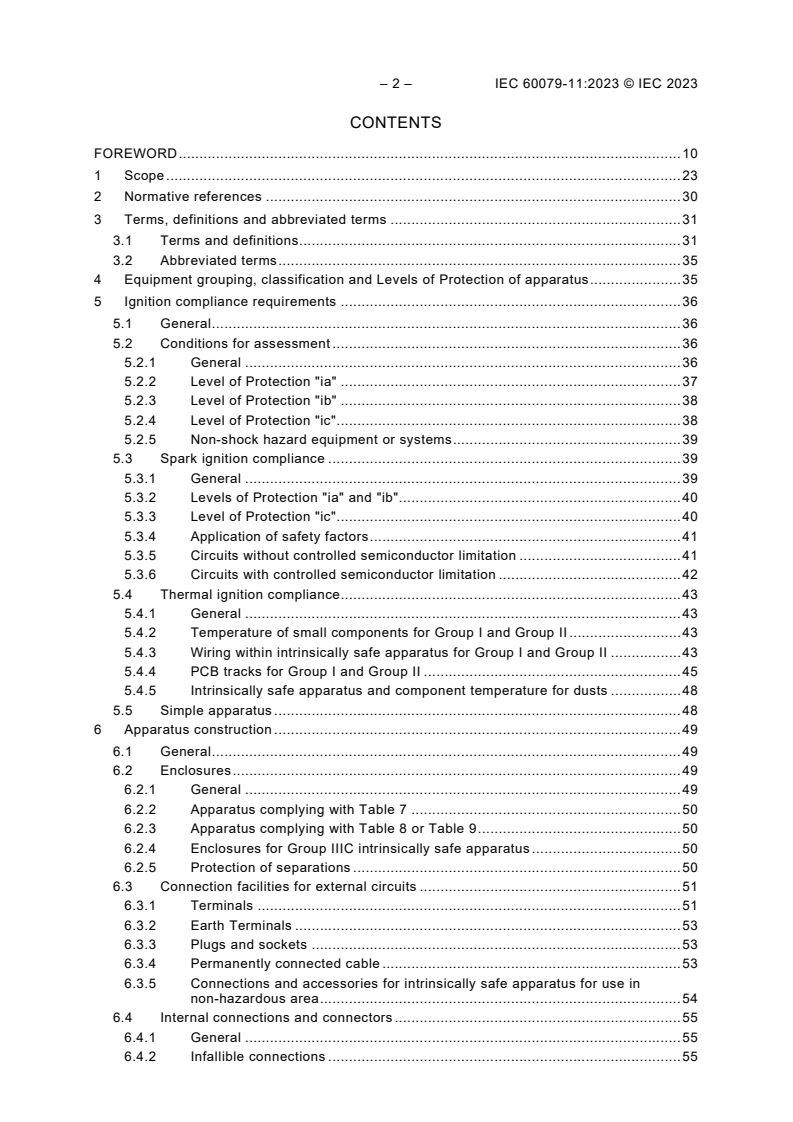
IEC 60079-11:2023 - Explosive atmospheres - Part 11: Equipment protection by intrinsic safety "i"
IEC 60079-11:2023 - Explosive atmospheres - Part 11: Equipment protection by intrinsic safety "i"
Overview
IEC 60079-11:2023 - "Explosive atmospheres - Part 11: Equipment protection by intrinsic safety 'i'" - is the international standard that specifies construction, testing and assessment requirements for intrinsically safe apparatus and associated equipment intended for use in explosive atmospheres. The standard covers electrical circuits that are designed so they are incapable of causing ignition of surrounding flammable gas, vapour or dust atmospheres, including circuits that are intrinsically safe only under defined conditions (for example battery-supplied only). This 2023 edition incorporates Corrigendum 1 and multiple interpretation sheets (2024–2025).
Key topics and requirements
The standard details technical requirements and test methods needed to achieve intrinsic safety ("i"). Major topics include:
- Levels of protection: criteria for protection levels ia, ib, ic and their assessment conditions.
- Ignition compliance: spark and thermal ignition testing, safety factors, and special rules for circuits with or without semiconductor limitations.
- Apparatus construction: enclosure requirements, terminals, earth connections, connectors and wiring practices.
- Separation and insulation: required separations, types of separation, printed circuit board (PCB) considerations and failure modes.
- Component characteristics and failures: ratings and failure behavior for resistors, capacitors, inductors, semiconductors, transformers, relays, fuses, batteries and other components on which intrinsic safety depends.
- Battery & cell requirements: construction, venting, replacement and charging considerations for batteries used in hazardous areas.
- Encapsulation, coatings and mechanical protection: when and how to use encapsulation or barriers to maintain intrinsic safety.
- Type tests & verification: spark ignition tests, thermal tests and type examination procedures for certification.
- Special apparatus topics: diode safety barriers, FISCO apparatus, signal isolators and other supplementary requirements.
Applications and users
IEC 60079-11 is essential for anyone designing, manufacturing, certifying or installing electrical equipment that will operate in potentially explosive atmospheres, including:
- Manufacturers of sensors, transmitters, handheld devices, control electronics and intrinsically safe barriers
- Design and safety engineers in oil & gas, petrochemical, mining, pharmaceuticals, food processing, and grain-handling industries
- Certification bodies and testing laboratories performing type examinations and compliance testing
- Installation and maintenance personnel responsible for equipment selection, wiring and safe replacement of batteries or modules
Related standards
- IEC 60079-0 (general requirements for explosive atmospheres) - referenced for other Types of Protection and general rules.
- Other IEC 60079 series documents cover specific protection methods (e.g., flameproof "d", increased safety "e") and subsystem requirements.
Keywords: IEC 60079-11, intrinsic safety, intrinsically safe apparatus, explosive atmospheres, equipment protection "i", intrinsically safe circuits, hazardous area equipment.
Relations
- Effective Date
- 11-Mar-2026
- Effective Date
- 03-Apr-2026
- Effective Date
- 05-Sep-2023
- Effective Date
- 20-Mar-2026
- Effective Date
- 26-Oct-2025
- Effective Date
- 26-Oct-2025
- Effective Date
- 02-Aug-2024
- Effective Date
- 12-Apr-2024
- Effective Date
- 09-Feb-2024
- Effective Date
- 09-Feb-2024
- Effective Date
- 05-Sep-2023
- Effective Date
- 05-Sep-2023
- Effective Date
- 05-Sep-2023
- Effective Date
- 05-Sep-2023
- Revises
IEC 60079-11:2011 - Explosive atmospheres - Part 11: Equipment protection by intrinsic safety "i" - Effective Date
- 05-Sep-2023
Buy Documents
IEC 60079-11:2023 - Explosive atmospheres - Part 11: Equipment protection by intrinsic safety "i"
IEC 60079-11:2023 - Explosive atmospheres - Part 11: Equipment protection by intrinsic safety "i"
Get Certified
Connect with accredited certification bodies for this standard

IMQ S.p.A. (Certification)
Italian electrical product certification.

SLG Prüf- und Zertifizierungs GmbH
German testing and certification body.

UL Solutions
Global safety science company with testing, inspection and certification.
Sponsored listings
Frequently Asked Questions
IEC 60079-11:2023 is a standard published by the International Electrotechnical Commission (IEC). Its full title is "Explosive atmospheres - Part 11: Equipment protection by intrinsic safety "i"". This standard covers: CORRECTED VERSION 2026-07 IEC 60079-11:2023 specifies the construction and testing of intrinsically safe apparatus intended for use in explosive atmospheres, and for associated apparatus which is intended for connection to intrinsically safe circuits which enter such atmospheres. This Type of Protection is applicable to electrical equipment in which the electrical circuits themselves are incapable of causing ignition of a surrounding explosive atmosphere. This includes electrical equipment which contains circuits that are intrinsically safe only under certain conditions, for example under battery supply with mains supply removed. This document is also applicable to electrical equipment or parts of electrical equipment located outside the explosive atmosphere or protected by another Type of Protection listed in IEC 60079-0, where the intrinsic safety of the electrical circuits in the explosive atmosphere may depend upon the design and construction of such electrical equipment or parts of such electrical equipment. The electrical circuits exposed to the explosive atmosphere are assessed for use in such atmospheres by applying this document. The contents of the corrigenda 1 (2023-06) and 2 (2026-05) and the interpretation sheets 1 (2024-05), 2 (2024-05), 3 (2024-08), 4 (2025-09), 5 (2025-09) and 6 (2026-07) have been included in this copy.
CORRECTED VERSION 2026-07 IEC 60079-11:2023 specifies the construction and testing of intrinsically safe apparatus intended for use in explosive atmospheres, and for associated apparatus which is intended for connection to intrinsically safe circuits which enter such atmospheres. This Type of Protection is applicable to electrical equipment in which the electrical circuits themselves are incapable of causing ignition of a surrounding explosive atmosphere. This includes electrical equipment which contains circuits that are intrinsically safe only under certain conditions, for example under battery supply with mains supply removed. This document is also applicable to electrical equipment or parts of electrical equipment located outside the explosive atmosphere or protected by another Type of Protection listed in IEC 60079-0, where the intrinsic safety of the electrical circuits in the explosive atmosphere may depend upon the design and construction of such electrical equipment or parts of such electrical equipment. The electrical circuits exposed to the explosive atmosphere are assessed for use in such atmospheres by applying this document. The contents of the corrigenda 1 (2023-06) and 2 (2026-05) and the interpretation sheets 1 (2024-05), 2 (2024-05), 3 (2024-08), 4 (2025-09), 5 (2025-09) and 6 (2026-07) have been included in this copy.
IEC 60079-11:2023 is classified under the following ICS (International Classification for Standards) categories: 29.260.20 - Electrical apparatus for explosive atmospheres. The ICS classification helps identify the subject area and facilitates finding related standards.
IEC 60079-11:2023 has the following relationships with other standards: It is inter standard links to EN ISO 16923:2026, IEC 60079-11:2023/COR2:2026, IEC 60079-11:2023/COR1:2023, IEC 60079-11:2023/ISH6:2026, IEC 60079-11:2023/ISH4:2025, IEC 60079-11:2023/ISH5:2025, IEC 60079-11:2011/ISH7:2024, IEC 60079-11:2023/ISH3:2024, IEC 60079-11:2023/ISH2:2024, IEC 60079-11:2023/ISH1:2024, IEC 60079-11:2011/ISH3:2016, IEC 60079-11:2011/ISH1:2014, IEC 60079-11:2011/ISH5:2019, IEC 60079-11:2011/COR1:2012, IEC 60079-11:2011. Understanding these relationships helps ensure you are using the most current and applicable version of the standard.
IEC 60079-11:2023 is available in PDF format for immediate download after purchase. The document can be added to your cart and obtained through the secure checkout process. Digital delivery ensures instant access to the complete standard document.
Standards Content (Sample)
IEC 60079-11 ®
Edition 7.0 2023-01
INTERNATIONAL
STANDARD
colour
inside
Explosive atmospheres –
Part 11: Equipment protection by intrinsic safety "i"
All rights reserved. Unless otherwise specified, no part of this publication may be reproduced or utilized in any form
or by any means, electronic or mechanical, including photocopying and microfilm, without permission in writing from
either IEC or IEC's member National Committee in the country of the requester. If you have any questions about IEC
copyright or have an enquiry about obtaining additional rights to this publication, please contact the address below or
your local IEC member National Committee for further information.
IEC Secretariat Tel.: +41 22 919 02 11
3, rue de Varembé info@iec.ch
CH-1211 Geneva 20 www.iec.ch
Switzerland
About the IEC
The International Electrotechnical Commission (IEC) is the leading global organization that prepares and publishes
International Standards for all electrical, electronic and related technologies.
About IEC publications
The technical content of IEC publications is kept under constant review by the IEC. Please make sure that you have the
latest edition, a corrigendum or an amendment might have been published.
IEC publications search - webstore.iec.ch/advsearchform IEC Products & Services Portal - products.iec.ch
The advanced search enables to find IEC publications by a Discover our powerful search engine and read freely all the
variety of criteria (reference number, text, technical publications previews. With a subscription you will always have
committee, …). It also gives information on projects, replaced access to up to date content tailored to your needs.
and withdrawn publications.
Electropedia - www.electropedia.org
IEC Just Published - webstore.iec.ch/justpublished
The world's leading online dictionary on electrotechnology,
Stay up to date on all new IEC publications. Just Published
containing more than 22 300 terminological entries in English
details all new publications released. Available online and once
and French, with equivalent terms in 19 additional languages.
a month by email.
Also known as the International Electrotechnical Vocabulary
(IEV) online.
IEC Customer Service Centre - webstore.iec.ch/csc
If you wish to give us your feedback on this publication or need
further assistance, please contact the Customer Service
Centre: sales@iec.ch.
IEC 60079-11 ®
Edition 7.0 2023-01
INTERNATIONAL
STANDARD
colour
inside
Explosive atmospheres –
Part 11: Equipment protection by intrinsic safety "i"
INTERNATIONAL
ELECTROTECHNICAL
COMMISSION
ICS 29.260.20 ISBN 978-2-8322-6271-9
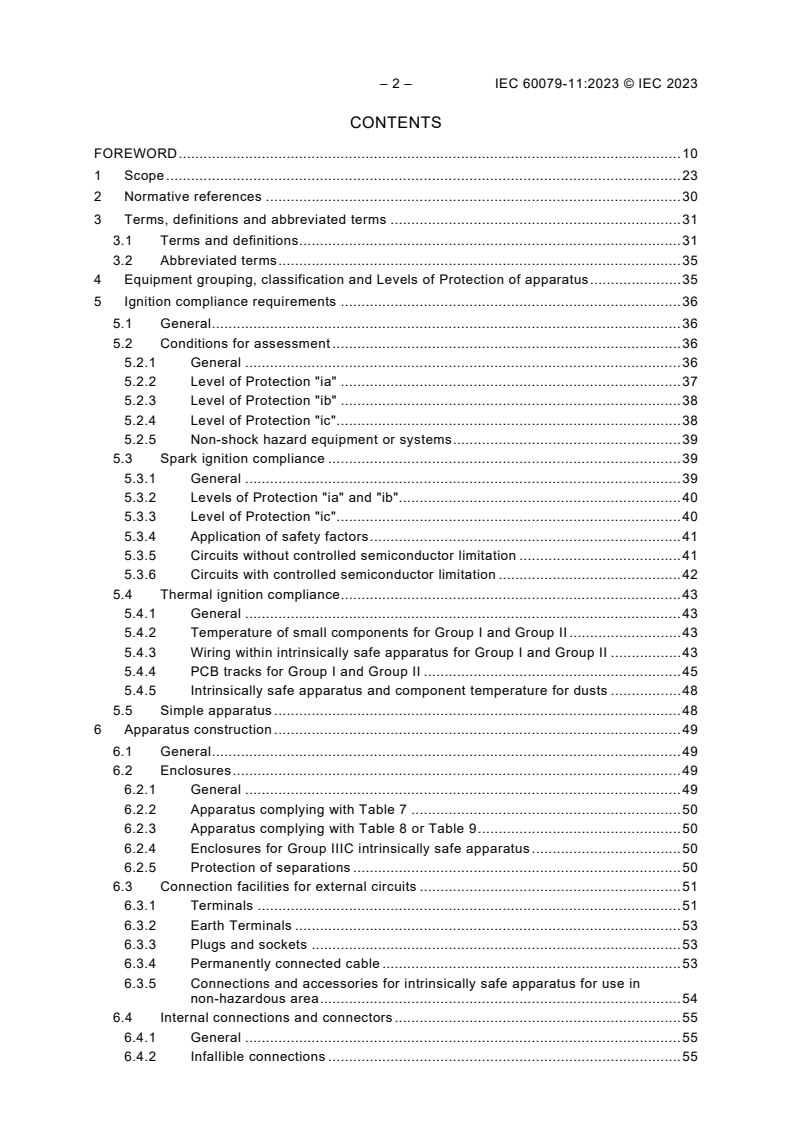
– 2 – IEC 60079-11:2023 © IEC 2023
CONTENTS
FOREWORD . 10
1 Scope . 23
2 Normative references . 30
3 Terms, definitions and abbreviated terms . 31
3.1 Terms and definitions . 31
3.2 Abbreviated terms . 35
4 Equipment grouping, classification and Levels of Protection of apparatus . 35
5 Ignition compliance requirements . 36
5.1 General . 36
5.2 Conditions for assessment . 36
5.2.1 General . 36
5.2.2 Level of Protection "ia" . 37
5.2.3 Level of Protection "ib" . 38
5.2.4 Level of Protection "ic". 38
5.2.5 Non-shock hazard equipment or systems . 39
5.3 Spark ignition compliance . 39
5.3.1 General . 39
5.3.2 Levels of Protection "ia" and "ib" . 40
5.3.3 Level of Protection "ic". 40
5.3.4 Application of safety factors . 41
5.3.5 Circuits without controlled semiconductor limitation . 41
5.3.6 Circuits with controlled semiconductor limitation . 42
5.4 Thermal ignition compliance . 43
5.4.1 General . 43
5.4.2 Temperature of small components for Group I and Group II . 43
5.4.3 Wiring within intrinsically safe apparatus for Group I and Group II . 43
5.4.4 PCB tracks for Group I and Group II . 45
5.4.5 Intrinsically safe apparatus and component temperature for dusts . 48
5.5 Simple apparatus . 48
6 Apparatus construction . 49
6.1 General . 49
6.2 Enclosures . 49
6.2.1 General . 49
6.2.2 Apparatus complying with Table 7 . 50
6.2.3 Apparatus complying with Table 8 or Table 9 . 50
6.2.4 Enclosures for Group IIIC intrinsically safe apparatus . 50
6.2.5 Protection of separations . 50
6.3 Connection facilities for external circuits . 51
6.3.1 Terminals . 51
6.3.2 Earth Terminals . 53
6.3.3 Plugs and sockets . 53
6.3.4 Permanently connected cable . 53
6.3.5 Connections and accessories for intrinsically safe apparatus for use in
non-hazardous area . 54
6.4 Internal connections and connectors . 55
6.4.1 General . 55
6.4.2 Infallible connections . 55
6.4.3 Connectors for internal connections, plug-in cards and components . 57
6.4.4 Earth conductors and connections . 57
6.5 Separation of conductive parts . 58
6.5.1 Separations on which intrinsic safety depends . 58
6.5.2 Separation distances according to Table 7. 58
6.5.3 Reduced separation distances . 59
6.5.4 Failure of separations . 59
6.5.5 Voltage between conductive parts . 65
6.5.6 Types of separation . 65
6.5.7 Composite separations . 72
6.5.8 Printed circuit board assemblies . 73
6.5.9 Separation by metal parts . 75
6.5.10 Separation by non-metallic insulating partitions . 75
6.5.11 Insulation of internal wiring . 76
6.6 Encapsulation . 76
6.6.1 General . 76
6.6.2 Encapsulation used for the exclusion of explosive atmospheres . 77
6.6.3 Mechanical protection to avoid access to parts . 80
6.6.4 Encapsulation used for protection of a fuse . 81
6.6.5 Encapsulation used to provide separation . 81
6.6.6 Encapsulation used to enhance the rating of protective components . 81
6.6.7 Free space within the encapsulation . 81
6.7 Specification of coating, encapsulation materials . 83
6.8 Protection against polarity reversal . 83
6.9 Dielectric strength requirement . 83
7 Characteristics and failure of components and assemblies . 84
7.1 Rating of components on which intrinsic safety depends . 84
7.2 Failure of components . 84
7.3 Manufacturing variation . 84
7.4 Resistors . 85
7.4.1 General . 85
7.4.2 Resistors on which intrinsic safety depends . 85
7.5 Capacitors . 86
7.5.1 General . 86
7.5.2 Capacitors on which intrinsic safety depends . 86
7.5.3 Blocking capacitors . 87
7.5.4 Infallible filter capacitors . 87
7.6 Inductors and windings . 88
7.6.1 General . 88
7.6.2 Inductors on which intrinsic safety depends . 88
7.6.3 Infallibly insulated inductors . 88
7.6.4 Damping windings . 89
7.6.5 Common mode choke coils (EMI suppression filters) . 89
7.7 Semiconductors . 90
7.7.1 Failure of semiconductors . 90
7.7.2 Semiconductors on which intrinsic safety depends . 91
7.7.3 Transient effects on semiconductors on which intrinsic safety depends . 91
7.7.4 Semiconductors in shunt voltage limiters . 91
7.7.5 Shunt assembly on which intrinsic safety depends . 92
– 4 – IEC 60079-11:2023 © IEC 2023
7.7.6 Safety assemblies infallible against failure to limit voltage . 92
7.7.7 Semiconductor current limiters . 92
7.7.8 Use of programmable components . 92
7.8 Transformers . 93
7.8.1 General . 93
7.8.2 Transformers on which intrinsic safety depends . 93
7.8.3 Construction of transformers on which intrinsic safety depends . 93
7.8.4 Protective measures for transformers on which intrinsic safety depends
for Levels of Protection "ia" and "ib" . 94
7.8.5 Requirements for transformers for Level of Protection "ic" . 95
7.9 Relays . 95
7.9.1 General . 95
7.9.2 Relays on which intrinsic safety depends . 96
7.10 Signal isolators . 97
7.10.1 General . 97
7.10.2 Signal isolators on which intrinsic safety depends . 97
7.10.3 Signal isolators between intrinsically safe and non-intrinsically safe
circuits . 98
7.10.4 Signal isolators between separate intrinsically safe circuits . 98
7.11 Fuses. 98
7.12 Primary and secondary cells and batteries . 100
7.12.1 General . 100
7.12.2 Construction of cells and batteries used in intrinsically safe apparatus . 100
7.12.3 Electrolyte leakage . 101
7.12.4 Ventilation . 101
7.12.5 Cell voltages . 101
7.12.6 Batteries in equipment protected by different Types of Protection . 102
7.12.7 Batteries used and replaced in explosive atmospheres . 102
7.12.8 Replaceable batteries used but not replaced in explosive atmospheres . 102
7.12.9 External contacts for charging batteries . 102
7.13 Piezoelectric devices . 102
7.14 Cells for the detection of gases . 103
7.14.1 Electrochemical . 103
7.14.2 Catalytic . 103
7.15 Supercapacitors . 103
7.16 Thermal devices . 104
7.16.1 General . 104
7.16.2 Thermal devices used to limit temperature . 104
7.16.3 PPTC devices used to limit current . 105
7.17 Mechanical switches . 106
8 Supplementary requirements for specific apparatus . 106
8.1 Diode safety barriers . 106
8.1.1 General . 106
8.1.2 Construction . 106
8.2 FISCO apparatus . 106
9 Type verifications and type tests. 107
9.1 Spark ignition test . 107
9.1.1 General . 107
9.1.2 Spark test apparatus and its use . 107
9.1.3 Test gas mixtures and spark test apparatus calibration current . 108
9.2 Spark ignition assessment using reference curves and tables . 109
9.2.1 General . 109
9.2.2 Assessment of simple resistive circuit . 109
9.2.3 Assessment of simple capacitive circuits . 110
9.2.4 Assessment of Simple Inductive Circuits . 112
9.2.5 Determination of L /R for resistance limited power source . 113
o o
9.2.6 Circuits with both inductance and capacitance . 114
9.3 Temperature tests . 114
9.4 Mechanical tests . 115
9.4.1 Casting compound . 115
9.4.2 Acceptability of encapsulated or coated fuses. 115
9.4.3 Partitions . 116
9.4.4 Cable pull test . 116
9.5 Current carrying capacity of infallible printed circuit board connections . 116
9.6 Dielectric strength tests . 116
9.7 Qualification of solid insulation and distance through casting compound for
application of reduced separations . 116
9.7.1 General . 116
9.7.2 Preconditioning . 117
9.7.3 AC power frequency voltage test . 117
9.7.4 Partial discharge test . 118
9.8 Type tests for PCB coatings . 119
9.9 Differential Leakage current tests for signal isolators . 119
9.10 Isolator tests . 120
9.10.1 General . 120
9.10.2 Thermal conditioning and dielectric test . 120
9.10.3 Dielectric and short circuit test . 121
9.11 Tests for intrinsically safe apparatus containing piezoelectric devices . 122
9.12 Tests for PTC devices . 122
9.13 Determination of parameters of loosely specified components . 123
9.14 Tests for cells, batteries and supercapacitors . 123
9.14.1 Conditions for testing . 123
9.14.2 Electrolyte leakage test for cells, batteries and supercapacitors . 124
9.14.3 Spark ignition and surface temperature of cells, batteries or
supercapacitors . 125
9.14.4 Battery container pressure tests . 126
9.14.5 Battery resistance . 126
9.15 Determination of storable energy in common mode chokes . 126
9.16 Type tests for components protected by time dependent current limitation . 128
9.17 Transformer tests . 129
9.17.1 General . 129
9.17.2 Mains transformers for Level of Protection "ia" and "ib" . 130
9.17.3 Transformers galvanically isolated from the mains supply for Levels of
Protection "ia" and "ib" . 130
9.17.4 Transformers for Level of Protection "ic" . 131
10 Routine verifications and tests . 131
10.1 Alternative reduced spacings . 131
10.2 Routine tests for diode safety barriers . 131
– 6 – IEC 60079-11:2023 © IEC 2023
10.2.1 Completed barriers . 131
10.2.2 Diodes for 2-diode "ia" barriers . 131
10.3 Routine tests for transformers . 131
10.3.1 Levels of Protection "ia" and "ib" . 131
10.3.2 Level of Protection "ic". 132
10.4 Routine verification of conformal coating and encapsulation . 132
11 Marking . 133
11.1 Intrinsically safe apparatus and associated apparatus . 133
11.1.1 General . 133
11.1.2 Intrinsic safety parameters . 133
11.1.3 FISCO . 133
11.1.4 Marking of connection facilities . 134
11.1.5 Non-hazardous area accessory. 134
11.2 Warning markings . 134
12 Instructions . 135
12.1 General . 135
12.2 Specific Conditions of Use . 135
Annex A (normative) Spark ignition reference curves . 137
Annex B (normative) Spark test apparatus for intrinsically safe circuits . 161
B.1 Principle . 161
B.2 Spark test apparatus . 161
B.3 Spark test apparatus sensitivity . 162
B.4 Preparation and cleaning of tungsten wires . 162
B.5 Conditioning a new cadmium disc . 163
B.6 Limitations of the spark test apparatus . 163
B.7 Modification of spark test apparatus for use at higher currents . 164
Annex C (informative) Measurement of creepage distances, clearances and
separation distances through casting compound and through solid insulation . 169
C.1 Clearances and separation distances through casting compound and
through solid insulation . 169
C.2 Creepage distances . 170
C.3 Examples for the application of an ambient pressure correction factor . 171
Annex D (normative) Excess transient energy test . 174
D.1 Overview. 174
D.2 Circuit configuration . 175
D.3 Test equipment . 176
D.4 Test load . 177
D.5 Supply voltage . 177
D.6 Supply change tests . 177
D.7 Load change tests. 178
D.8 Transient energy calculation . 178
Annex E (normative) FISCO – Apparatus requirements . 180
E.1 Overview. 180
E.2 Apparatus requirements . 180
E.2.1 General . 180
E.2.2 FISCO power supplies . 180
E.3 FISCO field devices . 181
E.3.1 General . 181
E.3.2 Additional requirements of "ia" and "ib" FISCO field devices . 182
E.3.3 Additional requirement of "ic" FISCO field devices . 182
E.3.4 Terminator . 182
E.3.5 Simple apparatus . 182
Annex F (normative) Ignition testing of semiconductor limiting power supply circuits . 184
F.1 Overview. 184
F.2 Initial test . 184
F.3 Subsequent tests . 184
F.4 Examples of pass and fail . 185
Annex G (normative) Universal output characteristics . 191
G.1 Overview. 191
G.2 Linear source . 191
G.3 Non-linear source . 191
G.4 Curves . 192
Annex H (informative) Examples of marking . 203
H.1 General . 203
H.2 Self-contained intrinsically safe apparatus . 203
H.3 Intrinsically safe apparatus supplied by other intrinsically safe circuits . 203
H.4 Associated apparatus. 204
H.5 Associated apparatus protected by a flameproof enclosure . 204
H.6 Intrinsically safe apparatus Level of Protection "ic" . 204
H.7 Intrinsically safe apparatus Level of Protection "ib" with "ia"' outputs . 205
H.8 FISCO . 205
H.8.1 Power supply . 205
H.8.2 Field device . 205
H.8.3 Terminator . 206
H.8.4 Dual marked field device . 206
Annex I (informative) Overview of tests on enclosures or parts of enclosures . 207
Bibliography . 209
Figure 1 – Separation at terminals . 52
Figure 2 – Examples of independent and non-independent connecting elements . 56
Figure 3 – Example of separation of conductive parts . 64
Figure 4 – Determination of creepage distances and clearance . 71
Figure 5 – Creepage distances and clearances on PCBAs . 74
Figure 6 – Encapsulation used without a separate external enclosure . 78
Figure 7 – Complete enclosure with no user removable covers or openings . 78
Figure 8 – Enclosure where the compound forms one of the external walls . 79
Figure 9 – Enclosure with cover . 79
Figure 10 – Moulding over un-mounted components . 80
Figure 11 – Moulding over components mounted on a PCB . 80
Figure 12 – Example of a simple resistive circuit . 109
Figure 13 – Example of simple capacitive circuit . 110
Figure 14 – Effective capacitance . 111
Figure 15 – Example of simple inductive circuit . 112
Figure 16 – Test voltages . 119
– 8 – IEC 60079-11:2023 © IEC 2023
Figure 17 – Recommended bias circuit for Differential Leakage measurement . 120
Figure 18 – Inductor test circuit . 127
Figure 19 – Measured oscillation . 128
Figure A.1 – Resistive circuits . 138
Figure A.2 – Group I capacitive circuits . 139
Figure A.3 – Group II capacitive circuits . 140
Figure A.4 – Inductive circuits of Group II . 141
Figure A.5 – Group I inductive circuits . 142
Figure A.6 – Group IIC inductive circuits . 143
Figure B.1 – Spark test apparatus for intrinsically safe circuits . 165
Figure B.2 – Cadmium contact disc . 166
Figure B.3 – Wire holder . 166
Figure B.4 – Example of a practical design of spark test apparatus . 167
Figure B.5 – Arrangement for fusing tungsten wires . 168
Figure C.1 – Measurement of clearance . 169
Figure C.2 – Measurement of composite distances . 169
Figure C.3 – Measurement of creepage . 170
Figure C.4 – Composite separation including creepage . 171
Figure C.5 – PCB with two coated components designed for ambient pressure
60 kPa to 110 kPa . 171
Figure C.6 – PCB with 3 mm slot designed for ambient pressure 60 kPa to 110 kPa . 172
Figure D.1 – Example circuit configuration . 175
Figure D.2 – Example output voltage, current, power and energy measured during a
load transient . 179
Figure E.1 – Typical FISCO system . 183
Figure F.1 – Safety factor vs ignition probability . 190
Figure G.1 – Example of an output characteristic for Group IIC . 192
Figure G.2 – Limit curve diagram for universal source characteristic − Group IIC . 197
Figure G.3 – Limit curve diagram for universal source characteristic – Group IIB . 202
Figure I.1 – Tests for enclosures or parts of enclosures for separation distances
complying with Table 7 . 207
Figure I.2 – Tests for enclosures or parts of enclosures for separation distances
complying with Table 8 or Table 9 . 208
Table 1 – Applicability of specific clauses of IEC 60079-0 . 24
Table 2 – List of abbreviated terms used. 35
Table 3 – Temperature classification of copper wiring for ambient temperature ≤ 40 °C . 45
Table 4 – Temperature classification of tracks on PCBs . 47
Table 5 – Maximum permitted power dissipation within a component immersed in dust . 48
Table 6 – Requirements for infallible circuit board tracks and vias . 57
Table 7 – Clearances, creepage distances and separations . 61
Table 8 – Reduced separations . 62
Table 9 – Reduced separations for Level of Protection "ic" . 63
Table 10 – Creepage distance and clearance X in Figure 4 . 67
Table 11 – Minimum thickness of compound adjacent to individual free space for
Group I and Group II . 82
Table 12 – Minimum thickness of compound adjacent to individual free space for
Group III . 82
Table 13 – Rating and failure modes of resistors . 85
Table 14 – Rating and failure modes of capacitors . 87
Table 15 – Rating and failure modes of inductors. 88
Table 16 – Rating and failure modes of semiconductors . 91
Table 17 – Minimum foil thickness or minimum wire diameter of the screen . 94
Table 18 – Rating and failure modes of signal isolators . 97
Table 19 – Rating and failure modes of temperature sensors . 104
Table 20 – Rating and failure modes of switching thermal devices . 105
Table 21 – Rating and failure modes of PTC devices used to limit temperature . 105
Table 22 – Rating and failure modes of PPTC devices used to limit current . 105
Table 23 – Compositions of explosive test mixtures adequate for 1,0 safety factor . 108
Table 24 – Compositions of explosive test mixtures adequate for 1,5 safety factor . 108
Table 25 – Permitted reduction of effective capacitance when protected by a series
resistance . 112
Table 26 – Routine test voltages for transformers . 132
Table 27 – Text of warning markings . 134
Table 28 – Concerns addressed by Specific Conditions of Use . 136
Table A.1 – Permitted short circuit current corresponding to the voltage and the
equipment group . 144
Table A.2 – Permitted capacitance corresponding to the voltage and the equipment
group . 151
Table D.1 – Energy limits by equipment group . 174
Table E.1 – Assessment of maximum output current for use with "ia" and "ib" FISCO
rectangular supplies . 181
Table E.2 – Assessment of maximum output current for use with "ic" FISCO
rectangular supplies .
...
IEC 60079-11 ®
Edition 7.0 2023-01
INTERNATIONAL
STANDARD
NORME
INTERNATIONALE
colour
inside
Explosive atmospheres –
Part 11: Equipment protection by intrinsic safety "i"
Atmosphères explosives –
Partie 11: Protection de l’appareil par sécurité intrinsèque "i"
All rights reserved. Unless otherwise specified, no part of this publication may be reproduced or utilized in any form
or by any means, electronic or mechanical, including photocopying and microfilm, without permission in writing from
either IEC or IEC's member National Committee in the country of the requester. If you have any questions about IEC
copyright or have an enquiry about obtaining additional rights to this publication, please contact the address below or
your local IEC member National Committee for further information.
Droits de reproduction réservés. Sauf indication contraire, aucune partie de cette publication ne peut être reproduite ni
utilisée sous quelque forme que ce soit et par aucun procédé, électronique ou mécanique, y compris la photocopie et
les microfilms, sans l'accord écrit de l'IEC ou du Comité national de l'IEC du pays du demandeur. Si vous avez des
questions sur le copyright de l'IEC ou si vous désirez obtenir des droits supplémentaires sur cette publication, utilisez
les coordonnées ci-après ou contactez le Comité national de l'IEC de votre pays de résidence.
IEC Secretariat Tel.: +41 22 919 02 11
3, rue de Varembé info@iec.ch
CH-1211 Geneva 20 www.iec.ch
Switzerland
About the IEC
The International Electrotechnical Commission (IEC) is the leading global organization that prepares and publishes
International Standards for all electrical, electronic and related technologies.
About IEC publications
The technical content of IEC publications is kept under constant review by the IEC. Please make sure that you have the
latest edition, a corrigendum or an amendment might have been published.
IEC publications search - webstore.iec.ch/advsearchform IEC Products & Services Portal - products.iec.ch
The advanced search enables to find IEC publications by a Discover our powerful search engine and read freely all the
variety of criteria (reference number, text, technical publications previews. With a subscription you will always have
committee, …). It also gives information on projects, replaced access to up to date content tailored to your needs.
and withdrawn publications.
Electropedia - www.electropedia.org
IEC Just Published - webstore.iec.ch/justpublished
The world's leading online dictionary on electrotechnology,
Stay up to date on all new IEC publications. Just Published
containing more than 22 300 terminological entries in English
details all new publications released. Available online and once
and French, with equivalent terms in 19 additional languages.
a month by email.
Also known as the International Electrotechnical Vocabulary
(IEV) online.
IEC Customer Service Centre - webstore.iec.ch/csc
If you wish to give us your feedback on this publication or need
further assistance, please contact the Customer Service
Centre: sales@iec.ch.
A propos de l'IEC
La Commission Electrotechnique Internationale (IEC) est la première organisation mondiale qui élabore et publie des
Normes internationales pour tout ce qui a trait à l'électricité, à l'électronique et aux technologies apparentées.
A propos des publications IEC
Le contenu technique des publications IEC est constamment revu. Veuillez vous assurer que vous possédez l’édition la
plus récente, un corrigendum ou amendement peut avoir été publié.
Recherche de publications IEC - IEC Products & Services Portal - products.iec.ch
webstore.iec.ch/advsearchform Découvrez notre puissant moteur de recherche et consultez
La recherche avancée permet de trouver des publications IEC gratuitement tous les aperçus des publications. Avec un
en utilisant différents critères (numéro de référence, texte, abonnement, vous aurez toujours accès à un contenu à jour
comité d’études, …). Elle donne aussi des informations sur les adapté à vos besoins.
projets et les publications remplacées ou retirées.
Electropedia - www.electropedia.org
IEC Just Published - webstore.iec.ch/justpublished
Le premier dictionnaire d'électrotechnologie en ligne au monde,
Restez informé sur les nouvelles publications IEC. Just
avec plus de 22 300 articles terminologiques en anglais et en
Published détaille les nouvelles publications parues.
français, ainsi que les termes équivalents dans 19 langues
Disponible en ligne et une fois par mois par email.
additionnelles. Egalement appelé Vocabulaire
Electrotechnique International (IEV) en ligne.
Service Clients - webstore.iec.ch/csc
Si vous désirez nous donner des commentaires sur cette
publication ou si vous avez des questions contactez-nous:
sales@iec.ch.
IEC 60079-11 ®
Edition 7.0 2023-01
INTERNATIONAL
STANDARD
NORME
INTERNATIONALE
colour
inside
Explosive atmospheres –
Part 11: Equipment protection by intrinsic safety "i"
Atmosphères explosives –
Partie 11: Protection de l’appareil par sécurité intrinsèque "i"
INTERNATIONAL
ELECTROTECHNICAL
COMMISSION
COMMISSION
ELECTROTECHNIQUE
INTERNATIONALE
ICS 29.260.20 ISBN 978-2-8322-7447-7
– 2 – IEC 60079-11:2023 © IEC 2023
CONTENTS
FOREWORD . 10
1 Scope . 23
2 Normative references . 30
3 Terms, definitions and abbreviated terms . 31
3.1 Terms and definitions . 31
3.2 Abbreviated terms . 35
4 Equipment grouping, classification and Levels of Protection of apparatus . 35
5 Ignition compliance requirements . 36
5.1 General . 36
5.2 Conditions for assessment . 36
5.2.1 General . 36
5.2.2 Level of Protection "ia" . 37
5.2.3 Level of Protection "ib" . 38
5.2.4 Level of Protection "ic". 38
5.2.5 Non-shock hazard equipment or systems . 39
5.3 Spark ignition compliance . 39
5.3.1 General . 39
5.3.2 Levels of Protection "ia" and "ib" . 40
5.3.3 Level of Protection "ic". 40
5.3.4 Application of safety factors . 41
5.3.5 Circuits without controlled semiconductor limitation . 41
5.3.6 Circuits with controlled semiconductor limitation . 42
5.4 Thermal ignition compliance . 43
5.4.1 General . 43
5.4.2 Temperature of small components for Group I and Group II . 43
5.4.3 Wiring within intrinsically safe apparatus for Group I and Group II . 43
5.4.4 PCB tracks for Group I and Group II . 45
5.4.5 Intrinsically safe apparatus and component temperature for dusts . 48
5.5 Simple apparatus . 48
6 Apparatus construction . 49
6.1 General . 49
6.2 Enclosures . 49
6.2.1 General . 49
6.2.2 Apparatus complying with Table 7 . 50
6.2.3 Apparatus complying with Table 8 or Table 9 . 50
6.2.4 Enclosures for Group IIIC intrinsically safe apparatus . 50
6.2.5 Protection of separations . 50
6.3 Connection facilities for external circuits . 51
6.3.1 Terminals . 51
6.3.2 Earth Terminals . 53
6.3.3 Plugs and sockets . 53
6.3.4 Permanently connected cable . 53
6.3.5 Connections and accessories for intrinsically safe apparatus for use in
non-hazardous area . 54
6.4 Internal connections and connectors . 55
6.4.1 General . 55
6.4.2 Infallible connections . 55
6.4.3 Connectors for internal connections, plug-in cards and components . 57
6.4.4 Earth conductors and connections . 57
6.5 Separation of conductive parts . 58
6.5.1 Separations on which intrinsic safety depends . 58
6.5.2 Separation distances according to Table 7. 58
6.5.3 Reduced separation distances . 59
6.5.4 Failure of separations . 59
6.5.5 Voltage between conductive parts . 65
6.5.6 Types of separation . 65
6.5.7 Composite separations . 72
6.5.8 Printed circuit board assemblies . 73
6.5.9 Separation by metal parts . 75
6.5.10 Separation by non-metallic insulating partitions . 75
6.5.11 Insulation of internal wiring . 76
6.6 Encapsulation . 76
6.6.1 General . 76
6.6.2 Encapsulation used for the exclusion of explosive atmospheres . 77
6.6.3 Mechanical protection to avoid access to parts . 80
6.6.4 Encapsulation used for protection of a fuse . 81
6.6.5 Encapsulation used to provide separation . 81
6.6.6 Encapsulation used to enhance the rating of protective components . 81
6.6.7 Free space within the encapsulation . 81
6.7 Specification of coating, encapsulation materials . 83
6.8 Protection against polarity reversal . 83
6.9 Dielectric strength requirement . 83
7 Characteristics and failure of components and assemblies . 84
7.1 Rating of components on which intrinsic safety depends . 84
7.2 Failure of components . 84
7.3 Manufacturing variation . 84
7.4 Resistors . 85
7.4.1 General . 85
7.4.2 Resistors on which intrinsic safety depends . 85
7.5 Capacitors . 86
7.5.1 General . 86
7.5.2 Capacitors on which intrinsic safety depends . 86
7.5.3 Blocking capacitors . 87
7.5.4 Infallible filter capacitors . 87
7.6 Inductors and windings . 88
7.6.1 General . 88
7.6.2 Inductors on which intrinsic safety depends . 88
7.6.3 Infallibly insulated inductors . 88
7.6.4 Damping windings . 89
7.6.5 Common mode choke coils (EMI suppression filters) . 89
7.7 Semiconductors . 90
7.7.1 Failure of semiconductors . 90
7.7.2 Semiconductors on which intrinsic safety depends . 91
7.7.3 Transient effects on semiconductors on which intrinsic safety depends . 91
7.7.4 Semiconductors in shunt voltage limiters . 91
7.7.5 Shunt assembly on which intrinsic safety depends . 92
– 4 – IEC 60079-11:2023 © IEC 2023
7.7.6 Safety assemblies infallible against failure to limit voltage . 92
7.7.7 Semiconductor current limiters . 92
7.7.8 Use of programmable components . 92
7.8 Transformers . 93
7.8.1 General . 93
7.8.2 Transformers on which intrinsic safety depends . 93
7.8.3 Construction of transformers on which intrinsic safety depends . 93
7.8.4 Protective measures for transformers on which intrinsic safety depends
for Levels of Protection "ia" and "ib" . 94
7.8.5 Requirements for transformers for Level of Protection "ic" . 95
7.9 Relays . 95
7.9.1 General . 95
7.9.2 Relays on which intrinsic safety depends . 96
7.10 Signal isolators . 97
7.10.1 General . 97
7.10.2 Signal isolators on which intrinsic safety depends . 97
7.10.3 Signal isolators between intrinsically safe and non-intrinsically safe
circuits . 98
7.10.4 Signal isolators between separate intrinsically safe circuits . 98
7.11 Fuses. 98
7.12 Primary and secondary cells and batteries . 100
7.12.1 General . 100
7.12.2 Construction of cells and batteries used in intrinsically safe apparatus . 100
7.12.3 Electrolyte leakage . 101
7.12.4 Ventilation . 101
7.12.5 Cell voltages . 101
7.12.6 Batteries in equipment protected by different Types of Protection . 102
7.12.7 Batteries used and replaced in explosive atmospheres . 102
7.12.8 Replaceable batteries used but not replaced in explosive atmospheres . 102
7.12.9 External contacts for charging batteries . 102
7.13 Piezoelectric devices . 102
7.14 Cells for the detection of gases . 103
7.14.1 Electrochemical . 103
7.14.2 Catalytic . 103
7.15 Supercapacitors . 103
7.16 Thermal devices . 104
7.16.1 General . 104
7.16.2 Thermal devices used to limit temperature . 104
7.16.3 PPTC devices used to limit current . 105
7.17 Mechanical switches . 106
8 Supplementary requirements for specific apparatus . 106
8.1 Diode safety barriers . 106
8.1.1 General . 106
8.1.2 Construction . 106
8.2 FISCO apparatus . 106
9 Type verifications and type tests. 107
9.1 Spark ignition test . 107
9.1.1 General . 107
9.1.2 Spark test apparatus and its use . 107
9.1.3 Test gas mixtures and spark test apparatus calibration current . 108
9.2 Spark ignition assessment using reference curves and tables . 109
9.2.1 General . 109
9.2.2 Assessment of simple resistive circuit . 109
9.2.3 Assessment of simple capacitive circuits . 110
9.2.4 Assessment of Simple Inductive Circuits . 112
9.2.5 Determination of L /R for resistance limited power source . 113
o o
9.2.6 Circuits with both inductance and capacitance . 114
9.3 Temperature tests . 114
9.4 Mechanical tests . 115
9.4.1 Casting compound . 115
9.4.2 Acceptability of encapsulated or coated fuses. 115
9.4.3 Partitions . 116
9.4.4 Cable pull test . 116
9.5 Current carrying capacity of infallible printed circuit board connections . 116
9.6 Dielectric strength tests . 116
9.7 Qualification of solid insulation and distance through casting compound for
application of reduced separations . 116
9.7.1 General . 116
9.7.2 Preconditioning . 117
9.7.3 AC power frequency voltage test . 117
9.7.4 Partial discharge test . 118
9.8 Type tests for PCB coatings . 119
9.9 Differential Leakage current tests for signal isolators . 119
9.10 Isolator tests . 120
9.10.1 General . 120
9.10.2 Thermal conditioning and dielectric test . 120
9.10.3 Dielectric and short circuit test . 121
9.11 Tests for intrinsically safe apparatus containing piezoelectric devices . 122
9.12 Tests for PTC devices . 122
9.13 Determination of parameters of loosely specified components . 123
9.14 Tests for cells, batteries and supercapacitors . 123
9.14.1 Conditions for testing . 123
9.14.2 Electrolyte leakage test for cells, batteries and supercapacitors . 124
9.14.3 Spark ignition and surface temperature of cells, batteries or
supercapacitors . 125
9.14.4 Battery container pressure tests . 126
9.14.5 Battery resistance . 126
9.15 Determination of storable energy in common mode chokes . 126
9.16 Type tests for components protected by time dependent current limitation . 128
9.17 Transformer tests . 129
9.17.1 General . 129
9.17.2 Mains transformers for Level of Protection "ia" and "ib" . 130
9.17.3 Transformers galvanically isolated from the mains supply for Levels of
Protection "ia" and "ib" . 130
9.17.4 Transformers for Level of Protection "ic" . 131
10 Routine verifications and tests . 131
10.1 Alternative reduced spacings . 131
10.2 Routine tests for diode safety barriers . 131
– 6 – IEC 60079-11:2023 © IEC 2023
10.2.1 Completed barriers . 131
10.2.2 Diodes for 2-diode "ia" barriers . 131
10.3 Routine tests for transformers . 131
10.3.1 Levels of Protection "ia" and "ib" . 131
10.3.2 Level of Protection "ic". 132
10.4 Routine verification of conformal coating and encapsulation . 132
11 Marking . 133
11.1 Intrinsically safe apparatus and associated apparatus . 133
11.1.1 General . 133
11.1.2 Intrinsic safety parameters . 133
11.1.3 FISCO . 133
11.1.4 Marking of connection facilities . 134
11.1.5 Non-hazardous area accessory. 134
11.2 Warning markings . 134
12 Instructions . 135
12.1 General . 135
12.2 Specific Conditions of Use . 135
Annex A (normative) Spark ignition reference curves . 137
Annex B (normative) Spark test apparatus for intrinsically safe circuits . 161
B.1 Principle . 161
B.2 Spark test apparatus . 161
B.3 Spark test apparatus sensitivity . 162
B.4 Preparation and cleaning of tungsten wires . 162
B.5 Conditioning a new cadmium disc . 163
B.6 Limitations of the spark test apparatus . 163
B.7 Modification of spark test apparatus for use at higher currents . 164
Annex C (informative) Measurement of creepage distances, clearances and
separation distances through casting compound and through solid insulation . 169
C.1 Clearances and separation distances through casting compound and
through solid insulation . 169
C.2 Creepage distances . 170
C.3 Examples for the application of an ambient pressure correction factor . 171
Annex D (normative) Excess transient energy test . 174
D.1 Overview. 174
D.2 Circuit configuration . 175
D.3 Test equipment . 176
D.4 Test load . 177
D.5 Supply voltage . 177
D.6 Supply change tests . 177
D.7 Load change tests. 178
D.8 Transient energy calculation . 178
Annex E (normative) FISCO – Apparatus requirements . 180
E.1 Overview. 180
E.2 Apparatus requirements . 180
E.2.1 General . 180
E.2.2 FISCO power supplies . 180
E.3 FISCO field devices . 181
E.3.1 General . 181
E.3.2 Additional requirements of "ia" and "ib" FISCO field devices . 182
E.3.3 Additional requirement of "ic" FISCO field devices . 182
E.3.4 Terminator . 182
E.3.5 Simple apparatus . 182
Annex F (normative) Ignition testing of semiconductor limiting power supply circuits . 184
F.1 Overview. 184
F.2 Initial test . 184
F.3 Subsequent tests . 184
F.4 Examples of pass and fail . 185
Annex G (normative) Universal output characteristics . 191
G.1 Overview. 191
G.2 Linear source . 191
G.3 Non-linear source . 191
G.4 Curves . 192
Annex H (informative) Examples of marking . 203
H.1 General . 203
H.2 Self-contained intrinsically safe apparatus . 203
H.3 Intrinsically safe apparatus supplied by other intrinsically safe circuits . 203
H.4 Associated apparatus. 204
H.5 Associated apparatus protected by a flameproof enclosure . 204
H.6 Intrinsically safe apparatus Level of Protection "ic" . 204
H.7 Intrinsically safe apparatus Level of Protection "ib" with "ia"' outputs . 205
H.8 FISCO . 205
H.8.1 Power supply . 205
H.8.2 Field device . 205
H.8.3 Terminator . 206
H.8.4 Dual marked field device . 206
Annex I (informative) Overview of tests on enclosures or parts of enclosures . 207
Bibliography . 209
Figure 1 – Separation at terminals . 52
Figure 2 – Examples of independent and non-independent connecting elements . 56
Figure 3 – Example of separation of conductive parts . 64
Figure 4 – Determination of creepage distances and clearance . 71
Figure 5 – Creepage distances and clearances on PCBAs . 74
Figure 6 – Encapsulation used without a separate external enclosure . 78
Figure 7 – Complete enclosure with no user removable covers or openings . 78
Figure 8 – Enclosure where the compound forms one of the external walls . 79
Figure 9 – Enclosure with cover . 79
Figure 10 – Moulding over un-mounted components . 80
Figure 11 – Moulding over components mounted on a PCB . 80
Figure 12 – Example of a simple resistive circuit . 109
Figure 13 – Example of simple capacitive circuit . 110
Figure 14 – Effective capacitance . 111
Figure 15 – Example of simple inductive circuit . 112
Figure 16 – Test voltages . 119
– 8 – IEC 60079-11:2023 © IEC 2023
Figure 17 – Recommended bias circuit for Differential Leakage measurement . 120
Figure 18 – Inductor test circuit . 127
Figure 19 – Measured oscillation . 128
Figure A.1 – Resistive circuits . 138
Figure A.2 – Group I capacitive circuits . 139
Figure A.3 – Group II capacitive circuits . 140
Figure A.4 – Inductive circuits of Group II . 141
Figure A.5 – Group I inductive circuits . 142
Figure A.6 – Group IIC inductive circuits . 143
Figure B.1 – Spark test apparatus for intrinsically safe circuits . 165
Figure B.2 – Cadmium contact disc . 166
Figure B.3 – Wire holder . 166
Figure B.4 – Example of a practical design of spark test apparatus . 167
Figure B.5 – Arrangement for fusing tungsten wires . 168
Figure C.1 – Measurement of clearance . 169
Figure C.2 – Measurement of composite distances . 169
Figure C.3 – Measurement of creepage . 170
Figure C.4 – Composite separation including creepage . 171
Figure C.5 – PCB with two coated components designed for ambient pressure
60 kPa to 110 kPa . 171
Figure C.6 – PCB with 3 mm slot designed for ambient pressure 60 kPa to 110 kPa . 172
Figure D.1 – Example circuit configuration . 175
Figure D.2 – Example output voltage, current, power and energy measured during a
load transient . 179
Figure E.1 – Typical FISCO system . 183
Figure F.1 – Safety factor vs ignition probability . 190
Figure G.1 – Example of an output characteristic for Group IIC . 192
Figure G.2 – Limit curve diagram for universal source characteristic − Group IIC . 197
Figure G.3 – Limit curve diagram for universal source characteristic – Group IIB . 202
Figure I.1 – Tests for enclosures or parts of enclosures for separation distances
complying with Table 7 . 207
Figure I.2 – Tests for enclosures or parts of enclosures for separation distances
complying with Table 8 or Table 9 . 208
Table 1 – Applicability of specific clauses of IEC 60079-0 . 24
Table 2 – List of abbreviated terms used. 35
Table 3 – Temperature classification of copper wiring for ambient temperature ≤ 40 °C . 45
Table 4 – Temperature classification of tracks on PCBs . 47
Table 5 – Maximum permitted power dissipation within a component immersed in dust . 48
Table 6 – Requirements for infallible circuit board tracks and vias . 57
Table 7 – Clearances, creepage distances and separations . 61
Table 8 – Reduced separations . 62
Table 9 – Reduced separations for Level of Protection "ic" . 63
Table 10 – Creepage distance and clearance X in Figure 4 . 67
Table 11 – Minimum thickness of compound adjacent to individual free space for
Group I and Group II . 82
Table 12 – Minimum thickness of compound adjacent to individual free space for
Group III . 82
Table 13 – Rating and failure modes of resistors .
...