

IEC 62607-3-1:2014
(Main)Nanomanufacturing - Key control characteristics - Part 3-1: Luminescent nanomaterials - Quantum efficiency
General Information
- Abstract
IEC 62607-3-1:2014 describes the procedures to be followed and precautions to be observed when performing reproducible measurements of the quantum efficiency of luminescent nanomaterials. Luminescent nanomaterials covered by this method include nano-objects such as quantum dots, nanophosphors, nanoparticles, nanofibers, nanocrystals, nanoplates, and structures containing these materials. The nanomaterials may be dispersed in either a liquid state (e.g., colloidal dispersion of quantum dots) or solid-state (e.g., nanofibers containing luminescent nanoparticles). This standard covers both relative measurements of liquid state luminescent nanomaterials and absolute measurements of both solid and liquid state nanomaterials. Key words: nanotechnology, nano, naloleds
- Status
- Published
- Publication Date
- 21-May-2014
- Technical Committee
- TC 113 - Nanotechnology for electrotechnical products and systems
- Drafting Committee
- WG 3 - TC 113/WG 3
- Current Stage
- PPUB - Publication issued
- Start Date
- 22-May-2014
- Completion Date
- 15-Jun-2014
Overview
IEC 62607-3-1:2014 defines standardized procedures for measuring the quantum efficiency of luminescent nanomaterials. This international standard from the International Electrotechnical Commission (IEC) ensures reproducible and comparable results for industries working with advanced nanotechnology, specifically those using quantum dots, nanophosphors, nanoparticles, nanofibers, nanocrystals, and nanoplates. The standard covers both solid- and liquid-state materials, allowing universal assessment for a wide range of nanomanufacturing applications.
Quantum efficiency, also known as quantum yield, is a key control characteristic for manufacturers and users of luminescent nanomaterials in fields such as solid-state lighting (SSL), flat-panel displays, and emerging photonic devices. Reliable measurement enhances product development, procurement, and quality assurance.
Key Topics
- Measurement Procedures: IEC 62607-3-1 outlines step-by-step methods for evaluating both relative quantum efficiency (typically for liquid dispersions) and absolute quantum efficiency (for both solid and liquid forms).
- Relative Quantum Efficiency: Comparison is made to reference standards, often using known fluorescent dyes.
- Absolute Quantum Efficiency: Direct measurement of emitted versus absorbed photons using calibrated equipment.
- Applicable Nanomaterials: The standard applies to various nano-objects, including quantum dots, nanophosphors, nanofibers, nanoplates, and their composite structures, ensuring versatility across nanotechnology applications.
- Sample and Equipment Handling: Guidelines address environmental conditions, prevention of photobleaching and photobrightening phenomena, and minimize contamination, which are essential for accurate and reproducible measurements.
- Calibration and Referencing: Emphasizes the importance of traceable calibration and the use of well-characterized standard reference materials for comparison and data reliability.
- Health & Safety: Discusses prudent laboratory practices and ongoing development of safety standards for handling nanomaterials.
Applications
IEC 62607-3-1:2014 is crucial for industries and research organizations involved in:
- Solid-State Lighting (SSL): Enables reliable performance comparison for new generations of phosphor-converted LEDs that use nanomaterial-based luminophores for increased energy efficiency and improved color rendering.
- Display Technologies: Used in manufacturing and quality control of flat-panel screens and other devices employing quantum dots or nanophosphors to enhance color and brightness.
- Materials Research and Development: Supports development and benchmarking of innovations in nanofiber composites, coatings, and polymer matrices containing luminescent nanoparticles.
- Biomedical Imaging: Ensures reproducibility in R&D, where quantum dots in suspension are valued for their unique optical properties.
- Quality Assurance and Procurement: Provides a universal basis for purchasers and suppliers to compare batches, suppliers, or new formulations of luminescent nanomaterials, both in research and in manufacturing settings.
Related Standards
Organizations working with luminescent nanomaterials and photonics often reference or combine IEC 62607-3-1 with:
- IEC 62607 Series: Other parts cover additional key control characteristics in nanomanufacturing.
- CIE 017/E:2011 (International Lighting Vocabulary): Defines key terminology intersecting lighting and photonics.
- ISO TS 80004 Series: Standards focused on nanotechnologies-vocabulary and core concepts.
- National Reference Standards: Such as NIST-traceable calibration procedures for optical measurements.
- Health & Safety Publications: For example, U.S. National Institute for Occupational Safety and Health (NIOSH) guidance on safe handling of nanomaterials.
Practical Value
Implementing IEC 62607-3-1:2014 ensures that quantum efficiency data for luminescent nanomaterials is accurate, reproducible, and recognized internationally, which is fundamental for product development, regulatory compliance, and advancing innovations in LED lighting, displays, and photonic devices. Adherence to this standard also facilitates global trade, supports international supply chains, and minimizes errors in technical and commercial evaluation of advanced nanomaterials.
Keywords: IEC 62607-3-1, luminescent nanomaterials, quantum efficiency, quantum dots, nanotechnology standards, solid-state lighting, nanophosphors, optical measurement, nanomanufacturing standard, naloleds.
Get Certified
Connect with accredited certification bodies for this standard

IMQ S.p.A. (Certification)
Italian electrical product certification.

SLG Prüf- und Zertifizierungs GmbH
German testing and certification body.

UL Solutions
Global safety science company with testing, inspection and certification.
Sponsored listings
Frequently Asked Questions
IEC 62607-3-1:2014 is a standard published by the International Electrotechnical Commission (IEC). Its full title is "Nanomanufacturing - Key control characteristics - Part 3-1: Luminescent nanomaterials - Quantum efficiency". This standard covers: IEC 62607-3-1:2014 describes the procedures to be followed and precautions to be observed when performing reproducible measurements of the quantum efficiency of luminescent nanomaterials. Luminescent nanomaterials covered by this method include nano-objects such as quantum dots, nanophosphors, nanoparticles, nanofibers, nanocrystals, nanoplates, and structures containing these materials. The nanomaterials may be dispersed in either a liquid state (e.g., colloidal dispersion of quantum dots) or solid-state (e.g., nanofibers containing luminescent nanoparticles). This standard covers both relative measurements of liquid state luminescent nanomaterials and absolute measurements of both solid and liquid state nanomaterials. Key words: nanotechnology, nano, naloleds
IEC 62607-3-1:2014 describes the procedures to be followed and precautions to be observed when performing reproducible measurements of the quantum efficiency of luminescent nanomaterials. Luminescent nanomaterials covered by this method include nano-objects such as quantum dots, nanophosphors, nanoparticles, nanofibers, nanocrystals, nanoplates, and structures containing these materials. The nanomaterials may be dispersed in either a liquid state (e.g., colloidal dispersion of quantum dots) or solid-state (e.g., nanofibers containing luminescent nanoparticles). This standard covers both relative measurements of liquid state luminescent nanomaterials and absolute measurements of both solid and liquid state nanomaterials. Key words: nanotechnology, nano, naloleds
IEC 62607-3-1:2014 is classified under the following ICS (International Classification for Standards) categories: 07.030 - Physics. Chemistry; 07.120 - Nanotechnologies; 29.140.10 - Lamp caps and holders. The ICS classification helps identify the subject area and facilitates finding related standards.
IEC 62607-3-1:2014 is available in PDF format for immediate download after purchase. The document can be added to your cart and obtained through the secure checkout process. Digital delivery ensures instant access to the complete standard document.
Standards Content (Sample)
IEC 62607-3-1 ®
Edition 1.0 2014-05
INTERNATIONAL
STANDARD
NORME
INTERNATIONALE
colour
inside
Nanomanufacturing – Key control characteristics
Part 3-1: Luminescent nanomaterials – Quantum efficiency
Nanofabrication – Caractéristiques de contrôle clé
Partie 3-1: Nanomatériaux luminescents – Rendement quantique
All rights reserved. Unless otherwise specified, no part of this publication may be reproduced or utilized in any form
or by any means, electronic or mechanical, including photocopying and microfilm, without permission in writing from
either IEC or IEC's member National Committee in the country of the requester. If you have any questions about IEC
copyright or have an enquiry about obtaining additional rights to this publication, please contact the address below or
your local IEC member National Committee for further information.
Droits de reproduction réservés. Sauf indication contraire, aucune partie de cette publication ne peut être reproduite
ni utilisée sous quelque forme que ce soit et par aucun procédé, électronique ou mécanique, y compris la photocopie
et les microfilms, sans l'accord écrit de l'IEC ou du Comité national de l'IEC du pays du demandeur. Si vous avez des
questions sur le copyright de l'IEC ou si vous désirez obtenir des droits supplémentaires sur cette publication, utilisez
les coordonnées ci-après ou contactez le Comité national de l'IEC de votre pays de résidence.
IEC Central Office Tel.: +41 22 919 02 11
3, rue de Varembé Fax: +41 22 919 03 00
CH-1211 Geneva 20 info@iec.ch
Switzerland www.iec.ch
About the IEC
The International Electrotechnical Commission (IEC) is the leading global organization that prepares and publishes
International Standards for all electrical, electronic and related technologies.
About IEC publications
The technical content of IEC publications is kept under constant review by the IEC. Please make sure that you have the
latest edition, a corrigenda or an amendment might have been published.
IEC Catalogue - webstore.iec.ch/catalogue Electropedia - www.electropedia.org
The stand-alone application for consulting the entire The world's leading online dictionary of electronic and
bibliographical information on IEC International Standards, electrical terms containing more than 30 000 terms and
Technical Specifications, Technical Reports and other definitions in English and French, with equivalent terms in 14
documents. Available for PC, Mac OS, Android Tablets and additional languages. Also known as the International
iPad. Electrotechnical Vocabulary (IEV) online.
IEC publications search - www.iec.ch/searchpub IEC Glossary - std.iec.ch/glossary
The advanced search enables to find IEC publications by a More than 55 000 electrotechnical terminology entries in
variety of criteria (reference number, text, technical English and French extracted from the Terms and Definitions
committee,…). It also gives information on projects, replaced clause of IEC publications issued since 2002. Some entries
and withdrawn publications. have been collected from earlier publications of IEC TC 37,
77, 86 and CISPR.
IEC Just Published - webstore.iec.ch/justpublished
Stay up to date on all new IEC publications. Just Published IEC Customer Service Centre - webstore.iec.ch/csc
details all new publications released. Available online and If you wish to give us your feedback on this publication or
also once a month by email. need further assistance, please contact the Customer Service
Centre: csc@iec.ch.
A propos de l'IEC
La Commission Electrotechnique Internationale (IEC) est la première organisation mondiale qui élabore et publie des
Normes internationales pour tout ce qui a trait à l'électricité, à l'électronique et aux technologies apparentées.
A propos des publications IEC
Le contenu technique des publications IEC est constamment revu. Veuillez vous assurer que vous possédez l’édition la
plus récente, un corrigendum ou amendement peut avoir été publié.
Catalogue IEC - webstore.iec.ch/catalogue Electropedia - www.electropedia.org
Application autonome pour consulter tous les renseignements
Le premier dictionnaire en ligne de termes électroniques et
bibliographiques sur les Normes internationales,
électriques. Il contient plus de 30 000 termes et définitions en
Spécifications techniques, Rapports techniques et autres
anglais et en français, ainsi que les termes équivalents dans
documents de l'IEC. Disponible pour PC, Mac OS, tablettes
14 langues additionnelles. Egalement appelé Vocabulaire
Android et iPad.
Electrotechnique International (IEV) en ligne.
Recherche de publications IEC - www.iec.ch/searchpub
Glossaire IEC - std.iec.ch/glossary
Plus de 55 000 entrées terminologiques électrotechniques, en
La recherche avancée permet de trouver des publications IEC
en utilisant différents critères (numéro de référence, texte, anglais et en français, extraites des articles Termes et
comité d’études,…). Elle donne aussi des informations sur les Définitions des publications IEC parues depuis 2002. Plus
projets et les publications remplacées ou retirées. certaines entrées antérieures extraites des publications des
CE 37, 77, 86 et CISPR de l'IEC.
IEC Just Published - webstore.iec.ch/justpublished
Service Clients - webstore.iec.ch/csc
Restez informé sur les nouvelles publications IEC. Just
Published détaille les nouvelles publications parues. Si vous désirez nous donner des commentaires sur cette
Disponible en ligne et aussi une fois par mois par email. publication ou si vous avez des questions contactez-nous:
csc@iec.ch.
IEC 62607-3-1 ®
Edition 1.0 2014-05
INTERNATIONAL
STANDARD
NORME
INTERNATIONALE
colour
inside
Nanomanufacturing – Key control characteristics
Part 3-1: Luminescent nanomaterials – Quantum efficiency
Nanofabrication – Caractéristiques de contrôle clé
Partie 3-1: Nanomatériaux luminescents – Rendement quantique
INTERNATIONAL
ELECTROTECHNICAL
COMMISSION
COMMISSION
ELECTROTECHNIQUE
PRICE CODE
INTERNATIONALE
CODE PRIX V
ICS 07.030 ISBN 978-2-8322-1605-7
– 2 – IEC 62607-3-1:2014 © IEC 2014
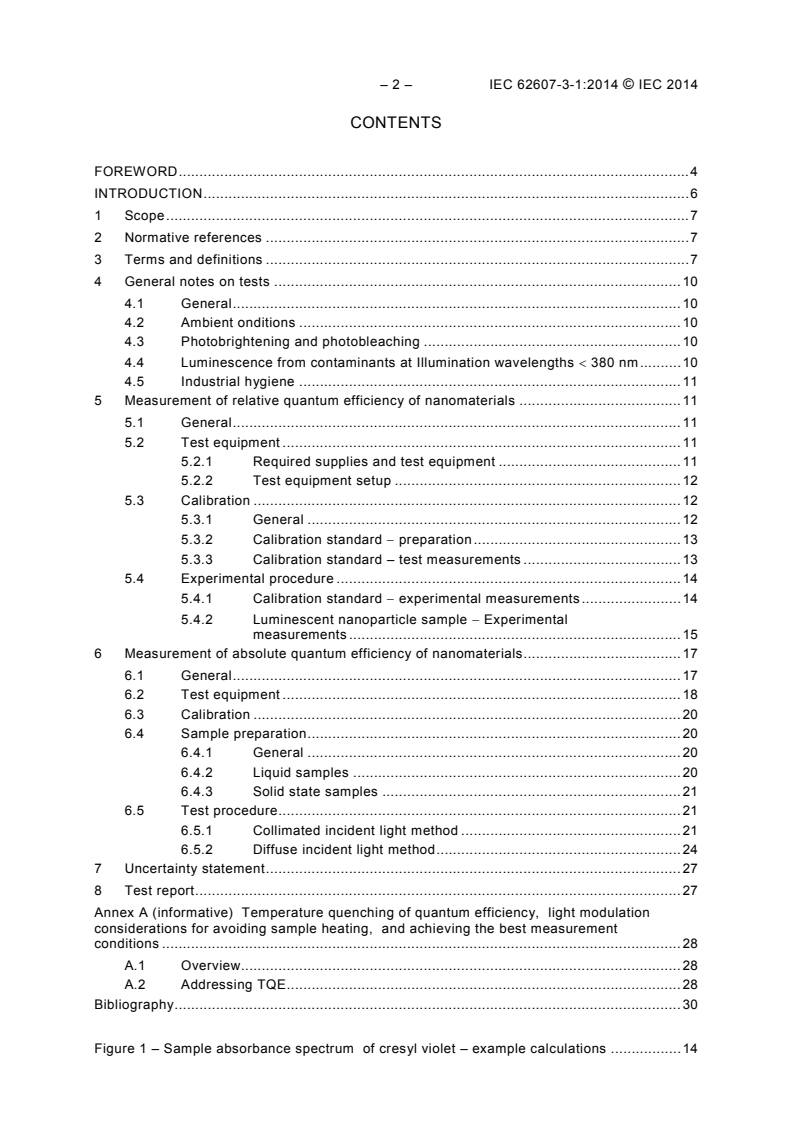
CONTENTS
FOREWORD . 4
INTRODUCTION . 6
1 Scope . 7
2 Normative references . 7
3 Terms and definitions . 7
4 General notes on tests . 10
4.1 General . 10
4.2 Ambient onditions . 10
4.3 Photobrightening and photobleaching . 10
4.4 Luminescence from contaminants at Illumination wavelengths < 380 nm . 10
4.5 Industrial hygiene . 11
5 Measurement of relative quantum efficiency of nanomaterials . 11
5.1 General . 11
5.2 Test equipment . 11
5.2.1 Required supplies and test equipment . 11
5.2.2 Test equipment setup . 12
5.3 Calibration . 12
5.3.1 General . 12
5.3.2 Calibration standard − preparation . 13
5.3.3 Calibration standard – test measurements . 13
5.4 Experimental procedure . 14
5.4.1 Calibration standard − experimental measurements . 14
5.4.2 Luminescent nanoparticle sample − Experimental
measurements . 15
6 Measurement of absolute quantum efficiency of nanomaterials . 17
6.1 General . 17
6.2 Test equipment . 18
6.3 Calibration . 20
6.4 Sample preparation . 20
6.4.1 General . 20
6.4.2 Liquid samples . 20
6.4.3 Solid state samples . 21
6.5 Test procedure . 21
6.5.1 Collimated incident light method . 21
6.5.2 Diffuse incident light method . 24
7 Uncertainty statement . 27
8 Test report . 27
Annex A (informative) Temperature quenching of quantum efficiency, light modulation
considerations for avoiding sample heating, and achieving the best measurement
conditions . 28
A.1 Overview. 28
A.2 Addressing TQE . 28
Bibliography . 30
Figure 1 – Sample absorbance spectrum of cresyl violet – example calculations . 14
Figure 2 – Schematic of the test equipment configuration for both the collimated
incident light and diffuse incident light methods . 18
Figure 3 – Sample spectrum for collimated incident light method . 23
Figure 4 – Sample spectra for the diffuse incident light method. 26
Figure A.1 – Example of transient behaviour of luminescent material (YAG:Ce) under
pulsed excitation . 28
Figure A.2 – Schematic diagram of variation of normalised QE with average excitation
power and the preferred range of input power (indicated by vertical lines) . 29
Table 1 – Example fluorescence methods for relative measurements . 12
Table 2 – Suggested calibration standards for relative quantum efficiency
measurements of luminescent nanoparticle solutions . 13
Table 3 – Spreadsheet format for quantum efficiency data comparisons . 16
Table 4 – Spreadsheet format for quantum efficiency data comparisons . 17
Table 5 – Comparison of methods for measuring the absolute quantum efficiency of
luminescent nanoparticles. 18
– 4 – IEC 62607-3-1:2014 © IEC 2014
INTERNATIONAL ELECTROTECHNICAL COMMISSION
____________
NANOMANUFACTURING –
KEY CONTROL CHARACTERISTICS
Part 3-1: Luminescent nanomaterials –
Quantum efficiency
FOREWORD
1) The International Electrotechnical Commission (IEC) is a worldwide organization for standardization comprising
all national electrotechnical committees (IEC National Committees). The object of IEC is to promote
international co-operation on all questions concerning standardization in the electrical and electronic fields. To
this end and in addition to other activities, IEC publishes International Standards, Technical Specifications,
Technical Reports, Publicly Available Specifications (PAS) and Guides (hereafter referred to as “IEC
Publication(s)”). Their preparation is entrusted to technical committees; any IEC National Committee interested
in the subject dealt with may participate in this preparatory work. International, governmental and non-
governmental organizations liaising with the IEC also participate in this preparation. IEC collaborates closely
with the International Organization for Standardization (ISO) in accordance with conditions determined by
agreement between the two organizations.
2) The formal decisions or agreements of IEC on technical matters express, as nearly as possible, an international
consensus of opinion on the relevant subjects since each technical committee has representation from all
interested IEC National Committees.
3) IEC Publications have the form of recommendations for international use and are accepted by IEC National
Committees in that sense. While all reasonable efforts are made to ensure that the technical content of IEC
Publications is accurate, IEC cannot be held responsible for the way in which they are used or for any
misinterpretation by any end user.
4) In order to promote international uniformity, IEC National Committees undertake to apply IEC Publications
transparently to the maximum extent possible in their national and regional publications. Any divergence
between any IEC Publication and the corresponding national or regional publication shall be clearly indicated in
the latter.
5) IEC itself does not provide any attestation of conformity. Independent certification bodies provide conformity
assessment services and, in some areas, access to IEC marks of conformity. IEC is not responsible for any
services carried out by independent certification bodies.
6) All users should ensure that they have the latest edition of this publication.
7) No liability shall attach to IEC or its directors, employees, servants or agents including individual experts and
members of its technical committees and IEC National Committees for any personal injury, property damage or
other damage of any nature whatsoever, whether direct or indirect, or for costs (including legal fees) and
expenses arising out of the publication, use of, or reliance upon, this IEC Publication or any other IEC
Publications.
8) Attention is drawn to the Normative references cited in this publication. Use of the referenced publications is
indispensable for the correct application of this publication.
9) Attention is drawn to the possibility that some of the elements of this IEC Publication may be the subject of
patent rights. IEC shall not be held responsible for identifying any or all such patent rights.
International Standard IEC 62607-3-1 has been prepared by IEC technical committee 113:
Nanotechnology standardization for electrical and electronic products and systems.
The text of this standard is based on the following documents:
FDIS Report on voting
113/214/FDIS 113/219/RVD
Full information on the voting for the approval of this standard can be found in the report on
voting indicated in the above table.
This publication has been drafted in accordance with the ISO/IEC Directives, Part 2.
A list of all parts of the IEC 625607 series, published under the general title
Nanomanufacturing – Key control characteristics, can be found on the IEC website.
The committee has decided that the contents of this publication will remain unchanged until
the stability date indicated on the IEC web site under "http://webstore.iec.ch" in the data
related to the specific publication. At this date, the publication will be
• reconfirmed,
• withdrawn,
• replaced by a revised edition, or
• amended.
IMPORTANT – The 'colour inside' logo on the cover page of this publication indicates
that it contains colours which are considered to be useful for the correct
understanding of its contents. Users should therefore print this document using a
colour printer.
– 6 – IEC 62607-3-1:2014 © IEC 2014
INTRODUCTION
One of the principal drivers of solid-state lighting (SSL) is the potential efficiency of the
illumination devices to convert electricity into light. Incandescent and fluorescent lighting
devices are only about 5 % to 30 % efficient, with incandescent lighting having the lowest
efficiency. Since a significant portion of all electricity consumed is used in providing lighting,
increasing the efficiency of lighting devices will have a huge impact on the world’s energy
consumption. The luminous efficiency of SSL devices is a critical measurement of their overall
efficiency, and standard methods to perform these measurements have been established and
were essential to producing reliable product information for manufacturers and consumers.
The same is true of the luminescent materials on which these light-emitting diode (LED)
manufacturers rely; however, no such standard currently exists. This standard provides SSL
manufacturers a universal means for comparing luminescent nanomaterials from different
suppliers, and potentially for luminescent materials for LEDs in general.
The most common SSL devices are composed of a blue light-emitting diode (LED) and a
luminescent material. The blue LED optically excites the luminophore, which will radiate light
of the appropriate colour or colours to yield the desired white spectrum. This device, termed a
phosphor-converted light emitting diode (or pc-LED), converts the electricity indirectly into
white light by first creating blue light and then converting the blue light into broad-band visible
radiation. Currently, quantum dots (QDs) or nanophosphors are one option for the
photoluminescent material that converts the blue LED wavelength to broad spectrum visible
light. QDs and nanophosphors are of interest in this application for several reasons including
their greater colour flexibility, narrowband emission spectrum, broadband absorption, near-
infinite flocculation time, reduced bleaching, and lower scattering compared to conventional
phosphors which are typically larger than 5 µm. QD-enabled pc-LEDs have been shown to
have the best possible combination of colour rendering, correlated colour temperature, and
luminous efficiency of any other pc-LED on the market.
A critical measurement parameter for luminescent materials used in the lighting industry is
quantum efficiency, which is defined in this standard as the number of photons emitted into
free space by a luminescent nanoparticle divided by the number of photons absorbed by the
nanoparticle. Suppliers of QDs and luminescent nanomaterials typically measure only relative
quantum efficiency (or alternatively, quantum yield) in the solution phase due to the ease of
such measurements and the applicability of such measurements to biomedical imaging (a
widespread use of QDs in R&D). These measurements are often taken at low concentrations
where effects such as nanoparticle agglomeration and re-absorption are minimized. However,
in end-use applications, the actual concentration of luminescent nanomaterials may be
significantly different. For example, concentrated luminescent nanoparticle formulations (in
either solid or liquid state) may be required to achieve a desired luminous flux and correlated
colour temperature in a SSL device. This standard codifies that method for the first time, and
establishes an absolute quantum efficiency test method for both solid (e.g., luminescent
nanoparticles embedded in polymer matrices, coated on glass optics, applied directly to light
emitted diodes, and other form factors) and solution samples (e.g., colloidal suspensions of
luminescent nanoparticles), enabling suppliers and purchasers to compare the performance of
one material to another, both in their raw (solution) phase as well as their technologically
relevant (solid) phase of matter.
NANOMANUFACTURING –
KEY CONTROL CHARACTERISTICS
Part 3-1: Luminescent nanomaterials –
Quantum efficiency
1 Scope
This part of IEC 62607 describes the procedures to be followed and precautions to be
observed when performing reproducible measurements of the quantum efficiency of
luminescent nanomaterials. Luminescent nanomaterials covered by this method include nano-
objects such as quantum dots, nanophosphors, nanoparticles, nanofibers, nanocrystals,
nanoplates, and structures containing these materials. The nanomaterials may be dispersed
in either a liquid state (e.g., colloidal dispersion of quantum dots) or solid-state (e.g.,
nanofibers containing luminescent nanoparticles). This standard covers both relative
measurements of liquid state luminescent nanomaterials and absolute measurements of both
solid and liquid state nanomaterials.
2 Normative references
The following documents, in whole or in part, are normatively referenced in this document and
are indispensable for its application. For dated references, only the edition cited applies. For
undated references, the latest edition of the referenced document (including any
amendments) applies.
CIE 017/E:2011, International Lighting Vocabulary
3 Terms and definitions
For the purposes of this document, the terms and definitions given in CIE 017/E:2011 as well
as the following terms and definitions apply.
NOTE See also ISO TS 80004-2 (in preparation).
3.1
absorbance
negative base 10 logarithm of the ratio of the intensity of light (I) that has passed through and
transmitted by a sample to the incident intensity (I ) at a specified wavelength
o
Note 1 to entry: Expressed mathematically, absorbance = -log(I/I ). Proper corrections are required for other
o
losses (e.g., reflection and scattering) for this equation to be correct.
3.2
absorptance
ratio of the radiant or luminous flux in a given spectral interval that is absorbed by a medium
to that of the incident light source
Note 1 to entry: The sum of the hemispherical reflectance, the hemispherical transmittance, and the absorptance
is one.
3.3
absorption
process by which matter removes photons from incident light and converts it to another form
of energy such as heat
– 8 – IEC 62607-3-1:2014 © IEC 2014
Note 1 to entry: All of the incident photon flux is accounted for by the processes of absorption, reflection, and
transmission.
3.4
collimated incident light method
method of determining absolute quantum efficiency that utilizes a collimated light beam, such
as a laser, which is introduced into an integrating sphere containing the sample to be
measured
3.5
diffuse incident light method
a method of determining absolute quantum efficiency that utilizes a diffuse light beam from a
laser, light emitting diode or other source, which is introduced into an integrating sphere
containing the sample to be measured
3.6
matrix
components of a sample other than the material being analyzed
Note 1 to entry: Matrix materials are typically inert organic or inorganic materials that contain luminescent
nanoparticles.
3.7
nanomaterial
classification of materials that encompasses both nano-objects and nanostructured materials
Note 1 to entry: Nano-objects are materials with one, two, or three dimensions in the size range from 1 to 100
nanometres.
3.8
optical density
OD
negative base 10 logarithm of the ratio of the intensity of light that has passed through a
sample, at a specified wavelength, to the intensity of the incident light source at that
wavelength
Note 1 to entry: The abbreviation for optical density is OD. The optical density and absorbance of a sample are
the same, if reflection losses have first been taken into account.
3.9
photobleaching
phenomenon occurring in luminescent nanomaterials in which the fluorescent characteristic of
the nanomaterial is degraded or destroyed by the light exposure necessary to initiate
photoluminescence
Note 1 to entry: The net result of photobleaching is a decrease in quantum efficiency over time.
3.10
photobrightening
phenomenon occurring in quantum dots and other luminescent nanomaterials in which the
intensity of light emission from the nanomaterials, at a constant incidence flux, gradually
increases over a period of time
Note 1 to entry: The net result of photobrightening is an increase in quantum efficiency over time.
3.11
power conversion efficiency
ratio of the optical power in the emitted radiation divided by the optical power required to
produce the radiation
3.12
quantum dot
semiconductor nanocrystal that exhibits size dependent properties due to quantum
confinement effects on the electronic states
3.13
quantum efficiency
efficiency of photon emission from luminescent nanoparticles
Note 1 to entry: Quantum efficiency is also known as quantum yield.
Note 2 to entry: Quantum efficiency for luminescent nanomaterials is the ratio of the number of emitted photons to
the number of absorbed photons. For the purposes of this standard, the measured quantum efficiency is a measure
of the photons radiated by the luminescent nanomaterials into free space, and is more a measure of external
quantum efficiency.
3.14
relative quantum efficiency
quantum efficiency measured relative to that of a well-characterized standard reference
material
3.15
absolute quantum efficiency
quantum efficiency determined by measuring a value directly proportional to the number of
photons emitted and absorbed
Note 1 to entry: The calibration standards used to determine absolute quantum efficiency shall be traceable to
primary standards or national reference standards (e.g. NIST).
3.16
external quantum efficiency
ratio of the total number of photons emitted into free space by a luminescent material to the
number of photons absorbed by the material
Note 1 to entry: For the purposes of this standard, external quantum efficiency (EQE) and quantum efficiency are
used interchangeability.
3.17
internal quantum efficiency
ratio of the total number of photons emitted by a luminescent material internal to a device or
material, to the number of photons absorbed by the material, regardless of whether the
photons are emitted into free space
Note 1 to entry: The distinction between internal quantum efficiency (IQE) and external quantum efficiency (EQE)
is that IQE includes all photons emitted by a luminescent material whereas EQE includes only those photons
emitted into free space.
3.18
radiant energy
Q
energy travelling as electromagnetic waves
Note 1 to entry: Radiant energy is usually expressed in joules or watts times seconds. A quantum of radiant
energy is a photon.
3.19
radiant flux
Φ
time rate flow of radiant energy
Note 1 to entry: Radiant flux is typically expressed in watts
– 10 – IEC 62607-3-1:2014 © IEC 2014
3.20
spectral radiant flux
radiant flux per unit wavelength interval at a given wavelength (λ)
Note 1 to entry: Spectral radiant flux is typically denoted by Φ , which is equivalent to dΦ/dλ, and is usually
λ
expressed in units of watts per nm.
3.21
standard reference material
SRM
material which has been characterized to be sufficiently homogeneous and stable with respect
to one or more specified properties
Note 1 to entry: SRMs are accompanied by a certificate which certifies the values of these properties that have
been established with traceability to the accurate realization of the unit and each certified value includes a stated
nd
uncertainty with a given level of confidence (see also SIPM Metrology brochure, 2 edition, December 2003).
4 General notes on tests
4.1 General
It is recommended that good laboratory practices be exercised in conducting measurements
on the quantum efficiency of luminescent nanomaterials as described in this document. In
particular, the area where measurements are taken should be clean and free of dirt and
debris and their sources.
4.2 Ambient onditions
Test equipment shall be located in an area with stable ambient (25 ± 2) °C, relative humidity,
and consistent air flow. Locations underneath heating, ventilation, or air conditioning vents or
by large fans shall be avoided since the change in air movement may adversely impact
measurements. Ambient room temperature shall be measured in a consistent manner and
reported with test results. When measuring room temperature, the temperature sensor shall
be shielded from direct optical radiation from any source.
In addition, since stray light could influence the measurement results, background lighting
should be held to the lowest possible level during all measurements.
4.3 Photobrightening and photobleaching
When irradiated with high intensity excitation sources, luminescent nanoparticles can exhibit
both photobrightening (where the emission efficiency of the material increases during
irradiation) and photobleaching (where the emission efficiency decreases during irradiation).
Photobrightening can be either reversible (whereby the efficiency equilibrates to the original
value once the excitation source is removed from the sample) or irreversible. Photobleaching
is often irreversible due to physical damage or degradation of the material. These two
phenomena can lead to erroneous efficiency measurements and therefore, care should be
taken to eliminate or reduce their effects during measurement by closely monitoring the light
exposure history of the sample. Consideration should be given to the excitation power applied
to the sample (should be minimized while not sacrificing signal-to-noise) as well as the
exposure time the excitation is applied to the sample (should be kept to a minimum while not
sacrificing signal-to-noise).
4.4 Luminescence from contaminants at Illumination wavelengths < 380 nm
Airborne contaminants such as smoke, hydrocarbons and fabric lint can accumulate in an
integrating sphere over time. These contaminants can fluoresce under UV irradiation
(< 380 nm) and hence cause attenuation of excitation signal and/or emission signal. In
addition, some highly reflecting materials used for coating the integrating spheres may exhibit
intrinsic parasitic emissions that cannot be removed by cleaning the sphere. The fluorescence
effect is amplified because of multiple reflections inside the integrating sphere. Therefore, it is
important to characterize the fluorescence properties of the integrating sphere and make
suitable corrections particularly while conducting measurements with UV excitation sources.
Procedures are available for correcting for this stray luminescence [1,2] .
4.5 Industrial hygiene
Limited information is presently available on the environmental, health, and safety effects of
nanomaterials in general. As such, the effects of human exposure to nanomaterials are
unknown, however international exposure standards are under development. Prudent
laboratory methods should be followed to minimize exposure to nanomaterials until additional
information is available. Information and recommendations on the safe handling of
nanomaterials are available and should be consulted.
NOTE One reference is U.S. National Institute for Occupational Safety and Health publication 2009-125 [3].
5 Measurement of relative quantum efficiency of nanomaterials
5.1 General
Relative measurements of quantum efficiency are performed using a standard reference
material with well-characterized properties. Due to the widespread use of relative
measurement methods, there are a number of references that describe the instrumentation
and setup procedures for fluorescence measurements [4, 5, 6, 7]. An example of a standard
reference material used in relative quantum efficiency measurements is the use of a
fluorescent organic dye of known quantum efficiency in determining the quantum efficiency of
a colloidal suspension of quantum dots. Examples of the quantum efficiency of some typical
standards can be found elsewhere [8]. The initial step of this procedure is to prepare a
calibration curve over a specific spectral region using the fluorescent organic dye. The
quantum efficiency of a sample is then determined relative to this calibration curve.
Measurements of this type are typically performed on liquid-phase materials, as the
fluorescent dye standards may be readily produced as liquid solutions of known
concentrations.
5.2 Test equipment
5.2.1 Required supplies and test equipment
Test equipment for relative measurements of quantum efficiency shall include the following:
– standard fluorescence quartz cuvette of known path length. In the discussion below, it is
assumed that cuvettes with a path length of 10 mm are used. If different sizes of cuvettes
are used, appropriate adjustments in solution volumes may be necessary;
NOTE Incomplete cleaning of the cuvettes may leave residues that could negatively impact quantum
efficiency measurements. It is good practice to acid-wash all quartz cuvettes before use to ensure that all
residual quantum dots are removed from the cuvette prior to measurements.
– microbalance;
– microsyringe;
– spectrophotometer with diffuse transmittance capability that measures absorption over the
spectral region of interest (typically the ultraviolet and visible (UV-Vis) regions).
Wavelength calibration of the spectrophotometer should be verified at least annually using
a light source of well-characterized emission wavelengths, such as a mercury argon
calibration source;
– fluorescence spectrophotometer capable of producing excitation radiation in the spectral
region of interest (typically UV-Vis) and measuring the excitation and emitted radiation.
Additional information on the setup and calibration of fluorescence spectrophotometers
—————————
Numbers in square brackets refer to the Bibliography.
– 12 – IEC 62607-3-1:2014 © IEC 2014
can be found elsewhere [4, 5, 6, 7,9,13]. Typically the excitation radiation is produced by a
monochromated discharge lamp with an adjustable slit at the exit of the monochromator to
control peak full-width-at-half-maximum (FWHM). Emitted radiation from the sample
typically passes through additional optics including an emission slit and monochromator,
and then strikes the detector (e.g., photomultiplier tube). A calibration file for the spectral
response of the emission monochromator and detector is needed and should either be
obtained from the instrument manufacturer or created from a calibrated light source.
5.2.2 Test equipment setup
5.2.2.1 UV-Vis spectrophotometer
The UV-Vis spectrophotometer shall be set to scan the spectral region of interest, which is
typically set from 300 nm to 800 nm. Acquisition parameters for the spectrophotometer shall
be adjusted to achieve an optimal signal-to-noise ratio. For example, the minimum
absorbance shall be set at -0,05 and the maximum absorbance set at 1,00.
5.2.2.2 Fluorescence spectrophotometer
In measuring sample fluorescence with a fluorescence spectrophotometer, it is necessary to
specify an excitation wavelength and wavelengths to start and end collection of the emission
spectra. In choosing these wavelengths, consideration should be given to minimize the
overlap region between the red edge of the excitation spectrum and blue edge of the emission
spectrum where re-absorption of the fluorescence occurs. Evidence has shown that the OD in
the overlap region is typically less than 0,05 to minimize re-absorption or inner-filter effects.
In addition, the slit width on both the excitation and emission monochromators shall normally
be set to the same value (see Table 1). In determining the slit width, there is a trade-off
between signal intensity and peak resolution. It is recommended that the slit width be set to
the minimum value that does not adversely affect signal-to-noise ratio. However, the spectral
bandpass conditions (i.e., slit width multiplied by the reciprocal linear dispersion of the
monochromator) shall remain invariant for the measurement of the sample and reference
material. Other spectrophotometer properties such as photomultiplier tube (PMT) voltage shall
also be the same for sample and reference materials.
Since fluorescence measurements are typically carried out over a narrower spectral region
than absorbance measurements, different pre-determined acquisition protocols can be
programmed into many instruments. Representative values from three methods, “Green QY
method”, “Red QY method – high QY”, and “Red QY method – low QY” are provided in
Table 1. In this example, QY stands for quantum yield. Different methods (and associated
fluorescent material standards) would be required for other spectral regions of interest.
Table 1 – Example fluorescence methods for relative measurements
Green QY method Red QY method – high QY Red QY method – low QY
Excitation 465 nm 540 nm 530 nm
Start collection 470 nm 545 nm 540 nm
End collection 700 nm 800 nm 850 nm
Excitation slit 2,5 nm 2,5 nm 2,5 nm
Emission slit 2,5 nm 2,5 nm 2,5 nm
PMT detector voltage Medium Medium High
5.3 Calibration
5.3.1 General
Fluorescent materials with well characterized quantum efficiencies shall be used as
calibration standards for relative measurements of solutions. In choosing a reference material,
it is important that the excitation wavelength of the reference material be similar to the
expected excitation wavelength of the sample in the intended application. It is also important
that the quantum efficiency of the reference material used in relative quantum efficiency
measurements be equal to or greater than the expected value for the samples undergoing
test. For SSL applications, the excitation wavelength often resides between 440 nm and
470 nm, although other excitation wavelengths may be used. The emission wavelength of the
standard should also be similar to that of the luminescent nanomaterials sample. A list of
potential reference materials may be found in reference [8] and other sources. Depending
upon the spectral region of interest, multiple fluorescent materials may be required to provide
accurate calibration. Examples of possible quantum efficiency calibration standards for
relative measurements are provided in Table 2. Calibration standards for other wavelengths of
interest can be found in reference [8].
Table 2 – Suggested calibration standards for relative quantum
efficiency measurements of luminescent nanoparticle solutions
Fluorescent Solvent Excitation Emission Method Quantum Reference
standard wavelength wavelength used efficiency
range
(nm) (nm)
Rhodamine 560 Ethanol 465 470 – 700 Green 0,92 10
Cresyl Violet Methanol 540 540 – 850 Red 0,54 8,11
Rhodamine 101 Ethanol 465, 540 450 – 750 Green, red 1,00 8,12
5.3.2 Calibration standard − preparation
5.3.2.1 Concentrated stock solution
Using a microbalance, weigh out approximately 2 mg of the fluorescent calibration standard in
a 20 ml vial. Dissolve the dye in 10 ml of the appropriate solvent to create a concentrated
stock solution of the calibration standard.
5.3.2.2 Dilute stock solution
Remove 2 ml of the concentrated stock solution via syringe and place it into a 20 ml vial.
Dilute the solution with an additional 8 ml of original solvent to create the dilute stock solution
of the calibration standard.
5.3.3 Calibration standard – test measurements
5.3.3.1 Initial measurement
Remove 2,5 ml of solvent and place into a quartz cuvette. Then run a baseline in the UV-Vis
spectrophotometer.
Using a microsyringe, add 100 µL of the calibration standard dilute stock solution to the
cuvette and mix well.
Take an absorbance measurement on the UV-Vis spectrophotometer and note the optical
density (OD) at the excitation wavelength of choice.
5.3.3.2 Maximum concentration measurements
Divide the noted OD by 100 in order to calculate an OD/µL stock solution ratio. With this
number, concentrate or dilute the quartz cuvette solution to the point where the OD at the
excitation wavelength is 0,05 (see Figure 1).
Check this calculation by taking an absorbance measurement on the spectrophotometer.
– 14 – IEC 62607-3-1:2014 © IEC 2014
Using the methods described in 5.2.2.2, take a measurement using the fluorescence
spectrophotomer. This will ensure that the maximum concentration does not produce a non-
linear response, such as saturation, in the detector of the fluorescence spectrophotomer. If
this is occurring, then the method parameters must be adjusted.
100 uL dilute stock solution, 2,5 mL methanol
Excitation wavelength of choice: 530 nm
OD at 530 nm = 0,05
0,15
OD / uL ratio =
0,05 / 100 uL =
0,0005 / 1 uL
Using this ratio …
0,1
10 uL = 0,005 OD
20 uL = 0,010 OD
60 uL = 0,030 OD
100 uL = 0,050 OD
140 uL = 0,070 OD
0,05
180 uL = 0,090 OD
200 uL = 0,100 OD
300 400 500 600 700 800
Wavelength, nm
IEC 1696/14
Figure 1 – Sample absorbance spectrum
of cresyl violet – example calculations
5.4 Experimental procedure
5.4.1 Calibration standard − experimental measurements
5.4.1.1 Obtaining a baseline
Remove 2,5 ml of the solvent used for the standard reference material and place into a quartz
cuvette. Measure a baseline in the UV-Vis spectrophotometer.
5.4.1.2 Varied concentration measurements
Using the OD/µL stock solution ratio described in 5.3.3.2, calculate the µL of standard dilute
stock solution needed to obtain an absorbance of 0,001, 0,003, 0,005, 0,01, 0,03, and 0,05, at
the excitation wavelength of choice (see Figure 1). These absorbances and the corresponding
integrated emission intensities will be used to create the calibration curve for determining
relative quantum efficiency.
NOTE The OD (i.e., absorbance) should not exceed 0,05 due to non-linear behaviour in the Beer-Lambert law,
including re-absorption effects, associated with higher concentrations.
Add the appropriate initial
...