

IEC 60050-851:2008
(Main)International Electrotechnical Vocabulary (IEV) - Part 851: Electric welding
General Information
- Abstract
IEC 60050-851:2008, which is a part of the IEV, defines terms specifically relevant to electric welding. This second edition cancels and replaces the first edition published in 1991. This edition constitutes a technical revision. This edition included the following significant technical changes with respect to the previous edition: Due to technical and standardisation progress, new entries had to be made in the sections. The changes in this listing are not numbered as the numbering of this edition is different to the previous edition. The changes are as follows:
- Section 11: This section augmented to take into consideration the development in general.
- Section 12: New terms are added taking care of engine (motor) driven equipment and arc striking and stabilizing devices.
- Section 13: New terms dealing with plasma welding equipment.
- Section 14: The terms concerning consumables had to be enlarged and terms concerning welding equipment such as wire feeders, cooling systems and gas consoles are added.
- Section 15: This section is completely new with the exception of two terms.
It has the status of a horizontal standard in accordance with IEC Guide 108.
- Status
- Published
- Publication Date
- 10-Jun-2008
- Technical Committee
- TC 1 - Terminology
- Drafting Committee
- JWG 2 - TC 59/JWG 2
- Current Stage
- PPUB - Publication issued
- Start Date
- 11-Jun-2008
- Completion Date
- 28-Feb-2008
Overview
IEC 60050-851:2008 – International Electrotechnical Vocabulary (IEV), Part 851: Electric welding – is a critical standard published by the International Electrotechnical Commission (IEC). This standard provides a comprehensive set of internationally-agreed terms and definitions specifically related to electric welding. Serving as a part of the broader IEV series, IEC 60050-851 supports clear communication, consistency, and interoperability across electric welding technologies and industries worldwide.
This second edition, published in 2008, is a technical revision that reflects recent advancements and standardization in electric welding. Significant updates include the expansion of terminology related to engine-driven equipment, arc striking and stabilizing devices, plasma welding equipment, consumables, wire feeders, cooling systems, gas consoles, and safety equipment.
Key Topics
IEC 60050-851:2008 organizes electric welding terminology into several key sections:
General Terms (Section 11)
Definitions foundational to the field of electric welding, including types of welding processes, types of joints, and related concepts such as fusion and resistance welding.Electric and Thermal Characteristics (Section 12)
Terms addressing the electrical and thermal properties of welding equipment, including newly introduced terminology for engine-driven and arc control devices.Welding Power Sources (Section 13)
Vocabulary specific to power sources used in various electric welding processes, with the inclusion of terms relevant to plasma welding equipment.Welding Accessories and Consumables (Section 14)
Expanded definitions for welding consumables, wire feeders, cooling systems, and gas consoles, reflecting recent industry developments.Safety Equipment (Section 15)
A newly introduced section (excluding two terms from previous editions) dedicated to defining safety equipment necessary for electric welding environments.
This structure ensures the standard covers the essential components, operations, and environments where electric welding takes place.
Applications
IEC 60050-851:2008 is a valuable resource across a broad spectrum of industries and applications:
- Manufacturing and Fabrication: Ensures a common understanding of electric welding terms, supporting the design, operation, and quality control of welded structures and products.
- Training and Certification: Provides authoritative definitions for use in technician and engineer training, certification examinations, and skill assessments in welding technology.
- Product Documentation and Labeling: Assists manufacturers in accurately describing welding equipment, accessories, and consumables for global markets.
- Standard Compliance and Safety: Supports regulatory compliance and the implementation of effective safety procedures in electric welding operations.
- R&D and Technical Communication: Facilitates effective technical writing, research, and international collaboration by standardizing terminology.
By providing multilingual definitions (including English, French, Russian, and additional languages), the standard is accessible to a global audience, reducing ambiguity in communication.
Related Standards
IEC 60050-851:2008 is part of the larger IEC 60050 vocabulary series, which standardizes terms across the electrotechnical spectrum. Key related standards include:
- IEC 60050 (IEV) Series – Covers terminology for various domains such as electromagnetic compatibility, rotating machines, and automation.
- IEC 60529 – Degrees of protection provided by enclosures (IP Code), referenced for applications involving electric welding equipment safety and classification.
- IEC Guide 108 – Guidance for the application and status of horizontal standards, which includes terminology standards like IEC 60050-851.
- ISO/IEC 2382 – Provides terms in information technology, sometimes referenced in multidisciplinary contexts.
For updated and harmonized welding terminology, organizations, educators, and professionals should regularly consult IEC 60050-851:2008 alongside these related international standards.
By establishing a clear, unified vocabulary for electric welding, IEC 60050-851:2008 drives enhanced safety, product consistency, and cross-border cooperation in the welding industry.
Relations
- Effective Date
- 25-Aug-2026
- Effective Date
- 25-Aug-2026
- Effective Date
- 25-Aug-2026
- Effective Date
- 25-Aug-2026
- Effective Date
- 25-Aug-2026
- Effective Date
- 25-Aug-2026
- Effective Date
- 20-Feb-2026
- Effective Date
- 20-Feb-2026
- Effective Date
- 20-Feb-2026
- Effective Date
- 20-Feb-2026
- Effective Date
- 20-Feb-2026
- Effective Date
- 20-Feb-2026
- Referred By
EN 61005:2017 - Radiation protection instrumentation - Neutron ambient dose equivalent (rate) meters - Effective Date
- 20-Feb-2026
- Effective Date
- 20-Feb-2026
- Effective Date
- 20-Feb-2026
Get Certified
Connect with accredited certification bodies for this standard

DVS-ZERT GmbH
German welding certification society.
CARES (UK Certification Authority for Reinforcing Steels)
UK certification for reinforcing steels and construction.
EWF/IIW (European/International Welding Federation)
International welding personnel certification.
Sponsored listings
Frequently Asked Questions
IEC 60050-851:2008 is a standard published by the International Electrotechnical Commission (IEC). Its full title is "International Electrotechnical Vocabulary (IEV) - Part 851: Electric welding". This standard covers: IEC 60050-851:2008, which is a part of the IEV, defines terms specifically relevant to electric welding. This second edition cancels and replaces the first edition published in 1991. This edition constitutes a technical revision. This edition included the following significant technical changes with respect to the previous edition: Due to technical and standardisation progress, new entries had to be made in the sections. The changes in this listing are not numbered as the numbering of this edition is different to the previous edition. The changes are as follows: - Section 11: This section augmented to take into consideration the development in general. - Section 12: New terms are added taking care of engine (motor) driven equipment and arc striking and stabilizing devices. - Section 13: New terms dealing with plasma welding equipment. - Section 14: The terms concerning consumables had to be enlarged and terms concerning welding equipment such as wire feeders, cooling systems and gas consoles are added. - Section 15: This section is completely new with the exception of two terms. It has the status of a horizontal standard in accordance with IEC Guide 108.
IEC 60050-851:2008, which is a part of the IEV, defines terms specifically relevant to electric welding. This second edition cancels and replaces the first edition published in 1991. This edition constitutes a technical revision. This edition included the following significant technical changes with respect to the previous edition: Due to technical and standardisation progress, new entries had to be made in the sections. The changes in this listing are not numbered as the numbering of this edition is different to the previous edition. The changes are as follows: - Section 11: This section augmented to take into consideration the development in general. - Section 12: New terms are added taking care of engine (motor) driven equipment and arc striking and stabilizing devices. - Section 13: New terms dealing with plasma welding equipment. - Section 14: The terms concerning consumables had to be enlarged and terms concerning welding equipment such as wire feeders, cooling systems and gas consoles are added. - Section 15: This section is completely new with the exception of two terms. It has the status of a horizontal standard in accordance with IEC Guide 108.
IEC 60050-851:2008 is classified under the following ICS (International Classification for Standards) categories: 01.040.25 - Manufacturing engineering (Vocabularies); 25.160.10 - Welding processes. The ICS classification helps identify the subject area and facilitates finding related standards.
IEC 60050-851:2008 has the following relationships with other standards: It is inter standard links to EN ISO 15118-1:2015, EN 13477-2:2010, EN 4604-006:2025, EN 4604-007:2025, EN 4604-008:2025, EN 4604-003:2025, EN IEC 62822-1:2018, EN 62626-1:2014, EN IEC 61730-1:2018, EN 62822-2:2016, EN 62604-1:2015, EN IEC 62822-3:2023, EN 61005:2017, EN 61970-301:2014, EN 60127-6:2014. Understanding these relationships helps ensure you are using the most current and applicable version of the standard.
IEC 60050-851:2008 is available in PDF format for immediate download after purchase. The document can be added to your cart and obtained through the secure checkout process. Digital delivery ensures instant access to the complete standard document.
Standards Content (Sample)
IEC 60050-851
Edition 2.0 2008-06
INTERNATIONAL
STANDARD
NORME
INTERNATIONALE
International Electrotechnical Vocabulary –
Part 851: Electric welding
Vocabulaire Electrotechnique International –
Partie 851: Soudage électrique
All rights reserved. Unless otherwise specified, no part of this publication may be reproduced or utilized in any form or by
any means, electronic or mechanical, including photocopying and microfilm, without permission in writing from either IEC or
IEC's member National Committee in the country of the requester.
If you have any questions about IEC copyright or have an enquiry about obtaining additional rights to this publication,
please contact the address below or your local IEC member National Committee for further information.
Droits de reproduction réservés. Sauf indication contraire, aucune partie de cette publication ne peut être reproduite
ni utilisée sous quelque forme que ce soit et par aucun procédé, électronique ou mécanique, y compris la photocopie
et les microfilms, sans l'accord écrit de la CEI ou du Comité national de la CEI du pays du demandeur.
Si vous avez des questions sur le copyright de la CEI ou si vous désirez obtenir des droits supplémentaires sur cette
publication, utilisez les coordonnées ci-après ou contactez le Comité national de la CEI de votre pays de résidence.
IEC Central Office
3, rue de Varembé
CH-1211 Geneva 20
Switzerland
Email: inmail@iec.ch
Web: www.iec.ch
About the IEC
The International Electrotechnical Commission (IEC) is the leading global organization that prepares and publishes
International Standards for all electrical, electronic and related technologies.
About IEC publications
The technical content of IEC publications is kept under constant review by the IEC. Please make sure that you have the
latest edition, a corrigenda or an amendment might have been published.
ƒ Catalogue of IEC publications: www.iec.ch/searchpub
The IEC on-line Catalogue enables you to search by a variety of criteria (reference number, text, technical committee,…).
It also gives information on projects, withdrawn and replaced publications.
ƒ IEC Just Published: www.iec.ch/online_news/justpub
Stay up to date on all new IEC publications. Just Published details twice a month all new publications released. Available
on-line and also by email.
ƒ Electropedia: www.electropedia.org
The world's leading online dictionary of electronic and electrical terms containing more than 20 000 terms and definitions
in English and French, with equivalent terms in additional languages. Also known as the International Electrotechnical
Vocabulary online.
ƒ Customer Service Centre: www.iec.ch/webstore/custserv
If you wish to give us your feedback on this publication or need further assistance, please visit the Customer Service
Centre FAQ or contact us:
Email: csc@iec.ch
Tel.: +41 22 919 02 11
Fax: +41 22 919 03 00
A propos de la CEI
La Commission Electrotechnique Internationale (CEI) est la première organisation mondiale qui élabore et publie des
normes internationales pour tout ce qui a trait à l'électricité, à l'électronique et aux technologies apparentées.
A propos des publications CEI
Le contenu technique des publications de la CEI est constamment revu. Veuillez vous assurer que vous possédez
l’édition la plus récente, un corrigendum ou amendement peut avoir été publié.
ƒ Catalogue des publications de la CEI: www.iec.ch/searchpub/cur_fut-f.htm
Le Catalogue en-ligne de la CEI vous permet d’effectuer des recherches en utilisant différents critères (numéro de référence,
texte, comité d’études,…). Il donne aussi des informations sur les projets et les publications retirées ou remplacées.
ƒ Just Published CEI: www.iec.ch/online_news/justpub
Restez informé sur les nouvelles publications de la CEI. Just Published détaille deux fois par mois les nouvelles
publications parues. Disponible en-ligne et aussi par email.
ƒ Electropedia: www.electropedia.org
Le premier dictionnaire en ligne au monde de termes électroniques et électriques. Il contient plus de 20 000 termes et
définitions en anglais et en français, ainsi que les termes équivalents dans les langues additionnelles. Egalement appelé
Vocabulaire Electrotechnique International en ligne.
ƒ Service Clients: www.iec.ch/webstore/custserv/custserv_entry-f.htm
Si vous désirez nous donner des commentaires sur cette publication ou si vous avez des questions, visitez le FAQ du
Service clients ou contactez-nous:
Email: csc@iec.ch
Tél.: +41 22 919 02 11
Fax: +41 22 919 03 00
IEC 60050-851
Edition 2.0 2008-06
INTERNATIONAL
STANDARD
NORME
INTERNATIONALE
International Electrotechnical Vocabulary –
Part 851: Electric welding
Vocabulaire Electrotechnique International –
Partie 851: Soudage électrique
INTERNATIONAL
ELECTROTECHNICAL
COMMISSION
COMMISSION
ELECTROTECHNIQUE
PRICE CODE
INTERNATIONALE
XA
CODE PRIX
ICS 01.040.25; 25.160.10 ISBN 2-8318-9829-3
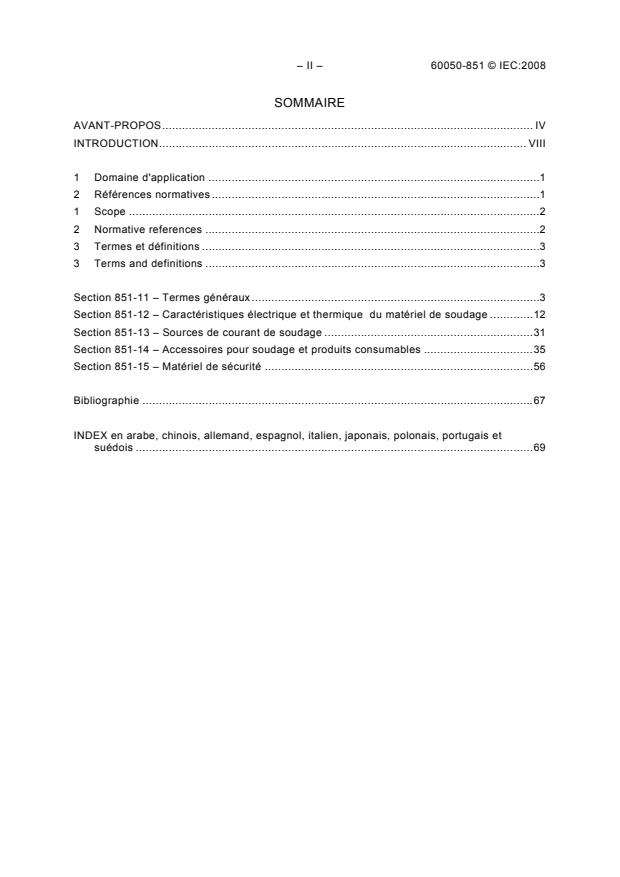
– II – 60050-851 © IEC:2008
SOMMAIRE
AVANT-PROPOS. IV
INTRODUCTION. VIII
1 Domaine d'application .1
2 Références normatives .1
1 Scope .2
2 Normative references .2
3 Termes et définitions .3
3 Terms and definitions .3
Section 851-11 – Termes généraux.3
Section 851-12 – Caractéristiques électrique et thermique du matériel de soudage .12
Section 851-13 – Sources de courant de soudage .31
Section 851-14 – Accessoires pour soudage et produits consumables .35
Section 851-15 – Matériel de sécurité .56
Bibliographie .67
INDEX en arabe, chinois, allemand, espagnol, italien, japonais, polonais, portugais et
suédois .69
60050-851 © IEC:2008 – III –
CONTENTS
FOREWORD. V
INTRODUCTION. IX
1 Scope .2
2 Normative references .2
3 Terms and definitions .3
Section 851-11 – General terms.3
Section 851-12 – Electric and thermal characteristics of welding equipment .12
Section 851-13 – Welding power sources .31
Section 851-14 – Welding accessories and consumables.35
Section 851-15 – Safety equipment .56
Bibliography .68
INDEX in Arabic, Chinese, German, Spanish, Italian, Japanese, Polish, Portuguese
and Swedish.69
– IV – 60050-851 © IEC:2008
COMMISSION ELECTROTECHNIQUE INTERNATIONALE
____________
VOCABULAIRE ELECTROTECHNIQUE INTERNATIONAL
Partie 851: SOUDAGE ÉLECTRIQUE
AVANT-PROPOS
1) La Commission Électrotechnique Internationale (CEI) est une organisation mondiale de normalisation
composée de l'ensemble des comités électrotechniques nationaux (Comités nationaux de la CEI). La CEI a
pour objet de favoriser la coopération internationale pour toutes les questions de normalisation dans les
domaines de l'électricité et de l'électronique. A cet effet, la CEI – entre autres activités – publie des Normes
internationales, des Spécifications techniques, des Rapports techniques, des Spécifications accessibles au
public (PAS) et des Guides (ci-après dénommés "Publication(s) de la CEI"). Leur élaboration est confiée à des
comités d'études, aux travaux desquels tout Comité national intéressé par le sujet traité peut participer. Les
organisations internationales, gouvernementales et non gouvernementales, en liaison avec la CEI, participent
également aux travaux. La CEI collabore étroitement avec l'Organisation Internationale de Normalisation (ISO),
selon des conditions fixées par accord entre les deux organisations.
2) Les décisions ou accords officiels de la CEI concernant les questions techniques représentent, dans la mesure
du possible, un accord international sur les sujets étudiés, étant donné que les Comités nationaux intéressés
sont représentés dans chaque comité d’études.
3) Les publications de la CEI se présentent sous la forme de recommandations internationales et sont agréées
comme tels par les Comités nationaux de la CEI. Tous les efforts raisonnables sont entrepris afin que la CEI
s'assure de l'exactitude du contenu technique de ses publications; la CEI ne peut pas être tenue responsable
de l'éventuelle mauvaise utilisation ou interprétation qui en est faite par un quelconque utilisateur final
4) Dans le but d'encourager l'uniformité internationale, les Comités nationaux de la CEI s'engagent, dans toute la
mesure possible, à appliquer de façon transparente les Publications de la CEI dans leurs publications
nationales et régionales. Toute divergence entre toute Publication de la CEI et toute publication nationale ou
régionale correspondante doit être indiquée en termes clairs dans cette dernière.
5) La CEI n’a fixé aucune procédure concernant le marquage comme indication d’approbation et sa responsabilité
n’est pas engagée quand un matériel est déclaré conforme à l’une de ses normes.
6) Tous les utilisateurs doivent s'assurer qu'ils sont en possession de la dernière édition de cette publication.
7) Aucune responsabilité ne doit être imputée à la CEI, à ses administrateurs, employés, auxiliaires ou
mandataires, y compris ses experts particuliers et les membres de ses comités d'études et des Comités
nationaux de la CEI, pour tout préjudice causé en cas de dommages corporels et matériels, ou de tout autre
dommage de quelque nature que ce soit, directe ou indirecte, ou pour supporter les coûts (y compris les frais
de justice) et les dépenses découlant de la publication ou de l'utilisation de cette Publication de la CEI ou de
toute autre Publication de la CEI, ou au crédit qui lui est accordé.
8) L'attention est attirée sur les références normatives citées dans cette publication. L'utilisation de publications
référencées est obligatoire pour une application correcte de la présente publication.
9) L’attention est attirée sur le fait que certains des éléments de la présente publication CEI peuvent faire l’objet
de droits de propriété intellectuelle ou de droits analogues. La CEI ne saurait être tenue pour responsable de
ne pas avoir identifié de tels droits de propriété ou de ne pas avoir signalé leur existence.
La norme internationale CEI 60050-851 a été établie par le comité d’études 26 de la CEI:
Soudage electrique, sous la responsabilité du comité d'études 1 de la CEI: Terminologie.
Cette deuxième édition annule et remplace la première édition parue en 1991. Cette édition
constitue une révision technique.
Cette édition inclut les modifications techniques majeures suivantes par rapport à l’édition
précédente:
En raison du progrès technique et en normalisation, de nouvelles entrées ont été introduites
dans les sections. Les changements de cette liste ne son pas numérotés car la numérotation
de cette édition est différente à l’édition précédente. Les changements sont comme suit:
Section 11: Cette section est complétée pour répondre au développement en général.
Section 12: De nouveaux termes ont été introduits concernant l'équipement piloté par un
moteur et les dispositifs d’amorçage et stabilisation.
Section 13: De nouveaux termes traitant les équipements pour soudage plasma.
60050-851 © IEC:2008 – V –
INTERNATIONAL ELECTROTECHNICAL COMMISSION
____________
INTERNATIONAL ELECTROTECHNICAL VOCABULARY
Part 851: ELECTRICAL WELDING
FOREWORD
1) The International Electrotechnical Commission (IEC) is a worldwide organization for standardization comprising
all national electrotechnical committees (IEC National Committees). The object of IEC is to promote
international co-operation on all questions concerning standardization in the electrical and electronic fields. To
this end and in addition to other activities, IEC publishes International Standards, Technical Specifications,
Technical Reports, Publicly Available Specifications (PAS) and Guides (hereafter referred to as “IEC
Publication(s)”). Their preparation is entrusted to technical committees; any IEC National Committee interested
in the subject dealt with may participate in this preparatory work. International, governmental and non-
governmental organizations liaising with the IEC also participate in this preparation. IEC collaborates closely
with the International Organization for Standardization (ISO) in accordance with conditions determined by
agreement between the two organizations.
2) The formal decisions or agreements of IEC on technical matters express, as nearly as possible, an international
consensus of opinion on the relevant subjects since each technical committee has representation from all
interested IEC National Committees.
3) IEC Publications have the form of recommendations for international use and are accepted by IEC National
Committees in that sense. While all reasonable efforts are made to ensure that the technical content of IEC
Publications is accurate, IEC cannot be held responsible for the way in which they are used or for any
misinterpretation by any end user.
4) In order to promote international uniformity, IEC National Committees undertake to apply IEC Publications
transparently to the maximum extent possible in their national and regional publications. Any divergence
between any IEC Publication and the corresponding national or regional publication shall be clearly indicated in
the latter.
5) IEC provides no marking procedure to indicate its approval and cannot be rendered responsible for any
equipment declared to be in conformity with an IEC Publication.
6) All users should ensure that they have the latest edition of this publication.
7) No liability shall attach to IEC or its directors, employees, servants or agents including individual experts and
members of its technical committees and IEC National Committees for any personal injury, property damage or
other damage of any nature whatsoever, whether direct or indirect, or for costs (including legal fees) and
expenses arising out of the publication, use of, or reliance upon, this IEC Publication or any other IEC
Publications.
8) Attention is drawn to the Normative references cited in this publication. Use of the referenced publications is
indispensable for the correct application of this publication.
9) Attention is drawn to the possibility that some of the elements of this IEC Publication may be the subject of
patent rights. IEC shall not be held responsible for identifying any or all such patent rights.
International Standard IEC 60050-851 has been prepared by IEC technical committee 26:
Electric welding, under the responsibility of IEC technical committee 1: Terminology.
This second edition cancels and replaces the first edition published in 1991. This edition
constitutes a technical revision.
This edition included the following significant technical changes with respect to the previous
edition:
Due to technical and standardisation progress, new entries had to be made in the sections.
The changes in this listing are not numbered as the numbering of this edition is different to
the preceeding edition. The changes are as follows:
Section 11: This section augmented to take into consideration the development in general.
Section 12: New terms are added taking care of engine (motor) driven equipment and arc
striking and stabilizing devices.
Section 13: New terms dealing with plasma welding equipment.
– VI – 60050-851 © IEC:2008
Section 14 : De nouveaux termes concernant les produits consommables ont été agrandis et
des termes concernant l’équipement de soudage comme dévidoirs, systèmes de
refroidissement et console de gaz ont été introduits.
Section 15: Cette section est complètement nouvelle, à l’exception de deux termes.
Le texte de la présente norme est issu des documents suivants:
FDIS Rapport de vote
1/2028/FDIS 1/2034/RVD
Le rapport de vote indiqué dans le tableau ci-dessus donne toute information sur le vote ayant
abouti à l'approbation de cette norme.
Cette publication a été rédigée selon les Directives ISO/CEI, Partie 2.
Dans la présente partie du VEI, les termes et définitions sont donnés en français et en
anglais: de plus, les termes sont indiqués en arabe (ar), chinois (zh), allemand (de), espagnol
(es), italien (it), japonais (ja), polonais (pl), portugais (pt) et suédois (sv).
Le comité a décidé que le contenu de cette publication ne sera pas modifié avant la date du
résultat de la maintenance indiquée sur le site web de la CEI à l’adresse suivante:
"http://webstore.iec.ch", dans les données liées à la publication spécifique. A cette date, la
publication sera:
• reconduite,
• supprimée,
• remplacée par une édition révisée, ou
• amendée.
60050-851 © IEC:2008 – VII –
Section 14: The terms concerning consumables had to be enlarged and terms concerning
welding equipment such as wire feeders, cooling systems and gas consoles are added.
Section 15: This section is completely new with the exception of two terms.
The text of this standard is based on the following documents:
FDIS Report on voting
1/2028/FDIS 1/2034/RVD
Full information on the voting for the approval of this standard can be found in the report on
voting indicated in the above table.
This publication has been drafted in accordance with the ISO/IEC Directives, Part 2.
In this part of IEV, the terms and definitions are written in French and English; in addition the
terms are given in Arabic (ar), Chinese (zh), German (de), Spanish (es), Italian (it), Japanese
(ja), Polish (pl), Portuguese (pt) and Swedish (sv).
The committee has decided that the contents of this publication will remain unchanged until
the maintenance result date indicated on the IEC web site under "http://webstore.iec.ch" in
the data related to the specific publication. At this date, the publication will be
• reconfirmed,
• withdrawn,
• replaced by a revised edition, or
• amended.
– VIII – 60050-851 © IEC:2008
INTRODUCTION
Principes d’établissement et règles suivies
Généralités
Le VEI (série de normes CEI 60050) est un vocabulaire multilingue à usage général couvrant
le champ de l’électrotechnique, de l’électronique et des télécommunications. Il comprend
environ 18 000 articles terminologiques correspondant chacune à une notion. Ces articles
sont répartis dans environ 80 parties, chacune correspondant à un domaine donné.
Exemples:
Partie 161 (CEI 60050-161): Compatibilité électromagnétique
Partie 411 (CEI 60050-411): Machines tournantes
Les articles suivent un schéma de classification hiérarchique Partie/Section/Notion, les
notions étant, au sein des sections, classées par ordre systématique.
Les termes, définitions et notes des articles sont donnés dans les trois langues de la CEI,
c’est-à-dire français, anglais et russe (langues principales du VEI).
Dans chaque article, les termes seuls sont également donnés dans les langues additionnelles
du VEI (arabe, chinois, allemand, grec, espagnol, italien, japonais, polonais, portugais et
suédois).
De plus, chaque partie comprend un index alphabétique des termes inclus dans cette partie,
et ce pour chacune des langues du VEI.
NOTE Certaines langues peuvent manquer.
Constitution d’un article terminologique
Chacun des articles correspond à une notion, et comprend:
- un numéro d’article,
- éventuellement un symbole littéral de grandeur ou d’unité,
puis, pour chaque langue principale du VEI:
- le terme désignant la notion, appelé “ terme privilégié ”, éventuellement accompagné de
synonymes et d’abréviations,
- la définition de la notion,
- éventuellement la source,
- éventuellement des notes,
et enfin, pour les langues additionnelles du VEI, les termes seuls.
Numéro d’article
Le numéro d’article comprend trois éléments, séparés par des traits d’union:
- Numéro de partie: 3 chiffres,
- Numéro de section: 2 chiffres,
- Numéro de la notion: 2 chiffres (01 à 99).
Exemple: 131-13-22
60050-851 © IEC:2008 – IX –
INTRODUCTION
Principles and rules followed
General
The IEV (IEC 60050 series) is a general purpose multilingual vocabulary covering the field of
electrotechnology, electronics and telecommunication. It comprises about 18 000
terminological entries, each corresponding to a concept. These entries are distributed among
about 80 parts, each part corresponding to a given field.
Examples:
Part 161 (IEC 60050-161): Electromagnetic compatibility
Part 411 (IEC 60050-411): Rotating machines
The entries follow a hierarchical classification scheme Part/Section/Concept, the concepts
being, within the sections, organized in a systematic order.
The terms, definitions and notes in the entries are given in the three IEC languages, that is
French, English and Russian (principal IEV languages).
In each entry, the terms alone are also given in the additional IEV languages (Arabic,
Chinese, German, Greek, Spanish, Italian, Japanese, Polish, Portuguese, and Swedish).
In addition, each part comprises an alphabetical index of the terms included in that part, for
each of the IEV languages.
NOTE Some languages may be missing.
Organization of a terminological entry
Each of the entries corresponds to a concept, and comprises:
- an entry number,
- possibly a letter symbol for quantity or unit,
then, for each of the principal IEV languages:
- the term designating the concept, called “preferred term”, possibly accompanied by
synonyms and abbreviations,
- the definition of the concept,
- possibly the source,
- possibly notes,
and finally, for the additional IEV languages, the terms alone.
Entry number
The entry number is comprised of three elements, separated by hyphens:
- Part number: 3 digits,
- Section number: 2 digits,
- Concept number: 2 digits (00 to 99).
Example: 131-13-22
– X – 60050-851 © IEC:2008
Symboles littéraux de grandeurs et unités
Ces symboles, indépendants de la langue, sont donnés sur une ligne séparée suivant le
numéro d’article.
Exemple:
131-12-04
symb.: R
résistance, f
Terme privilégié et synonymes
Le terme privilégié est le terme qui figure en tête d’un article ; il peut être suivi par des
synonymes. Il est imprimé en gras.
Synonymes:
Les synonymes sont imprimés sur des lignes séparées sous le terme privilégié: ils sont
également imprimés en gras, sauf les synonymes déconseillés, qui sont imprimés en maigre,
et suivis par l’attribut “ (déconseillé) ”.
Parties pouvant être omises:
Certaines parties d’un terme peuvent être omises, soit dans le domaine considéré, soit dans
un contexte approprié. Ces parties sont alors imprimées en gras, entre parenthèses:
Exemple: émission (électromagnétique)
Absence de terme approprié:
Lorsqu’il n’existe pas de terme approprié dans une langue, le terme privilégié est remplacé
par cinq points, comme ceci:
.....
“ ” (et il n’y a alors bien entendu pas de synonymes).
Attributs
Chaque terme (ou synonyme) peut être suivi d’attributs donnant des informations supplé-
mentaires ; ces attributs sont imprimés en maigre, à la suite de ce terme, et sur la même
ligne.
Exemples d’attributs:
- spécificité d’utilisation du terme:
rang (d’un harmonique)
- variante nationale:
unité de traitement CA
- catégorie grammaticale:
électronique, adj
électronique, f
- abréviation:
CEM (abréviation)
- déconseillé:
déplacement (terme déconseillé)
60050-851 © IEC:2008 – XI –
Letter symbols for quantities and units
These symbols, which are language independent, are given on a separate line following the
entry number.
Example:
131-12-04
symb.: R
résistance, f
Preferred term and synonyms
The preferred term is the term that heads a terminological entry; it may be followed by
synonyms. It is printed in boldface.
Synonyms:
The synonyms are printed on separate lines under the preferred term: they are also printed in
boldface, excepted for deprecated synonyms, which are printed in lightface, and followed by
the attribute "(deprecated)".
Parts that may be omitted:
Some parts of a term may be omitted, either in the field under consideration or in an
appropriate context. Such parts are printed in boldface type, and placed in parentheses:
Example: (electromagnetic) emission
Absence of an appropriate term:
When no adequate term exists in a given language, the preferred term is replaced by five
.....
dots, like that: " " (and there are of course no synonyms).
Attributes
Each term (or synonym) may be followed by attributes giving additional information, and
printed on the same line as the corresponding term, following this term.
Examples of attributes:
- specific use of the term:
transmission line (in electric power systems)
- national variant:
lift GB
- grammatical information:
thermoplastic, noun
AC, qualifier
- abbreviation:
EMC (abbreviation)
- deprecated: choke (deprecated)
– XII – 60050-851 © IEC:2008
Source
Dans certains cas, il a été nécessaire d’inclure dans une partie du VEI une notion prise dans
une autre partie du VEI, ou dans un autre document de terminologie faisant autorité (VIM,
ISO/CEI 2382, etc.), dans les deux cas avec ou sans modification de la définition (ou
éventuellement du terme).
Ceci est indiqué par la mention de cette source, imprimée en maigre et placée entre crochets
à la fin de la définition:
Exemple: [131-03-13 MOD]
(MOD indique que la définition a été modifiée)
Termes dans les langues additionnelles du VEI
Ces termes sont placés à la fin de l’article, sur des lignes séparées (une ligne par langue),
précédés par le code alpha-2 de la langue, défini dans l’ISO 639, et dans l’ordre alphabétique
de ce code. Les synonymes sont séparés par des points-virgules.
60050-851 © IEC:2008 – XIII –
Source
In some cases, it has been necessary to include in an IEV part a concept taken from another
IEV part, or from another authoritative terminology document (VIM, ISO/IEC 2382, etc.), in
both cases with or without modification to the definition (and possibly to the term).
This is indicated by the mention of this source, printed in lightface, and placed between
square brackets at the end of the definition.
Example: [131-03-13 MOD]
(MOD indicates that the definition has been modified)
Terms in additional IEV languages
These terms are placed at the end of the entry, on separate lines (one single line for each
language), preceded by the alpha-2 code for the language defined in ISO 639, and in the
alphabetic order of this code. Synonyms are separated by semicolons.
– 1 – 60050-851 © IEC:2008
VOCABULAIRE ÉLECTROTECHNIQUE INTERNATIONAL
Partie 851: SOUDAGE ÉLECTRIQUE
1 Domaine d'application
La présente partie de la CEI 60050 définit les termes relatifs spécifiquement au soudage
electrique.
2 Références normatives
Les documents de référence suivants sont indispensables pour l'application du présent
document. Pour les références datées, seule l'édition citée s'applique. Pour les références
non datées, la dernière édition du document de référence s'applique (y compris les éventuels
amendements).
CEI 60529:1989, Degrés de protection procurés par les enveloppes (Code IP)
Amendement 1 (1999)
60050-851 © IEC:2008 – 2 –
INTERNATIONAL ELECTROTECHNICAL VOCABULARY
Part 851: ELECTRIC WELDING
1 Scope
This part of IEC 60050 defines terms specifically relevant to electric welding.
2 Normative references
The following referenced documents are indispensable for the application of this document.
For dated references, only the edition cited applies. For undated references, the latest edition
of the referenced document (including any amendments) applies.
IEC 60529:1989 Degrees of protection provided by enclosures (IP Code)
Amendment 1 (1999)
– 3 – 60050-851 © IEC:2008
3 Termes et définitions
3 Terms and definitions
SECTION 851-11 – TERMES GÉNÉRAUX
SECTION 851-11 – GENERAL TERMS
851-11-01
soudage
opération consistant à réunir deux ou plusieurs parties constitutives d'un assemblage de
manière à assurer la continuité de la nature des matériaux à assembler (par exemple
matériau métallique, matière plastique), soit par chauffage, soit par l'intervention d'une
pression, soit par les deux, avec ou sans emploi d'un produit d'apport dont la température de
fusion est du même ordre de grandeur que celle du matériau de base
welding
operation by which two or more parts of an assembly are united by means of heat or pressure
or both in such a way that there is continuity of the nature of the materials to be joined (e.g.
metals or plastics, etc.), either with or without a filler material having a melting temperature
that is of the same order as that of the parent material
ar مﺎﺤﻟ
de Schweißen, n
es soldadura
it saldatura
ja 溶接
pl spawanie (dotyczy różnych technik) ; zgrzewanie (dotyczy różnych technik)
pt soldadura
sv svetsning
zh 焊接
851-11-02
brasage
opération consistant à assembler des pièces métalliques à l'aide d'un produit d'apport à l'état
liquide fondu ayant une température de fusion inférieure à celle des pièces à réunir et
mouillant les matériaux de base qui ne participent pas par leur fusion à la constitution de
l’assemblage
soldering
process by which the surfaces of two metallic parts are united by means of a molten filler
material, having a melting temperature lower than that of the parts to be joined, and wetting
these surfaces of the metallic parts which do not participate by fusion in the formation of the
joint
ar ريﺪﺼﻗ مﺎﺤﻟ
de Löten, n
es soldadura con metal de aportación de bajo punto de fusión
it brasatura (saldatura in generale)
ja ろう接
pl lutowanie
pt brasagem
sv lödning
zh 钎焊
60050-851 © IEC:2008 – 4 –
851-11-03
brasage fort
procédé de brasage utilisant un produit d'apport à l'état liquide fondu ayant une température
de fusion inférieure à celle des pièces à réunir, mais supérieure à 450 °C
NOTE En anglais, le terme "brazing" correspond à un type précis de brasage fort dans lequel le métal
d'apport utilisé est un laiton.
brazing
soldering process using a molten filler material having a melting temperature lower than that
of the parts to be joined but above 450 °C
NOTE In English “brazing” is a specific type of hard soldering in which the filler material used is brass.
ar ﺮﻔﺻﻷا سﺎﺤﻨﻟﺎﺑ مﺎﺤﻟ
de Hartlöten, n
es soldadura fuerte
it saldatura forte (brasatura)
ja ろう付
pl lutowanie twarde
pt brasagem forte
sv hårdlödning
zh 硬钎焊
851-11-04
brasage tendre
procédé de brasage utilisant un produit d'apport fondu à l'état liquide ayant une température
de fusion inférieure à celle des pièces à réunir et inférieure à 450 °C
soft soldering
soldering process using a molten filler material having a melting temperature lower than that
of the parts to be joined and below 450°C
ar يﺮﻃ مﺎﺤﻟ
de Weichlöten, n
es soldadura blanda
it saldatura dolce
ja はんだ付け
pl lutowanie miękkie
pt brasagem fraca
sv mjuklödning
zh 软钎焊
– 5 – 60050-851 © IEC:2008
851-11-05
coupage thermique
coupage de matériaux par combustion ou fusion localisée au moyen d'une source de chaleur
telle qu'une flamme, un arc électrique, un arc plasma ou un rayon laser
thermal cutting
parting of materials by burning or by local fusion, by means of a heat source, such as a flame,
an electric arc, a plasma arc or a laser beam
ar يراﺮﺣ ﻊﻄﻗ
de thermisches Trennen, n; thermisches Schneiden, n
es corte térmico
it taglio termico
ja 熱切断
pl cięcie termiczne ; cięcie cieplne
pt corte térmico
sv termisk skärning
zh 热切割
851-11-06
soudage par fusion
procédé de soudage comportant une fusion localisée sans application de pression
fusion welding
welding involving localized melting without the application of pressure
ar رﺎﻬﺼﻧﻻﺎﺑ مﺎﺤﻟ
de Schmelzschweißen, n
es soldadura por fusión
it saldatura per fusione
ja 融接
pl spawanie
pt soldadura por fusão
sv smältsvetsning
zh 熔焊
851-11-07
soudage à l'arc
procédé de soudage par fusion dans lequel la chaleur nécessaire au soudage est fournie par
un ou plusieurs arcs
arc welding
fusion welding in which the heat for welding is obtained from an electric arc or arcs
ar ﻲﺋﺎﺑﺮﻬآ سﻮﻗ مﺎﺤﻟ
de Lichtbogenschweißen, n
es soldadura por arco
it saldatura ad arco
ja アーク溶接
pl spawanie łukowe
pt soldadura por arco (eléctrico); soldadura a arco
sv bågsvetsning
zh 电弧焊;弧焊
60050-851 © IEC:2008 – 6 –
851-11-08
soudage par résistance
procédé de soudage dans lequel la chaleur est produite par un courant électrique traversant
la résistance des faces à souder et dans lequel les faces sont simultanément soumises à une
pression
resistance welding
welding in which heat is produced by an electric current through the resistance formed by the
surfaces to be welded together, and in which the surfaces are simultaneously subjected to
pressure
ar ﻪﻣوﺎﻘﻣ مﺎﺤﻟ
de Widerstandsschweißen, n
es soldadura por resistencia
it saldatura a resistenza
ja 抵抗溶接
pl zgrzewanie rezystancyjne
pt soldadura por resistência
sv motståndssvetsning
zh 电阻焊
851-11-09
installation de soudage
ensemble des appareils nécessaires pour effectuer une soudure, comprenant des matériels
de soudage et, si nécessaire, des dispositifs de manipulation additionnels
welding installation
entire apparatus for making a weld, consisting of welding equipment and, if applicable,
additional manipulative devices
ar مﺎﺤﻟ ﻩﺰﻴﻬﺠﺗ
de Schweißanlage, f
es instalación de soldadura
it impianto di saldatura
ja 溶接設備
pl instalacja spawalnicza
pt instalação de soldadura
sv svetsinstallation
zh 焊接装备
– 7 – 60050-851 © IEC:2008
851-11-10
expert
personne compétente
personne qualifiée
personne qui peut juger le travail assigné et reconnaître les dangers possibles sur la base de
sa formation, ses connaissances, son expérience et sa connaissance du matériel concerné
NOTE Plusieurs années de pratique dans le domaine technique concerné peuvent être prises en
considération pour l'estimation de la formation professionnelle.
expert
competent person
skilled person
person who can judge the work assigned and recognize possible hazards on the basis of
professional training, knowledge, experience and knowledge of the relevant equipment
NOTE Several years of practice in the relevant technical field may be taken into consideration in
assessment of professional training.
ar ﺮﻴﺒﺧ
de Fachkraft, f
es experto
it persona esperta; persona competente
ja 専門家,有資格者,熟練者
pl ekspert
pt perito; pessoa competente; pessoa qualificada
sv expert (kompetent person, fackkunnig person)
zh 专业人员
851-11-11
examen visuel
examen à l’œil nu destiné à vérifier qu'il n'y a pas de désaccord apparent par rapport aux
dispositions de la norme concernée
visual inspection
inspection by eye to verify that there are no apparent discrepancies with respect to provisions
of the standard concerned
ar يﺮهﺎﻇ ﺺﺤﻓ
de Sichtprüfung, f
es examen visual
it esame visivo
ja 目視検査
pl badania wizualne
pt inspecção visual
sv visuell inspektion
zh 目视检查
60050-851 © IEC:2008 – 8 –
851-11-12
usage industriel et professionnel
usage prévu uniquement par des experts ou des personnes averties
industrial and professional use
use intended only for experts or instructed persons
ar ﺺﺼﺨﺘﻣ ﻲﻋﺎﻨﺻ ماﺪﺨﺘﺳا
de gewerblicher Betrieb, m
es empleo industrial y profesional
it uso industriale e professionale
ja 工業用及び専門家用
pl użytkowanie przemysłowe i profesjonalne
pt uso industrial e profissional
sv industriell och yrkesmässig användning
zh 工业和专业使用
851-11-13
personne avertie
personne informée des tâches assignées et des dangers possibles dus à des négligences
NOTE Si nécessaire, la personne a subi une formation.
instructed person
person informed about the tasks assigned and about the possible hazards involved in
neglectful behaviour
NOTE If necessary, the person has undergone some training.
ar ﻪﺟﻮﻣ ﺺﺨﺷ
de unterwiesene Person, f
es persona instruida
it persona avvertita
ja 教育訓練を受けた者
pl osoba przeszkolona
pt pessoa instruída
sv instruerad person
zh 指派人员
851-11-14
non-professionnel
opérateur qui ne soude pas dans le cadre de sa profession et qui peut avoir peu ou pas
d’instruction formelle en soudage
layman (in arc welding)
operator who does not weld in the performance of his profession and may have little or no
formal instruction in arc welding
ar ( ﻲﺋﺎﺑﺮﻬﻜﻟا سﻮﻘﻟﺎﺑ مﺎﺤﻠﻟا ﻲﻓ )فﺮﺘﺤﻣ ﺮﻴﻏ ﻞﻣﺎﻋ
de Laie, m
es no profesional
it non professionale (nella saldatura ad arco)
ja 非専門家
pl nieprofesjonalista (w spawaniu łukowym)
pt não profissional
sv lekman
zh 非专业人员(电焊弧的)
– 9 – 60050-851 © IEC:2008
851-11-15
Limite Inférieure d’Explosivité
LIE (abréviation)
concentration dans l’air de gaz, vapeurs ou brouillards inflammables, au-dessous de laquelle
une atmosphère explosive gazeuse ne se forme pas
[426-02-09]
Lower Explosive Limit
LEL (abbreviation)
concentration of flammable gas, vapour or mist in air below which an explosive gas
atmosphere will not be formed
[426-02-09]
ar رﺎﺠﻔﻧﻼﻟ ﻲﻧدأ ﺪﺣ
de untere Explosionsgrenze, f; UEG (Abkürzung), f
es Límite Inferior de Explosividad; LIE (abreviatura)
it limite esplosivo inferiore
ja 下限爆発許容値
pl granica wybuchowości dolna ; LEL (akronim)
pt Limite Inferior de Explosividade; LIE (abreviatura)
sv undre explosionsgräns
zh 爆炸下限 ; LEL(缩写词)
851-11-16
Limite Supérieure d’Explosivité
(LSE) (abréviation)
concentration dans l'air de gaz, vapeurs ou brouillards inflammables, au dessus de laquelle
une atmosphère explosive gazeuse ne se forme pas
[426-02-10]
Upper Explosive Limit
(UEL) (abbreviation)
concentration of flammable gas, vapour or mist in air above which an explosive gas
atmosphere will not be formed
[426-02-10]
ar رﺎﺠﻔﻧﻼﻟ ﻲﻠﻋأ ﺪﺣ
de obere Explosionsgrenze, f; OEG (Abkürzung), f
es Límite Superior de Explosividad; LSE (abreviatura)
it limite esplosivo superiore
ja 上限爆発許容値
pl granica wybuchowości górna ; UEL (akronim)
pt Limite Superior de Explosividade; LSE (abreviatura)
sv övre explosionsgräns
zh 爆炸上限 ; UEL(缩写词)
60050-851 © IEC:2008 – 10 –
851-11-17
soudage manuel à l'arc métallique
procédé manuel de soudage à l'arc utilisant une électrode métallique enrobée
[ISO 857-1:1998, 4.2.4.4 MOD]
manual metal-arc welding
manually operated arc welding using a covered metal electrode
[ISO 857-1:1998, 4.2.4.4 MOD]
ar يوﺪﻳ ﻲﻧﺪﻌﻣ ﻲﺋﺎﺑﺮﻬآ سﻮﻗ مﺎﺤﻟ
de Lichtbogenhandschweißen, n
es soldadura manual por arco metálico
it saldatura manuale ad arco con elettrodo
ja 被覆アーク溶接
pl ręczne spawanie łukowe elektrodą otuloną
pt soldadura manual por arco metálico; soldadura manual a arco metálico
sv manuell metallbågsvetsning
zh (手工)焊条电弧焊
851-11-18
vêtements et accessoires de protection
vêtements et accessoires (par exemple, gants, protège-mains ou pare-mains, masques de
protection de la tête et verres filtrants) utilisés afin de réduire les risques de choc électrique et
les effets des fumées et des projections et afin de protéger la peau et les yeux contre le
rayonnement de l'arc
protective clothing and accessories
clothing and accessories (e.g. gloves, hand shields, head masks and filter lenses) used in
order to diminish electric shock risks and the effects of fume and spatter and to protect the
skin and eyes against arc radiation
ar تﺎﻘﺤﻠﻣو ﺔﻳﺎﻤﺣ تﺎﻣﺰﻠﺘﺴﻣو ﺲﺑﻼﻣ
de Schutzkleidung, f und Zubehör, n
es ropa y accesorios de protección
it indumenti di protezione e accessori
ja 防護服及び附属品
pl odzież i akcesoria ochronne
pt vestuário e acessórios de protecção
sv skyddskläder och skyddsutrustning
zh 防护服及辅助用品
– 11 – 60050-851 © IEC:2008
851-11-19
pièce mise en œuvre
pièce métallique ou ensemble de pièces métalliques sur lesquelles le soudage et les
techniques connexes sont réalisés
workpiece
metal piece or pieces on which welding or allied processes are performed
ar ﺔﻠﻐﺸﻟا
de Werkstück, n
es pieza de trabajo
it piastra di lavoro
ja 母材,ワークピース
pl przedmiot
pt peça de trabalho
sv arbetsstycke
zh 工件
851-11-20
condition de panne unique
condition dans laquelle un seul moyen de protection contre les dangers est défectueux
NOTE Lorsqu'une condition de défaillance unitaire résulte dans une autre condition de défaillance
unitaire, les deux défaillances sont considérées comme une condition de défaillance unitaire.
single-fault condition
condition in which one means for protection against hazard is defective
NOTE If a single-fault condition results unavoidably in another single-fault condition, the two failures
are considered as one single-fault condition.
ar يدﺎﺣأ ﺄﻄﺧ ﻪﻟﺎﺣ
de Einzelfehler, m
es condición de fallo simple
it condizione di guasto singolo
ja 単一故障状態
pl warunek pojedynczego uszkodzenia
pt condição de avaria única
sv enkelfel-situation
zh 单一故障状态
60050-851 © IEC:2008 – 12 –
SECTION 851-12 – CARACTÉRISTIQUES ÉLECTRIQUE ET THERMIQUE
DU MATÉRIEL DE SOUDAGE
SECTION 851-12 – ELECTRIC AND THERMAL CHARACTERISTICS
OF WELDING EQUIPMENT
851-12-01
caractéristiques assignées
ensemble des valeurs assignées et des conditions de fonctionnement
[151-16-11]
ratin
...