

IEC 62683-1:2026
(Main)Switchgear, controlgear and their assemblies for low-voltage - Product data and properties for information exchange - Part 1: Catalogue data
General Information
- Abstract
IEC 62683-1:2026 establishes the reference dictionary of the general description of classes of low-voltage switchgear and controlgear and their assemblies based on defined properties. This dictionary is used to facilitate the exchange in electronic format of data describing low voltage switchgear and controlgear, their accessories and their assemblies. This document provides clear and unambiguous definitions of a limited number of properties and classes which are mainly used for presentation, selection and identification of products particularly in electronic catalogues. Each property has an unambiguously defined meaning and name, and where relevant, a defined value list, a defined format, and a defined unit. Manufacturer specific features are not covered. This second edition cancels and replaces the first edition published in 2017. This edition constitutes a technical revision.
This edition includes the following significant technical changes with respect to the previous edition for reflecting the content of the IEC CDD 62683DB which has been updated with the change requests C00073, C00074, C00081, C00087, C00089, C00098, C00100, C00107, C00111, C00116, C00119, C00122, C00146, C00148, C00159, C00167, C00174 and C00135:
a) New device class descriptions: ACC304, ACC305, ACC413, ACC417, ACC503, ACC504, ACC505, ACC512, ACC516, ACC536, ACC537, ACC538, ACC540, ACC541, ACC542, ACC543, ACC544, ACC545, ACC546, ACC547, ACC548.
b) New associated properties.
c) New assembly class structure: ACC101, ACC102, ACC103, ACC104, ACC106, ACC110, ACC111, ACC112, ACC113, ACC114, ACC115, ACC116, ACC117, ACC118, ACC119, ACC120, ACC121, ACC123, ACC124, ACC125, ACC126, ACC127, ACC131, ACC132, ACC133, ACC135, ACC141, ACC142, ACC143, ACC144, ACC145, ACC146, ACC147, ACC148, ACC150, ACC151, ACC152, ACC153, ACC154, ACC155, ACC156, ACC157, ACC158, ACC159, ACC160, ACC161, ACC162, ACC163, ACC164, ACC165, ACC166, ACC167, ACC170, ACC171, ACC172, ACC173, ACC174, ACC175.
- Status
- Published
- Publication Date
- 21-Apr-2026
- Technical Committee
- TC 121 - Switchgear and controlgear and their assemblies for low voltage
- Drafting Committee
- WG 3 - TC 121/WG 3
- Current Stage
- PPUB - Publication issued
- Start Date
- 22-Apr-2026
- Completion Date
- 13-Mar-2026
Buy Documents
REDLINE IEC 62683-1:2026 RLV - Switchgear, controlgear and their assemblies for low-voltage - Product data and properties for information exchange - Part 1: Catalogue data
iec62683-1{ed2.0}en - Switchgear, controlgear and their assemblies for low-voltage - Product data and properties for information exchange - Part 1: Catalogue data
iec62683-1{ed2.0}fr - Appareillages et ensembles d'appareillage basse tension - Données et propriétés de produits pour l'échange d'informations - Partie 1: Données de catalogue
Overview
IEC 62683-1:2026 is an international standard developed by the International Electrotechnical Commission (IEC) that establishes a reference dictionary for describing low-voltage switchgear, controlgear, and their assemblies using defined properties. This standard enables efficient information exchange, particularly in electronic format, supporting manufacturers, wholesalers, and customers with standardized product data. By providing unambiguous descriptions of classes and properties, IEC 62683-1:2026 plays a vital role in streamlining the presentation, selection, and identification of low-voltage switchgear and controlgear products. This second edition supersedes the first edition (2017), representing a technical revision that aligns with updates to the IEC CDD 62683DB database.
Key Topics
Reference Dictionary for Product Data
IEC 62683-1:2026 defines a standardized set of data attributes (properties) and classes for low-voltage switchgear and controlgear. Each property is given a clear name, definition, format, and, where applicable, a list of valid values and units.Class and Property Structure
The standard covers the general classification of device and assembly classes, supporting presentation and product identification in electronic catalogues. It introduces new device and assembly classes, and associated properties, reflecting recent industry developments.Scope and Limitations
- Focuses on low-voltage switchgear, controlgear, accessories, and assemblies.
- Excludes manufacturer-specific features in favor of general properties applicable across the industry.
- Not intended to establish a product class hierarchy, but rather to serve as a reference for information exchange.
Benefits of Standardization
- Reduces effort and cost for data matching and catalog integration.
- Enhances data consistency and reduces duplication in digital inventories.
- Facilitates accurate and reliable product selection and identification.
- Supports the growing need for electronic product catalogues and e-commerce in the electrical sector.
Applications
The practical applications of IEC 62683-1:2026 include:
Electronic Product Catalogues
Enables standardized cataloguing of low-voltage switchgear and controlgear, improving consistency in digital product listings and searchability across platforms.Data Exchange Between Partners
Streamlines data sharing and integration between manufacturers, wholesalers, and customers, aiding the automation of procurement, inventory management, and supply chain operations.E-commerce and Online Marketplaces
Facilitates the development of e-commerce solutions by providing a uniform language for describing and comparing products, enabling interoperability between databases and online sales tools.Product Selection and Identification
Assists engineers, specifiers, and buyers in reliably analyzing, comparing, and selecting low-voltage electrical equipment based on standardized, objective data.Environmental Declarations
Supports the inclusion of product data relevant to environmental considerations, such as material declarations or lifecycle information, enhancing sustainability reporting.
Related Standards
IEC 62683-1:2026 is closely tied to several other key IEC standards and resources for product data and industrial automation:
- IEC 61360 - Standard for component data dictionaries, providing the foundation for the attribute structure used in IEC 62683-1.
- IEC CDD 62683DB - The online component data dictionary database housing up-to-date device and assembly classes and properties.
- IEC 60947 series - Product standards for low-voltage switchgear and controlgear, referenced for device definitions.
- Other parts of IEC 62683 - Cover specialized aspects and further develop the data model for electrical products.
By harmonizing with these standards and databases, IEC 62683-1:2026 ensures that product data for low-voltage switchgear and controlgear is consistent, interoperable, and ready for the digital era.
Relations
- Effective Date
- 05-Sep-2023
Buy Documents
REDLINE IEC 62683-1:2026 RLV - Switchgear, controlgear and their assemblies for low-voltage - Product data and properties for information exchange - Part 1: Catalogue data
iec62683-1{ed2.0}en - Switchgear, controlgear and their assemblies for low-voltage - Product data and properties for information exchange - Part 1: Catalogue data
iec62683-1{ed2.0}fr - Appareillages et ensembles d'appareillage basse tension - Données et propriétés de produits pour l'échange d'informations - Partie 1: Données de catalogue
Get Certified
Connect with accredited certification bodies for this standard

IMQ S.p.A. (Certification)
Italian electrical product certification.

SLG Prüf- und Zertifizierungs GmbH
German testing and certification body.

UL Solutions
Global safety science company with testing, inspection and certification.
Sponsored listings
Frequently Asked Questions
IEC 62683-1:2026 is a standard published by the International Electrotechnical Commission (IEC). Its full title is "Switchgear, controlgear and their assemblies for low-voltage - Product data and properties for information exchange - Part 1: Catalogue data". This standard covers: IEC 62683-1:2026 establishes the reference dictionary of the general description of classes of low-voltage switchgear and controlgear and their assemblies based on defined properties. This dictionary is used to facilitate the exchange in electronic format of data describing low voltage switchgear and controlgear, their accessories and their assemblies. This document provides clear and unambiguous definitions of a limited number of properties and classes which are mainly used for presentation, selection and identification of products particularly in electronic catalogues. Each property has an unambiguously defined meaning and name, and where relevant, a defined value list, a defined format, and a defined unit. Manufacturer specific features are not covered. This second edition cancels and replaces the first edition published in 2017. This edition constitutes a technical revision. This edition includes the following significant technical changes with respect to the previous edition for reflecting the content of the IEC CDD 62683DB which has been updated with the change requests C00073, C00074, C00081, C00087, C00089, C00098, C00100, C00107, C00111, C00116, C00119, C00122, C00146, C00148, C00159, C00167, C00174 and C00135: a) New device class descriptions: ACC304, ACC305, ACC413, ACC417, ACC503, ACC504, ACC505, ACC512, ACC516, ACC536, ACC537, ACC538, ACC540, ACC541, ACC542, ACC543, ACC544, ACC545, ACC546, ACC547, ACC548. b) New associated properties. c) New assembly class structure: ACC101, ACC102, ACC103, ACC104, ACC106, ACC110, ACC111, ACC112, ACC113, ACC114, ACC115, ACC116, ACC117, ACC118, ACC119, ACC120, ACC121, ACC123, ACC124, ACC125, ACC126, ACC127, ACC131, ACC132, ACC133, ACC135, ACC141, ACC142, ACC143, ACC144, ACC145, ACC146, ACC147, ACC148, ACC150, ACC151, ACC152, ACC153, ACC154, ACC155, ACC156, ACC157, ACC158, ACC159, ACC160, ACC161, ACC162, ACC163, ACC164, ACC165, ACC166, ACC167, ACC170, ACC171, ACC172, ACC173, ACC174, ACC175.
IEC 62683-1:2026 establishes the reference dictionary of the general description of classes of low-voltage switchgear and controlgear and their assemblies based on defined properties. This dictionary is used to facilitate the exchange in electronic format of data describing low voltage switchgear and controlgear, their accessories and their assemblies. This document provides clear and unambiguous definitions of a limited number of properties and classes which are mainly used for presentation, selection and identification of products particularly in electronic catalogues. Each property has an unambiguously defined meaning and name, and where relevant, a defined value list, a defined format, and a defined unit. Manufacturer specific features are not covered. This second edition cancels and replaces the first edition published in 2017. This edition constitutes a technical revision. This edition includes the following significant technical changes with respect to the previous edition for reflecting the content of the IEC CDD 62683DB which has been updated with the change requests C00073, C00074, C00081, C00087, C00089, C00098, C00100, C00107, C00111, C00116, C00119, C00122, C00146, C00148, C00159, C00167, C00174 and C00135: a) New device class descriptions: ACC304, ACC305, ACC413, ACC417, ACC503, ACC504, ACC505, ACC512, ACC516, ACC536, ACC537, ACC538, ACC540, ACC541, ACC542, ACC543, ACC544, ACC545, ACC546, ACC547, ACC548. b) New associated properties. c) New assembly class structure: ACC101, ACC102, ACC103, ACC104, ACC106, ACC110, ACC111, ACC112, ACC113, ACC114, ACC115, ACC116, ACC117, ACC118, ACC119, ACC120, ACC121, ACC123, ACC124, ACC125, ACC126, ACC127, ACC131, ACC132, ACC133, ACC135, ACC141, ACC142, ACC143, ACC144, ACC145, ACC146, ACC147, ACC148, ACC150, ACC151, ACC152, ACC153, ACC154, ACC155, ACC156, ACC157, ACC158, ACC159, ACC160, ACC161, ACC162, ACC163, ACC164, ACC165, ACC166, ACC167, ACC170, ACC171, ACC172, ACC173, ACC174, ACC175.
IEC 62683-1:2026 is classified under the following ICS (International Classification for Standards) categories: 29.130.20 - Low voltage switchgear and controlgear. The ICS classification helps identify the subject area and facilitates finding related standards.
IEC 62683-1:2026 has the following relationships with other standards: It is inter standard links to IEC 62683-1:2017. Understanding these relationships helps ensure you are using the most current and applicable version of the standard.
IEC 62683-1:2026 is available in PDF format for immediate download after purchase. The document can be added to your cart and obtained through the secure checkout process. Digital delivery ensures instant access to the complete standard document.
Standards Content (Sample)
IEC 62683-1 ®
Edition 2.0 2026-04
INTERNATIONAL
STANDARD
REDLINE VERSION
Low-voltage switchgear and controlgear Switchgear, controlgear and their
assemblies for low-voltage - Product data and properties for information
exchange -
Part 1: Catalogue data
ICS 29.130.20 ISBN 978-2-8327-1231-3
All rights reserved. Unless otherwise specified, no part of this publication may be reproduced or utilized in any form or
by any means, electronic or mechanical, including photocopying and microfilm, without permission in writing from either
IEC or IEC's member National Committee in the country of the requester. If you have any questions about IEC copyright
or have an enquiry about obtaining additional rights to this publication, please contact the address below or your local
IEC member National Committee for further information.
IEC Secretariat Tel.: +41 22 919 02 11
3, rue de Varembé info@iec.ch
CH-1211 Geneva 20 www.iec.ch
Switzerland
About the IEC
The International Electrotechnical Commission (IEC) is the leading global organization that prepares and publishes
International Standards for all electrical, electronic and related technologies.
About IEC publications
The technical content of IEC publications is kept under constant review by the IEC. Please make sure that you have the
latest edition, a corrigendum or an amendment might have been published.
IEC publications search - IEC Products & Services Portal - products.iec.ch
webstore.iec.ch/advsearchform Discover our powerful search engine and read freely all the
The advanced search enables to find IEC publications by a publications previews, graphical symbols and the glossary.
variety of criteria (reference number, text, technical With a subscription you will always have access to up to date
committee, …). It also gives information on projects, content tailored to your needs.
replaced and withdrawn publications.
Electropedia - www.electropedia.org
IEC Just Published - webstore.iec.ch/justpublished The world's leading online dictionary on electrotechnology,
Stay up to date on all new IEC publications. Just Published containing more than 22 500 terminological entries in English
details all new publications released. Available online and and French, with equivalent terms in 25 additional languages.
once a month by email. Also known as the International Electrotechnical Vocabulary
(IEV) online.
IEC Customer Service Centre - webstore.iec.ch/csc
If you wish to give us your feedback on this publication or
need further assistance, please contact the Customer
Service Centre: sales@iec.ch.
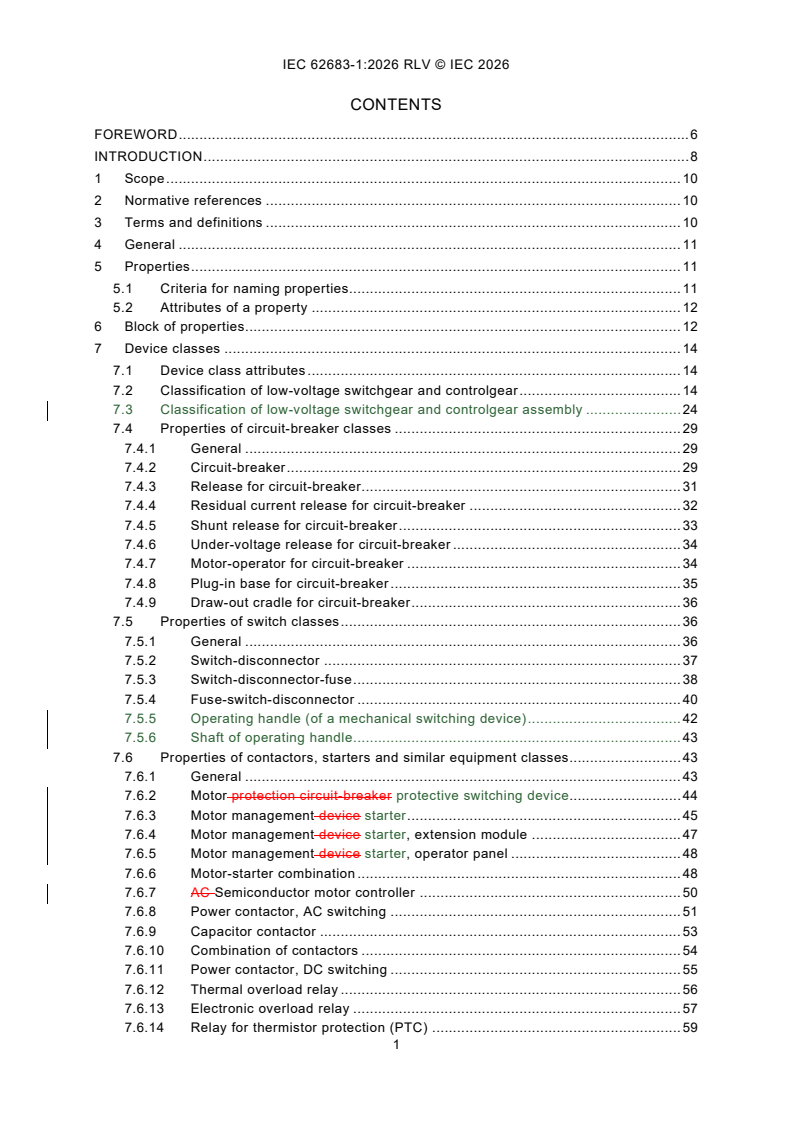
CONTENTS
FOREWORD . 6
INTRODUCTION . 8
1 Scope . 10
2 Normative references . 10
3 Terms and definitions . 10
4 General . 11
5 Properties . 11
5.1 Criteria for naming properties. 11
5.2 Attributes of a property . 12
6 Block of properties. 12
7 Device classes . 14
7.1 Device class attributes . 14
7.2 Classification of low-voltage switchgear and controlgear . 14
7.3 Classification of low-voltage switchgear and controlgear assembly . 24
7.4 Properties of circuit-breaker classes . 29
7.4.1 General . 29
7.4.2 Circuit-breaker . 29
7.4.3 Release for circuit-breaker. 31
7.4.4 Residual current release for circuit-breaker . 32
7.4.5 Shunt release for circuit-breaker . 33
7.4.6 Under-voltage release for circuit-breaker . 34
7.4.7 Motor-operator for circuit-breaker . 34
7.4.8 Plug-in base for circuit-breaker . 35
7.4.9 Draw-out cradle for circuit-breaker . 36
7.5 Properties of switch classes . 36
7.5.1 General . 36
7.5.2 Switch-disconnector . 37
7.5.3 Switch-disconnector-fuse . 38
7.5.4 Fuse-switch-disconnector . 40
7.5.5 Operating handle (of a mechanical switching device) . 42
7.5.6 Shaft of operating handle . 43
7.6 Properties of contactors, starters and similar equipment classes. 43
7.6.1 General . 43
7.6.2 Motor protection circuit-breaker protective switching device. 44
7.6.3 Motor management device starter . 45
7.6.4 Motor management device starter, extension module . 47
7.6.5 Motor management device starter, operator panel . 48
7.6.6 Motor-starter combination . 48
7.6.7 AC Semiconductor motor controller . 50
7.6.8 Power contactor, AC switching . 51
7.6.9 Capacitor contactor . 53
7.6.10 Combination of contactors . 54
7.6.11 Power contactor, DC switching . 55
7.6.12 Thermal overload relay . 56
7.6.13 Electronic overload relay . 57
7.6.14 Relay for thermistor protection (PTC) . 59
7.6.15 Electromechanical contactor for household and similar purposes . 60
7.6.16 Motor-starter . 61
7.6.17 Transient suppressor . 62
7.6.18 Mechanical interlocking device . 63
7.6.19 Motor-starter enclosure. 63
7.6.20 Coil for contactor or contactor relay . 64
7.6.21 Electromechanical latching device . 65
7.6.22 Control interface for contactor . 66
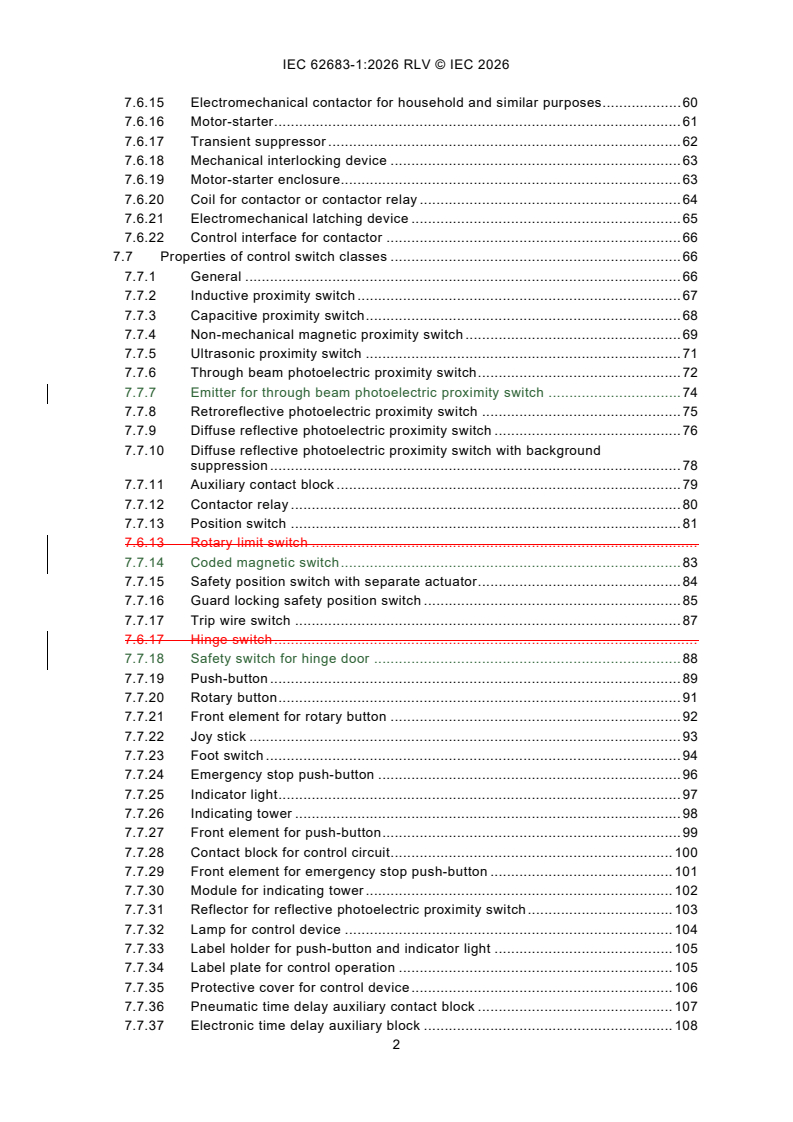
7.7 Properties of control switch classes . 66
7.7.1 General . 66
7.7.2 Inductive proximity switch . 67
7.7.3 Capacitive proximity switch . 68
7.7.4 Non-mechanical magnetic proximity switch . 69
7.7.5 Ultrasonic proximity switch . 71
7.7.6 Through beam photoelectric proximity switch . 72
7.7.7 Emitter for through beam photoelectric proximity switch . 74
7.7.8 Retroreflective photoelectric proximity switch . 75
7.7.9 Diffuse reflective photoelectric proximity switch . 76
7.7.10 Diffuse reflective photoelectric proximity switch with background
suppression . 78
7.7.11 Auxiliary contact block . 79
7.7.12 Contactor relay . 80
7.7.13 Position switch . 81
7.6.13 Rotary limit switch .
7.7.14 Coded magnetic switch . 83
7.7.15 Safety position switch with separate actuator . 84
7.7.16 Guard locking safety position switch . 85
7.7.17 Trip wire switch . 87
7.6.17 Hinge switch .
7.7.18 Safety switch for hinge door . 88
7.7.19 Push-button . 89
7.7.20 Rotary button . 91
7.7.21 Front element for rotary button . 92
7.7.22 Joy stick . 93
7.7.23 Foot switch . 94
7.7.24 Emergency stop push-button . 96
7.7.25 Indicator light . 97
7.7.26 Indicating tower . 98
7.7.27 Front element for push-button . 99
7.7.28 Contact block for control circuit . 100
7.7.29 Front element for emergency stop push-button . 101
7.7.30 Module for indicating tower . 102
7.7.31 Reflector for reflective photoelectric proximity switch . 103
7.7.32 Lamp for control device . 104
7.7.33 Label holder for push-button and indicator light . 105
7.7.34 Label plate for control operation . 105
7.7.35 Protective cover for control device . 106
7.7.36 Pneumatic time delay auxiliary contact block . 107
7.7.37 Electronic time delay auxiliary block . 108
7.7.38 Time relay . 109
7.7.39 Panel mounted audible signalling device . 110
7.7.40 Rotary encoder . 111
7.7.41 Linear encoder . 112
7.7.42 Control station, empty . 113
7.7.43 Control station, complete . 114
7.7.44 Pendant control station, empty . 115
7.7.45 Pendant control station, complete . 116
7.7.46 Two-hand control device . 117
7.7.47 Cable connection assembly for control device . 118
7.7.48 Actuator for coded magnetic switch . 119
7.8 Properties of multiple function equipment classes . 119
7.8.1 Transfer switching equipment . 119
7.8.2 Control and protective switching device (CPS) . 119
7.9 Properties of terminal block classes . 119
7.9.1 General . 119
7.9.2 Feed-through terminal block . 120
7.9.3 Disconnect terminal block . 121
7.9.4 Protective conductor terminal block . 122
7.9.5 Fuse terminal block . 123
8 ProductsDevice properties . 125
Bibliography . 179
Figure 1 – Operating distances of inductive and capacitive proximity switches . 172
Figure 2 – Ultrasonic proximity switch operating distance (IEC 60947-5-2:2019,
Figure 2) . 173
Figure 3 – Height of the device . 173
Figure 4 – Width of the device . 174
Figure 5 – Length of the device . 174
Table 1 – Library of blocks used in the device classes of low-voltage switchgear and
controlgear . 12
Table 2 – Low-voltage switchgear and controlgear classification . 14
Table 3 – Low-voltage switchgear and controlgear assembly classification . 24
Table 4 – Circuit-breaker . 29
Table 5 – Release for circuit-breaker . 31
Table 6 – Residual current release for circuit-breaker . 32
Table 7 – Shunt release for circuit-breaker . 33
Table 8 – Under-voltage release for circuit-breaker . 34
Table 9 – Motor-operator for circuit-breaker . 34
Table 10 – Plug-in base for circuit-breaker . 35
Table 11 – Draw-out cradle for circuit-breaker . 36
Table 12 – Switch-disconnector . 37
Table 13 – Switch-disconnector-fuse . 38
Table 14 – Fuse-switch-disconnector . 40
Table 15 – Operating handle (of a mechanical switching device). 42
Table 16 – Shaft of operating handle . 43
Table 17 – Motor protection circuit-breaker protective switching device . 44
Table 18 – Motor management device starter . 45
Table 19 – Motor management device starter, extension module . 47
Table 20 – Motor management device starter, operator panel . 48
Table 21 – Motor-starter combination . 48
Table 22 – AC Semiconductor motor controller . 50
Table 23 – Power contactor, AC switching . 51
Table 24 – Capacitor contactor . 53
Table 25 – Combination of contactors . 54
Table 26 – Power contactor, DC switching . 55
Table 27 – Thermal overload relay . 56
Table 28 – Electronic overload relay . 57
Table 29 – Relay for thermistor protection (PTC) . 59
Table 30 – Electromechanical contactor for household and similar purposes . 60
Table 31 – Motor-starter . 61
Table 32 – Transient suppressor . 62
Table 33 – Mechanical interlocking device . 63
Table 34 – Motor-starter enclosure . 63
Table 35 – Coil for contactor or contactor relay . 64
Table 36 – Electromechanical latching device . 65
Table 37 – Control interface for contactor . 66
Table 38 – Inductive proximity switch . 67
Table 39 – Capacitive proximity switch . 68
Table 40 – Non-mechanical magnetic proximity switch . 69
Table 41 – Ultrasonic proximity switch . 71
Table 42 – Through beam photoelectric proximity switch . 72
Table 43 – Emitter for through beam photoelectric proximity switch . 74
Table 44 – Retroreflective photoelectric proximity switch . 75
Table 45 – Diffuse reflective photoelectric proximity switch . 76
Table 46 – Diffuse reflective photoelectric proximity switch with background
suppression . 78
Table 47 – Auxiliary contact block . 79
Table 48 – Contactor relay . 80
Table 49 – Position switch . 81
Table 50 – Coded magnetic switch. 83
Table 51 – Safety position switch with separate actuator . 84
Table 52 – Guard locking safety position switch . 85
Table 53 – Trip wire switch . 87
Table 54 – Safety switch for hinge door . 88
Table 55 – Push-button . 89
Table 56 – Rotary button . 91
Table 57 – Front element for rotary button . 92
Table 58 – Joy stick . 93
Table 59 – Foot switch . 94
Table 60 – Emergency stop push-button . 96
Table 61 – Indicator light . 97
Table 62 – Indicating tower . 98
Table 63 – Front element for push-button . 99
Table 64 – Contact block for control circuit . 100
Table 65 – Front element for emergency stop push-button . 101
Table 66 – Module for indicating tower . 102
Table 67 – Reflector for reflective photoelectric proximity switch . 103
Table 68 – Lamp for control device . 104
Table 69 – Label holder for push-button and indicator light . 105
Table 70 – Label plate for control operation . 105
Table 71 – Protective cover for control device . 106
Table 72 – Pneumatic time delay auxiliary contact block . 107
Table 73 – Electronic time delay auxiliary block . 108
Table 74 – Time relay . 109
Table 75 – Panel mounted audible signalling device . 110
Table 76 – Rotary encoder . 111
Table 77 – Linear encoder . 112
Table 78 – Control station, empty . 113
Table 79 – Control station, complete . 114
Table 80 – Pendant control station, empty . 115
Table 81 – Pendant control station, complete. 116
Table 82 – Two-hand control device . 117
Table 83 – Cable connection assembly for control device . 118
Table 84 – Actuator for coded magnetic switch . 119
Table 85 – Feed-through terminal block . 120
Table 86 – Disconnect terminal block . 121
Table 87 – Protective conductor terminal block . 122
Table 88 – Fuse terminal block . 123
Table 89 – Library of properties used in the device classes . 125
Table 90 – Value lists of properties . 174
INTERNATIONAL ELECTROTECHNICAL COMMISSION
____________
Low-voltage switchgear and controlgear Switchgear, controlgear and their
assemblies for low-voltage - Product data and properties
for information exchange -
Part 1: Catalogue data
FOREWORD
1) The International Electrotechnical Commission (IEC) is a worldwide organization for standardization comprising
all national electrotechnical committees (IEC National Committees). The object of IEC is to promote international
co-operation on all questions concerning standardization in the electrical and electronic fields. To this end and
in addition to other activities, IEC publishes International Standards, Technical Specifications, Technical Reports,
Publicly Available Specifications (PAS) and Guides (hereafter referred to as “IEC Publication(s)”). Their
preparation is entrusted to technical committees; any IEC National Committee interested in the subject dealt with
may participate in this preparatory work. International, governmental and non-governmental organizations liaising
with the IEC also participate in this preparation. IEC collaborates closely with the International Organization for
Standardization (ISO) in accordance with conditions determined by agreement between the two organizations.
2) The formal decisions or agreements of IEC on technical matters express, as nearly as possible, an international
consensus of opinion on the relevant subjects since each technical committee has representation from all
interested IEC National Committees.
3) IEC Publications have the form of recommendations for international use and are accepted by IEC National
Committees in that sense. While all reasonable efforts are made to ensure that the technical content of IEC
Publications is accurate, IEC cannot be held responsible for the way in which they are used or for any
misinterpretation by any end user.
4) In order to promote international uniformity, IEC National Committees undertake to apply IEC Publications
transparently to the maximum extent possible in their national and regional publications. Any divergence between
any IEC Publication and the corresponding national or regional publication shall be clearly indicated in the latter.
5) IEC itself does not provide any attestation of conformity. Independent certification bodies provide conformity
assessment services and, in some areas, access to IEC marks of conformity. IEC is not responsible for any
services carried out by independent certification bodies.
6) All users should ensure that they have the latest edition of this publication.
7) No liability shall attach to IEC or its directors, employees, servants or agents including individual experts and
members of its technical committees and IEC National Committees for any personal injury, property damage or
other damage of any nature whatsoever, whether direct or indirect, or for costs (including legal fees) and
expenses arising out of the publication, use of, or reliance upon, this IEC Publication or any other IEC
Publications.
8) Attention is drawn to the Normative references cited in this publication. Use of the referenced publications is
indispensable for the correct application of this publication.
9) IEC draws attention to the possibility that the implementation of this document may involve the use of (a)
patent(s). IEC takes no position concerning the evidence, validity or applicability of any claimed patent rights in
respect thereof. As of the date of publication of this document, IEC had not received notice of (a) patent(s), which
may be required to implement this document. However, implementers are cautioned that this may not represent
the latest information, which may be obtained from the patent database available at https://patents.iec.ch. IEC
shall not be held responsible for identifying any or all such patent rights.
This redline version of the official IEC Standard allows the user to identify the changes made
to the previous edition IEC 62683-1:2017. A vertical bar appears in the margin wherever a
change has been made. Additions are in green text, deletions are in strikethrough red text.
IEC 62683-1 has been prepared by committee 121: Switchgear and controlgear and their
assemblies for low voltage. It is an International Standard.
This second edition cancels and replaces the first edition published in 2017. This edition
constitutes a technical revision.
This edition includes the following significant technical changes with respect to the previous
edition for reflecting the content of the IEC CDD 62683DB which has been updated with the
change requests C00073, C00074, C00081, C00087, C00089, C00098, C00100, C00107,
C00111, C00116, C00119, C00122, C00146, C00148, C00159, C00167, C00174 and C00135:
a) New device class descriptions: ACC304, ACC305, ACC413, ACC417, ACC503, ACC504,
ACC505, ACC512, ACC516, ACC536, ACC537, ACC538, ACC540, ACC541, ACC542,
ACC543, ACC544, ACC545, ACC546, ACC547, ACC548.
b) New associated properties.
c) New assembly class structure: ACC101, ACC102, ACC103, ACC104, ACC106, ACC110,
ACC111, ACC112, ACC113, ACC114, ACC115, ACC116, ACC117, ACC118, ACC119,
ACC120, ACC121, ACC123, ACC124, ACC125, ACC126, ACC127, ACC131, ACC132,
ACC133, ACC135, ACC141, ACC142, ACC143, ACC144, ACC145, ACC146, ACC147,
ACC148, ACC150, ACC151, ACC152, ACC153, ACC154, ACC155, ACC156, ACC157,
ACC158, ACC159, ACC160, ACC161, ACC162, ACC163, ACC164, ACC165, ACC166,
ACC167, ACC170, ACC171, ACC172, ACC173, ACC174, ACC175.
The text of this International Standard is based on the following documents:
Draft Report on voting
121/237/FDIS 121/241/RVD
Full information on the voting for its approval can be found in the report on voting indicated in
the above table.
The language used for the development of this International Standard is English.
This document was drafted in accordance with ISO/IEC Directives, Part 2, and developed in
accordance with ISO/IEC Directives, Part 1 and ISO/IEC Directives, IEC Supplement, available
at www.iec.ch/members_experts/refdocs. The main document types developed by IEC are
described in greater detail at www.iec.ch/publications.
A list of all parts in the IEC 62683 series, published under the general title Switchgear,
controlgear and their assemblies for low-voltage - Product data and properties for information
exchange, can be found on the IEC website.
The committee has decided that the contents of this document will remain unchanged until the
stability date indicated on the IEC website under webstore.iec.ch in the data related to the
specific document. At this date, the document will be
– reconfirmed,
– withdrawn, or
– revised.
INTRODUCTION
Mainly large customers and wholesalers are requesting standardized product descriptions and
product properties to product manufacturers. However, all stakeholders will can benefit from
this standardised presentation and data exchange.
Multiple associations or groups of actors launched different initiatives to try to respond to this
demand but, due to the lack of standardisation of classes and properties, the situation remains
unsatisfactory for both customers and manufacturers.
In order to keep the lead of product description, IEC proposes a consistent solution within its
product standards.
The purpose of this document is to:
– define device classes and properties for low-voltage switchgear and controlgear and their
assemblies in a dedicated standard,
– provide a basis for introduction of classes of the low-voltage switchgear and controlgear
classes and their assemblies, and properties introduced into the IEC 61360 database
maintained by IEC/SC3D (see http://std.iec.ch/iec61360).
This document is not intended to establish a hierarchy of product classes called classification.
The intended benefits of this document are to:
– reduce the costs, time and efforts of mapping data for each customer request;
– optimize the workflow of B2B exchanges;
– minimize duplication of articles in customer inventories and in databases;
– minimize losses and misinterpretation of data during exchanges;
– facilitate the selection of a product, especially regarding reliability and safety;
– give access to product data everywhere regardless of country, language and culture;
– provide product data related to environmental aspects such as material declaration;
– contribute to the fast growth of the e-business by simplifying the development of:
• e-Catalogue allowing the differentiation of products performances, certificates, etc;
• e-Commerce: use of electronic networks to exchange information, products, services
and payments for commercial and communication purposes between individuals
(consumers) and businesses, between businesses themselves.
The output of this document consists of:
– reference dictionary of low-voltage switchgear and controlgear and their assemblies using
existing terms from IEC documents. However, terminology used in e-business may can be
relevant for the purpose of naming classes in this document to get a high level of
acceptance;
– properties for e-commerce purposes, conformity of properties with product standards being
the main goal of this document.
NOTE The classes "under consideration" are for information only and are intended to be completed during the next
maintenance cycle.
For this project, the introductionThe description of low-voltage switchgear and controlgear and
their assemblies within the IEC 61360 database needs to address addresses the following
technical aspects:
– IEC 61360 requires mandatory attributes. The complete set of mandatory attributes with
additional relevant attributes for low-voltage switchgear and controlgear will be available
within the IEC 61360 database. At the development stage, the CDD 62683 database is
available at the following address: https://cdd.iec.ch/cdd/iec62683/iec62683.nsf.
The complete sets of attributes for low-voltage switchgear and controlgear and their
assemblies are available in the IEC 62683DB domain at
https://cdd.iec.ch/cdd/iec62683/iec62683.nsf/TreeFrameset?OpenFrameSet. Within the
present document, only the most useful attributes are presented.
– The switchgear and controlgear and their assemblies data models are implemented in an
appropriate the IEC 62683DB domain of the IEC Component Data Dictionary (CDD),
IEC 61360, by creating dictionaries of blocks, classes and properties.
1 Scope
This part of IEC 62683 establishes the reference dictionary of the general description of classes
of low-voltage switchgear and controlgear classes and their assemblies based on defined
properties.
This dictionary is used to facilitate the exchange in electronic format of data describing
low-voltage switchgear and controlgear, their accessories and their assemblies.
This document provides clear and unambiguous definitions of a limited number of properties
and classes which are mainly used for presentation, selection and identification of products
particularly in electronic catalogues.
Each property has an unambiguously defined meaning and naming name, and where relevant,
a defined value list, a defined format, and a defined unit.
The intention is not to cover manufacturer-specific features.
Manufacturer specific features are not covered.
2 Normative references
The following documents are referred to in the text in such a way that some or all of their content
constitutes requirements of this document. For dated references, only the edition cited applies.
For undated references, the latest edition of the referenced document (including any
amendments) applies.
IEC 60947-1:20072020, Low-voltage switchgear and controlgear - Part 1: General rules
IEC 60947-1:2007/AMD1:2010
IEC 60947-1:2007/AMD2:2014
IEC 61360-1, Standard data element types with associated classification scheme for electric
items - Part 1: Definitions - Principles and methods
IEC 61439-1:2020, Low-voltage switchgear and controlgear assemblies - Part 1: General rules
3 Terms and definitions
For the purposes of this document, the terms and definitions given in IEC 60947-1, IEC 61439-1
and the following apply.
ISO and IEC maintain terminology databases for use in standardization at the following
addresses:
– IEC Electropedia: available at https://www.electropedia.org/
– ISO Online browsing platform: available at https://www.iso.org/obp
3.1
attribute
data element for description of a property, a relation or a device class
EXAMPLE The name of a property, the code of a class, the measure unit of a property
3.2
block
collection of properties describing one common aspect of the device class
Note 1 to entry: A block is a feature class in the sense of IEC 61360-1 and ISO 13584-42.
EXAMPLE Diagnostic functions, control circuit.
3.3
cardinality
pattern defining the number of times a concept reoccurs within a description
Note 1 to entry: Cardinality allows a block of properties contained in a list of properties to be used more than once
for a particular transaction in order to describe, for example, a device with several different outputs or more than one
process cases.
Note 2 to entry: Cardinality is defined by IEC 61987-10.
3.4
device
material element or assembly of such elements intended to perform a required function
Note 1 to entry: In this document, a device corresponds to a low voltage switchgear and controlgear.
[SOURCE: IEC 60050-151:2001, 151-11-20, modified – the note has been modified replaced
by a new note to entry.]
3.5
device class
set of properties which gives a description of a device
3.6
polymorphism
pattern that allows substitution of a single concept in the same context by a different more
specific (specialized) concept
Note 1 to entry: A specialised polymorphic block of properties can replace a more generic one in the same context.
A polymorphic operator (control property) can act in selecting between of various specialisations.
Note 2 to entry: Polymorphism is defined by IEC 61987-10.
3.7
property
defined parameter suitable for the description and differentiation of device class specific
characteristic describing an aspect of device class
4 General
The attributes shall follow IEC 61360-1.
Based on IEC 61360-1 data model, the structured data called cardinality and polymorphism
may be used.
5 Properties
5.1 Criteria for naming properties
In order to maintain consistency and clarity in the naming of properties, terms from product
standards shall be used when they are available.
Synonymous names may be associated with the property name when well established terms
are used on the market.
5.2 Attributes of a property
The following attributes of a property are considered in this document: identifier, preferred
name, definition, source document, data type, unit of measure, value format, and value list.
6 Block of properties
A property within a block shall describe one common aspect covered by the definition of this
block.
A property may be reused in different blocks. In this case, this property is applicable within the
context of the definition of each block.
The list of blocks of properties is defined in Table 1.
Table 1 – Library of blocks used in the device classes
of low-voltage switchgear and controlgear
Block name Definition Source Class ID
Identification information necessary for unambiguous ACC011
identification of the device
General technical data general technical aspects of the device
...
IEC 62683-1 ®
Edition 2.0 2026-04
INTERNATIONAL
STANDARD
Switchgear, controlgear and their assemblies for low-voltage - Product data and
properties for information exchange -
Part 1: Catalogue data
ICS 29.130.20 ISBN 978-2-8327-1076-0
All rights reserved. Unless otherwise specified, no part of this publication may be reproduced or utilized in any form or
by any means, electronic or mechanical, including photocopying and microfilm, without permission in writing from either
IEC or IEC's member National Committee in the country of the requester. If you have any questions about IEC copyright
or have an enquiry about obtaining additional rights to this publication, please contact the address below or your local
IEC member National Committee for further information.
IEC Secretariat Tel.: +41 22 919 02 11
3, rue de Varembé info@iec.ch
CH-1211 Geneva 20 www.iec.ch
Switzerland
About the IEC
The International Electrotechnical Commission (IEC) is the leading global organization that prepares and publishes
International Standards for all electrical, electronic and related technologies.
About IEC publications
The technical content of IEC publications is kept under constant review by the IEC. Please make sure that you have the
latest edition, a corrigendum or an amendment might have been published.
IEC publications search - IEC Products & Services Portal - products.iec.ch
webstore.iec.ch/advsearchform Discover our powerful search engine and read freely all the
The advanced search enables to find IEC publications by a publications previews, graphical symbols and the glossary.
variety of criteria (reference number, text, technical With a subscription you will always have access to up to date
committee, …). It also gives information on projects, content tailored to your needs.
replaced and withdrawn publications.
Electropedia - www.electropedia.org
The world's leading online dictionary on electrotechnology,
IEC Just Published - webstore.iec.ch/justpublished
Stay up to date on all new IEC publications. Just Published containing more than 22 500 terminological entries in English
details all new publications released. Available online and and French, with equivalent terms in 25 additional languages.
once a month by email. Also known as the International Electrotechnical Vocabulary
(IEV) online.
IEC Customer Service Centre - webstore.iec.ch/csc
If you wish to give us your feedback on this publication or
need further assistance, please contact the Customer
Service Centre: sales@iec.ch.
CONTENTS
FOREWORD . 6
INTRODUCTION . 8
1 Scope . 10
2 Normative references . 10
3 Terms and definitions . 10
4 General . 11
5 Properties . 11
5.1 Criteria for naming properties. 11
5.2 Attributes of a property . 11
6 Block of properties. 12
7 Device classes . 13
7.1 Device class attributes . 13
7.2 Classification of low-voltage switchgear and controlgear . 13
7.3 Classification of low-voltage switchgear and controlgear assembly . 23
7.4 Properties of circuit-breaker classes . 28
7.4.1 General . 28
7.4.2 Circuit-breaker . 29
7.4.3 Release for circuit-breaker. 31
7.4.4 Residual current release for circuit-breaker . 32
7.4.5 Shunt release for circuit-breaker . 33
7.4.6 Under-voltage release for circuit-breaker . 33
7.4.7 Motor-operator for circuit-breaker . 34
7.4.8 Plug-in base for circuit-breaker . 35
7.4.9 Draw-out cradle for circuit-breaker . 36
7.5 Properties of switch classes . 36
7.5.1 General . 36
7.5.2 Switch-disconnector . 37
7.5.3 Switch-disconnector-fuse . 38
7.5.4 Fuse-switch-disconnector . 40
7.5.5 Operating handle (of a mechanical switching device) . 42
7.5.6 Shaft of operating handle . 43
7.6 Properties of contactors, starters and similar equipment classes. 43
7.6.1 General . 43
7.6.2 Motor protective switching device . 44
7.6.3 Motor management starter . 45
7.6.4 Motor management starter, extension module . 47
7.6.5 Motor management starter, operator panel . 48
7.6.6 Motor-starter combination . 49
7.6.7 Semiconductor motor controller . 50
7.6.8 Power contactor, AC switching . 51
7.6.9 Capacitor contactor . 53
7.6.10 Combination of contactors . 54
7.6.11 Power contactor, DC switching . 55
7.6.12 Thermal overload relay . 56
7.6.13 Electronic overload relay . 57
7.6.14 Relay for thermistor protection (PTC) . 59
7.6.15 Electromechanical contactor for household and similar purposes . 60
7.6.16 Motor-starter . 61
7.6.17 Transient suppressor . 62
7.6.18 Mechanical interlocking device . 63
7.6.19 Motor-starter enclosure. 63
7.6.20 Coil for contactor or contactor relay . 64
7.6.21 Electromechanical latching device . 65
7.6.22 Control interface for contactor . 66
7.7 Properties of control switch classes . 66
7.7.1 General . 66
7.7.2 Inductive proximity switch . 67
7.7.3 Capacitive proximity switch . 68
7.7.4 Non-mechanical magnetic proximity switch . 69
7.7.5 Ultrasonic proximity switch . 71
7.7.6 Through beam photoelectric proximity switch . 72
7.7.7 Emitter for through beam photoelectric proximity switch . 74
7.7.8 Retroreflective photoelectric proximity switch . 75
7.7.9 Diffuse reflective photoelectric proximity switch . 76
7.7.10 Diffuse reflective photoelectric proximity switch with background
suppression . 78
7.7.11 Auxiliary contact block . 79
7.7.12 Contactor relay . 80
7.7.13 Position switch . 81
7.7.14 Coded magnetic switch . 83
7.7.15 Safety position switch with separate actuator . 84
7.7.16 Guard locking safety position switch . 85
7.7.17 Trip wire switch . 87
7.7.18 Safety switch for hinge door . 88
7.7.19 Push-button . 89
7.7.20 Rotary button . 91
7.7.21 Front element for rotary button . 92
7.7.22 Joy stick . 93
7.7.23 Foot switch . 94
7.7.24 Emergency stop push-button . 96
7.7.25 Indicator light . 97
7.7.26 Indicating tower . 98
7.7.27 Front element for push-button . 99
7.7.28 Contact block for control circuit . 100
7.7.29 Front element for emergency stop push-button . 101
7.7.30 Module for indicating tower . 102
7.7.31 Reflector for reflective photoelectric proximity switch . 103
7.7.32 Lamp for control device . 104
7.7.33 Label holder for push-button and indicator light . 105
7.7.34 Label plate for control operation . 105
7.7.35 Protective cover for control device . 106
7.7.36 Pneumatic time delay auxiliary contact block . 107
7.7.37 Electronic time delay auxiliary block . 108
7.7.38 Time relay . 109
7.7.39 Panel mounted audible signalling device . 110
7.7.40 Rotary encoder . 111
7.7.41 Linear encoder . 112
7.7.42 Control station, empty . 113
7.7.43 Control station, complete . 114
7.7.44 Pendant control station, empty . 115
7.7.45 Pendant control station, complete . 116
7.7.46 Two-hand control device . 117
7.7.47 Cable connection assembly for control device . 118
7.7.48 Actuator for coded magnetic switch . 119
7.8 Properties of multiple function equipment classes . 119
7.8.1 Transfer switching equipment . 119
7.8.2 Control and protective switching device (CPS) . 119
7.9 Properties of terminal block classes . 119
7.9.1 General . 119
7.9.2 Feed-through terminal block . 120
7.9.3 Disconnect terminal block . 121
7.9.4 Protective conductor terminal block . 122
7.9.5 Fuse terminal block . 123
8 Device properties . 125
Bibliography . 185
Figure 1 – Operating distances of inductive and capacitive proximity switches . 178
Figure 2 – Ultrasonic proximity switch operating distance (IEC 60947-5-2:2019,
Figure 2) . 179
Figure 3 – Height of the device . 179
Figure 4 – Width of the device . 180
Figure 5 – Length of the device . 180
Table 1 – Library of blocks used in the device classes of low-voltage switchgear and
controlgear . 12
Table 2 – Low-voltage switchgear and controlgear classification . 13
Table 3 – Low-voltage switchgear and controlgear assembly classification . 24
Table 4 – Circuit-breaker . 29
Table 5 – Release for circuit-breaker . 31
Table 6 – Residual current release for circuit-breaker . 32
Table 7 – Shunt release for circuit-breaker . 33
Table 8 – Under-voltage release for circuit-breaker . 33
Table 9 – Motor-operator for circuit-breaker . 34
Table 10 – Plug-in base for circuit-breaker . 35
Table 11 – Draw-out cradle for circuit-breaker . 36
Table 12 – Switch-disconnector . 37
Table 13 – Switch-disconnector-fuse . 38
Table 14 – Fuse-switch-disconnector . 40
Table 15 – Operating handle (of a mechanical switching device). 42
Table 16 – Shaft of operating handle . 43
Table 17 – Motor protective switching device . 44
Table 18 – Motor management starter. 45
Table 19 – Motor management starter, extension module . 47
Table 20 – Motor management starter, operator panel . 48
Table 21 – Motor-starter combination . 49
Table 22 – Semiconductor motor controller . 50
Table 23 – Power contactor, AC switching . 51
Table 24 – Capacitor contactor . 53
Table 25 – Combination of contactors . 54
Table 26 – Power contactor, DC switching . 55
Table 27 – Thermal overload relay . 56
Table 28 – Electronic overload relay . 57
Table 29 – Relay for thermistor protection (PTC) . 59
Table 30 – Electromechanical contactor for household and similar purposes . 60
Table 31 – Motor-starter . 61
Table 32 – Transient suppressor . 62
Table 33 – Mechanical interlocking device . 63
Table 34 – Motor-starter enclosure . 63
Table 35 – Coil for contactor or contactor relay . 64
Table 36 – Electromechanical latching device . 65
Table 37 – Control interface for contactor . 66
Table 38 – Inductive proximity switch . 67
Table 39 – Capacitive proximity switch . 68
Table 40 – Non-mechanical magnetic proximity switch . 69
Table 41 – Ultrasonic proximity switch . 71
Table 42 – Through beam photoelectric proximity switch . 72
Table 43 – Emitter for through beam photoelectric proximity switch . 74
Table 44 – Retroreflective photoelectric proximity switch . 75
Table 45 – Diffuse reflective photoelectric proximity switch . 76
Table 46 – Diffuse reflective photoelectric proximity switch with background
suppression . 78
Table 47 – Auxiliary contact block . 79
Table 48 – Contactor relay . 80
Table 49 – Position switch . 81
Table 50 – Coded magnetic switch. 83
Table 51 – Safety position switch with separate actuator . 84
Table 52 – Guard locking safety position switch . 85
Table 53 – Trip wire switch . 87
Table 54 – Safety switch for hinge door . 88
Table 55 – Push-button . 89
Table 56 – Rotary button . 91
Table 57 – Front element for rotary button . 92
Table 58 – Joy stick . 93
Table 59 – Foot switch . 94
Table 60 – Emergency stop push-button . 96
Table 61 – Indicator light . 97
Table 62 – Indicating tower . 98
Table 63 – Front element for push-button . 99
Table 64 – Contact block for control circuit . 100
Table 65 – Front element for emergency stop push-button . 101
Table 66 – Module for indicating tower . 102
Table 67 – Reflector for reflective photoelectric proximity switch . 103
Table 68 – Lamp for control device . 104
Table 69 – Label holder for push-button and indicator light . 105
Table 70 – Label plate for control operation . 105
Table 71 – Protective cover for control device . 106
Table 72 – Pneumatic time delay auxiliary contact block . 107
Table 73 – Electronic time delay auxiliary block . 108
Table 74 – Time relay . 109
Table 75 – Panel mounted audible signalling device . 110
Table 76 – Rotary encoder . 111
Table 77 – Linear encoder . 112
Table 78 – Control station, empty . 113
Table 79 – Control station, complete . 114
Table 80 – Pendant control station, empty . 115
Table 81 – Pendant control station, complete. 116
Table 82 – Two-hand control device . 117
Table 83 – Cable connection assembly for control device . 118
Table 84 – Actuator for coded magnetic switch . 119
Table 85 – Feed-through terminal block . 120
Table 86 – Disconnect terminal block . 121
Table 87 – Protective conductor terminal block . 122
Table 88 – Fuse terminal block . 123
Table 89 – Library of properties used in the device classes . 125
Table 90 – Value lists of properties . 180
INTERNATIONAL ELECTROTECHNICAL COMMISSION
____________
Switchgear, controlgear and their assemblies for low-voltage -
Product data and properties for information exchange -
Part 1: Catalogue data
FOREWORD
1) The International Electrotechnical Commission (IEC) is a worldwide organization for standardization comprising
all national electrotechnical committees (IEC National Committees). The object of IEC is to promote international
co-operation on all questions concerning standardization in the electrical and electronic fields. To this end and
in addition to other activities, IEC publishes International Standards, Technical Specifications, Technical Reports,
Publicly Available Specifications (PAS) and Guides (hereafter referred to as “IEC Publication(s)”). Their
preparation is entrusted to technical committees; any IEC National Committee interested in the subject dealt with
may participate in this preparatory work. International, governmental and non-governmental organizations liaising
with the IEC also participate in this preparation. IEC collaborates closely with the International Organization for
Standardization (ISO) in accordance with conditions determined by agreement between the two organizations.
2) The formal decisions or agreements of IEC on technical matters express, as nearly as possible, an international
consensus of opinion on the relevant subjects since each technical committee has representation from all
interested IEC National Committees.
3) IEC Publications have the form of recommendations for international use and are accepted by IEC National
Committees in that sense. While all reasonable efforts are made to ensure that the technical content of IEC
Publications is accurate, IEC cannot be held responsible for the way in which they are used or for any
misinterpretation by any end user.
4) In order to promote international uniformity, IEC National Committees undertake to apply IEC Publications
transparently to the maximum extent possible in their national and regional publications. Any divergence between
any IEC Publication and the corresponding national or regional publication shall be clearly indicated in the latter.
5) IEC itself does not provide any attestation of conformity. Independent certification bodies provide conformity
assessment services and, in some areas, access to IEC marks of conformity. IEC is not responsible for any
services carried out by independent certification bodies.
6) All users should ensure that they have the latest edition of this publication.
7) No liability shall attach to IEC or its directors, employees, servants or agents including individual experts and
members of its technical committees and IEC National Committees for any personal injury, property damage or
other damage of any nature whatsoever, whether direct or indirect, or for costs (including legal fees) and
expenses arising out of the publication, use of, or reliance upon, this IEC Publication or any other IEC
Publications.
8) Attention is drawn to the Normative references cited in this publication. Use of the referenced publications is
indispensable for the correct application of this publication.
9) IEC draws attention to the possibility that the implementation of this document may involve the use of (a)
patent(s). IEC takes no position concerning the evidence, validity or applicability of any claimed patent rights in
respect thereof. As of the date of publication of this document, IEC had not received notice of (a) patent(s), which
may be required to implement this document. However, implementers are cautioned that this may not represent
the latest information, which may be obtained from the patent database available at https://patents.iec.ch. IEC
shall not be held responsible for identifying any or all such patent rights.
IEC 62683-1 has been prepared by committee 121: Switchgear and controlgear and their
assemblies for low voltage. It is an International Standard.
This second edition cancels and replaces the first edition published in 2017. This edition
constitutes a technical revision.
This edition includes the following significant technical changes with respect to the previous
edition for reflecting the content of the IEC CDD 62683DB which has been updated with the
change requests C00073, C00074, C00081, C00087, C00089, C00098, C00100, C00107,
C00111, C00116, C00119, C00122, C00146, C00148, C00159, C00167, C00174 and C00135:
a) New device class descriptions: ACC304, ACC305, ACC413, ACC417, ACC503, ACC504,
ACC505, ACC512, ACC516, ACC536, ACC537, ACC538, ACC540, ACC541, ACC542,
ACC543, ACC544, ACC545, ACC546, ACC547, ACC548.
b) New associated properties.
c) New assembly class structure: ACC101, ACC102, ACC103, ACC104, ACC106, ACC110,
ACC111, ACC112, ACC113, ACC114, ACC115, ACC116, ACC117, ACC118, ACC119,
ACC120, ACC121, ACC123, ACC124, ACC125, ACC126, ACC127, ACC131, ACC132,
ACC133, ACC135, ACC141, ACC142, ACC143, ACC144, ACC145, ACC146, ACC147,
ACC148, ACC150, ACC151, ACC152, ACC153, ACC154, ACC155, ACC156, ACC157,
ACC158, ACC159, ACC160, ACC161, ACC162, ACC163, ACC164, ACC165, ACC166,
ACC167, ACC170, ACC171, ACC172, ACC173, ACC174, ACC175.
The text of this International Standard is based on the following documents:
Draft Report on voting
121/237/FDIS 121/241/RVD
Full information on the voting for its approval can be found in the report on voting indicated in
the above table.
The language used for the development of this International Standard is English.
This document was drafted in accordance with ISO/IEC Directives, Part 2, and developed in
accordance with ISO/IEC Directives, Part 1 and ISO/IEC Directives, IEC Supplement, available
at www.iec.ch/members_experts/refdocs. The main document types developed by IEC are
described in greater detail at www.iec.ch/publications.
A list of all parts in the IEC 62683 series, published under the general title Switchgear,
controlgear and their assemblies for low-voltage - Product data and properties for information
exchange, can be found on the IEC website.
The committee has decided that the contents of this document will remain unchanged until the
stability date indicated on the IEC website under webstore.iec.ch in the data related to the
specific document. At this date, the document will be
– reconfirmed,
– withdrawn, or
– revised.
INTRODUCTION
Mainly large customers and wholesalers are requesting standardized product descriptions and
product properties to product manufacturers. However, all stakeholders can benefit from this
standardised presentation and data exchange.
Multiple associations or groups of actors launched different initiatives to try to respond to this
demand but, due to the lack of standardisation of classes and properties, the situation remains
unsatisfactory for both customers and manufacturers.
In order to keep the lead of product description, IEC proposes a consistent solution within its
product standards.
The purpose of this document is to:
– define device classes and properties for low-voltage switchgear and controlgear and their
assemblies in a dedicated standard,
– provide a basis of classes of the low-voltage switchgear and controlgear and their
assemblies, and properties introduced into the IEC 61360 database maintained by
IEC/SC3D (see http://std.iec.ch/iec61360).
This document is not intended to establish a hierarchy of product classes called classification.
The intended benefits of this document are to:
– reduce the costs, time and efforts of mapping data for each customer request;
– optimize the workflow of B2B exchanges;
– minimize duplication of articles in customer inventories and in databases;
– minimize losses and misinterpretation of data during exchanges;
– facilitate the selection of a product, especially regarding reliability and safety;
– give access to product data everywhere regardless of country, language and culture;
– provide product data related to environmental aspects such as material declaration;
– contribute to the fast growth of the e-business by simplifying the development of:
• e-Catalogue allowing the differentiation of products performances, certificates, etc;
• e-Commerce: use of electronic networks to exchange information, products, services
and payments for commercial and communication purposes between individuals
(consumers) and businesses, between businesses themselves.
The output of this document consists of:
– reference dictionary of low-voltage switchgear and controlgear and their assemblies using
existing terms from IEC documents. However, terminology used in e-business can be
relevant for the purpose of naming classes in this document to get a high level of
acceptance;
– properties for e-commerce purposes, conformity of properties with product standards being
the main goal of this document.
NOTE The classes "under consideration" are for information only and are intended to be completed during the next
maintenance cycle.
The description of low-voltage switchgear and controlgear and their assemblies within the
IEC 61360 database addresses the following technical aspects:
– IEC 61360 requires mandatory attributes. The complete sets of attributes for low-voltage
switchgear and controlgear and their assemblies are available in the IEC 62683DB domain
at https://cdd.iec.ch/cdd/iec62683/iec62683.nsf/TreeFrameset?OpenFrameSet. Within the
present document, only the most useful attributes are presented.
– The switchgear and controlgear and their assemblies data models are implemented in the
IEC 62683DB domain of the IEC Component Data Dictionary (CDD), by creating dictionaries
of blocks, classes and properties.
1 Scope
This part of IEC 62683 establishes the reference dictionary of the general description of classes
of low-voltage switchgear and controlgear and their assemblies based on defined properties.
This dictionary is used to facilitate the exchange in electronic format of data describing
low-voltage switchgear and controlgear, their accessories and their assemblies.
This document provides clear and unambiguous definitions of a limited number of properties
and classes which are mainly used for presentation, selection and identification of products
particularly in electronic catalogues.
Each property has an unambiguously defined meaning and name, and where relevant, a defined
value list, a defined format, and a defined unit.
Manufacturer specific features are not covered.
2 Normative references
The following documents are referred to in the text in such a way that some or all of their content
constitutes requirements of this document. For dated references, only the edition cited applies.
For undated references, the latest edition of the referenced document (including any
amendments) applies.
IEC 60947-1:2020, Low-voltage switchgear and controlgear - Part 1: General rules
IEC 61360-1, Standard data element types with associated classification scheme - Part 1:
Definitions - Principles and methods
IEC 61439-1:2020, Low-voltage switchgear and controlgear assemblies - Part 1: General rules
3 Terms and definitions
For the purposes of this document, the terms and definitions given in IEC 60947-1, IEC 61439-1
and the following apply.
ISO and IEC maintain terminology databases for use in standardization at the following
addresses:
– IEC Electropedia: available at https://www.electropedia.org/
– ISO Online browsing platform: available at https://www.iso.org/obp
3.1
attribute
data element for description of a property, a relation or a device class
EXAMPLE The name of a property, the code of a class, the measure unit of a property
3.2
block
collection of properties describing one common aspect of the device class
Note 1 to entry: A block is a feature class in the sense of IEC 61360-1 and ISO 13584-42.
EXAMPLE Diagnostic functions, control circuit.
3.3
cardinality
pattern defining the number of times a concept reoccurs within a description
Note 1 to entry: Cardinality allows a block of properties contained in a list of properties to be used more than once
for a particular transaction in order to describe, for example, a device with several different outputs or more than one
process cases.
Note 2 to entry: Cardinality is defined by IEC 61987-10.
3.4
device
material element or assembly of such elements intended to perform a required function
Note 1 to entry: In this document, a device corresponds to a low voltage switchgear and controlgear.
[SOURCE: IEC 60050-151:2001, 151-11-20, modified – the note has been replaced by a new
note to entry.]
3.5
device class
set of properties which gives a description of a device
3.6
polymorphism
pattern that allows substitution of a single concept in the same context by a different more
specific (specialized) concept
Note 1 to entry: A specialised polymorphic block of properties can replace a more generic one in the same context.
A polymorphic operator (control property) can act in selecting between of various specialisations.
Note 2 to entry: Polymorphism is defined by IEC 61987-10.
3.7
property
defined parameter suitable for the description and differentiation of device class specific
characteristic describing an aspect of device class
4 General
The attributes shall follow IEC 61360-1.
Based on IEC 61360-1 data model, the structured data called cardinality and polymorphism
may be used.
5 Properties
5.1 Criteria for naming properties
In order to maintain consistency and clarity in the naming of properties, terms from product
standards shall be used when they are available.
Synonymous names may be associated with the property name when well established terms
are used on the market.
5.2 Attributes of a property
The following attributes of a property are considered in this document: identifier, preferred
name, definition, source document, data type, unit of measure, value format, and value list.
6 Block of properties
A property within a block shall describe one common aspect covered by the definition of this
block.
A property may be reused in different blocks. In this case, this property is applicable within the
context of the definition of each block.
The list of blocks of properties is defined in Table 1.
Table 1 – Library of blocks used in the device classes
of low-voltage switchgear and controlgear
Block name Definition Source Class ID
Identification information necessary for unambiguous ACC011
identification of the device
General technical data general technical aspects of the device ACC012
Diagnostic functions ability to analyse a situation corresponding to a ACC013
predefined set of parameters of the device
Main circuit all the conductive parts of a switching device or IEC 60050-441:1984, ACC014
an assembly included in the circuit which it is 441-15-02, modified
designed to close or open
Input/output circuit circuit of the device used to receive or to send ACC015
signals or data
Control and auxiliary all the conductive parts of the device which are ACC016
circuits intended to be included in a circuit other than
the main circuit
Head of the control part which contains and supports the actuator ACC017
circuit device or contains the lens of an indicator light, fixed
on an enclosure or on the body of the device
Light block of the control part which contains and supports the lamp, ACC018
circuit device fixed on an enclosure or on the body of the
device
Equipment of control set of control devices and indicators mounted ACC019
station on a control station
Emitting source of radiation source which provides the beam ACC020
proximity switch operating the proximity switch
Short-circuit short-circuit conditions, stated by the ACC0
...
IEC 62683-1 ®
Edition 2.0 2026-04
NORME
INTERNATIONALE
Appareillages et ensembles d'appareillage basse tension - Données et
propriétés de produits pour l'échange d'informations -
Partie 1: Données de catalogue
ICS 29.130.20 ISBN 978-2-8327-1076-0
Droits de reproduction réservés. Sauf indication contraire, aucune partie de cette publication ne peut être reproduite ni
utilisée sous quelque forme que ce soit et par aucun procédé, électronique ou mécanique, y compris la photocopie et
les microfilms, sans l'accord écrit de l'IEC ou du Comité national de l'IEC du pays du demandeur. Si vous avez des
questions sur le copyright de l'IEC ou si vous désirez obtenir des droits supplémentaires sur cette publication, utilisez
les coordonnées ci-après ou contactez le Comité national de l'IEC de votre pays de résidence.
IEC Secretariat Tel.: +41 22 919 02 11
3, rue de Varembé info@iec.ch
CH-1211 Geneva 20 www.iec.ch
Switzerland
A propos de l'IEC
La Commission Electrotechnique Internationale (IEC) est la première organisation mondiale qui élabore et publie des
Normes internationales pour tout ce qui a trait à l'électricité, à l'électronique et aux technologies apparentées.
A propos des publications IEC
Le contenu technique des publications IEC est constamment revu. Veuillez vous assurer que vous possédez l’édition la
plus récente, un corrigendum ou amendement peut avoir été publié.
Recherche de publications IEC - IEC Products & Services Portal - products.iec.ch
webstore.iec.ch/advsearchform Découvrez notre puissant moteur de recherche et consultez
La recherche avancée permet de trouver des publications gratuitement tous les aperçus des publications, symboles
IEC en utilisant différents critères (numéro de référence, graphiques et le glossaire. Avec un abonnement, vous aurez
texte, comité d’études, …). Elle donne aussi des toujours accès à un contenu à jour adapté à vos besoins.
informations sur les projets et les publications remplacées
ou retirées. Electropedia - www.electropedia.org
Le premier dictionnaire d'électrotechnologie en ligne au
IEC Just Published - webstore.iec.ch/justpublished monde, avec plus de 22 500 articles terminologiques en
Restez informé sur les nouvelles publications IEC. Just anglais et en français, ainsi que les termes équivalents
dans 25 langues additionnelles. Egalement appelé
Published détaille les nouvelles publications parues.
Disponible en ligne et une fois par mois par email. Vocabulaire Electrotechnique International (IEV) en ligne.
Service Clients - webstore.iec.ch/csc
Si vous désirez nous donner des commentaires sur cette
publication ou si vous avez des questions contactez-
nous: sales@iec.ch.
SOMMAIRE
AVANT-PROPOS . 6
INTRODUCTION . 8
1 Domaine d'application . 10
2 Références normatives . 10
3 Termes et définitions . 10
4 Généralités . 11
5 Propriétés . 11
5.1 Critères de dénomination des propriétés . 11
5.2 Attributs d'une propriété . 12
6 Bloc de propriétés . 12
7 Classes d'appareillages . 13
7.1 Attributs de classe d'appareillage . 13
7.2 Classification des appareillages à basse tension . 13
7.3 Classification des ensembles d'appareillage à basse tension . 25
7.4 Propriétés des classes de disjoncteurs . 31
7.4.1 Généralités . 31
7.4.2 Disjoncteur . 32
7.4.3 Déclencheur pour disjoncteur . 34
7.4.4 Déclencheur à courant résiduel pour disjoncteur . 35
7.4.5 Déclencheur shunt pour disjoncteur . 36
7.4.6 Déclencheur à minimum de tension pour disjoncteur . 36
7.4.7 Commande motorisée pour disjoncteur . 37
7.4.8 Platine d'embrochage pour disjoncteur . 38
7.4.9 Support de chariot débrochable pour disjoncteur . 39
7.5 Propriétés des classes d'interrupteurs . 39
7.5.1 Généralités . 39
7.5.2 Interrupteur-sectionneur . 40
7.5.3 Interrupteur-sectionneur à fusible . 41
7.5.4 Fusible-interrupteur-sectionneur . 43
7.5.5 Poignée de manœuvre (d'un appareil mécanique de connexion) . 45
7.5.6 Axe de poignée de manœuvre . 46
7.6 Propriétés des classes de contacteurs, de démarreurs et d'équipements
similaires . 46
7.6.1 Généralités . 46
7.6.2 Appareil de connexion de protection des moteurs . 47
7.6.3 Système de gestion de moteur. 48
7.6.4 Système de gestion de moteur, module d'extension . 50
7.6.5 Système de gestion de moteur, panneau opérateur . 51
7.6.6 Combiné de démarrage de moteur . 52
7.6.7 Gradateur à semiconducteurs de moteur . 53
7.6.8 Contacteur de puissance, courant alternatif . 54
7.6.9 Contacteur pour condensateur . 56
7.6.10 Combiné de contacteurs . 57
7.6.11 Contacteur de puissance, courant continu . 58
7.6.12 Relais thermique de surcharge . 59
7.6.13 Relais électronique de surcharge . 60
7.6.14 Relais de protection à thermistance (CTP) . 62
7.6.15 Contacteur électromécanique à usage domestique et similaire . 63
7.6.16 Démarreur de moteur. 64
7.6.17 Suppresseur de transitoire . 65
7.6.18 Dispositif d'interverrouillage mécanique . 66
7.6.19 Coffret pour démarreur de moteur . 66
7.6.20 Bobine pour contacteur ou contacteur auxiliaire . 67
7.6.21 Dispositif d'accrochage électromécanique . 68
7.6.22 Interface de commande pour contacteur . 69
7.7 Propriétés des classes d'auxiliaires de commande . 69
7.7.1 Généralités . 69
7.7.2 Détecteur de proximité inductif . 70
7.7.3 Détecteur de proximité capacitif . 71
7.7.4 Détecteur de proximité magnétique non mécanique . 72
7.7.5 Détecteur de proximité ultrasonique . 74
7.7.6 Détecteur de proximité photoélectrique à barrage . 75
7.7.7 Émetteur pour détecteur de proximité photoélectrique en barrage . 77
7.7.8 Détecteur de proximité photoélectrique réflex . 78
7.7.9 Détecteur de proximité photoélectrique à détection directe . 79
7.7.10 Détecteur de proximité photoélectrique à détection directe avec
effacement d'arrière-plan . 81
7.7.11 Bloc de contact auxiliaire . 82
7.7.12 Contacteur auxiliaire . 83
7.7.13 Interrupteur de position . 84
7.7.14 Interrupteur magnétique codé . 86
7.7.15 Interrupteur de position de sécurité avec organe de commande séparé . 87
7.7.16 Interrupteur de sécurité pour blocage de protecteur . 88
7.7.17 Interrupteur à commande par câble . 90
7.7.18 Interrupteur de sécurité sur charnière . 91
7.7.19 Bouton-poussoir . 92
7.7.20 Bouton rotatif . 94
7.7.21 Tête de bouton rotatif . 95
7.7.22 Manipulateur. 96
7.7.23 Interrupteur à pédale . 97
7.7.24 Bouton-poussoir d'arrêt d'urgence . 99
7.7.25 Voyant lumineux . 100
7.7.26 Colonne lumineuse . 101
7.7.27 Unité frontale du bouton-poussoir . 102
7.7.28 Bloc de contact pour circuit de commande . 103
7.7.29 Unité frontale du bouton d'arrêt d'urgence . 104
7.7.30 Module pour colonne lumineuse . 105
7.7.31 Réflecteur pour détecteur de proximité photoélectrique réflectif . 106
7.7.32 Lampe pour auxiliaire de commande. 107
7.7.33 Porte étiquette pour bouton-poussoir et voyant lumineux . 108
7.7.34 Étiquette pour auxiliaire de commande . 108
7.7.35 Capuchon de protection pour auxiliaire de commande . 109
7.7.36 Bloc de contacts auxiliaires de temporisation électronique . 110
7.7.37 Bloc auxiliaires de temporisation électronique . 111
7.7.38 Relais temporisé . 112
7.7.39 Organe de signalisation sonore encastrable . 113
7.7.40 Codeur rotatif . 114
7.7.41 Codeur linéaire . 115
7.7.42 Boîtier de commande vide . 116
7.7.43 Boîte de commande équipée . 117
7.7.44 Boîte à boutons pendante vide . 118
7.7.45 Boîte à boutons pendante équipée . 119
7.7.46 Dispositifs de commande bimanuelle . 120
7.7.47 Ensemble de raccordement par câble pour organe de commande . 121
7.7.48 Actionneur pour interrupteur magnétique codé . 122
7.8 Propriétés des classes de matériels à fonctions multiples . 122
7.8.1 Équipement de transfert de source . 122
7.8.2 Appareil de connexion de commande de protection (ACP) . 122
7.9 Propriétés des classes de blocs de jonction . 122
7.9.1 Généralités . 122
7.9.2 Bloc de jonction traversant . 123
7.9.3 Bloc de jonction de déconnexion . 124
7.9.4 Bloc de jonction de conducteur de protection . 125
7.9.5 Bloc de jonction à fusible . 126
8 Propriétés des produits . 128
Bibliographie . 197
Figure 1 – Portées des détecteurs de proximité inductifs et capacitifs . 189
Figure 2 – Portée d'un détecteur de proximité ultrasonique (IEC 60947-5-2:2019,
Figure 2) . 190
Figure 3 – Hauteur de l'appareil . 190
Figure 4 – Largeur de l'appareil . 191
Figure 5 – Longueur de l'appareil . 191
Tableau 1 – Bibliothèque des blocs utilisés dans les classes de dispositifs des
appareillages à basse tension . 12
Tableau 2 – Classification des appareillages à basse tension . 13
Tableau 3 – Classification des ensembles d'appareillage à basse tension . 26
Tableau 4 – Disjoncteur . 32
Tableau 5 – Déclencheur pour disjoncteur . 34
Tableau 6 – Déclencheur à courant résiduel pour disjoncteur . 35
Tableau 7 – Déclencheur shunt pour disjoncteur . 36
Tableau 8 – Déclencheur à minimum de tension pour disjoncteur . 36
Tableau 9 – Commande motorisée pour disjoncteur . 37
Tableau 10 – Platine d'embrochage pour disjoncteur . 38
Tableau 11 – Support de chariot débrochable pour disjoncteur . 39
Tableau 12 – Interrupteur-sectionneur . 40
Tableau 13 – Interrupteur-sectionneur à fusible . 41
Tableau 14 – Fusible-interrupteur-sectionneur . 43
Tableau 15 – Poignée de manœuvre (d'un appareil mécanique de connexion) . 45
Tableau 16 – Axe de poignée de manœuvre . 46
Tableau 17 – Appareil de connexion de protection des moteurs . 47
Tableau 18 – Système de gestion de moteur . 48
Tableau 19 – Système de gestion de moteur, module d'extension . 50
Tableau 20 – Système de gestion de moteur, panneau opérateur . 51
Tableau 21 – Combiné de démarrage de moteur . 52
Tableau 22 – Gradateur à semiconducteurs de moteur . 53
Tableau 23 – Contacteur de puissance, courant alternatif . 54
Tableau 24 – Contacteur pour condensateur . 56
Tableau 25 – Combiné de contacteurs . 57
Tableau 26 – Contacteur de puissance, courant continu . 58
Tableau 27 – Relais thermique de surcharge . 59
Tableau 28 – Relais électronique de surcharge . 60
Tableau 29 – Relais de protection à thermistance (CTP) . 62
Tableau 30 – Contacteur électromécanique à usage domestique et similaire . 63
Tableau 31 – Démarreur de moteur . 64
Tableau 32 – Suppresseur de transitoire . 65
Tableau 33 – Dispositif d'interverrouillage mécanique . 66
Tableau 34 – Coffret pour démarreur de moteur . 66
Tableau 35 – Bobine pour contacteur ou contacteur auxiliaire. 67
Tableau 36 – Dispositif d'accrochage électromécanique . 68
Tableau 37 – Interface de commande pour contacteur . 69
Tableau 38 – Détecteur de proximité inductif . 70
Tableau 39 – Détecteur de proximité capacitif . 71
Tableau 40 – Détecteur de proximité magnétique non mécanique . 72
Tableau 41 – Détecteur de proximité ultrasonique . 74
Tableau 42 – Détecteur de proximité photoélectrique à barrage . 75
Tableau 43 – Émetteur pour détecteur de proximité photoélectrique en barrage . 77
Tableau 44 – Détecteur de proximité photoélectrique réflex . 78
Tableau 45 – Détecteur de proximité photoélectrique à détection directe . 79
Tableau 46 – Détecteur de proximité photoélectrique à détection directe avec
effacement d'arrière-plan . 81
Tableau 47 – Bloc de contact auxiliaire . 82
Tableau 48 – Contacteur auxiliaire . 83
Tableau 49 – Interrupteur de position . 84
Tableau 50 – Interrupteur magnétique codé . 86
Tableau 51 – Interrupteur de position de sécurité avec organe de commande séparé . 87
Tableau 52 – Interrupteur de sécurité pour blocage de protecteur . 88
Tableau 53 – Interrupteur à commande par câble . 90
Tableau 54 – Interrupteur de sécurité sur charnière . 91
Tableau 55 – Bouton-poussoir . 92
Tableau 56 – Bouton rotatif . 94
Tableau 57 – Tête de bouton rotatif . 95
Tableau 58 – Manipulateur . 96
Tableau 59 – Interrupteur à pédale . 97
Tableau 60 – Bouton-poussoir d'arrêt d'urgence . 99
Tableau 61 – Voyant lumineux . 100
Tableau 62 – Colonne lumineuse . 101
Tableau 63 – Unité frontale du bouton-poussoir . 102
Tableau 64 – Bloc de contact pour circuit de commande . 103
Tableau 65 – Unité frontale du bouton d'arrêt d'urgence . 104
Tableau 66 – Module pour colonne lumineuse . 105
Tableau 67 – Réflecteur pour détecteur de proximité photoélectrique réflectif . 106
Tableau 68 – Lampe pour auxiliaire de commande . 107
Tableau 69 – Porte étiquette pour bouton-poussoir et voyant lumineux . 108
Tableau 70 – Étiquette pour auxiliaire de commande . 108
Tableau 71 – Capuchon de protection pour auxiliaire de commande . 109
Tableau 72 – Bloc de contacts auxiliaires de temporisation électronique. 110
Tableau 73 – Bloc auxiliaires de temporisation électronique . 111
Tableau 74 – Relais temporisé . 112
Tableau 75 – Organe de signalisation sonore encastrable . 113
Tableau 76 – Codeur rotatif . 114
Tableau 77 – Codeur linéaire . 115
Tableau 78 – Boîtier de commande vide . 116
Tableau 79 – Boîte de commande équipée . 117
Tableau 80 – Boîte à boutons pendante vide . 118
Tableau 81 – Boîte à boutons pendante équipée . 119
Tableau 82 – Dispositifs de commande bimanuelle . 120
Tableau 83 – Ensemble de raccordement par câble pour organe de commande . 121
Tableau 84 – Actionneur pour interrupteur magnétique codé . 122
Tableau 85 – Bloc de jonction traversant . 123
Tableau 86 – Bloc de jonction de déconnexion . 124
Tableau 87 – Bloc de jonction de conducteur de protection . 125
Tableau 88 – Bloc de jonction à fusible . 126
Tableau 89 – Bibliothèque des propriétés utilisées dans les classes de dispositifs. 128
Tableau 90 – Liste de valeurs pour les propriétés . 191
COMMISSION ÉLECTROTECHNIQUE INTERNATIONALE
____________
Appareillages et ensembles d'appareillage basse tension -
Données et propriétés de produits pour l'échange d'informations -
Partie 1: Données de catalogue
AVANT-PROPOS
1) La Commission Électrotechnique Internationale (IEC) est une organisation mondiale de normalisation composée
de l'ensemble des comités électrotechniques nationaux (Comités nationaux de l'IEC). L'IEC a pour objet de
favoriser la coopération internationale pour toutes les questions de normalisation dans les domaines de
l'électricité et de l'électronique. À cet effet, l'IEC – entre autres activités – publie des Normes internationales,
des Spécifications techniques, des Rapports techniques, des Spécifications accessibles au public (PAS) et des
Guides (ci-après dénommés "Publication(s) de l'IEC"). Leur élaboration est confiée à des comités d'études, aux
travaux desquels tout Comité national intéressé par le sujet traité peut participer. Les organisations
internationales, gouvernementales et non gouvernementales, en liaison avec l'IEC, participent également aux
travaux. L'IEC collabore étroitement avec l'Organisation Internationale de Normalisation (ISO), selon des
conditions fixées par accord entre les deux organisations.
2) Les décisions ou accords officiels de l'IEC concernant les questions techniques représentent, dans la mesure du
possible, un accord international sur les sujets étudiés, étant donné que les Comités nationaux de l'IEC intéressés
sont représentés dans chaque comité d'études.
3) Les Publications de l'IEC se présentent sous la forme de recommandations internationales et sont agréées
comme telles par les Comités nationaux de l'IEC. Tous les efforts raisonnables sont entrepris afin que l'IEC
s'assure de l'exactitude du contenu technique de ses publications; l'IEC ne peut pas être tenue responsable de
l'éventuelle mauvaise utilisation ou interprétation qui en est faite par un quelconque utilisateur final.
4) Dans le but d'encourager l'uniformité internationale, les Comités nationaux de l'IEC s'engagent, dans toute la
mesure possible, à appliquer de façon transparente les Publications de l'IEC dans leurs publications nationales
et régionales. Toutes divergences entre toutes Publications de l'IEC et toutes publications nationales ou
régionales correspondantes doivent être indiquées en termes clairs dans ces dernières.
5) L'IEC elle-même ne fournit aucune attestation de conformité. Des organismes de certification indépendants
fournissent des services d'évaluation de conformité et, dans certains secteurs, accèdent aux marques de
conformité de l'IEC. L'IEC n'est responsable d'aucun des services effectués par les organismes de certification
indépendants.
6) Tous les utilisateurs doivent s'assurer qu'ils sont en possession de la dernière édition de cette publication.
7) Aucune responsabilité ne doit être imputée à l'IEC, à ses administrateurs, employés, auxiliaires ou mandataires,
y compris ses experts particuliers et les membres de ses comités d'études et des Comités nationaux de l'IEC,
pour tout préjudice causé en cas de dommages corporels et matériels, ou de tout autre dommage de quelque
nature que ce soit, directe ou indirecte, ou pour supporter les coûts (y compris les frais de justice) et les dépenses
découlant de la publication ou de l'utilisation de cette Publication de l'IEC ou de toute autre Publication de l'IEC,
ou au crédit qui lui est accordé.
8) L'attention est attirée sur les références normatives citées dans cette publication. L'utilisation de publications
référencées est obligatoire pour une application correcte de la présente publication.
9) L'IEC attire l'attention sur le fait que la mise en application du présent document peut entraîner l'utilisation d'un
ou de plusieurs brevets. L'IEC ne prend pas position quant à la preuve, à la validité et à l'applicabilité de tout
droit de brevet revendiqué à cet égard. À la date de publication du présent document, l'IEC n'avait pas reçu
notification qu'un ou plusieurs brevets pouvaient être nécessaires à sa mise en application. Toutefois, il y a lieu
d'avertir les responsables de la mise en application du présent document que des informations plus récentes
sont susceptibles de figurer dans la base de données de brevets, disponible à l'adresse https://patents.iec.ch.
L'IEC ne saurait être tenue pour responsable de ne pas avoir identifié de tels droits de brevets.
L'IEC 62683-1 a été établie par le comité d'études 121: Appareillages et ensembles
d'appareillages basse tension. Il s'agit d'une Norme internationale.
Cette deuxième édition annule et remplace la première édition parue en 2017. Cette édition
constitue une révision technique.
Cette édition inclut les modifications techniques majeures suivantes par rapport à l'édition
précédente pour refléter le contenu de l'IEC CDD 62683DB, qui a été mis à jour avec les
demandes de modification C00073, C00074, C00081, C00087, C00089, C00098, C00100,
C00107, C00111, C00116, C00119, C00122, C00146, C00148, C00159, C00167, C00174 et
C00135:
a) Nouvelles descriptions de classe de dispositif: ACC304, ACC305, ACC413, ACC417,
ACC503, ACC504, ACC505, ACC512, ACC516, ACC536, ACC537, ACC538, ACC540,
ACC541, ACC542, ACC543, ACC544, ACC545, ACC546, ACC547, ACC548.
b) Nouvelles propriétés associées.
c) Nouvelle structure de classe d'ensemble: ACC101, ACC102, ACC103, ACC104, ACC106,
ACC110, ACC111, ACC112, ACC113, ACC114, ACC115, ACC116, ACC117, ACC118,
ACC119, ACC120, ACC121, ACC123, ACC124, ACC125, ACC126, ACC127, ACC131,
ACC132, ACC133, ACC135, ACC141, ACC142, ACC143, ACC144, ACC145, ACC146,
ACC147, ACC148, ACC150, ACC151, ACC152, ACC153, ACC154, ACC155, ACC156,
ACC157, ACC158, ACC159, ACC160, ACC161, ACC162, ACC163, ACC164, ACC165,
ACC166, ACC167, ACC170, ACC171, ACC172, ACC173, ACC174, ACC175.
Le texte de cette Norme internationale est issu des documents suivants:
Projet Rapport de vote
121/237/FDIS 121/241/RVD
Le rapport de vote indiqué dans le tableau ci-dessus donne toute information sur le vote ayant
abouti à son approbation.
La langue employée pour l'élaboration de cette Norme internationale est l'anglais.
Ce document a été rédigé selon les Directives ISO/IEC, Partie 2, il a été développé selon les
Directives ISO/IEC, Partie 1 et les Directives ISO/IEC, Supplément IEC, disponibles sous
www.iec.ch/members_experts/refdocs. Les principaux types de documents développés par
l'IEC sont décrits plus en détail sous www.iec.ch/publications.
Une liste de toutes les parties de la série IEC 62683, publiées sous le titre général
Appareillages et ensembles d'appareillage basse tension - Données et propriétés de produits
pour l'échange d'informations, se trouve sur le site web de l'IEC.
Le comité a décidé que le contenu de ce document ne sera pas modifié avant la date de stabilité
indiquée sur le site web de l'IEC sous webstore.iec.ch dans les données relatives au document
recherché. À cette date, le document sera
– reconduit,
– supprimé, ou
– révisé.
INTRODUCTION
Ce sont principalement les clients importants et les grossistes qui demandent aux fabricants de
produits des descriptions et propriétés de produits normalisées. Toutes les parties prenantes
peuvent cependant tirer profit de cette présentation et de cet échange de données normalisés.
Plusieurs groupes et associations ont lancé différentes initiatives pour tenter de répondre à
cette demande, mais en raison de l'absence de normalisation des classes et des propriétés, la
situation demeure insatisfaisante pour les clients et les fabricants.
Afin de continuer à montrer la voie en matière de description de produits, l'IEC propose une
solution cohérente parmi ses normes de produits.
Le présent document a pour objet de:
– définir les classes et les propriétés de dispositifs pour les appareillages et ensembles
d'appareillage à basse tension dans une norme spécifique;
– proposer une base pour les classes et les propriétés des appareillages et ensembles
d'appareillage à basse tension, qui seront ajoutées à la base de données IEC 61360 tenue
à jour par le SC 3D de l'IEC (voir http://std.iec.ch/iec61360).
Le présent document n'est pas destiné à établir une hiérarchie de classes de produits appelée
"classification".
Les bénéfices attendus du présent document sont les suivants:
– réduire les coûts, le temps et le travail nécessaires pour mettre en correspondance les
données pour chaque demande client;
– optimiser le flux des échanges interentreprises;
– réduire le plus possible la duplication d'articles dans les inventaires des clients et les bases
de données;
– réduire le plus possible les pertes et les mauvaises interprétations de données durant les
échanges;
– faciliter la sélection d'un produit, en particulier du point de vue de la fiabilité et de la sécurité;
– donner accès aux données de produits à tout le monde, indépendamment du pays, de la
langue et de la culture;
– fournir des données de produits relatives aux aspects environnementaux, comme la
déclaration de matières;
– contribuer à la croissance rapide des activités professionnelles en ligne en simplifiant le
développement:
• des catalogues électroniques permettant de différencier les performances des produits,
les certificats, etc.;
• du commerce électronique, avec l'utilisation de réseaux électroniques pour échanger
des informations, des produits, des services et des règlements, à des fins commerciales
et de communication entre les personnes (consommateurs) et les entreprises, et entre
les entreprises elles-mêmes.
Le présent document est constitué des éléments suivants:
– un dictionnaire de référence des appareillages et ensembles d'appareillage à basse tension,
qui utilise des termes existants issus de documents de l'IEC. La terminologie employée dans
les activités professionnelles en ligne peut toutefois se révéler adaptée pour dénommer les
classes du présent document afin de faciliter leur acceptation;
– des propriétés destinées au commerce électronique, le principal objectif du présent
document étant que les propriétés soient conformes aux normes de produits.
NOTE Les classes notées "à l'étude" sont données seulement à titre d'information et seront complétées lors des
prochaines révisions du document.
La description des appareillages et ensembles d'appareillage à basse tension dans la base de
données IEC 61360 couvre les aspects techniques suivants:
– L'IEC 61360 exige des attributs obligatoires. Les ensembles complets d'attributs pour les
appareillages et ensembles d'appareillage à basse tension sont disponibles dans le
domaine IEC 62683DB, à
l'adresse https://cdd.iec.ch/cdd/iec62683/iec62683.nsf/TreeFrameset?OpenFrameSet.
Seuls les attributs les plus utiles sont décrits dans le présent document.
– Les modèles de données des appareillages et ensembles d'appareillage sont mis en œuvre
dans le domaine IEC 62683DB du dictionnaire de données de l'IEC concernant les
composants (IEC CDD), avec la création de dictionnaires de blocs, de classes et de
propriétés.
1 Domaine d'application
La présente partie de l'IEC 62683 définit le dictionnaire de référence pour la description
générale des classes d'appareillages et ensembles d'appareillage à basse tension à partir de
propriétés définies.
Ce dictionnaire est utilisé pour faciliter l'échange, au format électronique, de données décrivant
les appareillages, accessoires et ensembles d'appareillage à basse tension.
Le présent document propose des définitions claires et sans équivoque pour un certain nombre
de propriétés et de classes principalement destinées à la présentation, à la sélection et à
l'identification de produits, en particulier dans les catalogues électroniques.
Chaque propriété a une signification et un nom définis de manière univoque et, le cas échéant,
une liste de valeurs définie, un format défini et une unité définie.
Les fonctions spécifiques aux fabricants ne sont pas traitées.
2 Références normatives
Les documents suivants sont cités dans le texte de sorte qu'ils constituent, pour tout ou partie
de leur contenu, des exigences du présent document. Pour les références datées, seule
l'édition citée s'applique. Pour les références non datées, la dernière édition du document de
référence s'applique (y compris les éventuels amendements).
IEC 60947-1:2020, Appareillage à basse tension - Partie 1: Règles générales
IEC 61360-1, Types normalisés d'éléments de données avec plan de classification pour
composants électriques - Partie 1: Définitions - Principes et méthodes
IEC 61439-1:2020, Ensembles d'appareillage à basse tension - Partie 1: Règles générales
3 Termes et définitions
Pour les besoins du présent document, les termes et définitions de l'IEC 60947-1, de
l'IEC 61439-1 ainsi que les suivants s'appliquent.
L'ISO et l'IEC tiennent à jour des bases de données terminologiques destinées à être utilisées
en normalisation, consultables aux adresses suivantes:
– IEC Electropedia: disponible à l'adresse https://www.electropedia.org/
– ISO Online browsing platform: disponible à l'adresse https://www.iso.org/obp
3.1
attribut
élément de donnée destiné à décrire une propriété, une relation ou une classe de dispositif
EXEMPLE Nom d'une propriété, code d'une classe, unité de mesure d'une propriété
3.2
bloc
ensemble de propriétés décrivant un aspect commun de la classe de dispositif
Note 1 à l'article: Un bloc est une classe de caractéristique au sens de l'IEC 61360-1 et de l'ISO 13584-42.
EXEMPLE Fonctions de diagnostic, circuit de commande.
3.3
cardinalité
modèle qui définit le nombre de fois où un concept réapparaît dans une description
Note 1 à l'article: La cardinalité permet d'utiliser une ou plusieurs fois un bloc de propriétés contenu dans une liste
de propriétés, par exemple pour décrire lors d'une transaction particulière un dispositif avec plusieurs sorties
différentes ou avec plus d'une variante.
Note 2 à l'article: La cardinalité est définie dans l'IEC 61987-10.
3.4
dispositif
élément matériel ou assemblage d'éléments matériels destiné à remplir une fonction
déterminée
Note 1 à l'article: Dans le présent document, un dispositif correspond à un appareillage à basse tension.
[SOURCE: IEC 60050-151:2001, 151-11-20, modifié – La note a été remplacée par une
nouvelle note à l'article.]
3.5
classe de dispositif
ensemble de propriétés qui donne une description d'un dispositif
3.6
polymorphisme
modèle qui permet de remplacer dans le même contexte un concept simple par un concept
différent plus spécifique (spécialisé)
Note 1 à l'article: Un bloc de propriétés polymorphe spécialisé peut remplacer un bloc plus générique dans le même
contexte. Un opérateur polymorphe (propriété de contrôle) peut agir en effectuant une sélection entre diverses
spécialisations.
Note 2 à l'article: Le polymorphisme est défini dans l'IEC 61987-10.
3.7
propriété
paramètre défini qui permet de décrire et de distinguer une caractéristique particulière d'une
classe de dispositif décrivant un aspect d'une classe de dispositif
4 Généralités
Les attributs doivent respecter l'IEC 61360-1.
Les données structurées appelées "cardinalité" et "polymorphisme" peuvent être utilisées
conformément au modèle de données de l'IEC 61360-1.
5 Propriétés
5.1 Critères de dénomination des propriétés
Afin de conserver cohérence et clarté dans la dénomination des propriétés, les termes issus
des normes de produits doivent être utilisés lorsqu'ils existent.
Des noms synonymes peuvent être associés au nom de la propriété lorsque des termes bien
établis sont utilisés sur le marché.
5.2 Attributs d'une propriété
Les attributs d'une propriété qui sont traités dans le présent document sont les suivants:
identificateur, nom préférentiel, définition, document source, type de données, unité de mesure,
format de valeur et liste de valeurs.
6 Bloc de propriétés
Une propriété dans un bloc doit décrire un aspect commun correspondant à la définition de ce
bloc.
Une propriété peut être réutilisée dans différents blocs. Dans ce cas, cette propriété s'applique
dans le cadre de la définition de chaque bloc.
La liste des blocs de propriétés est définie dans le Tableau 1.
Tableau 1 – Bibliothèque des blocs utilisés dans les classes
de dispositifs des appareillages à basse tension
Nom de bloc Définition Source ID
classe
Identification informations nécessaires à une identification ACC011
sans ambiguïté de l'appareil
Données techniques
aspects techniques généraux de l'appareil
...