


IEC 60947-6-1:2026
(Main)Low-voltage switchgear and controlgear - Part 6-1: Multiple function equipment - Transfer switching equipment
General Information
- Abstract
IEC 60947-6-1:2026 is available as IEC 60947-6-1:2026 RLV which contains the International Standard and its Redline version, showing all changes of the technical content compared to the previous edition.
IEC 60947-6-1:2026 applies to transfer switching equipment (TSE), to be used in power systems for ensuring the continuity of the supply and allowing the energy management of the installation, by transferring a load between power supply sources, the rated voltage of which does not exceed 1 000 V AC or 1 500 V DC. Specific requirements for bypass/isolation transfer switch equipment are given in Annex C, ATSE having closed transition capability are given in Annex D, stand-alone ATS controllers are given in Annex E, and TSE for electric driven fire pump controllers are given in Annex F.
It covers:
- manually operated transfer switching equipment (MTSE);
- remotely operated transfer switching equipment (RTSE);
- automatic transfer switching equipment (ATSE), including the controller;
- stand-alone ATS controllers;
- bypass/isolation transfer switch equipment (BTSE);
- ATSE having closed transition capability;
- fire pump TSE.
It does not cover:
- TSE configurations that are not fully manufacturer type tested or marked according to this document as a complete transfer switch;
- auxiliary contacts (for guidance, see IEC 60947-5-1);
- transfer switches used in explosive atmospheres (for guidance, see IEC 60079 (all parts));
- embedded software design (for guidance, see IEC TR 63201);
- cybersecurity aspects (for guidance, see IEC 63208);
- TSE rated for direct-on-line starting asynchronous motor of design NE and HE, according to IEC 60034-12. (for guidance, see AC-3e utilisation category according to IEC 60947 4 1);
- other types of TSE under consideration including overlapping neutral TSE, multi-source TSE (i.e. TSE with more than two sources of supply), TSE with load-shedding functions, bus-tie TSE, and hybrid TSE;
- static transfer switches covered by IEC 62310 series.
This fourth edition cancels and replaces the third edition published in 2021. This edition constitutes a technical revision.
This edition includes the following significant technical changes with respect to the previous edition:
- clarification of scope;
- clarification of terms and definitions;
- Annex C for Bypass/Isolation Transfer Switch Equipment;
- Annex D for ATSE having closed transition capability;
- Annex E for Stand-alone ATS controller;
- Annex F for TSE used with electric driven fire pump control equipment.
- Status
- Published
- Publication Date
- 01-Apr-2026
- Technical Committee
- SC 121A - Low-voltage switchgear and controlgear
- Drafting Committee
- MT 18 - TC 121/SC 121A/MT 18
- Current Stage
- PPUB - Publication issued
- Start Date
- 02-Apr-2026
- Completion Date
- 17-Apr-2026
Buy Documents
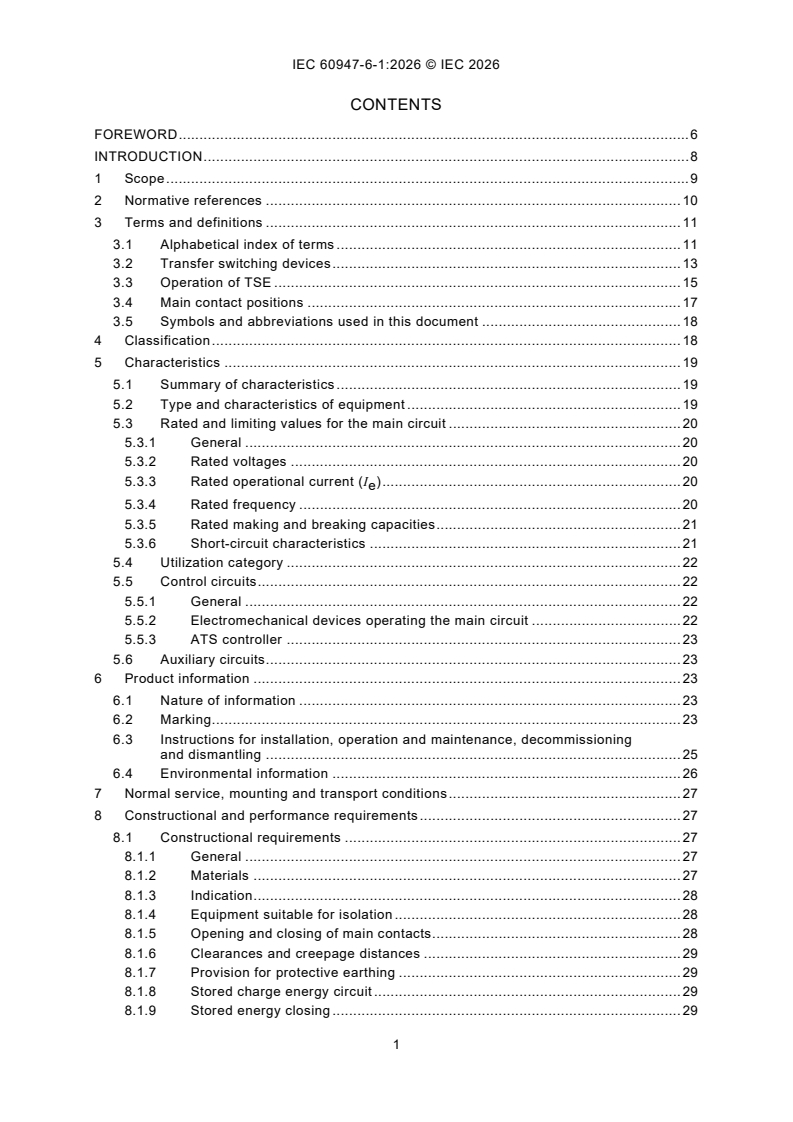
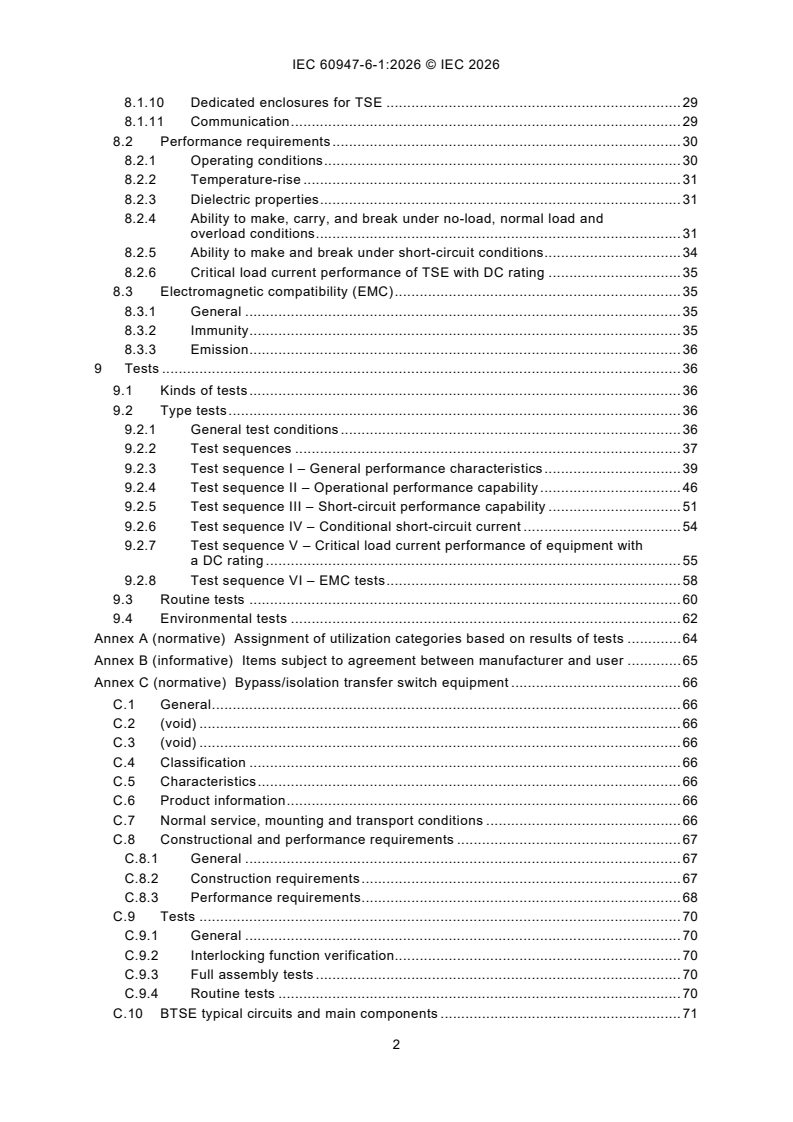
IEC 60947-6-1:2026 - Low-voltage switchgear and controlgear - Part 6-1: Multiple function equipment - Transfer switching equipment
REDLINE IEC 60947-6-1:2026 RLV - Low-voltage switchgear and controlgear - Part 6-1: Multiple function equipment - Transfer switching equipment
IEC 60947-6-1:2026 - Appareillage a basse tension - Partie 6-1: Matériels a fonctions multiples - Équipement de transfert de source
Overview
IEC 60947-6-1:2026 is the international standard for low-voltage switchgear and controlgear, specifically addressing multiple function equipment - transfer switching equipment (TSE). Published by the International Electrotechnical Commission (IEC), this fourth edition standard supersedes the previous (2021) edition and is available in a Redline version (IEC 60947-6-1:2026 RLV) that highlights all technical changes.
The scope of IEC 60947-6-1:2026 covers transfer switching equipment used in power systems up to 1,000 V AC or 1,500 V DC, enabling load transfer between power supply sources for improved continuity of supply and effective energy management. The standard establishes requirements and testing methods for various types of TSE, including manual, remote, automatic, and specialized transfer switches.
Key Topics
IEC 60947-6-1:2026 includes comprehensive guidelines and specifications for:
Types of Transfer Switching Equipment:
- Manually operated TSE (MTSE)
- Remotely operated TSE (RTSE)
- Automatic transfer switching equipment (ATSE), including controllers
- Stand-alone automatic transfer switch (ATS) controllers
- Bypass/isolation transfer switch equipment (BTSE)
- ATSE with closed transition functionality
- TSE for fire pump control applications
Key technical content:
- Product characteristics and performance criteria
- Classification and utilization categories
- Testing requirements (type, routine, and environmental tests)
- Marking, installation, operation, and maintenance instructions
- Constructional and dielectric properties
- Electromagnetic compatibility (EMC) requirements
Annexes addressing specific equipment:
- Annex C: Bypass/isolation transfer switch requirements
- Annex D: Closed transition ATSE
- Annex E: Stand-alone ATS controllers
- Annex F: TSE for electric driven fire pump controllers
Clarifications in the 2026 edition:
- Scope and application definitions
- Updated terminology and definitions
- Enhanced coverage of new and emerging TSE categories
Applications
IEC 60947-6-1:2026 is essential for manufacturers, design engineers, facility managers, system integrators, and maintenance professionals involved in:
- Critical infrastructure and industrial installations needing secure, reliable transfer between primary and backup power sources
- Data centers, hospitals, and commercial buildings where power continuity is vital
- Electrical panels and switchboards integrating transfer switching as part of their functionality
- Fire safety systems employing transfer switches for electric driven fire pump control
- Projects requiring compliance with international standards for export, certification, or regulatory approval
Implementing TSE according to IEC 60947-6-1:2026 ensures:
- Enhanced safety and operational reliability
- Compliance with international guidelines for product marking, testing, and performance
- Effective energy management in low-voltage power systems
Related Standards
IEC 60947-6-1:2026 is part of the broader IEC 60947 series, which covers low-voltage switchgear and controlgear. For enhanced compliance and system integration, related standards include:
- IEC 60947-1: General rules for low-voltage switchgear and controlgear
- IEC 60947-5-1: Auxiliary contacts for control circuits
- IEC 60079 (all parts): Equipment for explosive atmospheres
- IEC 62310: Static transfer switch equipment
- IEC TR 63201: Embedded software design in electrical equipment
- IEC 63208: Cybersecurity aspects in electrical control systems
- IEC 60034-12: Asynchronous motors and direct-on-line starting categories
For organizations committed to safety, energy continuity, and compliance, staying up to date with IEC 60947-6-1:2026 and its related standards is fundamental for the design, installation, and ongoing management of advanced low-voltage switching solutions.
Relations
- Effective Date
- 22-Dec-2023
Buy Documents
IEC 60947-6-1:2026 - Low-voltage switchgear and controlgear - Part 6-1: Multiple function equipment - Transfer switching equipment
REDLINE IEC 60947-6-1:2026 RLV - Low-voltage switchgear and controlgear - Part 6-1: Multiple function equipment - Transfer switching equipment
IEC 60947-6-1:2026 - Appareillage a basse tension - Partie 6-1: Matériels a fonctions multiples - Équipement de transfert de source
Get Certified
Connect with accredited certification bodies for this standard

IMQ S.p.A. (Certification)
Italian electrical product certification.

SLG Prüf- und Zertifizierungs GmbH
German testing and certification body.

UL Solutions
Global safety science company with testing, inspection and certification.
Sponsored listings
Frequently Asked Questions
IEC 60947-6-1:2026 is a standard published by the International Electrotechnical Commission (IEC). Its full title is "Low-voltage switchgear and controlgear - Part 6-1: Multiple function equipment - Transfer switching equipment". This standard covers: IEC 60947-6-1:2026 is available as IEC 60947-6-1:2026 RLV which contains the International Standard and its Redline version, showing all changes of the technical content compared to the previous edition. IEC 60947-6-1:2026 applies to transfer switching equipment (TSE), to be used in power systems for ensuring the continuity of the supply and allowing the energy management of the installation, by transferring a load between power supply sources, the rated voltage of which does not exceed 1 000 V AC or 1 500 V DC. Specific requirements for bypass/isolation transfer switch equipment are given in Annex C, ATSE having closed transition capability are given in Annex D, stand-alone ATS controllers are given in Annex E, and TSE for electric driven fire pump controllers are given in Annex F. It covers: - manually operated transfer switching equipment (MTSE); - remotely operated transfer switching equipment (RTSE); - automatic transfer switching equipment (ATSE), including the controller; - stand-alone ATS controllers; - bypass/isolation transfer switch equipment (BTSE); - ATSE having closed transition capability; - fire pump TSE. It does not cover: - TSE configurations that are not fully manufacturer type tested or marked according to this document as a complete transfer switch; - auxiliary contacts (for guidance, see IEC 60947-5-1); - transfer switches used in explosive atmospheres (for guidance, see IEC 60079 (all parts)); - embedded software design (for guidance, see IEC TR 63201); - cybersecurity aspects (for guidance, see IEC 63208); - TSE rated for direct-on-line starting asynchronous motor of design NE and HE, according to IEC 60034-12. (for guidance, see AC-3e utilisation category according to IEC 60947 4 1); - other types of TSE under consideration including overlapping neutral TSE, multi-source TSE (i.e. TSE with more than two sources of supply), TSE with load-shedding functions, bus-tie TSE, and hybrid TSE; - static transfer switches covered by IEC 62310 series. This fourth edition cancels and replaces the third edition published in 2021. This edition constitutes a technical revision. This edition includes the following significant technical changes with respect to the previous edition: - clarification of scope; - clarification of terms and definitions; - Annex C for Bypass/Isolation Transfer Switch Equipment; - Annex D for ATSE having closed transition capability; - Annex E for Stand-alone ATS controller; - Annex F for TSE used with electric driven fire pump control equipment.
IEC 60947-6-1:2026 is available as IEC 60947-6-1:2026 RLV which contains the International Standard and its Redline version, showing all changes of the technical content compared to the previous edition. IEC 60947-6-1:2026 applies to transfer switching equipment (TSE), to be used in power systems for ensuring the continuity of the supply and allowing the energy management of the installation, by transferring a load between power supply sources, the rated voltage of which does not exceed 1 000 V AC or 1 500 V DC. Specific requirements for bypass/isolation transfer switch equipment are given in Annex C, ATSE having closed transition capability are given in Annex D, stand-alone ATS controllers are given in Annex E, and TSE for electric driven fire pump controllers are given in Annex F. It covers: - manually operated transfer switching equipment (MTSE); - remotely operated transfer switching equipment (RTSE); - automatic transfer switching equipment (ATSE), including the controller; - stand-alone ATS controllers; - bypass/isolation transfer switch equipment (BTSE); - ATSE having closed transition capability; - fire pump TSE. It does not cover: - TSE configurations that are not fully manufacturer type tested or marked according to this document as a complete transfer switch; - auxiliary contacts (for guidance, see IEC 60947-5-1); - transfer switches used in explosive atmospheres (for guidance, see IEC 60079 (all parts)); - embedded software design (for guidance, see IEC TR 63201); - cybersecurity aspects (for guidance, see IEC 63208); - TSE rated for direct-on-line starting asynchronous motor of design NE and HE, according to IEC 60034-12. (for guidance, see AC-3e utilisation category according to IEC 60947 4 1); - other types of TSE under consideration including overlapping neutral TSE, multi-source TSE (i.e. TSE with more than two sources of supply), TSE with load-shedding functions, bus-tie TSE, and hybrid TSE; - static transfer switches covered by IEC 62310 series. This fourth edition cancels and replaces the third edition published in 2021. This edition constitutes a technical revision. This edition includes the following significant technical changes with respect to the previous edition: - clarification of scope; - clarification of terms and definitions; - Annex C for Bypass/Isolation Transfer Switch Equipment; - Annex D for ATSE having closed transition capability; - Annex E for Stand-alone ATS controller; - Annex F for TSE used with electric driven fire pump control equipment.
IEC 60947-6-1:2026 is classified under the following ICS (International Classification for Standards) categories: 29.120.40 - Switches; 29.130.20 - Low voltage switchgear and controlgear. The ICS classification helps identify the subject area and facilitates finding related standards.
IEC 60947-6-1:2026 has the following relationships with other standards: It is inter standard links to IEC 60947-6-1:2021. Understanding these relationships helps ensure you are using the most current and applicable version of the standard.
IEC 60947-6-1:2026 is available in PDF format for immediate download after purchase. The document can be added to your cart and obtained through the secure checkout process. Digital delivery ensures instant access to the complete standard document.
Standards Content (Sample)
IEC 60947-6-1 ®
Edition 4.0 2026-04
INTERNATIONAL
STANDARD
Low-voltage switchgear and controlgear -
Part 6-1: Multiple function equipment - Transfer switching equipment
ICS 29.120.40; 29.130.20 ISBN 978-2-8327-1141-5
All rights reserved. Unless otherwise specified, no part of this publication may be reproduced or utilized in any form or
by any means, electronic or mechanical, including photocopying and microfilm, without permission in writing from either
IEC or IEC's member National Committee in the country of the requester. If you have any questions about IEC copyright
or have an enquiry about obtaining additional rights to this publication, please contact the address below or your local
IEC member National Committee for further information.
IEC Secretariat Tel.: +41 22 919 02 11
3, rue de Varembé info@iec.ch
CH-1211 Geneva 20 www.iec.ch
Switzerland
About the IEC
The International Electrotechnical Commission (IEC) is the leading global organization that prepares and publishes
International Standards for all electrical, electronic and related technologies.
About IEC publications
The technical content of IEC publications is kept under constant review by the IEC. Please make sure that you have the
latest edition, a corrigendum or an amendment might have been published.
IEC publications search - IEC Products & Services Portal - products.iec.ch
webstore.iec.ch/advsearchform Discover our powerful search engine and read freely all the
The advanced search enables to find IEC publications by a publications previews, graphical symbols and the glossary.
variety of criteria (reference number, text, technical With a subscription you will always have access to up to date
committee, …). It also gives information on projects, content tailored to your needs.
replaced and withdrawn publications.
Electropedia - www.electropedia.org
The world's leading online dictionary on electrotechnology,
IEC Just Published - webstore.iec.ch/justpublished
Stay up to date on all new IEC publications. Just Published containing more than 22 500 terminological entries in English
details all new publications released. Available online and and French, with equivalent terms in 25 additional languages.
once a month by email. Also known as the International Electrotechnical Vocabulary
(IEV) online.
IEC Customer Service Centre - webstore.iec.ch/csc
If you wish to give us your feedback on this publication or
need further assistance, please contact the Customer
Service Centre: sales@iec.ch.
CONTENTS
FOREWORD . 6
INTRODUCTION . 8
1 Scope . 9
2 Normative references . 10
3 Terms and definitions . 11
3.1 Alphabetical index of terms . 11
3.2 Transfer switching devices . 13
3.3 Operation of TSE . 15
3.4 Main contact positions . 17
3.5 Symbols and abbreviations used in this document . 18
4 Classification . 18
5 Characteristics . 19
5.1 Summary of characteristics . 19
5.2 Type and characteristics of equipment . 19
5.3 Rated and limiting values for the main circuit . 20
5.3.1 General . 20
5.3.2 Rated voltages . 20
5.3.3 Rated operational current (I ) . 20
e
5.3.4 Rated frequency . 20
5.3.5 Rated making and breaking capacities . 21
5.3.6 Short-circuit characteristics . 21
5.4 Utilization category . 22
5.5 Control circuits . 22
5.5.1 General . 22
5.5.2 Electromechanical devices operating the main circuit . 22
5.5.3 ATS controller . 23
5.6 Auxiliary circuits . 23
6 Product information . 23
6.1 Nature of information . 23
6.2 Marking . 23
6.3 Instructions for installation, operation and maintenance, decommissioning
and dismantling . 25
6.4 Environmental information . 26
7 Normal service, mounting and transport conditions . 27
8 Constructional and performance requirements . 27
8.1 Constructional requirements . 27
8.1.1 General . 27
8.1.2 Materials . 27
8.1.3 Indication . 28
8.1.4 Equipment suitable for isolation . 28
8.1.5 Opening and closing of main contacts . 28
8.1.6 Clearances and creepage distances . 29
8.1.7 Provision for protective earthing . 29
8.1.8 Stored charge energy circuit . 29
8.1.9 Stored energy closing . 29
8.1.10 Dedicated enclosures for TSE . 29
8.1.11 Communication . 29
8.2 Performance requirements . 30
8.2.1 Operating conditions . 30
8.2.2 Temperature-rise . 31
8.2.3 Dielectric properties . 31
8.2.4 Ability to make, carry, and break under no-load, normal load and
overload conditions . 31
8.2.5 Ability to make and break under short-circuit conditions . 34
8.2.6 Critical load current performance of TSE with DC rating . 35
8.3 Electromagnetic compatibility (EMC) . 35
8.3.1 General . 35
8.3.2 Immunity . 35
8.3.3 Emission . 36
9 Tests . 36
9.1 Kinds of tests . 36
9.2 Type tests . 36
9.2.1 General test conditions . 36
9.2.2 Test sequences . 37
9.2.3 Test sequence I – General performance characteristics . 39
9.2.4 Test sequence II – Operational performance capability . 46
9.2.5 Test sequence III – Short-circuit performance capability . 51
9.2.6 Test sequence IV – Conditional short-circuit current . 54
9.2.7 Test sequence V – Critical load current performance of equipment with
a DC rating . 55
9.2.8 Test sequence VI – EMC tests . 58
9.3 Routine tests . 60
9.4 Environmental tests . 62
Annex A (normative) Assignment of utilization categories based on results of tests . 64
Annex B (informative) Items subject to agreement between manufacturer and user . 65
Annex C (normative) Bypass/isolation transfer switch equipment . 66
C.1 General . 66
C.2 (void) . 66
C.3 (void) . 66
C.4 Classification . 66
C.5 Characteristics . 66
C.6 Product information . 66
C.7 Normal service, mounting and transport conditions . 66
C.8 Constructional and performance requirements . 67
C.8.1 General . 67
C.8.2 Construction requirements . 67
C.8.3 Performance requirements . 68
C.9 Tests . 70
C.9.1 General . 70
C.9.2 Interlocking function verification. 70
C.9.3 Full assembly tests . 70
C.9.4 Routine tests . 70
C.10 BTSE typical circuits and main components . 71
C.10.1 Example of operating sequence of a single line fixed type BTSE . 71
C.10.2 Example of operating sequence of a double line fixed type BTSE . 72
C.10.3 Example of operating sequence of a double line withdrawable type
BTSE . 73
C.10.4 Example of operating sequence of a double line load-break
withdrawable type BTSE . 74
C.10.5 Example of operating sequence of a single line withdrawable type BTSE . 75
Annex D (normative) ATSE having closed transition capability . 76
D.1 General . 76
D.2 (void) . 76
D.3 (void) . 76
D.4 Classification . 76
D.5 Characteristics . 76
D.6 Product information . 76
D.6.1 General . 76
D.6.2 Product instructions for operation . 77
D.7 Normal service, mounting and transport conditions . 77
D.8 Constructional and performance requirements . 77
D.8.1 General . 77
D.8.2 Operating mechanism . 78
D.8.3 Controls, sequence, and limits of operation . 78
D.8.4 Performance requirements . 79
D.9 Tests . 80
D.9.1 General . 80
D.9.2 Test procedure . 80
D.9.3 Figures to clarify closed transition transfer . 81
Annex E (normative) Stand-alone ATS controller . 85
E.1 General . 85
E.2 (void) . 85
E.3 (void) . 85
E.4 Classification . 85
E.5 Characteristics . 85
E.6 Product information . 85
E.6.1 General . 85
E.6.2 Product instructions for operation . 87
E.7 Normal service, mounting and transport conditions . 88
E.8 Constructional and performance requirements . 88
E.8.1 Constructional requirements . 88
E.8.2 Performance requirements . 90
E.8.3 Electromagnetic compatibility (EMC) . 90
E.9 Tests . 90
E.9.1 General . 90
E.9.2 List of type tests . 90
E.9.3 Wire flexing test . 91
E.9.4 EMC tests . 91
E.9.5 Stand-alone ATS controller routine test . 92
E.9.6 Environmental tests . 92
E.9.7 Example to clarify stand-alone ATS controller operating transfer time . 92
Annex F (normative) TSE used with electric driven fire pump control equipment . 93
F.1 General . 93
F.2 Normative references . 93
F.3 Terms and definitions. 93
F.4 Classification . 93
F.5 Characteristics . 93
F.6 Product information . 93
F.7 Normal service, mounting and transport conditions . 94
F.8 Constructional, functional, and performance requirements . 94
F.8.1 General . 94
F.8.2 General . 94
F.8.3 Manual operating means for maintenance and servicing . 94
F.8.4 ATSE Voltage sensing . 95
F.8.5 ATSE Initiation of transfer to secondary supply source . 95
F.8.6 ATSE Frequency monitoring of generator source . 95
F.8.7 Indicators of transfer . 95
F.8.8 Integral protective devices . 95
F.8.9 ATSE Generator starting contacts . 95
F.8.10 Power circuit components . 96
F.8.11 Operating mechanism . 96
F.9 Tests . 96
F.9.1 General . 96
F.9.2 Type tests. 96
Bibliography . 97
Figure 1 – Example of operating sequences for TSE with three positions . 26
Figure 2 – Test circuit for connection to source I and source II supplies . 61
Figure 3 – Test circuit for the verification of making and breaking capacities . 62
Figure C.1 – Single line fixed type BTSE . 71
Figure C.2 – Double line fixed type BTSE . 72
Figure C.3 – Double line withdrawable type BTSE . 73
Figure C.4 – Double line load-break withdrawable type BTSE . 74
Figure C.5 – Single line withdrawable type BTSE . 75
Figure D.1 – Additional control circuit and external disconnecting devices . 79
Figure D.2 – Open transition . 81
Figure D.3 – Closed transition. 81
Figure D.4 – Example to describe a typical open and closed transition operating
sequence . 82
Figure D.5 – Example of an operating sequence with a fail to open position II contacts
within 100 ms during a return transfer in closed transition . 83
Figure D.6 – Example of an operating sequence with a fail to open both position I and
position II contacts during a return transfer in closed transition and showing the
removal of the condition by signalling an external device to open (source II) . 84
Figure E.1 – Example to show the stand-alone ATS controller operating transfer time . 92
Table 1 – Utilization categories . 22
Table 2 – Product information . 23
Table 3 – Verification of making and breaking capacity – Conditions for making and
breaking corresponding to the utilization categories . 32
Table 4 – Verification of operational performance – Conditions for making and breaking
corresponding to the utilization categories . 33
Table 5 – Value of the test current for the verification of the ability to operate under
short-circuit conditions . 34
Table 6 – Value of the test current for the verification of the ability to operate under
short-circuit conditions (harmonized table) . 35
Table 7 – Acceptance criteria of immunity test . 36
Table 8 – List of type tests (overall scheme of test sequences) . 37
Table 9 – List of type tests to which a derived TSE shall be submitted . 38
Table 10 – Number and duration of operating cycles for the making and breaking
capacity test . 47
Table 11 – Number and rate of operating cycles for the electrical and mechanical
operational performance tests for type A utilization categories . 48
Table 12 – Number and rate of operating cycles for the electrical and mechanical
operational performance tests for type B utilization categories . 49
Table 13 – Temperature-rise limits for terminals and accessible parts. 50
Table 14 – Number of operating cycles corresponding to the critical load current . 57
Table 15 – Test circuit parameters for Table 14 . 57
Table 16 – Test sequence V: Critical load current performance of equipment with a DC
rating . 57
Table D.1 – Product information . 77
Table E.1 – Product information . 86
Table E.2 – List of type tests for the stand-alone ATS controller . 91
Table F.1 – Product information . 94
INTERNATIONAL ELECTROTECHNICAL COMMISSION
____________
Low-voltage switchgear and controlgear -
Part 6-1: Multiple function equipment -
Transfer switching equipment
FOREWORD
1) The International Electrotechnical Commission (IEC) is a worldwide organization for standardization comprising
all national electrotechnical committees (IEC National Committees). The object of IEC is to promote international
co-operation on all questions concerning standardization in the electrical and electronic fields. To this end and
in addition to other activities, IEC publishes International Standards, Technical Specifications, Technical Reports,
Publicly Available Specifications (PAS) and Guides (hereafter referred to as "IEC Publication(s)"). Their
preparation is entrusted to technical committees; any IEC National Committee interested in the subject dealt with
may participate in this preparatory work. International, governmental and non-governmental organizations liaising
with the IEC also participate in this preparation. IEC collaborates closely with the International Organization for
Standardization (ISO) in accordance with conditions determined by agreement between the two organizations.
2) The formal decisions or agreements of IEC on technical matters express, as nearly as possible, an international
consensus of opinion on the relevant subjects since each technical committee has representation from all
interested IEC National Committees.
3) IEC Publications have the form of recommendations for international use and are accepted by IEC National
Committees in that sense. While all reasonable efforts are made to ensure that the technical content of IEC
Publications is accurate, IEC cannot be held responsible for the way in which they are used or for any
misinterpretation by any end user.
4) In order to promote international uniformity, IEC National Committees undertake to apply IEC Publications
transparently to the maximum extent possible in their national and regional publications. Any divergence between
any IEC Publication and the corresponding national or regional publication shall be clearly indicated in the latter.
5) IEC itself does not provide any attestation of conformity. Independent certification bodies provide conformity
assessment services and, in some areas, access to IEC marks of conformity. IEC is not responsible for any
services carried out by independent certification bodies.
6) All users should ensure that they have the latest edition of this publication.
7) No liability shall attach to IEC or its directors, employees, servants or agents including individual experts and
members of its technical committees and IEC National Committees for any personal injury, property damage or
other damage of any nature whatsoever, whether direct or indirect, or for costs (including legal fees) and
expenses arising out of the publication, use of, or reliance upon, this IEC Publication or any other IEC
Publications.
8) Attention is drawn to the Normative references cited in this publication. Use of the referenced publications is
indispensable for the correct application of this publication.
9) IEC draws attention to the possibility that the implementation of this document may involve the use of (a)
patent(s). IEC takes no position concerning the evidence, validity or applicability of any claimed patent rights in
respect thereof. As of the date of publication of this document, IEC had not received notice of (a) patent(s), which
may be required to implement this document. However, implementers are cautioned that this may not represent
the latest information, which may be obtained from the patent database available at https://patents.iec.ch. IEC
shall not be held responsible for identifying any or all such patent rights.
IEC 60947-6-1 has been prepared by sub-committee 121A: Low-voltage switchgear and
controlgear, of IEC technical committee 121: Switchgear and controlgear and their assemblies
for low voltage. It is an International Standard.
This fourth edition cancels and replaces the third edition published in 2021. This edition
constitutes a technical revision.
This edition includes the following significant technical changes with respect to the previous
edition:
– clarification of scope;
– clarification of terms and definitions;
– Annex C for Bypass/Isolation Transfer Switch Equipment;
– Annex D for ATSE having closed transition capability;
– Annex E for Stand-alone ATS controller;
– Annex F for TSE used with electric driven fire pump control equipment.
The text of this International Standard is based on the following documents:
Draft Report on voting
121A/711/FDIS 121A/719/RVD
Full information on the voting for its approval can be found in the report on voting indicated in
the above table.
The language used for the development of this International Standard is English.
This document was drafted in accordance with ISO/IEC Directives, Part 2, and developed in
accordance with ISO/IEC Directives, Part 1 and ISO/IEC Directives, IEC Supplement, available
at www.iec.ch/members_experts/refdocs. The main document types developed by IEC are
described in greater detail at www.iec.ch/publications.
A list of all the parts in the IEC 60947 series, published under the general title Low-voltage
switchgear and controlgear, can be found on the IEC website.
This document is to be read in conjunction with IEC 60947-1:2020, Low voltage switchgear and
controlgear - Part 1: General rules.
The provisions of the general rules are applicable to IEC 60947-6-1 where specifically called
for. General rules clauses and subclauses thus applicable as well as tables, figures and
appendices are identified by reference to IEC 60947-1:2020, for example, 1.2.3, Table 4, or
Annex A of IEC 60947-1:2020.
The committee has decided that the contents of this document will remain unchanged until the
stability date indicated on the IEC website under webstore.iec.ch in the data related to the
specific document. At this date, the document will be
– reconfirmed,
– withdrawn, or
– revised.
INTRODUCTION
The availability of power in low voltage electrical installations is playing an ever increasing role
in modern society. In fact, this requirement is a fundamental characteristic for the creation of
economically and functionally efficient installations. A system able to switch a load from one
source to another safely and with minimum disturbance to the load reduces problems caused
by faulty conditions in the normal supply to the minimum.
All these operations, commonly known as "transfer switching", control the installations and can
be done automatically, remotely or manually.
Therefore, an installation with installed "transfer switching" capability:
– ensures the continuity of production processes;
– provides a backup source of power if the main network is out of service;
– reduces the effect caused by network faults on parts of the installation;
– achieves a good compromise between reliability, simplicity and cost-effectiveness;
– provides the facility manager and managing system with a power source able to supply all
or part of the installation.
Key factors motivating customers to use Transfer Switch Equipment (TSE) include:
– the continuous world growth population, the increasing number of electronic devices and
the new demands of electric vehicles;
– the mediated pressure on climate change with a resulting increase in the cost of energy;
– the evolution of the electricity market with a greater number of alternate energy sources;
– the user’s expectations of better grid reliability, better economic performance, and a desire
to manage their energy.
Stakeholders involved in the management of electricity also have new expectations:
– customers want to reduce the cost of their energy and to have a quality energy supply;
– suppliers want to reinforce confidence to their customers;
– producers expect to optimize their investments;
– governments and regulators are willing to create a competitive and sustainable energy
market.
Today, the performance of transfer switching equipment is defined by TSE manufacturers and
also by this document. Consultants, integrators, facility managers and end users rely on this
document for their power availability needs.
Transfer switching is often realised by implementing a transfer function within the electrical
installation, and this critical function needs to be appropriately designed. Using a TSE following
the requirements of this document ensure the safety and the performance of the transfer
function which are necessary for reaching the objectives listed above.
1 Scope
This document applies to transfer switching equipment (TSE), to be used in power systems for
ensuring the continuity of the supply and allowing the energy management of the installation,
by transferring a load between power supply sources, the rated voltage of which does not
exceed 1 000 V AC or 1 500 V DC.
Specific requirements for bypass/isolation transfer switch equipment are given in Annex C,
ATSE having closed transition capability are given in Annex D, stand-alone ATS controllers are
given in Annex E, and TSE for electric driven fire pump controllers are given in Annex F.
It covers:
– manually operated transfer switching equipment (MTSE);
– remotely operated transfer switching equipment (RTSE);
– automatic transfer switching equipment (ATSE), including the controller;
– stand-alone ATS controllers;
– bypass/isolation transfer switch equipment (BTSE);
– ATSE having closed transition capability;
– fire pump TSE.
It does not cover:
– TSE configurations that are not fully manufacturer type tested or marked according to this
document as a complete transfer switch;
– auxiliary contacts (for guidance, see IEC 60947-5-1);
– transfer switches used in explosive atmospheres (for guidance, see IEC 60079 (all parts));
– embedded software design (for guidance, see IEC TR 63201);
– cybersecurity aspects (for guidance, see IEC 63208);
– TSE rated for direct-on-line starting asynchronous motor of design NE and HE, according
to IEC 60034-12. (for guidance, see AC-3e utilisation category according to IEC 60947-4-1);
– other types of TSE under consideration including overlapping neutral TSE, multi-source TSE
(i.e. TSE with more than two sources of supply), TSE with load-shedding functions, bus-tie
TSE, and hybrid TSE;
– static transfer switches covered by IEC 62310 series.
NOTE TSE used for safety services and for emergency escape lighting systems as described in IEC 60364-5-56
are subject to specific rules and legal requirements.
The object of this document is to state:
a) the required characteristics of the equipment;
b) the conditions with which the equipment is to comply with respect to:
1) operation for which the equipment is intended;
2) operation and behaviour in case of specified abnormal conditions, for example, short-
circuit;
3) dielectric properties;
4) electromagnetic compatibility;
c) the tests intended to confirm that these conditions have been met and the methods for
performing these tests;
d) the product information to be provided by the manufacturer.
2 Normative references
The following documents are referred to in the text in such a way that some or all of their content
constitutes requirements of this document. For dated references, only the edition cited applies.
For undated references, the latest edition of the referenced document (including any
amendments) applies.
IEC 60068-2-2:2007, Environmental testing - Part 2-2: Tests - Test B: Dry heat
IEC 60417:2025, Graphical symbols for use on equipment - 12-month subscription to regularly
updated online database comprising all graphical symbols published in IEC 60417
IEC 60715:2017, Dimensions of low-voltage switchgear and controlgear - Standardized
mounting on rails for mechanical support of switchgear, controlgear and accessories
IEC 60812:2018, Failure modes and effects analysis (FMEA and FMECA)
IEC 60947-1:2020, Low-voltage switchgear and controlgear - Part 1: General rules
IEC 60947-2:2024, Low-voltage switchgear and controlgear - Part 2: Circuit-breakers
IEC 60947-4-1:2023, Low-voltage switchgear and controlgear - Part 4-1: Contactors and
motor-starters - Electromechanical contactors and motor-starters
IEC 60947-5-1:2024, Low-voltage switchgear and controlgear - Part 5-1: Control circuit devices
and switching elements - Electromechanical control circuit devices
IEC 61000-4-13:2002, Electromagnetic compatibility (EMC) - Part 4-13: Testing and
measurement techniques - Harmonics and interharmonics including mains signaling at a.c.
power port, low frequency immunity tests
IEC 61000-4-13:2002/AMD1:2009
IEC 61000-4-13:2002/AMD2:2015
IEC 61439-1:2020, Low-voltage switchgear and controlgear assemblies - Part 1: General rules
IEC 61439-2:2020, Low-voltage switchgear and controlgear assemblies - Part 2: Power
switchgear and controlgear assemblies
IEC 61557-12:2018, Electrical safety in low voltage distribution systems up to 1 000 V AC and
1 500 V DC - Equipment for testing, measuring or monitoring of protective measures - Part 12:
Power metering and monitoring devices (PMD)
IEC 61557-12:2018/AMD1:2021
IEC 61812-1:2023, Time relays and coupling relays for industrial and residential use - Part 1:
Requirements and tests
IEC 63208:2025, Low-voltage switchgear and controlgear - Security aspects
CISPR 11:2024, Industrial, scientific and medical equipment - Radio-frequency disturbance
characteristics - Limits and methods of measurement
3 Terms and definitions
For the purposes of this document, the terms and definitions given in Clause 3 of
IEC 60947-1:2020, and the following apply.
ISO and IEC maintain terminological databases for use in standardization at the following
addresses:
– ISO Online browsing platform: available at http://www.iso.org/obp
– IEC Electropedia: available at http://www.electropedia.org/
3.1 Alphabetical index of terms
Reference
A
ATS (Automatic Transfer Switch) controller . 3.2.9
Automatic transfer switching equipment (ATSE) . 3.2.4
Available source . 3.3.11
B
Backup TSE (of a BTSE). 3.2.13
Bypass / Isolation mode (of a BTSE) . 3.2.17
Bypass mode (of a BTSE) . 3.2.15
Bypass transfer switching equipment (BTSE) . 3.2.11
C
Contact transfer time . 3.3.5
Class CB TSE . 3.2.7
Class CC TSE . 3.2.8
Class PC TSE . 3.2.6
Closed transition . 3.3.9
D
Derived transfer switching equipment (derived TSE) . 3.2.5
Dedicated wiring accessories . 3.2.10
F
Fire pump TSE . 3.2.21
Frequency supply deviation . 3.3.4
I
Interlocking . 3.3.10
Interlocking for ATSE having closed transition capability . 3.3.15
In-phase transfer .
...
IEC 60947-6-1 ®
Edition 4.0 2026-04
INTERNATIONAL
STANDARD
REDLINE VERSION
Low-voltage switchgear and controlgear -
Part 6-1: Multiple function equipment - Transfer switching equipment
ICS 29.120.40; 29.130.20 ISBN 978-2-8327-1191-0
All rights reserved. Unless otherwise specified, no part of this publication may be reproduced or utilized in any form or
by any means, electronic or mechanical, including photocopying and microfilm, without permission in writing from either
IEC or IEC's member National Committee in the country of the requester. If you have any questions about IEC copyright
or have an enquiry about obtaining additional rights to this publication, please contact the address below or your local
IEC member National Committee for further information.
IEC Secretariat Tel.: +41 22 919 02 11
3, rue de Varembé info@iec.ch
CH-1211 Geneva 20 www.iec.ch
Switzerland
About the IEC
The International Electrotechnical Commission (IEC) is the leading global organization that prepares and publishes
International Standards for all electrical, electronic and related technologies.
About IEC publications
The technical content of IEC publications is kept under constant review by the IEC. Please make sure that you have the
latest edition, a corrigendum or an amendment might have been published.
IEC publications search - IEC Products & Services Portal - products.iec.ch
webstore.iec.ch/advsearchform Discover our powerful search engine and read freely all the
The advanced search enables to find IEC publications by a publications previews, graphical symbols and the glossary.
variety of criteria (reference number, text, technical With a subscription you will always have access to up to date
committee, …). It also gives information on projects, content tailored to your needs.
replaced and withdrawn publications.
Electropedia - www.electropedia.org
The world's leading online dictionary on electrotechnology,
IEC Just Published - webstore.iec.ch/justpublished
Stay up to date on all new IEC publications. Just Published containing more than 22 500 terminological entries in English
details all new publications released. Available online and and French, with equivalent terms in 25 additional languages.
once a month by email. Also known as the International Electrotechnical Vocabulary
(IEV) online.
IEC Customer Service Centre - webstore.iec.ch/csc
If you wish to give us your feedback on this publication or
need further assistance, please contact the Customer
Service Centre: sales@iec.ch.
CONTENTS
FOREWORD . 6
INTRODUCTION . 8
1 Scope . 9
2 Normative references . 10
3 Terms and definitions . 11
3.1 Alphabetical index of terms . 11
3.2 Transfer switching devices . 13
3.3 Operation of TSE . 15
3.4 Main contact positions . 17
3.5 Symbols and abbreviations used in this document . 18
4 Classification . 18
5 Characteristics . 19
5.1 Summary of characteristics . 19
5.2 Type and characteristics of equipment . 19
5.3 Rated and limiting values for the main circuit . 20
5.3.1 General . 20
5.3.2 Rated voltages . 20
5.3.3 Rated operational current (I ) . 20
e
5.3.4 Rated frequency . 20
5.3.5 Rated making and breaking capacities . 21
5.3.6 Short-circuit characteristics . 21
5.4 Utilization category . 22
5.5 Control circuits . 22
5.5.1 General . 22
5.5.2 Electromechanical devices operating the main circuit . 22
5.5.3 ATS controller . 23
5.6 Auxiliary circuits . 23
6 Product information . 23
6.1 Nature of information . 23
6.2 Marking . 23
6.3 Instructions for installation, operation and maintenance, decommissioning
and dismantling . 25
6.4 Environmental information . 26
7 Normal service, mounting and transport conditions . 27
8 Constructional and performance requirements . 27
8.1 Constructional requirements . 27
8.1.1 General . 27
8.1.2 Materials . 27
8.1.3 Indication of the switching position . 28
8.1.4 Equipment suitable for isolation . 28
8.1.5 Opening and closing of main contacts . 28
8.1.6 Clearances and creepage distances . 29
8.1.7 Provision for protective earthing . 29
8.1.8 Stored charge energy circuit . 29
8.1.9 Stored energy closing . 29
8.1.10 Dedicated enclosures for TSE . 29
8.1.11 Communication . 29
8.2 Performance requirements . 30
8.2.1 Operating conditions . 30
8.2.2 Temperature-rise . 31
8.2.3 Dielectric properties . 31
8.2.4 Ability to make, carry, and break under no-load, normal load and
overload conditions . 31
8.2.5 Ability to make and break under short-circuit conditions . 34
8.2.6 Critical load current performance (DC equipment) of TSE with DC rating . 35
8.3 Electromagnetic compatibility (EMC) . 35
8.3.1 General . 35
8.3.2 Immunity . 35
8.3.3 Emission . 36
9 Tests . 36
9.1 Kinds of tests . 36
9.2 Type tests . 36
9.2.1 General test conditions . 36
9.2.2 Test sequences . 37
9.2.3 Test sequence I – General performance characteristics . 39
9.2.4 Test sequence II – Operational performance capability . 46
9.2.5 Test sequence III – Short-circuit performance capability . 51
9.2.6 Test sequence IV – Conditional short-circuit current . 54
9.2.7 Test sequence V – Critical load current performance of equipment with
a DC rating . 55
9.2.8 Test sequence VI – EMC tests . 58
9.3 Routine tests . 60
9.4 Environmental tests . 62
Annex A (normative) Assignment of utilization categories based on results of tests . 64
Annex B (informative) Items subject to agreement between manufacturer and user . 65
Annex C (normative) Bypass/isolation transfer switch equipment . 66
C.1 General . 66
C.2 (void) . 66
C.3 (void) . 66
C.4 Classification . 66
C.5 Characteristics . 66
C.6 Product information . 66
C.7 Normal service, mounting and transport conditions . 66
C.8 Constructional and performance requirements . 67
C.8.1 General . 67
C.8.2 Construction requirements . 67
C.8.3 Performance requirements . 68
C.9 Tests . 70
C.9.1 General . 70
C.9.2 Interlocking function verification. 70
C.9.3 Full assembly tests . 70
C.9.4 Routine tests . 70
C.10 BTSE typical circuits and main components . 71
C.10.1 Example of operating sequence of a single line fixed type BTSE . 71
C.10.2 Example of operating sequence of a double line fixed type BTSE . 72
C.10.3 Example of operating sequence of a double line withdrawable type
BTSE . 73
C.10.4 Example of operating sequence of a double line load-break
withdrawable type BTSE . 74
C.10.5 Example of operating sequence of a single line withdrawable type BTSE . 75
Annex D (normative) ATSE having closed transition capability . 76
D.1 General . 76
D.2 (void) . 76
D.3 (void) . 76
D.4 Classification . 76
D.5 Characteristics . 76
D.6 Product information . 76
D.6.1 General . 76
D.6.2 Product instructions for operation . 77
D.7 Normal service, mounting and transport conditions . 77
D.8 Constructional and performance requirements . 77
D.8.1 General . 77
D.8.2 Operating mechanism . 78
D.8.3 Controls, sequence, and limits of operation . 78
D.8.4 Performance requirements . 79
D.9 Tests . 80
D.9.1 General . 80
D.9.2 Test procedure . 80
D.9.3 Figures to clarify closed transition transfer . 81
Annex E (normative) Stand-alone ATS controller . 85
E.1 General . 85
E.2 (void) . 85
E.3 (void) . 85
E.4 Classification . 85
E.5 Characteristics . 85
E.6 Product information . 85
E.6.1 General . 85
E.6.2 Product instructions for operation . 87
E.7 Normal service, mounting and transport conditions . 88
E.8 Constructional and performance requirements . 88
E.8.1 Constructional requirements . 88
E.8.2 Performance requirements . 90
E.8.3 Electromagnetic compatibility (EMC) . 90
E.9 Tests . 90
E.9.1 General . 90
E.9.2 List of type tests . 90
E.9.3 Wire flexing test . 91
E.9.4 EMC tests . 91
E.9.5 Stand-alone ATS controller routine test . 92
E.9.6 Environmental tests . 92
E.9.7 Example to clarify stand-alone ATS controller operating transfer time . 92
Annex F (normative) TSE used with electric driven fire pump control equipment . 93
F.1 General . 93
F.2 Normative references . 93
F.3 Terms and definitions. 93
F.4 Classification . 93
F.5 Characteristics . 93
F.6 Product information . 93
F.7 Normal service, mounting and transport conditions . 94
F.8 Constructional, functional, and performance requirements . 94
F.8.1 General . 94
F.8.2 General . 94
F.8.3 Manual operating means for maintenance and servicing . 94
F.8.4 ATSE Voltage sensing . 95
F.8.5 ATSE Initiation of transfer to secondary supply source . 95
F.8.6 ATSE Frequency monitoring of generator source . 95
F.8.7 Indicators of transfer . 95
F.8.8 Integral protective devices . 95
F.8.9 ATSE Generator starting contacts . 95
F.8.10 Power circuit components . 96
F.8.11 Operating mechanism . 96
F.9 Tests . 96
F.9.1 General . 96
F.9.2 Type tests. 96
Bibliography . 97
Figure 1 – Example of operating sequences for TSE with three positions . 26
Figure 2 – Test circuit for connection to source I and source II supplies . 61
Figure 3 – Test circuit for the verification of making and breaking capacities . 62
Figure C.1 – Single line fixed type BTSE . 71
Figure C.2 – Double line fixed type BTSE . 72
Figure C.3 – Double line withdrawable type BTSE . 73
Figure C.4 – Double line load-break withdrawable type BTSE . 74
Figure C.5 – Single line withdrawable type BTSE . 75
Figure D.1 – Additional control circuit and external disconnecting devices . 79
Figure D.2 – Open transition . 81
Figure D.3 – Closed transition. 81
Figure D.4 – Example to describe a typical open and closed transition operating
sequence . 82
Figure D.5 – Example of an operating sequence with a fail to open position II contacts
within 100 ms during a return transfer in closed transition . 83
Figure D.6 – Example of an operating sequence with a fail to open both position I and
position II contacts during a return transfer in closed transition and showing the
removal of the condition by signalling an external device to open (source II) . 84
Figure E.1 – Example to show the stand-alone ATS controller operating transfer time . 92
Table 1 – Utilization categories . 22
Table 2 – Product information . 23
Table 3 – Verification of making and breaking capacity – Conditions for making and
breaking corresponding to the utilization categories . 32
Table 4 – Verification of operational performance – Conditions for making and breaking
corresponding to the utilization categories . 33
Table 5 – Value of the test current for the verification of the ability to operate under
short-circuit conditions . 34
Table 6 – Value of the test current for the verification of the ability to operate under
short-circuit conditions (harmonized table) . 35
Table 7 – Acceptance criteria of immunity test . 36
Table 8 – List of type tests (overall scheme of test sequences) . 37
Table 9 – List of type tests to which a derived TSE shall be submitted . 38
Table 10 – Number and duration of operating cycles for the making and breaking
capacity test . 47
Table 11 – Number and rate of operating cycles for the electrical and mechanical
operational performance tests for type A utilization categories . 48
Table 12 – Number and rate of operating cycles for the electrical and mechanical
operational performance tests for type B utilization categories . 49
Table 13 – Temperature-rise limits for terminals and accessible parts. 50
Table 14 – Number of operating cycles corresponding to the critical load current . 57
Table 15 – Test circuit parameters for Table 14 . 57
Table 16 – Test sequence V: Critical load current performance of equipment with a DC
rating . 57
Table D.1 – Product information . 77
Table E.1 – Product information . 86
Table E.2 – List of type tests for the stand-alone ATS controller . 91
Table F.1 – Product information . 94
INTERNATIONAL ELECTROTECHNICAL COMMISSION
____________
Low-voltage switchgear and controlgear -
Part 6-1: Multiple function equipment -
Transfer switching equipment
FOREWORD
1) The International Electrotechnical Commission (IEC) is a worldwide organization for standardization comprising
all national electrotechnical committees (IEC National Committees). The object of IEC is to promote international
co-operation on all questions concerning standardization in the electrical and electronic fields. To this end and
in addition to other activities, IEC publishes International Standards, Technical Specifications, Technical Reports,
Publicly Available Specifications (PAS) and Guides (hereafter referred to as "IEC Publication(s)"). Their
preparation is entrusted to technical committees; any IEC National Committee interested in the subject dealt with
may participate in this preparatory work. International, governmental and non-governmental organizations liaising
with the IEC also participate in this preparation. IEC collaborates closely with the International Organization for
Standardization (ISO) in accordance with conditions determined by agreement between the two organizations.
2) The formal decisions or agreements of IEC on technical matters express, as nearly as possible, an international
consensus of opinion on the relevant subjects since each technical committee has representation from all
interested IEC National Committees.
3) IEC Publications have the form of recommendations for international use and are accepted by IEC National
Committees in that sense. While all reasonable efforts are made to ensure that the technical content of IEC
Publications is accurate, IEC cannot be held responsible for the way in which they are used or for any
misinterpretation by any end user.
4) In order to promote international uniformity, IEC National Committees undertake to apply IEC Publications
transparently to the maximum extent possible in their national and regional publications. Any divergence between
any IEC Publication and the corresponding national or regional publication shall be clearly indicated in the latter.
5) IEC itself does not provide any attestation of conformity. Independent certification bodies provide conformity
assessment services and, in some areas, access to IEC marks of conformity. IEC is not responsible for any
services carried out by independent certification bodies.
6) All users should ensure that they have the latest edition of this publication.
7) No liability shall attach to IEC or its directors, employees, servants or agents including individual experts and
members of its technical committees and IEC National Committees for any personal injury, property damage or
other damage of any nature whatsoever, whether direct or indirect, or for costs (including legal fees) and
expenses arising out of the publication, use of, or reliance upon, this IEC Publication or any other IEC
Publications.
8) Attention is drawn to the Normative references cited in this publication. Use of the referenced publications is
indispensable for the correct application of this publication.
9) IEC draws attention to the possibility that the implementation of this document may involve the use of (a)
patent(s). IEC takes no position concerning the evidence, validity or applicability of any claimed patent rights in
respect thereof. As of the date of publication of this document, IEC had not received notice of (a) patent(s), which
may be required to implement this document. However, implementers are cautioned that this may not represent
the latest information, which may be obtained from the patent database available at https://patents.iec.ch. IEC
shall not be held responsible for identifying any or all such patent rights.
This redline version of the official IEC Standard allows the user to identify the changes made
to the previous edition IEC 60947-6-1:2021. A vertical bar appears in the margin wherever a
change has been made. Additions are in green text, deletions are in strikethrough red text.
IEC 60947-6-1 has been prepared by sub-committee 121A: Low-voltage switchgear and
controlgear, of IEC technical committee 121: Switchgear and controlgear and their assemblies
for low voltage. It is an International Standard.
This fourth edition cancels and replaces the third edition published in 2021. This edition
constitutes a technical revision.
This edition includes the following significant technical changes with respect to the previous
edition:
– clarification of scope;
– clarification of terms and definitions;
– Annex C for Bypass/Isolation Transfer Switch Equipment;
– Annex D for ATSE having closed transition capability;
– Annex E for Stand-alone ATS controller;
– Annex F for TSE used with electric driven fire pump control equipment.
The text of this International Standard is based on the following documents:
Draft Report on voting
121A/711/FDIS 121A/719/RVD
Full information on the voting for its approval can be found in the report on voting indicated in
the above table.
The language used for the development of this International Standard is English.
This document was drafted in accordance with ISO/IEC Directives, Part 2, and developed in
accordance with ISO/IEC Directives, Part 1 and ISO/IEC Directives, IEC Supplement, available
at www.iec.ch/members_experts/refdocs. The main document types developed by IEC are
described in greater detail at www.iec.ch/publications.
A list of all the parts in the IEC 60947 series, published under the general title Low-voltage
switchgear and controlgear, can be found on the IEC website.
This document is to be read in conjunction with IEC 60947-1:2020, Low voltage switchgear and
controlgear - Part 1: General rules.
The provisions of the general rules are applicable to IEC 60947-6-1 where specifically called
for. General rules clauses and subclauses thus applicable as well as tables, figures and
appendices are identified by reference to IEC 60947-1:2020, for example, 1.2.3, Table 4, or
Annex A of IEC 60947-1:2020.
The committee has decided that the contents of this document will remain unchanged until the
stability date indicated on the IEC website under webstore.iec.ch in the data related to the
specific document. At this date, the document will be
– reconfirmed,
– withdrawn, or
– revised.
INTRODUCTION
The availability of power in low voltage electrical installations is playing an ever increasing role
in modern society. In fact, this requirement is a fundamental characteristic for the creation of
economically and functionally efficient installations. A system able to switch a load from one
source to another safely and with minimum disturbance to the load reduces problems caused
by faulty conditions in the normal supply to the minimum.
All these operations, commonly known as "transfer switching", control the installations and can
be done automatically, remotely or manually.
Therefore, an installation with installed "transfer switching" capability:
– ensures the continuity of production processes;
– provides a backup source of power if the main network is out of service;
– reduces the effect caused by network faults on parts of the installation;
– achieves a good compromise between reliability, simplicity and cost-effectiveness;
– provides the facility manager and managing system with a power source able to supply all
or part of the installation.
Key factors motivating customers to use Transfer Switch Equipment (TSE) include:
– the continuous world growth population, the increasing number of electronic devices and
the new demands of electric vehicles;
– the mediated pressure on climate change with a resulting increase in the cost of energy;
– the evolution of the electricity market with a greater number of alternate energy sources;
– the user’s expectations of better grid reliability, better economic performance, and a desire
to manage their energy.
Stakeholders involved in the management of electricity also have new expectations:
– customers want to reduce the cost of their energy and to have a quality energy supply;
– suppliers want to reinforce confidence to their customers;
– producers expect to optimize their investments;
– governments and regulators are willing to create a competitive and sustainable energy
market.
Today, the performance of transfer switching equipment is defined by TSE manufacturers and
also by this document. Consultants, integrators, facility managers and end users rely on this
document for their power availability needs.
Transfer switching is often realised by implementing a transfer function within the electrical
installation, and this critical function can needs to be inappropriately appropriately designed.
Using a TSE following the requirements of this document ensure the safety and the performance
of the transfer function which are necessary for reaching the objectives listed above.
1 Scope
This document applies to transfer switching equipment (TSE), to be used in power systems for
ensuring the continuity of the supply and allowing the energy management of the installation,
by transferring a load between power supply sources, the rated voltage of which does not
exceed 1 000 V AC or 1 500 V DC.
Specific requirements for bypass/isolation transfer switch equipment are given in Annex C,
ATSE having closed transition capability are given in Annex D, stand-alone ATS controllers are
given in Annex E, and TSE for electric driven fire pump controllers are given in Annex F.
It covers:
– manually operated transfer switching equipment (MTSE);
– remotely operated transfer switching equipment (RTSE);
– automatic transfer switching equipment (ATSE), including the controller;
– stand-alone ATS controllers;
– bypass/isolation transfer switch equipment (BTSE);
– ATSE having closed transition capability;
– fire pump TSE.
It does not cover:
– TSE configurations that are either not fully manufacturer type tested and/or not marked
according to this document as a complete transfer switch;
– auxiliary contacts (for guidance, see IEC 60947-5-1);
– transfer switches used in explosive atmospheres (for guidance, see IEC 60079 (all parts));
– embedded software design (for guidance, see IEC TR 63201);
– cybersecurity aspects (for guidance, see IEC TS 63208);
– TSE rated for direct-on-line starting asynchronous motor of design NE and HE, according
to IEC 60034-12:2016. (for guidance, see AC-3e utilisation category according to
IEC 60947-4-1:2018);
– other types of TSE under consideration including closed transition TSE, overlapping neutral
TSE, multi-source TSE (i.e. TSE with more than two sources of supply), stand-alone ATS
controllers, bypass isolation TSE, TSE with load-shedding functions, bus-tie TSE, and
hybrid TSE;
– static transfer switches covered by IEC 62310 series.
NOTE TSE used for safety services and for emergency escape lighting systems as described in IEC 60364-5-56
are subject to specific rules and/or legal requirements.
The object of this document is to state:
a) the required characteristics of the equipment;
b) the conditions with which the equipment is to comply with respect to:
1) operation for which the equipment is intended;
2) operation and behaviour in case of specified abnormal conditions, for example, short-
circuit;
3) dielectric properties;
4) electromagnetic compatibility;
c) the tests intended to confirm that these conditions have been met and the methods for
performing these tests;
d) the product information to be provided by the manufacturer.
2 Normative references
The following documents are referred to in the text in such a way that some or all of their content
constitutes requirements of this document. For dated references, only the edition cited applies.
For undated references, the latest edition of the referenced document (including any
amendments) applies.
IEC 60068-2-2:2007, Environmental testing - Part 2-2: Tests - Test B: Dry heat
IEC 60417:2025, Graphical symbols for use on equipment - (available at http://www.graphical-
symbols.info/equipment) 12-month subscription to regularly updated online database
comprising all graphical symbols published in IEC 60417
IEC 60715:2017, Dimensions of low-voltage switchgear and controlgear - Standardized
mounting on rails for mechanical support of switchgear, controlgear and accessories
IEC 60812:2018, Failure modes and effects analysis (FMEA and FMECA)
IEC 60947 (all parts), Low-voltage switchgear and controlgear
IEC 60947-1:2020, Low-voltage switchgear and controlgear - Part 1: General rules
IEC 60947-2:20162024, Low-voltage switchgear and controlgear - Part 2: Circuit-breakers
IEC 60947-2:2016/AMD1:2019
IEC 60947-3:2020, Low-voltage switchgear and controlgear – Part 3: Switches, disconnectors,
switch-disconnectors and fuse-combination units
IEC 60947-4-1:20182023, Low-voltage switchgear and controlgear - Part 4-1: Contactors and
motor-starters - Electromechanical contactors and motor-starters
IEC 60947-5-1:2024, Low-voltage switchgear and controlgear - Part 5-1: Control circuit devices
and switching elements - Electromechanical control circuit devices
IEC 61000-4-13:2002, Electromagnetic compatibility (EMC) - Part 4-13: Testing and
measurement techniques - Harmonics and interharmonics including mains signaling at a.c.
power port, low frequency immunity tests
IEC 61000-4-13:2002/AMD1:2009
IEC 61000-4-13:2002/AMD2:2015
IEC 61439-1:2020, Low-voltage switchgear and controlgear assemblies - Part 1: General rules
IEC 61439-2:2020, Low-voltage switchgear and controlgear assemblies - Part 2: Power
switchgear and controlgear assemblies
IEC 61557-12:2018, Electrical safety in low voltage distribution systems up to 1 000 V AC and
1 500 V DC - Equipment for testing, measuring or monitoring of protective measures - Part 12:
Power metering and monitoring devices (PMD)
IEC 61557-12:2018/AMD1:2021
IEC 61812-1:2023, Time relays and coupling relays for industrial and residential use - Part 1:
Requirements and tests
IEC 63208:2025, Low-voltage switchgear and controlgear - Security aspects
CISPR 11:20152024, Industrial, scientific and medical equipment - Radio-frequency
disturbance characteristics - Limits and methods of measurement
CISPR 11:2015/AMD1:2016
3 Terms and definitions
For the purposes of this document, the terms and definitions given in Clause 3 of
IEC 60947-1:2020, and the following apply.
ISO and IEC maintain terminological databases for use in standardization at the following
addresses:
– ISO Online browsing platform: available at http://www.iso.org/obp
– IEC Electropedia: available at http://www.electropedia.org/
3.1 Alphabetical index of terms
Reference
A
ATS (Automatic Transfer Switch) controller . 3.2.9
Automatic transfer switching equipment (ATSE) . 3.2.4
Available source . 3.3.11
B
Backup TSE (of a BTSE). 3.2.13
Bypass / Isolation mode (of a BTSE) . 3.2.17
Bypass mode (of a BTSE) . 3.2.15
Bypass transfer switching equipment (BTSE) . 3.2.11
C
Contact transfer time . 3.3.5
Class CB TSE . 3.2.7
Class CC TSE . 3.2.8
Class PC TSE . 3.2.6
Closed transition . 3.3.9
D
Derived transfer switching equipment (derived TSE) . 3.2.5
Dedicated wiring accessories .
...
IEC 60947-6-1 ®
Edition 4.0 2026-04
NORME
INTERNATIONALE
Appareillage à basse tension -
Partie 6-1: Matériels à fonctions multiples - Équipement de transfert de source
ICS 29.120.40; 29.130.20 ISBN 978-2-8327-1141-5
Droits de reproduction réservés. Sauf indication contraire, aucune partie de cette publication ne peut être reproduite ni
utilisée sous quelque forme que ce soit et par aucun procédé, électronique ou mécanique, y compris la photocopie et
les microfilms, sans l'accord écrit de l'IEC ou du Comité national de l'IEC du pays du demandeur. Si vous avez des
questions sur le copyright de l'IEC ou si vous désirez obtenir des droits supplémentaires sur cette publication, utilisez
les coordonnées ci-après ou contactez le Comité national de l'IEC de votre pays de résidence.
IEC Secretariat Tel.: +41 22 919 02 11
3, rue de Varembé info@iec.ch
CH-1211 Geneva 20 www.iec.ch
Switzerland
A propos de l'IEC
La Commission Electrotechnique Internationale (IEC) est la première organisation mondiale qui élabore et publie des
Normes internationales pour tout ce qui a trait à l'électricité, à l'électronique et aux technologies apparentées.
A propos des publications IEC
Le contenu technique des publications IEC est constamment revu. Veuillez vous assurer que vous possédez l’édition la
plus récente, un corrigendum ou amendement peut avoir été publié.
Recherche de publications IEC - IEC Products & Services Portal - products.iec.ch
webstore.iec.ch/advsearchform Découvrez notre puissant moteur de recherche et consultez
La recherche avancée permet de trouver des publications gratuitement tous les aperçus des publications, symboles
IEC en utilisant différents critères (numéro de référence, graphiques et le glossaire. Avec un abonnement, vous aurez
texte, comité d’études, …). Elle donne aussi des toujours accès à un contenu à jour adapté à vos besoins.
informations sur les projets et les publications remplacées
ou retirées. Electropedia - www.electropedia.org
Le premier dictionnaire d'électrotechnologie en ligne au
IEC Just Published - webstore.iec.ch/justpublished monde, avec plus de 22 500 articles terminologiques en
Restez informé sur les nouvelles publications IEC. Just anglais et en français, ainsi que les termes équivalents
dans 25 langues additionnelles. Egalement appelé
Published détaille les nouvelles publications parues.
Disponible en ligne et une fois par mois par email. Vocabulaire Electrotechnique International (IEV) en ligne.
Service Clients - webstore.iec.ch/csc
Si vous désirez nous donner des commentaires sur cette
publication ou si vous avez des questions contactez-
nous: sales@iec.ch.
SOMMAIRE
AVANT-PROPOS . 6
INTRODUCTION . 8
1 Domaine d'application . 9
2 Références normatives . 10
3 Termes et définitions . 11
3.1 Index alphabétique des termes . 11
3.2 Dispositifs de transfert de source . 13
3.3 Manœuvre des TSE . 16
3.4 Positions des contacts principaux . 18
3.5 Symboles et abréviations utilisés dans le présent document . 18
4 Classification . 19
5 Caractéristiques . 19
5.1 Énumération des caractéristiques . 19
5.2 Type et caractéristiques du matériel . 20
5.3 Valeurs assignées et valeurs limites pour le circuit principal . 20
5.3.1 Généralités . 20
5.3.2 Tensions assignées . 21
5.3.3 Courant assigné d'emploi (I ) . 21
e
5.3.4 Fréquence assignée . 21
5.3.5 Pouvoirs assignés de fermeture et de coupure . 21
5.3.6 Caractéristiques de court-circuit . 21
5.4 Catégorie d'emploi . 22
5.5 Circuits de commande . 23
5.5.1 Généralités . 23
5.5.2 Dispositifs électromécaniques de commande du circuit principal . 23
5.5.3 Contrôleur ATS . 23
5.6 Circuits auxiliaires . 23
6 Informations sur le produit . 23
6.1 Nature des informations . 23
6.2 Marquage . 23
6.3 Instructions d'installation, de fonctionnement, de maintenance, de mise hors
service et de démontage . 26
6.4 Informations relatives à l'environnement . 27
7 Conditions de service normal, de montage et de transport . 28
8 Exigences relatives à la construction et aux performances . 28
8.1 Exigences relatives à la construction . 28
8.1.1 Généralités . 28
8.1.2 Matériaux . 29
8.1.3 Indication . 29
8.1.4 Matériels aptes au sectionnement . 29
8.1.5 Ouverture et fermeture des contacts principaux . 29
8.1.6 Distances d'isolement et lignes de fuite . 30
8.1.7 Dispositions pour assurer la mise à la terre . 30
8.1.8 Circuit à accumulation d'énergie . 30
8.1.9 Fermeture par accumulation d'énergie . 30
8.1.10 Enveloppes dédiées pour le TSE . 31
8.1.11 Communication . 31
8.2 Exigences relatives aux performances . 31
8.2.1 Conditions de fonctionnement . 31
8.2.2 Échauffement . 32
8.2.3 Propriétés diélectriques . 32
8.2.4 Aptitude à l'établissement, au passage et à la coupure des courants à
vide et dans les conditions de charge normale et de surcharge . 33
8.2.5 Aptitude à l'établissement et à la coupure en conditions de court-circuit . 35
8.2.6 Fonctionnement au courant critique de charge du TSE avec une
caractéristique assignée en courant continu . 36
8.3 Compatibilité électromagnétique (CEM) . 37
8.3.1 Généralités . 37
8.3.2 Immunité . 37
8.3.3 Émissions . 38
9 Essais . 38
9.1 Nature des essais . 38
9.2 Essais de type . 38
9.2.1 Conditions générales d'essai . 38
9.2.2 Séquences d'essais . 38
9.2.3 Séquence d'essais I – Caractéristiques générales de fonctionnement . 41
9.2.4 Séquence d'essais II – Aptitude au fonctionnement en service . 48
9.2.5 Séquence d'essais III – Aptitude au fonctionnement en court-circuit . 54
9.2.6 Séquence d'essais IV – Courant de court-circuit conditionnel . 57
9.2.7 Séquence d'essais V – Fonctionnement au courant critique de charge
du matériel avec une caractéristique en courant continu . 58
9.2.8 Séquence d'essais VI – Essais CEM . 61
9.3 Essais individuels de série . 63
9.4 Essais d'environnement . 65
Annexe A (normative) Attribution des catégories d'emploi suivant les résultats des
essais . 67
Annexe B (informative) Points faisant l'objet d'un accord entre le fabricant et
l'utilisateur . 68
Annexe C (normative) Équipements de transfert de source à shuntage/sectionnement . 69
C.1 Généralités . 69
C.2 (vacant) . 69
C.3 (vacant) . 69
C.4 Classification . 69
C.5 Caractéristiques . 69
C.6 Informations sur le produit . 69
C.7 Conditions de service normal, de montage et de transport . 69
C.8 Exigences relatives à la construction et aux performances . 70
C.8.1 Généralités . 70
C.8.2 Exigences relatives à la construction . 70
C.8.3 Exigences relatives aux performances . 71
C.9 Essais . 73
C.9.1 Généralités . 73
C.9.2 Vérification de la fonction d'interverrouillage . 73
C.9.3 Essais sur ensembles complets . 74
C.9.4 Essais individuels de série. 74
C.10 Circuits types et composants principaux des BTSE . 74
C.10.1 Exemple de séquence de manœuvres d'un BTSE fixe à une phase . 74
C.10.2 Exemple de séquence de manœuvres d'un BTSE fixe à deux phases . 75
C.10.3 Exemple de séquence de manœuvres d'un BTSE débrochable à deux
phases . 76
C.10.4 Exemple de séquence de manœuvres d'un BTSE débrochable en
charge à deux phases . 77
C.10.5 Exemple de séquence de manœuvres d'un BTSE débrochable à une
phase . 78
Annexe D (normative) ATSE sans coupure . 79
D.1 Généralités . 79
D.2 (vacant) . 79
D.3 (vacant) . 79
D.4 Classification . 79
D.5 Caractéristiques . 79
D.6 Informations sur le produit . 79
D.6.1 Généralités . 79
D.6.2 Instructions de fonctionnement du produit. 80
D.7 Conditions de service normal, de montage et de transport . 80
D.8 Exigences relatives à la construction et aux performances . 80
D.8.1 Généralités . 80
D.8.2 Mécanisme de manœuvre . 81
D.8.3 Commandes, séquence et limites de fonctionnement . 81
D.8.4 Exigences relatives aux performances . 82
D.9 Essais . 83
D.9.1 Généralités . 83
D.9.2 Procédure d'essai . 83
D.9.3 Figures pour clarifier le transfert sans coupure . 84
Annexe E (normative) Contrôleurs ATS autonomes. 91
E.1 Généralités . 91
E.2 (vacant) . 91
E.3 (vacant) . 91
E.4 Classification . 91
E.5 Caractéristiques . 91
E.6 Informations sur le produit . 91
E.6.1 Généralités . 91
E.6.2 Instructions de fonctionnement du produit. 94
E.7 Conditions de service normal, de montage et de transport . 94
E.8 Exigences relatives à la construction et aux performances . 94
E.8.1 Exigences relatives à la construction . 94
E.8.2 Exigences relatives aux performances . 96
E.8.3 Compatibilité électromagnétique (CEM) . 96
E.9 Essais . 97
E.9.1 Généralités . 97
E.9.2 Liste des essais de type . 97
E.9.3 Essai de flexion de câble . 98
E.9.4 Essais CEM . 98
E.9.5 Essai individuel de série du contrôleur ATS autonome . 98
E.9.6 Essais d'environnement . 98
E.9.7 Exemple pour expliquer la durée de manœuvre de transfert du
contrôleur ATS autonome . 98
Annexe F (normative) TSE utilisés avec un appareil de commande de pompe à
incendie à entraînement électrique . 100
F.1 Généralités . 100
F.2 Références normatives . 100
F.3 Termes et définitions . 100
F.4 Classification . 100
F.5 Caractéristiques . 100
F.6 Informations sur le produit . 100
F.7 Conditions de service normal, de montage et de transport . 101
F.8 Exigences relatives à la construction, au fonctionnement et aux
performances . 101
F.8.1 Généralités . 101
F.8.2 Généralités . 101
F.8.3 Organes de manœuvre pour la maintenance et l'entretien . 102
F.8.4 Mesure de la tension d'un ATSE . 102
F.8.5 Déclenchement du transfert à la source d'alimentation secondaire d'un
ATSE . 102
F.8.6 Surveillance de la fréquence de la source du générateur d'un ATSE . 102
F.8.7 Indicateurs de transfert . 102
F.8.8 Dispositifs de protection intégrés . 102
F.8.9 Contacts de démarrage du générateur d'un ATSE . 102
F.8.10 Composants du circuit d'alimentation . 103
F.8.11 Mécanisme de manœuvre . 103
F.9 Essais . 103
F.9.1 Généralités . 103
F.9.2 Essais de type . 103
Bibliographie . 104
Figure 1 – Exemple de séquences de manœuvres pour un TSE à trois positions . 27
Figure 2 – Circuit d'essai pour le raccordement aux alimentations des sources I et II . 64
Figure 3 – Circuit d'essai pour la vérification des pouvoirs de fermeture et de coupure . 65
Figure C.1 – BTSE fixe à une phase . 74
Figure C.2 – BTSE fixe à deux phases . 75
Figure C.3 – BTSE débrochable à deux phases . 76
Figure C.4 – BTSE débrochable en charge à deux phases . 77
Figure C.5 – BTSE débrochable à une phase . 78
Figure D.1 – Exemples de circuit de commande supplémentaire et de dispositifs de
déconnexion externes . 82
Figure D.2 – Transition avec coupure . 84
Figure D.3 – Transition sans coupure . 85
Figure D.4 – Exemple de description d'une séquence type de manœuvres pendant un
transfert avec et sans coupure . 86
Figure D.5 – Exemple de séquence de manœuvres avec défaut d'ouverture des
contacts en position II en moins de 100 ms lors d'un transfert en retour en mode
transition sans coupure . 88
Figure D.6 – Exemple de séquence de manœuvres avec défaut d'ouverture des
contacts en position I et en position II lors d'un transfert en retour en mode transition
sans coupure et qui montre la suppression de la condition par l'envoi d'un signal
d'ouverture à un dispositif externe (source II) . 90
Figure E.1 – Exemple pour expliquer la durée de manœuvre de transfert du contrôleur
ATS autonome . 99
Tableau 1 – Catégories d'emploi . 23
Tableau 2 – Informations sur le produit . 24
Tableau 3 – Vérification des pouvoirs de fermeture et de coupure – Conditions de
fermeture et de coupure selon les catégories d'emploi . 33
Tableau 4 – Vérification du fonctionnement en service – Conditions de fermeture et de
coupure selon les catégories d'emploi . 34
Tableau 5 – Valeur du courant d'essai pour la vérification de l'aptitude au
fonctionnement en conditions de court-circuit . 36
Tableau 6 – Valeur du courant d'essai pour la vérification de l'aptitude au
fonctionnement en conditions de court-circuit (tableau harmonisé) . 36
Tableau 7 – Critères d'acceptation de l'essai d'immunité . 37
Tableau 8 – Liste des essais de type (plan général des séquences d'essais) . 39
Tableau 9 – Liste des essais de type auxquels doit être soumis un TSE dérivé . 40
Tableau 10 – Nombre et durée des cycles de manœuvres pour l'essai des pouvoirs de
fermeture et de coupure . 50
Tableau 11 – Nombres et vitesses des cycles de manœuvres pour les essais de
fonctionnement électrique et mécanique en service pour les catégories d'emploi de
type A . 51
Tableau 12 – Nombres et vitesses des cycles de manœuvres pour les essais de
fonctionnement électrique et mécanique en service pour les catégories d'emploi de
type B . 51
Tableau 13 – Limites d'échauffement des bornes et des parties accessibles . 53
Tableau 14 – Nombre de cycles de manœuvres correspondant au courant critique de
charge . 60
Tableau 15 – Paramètres du circuit d'essai pour le Tableau 14 . 60
Tableau 16 – Essais de la séquence d'essais V – Fonctionnement au courant critique
de charge du matériel avec une caractéristique assignée en courant continu . 61
Tableau D.1 – Informations sur le produit . 80
Tableau E.1 – Informations sur le produit . 92
Tableau E.2 – Liste des essais de type pour les contrôleurs ATS autonomes . 98
Tableau F.1 – Informations sur le produit . 101
COMMISSION ÉLECTROTECHNIQUE INTERNATIONALE
____________
Appareillage à basse tension -
Partie 6-1: Matériels à fonctions multiples -
Équipement de transfert de source
AVANT-PROPOS
1) La Commission Électrotechnique Internationale (IEC) est une organisation mondiale de normalisation composée
de l'ensemble des comités électrotechniques nationaux (Comités nationaux de l'IEC). L'IEC a pour objet de
favoriser la coopération internationale pour toutes les questions de normalisation dans les domaines de
l'électricité et de l'électronique. À cet effet, l'IEC – entre autres activités – publie des Normes internationales,
des Spécifications techniques, des Rapports techniques, des Spécifications accessibles au public (PAS) et des
Guides (ci-après dénommés "Publication(s) de l'IEC"). Leur élaboration est confiée à des comités d'études, aux
travaux desquels tout Comité national intéressé par le sujet traité peut participer. Les organisations
internationales, gouvernementales et non gouvernementales, en liaison avec l'IEC, participent également aux
travaux. L'IEC collabore étroitement avec l'Organisation Internationale de Normalisation (ISO), selon des
conditions fixées par accord entre les deux organisations.
2) Les décisions ou accords officiels de l'IEC concernant les questions techniques représentent, dans la mesure du
possible, un accord international sur les sujets étudiés, étant donné que les Comités nationaux de l'IEC intéressés
sont représentés dans chaque comité d'études.
3) Les Publications de l'IEC se présentent sous la forme de recommandations internationales et sont agréées
comme telles par les Comités nationaux de l'IEC. Tous les efforts raisonnables sont entrepris afin que l'IEC
s'assure de l'exactitude du contenu technique de ses publications; l'IEC ne peut pas être tenue responsable de
l'éventuelle mauvaise utilisation ou interprétation qui en est faite par un quelconque utilisateur final.
4) Dans le but d'encourager l'uniformité internationale, les Comités nationaux de l'IEC s'engagent, dans toute la
mesure possible, à appliquer de façon transparente les Publications de l'IEC dans leurs publications nationales
et régionales. Toutes divergences entre toutes Publications de l'IEC et toutes publications nationales ou
régionales correspondantes doivent être indiquées en termes clairs dans ces dernières.
5) L'IEC elle-même ne fournit aucune attestation de conformité. Des organismes de certification indépendants
fournissent des services d'évaluation de conformité et, dans certains secteurs, accèdent aux marques de
conformité de l'IEC. L'IEC n'est responsable d'aucun des services effectués par les organismes de certification
indépendants.
6) Tous les utilisateurs doivent s'assurer qu'ils sont en possession de la dernière édition de cette publication.
7) Aucune responsabilité ne doit être imputée à l'IEC, à ses administrateurs, employés, auxiliaires ou mandataires,
y compris ses experts particuliers et les membres de ses comités d'études et des Comités nationaux de l'IEC,
pour tout préjudice causé en cas de dommages corporels et matériels, ou de tout autre dommage de quelque
nature que ce soit, directe ou indirecte, ou pour supporter les coûts (y compris les frais de justice) et les dépenses
découlant de la publication ou de l'utilisation de cette Publication de l'IEC ou de toute autre Publication de l'IEC,
ou au crédit qui lui est accordé.
8) L'attention est attirée sur les références normatives citées dans cette publication. L'utilisation de publications
référencées est obligatoire pour une application correcte de la présente publication.
9) L'IEC attire l'attention sur le fait que la mise en application du présent document peut entraîner l'utilisation d'un
ou de plusieurs brevets. L'IEC ne prend pas position quant à la preuve, à la validité et à l'applicabilité de tout
droit de brevet revendiqué à cet égard. À la date de publication du présent document, l'IEC n'avait pas reçu
notification qu'un ou plusieurs brevets pouvaient être nécessaires à sa mise en application. Toutefois, il y a lieu
d'avertir les responsables de la mise en application du présent document que des informations plus récentes
sont susceptibles de figurer dans la base de données de brevets, disponible à l'adresse https://patents.iec.ch.
L'IEC ne saurait être tenue pour responsable de ne pas avoir identifié de tels droits de brevets.
L'IEC 60947-6-1 a été établie par le sous-comité 121A: Appareillages à basse tension, du
comité d'études 121 de l'IEC: Appareillages et ensembles d'appareillages basse tension. Il
s'agit d'une Norme internationale.
Cette quatrième édition annule et remplace la troisième édition parue en 2021. Cette édition
constitue une révision technique.
Cette édition inclut les modifications techniques majeures suivantes par rapport à l'édition
précédente:
– clarification du domaine d'application;
– clarification des termes et définitions;
– Annexe C, pour les équipements de transfert de source à shuntage/sectionnement;
– Annexe D, pour les ATSE sans coupure;
– Annexe E, pour les contrôleurs ATS autonomes;
– Annexe F, pour les TSE utilisés avec un appareil de commande de pompe à incendie à
entraînement électrique.
Le texte de cette Norme internationale est issu des documents suivants:
Projet Rapport de vote
121A/711/FDIS 121A/719/RVD
Le rapport de vote indiqué dans le tableau ci-dessus donne toute information sur le vote ayant
abouti à son approbation.
La langue employée pour l'élaboration de cette Norme internationale est l'anglais.
Ce document a été rédigé selon les Directives ISO/IEC, Partie 2, il a été développé selon les
Directives ISO/IEC, Partie 1 et les Directives ISO/IEC, Supplément IEC, disponibles sous
www.iec.ch/members_experts/refdocs. Les principaux types de documents développés par
l'IEC sont décrits plus en détail sous www.iec.ch/publications.
Une liste de toutes les parties de la série IEC 60947, publiées sous le titre général Appareillage
à basse tension, se trouve sur le site web de l'IEC.
Le présent document doit être lu conjointement avec l'IEC 60947-1:2020, Appareillage à basse
tension - Partie 1: Règles générales.
Les dispositions des règles générales s'appliquent à l'IEC 60947-6-1 lorsque celle-ci le précise.
Les articles, paragraphes, tableaux, figures et annexes des règles générales qui s'appliquent
ainsi sont identifiés par référence à l'IEC 60947-1:2020, par exemple 1.2.3, Tableau 4 ou
Annexe A de l'IEC 60947-1:2020.
Le comité a décidé que le contenu de ce document ne sera pas modifié avant la date de stabilité
indiquée sur le site web de l'IEC sous webstore.iec.ch dans les données relatives au document
recherché. À cette date, le document sera
– reconduit,
– supprimé, ou
– révisé.
INTRODUCTION
La disponibilité de l'alimentation au sein des installations électriques à basse tension joue un
rôle de plus en plus important dans la société moderne. En réalité, cette exigence est une
caractéristique fondamentale pour la création d'installations efficaces sur le plan fonctionnel et
économique. Un système capable de transférer une charge d'une source à une autre de façon
sécurisée et avec le moins de perturbations possible pour la charge permet de réduire les
problèmes engendrés par des conditions de défaillance dans l'alimentation normale.
Toutes ces manœuvres, communément appelées "transferts de source", pilotent les
installations et peuvent être effectuées automatiquement, à distance ou manuellement.
Par conséquent, une installation disposant d'une fonctionnalité de "transfert de source":
– assure la continuité des processus de production;
– fournit une source d'alimentation de secours si le réseau est hors service;
– réduit les effets engendrés par des dysfonctionnements du réseau sur des parties de
l'installation;
– constitue un bon compromis entre fiabilité, simplicité et rentabilité;
– fournit au gestionnaire de site et au système de gestion une source d'alimentation capable
d'alimenter tout ou partie de l'installation.
Les principaux facteurs incitant les clients à utiliser un équipement de transfert de source (TSE)
incluent:
– la croissance constante de la population mondiale, le nombre croissant d'appareils
électroniques et les nouvelles demandes en véhicules électriques;
– la pression médiatique relative aux changements climatiques, avec l'augmentation du coût
de l'énergie qui en résulte;
– l'évolution du marché de l'électricité avec un nombre croissant de sources d'énergie
alternatives;
– les attentes des utilisateurs pour une plus grande fiabilité du réseau, des performances plus
économiques et le souhait de gérer leur énergie.
Les parties prenantes impliquées dans la gestion de l'électricité ont également de nouvelles
attentes:
– les clients souhaitent réduire le coût de leur énergie et disposer d'une alimentation en
énergie de qualité;
– les fournisseurs souhaitent renforcer la confiance de leurs clients;
– les producteurs s'attendent à optimiser leurs investissements;
– les gouvernements et les organismes de réglementation sont disposés à créer un marché
énergétique compétitif et durable.
Aujourd'hui, les performances des équipements de transfert de source sont définies par les
fabricants de TSE ainsi que par le présent document. Les consultants, les intégrateurs, les
gestionnaires de sites et les utilisateurs finaux s'appuient sur le présent document pour leurs
besoins en matière de disponibilité énergétique.
Les transferts de source sont souvent réalisés en mettant en œuvre une fonction de transfert
dans l'installation électrique, et il est nécessaire de concevoir cette fonction critique de façon
appropriée. L'utilisation d'un TSE conforme aux exigences du présent document assure la
sécurité et les performances de la fonction de transfert qui sont nécessaires pour atteindre les
objectifs énumérés ci-dessus.
1 Domaine d'application
Le présent document s'applique aux équipements de transfert de source (TSE) destinés à être
utilisés au sein de réseaux d'énergie qui assurent la continuité de l'alimentation et permettent
la gestion de l'énergie de l'installation, en transférant une charge entre des sources
d'alimentation dont la tension assignée ne dépasse pas 1 000 V en courant alternatif ou 1 500 V
en courant continu.
Les exigences spécifiques aux équipements de transfert de source à shuntage/sectionnement
sont fournies à l'Annexe C. Les exigences spécifiques aux ATSE sans coupure sont fournies à
l'Annexe D. Les exigences spécifiques aux contrôleurs ATS autonomes sont fournies à
l'Annexe E. Les exigences spécifiques aux TSE pour appareils de commande de pompe à
incendie à entraînement électrique sont fournies à l'Annexe F.
Le présent document couvre:
– les équipements de transfert de source manœuvrés manuellement (MTSE);
– les équipements de transfert de source manœuvrés à distance (RTSE);
– les équipements de transfert de source automatiques (ATSE), y compris le contrôleur;
– les contrôleurs ATS autonomes;
– les équipements de transfert de source à shuntage/sectionnement (BTSE);
– les ATSE sans coupure;
– les TSE pour pompe à incendie.
Le présent document ne couvre pas:
– les configurations de TSE qui ne sont pas complètement soumises aux essais de type ou
marquées par le fabricant conformément au présent document pour le transfert de source
complet;
– les contacts auxiliaires (voir les recommandations de l'IEC 60947-5-1);
– les transferts de source utilisés en atmosphères explosives (voir les recommandations de
l'IEC 60079 (toutes les parties));
– la conception des logiciels embarqués (voir les recommandations de l'IEC TR 63201);
– les aspects liés à la cybersécurité (voir les recommandations de l'IEC 63208);
– les TSE conçus pour les moteurs asynchrones à démarrage direct de types NE et HE selon
l'IEC 60034-12 (voir les recommandations pour la catégorie d'emploi AC-3e selon
l'IEC 60947-4-1);
– les autres types de TSE à l'étude, notamment les TSE à transition avec recouvrement du
neutre, les TSE multisources (c'est-à-dire les TSE comportant plus de deux sources
d'alimentation), les TSE comportant des fonctions de délestage, les TSE comportant un jeu
de barres de couplage et les TSE hybrides;
– les commutateurs de transfert statique couverts par la série IEC 62310.
NOTE Les TSE destinés aux services de sécurité et aux systèmes d'éclairage d'évacuation tels que ceux décrits
dans l'IEC 60364-5-56 sont soumis à des règles et exigences légales spécifiques.
Le présent document a pour objet de spécifier:
a) les caractéristiques exigées du matériel;
b) les conditions que le matériel doit respecter en ce qui concerne:
1) le fonctionnement auquel il est destiné;
2) le fonctionnement et le comportement en cas de conditions anormales spécifiées, telles
qu'un court-circuit;
3) leurs propriétés diélectriques;
4) la compatibilité électromagnétique.
c) les essais destinés à vérifier si ces conditions sont remplies, ainsi que les méthodes à
adopter pour ces essais;
d) les informations sur le produit à fournir par le fabricant.
2 Références normatives
Les documents suivants sont cités dans le texte de sorte qu'ils constituent, pour tout ou partie
de leur contenu, des exigences du présent document. Pour les références datées, seule
l'édition citée s'applique. Pour les références non datées, la dernière édition du document de
référence s'applique (y compris les éventuels amendements).
IEC 60068-2-2:2007, Essais d'environnement - Partie 2-2: Essais - Essai B: Chaleur sèche
IEC 60417:2025, Symboles graphiques utilisables sur le matériel - Abonnement de 12 mois à
la base de données en ligne mise à jour régulièrement et comprenant tous les symboles
graphiques publiés dans l'IEC 60417
IEC 60715:2017, Dimensions de l'appareillage à basse tension - Montage normalisé sur
profilés-supports pour le support mécanique des appareillages et de leurs accessoires
IEC 60812:2018, Analyse des modes de défaillance et de leurs effets (AMDE et AMDEC)
IEC 60947-1:2020, Appareillage à basse tension - Partie 1: Règles générales
IEC 60947-2:2024, Appareillage à basse tension - Partie 2: Disjoncteurs
IEC 60947-4-1:2023, Appareillage à basse tension - Partie 4-1: Contacteurs et démarreurs de
moteurs - Contacteurs et démarreurs électromécaniques
IEC 60947-5-1:2024, Appareillage à basse tension - Partie 5-1: Appareils et éléments de
commutation pour circuits de commande - Appareils électromécaniques pour circuits de
commande
IEC 61000-4-13:2002, Compatibilité électromagnétique (CEM) - Partie 4-13: Techniques
d'essai et de mesure - Essais d'immunité basse fréquence aux harmoniques et
interharmoniques incluant les signaux transmis sur le réseau électrique alternatif
IEC 61000-4-13:2002/AMD1:2009
IEC 61000-4-13:2002/AMD2:2015
IEC 61439-1:2020, Ensembles d'appareillage à basse tension - Partie 1: Règles générales
IEC 61439-2:2020, Ensembles d'appareillage à basse tension - Partie 2: Ensembles
d'appareillage de puissance
IEC 61557-12:2018, Sécurité électrique dans les réseaux de distribution basse tension jusqu'à
1 000 V c.a. et 1 500 V c.c. - Dispositifs de contrôle, de mesure ou de surveillance de mesures
de protection - Partie 12: Dispositifs de comptage et de surveillance du réseau électrique (PMD)
IEC 61557-12:2018/AMD1:2021
IEC 61812-1:2023, Relais à temps spécifié pour applications industrielles et résidentielles -
Partie 1: Exigences et essais
IEC 63208:2025, Appareillages et ensembles d'appareillages à basse tension - Exigences de
sécurité
CISPR 11:2024, Appareils industriels, scientifiques et médicaux - Carac
...