

IEC 62683-2-2:2025
(Main)Low-voltage switchgear and controlgear - Product data and properties for information exchange - Engineering data - Part 2-2: Switchgear and controlgear assembly objects for building information modelling
General Information
- Abstract
IEC 62683-2-2:2025 specifies the building information modelling (BIM) with the physical characteristics and technical services of low-voltage switchgear and controlgear assemblies to be used mainly for the construction phase of the building and also for delivering data for operation.
This document covers all types of assemblies covered by the IEC 61439 series which can be installed in a building.
Busbar trunking systems defined by IEC 61439-6 are under consideration for a next edition.
These BIM object models, registered in IEC CDD, are intended to supply the process defined by ISO 16739 series.
This document does not cover:
– the build-in components included within the assembly such as switchgear and controlgear,
– safety related control system of machinery,
– the detailed electrical and mechanical configuration of the assembly
– logistic information.
- Status
- Published
- Publication Date
- 09-Sep-2025
- Technical Committee
- TC 121 - Switchgear and controlgear and their assemblies for low voltage
- Drafting Committee
- WG 3 - TC 121/WG 3
- Current Stage
- PPUB - Publication issued
- Start Date
- 10-Sep-2025
- Completion Date
- 15-Aug-2025
Buy Documents
IEC 62683-2-2:2025 - Low-voltage switchgear and controlgear - Product data and properties for information exchange - Engineering data - Part 2-2: Switchgear and controlgear assembly objects for building information modelling Released:9/10/2025
IEC 62683-2-2:2025 - Appareillage a basse tension - Données et propriétés de produits pour l'échange d'informations - Données d'ingénierie - Partie 2-2 : Objets d'ensembles d'appareillage pour la modélisation des informations de la construction Released:9/10/2025
IEC 62683-2-2:2025 - Low-voltage switchgear and controlgear - Product data and properties for information exchange - Engineering data - Part 2-2: Switchgear and controlgear assembly objects for building information modelling Released:9/10/2025
Overview
IEC 62683-2-2:2025 - Low-voltage switchgear and controlgear - Product data and properties for information exchange - Engineering data - Part 2-2 - specifies Building Information Modelling (BIM) object models for low-voltage switchgear and controlgear assemblies used primarily in the construction phase and for delivering operational asset data. The standard covers assemblies in the scope of the IEC 61439 series (switchboard and distribution assemblies) and defines engineering data and physical/technical service attributes to be registered in the IEC CDD for standardized, interoperable exchange (IFC/ISO 16739 workflows). Excluded are internal built‑in components, machinery safety control systems, detailed electrical/mechanical configuration and logistic information.
Key topics and requirements
- BIM object models and decomposition: Defines object classes for assemblies, their decomposition and building-related aspects to support lifecycle workflows.
- Object attributes and property libraries: Specifies a library of properties (with value lists and units) for assembly objects to ensure consistent semantics and data quality.
- Assembly and unit models: Addresses assembly building information models and busbar trunking unit BIM (busbar trunking systems are under consideration for a future edition).
- Data lifecycle and exchange: Aligns BIM objects with IFC/ISO 16739 exchange formats and the IEC CDD ontology (IEC 61360 / ISO 13584-42), including IRDI identifiers for unambiguous references.
- Creation guidance: Practical guidance on creating BIM objects - electrical family creation, geometry, properties, and connectors - to help implementers produce compliant BIM assets.
- Normative and informative support: Includes terms, normative references, a properties library, and a typical use case annex to illustrate application.
Applications and users
Who benefits:
- Electrical engineers and switchgear manufacturers creating BIM-ready product data
- BIM managers and modelers integrating low-voltage distribution assemblies into building models
- Building owners/operators using BIM for asset management, operation and maintenance
- Construction contractors and prefabrication teams relying on standardized data for coordination and clash detection
- Software vendors, CAE/CAD tool integrators, and database consortia consuming IEC CDD-hosted engineering data
Practical uses:
- Adding standardized switchgear assembly objects to IFC models for clash detection and coordination
- Delivering asset data for operations, maintenance and lifecycle management
- Enabling interoperable exchange between electrical engineering tools and building BIM platforms
- Supporting prefabrication, installation planning and consistency across project phases
Related standards
- IEC 61439 series (low-voltage assemblies)
- IEC 62683-1 (Catalogue data)
- ISO 16739 / IFC (BIM exchange)
- ISO 19650 (BIM information management)
- ISO 12006 / bSDD (data dictionaries)
- ISO 29481 (IDM / information delivery)
Keywords: IEC 62683-2-2:2025, BIM, low-voltage switchgear, controlgear, IEC CDD, IEC 61439, IFC, ISO 16739, engineering data, BIM objects, property library.
Buy Documents
IEC 62683-2-2:2025 - Low-voltage switchgear and controlgear - Product data and properties for information exchange - Engineering data - Part 2-2: Switchgear and controlgear assembly objects for building information modelling Released:9/10/2025
IEC 62683-2-2:2025 - Appareillage a basse tension - Données et propriétés de produits pour l'échange d'informations - Données d'ingénierie - Partie 2-2 : Objets d'ensembles d'appareillage pour la modélisation des informations de la construction Released:9/10/2025
IEC 62683-2-2:2025 - Low-voltage switchgear and controlgear - Product data and properties for information exchange - Engineering data - Part 2-2: Switchgear and controlgear assembly objects for building information modelling Released:9/10/2025
Get Certified
Connect with accredited certification bodies for this standard

IMQ S.p.A. (Certification)
Italian electrical product certification.

SLG Prüf- und Zertifizierungs GmbH
German testing and certification body.

UL Solutions
Global safety science company with testing, inspection and certification.
Sponsored listings
Frequently Asked Questions
IEC 62683-2-2:2025 is a standard published by the International Electrotechnical Commission (IEC). Its full title is "Low-voltage switchgear and controlgear - Product data and properties for information exchange - Engineering data - Part 2-2: Switchgear and controlgear assembly objects for building information modelling". This standard covers: IEC 62683-2-2:2025 specifies the building information modelling (BIM) with the physical characteristics and technical services of low-voltage switchgear and controlgear assemblies to be used mainly for the construction phase of the building and also for delivering data for operation. This document covers all types of assemblies covered by the IEC 61439 series which can be installed in a building. Busbar trunking systems defined by IEC 61439-6 are under consideration for a next edition. These BIM object models, registered in IEC CDD, are intended to supply the process defined by ISO 16739 series. This document does not cover: – the build-in components included within the assembly such as switchgear and controlgear, – safety related control system of machinery, – the detailed electrical and mechanical configuration of the assembly – logistic information.
IEC 62683-2-2:2025 specifies the building information modelling (BIM) with the physical characteristics and technical services of low-voltage switchgear and controlgear assemblies to be used mainly for the construction phase of the building and also for delivering data for operation. This document covers all types of assemblies covered by the IEC 61439 series which can be installed in a building. Busbar trunking systems defined by IEC 61439-6 are under consideration for a next edition. These BIM object models, registered in IEC CDD, are intended to supply the process defined by ISO 16739 series. This document does not cover: – the build-in components included within the assembly such as switchgear and controlgear, – safety related control system of machinery, – the detailed electrical and mechanical configuration of the assembly – logistic information.
IEC 62683-2-2:2025 is classified under the following ICS (International Classification for Standards) categories: 29.130.20 - Low voltage switchgear and controlgear. The ICS classification helps identify the subject area and facilitates finding related standards.
IEC 62683-2-2:2025 is available in PDF format for immediate download after purchase. The document can be added to your cart and obtained through the secure checkout process. Digital delivery ensures instant access to the complete standard document.
Standards Content (Sample)
IEC 62683-2-2 ®
Edition 1.0 2025-09
INTERNATIONAL
STANDARD
Low-voltage switchgear and controlgear - Product data and properties for
information exchange - Engineering data -
Part 2-2: Switchgear and controlgear assembly objects for building information
modelling
ICS 29.130.20 ISBN 978-2-8327-0583-4
All rights reserved. Unless otherwise specified, no part of this publication may be reproduced or utilized in any form or
by any means, electronic or mechanical, including photocopying and microfilm, without permission in writing from either
IEC or IEC's member National Committee in the country of the requester. If you have any questions about IEC copyright
or have an enquiry about obtaining additional rights to this publication, please contact the address below or your local
IEC member National Committee for further information.
IEC Secretariat Tel.: +41 22 919 02 11
3, rue de Varembé info@iec.ch
CH-1211 Geneva 20 www.iec.ch
Switzerland
About the IEC
The International Electrotechnical Commission (IEC) is the leading global organization that prepares and publishes
International Standards for all electrical, electronic and related technologies.
About IEC publications
The technical content of IEC publications is kept under constant review by the IEC. Please make sure that you have the
latest edition, a corrigendum or an amendment might have been published.
IEC publications search - IEC Products & Services Portal - products.iec.ch
webstore.iec.ch/advsearchform Discover our powerful search engine and read freely all the
The advanced search enables to find IEC publications by a
publications previews, graphical symbols and the glossary.
variety of criteria (reference number, text, technical With a subscription you will always have access to up to date
committee, …). It also gives information on projects, content tailored to your needs.
replaced and withdrawn publications.
Electropedia - www.electropedia.org
IEC Just Published - webstore.iec.ch/justpublished The world's leading online dictionary on electrotechnology,
Stay up to date on all new IEC publications. Just Published containing more than 22 500 terminological entries in English
details all new publications released. Available online and and French, with equivalent terms in 25 additional languages.
once a month by email. Also known as the International Electrotechnical Vocabulary
(IEV) online.
IEC Customer Service Centre - webstore.iec.ch/csc
If you wish to give us your feedback on this publication or
need further assistance, please contact the Customer
Service Centre: sales@iec.ch.
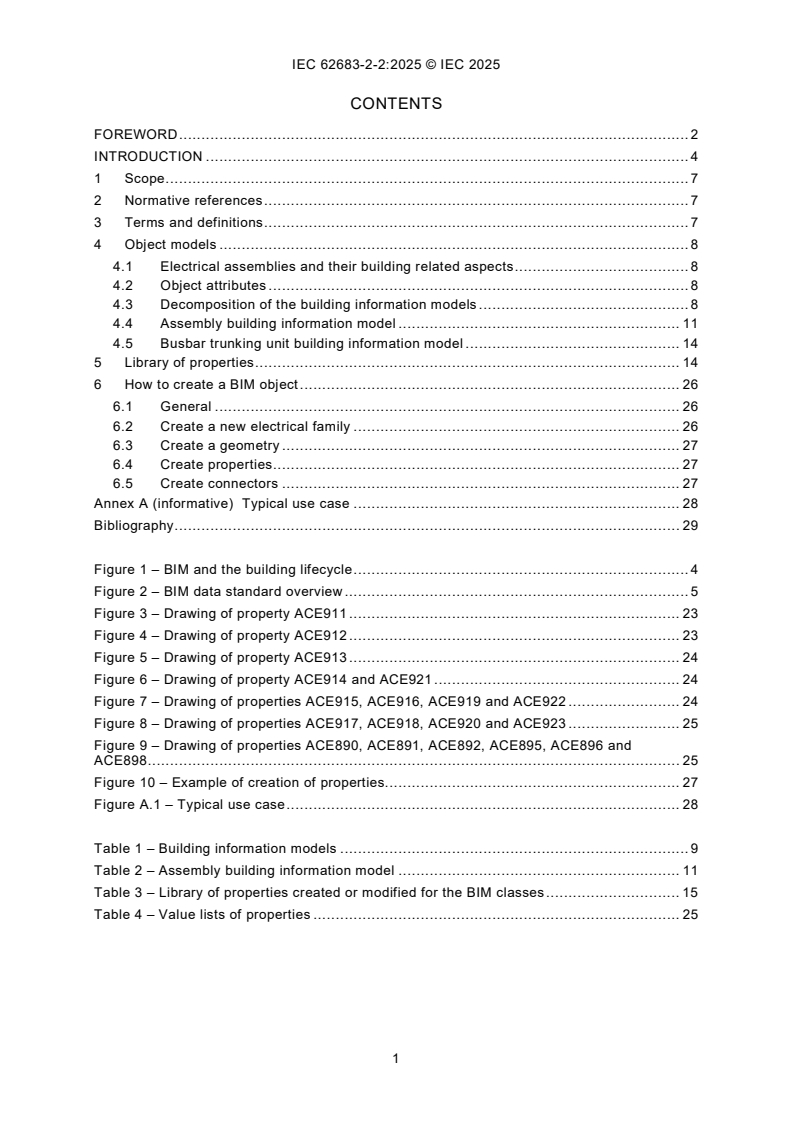
CONTENTS
FOREWORD . 2
INTRODUCTION . 4
1 Scope . 7
2 Normative references . 7
3 Terms and definitions . 7
4 Object models . 8
4.1 Electrical assemblies and their building related aspects . 8
4.2 Object attributes . 8
4.3 Decomposition of the building information models . 8
4.4 Assembly building information model . 11
4.5 Busbar trunking unit building information model . 14
5 Library of properties . 14
6 How to create a BIM object . 26
6.1 General . 26
6.2 Create a new electrical family . 26
6.3 Create a geometry . 27
6.4 Create properties . 27
6.5 Create connectors . 27
Annex A (informative) Typical use case . 28
Bibliography . 29
Figure 1 – BIM and the building lifecycle . 4
Figure 2 – BIM data standard overview . 5
Figure 3 – Drawing of property ACE911 . 23
Figure 4 – Drawing of property ACE912 . 23
Figure 5 – Drawing of property ACE913 . 24
Figure 6 – Drawing of property ACE914 and ACE921 . 24
Figure 7 – Drawing of properties ACE915, ACE916, ACE919 and ACE922 . 24
Figure 8 – Drawing of properties ACE917, ACE918, ACE920 and ACE923 . 25
Figure 9 – Drawing of properties ACE890, ACE891, ACE892, ACE895, ACE896 and
ACE898 . 25
Figure 10 – Example of creation of properties. 27
Figure A.1 – Typical use case . 28
Table 1 – Building information models . 9
Table 2 – Assembly building information model . 11
Table 3 – Library of properties created or modified for the BIM classes . 15
Table 4 – Value lists of properties . 25
INTERNATIONAL ELECTROTECHNICAL COMMISSION
____________
Low-voltage switchgear and controlgear –
Product data and properties for information exchange - Engineering data -
Part 2-2: Switchgear and controlgear assembly objects
for building information modelling
FOREWORD
1) The International Electrotechnical Commission (IEC) is a worldwide organization for standardization comprising
all national electrotechnical committees (IEC National Committees). The object of IEC is to promote international
co-operation on all questions concerning standardization in the electrical and electronic fields. To this end and
in addition to other activities, IEC publishes International Standards, Technical Specifications, Technical Reports,
Publicly Available Specifications (PAS) and Guides (hereafter referred to as “IEC Publication(s)”). Their
preparation is entrusted to technical committees; any IEC National Committee interested in the subject dealt with
may participate in this preparatory work. International, governmental and non-governmental organizations liaising
with the IEC also participate in this preparation. IEC collaborates closely with the International Organization for
Standardization (ISO) in accordance with conditions determined by agreement between the two organizations.
2) The formal decisions or agreements of IEC on technical matters express, as nearly as possible, an international
consensus of opinion on the relevant subjects since each technical committee has representation from all
interested IEC National Committees.
3) IEC Publications have the form of recommendations for international use and are accepted by IEC National
Committees in that sense. While all reasonable efforts are made to ensure that the technical content of IEC
Publications is accurate, IEC cannot be held responsible for the way in which they are used or for any
misinterpretation by any end user.
4) In order to promote international uniformity, IEC National Committees undertake to apply IEC Publications
transparently to the maximum extent possible in their national and regional publications. Any divergence between
any IEC Publication and the corresponding national or regional publication shall be clearly indicated in the latter.
5) IEC itself does not provide any attestation of conformity. Independent certification bodies provide conformity
assessment services and, in some areas, access to IEC marks of conformity. IEC is not responsible for any
services carried out by independent certification bodies.
6) All users should ensure that they have the latest edition of this publication.
7) No liability shall attach to IEC or its directors, employees, servants or agents including individual experts and
members of its technical committees and IEC National Committees for any personal injury, property damage or
other damage of any nature whatsoever, whether direct or indirect, or for costs (including legal fees) and
expenses arising out of the publication, use of, or reliance upon, this IEC Publication or any other IEC
Publications.
8) Attention is drawn to the Normative references cited in this publication. Use of the referenced publications is
indispensable for the correct application of this publication.
9) IEC draws attention to the possibility that the implementation of this document may involve the use of (a)
patent(s). IEC takes no position concerning the evidence, validity or applicability of any claimed patent rights in
respect thereof. As of the date of publication of this document, IEC had not received notice of (a) patent(s), which
may be required to implement this document. However, implementers are cautioned that this may not represent
the latest information, which may be obtained from the patent database available at https://patents.iec.ch. IEC
shall not be held responsible for identifying any or all such patent rights.
IEC 62683-2-2 has been prepared by IEC technical committee 121: Switchgear and controlgear
and their assemblies for low voltage. It is an International Standard.
The text of this International Standard is based on the following documents:
Draft Report on voting
121/224/FDIS 121/229/RVD
Full information on the voting for its approval can be found in the report on voting indicated in
the above table.
The language used for the development of this International Standard is English.
This document was drafted in accordance with ISO/IEC Directives, Part 2, and developed in
accordance with ISO/IEC Directives, Part 1 and ISO/IEC Directives, IEC Supplement, available
at www.iec.ch/members_experts/refdocs. The main document types developed by IEC are
described in greater detail at www.iec.ch/publications.
A list of all parts in the IEC 62683 series, published under the general title Low-voltage
switchgear and controlgear – Product data and properties for information exchange –
Engineering data, can be found on the IEC website.
The committee has decided that the contents of this document will remain unchanged until the
stability date indicated on the IEC website under webstore.iec.ch in the data related to the
specific document. At this date, the document will be
• reconfirmed,
• withdrawn, or
• revised.
INTRODUCTION
Building information modelling (BIM) is an optimizing design process for the construction and
operation of buildings. The information in the model remains coordinated and consistent
throughout the lifecycle of the project to better optimise its construction schedule and operation
(see Figure 1). BIM is a digital process enabled by a set of software, dictionaries, BIM objects
and data which aims to increase efficiency around the building lifecycle, through the design,
operation, maintenance and destruction phases. BIM was initially mainly used at the design
stage to avoid collisions between the different elements of the construction. However, BIM
offers many other possible use cases to be investigated, such as extracting electrical load
demands, simulating photovoltaic production capacity, and simulating thermal and energy
behaviour of the building, etc.
Figure 1 – BIM and the building lifecycle
The main intended benefits of BIM are:
– increasing design dependability and process transparency;
– improving project communication and project marketing;
– shortening construction periods;
– minimizing risks in execution and reducing construction costs;
– increasing the degree of prefabrication;
– use information for building operation purposes.
Governments worldwide recommend or require the use of digitalised information for public
construction projects, recognizing its value for helping to deliver projects successfully.
BIM is a standardised process by ISO TC 59/SC 13 and includes a 3D representation and an
optimised set of data, which can be enhanced by adding further information, such as technical
features.
BuildingSMART is a global community committed to creating and developing open digital ways
of working for built asset environment. BuildingSMART promotes international consensus
among stakeholders on specific standards to accelerate implementation and uptake and
propose standards to ISO TC 59.
ISO 19650 defines the information management process.
Other standards such as ISO 16739 and dictionaries such as ISO 12006 specifically address
the exchange format. An overview is shown in Figure 2.
Figure 2 – BIM data standard overview
The main elements of the BIM process are:
– Industry foundation class (IFC – ISO 16739-1)
IFC is a standardized, digital description of the built asset industry. It is an open,
international standard (ISO 16739-1) and promotes vendor-neutral or agnostic, and usable
capabilities across a wide range of hardware devices, software platforms, and interfaces for
many different use cases.
– Information delivery specifications (IDS)
An IDS is a computer interpretable document that defines the exchange requirements of
model-based exchange. It defines how objects, classifications, materials, properties, and
even values should be delivered and exchanged. This is often done based on industry
foundation classes (IFC) and additional classifications, materials and properties (national
agreements or company specific ones; either stored in bSDD or somewhere else). This is
the standard to use to define the level of information needs (CEN term), the exchange
information requirements (ISO 19650 term) or even to exchange product data templates
with some more details.
– Building smart data dictionary (bSDD ISO 12006-3, ISO 23386)
The buildingSMART Data Dictionary (bSDD) is a library of classes, properties, relations and
units. It is an online service that hosts classifications and their properties, allowed values,
units and translations. The bSDD allows linking between all the content inside the database.
It provides a standardized workflow to guarantee data quality and information consistency.
– BIM Collaboration Format (BCF)
The BIM Collaboration Format (BCF) allows different BIM applications to communicate
model-based issues with each other by leveraging IFC data that have been previously
shared among project collaborators. BCF was created for facilitating open communications
and improving IFC-based processes to more readily identify and exchange model-based
issues between BIM software tools, bypassing proprietary formats and workflows.
– Information delivery manual (IDM, ISO 29481-1)
The built asset industry (including buildings and civil infrastructure) is characterized by
bringing many different companies and authorities together in a project specific
organisation. In order to work efficiently, it is necessary for all participants in the
organisation to know which and when different kinds of information have to be
communicated. The issue is even more important when digital tools are applied, since most
industry tools have a very low threshold of tolerance when it comes to the ability to interpret
digital data. The “building information modelling – Information delivery manual” standard
has been developed by buildingSMART in order to have a methodology to capture and
specify processes and information flow during the lifecycle of a facility.
Up to now, electrical engineering has not been adequately represented in BIM (IFC, IDS, BSDD)
although electrical engineering is an essential trade within every property.
Particularly in electrical systems engineering, the expectation is to cover from planning,
execution, operation, to demolition and improve ease of exchange and interoperability between,
different phases, electrical personas and CAD and CAE software.
BIM is the right approach as a working method in the electrotechnical trade of a building (low
voltage and medium voltage). But objects of electrical assemblies should be further detailed
and standardised.
BIM design software should be supplied with objects. The properties of these objects, for
example, the functional description of an electrical distribution panel, will be easier to be
handled by a building designer if this description is based on a common ontology defined by
recognised electrical standards.
This part of IEC 62683-2 series is intended to be used in combination with the following part:
– IEC 62683-1, Catalogue data
The described data models including in this part is intended to be hosted within IEC CDD in the
class tree dedicated to engineering data of low-voltage switchgear, controlgear and their
assemblies. This branch of the IEC 62683 DB dictionary is intended to be used by catalogue
consortia, other database standards and engineering software editors as reference to low-
voltage switchgear and controlgear standards.
IEC CDD ontology data model followings IEC 61360-2 and ISO 13584-42. It includes the unique
identification of each dictionary and dictionary element according to ISO 29002-5 called
"international registration data identifier" (IRDI). This identifier includes the IEC International
Code Designator (ICD) “0112” registered according to the registration authority identification
concept as defined in ISO/IEC 6523-1.
1 Scope
This part of IEC 62683-2 specifies the building information modelling (BIM) with the physical
characteristics and technical services of low-voltage switchgear and controlgear assemblies to
be used mainly for the construction phase of the building and for delivering data for operation.
This document covers all types of assemblies covered by the IEC 61439 series which can be
installed in a building.
Busbar trunking systems defined by IEC 61439-6 are under consideration for a next edition.
These BIM object models, registered in IEC CDD, are intended to supply the process defined
by ISO 16739 series.
This document does not cover:
– the built-in components included within the assembly such as switchgear and controlgear,
– safety related control system of machinery,
– the detailed electrical and mechanical configuration of the assembly
– logistic information.
2 Normative references
The following documents are referred to in the text in such a way that some or all of their content
constitutes requirements of this document. For dated references, only the edition cited applies.
For undated references, the latest edition of the referenced document (including any
amendments) applies.
IEC 61360-1, Standard data element types with associated classification scheme - Part 1:
Definitions - Principles and methods
IEC 62683-1, Low-voltage switchgear and controlgear - Product data and properties for
information exchange - Part 1: Catalogue data
3 Terms and definitions
For the purposes of this document, the terms and definitions given in IEC 62683-1 and the
following apply.
ISO and IEC maintain terminology databases for use in standardization at the following
addresses:
• IEC Electropedia: available at https://www.electropedia.org/
• ISO Online browsing platform: available at https://www.iso.org/obp
3.1
BIM
building information modelling
construction of a model that contains the information about a building for all phases of the
building life cycle
Note 1 to entry: It includes both the 3D model and the building processes.
[SOURCE: ISO 16757-1:2015, 2.4, modified – the note has been replaced]
3.2
BIM object
digital representation of a physical object used to facilitate design, build and operation
processes to form a reliable basis for decisions
Note 1 to entry: As a result, a building is composed by assembling “BIM objects” of any component of the building:
wall, doors, tubes, pipes, etc. and electrical switchboard assemblies. A BIM object is also a digital file, composed of
a geometry and a set of data. Along the process, the level of geometry (LOG) and level of detail (LOD) are evolving
to be more precise and comprehensive along the workflow.
[SOURCE: ISO 29481-1:2026, 3.2, modified – “object” added to the term, “use of a shared”
deleted from the beginning of the definition, “(including buildings, bridges, roads, process
plants, etc.)” deleted from the definition, “build” replaced by “construction” and note 1 to entry
replaced]
3.3
assembly building information model
digital representation of the physical characteristics and technical services of switchgear and
controlgear assembly
Note 1 to entry: This assembly building information model is a BIM object which is used to form the BIM model
creation.
3.4
building information model
BIM model
digital representation of the whole building including architectural and mechanical electrical and
plumbing (MEP) objects
4 Object models
4.1 Electrical assemblies and their building related aspects
The models of this document are intended to describe the interfaces of the objects to the
building, especially the zones, accessibility to the equipment, mechanical interfaces, electrical
interconnection positions, functions (supply, control, protection, etc.), etc.
4.2 Object attributes
The attributes of an item class shall be used according to IEC 61360-1.
The following attributes of an item class are considered in this document: identifier,
preferred name, definition, synonymous name and source document.
NOTE The synonymous names are limited to those necessary to avoid confusion when selecting a device class.
4.3 Decomposition of the building information models
Table 1 gives the decomposition of the classes and blocks of properties. The class name
column is structured in three levels of class hierarchy using vertical indent alignments.
NOTE The class hierarchy is shown on the left end side of the graphical user interface of IEC CDD.
Table 1 – Building information models
Class name Synonymous Definition Source Class ID
shared digital
representation of physical
and functional
characteristics of any built
object, including buildings,
bridges, roads, process
plant
ISO TS
Note 1 to entry: Adapted
12911:2012, 3.1,
from ISO 29481-1:2010,
modified – two
definition 2.2.
building information instances of
ACC004
Note 2 to entry: Building
models “may” have been
information model is
replaced by
frequently used as a
“can” in Note 3
synonym for BIM.
to entry
Note 3 to entry: It can form
the common basis for
decisions and can form the
contractual point of
reference, across one or
more stages in the life
cycle.
digital representation of the IEC 62683-2-
physical characteristics and 2:2025, 3.3,
assembly building
technical services of modified – Note ACC006
information model
switchgear and controlgear 1 to entry has
assembly been omitted
information necessary for
identification of the
unambiguous identification ACG019
assembly
of the assembly
information to enable a
original contact with the original
0112/2///61360_
manufacturer manufacturer of the
7#AAS002
contact information assembly to be located or
communicated with
information to enable a
assembly
contact with the assembly 0112/2///61360_
manufacturer
manufacturer to be located 7#AAS002
contact information
or communicated with
information to enable a
installer contact contact with the installer of 0112/2///61360_
information the assembly to be located 7#AAS002
or communicated with
IEC 81346-1:
2022, 3.11,
modified –
concept for the
“object” has
identification of a specific
been added to
object formed with respect
object reference the term, in the 0112/2///61360_
to the system of which the
designation definition 4#AAA759
object is a constituent,
“identifier” has
based on one or more
been replaced
aspects of that system
by “concept for
the
identification”
technical information on the
construction of the
construction features of the ACG089
assembly
assembly
IEC 61439-1:
2020, 3.8.4,
set of rated values and modified – “of
ratings of the
operating conditions of the the assembly”
Main circuits ACG031
assembly
assembly has been added
to the term and
the definition
Class name Synonymous Definition Source Class ID
voltage values, declared in
the assembly
voltage ratings of
documentation, that can be ACG056
the assembly
withstood under specified
conditions
current values, declared in
the assembly
current ratings of
documentation, that can be ACG098
the assembly
withstood under specified
conditions
functions performed by the
assembly in addition to its
essential functions and
capabilities
service functions of
Note 1 to entry Typical
ACG020
the assembly
essential functions and
capability are switching
loads, over-current
protections and short-
circuit withstand.
communication functions
communication
for the transfer of
interface of the ACG035
information between the
assembly
assembly and the system
physical characteristics of
dimensions of the the assembly related to its
ACG050
assembly space occupancy for
operation and maintenance
physical characteristics of
installation and
the assembly related to its
mounting of the ACG099
transportation, installation
assembly
and mounting
identification and
fixing of the
localisation of the fixing ACG128
assembly
points of the assembly
point at the centre of the
attachment mean defined
fixing point
by its coordinates in a ACG132
coordinates
rectangular Cartesian
coordinate system
connecting paths used for
connection facilities the electrical connection of
ACG051
of the assembly conductors of external
circuits of the assembly
part with openings which
IEC 61439-
permit the passage of
1:2020, 3.4.14,
cables into the assembly
modified – Note
cable entry ACG093
Note 1 to entry This part
1 to entry has
can be a gland plate, or
been added
similar means.
point of reference located
conductor entry at the extreme left (x axis),
ACG095
reference point bottom (z axis) and rear (z
axis) of the conductor entry
part with openings which
permit the passage of
busbar trunking
ACG094
system entry busbar trunking system into
the assembly
point of reference located
conductor entry at the extreme left (x axis),
ACG095
reference point bottom (z axis) and rear (z
axis) of the conductor entry
Class name Synonymous Definition Source Class ID
IEC 60505:2011,
3.2.3, modified
– “of the
combination of stresses,
assembly” has
including environment
been added to
service conditions conditions, and duty that
the term and the
ACG054
of the assembly are to be expected in a
definition,
specific application of the
“including
assembly
environmental
conditions” has
been added to
the definition
conformity of the equipment
with specified requirements
product certificates
and compliance with
ACC070
and standards
recognised product
standards
digital representation of the
busbar trunking
BIM BTS, physical characteristics and
system building ACC009
BIM busway technical services of
a
information model
busbar trunking unit
a
Characteristics under consideration for the next edition.
4.4 Assembly building information model
Table 2 describes the BIM object of an assembly.
Table 2 – Assembly building information model
Properties of each class Class ID Property ID
Assembly building information model ACC006
Identification of the assembly ACG019
original manufacturer ACE114
original manufacturer contact information 0112/2///61360_7#AAS002 ACF104
street 0112/2///61987#ABA286
ZIP/Postal code 0112/2///61987#ABA281
city/town 0112/2///61987#ABA129
country 0112/2///61987#ABA092
ass
...
IEC 62683-2-2 ®
Edition 1.0 2025-09
NORME
INTERNATIONALE
Appareillage à basse tension - Données et propriétés de produits pour l'échange
d'informations - Données d'ingénierie -
Partie 2-2: Objets d'ensembles d'appareillage pour la modélisation des
informations de la construction
ICS 29.130.20 ISBN 978-2-8327-0583-4
Droits de reproduction réservés. Sauf indication contraire, aucune partie de cette publication ne peut être reproduite ni
utilisée sous quelque forme que ce soit et par aucun procédé, électronique ou mécanique, y compris la photocopie et
les microfilms, sans l'accord écrit de l'IEC ou du Comité national de l'IEC du pays du demandeur. Si vous avez des
questions sur le copyright de l'IEC ou si vous désirez obtenir des droits supplémentaires sur cette publication, utilisez
les coordonnées ci-après ou contactez le Comité national de l'IEC de votre pays de résidence.
IEC Secretariat Tel.: +41 22 919 02 11
3, rue de Varembé info@iec.ch
CH-1211 Geneva 20 www.iec.ch
Switzerland
A propos de l'IEC
La Commission Electrotechnique Internationale (IEC) est la première organisation mondiale qui élabore et publie des
Normes internationales pour tout ce qui a trait à l'électricité, à l'électronique et aux technologies apparentées.
A propos des publications IEC
Le contenu technique des publications IEC est constamment revu. Veuillez vous assurer que vous possédez l’édition la
plus récente, un corrigendum ou amendement peut avoir été publié.
Recherche de publications IEC - IEC Products & Services Portal - products.iec.ch
webstore.iec.ch/advsearchform Découvrez notre puissant moteur de recherche et consultez
La recherche avancée permet de trouver des publications gratuitement tous les aperçus des publications, symboles
IEC en utilisant différents critères (numéro de référence, graphiques et le glossaire. Avec un abonnement, vous aurez
texte, comité d’études, …). Elle donne aussi des toujours accès à un contenu à jour adapté à vos besoins.
informations sur les projets et les publications remplacées
ou retirées. Electropedia - www.electropedia.org
Le premier dictionnaire d'électrotechnologie en ligne au
IEC Just Published - webstore.iec.ch/justpublished monde, avec plus de 22 500 articles terminologiques en
Restez informé sur les nouvelles publications IEC. Just anglais et en français, ainsi que les termes équivalents
Published détaille les nouvelles publications parues. dans 25 langues additionnelles. Egalement appelé
Disponible en ligne et une fois par mois par email. Vocabulaire Electrotechnique International (IEV) en ligne.
Service Clients - webstore.iec.ch/csc
Si vous désirez nous donner des commentaires sur cette
publication ou si vous avez des questions contactez-
nous: sales@iec.ch.
SOMMAIRE
AVANT-PROPOS . 2
INTRODUCTION . 4
1 Domaine d’application . 7
2 Références normatives . 7
3 Termes et définitions. 7
4 Modèles d’objet . 8
4.1 Ensembles électriques et leurs répercussions sur le bâtiment . 8
4.2 Attributs des objets . 9
4.3 Décomposition des modèles des informations de la construction . 9
4.4 Modèle des informations de la construction pour un ensemble . 11
4.5 Modèle des informations de la construction d’une unité de canalisation
préfabriquée. 15
5 Bibliothèque des propriétés . 15
6 Comment créer un objet BIM. 29
6.1 Généralités . 29
6.2 Créer une nouvelle famille électrique . 29
6.3 Créer une géométrie . 29
6.4 Créer des propriétés . 29
6.5 Créer des connecteurs . 30
Annexe A (informative) Cas d’utilisation type . 31
Bibliographie . 32
Figure 1 – Le BIM et le cycle de vie du bâtiment . 4
Figure 2 – Vue d’ensemble des normes régissant les données du BIM . 5
Figure 3 – Représentation schématique de la propriété ACE911 . 25
Figure 4 – Représentation schématique de la propriété ACE912 . 26
Figure 5 – Représentation schématique de la propriété ACE913 . 26
Figure 6 – Représentation schématique des propriétés ACE914 et ACE921 . 26
Figure 7 – Représentation schématique des propriétés ACE915, ACE916, ACE919 et
ACE922 . 27
Figure 8 – Représentation schématique des propriétés ACE917, ACE918, ACE920 et
ACE923 . 27
Figure 9 – Représentation schématique des propriétés ACE890, ACE891, ACE892,
ACE895, ACE896 et ACE898. 27
Figure 10 – Exemple de création de propriétés . 29
Figure A.1 – Cas d’utilisation type . 31
Tableau 1 – Modèles des informations de la construction . 9
Tableau 2 – Modèle des informations de la construction pour un ensemble . 12
Tableau 3 – Bibliothèque des propriétés créées ou modifiées pour les classes BIM . 16
Tableau 4 – Énumérations de valeur pour les propriétés . 28
COMMISSION ÉLECTROTECHNIQUE INTERNATIONALE
____________
Appareillage à basse tension - Données et propriétés de produits
pour l’échange d’informations - Données d’ingénierie -
Partie 2-2: Objets d’ensembles d’appareillage pour la modélisation
des informations de la construction
AVANT-PROPOS
1) La Commission Électrotechnique Internationale (IEC) est une organisation mondiale de normalisation composée
de l’ensemble des comités électrotechniques nationaux (Comités nationaux de l’IEC). L’IEC a pour objet de
favoriser la coopération internationale pour toutes les questions de normalisation dans les domaines de
l’électricité et de l’électronique. À cet effet, l’IEC – entre autres activités – publie des Normes internationales,
des Spécifications techniques, des Rapports techniques, des Spécifications accessibles au public (PAS) et des
Guides (ci-après dénommés "Publication(s) de l’IEC"). Leur élaboration est confiée à des comités d’études, aux
travaux desquels tout Comité national intéressé par le sujet traité peut participer. Les organisations
internationales, gouvernementales et non gouvernementales, en liaison avec l’IEC, participent également aux
travaux. L’IEC collabore étroitement avec l’Organisation Internationale de Normalisation (ISO), selon des
conditions fixées par accord entre les deux organisations.
2) Les décisions ou accords officiels de l’IEC concernant les questions techniques représentent, dans la mesure du
possible, un accord international sur les sujets étudiés, étant donné que les Comités nationaux de l’IEC intéressés
sont représentés dans chaque comité d’études.
3) Les Publications de l’IEC se présentent sous la forme de recommandations internationales et sont agréées
comme telles par les Comités nationaux de l’IEC. Tous les efforts raisonnables sont entrepris afin que l’IEC
s’assure de l’exactitude du contenu technique de ses publications; l’IEC ne peut pas être tenue responsable de
l’éventuelle mauvaise utilisation ou interprétation qui en est faite par un quelconque utilisateur final.
4) Dans le but d’encourager l’uniformité internationale, les Comités nationaux de l’IEC s’engagent, dans toute la
mesure possible, à appliquer de façon transparente les Publications de l’IEC dans leurs publications nationales
et régionales. Toutes divergences entre toutes Publications de l’IEC et toutes publications nationales ou
régionales correspondantes doivent être indiquées en termes clairs dans ces dernières.
5) L’IEC elle-même ne fournit aucune attestation de conformité. Des organismes de certification indépendants
fournissent des services d’évaluation de conformité et, dans certains secteurs, accèdent aux marques de
conformité de l’IEC. L’IEC n’est responsable d’aucun des services effectués par les organismes de certification
indépendants.
6) Tous les utilisateurs doivent s’assurer qu’ils sont en possession de la dernière édition de cette publication.
7) Aucune responsabilité ne doit être imputée à l’IEC, à ses administrateurs, employés, auxiliaires ou mandataires,
y compris ses experts particuliers et les membres de ses comités d’études et des Comités nationaux de l’IEC,
pour tout préjudice causé en cas de dommages corporels et matériels, ou de tout autre dommage de quelque
nature que ce soit, directe ou indirecte, ou pour supporter les coûts (y compris les frais de justice) et les dépenses
découlant de la publication ou de l’utilisation de cette Publication de l’IEC ou de toute autre Publication de l’IEC,
ou au crédit qui lui est accordé.
8) L’attention est attirée sur les références normatives citées dans cette publication. L’utilisation de publications
référencées est obligatoire pour une application correcte de la présente publication.
9) L’IEC attire l’attention sur le fait que la mise en application du présent document peut entraîner l’utilisation d’un
ou de plusieurs brevets. L’IEC ne prend pas position quant à la preuve, à la validité et à l’applicabilité de tout
droit de brevet revendiqué à cet égard. À la date de publication du présent document, l’IEC n’avait pas reçu
notification qu’un ou plusieurs brevets pouvaient être nécessaires à sa mise en application. Toutefois, il y a lieu
d’avertir les responsables de la mise en application du présent document que des informations plus récentes
sont susceptibles de figurer dans la base de données de brevets, disponible à l’adresse https://patents.iec.ch.
L’IEC ne saurait être tenue pour responsable de ne pas avoir identifié de tels droits de brevet.
L’IEC 62683-2-2 a été établie par le comité d’études 121 de l’IEC: Appareillages et ensembles
d’appareillages basse tension. Il s’agit d’une Norme internationale.
Le texte de cette Norme internationale est issu des documents suivants:
Projet Rapport de vote
121/224/FDIS 121/229/RVD
Le rapport de vote indiqué dans le tableau ci-dessus donne toute information sur le vote ayant
abouti à son approbation.
La langue employée pour l’élaboration de cette Norme internationale est l’anglais.
Ce document a été rédigé selon les Directives ISO/IEC, Partie 2, il a été développé selon les
Directives ISO/IEC, Partie 1 et les Directives ISO/IEC, Supplément IEC, disponibles sous
www.iec.ch/members_experts/refdocs. Les principaux types de documents développés par
l’IEC sont décrits plus en détail sous www.iec.ch/publications.
Une liste de toutes les parties de la série IEC 62683, publiées sous le titre général Appareillage
à basse tension – Données et propriétés de produits pour l’échange d’informations – Données
d’ingénierie, se trouve sur le site web de l’IEC.
Le comité a décidé que le contenu de ce document ne sera pas modifié avant la date de stabilité
indiquée sur le site web de l’IEC sous webstore.iec.ch dans les données relatives au document
recherché. À cette date, le document sera
• reconduit,
• supprimé, ou
• révisé.
INTRODUCTION
La modélisation des informations de la construction (BIM) est un processus de conception
optimisé pour la construction et l’exploitation des bâtiments. Les informations comprises dans
le modèle restent coordonnées et homogènes tout au long du cycle de vie du projet, afin
d’optimiser davantage la planification de sa construction et son exploitation (voir la Figure 1).
Le BIM est un processus numérique reposant sur un ensemble de logiciels, de dictionnaires,
d’objets BIM et de données, qui vise un gain d’efficience sur l’ensemble du cycle de vie du
bâtiment, qui englobe les phases de conception, d’exploitation, de maintenance et de
démolition. Le BIM était initialement principalement utilisé lors de la phase de conception, afin
d’éviter les collisions entre les différents éléments de la construction. Cependant, le BIM permet
d’étudier de nombreux autres cas d’utilisation potentiels, tels que l’extraction des demandes
énergétiques associées aux charges électriques, la simulation de la capacité de production
photovoltaïque, et la simulation du comportement thermique et énergétique du bâtiment, etc.
Figure 1 – Le BIM et le cycle de vie du bâtiment
Les principaux atouts attendus du BIM sont les suivants:
– augmentation de la fiabilité de la conception et plus grande transparence du processus;
– amélioration des aspects communication et marketing liés au projet;
– compression des délais de construction;
– réduction des risques liés à l’exécution des travaux et réduction des coûts de construction;
– augmentation de la part d’éléments préfabriqués;
– utilisation des informations à des fins d’exploitation du bâtiment.
Partout dans le monde, les gouvernements recommandent ou exigent l’utilisation d’informations
numérisées pour les projets de construction publics, renforçant ainsi leur intérêt dans la
livraison de projets conformes.
Le BIM est un processus normalisé établi par le SC 13 du TC 59 de l’ISO, qui inclut une
représentation tridimensionnelle et un ensemble de données optimisé, qui peut être encore
amélioré par l’ajout d’informations complémentaires, telles que des caractéristiques
techniques.
BuildingSMART est une communauté mondiale engagée dans la création et le développement
de pratiques de travail numériques ouvertes, pour l’environnement des biens construits.
BuildingSMART œuvre pour un consensus international entre les différentes parties prenantes,
pour définir des normes spécifiques, afin d’accélérer la mise en œuvre et l’adoption, et de
soumettre les normes au TC 59 de l’ISO.
L’ISO 19650 définit le processus de gestion des informations.
D’autres normes, telles que l’ISO 16739, ainsi que les dictionnaires, tels que l’ISO 12006,
couvrent plus spécifiquement le format d’échange. Une vue d’ensemble est donnée à la
Figure 2.
Figure 2 – Vue d’ensemble des normes régissant les données du BIM
Les principaux éléments constitutifs du processus BIM sont les suivants.
– Classes de fondation d’industrie (IFC, Industry Foundation Class – ISO 16739-1)
Les classes IFC constituent une description numérique normalisée de l’industrie des biens
construits. Il s’agit d’une Norme internationale ouverte (ISO 16739-1), qui revendique une
approche sans parti pris envers un fournisseur, ou agnostique, ainsi que des capacités
exploitables sur une large gamme de dispositifs matériels, plateformes logicielles et
interfaces, dans de nombreux cas d’utilisation différents.
– Spécification de livraison d’informations (IDS, Information Delivery Specification)
Une spécification de livraison d’informations (IDS) est un document interprétable
informatiquement qui définit les exigences d’échange, dans le contexte d’un échange basé
sur un modèle. La spécification IDS définit la façon dont il convient que les objets, les
classifications, les matériaux, les propriétés et même les valeurs soient livrés et échangés.
Cela s’effectue souvent en se basant sur les classes de fondation d’industrie (IFC) et sur
des classifications, matériaux et propriétés supplémentaires (accords nationaux ou
spécifiques à une entreprise, stockés soit dans le bSDD, soit ailleurs). Il s’agit de la norme
à utiliser pour définir le niveau du besoin d’information (concept établi par le Comité
européen de normalisation (CEN)), les exigences d’échange d’informations (concept établi
dans l’ISO 19650), ou même pour échanger des modèles de données de produits avec des
détails supplémentaires.
– Dictionnaire de données du bâtiment (bSDD, building SMART Data Dictionary) (bSDD
ISO 12006-3, ISO 23386)
Le référentiel bSDD est une bibliothèque réunissant des classes, des propriétés, des
relations et des unités. Il s’agit d’un service en ligne qui héberge les classifications et leurs
propriétés, les valeurs autorisées, les unités et les traductions. Le bSDD permet d’établir
des liaisons entre l’ensemble des contenus figurant dans la base de données. Il propose un
flux de travail normalisé assurant la qualité des données et la cohérence des informations.
– Format de collaboration BIM (BCF, BIM Collaboration Format)
Le format BCF permet à différentes applications BIM de communiquer entre elles sur les
interférences liées au modèle, en exploitant des données IFC qui ont été partagées
précédemment entre les parties prenantes au projet. Le format BCF a été créé pour
permettre des communications ouvertes, et pour améliorer les processus basés sur le
format IFC, afin d’identifier plus aisément les interférences liées au modèle, et de les
échanger entre les différents outils logiciels BIM, en s’affranchissant des formats et flux de
travail propriétaires.
– Protocole d’échange d’informations (IDM, Information Delivery Manual) (ISO 29481-1)
L’industrie des biens construits (comprenant les bâtiments et les infrastructures de génie
civil) est caractérisée par le fait qu’elle réunit de nombreuses entreprises et de nombreux
organismes différents au sein d’une organisation spécifique à un projet. Pour que celle-ci
fonctionne efficacement, il est nécessaire que toutes ses parties prenantes sachent quels
sont les différents types d’information à communiquer, et quand ils doivent être
communiqués. Ce point est d’autant plus important lorsque des outils numériques sont
utilisés, car la plupart des outils de l’industrie présentent un seuil de tolérance très bas,
s’agissant de leur capacité à interpréter des données numériques. La norme "Modèles des
informations de la construction — Protocole d’échange d’informations" a été développée
par buildingSMART afin de disposer d’une méthodologie permettant de capturer et de
spécifier les processus et les flux d’informations intervenant au cours du cycle de vie d’une
installation.
Jusqu’à maintenant, le génie électrique n’était pas représenté de manière appropriée dans le
BIM (IFC, IDS, bSDD), alors qu’il constitue un volet essentiel pour chaque bien construit.
Concernant plus particulièrement le génie des réseaux électriques, l’objectif est de couvrir les
phases de planification, d’exécution, d’exploitation et de démolition, et de simplifier les
échanges et l’interopérabilité entre les différentes phases, entre les différents intervenants en
électricité, et entre les logiciels de conception assistée par ordinateur (CAO) et d’ingénierie
assistée par ordinateur (IAO).
Le BIM constitue l’approche pertinente pour une méthode de travail inhérente au volet
électrotechnique d’un bâtiment (basse tension et moyenne tension). Mais il convient que les
objets des ensembles électriques soient encore davantage détaillés et normalisés.
Il convient que les logiciels de conception BIM soient fournis avec des objets. Les propriétés
de ces objets, par exemple la description fonctionnelle d’un tableau électrique, sont plus
aisément manipulables par un dessinateur-projeteur si cette description repose sur une
ontologie commune, régie par des normes électriques reconnues.
La présente partie de la série IEC 62683-2 est destinée à être utilisée conjointement avec la
partie suivante:
– IEC 62683-1, Données de catalogue
Les modèles de données décrits, y compris dans la présente partie, sont destinés à être
hébergés dans le dictionnaire de données communes (CDD, Common Data Dictionary) de l’IEC,
dans l’arborescence de classes consacrée aux données techniques des appareillages basse
tension et de leurs ensembles. Cette branche de la base de données CDD 62683 de l’IEC est
destinée à être utilisée par les consortiums prenant part aux catalogues, les autres normes de
base de données et les éditeurs de logiciels d’ingénierie, à titre de référence pour les normes
d’appareillage basse tension.
Le modèle de données de l’ontologie IEC CDD respecte l’IEC 61360-2 et l’ISO 13584-42. Il
inclut l’identification unique de chaque dictionnaire et élément de dictionnaire selon le système
d’enregistrement international d’identifiant de données (IRDI, International Registration Data
Identifier), conformément à l’ISO 29002-5. Cet identifiant inclut le désignateur de code
international (ICD, International Code Designator) de l’IEC "0112", enregistré conformément au
concept d’identification des organismes d’enregistrement tel qu’il est défini dans
l’ISO/IEC 6523-1.
1 Domaine d’application
La présente partie de l’IEC 62683-2 spécifie la modélisation des informations de la construction
(BIM), avec les caractéristiques physiques et les services techniques des ensembles
d’appareillage à basse tension à utiliser principalement pour la phase de construction du
bâtiment, mais aussi pour la livraison des données pour l’exploitation du bâtiment.
Le présent document englobe tous les types d’ensembles couverts par la série IEC 61439, qui
peuvent être installés dans un bâtiment.
Les systèmes de canalisation préfabriquée définis dans l’IEC 61439-6 sont à l’étude pour une
prochaine édition.
Ces modèles d’objets BIM, enregistrés dans l’IEC CDD, sont destinés à servir d’intrants au
processus défini par la série ISO 16739.
Le présent document ne couvre pas:
– les composants intégrés au sein d’un ensemble, tel que l’appareillage;
– le système de commande de machines qui soit relatif à la sécurité;
– la configuration électrique et mécanique détaillée de l’ensemble;
– les informations logistiques.
2 Références normatives
Les documents suivants sont cités dans le texte de sorte qu’ils constituent, pour tout ou partie
de leur contenu, des exigences du présent document. Pour les références datées, seule
l’édition citée s’applique. Pour les références non datées, la dernière édition du document de
référence s’applique (y compris les éventuels amendements).
IEC 61360-1, Types normalisés d’éléments de données avec plan de classification - Partie 1:
Définitions - Principes et méthodes
IEC 62683-1, Appareillage à basse tension - Données et propriétés de produits pour l’échange
d’informations - Partie 1: Données de catalogue
3 Termes et définitions
Pour les besoins du présent document, les termes et les définitions de l’IEC 62683-1 ainsi que
les suivants s’appliquent.
L’ISO et l’IEC tiennent à jour des bases de données terminologiques destinées à être utilisées
en normalisation, consultables aux adresses suivantes:
• IEC Electropedia: disponible à l’adresse https://www.electropedia.org/
• ISO Online browsing platform: disponible à l’adresse https://www.iso.org/obp
3.1
BIM
modélisation des informations de la construction
construction d’un modèle qui contient les informations sur un bâtiment pour toutes les phases
du cycle de vie du bâtiment
Note 1 à l’article: Cela inclut à la fois le modèle 3D et les processus de construction.
Note 2 à l'article: L’abréviation "BIM" est dérivée du terme anglais développé correspondant "Building Information
Modelling".
[SOURCE: ISO 16757-1:2015, 2.4, modifié – La note a été remplacée par une nouvelle note à
l’article.]
3.2
objet BIM
représentation numérique d’un objet physique utilisée pour faciliter les processus de
conception, de construction et d’exploitation afin de former une base fiable permettant les
prises de décision
Note 1 à l’article: En conséquence, un bâtiment est composé en assemblant des "objets BIM" de n’importe quel
composant du bâtiment: murs, portes, tubes, tuyaux, etc., et tableaux électriques. Un objet BIM est également un
fichier numérique, composé d’une géométrie et d’un ensemble de données. Tout au long du processus, le niveau de
géométrie (LOG, Level Of Geometry) et le niveau de détail (LOD, Level Of Detail) évoluent pour être plus précis et
plus complets tout au long du flux de travail.
[SOURCE: ISO 29481-1:2026, 3.2, modifié – dans le terme, "objet" a été ajouté; dans la
définition, au début, "utilisation d’une représentation numérique partagée" a été remplacé par
"représentation numérique", "(comprenant bâtiments, ponts, routes, usines, etc.)" a été
supprimé et la Note 1 a été remplacée par une nouvelle note à l’article.]
3.3
modèle BIM de l’ensemble
représentation numérique des caractéristiques physiques et des services techniques d’un
ensemble d’appareillage
Note 1 à l’article: Ce modèle des informations de la construction spécifique à un ensemble est un objet BIM, utilisé
pour former la création du modèle BIM.
3.4
modèle BIM du bâtiment
modèle BIM
représentation numérique de l’ensemble du bâtiment, y compris les objets architecturaux et les
objets mécaniques, électriques et de plomberie (MEP, Mechanical, Electrical and Plumbing)
4 Modèles d’objet
4.1 Ensembles électriques et leurs répercussions sur le bâtiment
Les modèles du présent document sont destinés à décrire les interfaces des objets avec le
bâtiment, notamment les zones, l’accessibilité aux équipements, les interfaces mécaniques, les
positions des interconnexions électriques, les fonctions (alimentation, commande, protection,
etc.), etc.
4.2 Attributs des objets
Les attributs d’une classe d’articles doivent être utilisés conformément à l’IEC 61360-1.
Les attributs d’une classe d’articles qui sont traités dans le présent document sont les suivants:
identifiant, nom préférentiel, définition, synonyme et document source.
NOTE Les synonymes sont limités aux noms essentiels pour éviter toute confusion lors de la sélection d’une classe
d’appareil.
4.3 Décomposition des modèles des informations de la construction
Le Tableau 1 donne la décomposition des classes et des blocs de propriétés. La colonne du
nom de classe est construite par indentation verticale sur trois niveaux de hiérarchie des
classes.
NOTE La hiérarchie des classes est représentée à l’extrémité gauche de l’interface utilisateur graphique de l’IEC
CDD.
Tableau 1 – Modèles des informations de la construction
Nom de la classe Synonyme Définition Source Ident. classe
représentation numérique
partagée des
caractéristiques physiques
et fonctionnelles d’un
quelconque objet construit,
comprenant les bâtiments,
ponts, routes, installations
de traitement
Note 1 à l’article: Adapté
de la définition 2.2 de
ISO TS 12911:2
l’ISO 29481-1:2010.
012, 3.1, modifié
modèles des
– Cette
Note 2 à l’article:
informations de la
ACC004
modification ne
L’expression "modèle des
construction
concerne que la
informations de la
version anglaise.
construction" est
fréquemment utilisé comme
synonyme de BIM.
Note 3 à l’article: Il peut
constituer la base
commune des décisions et
peut constituer le point de
référence contractuel, pour
une ou plusieurs phases du
cycle de vie.
représentation numérique IEC 62683-2-
des caractéristiques 2:2025, 3.3,
modèle BIM de
physiques et des services modifié – La ACC006
l’ensemble
techniques d’un ensemble Note 1 à l’article
d’appareillage a été supprimée.
informations nécessaires à
identification de
une identification sans ACG019
l’ensemble
ambiguïté de l’ensemble
informations permettant de
informations de
localiser un contact auprès
contact du 0112/2///61360_
du constructeur d’origine
constructeur 7#AAS002
de l’ensemble, ou de
d’origine
communiquer avec lui
informations permettant de
informations de
localiser un contact auprès
contact du 0112/2///61360_
du constructeur
constructeur 7#AAS002
d’ensembles, ou de
d’ensembles
communiquer avec lui
Nom de la classe Synonyme Définition Source Ident. classe
informations permettant de
informations de
localiser un contact auprès
contact de 0112/2///61360_
de l’entreprise d’installation
l’entreprise 7#AAS002
de l’ensemble, ou de
d’installation
communiquer avec lui
IEC 81346-1:
2022, 3.11,
concept permettant
modifié – "objet"
l’identification d’un objet
a été ajouté au
spécifique formé en
terme; dans la
désignation de fonction du système dont 0112/2///61360_
définition,
référence d’objet cet objet est un élément 4#AAA759
"identifiant" a
constituant, basé sur un ou
été remplacé par
plusieurs aspects de ce
"concept
système
permettant
l’identification".
informations techniques
relatives aux
construction de
ACG089
l’ensemble caractéristiques de
construction de l’ensemble
IEC 61439-1:
2020, 3.8.4,
ensemble des valeurs
caractéristiques modifié – "de
Circuits assignées et des conditions
assignées de l’ensemble" a ACG031
principaux de fonctionnement de
l’ensemble été ajouté au
l’ensemble
terme et à la
définition.
valeurs de tension
déclarées dans la
caractéristiques
documentation de
assignées de
l’ensemble, auxquelles ACG056
tension de
l’ensemble peut résister
l’ensemble
dans des conditions
spécifiées
valeurs de courant
déclarées dans la
caractéristiques
documentation de
assignées de
l’ensemble, auxquelles ACG098
courant de
l’ensemble peut résister
l’ensemble
dans des conditions
spécifiées
fonctions exercées par
l’ensemble en plus de ses
fonctions et capacités
essentielles
Note 1 à l’article: Les
fonctions d’emploi
ACG020
fonctions et capacités
de l’ensemble
essentielles types sont les
charges de commutation,
les protections contre les
surintensités et la tenue
aux courts-circuits.
fonction de communication
interface de
pour le transfert
communication de ACG035
d’informations entre
l’ensemble
l’ensemble et le système
caractéristiques physiques
de l’ensemble relatives à
dimensions de
son encombrement, à des ACG050
l’ensemble
fins d’exploitation et de
maintenance
caractéristiques physiques
installation et de l’ensemble relatives à
montage de son transport, à son ACG099
l’ensemble installation et à son
montage
Nom de la classe Synonyme Définition Source Ident. classe
identification et localisation
fixation de
des points de fixation de ACG128
l’ensemble
l’ensemble
point situé au centre du
moyen de fixation, défini
coordonnées des par ses coordonnées dans
ACG132
points de fixation un système de
coordonnées cartésiennes
(rectangulaires)
zones de connexion
éléments de utilisées pour la connexion
raccordement de électrique des conducteurs
ACG051
l’ensemble des circuits externes de
l’ensemble
partie comportant des
ouvertures permettant le
IEC 61439-
passage de câbles à
1:2020, 3.4.14,
l’intérieur de l’ensemble
entrée de câble modifié – La ACG093
Note 1 à l’article: Cette
Note 1 à l’article
partie peut être une plaque
a été ajoutée.
presse-étoupe ou des
moyens similaires.
point de référence situé
point de
tout à gauche (axe x), tout
référence pour
à l’arrière (axe y) et tout en ACG095
l’entrée de
bas (axe z) de l’entrée de
conducteur
conducteur
partie comportant des
entrée du système ouvertures permettant le
de canalisation passage d’un système de
ACG094
préfabriquée canalisation préfabriquée à
l’intérieur de l’ensemble
point de référence situé
point de
tout à gauche (axe x), tout
référence pour
à l’arrière (axe y) et tout en ACG095
l’entrée de
bas (axe z) de l’entrée de
conducteur
conducteur
IEC 60505:2011,
3.2.3, modifié
– "de
combinaison de
l’ensemble" a
contraintes, y compris les
été ajouté au
conditions d’emploi conditions d’environnement
terme et la
ACG054
de l’ensemble et de service à prévoir dans
définition, "y
une application spécifique
compris les
de l’ensemble
conditions
d’environnement
" a été ajouté à
la définition.
conformité de l’équipement
certificats et aux exigences spécifiées et
ACC070
normes de produits conformité aux normes de
produits reconnues
modèle des
représentation numérique
informations de la
des caractéristiques
construction du BIM BTS,
physiques et des services ACC009
système de BIM busway
techniques de l’unité de
canalisation
canalisation préfabriquée
a
préfabriquée
a
Caractéristiques à l’étude pour la prochaine édition.
4.4 Modèle des informations de la construction pour un ensemble
Le Tableau 2 décrit l’objet BIM d’un ensemble.
Tableau 2 – Modèle des informations de la construction pour un ensemble
Propriétés de chaque classe Ident. classe Ident. propriété
Modèle des informations de la construction pour
ACC006
un ensemble
Identification de l’ensemble ACG019
constructeur d’origine ACE114
informations de contact du constructeur
0112/2///61360_7#AAS002 ACF104
d’origine
rue 0112/2///61987#ABA286
code postal 0112/2///61987#ABA281
ville 0112/2///61987#ABA129
pays 0112/2///61987#ABA092
constructeur d’ensembles ACE118
informations de contact du constructeur
0112/2///61360_7#AAS002 ACF109
d’ensembles
rue 0112/2///61987#ABA286
code postal 0112/2///61987#ABA281
ville 0112/2///61987#ABA129
pays 0112/2///61987#ABA092
entreprise d’installation de l’ensemble ACE116
informations de contact de l’entreprise
0112/2///61360_7#AAS002 ACF105
d’installation
rue 0112/2///61987#ABA286
code postal 0112/2///61987#ABA281
ville 0112/2///61987#ABA129
pays 0112/2///61987#ABA092
famille de produits ACE104
nom du produit ACE105
URL pour accéder aux informations en ligne sur
ACE108
le produit
désignation de référence d’objet 0112/2///61360_4#AAA759 ACF110
aspect 0112/2///61360_4#AAF751
désignation de référence à niveau unique 0112/2///61360_4#AAF784
Construction de l’ensemble ACG089
nombre de cellules de l’ensemble ACE926
méthode de refroidissement de l’ensemble ACE929
puissance dissipée de l’ensemble ACE930
zone d’ouverture de porte d’un ensemble ACE931
angle d’ouverture de porte ACE934
position d’accès à l’ensemble ACE933
couleur extérieure de l’enveloppe ACE299
matériau de l’enveloppe ACE260
Propriétés de chaque classe Ident. classe Ident. propriété
Caractéristiques assignées de l’ensemble ACG031
Caractéristiques assignées de courant de
ACG098
l’ensemble
courant assigné de l’ensemble ACE441
nature du courant ACE601
fréquence assignée ACE532
courant conditionnel de court-circuit assigné ACE710
courant assigné de courte durée admissible,
ACE712
1 s
valeur de crête du courant assigné admissible ACE711
Caractéristiques assignées de tension de
ACG056
l’ensemble
tension assignée de l’ensemble ACE448
tension assignée de tenue aux chocs ACE460
Fonctions d’emploi de l’ensemble ACG020
indice de niveau de service des unités
ACE264
fonctionnelles
mesure par utilisation ACE265
classification fonctionnelle des instruments de
qualité de l’alimentation (PQI, Power Quality 0112/2///63213#KEA306
Instrument) (ensemble minimal de fonctions)
classification fonctionnelle des dispositifs de
comptage et de surveillance du réseau
0112/2///63213#KEA302
électrique (PMD, Power Metering and monitoring
Device) (ensemble minimal de fonctions)
Interface de communication de l’ensemble ACG035
communication de données prise en charge ACE360
protocole de communication ACE361
port IHM ACE362
Dimensions de l’ensemble ACG050
hauteur de l’ensemble ACE911
longueur de l’ensemble ACE912
profondeur de l’ensemble ACE913
largeur fonctionnelle - côté droit ACE919
épaisseur fonctionnelle - à l’arrière ACE920
hauteur fonctionnelle ACE921
largeur fonctionnelle - côté gauche ACE922
épaisseur fonctionnelle - à l’avant ACE923
masse du produit ACE808
Installation et montage de l’ensemble ACG099
volume d’installation - en hauteur ACE914
volume d’installation - côté gauche ACE915
volume d’installation - côté droit ACE916
volume d’installation - à l’avant ACE917
volume d’installation - à l’arrière ACE918
largeur de l’unité de transport ACE927
masse de l’unité de transport ACE928
nombre d’unités de transport ACE924
Propriétés de chaque classe Ident. classe Ident. propriété
nombre de points d’ancrage pour le levage ACE925
Fixation de l’ensemble ACG128
type de surface de montage ACE932
nombre de points de fixation ACE942
désignation du point de fixation ACE943
coordonnées du point de fixation ACG132
coordonnée sur l’axe X ACE890
coordonnée sur l’axe Y ACE891
coordonnée sur l’axe Z ACE892
Éléments de raccordement de l’ensemble ACG051
nombre de circuits de puissance entrants ACE846
type de connexion des circuits de puissance
ACE847
entrants
installation de mise à la terre en amont de
ACE843
l’ensemble
position de la connexion des circuits de
ACE848
puissance entrants
nombre de circuits sortants ACE849
type de connexion des circuits de puissance
ACE884
sortants
installation de mise à la terre en aval de
ACE844
l’ensemble
position de la connexion des circuits de
ACE883
puissance sortants
type de connexion des unités fonctionnelles ACE885
forme de séparation interne ACE845
rapport d’extensibilité ACE899
nombre d’entrées de câbles ACE072
Entrée de câble ACG093
numéro d’entrée de conducteur ACE887
désignation de l’entrée de conducteur ACE888
Point de référence pour l’entrée de
ACG095
conducteur
coordonnée sur l’axe X ACE890
coordonnée sur l’axe Y ACE891
coordonnée sur l’axe Z ACE892
position de l’entrée de conducteur ACE894
profondeur de l’entrée de conducteur ACE895
hauteur de l’entrée de conducteur ACE896
forme de l’entrée de conducteur ACE897
largeur de l’entrée de conducteur ACE898
nombre d’entrées de conducteurs du jeu de
ACE073
barres
Entrée du système de canalisation
ACG094
préfabriquée
numéro d’entrée de conducteur ACE887
désignation de l’entrée de conducteur ACE888
Propriétés de chaque classe Ident. classe Ident. propriété
Point de référence pour l’entrée de
ACG095
conducteur
coordonnée sur l’axe X ACE890
coordonnée sur l’axe Y ACE891
coordonnée sur l’axe Z ACE892
position de l’entrée de conducteur ACE894
profondeur de l’entrée de conducteur ACE895
hauteur de l’entrée de conducteur ACE896
forme de l’entrée de conducteur ACE897
largeur de l’entrée de conducteur ACE898
Conditions d’emploi de l’ensemble ACG054
conditions climatiques de l’ensemble ACE936
habilitation électrique exigée ACE935
humidité relative maximale en fonctionnement ACE937
environnement corrosif ACE938
atmosphère explosive ACE939
autre condition spéciale d’emploi ACE940
périodicité de maintenance ACE941
degré de pollution 0112/2///61360_4#AAF967
altitude au-dessus du niveau moyen de la mer 0112/2///61360_4#AAF905
température de l’air ambiant ACE440
degré de protection d’une enveloppe ACE218
degré de protection contre les impacts
ACE238
mécaniques
catégorie de corrosivité atmosphérique 0112/2///61360_4#AAF924
degré de protection de la face avant ACE247
Certificats et normes de produits ACC070
certificats et agréments ACE902
normes de produits ACE901
déclaration environnementale ACE903
4.5 Modèle des informations de la construction d’une unité de canalisation
préfabriquée
À l’étude.
5 Bibliothèque des propriétés
Les propriétés nouvelles ou modifiées énumérées dans le Tableau 3 sont représentées avec
seulement huit attributs. D’autres attributs sont donnés dans l’IEC CDD. Les listes de valeurs
pour chaque code de liste de valeurs sont données dans le Tableau 4.
Tableau 3 – Bibliothèque des propriétés créées ou modifiées pour les classes BIM
Format
Ident. Nom Symbol Unit Type de
Définition Source de
propriété préférentiel e é données
valeur
propriété de cardinalité
nombre définissant le nombre de parties
d’entrées comportant des ouvertures
ACE072 INT_TYPE NR1.2
de câbles permettant le passage de câbles
à l’intérieur de l’ensemble
propriété de cardinalité
nombre définissant le nombre de parties
d’entrées comportant des ouvertures
ACE073 INT_TYPE NR1.2
du jeu de permettant le passage de jeux
barres de barres à l’intérieur de
l’ensemble
organisme qui a réalisé la
NON_TRA
Construc- conception d’origine et la IEC 6143
NSLATABL
ACE114 teur vérification associée d’un 9-1:2020, X.64
E_STRING
d’origine ensemble, conformément à la 3.10.1
_TYPE
norme d’ensemble applicable
organisme chargé de
l’installation et du raccordement
entreprise NON_TRA
à l’installation électrique des
d’installati NSLATABL
ACE116 parties de l’ensemble qui ont été
X.64
on de E_STRING
livrées, et de la mise en œuvre
l’ensemble _TYPE
sur site du réseau électrique
global
organisme prenant la
responsabilité de l’ensemble fini
Construc-
NON_TRA
IEC 6143
Note 1 à l’article: Le constructeur
teur NSLATABL
ACE118 9-1:2020, X.64
d’ensembles peut être le même
d’ensemb E_STRING
3.10.2
organisme que le constructeur
les _TYPE
d’origine ou un organisme
différent.
IEC 60529:
système de codage destiné à
1989, 3.4,
indiquer les degrés de protection
modifié –
procurés par une enveloppe
Le terme
contre l’accès aux parties
"code IP" a
dangereuses, contre la
été
pénétration de corps solides
remplacé
étrangers et contre la
degré de ENUM_
par "degré
pénétration de l’eau, et à fournir
protection CODE_
ACE218 de M.8
IP
des informations
d’une TYPE
protection
supplémentaires relatives à cette
enveloppe (ACI001)
d’une
protection
enveloppe"
Note 1 à l’article: Pour les
; une
appareillages qui ne sont pas
nouvelle
disposés sous enveloppe, le
Note 1 à
code IP est donné pour l’appareil
l’article a
lui-même.
été ajoutée
Format
Ident. Nom Symbol Unit Type de
Définition Source
...
IEC 62683-2-2 ®
Edition 1.0 2025-09
INTERNATIONAL
STANDARD
NORME
INTERNATIONALE
Low-voltage switchgear and controlgear - Product data and properties for
information exchange - Engineering data -
Part 2-2: Switchgear and controlgear assembly objects for building information
modelling
Appareillage à basse tension - Données et propriétés de produits pour l'échange
d'informations - Données d'ingénierie -
Partie 2-2: Objets d'ensembles d'appareillage pour la modélisation des
informations de la construction
ICS 29.130.20 ISBN 978-2-8327-0583-4
All rights reserved. Unless otherwise specified, no part of this publication may be reproduced or utilized in any form or
by any means, electronic or mechanical, including photocopying and microfilm, without permission in writing from either
IEC or IEC's member National Committee in the country of the requester. If you have any questions about IEC copyright
or have an enquiry about obtaining additional rights to this publication, please contact the address below or your local
IEC member National Committee for further information.
Droits de reproduction réservés. Sauf indication contraire, aucune partie de cette publication ne peut être reproduite ni
utilisée sous quelque forme que ce soit et par aucun procédé, électronique ou mécanique, y compris la photocopie et
les microfilms, sans l'accord écrit de l'IEC ou du Comité national de l'IEC du pays du demandeur. Si vous avez des
questions sur le copyright de l'IEC ou si vous désirez obtenir des droits supplémentaires sur cette publication, utilisez
les coordonnées ci-après ou contactez le Comité national de l'IEC de votre pays de résidence.
IEC Secretariat Tel.: +41 22 919 02 11
3, rue de Varembé info@iec.ch
CH-1211 Geneva 20 www.iec.ch
Switzerland
About the IEC
The International Electrotechnical Commission (IEC) is the leading global organization that prepares and publishes
International Standards for all electrical, electronic and related technologies.
About IEC publications
The technical content of IEC publications is kept under constant review by the IEC. Please make sure that you have the
latest edition, a corrigendum or an amendment might have been published.
IEC publications search - IEC Products & Services Portal - products.iec.ch
webstore.iec.ch/advsearchform Discover our powerful search engine and read freely all the
The advanced search enables to find IEC publications by a publications previews, graphical symbols and the glossary.
variety of criteria (reference number, text, technical With a subscription you will always have access to up to date
committee, …). It also gives information on projects, content tailored to your needs.
replaced and withdrawn publications.
Electropedia - www.electropedia.org
IEC Just Published - webstore.iec.ch/justpublished The world's leading online dictionary on electrotechnology,
Stay up to date on all new IEC publications. Just Published containing more than 22 500 terminological entries in English
details all new publications released. Available online and and French, with equivalent terms in 25 additional languages.
once a month by email. Also known as the International Electrotechnical Vocabulary
(IEV) online.
IEC Customer Service Centre - webstore.iec.ch/csc
If you wish to give us your feedback on this publication or
need further assistance, please contact the Customer
Service Centre: sales@iec.ch.
A propos de l'IEC
La Commission Electrotechnique Internationale (IEC) est la première organisation mondiale qui élabore et publie des
Normes internationales pour tout ce qui a trait à l'électricité, à l'électronique et aux technologies apparentées.
A propos des publications IEC
Le contenu technique des publications IEC est constamment revu. Veuillez vous assurer que vous possédez l’édition la
plus récente, un corrigendum ou amendement peut avoir été publié.
Recherche de publications IEC - IEC Products & Services Portal - products.iec.ch
webstore.iec.ch/advsearchform Découvrez notre puissant moteur de recherche et consultez
La recherche avancée permet de trouver des publications gratuitement tous les aperçus des publications, symboles
IEC en utilisant différents critères (numéro de référence, graphiques et le glossaire. Avec un abonnement, vous aurez
texte, comité d’études, …). Elle donne aussi des toujours accès à un contenu à jour adapté à vos besoins.
informations sur les projets et les publications remplacées
ou retirées. Electropedia - www.electropedia.org
Le premier dictionnaire d'électrotechnologie en ligne au
IEC Just Published - webstore.iec.ch/justpublished monde, avec plus de 22 500 articles terminologiques en
Restez informé sur les nouvelles publications IEC. Just anglais et en français, ainsi que les termes équivalents
Published détaille les nouvelles publications parues. dans 25 langues additionnelles. Egalement appelé
Disponible en ligne et une fois par mois par email. Vocabulaire Electrotechnique International (IEV) en ligne.
Service Clients - webstore.iec.ch/csc
Si vous désirez nous donner des commentaires sur cette
publication ou si vous avez des questions contactez-
nous: sales@iec.ch.
CONTENTS
FOREWORD . 2
INTRODUCTION . 4
1 Scope . 7
2 Normative references . 7
3 Terms and definitions . 7
4 Object models . 8
4.1 Electrical assemblies and their building related aspects . 8
4.2 Object attributes . 8
4.3 Decomposition of the building information models . 8
4.4 Assembly building information model . 11
4.5 Busbar trunking unit building information model . 14
5 Library of properties . 14
6 How to create a BIM object . 26
6.1 General . 26
6.2 Create a new electrical family . 26
6.3 Create a geometry . 27
6.4 Create properties . 27
6.5 Create connectors . 27
Annex A (informative) Typical use case . 28
Bibliography . 29
Figure 1 – BIM and the building lifecycle . 4
Figure 2 – BIM data standard overview . 5
Figure 3 – Drawing of property ACE911 . 23
Figure 4 – Drawing of property ACE912 . 23
Figure 5 – Drawing of property ACE913 . 24
Figure 6 – Drawing of property ACE914 and ACE921 . 24
Figure 7 – Drawing of properties ACE915, ACE916, ACE919 and ACE922 . 24
Figure 8 – Drawing of properties ACE917, ACE918, ACE920 and ACE923 . 25
Figure 9 – Drawing of properties ACE890, ACE891, ACE892, ACE895, ACE896 and
ACE898 . 25
Figure 10 – Example of creation of properties. 27
Figure A.1 – Typical use case . 28
Table 1 – Building information models . 9
Table 2 – Assembly building information model . 11
Table 3 – Library of properties created or modified for the BIM classes . 15
Table 4 – Value lists of properties . 25
INTERNATIONAL ELECTROTECHNICAL COMMISSION
____________
Low-voltage switchgear and controlgear –
Product data and properties for information exchange - Engineering data -
Part 2-2: Switchgear and controlgear assembly objects
for building information modelling
FOREWORD
1) The International Electrotechnical Commission (IEC) is a worldwide organization for standardization comprising
all national electrotechnical committees (IEC National Committees). The object of IEC is to promote international
co-operation on all questions concerning standardization in the electrical and electronic fields. To this end and
in addition to other activities, IEC publishes International Standards, Technical Specifications, Technical Reports,
Publicly Available Specifications (PAS) and Guides (hereafter referred to as “IEC Publication(s)”). Their
preparation is entrusted to technical committees; any IEC National Committee interested in the subject dealt with
may participate in this preparatory work. International, governmental and non-governmental organizations liaising
with the IEC also participate in this preparation. IEC collaborates closely with the International Organization for
Standardization (ISO) in accordance with conditions determined by agreement between the two organizations.
2) The formal decisions or agreements of IEC on technical matters express, as nearly as possible, an international
consensus of opinion on the relevant subjects since each technical committee has representation from all
interested IEC National Committees.
3) IEC Publications have the form of recommendations for international use and are accepted by IEC National
Committees in that sense. While all reasonable efforts are made to ensure that the technical content of IEC
Publications is accurate, IEC cannot be held responsible for the way in which they are used or for any
misinterpretation by any end user.
4) In order to promote international uniformity, IEC National Committees undertake to apply IEC Publications
transparently to the maximum extent possible in their national and regional publications. Any divergence between
any IEC Publication and the corresponding national or regional publication shall be clearly indicated in the latter.
5) IEC itself does not provide any attestation of conformity. Independent certification bodies provide conformity
assessment services and, in some areas, access to IEC marks of conformity. IEC is not responsible for any
services carried out by independent certification bodies.
6) All users should ensure that they have the latest edition of this publication.
7) No liability shall attach to IEC or its directors, employees, servants or agents including individual experts and
members of its technical committees and IEC National Committees for any personal injury, property damage or
other damage of any nature whatsoever, whether direct or indirect, or for costs (including legal fees) and
expenses arising out of the publication, use of, or reliance upon, this IEC Publication or any other IEC
Publications.
8) Attention is drawn to the Normative references cited in this publication. Use of the referenced publications is
indispensable for the correct application of this publication.
9) IEC draws attention to the possibility that the implementation of this document may involve the use of (a)
patent(s). IEC takes no position concerning the evidence, validity or applicability of any claimed patent rights in
respect thereof. As of the date of publication of this document, IEC had not received notice of (a) patent(s), which
may be required to implement this document. However, implementers are cautioned that this may not represent
the latest information, which may be obtained from the patent database available at https://patents.iec.ch. IEC
shall not be held responsible for identifying any or all such patent rights.
IEC 62683-2-2 has been prepared by IEC technical committee 121: Switchgear and controlgear
and their assemblies for low voltage. It is an International Standard.
The text of this International Standard is based on the following documents:
Draft Report on voting
121/224/FDIS 121/229/RVD
Full information on the voting for its approval can be found in the report on voting indicated in
the above table.
The language used for the development of this International Standard is English.
This document was drafted in accordance with ISO/IEC Directives, Part 2, and developed in
accordance with ISO/IEC Directives, Part 1 and ISO/IEC Directives, IEC Supplement, available
at www.iec.ch/members_experts/refdocs. The main document types developed by IEC are
described in greater detail at www.iec.ch/publications.
A list of all parts in the IEC 62683 series, published under the general title Low-voltage
switchgear and controlgear – Product data and properties for information exchange –
Engineering data, can be found on the IEC website.
The committee has decided that the contents of this document will remain unchanged until the
stability date indicated on the IEC website under webstore.iec.ch in the data related to the
specific document. At this date, the document will be
• reconfirmed,
• withdrawn, or
• revised.
INTRODUCTION
Building information modelling (BIM) is an optimizing design process for the construction and
operation of buildings. The information in the model remains coordinated and consistent
throughout the lifecycle of the project to better optimise its construction schedule and operation
(see Figure 1). BIM is a digital process enabled by a set of software, dictionaries, BIM objects
and data which aims to increase efficiency around the building lifecycle, through the design,
operation, maintenance and destruction phases. BIM was initially mainly used at the design
stage to avoid collisions between the different elements of the construction. However, BIM
offers many other possible use cases to be investigated, such as extracting electrical load
demands, simulating photovoltaic production capacity, and simulating thermal and energy
behaviour of the building, etc.
Figure 1 – BIM and the building lifecycle
The main intended benefits of BIM are:
– increasing design dependability and process transparency;
– improving project communication and project marketing;
– shortening construction periods;
– minimizing risks in execution and reducing construction costs;
– increasing the degree of prefabrication;
– use information for building operation purposes.
Governments worldwide recommend or require the use of digitalised information for public
construction projects, recognizing its value for helping to deliver projects successfully.
BIM is a standardised process by ISO TC 59/SC 13 and includes a 3D representation and an
optimised set of data, which can be enhanced by adding further information, such as technical
features.
BuildingSMART is a global community committed to creating and developing open digital ways
of working for built asset environment. BuildingSMART promotes international consensus
among stakeholders on specific standards to accelerate implementation and uptake and
propose standards to ISO TC 59.
ISO 19650 defines the information management process.
Other standards such as ISO 16739 and dictionaries such as ISO 12006 specifically address
the exchange format. An overview is shown in Figure 2.
Figure 2 – BIM data standard overview
The main elements of the BIM process are:
– Industry foundation class (IFC – ISO 16739-1)
IFC is a standardized, digital description of the built asset industry. It is an open,
international standard (ISO 16739-1) and promotes vendor-neutral or agnostic, and usable
capabilities across a wide range of hardware devices, software platforms, and interfaces for
many different use cases.
– Information delivery specifications (IDS)
An IDS is a computer interpretable document that defines the exchange requirements of
model-based exchange. It defines how objects, classifications, materials, properties, and
even values should be delivered and exchanged. This is often done based on industry
foundation classes (IFC) and additional classifications, materials and properties (national
agreements or company specific ones; either stored in bSDD or somewhere else). This is
the standard to use to define the level of information needs (CEN term), the exchange
information requirements (ISO 19650 term) or even to exchange product data templates
with some more details.
– Building smart data dictionary (bSDD ISO 12006-3, ISO 23386)
The buildingSMART Data Dictionary (bSDD) is a library of classes, properties, relations and
units. It is an online service that hosts classifications and their properties, allowed values,
units and translations. The bSDD allows linking between all the content inside the database.
It provides a standardized workflow to guarantee data quality and information consistency.
– BIM Collaboration Format (BCF)
The BIM Collaboration Format (BCF) allows different BIM applications to communicate
model-based issues with each other by leveraging IFC data that have been previously
shared among project collaborators. BCF was created for facilitating open communications
and improving IFC-based processes to more readily identify and exchange model-based
issues between BIM software tools, bypassing proprietary formats and workflows.
– Information delivery manual (IDM, ISO 29481-1)
The built asset industry (including buildings and civil infrastructure) is characterized by
bringing many different companies and authorities together in a project specific
organisation. In order to work efficiently, it is necessary for all participants in the
organisation to know which and when different kinds of information have to be
communicated. The issue is even more important when digital tools are applied, since most
industry tools have a very low threshold of tolerance when it comes to the ability to interpret
digital data. The “building information modelling – Information delivery manual” standard
has been developed by buildingSMART in order to have a methodology to capture and
specify processes and information flow during the lifecycle of a facility.
Up to now, electrical engineering has not been adequately represented in BIM (IFC, IDS, BSDD)
although electrical engineering is an essential trade within every property.
Particularly in electrical systems engineering, the expectation is to cover from planning,
execution, operation, to demolition and improve ease of exchange and interoperability between,
different phases, electrical personas and CAD and CAE software.
BIM is the right approach as a working method in the electrotechnical trade of a building (low
voltage and medium voltage). But objects of electrical assemblies should be further detailed
and standardised.
BIM design software should be supplied with objects. The properties of these objects, for
example, the functional description of an electrical distribution panel, will be easier to be
handled by a building designer if this description is based on a common ontology defined by
recognised electrical standards.
This part of IEC 62683-2 series is intended to be used in combination with the following part:
– IEC 62683-1, Catalogue data
The described data models including in this part is intended to be hosted within IEC CDD in the
class tree dedicated to engineering data of low-voltage switchgear, controlgear and their
assemblies. This branch of the IEC 62683 DB dictionary is intended to be used by catalogue
consortia, other database standards and engineering software editors as reference to low-
voltage switchgear and controlgear standards.
IEC CDD ontology data model followings IEC 61360-2 and ISO 13584-42. It includes the unique
identification of each dictionary and dictionary element according to ISO 29002-5 called
"international registration data identifier" (IRDI). This identifier includes the IEC International
Code Designator (ICD) “0112” registered according to the registration authority identification
concept as defined in ISO/IEC 6523-1.
1 Scope
This part of IEC 62683-2 specifies the building information modelling (BIM) with the physical
characteristics and technical services of low-voltage switchgear and controlgear assemblies to
be used mainly for the construction phase of the building and for delivering data for operation.
This document covers all types of assemblies covered by the IEC 61439 series which can be
installed in a building.
Busbar trunking systems defined by IEC 61439-6 are under consideration for a next edition.
These BIM object models, registered in IEC CDD, are intended to supply the process defined
by ISO 16739 series.
This document does not cover:
– the built-in components included within the assembly such as switchgear and controlgear,
– safety related control system of machinery,
– the detailed electrical and mechanical configuration of the assembly
– logistic information.
2 Normative references
The following documents are referred to in the text in such a way that some or all of their content
constitutes requirements of this document. For dated references, only the edition cited applies.
For undated references, the latest edition of the referenced document (including any
amendments) applies.
IEC 61360-1, Standard data element types with associated classification scheme - Part 1:
Definitions - Principles and methods
IEC 62683-1, Low-voltage switchgear and controlgear - Product data and properties for
information exchange - Part 1: Catalogue data
3 Terms and definitions
For the purposes of this document, the terms and definitions given in IEC 62683-1 and the
following apply.
ISO and IEC maintain terminology databases for use in standardization at the following
addresses:
• IEC Electropedia: available at https://www.electropedia.org/
• ISO Online browsing platform: available at https://www.iso.org/obp
3.1
BIM
building information modelling
construction of a model that contains the information about a building for all phases of the
building life cycle
Note 1 to entry: It includes both the 3D model and the building processes.
[SOURCE: ISO 16757-1:2015, 2.4, modified – the note has been replaced]
3.2
BIM object
digital representation of a physical object used to facilitate design, build and operation
processes to form a reliable basis for decisions
Note 1 to entry: As a result, a building is composed by assembling “BIM objects” of any component of the building:
wall, doors, tubes, pipes, etc. and electrical switchboard assemblies. A BIM object is also a digital file, composed of
a geometry and a set of data. Along the process, the level of geometry (LOG) and level of detail (LOD) are evolving
to be more precise and comprehensive along the workflow.
[SOURCE: ISO 29481-1:2026, 3.2, modified – “object” added to the term, “use of a shared”
deleted from the beginning of the definition, “(including buildings, bridges, roads, process
plants, etc.)” deleted from the definition, “build” replaced by “construction” and note 1 to entry
replaced]
3.3
assembly building information model
digital representation of the physical characteristics and technical services of switchgear and
controlgear assembly
Note 1 to entry: This assembly building information model is a BIM object which is used to form the BIM model
creation.
3.4
building information model
BIM model
digital representation of the whole building including architectural and mechanical electrical and
plumbing (MEP) objects
4 Object models
4.1 Electrical assemblies and their building related aspects
The models of this document are intended to describe the interfaces of the objects to the
building, especially the zones, accessibility to the equipment, mechanical interfaces, electrical
interconnection positions, functions (supply, control, protection, etc.), etc.
4.2 Object attributes
The attributes of an item class shall be used according to IEC 61360-1.
The following attributes of an item class are considered in this document: identifier,
preferred name, definition, synonymous name and source document.
NOTE The synonymous names are limited to those necessary to avoid confusion when selecting a device class.
4.3 Decomposition of the building information models
Table 1 gives the decomposition of the classes and blocks of properties. The class name
column is structured in three levels of class hierarchy using vertical indent alignments.
NOTE The class hierarchy is shown on the left end side of the graphical user interface of IEC CDD.
Table 1 – Building information models
Class name Synonymous Definition Source Class ID
shared digital
representation of physical
and functional
characteristics of any built
object, including buildings,
bridges, roads, process
plant
ISO TS
Note 1 to entry: Adapted
12911:2012, 3.1,
from ISO 29481-1:2010,
modified – two
definition 2.2.
building information instances of
ACC004
Note 2 to entry: Building
models “may” have been
information model is
replaced by
frequently used as a
“can” in Note 3
synonym for BIM.
to entry
Note 3 to entry: It can form
the common basis for
decisions and can form the
contractual point of
reference, across one or
more stages in the life
cycle.
digital representation of the IEC 62683-2-
physical characteristics and 2:2025, 3.3,
assembly building
technical services of modified – Note ACC006
information model
switchgear and controlgear 1 to entry has
assembly been omitted
information necessary for
identification of the
unambiguous identification ACG019
assembly
of the assembly
information to enable a
original contact with the original
0112/2///61360_
manufacturer manufacturer of the
7#AAS002
contact information assembly to be located or
communicated with
information to enable a
assembly
contact with the assembly 0112/2///61360_
manufacturer
manufacturer to be located 7#AAS002
contact information
or communicated with
information to enable a
installer contact contact with the installer of 0112/2///61360_
information the assembly to be located 7#AAS002
or communicated with
IEC 81346-1:
2022, 3.11,
modified –
concept for the
“object” has
identification of a specific
been added to
object formed with respect
object reference the term, in the 0112/2///61360_
to the system of which the
designation definition 4#AAA759
object is a constituent,
“identifier” has
based on one or more
been replaced
aspects of that system
by “concept for
the
identification”
technical information on the
construction of the
construction features of the ACG089
assembly
assembly
IEC 61439-1:
2020, 3.8.4,
set of rated values and modified – “of
ratings of the
operating conditions of the the assembly”
Main circuits ACG031
assembly
assembly has been added
to the term and
the definition
Class name Synonymous Definition Source Class ID
voltage values, declared in
the assembly
voltage ratings of
documentation, that can be ACG056
the assembly
withstood under specified
conditions
current values, declared in
the assembly
current ratings of
documentation, that can be ACG098
the assembly
withstood under specified
conditions
functions performed by the
assembly in addition to its
essential functions and
capabilities
service functions of
Note 1 to entry Typical
ACG020
the assembly
essential functions and
capability are switching
loads, over-current
protections and short-
circuit withstand.
communication functions
communication
for the transfer of
interface of the ACG035
information between the
assembly
assembly and the system
physical characteristics of
dimensions of the the assembly related to its
ACG050
assembly space occupancy for
operation and maintenance
physical characteristics of
installation and
the assembly related to its
mounting of the ACG099
transportation, installation
assembly
and mounting
identification and
fixing of the
localisation of the fixing ACG128
assembly
points of the assembly
point at the centre of the
attachment mean defined
fixing point
by its coordinates in a ACG132
coordinates
rectangular Cartesian
coordinate system
connecting paths used for
connection facilities the electrical connection of
ACG051
of the assembly conductors of external
circuits of the assembly
part with openings which
IEC 61439-
permit the passage of
1:2020, 3.4.14,
cables into the assembly
modified – Note
cable entry ACG093
Note 1 to entry This part
1 to entry has
can be a gland plate, or
been added
similar means.
point of reference located
conductor entry at the extreme left (x axis),
ACG095
reference point bottom (z axis) and rear (z
axis) of the conductor entry
part with openings which
permit the passage of
busbar trunking
ACG094
system entry busbar trunking system into
the assembly
point of reference located
conductor entry at the extreme left (x axis),
ACG095
reference point bottom (z axis) and rear (z
axis) of the conductor entry
Class name Synonymous Definition Source Class ID
IEC 60505:2011,
3.2.3, modified
– “of the
combination of stresses,
assembly” has
including environment
been added to
service conditions conditions, and duty that
the term and the
ACG054
of the assembly are to be expected in a
definition,
specific application of the
“including
assembly
environmental
conditions” has
been added to
the definition
conformity of the equipment
with specified requirements
product certificates
and compliance with
ACC070
and standards
recognised product
standards
digital representation of the
busbar trunking
BIM BTS, physical characteristics and
system building ACC009
BIM busway technical services of
a
information model
busbar trunking unit
a
Characteristics under consideration for the next edition.
4.4 Assembly building information model
Table 2 describes the BIM object of an assembly.
Table 2 – Assembly building information model
Properties of each class Class ID Property ID
Assembly building information model ACC006
Identification of the assembly ACG019
original manufacturer ACE114
original manufacturer contact information 0112/2///61360_7#AAS002 ACF104
street 0112/2///61987#ABA286
ZIP/Postal code 0112/2///61987#ABA281
city/town 0112/2///61987#ABA129
country 0112/2///61987#ABA092
assembly manufacturer ACE118
assembly manufacturer contact information 0112/2///61360_7#AAS002 ACF109
street 0112/2///61987#ABA286
ZIP/Postal code 0112/2///61987#ABA281
city/town 0112/2///61987#ABA129
country 0112/2///61987#ABA092
assembly installer ACE116
installer contact information 0112/2///61360_7#AAS002 ACF105
street 0112/2///61987#ABA286
ZIP/Postal code 0112/2///61987#ABA281
city/town 0112/2///61987#ABA129
country 0112/2///61987#ABA092
product family ACE104
product name ACE105
Properties of each class Class ID Property ID
product online information URL ACE108
object reference designation 0112/2///61360_4#AAA759 ACF110
aspect 0112/2///61360_4#AAF751
single-level reference designation 0112/2///61360_4#AAF784
Construction of the assembly ACG089
number of cubicle-type assemblies ACE926
cooling method of the assembly ACE929
dissipating power of the assembly ACE930
door opening area of an assembly ACE931
door opening angle ACE934
access position to the assembly ACE933
external colour of the enclosure ACE299
housing or body material ACE260
Ratings of the assembly ACG031
Current ratings of the assembly ACG098
rated current of the assembly ACE441
kind of current ACE601
rated supply frequency ACE532
rated conditional short-circuit current ACE710
rated short-time withstand current, a.c. 1 s ACE712
rated peak withstand current ACE711
Voltage ratings of the assembly ACG056
rated voltage of the assembly ACE448
rated impulse withstand voltage ACE460
Service functions of the assembly ACG020
service level index of functional units ACE264
measurement by usage ACE265
functional classification of PQI (minimum set of
0112/2///63213#KEA306
functions)
functional classification of PMD (minimum set of
0112/2///63213#KEA302
functions)
Communication interface of the assembly ACG035
data communication supported ACE360
communication protocol ACE361
HMI port ACE362
Dimensions of the assembly ACG050
height of the assembly ACE911
length of the assembly ACE912
depth of the assembly ACE913
operation clearance right ACE919
operation clearance rear ACE920
operation clearance height ACE921
operation clearance left ACE922
operation clearance front ACE923
product mass ACE808
Properties of each class Class ID Property ID
Installation and mounting of the assembly ACG099
installation height clearance ACE914
installation left clearance ACE915
installation right clearance ACE916
installation front clearance ACE917
installation rear clearance ACE918
transportation unit width ACE927
transportation unit mass ACE928
number of transport units ACE924
number of lifting attachment points ACE925
Fixing of the assembly ACG128
type of mounting surface ACE932
Number of fixing points ACE942
fixing point designation ACE943
fixing point coordinate ACG132
x-coordinate ACE890
y-coordinate ACE891
z-coordinate ACE892
Connection facilities of the assembly ACG051
number of incoming power circuits ACE846
type of incoming power circuits connection ACE847
upstream earthing arrangement of the assembly ACE843
position of incoming power circuits connection ACE848
number of outgoing circuits ACE849
type of outgoing power circuits connection ACE884
downstream earthing arrangement of the
ACE844
assembly
position of outgoing power circuits connection ACE883
type of connection of functional units ACE885
form of internal separation ACE845
expandability ratio ACE899
number of cable entries ACE072
Cable entry ACG093
conductor entry number ACE887
conductor entry designation ACE888
Conductor entry reference point ACG095
x-coordinate ACE890
y-coordinate ACE891
z-coordinate ACE892
conductor entry position ACE894
conductor entry depth ACE895
conductor entry height ACE896
conductor entry shape ACE897
conductor entry width ACE898
Properties of each class Class ID Property ID
number of busbar conductor entries ACE073
Busbar trunking system entry ACG094
conductor entry number ACE887
conductor entry designation ACE888
Conductor entry reference point ACG095
x-coordinate ACE890
y-coordinate ACE891
z-coordinate ACE892
conductor entry position ACE894
conductor entry depth ACE895
conductor entry height ACE896
conductor entry shape ACE897
conductor entry width ACE898
Service conditions of the assembly ACG054
climatic condition on the assembly ACE936
required electrotechnical skill ACE935
maximum operating relative humidity ACE937
corrosive environment ACE938
explosive atmosphere ACE939
other special service condition ACE940
maintenance periodicity ACE941
pollution degree 0112/2///61360_4#AAF967
altitude above mean sea level 0112/2///61360_4#AAF905
ambient air temperature ACE440
degree of protection of enclosure ACE218
degree of protection against mechanical impacts ACE238
atmospheric corrosivity category 0112/2///61360_4#AAF924
degree of protection of front face ACE247
Product certificates and standards ACC070
certificates and approvals ACE902
product standards ACE901
environmental declaration ACE903
4.5 Busbar trunking unit building information model
Under consideration.
5 Library of properties
The new or modified properties listed in Table 3 are depicted with only eight attributes. More
attributes are given in the IEC CDD. The lists of values for each value list code are given in
Table 4.
Table 3 – Library of properties created or modified for the BIM classes
Property Preferred Value
Definition Source Symbol Unit Data type
ID name format
cardinality property of the
number
number of parts with openings
ACE072 of cables INT_TYPE NR1.2
which permit the passage of
entries
cables into the assembly
cardinality property of the
number
number of parts with openings
ACE073 of busbar INT_TYPE NR1.2
which permit the passage of
entries
busbars into the assembly
organization that has carried out
NON_TRA
original the original design and the IEC 6143
NSLATABL
ACE114 manufact associated verification of an 9-1:2020, X.64
E_STRING
urer assembly in accordance with the 3.10.1
_TYPE
relevant assembly standard
organization taking the
responsibility of installing and NON_TRA
assembly connecting the delivered parts of NSLATABL
ACE116 X.64
installer the assembly to the electrical E_STRING
installation, and implementing at _TYPE
site the global electrical network
organization taking the
responsibility for the completed
NON_TRA
assembly
assembly IEC 6143
NSLATABL
ACE118 manufact 9-1:2020, X.64
Note 1 to entry: The assembly
E_STRING
urer 3.10.2
manufacturer can be the same or
_TYPE
a different organization to the
original manufacturer.
IEC 60529:
1989, 3.4,
modified –
coding system to indicate the
the term
degrees of protection provided
“IP code”
by an enclosure against access
has been
to hazardous parts, ingress of
replaced
solid foreign objects, ingress of
degree of ENUM_
by “degree
water and to give additional
protection CODE_
ACE218 of M.8
IP
information in connection with
of TYPE
protection
such protection
enclosure (ACI001)
of
Note 1 to entry: For non-
enclosure”,
enclosed switchgear and
a new
controlgear, the IP code is given
Note 1 to
for the device itself.
entry has
been
added
Property Preferred Value
Definition Source Symbol Unit Data type
ID name format
UTE C
63-
429:2002
, 3.1,
modified,
the term
changed,
“code
character
code characterizing the levels of izing the
service ability of the assembly to level of”
ENUM_
level electrically separate or added at
STRING_
ACE264 index of mechanically condemn all or part the X.64
TYPE
functional of its functional units with a view beginning
(ACI129)
units to their operation, repair and and “with
evolution a view to
their
operation
, repair
and
evolution”
added at
the end
of the
definition
ENUM_
measure ability to provide annual energy
BOOLEAN
ACE265 ment by consumption of the loads
_TYPE
usage measured by usage
(ACI008)
external ENUM_
colour of colour of the external surface of STRING_
ACE299 X.16
the the enclosure TYPE
enclosure (ACI024)
data ENUM_
available physical medium of
communic BOOLEAN
ACE360 communication for transmitting
ation _TYPE
digital information
supported (ACI008)
total current that the main busbar
Derived LEVEL
rated can distribute, which can be
from (MAX) OF
current of carried without the temperature- NR2.5.
I
ACE441 IEC 6143 A REAL_
nA
the rise of the individual parts of the 2
9-1:2020, MEASURE
assembly assembly exceeding specified
5.3.1 _TYPE
limits
voltage value assigned to the
assembly for which it is designed
and can be operated
Note 1 to entry: In polyphase
circuits, it is the voltage between
lines.
rated Note 2 to entry: Transients are LEVEL
IEC 6143
voltage of disregarded. (MAX) OF
U
ACE448 9-1:2020, volt NR1.4
n
the INT_MEAS
5.2.1
Note 3 to entry: The value of the
assembly URE_TYPE
supply voltage can exceed the
rated voltage due to permissible
system tolerances.
Note 4 to entry: The voltage is
the RMS value and the mean
value for AC and DC
applications, respectively.
value of the impulse withstand
voltage assigned by the
rated IEC 6066
manufacturer to the equipment
REAL_
impulse 4– NR2.2.
U
ACE460 or to a part of it, characterizing kV MEASURE
imp
withstand 1:2020, 1
the specified withstand capability _TYPE
voltage 3.1.19
of its insulation against transient
overvoltages
Property Preferred Value
Definition Source Symbol Unit Data type
ID name format
value of the prospective short-
rated circuit current, declared by the
condition assembly manufacturer, that can IEC 6143 REAL_
NR2.3.
I
ACE710 al short- be withstood for the total 9-1:2020, kA MEASURE
cc
circuit operating time (clearing time) of 3.8.10.4 _TYPE
current the short-circuit protective device
under specified conditions
value of peak short-circuit
rated
current declared by the assembly
IEC 6143 REAL_
peak NR2.3.
I
ACE711 manufacturer, that can be 9-1:2020, kA MEASURE
pk
withstand 2
withstood under specified 3.8.10.2 _TYPE
current
conditions
upstream earthing system of the incoming
ENUM_
earthing electrical installation to which all
STRING_
ACE843 arrangem electrical connections and X.6
TYPE
ent of the components within the assembly
(ACI118)
assembly are connected
downstre
earthing system of the outgoing
am ENUM_
electrical installation to which all
earthing STRING_
ACE844 electrical load connections and X.6
arrangem TYPE
components within the assembly
ent of the (ACI118)
are connected
assembly
IEC 6143
9-2:2020,
3.1.103,
modificati
on –
“PSC-
assembly
classification of physical ENUM_
form of ” has
separation within a power STRING_
internal been
ACE845 X.8
switchgear and controlgear TYPE
separation replaced
assemblies (ACI126)
by “power
switch-
gear and
control-
gear
assem-
blies”
number
of number of incomi
...