

IEC 63208:2025
(Main)Low-voltage switchgear and controlgear and their assemblies - Security requirements
General Information
- Abstract
IEC 63208:2025 This document applies to the main functions of switchgear and controlgear and their assemblies, called equipment, in the context of operational technology (OT 3.1.34). It is applicable to equipment with wired or wireless data communication means and their physical accessibility, within their limits of environmental conditions. It is intended to achieve the appropriate physical and cybersecurity mitigation against vulnerabilities to security threats.
This document provides requirements on the appropriate:
– security risk assessment to be developed including the attack levels, the typical threats, the impact assessment and the relationship with safety;
– levels of exposure of the communication interface and the determination of the equipment security level;
– assessment of the exposure level of the communication interfaces;
– assignment of the required security measures for the equipment;
– countermeasures for the physical access and the environment derived from ISO/IEC 27001;
– countermeasures referring to IEC 62443-4-2 with their criteria of applicability;
– user instructions for installation, operation and maintenance;
– conformance verification and testing, and – security protection profiles by family of equipment (Annex E to Annex I).
In particular, it focuses on potential vulnerabilities to threats resulting in:
– unintended operation, which can lead to hazardous situations;
– unavailability of the protective functions (overcurrent, earth fault, etc.);
– other degradation of main function.
It also provides guidance on the cybersecurity management with the:
– roles and responsibilities (Table 4);
– typical architectures (Annex A);
– use cases (Annex B);
– development methods (Annex C);
– recommendations to be provided to users and for integration into an assembly (Annex D);
– bridging references to cybersecurity management systems (Annex K).
This document does not cover security requirements for:
– information technology (IT);
– industrial automation and control systems (IACS), engineering workstations and their software applications;
– critical infrastructure or energy management systems;
– network device (communication network switch or virtual private network terminator), or
– data confidentiality other than for critical security parameters;
– design lifecycle management. For this aspect, see IEC 62443-4-1, ISO/IEC 27001 or other security lifecycle management standards.
- Status
- Published
- Publication Date
- 21-Aug-2025
- Technical Committee
- TC 121 - Switchgear and controlgear and their assemblies for low voltage
- Current Stage
- PPUB - Publication issued
- Start Date
- 22-Aug-2025
- Completion Date
- 15-Aug-2025
Buy Documents
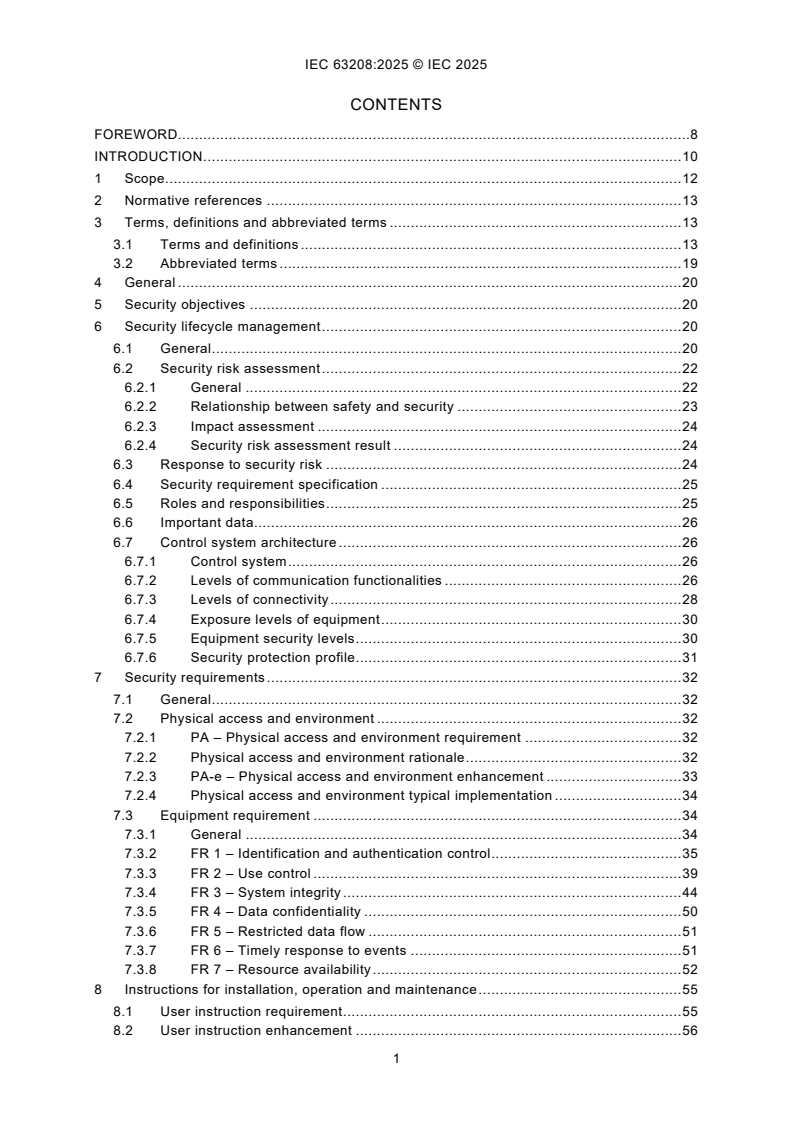
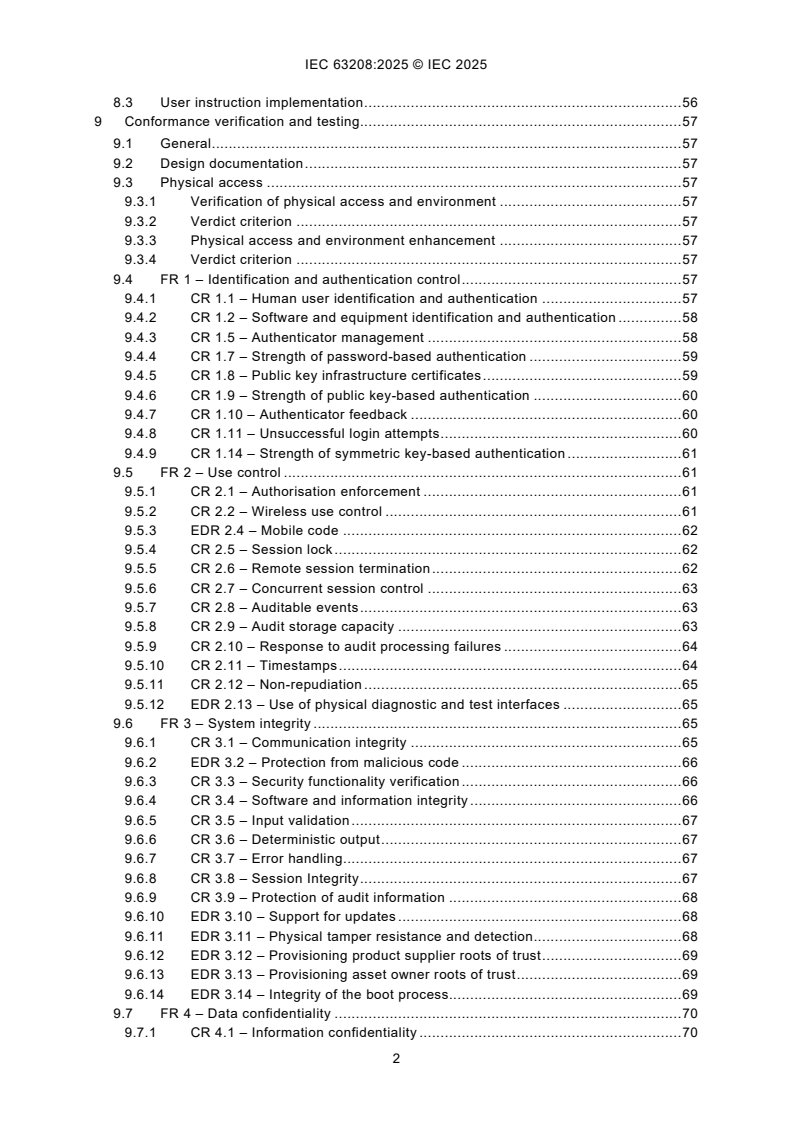
IEC 63208:2025 - Low-voltage switchgear and controlgear and their assemblies - Security requirements Released:8/22/2025
IEC 63208:2025 - Appareillages et ensembles d'appareillages a basse tension - Exigences de sécurité Released:8/22/2025
IEC 63208:2025 - Low-voltage switchgear and controlgear and their assemblies - Security requirements Released:8/22/2025
Overview
IEC 63208:2025 sets out comprehensive security requirements for low-voltage switchgear and controlgear, as well as their assemblies, with a particular focus on operational technology (OT) environments. This standard addresses equipment that leverages wired or wireless data communications and ensures that such equipment is protected against physical and cybersecurity threats and vulnerabilities. By applying robust risk assessment methodologies and specifying essential mitigation measures, IEC 63208:2025 enhances the resilience and safety of electrical installations in modern, connected infrastructures.
Key Topics
IEC 63208:2025 covers a range of essential topics for securing low-voltage switchgear and controlgear:
- Security Risk Assessment: Implements risk assessment approaches, including attack level identification, threat and impact analysis, and links to safety considerations.
- Communication Interface Exposure: Defines levels of exposure for equipment interfaces and establishes criteria for determining the necessary security levels.
- Physical and Cyber Countermeasures: Specifies measures for safeguarding physical access, including environmental controls in line with ISO/IEC 27001, and cybersecurity requirements referencing IEC 62443-4-2.
- User Instructions: Provides requirements for clear user documentation on installation, operation, and maintenance to support secure practices.
- Conformance and Testing: Outlines verification and testing procedures to ensure compliance with security requirements.
- Roles and Responsibilities: Addresses organizational roles and responsibilities concerning equipment security.
- Security Profiles: Develops protection profiles tailored to equipment families, such as soft-starters, motor starters, circuit-breakers, transfer switches, and wireless devices.
Applications
The requirements of IEC 63208:2025 are highly relevant across industries that depend on safe, reliable, and secure electrical distribution:
- Building Automation: Protects building management and control systems where low-voltage switchgear often features connected interfaces.
- Industrial Facilities: Safeguards controlgear assemblies within manufacturing, processing, and automation environments, where equipment is vulnerable to cyber and physical threats.
- Energy Distribution: Ensures security in electrical substations, power distribution panels, and utility installations by preventing unauthorized operation, service disruption, and other risks.
- Critical Infrastructure: Provides baseline security measures for operational technology in sectors such as transportation, healthcare, and water utilities.
By addressing threats ranging from denial of service and unauthorized control to integrity and availability of protective functions, this standard increases organizational confidence in the operational continuity and safety of electrical systems.
Related Standards
IEC 63208:2025 builds upon and complements several key security and safety frameworks, including:
- ISO/IEC 27001 - Refers to requirements for physical and environmental controls as part of information security management.
- IEC 62443-4-2 - Relates to technical security requirements for components used in industrial automation and control systems.
- IEC 62443-4-1 - Addresses secure product development lifecycle practices (referenced for lifecycle management outside this document's scope).
- European Cyber Resilient Act (CRA) - The standard maps requirements to the essential cybersecurity requirements of the European CRA where appropriate.
Practical Value
Implementing IEC 63208:2025:
- Reduces vulnerability to physical and cyber threats, mitigating risks such as equipment tampering, denial of service, and data breaches.
- Supports regulatory and contractual compliance by aligning with widely recognized international standards.
- Enhances the safe integration of smart and connected switchgear solutions in both new and legacy installations.
- Guides manufacturers, integrators, and end-users in establishing a clear, systematic approach to equipment security, from risk assessment to conformance testing.
For organizations aiming to strengthen the integrity and resilience of their electrical systems, IEC 63208:2025 provides a robust foundation for secure, sustainable operations.
Relations
- Effective Date
- 22-Dec-2023
Buy Documents
IEC 63208:2025 - Low-voltage switchgear and controlgear and their assemblies - Security requirements Released:8/22/2025
IEC 63208:2025 - Appareillages et ensembles d'appareillages a basse tension - Exigences de sécurité Released:8/22/2025
IEC 63208:2025 - Low-voltage switchgear and controlgear and their assemblies - Security requirements Released:8/22/2025
Get Certified
Connect with accredited certification bodies for this standard

IMQ S.p.A. (Certification)
Italian electrical product certification.

SLG Prüf- und Zertifizierungs GmbH
German testing and certification body.

UL Solutions
Global safety science company with testing, inspection and certification.
Sponsored listings
Frequently Asked Questions
IEC 63208:2025 is a standard published by the International Electrotechnical Commission (IEC). Its full title is "Low-voltage switchgear and controlgear and their assemblies - Security requirements". This standard covers: IEC 63208:2025 This document applies to the main functions of switchgear and controlgear and their assemblies, called equipment, in the context of operational technology (OT 3.1.34). It is applicable to equipment with wired or wireless data communication means and their physical accessibility, within their limits of environmental conditions. It is intended to achieve the appropriate physical and cybersecurity mitigation against vulnerabilities to security threats. This document provides requirements on the appropriate: – security risk assessment to be developed including the attack levels, the typical threats, the impact assessment and the relationship with safety; – levels of exposure of the communication interface and the determination of the equipment security level; – assessment of the exposure level of the communication interfaces; – assignment of the required security measures for the equipment; – countermeasures for the physical access and the environment derived from ISO/IEC 27001; – countermeasures referring to IEC 62443-4-2 with their criteria of applicability; – user instructions for installation, operation and maintenance; – conformance verification and testing, and – security protection profiles by family of equipment (Annex E to Annex I). In particular, it focuses on potential vulnerabilities to threats resulting in: – unintended operation, which can lead to hazardous situations; – unavailability of the protective functions (overcurrent, earth fault, etc.); – other degradation of main function. It also provides guidance on the cybersecurity management with the: – roles and responsibilities (Table 4); – typical architectures (Annex A); – use cases (Annex B); – development methods (Annex C); – recommendations to be provided to users and for integration into an assembly (Annex D); – bridging references to cybersecurity management systems (Annex K). This document does not cover security requirements for: – information technology (IT); – industrial automation and control systems (IACS), engineering workstations and their software applications; – critical infrastructure or energy management systems; – network device (communication network switch or virtual private network terminator), or – data confidentiality other than for critical security parameters; – design lifecycle management. For this aspect, see IEC 62443-4-1, ISO/IEC 27001 or other security lifecycle management standards.
IEC 63208:2025 This document applies to the main functions of switchgear and controlgear and their assemblies, called equipment, in the context of operational technology (OT 3.1.34). It is applicable to equipment with wired or wireless data communication means and their physical accessibility, within their limits of environmental conditions. It is intended to achieve the appropriate physical and cybersecurity mitigation against vulnerabilities to security threats. This document provides requirements on the appropriate: – security risk assessment to be developed including the attack levels, the typical threats, the impact assessment and the relationship with safety; – levels of exposure of the communication interface and the determination of the equipment security level; – assessment of the exposure level of the communication interfaces; – assignment of the required security measures for the equipment; – countermeasures for the physical access and the environment derived from ISO/IEC 27001; – countermeasures referring to IEC 62443-4-2 with their criteria of applicability; – user instructions for installation, operation and maintenance; – conformance verification and testing, and – security protection profiles by family of equipment (Annex E to Annex I). In particular, it focuses on potential vulnerabilities to threats resulting in: – unintended operation, which can lead to hazardous situations; – unavailability of the protective functions (overcurrent, earth fault, etc.); – other degradation of main function. It also provides guidance on the cybersecurity management with the: – roles and responsibilities (Table 4); – typical architectures (Annex A); – use cases (Annex B); – development methods (Annex C); – recommendations to be provided to users and for integration into an assembly (Annex D); – bridging references to cybersecurity management systems (Annex K). This document does not cover security requirements for: – information technology (IT); – industrial automation and control systems (IACS), engineering workstations and their software applications; – critical infrastructure or energy management systems; – network device (communication network switch or virtual private network terminator), or – data confidentiality other than for critical security parameters; – design lifecycle management. For this aspect, see IEC 62443-4-1, ISO/IEC 27001 or other security lifecycle management standards.
IEC 63208:2025 is classified under the following ICS (International Classification for Standards) categories: 29.130.20 - Low voltage switchgear and controlgear. The ICS classification helps identify the subject area and facilitates finding related standards.
IEC 63208:2025 has the following relationships with other standards: It is inter standard links to IEC TS 63208:2020. Understanding these relationships helps ensure you are using the most current and applicable version of the standard.
IEC 63208:2025 is available in PDF format for immediate download after purchase. The document can be added to your cart and obtained through the secure checkout process. Digital delivery ensures instant access to the complete standard document.
Standards Content (Sample)
IEC 63208 ®
Edition 1.0 2025-08
INTERNATIONAL
STANDARD
Low-voltage switchgear and controlgear and their assemblies - Security
requirements
ICS 29.130.20 ISBN 978-2-8327-0604-6
All rights reserved. Unless otherwise specified, no part of this publication may be reproduced or utilized in any form or
by any means, electronic or mechanical, including photocopying and microfilm, without permission in writing from either
IEC or IEC's member National Committee in the country of the requester. If you have any questions about IEC copyright
or have an enquiry about obtaining additional rights to this publication, please contact the address below or your local
IEC member National Committee for further information.
IEC Secretariat Tel.: +41 22 919 02 11
3, rue de Varembé info@iec.ch
CH-1211 Geneva 20 www.iec.ch
Switzerland
About the IEC
The International Electrotechnical Commission (IEC) is the leading global organization that prepares and publishes
International Standards for all electrical, electronic and related technologies.
About IEC publications
The technical content of IEC publications is kept under constant review by the IEC. Please make sure that you have the
latest edition, a corrigendum or an amendment might have been published.
IEC publications search - IEC Products & Services Portal - products.iec.ch
webstore.iec.ch/advsearchform Discover our powerful search engine and read freely all the
publications previews, graphical symbols and the glossary.
The advanced search enables to find IEC publications by a
variety of criteria (reference number, text, technical With a subscription you will always have access to up to date
committee, …). It also gives information on projects, content tailored to your needs.
replaced and withdrawn publications.
Electropedia - www.electropedia.org
The world's leading online dictionary on electrotechnology,
IEC Just Published - webstore.iec.ch/justpublished
Stay up to date on all new IEC publications. Just Published containing more than 22 500 terminological entries in English
details all new publications released. Available online and and French, with equivalent terms in 25 additional languages.
once a month by email. Also known as the International Electrotechnical Vocabulary
(IEV) online.
IEC Customer Service Centre - webstore.iec.ch/csc
If you wish to give us your feedback on this publication or
need further assistance, please contact the Customer
Service Centre: sales@iec.ch.
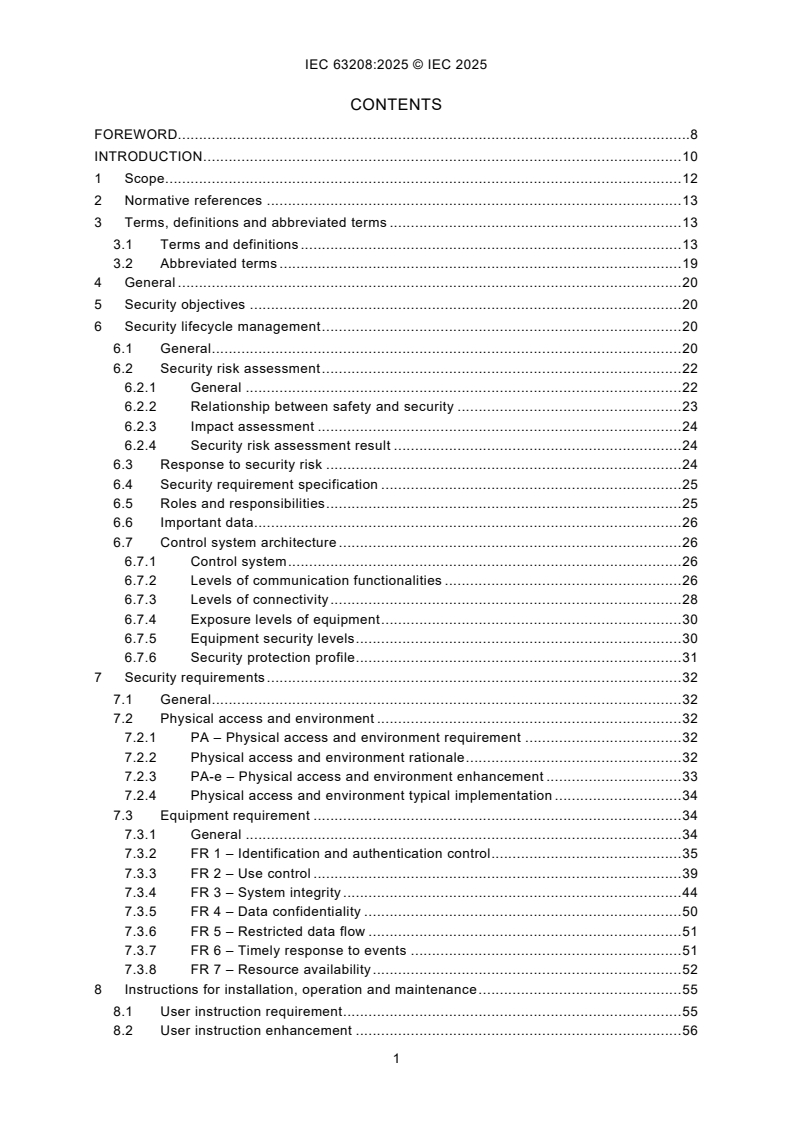
CONTENTS
FOREWORD. 8
INTRODUCTION . 10
1 Scope . 12
2 Normative references . 13
3 Terms, definitions and abbreviated terms . 13
3.1 Terms and definitions . 13
3.2 Abbreviated terms . 19
4 General . 20
5 Security objectives . 20
6 Security lifecycle management . 20
6.1 General . 20
6.2 Security risk assessment . 22
6.2.1 General . 22
6.2.2 Relationship between safety and security . 23
6.2.3 Impact assessment . 24
6.2.4 Security risk assessment result . 24
6.3 Response to security risk . 24
6.4 Security requirement specification . 25
6.5 Roles and responsibilities . 25
6.6 Important data . 26
6.7 Control system architecture . 26
6.7.1 Control system . 26
6.7.2 Levels of communication functionalities . 26
6.7.3 Levels of connectivity . 28
6.7.4 Exposure levels of equipment . 30
6.7.5 Equipment security levels . 30
6.7.6 Security protection profile . 31
7 Security requirements . 32
7.1 General . 32
7.2 Physical access and environment . 32
7.2.1 PA – Physical access and environment requirement . 32
7.2.2 Physical access and environment rationale . 32
7.2.3 PA-e – Physical access and environment enhancement . 33
7.2.4 Physical access and environment typical implementation . 34
7.3 Equipment requirement . 34
7.3.1 General . 34
7.3.2 FR 1 – Identification and authentication control . 35
7.3.3 FR 2 – Use control . 39
7.3.4 FR 3 – System integrity . 44
7.3.5 FR 4 – Data confidentiality . 50
7.3.6 FR 5 – Restricted data flow . 51
7.3.7 FR 6 – Timely response to events . 51
7.3.8 FR 7 – Resource availability . 52
8 Instructions for installation, operation and maintenance . 55
8.1 User instruction requirement . 55
8.2 User instruction enhancement . 56
8.3 User instruction implementation . 56
9 Conformance verification and testing. 57
9.1 General . 57
9.2 Design documentation . 57
9.3 Physical access . 57
9.3.1 Verification of physical access and environment . 57
9.3.2 Verdict criterion . 57
9.3.3 Physical access and environment enhancement . 57
9.3.4 Verdict criterion . 57
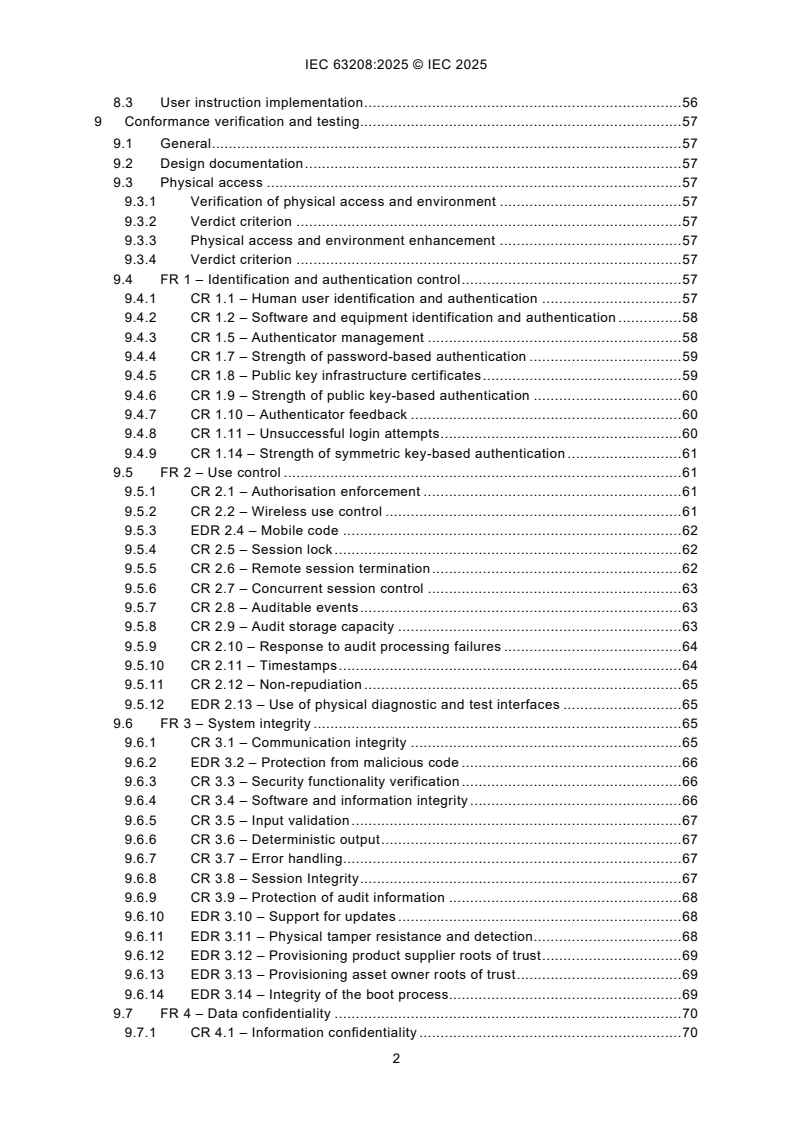
9.4 FR 1 – Identification and authentication control . 57
9.4.1 CR 1.1 – Human user identification and authentication . 57
9.4.2 CR 1.2 – Software and equipment identification and authentication . 58
9.4.3 CR 1.5 – Authenticator management . 58
9.4.4 CR 1.7 – Strength of password-based authentication . 59
9.4.5 CR 1.8 – Public key infrastructure certificates . 59
9.4.6 CR 1.9 – Strength of public key-based authentication . 60
9.4.7 CR 1.10 – Authenticator feedback . 60
9.4.8 CR 1.11 – Unsuccessful login attempts . 60
9.4.9 CR 1.14 – Strength of symmetric key-based authentication . 61
9.5 FR 2 – Use control . 61
9.5.1 CR 2.1 – Authorisation enforcement . 61
9.5.2 CR 2.2 – Wireless use control . 61
9.5.3 EDR 2.4 – Mobile code . 62
9.5.4 CR 2.5 – Session lock . 62
9.5.5 CR 2.6 – Remote session termination . 62
9.5.6 CR 2.7 – Concurrent session control . 63
9.5.7 CR 2.8 – Auditable events . 63
9.5.8 CR 2.9 – Audit storage capacity . 63
9.5.9 CR 2.10 – Response to audit processing failures . 64
9.5.10 CR 2.11 – Timestamps . 64
9.5.11 CR 2.12 – Non-repudiation . 65
9.5.12 EDR 2.13 – Use of physical diagnostic and test interfaces . 65
9.6 FR 3 – System integrity . 65
9.6.1 CR 3.1 – Communication integrity . 65
9.6.2 EDR 3.2 – Protection from malicious code . 66
9.6.3 CR 3.3 – Security functionality verification . 66
9.6.4 CR 3.4 – Software and information integrity . 66
9.6.5 CR 3.5 – Input validation . 67
9.6.6 CR 3.6 – Deterministic output . 67
9.6.7 CR 3.7 – Error handling . 67
9.6.8 CR 3.8 – Session Integrity . 67
9.6.9 CR 3.9 – Protection of audit information . 68
9.6.10 EDR 3.10 – Support for updates . 68
9.6.11 EDR 3.11 – Physical tamper resistance and detection . 68
9.6.12 EDR 3.12 – Provisioning product supplier roots of trust . 69
9.6.13 EDR 3.13 – Provisioning asset owner roots of trust . 69
9.6.14 EDR 3.14 – Integrity of the boot process. 69
9.7 FR 4 – Data confidentiality . 70
9.7.1 CR 4.1 – Information confidentiality . 70
9.7.2 CR 4.3 – Use of cryptography . 70
9.8 FR 6 – Timely response to events . 70
9.8.1 CR 6.1 – Audit log accessibility . 70
9.9 FR 7 – Resource availability . 71
9.9.1 CR 7.1 – Denial of service protection . 71
9.9.2 CR 7.2 – Resource management . 71
9.9.3 CR 7.3 – Control system backup . 71
9.9.4 CR 7.4 – Control system recovery and reconstitution . 72
9.9.5 CR 7.6 – Network and security configuration settings . 72
9.9.6 CR 7.7 – Least functionality . 72
9.9.7 CR 7.8 – Control system inventory . 72
Annex A (informative) Cybersecurity and electrical system architecture . 74
A.1 General . 74
A.2 Typical architecture involving switchgear, controlgear and their assembly . 74
A.2.1 Building . 74
A.2.2 Manufacturing . 75
Annex B (informative) Use case studies . 77
B.1 General . 77
B.2 Use case 1 – Protection against Denial of Service (DoS) attack . 78
B.3 Use case 2 – Protection against unauthorised modification of sensing device . 79
B.4 Use case 3 – Protection against unauthorised modification of wireless
equipment . 80
B.5 Use case 4 – Protection against threat actor remotely taking control of a
"managing" intelligent assembly . 81
Annex C (informative) Development methods of cybersecurity measures . 82
Annex D (informative) Security related instructions in the product documentation . 83
D.1 General . 83
D.2 Risk assessment and security planning . 83
D.2.1 Risk assessment . 83
D.2.2 Security plan . 83
D.3 Recommendations for design and installation of the system integrating
switchgear, controlgear and their assemblies . 84
D.3.1 General access control . 84
D.3.2 Recommendations for local access . 84
D.3.3 Recommendations for remote access . 85
D.3.4 Recommendations for firmware upgrades . 86
D.3.5 Recommendations for the end of life . 86
D.4 Instructions for an assembly . 86
Annex E (normative) Security protection profile of soft-starter and semiconductor
controller . 87
E.1 Introduction . 87
E.1.1 Security protection profile reference . 87
E.1.2 Target of evaluation overview . 87
E.1.3 General mission objectives . 88
E.1.4 Features . 88
E.1.5 Product usage . 88
E.1.6 Users . 88
E.2 Assumptions . 89
E.3 Conformance claims and conformance statement . 89
E.4 Security problem definition . 89
E.4.1 Critical assets of the environment . 89
E.4.2 ToE critical assets . 90
E.4.3 Threat modelFR 7 – Resource availability . 90
E.5 Security objectives . 91
E.6 Security requirements . 91
E.6.1 Security functional requirements . 91
E.6.2 Security assurance requirements . 91
Annex F (normative) Security protection profile of network connected motor starter . 92
F.1 Introduction . 92
F.1.1 Security protection profile reference . 92
F.1.2 Target of evaluation overview . 92
F.1.3 General mission objectives . 93
F.1.4 Features . 93
F.1.5 Product usage . 93
F.1.6 Users . 93
F.2 Assumptions . 94
F.3 Conformance claims and conformance statement . 94
F.4 Security problem definition . 94
F.4.1 Critical assets of the environment . 94
F.4.2 ToE critical assets . 95
F.4.3 Threat model . 95
F.5 Security objectives . 96
F.6 Security requirements . 96
F.6.1 Security functional requirements . 96
F.6.2 Security assurance requirements . 96
Annex G (normative) Security protection profile of circuit-breaker . 97
G.1 Introduction . 97
G.1.1 Security protection profile reference . 97
G.1.2 Target of evaluation overview . 97
G.1.3 General mission objectives . 98
G.1.4 Features . 98
G.1.5 Product usage . 98
G.1.6 Users . 98
G.2 Assumptions . 99
G.3 Conformance claims and conformance statement . 99
G.4 Security problem definition . 99
G.4.1 Critical assets of the environment . 99
G.4.2 ToE critical assets . 100
G.4.3 Threat model . 100
G.5 Security objectives . 101
G.6 Security requirements . 101
G.6.1 Security functional requirements . 101
G.6.2 Security assurance requirements . 101
Annex H (normative) Security protection profile of transfer switch equipment . 102
H.1 Introduction . 102
H.1.1 Security protection profile reference . 102
H.1.2 Target of evaluation overview . 102
H.1.3 General mission objectives . 103
H.1.4 Features . 103
H.1.5 Product usage . 103
H.1.6 Users . 103
H.2 Assumptions . 104
H.3 Conformance claims and conformance statement . 104
H.4 Security problem definition . 104
H.4.1 Critical assets of the environment . 104
H.4.2 ToE critical assets . 105
H.4.3 Threat model . 105
H.5 Security objectives . 106
H.6 Security requirements . 106
H.6.1 Security functional requirements . 106
H.6.2 Security assurance requirements . 107
Annex I (normative) Security protection profile for wireless controlgear with its
communication interface . 108
I.1 Introduction . 108
I.1.1 Security protection profile reference . 108
I.1.2 Target of evaluation overview . 108
I.1.3 General mission objectives . 109
I.1.4 Features . 109
I.1.5 Product usage . 109
I.1.6 Users . 109
I.2 Assumptions . 109
I.3 Conformance claims and conformance statement . 110
I.4 Security problem definition . 110
I.4.1 Critical assets of the environment . 110
I.4.2 ToE critical assets . 110
I.4.3 Threat model . 111
I.5 Security objectives . 111
I.6 Security requirements . 112
I.6.1 Security functional requirements . 112
I.6.2 Security assurance requirements . 112
Annex J (informative) Equipment requirements by level of exposure . 113
Annex K (informative) Bridging references to cybersecurity management systems . 115
Annex L (informative) Mapping of provisions to the essential cybersecurity
requirements of the European Cyber Resilient Act Annexes . 120
Bibliography . 123
Figure 1 – Standard landscape . 11
Figure 2 – Example of physical interfaces of an embedded device in an equipment
which can be subject to an attack . 22
Figure 3 – Example of relation between security and safety . 23
Figure 4 – Control system architecture with switchgear and controlgear . 27
Figure 5 – Control system connectivity level C1 . 28
Figure 6 – Control system connectivity level C2 . 28
Figure 7 – Control system connectivity level C3 . 28
Figure 8 – Control system connectivity level C4 . 29
Figure 9 – Control system connectivity level C5 . 29
Figure 10 – Structure of a security protection profile . 31
Figure 11 – Example of security instruction symbol . 56
Figure A.1 – Building electrical architecture . 75
Figure A.2 – Industrial plants . 76
Figure E.1 – Machinery control architecture . 87
Figure F.1 – Machinery control architecture . 92
Figure G.1 – Circuit-breaker in its environment . 97
Figure H.1 – Functional units of the transfer switch equipment . 102
Figure I.1 – Machinery control architecture . 108
Table 1 – Potential attack levels . 21
Table 2 – Typical threats . 21
Table 3 – Impact evaluation . 24
Table 4 – Roles related to security responsibilities . 25
Table 5 – Level of exposure of an equipment . 30
Table 6 – Equipment security level . 31
Table 7 – Physical access related requirement references . 33
Table 8 – Physical access enhancement related requirement references . 33
Table B.1 – List of actors . 77
Table B.2 – Base line requirement. 77
Table B.3 – Security problems of use cases . 77
Table E.1 – Security requirements for the critical assets of the environment . 89
Table E.2 – Security requirements for the critical assets . 90
Table E.3 – Security functional requirements . 91
Table F.1 – Security requirements for the critical assets of the environment . 95
Table F.2 – Security requirements for the critical assets . 95
Table F.3 – Security functional requirements . 96
Table G.1 – Security requirements for the critical assets of the environment . 100
Table G.2 – Security requirements for the critical assets . 100
Table G.3 – Security functional requirements . 101
Table H.1 – Security requirements for the critical assets of the environment. 105
Table H.2 – Security requirements for the critical assets . 105
Table H.3 – Security functional requirements . 106
Table I.1 – Security requirements for the critical assets of the environment . 110
Table I.2 – Security requirements for the critical assets . 111
Table I.3 – Security functional requirements . 112
Table J.1 – Equipment requirements by level of exposure . 113
Table K.1 – Useful security standards . 115
Table K.2 – Contribution of switchgear, controlgear and their assemblies to ISO and
IEC horizontal security framework . 117
Table K.3 – Mapping to other security framework . 118
Table K.4 – Requirements for IACS not relevant for switchgear, controlgear and their
assemblies . 118
Table K.5 – Requirements for IoT device not relevant for switchgear, controlgear and
their assemblies . 119
Table L.1 – Mapping to the essential cybersecurity requirements of the CRA Annex I . 120
INTERNATIONAL ELECTROTECHNICAL COMMISSION
____________
Low-voltage switchgear and controlgear and their assemblies -
Security requirements
FOREWORD
1) The International Electrotechnical Commission (IEC) is a worldwide organization for standardization comprising
all national electrotechnical committees (IEC National Committees). The object of IEC is to promote international
co-operation on all questions concerning standardization in the electrical and electronic fields. To this end and
in addition to other activities, IEC publishes International Standards, Technical Specifications, Technical Reports,
Publicly Available Specifications (PAS) and Guides (hereafter referred to as "IEC Publication(s)"). Their
preparation is entrusted to technical committees; any IEC National Committee interested in the subject dealt with
may participate in this preparatory work. International, governmental and non-governmental organizations liaising
with the IEC also participate in this preparation. IEC collaborates closely with the International Organization for
Standardization (ISO) in accordance with conditions determined by agreement between the two organizations.
2) The formal decisions or agreements of IEC on technical matters express, as nearly as possible, an international
consensus of opinion on the relevant subjects since each technical committee has representation from all
interested IEC National Committees.
3) IEC Publications have the form of recommendations for international use and are accepted by IEC National
Committees in that sense. While all reasonable efforts are made to ensure that the technical content of IEC
Publications is accurate, IEC cannot be held responsible for the way in which they are used or for any
misinterpretation by any end user.
4) In order to promote international uniformity, IEC National Committees undertake to apply IEC Publications
transparently to the maximum extent possible in their national and regional publications. Any divergence between
any IEC Publication and the corresponding national or regional publication shall be clearly indicated in the latter.
5) IEC itself does not provide any attestation of conformity. Independent certification bodies provide conformity
assessment services and, in some areas, access to IEC marks of conformity. IEC is not responsible for any
services carried out by independent certification bodies.
6) All users should ensure that they have the latest edition of this publication.
7) No liability shall attach to IEC or its directors, employees, servants or agents including individual experts and
members of its technical committees and IEC National Committees for any personal injury, property damage or
other damage of any nature whatsoever, whether direct or indirect, or for costs (including legal fees) and
expenses arising out of the publication, use of, or reliance upon, this IEC Publication or any other IEC
Publications.
8) Attention is drawn to the Normative references cited in this publication. Use of the referenced publications is
indispensable for the correct application of this publication.
9) IEC draws attention to the possibility that the implementation of this document may involve the use of (a)
patent(s). IEC takes no position concerning the evidence, validity or applicability of any claimed patent rights in
respect thereof. As of the date of publication of this document, IEC had not received notice of (a) patent(s), which
may be required to implement this document. However, implementers are cautioned that this may not represent
the latest information, which may be obtained from the patent database available at https://patents.iec.ch. IEC
shall not be held responsible for identifying any or all such patent rights.
IEC 63208 has been prepared by IEC technical committee 121: Switchgear and controlgear and
their assemblies for low voltage. It is an International Standard.
This first edition cancels and replaces the first edition IEC TS 63208 published in 2020. This
edition constitutes a technical revision.
This edition includes the following significant technical changes with respect to the previous
edition:
a) Risk assessment: Attack levels, impact assessment, relationship with safety;
b) Risk objectives: Determination of the equipment security level;
c) Countermeasures referring to IEC 62443-4-2;
d) Conformance verification and testing;
e) Security protection profiles.
The text of this International Standard is based on the following documents:
Draft Report on voting
121/221/FDIS 121/230/RVD
Full information on the voting for its approval can be found in the report on voting indicated in
the above table.
The language used for the development of this International Standard is English.
This document was drafted in accordance with ISO/IEC Directives, Part 2, and developed in
accordance with ISO/IEC Directives, Part 1 and ISO/IEC Directives, IEC Supplement, available
at www.iec.ch/members_experts/refdocs. The main document types developed by IEC are
described in greater detail at www.iec.ch/publications.
The committee has decided that the contents of this document will remain unchanged until the
stability date indicated on the IEC website under webstore.iec.ch in the data related to the
specific document. At this date, the document will be
• reconfirmed,
• withdrawn, or
• revised.
INTRODUCTION
The growing use of data communication capabilities by switchgear, controlgear and their
assemblies (called "equipment" in this document) automatically increases cybersecurity risks.
In addition, information technology is more often interconnected to and even integrated into
industrial systems which therefore increase this risk.
Very often, switchgear such as circuit-breakers, or controlgear such as overload relays or
proximity switches, are equipped with data communication interface. They can be connected to
a logic controller or remote display, with local and remote connectivity for giving access to data
such as settings, actual power supply values, monitoring data, data logging, control and
firmware update.
For these typical applications of electrical distribution and machinery, minimum cybersecurity
requirements are necessary for maintaining an acceptable level of safety integrity of the main
functions for equipment, with or without data communication capability. These requirements are
intended to limit the vulnerability of the data communication interfaces. To keep the largest
freedom of innovation, the relevant requirements for a defined application are determined
preferably by a systematic risk assessment approach.
The intention of this document is to:
1) provide minimum sets of cybersecurity requirements called security protection profiles for
equipment to mitigate the likelihood of unintended operation and loss of protective functions
in the context of electrical distribution installations and control systems of machinery;
2) provide the test methods for verifying the implementation of the cybersecurity
countermeasure within the equipment;
3) provide guidance to avoid impairing the main function of the equipment, in all operating
modes, as a consequence of the implementation of security countermeasures.
This document gives guidance on countermeasures applicable to the design of the equipment
(hardware, firmware, network interface, access control, system) and on additional
countermeasures to be considered for the implementation and instruction for use.
Figure 1 – Standard landscape
Figure 1 positions the landscape of the standards considered in this document with respect to
governance and policy aspects, cybersecurity operation aspects, technical details and product
requirements. ISO/IEC 27001 and its family of standards are used in many organisations for
managing the cybersecurity of information systems and general business. The cybersecurity of
industrial control systems is more focussed on maintaining the integrity and the availability of
its main functions. IEC 62443 is currently specialised on the generic requirements for process
automation system at activity levels 2 and 3 of IEC 62264-1. This document considers the use
of the equipment in the activity level 1 of IEC 62264-1 with the cybersecurity of electrical
distribution boards and machinery with secured power control and control switching end
components. As an example, the principle of systematic and uniformed Security Level
requirements SL-1 to SL-4 of IEC 62443-4-2 for the automation components of a control system
in a process zone is not relevant for switchgear, controlgear and their assemblies because of
their associated cybersecurity risks mainly depending on their limited levels of functionality and
their wide possible levels of exposure. Cons
...
IEC 63208 ®
Edition 1.0 2025-08
NORME
INTERNATIONALE
Appareillages et ensembles d'appareillages à basse tension - Exigences de
sécurité
ICS 29.130.20 ISBN 978-2-8327-0604-6
Droits de reproduction réservés. Sauf indication contraire, aucune partie de cette publication ne peut être reproduite ni
utilisée sous quelque forme que ce soit et par aucun procédé, électronique ou mécanique, y compris la photocopie et
les microfilms, sans l'accord écrit de l'IEC ou du Comité national de l'IEC du pays du demandeur. Si vous avez des
questions sur le copyright de l'IEC ou si vous désirez obtenir des droits supplémentaires sur cette publication, utilisez
les coordonnées ci-après ou contactez le Comité national de l'IEC de votre pays de résidence.
IEC Secretariat Tel.: +41 22 919 02 11
3, rue de Varembé info@iec.ch
CH-1211 Geneva 20 www.iec.ch
Switzerland
A propos de l'IEC
La Commission Electrotechnique Internationale (IEC) est la première organisation mondiale qui élabore et publie des
Normes internationales pour tout ce qui a trait à l'électricité, à l'électronique et aux technologies apparentées.
A propos des publications IEC
Le contenu technique des publications IEC est constamment revu. Veuillez vous assurer que vous possédez l’édition la
plus récente, un corrigendum ou amendement peut avoir été publié.
Recherche de publications IEC - IEC Products & Services Portal - products.iec.ch
webstore.iec.ch/advsearchform Découvrez notre puissant moteur de recherche et consultez
La recherche avancée permet de trouver des publications gratuitement tous les aperçus des publications, symboles
IEC en utilisant différents critères (numéro de référence, graphiques et le glossaire. Avec un abonnement, vous aurez
texte, comité d’études, …). Elle donne aussi des toujours accès à un contenu à jour adapté à vos besoins.
informations sur les projets et les publications remplacées
ou retirées. Electropedia - www.electropedia.org
Le premier dictionnaire d'électrotechnologie en ligne au
IEC Just Published - webstore.iec.ch/justpublished monde, avec plus de 22 500 articles terminologiques en
Restez informé sur les nouvelles publications IEC. Just anglais et en français, ainsi que les termes équivalents
Published détaille les nouvelles publications parues. dans 25 langues additionnelles. Egalement appelé
Disponible en ligne et une fois par mois par email. Vocabulaire Electrotechnique International (IEV) en ligne.
Service Clients - webstore.iec.ch/csc
Si vous désirez nous donner des commentaires sur cette
publication ou si vous avez des questions contactez-
nous: sales@iec.ch.
SOMMAIRE
AVANT-PROPOS . 8
INTRODUCTION . 10
1 Domaine d'application . 12
2 Références normatives . 13
3 Termes, définitions et abréviations . 13
3.1 Termes et définitions . 13
3.2 Abréviations . 20
4 Généralités . 21
5 Objectifs de sécurité . 21
6 Gestion du cycle de vie de la sécurité . 21
6.1 Généralités . 21
6.2 Appréciation du risque pour la sécurité . 23
6.2.1 Généralités . 23
6.2.2 Relation entre sécurité et sécurité humaine . 24
6.2.3 Appréciation de l'impact . 25
6.2.4 Résultat de l'appréciation du risque pour la sécurité . 25
6.3 Réponse au risque pour la sécurité . 26
6.4 Spécification des exigences de sécurité . 26
6.5 Rôles et responsabilités . 26
6.6 Données importantes . 27
6.7 Architecture du système de commande . 27
6.7.1 Système de commande . 27
6.7.2 Niveaux des fonctionnalités de communication . 28
6.7.3 Niveaux de connectivité . 30
6.7.4 Niveaux d'exposition de l'équipement . 32
6.7.5 Niveaux de sécurité de l'équipement . 32
6.7.6 Profil de protection de la sécurité . 33
7 Exigences de sécurité . 34
7.1 Généralités . 34
7.2 Accès physique et environnement . 34
7.2.1 PA – Exigence relative à l'accès physique et à l'environnement . 34
7.2.2 Justification pour l'accès physique et l'environnement . 34
7.2.3 PA-e – Amélioration des accès physiques et de l'environnement . 35
7.2.4 Mise en œuvre type de l'accès physique et de l'environnement . 36
7.3 Exigences relatives à l'équipement . 37
7.3.1 Généralités . 37
7.3.2 FR 1 – Contrôle d'identification et d'authentification . 38
7.3.3 FR 2 – Contrôle d'utilisation . 42
7.3.4 FR 3 – Intégrité du système . 47
7.3.5 FR 4 – Confidentialité des données . 53
7.3.6 FR 5 – Transfert de données limité (RDF) . 54
7.3.7 FR 6 – Réponse appropriée aux événements . 55
7.3.8 FR 7 – Disponibilité des ressources . 55
8 Instructions d'installation, de fonctionnement et de maintenance. 59
8.1 Exigences relatives aux instructions pour l'utilisateur . 59
8.2 Amélioration des instructions pour l'utilisateur . 60
8.3 Mise en œuvre des instructions pour l'utilisateur . 60
9 Vérification et essais de conformité . 60
9.1 Généralités . 60
9.2 Documentation de conception . 60
9.3 Accès physique . 61
9.3.1 Vérification de l'accès physique et de l'environnement . 61
9.3.2 Critère de décision . 61
9.3.3 Amélioration des accès physiques et de l'environnement . 61
9.3.4 Critère de décision . 61
9.4 FR 1 – Contrôle d'identification et d'authentification . 61
9.4.1 CR 1.1 – Identification et authentification d'un utilisateur humain . 61
9.4.2 CR 1.2 – Identification et authentification des logiciels et équipements . 62
9.4.3 CR 1.5 – Gestion d'authentifiant . 62
9.4.4 CR 1.7 – Force de l'authentification par mot de passe . 63
9.4.5 CR 1.8 – Certificats d'infrastructure à clés publiques . 63
9.4.6 CR 1.9 – Force de l'authentification par clé publique . 63
9.4.7 CR 1.10 – Retour de l'authentifiant . 64
9.4.8 CR 1.11 – Tentatives infructueuses de connexion . 64
9.4.9 CR 1.14 – Force de l'authentification par clés symétriques . 64
9.5 FR 2 – Contrôle d'utilisation . 65
9.5.1 CR 2.1 – Mise en œuvre d'autorisation . 65
9.5.2 CR 2.2 – Contrôle d'utilisation sans fil . 65
9.5.3 EDR 2.4 – Code mobile . 65
9.5.4 CR 2.5 – Verrouillage de session . 66
9.5.5 CR 2.6 – Fermeture de la session à distance . 66
9.5.6 CR 2.7 – Contrôle de sessions simultanées . 67
9.5.7 CR 2.8 – Événements auditables . 67
9.5.8 CR 2.9 – Capacité de stockage des données d'audit . 67
9.5.9 CR 2.10 – Réponse aux défaillances de traitement des audits . 68
9.5.10 CR 2.11 – Horodatages . 68
9.5.11 CR 2.12 – Non-répudiation . 69
9.5.12 EDR 2.13 – Utilisation d'interfaces physiques de diagnostic et d'essai . 69
9.6 FR 3 – Intégrité du système . 69
9.6.1 CR 3.1 – Intégrité de la communication . 69
9.6.2 EDR 3.2 – Protection contre les programmes malveillants . 70
9.6.3 CR 3.3 – Vérification de la fonctionnalité de sécurité. 70
9.6.4 CR 3.4 – Intégrité des logiciels et des informations . 70
9.6.5 CR 3.5 – Validation d'entrée . 71
9.6.6 RC 3.6 – Sortie déterministe . 71
9.6.7 CR 3.7 – Traitement des erreurs . 71
9.6.8 CR 3.8 – Intégrité de la session . 72
9.6.9 CR 3.9 – Protection des informations d'audit . 72
9.6.10 EDR 3.10 – Support pour les mises à jour . 72
9.6.11 EDR 3.11 – Résistance aux violations physiques et détection . 73
9.6.12 EDR 3.12 – Fourniture des racines de confiance du fournisseur de
produit . 73
9.6.13 EDR 3.13 – Fourniture des racines de confiance du propriétaire d'actif . 73
9.6.14 EDR 3.14 – Intégrité du processus d'amorçage . 74
9.7 FR 4 – Confidentialité des données . 74
9.7.1 CR 4.1 – Confidentialité des informations . 74
9.7.2 CR 4.3 – Utilisation de la cryptographie . 74
9.8 FR 6 – Réponse appropriée aux événements . 75
9.8.1 CR 6.1 – Accessibilité au journal d'audit . 75
9.9 FR 7 – Disponibilité des ressources . 75
9.9.1 CR 7.1 – Protection contre le refus de service . 75
9.9.2 CR 7.2 – Gestion des ressources . 75
9.9.3 CR 7.3 – Sauvegarde du système de commande . 76
9.9.4 CR 7.4 – Reprise et reconstitution du système de commande . 76
9.9.5 CR 7.6 – Paramètres de configuration du réseau et de la sécurité . 76
9.9.6 CR 7.7 – Fonctionnalité minimale . 77
9.9.7 CR 7.8 – Inventaire des composants du système de commande . 77
Annexe A (informative) Cybersécurité et architecture des systèmes électriques . 78
A.1 Généralités . 78
A.2 Architecture type comprenant des appareillages et ensembles
d'appareillages . 78
A.2.1 Bâtiment . 78
A.2.2 Installation de fabrication . 79
Annexe B (informative) Études de cas d'utilisation . 81
B.1 Généralités . 81
B.2 Cas d'utilisation 1 – Protection contre les attaques par déni de service (DoS) . 82
B.3 Cas d'utilisation 2 – Protection contre les modifications non autorisées d'un
dispositif de détection . 83
B.4 Cas d'utilisation 3 – Protection contre les modifications non autorisées d'un
équipement sans fil . 84
B.5 Cas d'utilisation 4 – Protection contre les agents menaçants qui prennent le
contrôle à distance d'un ensemble intelligent "de gestion" . 85
Annexe C (informative) Méthodes de développement de mesures de cybersécurité . 87
Annexe D (informative) Instructions relatives à la sécurité dans la documentation du
produit . 88
D.1 Généralités . 88
D.2 Appréciation du risque et planification de la sécurité . 88
D.2.1 Appréciation du risque . 88
D.2.2 Plan de sécurité . 89
D.3 Recommandations pour la conception et l'installation du système intégrant
des appareillages et ensembles d'appareillages . 89
D.3.1 Contrôle d'accès général . 89
D.3.2 Recommandations pour l'accès local . 89
D.3.3 Recommandations pour l'accès à distance . 90
D.3.4 Recommandations pour les mises à niveau du microprogramme . 91
D.3.5 Recommandations pour la fin de vie . 91
D.4 Instructions pour un ensemble . 91
Annexe E (normative) Profil de protection de la sécurité d'un démarreur progressif et
d'un contrôleur à semiconducteurs . 92
E.1 Introduction . 92
E.1.1 Référence du profil de protection de la sécurité . 92
E.1.2 Vue d'ensemble de la cible d'évaluation . 92
E.1.3 Objectifs généraux de la mission . 93
E.1.4 Caractéristiques . 93
E.1.5 Utilisation du produit . 93
E.1.6 Utilisateurs . 93
E.2 Hypothèses . 94
E.3 Revendications de conformité et déclaration de conformité . 94
E.4 Définition du problème de sécurité . 94
E.4.1 Actifs essentiels de l'environnement . 94
E.4.2 Actifs essentiels de la ToE . 95
E.4.3 Modèle de menaces . 95
E.5 Objectifs de sécurité . 96
E.6 Exigences de sécurité . 96
E.6.1 Exigences fonctionnelles de sécurité . 96
E.6.2 Exigences d'assurance de sécurité . 97
Annexe F (normative) Profil de protection de la sécurité d'un démarreur de moteur
raccordé au réseau . 98
F.1 Introduction . 98
F.1.1 Référence du profil de protection de la sécurité . 98
F.1.2 Vue d'ensemble de la cible d'évaluation . 98
F.1.3 Objectifs généraux de la mission . 99
F.1.4 Caractéristiques . 99
F.1.5 Utilisation du produit . 99
F.1.6 Utilisateurs . 99
F.2 Hypothèses . 100
F.3 Revendications de conformité et déclaration de conformité . 100
F.4 Définition du problème de sécurité . 100
F.4.1 Actifs essentiels de l'environnement . 100
F.4.2 Actifs essentiels de la ToE . 101
F.4.3 Modèle de menaces . 101
F.5 Objectifs de sécurité . 102
F.6 Exigences de sécurité . 102
F.6.1 Exigences fonctionnelles de sécurité . 102
F.6.2 Exigences d'assurance de sécurité . 103
Annexe G (normative) Profil de protection de la sécurité d'un disjoncteur . 104
G.1 Introduction . 104
G.1.1 Référence du profil de protection de la sécurité . 104
G.1.2 Vue d'ensemble de la cible d'évaluation . 104
G.1.3 Objectifs généraux de la mission . 105
G.1.4 Caractéristiques . 105
G.1.5 Utilisation du produit . 105
G.1.6 Utilisateurs . 105
G.2 Hypothèses . 106
G.3 Revendications de conformité et déclaration de conformité . 106
G.4 Définition du problème de sécurité . 106
G.4.1 Actifs essentiels de l'environnement . 106
G.4.2 Actifs essentiels de la ToE . 107
G.4.3 Modèle de menaces . 107
G.5 Objectifs de sécurité . 108
G.6 Exigences de sécurité . 108
G.6.1 Exigences fonctionnelles de sécurité . 108
G.6.2 Exigences d'assurance de sécurité . 109
Annexe H (normative) Profil de protection de la sécurité d'un commutateur de transfert . 110
H.1 Introduction . 110
H.1.1 Référence du profil de protection de la sécurité . 110
H.1.2 Vue d'ensemble de la cible d'évaluation . 110
H.1.3 Objectifs généraux de la mission . 111
H.1.4 Caractéristiques . 111
H.1.5 Utilisation du produit . 111
H.1.6 Utilisateurs . 112
H.2 Hypothèses . 112
H.3 Revendications de conformité et déclaration de conformité . 112
H.4 Définition du problème de sécurité . 113
H.4.1 Actifs essentiels de l'environnement . 113
H.4.2 Actifs essentiels de la ToE . 113
H.4.3 Modèle de menaces . 114
H.5 Objectifs de sécurité . 114
H.6 Exigences de sécurité . 115
H.6.1 Exigences fonctionnelles de sécurité . 115
H.6.2 Exigences d'assurance de sécurité . 115
Annexe I (normative) Profil de protection de la sécurité pour un appareillage de
commande sans fil avec son interface de communication . 116
I.1 Introduction . 116
I.1.1 Référence du profil de protection de la sécurité . 116
I.1.2 Vue d'ensemble de la cible d'évaluation . 116
I.1.3 Objectifs généraux de la mission . 117
I.1.4 Caractéristiques . 117
I.1.5 Utilisation du produit . 117
I.1.6 Utilisateurs . 117
I.2 Hypothèses . 117
I.3 Revendications de conformité et déclaration de conformité . 118
I.4 Définition du problème de sécurité . 118
I.4.1 Actifs essentiels de l'environnement . 118
I.4.2 Actifs essentiels de la ToE . 119
I.4.3 Modèle de menaces . 119
I.5 Objectifs de sécurité . 120
I.6 Exigences de sécurité . 120
I.6.1 Exigences fonctionnelles de sécurité . 120
I.6.2 Exigences d'assurance de sécurité . 121
Annexe J (informative) Exigences relatives à l'équipement par niveau d'exposition . 122
Annexe K (informative) Établissement de références aux systèmes de management de
la cybersécurité . 124
Annexe L (informative) Mapping avec les dispositions relatives aux exigences
essentielles de cybersécurité des annexes du règlement européen sur la
cyberrésilience . 130
Bibliographie . 133
Figure 1 – Paysage normatif . 11
Figure 2 – Exemple d'interfaces physiques d'un dispositif intégré dans un équipement
pouvant faire l'objet d'une attaque . 23
Figure 3 – Exemple de relation entre sécurité et sécurité humaine . 24
Figure 4 – Architecture du système de commande avec appareillages . 29
Figure 5 – Niveau de connectivité C1 du système de commande . 30
Figure 6 – Niveau de connectivité C2 du système de commande . 30
Figure 7 – Niveau de connectivité C3 du système de commande . 30
Figure 8 – Niveau de connectivité C4 du système de commande . 31
Figure 9 – Niveau de connectivité C5 du système de commande . 31
Figure 10 – Structure d'un profil de protection de la sécurité . 33
Figure 11 – Exemple de symbole d'instruction de sécurité . 60
Figure A.1 – Architecture électrique d'un bâtiment . 79
Figure A.2 – Installations industrielles . 80
Figure E.1 – Architecture de commande des machines . 92
Figure F.1 – Architecture de commande des machines . 98
Figure G.1 – Disjoncteur dans son environnement . 104
Figure H.1 – Unités fonctionnelles d'un commutateur de transfert . 110
Figure I.1 – Architecture de commande des machines . 116
Tableau 1 – Niveaux d'attaque potentielle . 22
Tableau 2 – Menaces types . 22
Tableau 3 – Évaluation de l'impact . 25
Tableau 4 – Rôles relatifs aux responsabilités en matière de sécurité . 26
Tableau 5 – Niveau d'exposition d'un équipement . 32
Tableau 6 – Niveau de sécurité de l'équipement . 33
Tableau 7 – Références aux exigences relatives à l'accès physique . 35
Tableau 8 – Références aux exigences relatives à l'amélioration de l'accès physique . 35
Tableau B.1 – Liste des acteurs . 81
Tableau B.2 – Exigence de référence . 81
Tableau B.3 – Problèmes de sécurité des cas d'utilisation . 82
Tableau E.1 – Exigences de sécurité applicables aux actifs essentiels de
l'environnement . 95
Tableau E.2 – Exigences de sécurité applicables aux actifs essentiels . 95
Tableau E.3 – Exigences fonctionnelles de sécurité . 96
Tableau F.1 – Exigences de sécurité applicables aux actifs essentiels de
l'environnement . 101
Tableau F.2 – Exigences de sécurité applicables aux actifs essentiels . 101
Tableau F.3 – Exigences fonctionnelles de sécurité . 103
Tableau G.1 – Exigences de sécurité applicables aux actifs essentiels de
l'environnement . 107
Tableau G.2 – Exigences de sécurité applicables aux actifs essentiels . 107
Tableau G.3 – Exigences fonctionnelles de sécurité . 108
Tableau H.1 – Exigences de sécurité applicables aux actifs essentiels de
l'environnement . 113
Tableau H.2 – Exigences de sécurité applicables aux actifs essentiels. 113
Tableau H.3 – Exigences fonctionnelles de sécurité . 115
Tableau I.1 – Exigences de sécurité applicables aux actifs essentiels de
l'environnement . 118
Tableau I.2 – Exigences de sécurité applicables aux actifs essentiels . 119
Tableau I.3 – Exigences fonctionnelles de sécurité . 120
Tableau J.1 – Exigences relatives à l'équipement par niveau d'exposition . 122
Tableau K.1 – Normes de sécurité utiles . 124
Tableau K.2 – Contribution des appareillages et ensembles d'appareillages au cadre
de sécurité horizontal de l'ISO et de l'IEC . 126
Tableau K.3 – Mapping avec un autre cadre de sécurité . 127
Tableau K.4 – Exigences pour les IACS non pertinentes pour les appareillages et
ensembles d'appareillages . 127
Tableau K.5 – Exigences pour les dispositifs IdO non pertinentes pour les
appareillages et ensembles d'appareillages . 129
Tableau L.1 – Mapping avec les exigences essentielles de cybersécurité de l'Annexe I
du CRA . 130
COMMISSION ÉLECTROTECHNIQUE INTERNATIONALE
____________
Appareillages et ensembles d'appareillages à basse tension -
Exigences de sécurité
AVANT-PROPOS
1) La Commission Électrotechnique Internationale (IEC) est une organisation mondiale de normalisation composée
de l'ensemble des comités électrotechniques nationaux (Comités nationaux de l'IEC). L'IEC a pour objet de
favoriser la coopération internationale pour toutes les questions de normalisation dans les domaines de
l'électricité et de l'électronique. À cet effet, l'IEC – entre autres activités – publie des Normes internationales,
des Spécifications techniques, des Rapports techniques, des Spécifications accessibles au public (PAS) et des
Guides (ci-après dénommés "Publication(s) de l'IEC"). Leur élaboration est confiée à des comités d'études, aux
travaux desquels tout Comité national intéressé par le sujet traité peut participer. Les organisations
internationales, gouvernementales et non gouvernementales, en liaison avec l'IEC, participent également aux
travaux. L'IEC collabore étroitement avec l'Organisation Internationale de Normalisation (ISO), selon des
conditions fixées par accord entre les deux organisations.
2) Les décisions ou accords officiels de l'IEC concernant les questions techniques représentent, dans la mesure du
possible, un accord international sur les sujets étudiés, étant donné que les Comités nationaux de l'IEC intéressés
sont représentés dans chaque comité d'études.
3) Les Publications de l'IEC se présentent sous la forme de recommandations internationales et sont agréées
comme telles par les Comités nationaux de l'IEC. Tous les efforts raisonnables sont entrepris afin que l'IEC
s'assure de l'exactitude du contenu technique de ses publications; l'IEC ne peut pas être tenue responsable de
l'éventuelle mauvaise utilisation ou interprétation qui en est faite par un quelconque utilisateur final.
4) Dans le but d'encourager l'uniformité internationale, les Comités nationaux de l'IEC s'engagent, dans toute la
mesure possible, à appliquer de façon transparente les Publications de l'IEC dans leurs publications nationales
et régionales. Toutes divergences entre toutes Publications de l'IEC et toutes publications nationales ou
régionales correspondantes doivent être indiquées en termes clairs dans ces dernières.
5) L'IEC elle-même ne fournit aucune attestation de conformité. Des organismes de certification indépendants
fournissent des services d'évaluation de conformité et, dans certains secteurs, accèdent aux marques de
conformité de l'IEC. L'IEC n'est responsable d'aucun des services effectués par les organismes de certification
indépendants.
6) Tous les utilisateurs doivent s'assurer qu'ils sont en possession de la dernière édition de cette publication.
7) Aucune responsabilité ne doit être imputée à l'IEC, à ses administrateurs, employés, auxiliaires ou mandataires,
y compris ses experts particuliers et les membres de ses comités d'études et des Comités nationaux de l'IEC,
pour tout préjudice causé en cas de dommages corporels et matériels, ou de tout autre dommage de quelque
nature que ce soit, directe ou indirecte, ou pour supporter les coûts (y compris les frais de justice) et les dépenses
découlant de la publication ou de l'utilisation de cette Publication de l'IEC ou de toute autre Publication de l'IEC,
ou au crédit qui lui est accordé.
8) L'attention est attirée sur les références normatives citées dans cette publication. L'utilisation de publications
référencées est obligatoire pour une application correcte de la présente publication.
9) L'IEC attire l'attention sur le fait que la mise en application du présent document peut entraîner l'utilisation d'un
ou de plusieurs brevets. L'IEC ne prend pas position quant à la preuve, à la validité et à l'applicabilité de tout
droit de brevet revendiqué à cet égard. À la date de publication du présent document, l'IEC n'avait pas reçu
notification qu'un ou plusieurs brevets pouvaient être nécessaires à sa mise en application. Toutefois, il y a lieu
d'avertir les responsables de la mise en application du présent document que des informations plus récentes
sont susceptibles de figurer dans la base de données de brevets, disponible à l'adresse https://patents.iec.ch.
L'IEC ne saurait être tenue pour responsable de ne pas avoir identifié de tels droits de brevets.
L'IEC 63208 a été établie par le comité d'études 121 de l'IEC: Appareillages et ensembles
d'appareillages basse tension. Il s'agit d'une Norme internationale.
Cette première édition annule et remplace la première édition de l'IEC TS 63208 parue en 2020.
Cette édition constitue une révision technique.
Cette édition inclut les modifications techniques majeures suivantes par rapport à l'édition
précédente:
a) appréciation du risque: niveaux d'attaque, appréciation de l'impact, relation à la sécurité
humaine;
b) objectifs de risque: détermination du niveau de sécurité de l'équipement;
c) contre-mesures en référence à l'IEC 62443-4-2;
d) vérification et essais de conformité;
e) profils de protection de la sécurité.
Le texte de cette Norme internationale est issu des documents suivants:
Projet Rapport de vote
121/221/FDIS 121/230/RVD
Le rapport de vote indiqué dans le tableau ci-dessus donne toute information sur le vote ayant
abouti à son approbation.
La langue employée pour l'élaboration de cette Norme internationale est l'anglais.
Ce document a été rédigé selon les Directives ISO/IEC, Partie 2, il a été développé selon les
Directives ISO/IEC, Partie 1 et les Directives ISO/IEC, Supplément IEC, disponibles sous
www.iec.ch/members_experts/refdocs. Les principaux types de documents développés par
l'IEC sont décrits plus en détail sous www.iec.ch/publications.
Le comité a décidé que le contenu de ce document ne sera pas modifié avant la date de stabilité
indiquée sur le site web de l'IEC sous webstore.iec.ch dans les données relatives au document
recherché. À cette date, le document sera
• reconduit,
• supprimé, ou
• révisé.
INTRODUCTION
L'utilisation croissante des capacités de communication de données par les appareillages et
ensembles d'appareillages (appelés "équipement" dans le présent document) augmente
automatiquement les risques de cybersécurité. En outre, les technologies de l'information étant
plus souvent interconnectées et même intégrées à des systèmes industriels, ce risque est
encore amplifié.
Très souvent, les appareillages de commutation, tels que les disjoncteurs, ou les appareillages
de commande, tels que les relais de surcharge ou les détecteurs de proximité, sont équipés
d'une interface de communication de données. Ils peuvent être connectés à un contrôleur
logique ou à un affichage distant, avec une connectivité locale et à distance pour donner l'accès
à des données telles que les réglages, les valeurs d'alimentation réelles, les données de
surveillance, la journalisation des données, le contrôle et la mise à jour des microprogrammes.
Pour ces applications types de la distribution électrique et des machines, des exigences
minimales en matière de cybersécurité sont nécessaires pour maintenir un niveau acceptable
d'intégrité de sécurité humaine des fonctions principales de l'équipement, avec ou sans
capacité de communication de données. Ces exigences visent à limiter la vulnérabilité des
interfaces de communication de données. Pour maintenir la plus grande liberté d'innovation,
les exigences pertinentes pour une application définie sont préférentiellement déterminées par
une approche systématique d'appréciation du risque.
Le présent document a pour objet de:
1) fournir des ensembles minimaux d'exigences de cybersécurité, appelés profils de protection
de la sécurité de l'équipement, afin d'atténuer la vraisemblance d'un fonctionnement non
souhaitable et d'une perte de fonctions de protection dans le contexte des installations de
distribution électrique et des systèmes de commande de machines;
2) fournir les méthodes d'essai pour vérifier la mise en œuvre de la contre-mesure de
cybersécurité au sein de l'équipement;
3) fournir des recommandations pour éviter de compromettre la fonction principale de
l'équipement, dans tous les modes de fonctionnement, à la suite de la mise en œuvre de
contre-mesures de sécurité.
Le présent document fournit des recommanda
...
IEC 63208 ®
Edition 1.0 2025-08
INTERNATIONAL
STANDARD
NORME
INTERNATIONALE
Low-voltage switchgear and controlgear and their assemblies - Security
requirements
Appareillages et ensembles d'appareillages à basse tension - Exigences de
sécurité
ICS 29.130.20 ISBN 978-2-8327-0604-6
All rights reserved. Unless otherwise specified, no part of this publication may be reproduced or utilized in any form or
by any means, electronic or mechanical, including photocopying and microfilm, without permission in writing from either
IEC or IEC's member National Committee in the country of the requester. If you have any questions about IEC copyright
or have an enquiry about obtaining additional rights to this publication, please contact the address below or your local
IEC member National Committee for further information.
Droits de reproduction réservés. Sauf indication contraire, aucune partie de cette publication ne peut être reproduite ni
utilisée sous quelque forme que ce soit et par aucun procédé, électronique ou mécanique, y compris la photocopie et
les microfilms, sans l'accord écrit de l'IEC ou du Comité national de l'IEC du pays du demandeur. Si vous avez des
questions sur le copyright de l'IEC ou si vous désirez obtenir des droits supplémentaires sur cette publication, utilisez
les coordonnées ci-après ou contactez le Comité national de l'IEC de votre pays de résidence.
IEC Secretariat Tel.: +41 22 919 02 11
3, rue de Varembé info@iec.ch
CH-1211 Geneva 20 www.iec.ch
Switzerland
About the IEC
The International Electrotechnical Commission (IEC) is the leading global organization that prepares and publishes
International Standards for all electrical, electronic and related technologies.
About IEC publications
The technical content of IEC publications is kept under constant review by the IEC. Please make sure that you have the
latest edition, a corrigendum or an amendment might have been published.
IEC publications search - IEC Products & Services Portal - products.iec.ch
webstore.iec.ch/advsearchform Discover our powerful search engine and read freely all the
The advanced search enables to find IEC publications by a publications previews, graphical symbols and the glossary.
variety of criteria (reference number, text, technical With a subscription you will always have access to up to date
committee, …). It also gives information on projects, content tailored to your needs.
replaced and withdrawn publications.
Electropedia - www.electropedia.org
IEC Just Published - webstore.iec.ch/justpublished The world's leading online dictionary on electrotechnology,
Stay up to date on all new IEC publications. Just Published containing more than 22 500 terminological entries in English
details all new publications released. Available online and and French, with equivalent terms in 25 additional languages.
Also known as the International Electrotechnical Vocabulary
once a month by email.
(IEV) online.
IEC Customer Service Centre - webstore.iec.ch/csc
If you wish to give us your feedback on this publication or
need further assistance, please contact the Customer
Service Centre: sales@iec.ch.
A propos de l'IEC
La Commission Electrotechnique Internationale (IEC) est la première organisation mondiale qui élabore et publie des
Normes internationales pour tout ce qui a trait à l'électricité, à l'électronique et aux technologies apparentées.
A propos des publications IEC
Le contenu technique des publications IEC est constamment revu. Veuillez vous assurer que vous possédez l’édition la
plus récente, un corrigendum ou amendement peut avoir été publié.
Recherche de publications IEC - IEC Products & Services Portal - products.iec.ch
webstore.iec.ch/advsearchform Découvrez notre puissant moteur de recherche et consultez
La recherche avancée permet de trouver des publications gratuitement tous les aperçus des publications, symboles
IEC en utilisant différents critères (numéro de référence, graphiques et le glossaire. Avec un abonnement, vous aurez
texte, comité d’études, …). Elle donne aussi des toujours accès à un contenu à jour adapté à vos besoins.
informations sur les projets et les publications remplacées
ou retirées. Electropedia - www.electropedia.org
Le premier dictionnaire d'électrotechnologie en ligne au
IEC Just Published - webstore.iec.ch/justpublished monde, avec plus de 22 500 articles terminologiques en
Restez informé sur les nouvelles publications IEC. Just anglais et en français, ainsi que les termes équivalents
Published détaille les nouvelles publications parues. dans 25 langues additionnelles. Egalement appelé
Disponible en ligne et une fois par mois par email. Vocabulaire Electrotechnique International (IEV) en ligne.
Service Clients - webstore.iec.ch/csc
Si vous désirez nous donner des commentaires sur cette
publication ou si vous avez des questions contactez-
nous: sales@iec.ch.
CONTENTS
FOREWORD. 8
INTRODUCTION . 10
1 Scope . 12
2 Normative references . 13
3 Terms, definitions and abbreviated terms . 13
3.1 Terms and definitions . 13
3.2 Abbreviated terms . 19
4 General . 20
5 Security objectives . 20
6 Security lifecycle management . 20
6.1 General . 20
6.2 Security risk assessment . 22
6.2.1 General . 22
6.2.2 Relationship between safety and security . 23
6.2.3 Impact assessment . 24
6.2.4 Security risk assessment result . 24
6.3 Response to security risk . 24
6.4 Security requirement specification . 25
6.5 Roles and responsibilities . 25
6.6 Important data . 26
6.7 Control system architecture . 26
6.7.1 Control system . 26
6.7.2 Levels of communication functionalities . 26
6.7.3 Levels of connectivity . 28
6.7.4 Exposure levels of equipment . 30
6.7.5 Equipment security levels . 30
6.7.6 Security protection profile . 31
7 Security requirements . 32
7.1 General . 32
7.2 Physical access and environment . 32
7.2.1 PA – Physical access and environment requirement . 32
7.2.2 Physical access and environment rationale . 32
7.2.3 PA-e – Physical access and environment enhancement . 33
7.2.4 Physical access and environment typical implementation . 34
7.3 Equipment requirement . 34
7.3.1 General . 34
7.3.2 FR 1 – Identification and authentication control . 35
7.3.3 FR 2 – Use control . 39
7.3.4 FR 3 – System integrity . 44
7.3.5 FR 4 – Data confidentiality . 50
7.3.6 FR 5 – Restricted data flow . 51
7.3.7 FR 6 – Timely response to events . 51
7.3.8 FR 7 – Resource availability . 52
8 Instructions for installation, operation and maintenance . 55
8.1 User instruction requirement . 55
8.2 User instruction enhancement . 56
8.3 User instruction implementation . 56
9 Conformance verification and testing. 57
9.1 General . 57
9.2 Design documentation . 57
9.3 Physical access . 57
9.3.1 Verification of physical access and environment . 57
9.3.2 Verdict criterion . 57
9.3.3 Physical access and environment enhancement . 57
9.3.4 Verdict criterion . 57
9.4 FR 1 – Identification and authentication control . 57
9.4.1 CR 1.1 – Human user identification and authentication . 57
9.4.2 CR 1.2 – Software and equipment identification and authentication . 58
9.4.3 CR 1.5 – Authenticator management . 58
9.4.4 CR 1.7 – Strength of password-based authentication . 59
9.4.5 CR 1.8 – Public key infrastructure certificates . 59
9.4.6 CR 1.9 – Strength of public key-based authentication . 60
9.4.7 CR 1.10 – Authenticator feedback . 60
9.4.8 CR 1.11 – Unsuccessful login attempts . 60
9.4.9 CR 1.14 – Strength of symmetric key-based authentication . 61
9.5 FR 2 – Use control . 61
9.5.1 CR 2.1 – Authorisation enforcement . 61
9.5.2 CR 2.2 – Wireless use control . 61
9.5.3 EDR 2.4 – Mobile code . 62
9.5.4 CR 2.5 – Session lock . 62
9.5.5 CR 2.6 – Remote session termination . 62
9.5.6 CR 2.7 – Concurrent session control . 63
9.5.7 CR 2.8 – Auditable events . 63
9.5.8 CR 2.9 – Audit storage capacity . 63
9.5.9 CR 2.10 – Response to audit processing failures . 64
9.5.10 CR 2.11 – Timestamps . 64
9.5.11 CR 2.12 – Non-repudiation . 65
9.5.12 EDR 2.13 – Use of physical diagnostic and test interfaces . 65
9.6 FR 3 – System integrity . 65
9.6.1 CR 3.1 – Communication integrity . 65
9.6.2 EDR 3.2 – Protection from malicious code . 66
9.6.3 CR 3.3 – Security functionality verification . 66
9.6.4 CR 3.4 – Software and information integrity . 66
9.6.5 CR 3.5 – Input validation . 67
9.6.6 CR 3.6 – Deterministic output . 67
9.6.7 CR 3.7 – Error handling . 67
9.6.8 CR 3.8 – Session Integrity . 67
9.6.9 CR 3.9 – Protection of audit information . 68
9.6.10 EDR 3.10 – Support for updates . 68
9.6.11 EDR 3.11 – Physical tamper resistance and detection . 68
9.6.12 EDR 3.12 – Provisioning product supplier roots of trust . 69
9.6.13 EDR 3.13 – Provisioning asset owner roots of trust . 69
9.6.14 EDR 3.14 – Integrity of the boot process. 69
9.7 FR 4 – Data confidentiality . 70
9.7.1 CR 4.1 – Information confidentiality . 70
9.7.2 CR 4.3 – Use of cryptography . 70
9.8 FR 6 – Timely response to events . 70
9.8.1 CR 6.1 – Audit log accessibility . 70
9.9 FR 7 – Resource availability . 71
9.9.1 CR 7.1 – Denial of service protection . 71
9.9.2 CR 7.2 – Resource management . 71
9.9.3 CR 7.3 – Control system backup . 71
9.9.4 CR 7.4 – Control system recovery and reconstitution . 72
9.9.5 CR 7.6 – Network and security configuration settings . 72
9.9.6 CR 7.7 – Least functionality . 72
9.9.7 CR 7.8 – Control system inventory . 72
Annex A (informative) Cybersecurity and electrical system architecture . 74
A.1 General . 74
A.2 Typical architecture involving switchgear, controlgear and their assembly . 74
A.2.1 Building . 74
A.2.2 Manufacturing . 75
Annex B (informative) Use case studies . 77
B.1 General . 77
B.2 Use case 1 – Protection against Denial of Service (DoS) attack . 78
B.3 Use case 2 – Protection against unauthorised modification of sensing device . 79
B.4 Use case 3 – Protection against unauthorised modification of wireless
equipment . 80
B.5 Use case 4 – Protection against threat actor remotely taking control of a
"managing" intelligent assembly . 81
Annex C (informative) Development methods of cybersecurity measures . 82
Annex D (informative) Security related instructions in the product documentation . 83
D.1 General . 83
D.2 Risk assessment and security planning . 83
D.2.1 Risk assessment . 83
D.2.2 Security plan . 83
D.3 Recommendations for design and installation of the system integrating
switchgear, controlgear and their assemblies . 84
D.3.1 General access control . 84
D.3.2 Recommendations for local access . 84
D.3.3 Recommendations for remote access . 85
D.3.4 Recommendations for firmware upgrades . 86
D.3.5 Recommendations for the end of life . 86
D.4 Instructions for an assembly . 86
Annex E (normative) Security protection profile of soft-starter and semiconductor
controller . 87
E.1 Introduction . 87
E.1.1 Security protection profile reference . 87
E.1.2 Target of evaluation overview . 87
E.1.3 General mission objectives . 88
E.1.4 Features . 88
E.1.5 Product usage . 88
E.1.6 Users . 88
E.2 Assumptions . 89
E.3 Conformance claims and conformance statement . 89
E.4 Security problem definition . 89
E.4.1 Critical assets of the environment . 89
E.4.2 ToE critical assets . 90
E.4.3 Threat modelFR 7 – Resource availability . 90
E.5 Security objectives . 91
E.6 Security requirements . 91
E.6.1 Security functional requirements . 91
E.6.2 Security assurance requirements . 91
Annex F (normative) Security protection profile of network connected motor starter . 92
F.1 Introduction . 92
F.1.1 Security protection profile reference . 92
F.1.2 Target of evaluation overview . 92
F.1.3 General mission objectives . 93
F.1.4 Features . 93
F.1.5 Product usage . 93
F.1.6 Users . 93
F.2 Assumptions . 94
F.3 Conformance claims and conformance statement . 94
F.4 Security problem definition . 94
F.4.1 Critical assets of the environment . 94
F.4.2 ToE critical assets . 95
F.4.3 Threat model . 95
F.5 Security objectives . 96
F.6 Security requirements . 96
F.6.1 Security functional requirements . 96
F.6.2 Security assurance requirements . 96
Annex G (normative) Security protection profile of circuit-breaker . 97
G.1 Introduction . 97
G.1.1 Security protection profile reference . 97
G.1.2 Target of evaluation overview . 97
G.1.3 General mission objectives . 98
G.1.4 Features . 98
G.1.5 Product usage . 98
G.1.6 Users . 98
G.2 Assumptions . 99
G.3 Conformance claims and conformance statement . 99
G.4 Security problem definition . 99
G.4.1 Critical assets of the environment . 99
G.4.2 ToE critical assets . 100
G.4.3 Threat model . 100
G.5 Security objectives . 101
G.6 Security requirements . 101
G.6.1 Security functional requirements . 101
G.6.2 Security assurance requirements . 101
Annex H (normative) Security protection profile of transfer switch equipment . 102
H.1 Introduction . 102
H.1.1 Security protection profile reference . 102
H.1.2 Target of evaluation overview . 102
H.1.3 General mission objectives . 103
H.1.4 Features . 103
H.1.5 Product usage . 103
H.1.6 Users . 103
H.2 Assumptions . 104
H.3 Conformance claims and conformance statement . 104
H.4 Security problem definition . 104
H.4.1 Critical assets of the environment . 104
H.4.2 ToE critical assets . 105
H.4.3 Threat model . 105
H.5 Security objectives . 106
H.6 Security requirements . 106
H.6.1 Security functional requirements . 106
H.6.2 Security assurance requirements . 107
Annex I (normative) Security protection profile for wireless controlgear with its
communication interface . 108
I.1 Introduction . 108
I.1.1 Security protection profile reference . 108
I.1.2 Target of evaluation overview . 108
I.1.3 General mission objectives . 109
I.1.4 Features . 109
I.1.5 Product usage . 109
I.1.6 Users . 109
I.2 Assumptions . 109
I.3 Conformance claims and conformance statement . 110
I.4 Security problem definition . 110
I.4.1 Critical assets of the environment . 110
I.4.2 ToE critical assets . 110
I.4.3 Threat model . 111
I.5 Security objectives . 111
I.6 Security requirements . 112
I.6.1 Security functional requirements . 112
I.6.2 Security assurance requirements . 112
Annex J (informative) Equipment requirements by level of exposure . 113
Annex K (informative) Bridging references to cybersecurity management systems . 115
Annex L (informative) Mapping of provisions to the essential cybersecurity
requirements of the European Cyber Resilient Act Annexes . 120
Bibliography . 123
Figure 1 – Standard landscape . 11
Figure 2 – Example of physical interfaces of an embedded device in an equipment
which can be subject to an attack . 22
Figure 3 – Example of relation between security and safety . 23
Figure 4 – Control system architecture with switchgear and controlgear . 27
Figure 5 – Control system connectivity level C1 . 28
Figure 6 – Control system connectivity level C2 . 28
Figure 7 – Control system connectivity level C3 . 28
Figure 8 – Control system connectivity level C4 . 29
Figure 9 – Control system connectivity level C5 . 29
Figure 10 – Structure of a security protection profile . 31
Figure 11 – Example of security instruction symbol . 56
Figure A.1 – Building electrical architecture . 75
Figure A.2 – Industrial plants . 76
Figure E.1 – Machinery control architecture . 87
Figure F.1 – Machinery control architecture . 92
Figure G.1 – Circuit-breaker in its environment . 97
Figure H.1 – Functional units of the transfer switch equipment . 102
Figure I.1 – Machinery control architecture . 108
Table 1 – Potential attack levels . 21
Table 2 – Typical threats . 21
Table 3 – Impact evaluation . 24
Table 4 – Roles related to security responsibilities . 25
Table 5 – Level of exposure of an equipment . 30
Table 6 – Equipment security level . 31
Table 7 – Physical access related requirement references . 33
Table 8 – Physical access enhancement related requirement references . 33
Table B.1 – List of actors . 77
Table B.2 – Base line requirement. 77
Table B.3 – Security problems of use cases . 77
Table E.1 – Security requirements for the critical assets of the environment . 89
Table E.2 – Security requirements for the critical assets . 90
Table E.3 – Security functional requirements . 91
Table F.1 – Security requirements for the critical assets of the environment . 95
Table F.2 – Security requirements for the critical assets . 95
Table F.3 – Security functional requirements . 96
Table G.1 – Security requirements for the critical assets of the environment . 100
Table G.2 – Security requirements for the critical assets . 100
Table G.3 – Security functional requirements . 101
Table H.1 – Security requirements for the critical assets of the environment. 105
Table H.2 – Security requirements for the critical assets . 105
Table H.3 – Security functional requirements . 106
Table I.1 – Security requirements for the critical assets of the environment . 110
Table I.2 – Security requirements for the critical assets . 111
Table I.3 – Security functional requirements . 112
Table J.1 – Equipment requirements by level of exposure . 113
Table K.1 – Useful security standards . 115
Table K.2 – Contribution of switchgear, controlgear and their assemblies to ISO and
IEC horizontal security framework . 117
Table K.3 – Mapping to other security framework . 118
Table K.4 – Requirements for IACS not relevant for switchgear, controlgear and their
assemblies . 118
Table K.5 – Requirements for IoT device not relevant for switchgear, controlgear and
their assemblies . 119
Table L.1 – Mapping to the essential cybersecurity requirements of the CRA Annex I . 120
INTERNATIONAL ELECTROTECHNICAL COMMISSION
____________
Low-voltage switchgear and controlgear and their assemblies -
Security requirements
FOREWORD
1) The International Electrotechnical Commission (IEC) is a worldwide organization for standardization comprising
all national electrotechnical committees (IEC National Committees). The object of IEC is to promote international
co-operation on all questions concerning standardization in the electrical and electronic fields. To this end and
in addition to other activities, IEC publishes International Standards, Technical Specifications, Technical Reports,
Publicly Available Specifications (PAS) and Guides (hereafter referred to as "IEC Publication(s)"). Their
preparation is entrusted to technical committees; any IEC National Committee interested in the subject dealt with
may participate in this preparatory work. International, governmental and non-governmental organizations liaising
with the IEC also participate in this preparation. IEC collaborates closely with the International Organization for
Standardization (ISO) in accordance with conditions determined by agreement between the two organizations.
2) The formal decisions or agreements of IEC on technical matters express, as nearly as possible, an international
consensus of opinion on the relevant subjects since each technical committee has representation from all
interested IEC National Committees.
3) IEC Publications have the form of recommendations for international use and are accepted by IEC National
Committees in that sense. While all reasonable efforts are made to ensure that the technical content of IEC
Publications is accurate, IEC cannot be held responsible for the way in which they are used or for any
misinterpretation by any end user.
4) In order to promote international uniformity, IEC National Committees undertake to apply IEC Publications
transparently to the maximum extent possible in their national and regional publications. Any divergence between
any IEC Publication and the corresponding national or regional publication shall be clearly indicated in the latter.
5) IEC itself does not provide any attestation of conformity. Independent certification bodies provide conformity
assessment services and, in some areas, access to IEC marks of conformity. IEC is not responsible for any
services carried out by independent certification bodies.
6) All users should ensure that they have the latest edition of this publication.
7) No liability shall attach to IEC or its directors, employees, servants or agents including individual experts and
members of its technical committees and IEC National Committees for any personal injury, property damage or
other damage of any nature whatsoever, whether direct or indirect, or for costs (including legal fees) and
expenses arising out of the publication, use of, or reliance upon, this IEC Publication or any other IEC
Publications.
8) Attention is drawn to the Normative references cited in this publication. Use of the referenced publications is
indispensable for the correct application of this publication.
9) IEC draws attention to the possibility that the implementation of this document may involve the use of (a)
patent(s). IEC takes no position concerning the evidence, validity or applicability of any claimed patent rights in
respect thereof. As of the date of publication of this document, IEC had not received notice of (a) patent(s), which
may be required to implement this document. However, implementers are cautioned that this may not represent
the latest information, which may be obtained from the patent database available at https://patents.iec.ch. IEC
shall not be held responsible for identifying any or all such patent rights.
IEC 63208 has been prepared by IEC technical committee 121: Switchgear and controlgear and
their assemblies for low voltage. It is an International Standard.
This first edition cancels and replaces the first edition IEC TS 63208 published in 2020. This
edition constitutes a technical revision.
This edition includes the following significant technical changes with respect to the previous
edition:
a) Risk assessment: Attack levels, impact assessment, relationship with safety;
b) Risk objectives: Determination of the equipment security level;
c) Countermeasures referring to IEC 62443-4-2;
d) Conformance verification and testing;
e) Security protection profiles.
The text of this International Standard is based on the following documents:
Draft Report on voting
121/221/FDIS 121/230/RVD
Full information on the voting for its approval can be found in the report on voting indicated in
the above table.
The language used for the development of this International Standard is English.
This document was drafted in accordance with ISO/IEC Directives, Part 2, and developed in
accordance with ISO/IEC Directives, Part 1 and ISO/IEC Directives, IEC Supplement, available
at www.iec.ch/members_experts/refdocs. The main document types developed by IEC are
described in greater detail at www.iec.ch/publications.
The committee has decided that the contents of this document will remain unchanged until the
stability date indicated on the IEC website under webstore.iec.ch in the data related to the
specific document. At this date, the document will be
• reconfirmed,
• withdrawn, or
• revised.
INTRODUCTION
The growing use of data communication capabilities by switchgear, controlgear and their
assemblies (called "equipment" in this document) automatically increases cybersecurity risks.
In addition, information technology is more often interconnected to and even integrated into
industrial systems which therefore increase this risk.
Very often, switchgear such as circuit-breakers, or controlgear such as overload relays or
proximity switches, are equipped with data communication interface. They can be connected to
a logic controller or remote display, with local and remote connectivity for giving access to data
such as settings, actual power supply values, monitoring data, data logging, control and
firmware update.
For these typical applications of electrical distribution and machinery, minimum cybersecurity
requirements are necessary for maintaining an acceptable level of safety integrity of the main
functions for equipment, with or wi
...