

IEC 60601-2-22:2019
(Main)Medical electrical equipment - Part 2-22: Particular requirements for basic safety and essential performance of surgical, cosmetic, therapeutic and diagnostic laser equipment
General Information
- Abstract
IEC 60601-2-22:2019 applies to the Basic Safety and Essential Performance of laser equipment for surgical, therapeutic, medical diagnostic, cosmetic or veterinary applications, intended for use on humans or animals, classified as Laser Product of Class 1C where the Enclosed Laser is of Class 3B or 4, or Class 3B, or Class 4. Medical Electrical Equipment or Medical Electrical Systems which incorporate lasers as sources of energy being transferred to the Patient or animal and where the lasers are specified as above, are referred to as “laser equipment” in this document. Laser Products for these applications classified as a Class 1, Class 1M, Class 2, Class 2M or Class 3R Laser Product, are covered by IEC 60825-1:2014 and by the general standard. If a clause or subclause is specifically intended to be applicable to ME Equipment only, or to ME Systems only, the title and content of that clause or subclause will say so. If that is not the case, the clause or subclause applies to ME Equipment and to ME Systems, as relevant. Hazards inherent in the intended physiological function of laser equipment within the scope of this document are not covered by specific requirements in this document except in 7.2.13, Physiological effects, of the general standard. If the laser equipment is Class 1C according to IEC 60825-1:2014 and is used as a laser appliance in a household, it is covered by IEC 60335-2-113:2016. This fourth edition cancels and replaces the third edition published in 2007 and Amendment 1:2012. This edition constitutes a technical revision. This edition includes the following significant technical changes with respect to the previous edition:
a) it takes account of IEC 60601-1:2005/AMD1:2012 and IEC 60825-1:2014, which have been published since publication of the third edition;
b) it addresses technical and safety issues which have arisen since publication of the third edition;
c) the scope of this fourth edition differs from the scope of the third edition. It now includes Class 1C laser equipment, as defined in IEC 60825-1:2014, when the Enclosed Laser is Class 3B or 4;
d) LED (light emitting diode) products are now excluded from this document as medical LED products may be covered by IEC 60601-2-57.
- Status
- Published
- Publication Date
- 23-Apr-2026
- Technical Committee
- TC 76 - Optical radiation safety and laser equipment
- Drafting Committee
- WG 4 - TC 76/WG 4
- Current Stage
- PPUB - Publication issued
- Start Date
- 20-Nov-2019
- Completion Date
- 02-Dec-2019
Buy Documents


IEC 60601-2-22:2019 RLV - Medical electrical equipment - Part 2-22: Particular requirements for basic safety and essential performance of surgical, cosmetic, therapeutic and diagnostic laser equipment Released:11/20/2019
IEC 60601-2-22:2019+AMD1:2026 CSV - Medical electrical equipment - Part 2-22: Particular requirements for basic safety and essential performance of surgical, cosmetic, therapeutic and diagnostic laser equipment

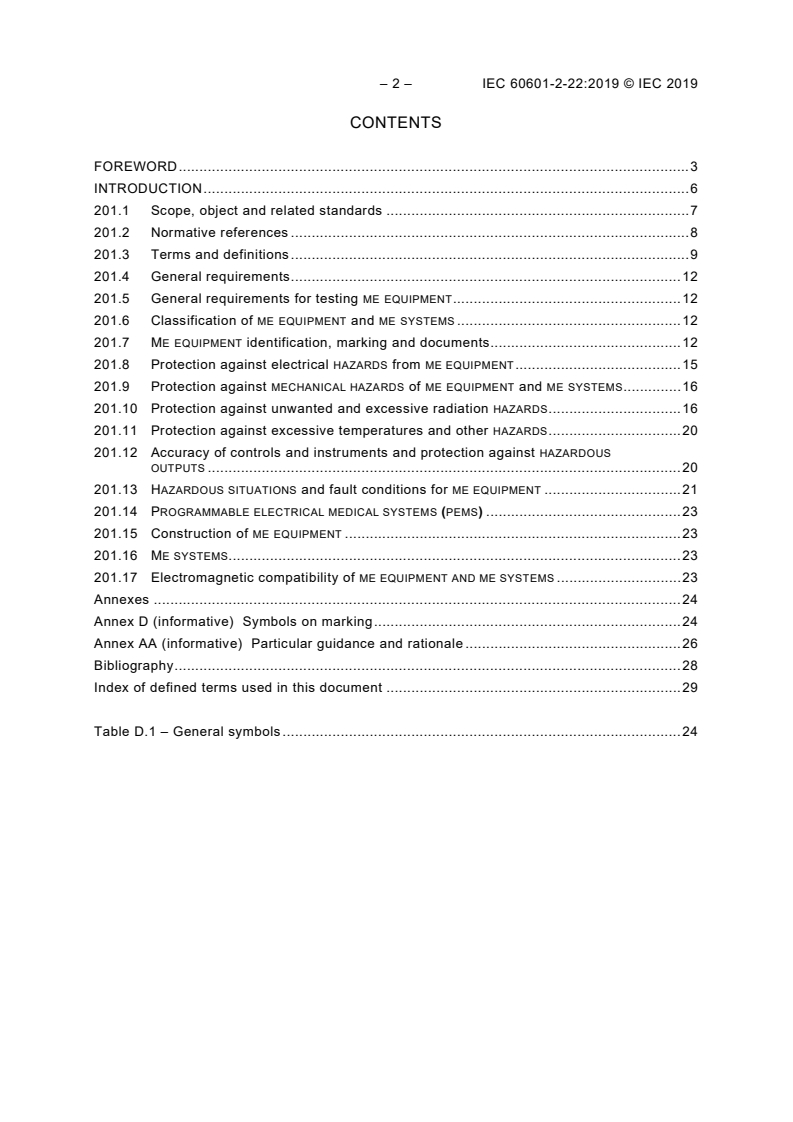
IEC 60601-2-22:2019 - Medical electrical equipment - Part 2-22: Particular requirements for basic safety and essential performance of surgical, cosmetic, therapeutic and diagnostic laser equipment Released:11/20/2019
Overview
IEC 60601-2-22:2019 is the fourth-edition particular standard for medical electrical laser equipment, defining requirements for the basic safety and essential performance of surgical, cosmetic, therapeutic and diagnostic laser devices. It applies to laser equipment used on humans or animals and specifically covers devices classified as Class 3B, Class 4, and Class 1C where the enclosed laser is Class 3B or 4. This edition updates the previous (2007) edition to reflect changes in IEC 60601‑1 and IEC 60825‑1:2014, addresses safety issues that have emerged since the prior edition, and clarifies scope (LED medical products are excluded and normally fall under IEC 60601‑2‑57).
Key topics and requirements
The standard supplements IEC 60601‑1 and focuses on laser-specific hazards and system behavior. Major technical topics include:
- Scope and classification of laser products (Class 1C, 3B, 4) and applicability to ME Equipment and ME Systems
- Basic safety and essential performance criteria for laser output delivery to patients/animals
- Identification, marking and documentation requirements for safe use, servicing and labeling
- Protection against radiation hazards (unwanted/excessive optical radiation and safeguards)
- Electrical, mechanical and thermal protection to avoid ancillary hazards during operation
- Accuracy of controls and instruments and protection against hazardous outputs
- Hazardous situations, fault conditions and risk management requirements aligned with the general standard
- Programmable Electrical Medical Systems (PEMS) considerations and electromagnetic compatibility (EMC) expectations
- Testing and verification approaches consistent with IEC 60601 test structure
(These topics reflect the standard’s clause structure and annexes that provide symbols, guidance and rationale.)
Practical applications and who uses it
IEC 60601-2-22 is essential for:
- Medical device manufacturers designing or integrating surgical, cosmetic, therapeutic or diagnostic lasers
- Design verification and safety engineers performing risk assessment and validation testing
- Regulatory and compliance teams preparing technical files for CE marking, conformity assessment, or national approvals
- Test laboratories and notified bodies evaluating laser medical equipment to IEC 60601 series requirements
- Clinical engineers and procurement specialists ensuring safe selection and maintenance of laser systems, including veterinary applications
Use the standard to guide product design, labeling, integration into ME systems, pre‑market testing and conformity documentation.
Related standards
- IEC 60601‑1 (General requirements for basic safety and essential performance)
- IEC 60825‑1:2014 (Laser product safety / classification)
- IEC 60601‑2‑57 (medical LED products - where applicable)
Keywords: IEC 60601-2-22, medical laser standard, laser safety, Class 3B, Class 4, Class 1C, IEC 60601, IEC 60825-1, medical device compliance.
Relations
- Effective Date
- 26-Oct-2025
- Effective Date
- 05-Sep-2023
- Effective Date
- 05-Sep-2023
Buy Documents
IEC 60601-2-22:2019 RLV - Medical electrical equipment - Part 2-22: Particular requirements for basic safety and essential performance of surgical, cosmetic, therapeutic and diagnostic laser equipment Released:11/20/2019
IEC 60601-2-22:2019+AMD1:2026 CSV - Medical electrical equipment - Part 2-22: Particular requirements for basic safety and essential performance of surgical, cosmetic, therapeutic and diagnostic laser equipment
IEC 60601-2-22:2019 - Medical electrical equipment - Part 2-22: Particular requirements for basic safety and essential performance of surgical, cosmetic, therapeutic and diagnostic laser equipment Released:11/20/2019
Get Certified
Connect with accredited certification bodies for this standard

BSI Group
BSI (British Standards Institution) is the business standards company that helps organizations make excellence a habit.

TÜV Rheinland
TÜV Rheinland is a leading international provider of technical services.

TÜV SÜD
TÜV SÜD is a trusted partner of choice for safety, security and sustainability solutions.
Sponsored listings
Frequently Asked Questions
IEC 60601-2-22:2019 is a standard published by the International Electrotechnical Commission (IEC). Its full title is "Medical electrical equipment - Part 2-22: Particular requirements for basic safety and essential performance of surgical, cosmetic, therapeutic and diagnostic laser equipment". This standard covers: IEC 60601-2-22:2019 applies to the Basic Safety and Essential Performance of laser equipment for surgical, therapeutic, medical diagnostic, cosmetic or veterinary applications, intended for use on humans or animals, classified as Laser Product of Class 1C where the Enclosed Laser is of Class 3B or 4, or Class 3B, or Class 4. Medical Electrical Equipment or Medical Electrical Systems which incorporate lasers as sources of energy being transferred to the Patient or animal and where the lasers are specified as above, are referred to as “laser equipment” in this document. Laser Products for these applications classified as a Class 1, Class 1M, Class 2, Class 2M or Class 3R Laser Product, are covered by IEC 60825-1:2014 and by the general standard. If a clause or subclause is specifically intended to be applicable to ME Equipment only, or to ME Systems only, the title and content of that clause or subclause will say so. If that is not the case, the clause or subclause applies to ME Equipment and to ME Systems, as relevant. Hazards inherent in the intended physiological function of laser equipment within the scope of this document are not covered by specific requirements in this document except in 7.2.13, Physiological effects, of the general standard. If the laser equipment is Class 1C according to IEC 60825-1:2014 and is used as a laser appliance in a household, it is covered by IEC 60335-2-113:2016. This fourth edition cancels and replaces the third edition published in 2007 and Amendment 1:2012. This edition constitutes a technical revision. This edition includes the following significant technical changes with respect to the previous edition: a) it takes account of IEC 60601-1:2005/AMD1:2012 and IEC 60825-1:2014, which have been published since publication of the third edition; b) it addresses technical and safety issues which have arisen since publication of the third edition; c) the scope of this fourth edition differs from the scope of the third edition. It now includes Class 1C laser equipment, as defined in IEC 60825-1:2014, when the Enclosed Laser is Class 3B or 4; d) LED (light emitting diode) products are now excluded from this document as medical LED products may be covered by IEC 60601-2-57.
IEC 60601-2-22:2019 applies to the Basic Safety and Essential Performance of laser equipment for surgical, therapeutic, medical diagnostic, cosmetic or veterinary applications, intended for use on humans or animals, classified as Laser Product of Class 1C where the Enclosed Laser is of Class 3B or 4, or Class 3B, or Class 4. Medical Electrical Equipment or Medical Electrical Systems which incorporate lasers as sources of energy being transferred to the Patient or animal and where the lasers are specified as above, are referred to as “laser equipment” in this document. Laser Products for these applications classified as a Class 1, Class 1M, Class 2, Class 2M or Class 3R Laser Product, are covered by IEC 60825-1:2014 and by the general standard. If a clause or subclause is specifically intended to be applicable to ME Equipment only, or to ME Systems only, the title and content of that clause or subclause will say so. If that is not the case, the clause or subclause applies to ME Equipment and to ME Systems, as relevant. Hazards inherent in the intended physiological function of laser equipment within the scope of this document are not covered by specific requirements in this document except in 7.2.13, Physiological effects, of the general standard. If the laser equipment is Class 1C according to IEC 60825-1:2014 and is used as a laser appliance in a household, it is covered by IEC 60335-2-113:2016. This fourth edition cancels and replaces the third edition published in 2007 and Amendment 1:2012. This edition constitutes a technical revision. This edition includes the following significant technical changes with respect to the previous edition: a) it takes account of IEC 60601-1:2005/AMD1:2012 and IEC 60825-1:2014, which have been published since publication of the third edition; b) it addresses technical and safety issues which have arisen since publication of the third edition; c) the scope of this fourth edition differs from the scope of the third edition. It now includes Class 1C laser equipment, as defined in IEC 60825-1:2014, when the Enclosed Laser is Class 3B or 4; d) LED (light emitting diode) products are now excluded from this document as medical LED products may be covered by IEC 60601-2-57.
IEC 60601-2-22:2019 is classified under the following ICS (International Classification for Standards) categories: 11.040.50 - Radiographic equipment; 11.040.60 - Therapy equipment; 31.120 - Electronic display devices; 31.260 - Optoelectronics. Laser equipment. The ICS classification helps identify the subject area and facilitates finding related standards.
IEC 60601-2-22:2019 has the following relationships with other standards: It is inter standard links to IEC 60601-2-22:2019/AMD1:2026, IEC 60601-2-22:2007, IEC 60601-2-22:2007/AMD1:2012. Understanding these relationships helps ensure you are using the most current and applicable version of the standard.
IEC 60601-2-22:2019 is available in PDF format for immediate download after purchase. The document can be added to your cart and obtained through the secure checkout process. Digital delivery ensures instant access to the complete standard document.
Standards Content (Sample)
IEC 60601-2-22 ®
Edition 4.0 2019-11
REDLINE VERSION
INTERNATIONAL
STANDARD
colour
inside
Medical electrical equipment –
Part 2-22: Particular requirements for basic safety and essential performance
of surgical, cosmetic, therapeutic and diagnostic laser equipment
All rights reserved. Unless otherwise specified, no part of this publication may be reproduced or utilized in any form
or by any means, electronic or mechanical, including photocopying and microfilm, without permission in writing from
either IEC or IEC's member National Committee in the country of the requester. If you have any questions about IEC
copyright or have an enquiry about obtaining additional rights to this publication, please contact the address below or
your local IEC member National Committee for further information.
IEC Central Office Tel.: +41 22 919 02 11
3, rue de Varembé info@iec.ch
CH-1211 Geneva 20 www.iec.ch
Switzerland
About the IEC
The International Electrotechnical Commission (IEC) is the leading global organization that prepares and publishes
International Standards for all electrical, electronic and related technologies.
About IEC publications
The technical content of IEC publications is kept under constant review by the IEC. Please make sure that you have the
latest edition, a corrigendum or an amendment might have been published.
IEC publications search - webstore.iec.ch/advsearchform Electropedia - www.electropedia.org
The advanced search enables to find IEC publications by a The world's leading online dictionary on electrotechnology,
variety of criteria (reference number, text, technical containing more than 22 000 terminological entries in English
committee,…). It also gives information on projects, replaced and French, with equivalent terms in 16 additional languages.
and withdrawn publications. Also known as the International Electrotechnical Vocabulary
(IEV) online.
IEC Just Published - webstore.iec.ch/justpublished
Stay up to date on all new IEC publications. Just Published IEC Glossary - std.iec.ch/glossary
details all new publications released. Available online and 67 000 electrotechnical terminology entries in English and
once a month by email. French extracted from the Terms and Definitions clause of
IEC publications issued since 2002. Some entries have been
IEC Customer Service Centre - webstore.iec.ch/csc collected from earlier publications of IEC TC 37, 77, 86 and
If you wish to give us your feedback on this publication or CISPR.
need further assistance, please contact the Customer Service
Centre: sales@iec.ch.
IEC 60601-2-22 ®
Edition 4.0 2019-11
REDLINE VERSION
INTERNATIONAL
STANDARD
colour
inside
Medical electrical equipment –
Part 2-22: Particular requirements for basic safety and essential performance
of surgical, cosmetic, therapeutic and diagnostic laser equipment
INTERNATIONAL
ELECTROTECHNICAL
COMMISSION
ICS 11.040.50; 11.040.60; 31.260 ISBN 978-2-8322-7650-1
– 2 – IEC 60601-2-22:2019 RLV © IEC 2019
CONTENTS
FOREWORD . 3
INTRODUCTION . 6
201.1 Scope, object and related standards . 7
201.2 Normative references . 9
201.3 Terms and definitions . 9
201.4 General requirements . 14
201.5 General requirements for testing ME EQUIPMENT . 14
201.6 Classification of ME EQUIPMENT and ME SYSTEMS . 14
201.7 ME EQUIPMENT identification, marking and documents . 15
201.8 Protection against electrical HAZARDS from ME EQUIPMENT . 18
201.9 Protection against MECHANICAL HAZARDS of ME EQUIPMENT and ME SYSTEMS . 19
201.10 Protection against unwanted and excessive radiation HAZARDS . 19
201.11 Protection against excessive temperatures and other HAZARDS . 23
201.12 Accuracy of controls and instruments and protection against HAZARDOUS
OUTPUTS . 23
201.13 HAZARDOUS SITUATIONS and fault conditions for me equipment . 25
201.14 PROGRAMMABLE ELECTRICAL MEDICAL SYSTEMS (PEMS) . 27
201.15 Construction of ME EQUIPMENT . 27
201.16 ME SYSTEMS . 28
201.17 Electromagnetic compatibility of ME EQUIPMENT AND ME SYSTEMS . 28
Annexes . 29
Annex D (informative) Symbols on marking . 29
Annex AA (informative) Particular guidance and rationale . 30
Bibliography . 33
Index of defined terms used in this document . 34
Table D.1 – General symbols . 29
INTERNATIONAL ELECTROTECHNICAL COMMISSION
____________
MEDICAL ELECTRICAL EQUIPMENT –
Part 2-22: Particular requirements for basic safety and essential
performance of surgical, cosmetic, therapeutic and diagnostic
laser equipment
FOREWORD
1) The International Electrotechnical Commission (IEC) is a worldwide organization for standardization comprising
all national electrotechnical committees (IEC National Committees). The object of IEC is to promote
international co-operation on all questions concerning standardization in the electrical and electronic fields. To
this end and in addition to other activities, IEC publishes International Standards, Technical Specifications,
Technical Reports, Publicly Available Specifications (PAS) and Guides (hereafter referred to as “IEC
Publication(s)”). Their preparation is entrusted to technical committees; any IEC National Committee interested
in the subject dealt with may participate in this preparatory work. International, governmental and non-
governmental organizations liaising with the IEC also participate in this preparation. IEC collaborates closely
with the International Organization for Standardization (ISO) in accordance with conditions determined by
agreement between the two organizations.
2) The formal decisions or agreements of IEC on technical matters express, as nearly as possible, an international
consensus of opinion on the relevant subjects since each technical committee has representation from all
interested IEC National Committees.
3) IEC Publications have the form of recommendations for international use and are accepted by IEC National
Committees in that sense. While all reasonable efforts are made to ensure that the technical content of IEC
Publications is accurate, IEC cannot be held responsible for the way in which they are used or for any
misinterpretation by any end user.
4) In order to promote international uniformity, IEC National Committees undertake to apply IEC Publications
transparently to the maximum extent possible in their national and regional publications. Any divergence
between any IEC Publication and the corresponding national or regional publication shall be clearly indicated in
the latter.
5) IEC itself does not provide any attestation of conformity. Independent certification bodies provide conformity
assessment services and, in some areas, access to IEC marks of conformity. IEC is not responsible for any
services carried out by independent certification bodies.
6) All users should ensure that they have the latest edition of this publication.
7) No liability shall attach to IEC or its directors, employees, servants or agents including individual experts and
members of its technical committees and IEC National Committees for any personal injury, property damage or
other damage of any nature whatsoever, whether direct or indirect, or for costs (including legal fees) and
expenses arising out of the publication, use of, or reliance upon, this IEC Publication or any other IEC
Publications.
8) Attention is drawn to the Normative references cited in this publication. Use of the referenced publications is
indispensable for the correct application of this publication.
9) Attention is drawn to the possibility that some of the elements of this IEC Publication may be the subject of
patent rights. IEC shall not be held responsible for identifying any or all such patent rights.
This redline version of the official IEC Standard allows the user to identify the changes
made to the previous edition. A vertical bar appears in the margin wherever a change
has been made. Additions are in green text, deletions are in strikethrough red text.
– 4 – IEC 60601-2-22:2019 RLV © IEC 2019
International Standard IEC 60601-2-22 has been prepared by IEC subcommittee 76: Optical
radiation safety and laser equipment.
This fourth edition cancels and replaces the third edition published in 2007 and
Amendment 1:2012. This edition constitutes a technical revision.
This edition includes the following significant technical changes with respect to the previous
edition:
a) it takes account of IEC 60601-1:2005/AMD1:2012 and IEC 60825-1:2014, which have
been published since publication of the third edition;
b) it addresses technical and safety issues which have arisen since publication of the third
edition;
c) the scope of this fourth edition differs from the scope of the third edition. It now includes
CLASS 1C laser equipment, as defined in IEC 60825-1:2014, when the ENCLOSED LASER is
CLASS 3B or 4;
d) LED (light emitting diode) products are now excluded from this document as medical LED
products may be covered by IEC 60601-2-57.
The text of this International Standard is based on the following documents:
CDV Report on voting
76/580/CDV 76/610/RVC
Full information on the voting for the approval of this International Standard can be found in
the report on voting indicated in the above table.
This document has been drafted in accordance with the ISO/IEC Directives, Part 2.
In this document, the following print types are used:
• requirements and definitions: roman type;
• test specifications: italic type;
• informative material appearing outside of tables, such as notes, examples and references: in smaller type.
Normative text of tables is also in a smaller type.
• TERMS DEFINED IN CLAUSE 3 OF THE GENERAL STANDARD, IN THIS PARTICULAR STANDARD OR AS
NOTED: SMALL CAPITALS.
In referring to the structure of this document, the term
• “clause” means one of the seventeen numbered divisions within the table of contents,
inclusive of all subdivisions (e.g. Clause 7 includes subclauses 7.1, 7.2, etc.);
• “subclause” means a numbered subdivision of a clause (e.g. 7.1, 7.2 and 7.2.1 are all
subclauses of Clause 7).
References to clauses within this document are preceded by the term “Clause” followed by
the clause number. References to subclauses within this document are by number only.
In this document, the conjunctive “or” is used as an “inclusive or” so a statement is true if any
combination of the conditions is true.
The verbal forms used in this document conform to usage described in Clause 7 of the
ISO/IEC Directives, Part 2:2018. For the purposes of this document, the auxiliary verb:
• “shall” means that compliance with a requirement or a test is mandatory for compliance
with this document;
• “should” means that compliance with a requirement or a test is recommended but is not
mandatory for compliance with this document;
• “may” is used to describe a permissible way to achieve compliance with a requirement or
test.
A list of all parts of the IEC 60601 and IEC 80601 series, published under the general title
Medical electrical equipment, can be found on the IEC website.
The committee has decided that the contents of this document will remain unchanged until the
stability date indicated on the IEC website under "http://webstore.iec.ch" in the data related to
the specific document. At this date, the document will be
• reconfirmed,
• withdrawn,
• replaced by a revised edition, or
• amended.
IMPORTANT – The 'colour inside' logo on the cover page of this publication indicates
that it contains colours which are considered to be useful for the correct
understanding of its contents. Users should therefore print this document using a
colour printer.
– 6 – IEC 60601-2-22:2019 RLV © IEC 2019
INTRODUCTION
This document amends and supplements IEC 60601-1:2005 and IEC 60601-
1:2005/AMD1:2012, Medical electrical equipment – Part 1: General requirements for basic
safety and essential performance.
This document also refers to IEC 60825-1:20072014. The requirements of this document are
the minimum that need to be complied with, in order to achieve a reasonable level of safety
and reliability during operation and application of medical laser equipment.
An asterisk (*) as the first character of a title or at the beginning of a paragraph or table title
indicates that there is guidance or rationale related to that item in Annex AA. Understanding
the reasons for these requirements will not only facilitate the proper application of this
document but will, in due course, expedite any revisions necessitated by changes in clinical
practice or by developments in technology.
MEDICAL ELECTRICAL EQUIPMENT –
Part 2-22: Particular requirements for basic safety and essential
performance of surgical, cosmetic, therapeutic and diagnostic
laser equipment
201.1 Scope, object and related standards
Clause 1 of the general standard applies, except as follows:
201.1.1 Scope
Replacement:
This part of IEC 60601 applies to the BASIC SAFETY and ESSENTIAL PERFORMANCE of laser
equipment for either surgical, therapeutic, medical diagnostic, cosmetic or veterinary
applications, intended for its use on humans or animals, classified as a CLASS 3B or CLASS 4
LASER PRODUCT as defined by 3.22 and 3.23 in IEC 60825-1, hereafter referred to as LASER
EQUIPMENT LASER PRODUCT of CLASS 1C where the ENCLOSED LASER is of CLASS 3B or 4, or
CLASS 3B, or CLASS 4.
Throughout this International Standard, light emitting diodes (LED) are included whenever the
word “laser” is used.
NOTE 1 Refer to Definition 3.49 in IEC 60825-1.
MEDICAL ELECTRICAL EQUIPMENT or MEDICAL ELECTRICAL SYSTEMS which incorporate lasers as
sources of energy being transferred to the PATIENT or animal and where the lasers are
specified as above, are referred to as “laser equipment” in this document.
NOTE 21 LASER PRODUCTS for these applications classified as a CLASS 1, 1M, 2, 2M or CLASS 3R LASER PRODUCT,
are covered by IEC 60825-1 and IEC 60601-1 a Class 1, Class 1M, CLASS 2, Class 2M or CLASS 3R LASER
PRODUCT, are covered by IEC 60825-1:2014 and by the general standard.
If a clause or subclause is specifically intended to be applicable to ME EQUIPMENT only, or to
ME SYSTEMS only, the title and content of that clause or subclause will say so. If that is not the
case, the clause or subclause applies both to ME EQUIPMENT and to ME SYSTEMS, as relevant.
HAZARDS inherent in the intended physiological function of ME EQUIPMENT or ME SYSTEMS
within the scope of this standard are not covered by specific requirements in this standard
except in 7.2.13 and 8.4.1 of the General Standard.
Hazards inherent in the intended physiological function of laser equipment within the scope of
this document are not covered by specific requirements in this document except in 7.2.13,
Physiological effects, of the general standard.
NOTE 2 See also 4.2, RISK MANAGEMENT process, of the general standard.
NOTE 3 If the laser equipment is CLASS 1C according to IEC 60825-1:2014 and is used as a laser appliance in a
household, it is covered by IEC 60335-2-113:2016.
This standard can also be applied to surgical, cosmetic, therapeutic and diagnostic laser
equipment used for compensation or alleviation of disease, injury or disability.
—————————
In this document, "the general standard" means IEC 60601-1:2005 and IEC 60601-1:2005/AMD1:2012.
– 8 – IEC 60601-2-22:2019 RLV © IEC 2019
201.1.2 Object
Replacement:
The object of this document is to establish particular BASIC SAFETY and ESSENTIAL
PERFORMANCE requirements for the safety of surgical, cosmetic, therapeutic and diagnostic
laser equipment.
NOTE Laser classification (IEC 60825-1) must not be confused with electrical classification (IEC 60601-1).
201.1.3 Collateral standards
Addition:
This document refers to those applicable collateral standards that are listed in Clause 2 of the
general standard and Clause 201.2 of this document.
IEC 60601-1-3 does not apply.
201.1.4 Particular standards
Replacement:
In the IEC 60601 series, particular standards may modify, replace or delete requirements
contained in this standard as appropriate for the particular ME EQUIPMENT under consideration,
and may add other BASIC SAFETY and ESSENTIAL PERFORMANCE requirements.
A requirement of a particular standard takes priority over the General Standard.
Addition:
For brevity, IEC 60601-1:2005 and IEC 60601-1:2005/AMD1:2012 are referred to in this
document as "the general standard". Collateral standards are referred to by their document
number.
The numbering of sections, clauses and subclauses of this document corresponds to that of
the general standard or applicable collateral standard. The changes to the text of the general
standard are specified by the use of the following words:
"Replacement" means that the clause or subclause of the general standard or applicable
collateral standard is replaced completely by the text of this document.
"Addition" means that the text of this document is additional to the requirements of the
general standard or applicable collateral standard.
"Amendment" means that the clause or subclause of the general standard or applicable
collateral standard is amended as indicated by the text of this document.
Subclauses or figures which are additional to those of the general standard are numbered
starting from 201.101, additional annexes are lettered AA, BB, etc., and additional items aa),
bb), etc.
Subclauses or figures which are additional to those of a collateral standard are numbered
starting from 20x, where “x” is the number of the collateral standard, e.g. 202 for
IEC 60601-1-2, 203 for IEC 60601-1-3, etc.
The term "this document" is used to make reference to the general standard, any applicable
collateral standards and this document taken together.
Where there is no corresponding section, clause or subclause in this document, the section,
clause or subclause of the general standard or applicable collateral standard, although
possibly not relevant, applies without modification; where it is intended that any part of the
general standard or applicable collateral standard, although possibly relevant, is not to be
applied, a statement to that effect is given in this document.
Concerning laser radiation safety of laser equipment, IEC 60825-1:2014 applies, except for
the relevant requirements that are specified, changed or amended in this document.
Clauses and subclauses of the General Standard and IEC 60825-1, which are not applicable
to laser equipment for medical applications, are not necessarily indicated as "not applicable".
201.2 Normative references
Clause 2 of the general standard applies, except as follows:
Addition:
IEC 60601-1:2005, Medical electrical equipment – Part 1: General requirements for basic
safety and essential performance
IEC 60601-1:2005/AMD1:2012
IEC 60825-1:20072014, Safety of laser products – Part 1: Equipment classification and
requirements
IEC 60947-3, Low-voltage switchgear and controlgear – Part 3: Switches, disconnectors,
switch-disconnectors and fuse-combination units
IEC 61010-1, Safety requirements for electrical equipment for measurement, control and
laboratory use – Part 1: General requirements
201.3 Terms and definitions
For the purposes of this document, the terms and definitions given in IEC 60601-1:2005,
apply, except as follows:
Addition:
201.3.101
ACCESSIBLE EMISSION LIMIT (AEL)
ACCESSIBLE EMISSION LIMIT for CLASS 1M, 2, 2M, 3R, or 3B lasers (see 3.3 and Tables 4
through 9 of IEC 60825-1)
201.3.102
AIMING BEAM
beam of optical radiation, producing a visible AIMING BEAM SPOT, intended for indication of the
anticipated point of impact of the WORKING BEAM
201.3.103
AIMING BEAM SPOT
area of impact of the AIMING BEAM within the WORKING AREA
– 10 – IEC 60601-2-22:2019 RLV © IEC 2019
201.3.104
AIMING LASER
LASER emitting an AIMING BEAM
201.3.105
APERTURE
distal opening of the BEAM DELIVERY SYSTEM (see 3.8 of IEC 60825-1)
201.3.106
BEAM DELIVERY SYSTEM
optical system which guides the LASER RADIATION from its origin to the WORKING AREA
201.3.107
CLASS 1, 1M, 2, 2M, 3R, 3B, OR 4 LASER PRODUCT
laser equipment, incorporating a LASER as defined in 3.41 and 3.18 through 3.23 of
IEC 60825-1
201.3.108
EMERGENCY LASER STOP
hand- or foot-actuated device intended to stop the LASER OUTPUT immediately in case of
emergency
201.3.109
LASER EMISSION CONTROL SWITCH
hand- or foot-actuated device intended to initiate and stop WORKING BEAM emission through
any APERTURE
201.3.110
LASER EMISSION INDICATOR
visible and/or audible signal which indicates that the WORKING BEAM is being emitted through
any APERTURE
NOTE The LASER EMISSION INDICATOR is different from the LASER RADIATION EMISSION warning requirement 4.7 of
IEC 60825-1.
201.3.111
LASER ENERGY
RADIANT ENERGY of the WORKING BEAM, incident on the WORKING AREA (see 3.70 of
IEC 60825-1)
201.3.112
LASER OPERATOR
the person who handles the laser equipment. In general, the LASER OPERATOR controls the
delivery of the laser radiation to the WORKING AREA. The LASER OPERATOR may appoint other
person(s), who assist with the selection and/or setting of the parameters
Refer to Definition 3.73 in IEC 60601-1.
NOTE The safety requirements in this standard apply to all above persons.
201.3.113
LASER OUTPUT
either LASER POWER or LASER ENERGY
201.3.114
LASER POWER
RADIANT POWER of the WORKING BEAM, incident on the WORKING AREA, see 3.72 of IEC 60825-1
201.3.115
LASER READY INDICATOR
visible means which indicate that the laser equipment is in the READY condition, and the
purpose of which is to make all persons present in the laser area aware of the need to take
precautions against hazardous LASER RADIATION, as detailed in the ACCOMPANYING DOCUMENTS
(instructions for use). See 201.7.9.
201.3.116
OPERATOR PROTECTIVE FILTER
a moveable or fixed filter which does not allow radiation in excess of the MAXIMUM PERMISSIBLE
EXPOSURE (MPE) to the LASER OPERATOR
NOTE For the definition of MPE, see 3.56 of IEC 60825-1.
201.3.117
SHUTTER
electronic, opto-electronic and/or mechanical means which allows or prevents LASER OUTPUT
to be emitted from the APERTURE
201.3.118
STAND-BY/READY
modes of operation when mains supply is connected and the mains switch activated, where
the STAND-BY mode means that the laser is not capable of emitting the WORKING BEAM even if
the laser control switch is activated, and where the READY mode keeps the laser equipment
enabled, so that it is capable of emitting LASER OUTPUT when the control switch is activated
201.3.119
TARGET INDICATING DEVICE
an aiming device which designates the position where the WORKING BEAM will perform its
surgical, cosmetic, therapeutic or diagnostic purpose
201.3.120
WORKING AREA
area which is intended to be irradiated with WORKING BEAM
201.3.121
WORKING BEAM
beam of LASER RADIATION emitted by the laser equipment for surgical, cosmetic, therapeutic or
diagnostic purposes (other than the AIMING BEAM)
Clause 3 of the general standard applies, except as follows:
Addition:
201.3.201
AEL
ACCESSIBLE EMISSION LIMIT
maximum accessible emission permitted within a particular class where the accessible
emission is the level of radiation determined at a position and with APERTURE stops (when the
AEL is given in units of watts or joules) or limiting APERTURES (when the AEL is given in units
-2 -2
of W·m or J·m )
[SOURCE: IEC 60825-1:2014, 3.2 and 3.3, modified – The two definitions have been
combined into one.]
201.3.202
AIMING BEAM
beam of optical radiation, producing a visible spot, intended for indication of the anticipated
point of impact of the WORKING BEAM
– 12 – IEC 60601-2-22:2019 RLV © IEC 2019
201.3.203
AIMING LASER
laser emitting an AIMING BEAM
201.3.204
APERTURE
opening of the BEAM DELIVERY SYSTEM through which laser radiation is transmitted, thereby
allowing human access to such radiation
[SOURCE: IEC 60825-1:2014, 3.8, modified – In the definition, "any opening in the
protective housing of a laser product" has been replaced by "opening of the BEAM DELIVERY
SYSTEM".]
201.3.205
BEAM DELIVERY SYSTEM
optical system which guides the laser radiation from its origin to the WORKING AREA
201.3.206
CLASS 1C
class of any LASER PRODUCT which is designed explicitly for contact application to the skin or
non-ocular tissue
[SOURCE: IEC 60825-1:2014, 3.19, modified – The list and notes to entry have been
deleted.]
201.3.207
CLASS 2
class of any LASER PRODUCT in the wavelength range from 400 nm to 700 nm which during
operation does not permit human access to laser radiation in excess of the AEL of CLASS 2
[SOURCE: IEC 60825-1:2014, 3.21, modified – In the definition, "for applicable wavelengths
and emission durations" and the text in parentheses have been deleted.]
201.3.208
CLASS 3B
LASER PRODUCT which during operation permits human access to laser radiation
class of any
in excess of the AEL of Class 1 and CLASS 2, as applicable, but which does not permit human
access to laser radiation in excess of the AEL of CLASS 3B for any emission duration and
wavelength
[SOURCE: IEC 60825-1:2014, 3.23, modified – The term and definition have been modified
to refer only to CLASS 3B. In the definition, the text in parentheses has been deleted.]
201.3.209
CLASS 3R
class of any LASER PRODUCT which during operation permits human access to laser radiation
in excess of the AEL of Class 1 and CLASS 2, as applicable, but which does not permit human
access to laser radiation in excess of the AEL of CLASS 3R for any emission duration and
wavelength
[SOURCE: IEC 60825-1:2014, 3.23, modified – The term and definition have been modified
to refer only to CLASS 3R. In the definition, the text in parentheses has been deleted.]
201.3.210
CLASS 4
class of any LASER PRODUCT which permits human access to laser radiation in excess of the
AEL of CLASS 3B
[SOURCE: IEC 60825-1:2014, 3.24, modified – In the definition, the text in parentheses has
been deleted.]
201.3.211
EMERGENCY LASER STOP
hand- or foot-actuated device intended to stop the LASER OUTPUT immediately in case of
emergency
201.3.212
ENCLOSED LASER
laser which is incorporated in laser equipment of CLASS 1C
201.3.213
GOOD CONTACT
state that is established when the applicator of the laser equipment which is classified laser
CLASS 1C is positioned at the target tissue so that the tissue surface acts to effectively
prevent hazardous eye exposure to STRAY OPTICAL RADIATION
[SOURCE: IEC 60335-2-113:2016, 3.104, modified]
201.3.214
LASER EMISSION CONTROL SWITCH
hand- or foot-actuated device intended to initiate and stop WORKING BEAM emission
201.3.215
LASER EMISSION INDICATOR
visible and/or audible signal which indicates that the WORKING BEAM is being emitted
Note 1 to entry: Refer to IEC 60825-1:2014, 6.7 Laser radiation emission warning.
201.3.216
LASER ENERGY
LASER OUTPUT
RADIANT ENERGY of the WORKING BEAM, incident on the WORKING AREA, where the RADIANT
ENERGY is the time integral of the radiant flux Φ over a given duration ∆t
Note 1 to entry: LASER OUTPUT is a more general term which covers both LASER POWER and LASER ENERGY.
[SOURCE: IEC 60825-1:2014, 3.72, modified – In the definition, “RADIANT ENERGY of the
WORKING BEAM, incident on the WORKING AREA, where the RADIANT ENERGY is the”]
201.3.217
LASER OPERATOR
person handling the laser equipment.
Note 1 to entry: In general, the LASER OPERATOR controls the delivery of the laser radiation to the WORKING AREA.
The LASER OPERATOR may appoint other person(s), who assist with the selection and/or setting of the parameters.
[SOURCE: IEC 60601-1:2012, 3.73, modified – The word "laser" has been added in the term
and definition.]
201.3.218
LASER POWER
LASER OUTPUT
RADIANT POWER of the WORKING BEAM, incident on the WORKING AREA where the RADIANT POWER
is the power emitted, transferred, or received in the form of radiation
Note 1 to entry: LASER OUTPUT is a more general term which covers both LASER POWER and LASER ENERGY.
[SOURCE: IEC 60825-1:2014, 3.74, modified – In the term, "radiant" has been replaced by
"laser". In the definition, “RADIANT POWER of the WORKING BEAM, incident on the WORKING AREA
where the RADIANT POWER is the” has been added.]
201.3.219
LASER READY INDICATOR
means which visibly indicates that the laser equipment is in the READY condition
– 14 – IEC 60601-2-22:2019 RLV © IEC 2019
Note 1 to entry: The purpose of the LASER READY INDICATOR is to make the personnel present in the laser area
aware of the need to take precautions against inadvertent hazardous laser radiation.
201.3.220
MPE
MAXIMUM PERMISSIBLE EXPOSURE
level of laser radiation to which, under normal circumstances, persons may be exposed
without suffering adverse effects
[SOURCE: IEC 60825-1:2014, 3.59, modified – The notes to entry have been deleted.]
201.3.221
OPERATOR PROTECTIVE FILTER
moveable or fixed optical filter incorporated in the optical pathway of viewing optics which
allows viewing of the WORKING AREA but blocks hazardous levels of the radiation of the
WORKING LASER
201.3.222
READY
mode of operation when SUPPLY MAINS is connected and the laser equipment is switched on,
and in which upon activation of the LASER EMISSION CONTROL SWITCH the laser equipment emits
the WORKING BEAM
201.3.223
STAND-BY
mode of operation when SUPPLY MAINS is connected and the laser equipment is switched on,
and in which the laser equipment is not capable of emitting the WORKING BEAM even if the
LASER EMISSION CONTROL SWITCH is activated
201.3.224
STRAY OPTICAL RADIATION
laser radiation that is unintentionally emitted from the applicator of the laser equipment of
CLASS 1C, either by scattering around the edges of the applicator or by any other pathway
201.3.225
TARGET INDICATING DEVICE
aiming device which designates the position where the WORKING BEAM will perform its surgical,
cosmetic, therapeutic or diagnostic purpose
201.3.226
WORKING AREA
area which is intended to be irradiated with the WORKING BEAM
201.3.227
WORKING BEAM
beam of laser radiation, other than the AIMING BEAM, emitted by the laser equipment for
surgical, cosmetic, therapeutic or diagnostic purposes
201.4 General requirements
Clause 4 of the General Standard applies.
201.5 General requirements for testing ME EQUIPMENT
Clause 5 of the general standard applies.
201.6 Classification of ME EQUIPMENT and ME SYSTEMS
Clause 6 of the general standard applies.
201.7 ME EQUIPMENT identification, marking and documents
Clause 7 of the general standard applies, except as follows:
201.7.2 Marking on the outside of ME EQUIPMENT or ME EQUIPMENT parts
Addition:
201.7.2.101 Additional items labels
See IEC 60825-1:2014, Clause 57.
a) General
Laser equipment shall carry labels in accordance with 5.5, 5.6, 5.8, 5.9, 5.10, 5.11 7.3, 7.6
or 7.7 of IEC 60825-1:2014, as applicable. These labels shall be visible from the normal
operating position.
b) *APERTURE label
Laser equipment except CLASS 1C shall have a label positioned as close as practicable to
each laser APERTURE. The label shall be similar to the laser hazard symbol as specified in
IEC 60825-1, Figure 1, with the exception that the size can be adjusted as appropriate or
alternatively be similar to the label described in 5.7 of IEC 60825-1. Hand-pieces and
other applicators are exempt from these requirements. The label as specified in
IEC 60825-1:2014, 7.8 shall be used. Applicators which are subject to disinfection or
sterilizing and fibre-optics are exempt from these requirements. In this case, a label is to
be affixed in a prominent position with either:
– a statement that the laser APERTURE is on the end of the fibre/applicator, or
– a symbol as detailed in Table D.1, number 113.
NOTE The required information can be combined into one single label if the area where the label is to be
affixed is suitable.
c) CLASS 1C laser equipment shall in addition include the class of the ENCLOSED LASER in the
explanatory label.
201.7.9 ACCOMPANYING DOCUMENTS
Subclause 7.9 of the general standard applies except as follows:
201.7.9.1 General
Addition:
The ACCOMPANYING DOCUMENTS shall give adequate instructions for proper operation,
including clear warnings concerning precautions to avoid possible exposure to hazardous
laser radiation.
201.7.9.2 Instructions for use
201.7.9.2.13 Maintenance
Addition:
The instructions for maintenance shall include clear warnings concerning precautions to avoid
possible exposure to hazardous laser radiation.
Addition of the following subclause:
– 16 – IEC 60601-2-22:2019 RLV © IEC 2019
201.7.9.2.101 LASER specific information for the RESPONSIBLE ORGANIZATION and for the
LASER OPERATOR
The instructions for use shall include (as applicable):
NOMINAL OCULAR HAZARD DISTANCE (NOHD) for the laser equipment in
a) information on the
NORMAL USE with each appropriate ACCESSORY;
NOTE 1 The NOHD does not apply to laser equipment of CLASS 1C.
b) a statement in SI units of BEAM DIVERGENCE, PULSE DURATION, maximum LASER OUTPUT of
the laser radiation, with the magnitudes of the cumulative measurement uncertainty and
any expected increase in the measured quantities at any time after manufacture added
which may add to the values measured at the time of manufacture, meaning that the
equipment performs differently than expected, refer to 7.9.2.17 of the general standard;
c) where a single pulse is made up of a pulse train, the technical details shall be described in
the information for the laser user. For example, where nominal pulses are comprised of a
predetermined sub-pulse structure or pulse-train, the number of sub-pulses and
approximate duration of each sub-pulse shall be stated;
d) the potential variation in wavelength shall be stated;
e) legible reproductions (colour optional) of all required laser labels and HAZARD warnings
affixed to the laser equipment;
f) information and guidance for regular calibration of the LASER OUTPUT in accordance with
201.12.1. The information shall include a specification for the measuring equipment and
frequency of calibration and clarification requirements concerning regular calibration of
LASER OUTPUT;
g) a clear indication of all locations of laser APERTURES;
h) a listing of controls, adjustments and procedures for operation and maintenance by the
RESPONSIBLE ORGANIZATION, including the warning "Caution – Use of controls or
adjustments or performance of procedures other than those specified herein may result in
HAZARDOUS radiation exposure";
i) a description of the BEAM DELIVERY SYSTEMS including the characteristics of the LASER
OUTPUT;
j) when the laser equipment is of CLASS 1C, a detailed technical description of the interlocks,
a description of possible limitations and malfunction following false positioning of the
applicator, a comprehensive description of how to position the applicator properly, a
warning about possible usage conditions which may result in hazardous STRAY OPTICAL
RADIATION;
k) a note statement, saying that laser equipment should be protected against unauthorized
use, for example by removal of the key from the key switch;
l) a specification for eye protection; not required for laser equipment of CLASS 1C;
NOTE 2 Refer to 8.4.5.2 of IEC TR 60825-14:2004, Safety of LASER PRODUCTS – Part 14: A user’s guide.
m) a specification for fume and plume extraction, including a cautionary statement: "Caution –
Laser fume and/or plume may contain viable tissue particulates";
n) information about the potential HAZARDS when inserting, sharply bending or improperly
securing the fibre optics, stating that not following the recommendations of the
manufacturer may lead to damage to the fibre or BEAM DELIVERY SYSTEM and/or harm to the
PATIENT or LASER OPERATOR;
o) recommendation instructions for checking the integrity of the BEAM DELIVERY SYSTEM, for
example as follows: "As the AIMING BEAM passes down the same delivery system as the
WORKING BEAM, it provides a good means of checking the integrity of the delivery system. If
the AIMING BEAM is not present at the distal end of the BEAM DELIVERY SYSTEM, its intensity
is reduced or it looks diffused, this is a possible indication of a damaged or malfunctioning
BEAM DELIVERY SYSTEM";
p) a warning information on non-laser HAZARDS, for example as follows: “A risk of fire and/or
explosion exists when the LASER OUTPUT is used in the presence of flammable materials,
solutions or gases, or in an oxygen enriched environment”. The high temperatures
produced in NORMAL USE of the laser equipment may ignite some materials, for example
cotton wool when saturated with oxygen. The solvents of adhesives and flammable
solutions used for cleaning and disinfecting should be allowed to evaporate before the
laser equipment is used. Attention should also be drawn to the danger of ignition of
endogenous gases;
q) information on safe procedures which ensure a minimum of acceptable side effects to the
PATIENTS, including a list of counter-indications and including a list of all conditions which
would render the balance of the expected success of treatment and the non-avoidable
side-effects non-acceptable;
r) information on separate equipment which would be useful to assess the favourable
conditions which are acceptable for treatment or to assess the unfavourable conditions
which would render a treatment unacceptable or HAZARDOUS;
s) checklists and forms which help the user collect the information necessary to assess the
favourable conditions of treatment;
t) information about the applicable national regulations, e.g. on professional cosmetic
applications of laser equipment;
u) description of procedures to ensure that sterile ACCESSORIES remain sterile;
v) information about ACCESSORIES such as fibre-optics which are compatible with the laser
equipment;
w) if the laser equipment is installed with or connected to other medical devices or equipment
to operate as required for its intended purpose, sufficient details of its characteristics to
identify the correct devices or equipment to use in order to obtain a safe combination shall
be provided;
x) if the ACCESSORY to the laser equipment is reusable, information on the appropriate
processes to allow reuse, including cleaning, disinfection, packaging and, where
appropriate, the method of sterilization of the device to be re-sterilized, and any restriction
on the number of reuses shall be provided. Where ACCESSORIES are supplied with the
intention that they be sterilized before use, the instructions for cleaning and sterilization
shall be such that, if correctly followed, the ACCESSORY will still comply with the
requirements of this document;
y) if the ACCESSORY bears an indication that the ACCESSORY is for single use, information on
known characteristics and technical factors known to the manufacturer that could pose a
risk if the device were to be re-used shall be provided. If no instructions for use are
needed, the information shall be made available to the user upon request. The possibility
of this request and provisions for obtaining the requested information shall be described;
z) details of any further treatment or handling needed before the ACCESSORY can be used (for
example sterilization, final assembly, etc.);
aa) precautions to be taken in the event of changes in the performance of the laser
equipment;
bb) precautions to be taken, as regards malfunction of laser equipment due to exposure, in
reasonably foreseeable environmental conditions, to magnetic fields, external electrical
influences, electrostatic discharge, pressure or variations in pressure, acceleration,
thermal ignition sources, etc.;
cc) degree of accuracy claimed for ACCESSORIES with a measuring function, such as skin
colour detectors or detectors of laser-induced fluorescence or frequency shifted scattered
radiation, etc.;
dd) understandable explanation of symbols, controls, instructions, operating or adjustment
parameters when required for the operation of the laser equipment.
NOTE 3 If the laser equipment is intended to be used by non-medical professionals, e.g. cosmetic or beauty-care
practitioners, they may need information which is additional to the information required in 201.7.9.2.101.
– 18 – IEC 60601-2-22:2019 RLV © IEC 2019
201.8 Protection against electrical HAZARDS from ME EQUIPMENT
Clause 8 of the general standard applies except as follows:
201.8.5 Separation of parts
Amendment:
If an OEM (Original Equipment Manufacturer) laser and/or OEM laser power supply is
incorporated into the laser product equipment and the OEM product complies with IEC 61010-
1, then the OEM product is exempt from the differing requirements of IEC 60601-1 the general
standard. This exemption applies to the means of operator protection (MOOP) and to the
requirements of 8.6, 8.8 and 8.9 for MEANS OF OPERATOR PROTECTION. MEANS OF PATIENT
PROTECTION are not exempt.
201.8.7 LEAKAGE CURRENTS AND PATIENT AU
...
IEC 60601-2-22 ®
Edition 4.1 2026-04
INTERNATIONAL
STANDARD
CONSOLIDATED VERSION
Medical electrical equipment -
Part 2-22: Particular requirements for the basic safety and essential performance
of surgical, cosmetic, therapeutic and diagnostic laser equipment
ICS 11.040.50; 11.040.60; 31.260 ISBN 978-2-8327-1238-2
All rights reserved. Unless otherwise specified, no part of this publication may be reproduced or utilized in any form or
by any means, electronic or mechanical, including photocopying and microfilm, without permission in writing from either
IEC or IEC's member National Committee in the country of the requester. If you have any questions about IEC copyright
or have an enquiry about obtaining additional rights to this publication, please contact the address below or your local
IEC member National Committee for further information.
IEC Secretariat Tel.: +41 22 919 02 11
3, rue de Varembé info@iec.ch
CH-1211 Geneva 20 www.iec.ch
Switzerland
About the IEC
The International Electrotechnical Commission (IEC) is the leading global organization that prepares and publishes
International Standards for all electrical, electronic and related technologies.
About IEC publications
The technical content of IEC publications is kept under constant review by the IEC. Please make sure that you have the
latest edition, a corrigendum or an amendment might have been published.
IEC publications search - IEC Products & Services Portal - products.iec.ch
webstore.iec.ch/advsearchform Discover our powerful search engine and read freely all the
The advanced search enables to find IEC publications by a publications previews, graphical symbols and the glossary.
variety of criteria (reference number, text, technical With a subscription you will always have access to up to date
committee, …). It also gives information on projects, content tailored to your needs.
replaced and withdrawn publications.
Electropedia - www.electropedia.org
The world's leading online dictionary on electrotechnology,
IEC Just Published - webstore.iec.ch/justpublished
Stay up to date on all new IEC publications. Just Published containing more than 22 500 terminological entries in English
details all new publications released. Available online and and French, with equivalent terms in 25 additional languages.
once a month by email. Also known as the International Electrotechnical Vocabulary
(IEV) online.
IEC Customer Service Centre - webstore.iec.ch/csc
If you wish to give us your feedback on this publication or
need further assistance, please contact the Customer
Service Centre: sales@iec.ch.
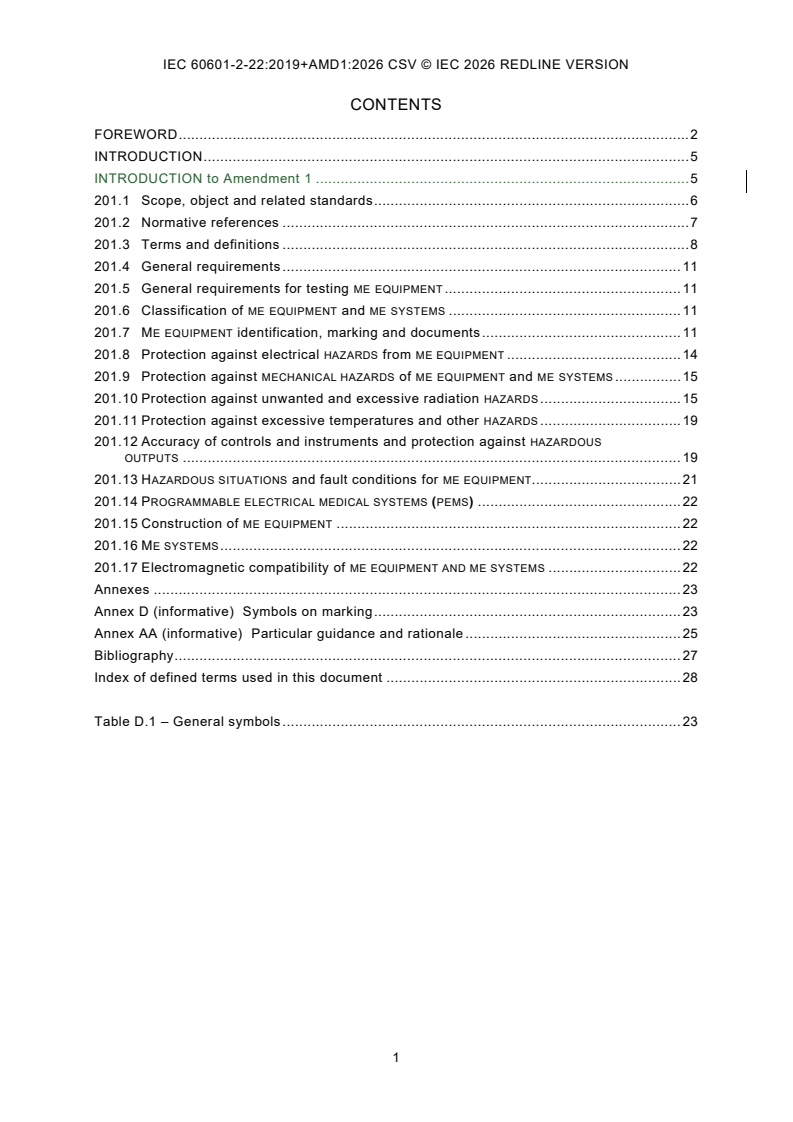
CONTENTS
FOREWORD . 2
INTRODUCTION . 5
INTRODUCTION to Amendment 1 . 5
201.1 Scope, object and related standards . 6
201.2 Normative references . 7
201.3 Terms and definitions . 8
201.4 General requirements . 11
201.5 General requirements for testing ME EQUIPMENT . 11
201.6 Classification of ME EQUIPMENT and ME SYSTEMS . 11
201.7 ME EQUIPMENT identification, marking and documents . 11
201.8 Protection against electrical HAZARDS from ME EQUIPMENT . 14
201.9 Protection against MECHANICAL HAZARDS of ME EQUIPMENT and ME SYSTEMS . 15
201.10 Protection against unwanted and excessive radiation HAZARDS . 15
201.11 Protection against excessive temperatures and other HAZARDS . 19
201.12 Accuracy of controls and instruments and protection against HAZARDOUS
OUTPUTS . 19
201.13 HAZARDOUS SITUATIONS and fault conditions for ME EQUIPMENT. 21
201.14 PROGRAMMABLE ELECTRICAL MEDICAL SYSTEMS (PEMS) . 22
201.15 Construction of ME EQUIPMENT . 22
201.16 ME SYSTEMS . 22
201.17 Electromagnetic compatibility of ME EQUIPMENT AND ME SYSTEMS . 22
Annexes . 23
Annex D (informative) Symbols on marking . 23
Annex AA (informative) Particular guidance and rationale . 25
Bibliography . 27
Index of defined terms used in this document . 28
Table D.1 – General symbols . 23
INTERNATIONAL ELECTROTECHNICAL COMMISSION
____________
Medical electrical equipment -
Part 2-22: Particular requirements for the basic safety
and essential performance of surgical, cosmetic,
therapeutic and diagnostic laser equipment
FOREWORD
1) The International Electrotechnical Commission (IEC) is a worldwide organization for standardization comprising
all national electrotechnical committees (IEC National Committees). The object of IEC is to promote
international co-operation on all questions concerning standardization in the electrical and electronic fields. To
this end and in addition to other activities, IEC publishes International Standards, Technical Specifications,
Technical Reports, Publicly Available Specifications (PAS) and Guides (hereafter referred to as "IEC
Publication(s)"). Their preparation is entrusted to technical committees; any IEC National Committee interested
in the subject dealt with may participate in this preparatory work. International, governmental and non-
governmental organizations liaising with the IEC also participate in this preparation. IEC collaborates closely
with the International Organization for Standardization (ISO) in accordance with conditions determined by
agreement between the two organizations.
2) The formal decisions or agreements of IEC on technical matters express, as nearly as possible, an international
consensus of opinion on the relevant subjects since each technical committee has representation from all
interested IEC National Committees.
3) IEC Publications have the form of recommendations for international use and are accepted by IEC National
Committees in that sense. While all reasonable efforts are made to ensure that the technical content of IEC
Publications is accurate, IEC cannot be held responsible for the way in which they are used or for any
misinterpretation by any end user.
4) In order to promote international uniformity, IEC National Committees undertake to apply IEC Publications
transparently to the maximum extent possible in their national and regional publications. Any divergence
between any IEC Publication and the corresponding national or regional publication shall be clearly indicated in
the latter.
5) IEC itself does not provide any attestation of conformity. Independent certification bodies provide conformity
assessment services and, in some areas, access to IEC marks of conformity. IEC is not responsible for any
services carried out by independent certification bodies.
6) All users should ensure that they have the latest edition of this publication.
7) No liability shall attach to IEC or its directors, employees, servants or agents including individual experts and
members of its technical committees and IEC National Committees for any personal injury, property damage or
other damage of any nature whatsoever, whether direct or indirect, or for costs (including legal fees) and
expenses arising out of the publication, use of, or reliance upon, this IEC Publication or any other IEC
Publications.
8) Attention is drawn to the Normative references cited in this publication. Use of the referenced publications is
indispensable for the correct application of this publication.
9) IEC draws attention to the possibility that the implementation of this document may involve the use of (a)
patent(s). IEC takes no position concerning the evidence, validity or applicability of any claimed patent rights in
respect thereof. As of the date of publication of this document, IEC had not received notice of (a) patent(s),
which may be required to implement this document. However, implementers are cautioned that this may not
represent the latest information, which may be obtained from the patent database available at
https://patents.iec.ch. IEC shall not be held responsible for identifying any or all such patent rights.
This consolidated version of the official IEC Standard and its amendment has been prepared
for user convenience.
IEC 60601-2-22 edition 4.1 contains the fourth edition (2019-11) [documents 76/580/CDV and
76/610/RVC] and its amendment 1 (2026-04) [documents 76/793/FDIS and 76/796/RVD].
In this Redline version, a vertical line in the margin shows where the technical content is
modified by amendment 1. Additions are in green text, deletions are in strikethrough red text.
A separate Final version with all changes accepted is available in this publication.
International Standard IEC 60601-2-22 has been prepared by IEC subcommittee 76: Optical
radiation safety and laser equipment.
This fourth edition cancels and replaces the third edition published in 2007 and
Amendment 1:2012. This edition constitutes a technical revision.
This edition includes the following significant technical changes with respect to the previous
edition:
a) it takes account of IEC 60601-1:2005/AMD1:2012 and IEC 60825-1:2014, which have
been published since publication of the third edition;
b) it addresses technical and safety issues which have arisen since publication of the third
edition;
c) the scope of this fourth edition differs from the scope of the third edition. It now includes
CLASS 1C laser equipment, as defined in IEC 60825-1:2014, when the ENCLOSED LASER is
CLASS 3B or 4;
d) LED (light emitting diode) products are now excluded from this document as medical LED
products may be covered by IEC 60601-2-57.
The text of this International Standard is based on the following documents:
CDV Report on voting
76/580/CDV 76/610/RVC
Full information on the voting for the approval of this International Standard can be found in
the report on voting indicated in the above table.
This document has been drafted in accordance with the ISO/IEC Directives, Part 2.
In this document, the following print types are used:
• requirements and definitions: roman type;
• test specifications: italic type;
• informative material appearing outside of tables, such as notes, examples and references: in smaller type.
Normative text of tables is also in a smaller type.
• TERMS DEFINED IN CLAUSE 3 OF THE GENERAL STANDARD, IN THIS PARTICULAR STANDARD OR AS
NOTED: SMALL CAPITALS.
In referring to the structure of this document, the term
• “clause” means one of the seventeen numbered divisions within the table of contents,
inclusive of all subdivisions (e.g. Clause 7 includes subclauses 7.1, 7.2, etc.);
• “subclause” means a numbered subdivision of a clause (e.g. 7.1, 7.2 and 7.2.1 are all
subclauses of Clause 7).
References to clauses within this document are preceded by the term “Clause” followed by
the clause number. References to subclauses within this document are by number only.
In this document, the conjunctive “or” is used as an “inclusive or” so a statement is true if any
combination of the conditions is true.
The verbal forms used in this document conform to usage described in Clause 7 of the
ISO/IEC Directives, Part 2:2018. For the purposes of this document, the auxiliary verb:
• “shall” means that compliance with a requirement or a test is mandatory for compliance
with this document;
• “should” means that compliance with a requirement or a test is recommended but is not
mandatory for compliance with this document;
• “may” is used to describe a permissible way to achieve compliance with a requirement or
test.
A list of all parts of the IEC 60601 and IEC 80601 series, published under the general title
Medical electrical equipment, can be found on the IEC website.
The committee has decided that the contents of this document and its amendment will remain
unchanged until the stability date indicated on the IEC website under webstore.iec.ch in the
data related to the specific document. At this date, the document will be
– reconfirmed,
– withdrawn, or
– revised.
INTRODUCTION
This document amends and supplements IEC 60601-1:2005 and IEC 60601-
1:2005/AMD1:2012, Medical electrical equipment – Part 1: General requirements for basic
safety and essential performance.
This document also refers to IEC 60825-1:2014. The requirements of this document are the
minimum that need to be complied with, in order to achieve a reasonable level of safety and
reliability during operation and application of medical laser equipment.
An asterisk (*) as the first character of a title or at the beginning of a paragraph or table title
indicates that there is guidance or rationale related to that item in Annex AA. Understanding
the reasons for these requirements will not only facilitate the proper application of this
document but will, in due course, expedite any revisions necessitated by changes in clinical
practice or by developments in technology.
INTRODUCTION to Amendment 1
th
The 4 Edition of IEC 60601-2-22 was published in 2019. This amendment is intended to
align the standard to IEC 60601-1:2005/AMD2:2020.
Additionally, this amendment resolves minor ambiguities: refer to 201.1.3, 201.3.221,
201.7.9.2.101 b), 201.8.5, 201.10.4, 201.10.4.101 d), 201.10.4.103.
This amendment turns an informal note into a technical requirement. See 201.10.4.101 e)
requiring that an aiming beam shall not take the function of the laser emission indicator.
201.1 Scope, object and related standards
Clause 1 of the general standard applies, except as follows:
201.1.1 Scope
Replacement:
This part of IEC 60601 applies to the BASIC SAFETY and ESSENTIAL PERFORMANCE of laser
equipment for surgical, therapeutic, medical diagnostic, cosmetic or veterinary applications,
intended for use on humans or animals, classified as LASER PRODUCT of CLASS 1C where the
ENCLOSED LASER is of CLASS 3B or 4, or CLASS 3B, or CLASS 4.
MEDICAL ELECTRICAL EQUIPMENT or MEDICAL ELECTRICAL SYSTEMS which incorporate lasers as
sources of energy being transferred to the PATIENT or animal and where the lasers are
specified as above, are referred to as “laser equipment” in this document.
NOTE 1 LASER PRODUCTS for these applications classified as a Class 1, Class 1M, CLASS 2, Class 2M or
CLASS 3R LASER PRODUCT, are covered by IEC 60825-1:2014 and by the general standard.
If a clause or subclause is specifically intended to be applicable to ME EQUIPMENT only, or to
ME SYSTEMS only, the title and content of that clause or subclause will say so. If that is not the
case, the clause or subclause applies to ME EQUIPMENT and to ME SYSTEMS, as relevant.
Hazards inherent in the intended physiological function of laser equipment within the scope of
this document are not covered by specific requirements in this document except in 7.2.13,
Physiological effects, of the general standard.
NOTE 2 See also 4.2, RISK MANAGEMENT process, of the general standard.
NOTE 3 If the laser equipment is CLASS 1C according to IEC 60825-1:2014 and is used as a laser appliance in a
household, it is covered by IEC 60335-2-113:2016.
201.1.2 Object
Replacement:
The object of this document is to establish particular BASIC SAFETY and ESSENTIAL
PERFORMANCE requirements for the safety of surgical, cosmetic, therapeutic and diagnostic
laser equipment.
201.1.3 Collateral standards
Addition:
This document refers to those applicable collateral standards that are listed in Clause 2 of the
general standard and Clause 201.2 of this document.
201.1.4 Particular standards
Addition:
For brevity, IEC 60601-1:2005, IEC 60601-1:2005/AMD1:20122 and
IEC 60601-1:2005/AMD2:2020 are referred to in this document as "the general standard".
Collateral standards are referred to by their document number.
—————————
In this document, "the general standard" means IEC 60601-1:2005, IEC 60601-1:2005/AMD1:2012 and
IEC 60601-1:2005/AMD2:2020.
The numbering of sections, clauses and subclauses of this document corresponds to that of
the general standard or applicable collateral standard. The changes to the text of the general
standard are specified by the use of the following words:
"Replacement" means that the clause or subclause of the general standard or applicable
collateral standard is replaced completely by the text of this document.
"Addition" means that the text of this document is additional to the requirements of the
general standard or applicable collateral standard.
"Amendment" means that the clause or subclause of the general standard or applicable
collateral standard is amended as indicated by the text of this document.
Subclauses or figures which are additional to those of the general standard are numbered
starting from 201.101, additional annexes are lettered AA, BB, etc., and additional items aa),
bb), etc.
Subclauses or figures which are additional to those of a collateral standard are numbered
starting from 20x, where “x” is the number of the collateral standard, e.g. 202 for
IEC 60601-1-2, 203 for IEC 60601-1-3, etc.
The term "this document" is used to make reference to the general standard, any applicable
collateral standards and this document taken together.
Where there is no corresponding section, clause or subclause in this document, the section,
clause or subclause of the general standard or applicable collateral standard, although
possibly not relevant, applies without modification; where it is intended that any part of the
general standard or applicable collateral standard, although possibly relevant, is not to be
applied, a statement to that effect is given in this document.
Concerning laser radiation safety of laser equipment, IEC 60825-1:2014 applies, except for
the relevant requirements that are specified, changed or amended in this document.
201.2 Normative references
Clause 2 of the general standard applies, except as follows:
Addition:
IEC 60601-1:2005, Medical electrical equipment - Part 1: General requirements for basic
safety and essential performance
IEC 60601-1:2005/AMD1:2012
IEC 60601-1:2005/AMD2:2020
IEC 60825-1:2014, Safety of laser products – Part 1: Equipment classification and
requirements
201.3 Terms and definitions
Clause 3 of the general standard applies, except as follows:
Addition:
201.3.201
AEL
ACCESSIBLE EMISSION LIMIT
maximum accessible emission permitted within a particular class where the accessible
emission is the level of radiation determined at a position and with APERTURE stops (when the
AEL is given in units of watts or joules) or limiting APERTURES (when the AEL is given in units
-2 -2
of W·m or J·m )
[SOURCE: IEC 60825-1:2014, 3.2 and 3.3, modified – The two definitions have been
combined into one.]
201.3.202
AIMING BEAM
beam of optical radiation, producing a visible spot, intended for indication of the anticipated
point of impact of the WORKING BEAM
201.3.203
AIMING LASER
laser emitting an AIMING BEAM
201.3.204
APERTURE
opening of the BEAM DELIVERY SYSTEM through which laser radiation is transmitted, thereby
allowing human access to such radiation
[SOURCE: IEC 60825-1:2014, 3.8, modified – In the definition, "any opening in the
protective housing of a laser product" has been replaced by "opening of the BEAM DELIVERY
SYSTEM".]
201.3.205
BEAM DELIVERY SYSTEM
optical system which guides the laser radiation from its origin to the WORKING AREA
201.3.206
CLASS 1C
class of any LASER PRODUCT which is designed explicitly for contact application to the skin or
non-ocular tissue
[SOURCE: IEC 60825-1:2014, 3.19, modified – The list and notes to entry have been
deleted.]
201.3.207
CLASS 2
class of any LASER PRODUCT in the wavelength range from 400 nm to 700 nm which during
operation does not permit human access to laser radiation in excess of the AEL of CLASS 2
[SOURCE: IEC 60825-1:2014, 3.21, modified – In the definition, "for applicable wavelengths
and emission durations" and the text in parentheses have been deleted.]
201.3.208
CLASS 3B
class of any LASER PRODUCT which during operation permits human access to laser radiation
in excess of the AEL of Class 1 and CLASS 2, as applicable, but which does not permit human
access to laser radiation in excess of the AEL of CLASS 3B for any emission duration and
wavelength
[SOURCE: IEC 60825-1:2014, 3.23, modified – The term and definition have been modified
to refer only to CLASS 3B. In the definition, the text in parentheses has been deleted.]
201.3.209
CLASS 3R
class of any LASER PRODUCT which during operation permits human access to laser radiation
in excess of the AEL of Class 1 and CLASS 2, as applicable, but which does not permit human
access to laser radiation in excess of the AEL of CLASS 3R for any emission duration and
wavelength
[SOURCE: IEC 60825-1:2014, 3.23, modified – The term and definition have been modified
to refer only to CLASS 3R. In the definition, the text in parentheses has been deleted.]
201.3.210
CLASS 4
class of any LASER PRODUCT which permits human access to laser radiation in excess of the
AEL of CLASS 3B
[SOURCE: IEC 60825-1:2014, 3.24, modified – In the definition, the text in parentheses has
been deleted.]
201.3.211
EMERGENCY LASER STOP
hand- or foot-actuated device intended to stop the LASER OUTPUT immediately in case of
emergency
201.3.212
ENCLOSED LASER
laser which is incorporated in laser equipment of CLASS 1C
201.3.213
GOOD CONTACT
state that is established when the applicator of the laser equipment which is classified laser
CLASS 1C is positioned at the target tissue so that the tissue surface acts to effectively
prevent hazardous eye exposure to STRAY OPTICAL RADIATION
[SOURCE: IEC 60335-2-113:2016, 3.104, modified]
201.3.214
LASER EMISSION CONTROL SWITCH
hand- or foot-actuated device intended to initiate and stop WORKING BEAM emission
201.3.215
LASER EMISSION INDICATOR
visible and/or audible signal which indicates that the WORKING BEAM is being emitted
Note 1 to entry: Refer to IEC 60825-1:2014, 6.7 Laser radiation emission warning.
201.3.216
LASER ENERGY
LASER OUTPUT
RADIANT ENERGY of the WORKING BEAM, incident on the WORKING AREA, where the RADIANT
ENERGY is the time integral of the radiant flux Φ over a given duration ∆t
Note 1 to entry: LASER OUTPUT is a more general term which covers both LASER POWER and LASER ENERGY.
[SOURCE: IEC 60825-1:2014, 3.72, modified – In the definition, “RADIANT ENERGY of the
WORKING BEAM, incident on the WORKING AREA, where the RADIANT ENERGY is the”]
201.3.217
LASER OPERATOR
person handling the laser equipment.
Note 1 to entry: In general, the LASER OPERATOR controls the delivery of the laser radiation to the WORKING AREA.
The LASER OPERATOR may appoint other person(s), who assist with the selection and/or setting of the parameters.
[SOURCE: IEC 60601-1:2012, 3.73, modified – The word "laser" has been added in the term
and definition.]
201.3.218
LASER POWER
LASER OUTPUT
RADIANT POWER of the WORKING BEAM, incident on the WORKING AREA where the RADIANT POWER
is the power emitted, transferred, or received in the form of radiation
Note 1 to entry: LASER OUTPUT is a more general term which covers both LASER POWER and LASER ENERGY.
[SOURCE: IEC 60825-1:2014, 3.74, modified – In the term, "radiant" has been replaced by
"laser". In the definition, “RADIANT POWER of the WORKING BEAM, incident on the WORKING AREA
where the RADIANT POWER is the” has been added.]
201.3.219
LASER READY INDICATOR
means which visibly indicates that the laser equipment is in the READY condition
Note 1 to entry: The purpose of the LASER READY INDICATOR is to make the personnel present in the laser area
aware of the need to take precautions against inadvertent hazardous laser radiation.
201.3.220
MPE
MAXIMUM PERMISSIBLE EXPOSURE
level of laser radiation to which, under normal circumstances, persons may be exposed
without suffering adverse effects
Note 1 to entry: The MPE of the skin is given in IEC 60825-1:2014, Table A.5 and the MPE at the cornea is given
in IEC 60825-1:2014, Table A.1 to Table A.4.
[SOURCE: IEC 60825-1:2014, 3.59, modified – The notes to entry have been deleted and a
new Note 1 to entry has been added.]
201.3.221
OPERATOR PROTECTIVE FILTER
moveable or fixed optical filter incorporated in the optical pathway of viewing optics which
allows viewing of the WORKING AREA but blocks hazardous levels of the radiation of the
WORKING LASER
201.3.222
READY
mode of operation when SUPPLY MAINS is connected and the laser equipment is switched on,
and in which upon activation of the LASER EMISSION CONTROL SWITCH the laser equipment emits
the WORKING BEAM
201.3.223
STAND-BY
mode of operation when SUPPLY MAINS is connected and the laser equipment is switched on,
and in which the laser equipment is not capable of emitting the WORKING BEAM even if the
LASER EMISSION CONTROL SWITCH is activated
201.3.224
STRAY OPTICAL RADIATION
laser radiation that is unintentionally emitted from the applicator of the laser equipment of
CLASS 1C, either by scattering around the edges of the applicator or by any other pathway
201.3.225
TARGET INDICATING DEVICE
aiming device which designates the position where the WORKING BEAM will perform its surgical,
cosmetic, therapeutic or diagnostic purpose
201.3.226
WORKING AREA
area which is intended to be irradiated with the WORKING BEAM
201.3.227
WORKING BEAM
beam of laser radiation, other than the AIMING BEAM, emitted by the laser equipment for
surgical, cosmetic, therapeutic or diagnostic purposes
201.4 General requirements
Clause 4 of the general standard applies.
201.5 General requirements for testing ME EQUIPMENT
Clause 5 of the general standard applies.
201.6 Classification of ME EQUIPMENT and ME SYSTEMS
Clause 6 of the general standard applies.
201.7 ME EQUIPMENT identification, marking and documents
Clause 7 of the general standard applies, except as follows:
201.7.2 Marking on the outside of ME EQUIPMENT or ME EQUIPMENT parts PARTS (see also
Table C.1)
Addition:
201.7.2.101 Additional labels
See IEC 60825-1:2014, Clause 7.
a) General
Laser equipment shall carry labels in accordance with 7.3, 7.6 or 7.7 of IEC 60825-1:2014,
as applicable. These labels shall be visible from the normal operating position.
b) *APERTURE label
Laser equipment except CLASS 1C shall have a label positioned as close as practicable to
each laser APERTURE. The label as specified in IEC 60825-1:2014, 7.8 shall be used.
Applicators which are subject to disinfection or sterilizing and fibre-optics are exempt from
these requirements. In this case, a label is to be affixed in a prominent position with
either:
– a statement that the laser APERTURE is on the end of the fibre/applicator, or
– a symbol as detailed in Table D.1, number 113.
NOTE The required information can be combined into one single label if the area where the label is to be
affixed is suitable.
c) CLASS 1C laser equipment shall in addition include the class of the ENCLOSED LASER in the
explanatory label.
201.7.9 ACCOMPANYING DOCUMENTS
Subclause 7.9 of the general standard applies except as follows:
201.7.9.1 General (see also Table C.4)
Addition:
The ACCOMPANYING DOCUMENTS shall give adequate instructions for proper operation,
including clear warnings concerning precautions to avoid possible exposure to hazardous
laser radiation.
201.7.9.2 Instructions for use (see also Table C.5)
201.7.9.2.13 Maintenance
Addition:
The instructions for maintenance shall include clear warnings concerning precautions to avoid
possible exposure to hazardous laser radiation.
Addition of the following subclause:
201.7.9.2.101 LASER specific information for the RESPONSIBLE ORGANIZATION and for the
LASER OPERATOR
The instructions for use shall include (as applicable):
a) information on the NOMINAL OCULAR HAZARD DISTANCE (NOHD) for the laser equipment in
NORMAL USE with each appropriate ACCESSORY;
NOTE 1 The NOHD does not apply to laser equipment of CLASS 1C.
b) a statement in SI units of BEAM DIVERGENCE, PULSE DURATION, maximum LASER OUTPUT of
the laser radiation, with the magnitudes of the cumulative measurement uncertainty and
any expected increase in the measured quantities which may add to the values measured
at the time of manufacture, meaning that the equipment performs differently than
expected, refer to 7.9.2.17 of the general standard;
NOTE 2 In 7.9.2.17 of the general standard, ME EQUIPMENT emitting radiation, indication of the nature, type,
intensity and distribution of this radiation is required.
c) where a single pulse is made up of a pulse train, the technical details shall be described in
the information for the laser user. For example, where nominal pulses are comprised of a
predetermined sub-pulse structure or pulse-train, the number of sub-pulses and
approximate duration of each sub-pulse shall be stated;
d) the potential variation in wavelength shall be stated;
e) legible reproductions (colour optional) of all required laser labels and HAZARD warnings
affixed to the laser equipment;
f) information and guidance for regular calibration of the LASER OUTPUT in accordance with
201.12.1. The information shall include a specification for the measuring equipment and
frequency of calibration and clarification requirements concerning regular calibration of
LASER OUTPUT;
g) a clear indication of all locations of laser APERTURES;
h) a listing of controls, adjustments and procedures for operation and maintenance by the
RESPONSIBLE ORGANIZATION, including the warning "Caution – Use of controls or
adjustments or performance of procedures other than those specified herein may result in
HAZARDOUS radiation exposure";
i) a description of the BEAM DELIVERY SYSTEMS including the characteristics of the LASER
OUTPUT;
j) when the laser equipment is of CLASS 1C, a detailed technical description of the interlocks,
a description of possible limitations and malfunction following false positioning of the
applicator, a comprehensive description of how to position the applicator properly, a
warning about possible usage conditions which may result in hazardous STRAY OPTICAL
RADIATION;
k) a statement, saying that laser equipment should be protected against unauthorized use,
for example by removal of the key from the key switch;
l) a specification for eye protection; not required for laser equipment of CLASS 1C;
NOTE 23 Refer to 8.4.5.2 of IEC TR 60825-14:2004, Safety of LASER PRODUCTS – Part 14: A user’s guide.
m) a specification for fume and plume extraction, including a cautionary statement: "Caution –
Laser fume and/or plume may contain viable tissue particulates";
n) information about the potential HAZARDS when inserting, sharply bending or improperly
securing the fibre optics, stating that not following the recommendations of the
manufacturer may lead to damage to the fibre or BEAM DELIVERY SYSTEM and/or harm to the
PATIENT or LASER OPERATOR;
o) instructions for checking the integrity of the BEAM DELIVERY SYSTEM, for example as follows:
"As the AIMING BEAM passes down the same delivery system as the WORKING BEAM, it
provides a good means of checking the integrity of the delivery system. If the AIMING BEAM
BEAM DELIVERY SYSTEM, its intensity is reduced or it
is not present at the distal end of the
looks diffused, this is a possible indication of a damaged or malfunctioning BEAM DELIVERY
SYSTEM";
p) information on non-laser HAZARDS, for example as follows: “A risk of fire and/or explosion
LASER OUTPUT is used in the presence of flammable materials, solutions or
exists when the
gases, or in an oxygen enriched environment”. The temperatures produced in NORMAL USE
of the laser equipment may ignite some materials, for example cotton wool when saturated
with oxygen. The solvents of adhesives and flammable solutions used for cleaning and
disinfecting should be allowed to evaporate before the laser equipment is used. Attention
should also be drawn to the danger of ignition of endogenous gases;
q) information on safe procedures which ensure a minimum of acceptable side effects to the
PATIENTS, including a list of counter-indications and including a list of all conditions which
would render the balance of the expected success of treatment and the non-avoidable
side-effects non-acceptable;
r) information on separate equipment which would be useful to assess the favourable
conditions which are acceptable for treatment or to assess the unfavourable conditions
which would render a treatment unacceptable or HAZARDOUS;
s) checklists and forms which help the user collect the information necessary to assess the
favourable conditions of treatment;
t) information about the applicable national regulations, e.g. on professional cosmetic
applications of laser equipment;
u) description of procedures to ensure that sterile ACCESSORIES remain sterile;
ACCESSORIES such as fibre-optics which are compatible with the laser
v) information about
equipment;
w) if the laser equipment is installed with or connected to other medical devices or equipment
to operate as required for its intended purpose, sufficient details of its characteristics to
identify the correct devices or equipment to use in order to obtain a safe combination shall
be provided;
x) if the ACCESSORY to the laser equipment is reusable, information on the appropriate
processes to allow reuse, including cleaning, disinfection, packaging and, where
appropriate, the method of sterilization of the device to be re-sterilized, and any restriction
on the number of reuses shall be provided. Where ACCESSORIES are supplied with the
intention that they be sterilized before use, the instructions for cleaning and sterilization
shall be such that, if correctly followed, the ACCESSORY will still comply with the
requirements of this document;
y) if the ACCESSORY bears an indication that the ACCESSORY is for single use, information on
known characteristics and technical factors known to the manufacturer that could pose a
risk if the device were to be re-used shall be provided. If no instructions for use are
needed, the information shall be made available to the user upon request. The possibility
of this request and provisions for obtaining the requested information shall be described;
z) details of any further treatment or handling needed before the ACCESSORY can be used (for
example sterilization, final assembly, etc.);
aa) precautions to be taken in the event of changes in the performance of the laser
equipment;
bb) precautions to be taken, as regards malfunction of laser equipment due to exposure, in
reasonably foreseeable environmental conditions, to magnetic fields, external electrical
influences, electrostatic discharge, pressure or variations in pressure, acceleration,
thermal ignition sources, etc.;
cc) degree of accuracy claimed for ACCESSORIES with a measuring function, such as skin
colour detectors or detectors of laser-induced fluorescence or frequency shifted scattered
radiation, etc.;
dd) understandable explanation of symbols, controls, instructions, operating or adjustment
parameters when required for the operation of the laser equipment.
NOTE 3 If the laser equipment is intended to be used by non-medical professionals, e.g. cosmetic or beauty-care
practitioners, they may need information which is additional to the information required in 201.7.9.2.101.
201.8 Protection against electrical HAZARDS from ME EQUIPMENT
Clause 8 of the general standard applies except as follows:
201.8.5 Separation of parts
Amendment Addition:
If an OEM (Original Equipment Manufacturer) laser and/or OEM power supply is incorporated
into the laser equipment and the OEM product complies with IEC 61010-1, then the OEM
product is exempt from the differing requirements of the general standard. This exemption
applies to the requirements of 8.6, 8.8 and 8.9 for MEANS OF OPERATOR PROTECTION. MEANS OF
PATIENT PROTECTION are not exempt.
201.8.7 LEAKAGE CURRENTS AND PATIENT AUXILIARY CURRENTS
This subclause of the general standard applies except as follows:
201.8.7.3 *Allowable values
Addition:
Laser equipment is considered as PERMANENTLY INSTALLED equipment if
• it is connected to the SUPPLY MAINS by means of a MAINS PLUG which is mechanically
secured against unintentional loosening,
• the POWER SUPPLY CORD is non-detachable, and
• the cross-sectional area of the POWER SUPPLY CORD conductors is not less than 2,5 mm .
NOTE Mechanically securing the MAINS PLUG is considered equally safe as using a tool for disconnecting.
Compliance is checked by inspection.
201.8.10 Components and wiring
This subclause of the general standard applies except as follows:
201.8.10.4 Cord-connected HAND-HELD parts and cord-connected foot-operated control
devices (see also 15.4.7)
Addition:
201.8.10.4.101 Footswitch
Any foot-operated LASER EMISSION CONTROL SWITCH shall be shrouded to prevent unintentional
operation. The force required to actuate the switch shall be not less than 10 N, applied over
an area of 625 mm anywhere on the operating surface of the footswitch. This force shall not
exceed 50 N.
This requirement also applies to wirelessly connected footswitches.
Compliance is checked by measurement of the actuating force.
201.8.11 MAINS PARTS, components and layout
Addition:
201.8.11.101 Use of water for cooling
Where liquid is used in laser equipment for cooling and where the liquid assumes the task of
BASIC INSULATION to SUPPLY MAINS, the conductivity of the liquid shall be such that the
allowable value of the LEAKAGE CURRENT required in 8.7 of the general standard is not
exceeded in NORMAL USE. The conductivity of the liquid shall be continuously monitored by the
laser equipment. In case of LEAKAGE CURRENT exceeding the values required in 8.7 of the
general standard as a result of increased liquid conductivity, the laser equipment shall be
switched off automatically from the SUPPLY MAINS.
Compliance is checked by inspection and functional tests.
201.9 Protection against MECHANICAL HAZARDS of ME EQUIPMENT and ME SYSTEMS
Clause 9 of the general standard applies.
201.10 Protection against unwanted and excessive radiation HAZARDS
Clause 10 of the general standard applies, except as follows:
201.10.4 Lasers
Amendment:
Where the general standard refers to IEC 60825-1:2007, IEC 60825-1:2014 shall apply
instead.
Amendment:
Add “CLASS 1C” to the listing of the laser classes in the text of the NOTE in 10.4 of the
general standard.
Addition:
201.10.4.101 General requirements
NOTE In the context of this document, "light" radiation is understood to cover optical radiation as specified in
IEC 60825-1:2014.
The laser equipment shall incorporate:
a) REMOTE INTERLOCK CONNECTOR as described in 6.4 of IEC 60825-1:2014
This requirement does not apply to
– battery-powered hand-held medical laser equipment
– CLASS 1C laser equipment
b) Key control as described in 6.6 of IEC 60825-1:2014
c) Viewing optics as described in 6.10 of IEC 60825-1:2014
d) LASER READY INDICATOR
Laser equipment shall incorporate a visible LASER READY INDICATOR, which shall be
illuminated when emission of the WORKING BEAM is possible upon actuation of the control
switch, i.e. the laser equipment is in the READY mode. Subclause 7.8.1 of the general
standard applies. "LASER READY" state is different from "ready for use" state.
e) LASER EMISSION INDICATOR
Laser equipment of CLASS 3B and 4, and laser equipment of CLASS 1C incorporating an
ENCLOSED LASER of CLASS 3B or 4 shall be equipped with a visible or an audible signal,
which clearly indicates that emission of laser radiation in excess of the AEL for CLASS 3R
is taking place.
Both the LASER READY INDICATOR and the LASER EMISSION INDICATOR, if visible, shall be
visible through the laser protective eyewear as specified in the instructions for use, see
201.7.9.2.101.
Provided that one of the LASER EMISSION INDICATORS is clearly visible or audible to the
persons in the vicinity of the operational control or laser APERTURE, the 2 m distance
requirement in 4.7.3 of IEC 60825-1:2014 is not applicable.
The LASER EMISSION INDICATOR shall be recognizable by the LASER OPERATOR and by the
personnel involved in the laser procedure.
The LASER EMISSION INDICATOR shall be FAIL SAFE or redundant.
NOTE An AIMING BEAM is not considered to be a LASER EMISSION INDICATOR.
An aiming beam shall not take the function of the laser emission indicator.
f) *TARGET INDICATING DEVICE
The location where the LASER OUTPUT is to have its effect shall be indicated. Indication
shall be prior to emission of the WORKING BEAM.
Possible solutions include:
1) the use of a visible AIMING BEAM;
2) the attachment of a pointer on the hand piece;
3) optical aiming devices;
4) contact application;
5) electronic indication, such as a cursor on a screen.
If the TARGET INDICATING DEVICE
...
IEC 60601-2-22 ®
Edition 4.0 2019-11
INTERNATIONAL
STANDARD
NORME
INTERNATIONALE
Medical electrical equipment –
Part 2-22: Particular requirements for basic safety and essential performance
of surgical, cosmetic, therapeutic and diagnostic laser equipment
Appareils electromedicaux –
Partie 2-22: Exigences particulières pour la sécurité de base et les performances
essentielles des appareils chirurgicaux, esthétiques, thérapeutiques et de
diagnostic à laser
All rights reserved. Unless otherwise specified, no part of this publication may be reproduced or utilized in any form
or by any means, electronic or mechanical, including photocopying and microfilm, without permission in writing from
either IEC or IEC's member National Committee in the country of the requester. If you have any questions about IEC
copyright or have an enquiry about obtaining additional rights to this publication, please contact the address below or
your local IEC member National Committee for further information.
Droits de reproduction réservés. Sauf indication contraire, aucune partie de cette publication ne peut être reproduite
ni utilisée sous quelque forme que ce soit et par aucun procédé, électronique ou mécanique, y compris la photocopie
et les microfilms, sans l'accord écrit de l'IEC ou du Comité national de l'IEC du pays du demandeur. Si vous avez des
questions sur le copyright de l'IEC ou si vous désirez obtenir des droits supplémentaires sur cette publication, utilisez
les coordonnées ci-après ou contactez le Comité national de l'IEC de votre pays de résidence.
IEC Central Office Tel.: +41 22 919 02 11
3, rue de Varembé info@iec.ch
CH-1211 Geneva 20 www.iec.ch
Switzerland
About the IEC
The International Electrotechnical Commission (IEC) is the leading global organization that prepares and publishes
International Standards for all electrical, electronic and related technologies.
About IEC publications
The technical content of IEC publications is kept under constant review by the IEC. Please make sure that you have the
latest edition, a corrigendum or an amendment might have been published.
IEC publications search - webstore.iec.ch/advsearchform Electropedia - www.electropedia.org
The advanced search enables to find IEC publications by a The world's leading online dictionary on electrotechnology,
variety of criteria (reference number, text, technical containing more than 22 000 terminological entries in English
committee,…). It also gives information on projects, replaced and French, with equivalent terms in 16 additional languages.
and withdrawn publications. Also known as the International Electrotechnical Vocabulary
(IEV) online.
IEC Just Published - webstore.iec.ch/justpublished
Stay up to date on all new IEC publications. Just Published IEC Glossary - std.iec.ch/glossary
details all new publications released. Available online and 67 000 electrotechnical terminology entries in English and
once a month by email. French extracted from the Terms and Definitions clause of
IEC publications issued since 2002. Some entries have been
IEC Customer Service Centre - webstore.iec.ch/csc collected from earlier publications of IEC TC 37, 77, 86 and
If you wish to give us your feedback on this publication or CISPR.
need further assistance, please contact the Customer Service
Centre: sales@iec.ch.
A propos de l'IEC
La Commission Electrotechnique Internationale (IEC) est la première organisation mondiale qui élabore et publie des
Normes internationales pour tout ce qui a trait à l'électricité, à l'électronique et aux technologies apparentées.
A propos des publications IEC
Le contenu technique des publications IEC est constamment revu. Veuillez vous assurer que vous possédez l’édition la
plus récente, un corrigendum ou amendement peut avoir été publié.
Recherche de publications IEC - Electropedia - www.electropedia.org
webstore.iec.ch/advsearchform Le premier dictionnaire d'électrotechnologie en ligne au
La recherche avancée permet de trouver des publications IEC monde, avec plus de 22 000 articles terminologiques en
en utilisant différents critères (numéro de référence, texte, anglais et en français, ainsi que les termes équivalents dans
comité d’études,…). Elle donne aussi des informations sur les 16 langues additionnelles. Egalement appelé Vocabulaire
projets et les publications remplacées ou retirées. Electrotechnique International (IEV) en ligne.
IEC Just Published - webstore.iec.ch/justpublished Glossaire IEC - std.iec.ch/glossary
Restez informé sur les nouvelles publications IEC. Just 67 000 entrées terminologiques électrotechniques, en anglais
Published détaille les nouvelles publications parues. et en français, extraites des articles Termes et Définitions des
Disponible en ligne et une fois par mois par email. publications IEC parues depuis 2002. Plus certaines entrées
antérieures extraites des publications des CE 37, 77, 86 et
Service Clients - webstore.iec.ch/csc CISPR de l'IEC.
Si vous désirez nous donner des commentaires sur cette
publication ou si vous avez des questions contactez-nous:
sales@iec.ch.
IEC 60601-2-22 ®
Edition 4.0 2019-11
INTERNATIONAL
STANDARD
NORME
INTERNATIONALE
Medical electrical equipment –
Part 2-22: Particular requirements for basic safety and essential performance
of surgical, cosmetic, therapeutic and diagnostic laser equipment
Appareils electromedicaux –
Partie 2-22: Exigences particulières pour la sécurité de base et les
performances essentielles des appareils chirurgicaux, esthétiques,
thérapeutiques et de diagnostic à laser
INTERNATIONAL
ELECTROTECHNICAL
COMMISSION
COMMISSION
ELECTROTECHNIQUE
INTERNATIONALE
ICS 11.040.50; 11.040.60; 31.260 ISBN 978-2-8322-7586-3
– 2 – IEC 60601-2-22:2019 © IEC 2019
CONTENTS
FOREWORD . 3
INTRODUCTION . 6
201.1 Scope, object and related standards . 7
201.2 Normative references . 8
201.3 Terms and definitions . 9
201.4 General requirements . 12
201.5 General requirements for testing ME EQUIPMENT . 12
201.6 Classification of ME EQUIPMENT and ME SYSTEMS . 12
201.7 ME EQUIPMENT identification, marking and documents . 12
201.8 Protection against electrical HAZARDS from ME EQUIPMENT . 15
201.9 Protection against MECHANICAL HAZARDS of ME EQUIPMENT and ME SYSTEMS . 16
201.10 Protection against unwanted and excessive radiation HAZARDS . 16
201.11 Protection against excessive temperatures and other HAZARDS . 20
201.12 Accuracy of controls and instruments and protection against HAZARDOUS
OUTPUTS . 20
201.13 HAZARDOUS SITUATIONS and fault conditions for ME EQUIPMENT . 21
201.14 PROGRAMMABLE ELECTRICAL MEDICAL SYSTEMS (PEMS) . 23
201.15 Construction of ME EQUIPMENT . 23
201.16 ME SYSTEMS . 23
201.17 Electromagnetic compatibility of ME EQUIPMENT AND ME SYSTEMS . 23
Annexes . 24
Annex D (informative) Symbols on marking . 24
Annex AA (informative) Particular guidance and rationale . 26
Bibliography . 28
Index of defined terms used in this document . 29
Table D.1 – General symbols . 24
INTERNATIONAL ELECTROTECHNICAL COMMISSION
____________
MEDICAL ELECTRICAL EQUIPMENT –
Part 2-22: Particular requirements for basic safety and essential
performance of surgical, cosmetic, therapeutic and diagnostic
laser equipment
FOREWORD
1) The International Electrotechnical Commission (IEC) is a worldwide organization for standardization comprising
all national electrotechnical committees (IEC National Committees). The object of IEC is to promote
international co-operation on all questions concerning standardization in the electrical and electronic fields. To
this end and in addition to other activities, IEC publishes International Standards, Technical Specifications,
Technical Reports, Publicly Available Specifications (PAS) and Guides (hereafter referred to as “IEC
Publication(s)”). Their preparation is entrusted to technical committees; any IEC National Committee interested
in the subject dealt with may participate in this preparatory work. International, governmental and non-
governmental organizations liaising with the IEC also participate in this preparation. IEC collaborates closely
with the International Organization for Standardization (ISO) in accordance with conditions determined by
agreement between the two organizations.
2) The formal decisions or agreements of IEC on technical matters express, as nearly as possible, an international
consensus of opinion on the relevant subjects since each technical committee has representation from all
interested IEC National Committees.
3) IEC Publications have the form of recommendations for international use and are accepted by IEC National
Committees in that sense. While all reasonable efforts are made to ensure that the technical content of IEC
Publications is accurate, IEC cannot be held responsible for the way in which they are used or for any
misinterpretation by any end user.
4) In order to promote international uniformity, IEC National Committees undertake to apply IEC Publications
transparently to the maximum extent possible in their national and regional publications. Any divergence
between any IEC Publication and the corresponding national or regional publication shall be clearly indicated in
the latter.
5) IEC itself does not provide any attestation of conformity. Independent certification bodies provide conformity
assessment services and, in some areas, access to IEC marks of conformity. IEC is not responsible for any
services carried out by independent certification bodies.
6) All users should ensure that they have the latest edition of this publication.
7) No liability shall attach to IEC or its directors, employees, servants or agents including individual experts and
members of its technical committees and IEC National Committees for any personal injury, property damage or
other damage of any nature whatsoever, whether direct or indirect, or for costs (including legal fees) and
expenses arising out of the publication, use of, or reliance upon, this IEC Publication or any other IEC
Publications.
8) Attention is drawn to the Normative references cited in this publication. Use of the referenced publications is
indispensable for the correct application of this publication.
9) Attention is drawn to the possibility that some of the elements of this IEC Publication may be the subject of
patent rights. IEC shall not be held responsible for identifying any or all such patent rights.
International Standard IEC 60601-2-22 has been prepared by IEC subcommittee 76: Optical
radiation safety and laser equipment.
This fourth edition cancels and replaces the third edition published in 2007 and
Amendment 1:2012. This edition constitutes a technical revision.
This edition includes the following significant technical changes with respect to the previous
edition:
a) it takes account of IEC 60601-1:2005/AMD1:2012 and IEC 60825-1:2014, which have
been published since publication of the third edition;
b) it addresses technical and safety issues which have arisen since publication of the third
edition;
– 4 – IEC 60601-2-22:2019 © IEC 2019
c) the scope of this fourth edition differs from the scope of the third edition. It now includes
CLASS 1C laser equipment, as defined in IEC 60825-1:2014, when the ENCLOSED LASER is
CLASS 3B or 4;
d) LED (light emitting diode) products are now excluded from this document as medical LED
products may be covered by IEC 60601-2-57.
The text of this International Standard is based on the following documents:
CDV Report on voting
76/580/CDV 76/610/RVC
Full information on the voting for the approval of this International Standard can be found in
the report on voting indicated in the above table.
This document has been drafted in accordance with the ISO/IEC Directives, Part 2.
In this document, the following print types are used:
• requirements and definitions: roman type;
• test specifications: italic type;
• informative material appearing outside of tables, such as notes, examples and references: in smaller type.
Normative text of tables is also in a smaller type.
• TERMS DEFINED IN CLAUSE 3 OF THE GENERAL STANDARD, IN THIS PARTICULAR STANDARD OR AS
NOTED: SMALL CAPITALS.
In referring to the structure of this document, the term
• “clause” means one of the seventeen numbered divisions within the table of contents,
inclusive of all subdivisions (e.g. Clause 7 includes subclauses 7.1, 7.2, etc.);
• “subclause” means a numbered subdivision of a clause (e.g. 7.1, 7.2 and 7.2.1 are all
subclauses of Clause 7).
References to clauses within this document are preceded by the term “Clause” followed by
the clause number. References to subclauses within this document are by number only.
In this document, the conjunctive “or” is used as an “inclusive or” so a statement is true if any
combination of the conditions is true.
The verbal forms used in this document conform to usage described in Clause 7 of the
ISO/IEC Directives, Part 2:2018. For the purposes of this document, the auxiliary verb:
• “shall” means that compliance with a requirement or a test is mandatory for compliance
with this document;
• “should” means that compliance with a requirement or a test is recommended but is not
mandatory for compliance with this document;
• “may” is used to describe a permissible way to achieve compliance with a requirement or
test.
A list of all parts of the IEC 60601 and IEC 80601 series, published under the general title
Medical electrical equipment, can be found on the IEC website.
The committee has decided that the contents of this document will remain unchanged until the
stability date indicated on the IEC website under "http://webstore.iec.ch" in the data related to
the specific document. At this date, the document will be
• reconfirmed,
• withdrawn,
• replaced by a revised edition, or
• amended.
– 6 – IEC 60601-2-22:2019 © IEC 2019
INTRODUCTION
This document amends and supplements IEC 60601-1:2005 and IEC 60601-
1:2005/AMD1:2012, Medical electrical equipment – Part 1: General requirements for basic
safety and essential performance.
This document also refers to IEC 60825-1:2014. The requirements of this document are the
minimum that need to be complied with, in order to achieve a reasonable level of safety and
reliability during operation and application of medical laser equipment.
An asterisk (*) as the first character of a title or at the beginning of a paragraph or table title
indicates that there is guidance or rationale related to that item in Annex AA. Understanding
the reasons for these requirements will not only facilitate the proper application of this
document but will, in due course, expedite any revisions necessitated by changes in clinical
practice or by developments in technology.
MEDICAL ELECTRICAL EQUIPMENT –
Part 2-22: Particular requirements for basic safety and essential
performance of surgical, cosmetic, therapeutic and diagnostic
laser equipment
201.1 Scope, object and related standards
Clause 1 of the general standard applies, except as follows:
201.1.1 Scope
Replacement:
This part of IEC 60601 applies to the BASIC SAFETY and ESSENTIAL PERFORMANCE of laser
equipment for surgical, therapeutic, medical diagnostic, cosmetic or veterinary applications,
intended for use on humans or animals, classified as LASER PRODUCT of CLASS 1C where the
ENCLOSED LASER is of CLASS 3B or 4, or CLASS 3B, or CLASS 4.
MEDICAL ELECTRICAL EQUIPMENT or MEDICAL ELECTRICAL SYSTEMS which incorporate lasers as
sources of energy being transferred to the PATIENT or animal and where the lasers are
specified as above, are referred to as “laser equipment” in this document.
NOTE 1 LASER PRODUCTS for these applications classified as a Class 1, Class 1M, CLASS 2, Class 2M or
CLASS 3R LASER PRODUCT, are covered by IEC 60825-1:2014 and by the general standard.
If a clause or subclause is specifically intended to be applicable to ME EQUIPMENT only, or to
ME SYSTEMS only, the title and content of that clause or subclause will say so. If that is not the
ME EQUIPMENT and to ME SYSTEMS, as relevant.
case, the clause or subclause applies to
Hazards inherent in the intended physiological function of laser equipment within the scope of
this document are not covered by specific requirements in this document except in 7.2.13,
Physiological effects, of the general standard.
NOTE 2 See also 4.2, RISK MANAGEMENT process, of the general standard.
NOTE 3 If the laser equipment is CLASS 1C according to IEC 60825-1:2014 and is used as a laser appliance in a
household, it is covered by IEC 60335-2-113:2016.
201.1.2 Object
Replacement:
The object of this document is to establish particular BASIC SAFETY and ESSENTIAL
PERFORMANCE requirements for the safety of surgical, cosmetic, therapeutic and diagnostic
laser equipment.
201.1.3 Collateral standards
Addition:
This document refers to those applicable collateral standards that are listed in Clause 2 of the
general standard and Clause 201.2 of this document.
—————————
In this document, "the general standard" means IEC 60601-1:2005 and IEC 60601-1:2005/AMD1:2012.
– 8 – IEC 60601-2-22:2019 © IEC 2019
201.1.4 Particular standards
Addition:
For brevity, IEC 60601-1:2005 and IEC 60601-1:2005/AMD1:2012 are referred to in this
document as "the general standard". Collateral standards are referred to by their document
number.
The numbering of sections, clauses and subclauses of this document corresponds to that of
the general standard or applicable collateral standard. The changes to the text of the general
standard are specified by the use of the following words:
"Replacement" means that the clause or subclause of the general standard or applicable
collateral standard is replaced completely by the text of this document.
"Addition" means that the text of this document is additional to the requirements of the
general standard or applicable collateral standard.
"Amendment" means that the clause or subclause of the general standard or applicable
collateral standard is amended as indicated by the text of this document.
Subclauses or figures which are additional to those of the general standard are numbered
starting from 201.101, additional annexes are lettered AA, BB, etc., and additional items aa),
bb), etc.
Subclauses or figures which are additional to those of a collateral standard are numbered
starting from 20x, where “x” is the number of the collateral standard, e.g. 202 for
IEC 60601-1-2, 203 for IEC 60601-1-3, etc.
The term "this document" is used to make reference to the general standard, any applicable
collateral standards and this document taken together.
Where there is no corresponding section, clause or subclause in this document, the section,
clause or subclause of the general standard or applicable collateral standard, although
possibly not relevant, applies without modification; where it is intended that any part of the
general standard or applicable collateral standard, although possibly relevant, is not to be
applied, a statement to that effect is given in this document.
Concerning laser radiation safety of laser equipment, IEC 60825-1:2014 applies, except for
the relevant requirements that are specified, changed or amended in this document.
201.2 Normative references
Clause 2 of the general standard applies, except as follows:
Addition:
IEC 60601-1:2005, Medical electrical equipment – Part 1: General requirements for basic
safety and essential performance
IEC 60601-1:2005/AMD1:2012
IEC 60825-1:2014, Safety of laser products – Part 1: Equipment classification and
requirements
201.3 Terms and definitions
Clause 3 of the general standard applies, except as follows:
Addition:
201.3.201
AEL
ACCESSIBLE EMISSION LIMIT
maximum accessible emission permitted within a particular class where the accessible
emission is the level of radiation determined at a position and with APERTURE stops (when the
AEL is given in units of watts or joules) or limiting APERTURES (when the AEL is given in units
-2 -2
of W·m or J·m )
[SOURCE: IEC 60825-1:2014, 3.2 and 3.3, modified – The two definitions have been
combined into one.]
201.3.202
AIMING BEAM
beam of optical radiation, producing a visible spot, intended for indication of the anticipated
point of impact of the WORKING BEAM
201.3.203
AIMING LASER
laser emitting an AIMING BEAM
201.3.204
APERTURE
opening of the BEAM DELIVERY SYSTEM through which laser radiation is transmitted, thereby
allowing human access to such radiation
[SOURCE: IEC 60825-1:2014, 3.8, modified – In the definition, "any opening in the
protective housing of a laser product" has been replaced by "opening of the BEAM DELIVERY
SYSTEM".]
201.3.205
BEAM DELIVERY SYSTEM
optical system which guides the laser radiation from its origin to the WORKING AREA
201.3.206
CLASS 1C
class of any LASER PRODUCT which is designed explicitly for contact application to the skin or
non-ocular tissue
[SOURCE: IEC 60825-1:2014, 3.19, modified – The list and notes to entry have been
deleted.]
201.3.207
CLASS 2
class of any LASER PRODUCT in the wavelength range from 400 nm to 700 nm which during
operation does not permit human access to laser radiation in excess of the AEL of CLASS 2
[SOURCE: IEC 60825-1:2014, 3.21, modified – In the definition, "for applicable wavelengths
and emission durations" and the text in parentheses have been deleted.]
201.3.208
CLASS 3B
class of any LASER PRODUCT which during operation permits human access to laser radiation
in excess of the AEL of Class 1 and CLASS 2, as applicable, but which does not permit human
access to laser radiation in excess of the AEL of CLASS 3B for any emission duration and
wavelength
– 10 – IEC 60601-2-22:2019 © IEC 2019
[SOURCE: IEC 60825-1:2014, 3.23, modified – The term and definition have been modified
to refer only to CLASS 3B. In the definition, the text in parentheses has been deleted.]
201.3.209
CLASS 3R
class of any LASER PRODUCT which during operation permits human access to laser radiation
in excess of the AEL of Class 1 and CLASS 2, as applicable, but which does not permit human
access to laser radiation in excess of the AEL of CLASS 3R for any emission duration and
wavelength
[SOURCE: IEC 60825-1:2014, 3.23, modified – The term and definition have been modified
to refer only to CLASS 3R. In the definition, the text in parentheses has been deleted.]
201.3.210
CLASS 4
class of any LASER PRODUCT which permits human access to laser radiation in excess of the
AEL of CLASS 3B
[SOURCE: IEC 60825-1:2014, 3.24, modified – In the definition, the text in parentheses has
been deleted.]
201.3.211
EMERGENCY LASER STOP
hand- or foot-actuated device intended to stop the LASER OUTPUT immediately in case of
emergency
201.3.212
ENCLOSED LASER
laser which is incorporated in laser equipment of CLASS 1C
201.3.213
GOOD CONTACT
state that is established when the applicator of the laser equipment which is classified laser
CLASS 1C is positioned at the target tissue so that the tissue surface acts to effectively
STRAY OPTICAL RADIATION
prevent hazardous eye exposure to
[SOURCE: IEC 60335-2-113:2016, 3.104, modified]
201.3.214
LASER EMISSION CONTROL SWITCH
hand- or foot-actuated device intended to initiate and stop WORKING BEAM emission
201.3.215
LASER EMISSION INDICATOR
visible and/or audible signal which indicates that the WORKING BEAM is being emitted
Note 1 to entry: Refer to IEC 60825-1:2014, 6.7 Laser radiation emission warning.
201.3.216
LASER ENERGY
LASER OUTPUT
RADIANT ENERGY of the WORKING BEAM, incident on the WORKING AREA, where the RADIANT
ENERGY is the time integral of the radiant flux Φ over a given duration ∆t
Note 1 to entry: LASER OUTPUT is a more general term which covers both LASER POWER and LASER ENERGY.
[SOURCE: IEC 60825-1:2014, 3.72, modified – In the definition, “RADIANT ENERGY of the
WORKING BEAM, incident on the WORKING AREA, where the RADIANT ENERGY is the”]
201.3.217
LASER OPERATOR
person handling the laser equipment.
Note 1 to entry: In general, the LASER OPERATOR controls the delivery of the laser radiation to the WORKING AREA.
The LASER OPERATOR may appoint other person(s), who assist with the selection and/or setting of the parameters.
[SOURCE: IEC 60601-1:2012, 3.73, modified – The word "laser" has been added in the term
and definition.]
201.3.218
LASER POWER
LASER OUTPUT
RADIANT POWER of the WORKING BEAM, incident on the WORKING AREA where the RADIANT POWER
is the power emitted, transferred, or received in the form of radiation
Note 1 to entry: LASER OUTPUT is a more general term which covers both LASER POWER and LASER ENERGY.
[SOURCE: IEC 60825-1:2014, 3.74, modified – In the term, "radiant" has been replaced by
"laser". In the definition, “RADIANT POWER of the WORKING BEAM, incident on the WORKING AREA
where the RADIANT POWER is the” has been added.]
201.3.219
LASER READY INDICATOR
means which visibly indicates that the laser equipment is in the READY condition
Note 1 to entry: The purpose of the LASER READY INDICATOR is to make the personnel present in the laser area
aware of the need to take precautions against inadvertent hazardous laser radiation.
201.3.220
MPE
MAXIMUM PERMISSIBLE EXPOSURE
level of laser radiation to which, under normal circumstances, persons may be exposed
without suffering adverse effects
[SOURCE: IEC 60825-1:2014, 3.59, modified – The notes to entry have been deleted.]
201.3.221
OPERATOR PROTECTIVE FILTER
moveable or fixed optical filter incorporated in the optical pathway of viewing optics which
allows viewing of the WORKING AREA but blocks hazardous levels of the radiation of the
WORKING LASER
201.3.222
READY
mode of operation when SUPPLY MAINS is connected and the laser equipment is switched on,
and in which upon activation of the LASER EMISSION CONTROL SWITCH the laser equipment emits
the WORKING BEAM
201.3.223
STAND-BY
mode of operation when SUPPLY MAINS is connected and the laser equipment is switched on,
and in which the laser equipment is not capable of emitting the WORKING BEAM even if the
LASER EMISSION CONTROL SWITCH is activated
201.3.224
STRAY OPTICAL RADIATION
laser radiation that is unintentionally emitted from the applicator of the laser equipment of
CLASS 1C, either by scattering around the edges of the applicator or by any other pathway
201.3.225
TARGET INDICATING DEVICE
aiming device which designates the position where the WORKING BEAM will perform its surgical,
cosmetic, therapeutic or diagnostic purpose
– 12 – IEC 60601-2-22:2019 © IEC 2019
201.3.226
WORKING AREA
area which is intended to be irradiated with the WORKING BEAM
201.3.227
WORKING BEAM
beam of laser radiation, other than the AIMING BEAM, emitted by the laser equipment for
surgical, cosmetic, therapeutic or diagnostic purposes
201.4 General requirements
Clause 4 of the general standard applies.
201.5 General requirements for testing ME EQUIPMENT
Clause 5 of the general standard applies.
201.6 Classification of ME EQUIPMENT and ME SYSTEMS
Clause 6 of the general standard applies.
201.7 ME EQUIPMENT identification, marking and documents
Clause 7 of the general standard applies, except as follows:
201.7.2 Marking on the outside of ME EQUIPMENT or ME EQUIPMENT parts
Addition:
201.7.2.101 Additional labels
See IEC 60825-1:2014, Clause 7.
a) General
Laser equipment shall carry labels in accordance with 7.3, 7.6 or 7.7 of IEC 60825-1:2014,
as applicable. These labels shall be visible from the normal operating position.
b) *APERTURE label
Laser equipment except CLASS 1C shall have a label positioned as close as practicable to
each laser APERTURE. The label as specified in IEC 60825-1:2014, 7.8 shall be used.
Applicators which are subject to disinfection or sterilizing and fibre-optics are exempt from
these requirements. In this case, a label is to be affixed in a prominent position with either:
– a statement that the laser APERTURE is on the end of the fibre/applicator, or
– a symbol as detailed in Table D.1, number 113.
NOTE The required information can be combined into one single label if the area where the label is to be
affixed is suitable.
c) CLASS 1C laser equipment shall in addition include the class of the ENCLOSED LASER in the
explanatory label.
CCOMPANYING DOCUMENTS
201.7.9 A
Subclause 7.9 of the general standard applies except as follows:
201.7.9.1 General
Addition:
The ACCOMPANYING DOCUMENTS shall give adequate instructions for proper operation,
including clear warnings concerning precautions to avoid possible exposure to hazardous
laser radiation.
201.7.9.2 Instructions for use
201.7.9.2.13 Maintenance
Addition:
The instructions for maintenance shall include clear warnings concerning precautions to avoid
possible exposure to hazardous laser radiation.
Addition of the following subclause:
201.7.9.2.101 LASER specific information for the RESPONSIBLE ORGANIZATION and for the
LASER OPERATOR
The instructions for use shall include (as applicable):
a) information on the NOMINAL OCULAR HAZARD DISTANCE (NOHD) for the laser equipment in
NORMAL USE with each appropriate ACCESSORY;
NOTE 1 The NOHD does not apply to laser equipment of CLASS 1C.
b) a statement in SI units of BEAM DIVERGENCE, PULSE DURATION, maximum LASER OUTPUT of
the laser radiation, with the magnitudes of the cumulative measurement uncertainty and
any expected increase in the measured quantities which may add to the values measured
at the time of manufacture, meaning that the equipment performs differently than
expected, refer to 7.9.2.17 of the general standard;
c) where a single pulse is made up of a pulse train, the technical details shall be described in
the information for the laser user. For example, where nominal pulses are comprised of a
predetermined sub-pulse structure or pulse-train, the number of sub-pulses and
approximate duration of each sub-pulse shall be stated;
d) the potential variation in wavelength shall be stated;
e) legible reproductions (colour optional) of all required laser labels and HAZARD warnings
affixed to the laser equipment;
f) information and guidance for regular calibration of the LASER OUTPUT in accordance with
201.12.1. The information shall include a specification for the measuring equipment and
frequency of calibration and clarification requirements concerning regular calibration of
LASER OUTPUT;
g) a clear indication of all locations of laser APERTURES;
h) a listing of controls, adjustments and procedures for operation and maintenance by the
RESPONSIBLE ORGANIZATION, including the warning "Caution – Use of controls or
adjustments or performance of procedures other than those specified herein may result in
HAZARDOUS radiation exposure";
i) a description of the BEAM DELIVERY SYSTEMS including the characteristics of the LASER
OUTPUT;
j) when the laser equipment is of CLASS 1C, a detailed technical description of the interlocks,
a description of possible limitations and malfunction following false positioning of the
applicator, a comprehensive description of how to position the applicator properly, a
warning about possible usage conditions which may result in hazardous STRAY OPTICAL
RADIATION;
– 14 – IEC 60601-2-22:2019 © IEC 2019
k) a statement, saying that laser equipment should be protected against unauthorized use,
for example by removal of the key from the key switch;
l) a specification for eye protection; not required for laser equipment of CLASS 1C;
NOTE 2 Refer to 8.4.5.2 of IEC TR 60825-14:2004, Safety of LASER PRODUCTS – Part 14: A user’s guide.
m) a specification for fume and plume extraction, including a cautionary statement: "Caution –
Laser fume and/or plume may contain viable tissue particulates";
n) information about the potential HAZARDS when inserting, sharply bending or improperly
securing the fibre optics, stating that not following the recommendations of the
manufacturer may lead to damage to the fibre or BEAM DELIVERY SYSTEM and/or harm to the
PATIENT or LASER OPERATOR;
o) instructions for checking the integrity of the BEAM DELIVERY SYSTEM, for example as follows:
"As the AIMING BEAM passes down the same delivery system as the WORKING BEAM, it
provides a good means of checking the integrity of the delivery system. If the AIMING BEAM
is not present at the distal end of the BEAM DELIVERY SYSTEM, its intensity is reduced or it
looks diffused, this is a possible indication of a damaged or malfunctioning BEAM DELIVERY
SYSTEM";
p) information on non-laser HAZARDS, for example as follows: “A risk of fire and/or explosion
exists when the LASER OUTPUT is used in the presence of flammable materials, solutions or
gases, or in an oxygen enriched environment”. The temperatures produced in NORMAL USE
of the laser equipment may ignite some materials, for example cotton wool when saturated
with oxygen. The solvents of adhesives and flammable solutions used for cleaning and
disinfecting should be allowed to evaporate before the laser equipment is used. Attention
should also be drawn to the danger of ignition of endogenous gases;
q) information on safe procedures which ensure a minimum of acceptable side effects to the
PATIENTS, including a list of counter-indications and including a list of all conditions which
would render the balance of the expected success of treatment and the non-avoidable
side-effects non-acceptable;
r) information on separate equipment which would be useful to assess the favourable
conditions which are acceptable for treatment or to assess the unfavourable conditions
which would render a treatment unacceptable or HAZARDOUS;
s) checklists and forms which help the user collect the information necessary to assess the
favourable conditions of treatment;
t) information about the applicable national regulations, e.g. on professional cosmetic
applications of laser equipment;
u) description of procedures to ensure that sterile ACCESSORIES remain sterile;
v) information about ACCESSORIES such as fibre-optics which are compatible with the laser
equipment;
w) if the laser equipment is installed with or connected to other medical devices or equipment
to operate as required for its intended purpose, sufficient details of its characteristics to
identify the correct devices or equipment to use in order to obtain a safe combination shall
be provided;
x) if the ACCESSORY to the laser equipment is reusable, information on the appropriate
processes to allow reuse, including cleaning, disinfection, packaging and, where
appropriate, the method of sterilization of the device to be re-sterilized, and any restriction
on the number of reuses shall be provided. Where ACCESSORIES are supplied with the
intention that they be sterilized before use, the instructions for cleaning and sterilization
shall be such that, if correctly followed, the ACCESSORY will still comply with the
requirements of this document;
y) if the ACCESSORY bears an indication that the ACCESSORY is for single use, information on
known characteristics and technical factors known to the manufacturer that could pose a
risk if the device were to be re-used shall be provided. If no instructions for use are
needed, the information shall be made available to the user upon request. The possibility
of this request and provisions for obtaining the requested information shall be described;
z) details of any further treatment or handling needed before the ACCESSORY can be used (for
example sterilization, final assembly, etc.);
aa) precautions to be taken in the event of changes in the performance of the laser
equipment;
bb) precautions to be taken, as regards malfunction of laser equipment due to exposure, in
reasonably foreseeable environmental conditions, to magnetic fields, external electrical
influences, electrostatic discharge, pressure or variations in pressure, acceleration,
thermal ignition sources, etc.;
cc) degree of accuracy claimed for ACCESSORIES with a measuring function, such as skin
colour detectors or detectors of laser-induced fluorescence or frequency shifted scattered
radiation, etc.;
dd) understandable explanation of symbols, controls, instructions, operating or adjustment
parameters when required for the operation of the laser equipment.
NOTE 3 If the laser equipment is intended to be used by non-medical professionals, e.g. cosmetic or beauty-care
practitioners, they may need information which is additional to the information required in 201.7.9.2.101.
201.8 Protection against electrical HAZARDS from ME EQUIPMENT
Clause 8 of the general standard applies except as follows:
201.8.5 Separation of parts
Amendment:
If an OEM (Original Equipment Manufacturer) laser and/or OEM power supply is incorporated
into the laser equipment and the OEM product complies with IEC 61010-1, then the OEM
product is exempt from the differing requirements of the general standard. This exemption
applies to the requirements of 8.6, 8.8 and 8.9 for MEANS OF OPERATOR PROTECTION. MEANS OF
PATIENT PROTECTION are not exempt.
EAKAGE CURRENTS AND PATIENT AUXILIARY CURRENTS
201.8.7 L
This subclause of the general standard applies except as follows:
201.8.7.3 *Allowable values
Addition:
PERMANENTLY INSTALLED equipment if
Laser equipment is considered as
• it is connected to the SUPPLY MAINS by means of a MAINS PLUG which is mechanically
secured against unintentional loosening,
• the POWER SUPPLY CORD is non-detachable, and
• the cross-sectional area of the POWER SUPPLY CORD conductors is not less than 2,5 mm .
NOTE Mechanically securing the MAINS PLUG is considered equally safe as using a tool for disconnecting.
Compliance is checked by inspection.
201.8.10 Components and wiring
This subclause of the general standard applies except as follows:
201.8.10.4 Cord-connected HAND-HELD parts and cord-connected foot-operated control
devices
Addition:
– 16 – IEC 60601-2-22:2019 © IEC 2019
201.8.10.4.101 Footswitch
Any foot-operated LASER EMISSION CONTROL SWITCH shall be shrouded to prevent unintentional
operation. The force required to actuate the switch shall be not less than 10 N, applied over
an area of 625 mm anywhere on the operating surface of the footswitch. This force shall not
exceed 50 N.
This requirement also applies to wirelessly connected footswitches.
Compliance is checked by measurement of the actuating force.
AINS PARTS, components and layout
201.8.11 M
Addition:
201.8.11.101 Use of water for cooling
Where liquid is used in laser equipment for cooling and where the liquid assumes the task of
BASIC INSULATION to SUPPLY MAINS, the conductivity of the liquid shall be such that the
allowable value of the LEAKAGE CURRENT required in 8.7 of the general standard is not
exceeded in NORMAL USE. The conductivity of the liquid shall be continuously monitored by the
laser equipment. In case of LEAKAGE CURRENT exceeding the values required in 8.7 of the
general standard as a result of increased liquid conductivity, the laser equipment shall be
switched off automatically from the SUPPLY MAINS.
Compliance is checked by inspection and functional tests.
201.9 Protection against MECHANICAL HAZARDS of ME EQUIPMENT and ME SYSTEMS
Clause 9 of the general standard applies.
201.10 Protection against unwanted and excessive radiation HAZARDS
Clause 10 of the general standard applies, except as follows:
201.10.4 Lasers
Amendment:
Where the general standard refers to IEC 60825-1:2007, IEC 60825-1:2014 shall apply
instead.
Amendment:
Add “CLASS 1C” to the listing of the laser classes in the text of the NOTE in 10.4 of the
general standard.
Addition:
201.10.4.101 General requirements
NOTE In the context of this document, "light" radiation is understood to cover optical radiation as specified in
IEC 60825-1:2014.
The laser equipment shall incorporate:
a) REMOTE INTERLOCK CONNECTOR as described in 6.4 of IEC 60825-1:2014
This requirement does not apply to
– battery-powered hand-held medical laser equipment
– CLASS 1C laser equipment
b) Key control as described in 6.6 of IEC 60825-1:2014
c) Viewing optics as described in 6.10 of IEC 60825-1:2014
d) LASER READY INDICATOR
Laser equipment shall incorporate a visible LASER READY INDICATOR, which shall be
illuminated when emission of the WORKING BEAM is possible upon actuation of the control
READY mode.
switch, i.e. the laser equipment is in the
e) LASER EMISSION INDICATOR
LASS 3B and 4, and laser equipment of CLASS 1C incorporating an
Laser equipment of C
ENCLOSED LASER of CLASS 3B or 4 shall be equipped with a visible or an audible signal,
which clearly indicates that emission of laser radiation in excess of the AEL for CLASS 3R
is taking place.
LASER READY INDICATOR and the LASER EMISSION INDICATOR, if visible, shall be
Both the
visible through the laser protective eyewear as specified in the instructions for us
...