


IEC 60669-2-5:2013
(Main)Switches for household and similar fixed electrical installations - Part 2-5: Particular requirements - Switches and related accessories for use in home and building electronic systems (HBES)
General Information
- Abstract
IEC 60669-2-5:2013 applies to HBES switches with a working voltage not exceeding 250 V a.c. and a rated current up to and including 16 A for household and similar fixed electrical installations either indoors or outdoors and to associated electronic extension units.
- Status
- Withdrawn
- Publication Date
- 13-Oct-2013
- Withdrawal Date
- 23-Feb-2023
- Technical Committee
- SC 23B - Plugs, socket-outlets and switches
- Drafting Committee
- MT 6 - TC 23/SC 23B/MT 6
- Current Stage
- WPUB - Publication withdrawn
- Start Date
- 28-Feb-2023
- Completion Date
- 24-Feb-2023
Buy Documents
IEC 60669-2-5:2013 - Switches for household and similar fixed electrical installations - Part 2-5: Particular requirements - Switches and related accessories for use in home and building electronic systems (HBES) Released:10/14/2013
Buy Documents
IEC 60669-2-5:2013 - Switches for household and similar fixed electrical installations - Part 2-5: Particular requirements - Switches and related accessories for use in home and building electronic systems (HBES) Released:10/14/2013
Get Certified
Connect with accredited certification bodies for this standard

IMQ S.p.A. (Certification)
Italian electrical product certification.

SLG Prüf- und Zertifizierungs GmbH
German testing and certification body.

UL Solutions
Global safety science company with testing, inspection and certification.
Sponsored listings
Frequently Asked Questions
IEC 60669-2-5:2013 is a standard published by the International Electrotechnical Commission (IEC). Its full title is "Switches for household and similar fixed electrical installations - Part 2-5: Particular requirements - Switches and related accessories for use in home and building electronic systems (HBES)". This standard covers: IEC 60669-2-5:2013 applies to HBES switches with a working voltage not exceeding 250 V a.c. and a rated current up to and including 16 A for household and similar fixed electrical installations either indoors or outdoors and to associated electronic extension units.
IEC 60669-2-5:2013 applies to HBES switches with a working voltage not exceeding 250 V a.c. and a rated current up to and including 16 A for household and similar fixed electrical installations either indoors or outdoors and to associated electronic extension units.
IEC 60669-2-5:2013 is classified under the following ICS (International Classification for Standards) categories: 29.120.40 - Switches; 33.160.40 - Video systems. The ICS classification helps identify the subject area and facilitates finding related standards.
IEC 60669-2-5:2013 is available in PDF format for immediate download after purchase. The document can be added to your cart and obtained through the secure checkout process. Digital delivery ensures instant access to the complete standard document.
Standards Content (Sample)
IEC 60669-2-5 ®
Edition 1.0 2013-10
INTERNATIONAL
STANDARD
NORME
INTERNATIONALE
colour
inside
Switches for household and similar fixed electrical installations –
Part 2-5: Particular requirements – Switches and related accessories for use in
home and building electronic systems (HBES)
Interrupteurs pour installations électriques fixes domestiques et analogues –
Partie 2-5: Prescriptions particulières – Interrupteurs et appareils associés pour
usage dans les systèmes électroniques des foyers domestiques et bâtiments
(HBES)
All rights reserved. Unless otherwise specified, no part of this publication may be reproduced or utilized in any form
or by any means, electronic or mechanical, including photocopying and microfilm, without permission in writing from
either IEC or IEC's member National Committee in the country of the requester.
If you have any questions about IEC copyright or have an enquiry about obtaining additional rights to this publication,
please contact the address below or your local IEC member National Committee for further information.
Droits de reproduction réservés. Sauf indication contraire, aucune partie de cette publication ne peut être reproduite ni
utilisée sous quelque forme que ce soit et par aucun procédé, électronique ou mécanique, y compris la photocopie et les
microfilms, sans l'accord écrit de la CEI ou du Comité national de la CEI du pays du demandeur.
Si vous avez des questions sur le copyright de la CEI ou si vous désirez obtenir des droits supplémentaires sur cette
publication, utilisez les coordonnées ci-après ou contactez le Comité national de la CEI de votre pays de résidence.
IEC Central Office Tel.: +41 22 919 02 11
3, rue de Varembé Fax: +41 22 919 03 00
CH-1211 Geneva 20 info@iec.ch
Switzerland www.iec.ch
About the IEC
The International Electrotechnical Commission (IEC) is the leading global organization that prepares and publishes
International Standards for all electrical, electronic and related technologies.
About IEC publications
The technical content of IEC publications is kept under constant review by the IEC. Please make sure that you have the
latest edition, a corrigenda or an amendment might have been published.
Useful links:
IEC publications search - www.iec.ch/searchpub Electropedia - www.electropedia.org
The advanced search enables you to find IEC publications The world's leading online dictionary of electronic and
by a variety of criteria (reference number, text, technical electrical terms containing more than 30 000 terms and
committee,…). definitions in English and French, with equivalent terms in
It also gives information on projects, replaced and additional languages. Also known as the International
withdrawn publications. Electrotechnical Vocabulary (IEV) on-line.
IEC Just Published - webstore.iec.ch/justpublished Customer Service Centre - webstore.iec.ch/csc
Stay up to date on all new IEC publications. Just Published If you wish to give us your feedback on this publication
details all new publications released. Available on-line and or need further assistance, please contact the
also once a month by email. Customer Service Centre: csc@iec.ch.
A propos de la CEI
La Commission Electrotechnique Internationale (CEI) est la première organisation mondiale qui élabore et publie des
Normes internationales pour tout ce qui a trait à l'électricité, à l'électronique et aux technologies apparentées.
A propos des publications CEI
Le contenu technique des publications de la CEI est constamment revu. Veuillez vous assurer que vous possédez
l’édition la plus récente, un corrigendum ou amendement peut avoir été publié.
Liens utiles:
Recherche de publications CEI - www.iec.ch/searchpub Electropedia - www.electropedia.org
La recherche avancée vous permet de trouver des Le premier dictionnaire en ligne au monde de termes
publications CEI en utilisant différents critères (numéro de électroniques et électriques. Il contient plus de 30 000
référence, texte, comité d’études,…). termes et définitions en anglais et en français, ainsi que
Elle donne aussi des informations sur les projets et les les termes équivalents dans les langues additionnelles.
publications remplacées ou retirées. Egalement appelé Vocabulaire Electrotechnique
International (VEI) en ligne.
Just Published CEI - webstore.iec.ch/justpublished
Service Clients - webstore.iec.ch/csc
Restez informé sur les nouvelles publications de la CEI.
Just Published détaille les nouvelles publications parues. Si vous désirez nous donner des commentaires sur
Disponible en ligne et aussi une fois par mois par email. cette publication ou si vous avez des questions
contactez-nous: csc@iec.ch.
IEC 60669-2-5 ®
Edition 1.0 2013-10
INTERNATIONAL
STANDARD
NORME
INTERNATIONALE
colour
inside
Switches for household and similar fixed electrical installations –
Part 2-5: Particular requirements – Switches and related accessories for use in
home and building electronic systems (HBES)
Interrupteurs pour installations électriques fixes domestiques et analogues –
Partie 2-5: Prescriptions particulières – Interrupteurs et appareils associés pour
usage dans les systèmes électroniques des foyers domestiques et bâtiments
(HBES)
INTERNATIONAL
ELECTROTECHNICAL
COMMISSION
COMMISSION
ELECTROTECHNIQUE
PRICE CODE
INTERNATIONALE
CODE PRIX X
ICS 29.120.40 ISBN 978-2-8322-1152-6
– 2 – 60669-2-5 © IEC:2013
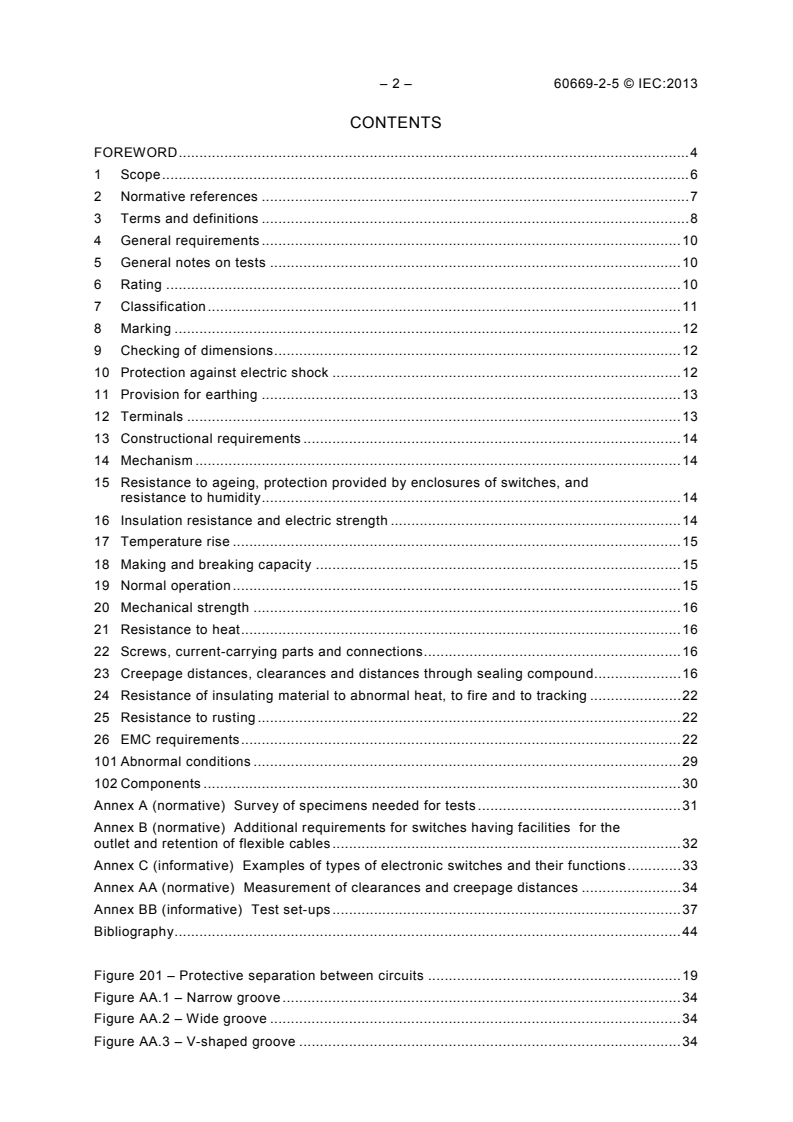
CONTENTS
FOREWORD . 4
1 Scope . 6
2 Normative references . 7
3 Terms and definitions . 8
4 General requirements . 10
5 General notes on tests . 10
6 Rating . 10
7 Classification . 11
8 Marking . 12
9 Checking of dimensions . 12
10 Protection against electric shock . 12
11 Provision for earthing . 13
12 Terminals . 13
13 Constructional requirements . 14
14 Mechanism . 14
15 Resistance to ageing, protection provided by enclosures of switches, and
resistance to humidity . 14
16 Insulation resistance and electric strength . 14
17 Temperature rise . 15
18 Making and breaking capacity . 15
19 Normal operation . 15
20 Mechanical strength . 16
21 Resistance to heat . 16
22 Screws, current-carrying parts and connections . 16
23 Creepage distances, clearances and distances through sealing compound. 16
24 Resistance of insulating material to abnormal heat, to fire and to tracking . 22
25 Resistance to rusting . 22
26 EMC requirements . 22
101 Abnormal conditions . 29
102 Components . 30
Annex A (normative) Survey of specimens needed for tests . 31
Annex B (normative) Additional requirements for switches having facilities for the
outlet and retention of flexible cables . 32
Annex C (informative) Examples of types of electronic switches and their functions . 33
Annex AA (normative) Measurement of clearances and creepage distances . 34
Annex BB (informative) Test set-ups . 37
Bibliography . 44
Figure 201 – Protective separation between circuits . 19
Figure AA.1 – Narrow groove . 34
Figure AA.2 – Wide groove . 34
Figure AA.3 – V-shaped groove . 34
60669-2-5 © IEC:2013 – 3 –
Figure AA.4 – Rib . 35
Figure AA.5 – Uncemented joint with narrow groove . 35
Figure AA.6 – Uncemented joint with wide groove . 35
Figure AA.7 – Uncemented joint with narrow and wide grooves. 35
Figure AA.8 – Intervening, unconnected conductive part . 36
Figure AA.9 – Narrow recess . 36
Figure AA.10 – Wide recess . 36
Figure BB.1 – Test setup for AC mains connection according to IEC 61000-4-4 . 37
Figure BB.2 – Test setup for bus and DC mains connection according to IEC 61000-4-4 . 38
Figure BB.3 – Test setup for AC mains connection according to IEC 61000-4-5 . 39
Figure BB.4 – Test setup for bus and DC mains connection according to IEC 61000-4-5 . 40
Figure BB.5 – Test setup for the ESD according to IEC 61000-4-2 . 41
Figure BB.6 – Test setup for AC mains connection according to IEC 61000-4-6 . 42
Figure BB.7 – Test setup for bus and DC mains connection according to
IEC 61000-4-6 . 43
Table 201 – Test loads for HBES switches for heating installations . 16
Table 202 – Relation between the rated voltage of the HBES switch, the rated
insulation voltage and the rated impulse voltage . 17
Table 203 – Minimum clearances without verification test . 19
Table 204 – Test voltages and corresponding altitudes . 20
Table 205 – Minimum clearances with verification test . 20
Table 206 – Minimum creepage distances of basic, supplementary and reinforced
insulation without verification test . 21
Table 207 – Minimum creepage distances of basic, supplementary and reinforced
insulation with verification test . 21
Table 208 – Immunity tests (overview) . 24
Table 209 – Voltage dip and short-interruption test values . 24
Table 210 – Surge immunity test voltages . 25
Table 211 – Fast transient test values . 26
Table 212 – Values for radiated electromagnetic field test of IEC 61000-4-3 . 27
– 4 – 60669-2-5 © IEC:2013
INTERNATIONAL ELECTROTECHNICAL COMMISSION
____________
SWITCHES FOR HOUSEHOLD AND
SIMILAR FIXED ELECTRICAL INSTALLATIONS –
Part 2-5: Particular requirements –
Switches and related accessories for use in home
and building electronic systems (HBES)
FOREWORD
1) The International Electrotechnical Commission (IEC) is a worldwide organization for standardization comprising
all national electrotechnical committees (IEC National Committees). The object of IEC is to promote
international co-operation on all questions concerning standardization in the electrical and electronic fields. To
this end and in addition to other activities, IEC publishes International Standards, Technical Specifications,
Technical Reports, Publicly Available Specifications (PAS) and Guides (hereafter referred to as “IEC
Publication(s)”). Their preparation is entrusted to technical committees; any IEC National Committee interested
in the subject dealt with may participate in this preparatory work. International, governmental and non-
governmental organizations liaising with the IEC also participate in this preparation. IEC collaborates closely
with the International Organization for Standardization (ISO) in accordance with conditions determined by
agreement between the two organizations.
2) The formal decisions or agreements of IEC on technical matters express, as nearly as possible, an international
consensus of opinion on the relevant subjects since each technical committee has representation from all
interested IEC National Committees.
3) IEC Publications have the form of recommendations for international use and are accepted by IEC National
Committees in that sense. While all reasonable efforts are made to ensure that the technical content of IEC
Publications is accurate, IEC cannot be held responsible for the way in which they are used or for any
misinterpretation by any end user.
4) In order to promote international uniformity, IEC National Committees undertake to apply IEC Publications
transparently to the maximum extent possible in their national and regional publications. Any divergence
between any IEC Publication and the corresponding national or regional publication shall be clearly indicated in
the latter.
5) IEC itself does not provide any attestation of conformity. Independent certification bodies provide conformity
assessment services and, in some areas, access to IEC marks of conformity. IEC is not responsible for any
services carried out by independent certification bodies.
6) All users should ensure that they have the latest edition of this publication.
7) No liability shall attach to IEC or its directors, employees, servants or agents including individual experts and
members of its technical committees and IEC National Committees for any personal injury, property damage or
other damage of any nature whatsoever, whether direct or indirect, or for costs (including legal fees) and
expenses arising out of the publication, use of, or reliance upon, this IEC Publication or any other IEC
Publications.
8) Attention is drawn to the Normative references cited in this publication. Use of the referenced publications is
indispensable for the correct application of this publication.
9) Attention is drawn to the possibility that some of the elements of this IEC Publication may be the subject of
patent rights. IEC shall not be held responsible for identifying any or all such patent rights.
International Standard IEC 60669-2-5 has been prepared by subcommittee 23B: Plugs,
socket-outlets and switches, of IEC technical committee 23: Electrical accessories.
The text of this standard is based on the following documents:
FDIS Report on voting
23B/1110/FDIS 23B/1129/RVD
Full information on the voting for the approval of this standard can be found in the report on
voting indicated in the above table.
This publication has been drafted in accordance with the ISO/IEC Directives, Part 2.
60669-2-5 © IEC:2013 – 5 –
This part of IEC 60669 is partially based on IEC 60669-1:1998, its Amendment 1:1999 and
Amendment 2:2006 and IEC 60669-2-1:2002 and its Amendment 1:2008. In cases where
parts of these standards apply, this will be mentioned explicitly by a normative cross-
reference describing the extent to which the referenced element (clause, subclause, figure,
table, etc.) applies. Subclauses, figures, tables or notes which are additional to those in
IEC 60669-1 and IEC 60669-2-1 and their amendments are numbered starting from 101 and
201 respectively, additional annexes are lettered AA, BB, etc.
This part of IEC 60669 lists the changes necessary to convert those standards into a specific
standard for home and building electronic systems (HBES) switches and related accessories.
In this standard, the following print types are used:
– requirements proper: in roman type;
– test specifications: in italic type;
– notes: in smaller roman type.
A list of all parts in the IEC 60669 series, published under the general title Switches for
household and similar fixed-electrical installations, can be found on the IEC website.
The following differences exist in the countries indicated below.
– Clause 26: all CENELEC countries.
The committee has decided that the contents of this publication will remain unchanged until
the stability date indicated on the IEC web site under "http://webstore.iec.ch" in the data
related to the specific publication. At this date, the publication will be
• reconfirmed,
• withdrawn,
• replaced by a revised edition, or
• amended.
IMPORTANT – The 'colour inside' logo on the cover page of this publication indicates
that it contains colours which are considered to be useful for the correct
understanding of its contents. Users should therefore print this document using a
colour printer.
– 6 – 60669-2-5 © IEC:2013
SWITCHES FOR HOUSEHOLD AND
SIMILAR FIXED ELECTRICAL INSTALLATIONS –
Part 2-5: Particular requirements –
Switches and related accessories for use in home
and building electronic systems (HBES)
1 Scope
This part of IEC 60669 applies to HBES switches with a working voltage not exceeding 250 V
a.c. and a rated current up to and including 16 A for household and similar fixed electrical
installations either indoors or outdoors and to associated electronic extension units.
It applies to:
– HBES switches for the operation of lamp circuits and the control of the brightness of lamps
(dimmers) as well as the control of the speed of motors (e.g. those used in ventilating
fans) and for other purposes (e.g. heating installations);
– sensors, actuators, switched-socket-outlets, associated electronic extension units, etc.
In the present standard the word "HBES switch" is applied to describe all kinds of HBES
devices e.g. switches, sensors, actuators, switched-socket-outlets, associated electronic
extension units, etc.
The operation and control are performed:
– intentionally by a person via an actuating member, a key, a card, etc., via a sensing
surface or a sensing unit, by means of touch, proximity, turn, optical, acoustic, thermal;
– by physical means, e.g. light, temperature, humidity, time, wind velocity, presence of
people;
– by any other influence;
and transmitted:
– by an electronic signal via several media, e.g. powerline (mains), twisted pair, optical
fibre, radio frequency, infra-red, etc.
HBES switches complying with this standard are suitable for use at ambient temperatures not
normally exceeding 25 °C, but occasionally reaching 35 °C.
This part of IEC 60669also applies to mounting boxes for HBES switches, with the exception
of those for flush-type HBES switches which are covered by IEC 60670-1.
NOTE 1 In the following country flush mounted boxes are covered by both EN 60670-1 and BS 4662: UK
Functional safety aspects of HBES switches are not covered by this standard. Functional
safety requirements are covered by the standards of the devices which are controlled by the
HBES.
In locations where special conditions prevail, e.g. higher temperature, special constructions
may be required.
NOTE 2 This standard is not intended to cover devices falling within the scope of IEC 60730.
60669-2-5 © IEC:2013 – 7 –
NOTE 3 Within this Part 2-5, for any reference to IEC 60669-2-1 and its Amendment 1:2008, the term “electronic
switches” is replaced by “HBES switches”.
NOTE 4 In the following country, HBES switches complying with this standard are suitable for use at ambient
temperatures not normally exceeding 35 °C, but occasionally reaching 40 °C: CN.
2 Normative references
The following documents, in whole or in part, are normatively referenced in this document and
are indispensable for its application. For dated references, only the edition cited applies. For
undated references, the latest edition of the referenced document (including any
amendments) applies.
IEC 60050 (all parts), International Electrotechnical Vocabulary, available at:
IEC 60664-1:2007, Insulation coordination for equipment within low-voltage systems – Part 1:
Principles, requirements and tests
IEC 60669-1:1998, Switches for household and similar fixed-electrical installations – Part 1:
General requirements
Amendment 1:1998
Amendment 2:2006
IEC 60669-2-1:2002, Switches for household and similar fixed electrical installations –
Part 2-1: Particular requirements – Electronic switches
Amendment 1:2008
IEC 60364-4-41, Low-voltage electrical installations– Part 4-41: Protection for safety –
Protection against electric shock
IEC 60664-3, Insulation coordination for equipment within low-voltage systems – Part 3: Use
of coating, potting or moulding for protection against pollution
IEC 60670-1, Boxes and enclosures for electrical accessories for household and similar fixed
electrical installations – Part 1: General requirements
IEC 60715, Dimensions of low-voltage switchgear and controlgear – Standardized mounting
on rails for mechanical support of electrical devices in switchgear and controlgear installations
IEC 60990, Methods of measurement of touch current and protective conductor current
IEC 61000-2-2, Electromagnetic compatibility (EMC) – Part 2-2: Environment – Compatibility
levels for low-frequency conducted disturbances and signalling in public low-voltage power
supply systems
IEC 61000-3-2, Electromagnetic compatibility (EMC) – Part 3-2: Limits – Limits for harmonic
current emissions (equipment input current ≤ 16A per phase)
IEC 61000-3-3, Electromagnetic compatibility (EMC) – Part 3-3: Limits – Limitation of voltage
changes, voltage fluctuations and flicker in public low-voltage supply systems, for equipment
with rated current ≤ 16 A per phase and not subject to conditional connection
IEC 61000-4-2, Electromagnetic compatibility (EMC) − Part 4-2: Testing and measurement
techniques − Electrostatic discharge immunity test
– 8 – 60669-2-5 © IEC:2013
− Part 4-3: Testing and measurement
IEC 61000-4-3, Electromagnetic compatibility (EMC)
techniques − Radiated, radio-frequency, electromagnetic field immunity test
IEC 61000-4-4, Electromagnetic compatibility (EMC) − Part 4-4: Testing and measurement
techniques − Electrical fast transient/burst immunity test
IEC 61000-4-5, Electromagnetic compatibility (EMC) − Part 4-5: Testing and measurement
techniques − Surge immunity test
IEC 61000-4-6, Electromagnetic compatibility (EMC) − Part 4-6: Testing and measurement
techniques − Immunity to conducted disturbances, induced by radio-frequency fields
IEC 61000-4-8, Electromagnetic compatibility (EMC) – Part 4-8: Testing and measurement
techniques –Power frequency magnetic field immunity test
IEC 61000-4-11, Electromagnetic compatibility (EMC) − Part 4-11: Testing and measurement
techniques − Voltage dips, short interruptions and voltage variations immunity tests
IEC 61000-4-20:2010, Electromagnetic compatibility (EMC) – Part 4-20: Testing and
measurement techniques – Emission and immunity testing in transverse electromagnetic
(TEM) waveguides
IEC 61058-1, Switches for appliances – Part 1: General requirements
Amendment 1:2000
Amendment 2:2007
IEC 61140:2001, Protection against electric shock – Common aspects for installation and
equipment
IEC 61558-2-6, Safety of transformers, reactors, power supply units and similar products for
supply voltages up to 1 100 V – Part 2-6: Particular requirements and tests for safety isolating
transformers and power supply units incorporating safety isolating transformers
CISPR 14 (all parts), Electromagnetic compatibility – Requirements for household appliances,
electric tools and similar apparatus
CISPR 15, Limits and methods of measurement of radio disturbance characteristics of
electrical lighting and similar equipment
CISPR 22, Information technology equipment – Radio disturbance characteristics – Limits and
methods of measurement
3 Terms and definitions
Clause 3 of IEC 60669-2-1:2002 and its Amendment 1:2008 is applicable with the following
additions:
3.201
HBES
home and building electronic systems
multi-application systems where functions are decentrally distributed and linked through a
common communication process
Note 1 to entry: HBES is used in homes and buildings plus their surroundings. Functions of the system are for
example: switching, open loop controlling, closed loop controlling, monitoring and supervising.
Note 2 to entry: This note applies to the French language only.
60669-2-5 © IEC:2013 – 9 –
[SOURCE: ISO/IEC 14762:2009, 3.1.10]
3.202
HBES switch
electronic switch intended to be used in an HBES system, used for two way communication
and designed to make or break and/or to control, directly (e.g. actuator) or indirectly (e.g.
sensor), the current in one or more electric circuits
Note 1 to entry: The communication can use different media e.g. Twisted Pair (TP), Power Line (PL), Infra-Red
(IR) and Radio Frequency (RF).
Note 2 to entry: To make or break and/or to control directly means that an actuator makes or breaks the current
and/or controls the current.
3.203
ELV
extra-low voltage
for the purpose of this standard, a voltage not exceeding 50 V a.c. or d.c. between
conductors, or in the case of three-phase circuits, not exceeding 29 V between conductors
and neutral, the no-load voltage of the circuit not exceeding 50 V and 29 V, respectively
Note 1 to entry: The use of ELV other than for protection by SELV or PELV in such circuits is not a protective
measure.
3.204
FELV
functional extra-low voltage circuit
electrical circuit in which the voltage cannot exceed ELV used for functional purposes and
having simple separation from LV.
Note 1 to entry: FELV does not fulfil the requirements for SELV (or PELV).
Note 2 to entry: A FELV circuit is not safe to touch and may be connected to protective earth.
3.205
SELV system
safety extra-low-voltage system
electrical system in which the voltage cannot exceed ELV
– under normal conditions
– under single fault conditions, including earth faults in other circuits
[SOURCE: IEC 61140:2001, 3.26.1]
3.206
PELV system
protected extra-low-voltage system
electrical system in which the voltage cannot exceed ELV
– under normal conditions
– under single fault conditions, except earth faults in other circuits
[SOURCE: IEC 61140:2001, 3.26.2]
3.207
simple separation
separation between circuits or between a circuit and earth by means of basic insulation
[SOURCE: IEC 61140:2001, 3.23]
– 10 – 60669-2-5 © IEC:2013
3.208
protective separation
separation of one electric circuit from another by means of
– double insulation, or
– basic insulation and protective screening, or
– reinforced insulation
[SOURCE: IEC 60050-195, Amendment 1:2001, 195-06-19]
3.209
basic insulation
insulation of hazardous-live-parts which provides basic protection
Note 1 to entry: This concept does not apply to insulation used exclusively for functional purposes.
[SOURCE: IEC 60050-195:1998, 195-06-06]
3.210
supplementary insulation
independent insulation applied in addition to basic insulation, for fault protection
[SOURCE: IEC 60050-195:1998, 195-06-07]
3.211
double insulation
insulation comprising both basic insulation and supplementary insulation
[SOURCE: IEC 60050-195:1998, 195-06-08]
3.212
reinforced insulation
insulation of hazardous-live-parts which provides a degree of protection against electric shock
equivalent to double insulation
Note 1 to entry: Reinforced insulation may comprise several layers which cannot be tested singly as basic
insulation or supplementary insulation
[SOURCE: IEC 60050-195:1998, 195-06-09]
4 General requirements
Clause 4 of IEC 60669-1:1998 and its Amendment 1:1999 and Amendment 2:2006 is
applicable.
5 General notes on tests
Clause 5 of IEC 60669-2-1:2002 and its Amendment 1:2008 applies, except as follows:
5.4 Replacement in Table 101 of the number of specimens in the column "Additional
specimens for clause or subclause 26" from 3 and 6 to 1 and 1.
6 Rating
Clause 6 of IEC 60669-2-1:2002 and its Amendment 1:2008 applies, except as follows:
60669-2-5 © IEC:2013 – 11 –
Addition:
For this standard the ELV is limited to 50 V a.c. and 50 V d.c.
NOTE For three phase circuits, see 3.203.
7 Classification
Clause 7 of IEC 60669-2-1:2002 and its Amendment 1:2008 applies, except as follows:
7.1.5 Replacement:
7.1.5 Addition:
– touch;
– proximity;
– optical;
– acoustic;
– other external influences, e.g. communication system.
NOTE Actuating the electronic switch includes on/off operation, and/or regulating the brightness of lamps or
speed of motors.
Additions:
7.1.7 Replacement:
7.1.7 Not applicable for SELV switches.
7.1.8 Replacement:
7.1.8 according to the wiring connection:
– switches with screw-type terminals;
– switches with screwless terminals for rigid conductors only;
– switches with screwless terminals for rigid and flexible conductors;
– switches without terminals equipped with connecting leads.
7.1.101 Addition of the following dashed item:
– load for heating installations (e.g. resistive load, a motor load with a power factor not less
than 0,6 or a combination of both);
Additional subclauses:
7.1.201 according to the presence of SELV or PELV part:
– switches with SELV or PELV parts only,
– switches without SELV or PELV parts,
– switches having a combination of parts connected to the mains and SELV or PELV parts.
7.1.202 according to the installation environment:
– switches intended to be used in SELV/PELV environment only;
– switches intended to be used in SELV/PELV and/or mains environment.
– 12 – 60669-2-5 © IEC:2013
7.1.203 according to the connection to the network port based on SELV/PELV:
a) Connected to a network which is installed wholly within the same equipotential earthing
system;
b) Connected to a network which is not installed wholly within the same equipotential
earthing system.
8 Marking
Clause 8 of IEC 60669-2-1:2002 and its Amendment 1:2008 is applicable, with the following
exceptions:
8.1 Replacement of the penultimate paragraph starting with “For general purpose electronic
switches with included automatic function” by:
In addition, for HBES switches with contact mechanism(s) classified for more than 20 000
operating cycles, the number of operating cycles shall be indicated. This information may be
put on the HBES switch and/or on the packaging unit and/or on the accompanying instruction
sheet.
Sensors, actuators and associated electronic extension units which do not control directly the
load and which are supplied by the network do not need the following markings:
– rated voltage in volts;
– rated current in amperes or rated load in volt-amperes or watts;
– symbol for nature of supply;
The correct installation of the product shall be provided in the manufacturer’s instructions.
8.4 Addition, at the end of the subclause, of the following paragraph:
If switched circuits cannot be used in SELV/PELV circuits, the relevant information shall be
provided in the manufacturer's instructions.
9 Checking of dimensions
Clause 9 of IEC 60669-2-1:2002 and its Amendment 1:2008 applies.
10 Protection against electric shock
Clause 10 of IEC 60669-2-1:2002 and its Amendment 1: applies, except as follows:
Additional subclauses:
10.201 Live parts of SELV, PELV or FELV circuits shall be electrically separated from each
other and from other circuits by simple or protective separation as given in Clause 23.
SELV / PELV is 50 V a.c. or d.c. maximum under no fault and one single fault condition.
FELV is 50 V a.c. or d.c. maximum under no fault.
In addition, if the SELV / PELV is higher than 25 V a.c. in dry conditions or 12 V a.c. or 30 V
d.c. in wet conditions, protection against direct contact shall be provided by:
– barriers or enclosures giving at least the degree of protection IP2X or IPXXB, or
60669-2-5 © IEC:2013 – 13 –
– insulation capable of withstanding a test voltage of 500 V a.c. for 1 min.
Compliance is checked by inspection and the tests of Clauses 16 and 23.
10.202 Protection from touch current
NOTE For an explanation on touch current, see IEC 60950-1:2005 Annex W.
10.202.1 Permissible touch current when touching accessible parts of HBES switches
The touch current of HBES switches shall not be higher than 0,5 mA r.m.s. (0,7 mA peak)
even during single fault condition.
Compliance is checked by inspection and if necessary by tests according to IEC 60990.
10.202.2 Limitation of the touch current from the device to the dedicated HBES
network
The touch current to the HBES network from HBES switches supplied from the mains supply,
or from interfaces to other networks, shall be limited to 0,25 mA r.m.s.
Compliance is checked by measurement according to IEC 60990.
This test does not apply to HBES switches where the circuit to be connected to the HBES
network is connected to the protective or functional earthing terminal in the HBES switch. In
this case the touch current from the HBES switch to the network is considered to be zero.
NOTE When it is possible to touch the HBES network during maintenance, the limitation of the summation of
touch current can be considered in accordance to IEC 60950-1.
11 Provision for earthing
Clause 11 of IEC 60669-2-1:2002 and its Amendment 1:2008 applies.
12 Terminals
Clause 12 of IEC 60669-1:1998 and its Amendment 1:1999 and Amendment 2:2006 applies,
except as follows:
12.1 Addition after the first paragraph:
The connecting capability of terminals for circuits other than those of the main circuit need not
be related to the rated current of the HBES switch. This means that these terminals need not
necessarily to have the same connecting capability as the mains terminals of the HBES
switch. Terminals for conductors smaller than 0,5 mm shall fulfil the requirements of
IEC 60999-1.
Addition after the third paragraph:
Terminals having screw clamping which are in compliance with IEC 60998-2-1 can be used.
Addition before the last paragraph:
Terminals having screw clamping complying with IEC 60998-2-1 are considered to be in
compliance with the requirements and tests of 12.2, except those of 12.2.6, 12.2.7 and 12.2.8,
provided they are chosen according to Table 2.
– 14 – 60669-2-5 © IEC:2013
12.2 Addition to Note 2 of Table 2:
This requirement can be achieved by using terminal(s) with two separate clamping units.
13 Constructional requirements
Clause 13 of IEC 60669-2-1:2002 and its Amendment 1:2008 applies, except as follows:
Addition:
13.3.2 Replacement of the text in Table 11 of the last line of the first column with "To
insulating parts, earthed metal parts, the live parts of SELV or metal parts separated from live
parts by creepage distances and by clearances twice those according to Table 20".
Additional subclause:
13.201 Free ends of leads of HBES switches, if any, may be prepared but pre-soldering shall
not be used.
Compliance is checked by inspection.
14 Mechanism
Clause 14 of IEC 60669-2-1:2002 and its Amendment 1:2008 applies.
15 Resistance to ageing, protection provided by enclosures of switches, and
resistance to humidity
Clause 15 of IEC 60669-1:1998 and its Amendment 1:1999 and Amendment 2:2006 applies.
16 Insulation resistance and electric strength
Clause 16 of IEC 60669-2-1:2002 and its Amendment 1:2008 applies, except as follows:
Replacement of the addition to Table 14 by:
9 Between LV (mains) circuit(s) and FELV circuit(s) 5 1 250 2 000
Between SELV/PELV circuits and other circuit(s)
10 7 2 500 3 750
having a higher voltage than SELV/PELV
Between a SELV or PELV circuit below 25 V a.c.
11 5 500 500
and a SELV or PELV circuit above 25 V a.c.
Between a SELV or PELV circuit above 25 V a.c
12 5 500 500
and accessible surfaces (see Clause 10)
Between a SELV and PELV circuits or between
13 different SELV- or different PELV circuits from 5 500 500
different sources
Between a SELV or PELV circuit(s) and FELV
14 5 1 250 2 000
circuit(s)
Addition of the following new notes to Table 14:
NOTE 201 Only items 10, 11, 12 and 13 are applicable to SELV or PELV parts of HBES switches.
60669-2-5 © IEC:2013 – 15 –
NOTE 202 Items 1 to 9 are not applicable to SELV or PELV parts of HBES switches.
17 Temperature rise
Clause 17 of IEC 60669-2-1:2002 and its Amendment 1:2008 applies, except as follows:
Addition:
NOTE 201 HBES switches having no load switching means need not be subjected to this test.
18 Making and breaking capacity
Clause 18 IEC 60669-2-1:2002 and its Amendment 1:2008 applies, except as follows:
Addition after "For electronic RCS, Clause 18 of IEC 60669-2-2:2006 applies":
HBES switches having no load switching means are not subjected to this test.
19 Normal operation
Clause 19 of IEC 60669-2-1:2002 and its Amendment 1:2008 applies, except as follows.
Replacement of the second paragraph by:
Compliance is checked by the tests of IEC 60669-2-1:2002 and its Amendment 1:2008,
19.101, 19.102, 19.103, 19.104 and 19.105 as well as 19.201 of this standard, during which
the HBES switches are tested at rated voltage and loaded as specified in Clause 17, unless
otherwise specified.
The test according to subclause 19.101 is conducted on the complete HBES switch which
shall be controlled by the sensors, actuators or electronic extension units as described by the
manufacturer of the system.
The sensors, actuators or electronic extension units are tested when installed according to
the manufacturer’s instructions so as to verify that they are capable of controlling the HBES
switch according to this paragraph.
Additional subclause:
19.201 For HBES switches designed for heating installations the number of operations shall
be 200 000.
Contact mechanisms incorporated in HBES switches intended for heating installations are
subjected to the test described in subclause 19.101 but with the electrical conditions specified
in Table 201.
– 16 – 60669-2-5 © IEC:2013
Table 201 – Test loads for HBES switches for heating installations
c
Type of load as Operation of Test voltage Test current r.m.s. Power factor
classified in 7.1.101 contacts
6 × I-M or 0,60 (+0,05)
b
Making Rated voltage
a
Resistive and motor I-R ≥0,9
a
Breaking Rated voltage I-R or I-M
≥0,9
NOTE
I-M: motor-load current; and
I-R: resistive-load current
a
Whichever is arithmetically greater or whichever is the most unfavourable value in case of equal values.
b
The specified making conditions are maintained for a period between 50 ms and 100 ms, and are then
reduced by an auxiliary switch to the specified breaking conditions. The reduction to the break current should
be achieved without any open circuiting of the simulated inductive loads circuit to ensure that no abnormal
voltage transients are generated. A typical method of achieving this is shown in Figure 19 of IEC 61058-1,
Amendment 2:2007.
c
Resistors and inductors are not connected in parallel except that if any air-core inductor is used, a resistor
taking approximately 1 % of the current through the inductor is connected in parallel with it. Iron-core
inductors may be used provided that the current has a substantially sine-wave form.
20 Mechanical strength
Clause 20 of IEC 60669-1:1998 and its Amendment 1:1999 and Amendment 2:2006 applies.
21 Resistance to heat
Clause 21 of IEC 60669-1:1998 and its Amendment 1:1999 and Amendment 2:2006 applies.
22 Screws, current-carrying parts and connections
Clause 22 of IEC 60669-1:1998 and its Amendment 1:1999 and Amendment 2:2006 applies.
23 Creepage distances, clearances and distances through sealing compound
Clause 23 of IEC 60669-2-1:2002 and its Amendment 1:2008 applies, except as follows.
Replacement of the addition except for Notes 1 and 2 by:
The values given in items 2 and 7 of Table 20 apply to terminals for external wiring and do not
apply to other live parts which are protected by a directly associated fuse, circuit breaker or
other current-limiting means with adequate breaking capacity under the provision that the
requirements of Clause 101 are fulfilled. If there are no directly associated fuse or other
current-limiting means, the electronic switch shall comply with Table 20.
The values given in items 1 an
...