

IEC TR 61807:1999
(Main)Magnetic properties of magnetically hard materials at elevated temperatures - Methods of measurement
General Information
- Abstract
Provides methods for measuring magnetically hard materials, at elevated temperatures. Magnetically hard materials (permanent magnet materials) are classified in IEC 60404-1 and their properties are specified in IEC 60404-8-1. The methods of measurement of the magnetic properties of magnetically hard materials at room temperature have been specified in IEC 60404-5 for closed magnetic circuits and in IEC 60404-7 for open magnetic circuits, respectively. The applications of magnetically hard materials are now expanding to elevated temperatures and it is therefore required to specify and guarantee the magnetic properties of these materials over their working temperature range. In IEC 60404-8-1 temperature coefficients of remanence (or saturation) and J-coercivity have been specified in addition to basic properties such as maximum magnetic energy product ((BH)max), remanence (Br), B-coercivity (HcB), J-coercivity (HcJ), recoil permeability (µrec) and density.
- Status
- Published
- Publication Date
- 19-Oct-1999
- Technical Committee
- TC 68 - Magnetic alloys and steels
- Drafting Committee
- WG 5 - TC 68/WG 5
- Current Stage
- PPUB - Publication issued
- Start Date
- 20-Oct-1999
- Completion Date
- 30-Sep-1999
Overview
IEC TR 61807:1999 is a technical report published by the International Electrotechnical Commission (IEC) that specifies methods for measuring the magnetic properties of magnetically hard materials (permanent magnet materials) at elevated temperatures. Magnetically hard materials, which include permanent magnets, are classified under IEC 60404-1, and their essential magnetic properties are detailed in IEC 60404-8-1. While previous standards such as IEC 60404-5 and IEC 60404-7 cover measurements at room temperature for closed and open magnetic circuits respectively, the current report addresses the increasing need to characterize these materials under elevated temperature conditions.
This standard is critical for applications where permanent magnets operate over a wide temperature range, ensuring consistent performance and reliability by specifying measurement techniques and temperature-dependent magnetic property coefficients such as remanence and coercivity.
Key Topics
Scope and Purpose
Establishes measurement procedures for magnetic properties of magnetically hard materials at elevated temperatures extending beyond room temperature.Magnetic Properties Covered
- Maximum magnetic energy product ((BH)_max)
- Remanence (B_r)
- B-coercivity (H_cB)
- J-coercivity (H_cJ)
- Recoil permeability (µ_rec)
- Density
Temperature Coefficients
Specifies temperature coefficients for remanence (or saturation) and J-coercivity to quantitatively assess material behavior under thermal stress.Measurement Methods
Standardizes testing methods applicable to different types of magnetic circuits (closed and open), utilizing equipment and procedures adapted for high-temperature environments.Evaluation and Reporting
Includes guidelines for data evaluation, test reporting, and examples of calculations to aid in precise interpretation of measurement results.Material Review
Provides an overview of existing magnetically hard materials, such as anisotropic sintered NdFeB and Sr-ferrite magnets, highlighting behavioral characteristics at elevated temperatures.
Applications
The standard IEC TR 61807:1999 is essential for industries and sectors where permanent magnets must maintain functionality at high temperatures, including:
Automotive Industry
Electrified vehicles and motor systems where magnets are exposed to elevated operating temperatures.Aerospace and Defense
Components subjected to harsh thermal environments requiring high reliability.Renewable Energy
Wind turbines and other electric generators where magnetic materials face varying temperature conditions during operation.Industrial Motors and Sensors
Devices operating in elevated temperature industrial settings demand accurate magnetic property evaluations for design optimization.Consumer Electronics
Ensures performance stability of magnetic components in devices that experience temperature variation.
Related Standards
IEC 60404-1
Classification of magnetic materials, foundational for understanding permanent magnet categories.IEC 60404-5
Measurement of magnetic properties of magnetically hard materials at room temperature for closed magnetic circuits.IEC 60404-7
Specifies the measurement method of coercive force in open magnetic circuits at room temperature.IEC 60404-8-1
Specifies magnetic property requirements and temperature coefficients for magnetically hard materials.IEC 60050 Series
International Electrotechnical Vocabulary (IEV), providing standardized terminology related to electromagnetism and magnetic materials.
Keywords: IEC TR 61807, magnetic properties, magnetically hard materials, permanent magnets, elevated temperature measurement, temperature coefficients, remanence, coercivity, magnetic energy product, magnet measurement methods, IEC magnetic standards.
Get Certified
Connect with accredited certification bodies for this standard

IMQ S.p.A. (Certification)
Italian electrical product certification.

SLG Prüf- und Zertifizierungs GmbH
German testing and certification body.

UL Solutions
Global safety science company with testing, inspection and certification.
Sponsored listings
Frequently Asked Questions
IEC TR 61807:1999 is a technical report published by the International Electrotechnical Commission (IEC). Its full title is "Magnetic properties of magnetically hard materials at elevated temperatures - Methods of measurement". This standard covers: Provides methods for measuring magnetically hard materials, at elevated temperatures. Magnetically hard materials (permanent magnet materials) are classified in IEC 60404-1 and their properties are specified in IEC 60404-8-1. The methods of measurement of the magnetic properties of magnetically hard materials at room temperature have been specified in IEC 60404-5 for closed magnetic circuits and in IEC 60404-7 for open magnetic circuits, respectively. The applications of magnetically hard materials are now expanding to elevated temperatures and it is therefore required to specify and guarantee the magnetic properties of these materials over their working temperature range. In IEC 60404-8-1 temperature coefficients of remanence (or saturation) and J-coercivity have been specified in addition to basic properties such as maximum magnetic energy product ((BH)max), remanence (Br), B-coercivity (HcB), J-coercivity (HcJ), recoil permeability (µrec) and density.
Provides methods for measuring magnetically hard materials, at elevated temperatures. Magnetically hard materials (permanent magnet materials) are classified in IEC 60404-1 and their properties are specified in IEC 60404-8-1. The methods of measurement of the magnetic properties of magnetically hard materials at room temperature have been specified in IEC 60404-5 for closed magnetic circuits and in IEC 60404-7 for open magnetic circuits, respectively. The applications of magnetically hard materials are now expanding to elevated temperatures and it is therefore required to specify and guarantee the magnetic properties of these materials over their working temperature range. In IEC 60404-8-1 temperature coefficients of remanence (or saturation) and J-coercivity have been specified in addition to basic properties such as maximum magnetic energy product ((BH)max), remanence (Br), B-coercivity (HcB), J-coercivity (HcJ), recoil permeability (µrec) and density.
IEC TR 61807:1999 is classified under the following ICS (International Classification for Standards) categories: 17.220.99 - Other standards related to electricity and magnetism; 29.030 - Magnetic materials. The ICS classification helps identify the subject area and facilitates finding related standards.
IEC TR 61807:1999 is available in PDF format for immediate download after purchase. The document can be added to your cart and obtained through the secure checkout process. Digital delivery ensures instant access to the complete standard document.
Standards Content (Sample)
RAPPORT CEI
TECHNIQUE IEC
TR 61807
TECHNICAL
Première édition
REPORT
First edition
1999-10
Propriétés magnétiques des matériaux
magnétiquement durs à des
températures élevées – Méthodes de mesure
Magnetic properties of magnetically
hard materials at elevated temperatures –
Methods of measurement
Numéro de référence
Reference number
IEC/TR 61807:1999
Numéros des publications Numbering
Depuis le 1er janvier 1997, les publications de la CEI As from 1 January 1997 all IEC publications are
sont numérotées à partir de 60000. issued with a designation in the 60000 series.
Publications consolidées Consolidated publications
Les versions consolidées de certaines publications de Consolidated versions of some IEC publications
la CEI incorporant les amendements sont disponibles. including amendments are available. For example,
Par exemple, les numéros d’édition 1.0, 1.1 et 1.2 edition numbers 1.0, 1.1 and 1.2 refer, respectively, to
indiquent respectivement la publication de base, la the base publication, the base publication incor-
publication de base incorporant l’amendement 1, et la porating amendment 1 and the base publication
publication de base incorporant les amendements 1 incorporating amendments 1 and 2.
et 2.
Validité de la présente publication Validity of this publication
Le contenu technique des publications de la CEI est The technical content of IEC publications is kept
constamment revu par la CEI afin qu'il reflète l'état under constant review by the IEC, thus ensuring that
actuel de la technique. the content reflects current technology.
Des renseignements relatifs à la date de reconfir- Information relating to the date of the reconfirmation
mation de la publication sont disponibles dans le of the publication is available in the IEC catalogue.
Catalogue de la CEI.
Les renseignements relatifs à des questions à l’étude et Information on the subjects under consideration and
des travaux en cours entrepris par le comité technique work in progress undertaken by the technical
qui a établi cette publication, ainsi que la liste des committee which has prepared this publication, as well
publications établies, se trouvent dans les documents ci- as the list of publications issued, is to be found at the
dessous: following IEC sources:
• «Site web» de la CEI* • IEC web site*
• Catalogue des publications de la CEI • Catalogue of IEC publications
Publié annuellement et mis à jour Published yearly with regular updates
régulièrement (On-line catalogue)*
(Catalogue en ligne)*
• Bulletin de la CEI
• IEC Bulletin
Disponible à la fois au «site web» de la CEI*
Available both at the IEC web site* and
et comme périodique imprimé
as a printed periodical
Terminologie, symboles graphiques
Terminology, graphical and letter
et littéraux
symbols
En ce qui concerne la terminologie générale, le lecteur
For general terminology, readers are referred to
se reportera à la CEI 60050: Vocabulaire Electro-
IEC 60050: International Electrotechnical Vocabulary
technique International (VEI).
(IEV).
Pour les symboles graphiques, les symboles littéraux
For graphical symbols, and letter symbols and signs
et les signes d'usage général approuvés par la CEI, le
approved by the IEC for general use, readers are
lecteur consultera la CEI 60027: Symboles littéraux à
referred to publications IEC 60027: Letter symbols to
utiliser en électrotechnique, la CEI 60417: Symboles
be used in electrical technology, IEC 60417: Graphical
graphiques utilisables sur le matériel. Index, relevé et
symbols for use on equipment. Index, survey and
compilation des feuilles individuelles, et la CEI 60617:
compilation of the single sheets and IEC 60617:
Symboles graphiques pour schémas.
Graphical symbols for diagrams.
* Voir adresse «site web» sur la page de titre.
* See web site address on title page.
RAPPORT CEI
TECHNIQUE IEC
TR 61807
TECHNICAL
Première édition
REPORT
First edition
1999-10
Propriétés magnétiques des matériaux
magnétiquement durs à des
températures élevées – Méthodes de mesure
Magnetic properties of magnetically
hard materials at elevated temperatures –
Methods of measurement
IEC 1999 Droits de reproduction réservés Copyright - all rights reserved
Aucune partie de cette publication ne peut être reproduite ni No part of this publication may be reproduced or utilized in
utilisée sous quelque forme que ce soit et par aucun procédé, any form or by any means, electronic or mechanical,
électronique ou mécanique, y compris la photocopie et les including photocopying and microfilm, without permission in
microfilms, sans l'accord écrit de l'éditeur. writing from the publisher.
International Electrotechnical Commission 3, rue de Varembé Geneva, Switzerland
Telefax: +41 22 919 0300 e-mail: inmail@iec.ch IEC web site http://www.iec.ch
CODE PRIX
Commission Electrotechnique Internationale
M
PRICE CODE
International Electrotechnical Commission
Pour prix, voir catalogue en vigueur
For price, see current catalogue
– 2 – TR 61807 © CEI:1999
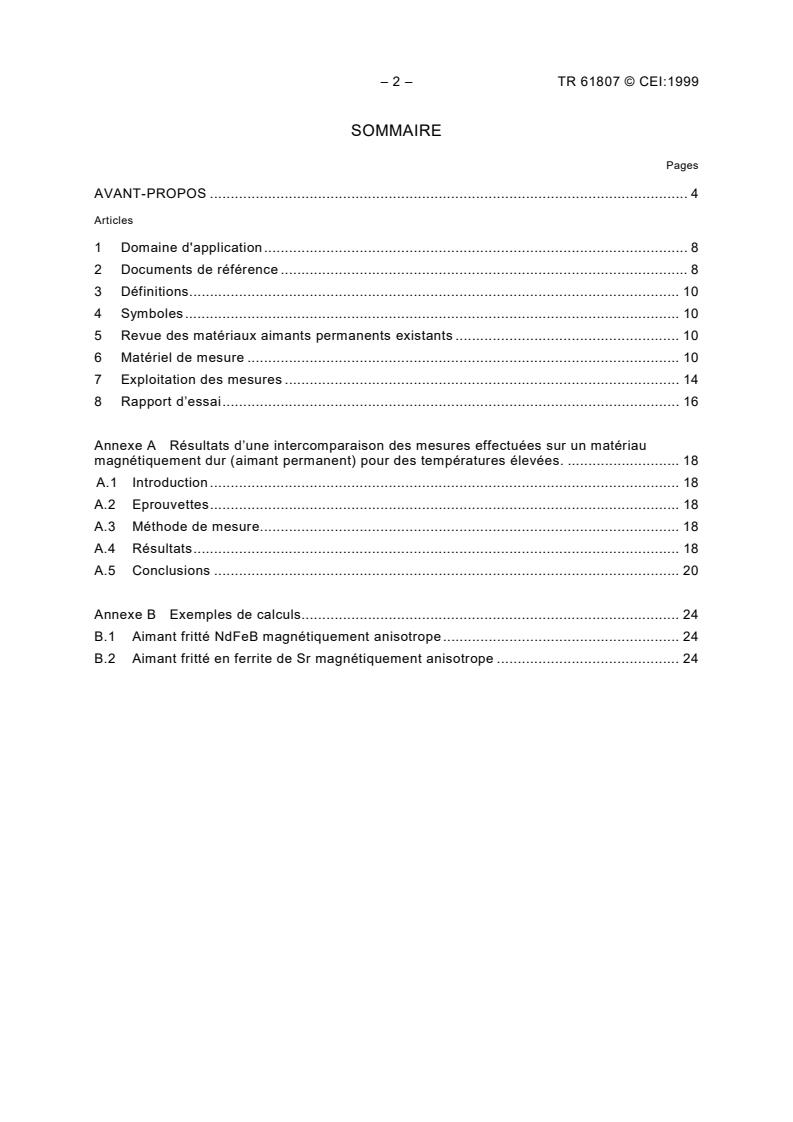
SOMMAIRE
Pages
AVANT-PROPOS . 4
Articles
1 Domaine d'application. 8
2 Documents de référence . 8
3 Définitions. 10
4 Symboles.10
5 Revue des matériaux aimants permanents existants . 10
6 Matériel de mesure . 10
7 Exploitation des mesures . 14
8 Rapport d’essai. 16
Annexe A Résultats d’une intercomparaison des mesures effectuées sur un matériau
magnétiquement dur (aimant permanent) pour des températures élevées. . 18
A.1 Introduction .18
A.2 Eprouvettes. 18
A.3 Méthode de mesure. 18
A.4 Résultats. 18
A.5 Conclusions . 20
Annexe B Exemples de calculs. 24
B.1 Aimant fritté NdFeB magnétiquement anisotrope. 24
B.2 Aimant fritté en ferrite de Sr magnétiquement anisotrope . 24
TR 61807 © IEC:1999 – 3 –
CONTENTS
Page
FOREWORD . 5
Clause
1 Scope . 9
2 Reference documents . 9
3 Definitions. 11
4 Symbols. 11
5 Review of existing permanent magnet materials. 11
6 Measuring equipment. 11
7 Evaluation of measured data. 15
8 Test report . 17
Annex A Results of an inter-comparison of measurements on magnetically hard
(permanent magnet) material at elevated temperatures . 19
A.1 Introduction .19
A.2 Test specimens . 19
A.3 Method of measurement. 19
A.4 Results. 19
A.5 Conclusions . 21
Annex B Example calculations . 25
B.1 Magnetically anisotropic sintered NdFeB magnet . 25
B.2 Magnetically anisotropic sintered Sr-ferrite magnet . 25
– 4 – TR 61807 © CEI:1999
COMMISSION ÉLECTROTECHNIQUE INTERNATIONALE
–––––––––––––
PROPRIÉTÉS MAGNÉTIQUES DES MATÉRIAUX
MAGNÉTIQUEMENT DURS À DES TEMPÉRATURES ÉLEVÉES –
MÉTHODES DE MESURE
AVANT-PROPOS
1) La CEI (Commission Électrotechnique Internationale) est une organisation mondiale de normalisation
composée de l'ensemble des comités électrotechniques nationaux (Comités nationaux de la CEI). La CEI a
pour objet de favoriser la coopération internationale pour toutes les questions de normalisation dans les
domaines de l'électricité et de l'électronique. A cet effet, la CEI, entre autres activités, publie des Normes
internationales. Leur élaboration est confiée à des comités d'études, aux travaux desquels tout Comité national
intéressé par le sujet traité peut participer. Les organisations internationales, gouvernementales et non
gouvernementales, en liaison avec la CEI, participent également aux travaux. La CEI collabore étroitement
avec l'Organisation Internationale de Normalisation (ISO), selon des conditions fixées par accord entre les
deux organisations.
2) Les décisions ou accords officiels de la CEI concernant les questions techniques représentent, dans la mesure
du possible, un accord international sur les sujets étudiés, étant donné que les Comités nationaux intéressés
sont représentés dans chaque comité d’études.
3) Les documents produits se présentent sous la forme de recommandations internationales. Ils sont publiés
comme normes, spécifications techniques, rapports techniques ou guides et agréés comme tels par les
Comités nationaux.
4) Dans le but d'encourager l'unification internationale, les Comités nationaux de la CEI s'engagent à appliquer de
façon transparente, dans toute la mesure possible, les Normes internationales de la CEI dans leurs normes
nationales et régionales. Toute divergence entre la norme de la CEI et la norme nationale ou régionale
correspondante doit être indiquée en termes clairs dans cette dernière.
5) La CEI n’a fixé aucune procédure concernant le marquage comme indication d’approbation et sa responsabilité
n’est pas engagée quand un matériel est déclaré conforme à l’une de ses normes.
6) L’attention est attirée sur le fait que certains des éléments du présent rapport technique peuvent faire l’objet de
droits de propriété intellectuelle ou de droits analogues. La CEI ne saurait être tenue pour responsable de ne
pas avoir identifié de tels droits de propriété et de ne pas avoir signalé leur existence.
La tâche principale des comités d’études de la CEI est l’élaboration des Normes
internationales. Toutefois, un comité d’études peut proposer la publication d’un rapport
technique lorsqu’il a réuni des données de nature différente de celles qui sont normalement
publiées comme Normes internationales, cela pouvant comprendre, par exemple, des
informations sur l’état de la technique.
Un rapport technique ne doit pas nécessairement être révisé avant que les données qu’il
contient ne soient plus jugées valables ou utiles par le groupe de maintenance.
La CEI 61807, qui est un rapport technique, a été établie par le comité d’études 68: Matériaux
magnétiques tels qu'alliages et aciers.
Le texte de ce rapport technique est issu des documents suivants:
Projet d’enquête Rapport de vote
68/190/CDV 68/201/RVC
Le rapport de vote indiqué dans le tableau ci-dessus donne toute information sur le vote ayant
abouti à l'approbation de ce rapport technique.
Cette publication a été rédigée selon les Directives ISO/CEI, Partie 3.
TR 61807 © IEC:1999 – 5 –
INTERNATIONAL ELECTROTECHNICAL COMMISSION
–––––––––––––
MAGNETIC PROPERTIES OF MAGNETICALLY HARD MATERIALS
AT ELEVATED TEMPERATURES – METHODS OF MEASUREMENT
FOREWORD
1) The IEC (International Electrotechnical Commission) is a worldwide organization for standardization comprising
all national electrotechnical committees (IEC National Committees). The object of the IEC is to promote
international co-operation on all questions concerning standardization in the electrical and electronic fields. To
this end and in addition to other activities, the IEC publishes International Standards. Their preparation is
entrusted to technical committees; any IEC National Committee interested in the subject dealt with may
participate in this preparatory work. International, governmental and non-governmental organizations liaising
with the IEC also participate in this preparation. The IEC collaborates closely with the International
Organization for Standardization (ISO) in accordance with conditions determined by agreement between the
two organizations.
2) The formal decisions or agreements of the IEC on technical matters express, as nearly as possible, an
international consensus of opinion on the relevant subjects since each technical committee has representation
from all interested National Committees.
3) The documents produced have the form of recommendations for international use and are published in the form
of standards, technical specifications, technical reports or guides and they are accepted by the National
Committees in that sense.
4) In order to promote international unification, IEC National Committees undertake to apply IEC International
Standards transparently to the maximum extent possible in their national and regional standards. Any
divergence between the IEC Standard and the corresponding national or regional standard shall be clearly
indicated in the latter.
5) The IEC provides no marking procedure to indicate its approval and cannot be rendered responsible for any
equipment declared to be in conformity with one of its standards.
6) Attention is drawn to the possibility that some of the elements of this technical report may be the subject of
patent rights. The IEC shall not be held responsible for identifying any or all such patent rights.
The main task of IEC technical committees is to prepare International Standards. However, a
technical committee may propose the publication of a technical report when it has collected
data of a different kind from that which is normally published as an International Standard, for
example "state of the art".
Technical reports do not necessarily have to be reviewed until the data they provide are
considered to be no longer valid or useful by the maintenance team.
IEC 61807, which is a technical report, has been prepared by IEC technical committee 68:
Magnetic alloys and steels.
The text of this technical report is based on the following documents:
Enquiry draft Report on voting
68/190/CDV 68/201/RVC
Full information on the voting for the approval of this technical report can be found in the
report on voting indicated in the above table.
This publication has been drafted in accordance with the ISO/IEC Directives, Part 3.
– 6 – TR 61807 © CEI:1999
Ce document, purement informatif, ne doit pas être considéré comme une Norme
internationale.
Le comité a décidé que cette publication reste valable jusqu’en 2007. A cette date, selon
décision préalable du comité, la publication sera
reconduite;
supprimée;
remplacée par une édition révisée, ou
amendée.
TR 61807 © IEC:1999 – 7 –
This document which is purely informative is not to be regarded as an International Standard.
The committee has decided that this publication remains valid until 2007. At this date, in
accordance with the committee’s decision, the publication will be
reconfirmed;
withdrawn;
replaced by a revised edition, or
amended.
– 8 – TR 61807 © CEI:1999
PROPRIÉTÉS MAGNÉTIQUES DES MATÉRIAUX
MAGNÉTIQUEMENT DURS À DES TEMPÉRATURES ÉLEVÉES –
MÉTHODES DE MESURE
1 Domaine d'application
Le présent rapport technique donne les méthodes pour réaliser les mesures sur les matériaux
magnétiquement durs, à des températures élevées. Les matériaux magnétiquement durs
(aimants permanents) sont classifiés dans la CEI 60404-1 et leurs propriétés sont spécifiées
dans la CEI 60404-8-1.
Les méthodes de mesure des propriétés magnétiques des matériaux magnétiquement durs à
la température ambiante ont été spécifiées respectivement dans la CEI 60404-5 pour les
circuits magnétiques fermés, et dans la CEI 60404-7 pour les circuits magnétiques ouverts.
Les applications des matériaux magnétiquement durs se développent maintenant pour des
températures élevées. Par conséquent, il est nécessaire de spécifier et de garantir les
propriétés magnétiques de ces matériaux sur toute leur gamme de températures de
fonctionnement.
Dans la CEI 60404-8-1 les coefficients de température pour la rémanence (ou la saturation) et
la coercitivité J ont été spécifiés en complément des propriétés de base comme par exemple
le maximum de l’énergie magnétique ((BH) ), la rémanence (B ), la coercitivité B (H ), la
max r cB
coercitivité J (H ), la perméabilité relative de recul (μ ) et la masse volumique.
cJ rec
2 Documents de référence
CEI 60050(121):1998, Vocabulaire électrotechnique international (VEI) – Partie 121:
Electromagnétisme
CEI 60050(151):1978, Vocabulaire électrotechnique international (VEI) – Chapitre 151:
Dispositifs électriques et magnétiques
CEI 60050(221):1990, Vocabulaire électrotechnique international (VEI) – Chapitre 221:
Matériaux et composants magnétiques
CEI 60404-1:1979, Matériaux magnétiques – Première partie: Classification
CEI 60404-5:1993, Matériaux magnétiques – Partie 5: Aimants permanents (magnétiques
durs) – Méthodes de mesure des propriétés magnétiques
CEI 60404-7:1982, Matériaux magnétiques – Septième partie: Méthode de mesure du champ
coercitif des matériaux magnétiques en circuit magnétique ouvert
CEI 60404-8-1:1986, Matériaux magnétiques – Huitième partie: Spécifications pour matériaux
particuliers – Section un: Spécifications normales des matériaux magnétiquement durs
–6 2
NOTE Il convient de redéfinir les coefficients de température quadratiques β et β , exprimés en 10 /K , de
Br HcJ
–6
même que les coefficients linéaires α et α , exprimés en 10 /K, dans toute partie appropriée des normes
Br HcJ
indiquées ci-dessus.
TR 61807 © IEC:1999 – 9 –
MAGNETIC PROPERTIES OF MAGNETICALLY HARD MATERIALS
AT ELEVATED TEMPERATURES – METHODS OF MEASUREMENT
1 Scope
The present technical report provides methods for measuring magnetically hard materials, at
elevated temperatures. Magnetically hard materials (permanent magnet materials) are
classified in IEC 60404-1 and their properties are specified in IEC 60404-8-1.
The methods of measurement of the magnetic properties of magnetically hard materials at
room temperature have been specified in IEC 60404-5 for closed magnetic circuits and in
IEC 60404-7 for open magnetic circuits, respectively. The applications of magnetically hard
materials are now expanding to elevated temperatures and it is therefore required to specify
and guarantee the magnetic properties of these materials over their working temperature
range.
In IEC 60404-8-1 temperature coefficients of remanence (or saturation) and J-coercivity have
been specified in addition to basic properties such as maximum magnetic energy product
((BH) ), remanence (B ), B-coercivity (H ), J-coercivity (H ), recoil permeability (μ ) and
max r cB cJ rec
density.
2 Reference documents
IEC 60050(121):1998, International Electrotechnical Vocabulary (IEV) – Part 121:
Electromagnetism
International Electrotechnical Vocabulary (IEV) – Chapter 151:
IEC 60050(151):1978,
Electrical and magnetic devices
IEC 60050(221):1990, International Electrotechnical Vocabulary (IEV) – Chapter 221:
Magnetic materials and components
IEC 60404-1:1979, Magnetic materials – Part 1: Classification
IEC 60404-5:1993, Magnetic materials – Part 5: Permanent magnet (magnetically hard)
materials – Methods of measurement of magnetic properties
IEC 60404-7:1982, Magnetic materials – Part 7: Method of measurement of the coercivity of
magnetic materials in an open magnetic circuit
IEC 60404-8-1:1986, Magnetic materials – Part 8: Specifications for individual materials –
Section One: Standard specification for magnetically hard materials
–6 2
NOTE Quadratic temperature coefficients β and β , in 10 /K , as well as linear coefficients α and α ,
Br HcJ Br HcJ
–6
in 10 /K, should be re-defined in any appropriate part of the above-mentioned standards.
– 10 – TR 61807 © CEI:1999
3 Définitions
Pour les besoins du présent rapport technique, les définitions données dans la
CEI 60050(121), la CEI 60050(151), la CEI 60050(221), ainsi que dans la norme de produit
CEI 60404-8-1 s’appliquent.
4 Symboles
B (ou J ) rémanence
r r
(BH) maximum du produit BH
max
H coercitivité relative à l'induction magnétique
cB
H coercitivité relative à la polarisation magnétique
cJ
4πμ (BH) /B maximum relatif du produit BH
o max r
H champ magnétique d'uniformité
k
μ H /B coercitivité B relative
o cB r
μ H /B coercitivité J relative
o cJ r
μ perméabilité relative de recul
rec
α coefficient linéaire de température pour la rémanence
Br
β coefficient quadratique de température pour la rémanence
Br
α coefficient linéaire de température pour la coercitivité intrinsèque
HcJ
β coefficient quadratique de température pour la coercitivité intrinsèque
HcJ
5 Revue des matériaux aimants permanents existants
Les aimants Alnico et Fe-Cr-Co sont utilisés maintenant, alors que la stabilité est la
préoccupation principale. Ils possèdent des coefficients de température négatifs à la fois pour
–3
la rémanence et pour la coercitivité J, inférieurs à –10 /K. Leur magnétisme permanent est
consécutif à l’anisotropie de forme des précipités ferromagnétiques allongés, séparés par une
décomposition spinodale. Ils possèdent un très haut point de Curie.
Les aimants en ferrites de baryum et de strontium sont actuellement les matériaux
magnétiques permanents dominants. Ils possèdent un coefficient positif de température pour
la coercitivité relative à la polarisation à la température ambiante et ils ont une tendance à la
désaimantation irréversible pour les basses températures.
Les aimants en terre rare à hautes performances dont le magnétisme permanent pourrait être
dû à l’anisotropie de leur cristal et/ou à un accrochage des parois possèdent un coefficient de
température négatif pour la coercitivité J plus important que celui des aimants Alnico. Le
coefficient de température est en lui-même dépendant de la température. Certaines nuances
ont l’inconvénient d’une désaimantation irréversible à une température élevée.
6 Matériel de mesure
Pour les mesures à températures élevées, la méthode utilisée est celle donnée dans la
CEI 60404-5. Il est préférable d’immerger le circuit magnétique fermé, l’éprouvette et les
bobines de mesure dans un récipient rempli d’huile électriquement isolante. L’huile est
chauffée à la température souhaitée et est mise en circulation ou agitée de manière à
améliorer l’équilibre thermique.
...