

IEC 61786-1:2013
(Main)Measurement of DC magnetic, AC magnetic and AC electric fields from 1 Hz to 100 kHz with regard to exposure of human beings - Part 1: Requirements for measuring instruments
General Information
- Abstract
IEC 61786-1:2013 provides guidance for measuring instruments used to measure the field strength of quasi-static magnetic and electric fields that have a frequency content in the range 1 Hz to 100 kHz and with DC magnetic fields to evaluate the exposure levels of the human body to these fields. Sources of fields include devices that operate at power frequencies and produce power frequency and power frequency harmonic fields, as well as devices that produce fields within the frequency range of this document, including devices that produce static fields, and the earth's static magnetic field. The magnitude ranges covered by this standard are 0,1 μT to 200 mT in AC (1 μT to 10 T in DC) and 1 V/m to 50 kV/m for magnetic fields and electric fields, respectively. When measurements outside this range are performed, most of the provisions of this standard will still apply, but special attention should be paid to specified uncertainty and calibration procedures. The first editions of IEC 61786-1 and IEC 61786-2 replace IEC 61786:1998. Part 1 deals with measuring instruments, and Part 2 deals with measurement procedures. The content of the standard was revised in order to give up-to-date and practical information to the user.
It has the status of a horizontal standard in accordance with IEC Guide 108.
- Status
- Published
- Publication Date
- 23-Jul-2024
- Current Stage
- PPUB - Publication issued
- Start Date
- 12-Dec-2013
- Completion Date
- 15-Jan-2014
Buy Documents
IEC 61786-1:2013+AMD1:2024 CSV - Measurement of DC magnetic, AC magnetic and AC electric fields from 1 Hz to 100 kHz with regard to exposure of human beings - Part 1: Requirements for measuring instruments Released:7/24/2024
IEC 61786-1:2013 - Measurement of DC magnetic, AC magnetic and AC electric fields from 1 Hz to 100 kHz with regard to exposure of human beings - Part 1: Requirements for measuring instruments Released:12/12/2013
Overview
IEC 61786-1:2013 (with amendments consolidated 2024) specifies requirements for measuring instruments used to assess human exposure to DC magnetic fields, AC magnetic fields and AC electric fields in the frequency range 1 Hz to 100 kHz. It covers instrument performance, magnitude ranges, calibration and uncertainty for field strength measurement of quasi‑static fields (including static/DC fields such as the earth’s magnetic field). The standard is a horizontal publication (IEC Guide 108) and complements Part 2 (measurement procedures).
Key topics and technical requirements
- Frequency and field ranges: instruments for 1 Hz–100 kHz; magnitude coverage typically 0.1 μT to 200 mT (AC), 1 μT to 10 T (DC) and 1 V/m to 50 kV/m (electric field).
- Instrumentation specifications: pass‑band, readability, operating temperature/humidity, weight and mechanical durability, probe selection (single‑ and three‑axis probes), and instrument dimensions.
- Measurement uncertainty and calibration: mandatory calibration procedures, calibration systems for magnetic and electric field meters, documentation and calibration uncertainty evaluation. The standard advises special attention when measuring outside stated magnitude ranges.
- Electromagnetic compatibility (EMC): immunity and emissions requirements to ensure meter accuracy in real environments.
- Crest factor and dynamic response: requirements to handle non‑sinusoidal waveforms (harmonics and transients) found near power equipment.
- Verification and traceability: guidance on periodic verification and links to reference instruments and calibration methods (coil/Helmholtz setups, plate systems, injection techniques).
Applications and who uses this standard
IEC 61786-1 is intended for professionals involved in accurate EMF assessment and instrument design:
- Test and calibration laboratories establishing traceable calibration for EMF meters.
- Manufacturers of magnetic and electric field meters designing instruments and probes to meet performance and EMC requirements.
- Occupational health & safety teams, utilities and power companies assessing worker and public exposure near power lines, substations and industrial equipment.
- Regulators and compliance auditors enforcing exposure limits and documenting measurement procedures (used together with Part 2).
- Researchers and consultants performing exposure assessments, epidemiological support or environmental surveys.
Related standards
- IEC 61786-2 - Measurement procedures (complements Part 1).
- IEC Guide 108 - horizontal standard guidance.
- The consolidated edition includes amendments to the original IEC 61786:1998, providing up‑to‑date calibration and instrumentation guidance.
Keywords: IEC 61786-1:2013, DC magnetic fields, AC magnetic fields, AC electric fields, 1 Hz to 100 kHz, measuring instruments, calibration, measurement uncertainty, EMF meters, human exposure.
Relations
- Effective Date
- 05-Sep-2023
- Effective Date
- 05-Sep-2023
Buy Documents
IEC 61786-1:2013+AMD1:2024 CSV - Measurement of DC magnetic, AC magnetic and AC electric fields from 1 Hz to 100 kHz with regard to exposure of human beings - Part 1: Requirements for measuring instruments Released:7/24/2024
IEC 61786-1:2013 - Measurement of DC magnetic, AC magnetic and AC electric fields from 1 Hz to 100 kHz with regard to exposure of human beings - Part 1: Requirements for measuring instruments Released:12/12/2013
Get Certified
Connect with accredited certification bodies for this standard

IMQ S.p.A. (Certification)
Italian electrical product certification.

SLG Prüf- und Zertifizierungs GmbH
German testing and certification body.

UL Solutions
Global safety science company with testing, inspection and certification.
Sponsored listings
Frequently Asked Questions
IEC 61786-1:2013 is a standard published by the International Electrotechnical Commission (IEC). Its full title is "Measurement of DC magnetic, AC magnetic and AC electric fields from 1 Hz to 100 kHz with regard to exposure of human beings - Part 1: Requirements for measuring instruments". This standard covers: IEC 61786-1:2013 provides guidance for measuring instruments used to measure the field strength of quasi-static magnetic and electric fields that have a frequency content in the range 1 Hz to 100 kHz and with DC magnetic fields to evaluate the exposure levels of the human body to these fields. Sources of fields include devices that operate at power frequencies and produce power frequency and power frequency harmonic fields, as well as devices that produce fields within the frequency range of this document, including devices that produce static fields, and the earth's static magnetic field. The magnitude ranges covered by this standard are 0,1 μT to 200 mT in AC (1 μT to 10 T in DC) and 1 V/m to 50 kV/m for magnetic fields and electric fields, respectively. When measurements outside this range are performed, most of the provisions of this standard will still apply, but special attention should be paid to specified uncertainty and calibration procedures. The first editions of IEC 61786-1 and IEC 61786-2 replace IEC 61786:1998. Part 1 deals with measuring instruments, and Part 2 deals with measurement procedures. The content of the standard was revised in order to give up-to-date and practical information to the user. It has the status of a horizontal standard in accordance with IEC Guide 108.
IEC 61786-1:2013 provides guidance for measuring instruments used to measure the field strength of quasi-static magnetic and electric fields that have a frequency content in the range 1 Hz to 100 kHz and with DC magnetic fields to evaluate the exposure levels of the human body to these fields. Sources of fields include devices that operate at power frequencies and produce power frequency and power frequency harmonic fields, as well as devices that produce fields within the frequency range of this document, including devices that produce static fields, and the earth's static magnetic field. The magnitude ranges covered by this standard are 0,1 μT to 200 mT in AC (1 μT to 10 T in DC) and 1 V/m to 50 kV/m for magnetic fields and electric fields, respectively. When measurements outside this range are performed, most of the provisions of this standard will still apply, but special attention should be paid to specified uncertainty and calibration procedures. The first editions of IEC 61786-1 and IEC 61786-2 replace IEC 61786:1998. Part 1 deals with measuring instruments, and Part 2 deals with measurement procedures. The content of the standard was revised in order to give up-to-date and practical information to the user. It has the status of a horizontal standard in accordance with IEC Guide 108.
IEC 61786-1:2013 is classified under the following ICS (International Classification for Standards) categories: 01 - GENERALITIES. TERMINOLOGY. STANDARDIZATION. DOCUMENTATION; 17.220.20 - Measurement of electrical and magnetic quantities; 29.080.10 - Insulators; 29.240.20 - Power transmission and distribution lines. The ICS classification helps identify the subject area and facilitates finding related standards.
IEC 61786-1:2013 has the following relationships with other standards: It is inter standard links to IEC 61786:1998, IEC 61786-1:2013/AMD1:2024. Understanding these relationships helps ensure you are using the most current and applicable version of the standard.
IEC 61786-1:2013 is available in PDF format for immediate download after purchase. The document can be added to your cart and obtained through the secure checkout process. Digital delivery ensures instant access to the complete standard document.
Standards Content (Sample)
IEC 61786-1 ®
Edition 1.1 2024-07
CONSOLIDATED VERSION
INTERNATIONAL
STANDARD
colour
inside
HORIZONTAL PUBLICATION
Measurement of DC magnetic, AC magnetic and AC electric fields from 1 Hz to
100 kHz with regard to exposure of human beings –
Part 1: Requirements for measuring instruments
All rights reserved. Unless otherwise specified, no part of this publication may be reproduced or utilized in any form
or by any means, electronic or mechanical, including photocopying and microfilm, without permission in writing from
either IEC or IEC's member National Committee in the country of the requester. If you have any questions about IEC
copyright or have an enquiry about obtaining additional rights to this publication, please contact the address below or
your local IEC member National Committee for further information.
IEC Secretariat Tel.: +41 22 919 02 11
3, rue de Varembé info@iec.ch
CH-1211 Geneva 20 www.iec.ch
Switzerland
About the IEC
The International Electrotechnical Commission (IEC) is the leading global organization that prepares and publishes
International Standards for all electrical, electronic and related technologies.
About IEC publications
The technical content of IEC publications is kept under constant review by the IEC. Please make sure that you have the
latest edition, a corrigendum or an amendment might have been published.
IEC publications search - webstore.iec.ch/advsearchform IEC Products & Services Portal - products.iec.ch
The advanced search enables to find IEC publications by a Discover our powerful search engine and read freely all the
variety of criteria (reference number, text, technical publications previews, graphical symbols and the glossary.
committee, …). It also gives information on projects, replaced With a subscription you will always have access to up to date
and withdrawn publications. content tailored to your needs.
IEC Just Published - webstore.iec.ch/justpublished
Electropedia - www.electropedia.org
Stay up to date on all new IEC publications. Just Published
The world's leading online dictionary on electrotechnology,
details all new publications released. Available online and once
containing more than 22 500 terminological entries in English
a month by email.
and French, with equivalent terms in 25 additional languages.
Also known as the International Electrotechnical Vocabulary
IEC Customer Service Centre - webstore.iec.ch/csc
(IEV) online.
If you wish to give us your feedback on this publication or need
further assistance, please contact the Customer Service
Centre: sales@iec.ch.
IEC 61786-1 ®
Edition 1.1 2024-07
CONSOLIDATED VERSION
INTERNATIONAL
STANDARD
colour
inside
HORIZONTAL PUBLICATION
Measurement of DC magnetic, AC magnetic and AC electric fields from 1 Hz to
100 kHz with regard to exposure of human beings –
Part 1: Requirements for measuring instruments
INTERNATIONAL
ELECTROTECHNICAL
COMMISSION
ICS 17.220.20 ISBN 978-2-8322-9461-1
REDLINE VERSION – 2 – IEC 61786-1:2013+AMD1:2024 CSV
© IEC 2024
CONTENTS
FOREWORD . 5
1 Scope . 7
2 Normative references . 7
3 Terms and definitions . 8
3.1 Meters . 8
3.2 Meter characteristics . 9
3.3 Field characteristics . 10
3.4 Measurements . 11
4 Symbols . 12
5 Instrumentation specifications . 13
5.1 General . 13
5.2 Measurement uncertainty . 13
5.3 Magnitude range . 14
5.4 Pass-band . 14
5.5 Operating temperature and humidity ranges . 14
5.6 Power supplies . 14
5.7 Readability of scale . 15
5.8 Instrument dimensions and choice of probe . 15
5.8.1 General schema schematic . 15
5.8.2 Magnetic field meter . 15
5.8.3 Electric field meter . 16
5.8.4 Support for electric field meter . 16
5.9 Electromagnetic compatibility . 16
5.9.1 Immunity . 16
5.9.2 Emissions . 17
5.10 Crest factor . 18
5.11 Durability . 18
5.12 Weight . 19
5.13 Instrumentation choice . 19
6 Calibration . 19
6.1 General . 19
6.2 Calibration procedure . 19
6.2.1 General . 19
6.2.2 Magnetic field calibration system . 19
6.2.3 Electric field calibration system . 20
6.2.4 Three-axis probes calibration . 20
6.2.5 Calibration values . 21
6.2.6 Calibration uncertainty . 21
6.3 Calibration documentation . 22
7 Verification . 23
Annex A (normative) Calibration methods . 24
A.1 Calibration of magnetic flux density meters . 24
A.1.1 Using magnetic field generation . 24
A.1.2 Voltage injection method . 28
A.1.3 Comparison with reference magnetic field meter . 29
A.2 Calibration of electric field strength meters . 30
© IEC 2024
A.2.1 Electric field generation method . 30
A.2.2 Current injection method . 34
A.2.3 Comparison with electric field reference . 34
Annex B (informative) Example of calibration uncertainty . 35
Annex C (informative) General characteristics of magnetic and electric fields . 37
C.1 General . 37
C.2 Polarisation . 37
C.3 Characteristics of magnetic field . 38
C.4 Characteristic of electric field . 39
Annex D (informative) Magnetic flux density meters (magnetic field meters) . 41
D.1 General characteristics of magnetic field meters . 41
D.2 Theory of operation (coil probes) . 42
D.3 Static magnetic field-measuring instrumentation . 44
Annex E (informative) Electric field strength meters (electric field meters) . 45
E.1 General characteristics of electric field meters . 45
E.2 Theory of operation . 45
E.2.1 Free-body meters . 45
E.2.2 Ground reference meters . 47
Annex F (informative) Influence of humidity on electric field measurement . 49
F.1 Measurement conditions . 49
F.2 Results . 49
Annex G (informative) Units . 51
G.1 Units . 51
G.2 SI units and SI derived units . 51
G.3 Useful physical constants . 51
Bibliography . 52
Figure 1 – Schema Schematic of a field meter . 15
Figure 2 – Insulating tripod and offset rod for an electric field probe (photograph RTE) . 16
Figure 3 – Electric field measurement using a hand-held stick (photograph RTE). 16
Figure A.1 – Deviation in percentage departure of calculated axial field [7] . 24
Figure A.2 – Coordinate system and geometry of rectangular loop of many turns of
wire (see Equation (A. 1)) . 25
Figure A.3 – Circular Helmholtz coils . 26
Figure A.4 – Deviation in percentage of calculated B from centre value (see Equation
z
(A.4)) . 27
Figure A.5 – Schematic view of a circuit for calibration of magnetic field meter using a
square loop to produce a known field . 27
Figure A.6 – Diagram for voltage injection technique . 29
Figure A.7 – Calculated normalized electric field at plate surfaces and midway between
plates as a function of the normalized distance from the edge of the plate . 30
Figure A.8 – Parallel plates system for calibrating free-body electric field meters . 32
Figure A.9 – Arrangement with parallel plates orientated perpendicular to the floor . 33
Figure A.10 – Diagram for current injection technique . 34
Figure C.1 – Oscillating and rotating field quantities for cases of elliptical polarization,
linear polarization, and circular polarization . 38
Figure C.2 – Magnetic field from current in straight and circular conductors . 39
REDLINE VERSION – 4 – IEC 61786-1:2013+AMD1:2024 CSV
© IEC 2024
Figure C.3 – Perturbation of electric field distribution by a person (from IEC 62226-3-1) . 40
Figure C.4 – Proximity effect with a 25 kV line and a building (from IEC 62110) . 40
Figure D.1 – Schematic view of simple magnetic field meter with coil-type probe . 41
Figure D.2 – Approximate equivalent circuit of a coil probe when connected to the
detector . 43
Figure E.1 – Single-axis free-body meter geometries . 46
Figure E.2 – Designs for flat plate probes used with ground-referenced electric field
meters . 47
Figure F.1 – Test in the climatic chamber with the normal tripod (left) and the offset
tripod (right) (photograph EDF R&D) . 49
Figure F.2 – E field measured as a function of the humidity with a normal tripod . 50
Figure F.3 – E field measured as a function of the humidity with an offset tripod . 50
Table 1 – Mains terminal disturbance voltage limits for class B group 1 equipment
measured on a test site . 18
Table A.1 – Calculated normalized electric field values midway between plates and at
plate surfaces . 32
Table B.1 – Example of uncertainty calculation . 35
© IEC 2024
INTERNATIONAL ELECTROTECHNICAL COMMISSION
____________
MEASUREMENT OF DC MAGNETIC, AC MAGNETIC AND
AC ELECTRIC FIELDS FROM 1 Hz TO 100 kHz
WITH REGARD TO EXPOSURE OF HUMAN BEINGS –
Part 1: Requirements for measuring instruments
FOREWORD
1) The International Electrotechnical Commission (IEC) is a worldwide organization for standardization comprising
all national electrotechnical committees (IEC National Committees). The object of IEC is to promote
international co-operation on all questions concerning standardization in the electrical and electronic fields. To
this end and in addition to other activities, IEC publishes International Standards, Technical Specifications,
Technical Reports, Publicly Available Specifications (PAS) and Guides (hereafter referred to as “IEC
Publication(s)”). Their preparation is entrusted to technical committees; any IEC National Committee interested
in the subject dealt with may participate in this preparatory work. International, governmental and non-
governmental organizations liaising with the IEC also participate in this preparation. IEC collaborates closely
with the International Organization for Standardization (ISO) in accordance with conditions determined by
agreement between the two organizations.
2) The formal decisions or agreements of IEC on technical matters express, as nearly as possible, an international
consensus of opinion on the relevant subjects since each technical committee has representation from all
interested IEC National Committees.
3) IEC Publications have the form of recommendations for international use and are accepted by IEC National
Committees in that sense. While all reasonable efforts are made to ensure that the technical content of IEC
Publications is accurate, IEC cannot be held responsible for the way in which they are used or for any
misinterpretation by any end user.
4) In order to promote international uniformity, IEC National Committees undertake to apply IEC Publications
transparently to the maximum extent possible in their national and regional publications. Any divergence
between any IEC Publication and the corresponding national or regional publication shall be clearly indicated in
the latter.
5) IEC itself does not provide any attestation of conformity. Independent certification bodies provide conformity
assessment services and, in some areas, access to IEC marks of conformity. IEC is not responsible for any
services carried out by independent certification bodies.
6) All users should ensure that they have the latest edition of this publication.
7) No liability shall attach to IEC or its directors, employees, servants or agents including individual experts and
members of its technical committees and IEC National Committees for any personal injury, property damage or
other damage of any nature whatsoever, whether direct or indirect, or for costs (including legal fees) and
expenses arising out of the publication, use of, or reliance upon, this IEC Publication or any other IEC
Publications.
8) Attention is drawn to the Normative references cited in this publication. Use of the referenced publications is
indispensable for the correct application of this publication.
9) IEC draws attention to the possibility that the implementation of this document may involve the use of (a)
patent(s). IEC takes no position concerning the evidence, validity or applicability of any claimed patent rights in
respect thereof. As of the date of publication of this document, IEC had not received notice of (a) patent(s),
which may be required to implement this document. However, implementers are cautioned that this may not
represent the latest information, which may be obtained from the patent database available at
https://patents.iec.ch. IEC shall not be held responsible for identifying any or all such patent rights.
This consolidated version of the official IEC Standard and its amendment has been
prepared for user convenience.
IEC 61786-1 edition 1.1 contains the fifth edition (2013-12) [documents 106/292/FDIS and
106/298/RVD] and its amendment 1 (2024-07) [documents 106/647/FDIS and
106/655/RVD].
In this Redline version, a vertical line in the margin shows where the technical content
is modified by amendment 1. Additions are in green text, deletions are in strikethrough
red text. A separate Final version with all changes accepted is available in this
publication.
REDLINE VERSION – 6 – IEC 61786-1:2013+AMD1:2024 CSV
© IEC 2024
International Standard IEC 61786-1 has been prepared by IEC technical committee 106:
Methods for the assessment of electric, magnetic and electromagnetic fields associated with
human exposure.
The first editions of IEC 61786-1 and IEC 61786-2 replace IEC 61786:1998. Part 1 deals with
measuring instruments, and Part 2 deals with measurement procedures. The content of the
standard was revised in order to give up-to-date and practical information to the user.
It has the status of a horizontal standard in accordance with IEC Guide 108.
This publication has been drafted in accordance with the ISO/IEC Directives, Part 2.
A list of all parts of the IEC 61786 series, published under the general title Measurement of
DC magnetic fields and AC magnetic and electric fields from 1 Hz to 100 kHz with regard to
exposure of human beings, can be found on the IEC website.
The committee has decided that the contents of this document and its amendment will remain
unchanged until the stability date indicated on the IEC website under webstore.iec.ch in the
data related to the specific document. At this date, the document will be
• reconfirmed,
• withdrawn, or
• revised.
IMPORTANT – The 'colour inside' logo on the cover page of this publication indicates
that it contains colours which are considered to be useful for the correct
understanding of its contents. Users should therefore print this document using a
colour printer.
© IEC 2024
MEASUREMENT OF DC MAGNETIC, AC MAGNETIC AND
AC ELECTRIC FIELDS FROM 1 Hz TO 100 kHz
WITH REGARD TO EXPOSURE OF HUMAN BEINGS –
Part 1: Requirements for measuring instruments
1 Scope
This part of IEC 61786 provides guidance for measuring instruments used to measure the
field strength of quasi-static magnetic and electric fields that have a frequency content in the
range 1 Hz to 100 kHz and with DC magnetic fields to evaluate the exposure levels of the
human body to these fields.
Sources of fields include devices that operate at power frequencies and produce power
frequency and power frequency harmonic fields, as well as devices that produce fields within
the frequency range of this document, including devices that produce static fields, and the
earth’s static magnetic field. The magnitude ranges covered by this standard are 0,1 µT to
200 mT in AC (1 µT to 10 T in DC) and 1 V/m to 50 kV/m for magnetic fields and electric
fields, respectively.
When measurements outside this range are performed, most of the provisions of this standard
will still apply, but special attention should be paid to specified uncertainty and calibration
procedures.
Specifically, this standard
– defines terminology;
– identifies requirements on field meter specifications;
– indicates methods of calibration;
– defines requirements on instrumentation uncertainty;
– describes general characteristics of fields;
– describes operational principles of instrumentation.
NOTE Measurement methods that achieve defined goals pertaining to assessment of human exposure are
described in IEC 61786-2
Sources of uncertainty during calibration are also identified. In regard to electric field
measurements, this standard considers only the measurement of the unperturbed electric field
strength at a point in free space (i.e. the electric field prior to the introduction of the field
meter and operator) or above conducting surfaces.
This horizontal standard is primarily intended for use by technical committees in the
preparation of standards in accordance with the principles laid down in IEC Guide 108.
One of the responsibilities of a technical committee is, wherever applicable, to make use of
horizontal standards in the preparation of its publications. The contents of this horizontal
standard will not apply unless specifically referred to or included in the relevant publications.
2 Normative references
The following documents, in whole or in part, are normatively referenced in this document and
are indispensable for its application. For dated references, only the edition cited applies. For
REDLINE VERSION – 8 – IEC 61786-1:2013+AMD1:2024 CSV
© IEC 2024
undated references, the latest edition of the referenced document (including any
amendments) applies.
IEC 61000-3-2, Electromagnetic compatibility (EMC) – Part 3-2: Limits – Limits for harmonic
current emissions (equipment input current ≤ 16 A per phase)
IEC 61000-4-2, Electromagnetic compatibility (EMC) – Part 4-2: Testing and measurement
techniques – Electrostatic discharge immunity test
IEC 61000-4-3, Electromagnetic compatibility (EMC) - Part 4-3 : Testing and measurement
techniques - Radiated, radio-frequency, electromagnetic field immunity test
IEC 61000-4-4, Electromagnetic compatibility (EMC) – Part 4-4: Testing and measurement
techniques – Electrical fast transient/burst immunity test
IEC 61000-4-6, Electromagnetic compatibility (EMC) – Part 4-6: Testing and measurement
techniques – Immunity to conducted disturbances, induced by radio-frequency fields
IEC 61000-4-8, Electromagnetic compatibility (EMC) – Part 4-8: Testing and measurement
techniques – Power frequency magnetic field immunity test
IEC 61000-6-1:2016, Electromagnetic compatibility (EMC) – Part 6-1: Generic standards –
Immunity standard for residential, commercial and light-industrial environments
CISPR 11, Industrial, scientific and medical equipment – Radio-frequency disturbance
characteristics – Limits and methods of measurement
ISO/IEC Guide 98-3, Uncertainty of measurement – Part 3: Guide to the expression of
uncertainty in measurement (GUM:1995)
Guide 108, Guidelines for ensuring the coherency of IEC publications – Application of
horizontal standards
3 Terms and definitions
For the purposes of this document, the following terms and definitions apply.
NOTE 1 Internationally accepted SI-units are used throughout the standard.
NOTE 2 For other units, see Annex G.
NOTE 3 Throughout this standard, the words "magnetic flux density" and "magnetic field" will be considered
synonymous.
3.1 Meters
3.1.1
measuring instrument
device intended to be used to make measurements, alone or in conjunction with
supplementary devices
[SOURCE: IEC 60050-300:2001, 311-03-01]
3.1.2
field meter
meter designed to measure electric, magnetic and electromagnetic fields
Note 1 to entry: Field meters usually consist of three parts: the probe, the detector circuit and the display.
© IEC 2024
3.1.3
probe
input device of a measuring instrument, generally made as a separate unit and connected to it
by means of a flexible cable, which transmits the measurand in a suitable form
Note 1 to entry: A probe can be composed of one or several sensors.
[SOURCE: IEC 60050-300:2001, 313-09-11, modified – a note to entry has been added.]
3.1.4
detector
device for discerning the existence or variations of waves, oscillations or signals, usually for
extracting information conveyed.
EXAMPLES Peak detector, rms detector
[SOURCE: IEC 60050-702:1992, 702-09-39, modified – the examples are different.]
3.1.5
free-body meter
meter that measures the unperturbed electric field strength at a point above the ground and is
supported in space without conductive contact to ground
3.1.6
fluxgate magnetometer
instrument designed to measure magnetic fields by making use of the non-linear magnetic
characteristics of a probe or sensing element that has a ferromagnetic core
3.1.7
ground reference meter
meter that measures the electric field at or close to the surface of the ground, frequently
implemented by measuring the induced current or charge oscillating between an isolated
electrode and ground.
Note 1 to entry: The isolated electrode is usually a plate located at ground level or slightly above the ground
surface.
3.1.8
survey meter
lightweight battery-operated meter that gives a real time read-out and that can be held
conveniently by hand in order to conduct survey type measurements in different locations
3.1.9
coil probe
magnetic flux density sensor comprised of a coil of wire that produces an induced voltage
proportional to the time derivative of the magnetic field
3.1.10
Hall effect probe
magnetic flux density sensor containing an element exhibiting the Hall effect to produce a
voltage proportional to the magnetic flux density
3.2 Meter characteristics
3.2.1
crest factor
ratio of the maximum absolute value of an alternating quantity to its root-mean-square value
[SOURCE: IEC 60050-103:2009, 103-14-57, modified – the original term was "peak factor"
and the note has been deleted.]
REDLINE VERSION – 10 – IEC 61786-1:2013+AMD1:2024 CSV
© IEC 2024
3.2.2
crosstalk
the appearance of undesired energy in a channel, owing to the presence of a signal in another
channel, caused by, for example induction, conduction or non-linearity
[SOURCE: IEC 60050-722:1992, 722-15-03]
3.2.3
frequency response
for a linear time-invariant system with a sinusoidal input variable in steady state the ratio of
the phasor of the output variable to the phasor of the corresponding input variable,
represented as a function of the angular frequency ω
[SOURCE: IEC 60050-351:2006, 351-24-33, modified – the note in the original has been
deleted.]
3.2.4
isotropy of the probe
a measure of the degree to which the response of a field probe is independent of the
polarization and direction of propagation of the incident field
3.2.5
pass-band
frequency band throughout which the attenuation is less than a specified value
[SOURCE: IEC 60050-151:2001, 151-13-52]
3.2.6
root-mean-square value
rms value
1) for n quantities x , x ,.x , positive square root of the mean value of their squares:
1 2 n
2 2 2
(1)
X = (x + x + . + x )
q 1 2 n
n
2) for a quantity x depending of a variable t, positive square root of the mean value of the
square of the quantity taken over a given interval [t , t +T] of the variable
0 0
t +T
1 0
2
(2)
X = [x(t)] dt
q
∫
t
T
Note 1 to entry: The rms value of a periodic quantity is usually taken over an integration interval the range of
which is the period multiplied by a natural number
[SOURCE: IEC 60050-103:2009, 103-02-02, modified – the second note in the original
definition has been deleted.]
3.3 Field characteristics
3.3.1
unperturbed field
field at a point that would exist in the absence of persons or movable objects
© IEC 2024
3.3.2
nearly uniform field
field in area where the resultant field over the cross-sectional area of the probe does not
change more than 1%
3.3.3
quasi-static field
c
field that satisfies the condition f << (i.e. wavelength >> l), where f is the frequency of the
l
field, c is the speed of light, and l is a characteristic dimension of the measurement geometry,
e.g. the distance between the field source and the measurement point
Note 1 to entry: Power frequency magnetic and electric fields near power lines and appliances are examples of
quasi-static fields.
3.3.4
resultant field
field given by the expression
2 2 2
= + + (3)
F F F F
R x y z
where F , F , and F are the rms values of the three orthogonal field components,
x y z
or by the expression
2 2
F = +
F F (4)
max min
R
where F and F are the rms values of the semi-major and semi-minor axes of the field
max min
ellipse, respectively.
Note 1 to entry: The resultant F is always ≥F . If the field is linearly polarized, F = 0 and F = F . If the
R max min R max
field is circularly polarized, F = F and F ≈ 1,41 F .
max min R max
3.4 Measurements
3.4.1
correction factor
numerical factor by which the uncorrected result of a measurement is multiplied to
compensate for a known error
Note 1 to entry: Since the known error cannot be determined perfectly, the compensation cannot be complete.
3.4.2
coverage factor
numerical factor used as a multiplier of the combined standard uncertainty in order to obtain
an expanded uncertainty
Note 1 to entry: For a quantity z described by a normal distribution with expectation µ and standard deviation σ,
z
the interval µ ± kσ encompasses 68,27 %, 95,45 % and 99,73 % of the distribution for a coverage factor k = 1, 2
z
and 3, respectively.
3.4.3
scale factor
factor by which the instrument reading is multiplied to obtain its input quantity
3.4.4
standard uncertainty
uncertainty of the result of a measurement expressed as a standard deviation
REDLINE VERSION – 12 – IEC 61786-1:2013+AMD1:2024 CSV
© IEC 2024
3.4.5
uncertainty of calibration
parameter, associated with the result of a calibration, that characterizes the dispersion of the
values that could reasonably be attributed to the measurand
Note 1 to entry: Uncertainty of calibration generally comprises many components. Some of these components
may be estimated on the basis of the statistical distribution of the results of series of measurements, and can be
characterized by experimental standard deviations. Estimates of other components can be based on experience or
other information.
4 Symbols
a = radius of coil probe; radius of spherical electric field probe
2a, 2b = side dimensions of rectangular coil
B = magnetic flux density vector
B = amplitude of alternating magnetic field
B = resultant magnetic field
R
B = axial magnetic flux density
z
C = stray capacitance of coil probe
d = spacing of parallel plates; distance from electromagnetic field source; spacing
of Helmholtz coils
D = electric displacement vector
E = electric field strength
E = uniform electric field strength
F , F = rms values of semi-major and semi-minor axes of field ellipse
max min
I = current to magnetic field coils
L = inductance of coil probe
N = number of turns of wire (magnetic field coil system)
Q = induced charge
r = distance between magnetic field source and measurement location; resistance
of coil probe and leads
R = approximate input impedance of detector circuit (magnetic field meter); radius
of Helmholtz coils
S = electrode surface area (electric field meter)
t = time
T = period of periodic signal
V = voltage
Z = impedance in current injection circuit
λ = wave length
ε = permittivity of free space
µ = permeability of free space
ϕ = magnetic flux
ω = angular frequency of alternating field
© IEC 2024
5 Instrumentation specifications
5.1 General
When measuring field in the context of assessment of human exposure, the following items
are considered below:
– measurement of the resultant field strength;
– measurement of the unperturbed electric field.
NOTE 1 Other items may be required depending on the goal of the measurement.
The various types of instrumentation available for characterizing quasi-static magnetic fields
are described in Clause D.1.
The various types of instrumentation available for characterizing static magnetic fields are
described in Clause D.3
Several types of magnetic field meters are in common use, e.g. field meters with coil probes,
meters with Hall-effect probes, and meters that combine two coils with a ferromagnetic core
as in a fluxgate magnetometer.
NOTE 2 Hall effect probes respond to static as well as time-varying magnetic flux densities. Due to limited
sensitivity and saturation problems sometimes encountered when attempting to measure small power frequency
flux densities in the presence of the substantial static geomagnetic flux of the earth, Hall-effect probes have
seldom been used to measure magnetic fields of a.c. power lines.
The various types of instrumentation available for characterizing quasi-static electric fields are
described in Clause E.1. The following two types of electric field meters are considered in this
standard:
a) the free-body meter;
b) the ground reference meter.
Sufficient information shall be provided with the instrumentation, including instrument
specifications and a clearly written instruction manual, to enable users to determine
compliance with this standard, to aid them in the proper operation of the field meter, and to
assess the usefulness of the device for the user's application. The instrument specifications
that shall be provided and/or satisfied are given below.
5.2 Measurement uncertainty
The measurement uncertainty of the measuring instrument shall be specified by the
manufacturer of the instrument. The measurement uncertainty shall be determined following
the ISO/IEC Guide 98-3. The uncertainty shall be specified as an extended measurement
uncertainty using a coverage factor of 2. The uncertainty is valid after available correction
factors are applied. The uncertainty shall contain all components which are relevant when the
instrument is used in a nearly uniform field. Such components may be calibration uncertainty,
frequency response, deviations of the gain in different measurement range settings, isotropy
of the probe, internal noise sources, non-linearity, stability, temperature response and
humidity response. The uncertainty of the instrument does not include effects due to the
handling of the instrument like positioning the probe in a non-uniform field or the influence of
the measuring person on the field to be measured. Such components must be taken into
account as additional uncertainties in the measurement report.
NOTE 1 At power frequency, the uncertainty of measuring instrument is usually 10 % or better.
NOTE 2 Examples of guidelines on the treatment of calibration uncertainties are given in Annex B.
REDLINE VERSION – 14 – IEC 61786-1:2013+AMD1:2024 CSV
© IEC 2024
5.3 Magnitude range
The magnitude range over which the instrument operates within the specified uncertainty shall
be clearly indicated.
5.4 Pass-band
Broadband measuring instruments in the AC range always have a lower and an upper cut off
frequency, which define a pass band. Normally the pass band limits are defined by the minus
3 dB point of the frequency response. The nominal frequency response of an instrument can
be described as the frequency response of a system with a high pass filter and a low pass
filter connected in series. The filter types and the filter orders should be specified (e.g. 3rd
th
order Butterworth low pass). The nominal frequency
order Butterworth high pass and 5
response of the instrument is normally not treated as a source of measurement uncertainty
because the band limiting effect of the filters is a desired property of the instrument if
broadband measurements are made. In frequency selective measurements (e.g. FFT) the
band limiting effect of the filters is not desired and the nominal frequency response should be
automatically corrected. The measurement uncertainty of an instrument due to manufacturing
tolerances is normally greater at the band limits compared to medium frequencies. Therefore
the measurement uncertainty of an instrument is often specified also and sometimes only in a
restricted frequency range. This range is not as broad as the pass band but should shall be
still broad enough to cover all frequencies of interest. In the restricted frequency range the
influence of the nominal frequency response shall be negligible.
5.5 Operating temperature and humidity ranges
The temperature and relative humidity ranges over which the instrument operates within the
specified uncertainty shall be at least -10 °C to 45 °C and 5 % to 95 %, respectively. Sudden
temperature changes that can lead to condensation in the instrument should be avoided.
Electric field measurement may be perturbed if the relative humidity is more than 70 % due to
condensation effect on the probe and support [2] . Since the effect of humidity depends on
the field meter, the ability of the field meter to work correctly under those conditions should be
checked before measurement (see Annex F).
5.6 Power supplies
The use of measurement equipment that is operating on internal battery power is
recommended.
If batteries are used, provision should be made to indicate whether the battery condition is
adequate for proper operation of the field meter. Instruments used to record personal
exposure should be capable of at least 8 h operation within their rated uncertainty before
replacement or recharging of the batteries becomes necessary.
If rechargeable batteries are used it is recommended that the instrumentation is not operated
while connected to the charging station. When such connections are necessary, it should be
demonstrated that stray fields from the battery charger, conducted disturbances from the
mains voltage and electromagnetic coupling via the connecting leads (to the battery charger)
do not affect the measurement (see 5.9).
There shall be no wire connections to electric field free-body meters.
If batteries with ferromagnetic jackets are used in exposure meters, care must be exercised
that the jackets do not significantly influence readings by the instrument (see IEC 61786-2 for
more details about source of measurement uncertainty).
___________
Numbers in square brackets refer to the Bibliography.
© IEC 2024
5.7 Readability of scale
The display of the meter, if applicable, should be digital.
Remote displays shall be used to avoid perturbation of the electric field by the observer.
The meter digital displays of magnetic field survey meters should be large enough to be easily
read at arm's length. If more than one range of sensitivity is provided, the full scale value of
the selected range should be indicated, and the units should be readily interpretable. For
auto-ranging instrumentation, the magnitude range may be indicated elsewhere, e.g. in the
user manual. The instrumentation should provide a clear indication of the units being
displayed.
5.8 Instrument dimensions and choice of probe
5.8.1 General schema schematic
A general schema schematic of a meter is given in Figure 1.
Field meter
Probe
Sensor
Display
Detector circuit
Sensor
Sensor
IEC 2993/13
Figure 1 – Schema Schematic of a field meter
The probes should be three-axis. For the weighted peak method (see IEC 61786-2:2014,
4.2.3), three-axis probes shall be used.
NOTE Single-axis probes can be used to measure the rms values of the semi-major axes of the field ellipse by
orienting the probe until a maximum reading is obtained. Single-axis meters can also be used to determine the
resultant magnetic field by measuring the rms values of three orthogonal spatial components and combining them
according to Equation (3). It is assumed that during this procedure there are no significant changes in the rms
values of the spatial components. Single axis use is suitable for electric field measurement referenced to
conducting surface.
5.8.2 Magnetic field meter
The dimensions of the meter should be provided.
The size of the probe should be appropriate to the spatial variation of the field measured. The
probe shall be of area 0,01 m , or smaller. With three-axis probes, the three sensors may be
concentric or, if the sensors are no larger than 0,05 m, they should be as close together as
possible. The maximum dimension of the space containing the three sensors combined shall
not exceed 0,2 m.
Coil probes should be either circular or square in cross-section; small deviations from these
shapes, for example where concen
...
IEC 61786-1 ®
Edition 1.0 2013-12
INTERNATIONAL
STANDARD
NORME
INTERNATIONALE
colour
inside
HORIZONTAL STANDARD
NORME HORIZONTALE
Measurement of DC magnetic, AC magnetic and AC electric fields from 1 Hz to
100 kHz with regard to exposure of human beings –
Part 1: Requirements for measuring instruments
Mesure de champs magnétiques continus et de champs magnétiques et
électriques alternatifs dans la plage de fréquences de 1 Hz à 100 kHz dans
leur rapport à l'exposition humaine –
Partie 1: Exigences applicables aux instruments de mesure
All rights reserved. Unless otherwise specified, no part of this publication may be reproduced or utilized in any form
or by any means, electronic or mechanical, including photocopying and microfilm, without permission in writing from
either IEC or IEC's member National Committee in the country of the requester.
If you have any questions about IEC copyright or have an enquiry about obtaining additional rights to this publication,
please contact the address below or your local IEC member National Committee for further information.
Droits de reproduction réservés. Sauf indication contraire, aucune partie de cette publication ne peut être reproduite ni
utilisée sous quelque forme que ce soit et par aucun procédé, électronique ou mécanique, y compris la photocopie et les
microfilms, sans l'accord écrit de la CEI ou du Comité national de la CEI du pays du demandeur.
Si vous avez des questions sur le copyright de la CEI ou si vous désirez obtenir des droits supplémentaires sur cette
publication, utilisez les coordonnées ci-après ou contactez le Comité national de la CEI de votre pays de résidence.
IEC Central Office Tel.: +41 22 919 02 11
3, rue de Varembé Fax: +41 22 919 03 00
CH-1211 Geneva 20 info@iec.ch
Switzerland www.iec.ch
About the IEC
The International Electrotechnical Commission (IEC) is the leading global organization that prepares and publishes
International Standards for all electrical, electronic and related technologies.
About IEC publications
The technical content of IEC publications is kept under constant review by the IEC. Please make sure that you have the
latest edition, a corrigenda or an amendment might have been published.
Useful links:
IEC publications search - www.iec.ch/searchpub Electropedia - www.electropedia.org
The advanced search enables you to find IEC publications The world's leading online dictionary of electronic and
by a variety of criteria (reference number, text, technical electrical terms containing more than 30 000 terms and
committee,…). definitions in English and French, with equivalent terms in
It also gives information on projects, replaced and additional languages. Also known as the International
withdrawn publications. Electrotechnical Vocabulary (IEV) on-line.
IEC Just Published - webstore.iec.ch/justpublished Customer Service Centre - webstore.iec.ch/csc
Stay up to date on all new IEC publications. Just Published If you wish to give us your feedback on this publication
details all new publications released. Available on-line and or need further assistance, please contact the
also once a month by email. Customer Service Centre: csc@iec.ch.
A propos de la CEI
La Commission Electrotechnique Internationale (CEI) est la première organisation mondiale qui élabore et publie des
Normes internationales pour tout ce qui a trait à l'électricité, à l'électronique et aux technologies apparentées.
A propos des publications CEI
Le contenu technique des publications de la CEI est constamment revu. Veuillez vous assurer que vous possédez
l’édition la plus récente, un corrigendum ou amendement peut avoir été publié.
Liens utiles:
Recherche de publications CEI - www.iec.ch/searchpub Electropedia - www.electropedia.org
La recherche avancée vous permet de trouver des Le premier dictionnaire en ligne au monde de termes
publications CEI en utilisant différents critères (numéro de électroniques et électriques. Il contient plus de 30 000
référence, texte, comité d’études,…). termes et définitions en anglais et en français, ainsi que
Elle donne aussi des informations sur les projets et les les termes équivalents dans les langues additionnelles.
publications remplacées ou retirées. Egalement appelé Vocabulaire Electrotechnique
International (VEI) en ligne.
Just Published CEI - webstore.iec.ch/justpublished
Service Clients - webstore.iec.ch/csc
Restez informé sur les nouvelles publications de la CEI.
Just Published détaille les nouvelles publications parues. Si vous désirez nous donner des commentaires sur
Disponible en ligne et aussi une fois par mois par email. cette publication ou si vous avez des questions
contactez-nous: csc@iec.ch.
IEC 61786-1 ®
Edition 1.0 2013-12
INTERNATIONAL
STANDARD
NORME
INTERNATIONALE
colour
inside
HORIZONTAL STANDARD
NORME HORIZONTALE
Measurement of DC magnetic, AC magnetic and AC electric fields from 1 Hz to
100 kHz with regard to exposure of human beings –
Part 1: Requirements for measuring instruments
Mesure de champs magnétiques continus et de champs magnétiques et
électriques alternatifs dans la plage de fréquences de 1 Hz à 100 kHz dans
leur rapport à l'exposition humaine –
Partie 1: Exigences applicables aux instruments de mesure
INTERNATIONAL
ELECTROTECHNICAL
COMMISSION
COMMISSION
ELECTROTECHNIQUE
PRICE CODE
INTERNATIONALE
CODE PRIX XA
ICS 17.220.20 ISBN 978-2-8322-1298-1
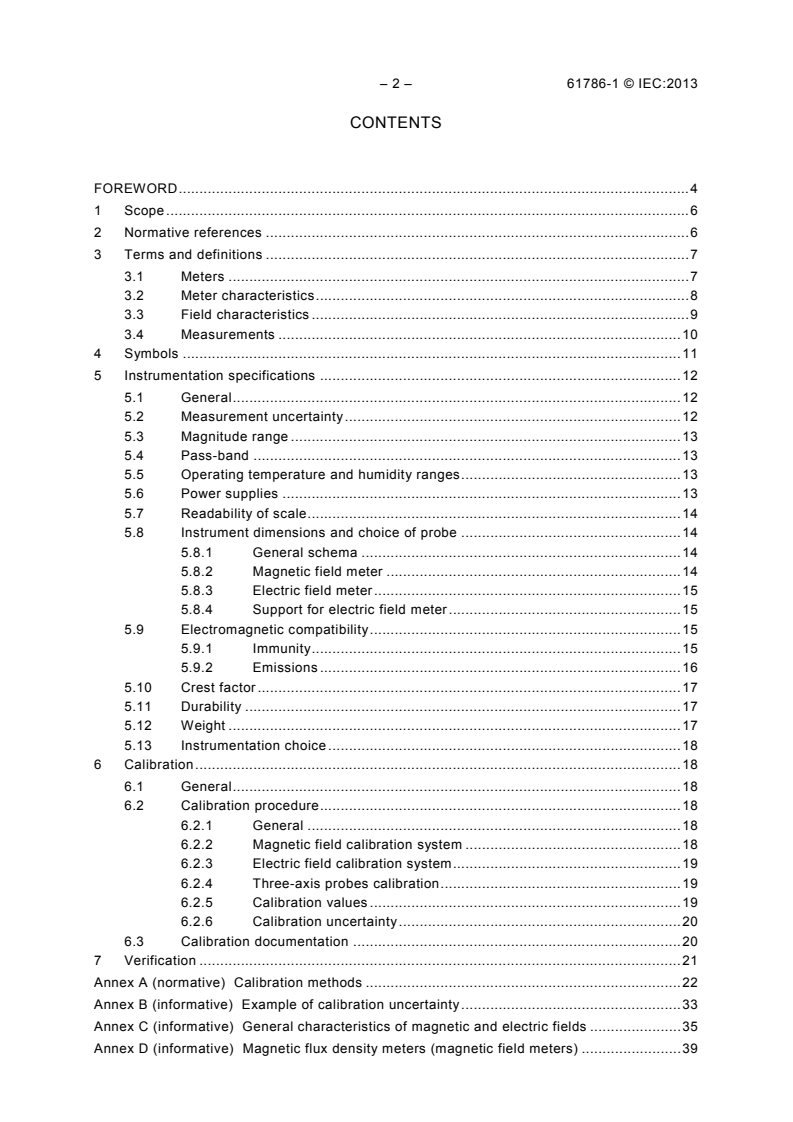
– 2 – 61786-1 © IEC:2013
CONTENTS
FOREWORD . 4
1 Scope . 6
2 Normative references . 6
3 Terms and definitions . 7
3.1 Meters . 7
3.2 Meter characteristics . 8
3.3 Field characteristics . 9
3.4 Measurements . 10
4 Symbols . 11
5 Instrumentation specifications . 12
5.1 General . 12
5.2 Measurement uncertainty . 12
5.3 Magnitude range . 13
5.4 Pass-band . 13
5.5 Operating temperature and humidity ranges . 13
5.6 Power supplies . 13
5.7 Readability of scale . 14
5.8 Instrument dimensions and choice of probe . 14
5.8.1 General schema . 14
5.8.2 Magnetic field meter . 14
5.8.3 Electric field meter . 15
5.8.4 Support for electric field meter . 15
5.9 Electromagnetic compatibility . 15
5.9.1 Immunity . 15
5.9.2 Emissions . 16
5.10 Crest factor . 17
5.11 Durability . 17
5.12 Weight . 17
5.13 Instrumentation choice . 18
6 Calibration . 18
6.1 General . 18
6.2 Calibration procedure . 18
6.2.1 General . 18
6.2.2 Magnetic field calibration system . 18
6.2.3 Electric field calibration system . 19
6.2.4 Three-axis probes calibration . 19
6.2.5 Calibration values . 19
6.2.6 Calibration uncertainty . 20
6.3 Calibration documentation . 20
7 Verification . 21
Annex A (normative) Calibration methods . 22
Annex B (informative) Example of calibration uncertainty . 33
Annex C (informative) General characteristics of magnetic and electric fields . 35
Annex D (informative) Magnetic flux density meters (magnetic field meters) . 39
61786-1 © IEC:2013 – 3 –
Annex E (informative) Electric field strength meters (electric field meters) . 43
Annex F (informative) Influence of humidity on electric field measurement . 47
Annex G (informative) Units . 49
Bibliography . 50
Figure 1 – Schema of a field meter . 14
Figure 2 – Insulating tripod and offset rod for an electric field probe (photograph RTE) . 15
Figure 3 – Electric field measurement using a hand-held stick (photograph RTE). 15
Figure A.1 – Deviation in percentage departure of calculated axial field [7] . 22
Figure A.2 – Coordinate system and geometry of rectangular loop of many turns of
wire (see Equation (A. 1)) . 23
Figure A.3 – Circular Helmholtz coils . 24
Figure A.4 – Deviation in percentage of calculated B from centre value (see Equation
z
(A.4)) . 25
Figure A.5 – Schematic view of a circuit for calibration of magnetic field meter using a
square loop to produce a known field . 25
Figure A.6 – Diagram for voltage injection technique . 27
Figure A.7 – Calculated normalized electric field at plate surfaces and midway between
plates as a function of the normalized distance from the edge of the plate . 28
Figure A.8 – Parallel plates system for calibrating free-body electric field meters . 30
Figure A.9 – Arrangement with parallel plates orientated perpendicular to the floor . 31
Figure A.10 – Diagram for current injection technique . 32
Figure C.1 – Oscillating and rotating field quantities for cases of elliptical polarization,
linear polarization, and circular polarization . 36
Figure C.2 – Magnetic field from current in straight and circular conductors . 37
Figure C.3 – Perturbation of electric field distribution by a person (from IEC 62226-3-1) . 38
Figure C.4 – Proximity effect with a 25 kV line and a building (from IEC 62110) . 38
Figure D.1 – Schematic view of simple magnetic field meter with coil-type probe . 39
Figure D.2 – Approximate equivalent circuit of a coil probe when connected to the
detector . 41
Figure E.1 – Single-axis free-body meter geometries . 44
Figure E.2 – Designs for flat plate probes used with ground-referenced electric field
meters . 45
Figure F.1 – Test in the climatic chamber with the normal tripod (left) and the offset
tripod (right) (photograph EDF R&D) . 47
Figure F.2 – E field measured as a function of the humidity with a normal tripod . 48
Figure F.3 – E field measured as a function of the humidity with an offset tripod . 48
Table 1 – Mains terminal disturbance voltage limits for class B group 1 equipment
measured on a test site . 17
Table A.1 – Calculated normalized electric field values midway between plates and at
plate surfaces . 30
Table B.1 – Example of uncertainty calculation . 33
– 4 – 61786-1 © IEC:2013
INTERNATIONAL ELECTROTECHNICAL COMMISSION
____________
MEASUREMENT OF DC MAGNETIC,
AC MAGNETIC AND AC ELECTRIC FIELDS FROM 1 Hz TO 100 kHz
WITH REGARD TO EXPOSURE OF HUMAN BEINGS –
Part 1: Requirements for measuring instruments
FOREWORD
1) The International Electrotechnical Commission (IEC) is a worldwide organization for standardization comprising
all national electrotechnical committees (IEC National Committees). The object of IEC is to promote
international co-operation on all questions concerning standardization in the electrical and electronic fields. To
this end and in addition to other activities, IEC publishes International Standards, Technical Specifications,
Technical Reports, Publicly Available Specifications (PAS) and Guides (hereafter referred to as “IEC
Publication(s)”). Their preparation is entrusted to technical committees; any IEC National Committee interested
in the subject dealt with may participate in this preparatory work. International, governmental and non-
governmental organizations liaising with the IEC also participate in this preparation. IEC collaborates closely
with the International Organization for Standardization (ISO) in accordance with conditions determined by
agreement between the two organizations.
2) The formal decisions or agreements of IEC on technical matters express, as nearly as possible, an international
consensus of opinion on the relevant subjects since each technical committee has representation from all
interested IEC National Committees.
3) IEC Publications have the form of recommendations for international use and are accepted by IEC National
Committees in that sense. While all reasonable efforts are made to ensure that the technical content of IEC
Publications is accurate, IEC cannot be held responsible for the way in which they are used or for any
misinterpretation by any end user.
4) In order to promote international uniformity, IEC National Committees undertake to apply IEC Publications
transparently to the maximum extent possible in their national and regional publications. Any divergence
between any IEC Publication and the corresponding national or regional publication shall be clearly indicated in
the latter.
5) IEC itself does not provide any attestation of conformity. Independent certification bodies provide conformity
assessment services and, in some areas, access to IEC marks of conformity. IEC is not responsible for any
services carried out by independent certification bodies.
6) All users should ensure that they have the latest edition of this publication.
7) No liability shall attach to IEC or its directors, employees, servants or agents including individual experts and
members of its technical committees and IEC National Committees for any personal injury, property damage or
other damage of any nature whatsoever, whether direct or indirect, or for costs (including legal fees) and
expenses arising out of the publication, use of, or reliance upon, this IEC Publication or any other IEC
Publications.
8) Attention is drawn to the Normative references cited in this publication. Use of the referenced publications is
indispensable for the correct application of this publication.
9) Attention is drawn to the possibility that some of the elements of this IEC Publication may be the subject of
patent rights. IEC shall not be held responsible for identifying any or all such patent rights.
International Standard IEC 61786-1 has been prepared by IEC technical committee 106:
Methods for the assessment of electric, magnetic and electromagnetic fields associated with
human exposure.
The first editions of IEC 61786-1 and IEC 61786-2 replace IEC 61786:1998. Part 1 deals with
measuring instruments, and Part 2 deals with measurement procedures. The content of the
standard was revised in order to give up-to-date and practical information to the user.
It has the status of a horizontal standard in accordance with IEC Guide 108.
61786-1 © IEC:2013 – 5 –
The text of this standard is based on the following documents:
FDIS Report on voting
106/292/FDIS 106/298/RVD
Full information on the voting for the approval of this standard can be found in the report on
voting indicated in the above table.
This publication has been drafted in accordance with the ISO/IEC Directives, Part 2.
A list of all parts of the IEC 61786 series, published under the general title Measurement of
DC magnetic fields and AC magnetic and electric fields from 1 Hz to 100 kHz with regard to
exposure of human beings, can be found on the IEC website.
The committee has decided that the contents of this publication will remain unchanged until
the stability date indicated on the IEC web site under "http://webstore.iec.ch" in the data
related to the specific publication. At this date, the publication will be
• reconfirmed,
• withdrawn,
• replaced by a revised edition, or
• amended.
IMPORTANT – The 'colour inside' logo on the cover page of this publication indicates
that it contains colours which are considered to be useful for the correct
understanding of its contents. Users should therefore print this document using a
colour printer.
– 6 – 61786-1 © IEC:2013
MEASUREMENT OF DC MAGNETIC,
AC MAGNETIC AND AC ELECTRIC FIELDS FROM 1 Hz TO 100 kHz
WITH REGARD TO EXPOSURE OF HUMAN BEINGS –
Part 1: Requirements for measuring instruments
1 Scope
This part of IEC 61786 provides guidance for measuring instruments used to measure the
field strength of quasi-static magnetic and electric fields that have a frequency content in the
range 1 Hz to 100 kHz and with DC magnetic fields to evaluate the exposure levels of the
human body to these fields.
Sources of fields include devices that operate at power frequencies and produce power
frequency and power frequency harmonic fields, as well as devices that produce fields within
the frequency range of this document, including devices that produce static fields, and the
earth’s static magnetic field. The magnitude ranges covered by this standard are 0,1 μT to
200 mT in AC (1 μT to 10 T in DC) and 1 V/m to 50 kV/m for magnetic fields and electric
fields, respectively.
When measurements outside this range are performed, most of the provisions of this standard
will still apply, but special attention should be paid to specified uncertainty and calibration
procedures.
Specifically, this standard
– defines terminology;
– identifies requirements on field meter specifications;
– indicates methods of calibration;
– defines requirements on instrumentation uncertainty;
– describes general characteristics of fields;
– describes operational principles of instrumentation.
NOTE Measurement methods that achieve defined goals pertaining to assessment of human exposure are
described in IEC 61786-2
Sources of uncertainty during calibration are also identified. In regard to electric field
measurements, this standard considers only the measurement of the unperturbed electric field
strength at a point in free space (i.e. the electric field prior to the introduction of the field
meter and operator) or above conducting surfaces.
This horizontal standard is primarily intended for use by technical committees in the
preparation of standards in accordance with the principles laid down in IEC Guide 108.
One of the responsibilities of a technical committee is, wherever applicable, to make use of
horizontal standards in the preparation of its publications. The contents of this horizontal
standard will not apply unless specifically referred to or included in the relevant publications.
2 Normative references
The following documents, in whole or in part, are normatively referenced in this document and
are indispensable for its application. For dated references, only the edition cited applies. For
61786-1 © IEC:2013 – 7 –
undated references, the latest edition of the referenced document (including any
amendments) applies.
IEC 61000-3-2, Electromagnetic compatibility (EMC) – Part 3-2: Limits – Limits for harmonic
current emissions (equipment input current ≤ 16 A per phase)
IEC 61000-4-2, Electromagnetic compatibility (EMC) – Part 4-2: Testing and measurement
techniques – Electrostatic discharge immunity test
IEC 61000-4-3, Electromagnetic compatibility (EMC) - Part 4-3 : Testing and measurement
techniques - Radiated, radio-frequency, electromagnetic field immunity test
IEC 61000-4-4, Electromagnetic compatibility (EMC) – Part 4-4: Testing and measurement
techniques – Electrical fast transient/burst immunity test
IEC 61000-4-6, Electromagnetic compatibility (EMC) – Part 4-6: Testing and measurement
techniques – Immunity to conducted disturbances, induced by radio-frequency fields
IEC 61000-4-8, Electromagnetic compatibility (EMC) – Part 4-8: Testing and measurement
techniques – Power frequency magnetic field immunity test
CISPR 11, Industrial, scientific and medical equipment – Radio-frequency disturbance
characteristics – Limits and methods of measurement
ISO/IEC Guide 98-3, Uncertainty of measurement – Part 3: Guide to the expression of
uncertainty in measurement (GUM:1995)
Guide 108, Guidelines for ensuring the coherency of IEC publications – Application of
horizontal standards
3 Terms and definitions
For the purposes of this document, the following terms and definitions apply.
NOTE 1 Internationally accepted SI-units are used throughout the standard.
NOTE 2 For other units, see Annex G.
NOTE 3 Throughout this standard, the words "magnetic flux density" and "magnetic field" will be considered
synonymous.
3.1 Meters
3.1.1
measuring instrument
device intended to be used to make measurements, alone or in conjunction with
supplementary devices
[SOURCE: IEC 60050-300:2001, 311-03-01]
3.1.2
field meter
meter designed to measure electric, magnetic and electromagnetic fields
Note 1 to entry: Field meters usually consist of three parts: the probe, the detector circuit and the display.
– 8 – 61786-1 © IEC:2013
3.1.3
probe
input device of a measuring instrument, generally made as a separate unit and connected to it
by means of a flexible cable, which transmits the measurand in a suitable form
Note 1 to entry: A probe can be composed of one or several sensors.
[SOURCE: IEC 60050-300:2001, 313-09-11, modified – a note to entry has been added.]
3.1.4
detector
device for discerning the existence or variations of waves, oscillations or signals, usually for
extracting information conveyed.
EXAMPLES Peak detector, rms detector
[SOURCE: IEC 60050-702:1992, 702-09-39, modified – the examples are different.]
3.1.5
free-body meter
meter that measures the unperturbed electric field strength at a point above the ground and is
supported in space without conductive contact to ground
3.1.6
fluxgate magnetometer
instrument designed to measure magnetic fields by making use of the non-linear magnetic
characteristics of a probe or sensing element that has a ferromagnetic core
3.1.7
ground reference meter
meter that measures the electric field at or close to the surface of the ground, frequently
implemented by measuring the induced current or charge oscillating between an isolated
electrode and ground.
Note 1 to entry: The isolated electrode is usually a plate located at ground level or slightly above the ground
surface.
3.1.8
survey meter
lightweight battery-operated meter that gives a real time read-out and that can be held
conveniently by hand in order to conduct survey type measurements in different locations
3.1.9
coil probe
magnetic flux density sensor comprised of a coil of wire that produces an induced voltage
proportional to the time derivative of the magnetic field
3.1.10
Hall effect probe
magnetic flux density sensor containing an element exhibiting the Hall effect to produce a
voltage proportional to the magnetic flux density
3.2 Meter characteristics
3.2.1
crest factor
ratio of the maximum absolute value of an alternating quantity to its root-mean-square value
[SOURCE: IEC 60050-103:2009, 103-14-57, modified – the original term was "peak factor"
and the note has been deleted.]
61786-1 © IEC:2013 – 9 –
3.2.2
crosstalk
the appearance of undesired energy in a channel, owing to the presence of a signal in another
channel, caused by, for example induction, conduction or non-linearity
[SOURCE: IEC 60050-722:1992, 722-15-03]
3.2.3
frequency response
for a linear time-invariant system with a sinusoidal input variable in steady state the ratio of
the phasor of the output variable to the phasor of the corresponding input variable,
represented as a function of the angular frequency ω
[SOURCE: IEC 60050-351:2006, 351-24-33, modified – the note in the original has been
deleted.]
3.2.4
isotropy of the probe
a measure of the degree to which the response of a field probe is independent of the
polarization and direction of propagation of the incident field
3.2.5
pass-band
frequency band throughout which the attenuation is less than a specified value
[SOURCE: IEC 60050-151:2001, 151-13-52]
3.2.6
root-mean-square value
rms value
1) for n quantities x , x ,.x , positive square root of the mean value of their squares:
1 2 n
2 2 2
(1)
X = (x + x + . + x )
q 1 2 n
n
2) for a quantity x depending of a variable t, positive square root of the mean value of the
square of the quantity taken over a given interval [t , t +T] of the variable
0 0
t +T
1 0
2
(2)
X = [x(t)] dt
q
∫
t
T
Note 1 to entry: The rms value of a periodic quantity is usually taken over an integration interval the range of
which is the period multiplied by a natural number
[SOURCE: IEC 60050-103:2009, 103-02-02, modified – the second note in the original
definition has been deleted.]
3.3 Field characteristics
3.3.1
unperturbed field
field at a point that would exist in the absence of persons or movable objects
– 10 – 61786-1 © IEC:2013
3.3.2
nearly uniform field
field in area where the resultant field over the cross-sectional area of the probe does not
change more than 1%
3.3.3
quasi-static field
c
(i.e. wavelength >> l), where f is the frequency of the
field that satisfies the condition f <<
l
field, c is the speed of light, and l is a characteristic dimension of the measurement geometry,
e.g. the distance between the field source and the measurement point
Note 1 to entry: Power frequency magnetic and electric fields near power lines and appliances are examples of
quasi-static fields.
3.3.4
resultant field
field given by the expression
2 2 2
= + + (3)
F F F F
R x y z
where F , F , and F are the rms values of the three orthogonal field components,
x y z
or by the expression
2 2
F = +
F F (4)
max min
R
where F and F are the rms values of the semi-major and semi-minor axes of the field
max min
ellipse, respectively.
Note 1 to entry: The resultant F is always ≥F . If the field is linearly polarized, F = 0 and F = F . If the
R max min R max
field is circularly polarized, F = F and F ≈ 1,41 F .
max min R max
3.4 Measurements
3.4.1
correction factor
numerical factor by which the uncorrected result of a measurement is multiplied to
compensate for a known error
Note 1 to entry: Since the known error cannot be determined perfectly, the compensation cannot be complete.
3.4.2
coverage factor
numerical factor used as a multiplier of the combined standard uncertainty in order to obtain
an expanded uncertainty
Note 1 to entry: For a quantity z described by a normal distribution with expectation µ and standard deviation σ,
z
the interval µ ± kσ encompasses 68,27 %, 95,45 % and 99,73 % of the distribution for a coverage factor k = 1, 2
z
and 3, respectively.
3.4.3
scale factor
factor by which the instrument reading is multiplied to obtain its input quantity
3.4.4
standard uncertainty
uncertainty of the result of a measurement expressed as a standard deviation
61786-1 © IEC:2013 – 11 –
3.4.5
uncertainty of calibration
parameter, associated with the result of a calibration, that characterizes the dispersion of the
values that could reasonably be attributed to the measurand
Note 1 to entry: Uncertainty of calibration generally comprises many components. Some of these components
may be estimated on the basis of the statistical distribution of the results of series of measurements, and can be
characterized by experimental standard deviations. Estimates of other components can be based on experience or
other information.
4 Symbols
a = radius of coil probe; radius of spherical electric field probe
2a, 2b = side dimensions of rectangular coil
B = magnetic flux density vector
B = amplitude of alternating magnetic field
B = resultant magnetic field
R
B = axial magnetic flux density
z
C = stray capacitance of coil probe
d = spacing of parallel plates; distance from electromagnetic field source; spacing
of Helmholtz coils
D = electric displacement vector
E = electric field strength
E = uniform electric field strength
F , F = rms values of semi-major and semi-minor axes of field ellipse
max min
I = current to magnetic field coils
L = inductance of coil probe
N = number of turns of wire (magnetic field coil system)
Q = induced charge
r = distance between magnetic field source and measurement location; resistance
of coil probe and leads
R = approximate input impedance of detector circuit (magnetic field meter); radius
of Helmholtz coils
S = electrode surface area (electric field meter)
t = time
T = period of periodic signal
V = voltage
Z = impedance in current injection circuit
λ = wave length
ε = permittivity of free space
µ = permeability of free space
ϕ = magnetic flux
ω = angular frequency of alternating field
– 12 – 61786-1 © IEC:2013
5 Instrumentation specifications
5.1 General
When measuring field in the context of assessment of human exposure, the following items
are considered below:
– measurement of the resultant field strength;
– measurement of the unperturbed electric field.
NOTE 1 Other items may be required depending on the goal of the measurement.
The various types of instrumentation available for characterizing quasi-static magnetic fields
are described in Clause D.1.
The various types of instrumentation available for characterizing static magnetic fields are
described in Clause D.3
Several types of magnetic field meters are in common use, e.g. field meters with coil probes,
meters with Hall-effect probes, and meters that combine two coils with a ferromagnetic core
as in a fluxgate magnetometer.
NOTE 2 Hall effect probes respond to static as well as time-varying magnetic flux densities. Due to limited
sensitivity and saturation problems sometimes encountered when attempting to measure small power frequency
flux densities in the presence of the substantial static geomagnetic flux of the earth, Hall-effect probes have
seldom been used to measure magnetic fields of a.c. power lines.
The various types of instrumentation available for characterizing quasi-static electric fields are
described in Clause E.1. The following two types of electric field meters are considered in this
standard:
a) the free-body meter;
b) the ground reference meter.
Sufficient information shall be provided with the instrumentation, including instrument
specifications and a clearly written instruction manual, to enable users to determine
compliance with this standard, to aid them in the proper operation of the field meter, and to
assess the usefulness of the device for the user's application. The instrument specifications
that shall be provided and/or satisfied are given below.
5.2 Measurement uncertainty
The measurement uncertainty of the measuring instrument shall be specified by the
manufacturer of the instrument. The measurement uncertainty shall be determined following
the ISO/IEC Guide 98-3. The uncertainty shall be specified as an extended measurement
uncertainty using a coverage factor of 2. The uncertainty is valid after available correction
factors are applied. The uncertainty shall contain all components which are relevant when the
instrument is used in a nearly uniform field. Such components may be calibration uncertainty,
frequency response, deviations of the gain in different measurement range settings, isotropy
of the probe, internal noise sources, non-linearity, stability, temperature response and
humidity response. The uncertainty of the instrument does not include effects due to the
handling of the instrument like positioning the probe in a non-uniform field or the influence of
the measuring person on the field to be measured. Such components must be taken into
account as additional uncertainties in the measurement report.
NOTE 1 At power frequency, the uncertainty of measuring instrument is usually 10 % or better.
NOTE 2 Examples of guidelines on the treatment of calibration uncertainties are given in Annex B.
61786-1 © IEC:2013 – 13 –
5.3 Magnitude range
The magnitude range over which the instrument operates within the specified uncertainty shall
be clearly indicated.
5.4 Pass-band
Broadband measuring instruments in the AC range always have a lower and an upper cut off
frequency, which define a pass band. Normally the pass band limits are defined by the minus
3 dB point of the frequency response. The nominal frequency response of an instrument can
be described as the frequency response of a system with a high pass filter and a low pass
filter connected in series. The filter types and the filter orders should be specified (e.g. 3rd
th
order Butterworth high pass and 5 order Butterworth low pass). The nominal frequency
response of the instrument is normally not treated as a source of measurement uncertainty
because the band limiting effect of the filters is a desired property of the instrument if
broadband measurements are made. In frequency selective measurements (e.g. FFT) the
band limiting effect of the filters is not desired and the nominal frequency response should be
automatically corrected. The measurement uncertainty of an instrument due to manufacturing
tolerances is normally greater at the band limits compared to medium frequencies. Therefore
the measurement uncertainty of an instrument is often specified also and sometimes only in a
restricted frequency range. This range is not as broad as the pass band but should be still
broad enough to cover all frequencies of interest. In the restricted frequency range the
influence of the nominal frequency response shall be negligible.
5.5 Operating temperature and humidity ranges
The temperature and relative humidity ranges over which the instrument operates within the
specified uncertainty shall be at least -10 °C to 45 °C and 5 % to 95 %, respectively. Sudden
temperature changes that can lead to condensation in the instrument should be avoided.
Electric field measurement may be perturbed if the relative humidity is more than 70 % due to
condensation effect on the probe and support [2] . Since the effect of humidity depends on
the field meter, the ability of the field meter to work correctly under those conditions should be
checked before measurement (see Annex F).
5.6 Power supplies
The use of measurement equipment that is operating on internal battery power is
recommended.
If batteries are used, provision should be made to indicate whether the battery condition is
adequate for proper operation of the field meter. Instruments used to record personal
exposure should be capable of at least 8 h operation within their rated uncertainty before
replacement or recharging of the batteries becomes necessary.
If rechargeable batteries are used it is recommended that the instrumentation is not operated
while connected to the charging station. When such connections are necessary, it should be
demonstrated that stray fields from the battery charger, conducted disturbances from the
mains voltage and electromagnetic coupling via the connecting leads (to the battery charger)
do not affect the measurement (see 5.9).
There shall be no wire connections to electric field free-body meters.
If batteries with ferromagnetic jackets are used in exposure meters, care must be exercised
that the jackets do not significantly influence readings by the instrument (see IEC 61786-2 for
more details about source of measurement uncertainty).
___________
Numbers in square brackets refer to the Bibliography.
– 14 – 61786-1 © IEC:2013
5.7 Readability of scale
The display of the meter, if applicable, should be digital.
Remote displays shall be used to avoid perturbation of the electric field by the observer.
The meter digital displays of magnetic field survey meters should be large enough to be easily
read at arm's length. If more than one range of sensitivity is provided, the full scale value of
the selected range should be indicated, and the units should be readily interpretable. For
auto-ranging instrumentation, the magnitude range may be indicated elsewhere, e.g. in the
user manual. The instrumentation should provide a clear indication of the units being
displayed.
5.8 Instrument dimensions and choice of probe
5.8.1 General schema
A general schema of a meter is given in Figure 1.
Field meter
Probe
Sensor
Display
Detector circuit
Sensor
Sensor
IEC 2993/13
Figure 1 – Schema of a field meter
The probes should be three-axis.
NOTE Single-axis probes can be used to measure the rms values of the semi-major axes of the field ellipse by
orienting the probe until a maximum reading is obtained. Single-axis meters can also be used to determine the
resultant magnetic field by measuring the rms values of three orthogonal spatial components and combining them
according to Equation (3). It is assumed that during this procedure there are no significant changes in the rms
values of the spatial components. Single axis use is suitable for electric field measurement referenced to
conducting surface.
5.8.2 Magnetic field meter
The dimensions of the meter should be provided.
The size of the probe should be appropriate to the spatial variation of the field measured. The
probe shall be of area 0,01 m , or smaller. With three-axis probes, the three sensors may be
concentric or, if the sensors are no larger than 0,05 m, they should be as close together as
possible. The maximum dimension of the space containing the three sensors combined shall
not exceed 0,2 m.
Coil probes should be either circular or square in cross-section; small deviations from these
shapes, for example where concentric coils cross each other, are permitted.
Since the induced voltage is proportional to the time derivative of the magnetic flux density,
the detector circuit requires an integrating stage to recover the waveform of the magnetic flux
density.
The locations and orientations of the sensors that are contained within the housings of
magnetic field meters shall be clearly indicated on the instrument or in the instruction manual.
61786-1 © IEC:2013 – 15 –
5.8.3 Electric field meter
The dimensions for electric field meters should be given in the manufacturer documentation
according to meter type:
a) free-body meter: the maximum probe dimensions of the volume containing probe shall not
exceed 0,2 m;
b) ground reference meter: probe dimensions and length of connecting coaxial cable.
5.8.4 Support for electric field meter
The support for electric field meter shall be made of insulating material, such as synthetic or
composite material.
The dimension of the support depends on how the probe is supported:
– probe supported by a insulating tripod = 1m (Figure 2);
– probe supported by a standing man holding a hand-held stick = 2m (Figure 3).
IEC 2994/13
Figure 2 – Insulating tripod and offset rod for an electric field probe (photograph RTE)
IEC 2995/13
Figure 3 – Electric field measurement using a hand-held stick (photograph RTE)
5.9 Electromagnetic compatibility
5.9.1 Immunity
a) Power frequency electric field
...