


IEC PAS 62129:2004
(Main)Calibration of optical spectrum analyzers
General Information
- Abstract
Provides procedures for calibrating an optical spectrum analyzer designed to measure the power distribution of an optical spectrum; this analyzer is equiped with an input port for use with a fibre-optic connector. This document applies to optical spectrum analyzers developed for use in fibre-optic communications and is limited to equipment that can directly measure the optical spectrum output from an optical fibre, where the optical fibre is connected to an input port installed in the optical spectrum analyzer through a fibre-optic connector.
- Status
- Replaced
- Publication Date
- 09-Mar-2004
- Technical Committee
- TC 86 - Fibre optics
- Drafting Committee
- WG 4 - TC 86/WG 4
- Current Stage
- DELPUB - Deleted Publication
- Start Date
- 16-Jan-2006
- Completion Date
- 28-Aug-2026

Relations
- Effective Date
- 05-Sep-2023
Get Certified
Connect with accredited certification bodies for this standard

ANCE
Mexican certification and testing association.

BSMI (Bureau of Standards, Metrology and Inspection)
Taiwan's standards and inspection authority.

Intertek Slovenia
Intertek testing, inspection, and certification services in Slovenia.
Sponsored listings
Frequently Asked Questions
IEC PAS 62129:2004 is a technical specification published by the International Electrotechnical Commission (IEC). Its full title is "Calibration of optical spectrum analyzers". This standard covers: Provides procedures for calibrating an optical spectrum analyzer designed to measure the power distribution of an optical spectrum; this analyzer is equiped with an input port for use with a fibre-optic connector. This document applies to optical spectrum analyzers developed for use in fibre-optic communications and is limited to equipment that can directly measure the optical spectrum output from an optical fibre, where the optical fibre is connected to an input port installed in the optical spectrum analyzer through a fibre-optic connector.
Provides procedures for calibrating an optical spectrum analyzer designed to measure the power distribution of an optical spectrum; this analyzer is equiped with an input port for use with a fibre-optic connector. This document applies to optical spectrum analyzers developed for use in fibre-optic communications and is limited to equipment that can directly measure the optical spectrum output from an optical fibre, where the optical fibre is connected to an input port installed in the optical spectrum analyzer through a fibre-optic connector.
IEC PAS 62129:2004 is classified under the following ICS (International Classification for Standards) categories: 17.180.30 - Optical measuring instruments; 33.180.99 - Other fibre optic equipment. The ICS classification helps identify the subject area and facilitates finding related standards.
IEC PAS 62129:2004 has the following relationships with other standards: It is inter standard links to IEC 62129:2006. Understanding these relationships helps ensure you are using the most current and applicable version of the standard.
IEC PAS 62129:2004 is available in PDF format for immediate download after purchase. The document can be added to your cart and obtained through the secure checkout process. Digital delivery ensures instant access to the complete standard document.
Standards Content (Sample)
PUBLICLY
IEC
AVAILABLE
PAS 62129
SPECIFICATION
First edition
Pre-Standard
2004-03
Calibration of optical spectrum analyzers
Reference number
IEC/PAS 62129:2004(E)
Publication numbering
As from 1 January 1997 all IEC publications are issued with a designation in the
60000 series. For example, IEC 34-1 is now referred to as IEC 60034-1.
Consolidated editions
The IEC is now publishing consolidated versions of its publications. For example,
edition numbers 1.0, 1.1 and 1.2 refer, respectively, to the base publication, the
base publication incorporating amendment 1 and the base publication incorporating
amendments 1 and 2.
Further information on IEC publications
The technical content of IEC publications is kept under constant review by the IEC,
thus ensuring that the content reflects current technology. Information relating to
this publication, including its validity, is available in the IEC Catalogue of
publications (see below) in addition to new editions, amendments and corrigenda.
Information on the subjects under consideration and work in progress undertaken
by the technical committee which has prepared this publication, as well as the list
of publications issued, is also available from the following:
• IEC Web Site (www.iec.ch)
• Catalogue of IEC publications
The on-line catalogue on the IEC web site (www.iec.ch/searchpub) enables you to
search by a variety of criteria including text searches, technical committees
and date of publication. On-line information is also available on recently issued
publications, withdrawn and replaced publications, as well as corrigenda.
• IEC Just Published
This summary of recently issued publications (www.iec.ch/online_news/ justpub)
is also available by email. Please contact the Customer Service Centre (see
below) for further information.
• Customer Service Centre
If you have any questions regarding this publication or need further assistance,
please contact the Customer Service Centre:
Email: custserv@iec.ch
Tel: +41 22 919 02 11
Fax: +41 22 919 03 00
PUBLICLY
IEC
AVAILABLE
PAS 62129
SPECIFICATION
First edition
Pre-Standard
2004-03
Calibration of optical spectrum analyzers
© IEC 2004 ⎯ Copyright - all rights reserved
No part of this publication may be reproduced or utilized in any form or by any means, electronic or
mechanical, including photocopying and microfilm, without permission in writing from the publisher.
International Electrotechnical Commission, 3, rue de Varembé, PO Box 131, CH-1211 Geneva 20, Switzerland
Telephone: +41 22 919 02 11 Telefax: +41 22 919 03 00 E-mail: inmail@iec.ch Web: www.iec.ch
PRICE CODE
Commission Electrotechnique Internationale
X
International Electrotechnical Commission
Международная Электротехническая Комиссия
For price, see current catalogue
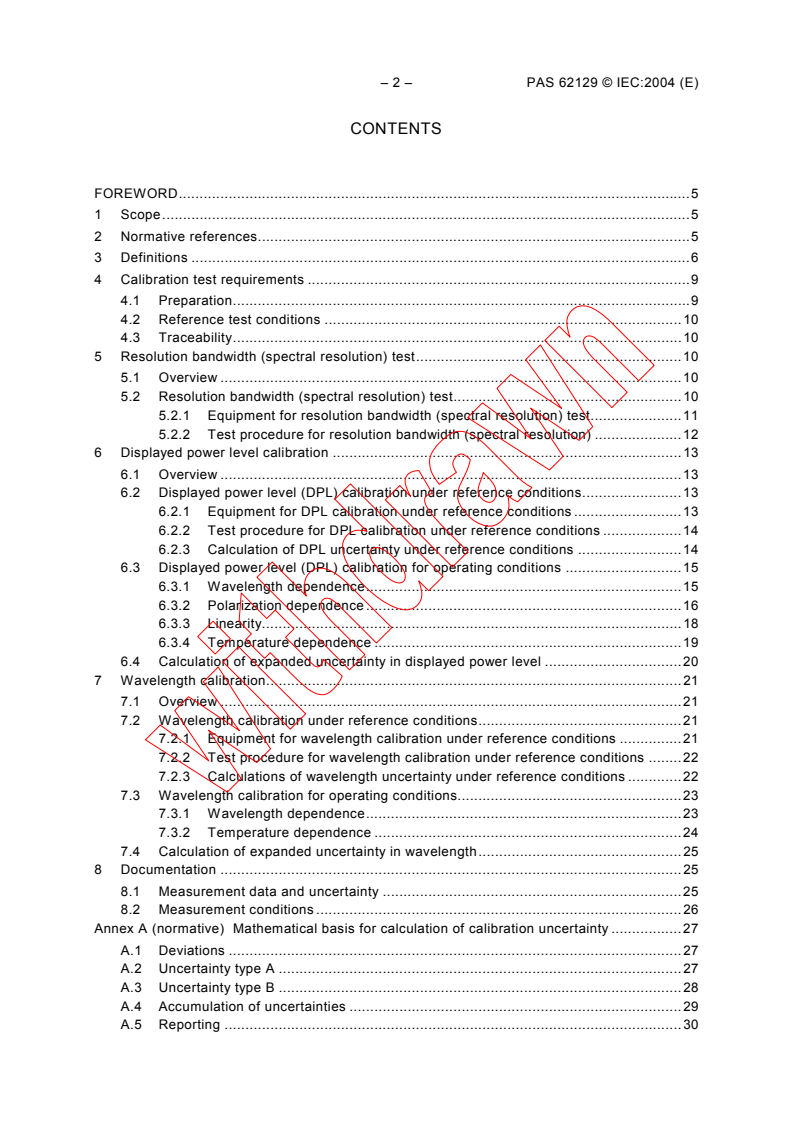
– 2 – PAS 62129 © IEC:2004 (E)
CONTENTS
FOREWORD.5
1 Scope.5
2 Normative references.5
3 Definitions .6
4 Calibration test requirements .9
4.1 Preparation.9
4.2 Reference test conditions .10
4.3 Traceability.10
5 Resolution bandwidth (spectral resolution) test.10
5.1 Overview .10
5.2 Resolution bandwidth (spectral resolution) test.10
5.2.1 Equipment for resolution bandwidth (spectral resolution) test.11
5.2.2 Test procedure for resolution bandwidth (spectral resolution) .12
6 Displayed power level calibration .13
6.1 Overview .13
6.2 Displayed power level (DPL) calibration under reference conditions.13
6.2.1 Equipment for DPL calibration under reference conditions .13
6.2.2 Test procedure for DPL calibration under reference conditions .14
6.2.3 Calculation of DPL uncertainty under reference conditions .14
6.3 Displayed power level (DPL) calibration for operating conditions .15
6.3.1 Wavelength dependence.15
6.3.2 Polarization dependence.16
6.3.3 Linearity.18
6.3.4 Temperature dependence .19
6.4 Calculation of expanded uncertainty in displayed power level .20
7 Wavelength calibration.21
7.1 Overview .21
7.2 Wavelength calibration under reference conditions.21
7.2.1 Equipment for wavelength calibration under reference conditions .21
7.2.2 Test procedure for wavelength calibration under reference conditions .22
7.2.3 Calculations of wavelength uncertainty under reference conditions .22
7.3 Wavelength calibration for operating conditions.23
7.3.1 Wavelength dependence.23
7.3.2 Temperature dependence .24
7.4 Calculation of expanded uncertainty in wavelength.25
8 Documentation .25
8.1 Measurement data and uncertainty .25
8.2 Measurement conditions .26
Annex A (normative) Mathematical basis for calculation of calibration uncertainty .27
A.1 Deviations .27
A.2 Uncertainty type A .27
A.3 Uncertainty type B .28
A.4 Accumulation of uncertainties .29
A.5 Reporting .30
PAS 62129 © IEC:2004 (E) – 3 –
Annex B (informative) Examples of calculation of calibration uncertainty.31
B.1 Displayed power level calibration .31
B.1.1 Uncertainty under reference conditions: σ .31
∆Pref
B.1.2 Uncertainty under operating conditions.32
B.1.3 Expanded uncertainty calculation .35
B.2 Wavelength calibration .35
B.2.1 Uncertainty under reference conditions: σ .35
∆λref
B.2.2 Uncertainty under operating conditions.36
B.2.3 Expanded uncertainty calculation .37
Annex C (informative) Using the calibration results .39
C.1 General .39
C.1.1 Scope 39
C.1.2 Parameters.39
C.1.3 Restrictions .39
C.2 Additive corrections .39
C.2.1 Parameters.39
C.2.2 Measurements close to a calibration reference wavelength.40
C.2.3 Measurements at other wavelengths .40
C.3 Multiplicative corrections.41
C.3.1 Parameters.41
C.3.2 Measurements close to a calibration reference wavelength.41
C.3.3 Measurements at other wavelengths .41
C.4 OSA calibration results (additive correction).42
Annex D (informative) Wavelength references .44
D.1 Gas laser lines .44
D.2 Noble gas reference lines .44
D.3 Molecular absorption lines .45
D.4 Reference documents.48
Annex E (informative) Further reading and references for calibration of wavelength
scale.49
– 4 – PAS 62129 © IEC:2004 (E)
INTERNATIONAL ELECTROTECHNICAL COMMISSION
____________
CALIBRATION OF OPTICAL SPECTRUM ANALYZERS
FOREWORD
1) The International Electrotechnical Commission (IEC) is a worldwide organization for standardization comprising
all national electrotechnical committees (IEC National Committees). The object of IEC is to promote
international co-operation on all questions concerning standardization in the electrical and electronic fields. To
this end and in addition to other activities, IEC publishes International Standards, Technical Specifications,
Technical Reports, Publicly Available Specifications (PAS) and Guides (hereafter referred to as “IEC
Publication(s)”). Their preparation is entrusted to technical committees; any IEC National Committee interested
in the subject dealt with may participate in this preparatory work. International, governmental and non-
governmental organizations liaising with the IEC also participate in this preparation. IEC collaborates closely
with the International Organization for Standardization (ISO) in accordance with conditions determined by
agreement between the two organizations.
2) The formal decisions or agreements of IEC on technical matters express, as nearly as possible, an international
consensus of opinion on the relevant subjects since each technical committee has representation from all
interested IEC National Committees.
3) IEC Publications have the form of recommendations for international use and are accepted by IEC National
Committees in that sense. While all reasonable efforts are made to ensure that the technical content of IEC
Publications is accurate, IEC cannot be held responsible for the way in which they are used or for any
misinterpretation by any end user.
4) In order to promote international uniformity, IEC National Committees undertake to apply IEC Publications
transparently to the maximum extent possible in their national and regional publications. Any divergence
between any IEC Publication and the corresponding national or regional publication shall be clearly indicated in
the latter.
5) IEC provides no marking procedure to indicate its approval and cannot be rendered responsible for any
equipment declared to be in conformity with an IEC Publication.
6) All users should ensure that they have the latest edition of this publication.
7) No liability shall attach to IEC or its directors, employees, servants or agents including individual experts and
members of its technical committees and IEC National Committees for any personal injury, property damage or
other damage of any nature whatsoever, whether direct or indirect, or for costs (including legal fees) and
expenses arising out of the publication, use of, or reliance upon, this IEC Publication or any other IEC
Publications.
8) Attention is drawn to the Normative references cited in this publication. Use of the referenced publications is
indispensable for the correct application of this publication.
9) Attention is drawn to the possibility that some of the elements of this IEC Publication may be the subject of
patent rights. IEC shall not be held responsible for identifying any or all such patent rights.
A PAS is a technical specification not fulfilling the requirements for a standard but made
available to the public.
IEC-PAS 62129 has been prepared by IEC technical committee 86: Fibre optics.
The text of this PAS is based on the This PAS was approved for
following document: publication by the P-members of the
committee concerned as indicated in
the following document
Draft PAS Report on voting
86/202/NP 86/214/RVN
Following publication of this PAS, which is a pre-standard publication, the technical committee
or subcommittee concerned will transform it into an International Standard.
PAS 62129 © IEC:2004 (E) – 5 –
CALIBRATION OF OPTICAL SPECTRUM ANALYZERS
1 Scope
This document provides procedures for calibrating an optical spectrum analyzer designed to
measure the power distribution of an optical spectrum; this analyzer is equipped with an input
port for use with a fibre-optic connector.
An optical spectrum analyzer is equipped with the following minimum features:
a) the ability to present a display of an optical spectrum with respect to absolute wavelength;
b) a marker/cursor that displays the optical power and wavelength at a point on the spectrum
display.
NOTE This specification applies to optical spectrum analyzers developed for use in fibre-optic communications
and is limited to equipment that can directly measure the optical spectrum output from an optical fibre, where the
optical fibre is connected to an input port installed in the optical spectrum analyzer through a fibre-optic connector.
In addition, an optical spectrum analyzer can measure the spectral power distribution with
respect to the absolute wavelength of the tested light and display the results of such
measurements; it will not include an optical wavelength meter that measures only centre
wavelengths, a Fabry-Perot interferometer or a monochromator that has no display unit.
The procedures outlined in this document are considered to be mainly performed by users of
optical spectrum analyzers. The document, therefore, does not include correction using the
calibration results in the main body. The correction procedures are described in Annex C. Of
course, this document will be useful in calibration laboratories and for manufacturers of optical
spectrum analyzers.
2 Normative references
The following referenced documents are indispensable for the application of this document. For
dated references, only the edition cited applies. For undated references, the latest edition of
the referenced document (including any amendments) applies.
IEC 60050-731:1991, International Electrotechnical Vocabulary (IEV) – Chapter 731: Optical
fibre communication
IEC 60359:2001, Electrical and electronic measurement equipment − Expression of
performance
IEC 60793-1(all parts), Optical fibres – Part 1: Measurement methods and test procedures
IEC 60825-1:1993, Safety of laser products – Part 1: Equipment classification, requirements
and user's guide
IEC 60825-2:2000, Safety of laser products – Part 2: Safety of optical fibre communication
systems
IEC 61290-3-1:2003, Optical amplifiers – Test methods − Part 3-1: Noise figure parameters –
Optical spectrum analyzer method
ISO 9000: Quality management systems − Fundamentals and vocabulary
ISO:1995, Guide to the expression of uncertainty in measurement
ISO:1993, International vocabulary of basic and general terms in metrology
– 6 – PAS 62129 © IEC:2004 (E)
3 Definitions
For the purposes of this document, the definitions contained in IEC 60050-731 and the
following definitions apply.
3.1
calibration
set of operations which establishes, under specified conditions, the relationship between the
values indicated by the measuring instrument and the corresponding known values of that
quantity (see also ISO International vocabulary of basic and general terms in metrology,
definition 6.11)
3.2
calibration under reference conditions
calibration which includes the evaluation of the test analyzer uncertainty under reference
conditions (3.17)
3.3
calibration for operating conditions
calibration for operating conditions of an optical spectrum analyzer (3.16) including the
evaluation of the test analyzer operational uncertainty
3.4
centre wavelength
λ
centre
power-weighted mean wavelength of a light source in a vacuum, in nanometers (nm)
For a continuous spectrum, the centre wavelength is defined as
λ = (1 / P ) ρ(λ) λ dλ (1)
centre total
∫
For a spectrum consisting of discrete lines, the centre wavelength is defined as
λ = Pλ / P (2)
∑ i i ∑ i
centre
ii
where
ρ(λ) is the power spectral density of the source, for example in W/nm;
th
λ is the i discrete wavelength;
i
P is the power at λ , for example, in watts;
i i
P is ΣP = total power, for example, in watts.
i
total
NOTE The above integrals and summations theoretically extend over the entire spectrum of the light source.
3.5
confidence level
estimation of the probability that the true value of a measured parameter lies in the given range
(see expanded uncertainty (3.11))
3.6
coverage factor
k
coverage factor, k, is used to calculate the expanded uncertainty (3.11) U from the standard
uncertainty (3.21), σ (see 3.11)
PAS 62129 © IEC:2004 (E) – 7 –
3.7
displayed power level
DPL
power level indicated by an optical spectrum analyzer (3.16) undergoing calibration (3.1) at
a specified wavelength resolution setting
NOTE With an optical spectrum analyzer, the power level for a set resolution is measured and displayed.
3.8
displayed power level deviation
∆P
difference between the displayed power level measured by the test analyzer, P , and the
OSA
corresponding reference power, P , divided by the reference power
ref
∆P = (P – P ) / P = P / P –1 (3)
OSA ref ref OSA ref
3.9
displayed power level uncertainty, symbol σ
∆P
standard uncertainty (3.21) of the displayed power level deviation
σ = σ(P / P – 1) (4)
∆P OSA ref
NOTE In the above formula, σ is to be understood as the standard uncertainty (3.21).
3.10
displayed wavelength range
complete wavelength range shown in an optical spectrum analyzer (3.16) display for a
particular instrument state (3.12)
3.11
expanded uncertainty
U
expanded uncertainty, U (also called the confidence interval) is the range of values within
which the measurement parameter, at the stated confidence level (3.5), can be expected to
lie. It is equal to the coverage factor (3.6), k, times the combined standard uncertainty
(3.21) σ:
U = k σ (5)
NOTE When the distribution of uncertainties is assumed to be normal and a large number of measurements are
made, then confidence levels (3.5) of 68,3 %, 95,5 % and 99,7 % correspond to k values of 1, 2 and 3 respectively.
The measurement uncertainty of an optical spectrum analyzer (3.16) should be specified in
the form of expanded uncertainty, U.
3.12
instrument state
complete description of the measurement conditions and state of an optical spectrum
analyzer (3.16) during the calibration process
NOTE Typical parameters of the instrument state are the displayed wavelength range (3.10) in use, the
resolution bandwidth (spectral resolution) (3.18), the display mode (watt or dBm), warm-up time and other
instrument settings.
3.13
measurement result
displayed or electrical output of any optical spectrum analyzer (3.16) in wavelength, in units
of nm or µm, and in power level, in units of mW or dBm, after completing all operations
suggested by the operating instructions, for example warm-up
– 8 – PAS 62129 © IEC:2004 (E)
3.14
measurement wavelength range
wavelength range of injected light over which an optical spectrum analyzer (3.16)
performance is specified
3.15
operating conditions
all conditions of the measured and influential qualities, and other important requirements which
the expanded uncertainty (3.11) of an optical spectrum analyzer (3.16) is intended to be
met (modified from ISO International vocabulary of basic and general terms in metrology,
definition 5.5)
3.16
optical spectrum analyzer
OSA
optical instrument for measuring the power distribution of a spectrum with respect to
wavelength (frequency)
NOTE An OSA is equipped with an input port for use with a fibre-optic connector, and the spectrum is obtained
from light injected into the input port; the instrument also includes a screen-display function.
3.17
reference conditions
appropriate set of influencing parameters, their nominal values and their tolerance bands, with
respect to which the uncertainty at reference conditions is specified (modified from IEC 60359,
3.3.10)
NOTE Each tolerance band includes both the possible uncertainty of the condition and the uncertainty in
measuring the condition.
The reference conditions normally include the following parameters and, if necessary, their tolerance bands:
reference date, reference temperature, reference humidity, reference atmospheric pressure, reference light source,
reference displayed power level (3.7), reference fibre, reference connector-adapter combination, reference
wavelength, reference (spectral) bandwidth and resolution bandwidth (spectral resolution) (3.18) set.
3.18
resolution bandwidth (spectral resolution)
R
full width at half maximum (FWHM) of the displayed spectrum obtained by the test analyzer
when using a source whose spectral bandwidth (3.20) is sufficiently narrow, that is, very
much less than the resolution bandwidth being measured
3.19
side-mode suppression ratio
SMSR
peak power ratio between the main mode spectrum and the largest side mode spectrum in a
single-mode laser diode such as a DFB-LD
NOTE The side-mode suppression ratio is usually described in dB.
3.20
spectral bandwidth
B
for the purpose of this document, the FWHM of the spectral width of the source.
If the source exhibits a continuous spectrum, then the spectral bandwidth, B, is the FWHM of
the spectrum.
If the source is a laser diode with a multiple-longitudinal mode spectrum, then the FWHM
spectral bandwidth B is the RMS spectral bandwidth, multiplied by 2,35 (assuming the source
has a Gaussian envelope):
1/2
⎡ ⎤
(6)
B = 2,35 [{(1 / P ) × Pλ } – λ ]
⎢ i i ⎥
∑
total centre
⎣ i ⎦
PAS 62129 © IEC:2004 (E) – 9 –
where
λ is the centre wavelength (3.4) of laser diode, in nm;
centre
P is ∑P = total power, in watts;
i
total
th
P
is the power of i longitudinal mode, in watts;
i
th
λ is the wavelength of i longitudinal mode, in nm.
i
3.21
standard uncertainty
σ
uncertainty of a measurement result expressed as a standard deviation
NOTE For further information, see Annex A and the ISO Guide to the expression of uncertainty in measurement.
3.22
uncertainty type A
type of uncertainty obtained by a statistical analysis of a series of observations, such as when
evaluating certain random effects of measurement (see ISO Guide to the expression of
uncertainty in measurement)
3.23
uncertainty type B
type of uncertainty obtained by means other than a statistical analysis of observations, for
example an estimation of probable sources of uncertainty, such as when evaluating systematic
effects of measurement (see ISO Guide to the expression of uncertainty in measurement)
NOTE Other means may include previous measurement data, experience with or general knowledge of the
behaviour and properties of relevant materials, instruments, manufacturers’ specifications, data provided in
calibration and other certificates, and uncertainties assigned to reference data taken from handbooks.
3.24
wavelength deviation
∆λ
difference between the centre wavelength (3.4) measured by the test analyzer, λ , and the
OSA
reference wavelength, λ , in nm or µm
ref
∆λ = λ – λ (7)
OSA ref
3.25
wavelength uncertainty
σ
∆λ
standard uncertainty (3.21) of the wavelength deviation (3.24), in nm or µm
4 Calibration test requirements
4.1 Preparation
The following recommendations apply.
Calibrations should be carried out in facilities that are separate from other functions of the
organization. This separation should include laboratory accommodation and measurement
equipment.
The calibration laboratory should operate a quality control system appropriate to the range of
measurement it performs (for example, ISO 9000), when the calibration is performed in
calibration laboratories. There should be independent scrutiny of the measurement results,
intermediary calculations and preparation of calibration certificates.
– 10 – PAS 62129 © IEC:2004 (E)
The environmental conditions shall be commensurate with the degree of uncertainty that is
required for calibration:
a) the environment shall be clean;
b) temperature monitoring and control is required;
c) all laser sources shall be safely operated (see IEC 60825-1).
Perform all tests at an ambient room temperature of 23 °C ± 3 °C with a relative humidity of
(50 ± 20) % unless otherwise specified. Give the test equipment a minimum of 2 h prior to
testing to reach equilibrium with its environment. Allow the optical spectrum analyzer a warm-
up period in accordance with the manufacturer’s instructions.
4.2 Reference test conditions
The reference test conditions usually include the following parameters and, if necessary, their
tolerance bands: date, temperature, relative humidity, displayed power level, wavelength, light
source, fibre, connector-adapter combination, (spectral) bandwidth and resolution bandwidth
(spectral resolution) set. Unless otherwise specified, use a single-mode optical fibre input
pigtail as prescribed by IEC 60793-1, having a length of at least 2 m.
Operate the optical spectrum analyzer in accordance with the manufacturer’s specifications
and operating procedures. Where practical, select a range of test conditions and parameters
which emulate the actual field operating conditions of the analyzer under test. Choose these
parameters so as to optimize the accuracy of the analyzer and resolution capabilities, as
specified by the manufacturer’s operating procedures.
Document the conditions as specified in Clause 8.
NOTE 1 The calibration results only apply to the set of test conditions used in the calibration process.
NOTE 2 Because of the potential for hazardous radiation, be sure to establish and maintain conditions of laser
safety. Refer to IEC 60825-1 and IEC 60825-2.
4.3 Traceability
Make sure that any test equipment which has a significant influence on the calibration results is
calibrated in an unbroken chain to the appropriate national standard or natural physical
constant. Upon request, specify this test equipment and its calibration chain(s). The re-
calibration period(s) shall be defined and documented.
5 Resolution bandwidth (spectral resolution) test
5.1 Overview
The resolution bandwidth (spectral resolution) of the test analyzer should be tested prior to
displayed power level and wavelength calibration because the resolution bandwidth influences
their calibration. This test is performed under reference calibration conditions. Wavelength is
shown in a vacuum.
NOTE The result of the resolution bandwidth (spectral resolution) test described here should be employed as the
optical bandwidth (in wavelength units) for the measurement of optical-amplifier noise-figure. The calibration of
optical bandwidth is described in IEC 61290-3-1.
5.2 Resolution bandwidth (spectral resolution) test
Alternative set-ups for the resolution bandwidth are shown in Figures 1, 2, and 3. In the Figure
1 set-up, a gas laser whose wavelength is known is used as the light source. Figure 2 shows a
set-up in which a broadband source is used in conjunction with a transmission device with
known (traceable) wavelengths of peak (or null) transmission. Figure 3 shows a set-up in which
a laser diode (LD) whose wavelength is unknown is used for the light source.
PAS 62129 © IEC:2004 (E) – 11 –
Optical fibre
Light Test
analyzer
source
a) for resolution bandwidth test,
b) for wavelength calibration under reference conditions, and
c) for determining the wavelength dependence of wavelength uncertainty.
Figure 1 – Set-up using a gas laser whose wavelength is known
Optical fibre Optical fibre
Broad-
Transmission
Test
band
device
analyzer
source
a) for resolution bandwidth test,
b) for wavelength calibration under reference conditions, and
c) for determining the wavelength dependence of wavelength uncertainty.
Figure 2 – Set-up using a broadband source with a transmission device
Optical fibre
Light Test
analyzer
source
Wavelength
meter
a) for resolution bandwidth test,
b) for wavelength calibration under reference conditions, and
c) for determining the wavelength dependence of wavelength uncertainty.
Figure 3 – Set-up using an LD with an unknown wavelength
5.2.1 Equipment for resolution bandwidth (spectral resolution) test
a) Light source: use the light source prescribed for calibrating the test analyzer; if a light
source is not prescribed, use one with a spectral bandwidth and wavelength stability
sufficient for the minimum resolution bandwidth prescribed for the test analyzer.
Recommended light sources are lasers such as those listed in Table 1, a laser diode (LD)
or other laser (which may be tunable) having a spectral bandwidth much narrower than the
resolution bandwidth of the test analyzer. Also, a broadband source may be used in
conjunction with a transmission device with known (traceable) wavelengths of peak (or null)
– 12 – PAS 62129 © IEC:2004 (E)
transmission. The transmission device may be, for example, a series of fixed narrowband
filters, absorption lines in gaseous media, or Fabry-Perot interferometers. Annex D
tabulates many stable wavelength references. The reference used should have a
wavelength stability, spectral bandwidth, and power stability sufficient for the resolution
bandwidth test.
Table 1 – Recommended light sources
Light source Wavelength (nm) [vac]
488,122
Ar laser
514,673
632,991
He-Ne laser 1152,590
1523,488
b) Wavelength meter: an instrument for measuring the wavelength of a light source. Its
precision must be sufficiently better than the precision required in the wavelength test. This
instrument is used when a laser diode (LD) with an unknown wavelength is used as the light
source.
c) Optical fibre: single-mode optical fibre as prescribed by IEC 60793-1.
5.2.2 Test procedure for resolution bandwidth (spectral resolution)
Using the test set-up shown in Figure 1, 2 or 3, set the wavelength measurement range of the
test analyzer so that it includes the wavelength of the light source.
a) Set the resolution bandwidth of the test analyzer to its specified value. Let the specified
value be R .
set
b) Measure the resolution of the displayed spectral bandwidth, that is, the wavelength interval
3 dB below the peak value, as R . Repeat this measurement at least ten times and
OSAi
calculate the average resolution.
m
R = R / m (8)
∑ OSAi
OSA
i=1
where m is the number of measurements.
c) Calculate the difference ratio of the OSA value from the resolution bandwidth setting using
equation (9).
∆r = R / R – 1 (9)
diff OSA set
d) If necessary, repeat this procedure with different resolution bandwidth settings.
NOTE 1 When the test analyzer has a wavelength span linearity error, it is necessary to tune the light source
slightly around the wavelength of interest, while making multiple measurements of the displayed 3 dB bandwidth to
obtain an accurate measurement of the true resolution bandwidth at a given wavelength. The required tuning range
is of the order of ±1 nm, so this measurement can be made with a temperature-tuned DFB laser, an external cavity
laser or a tunable fibre laser. By averaging the resolution bandwidth readings, a more accurate measurement of the
true resolution bandwidth can be obtained.
NOTE 2 If the resolution bandwidth should be corrected on the basis of the calibration results, this is typically
implemented by making software corrections to the instrument, mathematical corrections to the results, or
instrument hardware adjustments. Once the adjustments have been made, it is advisable to repeat the test to verify
that the correction has operated correctly. See Annex C.
PAS 62129 © IEC:2004 (E) – 13 –
6 Displayed power level calibration
6.1 Overview
The factors making up uncertainty in the displayed power level of the test analyzer consist of
a) the intrinsic uncertainty of the test analyzer as found in the test under reference conditions,
and
b) partial uncertainties due to wavelength dependence, polarization dependence, linearity and
temperature dependence as found in tests under operating conditions.
If the test analyzer is used beyond the reference conditions, it is necessary to obtain the partial
uncertainties.
The intrinsic uncertainty under the reference conditions is obtained by the calibration procedure
described in 6.2. The partial uncertainties are obtained by the calibration procedure described
in 6.3.1 to 6.3.4 in compliance with the individual factor, that is, wavelength, polarization,
linearity and temperature. When the test analyzer is only used under reference conditions, the
calibration procedures described in 6.3 are not essential, that is, they are not mandatory.
NOTE 1 Since the unit generally used for measurement values, dBm, is not appropriate for uncertainty
accumulation, linear units (mW, µW) are used. Results of such accumulations can be converted back to dB to
express overall uncertainty when needed.
NOTE 2 A power meter or a reference power meter will be needed to check the light source power each time a
new source wavelength is used.
NOTE 3 The state of polarization should not be changed during calibration except controlling by an optional
polarization controller.
6.2 Displayed power level (DPL) calibration under reference conditions
Figure 4 shows the test configuration for determining the uncertainty in the displayed power
level (DPL). This test is performed under reference calibration conditions.
Optical fibre Optical fibre
Optical fibre
Light Variable
Polarization Test
source attenuator analyzer
controller
(Optional)
Reference
power
meter
Figure 4 – Set-up for calibration of displayed power level under reference conditions
NOTE The light source used for the displayed power level calibration should be depolarized, or else a polarization
controller should be used. This will calibrate the test analyzer at the mid-point of its variation due to polarization
6.2.1 Equipment for DPL calibration under reference conditions
a) Light source: use a light source which can emit stable optical-fibre light with an output
from 0,1 mW (–10 dBm) to 1 mW (0 dBm), and which offers good suppression of side-
modes and optical noise (>40 dB, when measured with a resolution bandwidth which is the
same as that of the test analyzer) outside its spectral bandwidth. The source spectral
bandwidth should, in turn, be sufficiently narrower than the resolution prescribed for the test
analyzer. The light sources shown in Table 1, a laser diode (LD) (SMSR > 40 dB: see 3.19)
or a fibre laser (also with SMSR > 40 dB) are recommended.
– 14 – PAS 62129 © IEC:2004 (E)
NOTE The wavelength of the light source should be measured in advance by using a wavelength meter if a
laser diode (LD) or a fibre laser is used.
b) Variable attenuator: use a variable attenuator that can be adjusted over the optical power
range used in the test.
c) Reference optical power meter: either of the following operated under reference
calibration conditions:
1) an optical power meter calibrated by an official institution that performs calibration
services with a stated uncertainty; or
2) an optical power meter calibrated according to standards specified by such an official
institution with a stated uncertainty.
Namely, the uncertainty of the reference power meter, σ , is already known and is
PPM
described in its certification.
d) Optional polarization controller: a polarization controller is used which controls the state
of polarization of incident light to obtain an optical fibre output with an extinction ratio of
20 dB or more. The level variation when the state of polarization is changed should be far
smaller than the polarization dependence of the test analyzer. Some polarization controllers
are combinations of a polarizer, a 1/2-wavelength plate and a 1/4-wavelength plate; some
rotate two fibre loops.
6.2.2 Test procedure for DPL calibration under reference conditions
Using the test configuration shown in Figure 5, set the resolution of the test analyzer
sufficiently larger than the spectral bandwidth of the light source. Adjust the variable attenuator
so that the power level of the outgoing light to the test analyzer is optimized. If the wavelength
of the light source is not already known, it should be measured by using a wavelength meter.
The measurement sequence is as follows.
a) Measure the value of the outgoing optical-fibre light as P using a reference optical
REF,i
power meter. If a polarization controller is used, measure multiple times at different states
of polarization and average these values.
b) After this, connect the outgoing optical-fibre light to the test analyzer and read the peak
power level measured by the test analyzer as P use a linear scale (in units of mW or
OSAi;
µW) to read the value. If a polarization controller is used, measure multiple times at
different states of polarization and average these values.
c) Calculate the difference ratio of the OSA value from the power meter measurement using
equation (10).
∆P = P / P – 1 (10)
diff,i OSAi REF,i
d) Repeat this measurement at least ten times.
6.2.3 Calculation of DPL uncertainty under reference conditions
Calculate the mean and standard deviation of the difference ratio using the following equations.
m
∆P = ( /∆P ) m (11)
diff ∑ diff,i
i=1
m
2 1/2
σ = (∆P −∆P ) / (m – 1 ) (12)
∆Pdiff [∑ diff,i diff ]
i=1
where m is the number of measurements used.
PAS 62129 © IEC:2004 (E) – 15 –
The uncertainty σ with respect to the displayed power level for the test analyzer operated
∆Pref
under reference calibration conditions is given by equation (13).
2 2 1/2
σ = (σ + σ ) (13)
∆Pref PPM ∆Pdiff
where
σ is the uncertainty of the reference optical power meter described in its certification;
PPM
σ is the standard deviation of the values measured during the test.
∆Pdiff
The displayed power level deviation ∆P is given by equation (14), which is the same as the
ref
mean value of the difference ratio.
∆P = ∆P (14)
ref diff
6.3 Displayed power level (DPL) calibration for operating conditions
The calibration described in this chapter is not mandatory. Perform the calibration procedure
when the test analyzer is used beyond the reference calibrations.
Individual factors in the displayed power level uncertainty for the operating conditions may
consist of the following:
1) wavelength dependence;
2) polarization dependence;
3) linearity; and
4) temperature dependence.
6.3.1 Wavelength dependence
Figure 5 shows the test configuration for determining wavelength dependence. This test is
performed under reference calibration conditions except for the wavelength.
Optical fibre
Optical fibre
Variable-
Polarization Test
wavelength
analyzer
controller
light source
(Optional)
Optical
power
meter
Wavelength
meter
Figure 5 – Test configuration for determining the wavelength dependence
of displayed power level uncertainty
6.3.1.1 Equipment for determining DPL wavelength dependence
a) Light source: use a variable-wavelength light source such as a tunable laser. It should
supply the needed amount of light power stably within the test wavelength range of the test
– 16 – PAS 62129 © IEC:2004 (E)
analyzer, and its spectral bandwidth should be far narrower than the specified resolution
bandwidth of the test analyzer.
b) Wavelength meter: use to measure the wavelength of the variable-wavelength light source.
It is unnecessary if the light source has been calibrated.
c) Optical power meter: use a non-wavelength-dependent optical power meter, or one whose
wavelength dependence has been calibrated.
d) Optional polarization controller: a polarization controller is used which controls the state
of polarization of incident light to obtain an optical fibre output with an extinction ratio of 20
dB or more. The level variation when the state of polarization is changed should be far
smaller than the polarization dependence of the test analyzer. Some polarization controllers
are combinations of a polarizer, a 1/2-wavelength plate and a 1/4-wavelength plate; some
rotate two fibre loops.
6.3.1.2 Test procedure for determining DPL wavelength dependence
Use the test configuration shown in Figure 5.
The test procedure is as follows.
a) After the environmental temperature is completely stabilized, input light
...