

IEC 62384:2006
(Main)DC or AC supplied electronic control gear for LED modules - Performance requirements
General Information
- Abstract
This international standard specifies performance requirements for electronic control gear for use on d.c. supplies up to 250 V and a.c. supplies up to 1 000 V at 50 Hz or 60 Hz with an output frequency which can deviate from the supply frequency, associated with LED modules according to IEC 62031. Control gear for LED modules specified in this standard are designed to provide constant voltage or current. Deviations from the pure voltage and current types do not exclude the gear from this standard.
This publication is to be read in conjunction with IEC 61347-2-13:2006.
- Status
- Published
- Publication Date
- 29-Mar-2011
- Technical Committee
- SC 34C - Auxiliaries for lamps
- Drafting Committee
- WG 1 - TC 34/SC 34C/WG 1
- Current Stage
- DELPUB - Deleted Publication
- Start Date
- 13-May-2020
- Completion Date
- 28-Aug-2026
Buy Documents
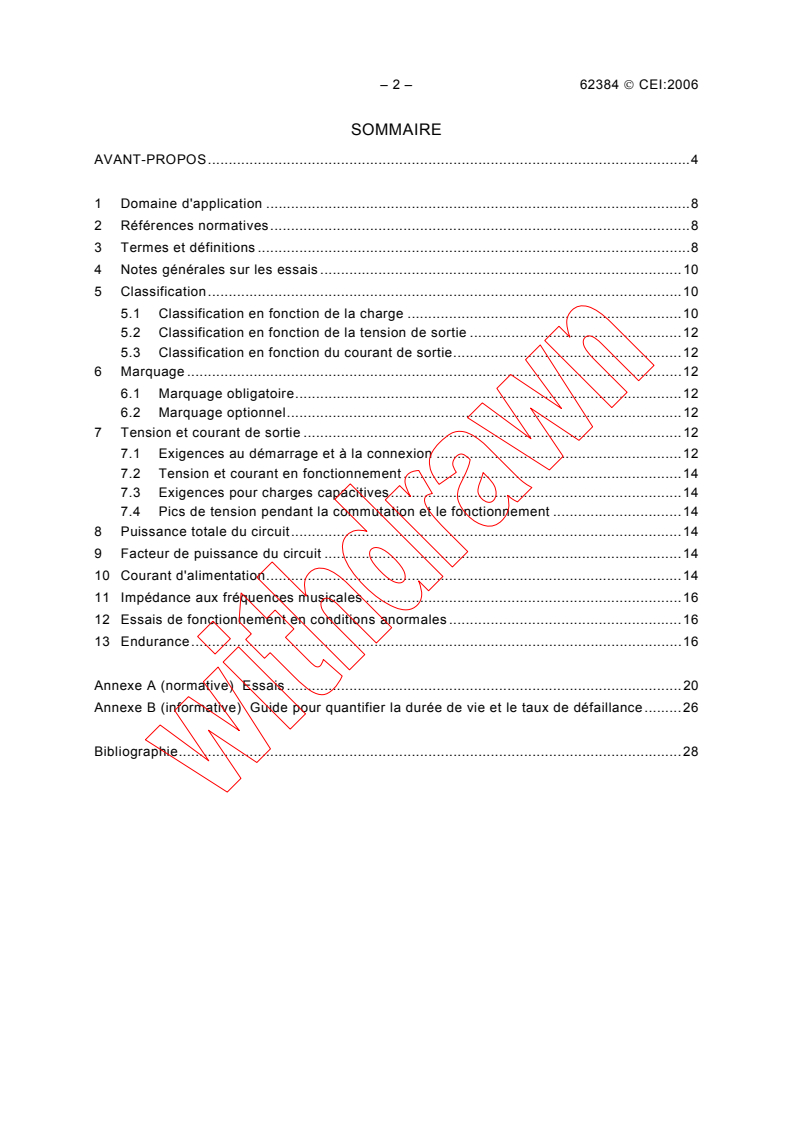
IEC 62384:2006 - DC or AC supplied electronic control gear for LED modules - Performance requirements Released:8/30/2006
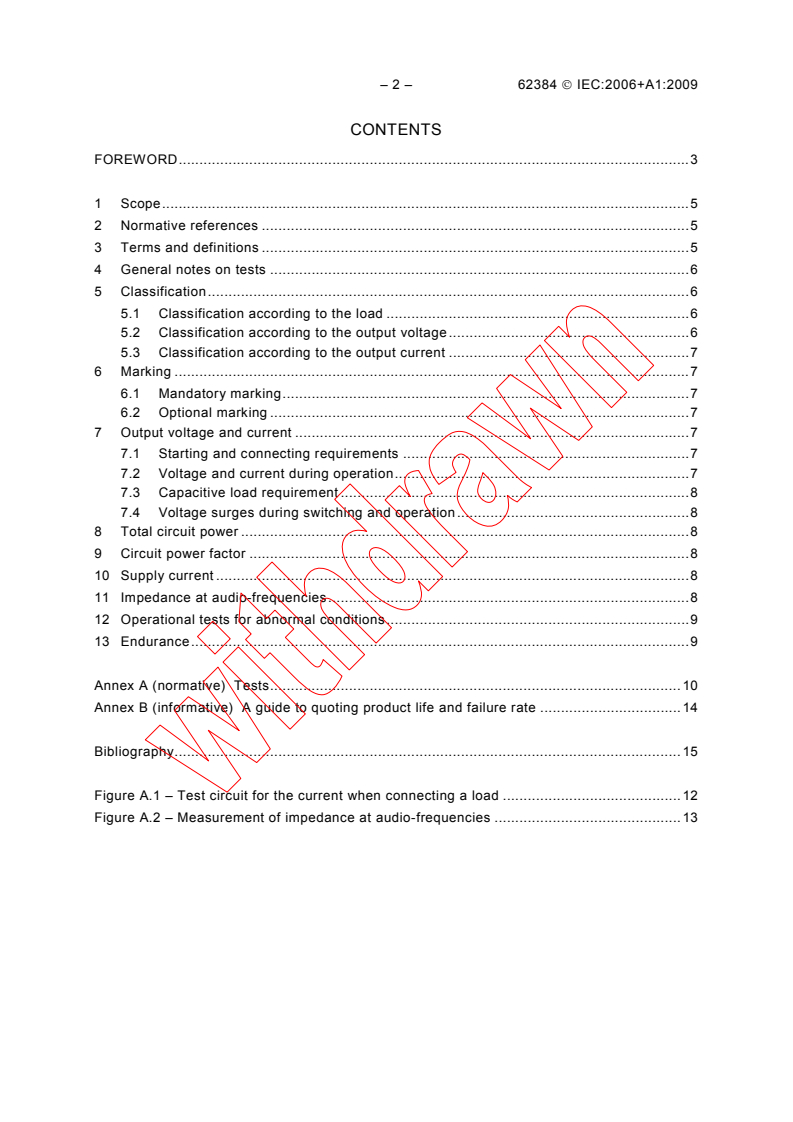
IEC 62384:2006+AMD1:2009 CSV - DC or AC supplied electronic control gear for LED modules - Performance requirements Released:3/30/2011
Overview
IEC 62384:2006 is an international standard developed by the International Electrotechnical Commission (IEC) that outlines the performance requirements for electronic control gear intended for use with LED modules. The standard covers both DC-supplied (up to 250 V) and AC-supplied (up to 1,000 V at 50 or 60 Hz) electronic control gear, with output frequencies that may differ from the supply frequency. Control gear described in this document are designed to provide either constant voltage or constant current to LED modules, supporting a wide range of lighting applications.
IEC 62384 applies to control gear operating with LED modules as specified in IEC 62031. It is intended to ensure reliable performance, enhance safety, and facilitate compatibility in the global lighting industry. This standard is to be read in conjunction with IEC 61347-2-13, which specifies particular safety requirements for DC or AC supplied electronic control gear for LED modules.
Key Topics
IEC 62384 addresses various critical parameters and test requirements for electronic control gear for LED modules. Key topics include:
- Performance Testing: Outlines type tests to verify the performance of control gear in terms of voltage and current stability, output limits, and response to load changes.
- Operating Voltage and Current: Defines criteria for both stabilized and non-stabilized voltage and current control gear, ensuring output stays within ±10% of rated values under specified supply conditions.
- Marking Requirements: Specifies mandatory product markings such as circuit power factor (λ), as well as optional markings for temperature ranges, suitability for dimming, and operational modes.
- Load and Output Classifications: Details classification schemes based on load (single value or multiple value), output voltage (stabilized/non-stabilized), and output current (stabilized/non-stabilized).
- Capacitive Load Handling: Sets requirements for handling capacitive loads to prevent operational disturbances, especially during the starting process and load connection.
- Abnormal Conditions Testing: Ensures control gear resilience when operated without LED modules or during short-circuit conditions.
- Endurance Testing: Includes cycling tests for temperature and supply voltage to assess longevity and performance stability.
- Impedance at Audio Frequencies: Specifies minimum impedance at audio frequencies to reduce potential audio interference in certain control gear.
Applications
IEC 62384 is crucial for manufacturers, testing laboratories, and lighting system integrators in the LED lighting sector. It is particularly relevant for:
- LED Luminaires Production: Ensuring that control gear used in commercial, residential, or industrial LED luminaires meets global performance standards.
- Quality Assurance and Certification: Serving as a reference for type testing and certifying electronic control gear for LED modules to ensure product reliability and safety.
- Product Design and Development: Guiding designers in the development of control gear that maintains stable LED operation, efficient energy usage, and compatibility with various supply voltages and frequencies.
- Market Compliance: Helping organizations meet international and regional regulatory requirements, smoothing access to global markets.
Related Standards
For comprehensive compliance and compatibility in LED installations, consider the following interconnected standards:
- IEC 61347-2-13: Particular safety requirements for electronic control gear for LED modules; IEC 62384 must be read in conjunction with this standard.
- IEC 62031: Safety requirements for LED modules; establishes expectations for the modules that the control gear operates.
- IEC 61000-3-2: Addresses limits on harmonic current emissions for electromagnetic compatibility.
- IEC 61547: Defines EMC immunity requirements for lighting equipment.
By adhering to IEC 62384:2006, organizations can ensure electronic control gear for LED modules deliver reliable performance, energy efficiency, and safe integration in lighting systems worldwide. For efficient implementation and up-to-date compliance, always consult the latest edition of the standard and related documentation.
Relations
- Effective Date
- 05-Sep-2023
- Revised
IEC 62384:2020 - DC or AC supplied electronic controlgear for LED modules - Performance requirements - Effective Date
- 05-Sep-2023
Buy Documents
IEC 62384:2006 - DC or AC supplied electronic control gear for LED modules - Performance requirements Released:8/30/2006
IEC 62384:2006+AMD1:2009 CSV - DC or AC supplied electronic control gear for LED modules - Performance requirements Released:3/30/2011
Get Certified
Connect with accredited certification bodies for this standard

IMQ S.p.A. (Certification)
Italian electrical product certification.

SLG Prüf- und Zertifizierungs GmbH
German testing and certification body.

UL Solutions
Global safety science company with testing, inspection and certification.
Sponsored listings
Frequently Asked Questions
IEC 62384:2006 is a standard published by the International Electrotechnical Commission (IEC). Its full title is "DC or AC supplied electronic control gear for LED modules - Performance requirements". This standard covers: This international standard specifies performance requirements for electronic control gear for use on d.c. supplies up to 250 V and a.c. supplies up to 1 000 V at 50 Hz or 60 Hz with an output frequency which can deviate from the supply frequency, associated with LED modules according to IEC 62031. Control gear for LED modules specified in this standard are designed to provide constant voltage or current. Deviations from the pure voltage and current types do not exclude the gear from this standard. This publication is to be read in conjunction with IEC 61347-2-13:2006.
This international standard specifies performance requirements for electronic control gear for use on d.c. supplies up to 250 V and a.c. supplies up to 1 000 V at 50 Hz or 60 Hz with an output frequency which can deviate from the supply frequency, associated with LED modules according to IEC 62031. Control gear for LED modules specified in this standard are designed to provide constant voltage or current. Deviations from the pure voltage and current types do not exclude the gear from this standard. This publication is to be read in conjunction with IEC 61347-2-13:2006.
IEC 62384:2006 is classified under the following ICS (International Classification for Standards) categories: 29.140.99 - Other standards related to lamps; 31.080.99 - Other semiconductor devices. The ICS classification helps identify the subject area and facilitates finding related standards.
IEC 62384:2006 has the following relationships with other standards: It is inter standard links to IEC 62384:2006/AMD1:2009, IEC 62384:2020. Understanding these relationships helps ensure you are using the most current and applicable version of the standard.
IEC 62384:2006 is available in PDF format for immediate download after purchase. The document can be added to your cart and obtained through the secure checkout process. Digital delivery ensures instant access to the complete standard document.
Standards Content (Sample)
NORME CEI
INTERNATIONALE
IEC
INTERNATIONAL
Première édition
STANDARD
First edition
2006-08
Appareillages électroniques alimentés
en courant continu ou alternatif
pour modules de DEL –
Exigences de performances
DC or AC supplied electronic
control gear for LED modules –
Performance requirements
Numéro de référence
Reference number
CEI/IEC 62384:2006
Numérotation des publications Publication numbering
Depuis le 1er janvier 1997, les publications de la CEI As from 1 January 1997 all IEC publications are
sont numérotées à partir de 60000. Ainsi, la CEI 34-1 issued with a designation in the 60000 series. For
devient la CEI 60034-1. example, IEC 34-1 is now referred to as IEC 60034-1.
Editions consolidées Consolidated editions
Les versions consolidées de certaines publications de la The IEC is now publishing consolidated versions of its
CEI incorporant les amendements sont disponibles. Par publications. For example, edition numbers 1.0, 1.1
exemple, les numéros d’édition 1.0, 1.1 et 1.2 indiquent and 1.2 refer, respectively, to the base publication,
respectivement la publication de base, la publication de the base publication incorporating amendment 1 and
base incorporant l’amendement 1, et la publication de the base publication incorporating amendments 1
base incorporant les amendements 1 et 2. and 2.
Informations supplémentaires Further information on IEC publications
sur les publications de la CEI
Le contenu technique des publications de la CEI est The technical content of IEC publications is kept
constamment revu par la CEI afin qu'il reflète l'état under constant review by the IEC, thus ensuring that
actuel de la technique. Des renseignements relatifs à the content reflects current technology. Information
cette publication, y compris sa validité, sont dispo- relating to this publication, including its validity, is
nibles dans le Catalogue des publications de la CEI available in the IEC Catalogue of publications
(voir ci-dessous) en plus des nouvelles éditions, (see below) in addition to new editions, amendments
amendements et corrigenda. Des informations sur les and corrigenda. Information on the subjects under
sujets à l’étude et l’avancement des travaux entrepris consideration and work in progress undertaken by the
par le comité d’études qui a élaboré cette publication, technical committee which has prepared this
ainsi que la liste des publications parues, sont publication, as well as the list of publications issued,
également disponibles par l’intermédiaire de: is also available from the following:
• Site web de la CEI (www.iec.ch) • IEC Web Site (www.iec.ch)
• Catalogue des publications de la CEI • Catalogue of IEC publications
Le catalogue en ligne sur le site web de la CEI The on-line catalogue on the IEC web site
(www.iec.ch/searchpub) vous permet de faire des (www.iec.ch/searchpub) enables you to search by a
recherches en utilisant de nombreux critères, variety of criteria including text searches,
comprenant des recherches textuelles, par comité technical committees and date of publication. On-
d’études ou date de publication. Des informations en line information is also available on recently
ligne sont également disponibles sur les nouvelles issued publications, withdrawn and replaced
publications, les publications remplacées ou retirées, publications, as well as corrigenda.
ainsi que sur les corrigenda.
• IEC Just Published • IEC Just Published
Ce résumé des dernières publications parues This summary of recently issued publications
(www.iec.ch/online_news/justpub) est aussi dispo- (www.iec.ch/online_news/justpub) is also available
nible par courrier électronique. Veuillez prendre by email. Please contact the Customer Service
contact avec le Service client (voir ci-dessous) Centre (see below) for further information.
pour plus d’informations.
• Service clients • Customer Service Centre
Si vous avez des questions au sujet de cette If you have any questions regarding this
publication ou avez besoin de renseignements publication or need further assistance, please
supplémentaires, prenez contact avec le Service contact the Customer Service Centre:
clients:
Email: custserv@iec.ch Email: custserv@iec.ch
Tél: +41 22 919 02 11 Tel: +41 22 919 02 11
Fax: +41 22 919 03 00 Fax: +41 22 919 03 00
.
NORME CEI
INTERNATIONALE
IEC
INTERNATIONAL
Première édition
STANDARD
First edition
2006-08
Appareillages électroniques alimentés
en courant continu ou alternatif
pour modules de DEL –
Exigences de performances
DC or AC supplied electronic
control gear for LED modules –
Performance requirements
IEC 2006 Droits de reproduction réservés Copyright - all rights reserved
Aucune partie de cette publication ne peut être reproduite ni No part of this publication may be reproduced or utilized in any
utilisée sous quelque forme que ce soit et par aucun procédé, form or by any means, electronic or mechanical, including
électronique ou mécanique, y compris la photocopie et les photocopying and microfilm, without permission in writing from
microfilms, sans l'accord écrit de l'éditeur. the publisher.
International Electrotechnical Commission, 3, rue de Varembé, PO Box 131, CH-1211 Geneva 20, Switzerland
Telephone: +41 22 919 02 11 Telefax: +41 22 919 03 00 E-mail: inmail@iec.ch Web: www.iec.ch
CODE PRIX
N
PRICE CODE
Commission Electrotechnique Internationale
International Electrotechnical Commission
МеждународнаяЭлектротехническаяКомиссия
Pour prix, voir catalogue en vigueur
For price, see current catalogue
– 2 – 62384 CEI:2006
SOMMAIRE
AVANT-PROPOS.4
1 Domaine d'application .8
2 Références normatives.8
3 Termes et définitions .8
4 Notes générales sur les essais .10
5 Classification.10
5.1 Classification en fonction de la charge .10
5.2 Classification en fonction de la tension de sortie .12
5.3 Classification en fonction du courant de sortie.12
6 Marquage .12
6.1 Marquage obligatoire.12
6.2 Marquage optionnel.12
7 Tension et courant de sortie .12
7.1 Exigences au démarrage et à la connexion .12
7.2 Tension et courant en fonctionnement .14
7.3 Exigences pour charges capacitives.14
7.4 Pics de tension pendant la commutation et le fonctionnement .14
8 Puissance totale du circuit.14
9 Facteur de puissance du circuit .14
10 Courant d'alimentation.14
11 Impédance aux fréquences musicales .16
12 Essais de fonctionnement en conditions anormales .16
13 Endurance.16
Annexe A (normative) Essais .20
Annexe B (informative) Guide pour quantifier la durée de vie et le taux de défaillance.26
Bibliographie.28
62384 IEC:2006 – 3 –
CONTENTS
FOREWORD.5
1 Scope.9
2 Normative references .9
3 Terms and definitions .9
4 General notes on tests .11
5 Classification.11
5.1 Classification according to the load .11
5.2 Classification according to the output voltage.13
5.3 Classification according to the output current .13
6 Marking .13
6.1 Mandatory marking.13
6.2 Optional marking .13
7 Output voltage and current .13
7.1 Starting and connecting requirements .13
7.2 Voltage and current during operation.15
7.3 Capacitive load requirement .15
7.4 Voltage surges during switching and operation.15
8 Total circuit power .15
9 Circuit power factor .15
10 Supply current .15
11 Impedance at audio-frequencies.17
12 Operational tests for abnormal conditions.17
13 Endurance.17
Annex A (normative) Tests.21
Annex B (informative) A guide to quoting product life and failure rate .27
Bibliography.29
– 4 – 62384 CEI:2006
COMMISSION ÉLECTROTECHNIQUE INTERNATIONALE
____________
APPAREILLAGES ÉLECTRONIQUES ALIMENTÉS EN COURANT
CONTINU OU ALTERNATIF POUR MODULES DE DEL –
EXIGENCES DE PERFORMANCES
AVANT-PROPOS
1) La Commission Electrotechnique Internationale (CEI) est une organisation mondiale de normalisation
composée de l'ensemble des comités électrotechniques nationaux (Comités nationaux de la CEI). La CEI a
pour objet de favoriser la coopération internationale pour toutes les questions de normalisation dans les
domaines de l'électricité et de l'électronique. A cet effet, la CEI – entre autres activités – publie des Normes
internationales, des Spécifications techniques, des Rapports techniques, des Spécifications accessibles au
public (PAS) et des Guides (ci-après dénommés "Publication(s) de la CEI"). Leur élaboration est confiée à des
comités d'études, aux travaux desquels tout Comité national intéressé par le sujet traité peut participer. Les
organisations internationales, gouvernementales et non gouvernementales, en liaison avec la CEI, participent
également aux travaux. La CEI collabore étroitement avec l'Organisation Internationale de Normalisation (ISO),
selon des conditions fixées par accord entre les deux organisations.
2) Les décisions ou accords officiels de la CEI concernant les questions techniques représentent, dans la mesure
du possible, un accord international sur les sujets étudiés, étant donné que les Comités nationaux de la CEI
intéressés sont représentés dans chaque comité d’études.
3) Les Publications de la CEI se présentent sous la forme de recommandations internationales et sont agréées
comme telles par les Comités nationaux de la CEI. Tous les efforts raisonnables sont entrepris afin que la CEI
s'assure de l'exactitude du contenu technique de ses publications; la CEI ne peut pas être tenue responsable
de l'éventuelle mauvaise utilisation ou interprétation qui en est faite par un quelconque utilisateur final.
4) Dans le but d'encourager l'uniformité internationale, les Comités nationaux de la CEI s'engagent, dans toute la
mesure possible, à appliquer de façon transparente les Publications de la CEI dans leurs publications
nationales et régionales. Toutes divergences entre toutes Publications de la CEI et toutes publications
nationales ou régionales correspondantes doivent être indiquées en termes clairs dans ces dernières.
5) La CEI n’a prévu aucune procédure de marquage valant indication d’approbation et n'engage pas sa
responsabilité pour les équipements déclarés conformes à une de ses Publications.
6) Tous les utilisateurs doivent s'assurer qu'ils sont en possession de la dernière édition de cette publication.
7) Aucune responsabilité ne doit être imputée à la CEI, à ses administrateurs, employés, auxiliaires ou
mandataires, y compris ses experts particuliers et les membres de ses comités d'études et des Comités
nationaux de la CEI, pour tout préjudice causé en cas de dommages corporels et matériels, ou de tout autre
dommage de quelque nature que ce soit, directe ou indirecte, ou pour supporter les coûts (y compris les frais
de justice) et les dépenses découlant de la publication ou de l'utilisation de cette Publication de la CEI ou de
toute autre Publication de la CEI, ou au crédit qui lui est accordé.
8) L'attention est attirée sur les références normatives citées dans cette publication. L'utilisation de publications
référencées est obligatoire pour une application correcte de la présente publication.
9) L’attention est attirée sur le fait que certains des éléments de la présente Publication de la CEI peuvent faire
l’objet de droits de propriété intellectuelle ou de droits analogues. La CEI ne saurait être tenue pour
responsable de ne pas avoir identifié de tels droits de propriété et de ne pas avoir signalé leur existence.
La Norme internationale CEI 62384 a été établie par le sous-comité 34C: Appareils auxiliaires
pour lampes, du comité d'études 34 de la CEI: Lampes et équipements associés
Le texte de cette norme est issu des documents suivants:
FDIS Rapport de vote
34C/752/FDIS 34C/760/RVD
Le rapport de vote indiqué dans le tableau ci-dessus donne toute information sur le vote ayant
abouti à l'approbation de cette norme.
Cette publication a été rédigée selon les Directives ISO/CEI, Partie 2.
62384 IEC:2006 – 5 –
INTERNATIONAL ELECTROTECHNICAL COMMISSION
____________
DC OR AC SUPPLIED ELECTRONIC CONTROL GEAR
FOR LED MODULES –
PERFORMANCE REQUIREMENTS
FOREWORD
1) The International Electrotechnical Commission (IEC) is a worldwide organization for standardization comprising
all national electrotechnical committees (IEC National Committees). The object of IEC is to promote
international co-operation on all questions concerning standardization in the electrical and electronic fields. To
this end and in addition to other activities, IEC publishes International Standards, Technical Specifications,
Technical Reports, Publicly Available Specifications (PAS) and Guides (hereafter referred to as “IEC
Publication(s)”). Their preparation is entrusted to technical committees; any IEC National Committee interested
in the subject dealt with may participate in this preparatory work. International, governmental and non-
governmental organizations liaising with the IEC also participate in this preparation. IEC collaborates closely
with the International Organization for Standardization (ISO) in accordance with conditions determined by
agreement between the two organizations.
2) The formal decisions or agreements of IEC on technical matters express, as nearly as possible, an international
consensus of opinion on the relevant subjects since each technical committee has representation from all
interested IEC National Committees.
3) IEC Publications have the form of recommendations for international use and are accepted by IEC National
Committees in that sense. While all reasonable efforts are made to ensure that the technical content of IEC
Publications is accurate, IEC cannot be held responsible for the way in which they are used or for any
misinterpretation by any end user.
4) In order to promote international uniformity, IEC National Committees undertake to apply IEC Publications
transparently to the maximum extent possible in their national and regional publications. Any divergence
between any IEC Publication and the corresponding national or regional publication shall be clearly indicated in
the latter.
5) IEC provides no marking procedure to indicate its approval and cannot be rendered responsible for any
equipment declared to be in conformity with an IEC Publication.
6) All users should ensure that they have the latest edition of this publication.
7) No liability shall attach to IEC or its directors, employees, servants or agents including individual experts and
members of its technical committees and IEC National Committees for any personal injury, property damage or
other damage of any nature whatsoever, whether direct or indirect, or for costs (including legal fees) and
expenses arising out of the publication, use of, or reliance upon, this IEC Publication or any other IEC
Publications.
8) Attention is drawn to the Normative references cited in this publication. Use of the referenced publications is
indispensable for the correct application of this publication.
9) Attention is drawn to the possibility that some of the elements of this IEC Publication may be the subject of
patent rights. IEC shall not be held responsible for identifying any or all such patent rights.
International Standard IEC 62384 has been prepared by subcommittee 34C: Auxiliaries for
lamps, of IEC technical committee 34: Lamps and related equipment
The text of this standard is based on the following documents:
FDIS Report on voting
34/752/FDIS 34/760/RVD
Full information on the voting for the approval of this standard can be found in the report on
voting indicated in the above table.
This publication has been drafted in accordance with the ISO/IEC Directives, Part 2.
– 6 – 62384 CEI:2006
Cette norme doit être lue conjointement avec la CEI 61347-2-13.
Le comité a décidé que le contenu de cette publication ne sera pas modifié avant la date de
maintenance indiquée sur le site web de la CEI sous "http://webstore.iec.ch" dans les
données relatives à la publication recherchée. A cette date, la publication sera
• reconduite,
• supprimée,
• remplacée par une édition révisée, ou
• amendée.
62384 IEC:2006 – 7 –
This standard is to be read in conjunction with IEC 61347-2-13.
The committee has decided that the contents of this publication will remain unchanged until
the maintenance result date indicated on the IEC web site under "http://webstore.iec.ch" in
the data related to the specific publication. At this date, the publication will be
• reconfirmed;
• withdrawn;
• replaced by a revised edition, or
• amended.
– 8 – 62384 CEI:2006
APPAREILLAGES ÉLECTRONIQUES ALIMENTÉS EN COURANT
CONTINU OU ALTERNATIF POUR MODULES DE DEL –
EXIGENCES DE PERFORMANCES
1 Domaine d'application
La présente Norme internationale spécifie les exigences de performances relatives aux
appareillages électroniques pour utilisation sur des alimentations en courant continu jusqu'à
250 V et sur des alimentations en courant alternatif jusqu'à 1 000 V à 50 Hz ou 60 Hz avec
une fréquence de sortie qui peut différer de la fréquence d'alimentation, associés à des
modules de DEL conformes à la CEI 62031. Les appareillages pour modules de DEL spécifiés
dans cette norme sont conçus pour délivrer une tension ou un courant constants. Cette norme
couvre aussi les appareillages qui ne sont pas des générateurs purs de courant ou de
tension.
NOTE1 Les essais dans cette norme sont des essais de type. Les exigences applicables aux essais individuels
des appareillages en cours de production ne sont pas incluses.
NOTE 2 Les exigences pour les appareillages qui incluent des dispositifs pour la variation de la puissance de
sortie sont à l’étude.
NOTE 3 Il y a tout lieu de penser que les appareillages conformes à cette norme assureront un fonctionnement
satisfaisant entre 92 % et 106 % de la tension d'alimentation nominale, en prenant en compte les spécifications du
fabricant du module de DEL.
2 Références normatives
Les documents de référence suivants sont indispensables pour l'utilisation du présent
document. Pour les références datées, seule l'édition citée s'applique. Pour les références
non datées, la dernière édition du document de référence s'applique (y compris les éventuels
amendements).
CEI 61347-2-13, Appareillage de lampe – Partie 2-13 Exigences particulières pour les
appareillages électroniques alimentés en courant continu ou alternatif pour modules de DEL
CEI 62031, Modules de DEL pour l'éclairage général – Exigences de sécurité
3 Termes et définitions
Pour les besoins du présent document, les termes et définitions suivantes s'appliquent.
3.1
puissance totale du circuit
puissance totale dissipée par l'appareillage en combinaison avec le ou les modules de DEL, à
la tension nominale d'alimentation de l'appareillage et à la plus grande charge nominale de
sortie.
3.2
facteur de puissance de circuit
λ
rapport entre la puissance du circuit mesurée et le produit de la tension d'alimentation
(efficace) par le courant d'alimentation (efficace)
3.3
appareillage à haute impédance aux fréquences musicales
appareillage dont l'impédance, dans la gamme de fréquences de 250 Hz à 2 000 Hz, excède
les valeurs spécifiées dans l'Article 11 de cette norme.
62384 IEC:2006 – 9 –
DC OR AC SUPPLIED ELECTRONIC CONTROL GEAR
FOR LED MODULES –
PERFORMANCE REQUIREMENTS
1 Scope
This international standard specifies performance requirements for electronic control gear for
use on d.c. supplies up to 250 V and a.c. supplies up to 1 000 V at 50 Hz or 60 Hz with an
output frequency which can deviate from the supply frequency, associated with LED modules
according to IEC 62031. Control gear for LED modules specified in this standard are designed
to provide constant voltage or current. Deviations from the pure voltage and current types do
not exclude the gear from this standard.
NOTE 1 The tests in this standard are type tests. Requirements for testing individual control gear during
production are not included.
NOTE 2 Requirements for control gear which incorporate means for varying the output power are under
consideration.
NOTE 3 It may be expected that control gear complying with this standard will ensure satisfactory operation
between 92 % and 106 % of the rated supply voltage, taking into account the specifications of the LED module
manufacturer.
2 Normative references
The following referenced documents are indispensable for the application of this document.
For dated references, only the edition cited applies. For undated references, the latest edition
of the referenced document (including any amendments) applies.
IEC 61347-2-13, Lamp controlgear – Part 2-13: Particular requirements for d.c. or a.c.
supplied electronic control gear for LED modules
IEC 62031, LED modules for general lighting – Safety requirements
3 Terms and definitions
For the purposes of this document, the following terms and definitions apply.
3.1
total circuit power
total power dissipated by control gear and LED module(s) in combination, at rated supply
voltage of the control gear and at the highest rated output load.
3.2
circuit power factor
λ
ratio of the measured circuit power to the product of the supply voltage (r.m.s.) and the supply
current (r.m.s.).
3.3
high audio-frequency impedance control gear
control gear the impedance of which in the frequency range 250 Hz to 2 000 Hz exceeds the
values specified in Clause 11 of this standard.
– 10 – 62384 CEI:2006
4 Notes générales sur les essais
4.1 Les essais selon cette norme sont des essais de type.
NOTE Les caractéristiques et tolérances autorisées dans cette norme sont fondées sur les essais de type d'un lot
soumis par le fabricant à cet effet. En principe, il convient que ce lot se compose d'éléments présentant des
caractéristiques typiques de la production du fabricant et qu’il soit aussi proche que possible des valeurs centrales
de production.
Tout porte à croire que, s'ils respectent les tolérances indiquées dans la présente norme, les produits fabriqués
conformément au lot soumis aux essais de type seront conformes à la norme, et ce pour la majorité de la
production. Cependant, pour des raisons liées à la dispersion de la production, il est inévitable que parfois certains
produits ne respectent pas les tolérances indiquées. Pour de plus amples renseignements concernant les plans
d'échantillonnage et les procédures à suivre pour les contrôles par attributs, voir la CEI 60410.
4.2 Pour les essais qui sont effectués avec un ou plusieurs modules DEL, ce ou ces
modules doivent satisfaire aux exigences suivantes:
La puissance du ou des modules de DEL, quand ils sont mesurés à leur tension nominale ou
à leur courant nominal (continu et /ou alternatif), ne doit pas différer de la puissance
nominale de plus de –0 % à + 6 %.
4.3 Les essais doivent être effectués dans l'ordre des articles, sauf spécifications contraires.
4.4 Un spécimen doit être soumis à tous les essais.
4.5 En général tous les essais sont effectués sur chaque type d'appareillage ou, quand une
gamme d'appareillages similaires est concernée, pour chaque puissance nominale dans la
gamme ou sur une sélection représentative de la gamme comme convenu avec le fabricant.
4.6 Les essais doivent être effectués dans les conditions spécifiées à l'Article A.1. Comme,
à ce jour, les données sur les modules de DEL ne sont pas publiées dans une norme CEI,
elles doivent être disponibles auprès du fabricant de modules de DEL.
4.7 Tous les appareillages couverts par cette norme doivent satisfaire aux exigences de la
CEI 61347-2-13.
4.8 Les essais doivent être effectués avec des câbles de sortie ayant 20 cm et 200 cm sauf
déclaration contraire du fabricant.
5 Classification
5.1 Classification en fonction de la charge
a) Appareillage à valeur de charge unique
Ce type d'appareillage est conçu pour une utilisation avec une puissance de sortie
spécifique uniquement, qui peut être dissipée par un ou plusieurs modules de DEL.
b) Appareillage à valeur de charges multiples
Ce type d'appareillage est conçu pour une utilisation avec un ou plusieurs modules de
DEL avec une charge totale comprise dans la gamme de puissances déclarée.
62384 IEC:2006 – 11 –
4 General notes on tests
4.1 The tests according to this standard are type tests.
NOTE The requirements and tolerances permitted by this standard are based on testing of a type test sample
submitted by the manufacturer for that purpose. In principle this type test sample should consist of units having
characteristics typical of the manufacturer’s production and be as close to the production centre point values as
possible.
It may be expected with the tolerances given in the standard that products manufactured in accordance with the
type test sample will comply with the standard for the majority of the production. Due to the production spread
however, it is inevitable that there will sometimes be products outside the specified tolerances. For guidance of
sampling plans and procedures for inspection by attributes, see IEC 60410.
4.2 For tests which are carried out with a LED module or LED modules, this (these) LED
module(s) shall fulfil the following requirements:
The wattage of the LED module(s) when measured at its(their) rated voltage or rated current
(d.c. and/or a.c.) shall not differ from the rated wattage by more than +6 % and –0 %.
4.3 The tests shall be carried out in the order of the clauses, unless otherwise specified.
4.4 One specimen shall be submitted to all the tests.
4.5 In general all the tests are made on each type of control gear or, where a range of
similar control gear is involved for each rated wattage in the range or on a representative
selection from the range as agreed with the manufacturer.
4.6 The tests shall be made under the conditions specified in Clause A.1. Since up to now
data of LED modules are not published in an IEC standard, they shall be made available by
the LED module manufacturer.
4.7 All control gear covered by this standard shall comply with the requirements of
IEC 61347-2-13.
4.8 The tests shall be carried out with the length of the output cable of both 20 cm and
200 cm unless otherwise declared by the manufacturer.
5 Classification
5.1 Classification according to the load
a) Single value load control gear
This type of control gear is designed for use with one specific output wattage only, which
may be dissipated by one or more LED modules.
b) Multiple value load control gear
This type of control gear is designed for use with one or more LED modules with a total
load within the declared wattage range.
–
...
IEC 62384 ®
Edition 1.1 2011-03
INTERNATIONAL
STANDARD
NORME
INTERNATIONALE
colour
inside
DC or AC supplied electronic control gear for LED modules – Performance
requirements
Appareillages électroniques alimentés en courant continu ou alternatif pour
modules de DEL – Exigences de performances
All rights reserved. Unless otherwise specified, no part of this publication may be reproduced or utilized in any form or by
any means, electronic or mechanical, including photocopying and microfilm, without permission in writing from either IEC or
IEC's member National Committee in the country of the requester.
If you have any questions about IEC copyright or have an enquiry about obtaining additional rights to this publication,
please contact the address below or your local IEC member National Committee for further information.
Droits de reproduction réservés. Sauf indication contraire, aucune partie de cette publication ne peut être reproduite
ni utilisée sous quelque forme que ce soit et par aucun procédé, électronique ou mécanique, y compris la photocopie
et les microfilms, sans l'accord écrit de la CEI ou du Comité national de la CEI du pays du demandeur.
Si vous avez des questions sur le copyright de la CEI ou si vous désirez obtenir des droits supplémentaires sur cette
publication, utilisez les coordonnées ci-après ou contactez le Comité national de la CEI de votre pays de résidence.
IEC Central Office
3, rue de Varembé
CH-1211 Geneva 20
Switzerland
Email: inmail@iec.ch
Web: www.iec.ch
About the IEC
The International Electrotechnical Commission (IEC) is the leading global organization that prepares and publishes
International Standards for all electrical, electronic and related technologies.
About IEC publications
The technical content of IEC publications is kept under constant review by the IEC. Please make sure that you have the
latest edition, a corrigenda or an amendment might have been published.
Catalogue of IEC publications: www.iec.ch/searchpub
The IEC on-line Catalogue enables you to search by a variety of criteria (reference number, text, technical committee,…).
It also gives information on projects, withdrawn and replaced publications.
IEC Just Published: www.iec.ch/online_news/justpub
Stay up to date on all new IEC publications. Just Published details twice a month all new publications released. Available
on-line and also by email.
Electropedia: www.electropedia.org
The world's leading online dictionary of electronic and electrical terms containing more than 20 000 terms and definitions
in English and French, with equivalent terms in additional languages. Also known as the International Electrotechnical
Vocabulary online.
Customer Service Centre: www.iec.ch/webstore/custserv
If you wish to give us your feedback on this publication or need further assistance, please visit the Customer Service
Centre FAQ or contact us:
Email: csc@iec.ch
Tel.: +41 22 919 02 11
Fax: +41 22 919 03 00
A propos de la CEI
La Commission Electrotechnique Internationale (CEI) est la première organisation mondiale qui élabore et publie des
normes internationales pour tout ce qui a trait à l'électricité, à l'électronique et aux technologies apparentées.
A propos des publications CEI
Le contenu technique des publications de la CEI est constamment revu. Veuillez vous assurer que vous possédez
l’édition la plus récente, un corrigendum ou amendement peut avoir été publié.
Catalogue des publications de la CEI: www.iec.ch/searchpub/cur_fut-f.htm
Le Catalogue en-ligne de la CEI vous permet d’effectuer des recherches en utilisant différents critères (numéro de référence,
texte, comité d’études,…). Il donne aussi des informations sur les projets et les publications retirées ou remplacées.
Just Published CEI: www.iec.ch/online_news/justpub
Restez informé sur les nouvelles publications de la CEI. Just Published détaille deux fois par mois les nouvelles
publications parues. Disponible en-ligne et aussi par email.
Electropedia: www.electropedia.org
Le premier dictionnaire en ligne au monde de termes électroniques et électriques. Il contient plus de 20 000 termes et
définitions en anglais et en français, ainsi que les termes équivalents dans les langues additionnelles. Egalement appelé
Vocabulaire Electrotechnique International en ligne.
Service Clients: www.iec.ch/webstore/custserv/custserv_entry-f.htm
Si vous désirez nous donner des commentaires sur cette publication ou si vous avez des questions, visitez le FAQ du
Service clients ou contactez-nous:
Email: csc@iec.ch
Tél.: +41 22 919 02 11
Fax: +41 22 919 03 00
IEC 62384 ®
Edition 1.1 2011-03
INTERNATIONAL
STANDARD
NORME
INTERNATIONALE
colour
inside
DC or AC supplied electronic control gear for LED modules – Performance
requirements
Appareillages électroniques alimentés en courant continu ou alternatif pour
modules de DEL – Exigences de performances
INTERNATIONAL
ELECTROTECHNICAL
COMMISSION
COMMISSION
ELECTROTECHNIQUE
PRICE CODE
INTERNATIONALE
CE
CODE PRIX
ICS 29.140.99; 31.080.99 ISBN 978-2-88912-416-9
– 2 – 62384 IEC:2006+A1:2009
CONTENTS
FOREWORD . 3
1 Scope . 5
2 Normative references . 5
3 Terms and definitions . 5
4 General notes on tests . 6
5 Classification . 6
5.1 Classification according to the load . 6
5.2 Classification according to the output voltage . 6
5.3 Classification according to the output current . 7
6 Marking . 7
6.1 Mandatory marking . 7
6.2 Optional marking . 7
7 Output voltage and current . 7
7.1 Starting and connecting requirements . 7
7.2 Voltage and current during operation . 7
7.3 Capacitive load requirement . 8
7.4 Voltage surges during switching and operation . 8
8 Total circuit power . 8
9 Circuit power factor . 8
10 Supply current . 8
11 Impedance at audio-frequencies . 8
12 Operational tests for abnormal conditions . 9
13 Endurance . 9
Annex A (normative) Tests . 10
Annex B (informative) A guide to quoting product life and failure rate . 14
Bibliography . 15
Figure A.1 – Test circuit for the current when connecting a load . 12
Figure A.2 – Measurement of impedance at audio-frequencies . 13
62384 IEC:2006+A1:2009 – 3 –
INTERNATIONAL ELECTROTECHNICAL COMMISSION
____________
DC OR AC SUPPLIED ELECTRONIC CONTROL GEAR
FOR LED MODULES –
PERFORMANCE REQUIREMENTS
FOREWORD
1) The International Electrotechnical Commission (IEC) is a worldwide organization for standardization comprising
all national electrotechnical committees (IEC National Committees). The object of IEC is to promote
international co-operation on all questions concerning standardization in the electrical and electronic fields. To
this end and in addition to other activities, IEC publishes International Standards, Technical Specifications,
Technical Reports, Publicly Available Specifications (PAS) and Guides (hereafter referred to as “IEC
Publication(s)”). Their preparation is entrusted to technical committees; any IEC National Committee interested
in the subject dealt with may participate in this preparatory work. International, governmental and non-
governmental organizations liaising with the IEC also participate in this preparation. IEC collaborates closely
with the International Organization for Standardization (ISO) in accordance with conditions determined by
agreement between the two organizations.
2) The formal decisions or agreements of IEC on technical matters express, as nearly as possible, an international
consensus of opinion on the relevant subjects since each technical committee has representation from all
interested IEC National Committees.
3) IEC Publications have the form of recommendations for international use and are accepted by IEC National
Committees in that sense. While all reasonable efforts are made to ensure that the technical content of IEC
Publications is accurate, IEC cannot be held responsible for the way in which they are used or for any
misinterpretation by any end user.
4) In order to promote international uniformity, IEC National Committees undertake to apply IEC Publications
transparently to the maximum extent possible in their national and regional publications. Any divergence
between any IEC Publication and the corresponding national or regional publication shall be clearly indicated in
the latter.
5) IEC itself does not provide any attestation of conformity. Independent certification bodies provide conformity
assessment services and, in some areas, access to IEC marks of conformity. IEC is not responsible for any
services carried out by independent certification bodies.
6) All users should ensure that they have the latest edition of this publication.
7) No liability shall attach to IEC or its directors, employees, servants or agents including individual experts and
members of its technical committees and IEC National Committees for any personal injury, property damage or
other damage of any nature whatsoever, whether direct or indirect, or for costs (including legal fees) and
expenses arising out of the publication, use of, or reliance upon, this IEC Publication or any other IEC
Publications.
8) Attention is drawn to the Normative references cited in this publication. Use of the referenced publications is
indispensable for the correct application of this publication.
9) Attention is drawn to the possibility that some of the elements of this IEC Publication may be the subject of
patent rights. IEC shall not be held responsible for identifying any or all such patent rights.
This consolidated version of IEC 62384 consists of the first edition (2006) [documents
34/752/FDIS and 34/760/RVD] and its amendment 1 (2009) [documents 34C/869/CDV and
34C/889/RVC]. It bears the edition number 1.1.
The technical content is therefore identical to the base edition and its amendment and
has been prepared for user convenience. A vertical line in the margin shows where the
base publication has been modified by amendment 1. Additions and deletions are
displayed in red, with deletions being struck through.
– 4 – 62384 IEC:2006+A1:2009
International Standard IEC 62384 has been prepared by subcommittee 34C: Auxiliaries for
lamps, of IEC technical committee 34: Lamps and related equipment
This publication has been drafted in accordance with the ISO/IEC Directives, Part 2.
This standard is to be read in conjunction with IEC 61347-2-13.
The committee has decided that the contents of the base publication and its amendments will
remain unchanged until the stability date indicated on the IEC web site under
"http://webstore.iec.ch" in the data related to the specific publication. At this date, the
publication will be
• reconfirmed,
• withdrawn,
• replaced by a revised edition, or
• amended.
IMPORTANT – The “colour inside” logo on the cover page of this publication indicates
that it contains colours which are considered to be useful for the correct understanding
of its contents. Users should therefore print this publication using a colour printer.
62384 IEC:2006+A1:2009 – 5 –
DC OR AC SUPPLIED ELECTRONIC CONTROL GEAR
FOR LED MODULES –
PERFORMANCE REQUIREMENTS
1 Scope
This international standard specifies performance requirements for electronic control gear for
use on d.c. supplies up to 250 V and a.c. supplies up to 1 000 V at 50 Hz or 60 Hz with an
output frequency which can deviate from the supply frequency, associated with LED modules
according to IEC 62031. Control gear for LED modules specified in this standard are designed
to provide constant voltage or current. Deviations from the pure voltage and current types do
not exclude the gear from this standard.
NOTE 1 The tests in this standard are type tests. Requirements for testing individual control gear during
production are not included.
NOTE 2 Requirements for control gear which incorporate means for varying the output power are under
consideration.
NOTE 3 It may be expected that control gear complying with this standard will ensure satisfactory operation
between 92 % and 106 % of the rated supply voltage, taking into account the specifications of the LED module
manufacturer.
2 Normative references
The following referenced documents are indispensable for the application of this document.
For dated references, only the edition cited applies. For undated references, the latest edition
of the referenced document (including any amendments) applies.
IEC 61347-2-13, Lamp controlgear – Part 2-13: Particular requirements for d.c. or a.c.
supplied electronic control gear for LED modules
IEC 62031, LED modules for general lighting – Safety requirements
3 Terms and definitions
For the purposes of this document, the following terms and definitions apply.
3.1
total circuit power
total power dissipated by control gear and LED module(s) in combination, at rated supply
voltage of the control gear and at the highest rated output load.
3.2
circuit power factor
λ
ratio of the measured circuit power to the product of the supply voltage (r.m.s.) and the supply
current (r.m.s.).
3.3
high audio-frequency impedance control gear
control gear the impedance of which in the frequency range 250 Hz to 2 000 Hz exceeds the
values specified in Clause 11 of this standard.
– 6 – 62384 IEC:2006+A1:2009
4 General notes on tests
4.1 The tests according to this standard are type tests.
NOTE The requirements and tolerances permitted by this standard are based on testing of a type test sample
submitted by the manufacturer for that purpose. In principle this type test sample should consist of units having
characteristics typical of the manufacturer’s production and be as close to the production centre point values as
possible.
It may be expected with the tolerances given in the standard that products manufactured in accordance with the
type test sample will comply with the standard for the majority of the production. Due to the production spread
however, it is inevitable that there will sometimes be products outside the specified tolerances. For guidance of
sampling plans and procedures for inspection by attributes, see IEC 60410.
4.2 For tests which are carried out with a LED module or LED modules, this (these) LED
module(s) shall fulfil the following requirements:
The wattage of the LED module(s) when measured at its(their) rated voltage or rated current
(d.c. and/or a.c.) shall not differ from the rated wattage by more than +6 % and –0 %.
4.3 The tests shall be carried out in the order of the clauses, unless otherwise specified.
4.4 One specimen shall be submitted to all the tests.
4.5 In general all the tests are made on each type of control gear or, where a range of
similar control gear is involved for each rated wattage in the range or on a representative
selection from the range as agreed with the manufacturer.
4.6 The tests shall be made under the conditions specified in Clause A.1. Since up to now
data of LED modules are not published in an IEC standard, they shall be made available by
the LED module manufacturer.
4.7 All control gear covered by this standard shall comply with the requirements of
IEC 61347-2-13.
4.8 The tests shall be carried out with the length of the output cable of both 20 cm and
200 cm unless otherwise declared by the manufacturer.
5 Classification
5.1 Classification according to the load
a) Single value load control gear
This type of control gear is designed for use with one specific output wattage only, which
may be dissipated by one or more LED modules.
b) Multiple value load control gear
This type of control gear is designed for use with one or more LED modules with a total
load within the declared wattage range.
5.2 Classification according to the output voltage
a) Control gear having a stabilised output voltage
b) Control gear without a stabilised output voltage
62384 IEC:2006+A1:2009 – 7 –
5.3 Classification according to the output current
a) Control gear having a stabilised output current
b) Control gear without a stabilized output current
6 Marking
6.1 Mandatory marking
6.1.1 Control gear shall be clearly marked as follows:
Circuit power factor; e.g. λ = 0,9
If the power factor is less than 0,95 leading, it shall be followed by the letter “C”, e.g.
λ = 0,9 C.
6.1.2 In addition to the above mandatory marking, the following information shall either be
given on the control gear or made available in the manufacturer’s catalogue or the like:
a) if applicable: limits of the permissible temperature range;
b) if applicable: an indication that the control gear has a stabilised output voltage;
c) if applicable: an indication that the control gear has a stabilised output current;
d) if applicable: an indication that the control gear is suitable for operation with a mains
supply dimmer;
e) if applicable: an indication of the operation mode, e.g. phase control.
6.2 Optional marking
The following information may either be given on the control gear or made available in the
manufacturer’s catalogue or the like:
a) total circuit power;
Z
b) if applicable: the symbol which indicates that the control gear is designed to comply
with conditions for audio-frequency impedance;
c) If applicable: a symbol which indicates that the control gear is a short-circuit proof type
(the symbol is under consideration).
7 Output voltage and current
7.1 Starting and connecting requirements
After starting or connecting a LED module, the output should be within 110 % of its rated
value within 2 s. Maximum current or maximum voltage shall not exceed the values given by
the manufacturer. This performance is tested with the minimum rated power.
NOTE If the output voltage is a.c., 110 % is the percentage of the r.m.s. value, if d.c., 110 % is the percentage of
the d.c. value.
7.2 Voltage and current during operation
For control gear having a non-stabilised output voltage, when supplied with the rated supply
voltage, the output voltage shall not differ by more than ±10 % from the rated voltage of the
LED modules; for control gear having a stabilised output voltage when supplied at any supply
voltage between 92 % and 106 % of the rated supply voltage, the output voltage shall not
differ by more than ±10 % from the rated voltage of the LED modules.
– 8 – 62384 IEC:2006+A1:2009
For control gear having a non-stabilised output current, when supplied with the rated supply
voltage, the output current shall not differ by more than ±10 % from the rated current of the
LED modules; for control gear having a stabilised output current when supplied at any supply
voltage between 92 % and 106 % of the rated supply voltage, the output current shall not
differ by more than ±10 % from the rated current of the LED modules.
Multiple load control gear shall be tested with both the minimum and maximum load.
7.3 Capacitive load requirement
If the LED module or any additional control unit connected to the convertor contain capacitors
for control and/or driving circuitry on the modules, current pulses may be generated when
connecting the LED module to the control gear. This shall not disturb the control gear
overcurrent detection nor the starting process of the control gear.
For test conditions, See clause A.2. Figure A.1a describes a test circuit during the starting
process of the control gear and figure A.1b describes a test circuit for connecting the load
during steady state operation.
Compliance: when connecting the measurement circuit to the control gear, the detection
device shall not trip.
7.4 Voltage surges during switching and operation
Voltage surges superimposed on the output voltage shall not exceed the values specified
below (values under consideration).
8 Total circuit power
At rated voltage, the total circuit power shall not be more than 110 % of the value declared by
the manufacturer, when the control gear is operated with LED module(s).
9 Circuit power factor
The measured circuit power factor shall not be less than the marked value by more than 0,05
when the control gear is operated on its rated wattage with LED module(s) and the whole
combination is supplied with rated voltage and frequency.
10 Supply current
At rated voltage, the supply current shall not differ by more than +10 % from the value marked
on the control gear or declared in the manufacturer’s literature, when that control gear is
operated on its rated wattage with LED module(s).
11 Impedance at audio-frequencies
Control gear marked with the audio-frequency symbol Z (see subclause 6.2b)) shall be tested
in accordance with Clause A.3, using the circuit in Figure A.2.
For every signal frequency between 400 Hz and 2 000 Hz, the impedance of the control gear
when operated with the rated LED module load at rated voltage and frequency shall be
inductive in characteristic. Its impedance in ohms shall be at least equal to the resistance of
the resistor which would dissipate the same power as the LED module-control gear
combination when operating at its rated voltage and frequency. The control gear impedance is
measured with a signal voltage equal to 3,5 % of the rated supply voltage of the control gear.
62384 IEC:2006+A1:2009 – 9 –
Between 250 Hz and 400 Hz, the impedance shall be at least equal to half the minimum value
required for frequencies between 400 Hz and 2 000 Hz.
NOTE Radio interference suppressors consisting of capacitors of less than 0,2 μF (total value) which may be
incorporated in the control gear may be disconnected for this test.
12 Operational tests for abnormal conditions
The control gear shall not be damaged under following conditions.
a) Test without LED module(s) inserted
The control gear shall be supplied with rated voltage for 1 h without LED module(s)
inserted. At the end of this test, the LED module(s) shall be connected and shall operate
normally.
b) Test for reduced LED module resistance
Under consideration.
c) Tests for short-circuit proof control gear
The control gear is short-circuited for 1 h or until a protecting device opens the circuit.
After these tests and after restoration of a possible protecting device, the control gear shall
function normally.
13 Endurance
13.1 The control gear shall be subjected to a temperature cycling shock test and a supply
voltage switching test as follows:
a) Temperature cycling shock test
The non-energised control gear shall be stored firstly at –10°C or if the control gear is
marked with a lower value, at that value for 1 h. The control gear is then moved into a
cabinet having a temperature of t and stored for 1 h. Five such temperature cycles shall
c
be carried out.
b) Supply voltage switching test
At rated supply voltage the control gear shall be switched on and off for 30 s. The cycling
shall be repeated 200 times with no load and 800 times with maximum load conditions.
LED modules failing during this test shall be replaced immediately.
At the end of these tests the control gear shall operate an appropriate LED module or LED
modules correctly for 15 min.
13.2 The control gear shall then be operated with an appropriate LED module/with
appropriate LED modules at rated supply voltage and at the ambient temperature which
produces t , until a test period of 200 h has passed. At the end of this time, and after cooling
c
down to room temperature, the control gear shall operate an appropriate LED
module/appropriate LED modules correctly for 15 min. During this test the LED module(s) is
(are) placed outside the test enclosure in an ambient temperature of (25 ± 5)°C.
– 10 – 62384 IEC:2006+A1:2009
Annex A
(normative)
Tests
A.1 General requirements
A.1.1 General
The tests are type tests. One sample shall be submitted to all the tests.
A.1.2 Ambient temperature
The tests shall be made in a draught-free room and at an ambient temperature within the
range 20°C to 27°C.
A.1.3 Supply voltage and frequency
a) Test voltage and frequency
Unless otherwise specified, the control gear to be tested shall be operated at its rated
supply voltage and frequency.
When a control gear is marked for use on a range of supply voltages, or has different
separate rated supply voltages, any voltage for which it is intended may be chosen as the
rated voltage.
b) Stability of supply voltage and frequency
During the tests, the supply voltage and the frequency shall be maintained constant within
±0,5 %. However, during the actual measurement, the voltage shall be adjusted to within
±0,2 % of the specified testing value.
c) Supply voltage waveform
The total harmonic content of the supply voltage shall not exceed 3 %. Harmonic content
being defined as the root-mean-square (r.m.s.) summation of the individual components
using the fundamental as 100 %.
A.1.4 Magetic effects
Unless otherwise specified, no magnetic object shall be allowed within 25 mm of any outer
surface of the control gear under test.
A.1.5 Instrument characteristics
a) Potential circuits
Potential circuits of instruments connected across the LED module shall not pass more
than 3 % of the nominal running current of the LED module.
b) Current circuits
Instruments connected in series with the LED module shall have a sufficiently low
impedance such that the voltage drop shall not exceed 2 % of the objective LED module
voltage.
c) RMS measurements
Instruments shall be essentially free from errors due to waveform distortion and shall be
suitable for the operating frequencies.
62384 IEC:2006+A1:2009 – 11 –
Care shall be taken to ensure that the earth capacitance of the instruments does not disturb
the operation of the unit under test. It may be necessary to ensure that the measuring point of
the circuit under test is at earth potential.
A.2 Measurement of capacitive load current (Figures A.1a and A.1b)
Figure A.1 illustrates the test circuit for the current when connecting a load.
Load
S
D.U.T.
R
C
U
IEC 1480/06
Figure A.1a – Test circuit for current during the starting process
Load
S
D.U.T.
C R
U
IEC 1481/06
Figure A.1b – Test circuit for current when connecting the load during the steady state operation
Key to figures A.1a and A.1b
U : Supply 50 Hz (60 Hz)
S : Switch
D.U.T. : Control gear under test
R : Resistor which gives the nominal output current of the D.U.T.
For voltage sources: R = U /P
max
For current sources: R = P /I
max
C : Suitable capacitor
For control gear intended to drive the LED module which includes a logic circuitry
a) for voltage sources: C = 20 µF/A
b) for current sources: C = 400 µF
For control gear intended to drive the LED module which does not include a logic circuitry
c) for voltage sources: C = 1 µF/A
d) for current sources: C = 1 µF
LOAD : Equivalent load for the LED module
– 12 – 62384 IEC:2006+A1:2009
LOAD
S
D.U.T.
U
I R
C
U
IEC 1260/09
Figure A.1a – Test circuit for current during the starting process
LOAD
S
U
I
D.U.T. R
C
U
IEC 1261/09
Figure A.1b – Test circuit for current when connecting the load
during the steady state operation
Key to Figures A.1a and A.1b
U: Supply 50 Hz (60 Hz)
U : Load voltage
l
D.U.T.: Control gear under test
S: Switch
R: Resistor which gives the nominal output current of the D.U.T.
For voltage sources: R = U /P
l
max
For current sources: R = P /I
max
C: Suitable capacitor
For control gear intended to drive the LED module which includes a logic circuitry
a) for voltage sources: C = 20 µF/A
b) for current sources: C = 400 µF
For control gear intended to drive the LED module which does not include a logic circuitry
c) for voltage sources: C = 1 µF/A
d) for current sources: C = 1 µF
LOAD: Equivalent load for the LED module
Figure A.1 – Test circuit for the current when connecting a load
62384 IEC:2006+A1:2009 – 13 –
A.3 Measurement of impedance at audio-frequencies (Figure A.2)
The circuit of Figure A.2 illustrates a complete bridge which permits a full determination of the
audio-frequency impedance Z of the LED module-control gear assembly that is not only its
absolute value (modulus) but its variation as well.
Let R’ and R’’ represent the values of the resistors shown in Figure A.2 by the values of 5 Ω
and 200 kΩ respectively (the latter at least not being critical). When by adjustments of R and
C a balance is obtained for a given audio-frequency selected on the wave analyser (or any
other suitable selective detector), we have in general:
Z = R’R’’(1/R + jωC)
A
D.U.T.
U 200 kΩ
Z
R
5 Ω
G
Z
2 C
F
W
IEC 1482/06
U : supply 50 Hz (60 Hz)
G : Generator 250 Hz…2 000 Hz
A : supply transformer 50 Hz (60 Hz)
D.U.T. : Control gear – LED-module-combination under test
Z : impedance of value sufficiently high for 50 Hz (60 Hz), sufficiently low for 250 Hz to 2 000 Hz (e.g.
resistance 15 Ω and capacitance 16 μF
Z : impedance of value sufficiently low for 50 Hz (60 Hz), sufficiently high for 250 Hz to 2 000 Hz (e.g.
inductance 20 mH)
F : Filter 50 Hz (60 Hz)
W : Selective voltmeter or wave analyser
NOTE 1 The value of 200 kΩ for one branch of the bridge is not critical.
NOTE 2 The impedance Z and/or Z are/is not necessary if the corresponding source has a low impedance for
1 2
the currents of the other.
Figure A.2 – Measurement of impedance at audio-frequencies
– 14 – 62384 IEC:2006+A1:2009
Annex B
(informative)
A guide to quoting product life and failure rate
To allow the lifetime and failure rate of different electronic products to be meaningfully
compared by a user it is recommended that the following data be provided by the
manufacturer in a product catalogue:
a) the maximum surface temperature, symbol t (t-lifetime) of the electronic product or the
l
maximum part temperature which affects product life, measured under normal operating
conditions and at the nominal voltage or at the maximum of the rated voltage range, that
allows a life of 50 000 h to be achieved.
NOTE In some countries, such as Japan, a life of 40 000 h should be applied.
b) the failure rate, if the electronic product is operated continuously at the maximum
temperature t (defined in a)). Failure rate should be quoted in units of failure in time (fit).
l
For the method used to obtain the information given in a) and b) above (mathematical
analysis, reliability test etc.), the manufacturer should, on request, provide a comprehensive
data file containing the details of the method.
62384 IEC:2006+A1:2009 – 15 –
Bibliography
IEC 60410:1973, Sampling plans and procedures for inspection by attributes
IEC 61000-3-2:2000, Electromagnetic compatibility (EMC) – Part 3-2: Limits – Limits for
harmonic current emissions (equipment input current ≤16 A per phase)
IEC 61547, Equipment for general lighting purposes – EMC immunity requirements
___________
– 16 – 62384 CEI:2006+A1:2009
SOMMAIRE
AVANT-PROPOS . 17
1 Domaine d'application . 19
2 Références normatives . 19
3 Termes et définitions . 19
4 Notes générales sur les essais . 20
5 Classification . 20
5.1 Classification en fonction de la charge . 20
5.2 Classification en fonction de la tension de sortie . 21
5.3 Classification en fonction du courant de sortie . 21
6 Marquage . 21
6.1 Marquage obligatoire . 21
6.2 Marquage optionnel . 21
7 Tension et courant de sortie . 21
7.1 Exigences au démarrage et à la connexion . 21
7.2 Tension et courant en fonctionnement . 22
7.3 Exigences pour charges capacitives . 22
7.4 Pics de tension pendant la commutation et le fonctionnement . 22
8 Puissance totale du circuit . 22
9 Facteur de puissance du circuit . 22
10 Courant d'alimentation . 22
11 Impédance aux fréquences musicales . 23
12 Essais de fonctionnement en conditions anormales . 23
13 Endurance . 23
Annexe A (normative) Essais . 25
Annexe B (informative) Guide pour quantifier la durée de vie et le taux de défaillance . 29
Bibliographie . 30
Figure A.1 – Circuit d'essai pour le courant durant la connexion d’une charge . 27
Figure A.2 – Mesure de l'impédance aux fréquences musicales . 28
62384 CEI:2006+A1:2009 – 17 –
COMMISSION ÉLECTROTECHNIQUE INTERNATIONALE
____________
APPAREILLAGES ÉLECTRONIQUES ALIMENTÉS EN COURANT
CONTINU OU ALTERNATIF POUR MODULES DE DEL –
EXIGENCES DE PERFORMANCES
AVANT-PROPOS
1) La Commission Electrotechnique Internationale (CEI) est une organisation mondiale de normalisation
composée de l'ensemble des comités électrotechniques nationaux (Comités nationaux de la CEI). La CEI a
pour objet de favoriser la coopération internationale pour toutes les questions de normalisation dans les
domaines de l'électricité et de l'électronique. A cet effet, la CEI – entre autres activités – publie des Normes
internationales, des Spécifications techniques, des Rapports techniques, des Spécifications accessibles au
public (PAS) et des Guides (ci-après dénommés "Publication(s) de la CEI"). Leur élaboration est confiée à des
comités d'études, aux travaux desquels tout Comité national intéressé par le sujet traité peut participer. Les
organisations internationales, gouvernementales et non gouvernementales, en liaison avec la CEI, participent
également aux travaux. La CEI collabore étroitement avec l'Organisation Internationale de Normalisation (ISO),
selon des conditions fixées par accord entre les deux organisations.
2) Les décisions ou accords officiels de la CEI concernant les questions techniques représentent, dans la mesure
du possible, un accord international sur les sujets étudiés, étant donné que les Comités nationaux de la CEI
intéressés sont représentés dans chaque comité d’études.
3) Les Publications de la CEI se présentent sous la forme de recommandations internationales et sont agréées
comme telles par les Comités nationaux de la CEI. Tous les efforts raisonnables sont entrepris afin que la CEI
s'assure de l'exactitude du contenu technique de ses publications; la CEI ne peut pas être tenue responsable
de l'éventuelle mauvaise utilisation ou interprétation qui en est faite par un quelconque utilisateur final.
4) Dans le but d'encourager l'uniformité internationale, les Comités nationaux de la CEI s'engagent, dans toute la
mesure possible, à appliquer de façon transparente les Publications de la CEI dans leurs publications
nationales et régionales. Toutes divergences entre toutes Publications de la CEI et toutes publications
nationales ou régionales correspondantes doivent être indiquées en termes clairs dans ces dernières.
5) La CEI elle-même ne fournit aucune attestation de conformité. Des organismes de certification indépendants
fournissent des services d'évaluation de conformité et, dans certains secteurs, accèdent aux marques de
conformité de la CEI. La CEI n'est responsable d'aucun des services effectués par les organismes de
certification indépendants.
6) Tous les utilisateurs doivent s'assurer qu'ils sont en possession de la dernière édition de cette publication.
7) Aucune responsabilité ne doit être imputée à la CEI, à ses administrateurs, employés, auxiliaires ou
mandataires, y compris ses experts particuliers et les membres de ses comités d'études et des Comités
nationaux de la CEI, pour tout préjudice causé en cas de dommages corporels et matériels, ou de tout autre
dommage de quelque nature que ce soit, directe ou indirecte, ou pour supporter les coûts (y compris les frais
de justice) et les dépenses découlant de la publication ou de l'utilisation de cette Publication de la CEI ou de
toute autre Publication de la CEI, ou au crédit qui lui est accordé.
8) L'attention est attirée sur les références normatives citées dans cette publication. L'utilisation de publications
référencées est obligatoire pour une application correcte de la présente publication.
9) L’attention est attirée sur le fait que certains des éléments de la présente Publication de la CEI peuvent faire
l’objet de droits de brevet. La CEI ne saurait être tenue pour responsable de ne pas avoir identifié de tels droits
de brevets et de ne pas avoir signalé leur existence.
Cette version consolidée de la CEI 62384 comprend la première édition (2006)
[documents 34C/752/FDIS et 34C/760/RVD] et son amendement 1 (2009) [documents
34C/869/CDV et 34C/889/RVC]. Elle porte le numéro d'édition 1.1.
Le contenu technique de cette version consolidée est donc identique à celui de l'édition
de base et à son amendement; cette version a été préparée par commodité pour
l'utilisateur. Une ligne verticale dans la marge indique où la publication de base a été
modifiée par l'amendement 1. Les ajouts et les suppressions apparaissent en rouge, les
suppressions sont barrées.
– 18 – 62384 CEI:2006+A1:2009
La Norme internationale CEI 62384 a été établie par le sous-comité 34C: Appareils auxiliaires
pour lampes, du comité d'études 34 de la CEI: Lampes et équipements associés
Cette publication a été rédigée selon les Directives ISO/CEI, Partie 2.
Cette norme doit être lue conjointement avec la CEI 61347-2-13.
Le comité a décidé que le contenu de la publication de base et de ses amendements ne sera
pas modifié avant la date de stabilité indiquée sur le site web de la CEI sous
"http://webstore.iec.ch" dans les données relatives à la publication recherchée. A cette date,
la publication sera
• reconduite,
• supprimée,
• remplacée par une édition révisée, ou
• amendée.
IMPORTANT – Le logo "colour inside" qui se trouve sur la page de couverture de cette
publication indique qu'elle contient des couleurs qui sont considérées comme utiles à
une bonne compréhension de son contenu. Les utilisateurs devraient, par conséquent,
imprimer cette publication en utilisant une imprimante couleur.
62384 CEI:2006+A1:2009 – 19 –
APPAREILLAGES ÉLECTRONIQUES ALIMENTÉS EN COURANT
CONTINU OU ALTERNATIF POUR MODULES DE DEL –
EXIGENCES DE PERFORMANCES
1 Domaine d'application
La présente Norme internationale spécifie les exigences de performances relatives aux
appareillages électroniques pour utilisation sur des alimentations en courant continu jusqu'à
...