

IEC 62031:2008
(Main)LED modules for general lighting - Safety specifications
General Information
- Abstract
This International Standard specifies general and safety requirements for light-emitting diode (LED) modules:
- LED modules without integral control gear for operation under constant voltage, constant current or constant power;
- self-ballasted LED modules for use on d.c. supplies up to 250 V or a.c. supplies up to 1 000 V at 50 Hz or 60 Hz.
- Status
- Published
- Publication Date
- 18-Sep-2014
- Technical Committee
- SC 34A - Electric light sources
- Current Stage
- DELPUB - Deleted Publication
- Start Date
- 08-Mar-2018
- Completion Date
- 28-Aug-2026
Buy Documents
IEC 62031:2008 - LED modules for general lighting - Safety specifications Released:1/15/2008
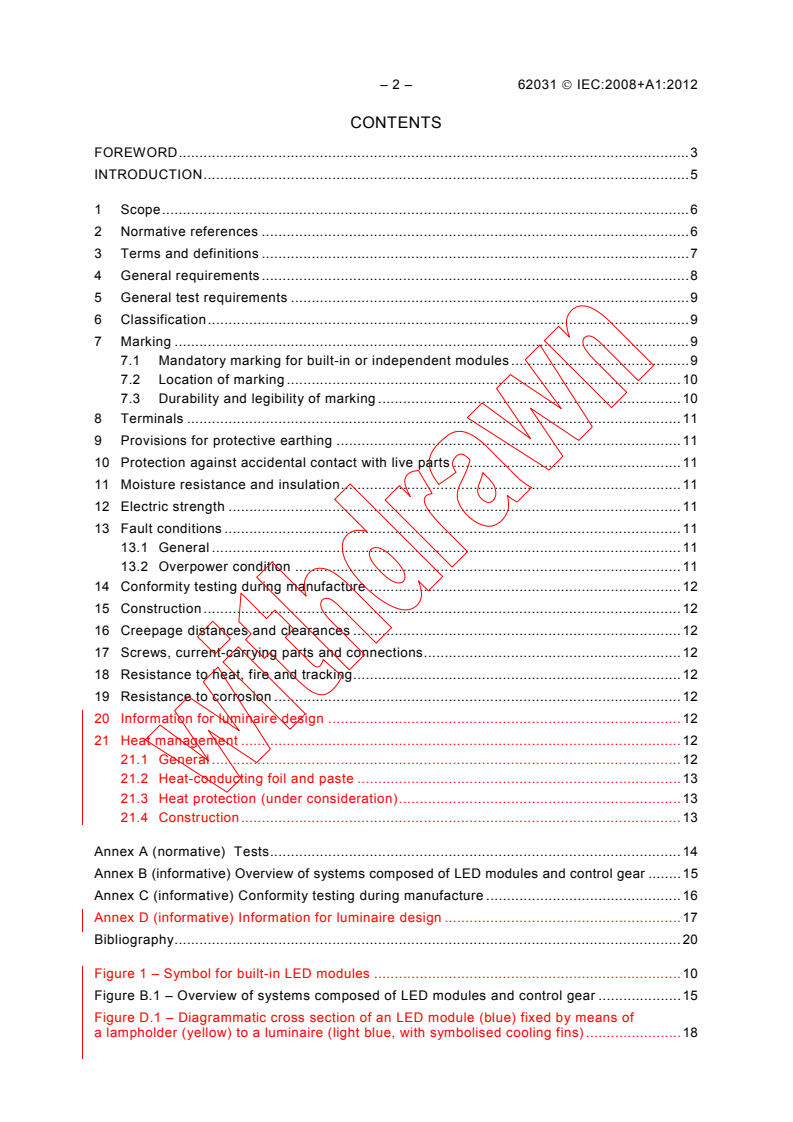
IEC 62031:2008+AMD1:2012 CSV - LED modules for general lighting - Safety specifications Released:10/30/2012

IEC 62031:2008+AMD1:2012+AMD2:2014 CSV - LED modules for general lighting - Safety specifications Released:9/19/2014
Overview
IEC 62031:2008 is an international standard published by the International Electrotechnical Commission (IEC) that specifies the general and safety requirements for LED modules used in general lighting applications. This standard focuses specifically on LED modules without integral control gear, as well as self-ballasted LED modules designed for operation on both direct current (DC) supplies up to 250 V and alternating current (AC) supplies up to 1000 V at 50 Hz or 60 Hz. By providing comprehensive safety specifications, IEC 62031 ensures the reliable and safe use of LED modules in various lighting systems globally.
This standard is essential for manufacturers, designers, and quality assurance teams involved in the production and integration of LED lighting modules to guarantee safety, performance, and compliance with international regulations.
Key Topics
Scope and Applicability
IEC 62031 covers LED modules operating under constant voltage, current, or power without integral control gear, and self-ballasted LED modules for general lighting. It excludes detailed requirements for separate control gear (covered under IEC 61347-2-13 and IEC 62384).General Safety Requirements
The standard presents safety criteria including protection against electric shock, mechanical hazards, moisture resistance, insulation properties, and fault condition management (e.g., overpower situations). These requirements ensure the product's electrical safety during normal operation and potential fault scenarios.Marking and Identification
Mandatory marking for built-in or independent LED modules is defined, emphasizing durability and legibility under real-world conditions. Proper labeling facilitates traceability and compliance verification.Construction and Materials
IEC 62031 covers requirements related to the construction of LED modules, such as creepage distances and clearances, resistance to heat, fire, corrosion, and tracking to maintain long-term safety and reliability.Heat Management
Effective thermal management guidelines are provided to avoid overheating, which can degrade LED performance and pose safety risks. Recommendations include the use of heat-conducting foils and pastes and design considerations for heat dissipation.Photobiological Safety
Special attention is given to the photobiological safety aspects of LED modules, including UV radiation, blue light hazards, and infrared radiation, which are critical for protecting users from potential optical hazards.Testing and Certification
The standard outlines conformity testing during manufacture to ensure compliance with safety specifications. This includes electrical strength tests, moisture resistance, and fault condition testing.
Applications
IEC 62031 is applicable to a wide range of LED modules used in general lighting settings including:
- Indoor and outdoor luminaires for residential, commercial, and industrial environments
- Street lighting and public area illumination
- Architectural and decorative LED lighting solutions
- Automotive and transportation lighting systems where self-ballasted modules are appropriate
Compliance with IEC 62031 improves product safety and performance, facilitating market acceptance and reducing risks related to electrical hazards, overheating, or photobiological effects.
Related Standards
- IEC 61347-2-13 – Safety requirements for control gear for LED modules
- IEC 62384 – Performance requirements for LED control gear
- IEC 60598 – Luminaires safety specifications, often complementing LED module standards
- IEC 62471 – Photobiological safety of lamps and lamp systems, relating to blue light and UV hazards
Manufacturers and testing laboratories often use IEC 62031 together with these standards to ensure comprehensive safety, performance, and compatibility of LED lighting products.
By adhering to IEC 62031:2008, industry stakeholders ensure that LED modules meet internationally recognized safety standards, reducing risks and enhancing consumer confidence in LED lighting technologies.
Relations
- Amended By
IEC 62031:2008/AMD1:2012 - Amendment 1 - LED modules for general lighting - Safety specifications - Effective Date
- 05-Sep-2023
- Amended By
IEC 62031:2008/AMD2:2014 - Amendment 2 - LED modules for general lighting - Safety specifications - Effective Date
- 05-Sep-2023
- Effective Date
- 05-Sep-2023
Buy Documents
IEC 62031:2008 - LED modules for general lighting - Safety specifications Released:1/15/2008
IEC 62031:2008+AMD1:2012 CSV - LED modules for general lighting - Safety specifications Released:10/30/2012
IEC 62031:2008+AMD1:2012+AMD2:2014 CSV - LED modules for general lighting - Safety specifications Released:9/19/2014
Get Certified
Connect with accredited certification bodies for this standard

IMQ S.p.A. (Certification)
Italian electrical product certification.

SLG Prüf- und Zertifizierungs GmbH
German testing and certification body.

UL Solutions
Global safety science company with testing, inspection and certification.
Sponsored listings
Frequently Asked Questions
IEC 62031:2008 is a standard published by the International Electrotechnical Commission (IEC). Its full title is "LED modules for general lighting - Safety specifications". This standard covers: This International Standard specifies general and safety requirements for light-emitting diode (LED) modules: - LED modules without integral control gear for operation under constant voltage, constant current or constant power; - self-ballasted LED modules for use on d.c. supplies up to 250 V or a.c. supplies up to 1 000 V at 50 Hz or 60 Hz.
This International Standard specifies general and safety requirements for light-emitting diode (LED) modules: - LED modules without integral control gear for operation under constant voltage, constant current or constant power; - self-ballasted LED modules for use on d.c. supplies up to 250 V or a.c. supplies up to 1 000 V at 50 Hz or 60 Hz.
IEC 62031:2008 is classified under the following ICS (International Classification for Standards) categories: 29.140.99 - Other standards related to lamps; 31.080.99 - Other semiconductor devices. The ICS classification helps identify the subject area and facilitates finding related standards.
IEC 62031:2008 has the following relationships with other standards: It is inter standard links to IEC 62031:2008/AMD1:2012, IEC 62031:2008/AMD2:2014, IEC 62031:2018. Understanding these relationships helps ensure you are using the most current and applicable version of the standard.
IEC 62031:2008 is available in PDF format for immediate download after purchase. The document can be added to your cart and obtained through the secure checkout process. Digital delivery ensures instant access to the complete standard document.
Standards Content (Sample)
IEC 62031
Edition 1.0 2008-01
INTERNATIONAL
STANDARD
NORME
INTERNATIONALE
LED modules for general lighting – Safety specifications
Modules de DEL pour éclairage général – Spécifications de sécurité
All rights reserved. Unless otherwise specified, no part of this publication may be reproduced or utilized in any form or by
any means, electronic or mechanical, including photocopying and microfilm, without permission in writing from either IEC or
IEC's member National Committee in the country of the requester.
If you have any questions about IEC copyright or have an enquiry about obtaining additional rights to this publication,
please contact the address below or your local IEC member National Committee for further information.
Droits de reproduction réservés. Sauf indication contraire, aucune partie de cette publication ne peut être reproduite
ni utilisée sous quelque forme que ce soit et par aucun procédé, électronique ou mécanique, y compris la photocopie
et les microfilms, sans l'accord écrit de la CEI ou du Comité national de la CEI du pays du demandeur.
Si vous avez des questions sur le copyright de la CEI ou si vous désirez obtenir des droits supplémentaires sur cette
publication, utilisez les coordonnées ci-après ou contactez le Comité national de la CEI de votre pays de résidence.
IEC Central Office
3, rue de Varembé
CH-1211 Geneva 20
Switzerland
Email: inmail@iec.ch
Web: www.iec.ch
About the IEC
The International Electrotechnical Commission (IEC) is the leading global organization that prepares and publishes
International Standards for all electrical, electronic and related technologies.
About IEC publications
The technical content of IEC publications is kept under constant review by the IEC. Please make sure that you have the
latest edition, a corrigenda or an amendment might have been published.
ƒ Catalogue of IEC publications: www.iec.ch/searchpub
The IEC on-line Catalogue enables you to search by a variety of criteria (reference number, text, technical committee,…).
It also gives information on projects, withdrawn and replaced publications.
ƒ IEC Just Published: www.iec.ch/online_news/justpub
Stay up to date on all new IEC publications. Just Published details twice a month all new publications released. Available
on-line and also by email.
ƒ Electropedia: www.electropedia.org
The world's leading online dictionary of electronic and electrical terms containing more than 20 000 terms and definitions
in English and French, with equivalent terms in additional languages. Also known as the International Electrotechnical
Vocabulary online.
ƒ Customer Service Centre: www.iec.ch/webstore/custserv
If you wish to give us your feedback on this publication or need further assistance, please visit the Customer Service
Centre FAQ or contact us:
Email: csc@iec.ch
Tel.: +41 22 919 02 11
Fax: +41 22 919 03 00
A propos de la CEI
La Commission Electrotechnique Internationale (CEI) est la première organisation mondiale qui élabore et publie des
normes internationales pour tout ce qui a trait à l'électricité, à l'électronique et aux technologies apparentées.
A propos des publications CEI
Le contenu technique des publications de la CEI est constamment revu. Veuillez vous assurer que vous possédez
l’édition la plus récente, un corrigendum ou amendement peut avoir été publié.
ƒ Catalogue des publications de la CEI: www.iec.ch/searchpub/cur_fut-f.htm
Le Catalogue en-ligne de la CEI vous permet d’effectuer des recherches en utilisant différents critères (numéro de référence,
texte, comité d’études,…). Il donne aussi des informations sur les projets et les publications retirées ou remplacées.
ƒ Just Published CEI: www.iec.ch/online_news/justpub
Restez informé sur les nouvelles publications de la CEI. Just Published détaille deux fois par mois les nouvelles
publications parues. Disponible en-ligne et aussi par email.
ƒ Electropedia: www.electropedia.org
Le premier dictionnaire en ligne au monde de termes électroniques et électriques. Il contient plus de 20 000 termes et
définitions en anglais et en français, ainsi que les termes équivalents dans les langues additionnelles. Egalement appelé
Vocabulaire Electrotechnique International en ligne.
ƒ Service Clients: www.iec.ch/webstore/custserv/custserv_entry-f.htm
Si vous désirez nous donner des commentaires sur cette publication ou si vous avez des questions, visitez le FAQ du
Service clients ou contactez-nous:
Email: csc@iec.ch
Tél.: +41 22 919 02 11
Fax: +41 22 919 03 00
IEC 62031
Edition 1.0 2008-01
INTERNATIONAL
STANDARD
NORME
INTERNATIONALE
LED modules for general lighting – Safety specifications
Modules de DEL pour éclairage général – Spécifications de sécurité
INTERNATIONAL
ELECTROTECHNICAL
COMMISSION
COMMISSION
ELECTROTECHNIQUE
PRICE CODE
INTERNATIONALE
P
CODE PRIX
ICS 29.140.99 ; 31.080.99 ISBN 2-8318-9503-0
– 2 – 62031 © IEC:2008
CONTENTS
FOREWORD.3
INTRODUCTION.5
1 Scope.6
2 Normative references .6
3 Terms and definitions .7
4 General requirements .8
5 General test requirements .8
6 Classification.9
7 Marking .9
7.1 Mandatory marking for built-in or independent modules.9
7.2 Location of marking .10
7.3 Durability and legibility of marking .10
8 Terminals .10
9 Provisions for protective earthing .10
10 Protection against accidental contact with live parts .10
11 Moisture resistance and insulation.10
12 Electric strength .10
13 Fault conditions .11
13.1 General .11
13.2 Overpower condition .11
14 Conformity testing during manufacture .11
15 Construction .11
16 Creepage distances and clearances .11
17 Screws, current-carrying parts and connections.11
18 Resistance to heat, fire and tracking.12
19 Resistance to corrosion .12
Annex A (normative) Tests.13
Annex B (informative) Overview of systems composed of LED modules and control
gear .14
Annex C (informative) Conformity testing during manufacture .15
Bibliography.16
Figure B.1 – Overview of systems composed of LED modules and control gear .14
62031 © IEC:2008 – 3 –
INTERNATIONAL ELECTROTECHNICAL COMMISSION
___________
LED MODULES FOR GENERAL LIGHTING –
SAFETY SPECIFICATIONS
FOREWORD
1) The International Electrotechnical Commission (IEC) is a worldwide organization for standardization comprising
all national electrotechnical committees (IEC National Committees). The object of IEC is to promote
international co-operation on all questions concerning standardization in the electrical and electronic fields. To
this end and in addition to other activities, IEC publishes International Standards, Technical Specifications,
Technical Reports, Publicly Available Specifications (PAS) and Guides (hereafter referred to as “IEC
Publication(s)”). Their preparation is entrusted to technical committees; any IEC National Committee interested
in the subject dealt with may participate in this preparatory work. International, governmental and non-
governmental organizations liaising with the IEC also participate in this preparation. IEC collaborates closely
with the International Organization for Standardization (ISO) in accordance with conditions determined by
agreement between the two organizations.
2) The formal decisions or agreements of IEC on technical matters express, as nearly as possible, an international
consensus of opinion on the relevant subjects since each technical committee has representation from all
interested IEC National Committees.
3) IEC Publications have the form of recommendations for international use and are accepted by IEC National
Committees in that sense. While all reasonable efforts are made to ensure that the technical content of IEC
Publications is accurate, IEC cannot be held responsible for the way in which they are used or for any
misinterpretation by any end user.
4) In order to promote international uniformity, IEC National Committees undertake to apply IEC Publications
transparently to the maximum extent possible in their national and regional publications. Any divergence
between any IEC Publication and the corresponding national or regional publication shall be clearly indicated in
the latter.
5) IEC provides no marking procedure to indicate its approval and cannot be rendered responsible for any
equipment declared to be in conformity with an IEC Publication.
6) All users should ensure that they have the latest edition of this publication.
7) No liability shall attach to IEC or its directors, employees, servants or agents including individual experts and
members of its technical committees and IEC National Committees for any personal injury, property damage or
other damage of any nature whatsoever, whether direct or indirect, or for costs (including legal fees) and
expenses arising out of the publication, use of, or reliance upon, this IEC Publication or any other IEC
Publications.
8) Attention is drawn to the Normative references cited in this publication. Use of the referenced publications is
indispensable for the correct application of this publication.
9) Attention is drawn to the possibility that some of the elements of this IEC Publication may be the subject of
patent rights. IEC shall not be held responsible for identifying any or all such patent rights.
International Standard IEC 62031 has been prepared by subcommittee 34A: Lamps, of IEC
technical committee 34: Lamps and related equipment.
The text of this first edition is based on the following documents:
FDIS Report on voting
34A/1237/FDIS 34A/1256/RVD
Full information on the voting for the approval of this standard can be found in the report on
voting indicated in the above table.
This publication has been drafted in accordance with the ISO/IEC Directives, Part 2.
– 4 – 62031 © IEC:2008
NOTE In this standard, the following print types are used:
– Requirements proper: in roman type.
– Test specifications: in italic type.
– Explanatory matter: in smaller roman type.
The committee has decided that the contents of this publication will remain unchanged until
the maintenance result date indicated on the IEC web site under "http://webstore.iec.ch" in
the data related to the specific publication. At this date, the publication will be
• reconfirmed;
• withdrawn;
• replaced by a revised edition, or
• amended.
62031 © IEC:2008 – 5 –
INTRODUCTION
The first edition of a safety standard for LED modules for general lighting applications
acknowledges the need for relevant tests for this new source of electrical light, sometimes
called “solid state lighting”.
The provisions in the standard represent the technical knowledge of experts from the fields of
the semiconductor industry and those of the traditional electrical light sources.
Two types of LED modules are covered: with integral and external control gear.
– 6 – 62031 © IEC:2008
LED MODULES FOR GENERAL LIGHTING –
SAFETY SPECIFICATIONS
1 Scope
This International Standard specifies general and safety requirements for light-emitting diode
(LED) modules:
٭ LED modules without integral control gear for operation under constant voltage, constant
current or constant power;
٭ self-ballasted LED modules for use on d.c. supplies up to 250 V or a.c. supplies up to
1 000 V at 50 Hz or 60 Hz.
NOTE 1 The safety requirements for separate control gear are specified in IEC 61347-2-13. The performance
requirements for separate control gear are specified in IEC 62384.
NOTE 2 Requirements for LED modules with integrated control gear and equipped with a lamp cap (self-ballasted
lamp), intended for mains voltage general lighting service retrofit applications (thereby replacing existing lamps
with identical lamp caps) are specified in IEC 60968 (an amendment to the present edition or a new edition with
extended scope is in preparation).
Requirements for LED modules with integrated control gear and equipped with a lamp cap (self-ballasted lamp),
intended for non-mains voltage general lighting service retrofit applications (thereby replacing existing lamps with
identical lamp caps) are under consideration.
NOTE 3 Where in the requirements of this standard both types of LED modules, with and without integral control
gear, are addressed, the word “modules” is used instead. Where only the expression “LED module(s)” is used, it is
understood to refer to the type without integral control gear.
2 Normative references
The following referenced documents are indispensable for the application of this document.
For dated references, only the edition cited applies. For undated references, the latest edition
of the referenced document (including any amendments) applies.
)
IEC 60598-1:2003, Luminaires, Part 1: General requirements and tests
Amendment 1 (2006)
IEC 60838-2-2, Miscellaneous lampholders – Part 2-2: Particular requirements – Connectors
for LED modules
IEC 61347-1:2007, Lamp controlgear – Part 1: General and safety requirements
IEC 61347-2-13:2006, Lamp controlgear – Part 2-13: Particular requirements for d.c. or a.c.
supplied electronic controlgear for LED modules
IEC 62471:2006, Photobiological safety of lamps and lamp systems
ISO 4046-4:2002, Paper, board, pulp and related terms – Vocabulary – Part 4: Paper and
board grades and converted products
—————————
)
A consolidated 6.1 (2006) exists, that includes IEC 60598-1 (2003) and its Amendment 1 (2006).
62031 © IEC:2008 – 7 –
3 Terms and definitions
For the purposes of this document, the following terms and definitions apply.
For expressions and terms in the field of LEDs and LED modules, refer to IEC TS 62504,
which is currently in development.
3.1
light-emitting diode
LED
solid state device embodying a p-n junction, emitting optical radiation when excited by an
electric current
[IEV 845-04-40]
3.2
LED module
unit supplied as a light source. In addition to one or more LEDs, it may contain further
components, e.g. optical, mechanical, electrical and electronic, but excluding the control gear.
3.3
self-ballasted LED module
LED module, designed for connection to the supply voltage
NOTE If the self-ballasted LED module is equipped with a lamp cap, it is regarded to be a self-ballasted lamp.
3.4
integral LED module
LED module, generally designed to form a non-replaceable part of a luminaire
3.5
integral self-ballasted LED module
self-ballasted LED module, generally designed to form a non-replaceable part of a luminaire
3.6
built-in LED module
LED module, generally designed to form a replaceable part built into a luminaire, a box, an
enclosure or the like and not intended to be mounted outside a luminaire, etc. without special
precautions
3.7
built-in self-ballasted LED module
self-ballasted LED module, generally designed to form a replaceable part built into a
luminaire, a box, an enclosure or the like and not intended to be mounted outside a luminaire,
etc. without special precautions
3.8
independent LED module
LED module, so designed that it can be mounted or placed separately from a luminaire, an
additional box or enclosure or the like. The independent LED module provides all the
necessary protection with regard to safety according to its classification and marking.
NOTE The control gear must not necessarily be integrated in the module.
– 8 – 62031 © IEC:2008
3.9
independent self-ballasted LED module
self-ballasted LED module, so designed that it can be mounted or placed separately from a
luminaire, an additional box or enclosure or the like. The independent LED module provides
all the necessary protection with regard to safety according to its classification and marking.
NOTE The control gear may be integrated in the module.
3.10
rated maximum temperature
t
c
highest permissible temperature which may occur on the outer surface of the LED module (at
the indicated position, if marked) under normal operating conditions and at the rated
voltage/current/power or the maximum of the rated voltage/current/power range
4 General requirements
4.1 Modules shall be so designed and constructed that in normal use (see manufacturer’s
instruction) they operate without danger to the user or surroundings.
4.2 For LED modules, all electrical measurements, unless otherwise specified, shall be
carried out at voltage limits (min/max), current limits (min/max) or power limits (min/max) and
minimum frequency, in a draught-free room at the temperature limits of the allowed range
specified by the manufacturer. Unless the manufacturer indicates the most critical
combination, all combinations (min/max) of voltage/current/power and temperature shall be
tested.
4.3 For self-ballasted LED modules, the electrical measurements shall be carried out at the
tolerance limit values of the marked supply voltage.
4.4 Integral modules not having their own enclosure shall be treated as integral components
of luminaires as defined in IEC 60598-1, Clause 0.5. They shall be tested assembled in the
luminaire, and as far as applicable with the present standard.
4.5 Independent modules shall comply, in addition to this standard, with the requirements of
relevant clauses of IEC 60598-1, where these requirements are not already covered in this
standard.
4.6 If the module is a factory sealed unit, it shall not be opened for any tests. In the case of
doubt based on the inspection of the module and the examination of the circuit diagram, and
in agreement with the manufacturer or responsible vendor, such specially prepared modules
shall be submitted for testing so that a fault condition can be simulated.
5 General test requirements
5.1 Tests according to this standard shall be type tests.
NOTE The requirements and tolerances permitted by this standard are related to testing of a type-test sample
submitted by the manufacturer for that purpose. Compliance of the type-test sample does not ensure compliance of
the whole production of a manufacturer with this safety standard.
Conformity of production is the responsibility of the manufacturer and may need routine tests and quality assurance
in addition to type testing.
62031 © IEC:2008 – 9 –
5.2 Unless otherwise specified, the tests shall be carried out at an ambient temperature of
10 °C to 30 °C.
5.3 Unless otherwise specified, the type test shall be carried out on one sample consisting
of one or more items submitted for the purpose of the type test.
In general, all tests shall be carried out on each type of module or, where a range of similar
modules is involved, for each wattage in the range or on a representative selection from the
range, as agreed with the manufacturer.
5.4 If the light output has detectably changed, the module shall not be used for further tests.
NOTE Usually, a value of 50 % indicates irreversible changes in the module.
5.5 For SELV-operated LED modules, the requirements of IEC 61347-2-13, Annex I, apply
additionally.
General conditions for tests are given in Annex A.
6 Classification
Modules are classified, according to the method of installation, as:
– built-in;
– independent;
– integral.
For integral modules, the NOTE to 1.2.1 in IEC 60598-1 applies.
7 Marking
7.1 Mandatory marking for built-in or independent modules
a) Mark of origin (trade mark, manufacturer’s name or name of the responsible
vendor/supplier).
b) Model number or type reference of the manufacturer.
c) Either the
● rated supply voltage(s), or voltage range, supply frequency or/and
● rated supply current(s) or current range, supply frequency (the supply current may be
given in the manufacturer’s literature) or/and
● rated input power, or power range.
d) Nominal power.
e) Indication of position and purpose of the connections where it is necessary for safety. In
case of connecting wires, a clear indication shall be given in a wiring diagram.
f) Value of t . If this relates to a certain place on the LED module, this place shall be
c
indicated or specified in the manufacturer’s literature.
g) For eye protection, see requirements of IEC 62471.
h) Built-in modules shall be marked in order to separate them from independent modules.
The mark shall be located on the packaging or on the module itself.
NOTE The symbol is under consideration.
– 10 – 62031 © IEC:2008
7.2 Location of marking
Items a), b), c) and f) of 7.1 shall be marked on the module.
Items d), e), g) and h) of 7.1 shall be marked legible on the module or on the module data
sheet.
For integral modules, no marking is required, but the information given in 7.1 a) to g) shall be
provided in the technical literature of the manufacturer.
7.3 Durability and legibility of marking
Marking shall be durable and legible.
For items a), b), c) and f) of 7.1, compliance is checked by inspection and by trying to remove
the marking by rubbing the area lightly by hand for 15 s with a piece of smooth cloth,
dampened with water.
The marking shall be legible after the test.
For items d) to h) of 7.1, compliance is checked by inspection.
8 Terminals
For screw terminals, the requirements of IEC 60598-1, Section 14, shall be used, if
applicable.
For screwless terminals, the requirements of IEC 60598-1, Section 15, shall be used, if
applicable.
For connectors, the requirements of IEC 60838-2-2 shall be used, if applicable.
9 Provisions for protective earthing
The requirements of IEC 61347-1, Clause 9, apply.
10 Protection against accidental contact with live parts
The requirements of IEC 61347-1, Clause 10, apply.
11 Moisture resistance and insulation
The requirements of IEC 61347-1, Clause 11, apply.
12 Electric strength
The requirements of IEC 61347-1, Clause 12, apply.
62031 © IEC:2008 – 11 –
13 Fault conditions
13.1 General
The module shall not impair safety when operated under fault conditions that may occur
during the intended use. The requirements of IEC 61347-1, Clause 14, apply. Additionally, the
following test shall be carried out.
13.2 Overpower condition
The test shall be started at an ambient temperature as specified in Annex A.
The module shall be switched on and the power monitored (at the input side) and increased
until 150 % of the rated voltage, current or power is reached. The test shall be continued until
the module is thermally stabilised. A stable condition is reached, if the temperature does not
change by more than 5 K in 1 h. The temperature shall be measured in the t point. The
c
module shall withstand the overpower condition for at least 15 min, the time period of which
can lie within the stabilisation period if the temperature change is ≤ 5 K.
If the module contains an automatic protective device or circuit which limits the power, it is
subjected to a 15 min operation at this limit. If the device or circuit effectively limits the power
over this period, the module has passed the test, provided the compliance (4.1 and last
paragraph of 13.2) is fulfilled.
After finalising the overpower mode, the module is operated under normal conditions until
thermally being stable.
A module fails safe if no fire, smoke or flammable gas is produced and if the 15 min
overpower condition has been withstood. To check whether molten material might present a
safety hazard, a tissue paper, as specified in 4.187 of ISO 4046-4, spread below the module
shall not ignite.
14 Conformity testing during manufacture
See Annex C.
15 Construction
Wood, cotton, silk, paper and similar fibrous material shall not be used as insulation.
Compliance is checked by inspection.
16 Creepage distances and clearances
The requirements of IEC 60598-1, Section 11, apply.
17 Screws, current-carrying parts and connections
The requirements of IEC 61347-1, Clause 17, apply.
– 12 – 62031 © IEC:2008
18 Resistance to heat, fire and tracking
The requirements of IEC 61347-1, Clause 18, apply.
19 Resistance to corrosion
The requirements of IEC 61347-1, Clause 19, apply.
62031 © IEC:2008 – 13 –
Annex A
(normative)
Tests
Refer to IEC 61347-1, Annex H, Clauses H.1, H.2, H.4, H.7, and to Subclause H.11.2. In
H.1.3, ignore the first paragraph. In all clauses, replace “lamp”, “(lamp) control gear” or
“ballast” by “LED module”.
– 14 – 62031 © IEC:2008
Annex B
(informative)
Overview of systems composed of LED modules and control gear
LED gear LED module
Lampholder
Supply
Gear and LED module: one unit
voltage:
Built-in
Integral “”Self-ballasted LED lamp
Independent
AC
Built-in
(up to
1 000V
Connection
50 Hz Gear without LEDs
LED module
Integral
or system
(IEC 61347-2-13)
60 Hz)
(IEC 62031)
(IEC 62384)
Independent
or
Combinations possible
“Electronic control gear for
LED modules”
DC
(up to
Built-in
250 V)
Gear LEDs
+ Integral
Independent
(IEC 62031)
“Self- ballasted LED module”
IEC 2316/07
Figure B.1 – Overview of systems composed of LED modules and control gear
62031 © IEC:2008 – 15 –
Annex C
(informative)
Conformity testing during manufacture
This test is carried out at 100 % of production. It is combined with
...
IEC 62031 ®
Edition 1.1 2012-10
INTERNATIONAL
STANDARD
NORME
INTERNATIONALE
colour
inside
LED modules for general lighting – Safety specifications
Modules de DEL pour éclairage général – Spécifications de sécurité
All rights reserved. Unless otherwise specified, no part of this publication may be reproduced or utilized in any form
or by any means, electronic or mechanical, including photocopying and microfilm, without permission in writing from
either IEC or IEC's member National Committee in the country of the requester.
If you have any questions about IEC copyright or have an enquiry about obtaining additional rights to this publication,
please contact the address below or your local IEC member National Committee for further information.
Droits de reproduction réservés. Sauf indication contraire, aucune partie de cette publication ne peut être reproduite ni
utilisée sous quelque forme que ce soit et par aucun procédé, électronique ou mécanique, y compris la photocopie et les
microfilms, sans l'accord écrit de la CEI ou du Comité national de la CEI du pays du demandeur.
Si vous avez des questions sur le copyright de la CEI ou si vous désirez obtenir des droits supplémentaires sur cette
publication, utilisez les coordonnées ci-après ou contactez le Comité national de la CEI de votre pays de résidence.
IEC Central Office Tel.: +41 22 919 02 11
3, rue de Varembé Fax: +41 22 919 03 00
CH-1211 Geneva 20 info@iec.ch
Switzerland www.iec.ch
About the IEC
The International Electrotechnical Commission (IEC) is the leading global organization that prepares and publishes
International Standards for all electrical, electronic and related technologies.
About IEC publications
The technical content of IEC publications is kept under constant review by the IEC. Please make sure that you have the
latest edition, a corrigenda or an amendment might have been published.
Useful links:
IEC publications search - www.iec.ch/searchpub Electropedia - www.electropedia.org
The advanced search enables you to find IEC publications The world's leading online dictionary of electronic and
by a variety of criteria (reference number, text, technical electrical terms containing more than 30 000 terms and
committee,…). definitions in English and French, with equivalent terms in
It also gives information on projects, replaced and additional languages. Also known as the International
withdrawn publications. Electrotechnical Vocabulary (IEV) on-line.
IEC Just Published - webstore.iec.ch/justpublished Customer Service Centre - webstore.iec.ch/csc
Stay up to date on all new IEC publications. Just Published If you wish to give us your feedback on this publication
details all new publications released. Available on-line and or need further assistance, please contact the
also once a month by email. Customer Service Centre: csc@iec.ch.
A propos de la CEI
La Commission Electrotechnique Internationale (CEI) est la première organisation mondiale qui élabore et publie des
Normes internationales pour tout ce qui a trait à l'électricité, à l'électronique et aux technologies apparentées.
A propos des publications CEI
Le contenu technique des publications de la CEI est constamment revu. Veuillez vous assurer que vous possédez
l’édition la plus récente, un corrigendum ou amendement peut avoir été publié.
Liens utiles:
Recherche de publications CEI - www.iec.ch/searchpub Electropedia - www.electropedia.org
La recherche avancée vous permet de trouver des Le premier dictionnaire en ligne au monde de termes
publications CEI en utilisant différents critères (numéro de électroniques et électriques. Il contient plus de 30 000
référence, texte, comité d’études,…). termes et définitions en anglais et en français, ainsi que
Elle donne aussi des informations sur les projets et les les termes équivalents dans les langues additionnelles.
publications remplacées ou retirées. Egalement appelé Vocabulaire Electrotechnique
International (VEI) en ligne.
Just Published CEI - webstore.iec.ch/justpublished
Service Clients - webstore.iec.ch/csc
Restez informé sur les nouvelles publications de la CEI.
Just Published détaille les nouvelles publications parues. Si vous désirez nous donner des commentaires sur
Disponible en ligne et aussi une fois par mois par email. cette publication ou si vous avez des questions
contactez-nous: csc@iec.ch.
IEC 62031 ®
Edition 1.1 2012-10
INTERNATIONAL
STANDARD
NORME
INTERNATIONALE
colour
inside
LED modules for general lighting – Safety specifications
Modules de DEL pour éclairage général – Spécifications de sécurité
INTERNATIONAL
ELECTROTECHNICAL
COMMISSION
COMMISSION
ELECTROTECHNIQUE
INTERNATIONALE
ICS 29.140.99; 31.080.99 ISBN 978-2-8322-0476-4
– 2 – 62031 IEC:2008+A1:2012
CONTENTS
FOREWORD . 3
INTRODUCTION . 5
1 Scope . 6
2 Normative references . 6
3 Terms and definitions . 7
4 General requirements . 8
5 General test requirements . 9
6 Classification . 9
7 Marking . 9
7.1 Mandatory marking for built-in or independent modules . 9
7.2 Location of marking . 10
7.3 Durability and legibility of marking . 10
8 Terminals . 11
9 Provisions for protective earthing . 11
10 Protection against accidental contact with live parts . 11
11 Moisture resistance and insulation . 11
12 Electric strength . 11
13 Fault conditions . 11
13.1 General . 11
13.2 Overpower condition . 11
14 Conformity testing during manufacture . 12
15 Construction . 12
16 Creepage distances and clearances . 12
17 Screws, current-carrying parts and connections . 12
18 Resistance to heat, fire and tracking . 12
19 Resistance to corrosion . 12
20 Information for luminaire design . 12
21 Heat management . 12
21.1 General . 12
21.2 Heat-conducting foil and paste . 13
21.3 Heat protection (under consideration) . 13
21.4 Construction . 13
Annex A (normative) Tests . 14
Annex B (informative) Overview of systems composed of LED modules and control gear . 15
Annex C (informative) Conformity testing during manufacture . 16
Annex D (informative) Information for luminaire design . 17
Bibliography . 20
Figure 1 – Symbol for built-in LED modules . 10
Figure B.1 – Overview of systems composed of LED modules and control gear . 15
Figure D.1 – Diagrammatic cross section of an LED module (blue) fixed by means of
a lampholder (yellow) to a luminaire (light blue, with symbolised cooling fins) . 18
62031 IEC:2008+A1:2012 – 3 –
INTERNATIONAL ELECTROTECHNICAL COMMISSION
___________
LED MODULES FOR GENERAL LIGHTING –
SAFETY SPECIFICATIONS
FOREWORD
1) The International Electrotechnical Commission (IEC) is a worldwide organization for standardization comprising
all national electrotechnical committees (IEC National Committees). The object of IEC is to promote
international co-operation on all questions concerning standardization in the electrical and electronic fields. To
this end and in addition to other activities, IEC publishes International Standards, Technical Specifications,
Technical Reports, Publicly Available Specifications (PAS) and Guides (hereafter referred to as “IEC
Publication(s)”). Their preparation is entrusted to technical committees; any IEC National Committee interested
in the subject dealt with may participate in this preparatory work. International, governmental and non-
governmental organizations liaising with the IEC also participate in this preparation. IEC collaborates closely
with the International Organization for Standardization (ISO) in accordance with conditions determined by
agreement between the two organizations.
2) The formal decisions or agreements of IEC on technical matters express, as nearly as possible, an international
consensus of opinion on the relevant subjects since each technical committee has representation from all
interested IEC National Committees.
3) IEC Publications have the form of recommendations for international use and are accepted by IEC National
Committees in that sense. While all reasonable efforts are made to ensure that the technical content of IEC
Publications is accurate, IEC cannot be held responsible for the way in which they are used or for any
misinterpretation by any end user.
4) In order to promote international uniformity, IEC National Committees undertake to apply IEC Publications
transparently to the maximum extent possible in their national and regional publications. Any divergence
between any IEC Publication and the corresponding national or regional publication shall be clearly indicated in
the latter.
5) IEC itself does not provide any attestation of conformity. Independent certification bodies provide conformity
assessment services and, in some areas, access to IEC marks of conformity. IEC is not responsible for any
services carried out by independent certification bodies.
6) All users should ensure that they have the latest edition of this publication.
7) No liability shall attach to IEC or its directors, employees, servants or agents including individual experts and
members of its technical committees and IEC National Committees for any personal injury, property damage or
other damage of any nature whatsoever, whether direct or indirect, or for costs (including legal fees) and
expenses arising out of the publication, use of, or reliance upon, this IEC Publication or any other IEC
Publications.
8) Attention is drawn to the Normative references cited in this publication. Use of the referenced publications is
indispensable for the correct application of this publication.
9) Attention is drawn to the possibility that some of the elements of this IEC Publication may be the subject of
patent rights. IEC shall not be held responsible for identifying any or all such patent rights.
This consolidated version of IEC 62031 consists of the first edition (2008) [documents
34A/1237/FDIS and 34A/1256/RVD] and its amendment 1 (2012) [documents
34A/1608/FDIS and 34A/1628/RVD]. It bears the edition number 1.1.
The technical content is therefore identical to the base edition and its amendment and
has been prepared for user convenience. A vertical line in the margin shows where the
base publication has been modified by amendment 1. Additions and deletions are
displayed in red, with deletions being struck through.
– 4 – 62031 IEC:2008+A1:2012
International Standard IEC 62031 has been prepared by subcommittee 34A: Lamps, of IEC
technical committee 34: Lamps and related equipment.
This publication has been drafted in accordance with the ISO/IEC Directives, Part 2.
NOTE In this standard, the following print types are used:
– Requirements proper: in roman type.
– Test specifications: in italic type.
– Explanatory matter: in smaller roman type.
The committee has decided that the contents of the base publication and its amendments will
remain unchanged until the stability date indicated on the IEC web site under
"http://webstore.iec.ch" in the data related to the specific publication. At this date, the
publication will be
• reconfirmed,
• withdrawn,
• replaced by a revised edition, or
• amended.
IMPORTANT – The “colour inside” logo on the cover page of this publication indicates
that it contains colours which are considered to be useful for the correct understanding
of its contents. Users should therefore print this publication using a colour printer.
62031 IEC:2008+A1:2012 – 5 –
INTRODUCTION
The first edition of a safety standard for LED modules for general lighting applications
acknowledges the need for relevant tests for this new source of electrical light, sometimes
called “solid state lighting”.
The provisions in the standard represent the technical knowledge of experts from the fields of
the semiconductor industry and those of the traditional electrical light sources.
Two types of LED modules are covered: with integral and external control gear.
– 6 – 62031 IEC:2008+A1:2012
LED MODULES FOR GENERAL LIGHTING –
SAFETY SPECIFICATIONS
1 Scope
This International Standard specifies general and safety requirements for light-emitting diode
(LED) modules:
٭ LED modules without integral control gear for operation under constant voltage, constant
current or constant power;
٭ self-ballasted LED modules for use on d.c. supplies up to 250 V or a.c. supplies up to
1 000 V at 50 Hz or 60 Hz.
NOTE 1 The safety requirements for separate control gear are specified in IEC 61347-2-13. The performance
requirements for separate control gear are specified in IEC 62384.
NOTE 2 Requirements for LED modules with integrated control gear and equipped with a lamp cap (self-ballasted
lamp), intended for mains voltage general lighting service retrofit applications (thereby replacing existing lamps
with identical lamp caps) are specified in IEC 60968 (an amendment to the present edition or a new edition with
extended scope is in preparation).
Requirements for LED modules with integrated control gear and equipped with a lamp cap (self-ballasted lamp),
intended for non-mains voltage general lighting service retrofit applications (thereby replacing existing lamps with
identical lamp caps) are under consideration.
NOTE 3 Where in the requirements of this standard both types of LED modules, with and without integral control
gear, are addressed, the word “modules” is used instead. Where only the expression “LED module(s)” is used, it is
understood to refer to the type without integral control gear.
2 Normative references
The following referenced documents are indispensable for the application of this document.
For dated references, only the edition cited applies. For undated references, the latest edition
of the referenced document (including any amendments) applies.
)
IEC 60598-1:2003, Luminaires – Part 1: General requirements and tests
Amendment 1 (2006)
IEC 60417, Graphical symbols for use on equipment. Available at http://www.graphical-
symbols.info/equipment
IEC 60838-2-2, Miscellaneous lampholders – Part 2-2: Particular requirements – Connectors
for LED modules
IEC 61347-1:2007, Lamp controlgear – Part 1: General and safety requirements
IEC 61347-2-13:2006, Lamp controlgear – Part 2-13: Particular requirements for d.c. or a.c.
supplied electronic controlgear for LED modules
IEC 62471:2006, Photobiological safety of lamps and lamp systems
ISO 4046-4:2002, Paper, board, pulp and related terms – Vocabulary – Part 4: Paper and
board grades and converted products
—————————
)
A consolidated 6.1 (2006) exists, that includes IEC 60598-1 (2003) and its Amendment 1 (2006).
62031 IEC:2008+A1:2012 – 7 –
3 Terms and definitions
For the purposes of this document, the following terms and definitions apply.
For expressions and terms in the field of LEDs and LED modules, refer to IEC TS 62504,
which is currently in development.
3.1
light-emitting diode
LED
solid state device embodying a p-n junction, emitting optical radiation when excited by an
electric current
[IEV 845-04-40]
3.2
LED module
unit supplied as a light source. In addition to one or more LEDs, it may contain further
components, e.g. optical, mechanical, electrical and electronic, but excluding the control gear.
3.3
self-ballasted LED module
LED module, designed for connection to the supply voltage
NOTE If the self-ballasted LED module is equipped with a lamp cap, it is regarded to be a self-ballasted lamp.
3.4
integral LED module
LED module, generally designed to form a non-replaceable part of a luminaire
3.5
integral self-ballasted LED module
self-ballasted LED module, generally designed to form a non-replaceable part of a luminaire
3.6
built-in LED module
LED module, generally designed to form a replaceable part built into a luminaire, a box, an
enclosure or the like and not intended to be mounted outside a luminaire, etc. without special
precautions
3.7
built-in self-ballasted LED module
self-ballasted LED module, generally designed to form a replaceable part built into a
luminaire, a box, an enclosure or the like and not intended to be mounted outside a luminaire,
etc. without special precautions
3.8
independent LED module
LED module, so designed that it can be mounted or placed separately from a luminaire, an
additional box or enclosure or the like. The independent LED module provides all the
necessary protection with regard to safety according to its classification and marking.
NOTE The control gear must not necessarily be integrated in the module.
– 8 – 62031 IEC:2008+A1:2012
3.9
independent self-ballasted LED module
self-ballasted LED module, so designed that it can be mounted or placed separately from a
luminaire, an additional box or enclosure or the like. The independent LED module provides
all the necessary protection with regard to safety according to its classification and marking.
NOTE The control gear may be integrated in the module.
3.10
rated maximum temperature
t
c
highest permissible temperature which may occur on the outer surface of the LED module (at
the indicated position, if marked) under normal operating conditions and at the rated
voltage/current/power or the maximum of the rated voltage/current/power range
3.11
heat transfer temperature
t
d
temperature occurring on a representative part of the LED module (or any heat-conducting foil
or paste applied as for insertion if delivered with the LED module) (at the indicated position if
marked) intended for the passing of heat to the lampholder or to other parts of the luminaire
under normal operating conditions and at the rated voltage/current/power or the maximum of
the rated voltage/current/power range
NOTE A measurement method is under consideration.
3.12
heat output to the luminaire
P
d
power to be transferred to the luminaire by means of heat-conduction in order to keep t
c
NOTE 1 P is below the rated power of an LED module.
d
NOTE 2 For LED modules which do not need heat-conduction to the luminaire for keeping t , P is equal to zero.
c d
NOTE 3 A measurement method is under consideration.
4 General requirements
4.1 Modules shall be so designed and constructed that in normal use (see manufacturer’s
instruction) they operate without danger to the user or surroundings.
4.2 For LED modules, all electrical measurements, unless otherwise specified, shall be
carried out at voltage limits (min/max), current limits (min/max) or power limits (min/max) and
minimum frequency, in a draught-free room at the temperature limits of the allowed range
specified by the manufacturer. Unless the manufacturer indicates the most critical
combination, all combinations (min/max) of voltage/current/power and temperature shall be
tested.
4.3 For self-ballasted LED modules, the electrical measurements shall be carried out at the
tolerance limit values of the marked supply voltage.
4.4 Integral modules not having their own enclosure shall be treated as integral components
of luminaires as defined in IEC 60598-1, Clause 0.5. They shall be tested assembled in the
luminaire, and as far as applicable with the present standard.
4.5 In addition, independent modules shall comply, in addition to this standard, with the
requirements of relevant clauses of IEC 60598-1, where these requirements are not already
covered in this standard including marking requirements of that standard such as IP
classification and mechanical stress.
62031 IEC:2008+A1:2012 – 9 –
4.6 If the module is a factory sealed unit, it shall not be opened for any tests. In the case of
doubt based on the inspection of the module and the examination of the circuit diagram, and
in agreement with the manufacturer or responsible vendor, such specially prepared modules
shall be submitted for testing so that a fault condition can be simulated.
5 General test requirements
5.1 Tests according to this standard shall be type tests.
NOTE The requirements and tolerances permitted by this standard are related to testing of a type-test sample
submitted by the manufacturer for that purpose. Compliance of the type-test sample does not ensure compliance of
the whole production of a manufacturer with this safety standard.
Conformity of production is the responsibility of the manufacturer and may need routine tests and quality assurance
in addition to type testing.
5.2 Unless otherwise specified, the tests shall be carried out at an ambient temperature of
10 °C to 30 °C.
5.3 Unless otherwise specified, the type test shall be carried out on one sample consisting
of one or more items submitted for the purpose of the type test.
In general, all tests shall be carried out on each type of module or, where a range of similar
modules is involved, for each wattage in the range or on a representative selection from the
range, as agreed with the manufacturer.
5.4 If the light output has detectably changed, the module shall not be used for further tests.
NOTE Usually, a value of 50 % indicates irreversible changes in the module.
5.5 For SELV-operated LED modules, the requirements of IEC 61347-2-13, Annex I, apply
additionally.
General conditions for tests are given in Annex A.
6 Classification
Modules are classified, according to the method of installation, as:
– built-in;
– independent;
– integral.
For integral modules, the NOTE to 1.2.1 in IEC 60598-1 applies.
7 Marking
7.1 Mandatory marking for built-in or independent modules
a) Mark of origin (trade mark, manufacturer’s name or name of the responsible
vendor/supplier).
b) Model number or type reference of the manufacturer.
c) Either the
● rated supply voltage(s), or voltage range, supply frequency or/and
● rated supply current(s) or current range, supply frequency (the supply current may be
given in the manufacturer’s literature) or/and
– 10 – 62031 IEC:2008+A1:2012
● rated input power, or power range.
1) If the LED module requires a stable voltage(s), the rated supply voltage or voltage
range, both together with the supply frequency shall be marked. Marking of the rated
supply current(s) is voluntary.
2) If the LED module requires a stable current, the rated supply current(s) or current
range, both together with the supply frequency shall be marked. Marking of the rated
supply voltage(s) is voluntary.
d) Nominal power.
e) Indication of position and purpose of the connections where it is necessary for safety. In
case of connecting wires, a clear indication shall be given in a wiring diagram.
f) Value of t . If this relates to a certain place on the LED module, this place shall be
c
indicated or specified in the manufacturer’s literature.
g) For eye protection, see requirements of IEC 62471.
h) Built-in modules shall be marked with the symbol according to Figure 1 in order to
separate them from independent modules. The mark shall be located on the packaging or
on the LED module itself.
Source: IEC 60417-6053 (2011-05)
Figure 1 – Symbol for built-in LED modules
i) The heat transfer temperature t (if the LED module is provided with a cap enabling the
d
insertion and the withdrawal without the use of tools and reliant on heat-conduction to the
luminaire).
j) The power for heat-conduction P (if the LED module is provided with a cap enabling the
d
insertion and the withdrawal without the use of tools and reliant on heat-conduction to the
luminaire). If P is not known exactly, the rated power of the LED module may be taken
d
instead.
k) Working voltage at which the insulation is designed.
NOTE The symbol is under consideration.
7.2 Location of marking
Items a), b), c) and f) of 7.1 shall be marked on the module.
Items d), e), g) and, h), i) and j) of 7.1 shall be marked legible on the LED module or on the
LED module data sheet. Item k) should be in the manufacturer's literature.
For integral modules, no marking is required, but the information given in 7.1 a) to g) shall be
provided in the technical literature of the manufacturer.
7.3 Durability and legibility of marking
Marking shall be durable and legible.
62031 IEC:2008+A1:2012 – 11 –
For items a), b), c) and f) of 7.1, compliance is checked by inspection and by trying to remove
the marking by rubbing the area lightly by hand for 15 s with a piece of smooth cloth,
dampened with water.
The marking shall be legible after the test.
For items d) to hj) of 7.1, compliance is checked by inspection.
8 Terminals
For screw terminals, the requirements of IEC 60598-1, Section 14, shall be used, if
applicable.
For screwless terminals, the requirements of IEC 60598-1, Section 15, shall be used, if
applicable.
For connectors, the requirements of IEC 60838-2-2 shall be used, if applicable.
9 Provisions for protective earthing
The requirements of IEC 61347-1, Clause 9, apply.
10 Protection against accidental contact with live parts
The requirements of IEC 61347-1, Clause 10, apply.
11 Moisture resistance and insulation
The requirements of IEC 61347-1, Clause 11, apply.
12 Electric strength
The requirements of IEC 61347-1, Clause 12, apply.
13 Fault conditions
13.1 General
The module shall not impair safety when operated under fault conditions that may occur
during the intended use. The requirements of IEC 61347-1, Clause 14, apply. Additionally, the
following test shall be carried out.
13.2 Overpower condition
The test shall be started at an ambient temperature as specified in Annex A.
The LED module shall be switched on and the power monitored (at the input side) and
increased until 150 % of the rated voltage, current or power is reached. The voltage or the
current shall be increased until 150 % of the rated power is reached. The test shall be
continued until the LED module is thermally stabilised. A stable condition is reached, if the
temperature does not change by more than 5 K in 1 h. The temperature shall be measured in
the t point. The LED module shall withstand the overpower condition for at least 15 min, the
c
time period of which can lie within the stabilisation period if the temperature change is ≤ 5K.
– 12 – 62031 IEC:2008+A1:2012
If the module contains an automatic protective device or circuit which limits the power, it is
subjected to a 15 min operation at this limit. If the device or circuit effectively limits the power
over this period, the module has passed the test, provided the compliance (4.1 and last
paragraph of 13.2) is fulfilled.
After finalising the overpower mode, the module is operated under normal conditions until
thermally being stable.
A module fails safe if no fire, smoke or flammable gas is produced and if the 15 min
overpower condition has been withstood. To check whether molten material might present a
safety hazard, a tissue paper, as specified in 4.187 of ISO 4046-4, spread below the module
shall not ignite.
14 Conformity testing during manufacture
See Annex C.
15 Construction
Wood, cotton, silk, paper and similar fibrous material shall not be used as insulation.
Compliance is checked by inspection.
16 Creepage distances and clearances
The requirements of IEC 60598-1, Section 11, apply.
17 Screws, current-carrying parts and connections
The requirements of IEC 61347-1, Clause 17, apply.
18 Resistance to heat, fire and tracking
The requirements of IEC 61347-1, Clause 18, apply.
19 Resistance to corrosion
The requirements of IEC 61347-1, Clause 19, apply.
20 Information for luminaire design
Information is given in Annex D.
21 Heat management
21.1 General
Clause 21 is applicable for exchangeable modules. It is not applicable for non-exchangeable
modules. Exchangeability is safeguarded by means of a cap or base and a lampholder.
Precondition is that a heat conducting thermal interface to the luminaire is needed for keeping
the temperature below the rated maximum temperature t .
c
62031 IEC:2008+A1:2012 – 13 –
21.2 Heat-conducting foil and paste
For the purpose of heat-transfer from the LED module to the luminaire, the use of a heat-
conducting foil can be necessary. Any heat-conducting foil shall be delivered within the LED
module packaging.
Heat-conducting paste shall not be used (under consideration).
21.3 Heat protection (under consideration)
LED modules shall be equipped with a device that cuts the power off or reduces it when t is
c
exceeded.
21.4 Construction
The heat-conduction from the LED module to the luminaire, the electrical connection and the
mechanical holding in the cap/holder system should be separate unless the contrary is proven
safe (under consideration).
– 14 – 62031 IEC:2008+A1:2012
Annex A
(normative)
Tests
Refer to IEC 61347-1, Annex H, Clauses H.1, H.2, H.4, H.7, and to Subclause H.11.2. In
H.1.3, ignore the first paragraph. In all clauses, replace “lamp”, “(lamp) control gear” or
“ballast” by “LED module”.
62031 IEC:2008+A1:2012 – 15 –
Annex B
(informative)
Overview of systems composed of LED modules and control gear
LED module
LED gear
Lampholder
Supply
Gear and LED module: one unit
voltage:
Built-in
Integral “”Self-ballasted LED lamp
Independent
AC
Built-in
(up to
1 000V
Connection
50 Hz
Gear without LEDs
LED module
Integral
system
or
(IEC 61347-2-13)
60 Hz)
(IEC 62031)
(IEC 62384)
Independent
or
“Electronic control gear for Combinations possible
LED modules”
DC
(up to
Built-in
250 V)
Gear LEDs
+ Integral
Independent
(IEC 62031)
“Self- ballasted LED module”
IEC 2316/07
Figure B.1 – Overview of systems composed of LED modules and control gear
– 16 – 62031 IEC:2008+A1:2012
Annex C
(informative)
Conformity testing during manufacture
This test is carried out at 100 % of production. It is combined with the measurement of input
power at rated voltage/current. The luminous flux of no module should be significantly lower
than that of the rest of the production.
NOTE Very low values of the luminous flux indicate internal losses that may be safety relevant, like current
bridges.
For independent and built-in modules, IEC 60598-1, Annex Q, is applicable, but without
polarity check.
62031 IEC:2008+A1:2012 – 17 –
Annex D
(informative)
Information for luminaire design
D.1 General
This annex applies for LED modules that:
have a cap/base enabling the insertion and the withdrawal of the LED module with or
without the use of tools,
do not have a heat management on board and rather rely on heat-conduction to the
luminaire for safe operation.
This annex covers only those provisions that are related to the thermal needs specific for
these LED modules.
NOTE Because of their non-interchangeability, integral LED modules are excluded. Because independent LED
modules are luminaire-like, not needing protection or else from a luminaire neither using a lampholder, they
provide for their own heat management and are excluded. Only built-in LED modules remain within the scope of
this annex.
For safe operation of these LED modules, it is essential to observe the recommendations of
this annex.
D.2 Design freedom
A diagrammatic cross section of an LED module fixed by means of a lampholder to a
luminaire with the locations for temperature measurements (t , t , t , t and t ) and thermal
a c d j l
resistances (R , R and R ) is given with Figure D.1.
th, module th, luminaire th, ambient
– 18 – 62031 IEC:2008+A1:2012
t
j
t
c
R
th, module
R
th, luminaire
t
d
R
th, ambient
t
a
t
l
IEC 2089/12
Key:
t rated maximum ambient temperature of the luminaire as defined in IEC 60598-1
a
t rated maximum temperature
c
t minimum heat transfer temperature
d
t junction temperature (shown for illustration only)
j
t temperature on the surface of the luminaire (shown for illustration only)
l
R thermal resistance between t point and t point
th, module c d
R thermal resistance between t point and t point
th, luminaire d l
R thermal resistance between t and ambient
th, ambient l
Figure D.1 – Diagrammatic cross section of an LED module (blue) fixed by means of a
lampholder (yellow) to a luminaire (light blue, with symbolised cooling fins)
The thermal resistances shown in Figure D.1 can be added to a thermal resistance of the
system:
R + R + R = R (D.1)
th, module th, luminaire th, ambient th, system
Any thermal resistance can be calculated from the temperature difference and the heat flow,
e. g.:
R = (t – t ) / P (D.2)
th, system c a d
R = (t – t ) / P (D.3)
th, module c d d
The design freedom of the luminaire is given by the sum of R + R . It can
th, luminaire th, ambient
be calculated as follows:
R + R = (t – t ) / P (D.4)
th, luminaire th, ambient d a d
62031 IEC:2008+A1:2012 – 19 –
D.3 Testing in the luminaire
The knowledge of t and P as provided by the LED module manufacturer, of the geometry
d d
and the surface properties of the cap and of the t of the luminaire to be designed, will allow
a
for designing a luminaire that will most probably keep the t of the LED module. However,
c
testing in the luminaire if the luminaires does so will still be necessary.
Details of the test procedure are under consideration.
– 20 – 62031 IEC:2008+A1:2012
Bibliography
IEC 60050-845:1987, International Electrotechnical Vocabulary – Chapter 845: Lighting
IEC 60968, Self-ballasted lamps for general lighting services – Safety requirements
IEC 62384, DC or AC supplied electronic control gear for LED modules – Performance
requirements
)
IEC TS 62504:___,Terms and definitions for LEDs and LED modules in general lighting
___________
—————————
)
In preparation.
– 22 – 62031 CEI:2008+A1:2012
SOMMAIRE
AVANT-PROPOS . 23
INTRODUCTION . 25
1 Domaine d’application . 26
2 Références normatives . 26
3 Termes et définitions . 27
4 Exigences générales . 28
5 Exigences générales pour les contrôles . 29
6 Classification . 29
7 Marquage . 29
7.1 Marquage obligatoire des modules à monter et des modules indépendants . 29
7.2 Emplacement du marquage . 30
7.3 Durabilité et lisibilité du marquage . 31
8 Bornes. 31
9 Dispositions en vue de la mise à la terre de protection . 31
10 Protection contre le contact accidentel avec des parties actives . 31
11 Résistance à l’humidité et isolement . 31
12 Rigidité diélectrique . 31
13 Conditions de défaut . 31
13.1 Généralités. 31
13.2 Condition de surpuissance . 32
14 Contrôle de conformité pendant la fabrication . 32
15 Construction . 32
16 Lignes de fuite et distances dans l’air . 32
17 Vis, parties transportant le courant et connexions. 32
18 Résistance à la chaleur, au feu et aux courants de cheminement . 32
19 Résistance à la corrosion . 33
20 Renseignements pour la conception des luminaires . 33
21 Gestion de la chaleur . 33
21.1 Généralités. 33
21.2 Feuille et pâte conductrice de chaleur . 33
21.3 Protection thermique (à l'étude) . 33
21.4 Construction . 33
Annexe A (normative) Essais . 34
Annexe B (informative) Systèmes composés de modules de DEL et d’appareillages . 35
Annexe C (informative) Contrôle de conformité pendant la fabrication . 36
Annexe D (informative) Renseignements pour la conception des luminaires . 37
Bibliographie . 40
Figure 1 – Symbole pour les modules de DEL à monter . 30
Figure B.1 – Vue d’ensemble des systèmes composés de modules de DEL et
d’appareillages . 35
Figure D.1 – Schéma de vue en coupe d’un module de DEL (bleu) fixé au moyen d’une
douille (jaune) à un luminaire (bleu clair, avec ailettes de refroidissement symbolisées) . 38
62031 CEI:2008+A1:2012 – 23 –
COMMISSION ÉLECTROTECHNIQUE INTERNATIONALE
____________
MODULES DE DEL POUR ÉCLAIRAGE GÉNÉRAL –
SPÉCIFICATIONS DE SÉCURITÉ
AVANT-PROPOS
1) La Commission Electrotechnique Internationale (CEI) est une organisation mondiale de normalis
...
IEC 62031 ®
Edition 1.2 2014-09
CONSOLIDATED
VERSION
VERSION
CONSOLIDÉE
colour
inside
LED modules for general lighting – Safety specifications
Modules de DEL pour éclairage général – Spécifications de sécurité
All rights reserved. Unless otherwise specified, no part of this publication may be reproduced or utilized in any form
or by any means, electronic or mechanical, including photocopying and microfilm, without permission in writing from
either IEC or IEC's member National Committee in the country of the requester. If you have any questions about IEC
copyright or have an enquiry about obtaining additional rights to this publication, please contact the address below or
your local IEC member National Committee for further information.
Droits de reproduction réservés. Sauf indication contraire, aucune partie de cette publication ne peut être reproduite
ni utilisée sous quelque forme que ce soit et par aucun procédé, électronique ou mécanique, y compris la photocopie
et les microfilms, sans l'accord écrit de l'IEC ou du Comité national de l'IEC du pays du demandeur. Si vous avez des
questions sur le copyright de l'IEC ou si vous désirez obtenir des droits supplémentaires sur cette publication, utilisez
les coordonnées ci-après ou contactez le Comité national de l'IEC de votre pays de résidence.
IEC Central Office Tel.: +41 22 919 02 11
3, rue de Varembé Fax: +41 22 919 03 00
CH-1211 Geneva 20 info@iec.ch
Switzerland www.iec.ch
About the IEC
The International Electrotechnical Commission (IEC) is the leading global organization that prepares and publishes
International Standards for all electrical, electronic and related technologies.
About IEC publications
The technical content of IEC publications is kept under constant review by the IEC. Please make sure that you have the
latest edition, a corrigenda or an amendment might have been published.
IEC Catalogue - webstore.iec.ch/catalogue Electropedia - www.electropedia.org
The stand-alone application for consulting the entire The world's leading online dictionary of electronic and
bibliographical information on IEC International Standards, electrical terms containing more than 30 000 terms and
Technical Specifications, Technical Reports and other definitions in English and French, with equivalent terms in 14
documents. Available for PC, Mac OS, Android Tablets and additional languages. Also known as the International
iPad. Electrotechnical Vocabulary (IEV) online.
IEC publications search - www.iec.ch/searchpub IEC Glossary - std.iec.ch/glossary
The advanced search enables to find IEC publications by a More than 55 000 electrotechnical terminology entries in
variety of criteria (reference number, text, technical English and French extracted from the Terms and Definitions
committee,…). It also gives information on projects, replaced clause of IEC publications issued since 2002. Some entries
and withdrawn publications. have been collected from earlier publications of IEC TC 37,
77, 86 and CISPR.
IEC Just Published - webstore.iec.ch/justpublished
Stay up to date on all new IEC publications. Just Published IEC Customer Service Centre - webstore.iec.ch/csc
details all new publications released. Available online and If you wish to give us your feedback on this publication or
also once a month by email. need further assistance, please contact the Customer Service
Centre: csc@iec.ch.
A propos de l'IEC
La Commission Electrotechnique Internationale (IEC) est la première organisation mondiale qui élabore et publie des
Normes internationales pour tout ce qui a trait à l'électricité, à l'électronique et aux technologies apparentées.
A propos des publications IEC
Le contenu technique des publications IEC est constamment revu. Veuillez vous assurer que vous possédez l’édition la
plus récente, un corrigendum ou amendement peut avoir été publié.
Catalogue IEC - webstore.iec.ch/catalogue Electropedia - www.electropedia.org
Application autonome pour consulter tous les renseignements
Le premier dictionnaire en ligne de termes électroniques et
bibliographiques sur les Normes internationales,
électriques. Il contient plus de 30 000 termes et définitions en
Spécifications techniques, Rapports techniques et autres
anglais et en français, ainsi que les termes équivalents dans
documents de l'IEC. Disponible pour PC, Mac OS, tablettes
14 langues additionnelles. Egalement appelé Vocabulaire
Android et iPad.
Electrotechnique International (IEV) en ligne.
Recherche de publications IEC - www.iec.ch/searchpub
Glossaire IEC - std.iec.ch/glossary
Plus de 55 000 entrées terminologiques électrotechniques, en
La recherche avancée permet de trouver des publications IEC
en utilisant différents critères (numéro de référence, texte, anglais et en français, extraites des articles Termes et
comité d’études,…). Elle donne aussi des informations sur les Définitions des publications IEC parues depuis 2002. Plus
projets et les publications remplacées ou retirées. certaines entrées antérieures extraites des publications des
CE 37, 77, 86 et CISPR de l'IEC.
IEC Just Published - webstore.iec.ch/justpublished
Service Clients - webstore.iec.ch/csc
Restez informé sur les nouvelles publications IEC. Just
Published détaille les nouvelles publications parues. Si vous désirez nous donner des commentaires sur cette
Disponible en ligne et aussi une fois par mois par email. publication ou si vous avez des questions contactez-nous:
csc@iec.ch.
IEC 62031 ®
Edition 1.2 2014-09
CONSOLIDATED
VERSION
VERSION
CONSOLIDÉE
colour
inside
LED modules for general lighting – Safety specifications
Modules de DEL pour éclairage général – Spécifications de sécurité
INTERNATIONAL
ELECTROTECHNICAL
COMMISSION
COMMISSION
ELECTROTECHNIQUE
INTERNATIONALE
ICS 29.140.99, 31.080.99 ISBN 978-2-8322-1864-8
IEC 62031 ®
Edition 1.2 2014-09
REDLINE VERSION
VERSION REDLINE
colour
inside
LED modules for general lighting – Safety specifications
Modules de DEL pour éclairage général – Spécifications de sécurité
– 2 – IEC 62031:2008
+AMD1:2012+AMD2:2014 CSV IEC 2014
CONTENTS
FOREWORD . 4
INTRODUCTION . 6
1 Scope . 7
2 Normative references . 7
3 Terms and definitions . 8
4 General requirements . 9
5 General test requirements . 10
6 Classification . 10
7 Marking . 11
7.1 Mandatory marking for built-in or independent modules . 11
7.2 Location of marking . 12
7.3 Durability and legibility of marking . 12
8 Terminals . 12
9 Provisions for protective earthing . 12
10 Protection against accidental contact with live parts . 12
11 Moisture resistance and insulation . 12
12 Electric strength . 12
13 Fault conditions . 13
13.1 General . 13
13.2 Overpower condition . 13
14 Conformity testing during manufacture . 13
15 Construction . 13
16 Creepage distances and clearances . 13
17 Screws, current-carrying parts and connections . 13
18 Resistance to heat, fire and tracking . 14
19 Resistance to corrosion . 14
20 Information for luminaire design . 14
21 Heat management . 14
21.1 General . 14
21.2 Heat-conducting foil and paste . 14
21.3 Heat protection (under consideration) . 14
21.4 Construction . 14
22 Photobiological safety . 14
22.1 UV radiation . 14
22.2 Blue light hazard . 15
22.3 Infrared radiation . 15
Annex A (normative) Tests . 16
Annex B (informative) Overview of systems composed of LED modules and control
gear . 17
Annex C (informative) Conformity testing during manufacture . 18
Annex D (informative) Information for luminaire design . 19
+AMD1:2012+AMD2:2014 CSV IEC 2014
Bibliography . 22
Figure 1 – Symbol for built-in LED modules . 11
Figure B.1 – Overview of systems composed of LED modules and control gear . 17
Figure D.1 – Diagrammatic cross section of an LED module (blue) fixed by means of a
lampholder (yellow) to a luminaire (light blue, with symbolised cooling fins) . 20
– 4 – IEC 62031:2008
+AMD1:2012+AMD2:2014 CSV IEC 2014
INTERNATIONAL ELECTROTECHNICAL COMMISSION
____________
LED MODULES FOR GENERAL LIGHTING –
SAFETY SPECIFICATIONS
FOREWORD
1) The International Electrotechnical Commission (IEC) is a worldwide organization for standardization comprising
all national electrotechnical committees (IEC National Committees). The object of IEC is to promote
international co-operation on all questions concerning standardization in the electrical and electronic fields. To
this end and in addition to other activities, IEC publishes International Standards, Technical Specifications,
Technical Reports, Publicly Available Specifications (PAS) and Guides (hereafter referred to as “IEC
Publication(s)”). Their preparation is entrusted to technical committees; any IEC National Committee interested
in the subject dealt with may participate in this preparatory work. International, governmental and non-
governmental organizations liaising with the IEC also participate in this preparation. IEC collaborates closely
with the International Organization for Standardization (ISO) in accordance with conditions determined by
agreement between the two organizations.
2) The formal decisions or agreements of IEC on technical matters express, as nearly as possible, an international
consensus of opinion on the relevant subjects since each technical committee has representation from all
interested IEC National Committees.
3) IEC Publications have the form of recommendations for international use and are accepted by IEC National
Committees in that sense. While all reasonable efforts are made to ensure that the technical content of IEC
Publications is accurate, IEC cannot be held responsible for the way in which they are used or for any
misinterpretation by any end user.
4) In order to promote international uniformity, IEC National Committees undertake to apply IEC Publications
transparently to the maximum extent possible in their national and regional publications. Any divergence
between any IEC Publication and the corresponding national or regional publication shall be clearly indicated in
the latter.
5) IEC itself does not provide any attestation of conformity. Independent certification bodies provide conformity
assessment services and, in some areas, access to IEC marks of conformity. IEC is not responsible for any
services carried out by independent certification bodies.
6) All users should ensure that they have the latest edition of this publication.
7) No liability shall attach to IEC or its directors, employees, servants or agents including individual experts and
members of its technical committees and IEC National Committees for any personal injury, property damage or
other damage of any nature whatsoever, whether direct or indirect, or for costs (including legal fees) and
expenses arising out of the publication, use of, or reliance upon, this IEC Publication or any other IEC
Publications.
8) Attention is drawn to the Normative references cited in this publication. Use of the referenced publications is
indispensable for the correct application of this publication.
9) Attention is drawn to the possibility that some of the elements of this IEC Publication may be the subject of
patent rights. IEC shall not be held responsible for identifying any or all such patent rights.
This Consolidated version of IEC 62031 bears the edition number 1.2. It consists of the
first edition (2008-01) [documents 34A/1237/FDIS and 34A/1256/RVD], its amendment 1
(2012-10) [documents 34A/1608/FDIS and 34A/1628/RVD] and its amendment 2 (2014-09)
[documents 34A/1771/FDIS and 34A/1788/RVD]. The technical content is identical to the
base edition and its amendments.
In this Redline version, a vertical line in the margin shows where the technical content
is modified by amendments 1 and 2. Additions and deletions are displayed in red, with
deletions being struck through. A separate Final version with all changes accepted is
available in this publication.
This publication has been prepared for user convenience.
+AMD1:2012+AMD2:2014 CSV IEC 2014
International Standard IEC 62031 has been prepared by subcommittee 34A: Lamps, of IEC
technical committee 34: Lamps and related equipment.
This publication has been drafted in accordance with the ISO/IEC Directives, Part 2.
NOTE In this standard, the following print types are used:
– Requirements proper: in roman type.
– Test specifications: in italic type.
– Explanatory matter: in smaller roman type.
The committee has decided that the contents of the base publication and its amendments will
remain unchanged until the stability date indicated on the IEC web site under
"http://webstore.iec.ch" in the data related to the specific publication. At this date, the
publication will be
• reconfirmed,
• withdrawn,
• replaced by a revised edition, or
• amended.
IMPORTANT – The “colour inside” logo on the cover page of this publication indicates
that it contains colours which are considered to be useful for the correct understanding
of its contents. Users should therefore print this publication using a colour printer.
– 6 – IEC 62031:2008
+AMD1:2012+AMD2:2014 CSV IEC 2014
INTRODUCTION
The first edition of a safety standard for LED modules for general lighting applications
acknowledges the need for relevant tests for this new source of electrical light, sometimes
called “solid state lighting”.
The provisions in the standard represent the technical knowledge of experts from the fields of
the semiconductor industry and those of the traditional electrical light sources.
Two types of LED modules are covered: with integral and external control gear.
+AMD1:2012+AMD2:2014 CSV IEC 2014
LED MODULES FOR GENERAL LIGHTING –
SAFETY SPECIFICATIONS
1 Scope
This International Standard specifies general and safety requirements for light-emitting diode
(LED) modules:
٭ LED modules without integral control gear for operation under constant voltage, constant
current or constant power;
٭ self-ballasted LED modules for use on d.c. supplies up to 250 V or a.c. supplies up to
1 000 V at 50 Hz or 60 Hz.
NOTE 1 The safety requirements for separate control gear are specified in IEC 61347-2-13. The performance
requirements for separate control gear are specified in IEC 62384.
NOTE 2 Requirements for LED modules with integrated control gear and equipped with a lamp cap (self-ballasted
lamp), intended for mains voltage general lighting service retrofit applications (thereby replacing existing lamps
with identical lamp caps) are specified in IEC 60968 (an amendment to the present edition or a new edition with
extended scope is in preparation).
Requirements for LED modules with integrated control gear and equipped with a lamp cap (self-ballasted lamp),
intended for non-mains voltage general lighting service retrofit applications (thereby replacing existing lamps with
identical lamp caps) are under consideration.
NOTE 3 Where in the requirements of this standard both types of LED modules, with and without integral control
gear, are addressed, the word “modules” is used instead. Where only the expression “LED module(s)” is used, it is
understood to refer to the type without integral control gear.
NOTE 4 This standard includes photobiological safety.
2 Normative references
The following referenced documents are indispensable for the application of this document.
For dated references, only the edition cited applies. For undated references, the latest edition
of the referenced document (including any amendments) applies.
IEC 60417, Graphical symbols for use on equipment. Available at http://www.graphical-
symbols.info/equipment
)
IEC 60598-1:2003, Luminaires, Part 1: General requirements and tests
Amendment 1 (2006)
IEC 60838-2-2, Miscellaneous lampholders – Part 2-2: Particular requirements – Connectors
for LED modules
IEC 61347-1:2007, Lamp controlgear – Part 1: General and safety requirements
IEC 61347-2-13:2006, Lamp controlgear – Part 2-13: Particular requirements for d.c. or a.c.
supplied electronic controlgear for LED modules
IEC 62471:2006, Photobiological safety of lamps and lamp systems
IEC TR 62778, Application of IEC 62471 for the assessment of blue light hazard to light
sources and luminaires
—————————
)
A consolidated 6.1 (2006) exists, that includes IEC 60598-1 (2003) and its Amendment 1 (2006).
– 8 – IEC 62031:2008
+AMD1:2012+AMD2:2014 CSV IEC 2014
ISO 4046-4:2002, Paper, board, pulp and related terms – Vocabulary – Part 4: Paper and
board grades and converted products
3 Terms and definitions
For the purposes of this document, the following terms and definitions apply.
For expressions and terms in the field of LEDs and LED modules, refer to IEC TS 62504,
which is currently in development.
3.1
light-emitting diode
LED
solid state device embodying a p-n junction, emitting optical radiation when excited by an
electric current
[IEV 845-04-40]
3.2
LED module
unit supplied as a light source. In addition to one or more LEDs, it may contain further
components, e.g. optical, mechanical, electrical and electronic, but excluding the control gear.
3.3
self-ballasted LED module
LED module, designed for connection to the supply voltage
NOTE If the self-ballasted LED module is equipped with a lamp cap, it is regarded to be a self-ballasted lamp.
3.4
integral LED module
LED module, generally designed to form a non-replaceable part of a luminaire
3.5
integral self-ballasted LED module
self-ballasted LED module, generally designed to form a non-replaceable part of a luminaire
3.6
built-in LED module
LED module, generally designed to form a replaceable part built into a luminaire, a box, an
enclosure or the like and not intended to be mounted outside a luminaire, etc. without special
precautions
3.7
built-in self-ballasted LED module
self-ballasted LED module, generally designed to form a replaceable part built into a
luminaire, a box, an enclosure or the like and not intended to be mounted outside a luminaire,
etc. without special precautions
3.8
independent LED module
LED module, so designed that it can be mounted or placed separately from a luminaire, an
additional box or enclosure or the like. The independent LED module provides all the
necessary protection with regard to safety according to its classification and marking.
NOTE The control gear must not necessarily be integrated in the module.
+AMD1:2012+AMD2:2014 CSV IEC 2014
3.9
independent self-ballasted LED module
self-ballasted LED module, so designed that it can be mounted or placed separately from a
luminaire, an additional box or enclosure or the like. The independent LED module provides
all the necessary protection with regard to safety according to its classification and marking.
NOTE The control gear may be integrated in the module.
3.10
rated maximum temperature
t
c
highest permissible temperature which may occur on the outer surface of the LED module (at
the indicated position, if marked) under normal operating conditions and at the rated
voltage/current/power or the maximum of the rated voltage/current/power range
3.11
heat transfer temperature
t
d
temperature occurring on a representative part of the LED module (or any heat-conducting foil
or paste applied as for insertion if delivered with the LED module) (at the indicated position if
marked) intended for the passing of heat to the lampholder or to other parts of the luminaire
under normal operating conditions and at the rated voltage/current/power or the maximum of
the rated voltage/current/power range
NOTE A measurement method is under consideration.
3.12
heat output to the luminaire
P
d
power to be transferred to the luminaire by means of heat-conduction in order to keep t
c
NOTE 1 P is below the rated power of an LED module.
d
NOTE 2 For LED modules which do not need heat-conduction to the luminaire for keeping t , P is equal to zero.
c d
NOTE 3 A measurement method is under consideration.
3.13
ultraviolet hazard efficacy of luminous radiation
K
S,v
quotient of an ultraviolet hazard quantity to the corresponding photometric quantity
NOTE 1 Ultraviolet hazard efficacy of luminous radiation is expressed in mW/klm.
NOTE 2 The ultraviolet hazard efficacy of luminous radiation is obtained by weighting the spectral power
distribution of the lamp or LED module with the UV hazard function S (λ). Information about the relevant UV
UV
hazard function is given in IEC 62471. It only relates to possible hazards regarding UV exposure of human beings.
It does not deal with the possible influence of optical radiation on materials, such as mechanical damage or
discoloration.
4 General requirements
4.1 Modules shall be so designed and constructed that in normal use (see manufacturer’s
instruction) they operate without danger to the user or surroundings.
4.2 For LED modules, all electrical measurements, unless otherwise specified, shall be
carried out at voltage limits (min/max), current limits (min/max) or power limits (min/max) and
minimum frequency, in a draught-free room at the temperature limits of the allowed range
specified by the manufacturer. Unless the manufacturer indicates the most critical
combination, all combinations (min/max) of voltage/current/power and temperature shall be
tested.
– 10 – IEC 62031:2008
+AMD1:2012+AMD2:2014 CSV IEC 2014
4.3 For self-ballasted LED modules, the electrical measurements shall be carried out at the
tolerance limit values of the marked supply voltage.
4.4 Integral modules not having their own enclosure shall be treated as integral components
of luminaires as defined in IEC 60598-1, Clause 0.5. They shall be tested assembled in the
luminaire, and as far as applicable with the present standard.
4.5 In addition, independent modules shall comply, in addition to this standard, with the
requirements of relevant clauses of IEC 60598-1, where these requirements are not already
covered in this standard including marking requirements of that standard such as IP
classification and mechanical stress.
4.6 If the module is a factory sealed unit, it shall not be opened for any tests. In the case of
doubt based on the inspection of the module and the examination of the circuit diagram, and
in agreement with the manufacturer or responsible vendor, such specially prepared modules
shall be submitted for testing so that a fault condition can be simulated.
5 General test requirements
5.1 Tests according to this standard shall be type tests.
NOTE The requirements and tolerances permitted by this standard are related to testing of a type-test sample
submitted by the manufacturer for that purpose. Compliance of the type-test sample does not ensure compliance of
the whole production of a manufacturer with this safety standard.
Conformity of production is the responsibility of the manufacturer and may need routine tests and quality assurance
in addition to type testing.
5.2 Unless otherwise specified, the tests shall be carried out at an ambient temperature of
10 °C to 30 °C.
5.3 Unless otherwise specified, the type test shall be carried out on one sample consisting
of one or more items submitted for the purpose of the type test.
In general, all tests shall be carried out on each type of module or, where a range of similar
modules is involved, for each wattage in the range or on a representative selection from the
range, as agreed with the manufacturer.
5.4 If the light output has detectably changed, the module shall not be used for further tests.
NOTE Usually, a value of 50 % indicates irreversible changes in the module.
5.5 For SELV-operated LED modules, the requirements of IEC 61347-2-13, Annex I, apply
additionally.
General conditions for tests are given in Annex A.
6 Classification
Modules are classified, according to the method of installation, as:
– built-in;
– independent;
– integral.
For integral modules, the NOTE to 1.2.1 in IEC 60598-1 applies.
+AMD1:2012+AMD2:2014 CSV IEC 2014
7 Marking
7.1 Mandatory marking for built-in or independent modules
a) Mark of origin (trade mark, manufacturer’s name or name of the responsible
vendor/supplier).
b) Model number or type reference of the manufacturer.
c) Either the
● rated supply voltage(s), or voltage range, supply frequency or/and
● rated supply current(s) or current range, supply frequency (the supply current may be
given in the manufacturer’s literature) or/and
● rated input power, or power range.
1) If the LED module requires a stable voltage(s), the rated supply voltage or voltage
range, both together with the supply frequency shall be marked. Marking of the rated
supply current(s) is voluntary.
2) If the LED module requires a stable current, the rated supply current(s) or current
range, both together with the supply frequency shall be marked. Marking of the rated
supply voltage(s) is voluntary.
d) Nominal power.
e) Indication of position and purpose of the connections where it is necessary for safety. In
case of connecting wires, a clear indication shall be given in a wiring diagram.
f) Value of t . If this relates to a certain place on the LED module, this place shall be
c
indicated or specified in the manufacturer’s literature.
g) For eye protection, see requirements of IEC 62471. If the assessment of blue light hazard
according to IEC TR 62778 results in assignment to risk group 0 or risk group 1, no
marking for photobiological safety is required. If the assessment of blue light hazard
according to IEC TR 62778 results in a threshold illuminance value E , marking with the
thr
E , is required.
thr
h) Built-in modules shall be marked with the symbol according to Figure 1 in order to
separate them from independent modules. The mark shall be located on the packaging or
on the LED module itself.
NOTE The symbol is under consideration.
Source: IEC 60417-6053 (2011-05)
Figure 1 – Symbol for built-in LED modules
i) The heat transfer temperature t (if the LED module is provided with a cap enabling the
d
insertion and the withdrawal without the use of tools and reliant on heat-conduction to the
luminaire).
j) The power for heat-conduction P (if the LED module is provided with a cap enabling the
d
insertion and the withdrawal without the use of tools and reliant on heat-conduction to the
luminaire). If P is not known exactly, the rated power of the LED module may be taken
d
instead.
– 12 – IEC 62031:2008
+AMD1:2012+AMD2:2014 CSV IEC 2014
k) Working voltage at which the insulation is designed.
7.2 Location of marking
Items a), b), c) and f) of 7.1 shall be marked on the module.
Items d), e), g) and, h), i) and j) of 7.1 shall be marked legibly on the LED module or on the
LED module data sheet. Item k) should be in the manufacturer's literature.
For integral modules, no marking is required, but the information given in 7.1 a) to g) shall be
provided in the technical literature of the manufacturer.
7.3 Durability and legibility of marking
Marking shall be durable and legible.
For items a), b), c) and f) of 7.1, compliance is checked by inspection and by trying to remove
the marking by rubbing the area lightly by hand for 15 s with a piece of smooth cloth,
dampened with water.
The marking shall be legible after the test.
For items d) to h j) of 7.1, compliance is checked by inspection.
8 Terminals
For screw terminals, the requirements of IEC 60598-1, Section 14, shall be used, if
applicable.
For screwless terminals, the requirements of IEC 60598-1, Section 15, shall be used, if
applicable.
For connectors, the requirements of IEC 60838-2-2 shall be used, if applicable.
9 Provisions for protective earthing
The requirements of IEC 61347-1, Clause 9, apply.
10 Protection against accidental contact with live parts
The requirements of IEC 61347-1, Clause 10, apply.
11 Moisture resistance and insulation
The requirements of IEC 61347-1, Clause 11, apply.
12 Electric strength
The requirements of IEC 61347-1, Clause 12, apply.
+AMD1:2012+AMD2:2014 CSV IEC 2014
13 Fault conditions
13.1 General
The module shall not impair safety when operated under fault conditions that may occur
during the intended use. The requirements of IEC 61347-1, Clause 14, apply. Additionally, the
following test shall be carried out.
13.2 Overpower condition
The test shall be started at an ambient temperature as specified in Annex A.
The LED module shall be switched on and the power monitored (at the input side) and. The
voltage or the current shall be increased until 150 % of the rated voltage, current or power is
reached. The test shall be continued until the LED module is thermally stabilised. A stable
condition is reached, if the temperature does not change by more than 5 K in 1 h. The
temperature shall be measured in the t point. The LED module shall withstand the overpower
c
condition for at least 15 min, the time period of which can lie within the stabilisation period if
the temperature change is ≤ 5 K.
If the module contains an automatic protective device or circuit which limits the power, it is
subjected to a 15 min operation at this limit. If the device or circuit effectively limits the power
over this period, the module has passed the test, provided the compliance (4.1 and last
paragraph of 13.2) is fulfilled.
After finalising the overpower mode, the module is operated under normal conditions until
thermally being stable.
A module fails safe if no fire, smoke or flammable gas is produced and if the 15 min
overpower condition has been withstood. To check whether molten material might present a
safety hazard, a tissue paper, as specified in 4.187 of ISO 4046-4, spread below the module
shall not ignite.
14 Conformity testing during manufacture
See Annex C.
15 Construction
Wood, cotton, silk, paper and similar fibrous material shall not be used as insulation.
Compliance is checked by inspection.
16 Creepage distances and clearances
The requirements of IEC 60598-1, Section 11, IEC 61347-1 apply except for conductive
accessible parts where IEC 60598-1 is applicable.
17 Screws, current-carrying parts and connections
The requirements of IEC 61347-1, Clause 17, apply.
– 14 – IEC 62031:2008
+AMD1:2012+AMD2:2014 CSV IEC 2014
18 Resistance to heat, fire and tracking
The requirements of IEC 61347-1, Clause 18, apply.
19 Resistance to corrosion
The requirements of IEC 61347-1, Clause 19, apply.
20 Information for luminaire design
Information is given in Annex D.
21 Heat management
21.1 General
Clause 21 is applicable for exchangeable modules. It is not applicable for non-exchangeable
modules. Exchangeability is safeguarded by means of a cap or base and a lampholder.
Precondition is that a heat conducting thermal interface to the luminaire is needed for keeping
the temperature below the rated maximum temperature t .
c
21.2 Heat-conducting foil and paste
For the purpose of heat-transfer from the LED module to the luminaire, the use of a heat-
conducting foil can be necessary. Any heat-conducting foil shall be delivered within the LED
module packaging.
Heat-conducting paste shall not be used (under consideration).
21.3 Heat protection (under consideration)
LED modules shall be equipped with a device that cuts the power off or reduces it when t is
c
exceeded.
21.4 Construction
The heat-conduction from the LED module to the luminaire, the electrical connection and the
mechanical holding in the cap/holder system should be separate unless the contrary is proven
safe (under consideration).
22 Photobiological safety
22.1 UV radiation
The ultraviolet hazard efficacy of luminous radiation of an LED module shall not exceed
2 mW/klm.
Compliance is checked by measurement of the spectral power distribution and subsequent
calculation of the ultraviolet hazard efficacy of luminous radiation.
LED modules not relying on the conversion of UV radiation are expected to not exceed the
maximum allowed ultraviolet hazard efficacy of luminous radiation. They do not require
measurement.
+AMD1:2012+AMD2:2014 CSV IEC 2014
22.2 Blue light hazard
The blue light hazard shall be assessed according to IEC TR 62778, which shall be regarded
as normative when testing LED modules to this standard.
NOTE Clause C.2 of IEC TR 62778 gives a method to classify LED modules where full spectral data is not
available.
22.3 Infrared radiation
LED modules are expected to not reach a level of infrared radiation where marking or other
safety measurements are required. They do not require measurement.
– 16 – IEC 62031:2008
+AMD1:2012+AMD2:2014 CSV IEC 2014
Annex A
(normative)
Tests
Refer to IEC 61347-1, Annex H, Clauses H.1, H.2, H.4, H.7, and to Subclause H.11.2. In
H.1.3, ignore the first paragraph. In all clauses, replace “lamp”, “(lamp) control gear” or
“ballast” by “LED module”.
+AMD1:2012+AMD2:2014 CSV IEC 2014
Annex B
(informative)
Overview of systems composed of LED modules and control gear
LED module
LED gear
Lampholder
Supply
Gear and LED module: one unit
voltage:
Built-in
Integral “”Self-ballasted LED lamp
Independent
AC
Built-in
(up to
1 000V
Connection
50 Hz
Gear without LEDs
LED module
Integral
system
or
(IEC 61347-2-13)
60 Hz)
(IEC 62031)
(IEC 62384)
Independent
or
“Electronic control gear for Combinations possible
LED modules”
DC
(up to
Built-in
250 V)
Gear LEDs
+ Integral
Independent
(IEC 62031)
“Self- ballasted LED module”
IEC 2316/07
Figure B.1 – Overview of systems composed of LED modules and control gear
– 18 – IEC 62031:2008
+AMD1:2012+AMD2:2014 CSV IEC 2014
Annex C
(informative)
Conformity testing during manufacture
This test is carried out at 100 % of production. It is combined with the measurement of input
power at rated voltage/current. The luminous flux of no module should be significantly lower
than that of the rest of the production.
NOTE Very low values of the luminous flux indicate internal losses that may be safety relevant, like current
bridges.
For independent and built-in modules, IEC 60598-1, Annex Q, is applicable, but without
polarity check.
+AMD1:2012+AMD2:2014 CSV IEC 2014
Annex D
(informative)
Information for luminaire design
D.1 General
This annex applies for LED modules that:
• have a cap/base enabling the insertion and the withdrawal of the LED module with or
without the use of tools,
• do not have a heat management on board and rather rely on heat-conduction to the
luminaire for safe operation.
This annex covers only those provisions that are related to the thermal needs specific for
these LED modules.
NOTE Because of their non-interchangeability, integral LED modules are excluded. Because independent LED
modules are luminaire-like, not needing protection or else from a luminaire neither using a lampholder, they
provide for their own heat management and are excluded. Only built-in LED modules remain within the scope of
this annex.
For safe operation of these LED modules, it is essential to observe the recommendations of
this annex.
D.2 Design freedom
A diagrammatic cross section of an LED module fixed by means of a lampholder to a
luminaire with the locations for temperature measurements (t , t , t , t and t ) and thermal
a c d j l
resistances (R , R and R ) is given with Figure D.1.
th, module th, luminaire th, ambient
– 20 – IEC 62031:2008
+AMD1:2012+AMD2:2014 CSV IEC 2014
t
j
t
c
R
th, module
R
th, luminaire
t
d
R
th, ambient
t
a
t
l
IEC 2089/12
Key:
t rated maximum ambient temperature of the luminaire as defined in IEC 60598-1
a
t rated maximum temperature
c
t minimum heat transfer temperature
d
t junction temperature (shown for illustration only)
j
t temperature on the surface of the luminaire (shown for illustration only)
l
R thermal resistance between t point and t point
th, module c d
R thermal resistance between t point and t point
th, luminaire d l
R thermal resistance between t and ambient
th, ambient l
Figure D.1 – Diagrammatic cross section of an LED module (blue) fixed by means of a
lampholder (yellow) to a luminaire (light blue, with symbolised cooling fins)
The thermal resistances shown in Figure D.1 can be added to a thermal resistance of the
system:
R + R + R = R (D.1)
th, module th, luminaire th, ambient th, system
Any thermal resistance can be calculated from the temperature difference and the heat flow,
e. g.:
R = (t – t ) / P (D.2)
th, system c a d
R = (t – t ) / P (D.3)
th, module c d d
The design freedom of the luminaire is given by the sum of R + R . It can
th, luminaire th, ambient
be calculated as follows:
R + R = (t – t ) / P (D.4)
th, luminaire th, ambient d a d
+AMD1:2012+AMD2:2014 CSV IEC 2014
D.3 Testing in the luminaire
The knowledge of t and P as provided by the LED module manufacturer, of the geometry
d d
and the surface properties of the cap and of the t of the luminaire to be designed, will allow
a
for designing a luminaire that will most probably keep the t of the LED module. However,
c
testing in the luminaire if the luminaires does so will still be necessary.
Details of the test procedure are under consideration.
D.4 Blue light hazard assessment
D.4.1 LED modules of risk group 0 and risk group 1
If assessment according to IEC TR 62778 leads to risk group 0 or risk group 1 classification of
an LED module with respect to blue light hazard, any luminaire incorporating one or more of
these LED modules should also be classified as of the same risk group with respect to blue
light hazard, regardless of optics and viewing distance.
However, it should be left to the discretion of the luminaire manufacturer to apply
IEC TR 62778 directly to the luminaire, which could lead to a lower risk group classification.
D.4.2 LED modules with a threshold illuminance E
thr
If assessment according to IEC TR 62778 leads to the classification of an LED module as
having a thres
...