

EN 1824:2011
(Main)Road marking materials - Road trials
- Abstract
This document specifies the requirements for conducting road trials for road marking materials intended for use in both permanent and temporary road marking. Details are given for test sites, for the application of road marking materials on the test sites, for the parameters to be measured and the frequency of the measurements and for the presentation of the results in the form of a test report.
- Status
- Withdrawn
- Publication Date
- 07-Jun-2011
- Withdrawal Date
- 06-Oct-2026
- Technical Committee
- CEN/TC 226 - Road equipment
- Drafting Committee
- CEN/TC 226/WG 2 - Horizontal road signs
- Current Stage
- 9960 - Withdrawal effective - Withdrawal
- Start Date
- 04-Nov-2020
- Completion Date
- 07-Oct-2026



Relations
- Effective Date
- 11-Jun-2011
- Effective Date
- 29-Jun-2016
- Effective Date
- 28-Jan-2026
- Refers
EN 1436:2018 - Road marking materials - Road marking performance for road users and test methods - Effective Date
- 28-Jan-2026
- Effective Date
- 28-Jan-2026
Get Certified
Connect with accredited certification bodies for this standard

Zavod za gradbeništvo Slovenije (ZAG) - Inšpekcija
ZAG inspection body for construction products, structures, and materials.
Sponsored listings
Frequently Asked Questions
EN 1824:2011 is a standard published by the European Committee for Standardization (CEN). Its full title is "Road marking materials - Road trials". This standard covers: This document specifies the requirements for conducting road trials for road marking materials intended for use in both permanent and temporary road marking. Details are given for test sites, for the application of road marking materials on the test sites, for the parameters to be measured and the frequency of the measurements and for the presentation of the results in the form of a test report.
This document specifies the requirements for conducting road trials for road marking materials intended for use in both permanent and temporary road marking. Details are given for test sites, for the application of road marking materials on the test sites, for the parameters to be measured and the frequency of the measurements and for the presentation of the results in the form of a test report.
EN 1824:2011 is classified under the following ICS (International Classification for Standards) categories: 93.080.20 - Road construction materials; 93.080.30 - Road equipment and installations. The ICS classification helps identify the subject area and facilitates finding related standards.
EN 1824:2011 has the following relationships with other standards: It is inter standard links to EN 1824:1998, EN 1824:2020, EN 13036-1:2010, EN 1436:2018, EN 1790:2013. Understanding these relationships helps ensure you are using the most current and applicable version of the standard.
EN 1824:2011 is associated with the following European legislation: EU Directives/Regulations: 305/2011, 89/106/EEC. When a standard is cited in the Official Journal of the European Union, products manufactured in conformity with it benefit from a presumption of conformity with the essential requirements of the corresponding EU directive or regulation.
EN 1824:2011 is available in PDF format for immediate download after purchase. The document can be added to your cart and obtained through the secure checkout process. Digital delivery ensures instant access to the complete standard document.
Standards Content (Sample)
2003-01.Slovenski inštitut za standardizacijo. Razmnoževanje celote ali delov tega standarda ni dovoljeno.Straßenmarkierungsmaterialien - FeldprüfungenProduits de marquage routier - Essais routiersRoad marking materials - Road trials93.080.20Materiali za gradnjo cestRoad construction materialsICS:Ta slovenski standard je istoveten z:EN 1824:2011SIST EN 1824:2011en01-oktober-2011SIST EN 1824:2011SLOVENSKI
STANDARDSIST EN 1824:19991DGRPHãþD
EUROPEAN STANDARD NORME EUROPÉENNE EUROPÄISCHE NORM
EN 1824
June 2011 ICS 93.080.20 Supersedes EN 1824:1998English Version
Road marking materials - Road trials
Produits de marquage routier - Essais routiers
Straßenmarkierungsmaterialien - Feldprüfungen This European Standard was approved by CEN on 22 April 2011.
CEN members are bound to comply with the CEN/CENELEC Internal Regulations which stipulate the conditions for giving this European Standard the status of a national standard without any alteration. Up-to-date lists and bibliographical references concerning such national standards may be obtained on application to the CEN-CENELEC Management Centre or to any CEN member.
This European Standard exists in three official versions (English, French, German). A version in any other language made by translation under the responsibility of a CEN member into its own language and notified to the CEN-CENELEC Management Centre has the same status as the official versions.
CEN members are the national standards bodies of Austria, Belgium, Bulgaria, Croatia, Cyprus, Czech Republic, Denmark, Estonia, Finland, France, Germany, Greece, Hungary, Iceland, Ireland, Italy, Latvia, Lithuania, Luxembourg, Malta, Netherlands, Norway, Poland, Portugal, Romania, Slovakia, Slovenia, Spain, Sweden, Switzerland and United Kingdom.
EUROPEAN COMMITTEE FOR STANDARDIZATION
COMITÉ EUROPÉEN DE NORMALISATION EUROPÄISCHES KOMITEE FÜR NORMUNG
Management Centre:
Avenue Marnix 17,
B-1000 Brussels © 2011 CEN All rights of exploitation in any form and by any means reserved worldwide for CEN national Members. Ref. No. EN 1824:2011: ESIST EN 1824:2011
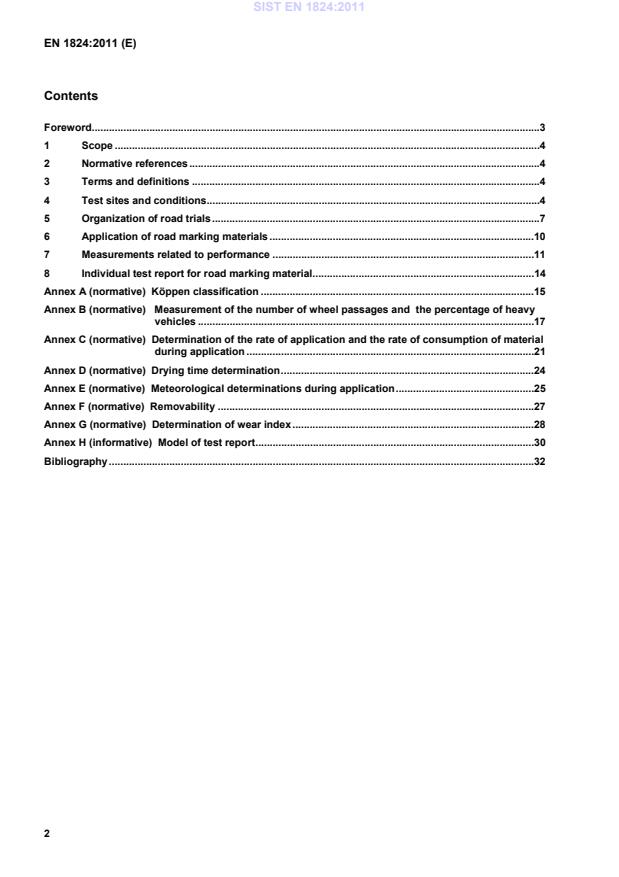
Köppen classification .15Annex B (normative)
Measurement of the number of wheel passages and
the percentage of heavy vehicles .17Annex C (normative)
Determination of the rate of application and the rate of consumption of material during application .21Annex D (normative)
Drying time determination .24Annex E (normative)
Meteorological determinations during application .25Annex F (normative)
Removability .27Annex G (normative)
Determination of wear index .28Annex H (informative)
Model of test report .30Bibliography .32 SIST EN 1824:2011
Preformed road markings, EN 1824, Road marking materials
Road trials, EN 1871, Road marking materials
Paint, thermoplastic and cold plastic materials Specifications, EN 12802, Road marking materials
Laboratory methods for identification, EN 13197, Road marking materials
Wear simulator Turntable, EN 13212, Road marking materials
Requirements for factory production control, EN 13459, Road marking materials
Sampling and testing.
Road marking performance for road users EN 13036-1, Road and airfield surface characteristics
Test methods
Part 1: Measurement of pavement surface macrotexture depth using a volumetric patch technique 3 Terms and definitions For the purpose of this document, the following terms and definitions apply. 3.1 roll-over number of wheels passing over a point of a road surface within a specified period of time 3.2 useful rate of application quantity, expressed in g×m-2, of drop-on and/or non-drop materials which have adhered to the road marking substrate, when lines are done 3.3 rate of consumption during application quantity, expressed in g×m-2, of drop-on or injection materials at the exit of the guns of the application equipment 3.4 percentage of heavy vehicles ratio between the number of heavy vehicles and the number of all vehicles circulating on the test site 4 Test sites and conditions 4.1 General Test sites shall be arranged at suitable locations in accordance with 4.2 to 4.5. The test results may depend on test field location, climate, road surface and traffic which shall be described according to 4.2 to 4.6. 4.2 Test sites characteristics and location The test site shall be located in an area which belongs to one of the climatic classes defined in 4.3. The test site shall consist of a field, where the road marking materials are to be applied, with extra space at both ends. The roads used for test sites should be straight and flat and without junctions, substantial obstacles to daylight, sources of frequent dirt (quarries, field exits, etc.) or tracked vehicles. SIST EN 1824:2011
Table 1 – Test Field climatic classes Climatic Class Climatic zone according to Köppen C1 Dfc E C2 Cfb without Winter maintenance C3 Cfb with Winter maintenance Dfb Dsb C4 Csa Bsh Cfa Csb
Table 2 – Test field roughness classes Roughness class Averaged measured texture depth RG1 ≤ 0,60 mm RG2 > 0,60 mm and ≤ 0,90 mm RG3 > 0,90 mm and ≤ 1,20 mm RG4 > 1,20 mm
NOTE 4 The texture depth has an influence on the result of road trials, at least for materials applied in thin layers. 4.5 Roll-over classes The volume of traffic shall be such as to ensure that one or more measurement areas with the desired roll-over class can be selected (see 7.2). At the termination of a road trial, a traffic report for the duration of the road trial should be made available. The traffic report shall include the roll-over classes according to Table 3, determined on the measurement area(s) in accordance with Annex B.
5 Organization of road trials 5.1 Duration A road trial shall include at least one full climatic cycle of one year for materials intended for permanent road marking and up to 6 months for materials intended for temporary road marking. In some cases, test markings may fall below the performance requirements of the road authority. In these cases, it may be necessary for the markings to be removed. 5.2 Transverse and longitudinal application patterns 5.2.1 General Road marking materials shall be applied in patterns of lines either transverse or longitudinal to the road. When a long (more than 40 cm) measurement area is necessary, the transverse pattern cannot be used. When both the transverse and longitudinal patterns are used on the same test site, they shall be used on separate parts of that test site. 5.2.2 Transverse pattern At least three lines shall be applied for each road marking material. The distance between two adjacent lines should be at least 0,35 m and the width at least 0,15 m as shown in Figure 1. The application could be done across one or two lanes.
Key 1 edge line 5 measurement areas 2 Lane 2 6 axis of measurement column 3 Lane 1 7 measurement column 4 road marking material in test 8 measurement points for determination of the number of wheel passages Figure 1 – Example of a transverse pattern showing a measurement column 5.2.3 Longitudinal pattern Lines are applied in transverse rows and longitudinal columns. For each of the road marking materials there shall be one line in each column containing measurement areas (see 7.2.2.3). The lines should be at least 0,13 m wide and at least 1 m long as shown in Figure 2. Unmarked space between the lines is a minimum of 0,5 m in the longitudinal direction. SIST EN 1824:2011
Key 1 2 6 columns 4 rows 6 7 axis of measurement column Measurement column 3 centre line 8 Measurement areas 4 Lane 1 9 Measurement point for the determination of the number of wheel passages 5 edge line
Figure 2 – Example of a longitudinal pattern showing a measurement column SIST EN 1824:2011
NOTE 1 For certification purposes, sampling will be done by test laboratory. NOTE 2 For materials used in more than one application, it is not necessary to sample every application. NOTE 3 The participating parties can agree to include further specifications for sampling, such as quantities to sample. NOTE 4 If diluents are allowed and used for the application, the rate of dilution will be verified sampling materials both from the original container and from the tank. 6.5.2 Measurement of drying time and weather conditions When required by the participating parties, the drying time shall be measured for paints and cold plastics. The drying time shall be determined in accordance with Annex D for every line that contains a measurement area (see 7.3) for further measurements. The drying time shall be reported together with an account of the weather conditions, including the ambient temperature, the road surface temperature, the relative air humidity and the wind speed as measured during application in accordance with Annex E. 6.5.3 Determination of the useful rate(s) of application and the rate(s) of consumption during application During the application of a road marking material, the useful rates of application of the material and of any drop-on or non drop-on material shall be determined in accordance with Annex C. When the rate(s) of consumption of material(s) during application are also required, they should be also determined in accordance with Annex C. NOTE The participating parties can agree to include a criterion for the acceptability of the application of a road marking material. For example, the application is rejected if any of the rates of application from the different lines deviates more than 10 % from the average rate of application, or if the average rate of application deviates more than, for example, 15 % from the rate of application given in the specification for the material. 7 Measurements related to performance 7.1 General Test lines shall only be washed when it is necessary to do so and by agreements between the participating parties. Washing shall be with a soft brush using clear water. The performance shall be then determined once the product is dry. When test lines have been washed, it shall be indicated on the test report. 7.2 Parameters The following parameters are relevant to this document: a) coefficient of retroreflected luminance, RL dry; SIST EN 1824:2011
The measurement area shall consist of at least two lines of the same road marking material. 7.3.2.3 Longitudinal pattern When introducing a measurement area, a 0,15 m wide column along the road shall be selected (see Figure 2) so that points within the column lie within longitudinal lines and have as close to the desired number of wheel passages as possible. The measurement area shall consist of at least 1 m of one line of one road marking material (see Figure 2). SIST EN 1824:2011
Table 4 – Periodicity of measurements Parameter Initial measurementsAfter application, measurements shall be taken after a minimum of 3 days after exposure to traffic an before a maximum of 14 days (permanent and temporary) Retained measurements Before 6 monthsc (temporary only) Retained measurements After one or more full
climatic cycled
(permanent only) RL (in dry, wet and under rain condition when relevant) + + + Qd + + + Colour + + + SRT + + + Removability
+
NOTE Other measuring periods can be used in field trials with special purposes. SIST EN 1824:2011
intended use of the material; technical data for application and removability including technical specifications for materials, road marking equipment used, drying time and ra
...