

EN 1790:2013
(Main)Road marking materials - Preformed road markings
- Abstract
This European Standard specifies construction products which are white and yellow, removable or non-removable, preformed road marking materials, under the form of tape, cold plastic, thermoplastics with or without drop-on materials, to be used for permanent and/or temporary road markings in circulation areas. Other products and colours intended for road markings are not covered in this European Standard.
This European Standard also gives specifications for the evaluation of conformity for white and yellow, removable or non-removable, preformed road materials under the form of tape, cold plastic, thermoplastics with or without drop-on materials to be used for permanent and/or temporary road markings in circulation areas including type testing and factory production control.
This European Standard includes an Annex ZA for tapes, preformed cold plastic road marking and thermoplastic road marking with and without drop-on materials with the clauses addressing the provisions of the EU Construction Product Directive for permanent road marking.
- Status
- Published
- Publication Date
- 01-Oct-2013
- Withdrawal Date
- 30-Jul-2015
- Technical Committee
- CEN/TC 226 - Road equipment
- Drafting Committee
- CEN/TC 226/WG 2 - Horizontal road signs
- Current Stage
- 9092 - Decision on results of review/2YR ENQ - revise - Review Enquiry
- Start Date
- 15-Oct-2018
- Completion Date
- 07-Oct-2026


Overview
EN 1790:2013 is the CEN European Standard for preformed road marking materials. It covers factory-produced white and yellow markings supplied as tape, preformed cold plastic or preformed thermoplastic (with or without drop-on materials) for permanent and temporary use in circulation areas. The standard specifies product requirements, test methods and conformity assessment (type testing and factory production control). It also includes an informative Annex ZA aligning clauses with the EU Construction Products Directive for permanent road marking.
Key topics and technical requirements
- Product scope: White and yellow preformed materials only; removable and non‑removable products; tapes, cold plastic sheets, thermoplastics (pre‑beaded or requiring drop‑on materials).
- Visibility and photometry
- Daytime visibility: measured as luminance coefficient (Qd) or luminance factor (β). Products are assigned classes (Q1–Q5 or B‑classes). Example class thresholds for luminance factor β are given for permanent and temporary white/yellow markings.
- Colour: chromaticity (x,y) coordinates must lie within the white/yellow regions defined in EN 1436.
- Night‑time visibility (retroreflection): retroreflected luminance (RL) classes for dry, wet and rain conditions (R‑, RW‑ and RR‑classes) as referenced to EN 1436.
- Skid resistance: laboratory SRT test for non‑structured products with S‑classes defined by EN 1436.
- Removability: assessed in real road trials (not solely in the lab) to verify that removable markings can be removed without leaving confusing residues.
- Identification, labelling and documentation: manufacturer identification, product type, assembly instructions (for thermoplastics with drop‑on materials) and marking requirements.
- Conformity assessment: type testing and factory production control procedures; references to testing and sampling standards.
Practical applications and users
- Who uses EN 1790:2013
- Road marking manufacturers and product developers
- Highway authorities and transport agencies specifying materials
- Contractors applying permanent and temporary road markings
- Testing laboratories and conformity assessors
- Procurement teams establishing technical specifications
- Typical applications
- Longitudinal lanes, symbols and temporary traffic control markings
- Pre‑cut signs and markings where rapid installation or removability is required
- Projects requiring compliance with EU construction product rules
Related standards
- EN 1436 (road marking performance), EN 1824 (road trials), prEN 1871 (physical properties), EN 12802 (identification), EN 13197 (wear simulator), EN 13212 (factory production control), EN 13459 (sampling). These referenced standards define test methods, performance classes and conformity procedures used together with EN 1790:2013.
Keywords: EN 1790:2013, preformed road markings, road marking materials, preformed thermoplastic, preformed cold plastic, tape road markings, road marking standard, CEN, retroreflection, skid resistance, removability.
Relations
- Effective Date
- 09-Oct-2013
- Effective Date
- 28-Jan-2026
- Effective Date
- 28-Jan-2026
- Effective Date
- 28-Jan-2026
- Effective Date
- 28-Jan-2026
- Effective Date
- 28-Jan-2026
- Effective Date
- 28-Jan-2026
- Effective Date
- 28-Jan-2026
- Effective Date
- 28-Jan-2026
- Effective Date
- 28-Jan-2026
- Effective Date
- 19-Jan-2023
Get Certified
Connect with accredited certification bodies for this standard

Zavod za gradbeništvo Slovenije (ZAG) - Inšpekcija
ZAG inspection body for construction products, structures, and materials.
Sponsored listings
Frequently Asked Questions
EN 1790:2013 is a standard published by the European Committee for Standardization (CEN). Its full title is "Road marking materials - Preformed road markings". This standard covers: This European Standard specifies construction products which are white and yellow, removable or non-removable, preformed road marking materials, under the form of tape, cold plastic, thermoplastics with or without drop-on materials, to be used for permanent and/or temporary road markings in circulation areas. Other products and colours intended for road markings are not covered in this European Standard. This European Standard also gives specifications for the evaluation of conformity for white and yellow, removable or non-removable, preformed road materials under the form of tape, cold plastic, thermoplastics with or without drop-on materials to be used for permanent and/or temporary road markings in circulation areas including type testing and factory production control. This European Standard includes an Annex ZA for tapes, preformed cold plastic road marking and thermoplastic road marking with and without drop-on materials with the clauses addressing the provisions of the EU Construction Product Directive for permanent road marking.
This European Standard specifies construction products which are white and yellow, removable or non-removable, preformed road marking materials, under the form of tape, cold plastic, thermoplastics with or without drop-on materials, to be used for permanent and/or temporary road markings in circulation areas. Other products and colours intended for road markings are not covered in this European Standard. This European Standard also gives specifications for the evaluation of conformity for white and yellow, removable or non-removable, preformed road materials under the form of tape, cold plastic, thermoplastics with or without drop-on materials to be used for permanent and/or temporary road markings in circulation areas including type testing and factory production control. This European Standard includes an Annex ZA for tapes, preformed cold plastic road marking and thermoplastic road marking with and without drop-on materials with the clauses addressing the provisions of the EU Construction Product Directive for permanent road marking.
EN 1790:2013 is classified under the following ICS (International Classification for Standards) categories: 93.080.20 - Road construction materials. The ICS classification helps identify the subject area and facilitates finding related standards.
EN 1790:2013 has the following relationships with other standards: It is inter standard links to EN 1790:1998, EN 1436:2007+A1:2008, EN 1824:2011, FprEN 1871, EN 13197:2011, EN ISO 4892-3:2024, EN ISO 11358-1:2022, EN 13459:2011, EN 12802:2011, EN 13212:2011, prEN 1790. Understanding these relationships helps ensure you are using the most current and applicable version of the standard.
EN 1790:2013 is associated with the following European legislation: EU Directives/Regulations: 305/2011, 89/106/EEC; Standardization Mandates: M/111. When a standard is cited in the Official Journal of the European Union, products manufactured in conformity with it benefit from a presumption of conformity with the essential requirements of the corresponding EU directive or regulation.
EN 1790:2013 is available in PDF format for immediate download after purchase. The document can be added to your cart and obtained through the secure checkout process. Digital delivery ensures instant access to the complete standard document.
Standards Content (Sample)
2003-01.Slovenski inštitut za standardizacijo. Razmnoževanje celote ali delov tega standarda ni dovoljeno.Straßenmarkierungsmaterialien - Vorgefertigte MarkierungenProduits de marquage routier - Marquages routiers préformésRoad marking materials - Preformed road markings93.080.20Materiali za gradnjo cestRoad construction materialsICS:Ta slovenski standard je istoveten z:EN 1790:2013SIST EN 1790:2013en,fr,de01-december-2013SIST EN 1790:2013SLOVENSKI
STANDARDSIST EN 1790:19991DGRPHãþD
EUROPEAN STANDARD NORME EUROPÉENNE EUROPÄISCHE NORM
EN 1790
October 2013 ICS 93.080.20 Supersedes EN 1790:1998English Version
Road marking materials - Preformed road markings
Produits de marquage routier - Marquages routiers préfabriqués
Straßenmarkierungsmaterialien - Vorgefertigte Markierungen This European Standard was approved by CEN on 5 April 2013.
CEN members are bound to comply with the CEN/CENELEC Internal Regulations which stipulate the conditions for giving this European Standard the status of a national standard without any alteration. Up-to-date lists and bibliographical references concerning such national standards may be obtained on application to the CEN-CENELEC Management Centre or to any CEN member.
This European Standard exists in three official versions (English, French, German). A version in any other language made by translation under the responsibility of a CEN member into its own language and notified to the CEN-CENELEC Management Centre has the same status as the official versions.
CEN members are the national standards bodies of Austria, Belgium, Bulgaria, Croatia, Cyprus, Czech Republic, Denmark, Estonia, Finland, Former Yugoslav Republic of Macedonia, France, Germany, Greece, Hungary, Iceland, Ireland, Italy, Latvia, Lithuania, Luxembourg, Malta, Netherlands, Norway, Poland, Portugal, Romania, Slovakia, Slovenia, Spain, Sweden, Switzerland, Turkey and United Kingdom.
EUROPEAN COMMITTEE FOR STANDARDIZATION
COMITÉ EUROPÉEN DE NORMALISATION EUROPÄISCHES KOMITEE FÜR NORMUNG
CEN-CENELEC Management Centre:
Avenue Marnix 17,
B-1000 Brussels © 2013 CEN All rights of exploitation in any form and by any means reserved worldwide for CEN national Members. Ref. No. EN 1790:2013: ESIST EN 1790:2013
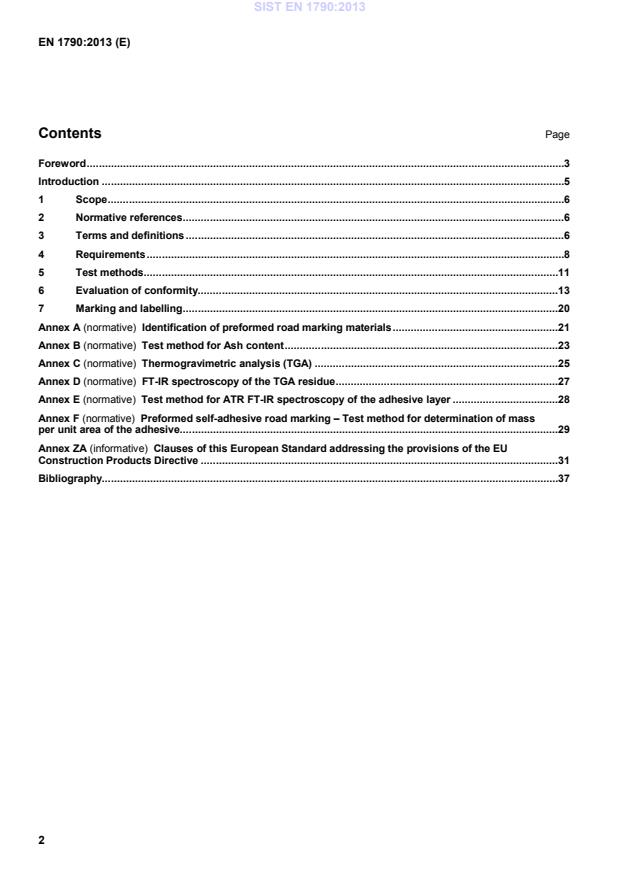
Identification of preformed road marking materials . 21 Annex B (normative)
Test method for Ash content . 23 Annex C (normative)
Thermogravimetric analysis (TGA) . 25 Annex D (normative)
FT-IR spectroscopy of the TGA residue . 27 Annex E (normative)
Test method for ATR FT-IR spectroscopy of the adhesive layer . 28 Annex F (normative)
Preformed self-adhesive road marking – Test method for determination of mass per unit area of the adhesive . 29 Annex ZA (informative)
Clauses of this European Standard addressing the provisions of the EU Construction Products Directive . 31 Bibliography. 37
EN 1790, Road marking materials
Preformed road markings (the present document), EN 1824, Road marking materials
Road trials, prEN 1871:2008, Road marking materials
Paint, cold plastic and thermoplastic marking materials – Physical properties, EN 12802, Road marking materials Laboratory methods for identification, EN 13197, Road marking materials Wear simulator Turntable, EN 13212, Road marking materials Requirements for factory production control, EN 13459, Road marking materials
Sampling from storage and testing. SIST EN 1790:2013
They are completely covered by this standard. Thermoplastic road markings with drop-on materials need the addition of drop-on materials during application on the road and therefore they are in some way similar to the thermoplastic products covered by prEN 1871:2008. This standard provides all the relevant information and cross references to prEN 1871:2008 in order to cover these kinds of products. SIST EN 1790:2013
EN 1824:2011, Road marking materials Road trials prEN 1871:2008, Road marking materials Paint, cold plastic and thermoplastic marking materials Physical properties EN 12802, Road marking materials Laboratory methods for identification EN 13197:2011, Road marking materials Wear simulator Turntable EN 13212:2011, Road marking materials Requirements for factory production control EN 13459, Road marking materials Sampling from storage and testing EN ISO 4892-3, Plastics Methods of exposure to laboratory light sources Part 3: Fluorescent UV lamps (ISO 4892-3) EN ISO 11358, Plastics Thermogravimetry (TG) of polymers General principles (ISO 11358) 3 Terms and definitions For the purposes of this document, the following terms and definitions apply. 3.1 preformed road marking factory produced road marking system (or product), in sheet or roll form, capable of being applied to the substrate with adhesive, primer, pressure, heat or a combination of these 3.1.1
tape preformed multilayer road marking, capable of adapting itself to the texture of the substrate, which may be precoated with pressure-sensitive adhesive, capable of being stuck to the substrate without heating the material, while the photometric, colorimetric and skid resistance characteristics are not significantly modified during application SIST EN 1790:2013
EXAMPLE Thermo AX – Assembly 1; Thermo AX – assembly 2, etc. Note 1 to entry: This definition is relevant only for preformed thermoplastic road marking with drop-on materials as defined in 3.1.4. 3.6 structured road marking products road marking product without areas of regular dimensions and tap surfaces, which has flat areas of a maximum width of 75,7 mm a maximum length of 125 mm at the top of the structure Note 1 to entry: The areas can be crossed by gaps that take up minimum 25 % of the total surface area and have widths of minimum 5 mm. The areas can have ridges or edges of blocks with a height of minimum 1,2 mm. 3.7 non-structured road marking products road marking product with areas of regular dimensions and tap surfaces, which has flat areas of a minimum width of 75,7 mm a minimum length of 125 mm at the top of the structure SIST EN 1790:2013
Primers are used to precoat road surfaces before the road marking system is applied. They improve the adhesion of the road marking and protect against disintegration, discolouring, etc. caused by incompatible compounds in the road surface. 4 Requirements 4.1 Tape, Preformed Cold Plastic Road Marking and Preformed Thermoplastic Road Marking without drop-on Materials 4.1.1 General The requirements are meant as characteristics of the materials as fully finished products. They are therefore intended as laboratory requirements. 4.1.2 Day-time visibility (reflection in daylight or under road lighting)
Day-time visibility represents the brightness of a road marking as seen by driver’s vehicles in typical or average daylight or under road lighting. It shall be measured either by the coefficient of luminance under diffuse illumination (Qd), expressed in mcd·m-2·lx-1 or by the luminance factor (). a) When luminance coefficient under diffuse illumination Qd is measured, the preformed road marking material is tested in accordance with 5.2.2 a) and shall comply with classes Q1 to Q5 of EN 1436:2007+A1:2008, Table 1.
b) When luminance factor
is measured, the preformed road marking material is tested in accordance with 5.2.2 b), and shall comply with Table 1: Table 1 Classes of luminance factor β in dry conditions Type and colour Class
Luminance factor β Permanent
White and yellow
White
Yellow
B0 B5 B3
No value requested
≥ 0,60 ≥ 0,40 Temporary
White and yellow
White
Yellow
B0 B6 B3
No value requested
≥ 0,70 ≥ 0,40
4.1.3 Night-time visibility (retroreflection under vehicle headlamp illumination)
Night-time visibility represents the brightness of a road marking as seen by driver’s vehicles under the illumination by the driver’s own headlamp. The result is expressed by the coefficient of retroreflected luminance in mcd·m-2·lx-1. The coefficient of retroreflected luminance on dry conditions changes during wetness or during rain. Retroreflected luminance during wetness or during rain only applies for road markings type II. a) When preformed road marking material is tested on dry conditions, in accordance with 5.2.3 a), the coefficient of the retroreflected luminance RL shall comply with classes R1 to R5 of EN 1436:2007+A1:2008, Table 3 (only for retroreflective road marking products). SIST EN 1790:2013
4.1.6 Removability
Removability, as defined in 3.2, shall be tested in order to evaluate whether the preformed road marking material is entirely removable without leaving permanent marks that could confuse the road user during the different weather conditions. The removability of preformed road markings cannot be determined in the laboratory and shall therefore be tested on the road, in accordance with 5.2.6. 4.1.7 Resistance to UV exposure
UV resistance shall be checked in accordance with 5.2.7. The chromaticity co-ordinates of preformed materials after UV exposure shall comply with the region for white road markings of Table 6 and with region Y2 for yellow road markings in EN 1436:2007+A1:2008, Table 6, respectively for white and yellow preformed road marking. The preformed materials shall be classified in accordance with Table 2, where ∆β is the difference between the luminance factor before and after UV exposure. Table 2 Classes of UV resistance
Colour Class ∆β White and yellow UV0 No value requested White and yellow UV2 ≤ 0,10
4.2 Preformed Thermoplastic Road Marking with drop-on Materials Requirements for these products are defined in prEN 1871:2008, 4.2.1 (Test before heat stability for base road marking materials) and in prEN 1871:2008, M.3.2.2 (Night- and Day-time Visibility and Skid Resistance). Test methods are defined in 5.3 of this European Standard. SIST EN 1790:2013
The following performance characteristics of the road marking assemblies are tested by road trial or wear simulator: Retroreflection under vehicle headlamp illumination (see 4.1.3): coefficient of retroreflected luminance RL expressed as class R on dry conditions (only for retroreflective road marking products); coefficient of retroreflected luminance RL expressed as class RW during wetness (only for Type II road marking products) and/or; coefficient of retroreflected luminance RL expressed as class RR during rain (only for Type II road marking products); Reflection in daylight or under road lighting (see 4.1.2 and 4.1.4): luminance coefficient under diffuse illumination (Qd) or luminance factor (); chromaticity co-ordinates (x,y); Skid Resistance (SRT vale) (only for non-structured road markings) (see 4.1.5). 4.3.2 Durability on road trials When a road marking product to be used for permanent road marking is tested according to 5.4.2, the road marking product shall be exposed to at least roll-over class P1 of EN 1824:2011, Table 3. In the case of road trial with studded tyres, class P0 applies and the actual value of wheel passages (to the nearest thousand wheel passages) shall be stated in the test report. When a road marking product to be used for temporary road marking is tested according to 5.4.2, the road marking product shall be exposed to at least roll-over classes T0; T1 or T2 of Table 3 of EN 1824:2011. For the requirements of the road marking product specified in 4.1 and 4.2, the results are expressed in terms of a class (with the exception of the colour for which pass/fail criteria is used) for the corresponding roll-over class (P) and accompanied by studded tyres (Y/N). 4.3.3 Durability of on wear simulator - turntable When a road marking product to be used for permanent road marking is tested according to 5.4.3, the road marking product shall be exposed to at least traffic class P4 of EN 13197:2011, Table 4.
When a road marking product to be used for temporary road marking is tested according to 5.4.3, the road marking product shall be exposed to at least traffic class P1 of EN 13197:2011, Table 4. For the requirements of the road marking product specified in 4.1 and 4.2, the results are expressed in terms of a class (with the exception of the colour for which pass/fail criteria is used) for the corresponding roll-over class (P). SIST EN 1790:2013
5.2.2 Day-time visibility (reflection in daylight or under road lighting) Day-time visibility may be measured either by: a) the coefficient of luminance under diffuse illumination (Qd), expressed in mcd·m-2·lx-1 according to EN 1436:2007+A1:2008, Annex A; or b) the luminance factor (), according to EN 1436:2007+A1:2008, Annex C. 5.2.3 Night-time visibility (retroreflection under vehicle headlamp illumination) Night-time visibility can be measured in different conditions as follows: a) coefficient of retroreflected luminance in dry conditions (R), in accordance with EN 1436:2007+A1:2008, Annex B; b) coefficient of retroreflected luminance with wetness (RW) in accordance with EN 1436:2007+A1:2008, Annex B; c) coefficient of retroreflected luminance during rain (RR) in accordance with EN 1436:2007+A1:2008, Annex B. SIST EN 1790:2013
Products may be in different families for different characteristics. Reference to the test method standards should be made to allow the selection of a suitable representative sample. Therefore Type Tests or Initial Type Testing shall be performed for all characteristics included in the standard for which the manufacturer declares performances, including that Identification is performed as in Annex A for Tape, Preformed Cold Plastic road marking and Preformed Thermoplastic road marking without drop-on materials and performed as in EN 12802 for Preformed Thermoplastic road marking with drop-on materials: at the beginning of the production of a new or modified preformed road marking materials,
at the beginning of a new or modified method of production (where this may affect the stated properties); or they shall be repeated for the appropriate characteristic(s), whenever a change occurs in the preformed road marking materials, in the raw material or in the supplier of the components, or in the production process (subject to the definition of a family), which would affect significantly one or more of the characteristics. SIST EN 1790:2013
Table 3 — Number of samples to be tested and compliance criteria
6.2.3 Test reports All Type Tests, Initial Type Tests and their results shall be documented in test reports. All test reports shall be retained by the manufacturer for at least 10 years after the last date of production of the preformed road marking materials to which they relate. Characteristic Requirement and Compliance criteria Assessment method No. of samples Essential characteristics Night-time visibility Retroreflection under headlamp illumination
Coefficient of retroreflected luminance RL on dry 4.1.3 a) 4.2* 5.2.3 a) 5.3* 1 Coefficient of retroreflected luminance RL during wetness 4.1.3 b) 4.2* 5.2.3 b) 5.3* 1 Coefficient of retroreflected luminance RL during rain 4.1.3 c) 4.2* 5.2.3 c) 5.3* 1 Day-time visibility Reflection in daylight or under road
lighting
Coefficient under diffuse illumination Qd 4.1.2 a) 4.2* 5.2.2 a) 5.3* 1 Luminance factor
4.1.2 b) 4.2* 5.2.2 b) 5.3* 1 Colour Chromaticity co-ordinates (x,y) 4.1.4 4.2* 5.2.4 5.3* 1 Skid resistance SRT units 4.1.2 4.2* 5.2.5 5.3* 1 Removability Y/N description 4.1.6 5.2.6 1 Resistance to UV exposure Classes of UV resistance 4.1.7 5.2.7 1 Test before heat stability Chromaticity co-ordinates (x,y) and luminance factor
4.2* 5.3* 1 Softening point 4.2* 5.3* 1 Alkali resistance 4.2* 5.3* 1 Cold impact resistance 4.2* 5.3* 1 UV ageing 4.2* 5.3* 1 Durability Road trials (Roll over class) 4.3.2 4.3.2* 5.4.2
5.4.2* 1 Turntable-wear simulator (Traffic class) 4.3.3 4.3.3* 5.4.3
5.4.3* 1 * Applies for preformed thermoplastics with drop-on materials. SIST EN 1790:2013
The manufacturer shall establish procedures to ensure that the stated values of the characteristics he declares are maintained. The characteristics, and the means of control, are described in Table 4 for Tape, Preformed Cold Plastic and Thermoplastic without drop-on material. For Preformed Thermoplastic with drop-on materials, EN 13212:2011, Table 3 applies. Table 4 Testing and minimum frequency for Tape, Preformed Cold Plastic Road Marking and Preformed Thermoplastic without drop-on materials Characteristic Minimum frequency of tests On semi finished product (for self-adhesive road markings) Adhesive - Mass per unit area (in accordance with Annex F of this standard) At least once a day per each product On final product Colour and luminance factor (x,y; β) Every 2 000 m² Daytime visibility (Qd) Every 2 000 m² Retroreflection (RL/RW/RR) Every 2 000 m² Skid resistance value (SRT) Every 2 000 m² Ash content Every 5 000 m²
6.3.2.8 Non-complying products The manufacturer shall have written procedures (including recall procedures) which specify how non-complying products shall be dealt with.
Any such events shall be recorded as they occur and these records shall be kept for the period defined in the manufacturer’s written procedures. 6.3.2.9 Corrective action The manufacturer shall have documented procedures that instigate action to eliminate the cause of non-conformities in order to prevent recurrence. 6.3.2.10 Handling, storage and packaging The manufacturer shall have procedures providing methods of product handling and shall provide suitable storage areas preventing damage or deterioration.
6.3.3 Product specific requirements The FPC system shall: address this European Standard and ensure that the products placed on the market comply with the stated performance characteristics. The FPC system shall include a product specific FPC, which identifies procedures to demonstrate compliance of the product at appropriate stages, i.e.: a) the controls and tests to be carried out prior to and/or during manufacture according to a frequency laid down in the FPC test plan, and/or SIST EN 1790:2013
...