

EN 18124:2025
(Main)Road marking materials - Temporary road markings
- Abstract
This document specifies white, yellow and orange road markings, removable or non-removable, under the form of road marking assemblies or preformed road markings, to be used for temporary road markings in circulation areas. Other road marking products and colours intended for temporary road markings are not covered in this document.
This document also gives specifications for the evaluation of conformity of temporary road markings in circulation areas including type testing and factory production control.
- Status
- Published
- Publication Date
- 18-Nov-2025
- Technical Committee
- CEN/TC 226 - Road equipment
- Drafting Committee
- CEN/TC 226/WG 2 - Horizontal road signs
- Current Stage
- 6060 - Definitive text made available (DAV) - Publishing
- Start Date
- 19-Nov-2025
- Due Date
- 23-Jan-2026
- Completion Date
- 19-Nov-2025

Overview
EN 18124:2025 - Road marking materials - Temporary road markings (CEN) defines requirements for white, yellow and orange temporary road markings used in circulation areas. The standard covers both preformed products (tape, preformed cold or thermoplastic) and assemblies (paint/thermoplastic/cold plastic with drop-on materials). It also sets out procedures for evaluation of conformity, including type testing and factory production control (FPC), and provides guidance on removability.
Key topics and technical requirements
- Product scope: Only white, yellow and orange temporary markings (removable or non-removable) in assembly or preformed form; other colours/products are excluded.
- Performance characteristics
- Day-time visibility: Measured as luminance coefficient Qd (classes Q0–Q5) or luminance factor β (classes B0–B5) per EN 1436. Note: orange markings require β ≥ 0,10.
- Night-time visibility: Retroreflection under vehicle headlamp illumination (defined and tested per referenced methods).
- Chromaticity coordinates: Day- and night-time colour requirements to ensure differentiation from permanent markings.
- Skid resistance: SRT value requirement to maintain safety under traffic.
- Durability
- Evaluated on road trials and on a wear simulator (turntable) to reflect expected short-term service life in workzones or temporary layouts.
- Technical characteristics
- Removability: Defined property and test method; guidance for removal is given in Annex A.
- Identification: Labelling and product identification requirements.
- Coverage and wear metrics: Percentage coverage, percentage wear and cover index to quantify material performance.
- Testing and conformity
- Test sample preparation, specific test methods for each performance metric, and sampling procedures are specified.
- Conformity assessment: Type testing and FPC (see also EN 13212 referenced for FPC principles).
Practical applications and users
- Who uses it:
- Manufacturers of preformed tapes, thermoplastics, paints and assemblies - to design and declare compliant temporary products.
- Road authorities and specifiers - to write procurement specs for temporary markings in workzones, detours and event traffic control.
- Contractors and installers - to follow application, primer and climatic guidance to ensure adhesion and removability.
- Testing laboratories and conformity assessors - to perform type testing, road trials and FPC checks.
- Typical uses:
- Short-term lane changes, workzone delineation, temporary diversions, or masking permanent markings where later removal is required.
- Situations requiring clear differentiation from permanent markings (e.g., yellow/orange marking classes, higher visibility performance).
Related standards
- EN 1436 - Road marking performance and test methods
- EN 1824 - Road trials
- EN 13197 - Wear simulator (turntable)
- EN 13459 - Sampling from storage and testing
- EN 13212 - Factory production control (referenced for FPC)
Keywords: EN 18124:2025, temporary road markings, road marking materials, preformed tape, removability, retroreflection, day-time visibility, factory production control (FPC), CEN standards.
Relations
- Effective Date
- 28-Jan-2026
- Effective Date
- 28-Jan-2026
- Refers
EN 1436:2018 - Road marking materials - Road marking performance for road users and test methods - Effective Date
- 28-Jan-2026
- Effective Date
- 28-Jan-2026
Get Certified
Connect with accredited certification bodies for this standard

Zavod za gradbeništvo Slovenije (ZAG) - Inšpekcija
ZAG inspection body for construction products, structures, and materials.
Sponsored listings
Frequently Asked Questions
EN 18124:2025 is a standard published by the European Committee for Standardization (CEN). Its full title is "Road marking materials - Temporary road markings". This standard covers: This document specifies white, yellow and orange road markings, removable or non-removable, under the form of road marking assemblies or preformed road markings, to be used for temporary road markings in circulation areas. Other road marking products and colours intended for temporary road markings are not covered in this document. This document also gives specifications for the evaluation of conformity of temporary road markings in circulation areas including type testing and factory production control.
This document specifies white, yellow and orange road markings, removable or non-removable, under the form of road marking assemblies or preformed road markings, to be used for temporary road markings in circulation areas. Other road marking products and colours intended for temporary road markings are not covered in this document. This document also gives specifications for the evaluation of conformity of temporary road markings in circulation areas including type testing and factory production control.
EN 18124:2025 is classified under the following ICS (International Classification for Standards) categories: 93.080.20 - Road construction materials. The ICS classification helps identify the subject area and facilitates finding related standards.
EN 18124:2025 has the following relationships with other standards: It is inter standard links to EN 1824:2020, EN 13197:2011+A1:2014, EN 1436:2018, EN 13459:2011. Understanding these relationships helps ensure you are using the most current and applicable version of the standard.
EN 18124:2025 is available in PDF format for immediate download after purchase. The document can be added to your cart and obtained through the secure checkout process. Digital delivery ensures instant access to the complete standard document.
Standards Content (Sample)
SLOVENSKI STANDARD
01-februar-2026
Materiali za označevanje vozišča - Začasne označbe vozišča
Road marking materials - Temporary road markings
Straßenmarkierungsmaterialien - Temporäre Straßenmarkierungen
Produits de marquage routier - Marquages routiers temporaires
Ta slovenski standard je istoveten z: EN 18124:2025
ICS:
93.080.20 Materiali za gradnjo cest Road construction materials
2003-01.Slovenski inštitut za standardizacijo. Razmnoževanje celote ali delov tega standarda ni dovoljeno.
EN 18124
EUROPEAN STANDARD
NORME EUROPÉENNE
November 2025
EUROPÄISCHE NORM
ICS 93.080.20
English Version
Road marking materials - Temporary road markings
Produits de marquage routier - Marquages routiers Straßenmarkierungsmaterialien - Vorübergehend
temporaires gültige Straßenmarkierungsmaterialien
This European Standard was approved by CEN on 12 October 2025.
CEN members are bound to comply with the CEN/CENELEC Internal Regulations which stipulate the conditions for giving this
European Standard the status of a national standard without any alteration. Up-to-date lists and bibliographical references
concerning such national standards may be obtained on application to the CEN-CENELEC Management Centre or to any CEN
member.
This European Standard exists in three official versions (English, French, German). A version in any other language made by
translation under the responsibility of a CEN member into its own language and notified to the CEN-CENELEC Management
Centre has the same status as the official versions.
CEN members are the national standards bodies of Austria, Belgium, Bulgaria, Croatia, Cyprus, Czech Republic, Denmark, Estonia,
Finland, France, Germany, Greece, Hungary, Iceland, Ireland, Italy, Latvia, Lithuania, Luxembourg, Malta, Netherlands, Norway,
Poland, Portugal, Republic of North Macedonia, Romania, Serbia, Slovakia, Slovenia, Spain, Sweden, Switzerland, Türkiye and
United Kingdom.
EUROPEAN COMMITTEE FOR STANDARDIZATION
COMITÉ EUROPÉEN DE NORMALISATION
EUROPÄISCHES KOMITEE FÜR NORMUNG
CEN-CENELEC Management Centre: Rue de la Science 23, B-1040 Brussels
© 2025 CEN All rights of exploitation in any form and by any means reserved Ref. No. EN 18124:2025 E
worldwide for CEN national Members.
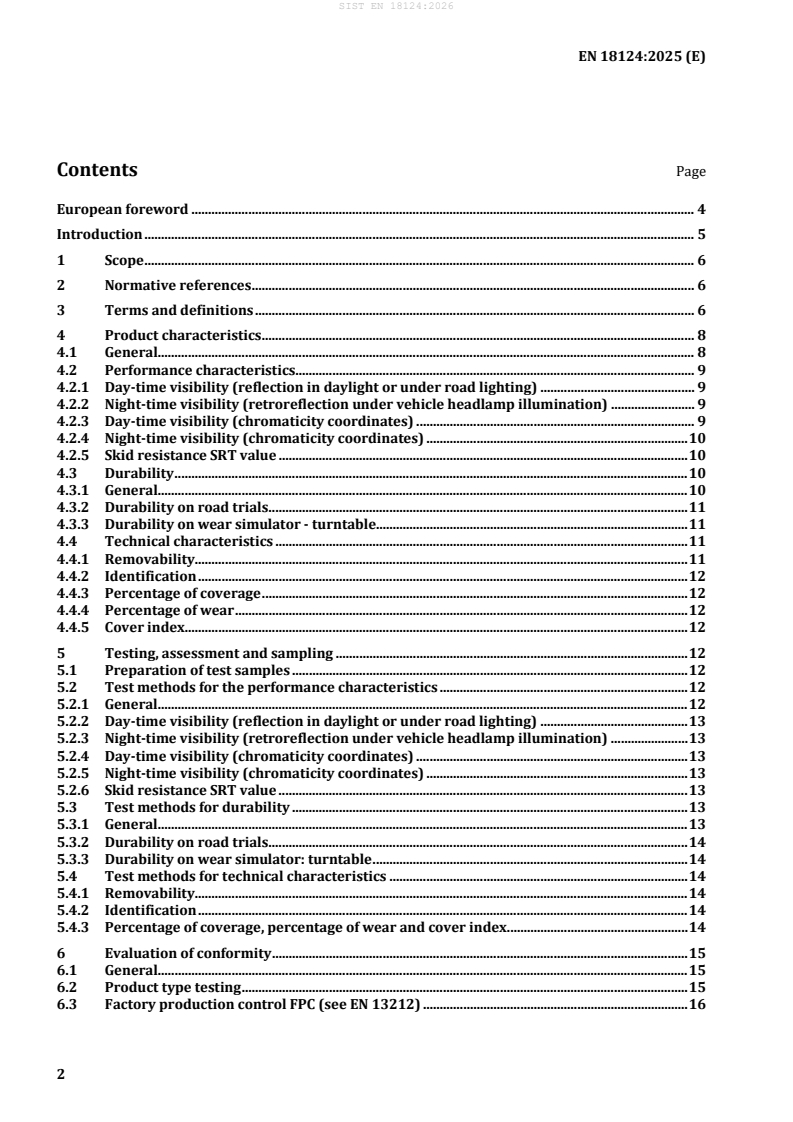
Contents Page
European foreword . 4
Introduction . 5
1 Scope . 6
2 Normative references . 6
3 Terms and definitions . 6
4 Product characteristics . 8
4.1 General. 8
4.2 Performance characteristics. 9
4.2.1 Day-time visibility (reflection in daylight or under road lighting) . 9
4.2.2 Night-time visibility (retroreflection under vehicle headlamp illumination) . 9
4.2.3 Day-time visibility (chromaticity coordinates) . 9
4.2.4 Night-time visibility (chromaticity coordinates) . 10
4.2.5 Skid resistance SRT value . 10
4.3 Durability . 10
4.3.1 General. 10
4.3.2 Durability on road trials . 11
4.3.3 Durability on wear simulator - turntable. 11
4.4 Technical characteristics . 11
4.4.1 Removability. 11
4.4.2 Identification . 12
4.4.3 Percentage of coverage . 12
4.4.4 Percentage of wear . 12
4.4.5 Cover index. 12
5 Testing, assessment and sampling . 12
5.1 Preparation of test samples . 12
5.2 Test methods for the performance characteristics . 12
5.2.1 General. 12
5.2.2 Day-time visibility (reflection in daylight or under road lighting) . 13
5.2.3 Night-time visibility (retroreflection under vehicle headlamp illumination) . 13
5.2.4 Day-time visibility (chromaticity coordinates) . 13
5.2.5 Night-time visibility (chromaticity coordinates) . 13
5.2.6 Skid resistance SRT value . 13
5.3 Test methods for durability . 13
5.3.1 General. 13
5.3.2 Durability on road trials . 14
5.3.3 Durability on wear simulator: turntable . 14
5.4 Test methods for technical characteristics . 14
5.4.1 Removability. 14
5.4.2 Identification . 14
5.4.3 Percentage of coverage, percentage of wear and cover index . 14
6 Evaluation of conformity . 15
6.1 General. 15
6.2 Product type testing . 15
6.3 Factory production control FPC (see EN 13212) . 16
Annex A (informative) Removal of temporary road markings . 17
Bibliography . 18
European foreword
This document (EN 18124:2025) has been prepared by Technical Committee CEN/TC 226 “Road
Equipment”, the secretariat of which is held by AFNOR.
This European Standard shall be given the status of a national standard, either by publication of an
identical text or by endorsement, at the latest by May 2026, and conflicting national standards shall be
withdrawn at the latest by May 2026.
Attention is drawn to the possibility that some of the elements of this document may be the subject of
patent rights. CEN shall not be held responsible for identifying any or all such patent rights.
Any feedback and questions on this document should be directed to the users’ national standards body.
A complete listing of these bodies can be found on the CEN website.
According to the CEN-CENELEC Internal Regulations, the national standards organisations of the
following countries are bound to implement this European Standard: Austria, Belgium, Bulgaria, Croatia,
Cyprus, Czech Republic, Denmark, Estonia, Finland, France, Germany, Greece, Hungary, Iceland, Ireland,
Italy, Latvia, Lithuania, Luxembourg, Malta, Netherlands, Norway, Poland, Portugal, Republic of North
Macedonia, Romania, Serbia, Slovakia, Slovenia, Spain, Sweden, Switzerland, Türkiye and the United
Kingdom.
Introduction
Temporary road markings can be made by using preformed or non-preformed road marking materials.
Temporary ‘preformed’ road marking products include tape, preformed cold plastic or preformed
thermoplastic road marking.
Preformed road marking products are fully finished during manufacturing and do not change
significantly their properties during application. They can be applied by means of adhesives, pressure or
heat, with or without the use of a primer.
‘Assemblies’ are the base road marking material (paint, thermoplastic or cold plastic) together with the
drop-on materials and / or premix glass beads needed to build up the applied road marking.
Temporary road markings are sometimes applied with a view for later removal and therefore the specific
property of “removability” can be required. See Annex A for more detail.
There are two different concepts for the use of temporary road markings:
1) Apply temporary road markings side by side with the existing permanent road marking to delineate
new lanes, e.g. in work zones.
In order to differentiate the relevant temporary markings from the existing permanent markings, a
different colour may be used (e.g. yellow or orange). It is good practice to specify higher visibility
performance for the temporary markings in respect to the permanent markings, to ensure superior
visibility during all driving conditions, wet and rain.
In case that yellow temporary markings should be clearly differentiated from permanent white
markings, it is recommended to specify the daytime colour class Y2. Also night-time colour may be
specified.
Special care should be given for the road presence and good adhesion of preformed temporary road
markings. Detailed application instructions, including the use of primers and the climatic conditions
allowing the safe application of the preformed marking should be given by the manufacturer.
2) Remove or optionally mask the permanent road markings in compliance with national requirements
and delineate new lanes with temporary road markings. No special provisions are needed for this
concept. Any of the colours, also yellow of class Y1 may be used, following the national specifications.
Release of dangerous substances
NOTE 1 National regulations on dangerous substances can require verification and declaration on release, and
sometimes content, when construction products covered by this document are placed on those markets.
NOTE 2 In the absence of European harmonized test methods, attention is drawn to national provisions in the
place of use regarding the verification and declaration on release/content.
NOTE 3 An informative database covering European and national provisions on dangerous substances is
available at the Construction website on EUROPA accessed through:
https://single-market-economy.ec.europa.eu/tools-databases/cp-ds-legislation-substances-construction-
products_en
1 Scope
This document specifies white, yellow and orange road markings, removable or non-removable, under
the form of road marking assemblies or preformed road markings, to be used for temporary road
markings in circulation areas. Other road marking products and colours intended for temporary road
markings are not covered in this document.
This document also gives specifications for the evaluation of conformity of temporary road markings in
circulation areas including type testing and factory production control.
2 Normative references
The following documents are referred to in the text in such a way that some or all of their content
constitutes requirements of this document. For dated references, only the edition cited applies. For
undated references, the latest edition of the referenced document (including any amendments) applies.
EN 1436:2018, Road marking materials - Road marking performance for road users and test methods
EN 1824:2020, Road marking materials — Road trials
EN 13197:2011+A1:2014, Road marking materials — Wear simulator Turntable
EN 13459:2011, Road marking materials - Sampling from storage and testing
3 Terms and definitions
For the purposes of this document, the following terms and definitions apply.
ISO and IEC maintain terminology databases for use in standardization at the following addresses:
— ISO Online browsing platform: available at https://www.iso.org/obp
— IEC Electropedia: available at https://www.electropedia.org/
3.1
temporary road marking
road marking that is used for a limited time, e.g. during the duration of a work zone
Note 1 to entry: The durability expectation can be lower than for permanent road markings. Temporary road
markings are sometimes applied with a view for later removal and therefore the specific property of “removability”
can be required. See Annex A for more details.
3.2
preformed road marking
factory produced road marking system (or product), in sheet or roll form, capable of being applied to the
substrate with adhesive, primer, pressure, heat or a combination of these
Note 1 to entry: These types of products are fully finished during manufacturing and do not change significantly
their properties during application.
3.2.1
tape
preformed multilayer road marking, capable of adapting itself to the texture of the substrate, which can
be precoated with pressure-sensitive adhesive, capable of being stuck to the substrate without heating
the material, while the photometric, colorimetric and skid resistance characteristics are not significantly
modified during application
[SOURCE: EN 1790:2013, definition 3.1.1.]
3.2.2
preformed cold plastic road marking
preformed road marking made of cold plastic marking material as defined in EN 1871:2020, applied to
the substrate by means of an adhesive, while the photometric, colorimetric and skid resistance
characteristics are not significantly modified during application
3.2.3
preformed thermoplastic road marking
“pre-beaded” preformed road marking made of thermoplastic marking material as defined in
EN 1871:2020, applied to the substrate by heating the material until adhesion to the pavement and
without the addition of any retroreflective and/or anti-skid drop-on materials during application to the
road
Note 1 to entry: Additional materials to those described in 3.2.1 to 3.2.3 can include, if recommended by the
manufacturer, primers which are liquid products which may contain solids and liquid additives suspended in an
organic solvent or in water. The solids comprise inorganic and/or organic fillers, pigments and additives. The
content of volatile organic solvents is not limited. Primers are used to precoat road surfaces before the road marking
system is applied. They improve the adhesion of the road marking and protect against disintegration, discolouring,
etc. caused by incompatible compounds in the road surface.
3.3
road marking assembly
paint, thermoplastic or cold plastic materials, with or without premix glass beads together with the
precise application instructions including the identification of the manufacturer, dosages, types and
proportions of drop-on materials and or premix glass beads needed to build up the applied road markings
Note 1 to entry: Road marking assemblies may also be applied in the form of stochastic or regular agglomerates
(e.g. dots) to build a structured marking, typically to enhance visibility during wetness and rain.
Note 2 to entry: Every change to these is a new assembly and it is identified with the name of the base road marking
material followed by the word assembly and a correlative number (e.g. Thermo AX – Assembly 1; Thermo AX –
assembly 2).
Note 3 to entry: Regarding premix glass beads, see EN 1871 and EN 1424. Regarding drop-on materials, see
EN 1423.
3.4
removability
characteristic of a temporary road marking capable of being removed without leaving permanent marks
that could confuse the road user during different weather conditions
Note 1 to entry: See Annex A for more details.
3.5
structured road marking
road marking with a structured surface that does not have areas of road marking of regular dimensions
and planeness
Note 1 to entry: Structures can be formed by patterns, profiles, random texture or other features.
3.6
type I road marking
road marking that does not necessarily have special properties intended to enhance the retroreflection
in wet or rainy conditions
3.7
type II road marking
road marking with special properties intended to enhance the retroreflection in wet or rainy conditions
3.8
luminance coefficient under diffuse illumination
Q
d
quotient of the luminance of a field of the road marking in a given direction by the illuminance on the field
−2 −1
Note 1 to entry: This is measured in mcd⋅m ⋅lx .
3.9
luminance factor
β
ratio of the luminance of a field of the road marking in a given direction to that of a perfect reflecting
diffuser identically illuminated
3.10
coefficient of retroreflected luminance
R
L
quotient of the luminance L of a field of the road marking in a direction of observation by the illuminance
E⊥ at the field perpendicular to the direction of the incident light
−2 −1
Note 1 to entry: This is measured in mcd⋅m ⋅lx .
3.11
chromaticity coordinates
x, y
coordinates in the CIE 1931 color space chromaticity diagram
4 Product characteristics
4.1 General
The performance is meant as characteristic of the temporary road marking as fully finished product. The
performance can be assessed on samples in a laboratory, but also on samples applied on the road or wear
simulator. The performance shall be measured after removing any surface coating used to protect the
surface of the temporary road marking during roll-up and transport, following the instructions of the
manufacturer.
4.2 Performance characteristics
4.2.1 Day-time visibility (reflection in daylight or under road lighting)
Reflection in daylight or under road lighting is measured either by the luminance coefficient under diffuse
−2 −1
illumination Q in the direction of traffic and expressed in mcd⋅m ⋅lx ; or by the luminance factor β.
d
a) When luminance coefficient under diffuse illumination Q is measured, the temporary road marking
d
material is tested in accordance with 5.2.2 a), test results shall be expressed by means of classes Q0
to Q5 of EN 1436:2018, Table 1.
b) When luminance factor β is measured, the temporary road marking material is tested in accordance
with 5.2.2 b), test results shall be expressed by means of classes B0 to B5 of EN 1436:2018, Table 2.
For orange temporary road markings the minimum luminance factor is β ≥ 0,10.
4.2.2 Night-time visibility (retroreflection under vehicle headlamp illumination)
Retroreflection under vehicle headlamp illumination represents the brightness of a road marking as seen
by the vehicle driver under the illumination by the vehicle’s own headlamp. The resul
...