

EN 12806:2022
(Main)LPG equipment and accessories - Automotive liquefied petroleum gas components - Other than containers
- Abstract
This document specifies the general design and testing requirements for all components in automotive Liquefied Petroleum Gas (LPG) propulsion systems, which have a maximum allowable pressure equal to or greater than 20 kPa.
This document also specifies the requirements for the Electric Control Unit (ECU), which is not subjected to pressure, and the gas-tight housing which has a maximum allowable pressure below 20 kPa.
This document does not apply to containers.
- Status
- Published
- Publication Date
- 25-Oct-2022
- Technical Committee
- CEN/TC 286 - Liquefied petroleum gas equipment and accessories
- Drafting Committee
- CEN/TC 286/WG 6 - Automative LPG system
- Current Stage
- 6060 - Definitive text made available (DAV) - Publishing
- Start Date
- 26-Oct-2022
- Due Date
- 11-Sep-2021
- Completion Date
- 26-Oct-2022


Overview
EN 12806:2022 is a CEN European standard that specifies general design and testing requirements for components used in automotive Liquefied Petroleum Gas (LPG) propulsion systems - other than fuel containers. Published October 2022 (superseding EN 12806:2003), it applies to all automotive LPG components with a maximum allowable pressure equal to or greater than 20 kPa. The standard also covers non‑pressure items such as the Electronic Control Unit (ECU) and gas‑tight housings with maximum allowable pressure below 20 kPa.
Key topics and requirements
EN 12806:2022 organizes technical requirements and tests into clear sections and normative annexes. Major topics include:
- General design rules: construction, workmanship, materials selection and design temperature considerations.
- Classification of components: including automatic valve types and component categories.
- Comprehensive testing program, for example:
- Overpressure tests and external leak tests
- Seat leak and operational tests
- Endurance and vibration testing
- Material compatibility tests (LPG compatibility for rubber)
- Corrosion resistance, resistance to dry heat, ozone ageing, creep and temperature cycling
- Marking and documentation requirements for traceability and safe use.
- Component‑specific requirements provided in normative annexes covering: fuel pumps, gas‑tight housings, power supply bushings, non‑return valves, multi‑valves, vaporizers/pressure regulators, remote shut‑off valves, injectors and mixing units, dosage units, flexible hoses, hydrostatic relief valves, filters, sensors, service couplings, ECUs, fuel rails, filling units and more.
Practical applications
EN 12806:2022 is intended to ensure safety, reliability and interoperability of automotive LPG components. Typical practical uses:
- Product design and R&D: guiding engineers on materials, pressure ratings and test regimes.
- Component manufacturing: defining construction, assembly and quality checks.
- Testing and certification: laboratories conduct the specified tests to demonstrate compliance.
- Vehicle OEMs and system integrators: selecting compliant parts for LPG propulsion systems.
- Aftermarket installers and service providers: ensuring replacement components meet safety standards.
- Regulators and technical assessors: using the standard for type approval and conformity assessment.
Related standards
EN 12806:2022 works alongside other automotive and fuel‑system standards (vehicle fuel systems, pressure equipment and safety device standards). It specifically excludes containers (LPG tanks), which are covered by separate container standards.
Keywords: EN 12806:2022, LPG equipment, automotive liquefied petroleum gas components, LPG components testing, ECU, gas-tight housing, automotive LPG systems, design requirements.
Relations
- Effective Date
- 27-Mar-2019
- Effective Date
- 25-Aug-2026
- Effective Date
- 25-Aug-2026
- Effective Date
- 25-Aug-2026
- Effective Date
- 09-Feb-2026
- Effective Date
- 09-Feb-2026
- Refers
ISO 188:2011 - Rubber, vulcanized or thermoplastic — Accelerated ageing and heat resistance tests - Effective Date
- 09-Feb-2026
- Effective Date
- 09-Feb-2026
- Effective Date
- 09-Feb-2026
- Effective Date
- 28-Jan-2026
- Effective Date
- 28-Jan-2026
- Refers
EN ISO 9227:2022 - Corrosion tests in artificial atmospheres - Salt spray tests (ISO 9227:2022) - Effective Date
- 28-Jan-2026
- Effective Date
- 28-Jan-2026
- Effective Date
- 28-Jan-2026
- Effective Date
- 28-Jan-2026
Get Certified
Connect with accredited certification bodies for this standard

TÜV Rheinland
TÜV Rheinland is a leading international provider of technical services.

TÜV SÜD
TÜV SÜD is a trusted partner of choice for safety, security and sustainability solutions.

DEKRA Certification Inc.
DEKRA US certification services.
Sponsored listings
Frequently Asked Questions
EN 12806:2022 is a standard published by the European Committee for Standardization (CEN). Its full title is "LPG equipment and accessories - Automotive liquefied petroleum gas components - Other than containers". This standard covers: This document specifies the general design and testing requirements for all components in automotive Liquefied Petroleum Gas (LPG) propulsion systems, which have a maximum allowable pressure equal to or greater than 20 kPa. This document also specifies the requirements for the Electric Control Unit (ECU), which is not subjected to pressure, and the gas-tight housing which has a maximum allowable pressure below 20 kPa. This document does not apply to containers.
This document specifies the general design and testing requirements for all components in automotive Liquefied Petroleum Gas (LPG) propulsion systems, which have a maximum allowable pressure equal to or greater than 20 kPa. This document also specifies the requirements for the Electric Control Unit (ECU), which is not subjected to pressure, and the gas-tight housing which has a maximum allowable pressure below 20 kPa. This document does not apply to containers.
EN 12806:2022 is classified under the following ICS (International Classification for Standards) categories: 43.060.40 - Fuel systems. The ICS classification helps identify the subject area and facilitates finding related standards.
EN 12806:2022 has the following relationships with other standards: It is inter standard links to EN 12806:2003, ISO 6957:1988, ISO 1431-1:2022, ISO 1817:2022, EN 60529:1991, ISO 37:2017, ISO 188:2011, ISO 1436:2020, EN IEC 60068-2-52:2018, EN ISO 1307:2008, EN 549:2019, EN ISO 9227:2022, EN ISO 10619-2:2021, EN ISO 8031:2020, EN ISO 4080:2024. Understanding these relationships helps ensure you are using the most current and applicable version of the standard.
EN 12806:2022 is associated with the following European legislation: EU Directives/Regulations: 2014/94/EU; Standardization Mandates: M/071, M/533. When a standard is cited in the Official Journal of the European Union, products manufactured in conformity with it benefit from a presumption of conformity with the essential requirements of the corresponding EU directive or regulation.
EN 12806:2022 is available in PDF format for immediate download after purchase. The document can be added to your cart and obtained through the secure checkout process. Digital delivery ensures instant access to the complete standard document.
Standards Content (Sample)
SLOVENSKI STANDARD
01-december-2022
Nadomešča:
SIST EN 12806:2003
Oprema in pribor za utekočinjeni naftni plin (UNP) - Sestavni deli pogonov
motornih vozil na UNP - Sestavni deli, razen posod za gorivo
LPG equipment and accessories - Automotive liquefied petroleum gas components -
Other than containers
Flüssiggas-Geräte und Ausrüstungsteile - Bauteile für Autogasanlagen/Treibgasanlagen
- Bauteile, ausgenommen Autogastanks
Équipements pour GPL et leurs accessoires - Composants pour véhicules au gaz de
pétrole liquéfié - Composants autres que le réservoir
Ta slovenski standard je istoveten z: EN 12806:2022
ICS:
43.060.40 Sistemi za gorivo Fuel systems
2003-01.Slovenski inštitut za standardizacijo. Razmnoževanje celote ali delov tega standarda ni dovoljeno.
EN 12806
EUROPEAN STANDARD
NORME EUROPÉENNE
October 2022
EUROPÄISCHE NORM
ICS 43.060.40 Supersedes EN 12806:2003
English Version
LPG equipment and accessories - Automotive liquefied
petroleum gas components - Other than containers
Équipements pour GPL et leurs accessoires - Flüssiggas-Geräte und Ausrüstungsteile - Bauteile für
Composants pour véhicules au gaz de pétrole liquéfié - Autogasanlagen/Treibgasanlagen - Bauteile,
Composants autres que le réservoir ausgenommen Autogastanks
This European Standard was approved by CEN on 8 May 2022.
CEN members are bound to comply with the CEN/CENELEC Internal Regulations which stipulate the conditions for giving this
European Standard the status of a national standard without any alteration. Up-to-date lists and bibliographical references
concerning such national standards may be obtained on application to the CEN-CENELEC Management Centre or to any CEN
member.
This European Standard exists in three official versions (English, French, German). A version in any other language made by
translation under the responsibility of a CEN member into its own language and notified to the CEN-CENELEC Management
Centre has the same status as the official versions.
CEN members are the national standards bodies of Austria, Belgium, Bulgaria, Croatia, Cyprus, Czech Republic, Denmark, Estonia,
Finland, France, Germany, Greece, Hungary, Iceland, Ireland, Italy, Latvia, Lithuania, Luxembourg, Malta, Netherlands, Norway,
Poland, Portugal, Republic of North Macedonia, Romania, Serbia, Slovakia, Slovenia, Spain, Sweden, Switzerland, Türkiye and
United Kingdom.
EUROPEAN COMMITTEE FOR STANDARDIZATION
COMITÉ EUROPÉEN DE NORMALISATION
EUROPÄISCHES KOMITEE FÜR NORMUNG
CEN-CENELEC Management Centre: Rue de la Science 23, B-1040 Brussels
© 2022 CEN All rights of exploitation in any form and by any means reserved Ref. No. EN 12806:2022 E
worldwide for CEN national Members.
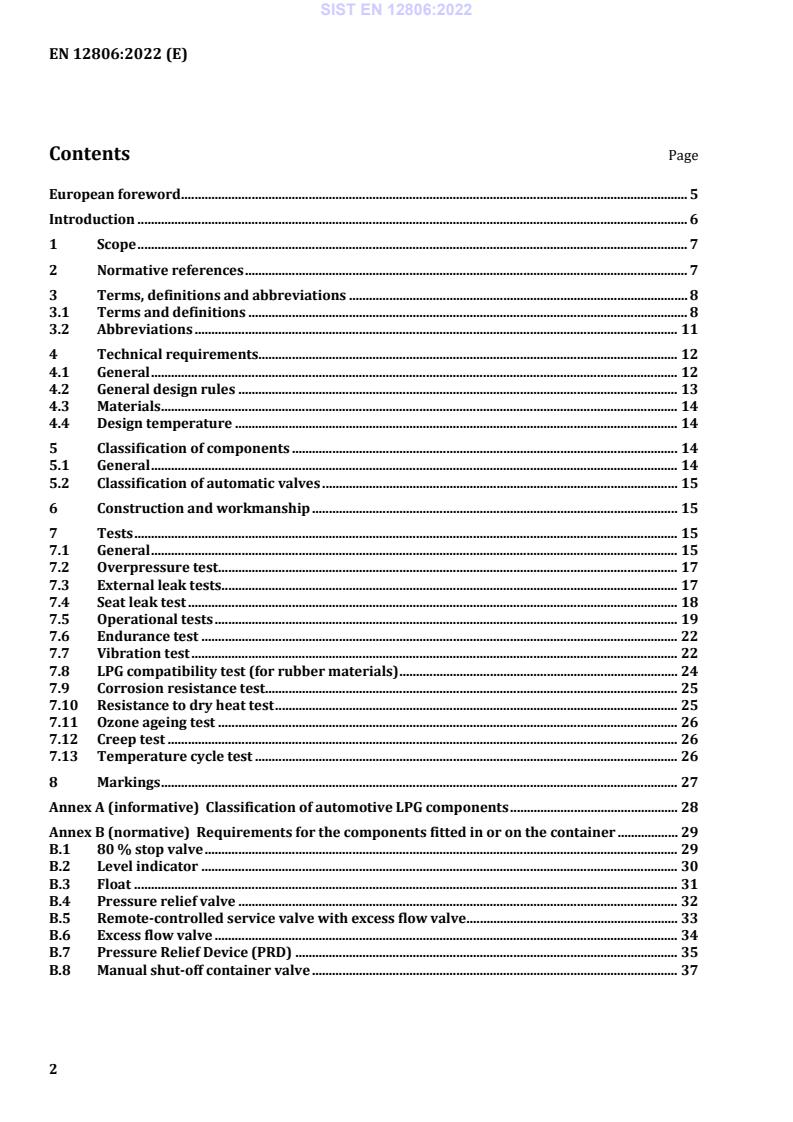
Contents Page
European foreword . 5
Introduction . 6
1 Scope . 7
2 Normative references . 7
3 Terms, definitions and abbreviations . 8
3.1 Terms and definitions . 8
3.2 Abbreviations . 11
4 Technical requirements. 12
4.1 General . 12
4.2 General design rules . 13
4.3 Materials . 14
4.4 Design temperature . 14
5 Classification of components . 14
5.1 General . 14
5.2 Classification of automatic valves . 15
6 Construction and workmanship . 15
7 Tests . 15
7.1 General . 15
7.2 Overpressure test . 17
7.3 External leak tests. 17
7.4 Seat leak test . 18
7.5 Operational tests . 19
7.6 Endurance test . 22
7.7 Vibration test . 22
7.8 LPG compatibility test (for rubber materials) . 24
7.9 Corrosion resistance test . 25
7.10 Resistance to dry heat test . 25
7.11 Ozone ageing test . 26
7.12 Creep test . 26
7.13 Temperature cycle test . 26
8 Markings . 27
Annex A (informative) Classification of automotive LPG components . 28
Annex B (normative) Requirements for the components fitted in or on the container . 29
B.1 80 % stop valve . 29
B.2 Level indicator . 30
B.3 Float . 31
B.4 Pressure relief valve . 32
B.5 Remote-controlled service valve with excess flow valve . 33
B.6 Excess flow valve . 34
B.7 Pressure Relief Device (PRD) . 35
B.8 Manual shut-off container valve . 37
Annex C (normative) Requirements for the fuel pump . 38
C.1 Design criteria . 38
C.2 Specific design rules . 38
C.3 Test procedures . 38
Annex D (normative) Requirements for the gas-tight housing . 40
D.1 Design criteria . 40
D.2 Specific design rules . 40
D.3 Applicable tests . 40
Annex E (normative) Requirements for the power supply bushing. 41
E.1 Design criteria . 41
E.2 Specific design rules . 41
E.3 Applicable tests . 41
Annex F (normative) Requirements for the non-return valve . 42
F.1 Design criteria . 42
F.2 Specific design rules . 42
F.3 Applicable tests . 42
Annex G (normative) Requirements for the multi-valve . 43
G.1 Design criteria . 43
G.2 Specific design rules . 43
G.3 Applicable tests . 43
Annex H (normative) Requirements for the vaporizer/pressure regulator . 44
H.1 Design criteria . 44
H.2 Specific design rules . 44
H.3 Applicable tests . 44
Annex I (normative) Requirements for the remote-controlled shut-off valve . 46
I.1 Design criteria . 46
I.2 Specific design rules . 46
I.3 Applicable tests . 46
Annex J (normative) Requirements for LPG injectors and the mixing unit . 47
J.1 Injector . 47
J.2 Mixing unit . 48
Annex K (normative) Requirements for the LPG dosage unit . 49
K.1 Design criteria . 49
K.2 Specific design rules . 49
K.3 Applicable tests . 49
Annex L (normative) Requirements for the flexible hoses . 50
L.1 Design criteria . 50
L.2 Specific design rules . 50
L.3 Tests . 51
L.4 Markings . 57
Annex M (normative) Requirements for the hydrostatic relief valve . 58
M.1 Design criteria . 58
M.2 Specific design rules . 58
M.3 Applicable tests . 58
Annex N (normative) Requirements for the filter unit . 59
N.1 Design criteria . 59
N.2 Specific design rules . 59
N.3 Applicable tests . 59
Annex O (normative) Requirements for the pressure and/or temperature sensor . 61
O.1 Design criteria . 61
O.2 Specific design rules . 61
O.3 Applicable tests . 61
Annex P (normative) Requirements for the service coupling . 63
P.1 Design criteria . 63
P.2 Specific design rules . 63
P.3 Applicable tests procedure . 63
Annex Q (normative) Requirements for the Electronic Control Unit (ECU) . 64
Q.1 Design criteria . 64
Q.2 Specific design rules . 64
Annex R (normative) Requirements for the fuel rail . 65
R.1 Design criteria . 65
R.2 Specific design rules . 65
R.3 Applicable tests . 65
Annex S (normative) Requirements for the filling unit . 67
S.1 Design criteria . 67
S.2 Specific design rules . 67
S.3 Applicable tests . 68
S.4 Main dimensions of different types of vehicle filling units in use in Europe . 70
Annex T (normative) Gas tube(s) . 74
T.1 General provisions . 74
T.2 Gas tubes of seamless type made of either copper or stainless steel or steel with
corrosion-resistant coating . 74
T.3 Gas tube(s) of non-seamless type, gas tube(s) made of materials other than copper,
stainless steel, and steel with corrosion-resistant coating, and their couplings . 74
Annex U (normative) Interconnected LPG systems . 77
U.1 Specific provisions for components of interconnected LPG-systems. 77
Bibliography . 80
European foreword
This document (EN 12806:2022) has been prepared by Technical Committee CEN/TC 286 “LPG
equipment and accessories”, the secretariat of which is held by NSAI.
This European Standard shall be given the status of a national standard, either by publication of an
identical text or by endorsement, at the latest by April 2023, and conflicting national standards shall be
withdrawn at the latest by April 2023.
Attention is drawn to the possibility that some of the elements of this document may be the subject of
patent rights. CEN shall not be held responsible for identifying any or all such patent rights.
This document supersedes EN 12806:2003.
In comparison with the previous edition, the following technical modifications have been made:
— Revised definitions;
— Updated normative references;
— General reference to maximum allowable pressure rather than design or test pressure;
— Addition of a new component ("Manual shut-off container valve") and the relative subclause B.8;
— General revision of the Annexes.
Any feedback and questions on this document should be directed to the users’ national standards body.
A complete listing of these bodies can be found on the CEN website.
According to the CEN-CENELEC Internal Regulations, the national standards organisations of the
following countries are bound to implement this European Standard: Austria, Belgium, Bulgaria,
Croatia, Cyprus, Czech Republic, Denmark, Estonia, Finland, France, Germany, Greece, Hungary, Iceland,
Ireland, Italy, Latvia, Lithuania, Luxembourg, Malta, Netherlands, Norway, Poland, Portugal, Republic of
North Macedonia, Romania, Serbia, Slovakia, Slovenia, Spain, Sweden, Switzerland, Türkiye and the
United Kingdom.
Introduction
Protection of the environment is a key political issue in Europe and elsewhere. For CEN/TC 286, this is
covered in CEN/TS 16765 [7] and this Technical Specification should be read in conjunction with this
document. The Technical Specification provides guidance on the environmental aspects to be
considered regarding equipment and accessories produced for the LPG industry and the following is
addressed:
a) design;
b) manufacture;
c) packaging;
d) use and operation; and
e) disposal.
1 Scope
This document specifies the general design and testing requirements for all components in automotive
Liquefied Petroleum Gas (LPG) propulsion systems, which have a maximum allowable pressure equal to
or greater than 20 kPa.
This document also specifies the requirements for the Electric Control Unit (ECU), which is not
subjected to pressure, and the gas-tight housing which has a maximum allowable pressure below
20 kPa.
This document does not apply to containers.
2 Normative references
The following documents are referred to in the text in such a way that some or all of their content
constitutes requirements of this document. For dated references, only the edition cited applies. For
undated references, the latest edition of the referenced document (including any amendments) applies.
EN 549:2019, Rubber materials for seals and diaphragms for gas appliances and gas equipment
EN 589, Automotive fuels - LPG - Requirements and test methods
EN 22768-1, General tolerances - Part 1: Tolerances for linear and angular dimensions without individual
tolerance indications (ISO 2768-1)
EN 60529, Degrees of protection provided by enclosures (IP code)
EN IEC 60068-2-52, Environmental testing - Part 2-52: Tests - Test Kb: Salt mist, cyclic (sodium chloride
solution)
EN ISO 1307:2008, Rubber and plastics hoses - Hose sizes, minimum and maximum inside diameters, and
tolerances on cut-to-length hoses (ISO 1307:2006)
EN ISO 1402, Rubber and plastics hoses and hose assemblies - Hydrostatic testing (ISO 1402)
EN ISO 4080, Rubber and plastics hoses and hose assemblies - Determination of permeability to gas (ISO
4080)
EN ISO 8031, Rubber and plastics hoses and hose assemblies - Determination of electrical resistance and
conductivity (ISO 8031)
EN ISO 9227, Corrosion tests in artificial atmospheres - Salt spray tests (ISO 9227)
EN ISO 10619-2:2021, Rubber and plastics hoses and tubing - Measurement of flexibility and stiffness -
Part 2: Bending tests at sub-ambient temperatures (ISO 10619-2:2021)
ISO 37, Rubber, vulcanized or thermoplastic — Determination of tensile stress-strain properties
ISO 188, Rubber, vulcanized or thermoplastic — Accelerated ageing and heat-resistance tests
ISO 1431-1, Rubber, vulcanized or thermoplastic — Resistance to ozone cracking — Part 1: Static and
dynamic strain testing
ISO 1436, Rubber hoses and hose assemblies — Wire-braid-reinforced hydraulic types for oil-based or
water-based fluids — Specification
ISO 1817, Rubber, vulcanized or thermoplastic — Determination of the effect of liquids
ISO 6957, Copper alloys — Ammonia test for stress corrosion resistance
3 Terms, definitions and abbreviations
3.1 Terms and definitions
For the purposes of this document, the following terms and definitions apply.
ISO and IEC maintain terminological databases for use in standardization at the following addresses:
— ISO Online browsing platform: available at https://www.iso.org/obp
— IEC Electropedia: available at https://www.electropedia.org/
3.1.1
pressure
gauge pressure, unless otherwise stated
3.1.2
test pressure
pressure to which the component, or an assembly of components, is subjected during the test
3.1.3
maximum allowable pressure
maximum pressure for which the equipment is designed
Note 1 to entry: All pressures are gauge pressures, unless otherwise stated.
3.1.4
fusible plug
component protecting the pressure vessel from bursting by venting the LPG content at a pre-set
temperature
3.1.5
automotive LPG-system
assembly of components enabling a vehicle to use automotive LPG in its propulsion system
Note 1 to entry: Requirements for each component are specified in their specific annexes (see Table 1 and
Table 2).
3.1.6
container
pressure vessel used for the storage of automotive LPG
3.1.7
80 % stop valve
device that limits the filling of the container to 80 % of its water capacity and acts as a non-return valve
3.1.8
level indicator
device that indicates the liquid level in the container
3.1.9
float
device, which may be used in the 80 % stop valve and/or the level indicator, floating on the surface of
the liquid to detect the liquid level in the container
3.1.10
pressure relief valve
PRV
self-closing valve which automatically, without the assistance of any energy other than that of the
vapour concerned, discharges vapour at a predetermined pressure, and operates with a pop action
Note 1 to entry: This is known as a "safety valve" in ADR.
3.1.11
remote-controlled service valve with excess flow valve
device that allows or interrupts the LPG supply to the vaporizer/pressure regulator which is operated
remotely and is combined with an excess flow valve
3.1.12
excess flow valve
valve designed to close automatically, with a small residual flow, when the fluid flow passing through it
exceeds a predetermined value, and to re-open when the pressure differential across the valve has been
restored below a certain value
3.1.13
pressure relief device
PRD
device protecting the container from bursting, when exposed to fire, by venting LPG at a pre-set
temperature and/or pressure
3.1.14
fuel pump
device that pumps liquid LPG to the engine fuel system
3.1.15
gas-tight housing
device that vents any leak from components fitted to the container to the venting tube
Note 1 to entry: It also collects and ducts any leaks to the outside of the vehicle, where necessary through a
connecting hose and a lead-through.
3.1.16
power supply bushing
gas-tight electrical power conductor for components installed inside the container
3.1.17
non-return valve
valve designed to close automatically to prevent reverse flow
3.1.18
multi-valve
device, which combines the functions of two or more components specified in Annex B
3.1.19
vaporizer
pressure regulator
device that vaporizes LPG, reduces and/or regulates the outlet pressure to a pre-set value independent
of variations of the inlet pressure and/or the flow rate
Note 1 to entry: The shut-off valve can be integrated in the vaporizer/regulator.
3.1.20
shut-off valve
valve to provide a leak tight seal which is operated either manually or remotely
3.1.21
remote-controlled shut-off valve
valve to provide a leak-tight seal which is remotely operated
3.1.22
manual shut-off container valve
manually operated shut-off valve which is rigidly fixed to the container
3.1.23
LPG injectors
device that supplies a controlled quantity of LPG to the engine
3.1.24
mixing unit
device that controls the quantity of vaporized LPG to the engine
3.1.25
LPG dosage unit
device that meters and/or distributes the LPG vapour to the engine
3.1.26
flexible hoses
flexible ducts that convey LPG liquid or vapour at various pressures from one point to another
3.1.27
hydrostatic relief valve
self-closing valve which automatically, without the assistance of any energy other than that of the fluid
concerned, discharges fluid at a predetermined pressure
3.1.28
filter unit
device that removes particulates from the LPG
Note 1 to entry: The filter can be integrated in other components.
3.1.29
pressure sensor
device that measures and transmits the pressure
3.1.30
temperature sensor
device that measures and transmits the temperature
3.1.31
service coupling
connector in the fuel line between the container and the engine for emergency fuelling
Note 1 to entry: If a mono-fuel vehicle is out of fuel, the engine can be operated by means of a service container
coupled to the service coupling.
3.1.32
Electronic Control Unit
ECU
device that controls the LPG supply to the engine and the electrical power supply to the remote-
controlled service valves
3.1.33
fuel rail
pipe or flexible hose that supplies the fuel to the injection devices
3.1.34
filling unit
device installed on the outside of the vehicle to receive the filling nozzle and enable the filling of the LPG
container
3.1.35
gas tube
tubing made of metallic material which has been designed not to flex in normal operation and through
which LPG flows
3.1.36
interconnected LPG system
LPG-system having hydraulic interconnections with the petrol or diesel fuelling system
3.1.37
multi-component
component which incorporates two or more service functions and which meets the combined
requirements of the individual functions
3.2 Abbreviations
For the purposes of this document, the following abbreviations apply.
CAN Controller Area Network
EMC Electromagnetic Compatibility
STP Standard Temperature and Pressure [15,6 °C (288,7 K), 1,013 bar absolute (0,101 3 MPa
absolute)]
4 Technical requirements
4.1 General
Components shall be designed for use with automotive LPG as specified in EN 589.
The specific requirements for design and testing are detailed in the annexes (see Table 1 and Table 2).
If a device combines two or more functions of separate components, the relevant requirements for each
component shall apply.
Table 1 — Annexes dealing with components fitted in or on the container
Component Annex Clause
80 % stop valve B B.1
level indicator B B.2
float B B.3
pressure relief valve B B.4
remote-controlled service valve with excess flow valve B B.5
excess flow valve B B.6
pressure relief device (PRD) B B.7
manual shut-off container valve B B.8
fuel pump C
gas-tight housing D
power supply bushing E
non-return valve F
multi-valve G
NOTE A fuel pump, multi-valve, gas-tight housing, power supply bushing and a non-
return valve can be fitted if required for proper operation of the automotive LPG-system.
Table 2 — Annexes dealing with components not fitted in or on the container
Component Annex
pressure regulator / vaporizer H
shut-off valve I
gas injection device or injector J
gas mixing unit J
gas dosage unit K
flexible hoses and gas pipes L
hydrostatic relief valve M
LPG filter unit N
pressure and/or temperature sensor O
service coupling P
electronic control unit (ECU) Q
fuel rail R
filling unit S
gas tube(s) T
Annexes applicable to the
multi-component
single components
4.2 General design rules
4.2.1 Electrically operated devices containing LPG
Electrically operated devices containing LPG shall not produce sparks in the event of failure.
No current shall flow through LPG containing parts.
The electrical system shall be insulated from the body of the component and from the container.
The insulation resistance shall be greater than 10 MΩ.
The electrical enclosures of the LPG installation inside the boot and passenger compartment and in the
LPG container shall comply with class IP 40 according to EN 60529.
All other electrical enclosures shall comply with class IP 54 in accordance with EN 60529.
NOTE See UN/ECE Regulation 10 [3] for electromagnetic compatibility aspects.
4.2.2 Remotely operated valves
Remotely operated valves (e.g. service valve, shut-off valves), shall fail safe and shall remain closed
when no power is applied (“normally closed” type).
4.2.3 Heat exchanger materials
Materials shall be compatible with the heat exchange medium. The heat exchanger shall be designed to
withstand a pressure of twice the maximum allowable pressure of the heat exchange medium.
4.2.4 Components containing high and low pressure parts
A component, containing both high pressure and low pressure parts, shall be designed to prevent
pressure build up in the low-pressure part above 2,25 times the maximum allowable pressure of that
part of the component.
4.3 Materials
Materials in contact with LPG shall be LPG compatible.
Materials exposed to corrosive conditions shall be corrosion resistant or protected against corrosion.
The component manufacturer shall maintain records of and provide if requested:
— chemical analysis certificates;
— mechanical property data;
— results of metallurgical and mechanical tests and analysis
for the materials used in construction of the parts subjected to pressure.
The component manufacturer shall maintain a system for the identification and tracing of materials
used in the fabrication of parts under pressure.
NOTE For guidance on the choice of non-metallic materials, see EN ISO 11114-2 [6].
4.4 Design temperature
The minimum design temperature shall be –20 °C.
For extreme cold operating conditions, a minimum design temperature of –40 °C shall apply.
The maximum design temperature shall be:
— 65 °C for components installed on the vehicle;
— 120 °C for components installed in the engine compartment.
5 Classification of components
5.1 General
Components are classified according to their maximum allowable pressure and function, see Annex A:
Class 0 High pressure parts including tubes and fittings containing liquid LPG with a maximum
allowable pressure > 3 000 kPa.
Maximum allowable pressure shall be defined by manufacturer.
Class 1 High pressure parts including pipes and fittings containing liquid LPG with a maximum
allowable pressure of 3 000 kPa, excluding valves and PRDs.
Class 2 Low pressure parts operating in the vapour phase including pipes and fittings with a
maximum allowable pressure of 450 kPa.
Class 2A Low pressure parts operating in the vapour phase including pipes and fittings with a
maximum allowable pressure of 120 kPa.
Class 3 Valves and PRDs with a maximum allowable pressure of 3 000 kPa.
For a component consisting of several parts, each part shall be classified in its own class depending on
the maximum allowable pressure and function of that part.
5.2 Classification of automatic valves
Remotely controlled service valves can be classified and marked as follows:
a) H1, if the engine shuts off automatically when the vehicle comes to a halt;
b) H2, if, in addition to a), the engine also shuts off automatically when the vehicle drives with the
electric motor only;
c) H3, if, in addition to a) or b), the engine also shuts off automatically when the accelerator pedal is
released.
Notwithstanding the above-mentioned provisions, the valve complying with b) shall be deemed to
satisfy a), and the valve complying with c) shall be deemed to satisfy a) and b).
According their classification, remotely controlled service valves shall be submitted to the following
numbers of operations during the endurance test of 7.6:
— 200 000 cycles, for valves marked H1;
— 500 000 cycles, for valves marked H2;
— 1 000 000 cycles, for valves marked H3.
6 Construction and workmanship
The manufacturer shall be able to demonstrate that the quality control system ensures that the
component produced meets the requirements of this document.
The manufacturer shall maintain records of the inspections that are carried out during production.
7 Tests
7.1 General
Each class of components shall be tested in accordance with Table 3, except the ones regarding flexible
hoses that shall be tested in accordance with Annex L.
Each component shall be tested as specified in the relevant Annex.
Table 3 — Type approval and production (routine) tests
Test Class 0 Class 1 Class 2/2A Class 3 Clause
Type Production Type Production Type Production Type Production
approval (routine) approval (routine) approval (routine) approval (routine)
Overpressure x x x x 7.2
e
External leak x x x x x x x x 7.3
b
Seat leak x x x x x x x x 7.4
b
Operational x x 7.5
Endurance x x 7.6
Vibration x x x x 7.7
a
LPG compatibility x x x x 7.8
Corrosion resistance x x x x 7.9
c
Resistance to dry x x x 7.10
a e
heat
a e
Ozone ageing x x x 7.11
a d e
Creep x x x 7.12
a
Temperature cycle x x x 7.13
a
Only applicable for rubber materials.
b
Only applicable for parts containing a valve.
c
Only applicable for metallic parts exposed to corrosive conditions.
d
Except for the 80 % stop valve and excess flow valve as the permitted leak exceeds the requirements of this test.
e
Only for parts having a sealing function.
Test pressure tolerances shall be 10 % of the stated value with a maximum of 100 kPa.
Test temperature tolerances shall be:
— -5 °C for the minimum test temperature;
— +5 °C for the maximum test temperature;
— ±5 °C for 20 °C.
Test medium are specified in each test procedure. However, the manufacturer shall evaluate and choose
the proper medium for test at extreme temperature range (e.g. water should not be used below 4 °C and
above 90 °C), ensuring that the viscosity does not exceed twice the viscosity of water at the given
temperature.
The test medium is not necessarily the same for all temperatures of a temperature range.
Test equipment accuracy shall be able to guarantee the acceptance criteria of each test.
It is recommended to choose an instrument with the accuracy below 1/3 of the acceptance criteria
tolerances.
Any tolerances given in this document include measurement uncertainties.
7.2 Overpressure test
7.2.1 General
The test pressure applied shall be 2,25 times the maximum allowable pressure, unless otherwise stated
in the specific component annex.
The test shall be performed at a temperature of 20 °C.
If an endurance test is required by Table 3, it shall be performed before the overpressure test.
7.2.2 Test procedure
The outlet of the component compartment to be tested shall be plugged. The level indicator and the
float shall be tested installed in a pressure vessel.
The test medium shall be water or any suitable liquid.
The pressure shall be raised gradually.
The test pressure shall be maintained for at least one minute.
7.2.3 Interpretation of the test
The component shall pass the overpressure test without any visible evidence of rupture or permanent
distortion.
7.3 External leak tests
7.3.1 Type approval test
7.3.1.1 General
An overpressure test, and an endurance test if required by Table 3, shall be performed before the
external leak test.
The test conditions shall be according to 7.3.1.2, unless otherwise stated in the specific component
annex.
7.3.1.2 Test procedure
The test shall be performed with air or nitrogen.
All components shall be tested at 20 kPa and at 1,5 times the maximum allowable pressure, in the case
of a Class 3 component 2,25 times the maximum allowable pressure, at the following temperatures:
a) 20 °C;
b) the minimum design temperature;
c) the maximum design temperature.
Tests shall be carried out according to the following procedure:
— plug the outlet of the component;
— pressurize the component at the inlet;
— immerse the component in a suitable test liquid;
— maintain the test pressure for not less than 1 min and determine the leak rate.
The components shall be preconditioned at the test temperature for at least 8 h.
7.3.1.3 Leak rate determination
The leak rate shall be determined according to the following method or any other equivalent method:
— A graduated cylinder that is calibrated in cubic centimetres, filled with the test liquid, shall be
placed inverted above the component.
— At the end of the test period, the liquid displacement in the graduated cylinder is recorded.
— The leakage rate is then calculated using the following formula:
273 P
VV=
lt
t
101,3 T
where
V is the leakage rate, cm /hour of air or nitrogen;
l
V is the liquid displacement during the test in cm ;
t
t is the time of test, minutes;
P is the atmospheric pressure during test in kPa;
T is the ambient temperature during test in K.
7.3.1.4 Test interpretation
The external leak rate shall be less than 15 cm /hour, except for the gas-tight housing, for which a leak
rate of no more than 100 cm /hour is allowed.
7.3.2 Production (routine) testing
Duri
...