

EN 14564:2013
(Main)Tanks for transport of dangerous goods - Terminology
- Abstract
This European Standard gives the terminology for all tanks and does not cover carriage in bulk for the transport of dangerous goods. This document is part of the standards on tanks for transport of dangerous goods, prepared by CEN/TC 296 in application of the RID/ADR [2, 3]:
- Annex A gives some definitions taken from RID/ADR chapter 1.2 ; and
- Annex B gives some definitions taken from RID/ADR chapter 6.7.
NOTE Annexes A and B are based on the 2013 edition of RID/ADR which are updated every two years. This includes the potential of temporary inconsistencies with these annexes.
- Status
- Withdrawn
- Publication Date
- 12-Feb-2013
- Withdrawal Date
- 06-Oct-2026
- Technical Committee
- CEN/TC 296 - Tanks for transport of dangerous goods
- Drafting Committee
- CEN/TC 296 - Tanks for transport of dangerous goods
- Current Stage
- 9960 - Withdrawal effective - Withdrawal
- Start Date
- 07-Aug-2019
- Completion Date
- 07-Oct-2026

Relations
- Effective Date
- 20-Feb-2013
- Effective Date
- 14-Aug-2019
- Effective Date
- 28-Jan-2026
- Effective Date
- 28-Jan-2026
- Effective Date
- 28-Jan-2026
- Effective Date
- 08-Jun-2022
Get Certified
Connect with accredited certification bodies for this standard

CIS Institut d.o.o.
Personal Protective Equipment (PPE) certification body. Notified Body NB-2890 for EU Regulation 2016/425 PPE.
Institut za varilstvo d.o.o. (Welding Institute)
Slovenia's leading welding institute since 1952. ISO 3834, EN 1090, pressure equipment certification, NDT personnel, welder qualification. Only IIW Au

Kiwa BDA Testing
Building and construction product certification.
Sponsored listings
Frequently Asked Questions
EN 14564:2013 is a standard published by the European Committee for Standardization (CEN). Its full title is "Tanks for transport of dangerous goods - Terminology". This standard covers: This European Standard gives the terminology for all tanks and does not cover carriage in bulk for the transport of dangerous goods. This document is part of the standards on tanks for transport of dangerous goods, prepared by CEN/TC 296 in application of the RID/ADR [2, 3]: - Annex A gives some definitions taken from RID/ADR chapter 1.2 ; and - Annex B gives some definitions taken from RID/ADR chapter 6.7. NOTE Annexes A and B are based on the 2013 edition of RID/ADR which are updated every two years. This includes the potential of temporary inconsistencies with these annexes.
This European Standard gives the terminology for all tanks and does not cover carriage in bulk for the transport of dangerous goods. This document is part of the standards on tanks for transport of dangerous goods, prepared by CEN/TC 296 in application of the RID/ADR [2, 3]: - Annex A gives some definitions taken from RID/ADR chapter 1.2 ; and - Annex B gives some definitions taken from RID/ADR chapter 6.7. NOTE Annexes A and B are based on the 2013 edition of RID/ADR which are updated every two years. This includes the potential of temporary inconsistencies with these annexes.
EN 14564:2013 is classified under the following ICS (International Classification for Standards) categories: 01.040.13 - Environment. Health protection. Safety (Vocabularies); 01.040.23 - Fluid systems and components for general use (Vocabularies); 13.300 - Protection against dangerous goods; 23.020.20 - Vessels and containers mounted on vehicles. The ICS classification helps identify the subject area and facilitates finding related standards.
EN 14564:2013 has the following relationships with other standards: It is inter standard links to EN 14564:2004, EN 14564:2019, EN 12266-1:2012, EN 16249:2013, CEN/TR 15120:2013, EN 14564:2013/prA1. Understanding these relationships helps ensure you are using the most current and applicable version of the standard.
EN 14564:2013 is associated with the following European legislation: EU Directives/Regulations: 2008/68/EC; Standardization Mandates: M/086. When a standard is cited in the Official Journal of the European Union, products manufactured in conformity with it benefit from a presumption of conformity with the essential requirements of the corresponding EU directive or regulation.
EN 14564:2013 is available in PDF format for immediate download after purchase. The document can be added to your cart and obtained through the secure checkout process. Digital delivery ensures instant access to the complete standard document.
Standards Content (Sample)
2003-01.Slovenski inštitut za standardizacijo. Razmnoževanje celote ali delov tega standarda ni dovoljeno.Cisterne za prevoz nevarnega blaga - TerminologijaTanks für die Beförderung gefährlicher Güter - BegriffeCiternes pour le transport des matières dangereuses - TerminologieTanks for transport of dangerous goods - Terminology23.020.20Posode in vsebniki, montirani na vozilaVessels and containers mounted on vehicles13.300Varstvo pred nevarnimi izdelkiProtection against dangerous goods01.040.23Fluid systems and components for general use (Vocabularies)ICS:Ta slovenski standard je istoveten z:EN 14564:2013SIST EN 14564:2013en,fr,de01-november-2013SIST EN 14564:2013SLOVENSKI
STANDARDSIST EN 14564:20051DGRPHãþD
EUROPEAN STANDARD NORME EUROPÉENNE EUROPÄISCHE NORM
EN 14564
February 2013 ICS 01.040.13; 01.040.23; 13.300; 23.020.20 Supersedes EN 14564:2004English Version
Tanks for transport of dangerous goods - Terminology
Citernes pour le transport des matières dangereuses - Terminologie
Tanks für die Beförderung gefährlicher Güter - Begriffe This European Standard was approved by CEN on 24 November 2012.
CEN members are bound to comply with the CEN/CENELEC Internal Regulations which stipulate the conditions for giving this European Standard the status of a national standard without any alteration. Up-to-date lists and bibliographical references concerning such national standards may be obtained on application to the CEN-CENELEC Management Centre or to any CEN member.
This European Standard exists in three official versions (English, French, German). A version in any other language made by translation under the responsibility of a CEN member into its own language and notified to the CEN-CENELEC Management Centre has the same status as the official versions.
CEN members are the national standards bodies of Austria, Belgium, Bulgaria, Croatia, Cyprus, Czech Republic, Denmark, Estonia, Finland, Former Yugoslav Republic of Macedonia, France, Germany, Greece, Hungary, Iceland, Ireland, Italy, Latvia, Lithuania, Luxembourg, Malta, Netherlands, Norway, Poland, Portugal, Romania, Slovakia, Slovenia, Spain, Sweden, Switzerland, Turkey and United Kingdom.
EUROPEAN COMMITTEE FOR STANDARDIZATION
COMITÉ EUROPÉEN DE NORMALISATION EUROPÄISCHES KOMITEE FÜR NORMUNG
Management Centre:
Avenue Marnix 17,
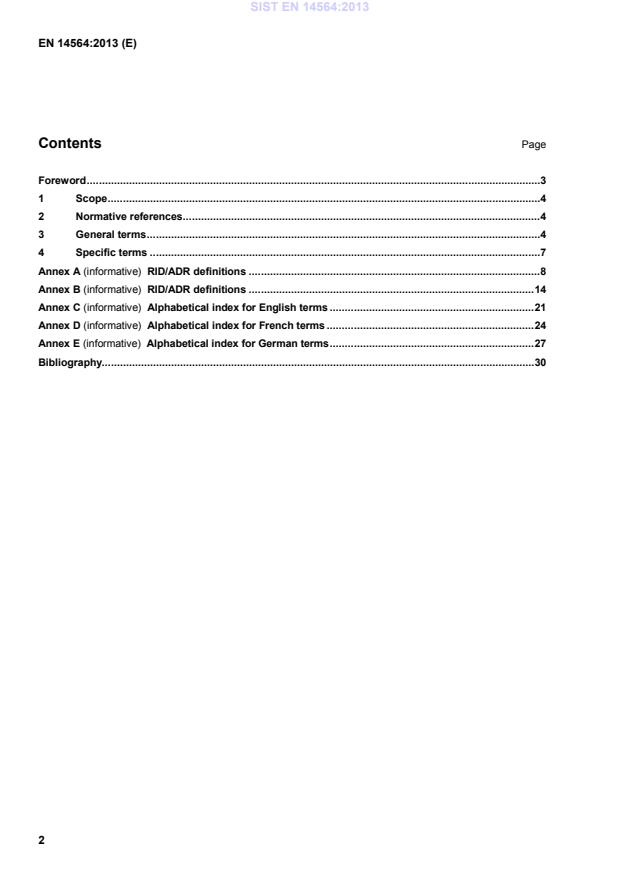
B-1000 Brussels © 2013 CEN All rights of exploitation in any form and by any means reserved worldwide for CEN national Members. Ref. No. EN 14564:2013: ESIST EN 14564:2013
RID/ADR definitions . 8 Annex B (informative)
RID/ADR definitions . 14 Annex C (informative)
Alphabetical index for English terms . 21 Annex D (informative)
Alphabetical index for French terms . 24 Annex E (informative)
Alphabetical index for German terms . 27 Bibliography. 30
Note 1 to entry: When it is impossible to fill completely the shell or shell compartment because of its shape or construction, this reduced capacity is used for the determination of the degree of filling and for the marking of the tank. 3.6 cold forming forming at temperatures not less than 25 °C below the maximum permissible temperature for stress relieving, in accordance with the applicable material specifications SIST EN 14564:2013
section of a shape which has a side radius of curvature lower than or equal to the radius of curvature of a circular section tank of the same width 3.11 end
head part of the shell shutting off the longitudinal section 3.12 fastenings structural equipment used for fixing the tank on the chassis, frame or auxiliary frame 3.13 flame arrester
flame trap device fitted to the opening of an enclosure or to the connecting pipework of a system of enclosures and whose intended function is to allow flow but prevent the transmission of flame 3.14 hydraulic pressure test
strength test carried out with liquid (generally water) 3.15 inspector individual of an inspection body approved by the competent authority 3.16 leak proof able to contain the fluid in accordance with Table A.5 of EN 12266-1:2012, Rate A 3.17 nominal capacity maximum volume intended to be carried 3.18 partition hermetically sealed dividing wall between adjacent compartments in compartmented tanks 3.19 pressure balanced equilibrium of substance pressure on both sides of the internal stop valve 3.20 product sensor device which detects the presence of product in liquid phase and whose output signal can be used to display whether liquid is present SIST EN 14564:2013
RID/ADR definitions A.1 battery-vehicle/battery-wagon vehicle/wagon containing elements which are linked to each other by a manifold and permanently fixed to a transport unit The following elements are considered to be elements of a battery-vehicle/wagon: cylinders, tubes, bundles of cylinders (also known as frames), pressure drums as well as tanks destined for the carriage of gases of Class 2 with a capacity of more than 450 l. A.2 calculation pressure theoretical pressure at least equal to the test pressure which, according to the degree of danger exhibited by the substance being carried, may to a greater or lesser degree exceed the working pressure It is used solely to determine the thickness of the walls of the shell, independently of any external or internal reinforcing device (See also "Discharge pressure”, “Filling pressure”, “Maximum working pressure (gauge pressure)” and “’Test pressure”). A.3 carriage in bulk carriage of unpackaged solids or articles in vehicles/wagons or containers The term does not apply to packaged goods nor to substances carried in tanks. A.4 closure device which closes an opening in a receptacle A.5 competent authority authority or authorities or any other body or bodies designated as such in each State and in each specific case in accordance with domestic law A.6 conformity assessment means the process of verifying the conformity of a product according to the provisions of sections 1.8.6 and 1.8.7 related to type approval, supervision of manufacture and initial inspection and testing A.7 control temperature means the maximum temperature at which the organic peroxide or the self-reactive substance can be safely carried A.8 critical temperature means the temperature above which the substance cannot exist in the liquid state SIST EN 14564:2013
A.24 MEGC see “Multiple-element gas container” A.25 mild steel steel having a minimum tensile strength between 360 N/mm2 and 440 N/mm2 A.26 multiple-element gas container unit containing elements which are linked to each other by a manifold and mounted on a frame The following elements are considered to be elements of a multiple-element gas container: cylinders, tubes, pressure drums and bundles of cylinders as well as tanks for the carriage of gases of Class 2 having a capacity of more than 450 l. A.27 portable tank means a multimodal tank having, when used for the carriage of gases as defined in 2.2.2.1.1, a capacity of more than 450 l in accordance with the definitions in Chapter 6.7 or the IMDG Code and indicated by a portable tank instruction (T-Code) in Column (10) of Table A of chapter 3.2 A.28 reference steel steel with a tensile strength of 370 N/mm2 and an elongation at fracture of 27 % A.29 safety valve spring-loaded device which is activated automatically by pressure to protect the tank against unacceptable excess internal pressure SIST EN 14564:2013
See also "calculation pressure", "Discharge pressure", "Filling pressure" and "Maximum working pressure (gauge pressure)". A.41 UN- number means the four-figure identification number of the substance or article taken from the UN Model Regulations A.42 vacuum valve spring-loaded device which is activated automatically by pressure to protect the tank against unacceptable negative internal pressure A.43 vacuum-operated waste tank tank primarily used for the carriage of dangerous wastes, with special constructional features and/or equipment to facilitate the loading and unloading of wastes as specified in RID/ADR Chapter 6.10 SIST EN 14564:2013
RID/ADR definitions
6.7.2 6.7.3 6.7.4 6.7.5 B.1 alternative arrangement an approval granted by the competent authority for a portable tank or MEGC that has been designed, constructed or tested to technical requirements or testing methods other than those specified in this Chapter: B.2 elements
elements are cylinders, tubes or bundles of cylinders B.3 portable tank a multimodal tank used for the carriage of substances of Class 1 and Classes 3 to 9. The portable tank includes a shell fitted with service equipment and structural equipment necessary for the carriage of dangerous substances a multimodal tank having a capacity of more than 450 l used for the carriage of non-refrigerated liquefied gases of Class 2 a thermally insulated multimodal tank having a capacity of more than 450 l fitted with service equipment and structural equipment necessary for the carriage of refrigerated liquefied gases
The portable tank shall be capable of being filled and discharged without the removal of its structural equipment. It shall possess stabilizing members external to the shell, and shall be capable of being lifted when full. It shall be designed primarily to be loaded onto a vehicle, wagon or sea-going or inland navigation vessel and shall be equipped with skids, mountings or accessories to facilitate mechanical handling. Tank vehicles, tank-wagons, non-metallic tanks and intermediate bulk containers (IBCs) are not considered to fall within the definition for portable tanks
B.4 shell the part of the portable tank which retains the substance intended the part of the portable tank which retains the non-refrigerated liquefied gas intended
the part of the portable tank which retains the refrigerated liquefied gas intended
for carriage, including openings and their closures, but does not include service equipment or external structural equipment
"to be continued" SIST EN 14564:2013
6.7.2 6.7.3 6.7.4 6.7.5 B.5 tank
a construction which normally consists of either:
a) a jacket and one or more inner shells where the space between the shell(s) and the jacket is exhausted of air (vacuum insulation) and may incorporate a thermal insulation system; or
b) a jacket and an inner shell with an intermediate layer of solid thermally insulating material (e.g. solid foam)
B.6 jacket
the outer insulation cover or cladding which may be part of the insulation system
B.7 service equipment service equipment means measuring instruments and filling, discharge, venting, safety, pressurizing, cooling and thermal insulation devices B.8 structural equipment structural equipment means the reinforcing, fastening, protective and stabilizing members external to the shell B.9 maximum allowable working pressure a pressure that shall be not less than the highest of the following pressures measured at the top of the shell while in operating position: a pressure that shall be not less than the highest of the following pressures measured
...