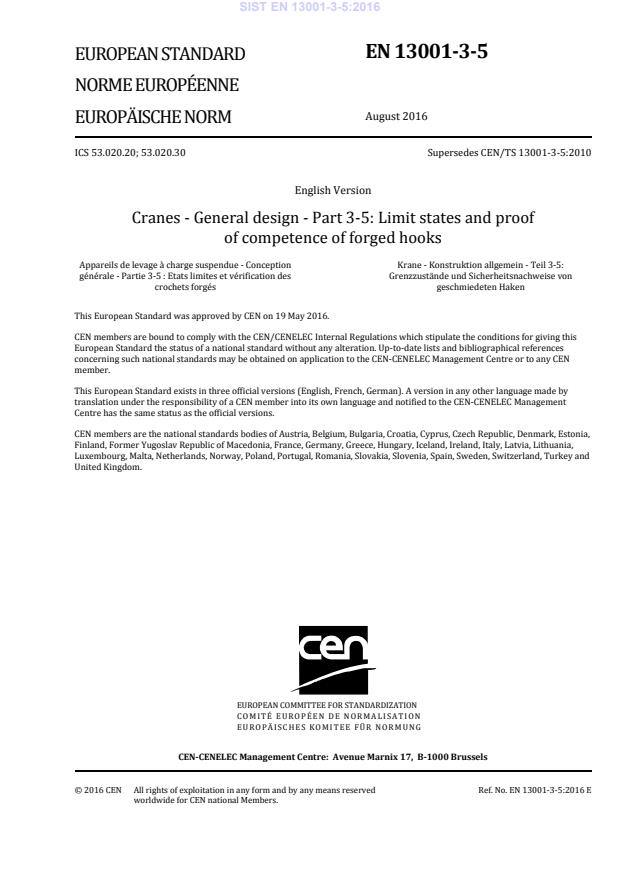
Cranes - General design - Part 3-5: Limit states and proof of competence of forged hooks

This European Standard is to be used together with EN 13001-1 and EN 13001-2 and, as such, they specify general conditions, requirements and methods to prevent by design and theoretical verification, mechanical hazards in crane hooks.
This European Standard covers the following parts of hooks and types of hooks:
-   bodies of any type of hooks made of steel forgings;
-   machined shanks of hooks with a thread/nut suspension.
Principles of this European Standard can be applied to machined shanks of hooks in general. However, stress concentration factors relevant to designs not given in this standard would have to be determined and applied.
NOTE 1   Cast hooks and plate hooks, which are those, assembled of one or several parallel parts of rolled steel plates, are not covered in this European Standard.
The following is a list of significant hazardous situations and hazardous events that could result in risks to persons during normal use and foreseeable misuse. Clauses 4 to 8 of this document are necessary to reduce or eliminate the risks associated with the following hazards:
a)   exceeding the limits of strength (yield, ultimate, fatigue);
b)   exceeding temperature limits of material.
The requirements of this European Standard are stated in the main body of the document and are applicable to forged hook designs in general.
The commonly used hook body and shank designs listed in Annexes A, B and F are only examples and should not be referred to as requirements of this European Standard. Annex I gives guidance for the selection of a hook size, where a hook body is in accordance with Annex A or B. The selection of hook form is not limited to those shown in Annexes A and B.
This European Standard is applicable to cranes, which are manufactured after the date of approval of this European Standard by CEN, and serves as a reference base for product standards of particular crane types.
NOTE 2   This part of EN 13001 deals only with the limit state method in accordance with EN 13001-1.

Krane - Konstruktion allgemein - Teil 3-5: Grenzzustände und Sicherheitshinweise von geschmiedeten Haken

Diese Europäische Norm ist in Verbindung mit den anderen einschlägigen Teilen der Normenreihe zu sehen. Insgesamt werden darin die allgemeinen Bedingungen, Anforderungen und Methoden zur Verhinderung von Gefahren an Haken als Bestandteil sämtlicher Krantypen festgelegt.
Diese Europäische Norm gilt für folgende Hakenteile und Hakenarten:
   alle Arten von geschmiedeten Spitzhakenkörpern
   bearbeitete Hakenschäfte mit Gewinde-/Mutter-Aufhängung.
ANMERKUNG 1   Die Grundsätze der Europäische Norm sind auch auf andere Arten von Gabelhaken sowie bei der Ermittlung und Verwendung von Spannungskonzentrationsfaktoren, die für die betreffende Schaftkonstruktion von Bedeutung sind, anwendbar. Lamellenhaken, die aus einem oder mehreren parallel angeordneten Blechen aus Walzstahl zusammengesetzt sind, sind nicht Gegenstand dieser Europäische Norm.
Die vorliegende Europäische Norm gilt für Haken aus Werkstoffen mit einer Bruchfestigkeit von maximal 800 N/mm2 und einer Fließgrenze von maximal 600 N/mm2.
Im Folgenden sind signifikante Gefahrensituationen und Gefahrenereignisse aufgeführt, die zu Gefahren für den Menschen während des normalen Gebrauchs und bei vorhersehbarem Missbrauch führen könnten. Abschnitte 4 bis 8 dieses Dokuments sind wichtig, um Risiken, die mit nachfolgend genannten Gefahren verbunden sind, zu minimieren oder zu verhindern:
a)   Überschreiten der Festigkeitsgrenzwerte (Fließen, Bruch, Ermüdung);
b)   Überschreiten der Temperaturgrenzwerte des Werkstoffs;
c)   unbeabsichtigtes Aushängen der Last vom Haken.
Die Anforderungen dieser Europäische Norm sind im Hauptteil des Dokuments beschrieben und gelten für Hakenkonstruktionen allgemein. Die in den Anhängen A, B und G aufgeführten Bemes¬sungen von Hakenkörpern und Hakenschäften dienen nur als Beispiel und sind nicht als Anforderungen dieser Europäische Norm zu verstehen.
Diese Europäische Norm gilt für Krane, die nach dem Datum der Genehmigung dieses Dokuments durch CEN gefertigt werden, und dient als Referenzgrundlage für Europäische Norm von speziellen Krantypen.
ANMERKUNG 2   Dieser Teil der EN 13001 befasst sich nur mit der Methode der Grenzzustände nach EN 13001-1.

Appareils de levage à charge suspendue - Conception générale - Partie 3-5 : Etats limites et vérification des crochets forgés

Il convient d’utiliser la présente Norme européenne conjointement avec l'EN 13001-1 et l'EN 13001-2. En tant que telles, elles spécifient les conditions, prescriptions et méthodes générales permettant d’éviter les phénomènes dangereux dus aux crochets par conception et vérification théorique.
La présente Norme européenne couvre les composants de crochets et types de crochets suivants :
-   corps de tout type de crochets à bec en acier forgé ;
-   tiges usinées de crochets à suspension par vis/écrou.
Les principes de la présente Norme européenne peuvent s‘appliquer aux tiges usinées des crochets en général. Cependant, des facteurs de concentration des contraintes correspondant aux conceptions qui ne sont pas données dans la présente Norme devraient être déterminés et utilisés.
NOTE 1    Les crochets moulés et les crochets lamellaires constitués de l’assemblage d’une ou de plusieurs tôles en acier laminé ne sont pas couverts par la présente Norme européenne.
La liste suivante spécifie les situations et les évènements dangereux significatifs susceptibles d’entraîner des risques pour les personnes lors d’une utilisation normale ou d’une mauvaise utilisation prévisible. Les Articles 4 à 8 du présent document sont nécessaires pour réduire ou éliminer les risques associés aux phénomènes dangereux suivants :
a)   dépassement des limites de résistance (élasticité, rupture, fatigue) ;
b)   dépassement des limites de température du matériau.
Les prescriptions de la présente Norme européenne sont spécifiées dans le corps du texte du document et s’appliquent aux conceptions de crochet forgé en général.
Les conceptions de corps et de tige de crochet fréquemment utilisées énumérées dans les Annexes A, B et F ne sont fournies qu’à titre d’exemple et il convient de ne pas les citer comme des prescriptions de la présente Norme européenne. L’annexe I donne des lignes directrices pour la sélection d’une taille de crochet, lorsque le corps du crochet est conforme à l’Annexe A ou B. La sélection d’une forme de crochet n’est pas limitée à celles des Annexes A et B.
La présente Norme européenne s'applique aux appareils de levage à charge suspendue construits après la date d'approbation par le CEN de la présente Norme européenne, et sert de référence pour les normes produit des types particuliers d’appareils de levage à charge suspendue.
NOTE 2   La présente partie de l’EN 13001 considère uniquement la méthode des états limites selon l’EN 13001-1.

Žerjavi - Konstrukcija, splošno - 3-5. del: Mejna stanja in dokaz varnosti kovanih kavljev

Ta evropski standard je namenjen uporabi skupaj z drugimi ustreznimi deli skupine standardov. Kot taki določajo splošne pogoje, zahteve in metode za preprečevanje nevarnosti pri kavljih, ki so del vseh vrst žerjavov.
Ta evropski standard obravnava naslednje dele kavljev in vrste kavljev:
– telesa vseh vrst koničastih kavljev, narejenih iz jeklenih izkovkov;
– strojno obdelana stebla kavljev z obeso z navojem/matico.
OPOMBA 1: Načela tega evropskega standarda se lahko uporabljajo za druge vrste kavljev s steblom in tudi, kjer so določeni in se uporabijo faktorji koncentracije napetosti, pomembni za zadevno konstrukcijo s steblom. Ploščati kavlji, tj. kavlji, sestavljeni iz enega ali več vzporednih delov valjanih jeklenih plošč, niso zajeti v tem evropskem standardu.
Ta evropski standard se uporablja za kavlje iz materialov s skrajno trdnostjo največ 800 N/mm² in obremenitvijo meje prožnosti največ 600 N/mm².
Spodaj je naveden seznam pomembnih nevarnih razmer in dogodkov, zaradi katerih bi lahko prišlo do ogroženosti oseb med običajno uporabo in predvideno nepravilno uporabo. Točke 4–8 v tem dokumentu so potrebne za omejitev ali odpravo tveganj, povezanih z naslednjimi nevarnostmi:
a) prekoračitev mej trdnosti (meja prožnosti, končna meja, meja utrujanja);
b) prekoračitev temperaturnih omejitev materiala;
c) nenamerna ločitev bremena od kavlja.
Zahteve tega evropskega standarda so navedene v glavnem besedilu dokumenta in se uporabljajo za zasnove kavljev na splošno. Zasnove teles in stebel kavljev, navedene v dodatkih A, B in G, so samo primeri ter se ne smejo obravnavati kot zahteve tega evropskega standarda.
Ta evropski standard se uporablja za žerjave, ki so proizvedeni po datumu, ko je CEN sprejel ta evropski standard, in se uporablja kot referenčna osnova standardom za proizvode za posamezne vrste žerjavov.
OPOMBA 2: Ta del standarda EN 13001 obravnava le metodo mejnega stanja v skladu s standardom EN 13001-1.

General Information

Status
Withdrawn
Publication Date
09-Aug-2016
Withdrawal Date
13-Apr-2025
Current Stage
9960 - Withdrawal effective - Withdrawal
Start Date
26-May-2021
Completion Date
14-Apr-2025

Relations

Standard
EN 13001-3-5:2016
English language
80 pages
sale 10% off
Preview
sale 10% off
Preview
e-Library read for
1 day

Frequently Asked Questions

EN 13001-3-5:2016 is a standard published by the European Committee for Standardization (CEN). Its full title is "Cranes - General design - Part 3-5: Limit states and proof of competence of forged hooks". This standard covers: This European Standard is to be used together with EN 13001-1 and EN 13001-2 and, as such, they specify general conditions, requirements and methods to prevent by design and theoretical verification, mechanical hazards in crane hooks. This European Standard covers the following parts of hooks and types of hooks: - bodies of any type of hooks made of steel forgings; - machined shanks of hooks with a thread/nut suspension. Principles of this European Standard can be applied to machined shanks of hooks in general. However, stress concentration factors relevant to designs not given in this standard would have to be determined and applied. NOTE 1 Cast hooks and plate hooks, which are those, assembled of one or several parallel parts of rolled steel plates, are not covered in this European Standard. The following is a list of significant hazardous situations and hazardous events that could result in risks to persons during normal use and foreseeable misuse. Clauses 4 to 8 of this document are necessary to reduce or eliminate the risks associated with the following hazards: a) exceeding the limits of strength (yield, ultimate, fatigue); b) exceeding temperature limits of material. The requirements of this European Standard are stated in the main body of the document and are applicable to forged hook designs in general. The commonly used hook body and shank designs listed in Annexes A, B and F are only examples and should not be referred to as requirements of this European Standard. Annex I gives guidance for the selection of a hook size, where a hook body is in accordance with Annex A or B. The selection of hook form is not limited to those shown in Annexes A and B. This European Standard is applicable to cranes, which are manufactured after the date of approval of this European Standard by CEN, and serves as a reference base for product standards of particular crane types. NOTE 2 This part of EN 13001 deals only with the limit state method in accordance with EN 13001-1.

This European Standard is to be used together with EN 13001-1 and EN 13001-2 and, as such, they specify general conditions, requirements and methods to prevent by design and theoretical verification, mechanical hazards in crane hooks. This European Standard covers the following parts of hooks and types of hooks: - bodies of any type of hooks made of steel forgings; - machined shanks of hooks with a thread/nut suspension. Principles of this European Standard can be applied to machined shanks of hooks in general. However, stress concentration factors relevant to designs not given in this standard would have to be determined and applied. NOTE 1 Cast hooks and plate hooks, which are those, assembled of one or several parallel parts of rolled steel plates, are not covered in this European Standard. The following is a list of significant hazardous situations and hazardous events that could result in risks to persons during normal use and foreseeable misuse. Clauses 4 to 8 of this document are necessary to reduce or eliminate the risks associated with the following hazards: a) exceeding the limits of strength (yield, ultimate, fatigue); b) exceeding temperature limits of material. The requirements of this European Standard are stated in the main body of the document and are applicable to forged hook designs in general. The commonly used hook body and shank designs listed in Annexes A, B and F are only examples and should not be referred to as requirements of this European Standard. Annex I gives guidance for the selection of a hook size, where a hook body is in accordance with Annex A or B. The selection of hook form is not limited to those shown in Annexes A and B. This European Standard is applicable to cranes, which are manufactured after the date of approval of this European Standard by CEN, and serves as a reference base for product standards of particular crane types. NOTE 2 This part of EN 13001 deals only with the limit state method in accordance with EN 13001-1.

EN 13001-3-5:2016 is classified under the following ICS (International Classification for Standards) categories: 53.020.20 - Cranes; 53.020.30 - Accessories for lifting equipment. The ICS classification helps identify the subject area and facilitates finding related standards.

EN 13001-3-5:2016 has the following relationships with other standards: It is inter standard links to CEN/TS 13001-3-5:2010, EN 13001-3-5:2016+A1:2021, EN 13001-3-5:2016/FprA1. Understanding these relationships helps ensure you are using the most current and applicable version of the standard.

EN 13001-3-5:2016 is associated with the following European legislation: EU Directives/Regulations: 2006/42/EC; Standardization Mandates: M/396. When a standard is cited in the Official Journal of the European Union, products manufactured in conformity with it benefit from a presumption of conformity with the essential requirements of the corresponding EU directive or regulation.

You can purchase EN 13001-3-5:2016 directly from iTeh Standards. The document is available in PDF format and is delivered instantly after payment. Add the standard to your cart and complete the secure checkout process. iTeh Standards is an authorized distributor of CEN standards.

Standards Content (Sample)


2003-01.Slovenski inštitut za standardizacijo. Razmnoževanje celote ali delov tega standarda ni dovoljeno.Žerjavi - Konstrukcija, splošno - 3-5. del: Mejna stanja in dokaz varnosti kovanih kavljevKrane - Konstruktion allgemein - Teil 3-5: Grenzzustände und Sicherheitshinweise von geschmiedeten HakenAppareils de levage à charge suspendue - Conception générale - Partie 3-5 : Etats limites et vérification d'aptitude des moufles à crochetCranes - General design - Part 3-5: Limit states and proof of competence of forged hooks53.020.20DvigalaCranesICS:Ta slovenski standard je istoveten z:EN 13001-3-5:2016SIST EN 13001-3-5:2016en,fr,de01-oktober-2016SIST EN 13001-3-5:2016SLOVENSKI
STANDARDSIST-TS CEN/TS 13001-3-5:20101DGRPHãþD

EUROPEAN STANDARD NORME EUROPÉENNE EUROPÄISCHE NORM
EN 13001-3-5
August
t r s x English Version
Cranes æ General design æ Part
uæ wã Limit states and proof of competence of forged hooks Appareils de levage à charge suspendue æ Conception générale æ Partie
uæ w ã Etats limites et vérification des crochets forgés
Krane æ Konstruktion allgemein æ Teil
uæ wã Grenzzustände und Sicherheitsnachweise von geschmiedeten Haken This European Standard was approved by CEN on
s { May
t r s xä
egulations which stipulate the conditions for giving this European Standard the status of a national standard without any alterationä Upætoædate lists and bibliographical references concerning such national standards may be obtained on application to the CENæCENELEC Management Centre or to any CEN memberä
translation under the responsibility of a CEN member into its own language and notified to the CENæCENELEC Management Centre has the same status as the official versionsä
CEN members are the national standards bodies of Austriaá Belgiumá Bulgariaá Croatiaá Cyprusá Czech Republicá Denmarká Estoniaá Finlandá Former Yugoslav Republic of Macedoniaá Franceá Germanyá Greeceá Hungaryá Icelandá Irelandá Italyá Latviaá Lithuaniaá Luxembourgá Maltaá Netherlandsá Norwayá Polandá Portugalá Romaniaá Slovakiaá Sloveniaá Spainá Swedená Switzerlandá Turkey and United Kingdomä
EUROPEAN COMMITTEE FOR STANDARDIZATION COMITÉ EUROPÉEN DE NORMALISATION EUROPÄISCHES KOMITEE FÜR NORMUNG
CEN-CENELEC Management Centre:
Avenue Marnix 17,
B-1000 Brussels
t r s x CEN All rights of exploitation in any form and by any means reserved worldwide for CEN national Membersä Refä Noä EN
s u r r sæ uæ wã t r s x ESIST EN 13001-3-5:2016

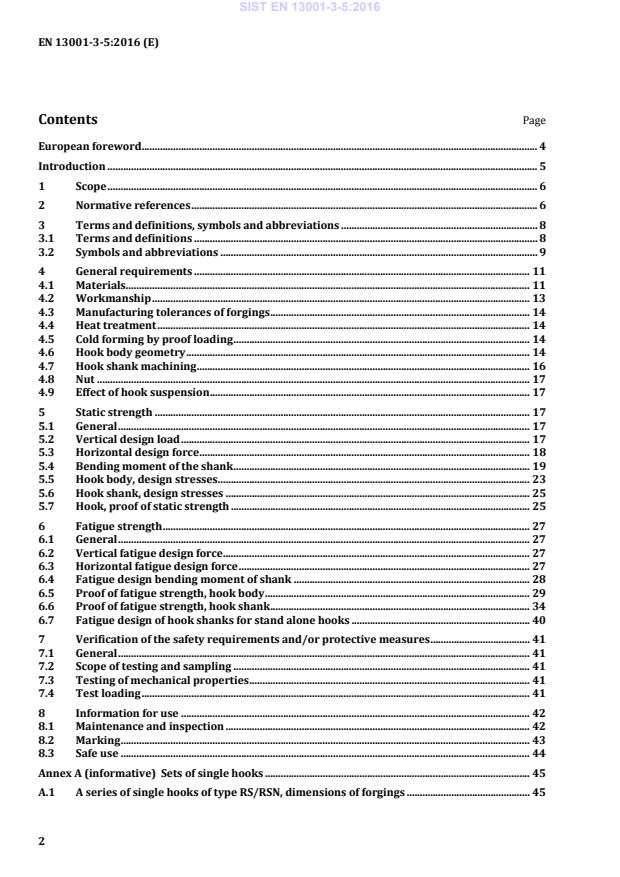
Sets of single hooks . 45 A.1 A series of single hooks of type RS/RSN, dimensions of forgings . 45 SIST EN 13001-3-5:2016

A series of ramshorn hooks of type RS/RSN and RF/RFN, dimensions of forgings . 51 Annex C (informative)
Dimensional tolerances of forgings . 53 Annex D (normative)
Static limit design forces of hook bodies . 54 D.1 Static limit design forces of hook bodies for hooks of type RS and RF .
...

Questions, Comments and Discussion

Ask us and Technical Secretary will try to provide an answer. You can facilitate discussion about the standard in here.

Loading comments...

Die Norm EN 13001-3-5:2016 ist ein wichtiger Bestandteil der europäischen Standards für Krananlagen und bietet umfassende Richtlinien zur Gestaltung und Überprüfung von geschmiedeten Haken. Ihr Hauptziel besteht darin, mechanische Gefahren zu minimieren und durch konstruktive sowie theoretische Überprüfungen eine sichere Anwendung zu gewährleisten. Der Anwendungsbereich dieser Norm erstreckt sich auf verschiedene Typen von Haken, insbesondere auf Körper aus Stahlguss sowie auf mechanisch bearbeitete Stiele mit Gewinde-/Mutternaufhängung. Ein herausragendes Merkmal dieser Norm ist die klare Definition der Gefahren, die mit dem Einsatz von Kranhaken verbunden sind. Die Abschnitte 4 bis 8 adressieren signifikante Gefahrensituationen wie das Überschreiten von Festigkeitsgrenzen und Temperaturgrenzen von Materialien. Diese spezifischen Anforderungen sind entscheidend, um Risiken im normalen Betrieb und bei vorhersehbarem Missbrauch zu reduzieren oder zu eliminieren. Die Norm enthält zudem allgemeine Bedingungen, Anforderungen und Methoden, die in Kombination mit den Teilen EN 13001-1 und EN 13001-2 angewendet werden. Dies zeigt die Relevanz der Norm innerhalb des Gesamtframeworks der europäischen Kranstandardisierung. Obwohl die Norm Beispiele für häufig verwendete Hakenformen in den Anhängen A, B und F bereitstellt, wird ausdrücklich darauf hingewiesen, dass diese nicht als Anforderungen verstanden werden sollen. Dies fördert die Flexibilität und Anpassungsfähigkeit bei der Gestaltung von Haken. Die Anforderungen sind im Haupttext der Norm formuliert und gelten allgemein für geschmiedete Hakenkonstruktionen. Die Möglichkeit, die Prinzipien auf mechanisch bearbeitete Stiele zu übertragen, unterstreicht die Breite der Anwendung dieser Norm. Zudem wird in Anhang I eine Anleitung zur Auswahl der Hakengröße gegeben, die auf den Anhängen A oder B basiert, wodurch eine strukturierte und sichere Entscheidungsfindung ermöglicht wird. Insgesamt bietet die Norm EN 13001-3-5:2016 eine solide Grundlage für Hersteller und Designer von Krananlagen, um die Sicherheit und Zuverlässigkeit von Haken zu gewährleisten und gleichzeitig den spezifischen Anforderungen des Marktes gerecht zu werden. Die Fokussierung auf die Begrenzung von Gefahren und die Sicherstellung der Kompetenzprüfung von geschmiedeten Haken machen diese Norm zu einem unverzichtbaren Dokument im Bereich der Kranstandards.

SIST EN 13001-3-5:2016 표준은 기계 안전을 보장하기 위해 제정된 유럽 표준으로, 주로 크레인 후크의 설계에 관한 일반적인 조건 및 요구사항을 제시하고 있습니다. 이 표준의 주요 초점은 크레인 후크의 기계적 위험을 예방하기 위한 이론적 검증 및 설계를 포함하고 있습니다. 표준은 강철 단조 후크의 바디와 나사/너트 서스펜션이 있는 기계 가공 샹크 후크를 다룹니다. 이는 크레인 후크의 다양한 형식에 대한 폭넓은 적용 가능성을 보장합니다. 특히, 후크의 바디와 샹크 설계에 대한 실제 사용 예시를 제공하므로, 사용자는 이를 바탕으로 설계 결정을 내릴 수 있습니다. 이 표준은 또한 크레인 후크의 안전성과 신뢰성을 높이기 위해 힘의 한계(항복, 궁극, 피로)를 초과하거나 재료의 온도 한계를 초과하는 등 다양한 위험 요소를 명확히 규정하고 있습니다. 이는 안전한 작업 환경을 조성하는 데 매우 중요합니다. 문서의 4조에서 8조는 특히 이와 같은 위험 상황을 줄이거나 제거하기 위한 구체적인 지침을 제공합니다. 표준의 부록(A, B, F)은 흔히 사용되는 후크 바디와 샹크 설계를 예시로 제시하지만, 이러한 설계는 요구 사항이 아니므로 다양한 형식의 후크 선택을 가능하게 합니다. 특히 부록 I은 후크 크기 선택에 대한 안내를 제공하여 사용자에게 실용적인 지원을 제공합니다. SIST EN 13001-3-5:2016은 CEN에 의해 승인된 이후 제조된 크레인에 적용되며, 특정 크레인 유형의 제품 표준에 대한 참조 기준으로 기능합니다. 이 표준은 설계의 한계 상태 방법에 중점을 둔 EN 13001-1과 연결되어 있습니다. 결론적으로, SIST EN 13001-3-5:2016 표준은 크레인 후크의 안전성 및 성능을 보장하는 데 매우 중요한 역할을 하며, 안전한 작업 환경을 위한 필수 지침을 제공합니다.

La norme SIST EN 13001-3-5:2016, intitulée « Grues - Conception générale - Partie 3-5 : États limites et preuve de compétence des crochets forgés », est un document essentiel pour le secteur des grues, fournissant des directives spécifiquement centrées sur la sécurité des crochets forgés. Cette norme européenne est à utiliser conjointement avec les normes EN 13001-1 et EN 13001-2, lesquelles établissent des conditions générales, des exigences et des méthodes pour prévenir les dangers mécaniques dans les crochets de grues par la conception et la vérification théorique. Le champ d'application de cette norme est clairement défini, englobant les corps de tous types de crochets en acier forgé, ainsi que les manchons usinés de crochets dotés d'une suspension par filet/nut. Ce cadre normatif est d'une grande pertinence car il aborde des situations de risque significatives, telles que l'excès de limites de résistance (délai, ultime, fatigue) et les dépassements des limites de température des matériaux. Les clauses 4 à 8 du document jouent un rôle crucial pour atténuer ou éliminer ces risques, garantissant ainsi une utilisation sûre des crochets en conditions normales et d'abus prévisibles. Une force majeure de cette norme réside dans sa capacité à prévenir les dangers identifiés par le biais d'une méthodologie basée sur les états limites, conformément à EN 13001-1. Elle fournit des exigences claires concernant les conceptions de crochets forgés, tout en laissant une certaine flexibilité grâce à l'exemple fourni dans les annexes A, B et F, qui ne doivent pas être considérés comme des exigences obligatoires mais comme des références utiles. De plus, cette norme s'applique spécifiquement aux grues fabriquées après l'approbation de la norme par le CEN, ce qui en fait une base de référence pertinente pour les normes de produit concernant des types de grues particuliers. L'énoncé des exigences dans le corps principal du document indique également une approche proactive en termes de sécurité, garantissant que les conceptions de crochets forgés répondent aux normes les plus élevées en obtenant ainsi la preuve de compétence. En résumé, la norme SIST EN 13001-3-5:2016 se distingue par son approche systématique à la sécurité des crochets de grues, en fournissant des directives pratiques tout en intégrant des principes de conception essentiels qui préservent l'intégrité mécanique et la sécurité des utilisateurs.

The EN 13001-3-5:2016 standard is an essential component of crane safety regulations, specifically focusing on the limit states and proof of competence of forged hooks. Its scope is comprehensive, serving in conjunction with EN 13001-1 and EN 13001-2 to address the general conditions, requirements, and methods necessary to mitigate mechanical hazards associated with crane hooks. One of the standout strengths of this standard is its focus on preventive measures against risks in the use of forged hooks, such as exceeding strength limits and temperature thresholds. By addressing these issues through clear clauses from 4 to 8, the standard effectively helps to reduce or eliminate the risks associated with hazardous situations, enhancing overall safety in crane operations. Furthermore, EN 13001-3-5:2016 provides detailed guidance regarding the design of hook bodies-made from steel forgings-and machined shanks with thread/nut suspensions. This aspect emphasizes the importance of robust engineering practices when it comes to handling heavy loads, ensuring that the hooks can withstand operational stresses without failure. While the standard includes commonly used designs in its annexes, it judiciously clarifies that these elements are provided as examples and not as prescriptive requirements. This flexibility allows manufacturers to innovate while still adhering to strict safety principles, ensuring that a variety of hook forms can be employed in compliance with the standard. Moreover, by specifying that the requirements are applicable to all forged hook designs in general, the EN 13001-3-5:2016 standard establishes a broad and relevant framework that is vital for crane manufacturers that have commenced production post-approval. Its emphasis on the limit state method consistent with the overarching EN 13001-1 offers a structured and reliable approach to verifying the integrity and safety of crane hooks. In conclusion, the EN 13001-3-5:2016 standard is a critical blueprint for safety, providing relevant and necessary guidelines for the design and use of forged hooks in crane operations. Its comprehensive scope, strengths in addressing specific hazards, and relevance to modern engineering practices make it an indispensable reference for industry professionals.

EN 13001-3-5:2016に関する標準化文書は、クレーンの一般設計における安全性と耐久性を確保するための重要な指針を提供しています。この欧州標準は、EN 13001-1およびEN 13001-2と併用され、機械的危険を防ぐための設計および理論的検証の一般的条件、要件、方法を明確に示しています。 この文書は、鋼製鍛造フックのボディとねじ付きシャンクの設計に特に焦点を当てており、鍛造フックに共通する基本的な原則が適用されます。鍛造されたフック設計に関連する力の限界や温度限界に関する要件は、文書の主要部分に記載されており、この標準に基づく設計が求められます。また、附属書A、B、Fに示されているフックボディおよびシャンクの一般的なデザインは、あくまで例示であり、必須の要件ではない点も強調されています。 この標準の強みは、クレーンの設計におけるリスクを特定し、リスク軽減策をシステマティックに定義していることです。特に、強度限界を超える危険や材料の温度限界を超えることによるリスクを管理するための条項が設けられています。これにより、使用時や予測される誤用時の危険を減少させることができます。 この標準は、CENによって承認された日以降に製造されたクレーンに適用され、特定のクレーンタイプの製品標準の基準として機能します。クレーンの設計者や製造者が遵守すべき重要な文書であり、クレーンの安全性と性能を確保するために必要な基盤を提供しています。 EN 13001-3-5:2016は、クレーンフックの鍛造設計に関連する実務にとって、極めて関連性の高い標準であり、今後のクレーン設計における安全基準を確立するための鍵となるでしょう。