

EN 10254:1999
(Main)Steel closed die forgings - General technical delivery conditions
- Abstract
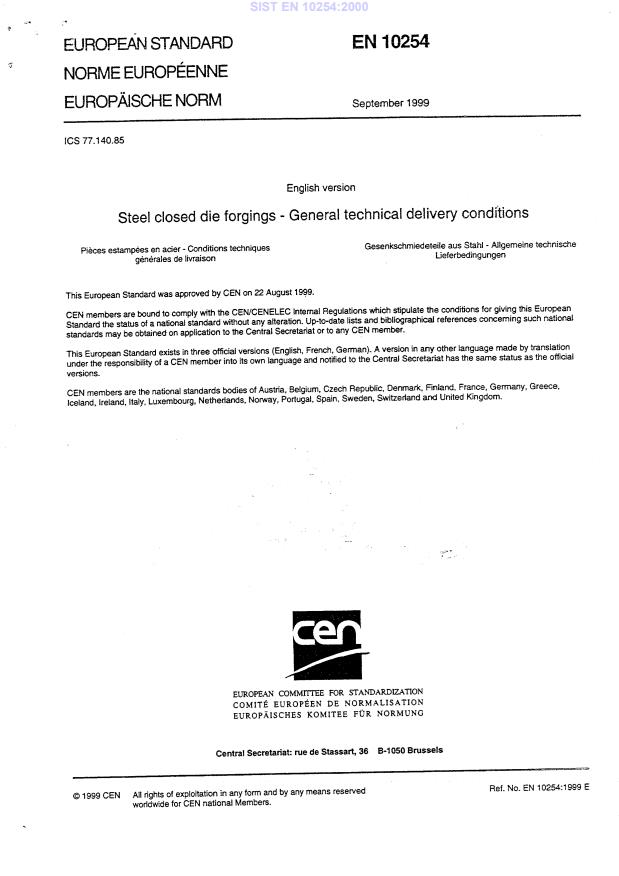
This European Standard specifies the general delivery conditions for steel closed die forgings. These forgings are produced by blow or pressure of the heated product at a suitable temperature (hot or warm) in a die, which in the forming process shapes the material to the form of the die. Similar products such as warm extrusions and upset forgings, are also regarded as part of the process.
- Status
- Published
- Publication Date
- 21-Sep-1999
- Withdrawal Date
- 30-Mar-2000
- Technical Committee
- ECISS/TC 111 - Steel castings and forgings
- Drafting Committee
- ECISS/TC 28/SC 1 - Drop forgings
- Current Stage
- 9020 - Submission to 2 Year Review Enquiry - Review Enquiry
- Start Date
- 15-Jul-2026
- Completion Date
- 15-Jul-2026
- Directive
- 97/23/EC - Pressure equipment
Overview
EN 10254:1999 - Steel closed die forgings - General technical delivery conditions is a European (CEN) standard that specifies the general delivery conditions for steel closed die forgings. The standard covers forgings produced by blow or pressure of a heated product at a suitable temperature (hot or warm) in a die. It also regards similar processes such as warm extrusions and upset forgings as part of the forging process. The Slovenian adoption of this standard is published as SIST EN 10254:2000.
Key topics
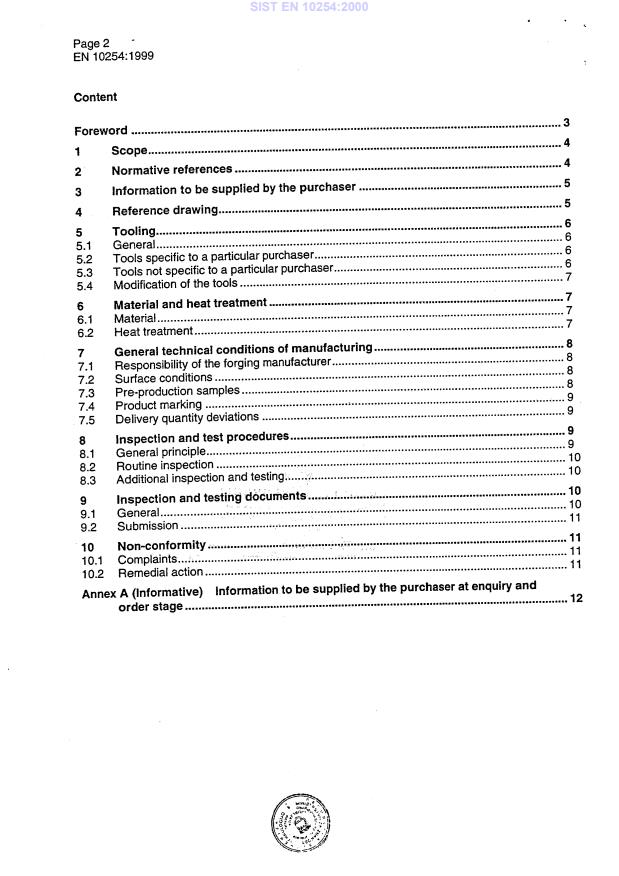
EN 10254:1999 addresses the core contractual and technical elements that govern the supply of steel closed die forgings. While the standard text sets the authoritative requirements, typical topics covered include:
- Scope and definitions - clarifies what constitutes closed die forgings, warm extrusions, and upset forgings.
- General delivery conditions - the contractual framework between purchaser and supplier for forged parts.
- Manufacturing process description - identification of hot and warm forging processes used to form the material in a die.
- Material and product identification - how forgings are identified and documented through production and delivery.
- Dimensional and geometric considerations - expectations for conformity with specified sizes and shapes.
- Surface condition and finish - acceptable surface state on delivery and handling of defects.
- Heat treatment and thermal processing - provisions for delivered condition (hot/warm) and any specified thermal operations.
- Inspection, testing and documentation - requirements for inspection, test records, certificates and acceptance criteria.
- Marking, packaging and transport - instructions to ensure safe, traceable delivery.
(Note: the standard text provides the definitive requirements; the above topics summarize areas typically covered under general delivery conditions.)
Applications
EN 10254:1999 is used to define clear, consistent delivery requirements for suppliers and purchasers of forged steel components. Practical uses include:
- Preparing purchase specifications and contracts for steel closed die forgings.
- Guiding quality assurance and inspection plans at forging suppliers.
- Ensuring traceability and conformity during procurement and acceptance.
- Reducing disputes by specifying delivery, marking, documentation and packaging expectations.
Typical users: forging manufacturers, component suppliers, procurement teams, quality managers, design and mechanical engineers who specify forged parts.
Related standards
- CEN series standards for steel and forgings (refer to local national adoptions such as SIST EN 10254:2000).
- Classified under ICS code 77.140.85 (iron and steel forgings).
Keywords: EN 10254:1999, steel closed die forgings, general technical delivery conditions, CEN standard, hot forgings, warm forgings, upset forgings, forging delivery specifications.
Relations
- Effective Date
- 19-Aug-2026
- Effective Date
- 12-Aug-2026
- Effective Date
- 22-Jul-2026
- Effective Date
- 22-Jul-2026
- Effective Date
- 22-Jul-2026
- Effective Date
- 22-Jul-2026
- Effective Date
- 28-Jan-2026
- Effective Date
- 28-Jan-2026
- Effective Date
- 28-Jan-2026
- Refers
EN 40-3-3:2003 - Lighting columns - Part 3-3: Design and verification - Verification by calculation - Effective Date
- 28-Jan-2026
- Effective Date
- 28-Jan-2026
- Effective Date
- 28-Jan-2026
- Effective Date
- 28-Jan-2026
- Effective Date
- 28-Jan-2026
- Effective Date
- 28-Jan-2026
Get Certified
Connect with accredited certification bodies for this standard

Element Materials Technology
Materials testing and product certification.

Inštitut za kovinske materiale in tehnologije
Institute of Metals and Technology. Materials testing, metallurgical analysis, NDT.
Sponsored listings
Frequently Asked Questions
EN 10254:1999 is a standard published by the European Committee for Standardization (CEN). Its full title is "Steel closed die forgings - General technical delivery conditions". This standard covers: This European Standard specifies the general delivery conditions for steel closed die forgings. These forgings are produced by blow or pressure of the heated product at a suitable temperature (hot or warm) in a die, which in the forming process shapes the material to the form of the die. Similar products such as warm extrusions and upset forgings, are also regarded as part of the process.
This European Standard specifies the general delivery conditions for steel closed die forgings. These forgings are produced by blow or pressure of the heated product at a suitable temperature (hot or warm) in a die, which in the forming process shapes the material to the form of the die. Similar products such as warm extrusions and upset forgings, are also regarded as part of the process.
EN 10254:1999 is classified under the following ICS (International Classification for Standards) categories: 77.140.85 - Iron and steel forgings. The ICS classification helps identify the subject area and facilitates finding related standards.
EN 10254:1999 has the following relationships with other standards: It is inter standard links to EN ISO 6892-2:2026, EN ISO 4885:2026, ISO 4968:1979, ISO 4967:1998, ISO 4969:1980, ISO 3763:1976, EN ISO 6892-1:2019, EN 10204:2004, EN ISO 7827:1995, EN 40-3-3:2003, EN ISO 6506-1:2014, EN ISO 6892-2:2018, EN ISO 148-1:2016, EN ISO 4885:2018, EN 10243-1:1999. Understanding these relationships helps ensure you are using the most current and applicable version of the standard.
EN 10254:1999 is associated with the following European legislation: EU Directives/Regulations: 97/23/EC; Standardization Mandates: M/005, M/071. When a standard is cited in the Official Journal of the European Union, products manufactured in conformity with it benefit from a presumption of conformity with the essential requirements of the corresponding EU directive or regulation.
EN 10254:1999 is available in PDF format for immediate download after purchase. The document can be added to your cart and obtained through the secure checkout process. Digital delivery ensures instant access to the complete standard document.
Standards Content (Sample)
2003-01.Slovenski inštitut za standardizacijo. Razmnoževanje celote ali delov tega standarda ni dovoljeno.Gesenkschmiedeteile aus Stahl - Allgemeine technische LieferbedingungenPieces estampées en acier - Conditions techniques générales de livraisonSteel closed die forgings - General technical delivery conditions77.140.85Železni in jekleni kovani izdelkiIron and steel forgingsICS:Ta slovenski standard je istoveten z:EN 1025
...