

CEN/TR 10261:2023
(Main)Iron and steel - European standards for the determination of chemical composition
- Abstract
This document lists, under Clause 4, the European Standards which are currently available for the determination of the chemical composition of steels and cast irons.
In Clause 5, this document provides details on the range of application and gives the principle of the method described in each standard.
Items which are under preparation as European Standards or as CEN Technical Reports by ECISS/TC 102 are available on the webpage of CEN, through the following link: https://standards.cen.eu/dyn/www/f?p=204:22:0::::FSP_ORG_ID:733643&cs=123E58BF77E3DE921F548B80C5FF2E5D4.
Annex A gives a list of other European Standards and CEN Technical Reports applicable for the determination of the chemical composition of steels and cast irons.
Annex B gives a list of withdrawn Euronorms, together with the corresponding replacement European Standards, if any.
Annex C shows graphical representations of the content ranges of the methods listed in this document. Figure C.1 gives the content ranges of the referee methods, Figure C.2 gives the content ranges of the routine methods and Figure C.3 represents the fields of application of all the methods described.
Annex D provides a trilingual key of the abbreviations used in the Figures given in Annex C.
NOTE Three methods applicable for the analysis of some ferro-alloys are listed in Annex A.
- Status
- Published
- Publication Date
- 25-Apr-2023
- Technical Committee
- ECISS/TC 102 - Methods of chemical analysis for iron and steel
- Drafting Committee
- ECISS/TC 102/WG 5 - Chemical analysis of ferro alloys
- Current Stage
- 6060 - Definitive text made available (DAV) - Publishing
- Start Date
- 26-Apr-2023
- Due Date
- 30-Aug-2023
- Completion Date
- 26-Apr-2023

Overview
CEN/TR 10261:2023 - "Iron and steel - European standards for the determination of chemical composition" is a CEN Technical Report that catalogues the European Standards available for analyzing the chemical composition of steels and cast irons. The report lists mono‑elemental and multi‑elemental standards (Clause 4), and, for each standard, gives the range of application and the principle of the method (Clause 5). It also includes informative annexes with related standards, withdrawn Euronorms and replacements, graphical content‑range maps, and a trilingual abbreviation key.
For items under development, the report points to the CEN web listing: https://standards.cen.eu/dyn/www/f?p=204:22:0::::FSP_ORG_ID:733643&cs=123E58BF77E3DE921F548B80C5FF2E5D4
Key topics
- Comprehensive index of standards for individual elements (Al, C, Cr, Mn, Ni, Si, S, etc.) and multi‑element techniques.
- Mono‑elemental methods: flame and electrothermal atomic absorption (FAAS/ETAAS), spectrophotometric, titrimetric, gravimetric and thermal conductimetric techniques. Example ranges: Al (EN 29658) 0.005–0.20 %; As (EN 10212) 0.001–0.08 %.
- Multi‑elemental methods: inductively coupled plasma optical emission spectrometry (ICP‑OES), X‑ray fluorescence (XRF), optical emission spectrometry (OES) and routine IR/combustion methods for C and S.
- Method classification: defines referee methods (stoichiometric or calibrated against pure substances for certification/arbitration) and routine methods (calibrated against certified reference materials for day‑to‑day control).
- Annexes and visual aids: Annex A lists other applicable standards; Annex B shows withdrawn standards; Annex C provides figures mapping content ranges of referee vs routine methods; Annex D decodes figure abbreviations.
Applications and users
- Quality control and production laboratories in steelworks and foundries
- Third‑party certification and arbitration laboratories using referee methods
- Material testing and R&D labs performing chemical analysis of ferrous materials
- Standards committees, procurement and compliance teams who need to reference harmonized European analytical methods Practical uses include batch release testing, certification analysis, supplier verification, failure investigation and regulatory compliance.
Related standards
- The report cross‑references element‑specific EN and EN ISO methods (e.g., EN ISO 15350 for C and S, EN ISO 4943 for Cu, EN 10351/10355 for ICP‑OES routine analysis).
- It also documents withdrawn Euronorms and their replacements, and lists a few ferro‑alloy analysis methods in Annex A.
CEN/TR 10261:2023 is a practical reference for anyone needing a consolidated, up‑to‑date map of European analytical standards for iron and steel chemical composition.
Relations
- Effective Date
- 23-Feb-2022
- Effective Date
- 28-Jan-2026
- Effective Date
- 28-Jan-2026
- Effective Date
- 28-Jan-2026
- Effective Date
- 28-Jan-2026
- Effective Date
- 28-Jan-2026
- Effective Date
- 28-Jan-2026
- Effective Date
- 28-Jan-2026
- Referred By
EN 10083-1:2006 - Steels for quenching and tempering - Part 1: General technical delivery conditions - Effective Date
- 28-Jan-2026
- Referred By
EN 10267:1998 - Ferritic-pearlitic steels for precipitation hardening from hot-working temperatures - Effective Date
- 28-Jan-2026
- Referred By
EN 13261:2020 - Railway applications - Wheelsets and bogies - Axles - Product requirements - Effective Date
- 28-Jan-2026
- Effective Date
- 28-Jan-2026
- Effective Date
- 28-Jan-2026
- Effective Date
- 28-Jan-2026
- Effective Date
- 28-Jan-2026
Get Certified
Connect with accredited certification bodies for this standard

Element Materials Technology
Materials testing and product certification.

Inštitut za kovinske materiale in tehnologije
Institute of Metals and Technology. Materials testing, metallurgical analysis, NDT.
Sponsored listings
Frequently Asked Questions
CEN/TR 10261:2023 is a technical report published by the European Committee for Standardization (CEN). Its full title is "Iron and steel - European standards for the determination of chemical composition". This standard covers: This document lists, under Clause 4, the European Standards which are currently available for the determination of the chemical composition of steels and cast irons. In Clause 5, this document provides details on the range of application and gives the principle of the method described in each standard. Items which are under preparation as European Standards or as CEN Technical Reports by ECISS/TC 102 are available on the webpage of CEN, through the following link: https://standards.cen.eu/dyn/www/f?p=204:22:0::::FSP_ORG_ID:733643&cs=123E58BF77E3DE921F548B80C5FF2E5D4. Annex A gives a list of other European Standards and CEN Technical Reports applicable for the determination of the chemical composition of steels and cast irons. Annex B gives a list of withdrawn Euronorms, together with the corresponding replacement European Standards, if any. Annex C shows graphical representations of the content ranges of the methods listed in this document. Figure C.1 gives the content ranges of the referee methods, Figure C.2 gives the content ranges of the routine methods and Figure C.3 represents the fields of application of all the methods described. Annex D provides a trilingual key of the abbreviations used in the Figures given in Annex C. NOTE Three methods applicable for the analysis of some ferro-alloys are listed in Annex A.
This document lists, under Clause 4, the European Standards which are currently available for the determination of the chemical composition of steels and cast irons. In Clause 5, this document provides details on the range of application and gives the principle of the method described in each standard. Items which are under preparation as European Standards or as CEN Technical Reports by ECISS/TC 102 are available on the webpage of CEN, through the following link: https://standards.cen.eu/dyn/www/f?p=204:22:0::::FSP_ORG_ID:733643&cs=123E58BF77E3DE921F548B80C5FF2E5D4. Annex A gives a list of other European Standards and CEN Technical Reports applicable for the determination of the chemical composition of steels and cast irons. Annex B gives a list of withdrawn Euronorms, together with the corresponding replacement European Standards, if any. Annex C shows graphical representations of the content ranges of the methods listed in this document. Figure C.1 gives the content ranges of the referee methods, Figure C.2 gives the content ranges of the routine methods and Figure C.3 represents the fields of application of all the methods described. Annex D provides a trilingual key of the abbreviations used in the Figures given in Annex C. NOTE Three methods applicable for the analysis of some ferro-alloys are listed in Annex A.
CEN/TR 10261:2023 is classified under the following ICS (International Classification for Standards) categories: 77.040.30 - Chemical analysis of metals; 77.140.01 - Iron and steel products in general. The ICS classification helps identify the subject area and facilitates finding related standards.
CEN/TR 10261:2023 has the following relationships with other standards: It is inter standard links to CEN/TR 10261:2018, EN 10270-1:2011+A1:2017, EN 10219-3:2020, EN 10250-1:2022, EN 10210-3:2020, EN 10250-1:1999, EN 10217-6:2019, EN 10083-2:2006, EN 10083-1:2006, EN 10267:1998, EN 13261:2020, EN 10277:2018, EN 13674-1:2011+A1:2017, EN 10083-3:2006, EN 10263-1:2001. Understanding these relationships helps ensure you are using the most current and applicable version of the standard.
CEN/TR 10261:2023 is available in PDF format for immediate download after purchase. The document can be added to your cart and obtained through the secure checkout process. Digital delivery ensures instant access to the complete standard document.
Standards Content (Sample)
SLOVENSKI STANDARD
01-julij-2023
Železo in jeklo - Evropski standardi za določevanje kemijske sestave
Iron and steel - European standards for the determination of chemical composition
Eisen und Stahl - Europäische Normen für die Bestimmung der chemischen
Zusammensetzung
Aciers et fontes - Normes européennes pour la détermination de la composition chimique
Ta slovenski standard je istoveten z: CEN/TR 10261:2023
ICS:
77.040.30 Kemijska analiza kovin Chemical analysis of metals
77.080.01 Železne kovine na splošno Ferrous metals in general
2003-01.Slovenski inštitut za standardizacijo. Razmnoževanje celote ali delov tega standarda ni dovoljeno.
CEN/TR 10261
TECHNICAL REPORT
RAPPORT TECHNIQUE
April 2023
TECHNISCHER REPORT
ICS 77.040.30; 77.140.01 Supersedes CEN/TR 10261:2018
English Version
Iron and steel - European standards for the determination
of chemical composition
Aciers et fontes - Normes européennes pour la Eisen und Stahl - Europäische Normen für die
détermination de la composition chimique Bestimmung der chemischen Zusammensetzung
This Technical Report was approved by CEN on 17 April 2023. It has been drawn up by the Technical Committee CEN/TC 459/SC
2.
CEN members are the national standards bodies of Austria, Belgium, Bulgaria, Croatia, Cyprus, Czech Republic, Denmark, Estonia,
Finland, France, Germany, Greece, Hungary, Iceland, Ireland, Italy, Latvia, Lithuania, Luxembourg, Malta, Netherlands, Norway,
Poland, Portugal, Republic of North Macedonia, Romania, Serbia, Slovakia, Slovenia, Spain, Sweden, Switzerland, Türkiye and
United Kingdom.
EUROPEAN COMMITTEE FOR STANDARDIZATION
COMITÉ EUROPÉEN DE NORMALISATION
EUROPÄISCHES KOMITEE FÜR NORMUNG
CEN-CENELEC Management Centre: Rue de la Science 23, B-1040 Brussels
© 2023 CEN All rights of exploitation in any form and by any means reserved Ref. No. CEN/TR 10261:2023 E
worldwide for CEN national Members.
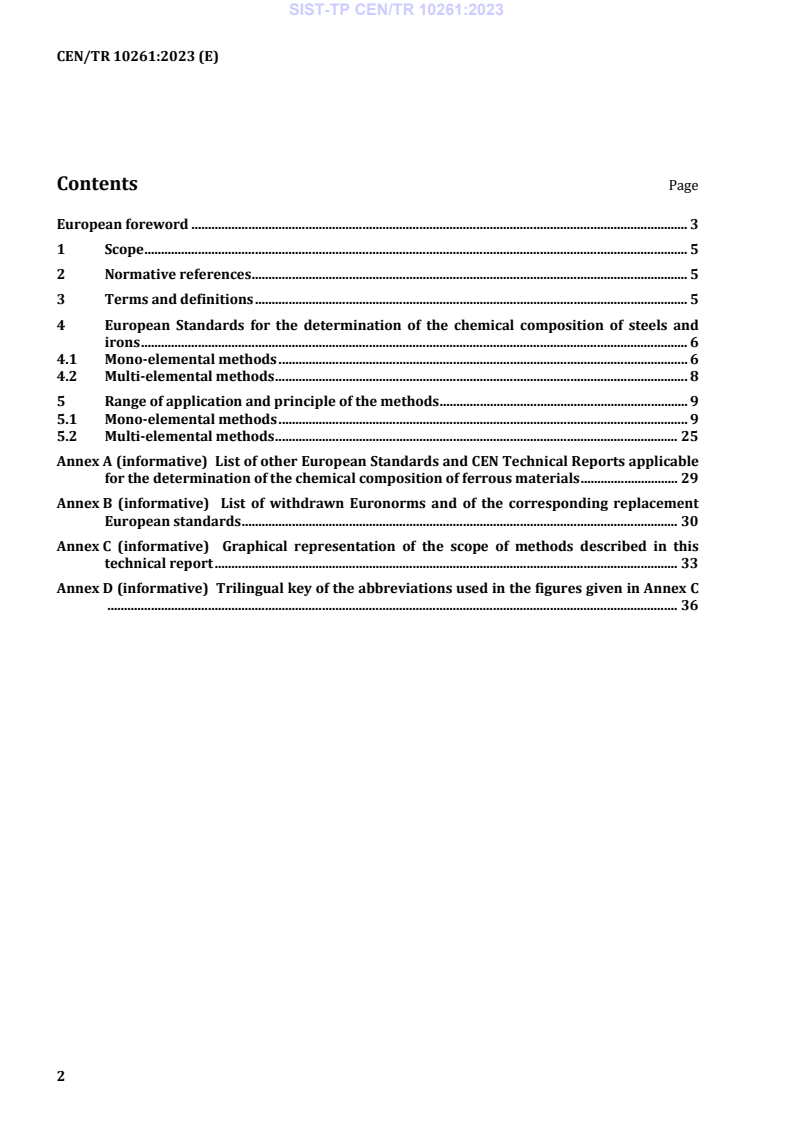
Contents Page
European foreword . 3
1 Scope . 5
2 Normative references . 5
3 Terms and definitions . 5
4 European Standards for the determination of the chemical composition of steels and
irons . 6
4.1 Mono-elemental methods . 6
4.2 Multi-elemental methods . 8
5 Range of application and principle of the methods . 9
5.1 Mono-elemental methods . 9
5.2 Multi-elemental methods . 25
Annex A (informative) List of other European Standards and CEN Technical Reports applicable
for the determination of the chemical composition of ferrous materials . 29
Annex B (informative) List of withdrawn Euronorms and of the corresponding replacement
European standards . 30
Annex C (informative) Graphical representation of the scope of methods described in this
technical report . 33
Annex D (informative) Trilingual key of the abbreviations used in the figures given in Annex C
.......................................................................................................................................................................... 36
European foreword
This document (CEN/TR 10261:2023) has been prepared by Technical Committee CEN/TC 459 “ECISS –
European Committee for Iron and Steel Standardization” , the secretariat of which is held by AFNOR.
Attention is drawn to the possibility that some of the elements of this document may be the subject of
patent rights. CEN shall not be held responsible for identifying any or all such patent rights.
This document supersedes CEN/TR 10261:2018.
In comparison with the previous edition, the following modifications have been made:
— Numbering of sub-paragraphs in Clause 4;
— In 3.1, addition of a Note;
— in 4.1, for calcium, reference of EN 10177 updated;
— in 4.1, for carbon, reference of EN ISO 15349-2 updated;
— in 4.1, for chromium, reference of CEN/TR 10367 updated;
— in 4.1, for cobalt, reference of EN ISO 11652 added;
— in 4.1, for copper, reference modified;
— in 4.1, for lead, reference of EN 10181 updated;
— in 4.1, for nickel, reference of EN 10136 updated;
— in 4.1, for nitrogen, reference of EN ISO 4945 updated;
— in 4.1, for silicon, reference of EN ISO 439 updated;
— in 4.1, for vanadium, reference of EN ISO 4947 updated;
— in 4.1, for vanadium, reference of EN ISO 9647 added;
— 5.1.4, information on EN 10177 revised;
— 5.1.6, reference of CEN/TR 10367 updated;
— 5.1.7, reference of EN ISO 11652 added;
— 5.1.9, information on EN 10181 revised;
— 5.1.11, information on EN 10136 revised;
— 5.1.13, information on EN ISO 4945 revised;
— 5.1.17, information on EN ISO 439 revised;
Through its sub-committee SC 2 “Methods of chemical analysis for iron and steel” (secretariat: SIS).
— 5.1.20, information on EN ISO 4947 revised;
— Annex A, reference of CEN/TR 10317 updated;
— Annex A, reference of CEN/TR 10364 updated;
— Annex C, CEN/TR 10362 moved from Figure C.1 to Figure C.2.
Any feedback and questions on this document should be directed to the users’ national standards body.
A complete listing of these bodies can be found on the CEN website.
1 Scope
This document lists, under Clause 4, the European Standards which are currently available for the
determination of the chemical composition of steels and cast irons.
In Clause 5, this document provides details on the range of application and gives the principle of the
method described in each standard.
Items which are under preparation as European Standards or as CEN Technical Reports by ECISS/TC 102
are available on the webpage of CEN, through the following link:
https://standards.cen.eu/dyn/www/f?p=204:22:0::::FSP_ORG_ID:733643&cs=123E58BF77E3DE921F
548B80C5FF2E5D4.
Annex A gives a list of other European Standards and CEN Technical Reports applicable for the
determination of the chemical composition of steels and cast irons.
Annex B gives a list of withdrawn Euronorms, together with the corresponding replacement European
Standards, if any.
Annex C shows graphical representations of the content ranges of the methods listed in this document.
Figure C.1 gives the content ranges of the referee methods, Figure C.2 gives the content ranges of the
routine methods and Figure C.3 represents the fields of application of all the methods described.
Annex D provides a trilingual key of the abbreviations used in the Figures given in Annex C.
NOTE Three methods applicable for the analysis of some ferro-alloys are listed in Annex A.
2 Normative references
There are no normative references in this document.
3 Terms and definitions
For the purposes of this document, the following terms and definitions apply.
ISO and IEC maintain terminology databases for use in standardization at the following addresses:
— IEC Electropedia: available at https://www.electropedia.org/
— ISO Online browsing platform: available at https://www.iso.org/obp
3.1
referee method
stoichiometric method or a method calibrated against pure metals or stoichiometric compounds, which
is to be used for certification analysis or in case of arbitration
Note 1 to entry Due to lack of accuracy or to a low number of laboratories having participated to the related
validation tests, some stoichiometric methods or methods calibrated against pure metals or stoichiometric
compounds cannot be taken as "referee methods". They are published as CEN/TRs.
3.2
routine method
method calibrated against reference materials or certified reference materials, or against standard
solutions commercially available, which is widely used for control purposes (day to day analysis)
4 European Standards for the determination of the chemical composition of
steels and irons
4.1 Mono-elemental methods
4.1.1 Aluminium, Al
EN 29658:1991, Steel — Determination of aluminium content — Flame atomic absorption spectrometric
method (ISO 9658:1990)
4.1.2 Arsenic, As
EN 10212:1995, Chemical analysis of ferrous materials — Determination of arsenic in steel and iron —
Spectrophotometric method
4.1.3 Boron, B
EN 10200:2012, Chemical analysis of ferrous materials — Determination of boron in steels —
Spectrophotometric method
EN ISO 13900:2002, Steel — Determination of boron content — Curcumin spectrophotometric method after
distillation (ISO 13900:1997)
4.1.4 Calcium, Ca
EN 10177:2019, Steels - Determination of calcium content — Flame atomic absorption spectrometric
method (FAAS)
4.1.5 Carbon, C
EN ISO 15349-2:2021, Unalloyed steel — Determination of low carbon content — Part 2: Infrared
absorption method after combustion in an induction furnace (with preheating) (ISO 15349-2:2021)
EN ISO 9556:2001, Steel and iron — Determination of total carbon content — Infrared absorption method
after combustion in an induction furnace (ISO 9556:1989)
4.1.6 Chromium, Cr
CEN/TR 10367:2019, Alloyed steels — Determination of chromium content — Inductively coupled plasma
optical emission spectrometric method
EN 10188:1989, Chemical analysis of ferrous materials — Determination of chromium in steels and irons —
Flame atomic absorption spectrometric method
EN 24937:1990, Steel and iron — Determination of chromium content — Potentiometric or visual method
(ISO 4937:1986)
EN 24937:1990/AC:1991 (Editorial correction), Steel and iron — Determination of chromium content —
Potentiometric or visual method (ISO 4937:1986)
4.1.7 Cobalt, Co
EN ISO 11652:2022, Steel and iron — Determination of cobalt content — Flame atomic absorption
spectrometric method (ISO 11652:1997)
4.1.8 Copper, Cu
EN ISO 4943:2022, Steel and cast iron — Determination of copper content — Flame atomic absorption
spectrometric method (ISO 4943:2022)
EN ISO 4946:2016, Steel and cast iron — Determination of copper — 2,2’-Biquinoline spectrophotometric
method (ISO 4946:2016)
4.1.9 Lead, Pb
EN 10181:2019, Steels — Determination of lead content — Flame atomic absorption spectrometric method
(FAAS)
4.1.10 Manganese, Mn
EN 10071:2012, Chemical analysis of ferrous materials — Determination of manganese in steels and
irons — Electrometric titration method
EN ISO 10700:1995, Steel and iron — Determination of manganese content — Flame atomic spectrometric
method (ISO 10700:1994)
4.1.11 Nickel, Ni
EN 10136:2019, Steels and cast irons — Determination of nickel content — Flame atomic absorption
spectrometric method (FAAS)
EN 10361:2015, Alloyed steels — Determination of nickel content — Inductively coupled plasma optical
emission spectrometric method
EN ISO 4938:2016, Steel and iron — Determination of nickel content — Gravimetric or titrimetric method
(ISO 4938:2016)
4.1.12 Niobium, Nb
EN 10178:1989, Chemical analysis of ferrous materials — Determination of niobium in steels —
Spectrophotometric method
4.1.13 Nitrogen, N
EN 10179:1989, Chemical analysis of ferrous materials — Determination of nitrogen (trace amounts) in
steels — Spectrophotometric method
EN ISO 4945:2018, Steel — Determination of nitrogen — Spectrophotometric method (ISO 4945:2018)
EN ISO 10720:2007, Steel and iron — Determination of nitrogen content — Thermal conductimetric
method after fusion in a current of inert gas (ISO 10720:1997)
EN ISO 15351:2010, Steel and iron — Determination of nitrogen content — Thermal conductimetric
method after fusion in a current of inert gas (Routine method) (ISO 15351:1999)
4.1.14 Oxygen, O
EN 10276-1:2000, Chemical analysis of ferrous materials — Determination of oxygen in steel and iron —
Part 1: Sampling and preparation of steel samples for oxygen determination
EN 10276-2:2003, Chemical analysis of ferrous materials — Determination of oxygen content in steel and
iron — Part 2: Infrared method after fusion under inert gas
4.1.15 Phosphorus, P
EN 10184:2006, Chemical analysis of ferrous materials — Determination of phosphorus in non-alloyed
steels and irons — Molybdenum blue spectrophotometric method
EN ISO 10714:2002, Steel and iron — Determination of phosphorus content — Phosphovanadomolybdate
spectrophotometric method (ISO 10714:1992)
4.1.16 Selenium, Se
CEN/TR 10362:2014, Chemical analysis of ferrous materials — Determination of selenium in steels —
Electrothermal atomic absorption spectrometric method
4.1.17 Silicon, Si
EN ISO 4829-1:2018, Steel and cast iron — Determination of total silicon contents — Reduced
molybdosilicate spectrophotometric method — Part 1: Silicon contents between 0,05 % and 1,0 % (ISO
4829-1:2018)
EN ISO 4829-2:2016, Steels — Determination of total silicon contents - Reduced molybdosilicate
spectrophotometric method — Part 2: Silicon contents between 0,01 % and 0,05 % (ISO 4829-2:2016)
EN ISO 439:2020, Steel and cast iron — Determination of silicon content — Gravimetric method
(ISO 439:2020)
4.1.18 Sulphur, S
EN 24935:1991, Steel and iron — Determination of sulphur content — Infrared absorption method after
combustion in an induction furnace (ISO 4935:1989)
EN ISO 4934:2003, Steel and iron — Determination of sulfur content — Gravimetric method
(ISO 4934:2003)
4.1.19 Titanium, Ti
EN 10211:2013, Chemical analysis of ferrous materials — Determination of titanium in steels and cast irons
— Flame atomic absorption spectrometric method
EN ISO 10280:1995, Steel and iron — Determination of titanium content — Diantipyrylmethane
spectrophotometric method (ISO 10280:1991)
4.1.20 Vanadium, V
EN ISO 4947:2020, Steel and cast iron — Determination of vanadium content — Potentiometric titration
method (ISO 4947:2020)
EN ISO 9647:2022, Steel - Determination of vanadium content - Flame atomic absorption spectrometric
method (FAAS)
4.2 Multi-elemental methods
4.2.1 Aluminium, Al; Chromium, Cr; Cobalt, Co; Copper, Cu; Manganese, Mn; Molybdenum, Mo;
Nickel, Ni; Phosphorus, P; Tin, Sn and Vanadium, V
EN 10351:2011, Chemical analysis of ferrous materials — Inductively coupled plasma optical emission
spectrometric analysis of unalloyed and low alloyed steels — Determination of Mn, P, Cu, Ni, Cr, Mo, V, Co, Al
(total) and Sn [Routine method]
4.2.2 Aluminium, Al; Lead, Pb; Nickel, Ni; Silicon, Si and Zinc, Zn
EN 10318:2005, Determination of thickness and chemical composition of zinc- and aluminium-based
metallic coatings — Routine method
4.2.3 Carbon, C; Chromium, Cr; Copper, Cu; Manganese, Mn; Nickel, Ni; Phosphorus, P; Silicon, Si
and Sulphur, S
CR 10320:2004, Optical emission analysis of low alloy steels (routine method) — Method for determination
of C, Si, S, P, Mn, Cr, Ni and Cu
4.2.4 Carbon, C and Sulphur, S
EN ISO 15350:2010, Steel and iron — Determination of total carbon and sulfur content — Infrared
absorption method after combustion in an induction furnace (routine method) (ISO 15350:2000)
4.2.5 Chromium, Cr; Cobalt, Co; Copper, Cu; Manganese, Mn; Molybdenum, Mo; Nickel, Ni;
Niobium, Nb; Phosphorus, P; Silicon, Si; Titanium, Ti and Vanadium, V
EN 10315:2006, Routine method for analysis of high alloy steel by X-ray Fluorescence Spectrometry (XRF)
by using a near by technique
4.2.6 Chromium, Cr; Copper, Cu; Manganese, Mn; Molybdenum, Mo; Nickel, Ni; Phosphorus, P;
Silicon, Si and Tin, Sn
EN 10355:2013, Chemical analysis of ferrous materials — Inductively coupled plasma optical emission
spectrometric analysis of unalloyed and low alloyed steels — Determination of Si, Mn, P, Cu, Ni, Cr, Mo and
Sn, following dissolution with nitric and sulphuric acids [Routine method]
5 Range of application and principle of the methods
5.1 Mono-elemental methods
5.1.1 Aluminium, Al
EN 29658:1991, Steel — Determination of aluminium content — Flame atomic absorption
spectrometric method (ISO 9658:1990)
Range of application:
— Determination of aluminium contents from 0,005 % (m/m) to 0,20 % (m/m) in non-alloyed steel.
Principle of the method:
a) Dissolution of a test portion in dilute hydrochloric and nitric acids;
b) Fusion of the acid-insoluble material with a mixture of orthoboric acid and potassium carbonate;
c) Spraying of the solution into a dinitrogen monoxide-acetylene flame;
d) Spectrometric measurement of the atomic absorption of the 309,3 nm spectral line emitted by an
aluminium hollow cathode lamp.
5.1.2 Arsenic, As
EN 10212:1995, Chemical analysis of ferrous materials — Determination of arsenic in steel and iron
— Spectrophotometric method
Range of application:
— Determination of arsenic contents from 0,001 % (m/m) to 0,08 % (m/m) in all types of steel and iron.
Principle of the method:
a) Dissolution of a test portion in a mixture of nitric and hydrochloric acids followed by evaporation to
dryness and prolonged heating of the dried residue;
b) Extraction of the residue with acid, reduction of the arsenic (As V to As III) by addition of potassium
iodine, ascorbic acid and tin (II) chloride. Conversion of the arsenic to arsenic hydride (arsine) with
zinc;
c) Absorption of the evolved arsine in a solution of silver diethyldithiocarbamate and l-ephedrin in
trichloromethane;
d) Spectrophotometric measurement of the reddish-violet coloured colloid at a wavelength between
500 nm and 520 nm.
5.1.3 Boron, B
EN 10200:2012, Chemical analysis of ferrous materials — Determination of boron in steels —
Spectrophotometric method
Range of application:
— Determination of boron content from 0,000 4 % to 0,012 0 % (m/m) in non-alloyed and alloyed
steels.
Principle of the method:
a) Dissolution of a test portion with hydrochloric and nitric acids;
b) Decomposition of boron compounds (nitrides etc.) with orthophosphoric and sulphuric acids at
290 °C;
c) Spectrophotometric measurement at a wavelength of 543 nm of the complex formed between boric
acid and curcumin in buffered acetic medium.
EN ISO 13900:2002, Steel — Determination of boron content — Curcumin spectrophotometric
method after distillation (ISO 13900:1997)
Range of application:
— Determination of boron content from 0,000 05 % (m/m) to 0,001 0 % (m/m) in steel.
Principle of the method:
a) Dissolution of a test portion in hydrochloric and nitric acids;
b) Decomposition of boron compounds (nitrides, etc.) with orthophosphoric and sulphuric acids at a
temperature of 290 °C;
c) Distillation of the solution after the addition of methanol and collection of methylborate in a receiver
containing sodium hydroxide solution;
d) Evaporation of the solution to dryness. Formation of a coloured complex between orthoboric acid
and curcumin in a methanol medium;
e) Spectrophotometric measurements at a wavelength of about 550 nm.
5.1.4 Calcium, Ca
EN 10177:2019, Steels - Determination of calcium content - Flame atomic absorption spectrometric
method (FAAS)
Range of application:
— Determination of calcium contents between 4 µg/g and 0120 µg/g in non-alloyed and low-alloy
steels.
NOTE 1 The method can be adapted to higher calcium contents by changing the test portion or the dilution
process, provided the criteria given in the paragraph 6.2 of the standard are still met
Principle of the method:
a) Dissolution of a test portion in hydrochloric acid followed by oxidation with nitric acid;
NOTE 2 Aqua regia can be used for simultaneous dissolution and oxidation of the test portion.
b) Addition of a solution of potassium chloride and nebulisation of the test solution into an
acetylene/nitrous oxide flame of an atomic absorption spectrometer;
NOTE 3 Potassium chloride is added to suppress ionization of calcium.
c) Spectrometric measurement of the atomic absorption of the 422,7 nm spectral line emitted by a
calcium hollow-cathode lamp.
NOTE 4 Other suitable radiation sources can also be used, provided the criteria in 6.2.2 and 6.2.3 are still met.
5.1.5 Carbon, C
EN ISO 15349-2:2021, Unalloyed steel — Determination of low carbon content — Part 2: Infrared
absorption method after combustion in an induction furnace (with preheating) (ISO 15349-2:2021)
Range of application:
— Carbon contents from 0,000 3 % (mass fraction) to 0,009 % (mass fraction) in unalloyed steel.
Principle of the method:
a) Pre-heating of a test portion at low temperature followed by its combustion in presence of an
accelerator at a high temperature in an induction furnace in a current of pure oxygen;
b) Transformation of carbon into carbon dioxide and/or carbon monoxide;
c) Measurement by infrared absorption of the carbon dioxide and/or carbon monoxide evolved from
sample and carried by a current of pure oxygen;
d) The calibration is carried out using sucrose or calcium carbonate.
EN ISO 9556:2001, Steel and iron — Determination of total carbon content — Infrared absorption
method after combustion in an induction furnace (ISO 9556:1989)
Range of application:
— Determination of carbon contents from 0,003 % (m/m) to 4,5 % (m/m) in steel and iron.
Principle of the method:
a) Combustion of a test portion with accelerator at a high temperature in a high-frequency induction
furnace in a current of pure oxygen; transformation of carbon into carbon dioxide and/or carbon
monoxide;
b) Measurement by infrared absorption of the carbon dioxide and/or carbon monoxide carried by a
current of oxygen.
5.1.6 Chromium, Cr
CEN/TR 10367:2019, Alloyed steels - Determination of chromium content - Inductively coupled
plasma optical emission spectrometric method
Range of application:
— Determination of the chromium contents (mass fraction) between 5,0 % (m/m) and 27,0 % (m/m)
in alloyed steels.
NOTE The method doesn't apply to alloyed steels having carbon contents higher than 1 % and niobium and/or
tungsten contents higher than 0,1 %.
Principle of the method:
a) Dissolution of a test portion with hydrochloric and nitric acids. Filtration and ignition of the acid
insoluble residue. Removal of silica with hydrofluoric acid. Fusion of the residue with potassium
hydrogen sulphate (or with potassium disulphate), acid dissolution of the melt and addition of this
solution to the reserved filtrate.
b) After suitable dilution and, if necessary, addition of an internal reference element, nebulisation of the
solution into an inductively coupled plasma optical emission spectrometer and measurement of the
intensity of the emitted light (including, where appropriate, that of the internal reference element).
c) The method uses a calibration based on a very close matrix matching of the calibration solutions to
the sample and bracketing of the mass fractions between 0,95 to 1,05 of the approximate content of
chromium in the sample to be analysed. The content of all elements in the sample has, therefore, to
be approximately known. If the contents are not known, the sample has to be analysed by some
semi-quantitative method. The advantage with this procedure is that all possible interferences from
the matrix will be compensated, which will result in high accuracy. This is most important for spectral
interferences, which can be severe in very highly alloyed matrixes. All possible interferences shall be
kept at a minimum level. Therefore, it is essential that the spectrometer used meets the performance
criteria specified in the method for the selected analytical lines.
d) The wavelengths reported in Table 1 have been investigated and the strongest possible interferences
are given. If other wavelengths are used, they shall be carefully checked. The wavelength for the
internal reference element should be selected carefully. The use of scandium at 363,1 nm or yttrium
at 371,0 nm is recommended. These wavelengths are interference-free for the elements and contents
generally found in alloyed steels.
EN 10188:1989, Chemical analysis of ferrous materials — Determination of chromium in steels and
irons — Flame atomic absorption spectrometric method
Range of application:
— Determination of chromium contents from 0,002 % to 2,0 % (m/m) in non-alloy and low-alloy steels
and irons.
Principle of the method:
a) Dissolution of a test portion with hydrochloric acid followed by oxidation with nitric acid. Filtration
and ignition of the acid insoluble residue. Removal of silica with hydrofluoric acid. Fusion of the
residue with potassium hydrogen sulphate, extraction of the melt in acid and addition of the extract
to the reserved filtrate;
b) Determination of the chromium by means of the spectrometric measurement of the atomic
absorption of the 357,87 nm line emitted by a chromium hollow cathode lamp when the solution is
nebulised into a nitrous oxide acetylene flame.
EN 24937:1990, Steel and iron — Determination of chromium content — Potentiometric or visual
method (ISO 4937:1986)
Range of application:
— Determination of chromium contents from 0,25 % to 35 % (m/m) in steel and iron.
Principle of the method:
a) Dissolution of a test portion with appropriate acids;
b) Oxidation of chromium in an acid medium to chromium (VI) by ammonium peroxydisulfate in the
presence of silver sulphate. Reduction of manganese (VII) by hydrochloric acid;
c) Reduction of chromium (VI) by ammonium iron (II) sulphate standard solution;
d) In the case of potentiometric detection, determination of the equivalence point by measurement of
the potential variation when the ammonium iron (II) sulphate standard solution is being added;
e) In the case of visual detection, titration of the excess ammonium iron (II) sulphate by potassium
permanganate standard solution which also acts as the indicator.
5.1.7 Cobalt, Co
EN ISO 11652:2022, Steel and iron - Determination of cobalt content - Flame atomic absorption
spectrometric method (ISO 11652:1997)
Range of application:
— Determination of cobalt contents from 0,003 % (m/m) to 5,0 % (m/m) in steel and iron.
Principle of the method:
a) Dissolution of a test portion in hydrochloric, nitric and perchloric acids;
b) Spraying of the solution into an air-acetylene flame;
c) Spectrometric measurement of the atomic absorption of the 240,7 nm spectral line emitted by a
cobalt hollow cathode lamp.
5.1.8 Copper, Cu
EN ISO 4943:2022, Steel and cast iron — Determination of copper content — Flame atomic
absorption spectrometric method (ISO 4943:2022)
Range of application:
— Determination of copper contents from 0,003 % to 3 % (by mass) in steels and cast irons.
Principle of the method:
a) Dissolution of a test portion in mixture of hydrochloric, nitric and perchloric acids;
b) Nebulization of the test solution into an air/acetylene flame of an atomic absorption spectrometer.
Spectrometric measurement of the atomic absorption of the 324,7 nm or 327,4 nm spectral line
emitted by a copper hollow-cathode lamp.
NOTE Other suitable radiation sources can also be used.
EN ISO 4946:2016, Steel and cast iron — Determination of copper — 2,2'-Biquinoline
spectrophotometric method (ISO 4946:2016)
Range of application:
— Determination of copper mass fraction in the range of 0,02 % and 5 %.
Principle of the method:
a) Dissolution of a test portion in appropriate acids;
b) Fuming with perchloric acid to remove hydrochloric and nitric acids and dehydrate silicic acid;
c) Reduction of copper(II) to copper(I) in hydrochloric acid solution by means of ascorbic acid.
Formation of a coloured compound of copper(I) with 2,2’-biquinoline;
d) Spectrophotometric measurement at a wavelength of about 545 nm.
5.1.9 Lead, Pb
EN 10181:2019, Steels — Determination of lead content — Flame atomic absorption spectrometric
method (FAAS)
Range of application:
— Determination of lead contents from 0,005 % (weight percent) to 0,5 % (weight percent) in non-alloy
and low-alloy steels.
NOTE 1 The method can be adapted to lower or higher lead contents by changing the test portion or the dilution
process, provided the criteria given in the paragraph 6.2 of the standard are still met.
Principle of the method:
a) Dissolution of a test portion in hydrochloric acid followed by oxidation with nitric acid;
NOTE 2 Aqua regia can be used for simultaneous dissolution and oxidation of the test portion.
Under publication
b) Nebulization of the test solution into an air/acetylene flame of an atomic absorption spectrometer;
c) Spectrometric measurement of the atomic absorption of the 283,3 nm spectral line emitted by a lead
hollow-cathode lamp.
NOTE 3 Other suitable radiation sources can also be used and measurements can also be carried out at 217,0
nm, provided the criteria in 6.2.2 and 6.2.3 are still met.
5.1.10 Manganese, Mn
EN 10071:2012, Chemical analysis of ferrous materials — Determination of manganese in steels
and irons — Electrometric titration method
Range of application:
— Determination of manganese contents greater than or equal to 0,5 % (m/m) in unalloyed, low alloy
or alloyed steels and irons.
Principle of the method:
a) Dissolution of the test portion with appropriate acids, followed by a partial neutralisation of the acids
with sodium hydrogen carbonate;
b) Precipitation of the interfering cations with zinc oxide;
c) Titration of Mn (II) with a potassium permanganate solution, in a pyrophosphoric medium at a pH of
about 6,5;
d) The oxidation-reduction reaction [oxidation of Mn (II) to Mn (III)] is controlled by an electrometric
measurement.
EN ISO 10700:1995, Steel and iron — Determination of manganese content — Flame atomic
spectrometric method (ISO 10700:1994)
Range of application:
— Determination of manganese contents from 0,002 % (m/m) to 2,0 % (m/m).
Principle of the method:
a) Dissolution of a test portion in hydrochloric and nitric acids followed by evaporation with perchloric
acid until white fumes appear;
b) Spraying of the solution into an air-acetylene flame;
c) Spectrometric measurement of the atomic absorption of the 279,5 nm spectral line emitted by a
manganese hollow cathode lamp.
5.1.11 Nickel, Ni
EN 10136:2019, Steels and cast irons — Determination of nickel content — Flame atomic absorption
spectrometric method (FAAS)
Range of application:
— Determination of nickel contents from 0,004 % (weight percent) to 2 % (weight percent) in steels
and cast irons.
NOTE 1 The method can be adapted to lower or higher nickel contents by changing the test portion or the
dilution process, provided the criteria given in the paragraph 6.2 of the standard are still met.
Principle of the method:
a) Dissolution of a test portion in a mixture of appropriate acids and fuming with perchloric acid;
b) Nebulisation of the test solution into an air/acetylene flame of an atomic absorption spectrometer;
c) Spectrometric measurement of the atomic absorption of the 232,0 nm or 352,5 nm spectral line
emitted by a nickel hollow-cathode lamp.
NOTE 2 Other suitable radiation sources can also be used, provided the criteria in 6.2.2 and 6.2.3 are still met.
EN 10361:2015, Alloyed steels — Determination of nickel content — Inductively coupled plasma
optical emission spectrometric method
Range of application:
— Determination of nickel contents (mass fraction) between 5,0 % and 25,0 % in alloyed steels.
Principle of the method:
a) Dissolution of a test portion with hydrochloric and nitric acids. Filtration and ignition of the acid
insoluble residue. Removal of silica with hydrofluoric acid. Fusion of the residue with potassium
hydrogen sulphate (or with potassium disulphate), dissolution of the melt with acid and addition of
this solution to the reserved filtrate;
b) After suitable dilution and, if necessary, addition of an internal reference element, nebulization of the
solution into an inductively coupled plasma emission spectrometer and measurement of the
intensity of the emitted light (including, where appropriate, that of the internal reference element);
c) The method uses a calibration based on a very close matrix matching of the calibration solutions to
the sample and bracketing of the mass fractions between 0,95 to 1,05 of the approximate content of
nickel in the sample to be analysed. The content of all elements in the sample has, therefore, to be
approximately known. If the contents are not known the sample shall be analysed by some semi
quantitative method. The advantage with this procedure is that all possible interferences from the
matrix will be compensated, which will result in high accuracy. This is most important for spectral
interferences, which can be severe in very highly alloyed matrixes. All possible interferences shall be
kept at a minimum level. Therefore, it is essential that the spectrometer used meets the performance
criteria specified in the method for the selected analytical lines;
d) The optical lines reported in the Table 1 have been investigated and the strongest possible
interferences are given. If other optical lines are used, they shall be carefully checked. The analytical
line for the internal reference element should be selected carefully. The use of scandium at 363,1 nm
or yttrium at 371,0 nm is recommended. These lines are interference-free for the elements and
contents generally found in alloyed steels.
EN ISO 4938:2016, Steel and iron — Determination of nickel content — Gravimetric or titrimetric
method (ISO 4938:2016)
Range of application:
— Determination of nickel contents from 1 % to 30 % (mass fraction) in steel and iron.
Principle of the method:
a) Dissolution of a test portion with appropriate acids;
b) Precipitation of the nickel as nickel-dimethylglyoxime:
1) Cobalt, if present, is oxidized by potassium hexacyanoferrate(lll),
2) Copper, if present with cobalt, preferably is removed by controlled potential electrolysis;
c) Acid dissolution of the precipitate and filtration of the solution, followed by a second precipitation of
the nickel as nickel dimethylglyoxime;
d) In the case of the gravimetric determination, weighing the dried dimethylglyoxime precipitate.
e) In the case of the titrimetric determination, acid dissolution of the precipitate, addition of excess
EDTA.Na solution and back titration of the excess EDTA.Na by zinc solution using xylenol orange
2 2
as an indicator;
f) In both cases, determination of residual nickel in the filtrate(s) by atomic absorption spectrometry.
5.1.12 Niobium, Nb
EN 10178:1989, Chemical analysis of ferrous materials — Determination of niobium in
steels — Spectrophotometric method
Range of application:
— Determination of niobium contents from 0,002 % to 1,3 % (m/m) in steels.
Principle of the method:
a) Dissolution of a test portion with hydrochloric acid followed by oxidation with hydrogen peroxide;
b) Precipitation of niobium and tantalum with phenylarsonic acid using zirconium as a carrier;
c) Formation of a complex of niobium with 4-(2-pyridylazo)-resorcinol (PAR) in a buffered sodium
tartrate medium;
d) Spectrophotometric measurement of the coloured compound at a wavelength of 550 nm.
5.1.13 Nitrogen, N
EN 10179:1989, Chemical analysis of ferrous materials — Determination of nitrogen (trace
amounts) in steels — Spectrophotometric method
Range of application:
— Determination of nitrogen contents from 0,000 5 % to 0,005 % (m/m) in steels.
Principle of the method:
a) Dissolution of the test portion with hydrochloric acid and separation of the acid-insoluble residue by
means of a centrifuge;
b) Decomposition of the acid-insoluble residue by intense fuming with sulphuric acid and addition of
the extract to the solution of the test portion containing the acid soluble nitrogen;
c) Recovery of the total nitrogen as ammonia by steam distillation over sodium hydroxide;
d) Spectrophotometric measurement of the coloured complex produced by the indophenol blue
reaction.
EN ISO 4945:2018, Steel — Determination of nitrogen — Spectrophotometric method (ISO
4945:2018)
Range of application:
— Determination of nitrogen contents from 0,000 6 % to 0,050 % (mass fraction), in low-alloy steels
and from 0,010 % and 0,050 % (mass fraction) in high alloy steels.
The method does not apply to samples containing silicon nitrides or having silicon contents higher
than 0,6 %.
Principle of the method:
a) Dissolution of a test portion in hydrochloric acid;
b) Fuming of the acid-insoluble residue in sulphuric acid with potassium sulfate and copper(lI) sulfate;
c) Distillation of the solution made alkaline with sodium hydroxide, and collection of ammonia in a
receiver containing diluted sulphuric acid;
d) Formation of a blue-coloured complex between the ammonium ions and phenol in the presence of
sodium hypochlorite and disodium pentacyanonitrosylferrate(III) (sodium nitroprusside);
e) Spectrophotometric measurement of the complex at a wavelength of about 640 nm.
EN ISO 10720:2007, Steel and iron — Determination of nitrogen content — Thermal conductimetric
method after fusion in a current of inert gas (ISO 10720:1997)
Range of application:
— Determination of nitrogen contents from 0,000 8 % (m/m) to 0,5 % (m/m) in steels and irons.
Principle of the method:
a) Fusion of a test portion in a single-use graphite crucible under helium gas at a high temperature
(e.g. 2 200 °C). Extraction of the nitrogen in the form of molecular nitrogen in the stream of helium;
b) Separation from the other gaseous extracts and measurement by thermal conductimetric method.
EN ISO 15351:2010, Steel and iron — Determination of nitrogen content — Thermal conductimetric
method after fusion in a current of inert gas (Routine method) (ISO 15351:1999)
Range of application:
— Determination of nitrogen contents from 0,002 % to 0,6 % (m/m) in steels and irons.
Principle of the method:
a) Fusion of a test portion in a single-use graphite crucible under helium gas at a high temperature
(e.g. 2 200 °C). Extraction of the nitrogen in the form of molecular nitrogen in the stream of helium;
b) Separation from the other gaseous extracts and measurement by thermal conductimetric method;
c) Calibration graph established using steel or iron certified reference materials (CRM).
5.1.14 Oxygen, O
EN 10276-1:2000, Chemical analysis of ferrous materials — Determination of oxygen in steel and
iron — Part 1: Sampling and preparation of steel samples for oxygen determination
Range of application:
— Determination of oxygen contents < 0,005 0 % (also applicable for higher contents). This standard is
applicable to steels having a hardness of < 400 HBW 10/3000.
Principle of the method:
a) Samples for oxygen determination are machined to a suitable shape and size within the restrictions
imposed by the instrument used. In order to ensure that the surface has the minimum possible
oxygen content, samples for analysis are prepared either by punching (Method A) or by turning
(Method B).
EN 10276-2:2003, Chemical analysis of ferrous materials — Determination of oxygen content in
steel and iron — Part 2: Infrared method after fusion under inert gas
Range of application:
— Determination of oxygen contents from 0,000 5 % to and 0,01 % (m/m) in steels and irons.
Principle of the method:
a) Fusion of a test portion in a single-use graphite crucible under helium gas at a minimum temperature
of 2 000 °C. Combination of the oxygen from the sample with carbon from the crucible to form carbon
monoxide. Eventually transformation of carbon monoxide into carbon dioxide;
b) Measurement of infrared absorption of the carbon monoxide or dioxide and use of a calibration curve
plotted using the measurements obtained with potassium nitrate.
5.1.15 Phosphorus, P
EN 10184:2006, Chemical analysis of ferrous materials — Determination of phosphorus in non-
alloyed steels and irons — Molybdenum blue spectrophotometric method
Range of application:
— Determination of phosphorus content from 0,005 % to 0,25 % (m/m) in non-alloyed steels and irons.
Principle of the method:
a) Dissolution of a test portion in nitric and hydrochloric acids and controlled addition of perchloric
acid;
b) Formation of the phosphomolybdate complex after removal of silicon and arsenic and reduction with
hydrazine sulphate to molybdenum blue;
c) Spectrophotometric measurement of the blue complex at a wavelength of 680 nm or 825 nm.
EN ISO 10714:2002, Steel and iron — Determination of phosphorus content —
Phosphovanadomolybdate spectrophotometric method (ISO 10714:1992)
Range of application:
— Determination of phosphorus contents from 0,001 0 % (m/m) to 1,0 % (m/m) in steels and irons.
Principle of the method:
a) Dissolution of a test portion in an oxidising acid mixture;
b) Fuming with perchloric acid and removal of chromium as volatile chromyl chloride;
c) Complexing of silicon and the refractory elements with hydrofluoric acid and complexing of the
excess of hydrofluoric acid with orthoboric acid;
d) Conversion of phosphorus to phosphovanadomolybdate in perchloric and nitric acid solution;
e) Extraction of phosphovanadomolybdate by 4-methyl-2-pentanone with citric acid present to
complex arsenic;
f) Spectrophotometric measurement at a wavelength of 355 nm.
5.1.16 Selenium, Se
CEN/TR 10362:2014, Chemical analysis of ferrous materials - Determination of selenium in steels -
Electrothermal atomic absorption spectrometric method
Range of application:
Determin
...