

EN 16214-1:2012
(Main)Sustainability criteria for the production of biofuels and bioliquids for energy applications - Principles, criteria, indicators and verifiers - Part 1: Terminology
- Abstract
This European Standard defines the terminology to be used in the field of sustainability criteria for the production of biofuels and bioliquids for energy applications. This European Standard specifically considers some relevant terms and definitions used in the European Commission Directive 2009/28/EC [1], referred to as Renewable Energy Directive (RED), and in the European Commission Directive 2009/30/EC [2] referred to as Fuel Quality Directive (FQD), or in other European regulations.
- Status
- Withdrawn
- Publication Date
- 28-Aug-2012
- Withdrawal Date
- 06-Oct-2026
- Technical Committee
- CEN/TC 383 - Sustainably produced biomass for energy applications
- Current Stage
- 9960 - Withdrawal effective - Withdrawal
- Start Date
- 27-Nov-2019
- Completion Date
- 07-Oct-2026



Relations
- Effective Date
- 19-Jan-2023
- Effective Date
- 28-Jan-2026
- Effective Date
- 28-Jan-2026
- Effective Date
- 28-Jan-2026
- Effective Date
- 28-Jan-2026
- Effective Date
- 28-Jan-2026
- Effective Date
- 11-Oct-2017
Get Certified
Connect with accredited certification bodies for this standard

DNV
DNV is an independent assurance and risk management provider.

Lloyd's Register
Lloyd's Register is a global professional services organisation specialising in engineering and technology.
DNV Energy Systems
Energy and renewable energy certification.
Sponsored listings
Frequently Asked Questions
EN 16214-1:2012 is a standard published by the European Committee for Standardization (CEN). Its full title is "Sustainability criteria for the production of biofuels and bioliquids for energy applications - Principles, criteria, indicators and verifiers - Part 1: Terminology". This standard covers: This European Standard defines the terminology to be used in the field of sustainability criteria for the production of biofuels and bioliquids for energy applications. This European Standard specifically considers some relevant terms and definitions used in the European Commission Directive 2009/28/EC [1], referred to as Renewable Energy Directive (RED), and in the European Commission Directive 2009/30/EC [2] referred to as Fuel Quality Directive (FQD), or in other European regulations.
This European Standard defines the terminology to be used in the field of sustainability criteria for the production of biofuels and bioliquids for energy applications. This European Standard specifically considers some relevant terms and definitions used in the European Commission Directive 2009/28/EC [1], referred to as Renewable Energy Directive (RED), and in the European Commission Directive 2009/30/EC [2] referred to as Fuel Quality Directive (FQD), or in other European regulations.
EN 16214-1:2012 is classified under the following ICS (International Classification for Standards) categories: 01.040.75 - Petroleum and related technologies (Vocabularies); 27.190 - Biological sources and alternative sources of energy; 75.160.20 - Liquid fuels; 75.160.40 - Biofuels. The ICS classification helps identify the subject area and facilitates finding related standards.
EN 16214-1:2012 has the following relationships with other standards: It is inter standard links to EN 16214-1:2012+A1:2019, EN 16214-4:2013, EN 16214-3:2012, EN 16214-3:2012+A1:2017, CEN/TS 16214-2:2014, CEN/TS 16214-2:2020, EN 16214-1:2012/FprA1. Understanding these relationships helps ensure you are using the most current and applicable version of the standard.
EN 16214-1:2012 is available in PDF format for immediate download after purchase. The document can be added to your cart and obtained through the secure checkout process. Digital delivery ensures instant access to the complete standard document.
Standards Content (Sample)
2003-01.Slovenski inštitut za standardizacijo. Razmnoževanje celote ali delov tega standarda ni dovoljeno.Nachhaltig produzierte Biomasse für Energieanwendungen - Grundsätze, Kriterien, Indikatoren und Prüfer für Biokraftstoffe und flüssige Biobrennstoffe - Teil 1: TerminologieBiomasse produite de façon durable pour des applications énergétiques - Principes, critères, indicateurs et vérificateurs pour biocarburants et bioliquides - Partie 1: TerminologieSustainably produced biomass for energy applications - Principles, criteria, indicators and verifiers for biofuels and bioliquids - Part 1: Terminology27.190Biološki viri in drugi alternativni viri energijeBiological sources and alternative sources of energy01.040.27Prenos energije in toplote (Slovarji)Energy and heat transfer engineering (Vocabularies)ICS:Ta slovenski standard je istoveten z:EN 16214-1:2012SIST EN 16214-1:2012en,fr,de01-november-2012SIST EN 16214-1:2012SLOVENSKI
STANDARD
EUROPEAN STANDARD NORME EUROPÉENNE EUROPÄISCHE NORM
EN 16214-1
August 2012 ICS 01.040.75; 27.190; 75.160.20 English Version
Sustainability criteria for the production of biofuels and bioliquids for energy applications - Principles, criteria, indicators and verifiers - Part 1: Terminology
Critères de durabilité de la production des biocarburants et bioliquides pour des applications énergétiques - Principes, critères, indicateurs et vérificateurs - Partie 1: Terminologie Nachhaltigkeitskriterien für die Herstellung von Biokraftstoffen und flüssigen Biobrennstoffen für Energieanwendungen - Grundsätze, Kriterien, Indikatoren und Prüfer - Teil 1: Terminologie This European Standard was approved by CEN on 20 July 2012.
CEN members are bound to comply with the CEN/CENELEC Internal Regulations which stipulate the conditions for giving this European Standard the status of a national standard without any alteration. Up-to-date lists and bibliographical references concerning such national standards may be obtained on application to the CEN-CENELEC Management Centre or to any CEN member.
This European Standard exists in three official versions (English, French, German). A version in any other language made by translation under the responsibility of a CEN member into its own language and notified to the CEN-CENELEC Management Centre has the same status as the official versions.
CEN members are the national standards bodies of Austria, Belgium, Bulgaria, Croatia, Cyprus, Czech Republic, Denmark, Estonia, Finland, Former Yugoslav Republic of Macedonia, France, Germany, Greece, Hungary, Iceland, Ireland, Italy, Latvia, Lithuania, Luxembourg, Malta, Netherlands, Norway, Poland, Portugal, Romania, Slovakia, Slovenia, Spain, Sweden, Switzerland, Turkey and United Kingdom.
EUROPEAN COMMITTEE FOR STANDARDIZATION
COMITÉ EUROPÉEN DE NORMALISATION EUROPÄISCHES KOMITEE FÜR NORMUNG
Management Centre:
Avenue Marnix 17,
B-1000 Brussels © 2012 CEN All rights of exploitation in any form and by any means reserved worldwide for CEN national Members. Ref. No. EN 16214-1:2012: ESIST EN 16214-1:2012
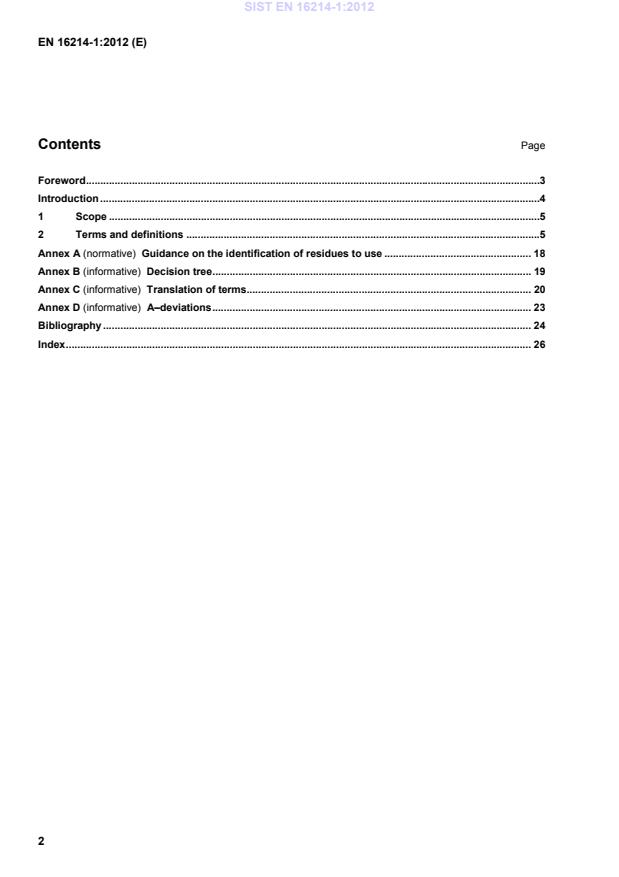
Guidance on the identification of residues to use . 18Annex B (informative)
Decision tree . 19Annex C (informative)
Translation of terms. 20Annex D (informative)
A–deviations . 23Bibliography . 24Index . 26 SIST EN 16214-1:2012
In May 2009, the European Commission requested CEN to initiate work on standard(s) on: the implementation, by economic operators, of the mass balance method of custody chain management; the provision, by economic operators, of evidence that the production of raw material has not interfered with nature protection purposes, that the harvesting of raw material is necessary to preserve grassland's grassland status, and that the cultivation and harvesting of raw material does not involve drainage of previously undrained soil; the auditing, by Member States and by voluntary schemes of information submitted by economic operators. Both the EC and CEN agreed that these may play a role in the implementation of the EU biofuel and bioliquid sustainability scheme. In the Communication from the Commission on the practical implementation of the EU biofuels and bioliquids sustainability scheme and on counting rules for biofuels (2010/C 160/02, [26]), awareness of the CEN work is indicated. It is widely accepted that sustainability at large encompasses environmental, social and economic aspects. The European Directives make mandatory the compliance of several sustainability criteria for biofuels and bioliquids. This European Standard has been developed with the aim to assist EU Member States and economic operators with the implementation of EU biofuel and bioliquids sustainability requirements mandated by the European Directives. This European Standard is limited to certain aspects relevant for a sustainability assessment of biomass produced for energy applications. Therefore compliance with this standard or parts thereof alone does not substantiate claims of the biomass being produced sustainably. Where applicable, the parts of this standard contain at the end an annex that informs the user of the link between the requirements in the European Directive and the requirements in the CEN Standard. SIST EN 16214-1:2012
NOTE 1 to entry: As per 2009/28/EC [1]. NOTE 2 to entry: See also default value (2.27), disaggregated default value (2.28), typical value (2.80). 2.4
agro-biodiversity component of biodiversity that contributes to food and agriculture production, encompassing within species, species and ecosystem diversity NOTE 1 to entry: Derived from FAO Glossary WFE 2005. 2.5 allocation partitioning the input or output flows of a process or a product system between the product system under study and one or more other product systems [SOURCE: EN ISO 14040:2006, 2.17] 2.6 area for nature protection purposes area designated by law or other equivalent competent legal authority for the long-term conservation of nature with associated ecosystem services and biodiversity values SIST EN 16214-1:2012
audit systematic, independent and documented process for obtaining evidence and evaluating it objectively to determine the extent to which the criteria are fulfilled NOTE 1 to entry: Internal audits, sometimes called first-party audits, are conducted by, or on behalf of, the organization itself for management review and other internal purposes, and may form the basis for an organization’s self-declaration of conformity. In many cases, particularly in smaller organizations, independence can be demonstrated by the freedom from responsibility for the activity being audited. NOTE 2 to entry: Adapted from EN ISO 19011:2011 [7]. 2.8 biofuel liquid or gaseous fuel for transport produced from biomass NOTE 1 to entry:
As per 2009/28/EC [1]. 2.9 biofuel production transformation of biomass or of an intermediate product derived from biomass into a biofuel 2.10 biofuel producer
organization or unit responsible for the production of the biofuel NOTE 1 to entry: Adapted from EN 14588:2010 [8]. 2.11 bioliquid liquid fuel for energy purposes other than for transport, including electricity and heating and cooling, produced from biomass NOTE 1 to entry: As per 2009/28/EC [1]. NOTE 2 to entry: Includes viscous liquids such as waste cooking oil, animal fats, palm oil, crude tall oil and tall oil pitch. 2.12 bioliquid production transformation of biomass or of an intermediate product derived from biomass into a bioliquid 2.13 biomass biodegradable fraction of products, waste and residues from biological origin from agriculture (including vegetal and animal substances), forestry and related industries including fisheries and aquaculture, as well as the biodegradable fraction of industrial and municipal waste NOTE 1 to entry: As per 2009/28/EC [1]. NOTE 2 to entry: The following definition is used in EN 14588:2010 [8]: material of biological origin excluding material embedded in geological formations and/or transformed to fossil. SIST EN 16214-1:2012
continuously forested area land spanning more than one hectare with trees higher than five metres and a canopy cover of more than 30 %, or trees able to reach those thresholds in situ NOTE 1 to entry:
As per 2009/28/EC [1]. SIST EN 16214-1:2012
2.25 CO2 equivalent unit for comparing the time integral of radiative forcing of a GHG to carbon dioxide NOTE 1 to entry: The carbon dioxide equivalent is calculated using the mass of a given GHG multiplied by its global warming potential. [ISO 14064-1:2006 [12]] 2.26 criterion state or property as a means of judging whether or not a principle has been fulfilled NOTE 1 to entry: See also sustainability criteria (2.77). 2.27 default value greenhouse gas emission or greenhouse gas emission savings derived from a typical value by the application of pre-determined factors, which may be used in place of an actual value as specified in applicable regulations NOTE 1 to entry: As per 2009/28/EC [1]. NOTE 2 to entry: See also actual value (2.3), disaggregated default value (2.28), typical value (2.80). 2.28 disaggregated default value greenhouse gas emission for a specific part of the supply chain derived from a default value. NOTE 1 to entry: See also actual value (2.3), default value (2.27), typical value (2.80). 2.29 distribution set of operations or activities to supply biofuels or bioliquids or their blends from their delivery to the fuel supplier and up to the final customer SIST EN 16214-1:2012
to entry: Adapted from EN ISO/IEC 17000:2004 [3]. 2.33 forest land spanning more than 1 ha1) with trees higher than 5 m and a canopy cover of more than 10 %, or trees able to reach these thresholds in situ, not including land that is predominantly under agricultural or urban land use NOTE 1 to entry: Forest is determined both by the presence of trees and the absence of other predominant land uses. The trees should be able to reach a minimum height of 5 m in situ. NOTE 2 to entry: Includes areas with young trees that have not yet reached but which are expected to reach a canopy cover of 10 % and tree height of 5 m. It also includes areas that are temporarily unstocked due to clear cutting as part of a forest management practice or natural disasters, and which are expected to be regenerated within five years. Local conditions may, in exceptional cases, justify that a longer time frame is used. NOTE 3 to entry: Includes forest roads, firebreaks and other small open areas; forest in national parks, nature reserves and other protected areas such as those of specific environmental, scientific, historical, cultural or spiritual interest. NOTE 4 to entry: Includes windbreaks, shelterbelts and corridors of trees with an area of more than 0,5 ha and width of more than 20 m. NOTE 5 to entry: Includes abandoned shifting cultivation land with a regeneration of trees that have, or is expected to reach, a canopy cover of 10 % and tree height of 5 m. NOTE 6 to entry: Includes areas with mangroves in tidal zones, regardless whether this area is classified as land area or not. NOTE 7 to entry: Excludes rubber-wood, cork oak and Christmas tree plantations with a fixed rotation cycle. NOTE 8 to entry: Includes areas with bamboo and palms provided that land use, height and canopy cover criteria are met. NOTE 9 to entry: Excludes tree stands in agricultural production systems, such as fruit tree plantations, oil palm plantations, short rotation coppice, and agroforestry systems when crops are grown under tree cover.
NOTE 10 to entry: Some agroforestry systems such as the “Taungya” system where crops are grown only during the first years of the forest rotation should be classified as forest.
1) The FAO source document [13] contains a value of 0,5 ha. The value has been adapted according to the RED [1]. SIST EN 16214-1:2012
NOTE 1 to entry: Fuels are solid, liquid or gaseous. NOTE 2 to entry: Fuels are in this context fossil fuels, biofuels and bioliquids. NOTE 3 to entry: As per 2009/28/EC [1]. 2.37 global warming potential GWP factor describing the radiative forcing impact of one mass-based unit of a given GHG relative to an equivalent unit of carbon dioxide over a given period of time
NOTE 1 to entry: Adapted from ISO 14064-1:2006 [12].
NOTE 2 to entry: GHG values are provided in Directive 2009/28/EC [1]. 2.38 greenhouse gas
GHG gaseous constituent of the atmosphere, both natural and anthropogenic, that absorbs and emits radiation at specific wavelengths within the spectrum of infrared radiation emitted by the earth's surface, the atmosphere, and clouds NOTE 1 to entry: For the purpose of this standard, GHGs include carbon dioxide (CO2), methane (CH4), nitrous oxide (N2O). NOTE 2 to entry: Adapted from ISO 14064-1:2006 [12]. 2.39 greenhouse gas emission total mass of a greenhouse gas released to the atmosphere over a specified period of time NOTE 1 to entry: Combined emissions of different greenhouse gases are commonly expressed in terms of “CO2 equivalents”. NOTE 2 to entry: Adapted from ISO 14064-1:2006 [12]. 2.40 greenhouse gas emission savings percentage of greenhouse gas emission saved by the use of a biofuel or bioliquid as compared to a fossil fuel comparator SIST EN 16214-1:2012
...