

EN 17533:2025
(Main)Gaseous hydrogen - Cylinders and tubes for stationary storage
- Abstract
This document specifies the requirements for the design, manufacture and testing of cylinders, tubes and other pressure vessels of steel, stainless steel, aluminium alloys or of non-metallic construction material. These are intended for the stationary storage of gaseous hydrogen of up to a maximum water capacity of 10 000 l and a maximum allowable working pressure not exceeding 1 100 bar, of seamless metallic construction (Type 1) or of composite construction (Types 2, 3 and 4), hereafter referred to as pressure vessels.
NOTE Additional requirements with regard to assemblies (manifolded cylinders and tubes and other pressure vessels) are not covered by this document.
This document is not applicable to Type 2 and 3 vessels with welded liners.
This document is not applicable to pressure vessels used for solid, liquid hydrogen or hybrid cryogenic-high pressure hydrogen storage applications.
This document is not applicable to external piping which can be designed according to recognized standards.
- Status
- Published
- Publication Date
- 13-May-2025
- Technical Committee
- CEN/TC 23 - Transportable gas cylinders
- Drafting Committee
- CEN/TC 23/WG 16 - Fully wrapped composite cylinders
- Current Stage
- 6060 - Definitive text made available (DAV) - Publishing
- Start Date
- 14-May-2025
- Due Date
- 10-Feb-2025
- Completion Date
- 14-May-2025

Overview
EN 17533:2025 - published by CEN - is the European standard that specifies requirements for the design, manufacture and testing of cylinders, tubes and other pressure vessels intended for the stationary storage of gaseous hydrogen. It applies to vessels of steel, stainless steel, aluminium alloys or non‑metallic construction with a maximum water capacity of 10 000 L and a maximum allowable working pressure (MAWP) up to 1 100 bar. Covered constructions include seamless metallic (Type 1) and composite (Types 2, 3 and 4) pressure vessels. The standard replaced EN 17533:2020 and provides technical rules and normative annexes for qualification and testing.
Note: EN 17533:2025 does not cover manifolded assemblies, Type 2/3 vessels with welded liners, solid/liquid hydrogen or hybrid cryogenic–high‑pressure storage, nor external piping.
Key Topics
- Scope and service conditions: MAWP, maximum/minimum temperature, maximum energy and defined pressure cycle life.
- Materials and compatibility: requirements for steels, stainless steels, aluminium alloys, fibre and matrix materials, and plastic liners.
- Design and stress analysis: burst pressure, test pressure, maximum defect sizing, protection of liners and bosses, and resistance to UV/humidity.
- Fatigue and cycle life methods: three accepted approaches - pressure cycling calculations (Annex A), fracture‑mechanics fatigue evaluation (Annex B) and performance testing (Annex C).
- Manufacturing and workmanship: forming, fibre winding, curing of resins, autofrettage for metallic vessels, and exterior environmental protection.
- Testing and acceptance criteria (Annex D): hydrogen compatibility, hydrogen sensitivity tests for metals, hydrostatic burst, ambient and extreme temperature pressure cycling, leak‑before‑break, bonfire, permeation and boss torque tests.
- Documentation and marking: required design drawings, material property data, manufacturing records and marking for traceability and certification.
Applications
EN 17533:2025 is essential for:
- Pressure vessel designers and manufacturers producing stationary hydrogen storage cylinders and tubes.
- Testing laboratories performing hydrogen compatibility, burst and cycle tests.
- Plant operators and system integrators specifying storage containers for hydrogen refueling stations, industrial gas plants, and energy storage installations.
- Certification bodies and regulators assessing conformity with European technical requirements.
Using EN 17533:2025 ensures safe, durable and traceable stationary hydrogen storage solutions that address high‑pressure performance, fatigue life and hydrogen‑specific material behaviours.
Related Standards
- Referenced transportable cylinder standards (used for pressure cycling methodology in Annex A)
- Material and testing standards cited in normative references (see EN 17533:2025 normative references for details)
Keywords: EN 17533:2025, gaseous hydrogen, stationary storage, hydrogen cylinders, pressure vessels, MAWP, pressure cycling, hydrogen compatibility, Type 1 Type 2 Type 3 Type 4.
Relations
- Effective Date
- 02-Mar-2022
- Effective Date
- 11-Mar-2026
- Effective Date
- 28-Jan-2026
- Effective Date
- 28-Jan-2026
- Effective Date
- 28-Jan-2026
- Effective Date
- 28-Jan-2026
- Effective Date
- 28-Jan-2026
- Effective Date
- 28-Jan-2026
- Effective Date
- 28-Jan-2026
- Effective Date
- 28-Jan-2026
- Effective Date
- 28-Jan-2026
- Effective Date
- 28-Jan-2026
- Effective Date
- 28-Jan-2026
- Effective Date
- 28-Jan-2026
- Effective Date
- 28-Jan-2026
Get Certified
Connect with accredited certification bodies for this standard

ECOCERT
Organic and sustainability certification.

Eurofins Food Testing Global
Global leader in food, environment, and pharmaceutical product testing.

Institut za varilstvo d.o.o. (Welding Institute)
Slovenia's leading welding institute since 1952. ISO 3834, EN 1090, pressure equipment certification, NDT personnel, welder qualification. Only IIW Au
Sponsored listings
Frequently Asked Questions
EN 17533:2025 is a standard published by the European Committee for Standardization (CEN). Its full title is "Gaseous hydrogen - Cylinders and tubes for stationary storage". This standard covers: This document specifies the requirements for the design, manufacture and testing of cylinders, tubes and other pressure vessels of steel, stainless steel, aluminium alloys or of non-metallic construction material. These are intended for the stationary storage of gaseous hydrogen of up to a maximum water capacity of 10 000 l and a maximum allowable working pressure not exceeding 1 100 bar, of seamless metallic construction (Type 1) or of composite construction (Types 2, 3 and 4), hereafter referred to as pressure vessels. NOTE Additional requirements with regard to assemblies (manifolded cylinders and tubes and other pressure vessels) are not covered by this document. This document is not applicable to Type 2 and 3 vessels with welded liners. This document is not applicable to pressure vessels used for solid, liquid hydrogen or hybrid cryogenic-high pressure hydrogen storage applications. This document is not applicable to external piping which can be designed according to recognized standards.
This document specifies the requirements for the design, manufacture and testing of cylinders, tubes and other pressure vessels of steel, stainless steel, aluminium alloys or of non-metallic construction material. These are intended for the stationary storage of gaseous hydrogen of up to a maximum water capacity of 10 000 l and a maximum allowable working pressure not exceeding 1 100 bar, of seamless metallic construction (Type 1) or of composite construction (Types 2, 3 and 4), hereafter referred to as pressure vessels. NOTE Additional requirements with regard to assemblies (manifolded cylinders and tubes and other pressure vessels) are not covered by this document. This document is not applicable to Type 2 and 3 vessels with welded liners. This document is not applicable to pressure vessels used for solid, liquid hydrogen or hybrid cryogenic-high pressure hydrogen storage applications. This document is not applicable to external piping which can be designed according to recognized standards.
EN 17533:2025 is classified under the following ICS (International Classification for Standards) categories: 23.020.30 - Pressure vessels, gas cylinders; 71.100.20 - Gases for industrial application. The ICS classification helps identify the subject area and facilitates finding related standards.
EN 17533:2025 has the following relationships with other standards: It is inter standard links to EN 17533:2020, EN ISO 9809-4:2026, EN ISO 11439:2013, EN ISO 1519:2011, EN ISO 14130:1997, EN ISO 2409:2020, EN ISO 16474-3:2021, EN ISO 7866:2012, EN ISO 11114-1:2020, EN ISO 6506-1:2014, EN ISO 11114-4:2017, EN ISO 11120:2015, EN ISO 11114-5:2022, EN ISO 6272-2:2011, EN ISO 9809-1:2019. Understanding these relationships helps ensure you are using the most current and applicable version of the standard.
EN 17533:2025 is associated with the following European legislation: EU Directives/Regulations: 2014/68/EU; Standardization Mandates: M/601. When a standard is cited in the Official Journal of the European Union, products manufactured in conformity with it benefit from a presumption of conformity with the essential requirements of the corresponding EU directive or regulation.
EN 17533:2025 is available in PDF format for immediate download after purchase. The document can be added to your cart and obtained through the secure checkout process. Digital delivery ensures instant access to the complete standard document.
Standards Content (Sample)
SLOVENSKI STANDARD
01-oktober-2025
Nadomešča:
SIST EN 17533:2020
Plinasti vodik - Jeklenke in velike jeklenke za stacionarno shranjevanje
Gaseous hydrogen - Cylinders and tubes for stationary storage
Gasförmiger Wasserstoff - Flaschen und Großflaschen zur ortsfesten Lagerung
Hydrogène gazeux - Bouteilles et tubes pour stockage stationnaire
Ta slovenski standard je istoveten z: EN 17533:2025
ICS:
23.020.35 Plinske jeklenke Gas cylinders
71.100.20 Industrijski plini Gases for industrial
application
2003-01.Slovenski inštitut za standardizacijo. Razmnoževanje celote ali delov tega standarda ni dovoljeno.
EN 17533
EUROPEAN STANDARD
NORME EUROPÉENNE
May 2025
EUROPÄISCHE NORM
ICS 71.100.20 Supersedes EN 17533:2020
English Version
Gaseous hydrogen - Cylinders and tubes for stationary
storage
Hydrogène gazeux - Bouteilles et tubes pour stockage Gasförmiger Wasserstoff - Flaschen und Großflaschen
stationnaire zur ortsfesten Lagerung
This European Standard was approved by CEN on 7 April 2025.
CEN members are bound to comply with the CEN/CENELEC Internal Regulations which stipulate the conditions for giving this
European Standard the status of a national standard without any alteration. Up-to-date lists and bibliographical references
concerning such national standards may be obtained on application to the CEN-CENELEC Management Centre or to any CEN
member.
This European Standard exists in three official versions (English, French, German). A version in any other language made by
translation under the responsibility of a CEN member into its own language and notified to the CEN-CENELEC Management
Centre has the same status as the official versions.
CEN members are the national standards bodies of Austria, Belgium, Bulgaria, Croatia, Cyprus, Czech Republic, Denmark, Estonia,
Finland, France, Germany, Greece, Hungary, Iceland, Ireland, Italy, Latvia, Lithuania, Luxembourg, Malta, Netherlands, Norway,
Poland, Portugal, Republic of North Macedonia, Romania, Serbia, Slovakia, Slovenia, Spain, Sweden, Switzerland, Türkiye and
United Kingdom.
EUROPEAN COMMITTEE FOR STANDARDIZATION
COMITÉ EUROPÉEN DE NORMALISATION
EUROPÄISCHES KOMITEE FÜR NORMUNG
CEN-CENELEC Management Centre: Rue de la Science 23, B-1040 Brussels
© 2025 CEN All rights of exploitation in any form and by any means reserved Ref. No. EN 17533:2025 E
worldwide for CEN national Members.
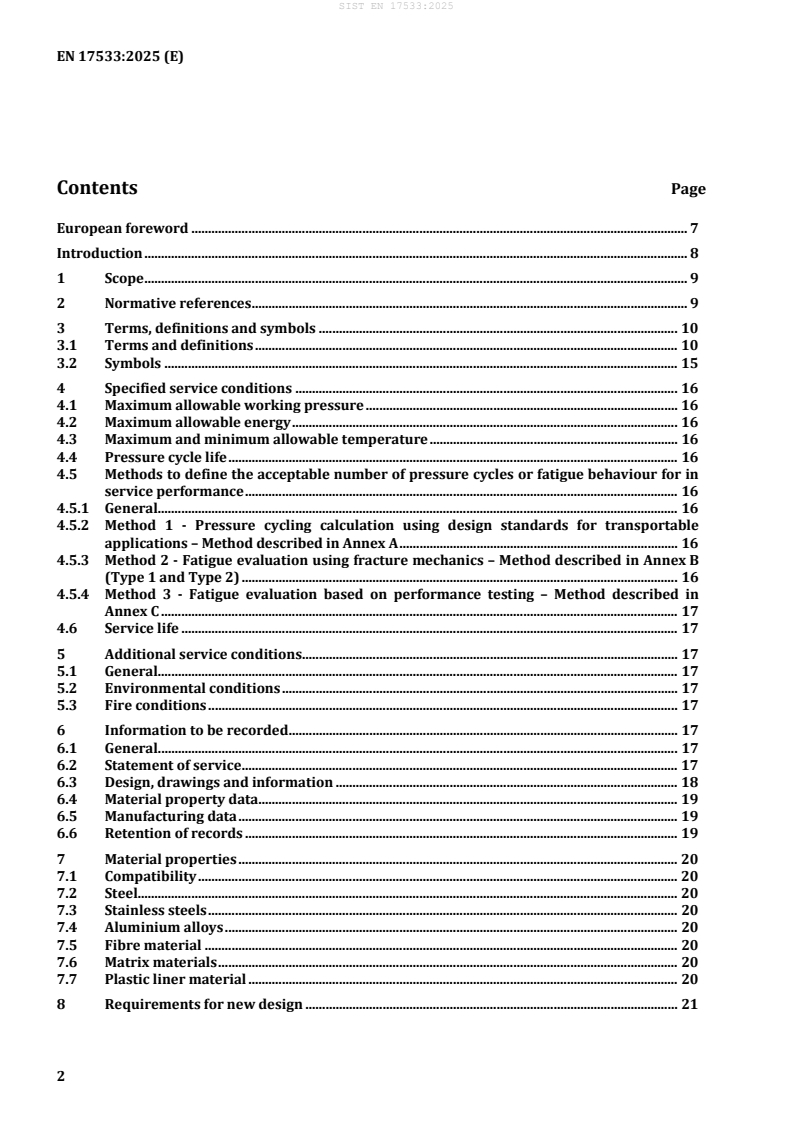
Contents Page
European foreword . 7
Introduction . 8
1 Scope . 9
2 Normative references . 9
3 Terms, definitions and symbols . 10
3.1 Terms and definitions . 10
3.2 Symbols . 15
4 Specified service conditions . 16
4.1 Maximum allowable working pressure . 16
4.2 Maximum allowable energy . 16
4.3 Maximum and minimum allowable temperature . 16
4.4 Pressure cycle life . 16
4.5 Methods to define the acceptable number of pressure cycles or fatigue behaviour for in
service performance . 16
4.5.1 General. 16
4.5.2 Method 1 - Pressure cycling calculation using design standards for transportable
applications – Method described in Annex A . 16
4.5.3 Method 2 - Fatigue evaluation using fracture mechanics – Method described in Annex B
(Type 1 and Type 2) . 16
4.5.4 Method 3 - Fatigue evaluation based on performance testing – Method described in
Annex C . 17
4.6 Service life . 17
5 Additional service conditions . 17
5.1 General. 17
5.2 Environmental conditions . 17
5.3 Fire conditions . 17
6 Information to be recorded . 17
6.1 General. 17
6.2 Statement of service . 17
6.3 Design, drawings and information . 18
6.4 Material property data . 19
6.5 Manufacturing data . 19
6.6 Retention of records . 19
7 Material properties . 20
7.1 Compatibility . 20
7.2 Steel. 20
7.3 Stainless steels . 20
7.4 Aluminium alloys . 20
7.5 Fibre material . 20
7.6 Matrix materials . 20
7.7 Plastic liner material . 20
8 Requirements for new design . 21
9 Minimum requirement for new designs . 21
9.1 Stress analysis . 21
9.1.1 General . 21
9.1.2 Burst pressure and fibre stress ratio (not applicable if Annex B is used) . 22
9.1.3 Test pressure. 22
9.1.4 Maximum defect size in metallic materials . 23
9.1.5 Protection liner and boss against corrosion . 23
9.1.6 Resistance to UV emissions . 23
9.1.7 Resistance to humidity . 23
9.1.8 Protective layer . 23
9.2 Construction and workmanship . 23
9.2.1 Materials . 23
9.2.2 Openings, neck threads, neck ring, foot ring, attachment for support . 24
9.2.3 Forming . 24
9.2.4 Fibre winding . 24
9.2.5 Curing of thermosetting resins . 25
9.2.6 Autofrettage . 25
9.2.7 Exterior environmental protection. 25
9.3 Production and batch tests . 26
9.3.1 Production tests . 26
9.3.2 Batch tests . 26
10 Markings . 29
11 Preparation for dispatch . 30
Annex A (informative) Pressure cycling calculation using design standards for transportable
applications . 31
A.1 General . 31
A.2 Requirements . 33
A.2.1 General requirements . 33
A.2.2 Specific requirements . 33
A.3 Marking . 35
A.4 Certificate . 36
A.5 Examples of calculation for PS (MAWP) . 36
A.5.1 Type 1 cylinder to EN ISO 9809-1 with P /P of 200/300 bar in Europe . 36
w h
A.5.2 Type 3 cylinder to ISO 11119-2 with P /P of 200/300 bar in Europe . 36
w h
A.5.3 Type 1 cylinder to EN ISO 9809-1 with P /P of 700/1 050 bar in Europe . 36
w h
A.5.4 Type 3 cylinder to ISO 11119-2 with P /P of 1 000/1 500 bar in Europe . 36
w h
A.6 Example of cycle life calculation . 37
Annex B (normative) Design and calculation and cycle life definition by fracture mechanics (Type
1 and Type 2) . 38
B.1 Purpose and scope . 38
B.2 Methodology . 38
B.3 Exemption for low alloy steels . 38
Annex C (normative) Design evaluation based on performance testing . 39
C.1 Testing . 39
C.1.1 General. 39
C.1.2 Material tests . 39
C.1.3 Pressure vessel tests . 40
C.1.4 Qualification and design changes . 43
Annex D (normative) Test methods and acceptance criteria . 46
D.1 Hydrogen compatibility . 46
D.2 Hydrogen sensitivity tests for metals . 46
D.2.1 General. 46
D.2.2 Test method 1 – Fatigue testing of tensile specimens . 46
D.2.3 Test method 2 – Fatigue testing of disks . 48
D.3 Tensile properties of plastics . 49
D.4 Softening temperature of plastics . 49
D.5 Resin properties tests . 49
D.6 Hydrostatic burst pressure test . 49
D.7 Ambient temperature pressure cycling for cycle life definition . 50
D.7.1 Full amplitude pressure cycling . 50
D.7.2 Partial amplitude pressure cycling . 50
D.7.3 Alternative to D.7.1 and D.7.2 . 50
D.7.4 Parameters to be monitored and recorded . 51
D.8 Leak before break (LBB) test . 51
D.9 Bonfire test . 51
D.10 High strain impact test . 51
D.11 Accelerated stress rupture test . 51
D.12 Extreme temperature pressure cycling . 51
D.13 Permeation test . 52
D.14 Boss torque test . 52
D.15 Hydrogen gas cycling test (for Type 4 only) . 52
D.16 Hardness test . 53
D.17 Hydraulic test . 53
D.18 Leak test . 53
D.19 Coating tests . 53
D.20 Coating batch tests. 54
D.20.1 Coating thickness . 54
D.20.2 Coating adhesion . 54
D.21 Impact damage test (optional). 54
Annex E (informative) Verification of stress ratios using strain gauges . 55
Annex F (informative) Non-destructive examination (NDE) defect size by flawed pressure vessel
cycling . 56
Annex G (informative) Manufacturer’s information for handling, use and inspection of pressure
vessels . 57
G.1 General . 57
G.2 Distribution . 57
G.3 Reference to existing codes, standards and regulations . 57
G.4 Pressure vessel handling . 57
G.5 Installation . 57
G.6 Use of pressure vessels . 58
G.7 In-service inspection . 58
G.7.1 General . 58
G.7.2 Periodic re-qualification . 58
G.7.3 Pressure vessels having experienced impact damage . 58
G.7.4 Pressure vessels involved in fires . 58
Annex H (informative) Optional bonfire test . 59
H.1 General . 59
H.2 Cylinder test. 59
H.2.1 Cylinder set-up . 59
H.2.2 Fire source . 59
H.2.3 Temperature and pressure measurements . 59
H.2.4 General test requirements . 60
H.2.5 Test options . 60
H.3 PRD test . 60
H.4 Vent test . 61
H.5 System assessment . 61
H.5.1 Qualification limit envelope . 61
H.5.2 Service limit envelope . 61
H.5.3 Acceptable results . 61
H.6 Generation of a safety envelope and actual cylinder/PRD performance . 61
Annex I (informative) Information of factor of safety . 63
I.1 Purpose . 63
I.2 Background . 63
I.3 Recommended safety factor . 63
I.4 Discussion . 63
I.5 Conclusions . 65
I.6 Recommendations . 65
I.7 Further reading . 65
Bibliography . 66
European foreword
This document (EN 17533:2025) has been prepared by Technical Committee CEN/TC 23 “Transportable
gas cylinders”, the secretariat of which is held by BSI.
This European Standard shall be given the status of a national standard, either by publication of an
identical text or by endorsement, at the latest by November 2025, and conflicting national standards shall
be withdrawn at the latest by November 2025.
Attention is drawn to the possibility that some of the elements of this document may be the subject of
patent rights. CEN shall not be held responsible for identifying any or all such patent rights.
This document supersedes EN 17533:2020.
— requirements for new design have been revised;
— addition of Figure A.1 Concept of Annex A;
— Annexes B and C have been revised.
Any feedback and questions on this document should be directed to the users’ national standards body.
A complete listing of these bodies can be found on the CEN website.
According to the CEN-CENELEC Internal Regulations, the national standards organisations of the
following countries are bound to implement this European Standard: Austria, Belgium, Bulgaria, Croatia,
Cyprus, Czech Republic, Denmark, Estonia, Finland, France, Germany, Greece, Hungary, Iceland, Ireland,
Italy, Latvia, Lithuania, Luxembourg, Malta, Netherlands, Norway, Poland, Portugal, Republic of North
Macedonia, Romania, Serbia, Slovakia, Slovenia, Spain, Sweden, Switzerland, Türkiye and the United
Kingdom.
Introduction
As the use of gaseous hydrogen evolves from the chemical industry into various emerging applications,
such as fuel for fuel cells, internal combustion engines and other speciality hydrogen applications, new
requirements are foreseen for seamless and composite pressure vessels, including higher number of
pressure cycles.
Requirements covering pressure vessels for stationary storage of compressed gaseous hydrogen are
listed in this document and are mainly intended to maintain or improve the level of safety for this
application.
1 Scope
This document specifies the requirements for the design, manufacture and testing of cylinders, tubes and
other pressure vessels of steel, stainless steel, aluminium alloys or of non-metallic construction material.
These are intended for the stationary storage of gaseous hydrogen of up to a maximum water capacity of
10 000 l and a maximum allowable working pressure not exceeding 1 100 bar, of seamless metallic
construction (Type 1) or of composite construction (Types 2, 3 and 4), hereafter referred to as pressure
vessels.
NOTE Additional requirements with regard to assemblies (manifolded cylinders and tubes and other pressure
vessels) are not covered by this document.
This document is not applicable to Type 2 and 3 vessels with welded liners.
This document is not applicable to pressure vessels used for solid, liquid hydrogen or hybrid cryogenic-
high pressure hydrogen storage applications.
This document is not applicable to external piping which can be designed according to recognized
standards.
2 Normative references
The following documents are referred to in the text in such a way that some or all of their content
constitutes requirements of this document. For dated references, only the edition cited applies. For
undated references, the latest edition of the referenced document (including any amendments) applies.
EN ISO 306, Plastics — Thermoplastic materials — Determination of Vicat softening temperature (VST)
(ISO 306)
EN ISO 527-2, Plastics — Determination of tensile properties — Part 2: Test conditions for moulding and
extrusion plastics (ISO 527-2)
EN ISO 1519, Paints and varnishes — Bend test (cylindrical mandrel) (ISO 1519)
EN ISO 2808, Paints and varnishes — Determination of film thickness (ISO 2808)
EN ISO 2812-1, Paints and varnishes — Determination of resistance to liquids — Part 1: Immersion in
liquids other than water (ISO 2812-1)
EN ISO 2409, Paints and varnishes — Cross-cut test (ISO 2409)
EN ISO 6272-2, Paints and varnishes — Rapid-deformation (impact resistance) tests — Part 2: Falling-
weight test, small-area indenter (ISO 6272-2)
EN ISO 6506-1, Metallic materials — Brinell hardness test — Part 1: Test method (ISO 6506-1)
EN ISO 7225, Gas cylinders — Precautionary labels (ISO 7225)
EN ISO 7866, Gas cylinders — Refillable seamless aluminium alloy gas cylinders — Design, construction and
testing (ISO 7866)
EN ISO 9227, Corrosion tests in artificial atmospheres — Salt spray tests (ISO 9227)
EN ISO 9809-1, Gas cylinders — Design, construction and testing of refillable seamless steel gas cylinders
and tubes — Part 1: Quenched and tempered steel cylinders and tubes with tensile strength less than 1 100
MPa (ISO 9809-1)
EN ISO 9809-4, Gas cylinders — Design, construction and testing of refillable seamless steel gas cylinders
and tubes — Part 4: Stainless steel cylinders with an Rm value of less than 1 100 MPa (ISO 9809-4)
EN ISO 11114-1, Gas cylinders — Compatibility of cylinder and valve materials with gas contents — Part 1:
Metallic materials (ISO 11114-1)
EN ISO 11114-2, Gas cylinders — Compatibility of cylinder and valve materials with gas contents — Part 2:
Non-metallic materials (ISO 11114-2)
EN ISO 11114-4, Transportable gas cylinders — Compatibility of cylinder and valve materials with gas
contents — Part 4: Test methods for selecting steels resistant to hydrogen embrittlement (ISO 11114-4)
EN ISO 11114-5:2022, Gas cylinders — Compatibility of cylinder and valve materials with gas contents —
Part 5: Test methods for evaluating plastic liners (ISO 11114-5:2022)
EN ISO 11120, Gas cylinders — Refillable seamless steel tubes of water capacity between 150 l and 3000
l — Design, construction and testing (ISO 11120)
EN ISO 11357-2, Plastics — Differential scanning calorimetry (DSC) — Part 2: Determination of glass
transition temperature and step height (ISO 11357-2)
EN ISO 11439, Gas cylinders — High pressure cylinders for the on-board storage of natural gas as a fuel for
automotive vehicles (ISO 11439)
EN ISO 14130, Fibre-reinforced plastic composites — Determination of apparent interlaminar shear
strength by short-beam method (ISO 14130)
EN ISO 16474-1, Paints and varnishes — Methods of exposure to laboratory light sources — Part 1: General
guidance (ISO 16474-1)
EN ISO 16474-3, Paints and varnishes — Methods of exposure to laboratory light sources — Part 3:
Fluorescent UV lamps (ISO 16474-3)
ASTM D3170/D3170M-14, Standard Test Method for Chipping Resistance of Coatings
3 Terms, definitions and symbols
3.1 Terms and definitions
For the purposes of this document, the following terms and definitions apply.
ISO and IEC maintain terminology databases for use in standardization at the following addresses:
— ISO Online browsing platform: available at https://www.iso.org/obp/
— IEC Electropedia: available at https://www.electropedia.org/
3.1.1
stationary storage
pressurized storage in a fixed location for a fixed purpose that is not transported while pressurized
3.1.2
Type 1 pressure vessel
metal seamless cylindrical pressure vessel
Note 1 to entry: All metal multi-layered non-seamless vessels are not covered in this document. For reference,
several types of multi-layered pressure vessels are addressed by ASME BPVC Section VII and Chinese standards GB
150 and GB/T 26466.
3.1.3
Type 2 pressure vessel
hoop wrapped cylindrical pressure vessel with a load-sharing metal liner (3.1.12) and composite
reinforcement on the cylindrical part only
3.1.4
Type 3 pressure vessel
fully wrapped cylindrical pressure vessel with a load-sharing metal liner (3.1.12) and composite
reinforcement on both the cylindrical part and dome ends
3.1.5
Type 4 pressure vessel
fully wrapped cylindrical pressure vessel with a non-load-sharing liner (3.1.14) and composite
reinforcement on both the cylindrical part and the dome ends
3.1.6
finished pressure vessel
pressure vessel, which is ready for use, typical of normal production, complete with identification marks
and external coating including integral insulation specified by the manufacturer, but free from non-
integral insulation or protection
Note 1 to entry: In the framework of this document, a tube or a cylinder is a finished pressure vessel.
3.1.7
batch of pressure vessels
batch of liners
set of manufactured finished pressure vessels (3.1.6) or liners (3.1.12) subject to a manufacturing quality
pass/fail criterion based on the results of specified tests performed on a specified number of units from
that set
3.1.8
matrix
material that is used to bind and hold the fibres in place
3.1.9
composite overwrap
combination of fibres (including steel wire) and matrix (3.1.8)
3.1.10
thermoplastic material
plastic capable of being repeatedly softened by an increase of temperature and hardened by a decrease
of temperature
3.1.11
thermosetting material
material capable of being changed into a substantially infusible and insoluble product when cured by heat
or by other means, such as radiation and catalysts
Note 1 to entry: These materials are resins and include polymers such as polyesters, epoxides, acrylics, urethanes
and phenolics.
Note 2 to entry: The resins may incorporate non-fibrous fillers, flame-retardants, pigments and stabilizers.
[SOURCE: ISO 25762:2009, 3.2.1]
3.1.12
liner
inner portion of the composite cylinder, comprising a metallic or non-metallic vessel, whose purpose is
both to contain the gas and transmit the gas pressure to the fibres
3.1.13
load-sharing liner
liner (3.1.12) that has a burst pressure (3.1.33) of at least 5 % of the minimum burst pressure of the
finished composite cylinder
3.1.14
non-load-sharing liner
liner (3.1.12) that has a burst pressure (3.1.33) less than 5 % of the nominal burst pressure of the finished
composite cylinder
3.1.15
boss
dome shaped metallic component mounted on one end or on the two ends of a non-metallic liner (3.1.12)
with a neck providing an opening and/or an external element of mechanical support
3.1.16
autofrettage
pressure application procedure which strains the metal liner (3.1.12) past its yield point sufficiently to
cause permanent plastic deformation, resulting in the liner having compressive stresses and the fibres
having tensile stresses when at zero internal gauge pressure
3.1.17
autofrettage pressure
pressure within the overwrapped composite pressure vessel at which the required distribution of
stresses between the liner (3.1.12) and the composite overwrap (3.1.9) is established
3.1.18
pre-stress
process of applying autofrettage (3.1.16) or controlled tension winding (3.1.19)
3.1.19
controlled tension winding
process used in manufacturing composite pressure vessels with metal liners (3.1.12) by which
compressive stresses in the liner and tensile stresses in the composite overwrap (3.1.9) at zero internal
pressure are obtained by winding the reinforcing fibres under controlled tension
3.1.20
cycle amplitude
ratio of pressure increase to maximum pressure in a pressure cycle (3.1.21)
Note 1 to entry: Cycle amplitude is expressed in %.
3.1.21
pressure cycle
pressure variation composed of one period of monotonic pressure increase up to a peak pressure
followed by one period of monotonic pressure decrease
Note 1 to entry: Pressure variations exclusively due to variations of ambient temperature are not counted as
pressure cycles.
3.1.22
full cycle
cycle of pressure amplitude between the maximum allowable working pressure (MAWP) (3.1.25) and
10 % of the MAWP
3.1.23
minimum allowable temperature
minimum temperature of any part of the pressure vessel for which it is designed
3.1.24
maximum allowable temperature
maximum temperature of any part of the pressure vessel for which it is designed
3.1.25
maximum allowable working pressure
MAWP (PS according to PED)
design pressure
maximum pressure to which the component is designed to be subjected to and which is the basis for
determining the strength of the component under consideration
Note 1 to entry: In the Pressure Equipment Directive (PED), PS is equal to the MAWP.
3.1.26
shallow pressure cycle
pressure cycle with an amplitude smaller than the amplitude of a full cycle
3.1.27
shallow pressure cycle life
maximum number of shallow pressure cycles (3.1.26) that the pressure vessel is designed to withstand in
hydrogen service
3.1.28
pressure cycle life
maximum number of pressure cycles (3.1.21) in hydrogen service that the pressure vessel is designed to
withstand in service
3.1.29
service life
maximum period for which the pressure vessel is designed to be in service based on fatigue life and stress
rupture characteristics of composite cylinders
Note 1 to entry: Service life is expressed in years.
Note 2 to entry: Service life usually depends on the pressure cycle (3.1.21) or other service conditions and
requirements from applicable standards. For composite cylinders, life in years is a requirement to address reliability
under stress rupture conditions, which is also an underlying basis for the required stress ratios (3.1.34).
3.1.30
stationary test pressure
TP
required pressure applied during a pressure test for the pressure vessel used in stationary service
Note 1 to entry: If Annex A is used, this is not to be confused with the test pressure (3.1.32) P used in e.g. the
h
EN ISO 9809 series for design purposes as transportable gas cylinder, see Figure A.1.
3.1.31
working pressure
settled pressure of a fully filled cylinder at a uniform temperature of 15 °C
Note 1 to entry: This term is normally used for transportable cylinders, see Annex A Figure A.1.
[SOURCE: ISO 11439:2013, 3.23, modified — Note 1 to entry has been added.]
3.1.32
test pressure
required pressure applied during a pressure test
3.1.33
burst pressure
highest pressure reached in a cylinder during a burst test
3.1.34
stress ratio
stress in fibre at specified minimum burst pressure (3.1.33) divided by stress at the MAWP (3.1.25)
3.1.35
pressure-activated pressure relief device
pressure-activated PRD
device designed to release pressure in order to prevent a rise in pressure above a specified value due to
emergency or abnormal conditions
Note 1 to entry: Pressure-activated PRDs may be either re-closing devices (such as valves) or non-re-closing
devices (such as rupture disks).
3.1.36
thermally activated pressure relief device
thermally activated PRD
device that activates by temperature to release pressure and prevent a pressure vessel from bursting due
to fire effects and which will activate regardless of the vessel pressure
3.1.37
design change
change in the selection of structural materials or dimensional change exceeding the tolerances as on the
design drawings
3.1.38
leakage
release of hydrogen through a crack, pore, or similar defect
Note 1 to entry: Permeation through the wall of a Type 4 pressure vessel that is less than the rates described in
D.13 is not considered a leakage.
3.1.39
operator
entity legally responsible for the use and maintenance of the vessel
3.2 Symbols
For the purposes of this document, the following terms and definitions apply.
ΔP difference between the minimum and the maximum of pressure during a given
i
actual pressure cycle (in bar)
ΔP maximum difference between the lower and the upper pressure during the cycling
max
pressure tests specified in the reference standard (in bar)
F design stress factor (ratio of equivalent wall stress at test pressure P to guarantee
h
minimum yield strength)
F hydrogen accelerating factor (see A.2.2.5), this factor is the multiplication factor to
a
be applied on equivalent cycles n calculation to take into account the ageing
eq
effect of H on cycling.
n number of cycles equivalent to full cycles (guaranteed in a given standard)
eq
n number of pressure cycle corresponding to ΔP
i i
P test pressure (in bar)
h
P working pressure (in bar)
w
a flaw size
N number of pressure cycles
C constant when fatigue is performed in hydrogen
H
ΔK range of the stress intensity factor during the fatigue cycle
R stress inten
...