

EN 14983:2024
(Main)Explosion prevention and protection in underground mines - Equipment and protective systems for firedamp drainage
- Abstract
This document specifies the requirements for equipment and protective systems for firedamp drainage at mines. It also contains requirements for the construction and monitoring of this equipment and protective systems (see EN 1127 2:2014).
This document does not apply to firedamp utilization systems beyond the utilization shut-off device.
- Status
- Published
- Publication Date
- 08-Oct-2024
- Technical Committee
- CEN/TC 305 - Potentially explosive atmospheres - Explosion prevention and protection
- Drafting Committee
- CEN/TC 305/WG 5 - Equipment and protection systems for mining
- Current Stage
- 6060 - Definitive text made available (DAV) - Publishing
- Start Date
- 09-Oct-2024
- Due Date
- 07-Aug-2023
- Completion Date
- 09-Oct-2024
- Directive
- 2014/34/EU - Directive 2014/34/EU Of The European Parliament And Of The Council of 26 February 2014 on the harmonisation of the laws of the Member States relating to equipment and protective systems intended for use in potentially explosive atmospheres (recast)OJ Ref: 2025/597, OJ, OJ L, OJ L, 2025/597, OJ L, 2025/597 OJ Date: 01-Apr-2025

Overview
EN 14983:2024 - "Explosion prevention and protection in underground mines - Equipment and protective systems for firedamp drainage" is a CEN European Standard approved August 2024 that supersedes EN 14983:2007. It defines mandatory requirements for the design, construction, installation and monitoring of equipment and protective systems used to remove firedamp (primarily methane) from underground mines. The standard is intended for preventive explosion protection and covers firedamp drainage up to the utilization shut-off device (it does not apply to utilization systems beyond that point).
Key topics and technical requirements
EN 14983:2024 addresses the full firedamp drainage chain and associated safety measures. Key technical topics include:
- General requirements for equipment and protective systems used in firedamp drainage.
- Borehole standpipes and firedamp collector/mains pipes - construction, connections and integrity (technically leaktight design).
- Drainage pipes for seals and stoppings, and water separators at drainage points.
- Measuring points and monitoring provisions for gas composition and pressure in drainage pipes.
- Pressure vessels and pressure generators - design, reserve systems and siting requirements (including normative annex on location).
- Venting arrangements and firedamp vent pipe outlets.
- Flame arresters in pipelines and outlet protection (reference to ISO/IEC 80079-49 for flame arrester performance).
- Electrical safety devices and electrostatic ignition risks, including references to functional safety standards (EN 61508 series).
- Installation, use, inspection and documentation requirements, plus guidance for failure modes (informative and normative annexes).
- Monitoring, t90-path calculation and specific provisions for degassing abandoned surface openings.
The standard also references explosion-prevention methodology in mining (EN 1127-2:2014) and includes annexes for monitoring procedures, documentation and examples.
Practical applications
EN 14983:2024 is used to:
- Specify safety and performance requirements for firedamp drainage equipment and protective systems.
- Guide design and installation of drainage networks, vent stacks, flame arresters, pressure systems and monitoring instrumentation.
- Support risk assessments and preventive explosion protection strategies in gassy mines.
- Inform commissioning, inspection regimes and operational procedures for firedamp control.
Who should use this standard
- Mine operators and ventilation/safety engineers
- Equipment manufacturers and system integrators (pipes, flame arresters, pressure generators)
- Design consultants and risk assessors working on underground gas control
- Certification bodies, inspectors and competent persons responsible for monitoring and documentation
- Regulatory authorities aligning national rules with CEN standards
Related standards
- EN 1127-2:2014 (explosion concepts for mining)
- EN 13237:2024 (terms and definitions)
- EN 61508 series (functional safety)
- ISO/IEC 80079-38 and ISO/IEC 80079-49 (equipment for explosive atmospheres / flame arresters)
- Annex ZA relates this standard to Directive 2014/34/EU (ATEX) where applicable
Keywords: EN 14983, firedamp drainage, explosion prevention, underground mines, flame arresters, pressure generators, monitoring, mining safety.
Relations
- Effective Date
- 26-Dec-2018
- Effective Date
- 09-Feb-2026
- Effective Date
- 09-Feb-2026
- Effective Date
- 09-Feb-2026
- Effective Date
- 09-Feb-2026
- Effective Date
- 09-Feb-2026
- Effective Date
- 09-Feb-2026
- Effective Date
- 09-Feb-2026
- Effective Date
- 09-Feb-2026
- Effective Date
- 28-Jan-2026
- Effective Date
- 28-Jan-2026
- Effective Date
- 28-Jan-2026
- Effective Date
- 28-Jan-2026
Get Certified
Connect with accredited certification bodies for this standard

Bureau Veritas Chile
Bureau Veritas certification services in Chile.
Bureau Veritas Peru
Bureau Veritas certification services in Peru.
BVQI Peru
Bureau Veritas certification in Peru.
Sponsored listings
Frequently Asked Questions
EN 14983:2024 is a standard published by the European Committee for Standardization (CEN). Its full title is "Explosion prevention and protection in underground mines - Equipment and protective systems for firedamp drainage". This standard covers: This document specifies the requirements for equipment and protective systems for firedamp drainage at mines. It also contains requirements for the construction and monitoring of this equipment and protective systems (see EN 1127 2:2014). This document does not apply to firedamp utilization systems beyond the utilization shut-off device.
This document specifies the requirements for equipment and protective systems for firedamp drainage at mines. It also contains requirements for the construction and monitoring of this equipment and protective systems (see EN 1127 2:2014). This document does not apply to firedamp utilization systems beyond the utilization shut-off device.
EN 14983:2024 is classified under the following ICS (International Classification for Standards) categories: 73.100.20 - Ventilation, air-conditioning and illumination equipment. The ICS classification helps identify the subject area and facilitates finding related standards.
EN 14983:2024 has the following relationships with other standards: It is inter standard links to EN 14983:2007, EN 61508-7:2010, EN 61508-5:2010, EN 61508-6:2010, EN 61508-1:2010, EN 61508-4:2010, ISO/IEC 80079-49:2024, EN 61508-3:2010, EN 61508-2:2010, EN ISO/IEC 80079-38:2016/A1:2018, EN ISO/IEC 80079-38:2016, EN 13237:2024, EN 1127-2:2014. Understanding these relationships helps ensure you are using the most current and applicable version of the standard.
EN 14983:2024 is associated with the following European legislation: EU Directives/Regulations: 2014/34/EU; Standardization Mandates: M/596, M/BC/CEN/92/46. When a standard is cited in the Official Journal of the European Union, products manufactured in conformity with it benefit from a presumption of conformity with the essential requirements of the corresponding EU directive or regulation.
EN 14983:2024 is available in PDF format for immediate download after purchase. The document can be added to your cart and obtained through the secure checkout process. Digital delivery ensures instant access to the complete standard document.
Standards Content (Sample)
SLOVENSKI STANDARD
01-december-2024
Preprečevanje eksplozij in zaščita v podzemnih rudnikih - Oprema in zaščitni
sistemi za odvajanje jamskega plina
Explosion prevention and protection in underground mines - Equipment and protective
systems for firedamp drainage
Explosionsschutz in untertägigen Bergwerken - Geräte und Schutzsysteme zur
Absaugung von Grubengas
Prévention de l’explosion et protection contre l’explosion dans les mines souterraines -
Appareils et systèmes de protection destinés au captage du grisou
Ta slovenski standard je istoveten z: EN 14983:2024
ICS:
13.230 Varstvo pred eksplozijo Explosion protection
73.100.20 Prezračevalna, Ventilation, air-conditioning
klimatizacijska in and illumination equipment
razsvetljevalna oprema
2003-01.Slovenski inštitut za standardizacijo. Razmnoževanje celote ali delov tega standarda ni dovoljeno.
EN 14983
EUROPEAN STANDARD
NORME EUROPÉENNE
October 2024
EUROPÄISCHE NORM
ICS 73.100.20 Supersedes EN 14983:2007
English Version
Explosion prevention and protection in underground
mines - Equipment and protective systems for firedamp
drainage
Prévention de l'explosion et protection contre Explosionsschutz in untertägigen Bergwerken - Geräte
l'explosion dans les mines souterraines - Appareils et und Schutzsysteme zur Absaugung von Grubengas
systèmes de protection destinés au captage du grisou
This European Standard was approved by CEN on 5 August 2024.
CEN members are bound to comply with the CEN/CENELEC Internal Regulations which stipulate the conditions for giving this
European Standard the status of a national standard without any alteration. Up-to-date lists and bibliographical references
concerning such national standards may be obtained on application to the CEN-CENELEC Management Centre or to any CEN
member.
This European Standard exists in three official versions (English, French, German). A version in any other language made by
translation under the responsibility of a CEN member into its own language and notified to the CEN-CENELEC Management
Centre has the same status as the official versions.
CEN members are the national standards bodies of Austria, Belgium, Bulgaria, Croatia, Cyprus, Czech Republic, Denmark, Estonia,
Finland, France, Germany, Greece, Hungary, Iceland, Ireland, Italy, Latvia, Lithuania, Luxembourg, Malta, Netherlands, Norway,
Poland, Portugal, Republic of North Macedonia, Romania, Serbia, Slovakia, Slovenia, Spain, Sweden, Switzerland, Türkiye and
United Kingdom.
EUROPEAN COMMITTEE FOR STANDARDIZATION
COMITÉ EUROPÉEN DE NORMALISATION
EUROPÄISCHES KOMITEE FÜR NORMUNG
CEN-CENELEC Management Centre: Rue de la Science 23, B-1040 Brussels
© 2024 CEN All rights of exploitation in any form and by any means reserved Ref. No. EN 14983:2024 E
worldwide for CEN national Members.
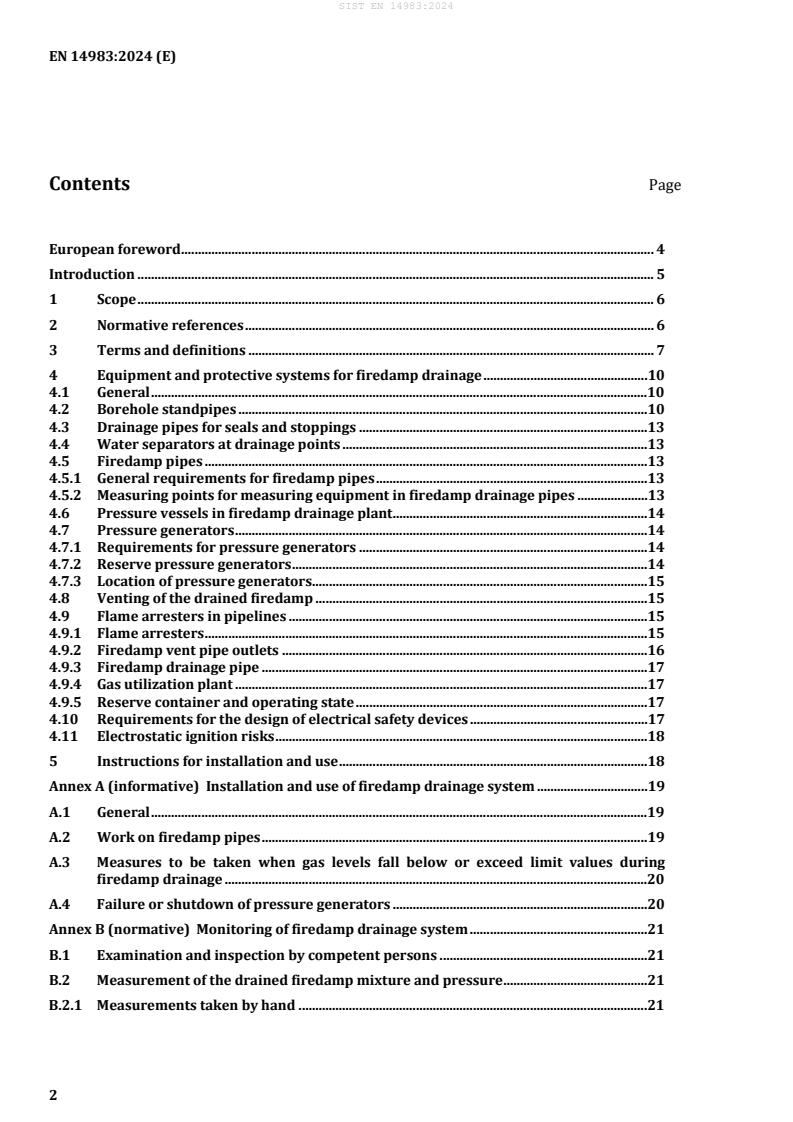
Contents Page
European foreword . 4
Introduction . 5
1 Scope . 6
2 Normative references . 6
3 Terms and definitions . 7
4 Equipment and protective systems for firedamp drainage .10
4.1 General .10
4.2 Borehole standpipes .10
4.3 Drainage pipes for seals and stoppings .13
4.4 Water separators at drainage points .13
4.5 Firedamp pipes .13
4.5.1 General requirements for firedamp pipes .13
4.5.2 Measuring points for measuring equipment in firedamp drainage pipes .13
4.6 Pressure vessels in firedamp drainage plant .14
4.7 Pressure generators .14
4.7.1 Requirements for pressure generators .14
4.7.2 Reserve pressure generators .14
4.7.3 Location of pressure generators .15
4.8 Venting of the drained firedamp .15
4.9 Flame arresters in pipelines .15
4.9.1 Flame arresters .15
4.9.2 Firedamp vent pipe outlets .16
4.9.3 Firedamp drainage pipe .17
4.9.4 Gas utilization plant .17
4.9.5 Reserve container and operating state .17
4.10 Requirements for the design of electrical safety devices .17
4.11 Electrostatic ignition risks .18
5 Instructions for installation and use .18
Annex A (informative) Installation and use of firedamp drainage system .19
A.1 General .19
A.2 Work on firedamp pipes .19
A.3 Measures to be taken when gas levels fall below or exceed limit values during
firedamp drainage .20
A.4 Failure or shutdown of pressure generators .20
Annex B (normative) Monitoring of firedamp drainage system .21
B.1 Examination and inspection by competent persons .21
B.2 Measurement of the drained firedamp mixture and pressure .21
B.2.1 Measurements taken by hand .21
B.2.2 Fixed monitoring equipment. 21
B.3 Documentation . 22
B.4 Firedamp circuit plan . 22
Annex C (normative) Requirements for location of pressure generators . 23
Annex D (normative) Requirements for degassing equipment for abandoned surface
openings . 24
Annex E (informative) Example for calculation of t -path . 28
E.1 General . 28
E.2 Example for calculation of t90-path . 28
Annex F (informative) Significant Changes between this European Standard and
EN 14983:2007 . 30
Annex ZA (informative) Relationship between this European Standard and the requirements
of Directive 2014/34/EU aimed to be covered . 32
Bibliography . 35
European foreword
This document (EN 14983:2024) has been prepared by Technical Committee CEN/TC 305 “Potentially
explosive atmospheres — Explosion prevention and protection”, the secretariat of which is held by DIN.
This European Standard shall be given the status of a national standard, either by publication of an
identical text or by endorsement, at the latest by April 2025, and conflicting national standards shall be
withdrawn at the latest by October 2026.
Attention is drawn to the possibility that some of the elements of this document may be the subject of
patent rights. CEN shall not be held responsible for identifying any or all such patent rights.
This document supersedes EN 14983:2007.
This document has been prepared under a standardization request addressed to CEN by the European
Commission. The Standing Committee of the EFTA States subsequently approves these requests for its
Member States.
For the relationship with EU Legislation, see informative Annex ZA, which is an integral part of this
document.
Any feedback and questions on this document should be directed to the users’ national standards body.
A complete listing of these bodies can be found on the CEN website.
According to the CEN-CENELEC Internal Regulations, the national standards organisations of the
following countries are bound to implement this European Standard: Austria, Belgium, Bulgaria, Croatia,
Cyprus, Czech Republic, Denmark, Estonia, Finland, France, Germany, Greece, Hungary, Iceland, Ireland,
Italy, Latvia, Lithuania, Luxembourg, Malta, Netherlands, Norway, Poland, Portugal, Republic of North
Macedonia, Romania, Serbia, Slovakia, Slovenia, Spain, Sweden, Switzerland, Türkiye and the United
Kingdom.
Introduction
Firedamp drainage is a technical process for selected gas removal, the purpose of which is to reduce the
risks presented by inflammable gas and air mixtures. Firedamp drainage is therefore a measure for
preventive explosion protection.
In the mining industry, firedamp is drained from the underground workings of gassy mines, from
boreholes and abandoned mine workings to ensure that mine workers are not exposed to the risks
associated with the occurrence of an explosive atmosphere at their place of work. In this case, the
explosion risk results from unacceptable accumulations of firedamp occurring in the waste areas and
cavities left in the in the rock strata after the coal has been extracted from the coal seam. In such cases,
the need to drain these accumulations, and the complexity of the drainage system, depends on the amount
of firedamp produced by the coal and the likelihood of it occurring in explosive quantities in the mine
roadways and coal face. Examples of situations that might cause firedamp to move in dangerous
concentrations from the waste area or cavities into the mine roadways: a breakdown of the mine
ventilation system or a sudden reduction in the underground atmospheric pressure. National legislation
in EU coal mining member countries requires workers to be withdrawn to a safe place if firedamp levels
attain a specific nationally defined value in the general body of mine air. Firedamp drainage is therefore
often used in gassy mines in an attempt to ensure that the concentration of firedamp in the general body
of mine air is kept well below this critical level, even during abnormal situations such as those described
above.
Once the accumulations of firedamp have been drained from the affected areas, it is usually discharged
to the mine surface, but in some cases it is discharged into the mine return ventilation system. In systems
where the firedamp is brought to the mine surface, it is discharged to the atmosphere through an earthed
metallic discharge stack or pressurized and delivered to a utilization system, such as a gas-fired boiler.
In abandoned mines, firedamp drainage is used
— to prevent gas pressure building up and gas issuing at the surface in an uncontrolled manner, and
— to protect workers at an adjacent nearby mine, or
— to allow it to be utilized, for example by burning it in a gas-fired boiler to produce heat or to generate
electricity.
1 Scope
This document specifies the requirements for equipment and protective systems for firedamp drainage
at mines. It also contains requirements for the construction and monitoring of this equipment and
protective systems (see EN 1127-2:2014).
This document does not apply to firedamp utilization systems beyond the utilization shut-off device.
2 Normative references
The following documents are referred to in the text in such a way that some or all of their content
constitutes requirements of this document. For dated references, only the edition cited applies. For
undated references, the latest edition of the referenced document (including any amendments) applies.
EN 1127-2:2014, Explosive atmospheres - Explosion prevention and protection - Part 2: Basic concepts and
methodology for mining
EN 13237:2024, Potentially explosive atmospheres - Terms and definitions for equipment and protective
systems intended for use in potentially explosive atmospheres
EN 61508-1:2010, Functional safety of electrical/electronic/programmable electronic safety-related
systems - Part 1: General requirements
EN 61508-2:2010, Functional safety of electrical/electronic/programmable electronic safety-related
systems - Part 2: Requirements for electrical/electronic/programmable electronic safety-related systems
EN 61508-3:2010, Functional safety of electrical/electronic/programmable electronic safety-related
systems - Part 3: Software requirements
EN 61508-4:2010, Functional safety of electrical/electronic/programmable electronic safety-related
systems - Part 4: Definitions and abbreviations
EN 61508-5:2010, Functional safety of electrical/electronic/programmable electronic safety-related
systems - Part 5: Examples of methods for the determination of safety integrity levels
EN 61508-6:2010, Functional safety of electrical/electronic/programmable electronic safety-related
systems - Part 6: Guidelines on the application of IEC 61508-2 and IEC 61508-3
EN 61508-7:2010, Functional safety of electrical/electronic/programmable electronic safety-related
systems - Part 7: Overview of techniques and measures
EN ISO/IEC 80079-38:2016, Explosive atmospheres - Part 38: Equipment and components in explosive
atmospheres in underground mines (ISO/IEC 80079-38:2016)
ISO/IEC 80079-49:2024, Explosive atmospheres -Part 49: Flame arresters-Performance requirements, test
methods and limits for use
Document impacted by A1:2018.
FprEN ISO/IEC 80079-49:2023 is still at draft stage at the time of this publication.
3 Terms and definitions
For the purposes of this document, the terms and definitions given in EN 1127-2:2014 and
EN 13237:2024 and the following apply:
ISO and IEC maintain terminological databases for use in standardization at the following addresses:
— IEC Electropedia: available at http://www.electropedia.org/
— ISO Online browsing platform: available at http://www.iso.org/obp
3.1
electrostatic leakage resistance
electrical resistance measured between an object and earth
3.2
active explosion isolation system
system which is designed to be activated by a detector and control and indicating equipment (CIE) which
are inherent parts of the system and stop explosions from travelling through pipelines or limit destructive
effects of the explosion
[SOURCE: EN 15089:2009, 3.7.1]
3.3
starting by-pass
temporary and specific by-passing of a safety device when starting the pressure generator of a firedamp
drainage plant
3.4
design pressure
p
d
pressure at the top of each chamber of the pressure equipment chosen for the derivation of the calculation
pressure of each component
[SOURCE: EN 764-1:2015+A1:2016, 3.2.33]
3.5
firedamp
any potentially explosive mixture of flammable gases naturally occurring in a mine
Note 1 to entry: As firedamp consists mainly of methane, the terms “firedamp” and “methane” are used frequently
in mining practice as synonyms.
[SOURCE: EN 1127-2:2014, 3.1]
3.6
firedamp collector pipe
gas pipes connected directly to one or more boreholes or gas drainage points
3.7
firedamp mains pipe
gas pipes connected to more than one gas collector pipe
3.8
extinguishing system
system that is used to discharge suppressant agent to extinguish flame and keep it from propagating into
the vent pipe
3.9
technically leaktight
made in such a way that no changes in gas composition occur
Note 1 to entry: Gas pipes, items of plant and equipment, including all detachable and non-detachable connections
can be technically leaktight.
Note 2 to entry: The term “technically leaktight” means that diffusion through statically stressed seals can occur.
3.10
t -path
distance between the monitoring position and the shut-off device
Note 1 to entry: This distance depends on the measured gas/air mixture, taking account of the velocity of flow, the
response time (according to EN 60079-29-1:2016) of the measurement device, the tripping time and the closing
time of the rapid shut-off device; the response time is the time taken to achieve 90 % of the final indication.
3.11
flame arrester
device fitted to the opening of an enclosure, or to the connecting pipe work of a system of enclosures, and
whose intended function is to allow the flow but prevent the transmission of flame
[SOURCE: ISO/IEC 80079-49:2024, 3.1]
3.12
flame arrester element
portion of a flame arrester whose principal function is to prevent flame transmission
[SOURCE: ISO/IEC 80079-49:2024, 3.3]
3.13
endurance burning
stabilized burning for an unlimited time
[SOURCE: ISO/IEC 80079-49:2024, 3.6]
3.14
endurance flame arrester
flame arrester that prevents flame transmission during and after endurance burning
[SOURCE: ISO/IEC 80079-49:2024, 3.16]
3.15
short time burning
stabilized burning for a specified time
[SOURCE: ISO/IEC 80079-49:2024, 3.5]
3.16
short-time burning flame arrester
flame arrester designed to prevent flameduring and after short-time burning
Note 1 to entry: In this case designed as end-of-line flame arrester (at the end of a pipe work), that means end-of-
line deflagration flame arrester. Equipped with an integrated temperature sensor that emits a signal suitable for
initiating countermeasures.
3.17
detonation
explosion propagating at supersonic velocity and characterized by a shock wave
[SOURCE: ISO 8421-1:1987, 1.12]
3.18
detonation flame arrester
DET
flame arrester designed to prevent the transmission of a detonation
[SOURCE: ISO/IEC 80079-49:2024, 3.15]
3.19
deflagration
explosion propagating at subsonic velocity
[SOURCE: ISO 8421-1:1987, 1.11]
3.20
deflagration flame arrester
DEF
flame arrester designed to prevent the transmission of a deflagration
Note 1 to entry: It can be an end-of-line flame arrester or an in-line flame arrester
[SOURCE: ISO/IEC 80079-49:2024, 3.14]
3.21
end-of-line flame arrester
flame arrester that is fitted with one pipe connection only
[SOURCE: ISO/IEC 80079-49:2024, 3.21]
3.22
stabilized burning
steady burning of a flame stabilized at, or close to, the flame arrester element
[SOURCE: ISO/IEC 80079-49:2024, 3.4]
3.23
housing
portion of a flame arrester whose principal function is to provide a suitable enclosure for the flame
arrester element and allow mechanical connections to other systems
[SOURCE: ISO/IEC 80079-49:2024, 3.2]
3.24
integrated temperature sensor
temperature sensor integrated into the flame arrester, as specified by the manufacturer of the flame
arrester, in order to provide a signal suitable to activate counter measures
[SOURCE: ISO/IEC 80079-49:2024, 3.24]
4 Equipment and protective systems for firedamp drainage
4.1 General
Electrical and mechanical equipment used in firedamp drainage shall not pose an explosion risk. For this
reason:
— equipment used in the firedamp drainage systems where flammable gas is likely to occur shall be
explosion protected either Group I Category M1 or M2, or, if on the surface, Group II Category 1G or
2G;
— where measuring equipment is in direct contact with firedamp/air concentration within the
explosive range (e.g. the purity measuring instruments), it shall be category M1 ignition protected.
In surface installations, Group II, Category 1G equipment may be used;
— the drainage system shall have a facility to allow it to be shut down, usually automatically, where the
concentration of extracted firedamp in the pipework reaches a prescribed limit, taking into account
the response time of the monitoring equipment and the t -path (see Annex E).
WARNING Care is needed during start-up of the firedamp drainage system when the pipework will be full
of air and will at some stage pass through the explosive range.
NOTE 1 Normally, the explosive range for firedamp/air mixtures is specified within a range of about 5 % by
volume to 15 % by volume methane. Automatic shutdown usually takes place when a methane concentration
reaches a level of approx. 22 % by volume.
NOTE 2 ISO/IEC 80079-49:2024 and EN 1127-2 give information about the ambient temperature.
4.2 Borehole standpipes
Standpipes shall be made in such a way that devices (Y- or T-pieces) for the insertion of borehole probes
can be attached to them. The standpipe shall have connection facilities to allow it to be connected, it shall
be made in such a way and arranged so that no reduction in cross-section occurs, and should contain a
suitable facility for measuring the volume flow and vacuum pressure where the boreholes are accessible
for measuring and taking firedamp samples, e.g. a measuring section (see Figure 1, Figure 2, Figure 3 and
Figure 4).
Key
d diameter 5 facility for measurements
1 borehole standpipe 6 facility for measurements
2 flexible hose suitable for the required flow and pressure 7 measuring section
3 T-piece 8 collector pipe
4 connection for water separator 9 shut-off device
Figure 1 — Example of connection of roof borehole to collector pipe when measurement and
control are accessible
Key
1 borehole standpipe
2 flexible hose suitable for the required flow and pressure
3 collector pipe
4 shut-off device
5 suitable connection for collector pipe
Figure 2 — Example of connection of roof borehole to collector pipe when measurement and
control are not accessible
Key
d diameter 5 facility for measurements
1 borehole standpipe 6 facility for measurements
2 flexible hose suitable for the required flow and pressure 7 measuring section
3 T-piece 8 shut-off device
4 connection for water separator 9 collector pipe
Figure 3 — Example of connection of floor borehole to collector pipe when measurement and
control are accessible
Key
1 borehole standpipe
2 flexible hose suitable for the required flow and pressure
3 collector pipe
4 shut-off device
5 suitable connection for collector pipe
6 water separator
Figure 4 — Example of connection of floor borehole to collector pipe when measurement and
control are not accessible
4.3 Drainage pipes for seals and stoppings
When firedamp drainage pipes are installed in seals and stoppings to drain methane, pipes shall be of
sufficient diameter, equipped with devices for controlling firedamp flows and be monitored in
accordance with 4.2.
The requirements of 4.2 are to be applied accordingly for gas measuring devices in seals and stoppings.
4.4 Water separators at drainage points
Where water is a problem, water separators should be provided between the drainage points and the
measuring sections. These separators shall be made in such a way that they can separate any water that
collects in the gas pipe without allowing the admission of the ambient atmosphere.
4.5 Firedamp pipes
4.5.1 General requirements for firedamp pipes
Firedamp pipes and their fittings (e.g. shut-off devices, controls, borehole connections) shall comply at
least with the nominal pressure stage PN 6 (see EN 1333). This strength rating is sufficient provided that
the permissible operating pressure in the gas drainage plant, based on the design of the pressure
generator and/or regulating equipment, does not exceed 0,3 bar.
Firedamp pipes shall only be fitted with pipe connections which are deemed suitable and necessary for
operation and control purposes.
Shut-off devices shall be provided in firedamp pipes in such a way that each branch pipe can be shut off
independently.
With the exception of the drainage points, all pipes shall be manufactured exclusively from materials
suitable for the transportation of methane underground.
Firedamp pipes shall be installed in such a manner as to be protected from damage.
Where necessary, vertical firedamp pipes shall be secured by the fitting of expansion pieces.
Firedamp pipes are to be positioned in such a way that any water which collects in the pipes can be
removed. Connections for water separators are to be provided at the lowest points and in the transfer
zone between the horizontal and the vertical pipe sections.
Where required, firedamp pipes are to be protected from the effects of frost and freezing.
4.5.2 Measuring points for measuring equipment in firedamp drainage pipes
Measuring points shall be provided at all places where the gas collector pipe joins a firedamp drainage
main and where the firedamp main enters a mine shaft. A damping section of at least 10 × d shall be
maintained in front of the measuring point, and a further damping section of at least 5 × d behind it.
Measuring points in firedamp main pipes, installed for monitoring pipes for leakage, shall be sited at a
minimum distance of 70 × d behind points where the firedamp collector pipes join.
The dimensions of the measuring points shall be determined on the basis of the measuring equipment
being installed.
4.6 Pressure vessels in firedamp drainage plant
Where pressure vessels are used in firedamp drainage plants the design pressure p of pressure vessels
d
shall be at least 6 bar pressure.
NOTE Systems operating below 0,5 bar pressure are not considered to be pressure systems.
4.7 Pressure generators
4.7.1 Requirements for pressure generators
The requirements of this standard are in addition to the applicable safety requirements of the relevant
industrial standards.
NOTE It is not a requirement of this document that compliance with the relevant industrial standards be
verified.
Each pressure generator shall have a manufacturer’s certificate stating that its housing has withstood a
water-pressure test for at least a 6 bar design pressure.
For materials of pressure generators, requirements for fans according to EN ISO/IEC 80079-38:2016, 5.3
shall be applied.
Where pressure generators operate below 0,5 bar pressure, they shall be tested in accordance with the
manufacturer's requirements.
Pressure generators shall be fitted with a temperature limiting device at the gas exit side according to the
maximum permissible operating temperature recommended by the manufacturer, unless other technical
measures can be used to prevent the permissible operating temperatures from being exceeded. The
limiting device shall be adjusted so that the maximum permissible compression temperature specified
by the manufacturer cannot be exceeded. Fluid-ring pressure generators shall be monitored so that they
are shut down automatically and immediately in the event of fluid deficiency. At the same time as this
shut-down, an audible and visual warning signal shall also be emitted at the permanently manned
position (see A.4).
Pressure generators (e.g. rotary compressors, fluid-ring pressure generators and discharge nozzles) and
pipe mains shall be designed so that a sufficient vacuum is available at each firedamp drainage point.
Where practicable, pressure generators shall be fitted additionally with:
— inlet and outlet gas pressure monitors;
— indicators showing the state of all inlet, outlet and bypass valves;
— mechanical fault monitoring (including driving motor) including an audible and visual warning
signal;
— indicators showing the state of power supply to driving motors.
All devices intended to automatically cut off power supply shall be designed so that they can only be reset
at the location of the pressure generator.
The control system shall ensure, that pressure generators cannot be started unless the outlet valve is
open, and if the outlet valve closes while the pressure generator is running the pressure generator is shut
down.
4.7.2 Reserve pressure generators
Pressure generators shall be designed in such a way that they can be changed easily due to maintenance
or after breakdown.
The number of pressure generators should be sufficient to cater for the maximum expected volume of
firedamp, and additional capacity are provided for periods when pressure generators are unavailable.
4.7.3 Location of pressure generators
Pressure generators for firedamp drainage shall, in principle, be installed above ground. The place of
installation is subject to the regulations which apply to areas where there is a risk of fire and explosion.
Examples of requirements for the location of pressure generators are given in Annex C.
Firedamp which is released into the water collector tanks of liquid-ring pressure generators shall be
removed in a safe manner. If necessary, an explosion barrier shall be provided at the discharge end.
4.8 Venting of the drained firedamp
Where firedamp is vented underground, the point of discharge shall have a dilution chamber around it,
so located that when firedamp discharge is taking place the concentration of firedamp at the dilution
chamber outlet does not exceed a value which has to be defined taking into account the LEL of methane
and the local explosion safety requirements.
NOTE The values are usually defined in national regulations.
Firedamp drainage plants above ground shall be provided with a firedamp pipe which allows the
firedamp to be vented to the atmosphere (firedamp vent pipe), see Annex D.
In practice, the mouth of the surface firedamp vent pipe shall be defined by a risk assessment, but it shall
be:
— at a minimum distance of 20 m, measured radially, from surface shafts and any areas presenting a
fire or explosion hazard. This shall not apply to the location of an pressure generator);
— at least 3 m above ground level and 1 m above any buildings sited within a radius of 15 m.
Any possible ingress of water into drainage pipes shall be considered.
Firedamp vent pipe outlets on the surface shall be protected against risks from lightning.
4.9 Flame arresters in pipelines
4.9.1 Flame arresters
Flame arresters (in accordance with ISO/IEC 80079-49:2024) shall be provided
— at firedamp vent outlets, designed and located to prevent an explosion at the vent outlet propagating
in the direction of the pressure generator and of the mine;
— in the drainage pipes between the pressure generator and the mine, designed and located to prevent
an explosion at the pressure generator propagating in the direction of the mine;
— in the pipes connected to the gas utilization plant upstream of the pressure generator, unless the
latter is protected separately, designed and located to prevent an explosion at the gas utilization plant
propagating in the direction of the pressure generator and the mine.
Although the restricted foreword of ISO/IEC 80079-49:2024 does not cover group I, a certified flame
arrester for equipment group IIA can be used safely for methane. Group I (methane) can be considered
as a subgroup of IIA. In different mixtures with more than 25 % by volume of hydrogen methane can be
considered as equipment Group IIA.
It is acceptable to dispense with the installation of a flame arrester between the pressure generator and
the mine provided that the pressure generator is of the water-filled fluid-ring non-sparking type, subject
to a minimum flow of water through the pump being proven.
Measures shall be taken to ensure that a flame cannot propagate into the pipeline system of the firedamp
drainage plant via feed pipes leading to firedamp measuring equipment or shut-off devices.
By using flame arresters, their operating conditions with regard to the gas group of the flammable
mixture according to ISO/IEC 80079-49:2024, temperature, pressure and installation method shall
always be taken into account.
After an explosion has occurred, all prescribed inspection, maintenance and repair work (e.g.
replacement of the flame arrester element if damaged) shall always be carried out.
NOTE It is recommended to inspect the flame arrester equipment according to manufacturer recommendation
and at least every year in order to check equipment condition.
Key
1 vent pipe 7 shut-off device
2 utilization pipe 8 rapid-action shut-off device
3 circulating pipe 9 bidirectional in-line detonation flame arrester
4 pressure generator
5 endurance or short-time burning flame arrester 10 bidirectional in-line detonation flame arrester
6 in-line detonation flame arrester 11 drainage pipe
Figure 5 — Example of explosion prevention with flame arresters for pipelines with one
firedamp vent pipe
4.9.2 Firedamp vent pipe outlets
Firedamp vent pipe outlets shall be equipped at the end of the vent pipe with an end-of-line flame arrester
(see Figure 5, Key 5), that can be
a) an endurance flame arrester or
b) with an atmospheric short-time burning flame arrester with integrated temperature sensor in
conjunction with an automatic extinguishing system and extinguishing container. The extinguishing
system shall extinguish a fire within half of the certified time period of the short-time burning flame
arrester.
An additional in-line detonation flame arrester (see Figure 5, Key 6) shall be equipped in the vent pipe to
protect the environment against an explosion from inside the mine and the pressure generator.
NOTE In regard with the use of a short time burning type flame arrester, the temperature sensor is used to
detect an explosion or the presence of a flame that might stabilized on the surface of the element matrix. Short time
burning flame arrester are tested for minimum one minute up to 30 min of continuous burning, depending on the
certification.
It is acceptable to dispense with the installation of an automatic extinguishing system at the firedamp
vent outlet if the temperature detection system of the short-time burning proofed deflagration flame
arrester (integrated temperature sensor) actuates a rapid-action shut-off device which interrupts the
firedamp gas flow to the firedamp vent outlet within half of the certified time period of the short-time
burning proofed deflagration flame arrester.
It is also acceptable to dispense the installation of an automatic extinguishing system at the firedamp vent
outlet if a gas detection system is coupled with a rapid-action shut-off device which interrupts the
firedamp gas flow to the firedamp vent outlet in case of detection of an ignitable gas mixture within half
of the certified time period of the short-time burning proofed deflagration flame arrester.
4.9.3 Firedamp drainage pipe
Firedamp drainage pipes shall be equipped between the pressure generator and the mine with an in-line
detonation flame arrester between pressure generator and the mine (see Figure 5, Key 9), installed as
close as possible to the pressure generator.
Outdoor pressure generators and flame arresters should be insulated and heated in regions where there
is a risk of ice formation to prevent condensation and ice formation.
4.9.4 Gas utilization plant
Between the gas utilization plant and the pressure generator a flame arrestor shall protect the pressure
generator and the mine, unless the gas utilization plant is protected separately. Depending on the
distance from the ignition source, protection shall then be provided with an in-line detonation flame
arrester (see Figure 5, Key 10).
4.9.5 Reserve container and operating state
Each extinguishing medium container which is intended for the extinguishing of fires and explosions shall
be provided with a second container (reserve container) and be connected to the firedamp pipes.
The reserve containers used in extinguishing systems shall be capable of being activated manually as
soon as practicable after the initial activation of the extinguishing system.
The reserve containers in active explosion isolation systems containing an extinguishing medium shall
operate automatically after the initial activation of the explosion isolation system.
The operational readiness of extinguishing systems and active explosion isolation systems, their
activation history and any faults which may be present shall be displayed in the firedamp drainage plant
and this information shall be relayed to a permanently-manned station (mine safety room or similar).
4.10 Requirements for the design of electrical safety devices
The measurement, control, regulation safety devices including increased-performance
telecommunication circuits (e.g. in monitoring, measurement and limit-value circuits) shall be designed
in accordance with EN 61508-1:2010 to EN 61508-7:2010. The appropriate safety integrity level (SIL)
according to EN 61508-1:2010 to EN 61508-7:2010 shall be defined as a result of a risk assessment.
If part of the measurement, control, regulation system fails, measures shall be introduced in such a way
as to prevent the shutdown of the entire firedamp drainage plant.
A starting by-pass is permissible provided that the operation of the constructional explosion protection
system (flame arresters, fluid-ring non-sparking pressure generators or active explosion isolation
system) is ensured during this period.
Devices for by-passing safety equipment shall be set up in such a way that they can only be activated by
authorized persons.
In the case of fixed measuring equipment, a two-way interlock shall be provided such that, when
maintenance and calibration work is being carried out, one measurement device is always available to
maintain the monitoring and shut-down system.
A manually-operated emergency stop switch shall be provided at each pressure generator. This
emergency stop switch shall be mechanically latched to prevent unintentional release.
4.11 Electrostatic ignition risks
In order to prevent electrostatic charges, all pipes shall be bonded together and earthed. A leakage
resistance of 10 Ω shall not be exceeded at any point along the pipe circuit.
For further information see CLC/TR 60079-32-1.
Measures shall be taken at discharge nozzles to prevent electrostatic discharges arising. A leakage
resistance of 10 Ω shall not be exceeded.
The earth connections shall be made substantially strong to withstand the mining environment.
Firedamp vent pipes and conducting parts that are in contact with the stream of firedamp being vented
shall be interconnected to form an equipotential bond.
5 Instructions for installation and use
The instructions for installation and use shall take into account the information on installation and use of
the firedamp drainage system and monitoring of the firedamp drainage system (see Annex A and
Annex B).
Annex A
(informative)
Installation and use of firedamp drainage system
A.1 General
The design and equipment of the firedamp drainage plant, such as deployed pressure generators, safety
equipment and water separators, should be arranged in such a way that the safety-related requirements
of the standard are met and the gas drainage plant can be operated in a safe and reliable manner.
Gas drainage points should be cased and sealed.
If, when preparing the gas drainage points, the quantity of firedamp anticipated is such that the airflow
is no longer sufficient to ensure an immediate and adequate dilution of the firedamp, a standpipe should
first be installed and sealed. The firedamp should then be drained off using appropriate equipment, with
special attention being paid to the gas pressure.
Gas drainage points which are not connected to the firedamp pipe and are accessible should be sealed in
a safe and gastight manner. Means should be provided for taking firedamp samples and for measuring
the firedamp pressure for as long as the gas drainage points are accessible.
Recognized leaks in firedamp pipes should be rectified immediately.
Firedamp pipes should be installed in upcast shafts.
Each firedamp drainage point should be assigned a permanent identification mark.
Firedamp pipes should be clearly and visibly identified by means of a yellow paint mark applied to the
flange connections or by means of a ring of yellow paint at least 50 mm in width to be applied to both
ends of each pipe.
Shut-off devices are to be clearly an
...