

ISO/IEC 80079-49:2024
(Main)Explosive atmospheres — Part 49: Flame arresters — Performance requirements, test methods and limits for use
General Information
- Abstract
This document specifies the requirements for flame arresters that prevent flame transmission when explosive gas-air or vapour-air mixtures are present. It establishes uniform principles for the classification, basic construction and information for use, including the marking of flame arresters, and specifies test methods to verify the safety requirements and determine safe limits of use. This document is applicable to pressures ranging from 80 kPa to 160 kPa and temperatures ranging from -20 °C to +200 °C. This document does not apply to the following: - external safety-related measurement and control equipment that might be required to keep the operational conditions within the established safe limits; - flame arresters used for explosive mixtures of vapours and gases, which tend to self-decompose (for example, acetylene) or which are chemically unstable; - flame arresters used for carbon disulfide, due to its special properties; - flame arresters whose intended use is for mixtures other than gas-air or vapour-air mixtures (for example, higher oxygen-nitrogen ratio, chlorine as oxidant); - flame arrester test procedures for reciprocating internal combustion engines; - fast acting valves, extinguishing systems and other explosion isolating systems; - Flame arresters used in gas detectors (those being covered for example, by IEC 60079‑29‑1 and IEC 62990‑1). This edition cancels and replaces ISO 16852:2016, which has been technically revised. This edition constitutes a technical revision. This edition includes the following significant technical changes with respect to ISO 16852:2016: a) adaptation of the relevant IEC TC 31 requirements on standards; b) modification of the upper limit of the temperature range from 150 °C to 200 °C under the condition that T0 shall be not larger than 80 % of the auto ignition temperature of the gas-air-mixture; c) change of the term "explosion group" to "equipment group" due to editorial requirements in IEC/TC 31; d) clarification of the conditions and requirements for flame arresters whose intended operating conditions are outside the atmospheric conditions in 7.3.4 and 7.3.5; e) clarification of the requirements on the information for use in Clause 12 f) concerning the burn time; f) addition of a permission to the construction requirements both in 7.1 and 14.1 to substitute visual inspection by performing a flow test; g) addition of a flow chart for the evaluation of test results as Annex D
- Status
- Published
- Publication Date
- 06-May-2024
- Technical Committee
- ISO/TMBG - Technical Management Board - groups
- Drafting Committee
- ISO/TMBG - Technical Management Board - groups
- Current Stage
- 6060 - International Standard published
- Start Date
- 07-May-2024
- Due Date
- 05-Jul-2023
- Completion Date
- 07-May-2024
Buy Documents
ISO/IEC 80079-49:2024 - Explosive atmospheres — Part 49: Flame arresters — Performance requirements, test methods and limits for use Released:7. 05. 2024
ISO/IEC 80079-49:2024 - Atmospheres explosives — Partie 49: Arrete flammes — Exigences de performance, méthodes d’essai et limites d’utilisation Released:12/6/2024
Overview
ISO/IEC 80079-49:2024 establishes international requirements for flame arresters designed to prevent flame transmission in explosive atmospheres where gas-air or vapour-air mixtures are present. The standard outlines key criteria for classification, construction, marking, safety, and performance testing of flame arresters across a practical range of pressures (80 kPa to 160 kPa) and temperatures (−20 °C to +200 °C). The goal is to ensure consistent safety, reliability, and regulatory compliance for equipment protecting facilities in chemical, oil and gas, and other process industries from the hazards of explosion propagation.
This document supersedes ISO 16852:2016, incorporating significant updates to align with current IEC requirements, adapt terminology, extend temperature limits, and refine test and information requirements. It focuses on static, dynamic, liquid product detonation, and hydraulic flame arresters, detailing methods to verify operational safety and define their safe use limits.
Key Topics
- Classification of Flame Arresters: Differentiates flame arresters by operating principle (static, dynamic, hydraulic, liquid) and by flame transmission type (deflagration, stable detonation, unstable detonation).
- Construction and Marking: Specifies uniform requirements for design, housing, and element construction, as well as mandatory information marking to ensure correct identification and safe operation.
- Performance and Testing: Details standardized test methods for assessing flame transmission prevention, including deflagration, detonation, short time burning, and endurance burning scenarios. Includes procedures for both in-line and end-of-line installations.
- Safe Operating Limits: Defines safe pressure and temperature ranges, with guidance for conditions outside atmospheric norms, ensuring suitability across various industrial applications.
- Instructions and Information for Use: Sets requirements for documentation accompanying flame arresters, including clear operational limits, maintenance, and correct installation.
- Technical Updates: Incorporates new IEC TC 31 requirements, updated terminology (from "explosion group" to "equipment group"), and clarified operational and test requirements.
Applications
Flame arresters specified by ISO/IEC 80079-49:2024 are critical safety components used in a variety of industries where explosive atmospheres can arise, including:
- Petrochemical plants: Protecting process vessels, storage tanks, pipelines, and vents from explosion propagation.
- Chemical processing: Ensuring equipment safety in environments handling volatile organic compounds or gases.
- Oil and gas facilities: Applied at the interface of storage and transportation systems to mitigate explosion risks.
- Pharmaceutical manufacturing: Controlling flame transmission in gas-handling processes.
- Industrial ventilation systems: Preventing external ignition sources from propagating into process systems.
The standard applies to most gas-air and vapour-air mixtures and is particularly suited for safety-critical environments requiring international compliance.
Exclusions: The document does not apply to flame arresters for self-decomposing or chemically unstable gases (such as acetylene), mixtures with unusual oxidants, carbon disulfide, explosion isolation systems, gas detectors (covered by IEC 60079-29-1 and IEC 62990-1), or reciprocating engine applications.
Related Standards
To ensure comprehensive conformity and safety in explosive atmospheres, the following standards are closely associated with ISO/IEC 80079-49:2024:
- IEC 60079-0: Explosive atmospheres – General requirements for equipment.
- IEC 60079-1: Equipment protection by flameproof enclosures ("d").
- ISO/IEC 80079-34: Application of quality management systems for Ex product manufacture.
- IEC 60079-29-1 and IEC 62990-1: Gas detection equipment (not covered by this flame arrester document).
Adherence to these related ISO and IEC standards supports robust risk management, best practice engineering, and regulatory acceptance for equipment used in potentially explosive atmospheres.
Keywords: ISO/IEC 80079-49, flame arresters, explosive atmospheres, performance requirements, test methods, limits for use, industrial safety, chemical industry, oil and gas, explosive mixtures, equipment protection.
Relations
- Effective Date
- 09-Feb-2026
- Effective Date
- 12-Feb-2026
- Effective Date
- 06-Jun-2022
Buy Documents
ISO/IEC 80079-49:2024 - Explosive atmospheres — Part 49: Flame arresters — Performance requirements, test methods and limits for use Released:7. 05. 2024
ISO/IEC 80079-49:2024 - Atmospheres explosives — Partie 49: Arrete flammes — Exigences de performance, méthodes d’essai et limites d’utilisation Released:12/6/2024
Get Certified
Connect with accredited certification bodies for this standard

CIS Institut d.o.o.
Personal Protective Equipment (PPE) certification body. Notified Body NB-2890 for EU Regulation 2016/425 PPE.

Kiwa BDA Testing
Building and construction product certification.
Kmetijski inštitut Slovenije
Agricultural Institute of Slovenia. Soil testing, plant health, agricultural product analysis.
Sponsored listings
Frequently Asked Questions
ISO/IEC 80079-49:2024 is a standard published by the International Organization for Standardization (ISO). Its full title is "Explosive atmospheres — Part 49: Flame arresters — Performance requirements, test methods and limits for use". This standard covers: This document specifies the requirements for flame arresters that prevent flame transmission when explosive gas-air or vapour-air mixtures are present. It establishes uniform principles for the classification, basic construction and information for use, including the marking of flame arresters, and specifies test methods to verify the safety requirements and determine safe limits of use. This document is applicable to pressures ranging from 80 kPa to 160 kPa and temperatures ranging from -20 °C to +200 °C. This document does not apply to the following: - external safety-related measurement and control equipment that might be required to keep the operational conditions within the established safe limits; - flame arresters used for explosive mixtures of vapours and gases, which tend to self-decompose (for example, acetylene) or which are chemically unstable; - flame arresters used for carbon disulfide, due to its special properties; - flame arresters whose intended use is for mixtures other than gas-air or vapour-air mixtures (for example, higher oxygen-nitrogen ratio, chlorine as oxidant); - flame arrester test procedures for reciprocating internal combustion engines; - fast acting valves, extinguishing systems and other explosion isolating systems; - Flame arresters used in gas detectors (those being covered for example, by IEC 60079‑29‑1 and IEC 62990‑1). This edition cancels and replaces ISO 16852:2016, which has been technically revised. This edition constitutes a technical revision. This edition includes the following significant technical changes with respect to ISO 16852:2016: a) adaptation of the relevant IEC TC 31 requirements on standards; b) modification of the upper limit of the temperature range from 150 °C to 200 °C under the condition that T0 shall be not larger than 80 % of the auto ignition temperature of the gas-air-mixture; c) change of the term "explosion group" to "equipment group" due to editorial requirements in IEC/TC 31; d) clarification of the conditions and requirements for flame arresters whose intended operating conditions are outside the atmospheric conditions in 7.3.4 and 7.3.5; e) clarification of the requirements on the information for use in Clause 12 f) concerning the burn time; f) addition of a permission to the construction requirements both in 7.1 and 14.1 to substitute visual inspection by performing a flow test; g) addition of a flow chart for the evaluation of test results as Annex D
This document specifies the requirements for flame arresters that prevent flame transmission when explosive gas-air or vapour-air mixtures are present. It establishes uniform principles for the classification, basic construction and information for use, including the marking of flame arresters, and specifies test methods to verify the safety requirements and determine safe limits of use. This document is applicable to pressures ranging from 80 kPa to 160 kPa and temperatures ranging from -20 °C to +200 °C. This document does not apply to the following: - external safety-related measurement and control equipment that might be required to keep the operational conditions within the established safe limits; - flame arresters used for explosive mixtures of vapours and gases, which tend to self-decompose (for example, acetylene) or which are chemically unstable; - flame arresters used for carbon disulfide, due to its special properties; - flame arresters whose intended use is for mixtures other than gas-air or vapour-air mixtures (for example, higher oxygen-nitrogen ratio, chlorine as oxidant); - flame arrester test procedures for reciprocating internal combustion engines; - fast acting valves, extinguishing systems and other explosion isolating systems; - Flame arresters used in gas detectors (those being covered for example, by IEC 60079‑29‑1 and IEC 62990‑1). This edition cancels and replaces ISO 16852:2016, which has been technically revised. This edition constitutes a technical revision. This edition includes the following significant technical changes with respect to ISO 16852:2016: a) adaptation of the relevant IEC TC 31 requirements on standards; b) modification of the upper limit of the temperature range from 150 °C to 200 °C under the condition that T0 shall be not larger than 80 % of the auto ignition temperature of the gas-air-mixture; c) change of the term "explosion group" to "equipment group" due to editorial requirements in IEC/TC 31; d) clarification of the conditions and requirements for flame arresters whose intended operating conditions are outside the atmospheric conditions in 7.3.4 and 7.3.5; e) clarification of the requirements on the information for use in Clause 12 f) concerning the burn time; f) addition of a permission to the construction requirements both in 7.1 and 14.1 to substitute visual inspection by performing a flow test; g) addition of a flow chart for the evaluation of test results as Annex D
ISO/IEC 80079-49:2024 is classified under the following ICS (International Classification for Standards) categories: 13.220.20 - Fire protection. The ICS classification helps identify the subject area and facilitates finding related standards.
ISO/IEC 80079-49:2024 has the following relationships with other standards: It is inter standard links to EN 14983:2024, EN ISO/IEC 80079-49:2024, ISO 16852:2016. Understanding these relationships helps ensure you are using the most current and applicable version of the standard.
ISO/IEC 80079-49:2024 is available in PDF format for immediate download after purchase. The document can be added to your cart and obtained through the secure checkout process. Digital delivery ensures instant access to the complete standard document.
Standards Content (Sample)
ISO/IEC 80079-49
Edition 1.0 2024-05
INTERNATIONAL
STANDARD
Explosive atmospheres –
Part 49: Flame arresters – Performance requirements, test methods and limits
for use
All rights reserved. Unless otherwise specified, no part of this publication may be reproduced or utilized in any form or
by any means, electronic or mechanical, including photocopying and microfilm, without permission in writing from either
IEC or IEC's member National Committee in the country of the requester. If you have any questions about ISO/IEC
copyright or have an enquiry about obtaining additional rights to this publication, please contact the address below or
your local IEC member National Committee for further information.
IEC Secretariat Tel.: +41 22 919 02 11
3, rue de Varembé info@iec.ch
CH-1211 Geneva 20 www.iec.ch
Switzerland
About the IEC
The International Electrotechnical Commission (IEC) is the leading global organization that prepares and publishes
International Standards for all electrical, electronic and related technologies.
About IEC publications
The technical content of IEC publications is kept under constant review by the IEC. Please make sure that you have the
latest edition, a corrigendum or an amendment might have been published.
IEC publications search - webstore.iec.ch/advsearchform IEC Products & Services Portal - products.iec.ch
The advanced search enables to find IEC publications by a Discover our powerful search engine and read freely all the
variety of criteria (reference number, text, technical publications previews, graphical symbols and the glossary.
committee, …). It also gives information on projects, replaced With a subscription you will always have access to up to date
and withdrawn publications. content tailored to your needs.
IEC Just Published - webstore.iec.ch/justpublished
Electropedia - www.electropedia.org
Stay up to date on all new IEC publications. Just Published
The world's leading online dictionary on electrotechnology,
details all new publications released. Available online and once
containing more than 22 500 terminological entries in English
a month by email.
and French, with equivalent terms in 25 additional languages.
Also known as the International Electrotechnical Vocabulary
IEC Customer Service Centre - webstore.iec.ch/csc
(IEV) online.
If you wish to give us your feedback on this publication or need
further assistance, please contact the Customer Service
Centre: sales@iec.ch.
ISO/IEC 80079-49
Edition 1.0 2024-05
INTERNATIONAL
STANDARD
Explosive atmospheres –
Part 49: Flame arresters – Performance requirements, test methods and limits
for use
INTERNATIONAL
ELECTROTECHNICAL
COMMISSION
ICS 13.220.10 ISBN 978-2-8322-8716-3
– 2 – ISO/IEC 80079-49:2024 © ISO/IEC 2024
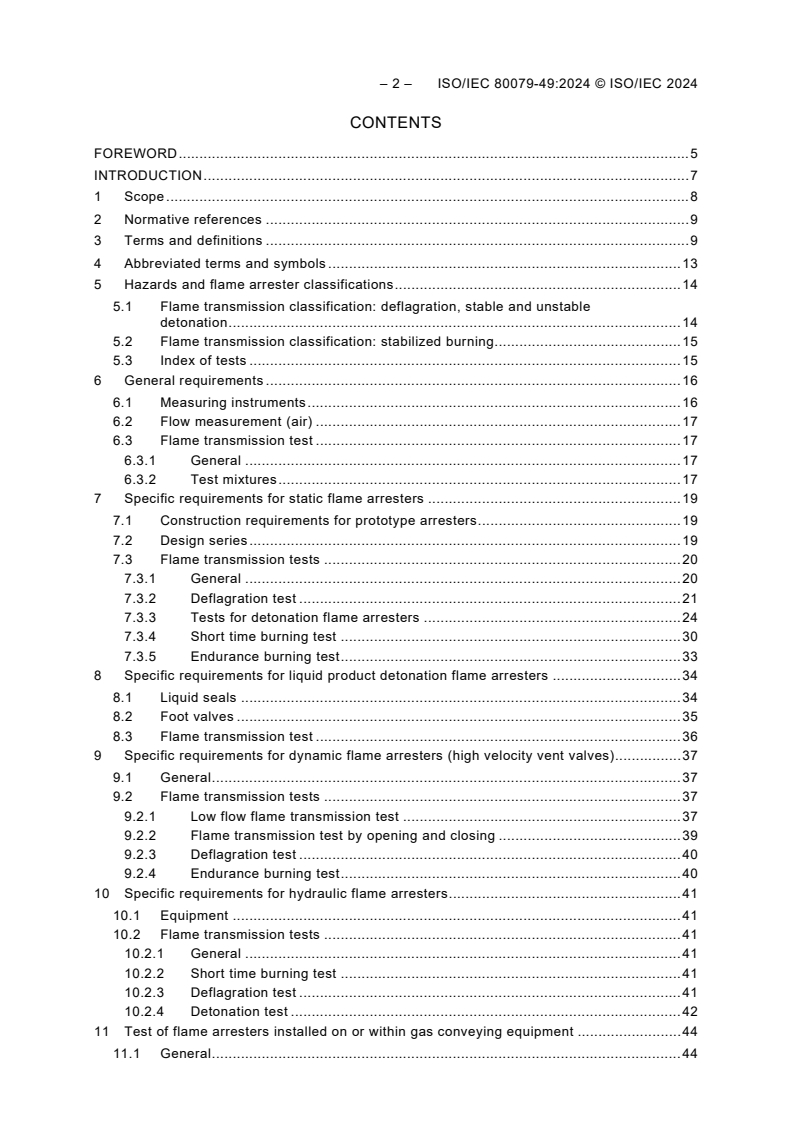
CONTENTS
FOREWORD . 5
INTRODUCTION . 7
1 Scope . 8
2 Normative references . 9
3 Terms and definitions . 9
4 Abbreviated terms and symbols . 13
5 Hazards and flame arrester classifications . 14
5.1 Flame transmission classification: deflagration, stable and unstable
detonation . 14
5.2 Flame transmission classification: stabilized burning . 15
5.3 Index of tests . 15
6 General requirements . 16
6.1 Measuring instruments . 16
6.2 Flow measurement (air) . 17
6.3 Flame transmission test . 17
6.3.1 General . 17
6.3.2 Test mixtures . 17
7 Specific requirements for static flame arresters . 19
7.1 Construction requirements for prototype arresters . 19
7.2 Design series . 19
7.3 Flame transmission tests . 20
7.3.1 General . 20
7.3.2 Deflagration test . 21
7.3.3 Tests for detonation flame arresters . 24
7.3.4 Short time burning test . 30
7.3.5 Endurance burning test . 33
8 Specific requirements for liquid product detonation flame arresters . 34
8.1 Liquid seals . 34
8.2 Foot valves . 35
8.3 Flame transmission test . 36
9 Specific requirements for dynamic flame arresters (high velocity vent valves) . 37
9.1 General . 37
9.2 Flame transmission tests . 37
9.2.1 Low flow flame transmission test . 37
9.2.2 Flame transmission test by opening and closing . 39
9.2.3 Deflagration test . 40
9.2.4 Endurance burning test . 40
10 Specific requirements for hydraulic flame arresters . 41
10.1 Equipment . 41
10.2 Flame transmission tests . 41
10.2.1 General . 41
10.2.2 Short time burning test . 41
10.2.3 Deflagration test . 41
10.2.4 Detonation test . 42
11 Test of flame arresters installed on or within gas conveying equipment . 44
11.1 General . 44
11.2 Flame transmission tests . 44
11.2.1 General . 44
11.2.2 Test procedure for gas conveying equipment with inlet pressure
> 600 hPa . 46
11.2.3 Test procedure for gas conveying equipment with inlet pressure
≤ 600 hPa . 47
12 Instructions . 47
13 Marking . 48
13.1 Location . 48
13.2 Flame arrester housing . 49
13.2.1 General information . 49
13.2.2 Warning markings . 49
13.2.3 Examples of marking . 50
13.3 Flame arrester element . 51
14 Manufacturing and production . 51
14.1 Construction . 51
14.2 Housing . 51
14.3 Joints . 51
14.4 Pressure test . 51
14.5 Leak test . 52
Annex A (normative) Flow measurement . 53
A.1 General . 53
A.2 In-line flame arresters . 54
A.3 End-of-line flame arrester . 54
A.3.1 General . 54
A.3.2 Special flow measurement for dynamic flame arresters . 55
A.4 Undamped oscillation tests of dynamic flame arrester (High velocity vent
valves) . 56
Annex B (informative) Information for selecting flame arresters . 58
Annex C (informative) Recommended practice . 59
Annex D (informative) Evaluation of test results . 60
Annex E (normative) Application . 62
E.1 General . 62
E.2 Limits for use for static flame arresters . 63
E.2.1 In-line flame arrester . 63
E.2.2 Pre-volume flame arrester . 63
E.2.3 Detonation flame arrester . 63
E.2.4 Short time burn flame arrester . 63
E.3 Limits for use for liquid detonation flame arresters . 64
E.4 Limits for use for dynamic flame arresters (high velocity vent valves) . 64
E.5 Limits for use for hydraulic flame arresters . 64
Annex F (informative) Significant changes between this document and EN ISO
16852:2016 . 67
Bibliography . 69
Figure 1 – Test apparatus for end-of-line flame arrester for deflagration test . 21
Figure 2 – Test apparatus for in-line flame arrester for deflagration test . 22
Figure 3 – Test apparatus for pre-volume flame arrester for deflagration test . 24
– 4 – ISO/IEC 80079-49:2024 © ISO/IEC 2024
Figure 4 – Test apparatus for detonation flame arrester for detonation without
restriction. 26
Figure 5 – Test apparatus for detonation flame arrester for detonation with restriction . 28
Figure 6 – Test apparatus for short time burning test . 31
Figure 7 – Test apparatus for endurance burning test . 33
Figure 8 – Liquid product detonation flame arrester . 35
Figure 9 – End-of-line flame arrester incorporating a non-return valve (foot valve) . 35
Figure 10 – Test apparatus for liquid product detonation flame arresters . 36
Figure 11 – Test apparatus for determining the non-hammering conditions for dynamic
flame arresters. 39
Figure 12 – Test apparatus for hydraulic flame arresters. 43
Figure 13 – Test apparatus for the flame transmission test of flame arresters installed
on or within gas conveying equipment . 45
Figure 14 – Example of marking plate, burn rating "a" . 50
Figure 15 – Example of marking plate, burn rating "b" . 50
Figure A.1 – Test apparatus for recording the pressure drop/flow rate curve for in-line
flame arresters. 54
Figure A.2 – Test apparatus for recording the pressure drop/flow rate curve for end-of-
line flame arresters with or without integrated pressure/vacuum valve . 56
Figure A.3 – Test apparatus for determining the non-oscillating conditions for dynamic
flame arresters. 57
Figure D.1 – Decision process for stable detonation arrester (DET3 and DET4) . 60
Figure D.2 – Decision process for unstable detonation arrester (DET1 and DET2) . 61
Figure E.1 – Test apparatus for hydraulic flame arresters . 66
Table 1 – Flame arrester classification for deflagration, stable and unstable detonation . 15
Table 2 – Summary of tests to be conducted . 16
Table 3 – Specification of gas-air mixtures for deflagration and detonation tests . 18
Table 4 – Specification of gas-air mixtures for short time burning tests and burning
tests of dynamic flame arresters . 18
Table 5 – Specification of gas-air or vapour-air mixtures for endurance burning tests of
static flame arresters . 19
Table 6 – Design series . 20
Table 7 – Ratio p /p . 27
md TB
Table 8 – Number of the individual tests and test parameters for the flame
transmission test of flame arresters installed on or within gas conveying equipment
with inlet pressures > 600 hPa . 46
Table 9 – Number of the individual tests and test parameters for the flame
transmission test of flame arresters installed on or within gas conveying equipment
with inlet pressures ≤ 600 hPa . 47
Table B.1 – Information for selecting flame arresters . 58
Table F.1 – Significant changes with respect to EN ISO 16852:2016 . 67
EXPLOSIVE ATMOSPHERES –
Part 49: Flame arresters –
Performance requirements, test methods and limits for use
FOREWORD
1) ISO (the International Organization for Standardization) and IEC (the International Electrotechnical Commission)
form the specialized system for worldwide standardization. National bodies that are members of ISO or IEC
participate in the development of International Standards through technical committees established by the
respective organization to deal with particular fields of technical activity. ISO and IEC technical committees
collaborate in fields of mutual interest. Other international organizations, governmental and non-governmental,
in liaison with ISO and IEC, also take part in the work.
2) The formal decisions or agreements of IEC and ISO on technical matters express, as nearly as possible, an
international consensus of opinion on the relevant subjects since each technical committee has representation
from all interested IEC and ISO National bodies.
3) IEC and ISO documents have the form of recommendations for international use and are accepted by IEC and
ISO National bodies in that sense. While all reasonable efforts are made to ensure that the technical content of
IEC and ISO documents is accurate, IEC and ISO cannot be held responsible for the way in which they are used
or for any misinterpretation by any end user.
4) In order to promote international uniformity, IEC and ISO National bodies undertake to apply IEC and ISO
documents transparently to the maximum extent possible in their national and regional publications. Any
divergence between any IEC and ISO document and the corresponding national or regional publication shall be
clearly indicated in the latter.
5) IEC and ISO do not provide any attestation of conformity. Independent certification bodies provide conformity
assessment services and, in some areas, access to IEC and ISO marks of conformity. IEC and ISO are not
responsible for any services carried out by independent certification bodies.
6) All users should ensure that they have the latest edition of this document.
7) No liability shall attach to IEC and ISO or their directors, employees, servants or agents including individual
experts and members of its technical committees and IEC and ISO National bodies for any personal injury,
property damage or other damage of any nature whatsoever, whether direct or indirect, or for costs (including
legal fees) and expenses arising out of the publication, use of, or reliance upon, this ISO/IEC document or any
other IEC and ISO documents.
8) Attention is drawn to the Normative references cited in this document. Use of the referenced publications is
indispensable for the correct application of this document.
9) IEC and ISO draw attention to the possibility that the implementation of this document may involve the use of (a)
patent(s). IEC and ISO take no position concerning the evidence, validity or applicability of any claimed patent
rights in respect thereof. As of the date of publication of this document, IEC and ISO had not received notice of
(a) patent(s), which may be required to implement this document. However, implementers are cautioned that this
may not represent the latest information, which may be obtained from the patent database available at
https://patents.iec.ch and www.iso.org/patents. IEC and ISO shall not be held responsible for identifying any or
all such patent rights.
ISO/IEC 80079-49 has been prepared by subcommittee 31M: Non-electrical equipment and
protective systems for explosive atmospheres, of ISO/IEC joint technical committee 1:
Information technology.
This edition cancels and replaces ISO 16852:2016, which has been technically revised. This
edition constitutes a technical revision.
This edition includes the following significant technical changes with respect to
ISO 16852:2016:
a) adaptation of the relevant IEC TC 31 requirements on standards;
b) modification of the upper limit of the temperature range from 150 °C to 200 °C under the
condition that T shall be not larger than 80 % of the auto ignition temperature of the gas-
air-mixture;
c) change of the term "explosion group" to "equipment group" due to editorial requirements in
IEC/TC 31;
d) clarification of the conditions and requirements for flame arresters whose intended operating
conditions are outside the atmospheric conditions in 7.3.4 and 7.3.5;
– 6 – ISO/IEC 80079-49:2024 © ISO/IEC 2024
e) clarification of the requirements on the information for use in Clause 12 f) concerning the
burn time;
f) addition of a permission to the construction requirements both in 7.1 and 14.1 to substitute
visual inspection by performing a flow test;
g) addition of a flow chart for the evaluation of test results as Annex D.
The text of this International Standard is based on the following documents:
Draft Report on voting
31M/212/FDIS 31M/223/RVD
Full information on the voting for its approval can be found in the report on voting indicated in
the above table.
The language used for the development of this International Standard is English.
A list of all parts in the ISO/IEC 80079 series, published under the general title Explosive
atmospheres, can be found on the IEC website.
NOTE The following print types are used:
• Words in italic font in the text are defined in Clause 3.
This document was drafted in accordance with ISO/IEC Directives, Part 2, and developed in
accordance with ISO/IEC Directives, Part 1, available at www.iec.ch/members_experts/refdocs
and www.iso.org/directives.
INTRODUCTION
Flame arresters are protective systems fitted to openings of enclosures or to pipe work and are
intended to allow fluid flow but prevent flame transmission if a flammable mixture is ignited.
They have widely been used for decades in the chemical and oil industry, and a variety of
national standards is available. This document was prepared with an aim to establish an
international basis by harmonizing and incorporating recent national developments and
standards as far as reasonable.
This document addresses performance requirements and test methods, as well as limits for use
for flame arresters.
Only the minimum safety requirements for flame arresters to prevent flame transmission are
specified.
The hazard identification of common applications found in industry leads to the specification of
the test methods. These test methods reflect standard practical situations and, as such, form
the heart of this document because they also allow classification of the various types of flame
arresters and then determination of the limits of use.
A considerable number of test methods and test conditions had to be taken into account for two
main reasons.
a) Different types of flame arresters are covered with respect to the operating principle (static,
hydraulic, liquid, dynamic) and each type clearly needs its specific test set-up and test
procedure.
b) It is necessary to adapt flame arresters to the special conditions of application (gas,
installation) because of the conflicting demands of high flame quenching capability and low
pressure loss. This situation is completely different from the otherwise similar principle of
protection by flameproof enclosure, for example for electrical equipment, where the
importance of process gas flow through any gaps is negligible and importance is placed on
the flame quenching effect of the gap.
Consequently, in this document, the testing and classification related to Equipment Groups and
installation conditions have been subdivided more than is usually the case in other parts of the
ISO/IEC 80079 and IEC 60079 series of standards. In particular,
– Equipment Group IIA is subdivided into sub-groups IIA1 and IIA,
– Equipment Group IIB is subdivided into sub-groups IIB1, IIB2, IIB3 and IIB, and
– the type "detonation arrester" is divided into four sub-types, which take into account specific
installation situations.
The test conditions lead to the limits for use which are most important for the user. This
document specifies this safety relevant information and its dissemination through the
manufacturer's written instructions for use and the marking of the flame arresters.
The limits for use are also a link to more general (operational) safety considerations and
regulations, which remain the responsibility the user and regulators. Annex B and Annex C offer
some guidance on these aspects.
– 8 – ISO/IEC 80079-49:2024 © ISO/IEC 2024
EXPLOSIVE ATMOSPHERES –
Part 49: Flame arresters –
Performance requirements, test methods and limits for use
1 Scope
This document specifies the requirements for flame arresters that prevent flame transmission
when explosive gas-air or vapour-air mixtures are present. It establishes uniform principles for
the classification, basic construction and information for use, including the marking of flame
arresters, and specifies test methods to verify the safety requirements and determine safe limits
of use.
This document is applicable to pressures ranging from 80 kPa to 160 kPa and temperatures
ranging from −20 °C to +200 °C.
NOTE 1 For flame arresters with operational conditions inside the scope, but outside atmospheric conditions,
see Annex E.
NOTE 2 In designing and testing flame arresters for operation under conditions other than those specified above,
this document can be used as a guide. This document can also be used to design any additional testing related to
the specific conditions of use. This is particularly important when high temperatures and pressures are applied. The
test mixtures might need to be modified in these cases.
This document does not apply to the following:
– external safety-related measurement and control equipment that might be required to keep
the operational conditions within the established safe limits;
NOTE 3 Integrated measurement and control equipment, such as integrated temperature and flame sensors as
well as parts which, for example, intentionally melt (retaining pin), burn away (weather hoods) or bend (bimetallic
strips), are within the scope of this document.
– flame arresters used for explosive mixtures of vapours and gases, which tend to self-
decompose (for example, acetylene) or which are chemically unstable;
– flame arresters used for carbon disulfide, due to its special properties;
– flame arresters whose intended use is for mixtures other than gas-air or vapour-air mixtures
(for example, higher oxygen-nitrogen ratio, chlorine as oxidant);
– flame arrester test procedures for reciprocating internal combustion engines;
NOTE 4 Flame arresters for specific applications (e.g. reciprocating internal combustion engines) can use this
document as a guide for design but be subject to testing related to their specific use.
– fast acting valves, extinguishing systems and other explosion isolating systems;
– Flame arresters used in gas detectors (those being covered for example, by IEC 60079‑29‑1
and IEC 62990‑1).
2 Normative references
The following documents are referred to in the text in such a way that some or all of their content
constitutes requirements of this document. For dated references, only the edition cited applies.
For undated references, the latest edition of the referenced document (including any
amendments) applies.
IEC 60079-0, Explosive atmospheres – Part 0: Equipment – General requirements
IEC 60079-1, Explosive atmospheres – Part 1: Equipment protection by flameproof enclosures
"d"
ISO/IEC 80079-34, Explosive atmospheres – Part 34: Application of quality management
systems for Ex Product manufacture
3 Terms and definitions
For the purposes of this document, the terms and definitions given in IEC 60079-0 and the
following apply.
ISO and IEC maintain terminology databases for use in standardization at the following
addresses:
• IEC Electropedia: available at https://www.electropedia.org/
• ISO Online browsing platform: available at https://www.iso.org/obp
3.1
flame arrester
device fitted to the opening of an enclosure, or to the connecting pipe work of a system of
enclosures, and whose intended function is to allow flow but prevent the transmission of flame
3.2
housing
portion of a flame arrester (3.1) whose principal function is to provide a suitable enclosure for
the flame arrester element (3.3) and allow mechanical connections to other systems
3.3
flame arrester element
portion of a flame arrester (3.1) whose principal function is to prevent flame transmission
3.4
stabilized burning
steady burning of a flame stabilized at, or close to, the flame arrester element (3.3)
3.5
short time burning
stabilized burning (3.4) for a specified time
3.6
endurance burning
stabilized burning (3.4) for an unlimited time
– 10 – ISO/IEC 80079-49:2024 © ISO/IEC 2024
3.7
explosion
abrupt oxidation or decomposition reaction producing an increase in temperature, pressure, or
both simultaneously
[SOURCE: ISO 8421-1:1987, 1.13]
3.8
deflagration
explosion (3.7) propagating at subsonic velocity
[SOURCE: ISO 8421-1:1987, 1.11]
3.9
detonation
explosion (3.7) propagating at supersonic velocity and characterized by a shock wave
[SOURCE: ISO 8421-1:1987, 1.12]
3.10
stable detonation
detonation (3.9) progressing through a confined system without significant variation of velocity
and pressure characteristics
Note 1 to entry: For the atmospheric conditions, test mixtures and test procedures of this document, typical
velocities range between 1 600 m/s and 2 200 m/s.
3.11
unstable detonation
detonation (3.9) during the transition of a combustion process from a deflagration (3.8) into a
stable detonation (3.10)
Note 1 to entry: The transition occurs in a limited spatial zone, where the velocity of the combustion wave is not
constant and where the explosion pressure is significantly higher than in a stable detonation. The position of this
transition zone depends, amongst other factors, on pipe diameter, pipe configuration, test gas and explosion group.
Note 2 to entry: An unstable detonation presents a higher level of hazard than a stable detonation due to higher
flame speeds and pressures.
3.12
characteristic safety data of explosive mixtures
3.12.1
maximum experimental safe gap
MESG
maximum gap of a joint of 25 mm in width which prevents any transmission of an explosion
during tests made under the conditions specified in ISO/IEC 80079-20-1
[SOURCE: ISO/IEC 80079-20-1:2017, 3.4, modified – "in ISO/IEC 80079-20-1" added and
Note 1 to entry deleted.]
3.12.2
safe gap
maximum gap of a joint of 25 mm in width which prevents any transmission of an explosion
during tests made under the conditions specified in ISO/IEC 80079-20-1 for the specified
vapour/gas mixture
3.12.3
equipment grouping
classification system of equipment related to the explosive atmosphere for which they are
intended to be used
Note 1 to entry: In a large part of the safety equipment industry "explosion group" is used as an alternative term.
[SOURCE: ISO/IEC 80079-20-1:2017, 3.7, modified – Note 1 to entry replaced.]
3.13
bi-directional flame arrester
flame arrester (3.1) that prevents flame transmission from both sides
3.14
deflagration flame arrester
DEF
flame arrester (3.1) designed to prevent the transmission of a deflagration (3.8)
Note 1 to entry: It can be an end-of-line flame arrester (3.21) or an in-line flame arrester (3.22).
3.15
detonation flame arrester
DET
flame arrester (3.1) designed to prevent the transmission of a detonation
Note 1 to entry: It can be an end-of-line flame arrester (3.21) or an in-line flame arrester (3.22), and can be used
for both stable detonations (3.10) and unstable detonations (3.11).
3.16
endurance flame arrester
flame arrester (3.1) that prevents flame transmission during and after endurance burning (3.6)
3.17
static flame arrester
flame arrester (3.1) designed to prevent flame transmission by quenching gaps
3.17.1
measurable type
flame arrester (3.1) where the quenching gaps of the flame arrester element (3.3) can be
technically drawn, measured and controlled
3.17.2
non-measurable type
flame arrester (3.1) where the quenching gaps of the flame arrester element (3.3) cannot be
technically drawn, measured or controlled
EXAMPLE Random structures such as knitted mesh, sintered materials and gravel beds.
3.18
dynamic flame arrester
high velocity vent valve
deflagration proof (see 3.14) pressure relief valve designed always to have efflux velocities that
prevent the flame propagation against the flow direction
Note 1 to entry: It can be endurance burn proof (see 3.16).
– 12 – ISO/IEC 80079-49:2024 © ISO/IEC 2024
3.19
liquid product detonation flame arrester
flame arrester (3.1) in which the liquid product is used to form a liquid seal as a flame arrester
medium, in order to prevent flame transmission of a stable or unstable detonation without
restriction (type 4 or type 2)
Note 1 to entry: There are two types of liquid product detonation flame arrester for use in liquid product lines: liquid
seals and foot valves.
3.19.1
liquid seal flame arrester
flame arrester (3.1) designed to use the liquid product to form a barrier to flame transmission
3.19.2
foot valve flame arrester
flame arrester (3.1) designed to use the liquid product combined with a non-return valve to form
a barrier to flame transmission
3.20
hydraulic flame arrester
flame arrester (3.1) designed to break the flow of an explosive mixture into discrete bubbles in
a water column, thus preventing flame transmission
3.21
end-of-line flame arrester
flame arrester (3.1) that is fitted with one pipe connection only
3.22
in-line flame arrester
flame arrester (3.1) that is fitted with two pipe connections, one on each side of the flame
arrester
3.23
pre-volume flame arrester
VDEF
flame arrester (3.1) that, after ignition by an internal ignition source, prevents flame
transmission from inside an explosion-pressure-resistant containment (for example, a vessel or
closed pipe work) to the outside, or into the connecting pipe work
Note 1 to entry: Explosion-pressure resistance is a property of vessels and equipment designed to withstand the
expected explosion pressure without becoming permanently deformed.
3.24
integrated temperature sensor
temperature sensor integrated into the flame arrester, as specified by the manufacturer of the
flame arrester, in order to provide a signal suitable to activate counter measures
4 Abbreviated terms and symbols
A free area of a static flame arrester element
A nominal cross sectional area of the flame arrester connection
p
A cross sectional area on the unprotected side of the flame arrester element
t
A effective open area of the flame arrester element on the protected side
u
D pipe diameter
D minimum diameter of the pipe on the protected side of a dynamic flame arrester
M
L maximum length without undamped oscillations
M
L pipe length upstream of the dynamic flame arrester used in flame transmission test
m
L pipe length on the protected side
p
L pipe length between flame arrester and restriction
r
L pipe length on the unprotected side, maximum allowable run-up length for
u
installation
L , L ,
1 2
L , L
3 4 pipe lengths in the flow test
p time average value of the detonation pressure in the time interval of 200 μs after
md
arrival of the detonation shock wave
p maximum time average value of the transient pressure of an unstable detonation
mu
over a time interval of 200 μs
p pressure in the pressure test
t
p pressure in the flow test of an end-of-line flame arrester
T
p pressure before ignition
TB
p maximum operational pressure
Δ pressure drop in the flow test of an in-line flame arrester
p
p maximum pressure for the endurance burning test of dynamic flame arresters
E
p pressure which can cause the maximum temperature at endurance burning test
m
R ratio of the effective open area of the flame arrester element to pipe cross sectional
A
area
R ratio of the free volume of the flame arrester element to the whole volume
U
t burning time
BT
t time at which the peak pressure correlating to the leading shock front is achieved in
Ppeak
the test
T temperature of the flame arrester before ignition
TB
T maximum operational temperature of the flame arrester
v maximum flow velocity during the volume flow-pressure drop measurement (flow
max
test)
v minimum flow velocity during the volume flow-pressure drop measurement (flow test)
min
volume flow rate
V
critical volume flow rate
V
c
flow rate at closing point of dynamic flame arresters
V
CL
– 14 – ISO/IEC 80079-49:2024 © ISO/IEC 2024
minimum volume flow rate for endurance burning on dynamic flame arresters
V
maximum volume flow rate for endurance burning on dynamic flame arresters
V
E
maximum volume flow rate for dynamic flame arresters at the set pressure
V
K
volume flow rate leading to maximum temperature
V
m
V
minimum volume in the protected tank
M
safe volume flow rate
V
max
safe volume flow rate including a safety margin
V
s
maximum volume flow rate leading to flame transmission
V
t
Z minimum water seal immersion depth at rest above the outlet openings of the
Rmin
immersion tubes
Z immersion depth at rest, corresponding to Z plus the manufacturer's
R Rmin
recommended safety margin
Z minimum operational water seal immersion depth when the mixture flow displaces
0min
the water from the immersion tubes, where Z > Z
0min Rmin
Z operational immersion depth, corresponding to Z plus the manufacturer's
0 0min
recommended safety margin
All pressure values are absolute pressures.
NOTE Symbols in the figures for the flame arrester are in line with ISO 14617-7.
5 Hazards and flame arrester classifications
5.1 Flame transmission classification: deflagration, stable and unstable detonation
The ignition of an explosive mixture will initiate a deflagration. A flame arrester covering only
this hazard is classified as a deflagration flame arrester.
NOTE 1 A deflagration when confined in a pipe will usually accelerate and can undergo transition through an
unstable to a stable detonation provided sufficient pipe length is available. This pipe length will vary depending upon
the initial conditions of the mixture and the pipe work configuration.
A flame arrester tested in accordance with 7.3.3.2 or 7.3.3.3 is classified as a stable detonation
flame arrester and is suitable for deflagrations and stable detonations.
NOTE 2 Unstable detonations are a specific hazard requiring higher performance flame arresters than for stable
detonations.
A flame arrester tested in accordance with 7.3.3.4 or 7.3.3.5 is classified as an unstable
detonation flame arrester and is suitable for deflagrations, stable detonations and unstable
detonations.
The specific hazards covered by this document, the classification and the testing required for
the appropriate flame arrester are listed in Table 1.
Table 1 – Flame arrester classification for deflagration, stable and unstable detonation
Application Flame arrester classification
a) unconfined deflagration into an enclosure or vessel end-of-line deflagration
b) confined deflagration propagating along a pipe into connecting pipe work in-line deflagration
c) deflagration confined by an enclosure or pipe work to the outside pre-volume deflagration
atmosphere or into connecting apparatus
d) stable detonation propagating along a pipe into connecting pipe work in-line stable detonation
e) unstable detonation propagating along a pipe into connecting pipe work in-line unstable detonation
f) stable detonation at the end of a pipe propagating into an enclosure or
end-of-line stable detonation
vessel
5.2 Flame transmission classification: stabilized burning
Stabilized burning after ignition creates additional hazards in applications where there could be
a continuous flow of the explosive mixture towards the unprotected side of the flame arrester.
The following situations shall be taken into account:
– if the flow of the explosive mixture can be stopped within a specific time that is between
1 min and 30 min, flame arresters which, when tested in accordance with 7.3.4, prevent
flame transmission during that period of stabilized burning are suitable for that hazard, and
they are classified as safe against short time burning;
NOTE Bypassing, sufficient diluting or inerting are measures equivalent to stopping the flow.
– if the flow of the explosive mixture cannot be stopped or, for operational reasons, is not
intended to be stopped within 30 min, flame arresters which, when tested in accordance
with 7.3.5, prevent flame transmission for this type of stabilized burning are suitable for that
hazard, and they are classified as safe
...
ISO/IEC 80079-49
Edition 1.0 2024-05
INTERNATIONAL
STANDARD
NORME
INTERNATIONALE
Explosive atmospheres –
Part 49: Flame arresters – Performance requirements, test methods and limits
for use
Atmosphères explosives –
Partie 49: Arrête-flammes – Exigences de performance, méthodes d’essai et
limites d’utilisation
All rights reserved. Unless otherwise specified, no part of this publication may be reproduced or utilized in any form or
by any means, electronic or mechanical, including photocopying and microfilm, without permission in writing from either
IEC or IEC's member National Committee in the country of the requester. If you have any questions about ISO/IEC
copyright or have an enquiry about obtaining additional rights to this publication, please contact the address below or
your local IEC member National Committee for further information.
Droits de reproduction réservés. Sauf indication contraire, aucune partie de cette publication ne peut être reproduite ni
utilisée sous quelque forme que ce soit et par aucun procédé, électronique ou mécanique, y compris la photocopie et
les microfilms, sans l'accord écrit de l'IEC ou du Comité national de l'IEC du pays du demandeur. Si vous avez des
questions sur le copyright de l'ISO/IEC ou si vous désirez obtenir des droits supplémentaires sur cette publication,
utilisez les coordonnées ci-après ou contactez le Comité national de l'IEC de votre pays de résidence.
IEC Secretariat Tel.: +41 22 919 02 11
3, rue de Varembé info@iec.ch
CH-1211 Geneva 20 www.iec.ch
Switzerland
About the IEC
The International Electrotechnical Commission (IEC) is the leading global organization that prepares and publishes
International Standards for all electrical, electronic and related technologies.
About IEC publications
The technical content of IEC publications is kept under constant review by the IEC. Please make sure that you have the
latest edition, a corrigendum or an amendment might have been published.
IEC publications search - webstore.iec.ch/advsearchform IEC Products & Services Portal - products.iec.ch
The advanced search enables to find IEC publications by a Discover our powerful search engine and read freely all the
variety of criteria (reference number, text, technical publications previews, graphical symbols and the glossary.
committee, …). It also gives information on projects, replaced With a subscription you will always have access to up to date
and withdrawn publications. content tailored to your needs.
IEC Just Published - webstore.iec.ch/justpublished
Electropedia - www.electropedia.org
Stay up to date on all new IEC publications. Just Published
The world's leading online dictionary on electrotechnology,
details all new publications released. Available online and once
containing more than 22 500 terminological entries in English
a month by email.
and French, with equivalent terms in 25 additional languages.
Also known as the International Electrotechnical Vocabulary
IEC Customer Service Centre - webstore.iec.ch/csc
(IEV) online.
If you wish to give us your feedback on this publication or need
further assistance, please contact the Customer Service
Centre: sales@iec.ch.
A propos de l'IEC
La Commission Electrotechnique Internationale (IEC) est la première organisation mondiale qui élabore et publie des
Normes internationales pour tout ce qui a trait à l'électricité, à l'électronique et aux technologies apparentées.
A propos des publications IEC
Le contenu technique des publications IEC est constamment revu. Veuillez vous assurer que vous possédez l’édition la
plus récente, un corrigendum ou amendement peut avoir été publié.
Recherche de publications IEC - Découvrez notre puissant moteur de recherche et consultez
webstore.iec.ch/advsearchform gratuitement tous les aperçus des publications, symboles
La recherche avancée permet de trouver des publications IEC graphiques et le glossaire. Avec un abonnement, vous aurez
en utilisant différents critères (numéro de référence, texte, toujours accès à un contenu à jour adapté à vos besoins.
comité d’études, …). Elle donne aussi des informations sur les
projets et les publications remplacées ou retirées. Electropedia - www.electropedia.org
Le premier dictionnaire d'électrotechnologie en ligne au monde,
IEC Just Published - webstore.iec.ch/justpublished
avec plus de 22 500 articles terminologiques en anglais et en
Restez informé sur les nouvelles publications IEC. Just
français, ainsi que les termes équivalents dans 25 langues
Published détaille les nouvelles publications parues.
additionnelles. Egalement appelé Vocabulaire
Disponible en ligne et une fois par mois par email.
Electrotechnique International (IEV) en ligne.
Service Clients - webstore.iec.ch/csc
Si vous désirez nous donner des commentaires sur cette
publication ou si vous avez des questions contactez-nous:
sales@iec.ch.
IEC Products & Services Portal - products.iec.ch
ISO/IEC 80079-49
Edition 1.0 2024-05
INTERNATIONAL
STANDARD
NORME
INTERNATIONALE
Explosive atmospheres –
Part 49: Flame arresters – Performance requirements, test methods and limits
for use
Atmosphères explosives –
Partie 49: Arrête-flammes – Exigences de performance, méthodes d’essai et
limites d’utilisation
INTERNATIONAL
ELECTROTECHNICAL
COMMISSION
COMMISSION
ELECTROTECHNIQUE
INTERNATIONALE
ICS 13.220.10 ISBN 978-2-8327-0077-8
– 2 – ISO/IEC 80079-49:2024 © ISO/IEC 2024
CONTENTS
FOREWORD . 5
INTRODUCTION . 7
1 Scope . 8
2 Normative references . 9
3 Terms and definitions . 9
4 Abbreviated terms and symbols . 13
5 Hazards and flame arrester classifications . 14
5.1 Flame transmission classification: deflagration, stable and unstable
detonation . 14
5.2 Flame transmission classification: stabilized burning . 15
5.3 Index of tests . 15
6 General requirements . 16
6.1 Measuring instruments . 16
6.2 Flow measurement (air) . 17
6.3 Flame transmission test . 17
6.3.1 General . 17
6.3.2 Test mixtures . 17
7 Specific requirements for static flame arresters . 19
7.1 Construction requirements for prototype arresters . 19
7.2 Design series . 19
7.3 Flame transmission tests . 20
7.3.1 General . 20
7.3.2 Deflagration test . 21
7.3.3 Tests for detonation flame arresters . 24
7.3.4 Short time burning test . 30
7.3.5 Endurance burning test . 33
8 Specific requirements for liquid product detonation flame arresters . 34
8.1 Liquid seals . 34
8.2 Foot valves . 35
8.3 Flame transmission test . 36
9 Specific requirements for dynamic flame arresters (high velocity vent valves) . 37
9.1 General . 37
9.2 Flame transmission tests . 37
9.2.1 Low flow flame transmission test . 37
9.2.2 Flame transmission test by opening and closing . 39
9.2.3 Deflagration test . 40
9.2.4 Endurance burning test . 40
10 Specific requirements for hydraulic flame arresters . 41
10.1 Equipment . 41
10.2 Flame transmission tests . 41
10.2.1 General . 41
10.2.2 Short time burning test . 41
10.2.3 Deflagration test . 41
10.2.4 Detonation test . 42
11 Test of flame arresters installed on or within gas conveying equipment . 44
11.1 General . 44
11.2 Flame transmission tests . 44
11.2.1 General . 44
11.2.2 Test procedure for gas conveying equipment with inlet pressure
> 600 hPa . 46
11.2.3 Test procedure for gas conveying equipment with inlet pressure
≤ 600 hPa . 47
12 Instructions . 47
13 Marking . 48
13.1 Location . 48
13.2 Flame arrester housing . 49
13.2.1 General information . 49
13.2.2 Warning markings . 49
13.2.3 Examples of marking . 50
13.3 Flame arrester element . 51
14 Manufacturing and production . 51
14.1 Construction . 51
14.2 Housing . 51
14.3 Joints . 51
14.4 Pressure test . 51
14.5 Leak test . 52
Annex A (normative) Flow measurement . 53
A.1 General . 53
A.2 In-line flame arresters . 54
A.3 End-of-line flame arrester . 54
A.3.1 General . 54
A.3.2 Special flow measurement for dynamic flame arresters . 55
A.4 Undamped oscillation tests of dynamic flame arrester (High velocity vent
valves) . 56
Annex B (informative) Information for selecting flame arresters . 58
Annex C (informative) Recommended practice . 59
Annex D (informative) Evaluation of test results . 60
Annex E (normative) Application . 62
E.1 General . 62
E.2 Limits for use for static flame arresters . 63
E.2.1 In-line flame arrester . 63
E.2.2 Pre-volume flame arrester . 63
E.2.3 Detonation flame arrester . 63
E.2.4 Short time burn flame arrester . 63
E.3 Limits for use for liquid detonation flame arresters . 64
E.4 Limits for use for dynamic flame arresters (high velocity vent valves) . 64
E.5 Limits for use for hydraulic flame arresters . 64
Annex F (informative) Significant changes between this document and EN ISO
16852:2016 . 67
Bibliography . 69
Figure 1 – Test apparatus for end-of-line flame arrester for deflagration test . 21
Figure 2 – Test apparatus for in-line flame arrester for deflagration test . 22
Figure 3 – Test apparatus for pre-volume flame arrester for deflagration test . 24
– 4 – ISO/IEC 80079-49:2024 © ISO/IEC 2024
Figure 4 – Test apparatus for detonation flame arrester for detonation without
restriction. 26
Figure 5 – Test apparatus for detonation flame arrester for detonation with restriction . 28
Figure 6 – Test apparatus for short time burning test . 31
Figure 7 – Test apparatus for endurance burning test . 33
Figure 8 – Liquid product detonation flame arrester . 35
Figure 9 – End-of-line flame arrester incorporating a non-return valve (foot valve) . 35
Figure 10 – Test apparatus for liquid product detonation flame arresters . 36
Figure 11 – Test apparatus for determining the non-hammering conditions for dynamic
flame arresters. 39
Figure 12 – Test apparatus for hydraulic flame arresters. 43
Figure 13 – Test apparatus for the flame transmission test of flame arresters installed
on or within gas conveying equipment . 45
Figure 14 – Example of marking plate, burn rating "a" . 50
Figure 15 – Example of marking plate, burn rating "b" . 50
Figure A.1 – Test apparatus for recording the pressure drop/flow rate curve for in-line
flame arresters. 54
Figure A.2 – Test apparatus for recording the pressure drop/flow rate curve for end-of-
line flame arresters with or without integrated pressure/vacuum valve . 56
Figure A.3 – Test apparatus for determining the non-oscillating conditions for dynamic
flame arresters. 57
Figure D.1 – Decision process for stable detonation arrester (DET3 and DET4) . 60
Figure D.2 – Decision process for unstable detonation arrester (DET1 and DET2) . 61
Figure E.1 – Test apparatus for hydraulic flame arresters . 66
Table 1 – Flame arrester classification for deflagration, stable and unstable detonation . 15
Table 2 – Summary of tests to be conducted . 16
Table 3 – Specification of gas-air mixtures for deflagration and detonation tests . 18
Table 4 – Specification of gas-air mixtures for short time burning tests and burning
tests of dynamic flame arresters . 18
Table 5 – Specification of gas-air or vapour-air mixtures for endurance burning tests of
static flame arresters . 19
Table 6 – Design series . 20
Table 7 – Ratio p /p . 27
md TB
Table 8 – Number of the individual tests and test parameters for the flame
transmission test of flame arresters installed on or within gas conveying equipment
with inlet pressures > 600 hPa . 46
Table 9 – Number of the individual tests and test parameters for the flame
transmission test of flame arresters installed on or within gas conveying equipment
with inlet pressures ≤ 600 hPa . 47
Table B.1 – Information for selecting flame arresters . 58
Table F.1 – Significant changes with respect to EN ISO 16852:2016 . 67
EXPLOSIVE ATMOSPHERES –
Part 49: Flame arresters –
Performance requirements, test methods and limits for use
FOREWORD
1) ISO (the International Organization for Standardization) and IEC (the International Electrotechnical Commission)
form the specialized system for worldwide standardization. National bodies that are members of ISO or IEC
participate in the development of International Standards through technical committees established by the
respective organization to deal with particular fields of technical activity. ISO and IEC technical committees
collaborate in fields of mutual interest. Other international organizations, governmental and non-governmental,
in liaison with ISO and IEC, also take part in the work.
2) The formal decisions or agreements of IEC and ISO on technical matters express, as nearly as possible, an
international consensus of opinion on the relevant subjects since each technical committee has representation
from all interested IEC and ISO National bodies.
3) IEC and ISO documents have the form of recommendations for international use and are accepted by IEC and
ISO National bodies in that sense. While all reasonable efforts are made to ensure that the technical content of
IEC and ISO documents is accurate, IEC and ISO cannot be held responsible for the way in which they are used
or for any misinterpretation by any end user.
4) In order to promote international uniformity, IEC and ISO National bodies undertake to apply IEC and ISO
documents transparently to the maximum extent possible in their national and regional publications. Any
divergence between any IEC and ISO document and the corresponding national or regional publication shall be
clearly indicated in the latter.
5) IEC and ISO do not provide any attestation of conformity. Independent certification bodies provide conformity
assessment services and, in some areas, access to IEC and ISO marks of conformity. IEC and ISO are not
responsible for any services carried out by independent certification bodies.
6) All users should ensure that they have the latest edition of this document.
7) No liability shall attach to IEC and ISO or their directors, employees, servants or agents including individual
experts and members of its technical committees and IEC and ISO National bodies for any personal injury,
property damage or other damage of any nature whatsoever, whether direct or indirect, or for costs (including
legal fees) and expenses arising out of the publication, use of, or reliance upon, this ISO/IEC document or any
other IEC and ISO documents.
8) Attention is drawn to the Normative references cited in this document. Use of the referenced publications is
indispensable for the correct application of this document.
9) IEC and ISO draw attention to the possibility that the implementation of this document may involve the use of (a)
patent(s). IEC and ISO take no position concerning the evidence, validity or applicability of any claimed patent
rights in respect thereof. As of the date of publication of this document, IEC and ISO had not received notice of
(a) patent(s), which may be required to implement this document. However, implementers are cautioned that this
may not represent the latest information, which may be obtained from the patent database available at
https://patents.iec.ch and www.iso.org/patents. IEC and ISO shall not be held responsible for identifying any or
all such patent rights.
ISO/IEC 80079-49 has been prepared by subcommittee 31M: Non-electrical equipment and
protective systems for explosive atmospheres, of ISO/IEC joint technical committee 1:
Information technology.
This edition cancels and replaces ISO 16852:2016, which has been technically revised. This
edition constitutes a technical revision.
This edition includes the following significant technical changes with respect to
ISO 16852:2016:
a) adaptation of the relevant IEC TC 31 requirements on standards;
b) modification of the upper limit of the temperature range from 150 °C to 200 °C under the
condition that T shall be not larger than 80 % of the auto ignition temperature of the gas-
air-mixture;
c) change of the term "explosion group" to "equipment group" due to editorial requirements in
IEC/TC 31;
d) clarification of the conditions and requirements for flame arresters whose intended operating
conditions are outside the atmospheric conditions in 7.3.4 and 7.3.5;
– 6 – ISO/IEC 80079-49:2024 © ISO/IEC 2024
e) clarification of the requirements on the information for use in Clause 12 f) concerning the
burn time;
f) addition of a permission to the construction requirements both in 7.1 and 14.1 to substitute
visual inspection by performing a flow test;
g) addition of a flow chart for the evaluation of test results as Annex D.
The text of this International Standard is based on the following documents:
Draft Report on voting
31M/212/FDIS 31M/223/RVD
Full information on the voting for its approval can be found in the report on voting indicated in
the above table.
The language used for the development of this International Standard is English.
A list of all parts in the ISO/IEC 80079 series, published under the general title Explosive
atmospheres, can be found on the IEC website.
NOTE The following print types are used:
• Words in italic font in the text are defined in Clause 3.
This document was drafted in accordance with ISO/IEC Directives, Part 2, and developed in
accordance with ISO/IEC Directives, Part 1, available at www.iec.ch/members_experts/refdocs
and www.iso.org/directives.
INTRODUCTION
Flame arresters are protective systems fitted to openings of enclosures or to pipe work and are
intended to allow fluid flow but prevent flame transmission if a flammable mixture is ignited.
They have widely been used for decades in the chemical and oil industry, and a variety of
national standards is available. This document was prepared with an aim to establish an
international basis by harmonizing and incorporating recent national developments and
standards as far as reasonable.
This document addresses performance requirements and test methods, as well as limits for use
for flame arresters.
Only the minimum safety requirements for flame arresters to prevent flame transmission are
specified.
The hazard identification of common applications found in industry leads to the specification of
the test methods. These test methods reflect standard practical situations and, as such, form
the heart of this document because they also allow classification of the various types of flame
arresters and then determination of the limits of use.
A considerable number of test methods and test conditions had to be taken into account for two
main reasons.
a) Different types of flame arresters are covered with respect to the operating principle (static,
hydraulic, liquid, dynamic) and each type clearly needs its specific test set-up and test
procedure.
b) It is necessary to adapt flame arresters to the special conditions of application (gas,
installation) because of the conflicting demands of high flame quenching capability and low
pressure loss. This situation is completely different from the otherwise similar principle of
protection by flameproof enclosure, for example for electrical equipment, where the
importance of process gas flow through any gaps is negligible and importance is placed on
the flame quenching effect of the gap.
Consequently, in this document, the testing and classification related to Equipment Groups and
installation conditions have been subdivided more than is usually the case in other parts of the
ISO/IEC 80079 and IEC 60079 series of standards. In particular,
– Equipment Group IIA is subdivided into sub-groups IIA1 and IIA,
– Equipment Group IIB is subdivided into sub-groups IIB1, IIB2, IIB3 and IIB, and
– the type "detonation arrester" is divided into four sub-types, which take into account specific
installation situations.
The test conditions lead to the limits for use which are most important for the user. This
document specifies this safety relevant information and its dissemination through the
manufacturer's written instructions for use and the marking of the flame arresters.
The limits for use are also a link to more general (operational) safety considerations and
regulations, which remain the responsibility the user and regulators. Annex B and Annex C offer
some guidance on these aspects.
– 8 – ISO/IEC 80079-49:2024 © ISO/IEC 2024
EXPLOSIVE ATMOSPHERES –
Part 49: Flame arresters –
Performance requirements, test methods and limits for use
1 Scope
This document specifies the requirements for flame arresters that prevent flame transmission
when explosive gas-air or vapour-air mixtures are present. It establishes uniform principles for
the classification, basic construction and information for use, including the marking of flame
arresters, and specifies test methods to verify the safety requirements and determine safe limits
of use.
This document is applicable to pressures ranging from 80 kPa to 160 kPa and temperatures
ranging from −20 °C to +200 °C.
NOTE 1 For flame arresters with operational conditions inside the scope, but outside atmospheric conditions,
see Annex E.
NOTE 2 In designing and testing flame arresters for operation under conditions other than those specified above,
this document can be used as a guide. This document can also be used to design any additional testing related to
the specific conditions of use. This is particularly important when high temperatures and pressures are applied. The
test mixtures might need to be modified in these cases.
This document does not apply to the following:
– external safety-related measurement and control equipment that might be required to keep
the operational conditions within the established safe limits;
NOTE 3 Integrated measurement and control equipment, such as integrated temperature and flame sensors as
well as parts which, for example, intentionally melt (retaining pin), burn away (weather hoods) or bend (bimetallic
strips), are within the scope of this document.
– flame arresters used for explosive mixtures of vapours and gases, which tend to self-
decompose (for example, acetylene) or which are chemically unstable;
– flame arresters used for carbon disulfide, due to its special properties;
– flame arresters whose intended use is for mixtures other than gas-air or vapour-air mixtures
(for example, higher oxygen-nitrogen ratio, chlorine as oxidant);
– flame arrester test procedures for reciprocating internal combustion engines;
NOTE 4 Flame arresters for specific applications (e.g. reciprocating internal combustion engines) can use this
document as a guide for design but be subject to testing related to their specific use.
– fast acting valves, extinguishing systems and other explosion isolating systems;
– Flame arresters used in gas detectors (those being covered for example, by IEC 60079‑29‑1
and IEC 62990‑1).
2 Normative references
The following documents are referred to in the text in such a way that some or all of their content
constitutes requirements of this document. For dated references, only the edition cited applies.
For undated references, the latest edition of the referenced document (including any
amendments) applies.
IEC 60079-0, Explosive atmospheres – Part 0: Equipment – General requirements
IEC 60079-1, Explosive atmospheres – Part 1: Equipment protection by flameproof enclosures
"d"
ISO/IEC 80079-34, Explosive atmospheres – Part 34: Application of quality management
systems for Ex Product manufacture
3 Terms and definitions
For the purposes of this document, the terms and definitions given in IEC 60079-0 and the
following apply.
ISO and IEC maintain terminology databases for use in standardization at the following
addresses:
• IEC Electropedia: available at https://www.electropedia.org/
• ISO Online browsing platform: available at https://www.iso.org/obp
3.1
flame arrester
device fitted to the opening of an enclosure, or to the connecting pipe work of a system of
enclosures, and whose intended function is to allow flow but prevent the transmission of flame
3.2
housing
portion of a flame arrester (3.1) whose principal function is to provide a suitable enclosure for
the flame arrester element (3.3) and allow mechanical connections to other systems
3.3
flame arrester element
portion of a flame arrester (3.1) whose principal function is to prevent flame transmission
3.4
stabilized burning
steady burning of a flame stabilized at, or close to, the flame arrester element (3.3)
3.5
short time burning
stabilized burning (3.4) for a specified time
3.6
endurance burning
stabilized burning (3.4) for an unlimited time
– 10 – ISO/IEC 80079-49:2024 © ISO/IEC 2024
3.7
explosion
abrupt oxidation or decomposition reaction producing an increase in temperature, pressure, or
both simultaneously
[SOURCE: ISO 8421-1:1987, 1.13]
3.8
deflagration
explosion (3.7) propagating at subsonic velocity
[SOURCE: ISO 8421-1:1987, 1.11]
3.9
detonation
explosion (3.7) propagating at supersonic velocity and characterized by a shock wave
[SOURCE: ISO 8421-1:1987, 1.12]
3.10
stable detonation
detonation (3.9) progressing through a confined system without significant variation of velocity
and pressure characteristics
Note 1 to entry: For the atmospheric conditions, test mixtures and test procedures of this document, typical
velocities range between 1 600 m/s and 2 200 m/s.
3.11
unstable detonation
detonation (3.9) during the transition of a combustion process from a deflagration (3.8) into a
stable detonation (3.10)
Note 1 to entry: The transition occurs in a limited spatial zone, where the velocity of the combustion wave is not
constant and where the explosion pressure is significantly higher than in a stable detonation. The position of this
transition zone depends, amongst other factors, on pipe diameter, pipe configuration, test gas and explosion group.
Note 2 to entry: An unstable detonation presents a higher level of hazard than a stable detonation due to higher
flame speeds and pressures.
3.12
characteristic safety data of explosive mixtures
3.12.1
maximum experimental safe gap
MESG
maximum gap of a joint of 25 mm in width which prevents any transmission of an explosion
during tests made under the conditions specified in ISO/IEC 80079-20-1
[SOURCE: ISO/IEC 80079-20-1:2017, 3.4, modified – "in ISO/IEC 80079-20-1" added and
Note 1 to entry deleted.]
3.12.2
safe gap
maximum gap of a joint of 25 mm in width which prevents any transmission of an explosion
during tests made under the conditions specified in ISO/IEC 80079-20-1 for the specified
vapour/gas mixture
3.12.3
equipment grouping
classification system of equipment related to the explosive atmosphere for which they are
intended to be used
Note 1 to entry: In a large part of the safety equipment industry "explosion group" is used as an alternative term.
[SOURCE: ISO/IEC 80079-20-1:2017, 3.7, modified – Note 1 to entry replaced.]
3.13
bi-directional flame arrester
flame arrester (3.1) that prevents flame transmission from both sides
3.14
deflagration flame arrester
DEF
flame arrester (3.1) designed to prevent the transmission of a deflagration (3.8)
Note 1 to entry: It can be an end-of-line flame arrester (3.21) or an in-line flame arrester (3.22).
3.15
detonation flame arrester
DET
flame arrester (3.1) designed to prevent the transmission of a detonation
Note 1 to entry: It can be an end-of-line flame arrester (3.21) or an in-line flame arrester (3.22), and can be used
for both stable detonations (3.10) and unstable detonations (3.11).
3.16
endurance flame arrester
flame arrester (3.1) that prevents flame transmission during and after endurance burning (3.6)
3.17
static flame arrester
flame arrester (3.1) designed to prevent flame transmission by quenching gaps
3.17.1
measurable type
flame arrester (3.1) where the quenching gaps of the flame arrester element (3.3) can be
technically drawn, measured and controlled
3.17.2
non-measurable type
flame arrester (3.1) where the quenching gaps of the flame arrester element (3.3) cannot be
technically drawn, measured or controlled
EXAMPLE Random structures such as knitted mesh, sintered materials and gravel beds.
3.18
dynamic flame arrester
high velocity vent valve
deflagration proof (see 3.14) pressure relief valve designed always to have efflux velocities that
prevent the flame propagation against the flow direction
Note 1 to entry: It can be endurance burn proof (see 3.16).
– 12 – ISO/IEC 80079-49:2024 © ISO/IEC 2024
3.19
liquid product detonation flame arrester
flame arrester (3.1) in which the liquid product is used to form a liquid seal as a flame arrester
medium, in order to prevent flame transmission of a stable or unstable detonation without
restriction (type 4 or type 2)
Note 1 to entry: There are two types of liquid product detonation flame arrester for use in liquid product lines: liquid
seals and foot valves.
3.19.1
liquid seal flame arrester
flame arrester (3.1) designed to use the liquid product to form a barrier to flame transmission
3.19.2
foot valve flame arrester
flame arrester (3.1) designed to use the liquid product combined with a non-return valve to form
a barrier to flame transmission
3.20
hydraulic flame arrester
flame arrester (3.1) designed to break the flow of an explosive mixture into discrete bubbles in
a water column, thus preventing flame transmission
3.21
end-of-line flame arrester
flame arrester (3.1) that is fitted with one pipe connection only
3.22
in-line flame arrester
flame arrester (3.1) that is fitted with two pipe connections, one on each side of the flame
arrester
3.23
pre-volume flame arrester
VDEF
flame arrester (3.1) that, after ignition by an internal ignition source, prevents flame
transmission from inside an explosion-pressure-resistant containment (for example, a vessel or
closed pipe work) to the outside, or into the connecting pipe work
Note 1 to entry: Explosion-pressure resistance is a property of vessels and equipment designed to withstand the
expected explosion pressure without becoming permanently deformed.
3.24
integrated temperature sensor
temperature sensor integrated into the flame arrester, as specified by the manufacturer of the
flame arrester, in order to provide a signal suitable to activate counter measures
4 Abbreviated terms and symbols
A free area of a static flame arrester element
A nominal cross sectional area of the flame arrester connection
p
A cross sectional area on the unprotected side of the flame arrester element
t
A effective open area of the flame arrester element on the protected side
u
D pipe diameter
D minimum diameter of the pipe on the protected side of a dynamic flame arrester
M
L maximum length without undamped oscillations
M
L pipe length upstream of the dynamic flame arrester used in flame transmission test
m
L pipe length on the protected side
p
L pipe length between flame arrester and restriction
r
L pipe length on the unprotected side, maximum allowable run-up length for
u
installation
L , L ,
1 2
L , L
3 4 pipe lengths in the flow test
p time average value of the detonation pressure in the time interval of 200 μs after
md
arrival of the detonation shock wave
p maximum time average value of the transient pressure of an unstable detonation
mu
over a time interval of 200 μs
p pressure in the pressure test
t
p pressure in the flow test of an end-of-line flame arrester
T
p pressure before ignition
TB
p maximum operational pressure
Δ pressure drop in the flow test of an in-line flame arrester
p
p maximum pressure for the endurance burning test of dynamic flame arresters
E
p pressure which can cause the maximum temperature at endurance burning test
m
R ratio of the effective open area of the flame arrester element to pipe cross sectional
A
area
R ratio of the free volume of the flame arrester element to the whole volume
U
t burning time
BT
t time at which the peak pressure correlating to the leading shock front is achieved in
Ppeak
the test
T temperature of the flame arrester before ignition
TB
T maximum operational temperature of the flame arrester
v maximum flow velocity during the volume flow-pressure drop measurement (flow
max
test)
v minimum flow velocity during the volume flow-pressure drop measurement (flow test)
min
volume flow rate
V
critical volume flow rate
V
c
flow rate at closing point of dynamic flame arresters
V
CL
– 14 – ISO/IEC 80079-49:2024 © ISO/IEC 2024
minimum volume flow rate for endurance burning on dynamic flame arresters
V
maximum volume flow rate for endurance burning on dynamic flame arresters
V
E
maximum volume flow rate for dynamic flame arresters at the set pressure
V
K
volume flow rate leading to maximum temperature
V
m
V
minimum volume in the protected tank
M
safe volume flow rate
V
max
safe volume flow rate including a safety margin
V
s
maximum volume flow rate leading to flame transmission
V
t
Z minimum water seal immersion depth at rest above the outlet openings of the
Rmin
immersion tubes
Z immersion depth at rest, corresponding to Z plus the manufacturer's
R Rmin
recommended safety margin
Z minimum operational water seal immersion depth when the mixture flow displaces
0min
the water from the immersion tubes, where Z > Z
0min Rmin
Z operational immersion depth, corresponding to Z plus the manufacturer's
0 0min
recommended safety margin
All pressure values are absolute pressures.
NOTE Symbols in the figures for the flame arrester are in line with ISO 14617-7.
5 Hazards and flame arrester classifications
5.1 Flame transmission classification: deflagration, stable and unstable detonation
The ignition of an explosive mixture will initiate a deflagration. A flame arrester covering only
this hazard is classified as a deflagration flame arrester.
NOTE 1 A deflagration when confined in a pipe will usually accelerate and can undergo tra
...