

ISO 6182-18:2025
(Main)Fire protection — Automatic sprinkler system — Part 18: Requirements and test methods for flexible sprinkler hose
General Information
- Abstract
This document covers performance, marking requirements and test methods for a flexible sprinkler hose with fittings, attachments and anchoring components intended for direct connection to a single fire sprinkler in installations utilizing a flexible attachment to the sprinkler system piping such as clean rooms, suspended ceilings, and exhaust ducts.
- Status
- Published
- Publication Date
- 13-Aug-2025
- Technical Committee
- ISO/TC 21/SC 5 - Fixed firefighting systems using water
- Drafting Committee
- ISO/TC 21/SC 5 - Fixed firefighting systems using water
- Current Stage
- 6060 - International Standard published
- Start Date
- 14-Aug-2025
- Due Date
- 10-May-2025
- Completion Date
- 14-Aug-2025

Overview
ISO 6182-18:2025 - Fire protection - Automatic sprinkler system - Part 18: Requirements and test methods for flexible sprinkler hose is the first-edition ISO standard that defines performance, marking and test methods for flexible sprinkler hose assemblies. It applies to hoses with fittings, attachments and anchoring components intended for direct connection to a single fire sprinkler in installations using flexible connections (examples: clean rooms, suspended ceilings, exhaust ducts). The document sets out required tests, manufacturer marking and installation information, and quality control expectations.
Key topics and requirements
The standard addresses both product requirements and detailed test methods. Important technical topics include:
- Design and dimensions
- Nominal sizes, hose length, inlet/outlet fittings and end connections, minimum inside diameter.
- Materials and tolerances
- Material selection and manufacturing tolerances to ensure consistent performance.
- Performance tests
- Leakage and dimensional examinations
- Hydrostatic strength and vacuum tests
- Pressure cycling (multiple options) and high-pressure flow
- U‑bend and arc‑bend fatigue tests
- Vibration and anchoring-component mechanical strength
- Pressure loss / equivalent length determination
- High and low temperature exposure
- Corrosion and cracking resistance (salt spray, moist ammonia air stress cracking, stress corrosion)
- Metallic coating thickness measurement (gravimetric, X‑ray, magnetic methods)
- Marking and documentation
- Required product markings, manufacturer’s installation instructions and quality control/testing records.
The document contains prescriptive test procedures (see clauses on test methods) and normative references to measurement and coating standards.
Applications and who uses it
ISO 6182-18:2025 is intended for:
- Manufacturers of flexible sprinkler hoses, fittings and anchoring devices (product design, verification and factory testing)
- Fire protection engineers and system specifiers selecting flexible attachments for sprinkler systems
- Test laboratories performing conformity and type testing against performance and durability criteria
- Installers and building owners who need compliant installation instructions and marked products for clean rooms, suspended ceilings, ducts and other areas requiring flexible connections
- Regulators and approval bodies assessing product compliance and safety documentation
Related standards
Normative references cited in ISO 6182-18:2025 include ISO 7-1, ISO 1460, ISO 2064, ISO 2178, ISO 3497, ISO 3575 and ISO 4998. ISO 6182-18 is part of the broader ISO 6182 series on automatic sprinkler systems.
Keywords: ISO 6182-18:2025, flexible sprinkler hose, automatic sprinkler system, fire protection, test methods, hydrostatic strength, pressure cycling, U-bend fatigue, marking, manufacturer installation instructions.
Get Certified
Connect with accredited certification bodies for this standard

CIS Institut d.o.o.
Personal Protective Equipment (PPE) certification body. Notified Body NB-2890 for EU Regulation 2016/425 PPE.

Kiwa BDA Testing
Building and construction product certification.
Kmetijski inštitut Slovenije
Agricultural Institute of Slovenia. Soil testing, plant health, agricultural product analysis.
Sponsored listings
Frequently Asked Questions
ISO 6182-18:2025 is a standard published by the International Organization for Standardization (ISO). Its full title is "Fire protection — Automatic sprinkler system — Part 18: Requirements and test methods for flexible sprinkler hose". This standard covers: This document covers performance, marking requirements and test methods for a flexible sprinkler hose with fittings, attachments and anchoring components intended for direct connection to a single fire sprinkler in installations utilizing a flexible attachment to the sprinkler system piping such as clean rooms, suspended ceilings, and exhaust ducts.
This document covers performance, marking requirements and test methods for a flexible sprinkler hose with fittings, attachments and anchoring components intended for direct connection to a single fire sprinkler in installations utilizing a flexible attachment to the sprinkler system piping such as clean rooms, suspended ceilings, and exhaust ducts.
ISO 6182-18:2025 is classified under the following ICS (International Classification for Standards) categories: 13.220.20 - Fire protection. The ICS classification helps identify the subject area and facilitates finding related standards.
ISO 6182-18:2025 is available in PDF format for immediate download after purchase. The document can be added to your cart and obtained through the secure checkout process. Digital delivery ensures instant access to the complete standard document.
Standards Content (Sample)
International
Standard
ISO 6182-18
First edition
Fire protection — Automatic
2025-08
sprinkler system —
Part 18:
Requirements and test methods for
flexible sprinkler hose
Protection contre l'incendie — Systèmes d'extinction
automatiques du type sprinkler —
Partie 18: Exigences et méthodes d'essai pour sprinkler à tuyau
flexible
Reference number
© ISO 2025
All rights reserved. Unless otherwise specified, or required in the context of its implementation, no part of this publication may
be reproduced or utilized otherwise in any form or by any means, electronic or mechanical, including photocopying, or posting on
the internet or an intranet, without prior written permission. Permission can be requested from either ISO at the address below
or ISO’s member body in the country of the requester.
ISO copyright office
CP 401 • Ch. de Blandonnet 8
CH-1214 Vernier, Geneva
Phone: +41 22 749 01 11
Email: copyright@iso.org
Website: www.iso.org
Published in Switzerland
ii
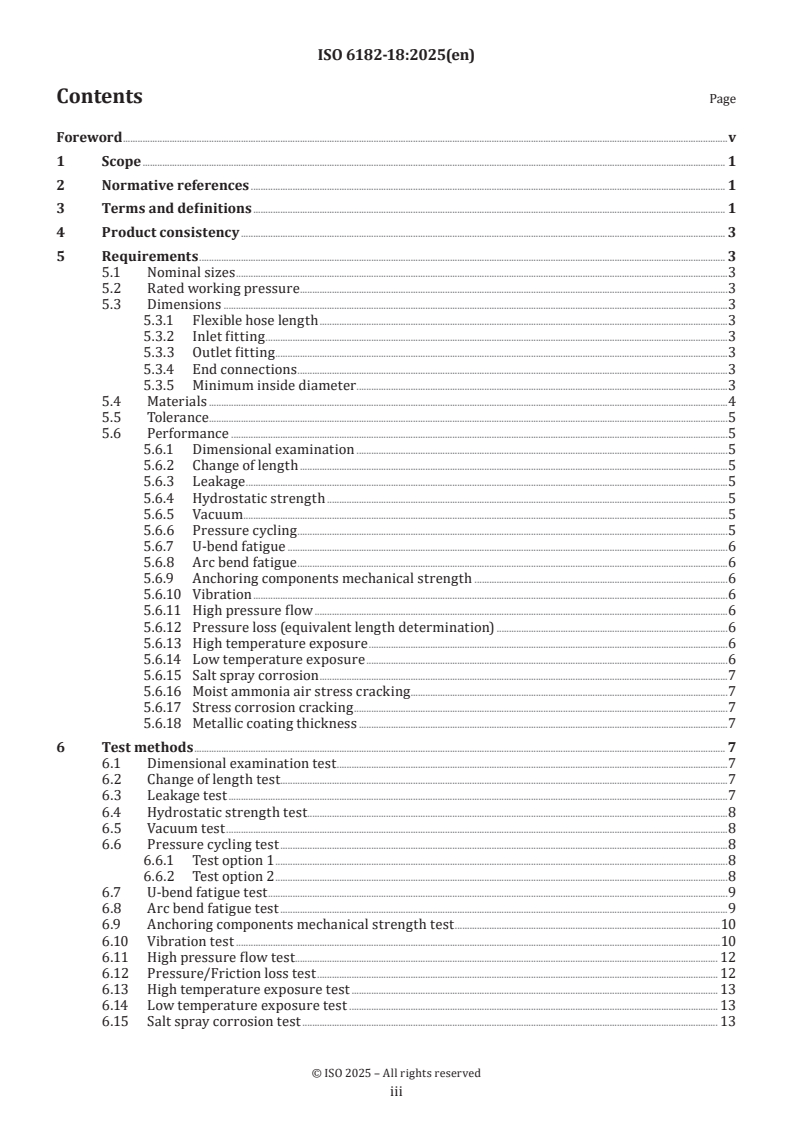
Contents Page
Foreword .v
1 Scope . 1
2 Normative references . 1
3 Terms and definitions . 1
4 Product consistency . 3
5 Requirements . 3
5.1 Nominal sizes .3
5.2 Rated working pressure . .3
5.3 Dimensions .3
5.3.1 Flexible hose length .3
5.3.2 Inlet fitting .3
5.3.3 Outlet fitting .3
5.3.4 End connections .3
5.3.5 Minimum inside diameter .3
5.4 Materials .4
5.5 Tolerance .5
5.6 Performance .5
5.6.1 Dimensional examination .5
5.6.2 Change of length .5
5.6.3 Leakage .5
5.6.4 Hydrostatic strength .5
5.6.5 Vacuum .5
5.6.6 Pressure cycling .5
5.6.7 U-bend fatigue .6
5.6.8 Arc bend fatigue .6
5.6.9 Anchoring components mechanical strength .6
5.6.10 Vibration .6
5.6.11 High pressure flow .6
5.6.12 Pressure loss (equivalent length determination) .6
5.6.13 High temperature exposure .6
5.6.14 Low temperature exposure .6
5.6.15 Salt spray corrosion .7
5.6.16 Moist ammonia air stress cracking .7
5.6.17 Stress corrosion cracking .7
5.6.18 Metallic coating thickness .7
6 Test methods . 7
6.1 Dimensional examination test .7
6.2 Change of length test .7
6.3 Leakage test .7
6.4 Hydrostatic strength test .8
6.5 Vacuum test .8
6.6 Pressure cycling test .8
6.6.1 Test option 1 .8
6.6.2 Test option 2 .8
6.7 U-bend fatigue test .9
6.8 Arc bend fatigue test .9
6.9 Anchoring components mechanical strength test .10
6.10 Vibration test .10
6.11 High pressure flow test . 12
6.12 Pressure/Friction loss test . 12
6.13 High temperature exposure test . 13
6.14 Low temperature exposure test . 13
6.15 Salt spray corrosion test . 13
iii
6.16 Moist ammonia air stress cracking test .14
6.17 Stress corrosion cracking test .14
6.18 Metallic coating thickness test . 15
6.18.1 General . 15
6.18.2 Gravimetric determination of the mass per area . 15
6.18.3 Measurement of coating thickness by X-ray spectrometry . 15
6.18.4 Magnetic determination of coating thickness . 15
6.18.5 Other methods . 15
7 Markings .15
8 Manufacturer’s installation instructions .16
9 Manufacturer’s quality control testing and requirements .16
Annex A (normative) Tolerances . 17
Bibliography .18
iv
Foreword
ISO (the International Organization for Standardization) is a worldwide federation of national standards
bodies (ISO member bodies). The work of preparing International Standards is normally carried out through
ISO technical committees. Each member body interested in a subject for which a technical committee
has been established has the right to be represented on that committee. International organizations,
governmental and non-governmental, in liaison with ISO, also take part in the work. ISO collaborates closely
with the International Electrotechnical Commission (IEC) on all matters of electrotechnical standardization.
The procedures used to develop this document and those intended for its further maintenance are described
in the ISO/IEC Directives, Part 1. In particular, the different approval criteria needed for the different types
of ISO document should be noted. This document was drafted in accordance with the editorial rules of the
ISO/IEC Directives, Part 2 (see www.iso.org/directives).
ISO draws attention to the possibility that the implementation of this document may involve the use of (a)
patent(s). ISO takes no position concerning the evidence, validity or applicability of any claimed patent
rights in respect thereof. As of the date of publication of this document, ISO had not received notice of (a)
patent(s) which may be required to implement this document. However, implementers are cautioned that
this may not represent the latest information, which may be obtained from the patent database available at
www.iso.org/patents. ISO shall not be held responsible for identifying any or all such patent rights.
Any trade name used in this document is information given for the convenience of users and does not
constitute an endorsement.
For an explanation of the voluntary nature of standards, the meaning of ISO specific terms and expressions
related to conformity assessment, as well as information about ISO's adherence to the World Trade
Organization (WTO) principles in the Technical Barriers to Trade (TBT), see www.iso.org/iso/foreword.html.
This document was prepared by Technical Committee ISO/TC 21, Equipment for fire protection and fire
fighting, Subcommittee SC 5, Fixed firefighting systems using water.
A list of all parts in the ISO 6182 series can be found on the ISO website.
Any feedback or questions on this document should be directed to the user’s national standards body. A
complete listing of these bodies can be found at www.iso.org/members.html.
v
International Standard ISO 6182-18:2025(en)
Fire protection — Automatic sprinkler system —
Part 18:
Requirements and test methods for flexible sprinkler hose
1 Scope
This document covers performance, marking requirements and test methods for a flexible sprinkler
hose with fittings, attachments and anchoring components intended for direct connection to a single fire
sprinkler in installations utilizing a flexible attachment to the sprinkler system piping such as clean rooms,
suspended ceilings, and exhaust ducts.
2 Normative references
The following referenced documents are indispensable for the application of this document. For dated
references, only the edition cited applies. For undated references, the latest edition of the referenced
document (including any amendments) applies.
ISO 7-1, Pipe threads where pressure-tight joints are made on the threads — Part 1: Dimensions, tolerances and
designation
ISO 1460, Metallic coatings — Hot dip galvanized coatings on ferrous materials — Gravimetric determination of
the mass per unit area
ISO 2064, Metallic and other inorganic coatings — Definitions and conventions concerning the measurement of
thickness
ISO 2178, Non-magnetic coatings on magnetic substrates — Measurement of coating thickness — Magnetic method
ISO 3497, Metallic coatings — Measurement of coating thickness — X-ray spectrometric methods
ISO 3575, Continuous hot-dip zinc-coated and zinc-iron alloy-coated carbon steel sheet of commercial and
drawing qualities
ISO 4998, Steel sheet, zinc-coated and zinc-iron alloy-coated by the continuous hot-dip process, of structural quality
3 Terms and definitions
For the purposes of this document, the following terms and definitions apply.
ISO and IEC maintain terminology databases for use in standardization at the following addresses:
— ISO Online browsing platform: available at https:// www .iso .org/ obp
— IEC Electropedia: available at https:// www .electropedia .org/
3.1
anchoring device
bracket
component used to connect the outlet fitting to the building structure
3.2
bend
maximum of a 90-degree change in direction of the flexible hose
Note 1 to entry: The bend may be comprised of multiple changes in directions whose sum adds up to 90 degrees or less.
3.3
end connection
method of connecting components of a piping system or an individual sprinkler to the flexible sprinkler hose
3.4
flexible hose
component of a flexible sprinkler hose assembly that consists of a corrugated length of pipe which can be
bent and flexed during installation and during system operation, often encased in braiding or armour
3.5
flexible sprinkler hose assembly
assembly of an inlet fitting, a flexible hose, and an outlet fitting used to connect a sprinkler system to a
sprinkler
3.6
flexible hose with fittings having high flexibility
hose type intended for use where frequent movement between the two ends of the hose is expected after
installation
3.7
limited flexibility
hose type intended for use where little or no movement between the two ends is expected after installation
3.8
flow constant
K
coefficient of discharge as expressed in the formula:
Q
K =
p
where Q is the flow in litres per minute (l/min) and p is the pressure in bar
5 2
Note 1 to entry: 1 bar = 0,1 MPa = 10 Pa; 1 MPa = 1 N/mm .
3.9
hose length
distance from the inlet fitting to the outlet fitting in a flexible sprinkler hose assembly
Note 1 to entry: The distance shall follow the centerline of the assembly.
3.10
inlet fitting
end connection of a flexible sprinkler hose assembly which is used to connect to a sprinkler system, often
threaded or grooved
3.11
minimum bend radius
least distance permitted by the manufacturer as measured from the focal point to the centerline of the hose
3.12
outlet fitting
end connection of a flexible sprinkler hose assembly which is used to connect to a sprinkler, often threaded
and it can be a straight fitting or an elbow fitting
3.13
rated working pressure
maximum service pressure at which the flexible sprinkler hose is intended to operate
4 Product consistency
It shall be the responsibility of the manufacturer to implement a quality control programme to ensure that
production continuously meets the requirements of this document in the same manner as the originally
tested samples.
5 Requirements
5.1 Nominal sizes
The nominal size of a flexible sprinkler hose assembly shall be the nominal diameter of the inlet fitting.
5.2 Rated working pressure
The flexible sprinkler hose assembly shall have a rated working pressure of 1 200 kPa or higher.
5.3 Dimensions
5.3.1 Flexible hose length
The flexible sprinkler hose assembly shall have a maximum length of 2,5 m.
5.3.2 Inlet fitting
The inlet fitting shall have a minimum nominal size of 20 mm.
5.3.3 Outlet fitting
The outlet fitting shall have a minimum nominal size of 15 mm.
5.3.4 End connections
Pipe threads shall be in accordance with ISO 7-1. Other alternative connections shall be in accordance with
International Standards. Where no International Standard applies, national standards may be used where
applicable.
5.3.5 Minimum inside diameter
5.3.5.1 The minimum inside diameter (nominal) of the corrugated hose shall not be less than 19 mm.
5.3.5.2 The minimum inside diameter (nominal) of inlet and outlet fittings in sizes greater than the
nominal 15 mm size shall not be less than 19 mm.
5.3.5.3 The minimum inside diameter (nominal) of outlet fittings in the nominal 15 mm size shall not be
less than 15,8 mm.
5.3.5.4 The largest nominal sprinkler K-factor referenced for use with a hose assembly shall be in
accordance with Table 1.
Table 1 — Minimum hose diameter (nominal) for sprinkler K-factor
Nominal K-factor of attached sprinkler Minimum inside diameter of hose
(l/min)/√bar mm
≤80 19
115 19
160 23
200 25
a
>200 Calculated
a
For sprinklers having a nominal K-factor greater than 200, the inside diameter of the hose shall not create a flow velocity
within the hose greater than 4,6 m/s when flowing water at a 48 kPa inlet pressure at the sprinkler. For example, the flow velocity
through a hose for a sprinkler having a nominal K-factor of 240 shall be calculated based upon a flow of 168 l/min.
5.4 Materials
5.4.1 A pressure retaining part constructed of ferrous metal (not including stainless steel) shall have a
wall thickness of not less than 2,76 mm.
5.4.2 Load carrying anchoring components are permitted to be made of non-metallic materials when
evaluated to provide acceptable performance for the application.
5.4.3 Ferrous metal anchoring devices
5.4.3.1 Ferrous metal anchoring devices having a thickness less than 3 mm shall be protected by a coating
as described below or comply with the salt spray corrosion test in 6.15. Acceptable coatings are as follows:
a) a zinc coating having a minimum thickness of 12,7 μm on all outside surfaces and 7,6 μm on all inside
surfaces; or
b) a Z180 continuous hot-dip zinc-coated steel sheet coating as specified in ISO 4998 or ISO 3575;
c) any other metallic or non-metallic finish or combination of the two which provides corrosion protection
equivalent to that described in a) or b).
5.4.3.2 A flexible sprinkler hose assembly shall be constructed of metallic components, except as
referenced in 5.4.3.3.
5.4.3.3 Gaskets, seals, and interior corrugated hose linings are permitted to be non-metallic.
5.4.3.4 Flexible hose and braiding (if provided) shall be constructed of a material having resistance to
corrosion equivalent to or exceeding that of bronze or series 300 stainless steel.
5.4.3.5 A flexible hose assembly shall be constructed to allow not less than the number of bends specified
in Table 2.
Table 2 — Minimum number of bends
Flexible sprinkler hose assembly length Minimum number of
bends
mm
≤610 1
>610 and ≤915 2
>915 3
5.5 Tolerance
Unless otherwise stated in this document, testing and measurement tolerances shall be in accordance with
Annex A.
5.6 Performance
5.6.1 Dimensional examination
The flexible sprinkler hose assembly, anchoring device, and associated components shall conform to the
manufacturer’s drawings and specifications in accordance with 6.1.
5.6.2 Change of length
A flexible sprinkler hose assembly shall not exceed a 1 % increase or decrease of the assembly’s original
length after an internal hydrostatic pressure of 1,5 times the rated working pressure is applied and released
in accordance with 6.2.
Following the change of length test, the hose assembly shall meet the requirements of 5.6.3.
5.6.3 Leakage
A flexible sprinkler hose assembly shall withstand, without leakage, an internal hydrostatic pressure of
2 times the rated working pressure for 1 min when tested in accordance with 6.3.
5.6.4 Hydrostatic strength
Prior to implementation of the hydrostatic strength test, the flexible sprinkler hose assembly shall meet the
requirements of 5.6.3.
A flexible sprinkler hose assembly shall withstand, without rupture, cracking or physical damage, an internal
hydrostatic pressure of 4 times the rated working pressure for 5 min when tested in accordance with 6.4.
5.6.5 Vacuum
A flexible sprinkler hose assembly shall maintain a vacuum of 660 mm of mercury for a period of 5 min
without leakage when tested in accordance with 6.5.
Following the vacuum
...