

ISO 6182-1:2021
(Main)Fire protection — Automatic sprinkler systems — Part 1: Requirements and test methods for sprinklers
General Information
- Abstract
This document specifies performance and marking requirements and test methods for conventional, spray, flat spray, sidewall, extended coverage, domestic and storage sprinklers, including early suppression fast response (ESFR), electrically activated sprinklers (EAS) and sprinklers with monitoring of activation (SMA) for use in water-based fire protection systems. This document is not applicable to sprinklers with multiple orifices.
- Status
- Published
- Publication Date
- 24-May-2021
- Technical Committee
- ISO/TC 21/SC 5 - Fixed firefighting systems using water
- Drafting Committee
- ISO/TC 21/SC 5/WG 9 - Sprinklers and nozzles
- Current Stage
- 9060 - Close of review
- Completion Date
- 02-Dec-2031
Buy Documents

ISO 6182-1:2021 - Fire protection -- Automatic sprinkler systems

ISO 6182-1:2021 - Fire protection — Automatic sprinkler systems — Part 1: Requirements and test methods for sprinklers/20/2021
Overview
ISO 6182-1:2021 - Fire protection - Automatic sprinkler systems - Part 1: Requirements and test methods for sprinklers - specifies performance and marking requirements and test methods for a wide range of water-based sprinklers. It applies to conventional, spray, flat spray, sidewall, extended coverage, domestic and storage sprinklers, including ESFR (early suppression fast response), electrically activated sprinklers (EAS) and sprinklers with monitoring of activation (SMA). The standard is not applicable to sprinklers with multiple orifices.
Keywords: ISO 6182-1:2021, automatic sprinkler systems, fire protection, sprinkler requirements, sprinkler test methods, ESFR, EAS, SMA.
Key topics and requirements
ISO 6182-1:2021 covers technical requirements and test procedures across the product lifecycle:
- Product consistency & quality control: manufacturer quality programmes, leak resistance and glass-bulb integrity checks.
- Product assembly & components: dynamic seals, rated pressure, dry-sprinkler features and escutcheons.
- Performance requirements: maximum coverage/spacing, temperature ratings and colour coding, service loads and mechanical strength.
- Heat-responsive elements: strength and integrity tests for glass bulb and fusible elements; thermal shock and heat exposure.
- Sensitivity & response: Response Time Index (RTI) pre- and post-exposure, room-response and plunge tests for flush/concealed sprinklers.
- Hydraulic & distribution characteristics: water flow constant, K-factors, spray patterns, lateral discharge, water shield angle and thrust for ESFR models (K202, K242).
- Durability & environmental resistance: leak/hydrostatic tests, vacuum, water hammer, vibration, impact, freezing, corrosion (salt spray, sulphur dioxide, hydrogen sulphide), and coating behaviour.
- Fire performance testing: standardized fire tests for spray, domestic, extended coverage and storage sprinklers, including ESFR variants.
- Electrical characteristics: requirements for electrically activated and monitored sprinklers (EAS/SMA).
- Test methods: detailed test procedures (visual, mechanical load, leakage, corrosion, fire tests and more) are specified in Clause 7.
Applications - who uses this standard
ISO 6182-1:2021 is essential for:
- Sprinkler manufacturers - design verification, product certification and marking.
- Independent testing laboratories - performing standardized mechanical, hydraulic and fire performance tests.
- Fire protection engineers & specifiers - selecting compliant sprinklers for building designs.
- Authorities having jurisdiction, insurers and standards bodies - evaluating compliance and safety equivalence.
- Installers and maintenance organizations - understanding product limits, temperature ratings and testing requirements.
Related standards
- ISO 6182 series (other parts of the automatic sprinkler systems standards) and national/regional codes for water-based fire suppression (refer to local authorities for harmonized requirements).
This summary helps stakeholders quickly find relevant technical requirements and test methods in ISO 6182-1:2021 when specifying, testing or certifying sprinklers for water-based fire protection systems.
Relations
- Effective Date
- 06-Jun-2022
- Effective Date
- 23-Sep-2017
Buy Documents
ISO 6182-1:2021 - Fire protection -- Automatic sprinkler systems
ISO 6182-1:2021 - Fire protection — Automatic sprinkler systems — Part 1: Requirements and test methods for sprinklers/20/2021
Get Certified
Connect with accredited certification bodies for this standard

CIS Institut d.o.o.
Personal Protective Equipment (PPE) certification body. Notified Body NB-2890 for EU Regulation 2016/425 PPE.

Kiwa BDA Testing
Building and construction product certification.
Kmetijski inštitut Slovenije
Agricultural Institute of Slovenia. Soil testing, plant health, agricultural product analysis.
Sponsored listings
Frequently Asked Questions
ISO 6182-1:2021 is a standard published by the International Organization for Standardization (ISO). Its full title is "Fire protection — Automatic sprinkler systems — Part 1: Requirements and test methods for sprinklers". This standard covers: This document specifies performance and marking requirements and test methods for conventional, spray, flat spray, sidewall, extended coverage, domestic and storage sprinklers, including early suppression fast response (ESFR), electrically activated sprinklers (EAS) and sprinklers with monitoring of activation (SMA) for use in water-based fire protection systems. This document is not applicable to sprinklers with multiple orifices.
This document specifies performance and marking requirements and test methods for conventional, spray, flat spray, sidewall, extended coverage, domestic and storage sprinklers, including early suppression fast response (ESFR), electrically activated sprinklers (EAS) and sprinklers with monitoring of activation (SMA) for use in water-based fire protection systems. This document is not applicable to sprinklers with multiple orifices.
ISO 6182-1:2021 is classified under the following ICS (International Classification for Standards) categories: 13.220.20 - Fire protection. The ICS classification helps identify the subject area and facilitates finding related standards.
ISO 6182-1:2021 has the following relationships with other standards: It is inter standard links to ISO 7012-3:2025, ISO 6182-1:2014. Understanding these relationships helps ensure you are using the most current and applicable version of the standard.
ISO 6182-1:2021 is available in PDF format for immediate download after purchase. The document can be added to your cart and obtained through the secure checkout process. Digital delivery ensures instant access to the complete standard document.
Standards Content (Sample)
INTERNATIONAL ISO
STANDARD 6182-1
Fourth edition
2021-05
Corrected version
2021-08
Fire protection — Automatic sprinkler
systems —
Part 1:
Requirements and test methods for
sprinklers
Protection contre l'incendie — Systèmes d'extinction automatiques du
type sprinkler —
Partie 1: Prescriptions et méthodes d'essai des sprinklers
Reference number
©
ISO 2021
© ISO 2021
All rights reserved. Unless otherwise specified, or required in the context of its implementation, no part of this publication may
be reproduced or utilized otherwise in any form or by any means, electronic or mechanical, including photocopying, or posting
on the internet or an intranet, without prior written permission. Permission can be requested from either ISO at the address
below or ISO’s member body in the country of the requester.
ISO copyright office
CP 401 • Ch. de Blandonnet 8
CH-1214 Vernier, Geneva
Phone: +41 22 749 01 11
Email: copyright@iso.org
Website: www.iso.org
Published in Switzerland
ii © ISO 2021 – All rights reserved
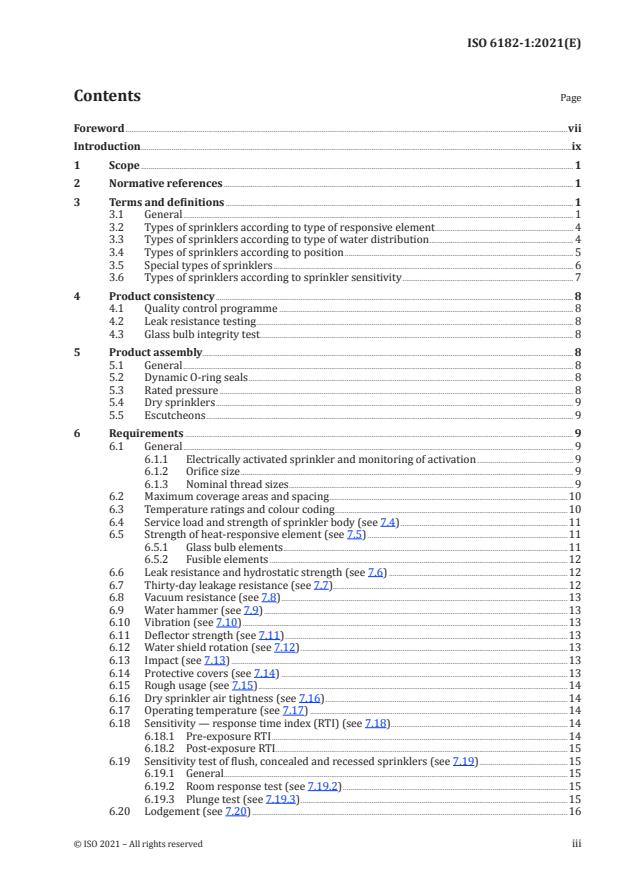
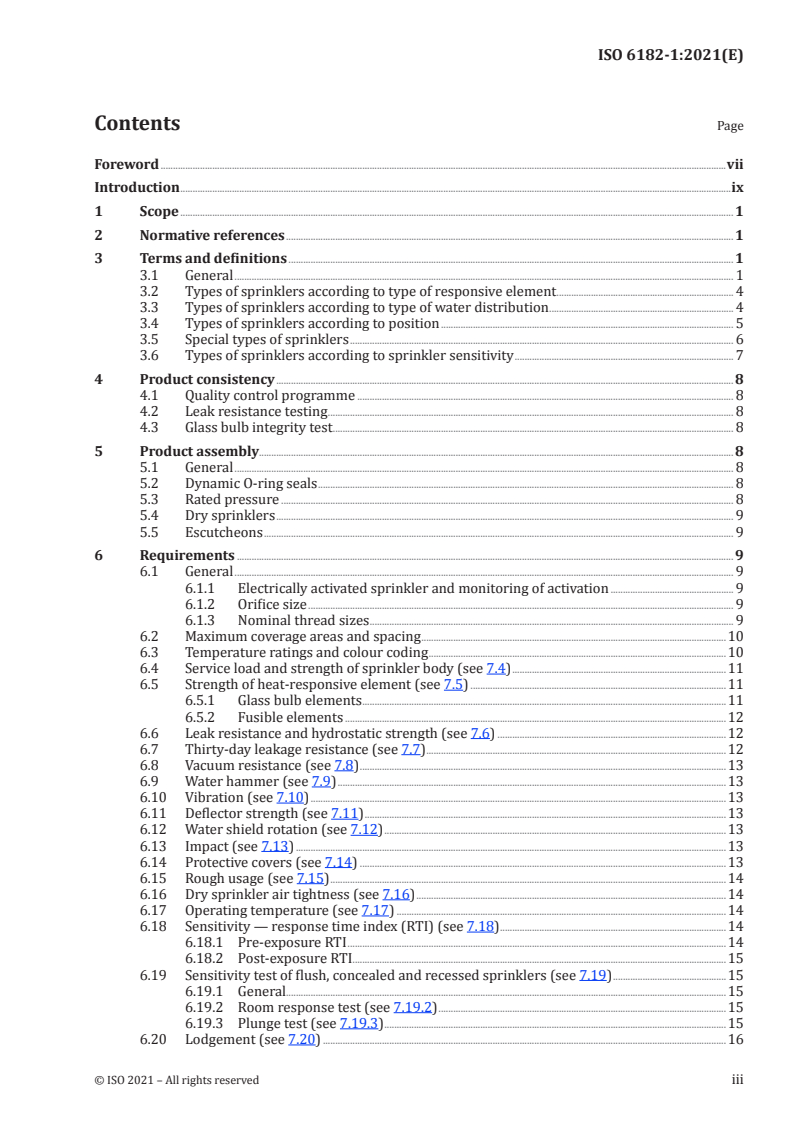
Contents Page
Foreword .vii
Introduction .ix
1 Scope . 1
2 Normative references . 1
3 Terms and definitions . 1
3.1 General . 1
3.2 Types of sprinklers according to type of responsive element . 4
3.3 Types of sprinklers according to type of water distribution . 4
3.4 Types of sprinklers according to position . 5
3.5 Special types of sprinklers . 6
3.6 Types of sprinklers according to sprinkler sensitivity . 7
4 Product consistency . 8
4.1 Quality control programme . 8
4.2 Leak resistance testing . 8
4.3 Glass bulb integrity test . 8
5 Product assembly. 8
5.1 General . 8
5.2 Dynamic O-ring seals . 8
5.3 Rated pressure . 8
5.4 Dry sprinklers . 9
5.5 Escutcheons . 9
6 Requirements . 9
6.1 General . 9
6.1.1 Electrically activated sprinkler and monitoring of activation . 9
6.1.2 Orifice size . 9
6.1.3 Nominal thread sizes . 9
6.2 Maximum coverage areas and spacing .10
6.3 Temperature ratings and colour coding .10
6.4 Service load and strength of sprinkler body (see 7.4) .11
6.5 Strength of heat-responsive element (see 7.5) .11
6.5.1 Glass bulb elements . .11
6.5.2 Fusible elements .12
6.6 Leak resistance and hydrostatic strength (see 7.6) .12
6.7 Thirty-day leakage resistance (see 7.7) .12
6.8 Vacuum resistance (see 7.8) .13
6.9 Water hammer (see 7.9) .13
6.10 Vibration (see 7.10) .13
6.11 Deflector strength (see 7.11) .13
6.12 Water shield rotation (see 7.12) .13
6.13 Impact (see 7.13) .13
6.14 Protective covers (see 7.14) .13
6.15 Rough usage (see 7.15) .14
6.16 Dry sprinkler air tightness (see 7.16) .14
6.17 Operating temperature (see 7.17) .14
6.18 Sensitivity — response time index (RTI) (see 7.18) .14
6.18.1 Pre-exposure RTI .14
6.18.2 Post-exposure RTI . .15
6.19 Sensitivity test of flush, concealed and recessed sprinklers (see 7.19) .15
6.19.1 General.15
6.19.2 Room response test (see 7.19.2) .15
6.19.3 Plunge test (see 7.19.3) .15
6.20 Lodgement (see 7.20) .16
6.21 Heat exposure (see 7.21) .17
6.21.1 Glass bulb sprinklers .17
6.21.2 All sprinklers .17
6.21.3 Coated sprinklers .17
6.22 Sprinkler coatings (see 7.22) .17
6.22.1 Evaporation of wax and bitumen .17
6.22.2 Resistance to low temperatures .17
6.23 Thermal shock for glass bulb sprinklers (see 7.23) .17
6.24 Resistance to heat (see 7.24) .17
6.25 Freezing test (see 7.25) .17
6.26 Corrosion (see 7.26) .18
6.26.1 Stress corrosion for copper-based alloy components (see 7.26.1) .18
6.26.2 Stress corrosion for stainless steel components (see 7.26.2) .18
6.26.3 Sulphur dioxide/carbon dioxide corrosion (see 7.26.3) .18
6.26.4 Hydrogen sulphide corrosion (see 7.26.4) .18
6.26.5 Salt spray loading (see 7.26.5) .18
6.26.6 Moist air exposure (see 7.26.6) .19
6.26.7 Dry-type sprinkler deposit loading (see 7.26.7) .19
6.26.8 Dezincification of brass parts (see 7.26.8) .19
6.27 Water flow constant (see 7.27) .19
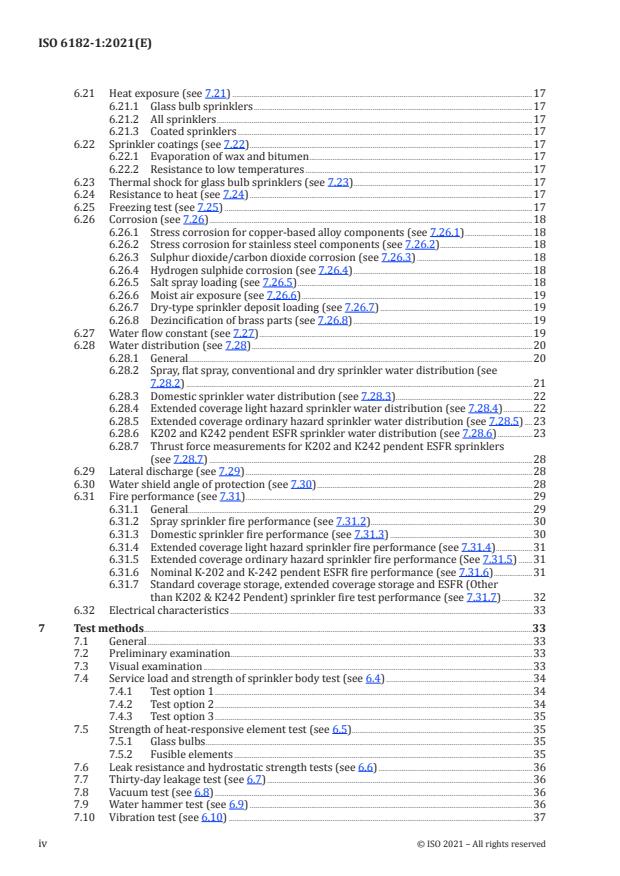
6.28 Water distribution (see 7.28) .20
6.28.1 General.20
6.28.2 Spray, flat spray, conventional and dry sprinkler water distribution (see
7.28.2) .21
6.28.3 Domestic sprinkler water distribution (see 7.28.3) .22
6.28.4 Extended coverage light hazard sprinkler water distribution (see 7.28.4) .22
6.28.5 Extended coverage ordinary hazard sprinkler water distribution (see 7.28.5) .23
6.28.6 K202 and K242 pendent ESFR sprinkler water distribution (see 7.28.6) .23
6.28.7 Thrust force measurements for K202 and K242 pendent ESFR sprinklers
(see 7.28.7) .28
6.29 Lateral discharge (see 7.29) .28
6.30 Water shield angle of protection (see 7.30) .28
6.31 Fire performance (see 7.31) .29
6.31.1 General.29
6.31.2 Spray sprinkler fire performance (see 7.31.2) .30
6.31.3 Domestic sprinkler fire performance (see 7.31.3) .30
6.31.4 Extended coverage light hazard sprinkler fire performance (see 7.31.4).31
6.31.5 Extended coverage ordinary hazard sprinkler fire performance (See 7.31.5) .31
6.31.6 Nominal K-202 and K-242 pendent ESFR fire performance (see 7.31.6) .31
6.31.7 Standard coverage storage, extended coverage storage and ESFR (Other
than K202 & K242 Pendent) sprinkler fire test performance (see 7.31.7) .32
6.32 Electrical characteristics .33
7 Test methods .33
7.1 General .33
7.2 Preliminary examination . .33
7.3 Visual examination .33
7.4 Service load and strength of sprinkler body test (see 6.4) .34
7.4.1 Test option 1 .34
7.4.2 Test option 2 .34
7.4.3 Test option 3 .35
7.5 Strength of heat-responsive element test (see 6.5).35
7.5.1 Glass bulbs .35
7.5.2 Fusible elements .35
7.6 Leak resistance and hydrostatic strength tests (see 6.6) .36
7.7 Thirty-day leakage test (see 6.7) .36
7.8 Vacuum test (see 6.8) .36
7.9 Water hammer test (see 6.9) .36
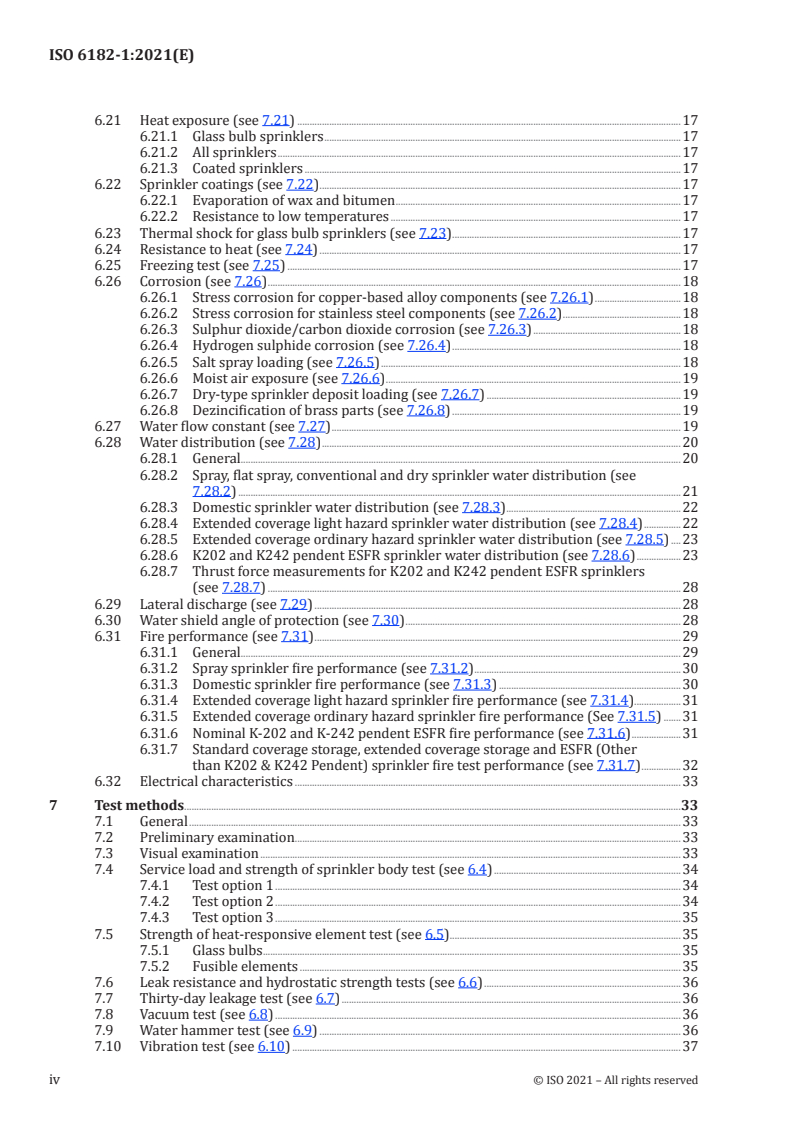
7.10 Vibration test (see 6.10) .37
iv © ISO 2021 – All rights reserved
7.11 Deflector strength test (see 6.11) .37
7.12 Water shield rotation test (see 6.12) .37
7.13 Impact (see 6.13) .37
7.14 Protective cover impact test for glass bulb sprinklers (see 6.14) .38
7.15 Rough usage test (see 6.15) .39
7.16 Dry sprinkler air tightness test (see 6.16) .40
7.17 Operating temperature tests (see 6.17) .41
7.17.1 Liquid test .41
7.17.2 Air test .42
7.18 Sensitivity test — response time index (RTI) (see 6.18) .43
7.18.1 Plunge test .43
7.18.2 Response time index (RTI) calculation .44
7.19 Sensitivity test for flush, concealed and recessed sprinklers (see 6.19).44
7.19.1 General.44
7.19.2 Room response test .44
7.19.3 Plunge test .49
7.20 Lodgement test (see 6.20).52
7.21 Heat exposure test (see 6.21) .55
7.21.1 Glass bulb sprinklers (see 6.21.1) .55
7.21.2 All sprinklers (see 6.21.2) .55
7.21.3 Coated sprinklers (see 6.21.3) .55
7.22 Sprinkler coatings (see 6.22) .56
7.22.1 Evaporation of wax and bitumen test (see 6.22.1) .56
7.22.2 Low temperature test (see 6.22.2) .56
7.23 Thermal shock test for glass bulb sprinklers (see 6.23) .56
7.24 Resistance to heat test (see 6.24) .56
7.25 Freezing (see 6.25) .57
7.26 Corrosion tests (see 6.26) .57
7.26.1 Stress corrosion test for copper-based alloy components (see 6.26.1) .57
7.26.2 Stress corrosion for stainless steel components (see 6.26.2) .57
7.26.3 Sulphur dioxide/carbon dioxide corrosion test (see 6.26.3) .58
7.26.4 Hydrogen sulphide corrosion test (see 6.26.4) .58
7.26.5 Salt spray loading test (see 6.26.5) .59
7.26.6 Moist air exposure (see 6.27.6) .59
7.26.7 Dry-type sprinkler deposit loading test (see 6.26.7) .59
7.26.8 Dezincification of brass components (see 6.26.8) .60
7.27 Water flow constant (see 6.27) .61
7.28 Water distribution tests (see 6.28).62
7.28.1 General.62
7.28.2 Spray, flat spray, conventional and dry sprinklers (see 6.28.2) .62
7.28.3 Domestic sprinklers (see 6.28.3) .70
7.28.4 Extended coverage light hazard sprinklers (see 6.28.4) .74
7.28.5 Extended coverage ordinary hazard sprinklers (see 6.28.5) .80
7.28.6 K202 and K242 pendent ESFR sprinklers (see 6.28.6) .80
7.28.7 Thrust force test (see 6.28.7) .85
7.29 Lateral discharge test (see 6.29) .86
7.29.1 General.86
7.29.2 Upright and pendent sprinklers .86
7.29.3 Sidewall sprinklers .87
7.29.4 Exposure to heat and flame .87
7.29.5 Consumption of heptane .87
7.30 Water shield angle of protection (see 6.30) .87
7.31 Fire performance (see 6.31) .88
7.31.1 General.88
7.31.2 Spray sprinkler fire performance .88
7.31.3 Domestic sprinkler fire performance (see 6.31.3) .91
7.31.4 Extended coverage light hazard sprinkler fire performance (see 6.31.4).99
7.31.5 Extended coverage ordinary hazard sprinkler fire performance (see 6.31.5) .102
7.31.6 Actual delivered density (nominal K-202 and K-242 pendent ESFR fire
performance) (see 6.31.6) .103
7.31.7 Standard coverage storage, extended coverage storage and ESFR (other
than K202 & K242 pendent) sprinkler fire test performance (see 6.31.7) .104
7.32 Electrical characteristics .106
7.32.1 Starting current and response time (see 6.32.1) .106
7.32.2 Monitoring current (see 6.32.2) .106
7.32.3 Wires (6.32.3) .106
8 Marking .106
8.1 Sprinklers .106
8.2 Sprinkler housings and concealed-sprinkler cover plates .108
8.3 Protective covers .108
9 Manufacturer’s installation instructions .108
Annex A (normative) Tolerance limit calculation methods .111
Annex B (informative) Analysis of the strength test for fusible element .113
Annex C (normative) Tolerances .114
Annex D (informative) Standard test commodities and fire test configurations .115
Annex E (informative) Fire test arrangements for extended coverage ordinary hazard .119
Annex F (informative) Statistical tolerance limits .122
Bibliography .125
vi © ISO 2021 – All rights reserved
Foreword
ISO (the International Organization for Standardization) is a worldwide federation of national standards
bodies (ISO member bodies). The work of preparing International Standards is normally carried out
through ISO technical committees. Each member body interested in a subject for which a technical
committee has been established has the right to be represented on that committee. International
organizations, governmental and non-governmental, in liaison with ISO, also take part in the work.
ISO collaborates closely with the International Electrotechnical Commission (IEC) on all matters of
electrotechnical standardization.
The procedures used to develop this document and those intended for its further maintenance are
described in the ISO/IEC Directives, Part 1. In particular, the different approval criteria needed for the
different types of ISO documents should be noted. This document was drafted in accordance with the
editorial rules of the ISO/IEC Directives, Part 2 (see www .iso .org/ directives).
Attention is drawn to the possibility that some of the elements of this document may be the subject of
patent rights. ISO shall not be held responsible for identifying any or all such patent rights. Details of
any patent rights identified during the development of the document will be in the Introduction and/or
on the ISO list of patent declarations received (see www .iso .org/ patents).
Any trade name used in this document is information given for the convenience of users and does not
constitute an endorsement.
For an explanation of the voluntary nature of standards, the meaning of ISO specific terms and
expressions related to conformity assessment, as well as information about ISO's adherence to the
World Trade Organization (WTO) principles in the Technical barriers to Trade (TBT), see www .iso .org/
iso/ foreword .html.
This document was prepared by Technical Committee ISO/TC 21, Equipment for fire protection and fire
fighting, Subcommittee SC 5, Fixed firefighting systems using water.
This fourth edition cancels and replaces the third edition (ISO 6182-1:2014) which has been technically
revised.
The main changes compared to the previous edition are as follows:
— Consolidation of the requirements for early suppression fast response (ESFR) sprinklers
(ISO 6182-7:2020), domestic sprinklers (ISO 6182-10:2014) and extended coverage sprinklers
(ISO 6182-13:2017) into a single document.
— Increased harmonization of test methods and requirements for the different types of sprinklers.
— Expanded scope to include extended coverage sprinklers for ordinary hazard occupancies and large
flow constant, K, storage type sprinklers.
— New water distribution and fire test methods as well as requirements for the additional sprinkler
technologies.
— New requirements for electrically operated style sprinklers.
A list of all parts in the ISO 6182 series can be found on the ISO website.
Any feedback or questions on this document should be directed to the user’s national standards body. A
complete listing of these bodies can be found at www .iso .org/ members .html.
This corrected version of ISO 6182-1:2021 incorporates the following corrections:
— Correction of error in column 1, second row of Table 11 and column 1, final row of Table 12.
— First column heading in Table 22 and Table 23 changed from "Flow constant, K" to "Nominal flow
constant, K".
a b
— Corrections to key elements and in Figure 27 (addition of the phrase "divided by 2").
a
— Correction to key element in Figure 28 (addition of the phrase "divided by 2").
— Figure 32 and Figure 42 reduced in size for formatting purposes.
— Two subfigures added to Figure 46 and key corrected.
— Corrections to whole key of Figure D.1.
— The term "K-factor" replaced by "flow constant, K," throughout.
viii © ISO 2021 – All rights reserved
Introduction
This document includes requirements for conventional, spray, flat spray, sidewall, extended coverage,
domestic and storage sprinklers, including early suppression fast response (ESFR) sprinklers,
electrically activated sprinklers (EAS) and sprinklers with monitoring of activation (SMA).
Conventional sprinklers are the oldest of the fire sprinkler technologies. These sprinklers discharge
water in a spherical discharge pattern such that 40 % to 60 % of the total water flow is initially
discharged in the downward direction. In general, the use of this sprinkler technology is limited to
applications where this discharge characteristic has been determined to be more effective than the
spray sprinkler.
Spray sprinklers were developed in the 1950s and are used to provide fire protection for a wide range
of fire risks, including those found in light hazard, ordinary hazard and extra hazard occupancies, as
well as storage facilities.
Flat spray sprinklers have a wider spray angle than spray sprinklers and are generally limited to use in
spaces with low clearances and storage racks in specific geographic regions.
Domestic sprinklers are intended to provide control of fires in domestic occupancies, to prevent
flashover (total involvement) in the room of fire origin and to improve the probability for successful
escape or evacuation of the occupants.
Extended coverage light hazard sprinklers are intended to provide control of fires in occupancies or
portions of occupancies where quantity and/or combustibility of contents is low, such as office spaces.
Extended coverage ordinary hazard sprinklers are intended to provide control of fires in occupancies
or portions of occupancies where quantity and/or combustibility of contents is moderate to high, such
as mercantile areas.
Storage sprinklers, including ESFR sprinklers, are primarily intended to be used to provide fire
protection for storage facilities.
Electrically activated sprinklers make it possible to activate more than one sprinkler simultaneously.
Sprinklers with monitoring of activation make it possible to detect the location of an actuated sprinkler.
INTERNATIONAL STANDARD ISO 6182-1:2021(E)
Fire protection — Automatic sprinkler systems —
Part 1:
Requirements and test methods for sprinklers
1 Scope
This document specifies performance and marking requirements and test methods for conventional,
spray, flat spray, sidewall, extended coverage, domestic and storage sprinklers, including early
suppression fast response (ESFR), electrically activated sprinklers (EAS) and sprinklers with
monitoring of activation (SMA) for use in water-based fire protection systems. This document is not
applicable to sprinklers with multiple orifices.
2 Normative references
The following documents are referred to in the text in such a way that some or all of their content
constitutes requirements of this document. For dated references, only the edition cited applies. For
undated references, the latest edition of the referenced document (including any amendments) applies.
ISO 7-1, Pipe threads where pressure-tight joints are made on the threads — Part 1: Dimensions, tolerances
and designation
ISO 5660-1, Reaction-to-fire tests — Heat release, smoke production and mass loss rate — Part 1: Heat
release rate (cone calorimeter method) and smoke production rate (dynamic measurement)
3 Terms and definitions
For the purposes of this document, the following terms and definitions apply.
ISO and IEC maintain terminological databases for use in standardization at the following addresses:
— ISO Online browsing platform: available at https:// www .iso .org/ obp
— IEC Electropedia: available at http:// www .electropedia .org/
3.1 General
3.1.1
actual delivered density
ADD
rate at which water is deposited from an operating sprinkler (3.1.13) onto the top horizontal surface of a
simulated burning combustible array
3.1.2
assembly load
force exerted on the sprinkler body excluding hydrostatic pressure
3.1.3
average design strength
glass bulb supplier’s specified and assured lowest average axial design strength of any batch of 50 bulbs
3.1.4
coverage length
maximum length of the sprinkler coverage area
3.1.5
coverage width
maximum width of the sprinkler coverage area
3.1.6
design load
force exerted on the release element at the service load (3.1.12) of the sprinkler (3.1.13)
3.1.7
housing assembly
escutcheon
ornamental or protective component(s) around the hole from which the sprinkler (3.1.13) penetrates
the plane of the ceiling or the wall
Note 1 to entry: See Figure 3.
Note 2 to entry: For the purposes of this document, housing applies to recessed and concealed sprinklers (3.5.2).
3.1.8
orientation A
orientation with the airflow perpendicular to both the waterway axis and the plane of the frame arms
and with the heat responsive element upstream of the frame arms
Note 1 to entry: See Figure 1.
Key
1 tunnel test section (elevation view)
a
Airflow.
Figure 1 — Orientation A
3.1.9
orientation B
orientation with the airflow perpendicular to both the waterway axis and the plane of the frame arms
and with the heat responsive element downstream of the frame arms
Note 1 to entry: See Figure 2.
2 © ISO 2021 – All rights reserved
Key
1 tunnel test section (elevation view)
a
Airflow.
Figure 2 — Orientation B
3.1.10
protective covers
protective caps or straps intended to provide temporary protection for sprinklers (3.1.13) during
shipping, handling and installation
3.1.11
response time index
RTI
measure of sprinkler sensitivity determined by Formula (1)
RTIt = u (1)
where
t is equal to the time constant, in seconds, of the heat-responsive element;
u is the gas velocity, in meters per second.
0,5
Note 1 to entry: The response time index is expressed in units of (m∙s) .
3.1.12
service load
combined force exerted on the sprinkler body by the assembly load (3.1.2) of the sprinkler (3.1.13) and
the equivalent force of the rated pressure on the inlet
3.1.13
sprinkler
thermosensitive device designed to react at a predetermined temperature by automatically releasing a
stream of water and distributing it in a specified pattern and quantity over a designated area
Note 1 to entry: These devices may sometimes be referred to as a sprinkler head.
3.1.14
standard orientation
orientation that produces the shortest response time with the axis of the sprinkler inlet perpendicular
to the airflow
Note 1 to entry: In the case of symmetrical heat-responsive elements, standard orientation is with the airflow
perpendicular to both the axis of the waterway and the plane of the frame arms; in the case of non-symmetrical
heat-responsive elements, it is with the airflow perpendicular to both the waterway axis and the plane of the
frame arms which produces the shortest response time.
3.2 Types of sprinklers according to type of responsive element
3.2.1
electrically activated sprinkler
EAS
sprinkler (3.1.13) that is equipped with an integral means of activation using electricity
3.2.2
sprinklers with monitoring of activation
SMA
sprinkler (3.1.13) that is equipped with an integral means of monitoring of activation using electricity
3.2.3
electrically activated sprinkler with monitoring of activation
EAS-M
sprinkler (3.1.13) that is equipped with an integral means of activation using electricity and monitoring
of activation
3.2.4
fusible element sprinkler
sprinkler (3.1.13) that opens under the influence of heat by the melting of a component
3.2.5
glas
...
INTERNATIONAL ISO
STANDARD 6182-1
Fourth edition
2021-05
Corrected version
2021-08
Fire protection — Automatic sprinkler
systems —
Part 1:
Requirements and test methods for
sprinklers
Protection contre l'incendie — Systèmes d'extinction automatiques du
type sprinkler —
Partie 1: Prescriptions et méthodes d'essai des sprinklers
Reference number
©
ISO 2021
© ISO 2021
All rights reserved. Unless otherwise specified, or required in the context of its implementation, no part of this publication may
be reproduced or utilized otherwise in any form or by any means, electronic or mechanical, including photocopying, or posting
on the internet or an intranet, without prior written permission. Permission can be requested from either ISO at the address
below or ISO’s member body in the country of the requester.
ISO copyright office
CP 401 • Ch. de Blandonnet 8
CH-1214 Vernier, Geneva
Phone: +41 22 749 01 11
Email: copyright@iso.org
Website: www.iso.org
Published in Switzerland
ii © ISO 2021 – All rights reserved
Contents Page
Foreword .vii
Introduction .ix
1 Scope . 1
2 Normative references . 1
3 Terms and definitions . 1
3.1 General . 1
3.2 Types of sprinklers according to type of responsive element . 4
3.3 Types of sprinklers according to type of water distribution . 4
3.4 Types of sprinklers according to position . 5
3.5 Special types of sprinklers . 6
3.6 Types of sprinklers according to sprinkler sensitivity . 7
4 Product consistency . 8
4.1 Quality control programme . 8
4.2 Leak resistance testing . 8
4.3 Glass bulb integrity test . 8
5 Product assembly. 8
5.1 General . 8
5.2 Dynamic O-ring seals . 8
5.3 Rated pressure . 8
5.4 Dry sprinklers . 9
5.5 Escutcheons . 9
6 Requirements . 9
6.1 General . 9
6.1.1 Electrically activated sprinkler and monitoring of activation . 9
6.1.2 Orifice size . 9
6.1.3 Nominal thread sizes . 9
6.2 Maximum coverage areas and spacing .10
6.3 Temperature ratings and colour coding .10
6.4 Service load and strength of sprinkler body (see 7.4) .11
6.5 Strength of heat-responsive element (see 7.5) .11
6.5.1 Glass bulb elements . .11
6.5.2 Fusible elements .12
6.6 Leak resistance and hydrostatic strength (see 7.6) .12
6.7 Thirty-day leakage resistance (see 7.7) .12
6.8 Vacuum resistance (see 7.8) .13
6.9 Water hammer (see 7.9) .13
6.10 Vibration (see 7.10) .13
6.11 Deflector strength (see 7.11) .13
6.12 Water shield rotation (see 7.12) .13
6.13 Impact (see 7.13) .13
6.14 Protective covers (see 7.14) .13
6.15 Rough usage (see 7.15) .14
6.16 Dry sprinkler air tightness (see 7.16) .14
6.17 Operating temperature (see 7.17) .14
6.18 Sensitivity — response time index (RTI) (see 7.18) .14
6.18.1 Pre-exposure RTI .14
6.18.2 Post-exposure RTI . .15
6.19 Sensitivity test of flush, concealed and recessed sprinklers (see 7.19) .15
6.19.1 General.15
6.19.2 Room response test (see 7.19.2) .15
6.19.3 Plunge test (see 7.19.3) .15
6.20 Lodgement (see 7.20) .16
6.21 Heat exposure (see 7.21) .17
6.21.1 Glass bulb sprinklers .17
6.21.2 All sprinklers .17
6.21.3 Coated sprinklers .17
6.22 Sprinkler coatings (see 7.22) .17
6.22.1 Evaporation of wax and bitumen .17
6.22.2 Resistance to low temperatures .17
6.23 Thermal shock for glass bulb sprinklers (see 7.23) .17
6.24 Resistance to heat (see 7.24) .17
6.25 Freezing test (see 7.25) .17
6.26 Corrosion (see 7.26) .18
6.26.1 Stress corrosion for copper-based alloy components (see 7.26.1) .18
6.26.2 Stress corrosion for stainless steel components (see 7.26.2) .18
6.26.3 Sulphur dioxide/carbon dioxide corrosion (see 7.26.3) .18
6.26.4 Hydrogen sulphide corrosion (see 7.26.4) .18
6.26.5 Salt spray loading (see 7.26.5) .18
6.26.6 Moist air exposure (see 7.26.6) .19
6.26.7 Dry-type sprinkler deposit loading (see 7.26.7) .19
6.26.8 Dezincification of brass parts (see 7.26.8) .19
6.27 Water flow constant (see 7.27) .19
6.28 Water distribution (see 7.28) .20
6.28.1 General.20
6.28.2 Spray, flat spray, conventional and dry sprinkler water distribution (see
7.28.2) .21
6.28.3 Domestic sprinkler water distribution (see 7.28.3) .22
6.28.4 Extended coverage light hazard sprinkler water distribution (see 7.28.4) .22
6.28.5 Extended coverage ordinary hazard sprinkler water distribution (see 7.28.5) .23
6.28.6 K202 and K242 pendent ESFR sprinkler water distribution (see 7.28.6) .23
6.28.7 Thrust force measurements for K202 and K242 pendent ESFR sprinklers
(see 7.28.7) .28
6.29 Lateral discharge (see 7.29) .28
6.30 Water shield angle of protection (see 7.30) .28
6.31 Fire performance (see 7.31) .29
6.31.1 General.29
6.31.2 Spray sprinkler fire performance (see 7.31.2) .30
6.31.3 Domestic sprinkler fire performance (see 7.31.3) .30
6.31.4 Extended coverage light hazard sprinkler fire performance (see 7.31.4).31
6.31.5 Extended coverage ordinary hazard sprinkler fire performance (See 7.31.5) .31
6.31.6 Nominal K-202 and K-242 pendent ESFR fire performance (see 7.31.6) .31
6.31.7 Standard coverage storage, extended coverage storage and ESFR (Other
than K202 & K242 Pendent) sprinkler fire test performance (see 7.31.7) .32
6.32 Electrical characteristics .33
7 Test methods .33
7.1 General .33
7.2 Preliminary examination . .33
7.3 Visual examination .33
7.4 Service load and strength of sprinkler body test (see 6.4) .34
7.4.1 Test option 1 .34
7.4.2 Test option 2 .34
7.4.3 Test option 3 .35
7.5 Strength of heat-responsive element test (see 6.5).35
7.5.1 Glass bulbs .35
7.5.2 Fusible elements .35
7.6 Leak resistance and hydrostatic strength tests (see 6.6) .36
7.7 Thirty-day leakage test (see 6.7) .36
7.8 Vacuum test (see 6.8) .36
7.9 Water hammer test (see 6.9) .36
7.10 Vibration test (see 6.10) .37
iv © ISO 2021 – All rights reserved
7.11 Deflector strength test (see 6.11) .37
7.12 Water shield rotation test (see 6.12) .37
7.13 Impact (see 6.13) .37
7.14 Protective cover impact test for glass bulb sprinklers (see 6.14) .38
7.15 Rough usage test (see 6.15) .39
7.16 Dry sprinkler air tightness test (see 6.16) .40
7.17 Operating temperature tests (see 6.17) .41
7.17.1 Liquid test .41
7.17.2 Air test .42
7.18 Sensitivity test — response time index (RTI) (see 6.18) .43
7.18.1 Plunge test .43
7.18.2 Response time index (RTI) calculation .44
7.19 Sensitivity test for flush, concealed and recessed sprinklers (see 6.19).44
7.19.1 General.44
7.19.2 Room response test .44
7.19.3 Plunge test .49
7.20 Lodgement test (see 6.20).52
7.21 Heat exposure test (see 6.21) .55
7.21.1 Glass bulb sprinklers (see 6.21.1) .55
7.21.2 All sprinklers (see 6.21.2) .55
7.21.3 Coated sprinklers (see 6.21.3) .55
7.22 Sprinkler coatings (see 6.22) .56
7.22.1 Evaporation of wax and bitumen test (see 6.22.1) .56
7.22.2 Low temperature test (see 6.22.2) .56
7.23 Thermal shock test for glass bulb sprinklers (see 6.23) .56
7.24 Resistance to heat test (see 6.24) .56
7.25 Freezing (see 6.25) .57
7.26 Corrosion tests (see 6.26) .57
7.26.1 Stress corrosion test for copper-based alloy components (see 6.26.1) .57
7.26.2 Stress corrosion for stainless steel components (see 6.26.2) .57
7.26.3 Sulphur dioxide/carbon dioxide corrosion test (see 6.26.3) .58
7.26.4 Hydrogen sulphide corrosion test (see 6.26.4) .58
7.26.5 Salt spray loading test (see 6.26.5) .59
7.26.6 Moist air exposure (see 6.27.6) .59
7.26.7 Dry-type sprinkler deposit loading test (see 6.26.7) .59
7.26.8 Dezincification of brass components (see 6.26.8) .60
7.27 Water flow constant (see 6.27) .61
7.28 Water distribution tests (see 6.28).62
7.28.1 General.62
7.28.2 Spray, flat spray, conventional and dry sprinklers (see 6.28.2) .62
7.28.3 Domestic sprinklers (see 6.28.3) .70
7.28.4 Extended coverage light hazard sprinklers (see 6.28.4) .74
7.28.5 Extended coverage ordinary hazard sprinklers (see 6.28.5) .80
7.28.6 K202 and K242 pendent ESFR sprinklers (see 6.28.6) .80
7.28.7 Thrust force test (see 6.28.7) .85
7.29 Lateral discharge test (see 6.29) .86
7.29.1 General.86
7.29.2 Upright and pendent sprinklers .86
7.29.3 Sidewall sprinklers .87
7.29.4 Exposure to heat and flame .87
7.29.5 Consumption of heptane .87
7.30 Water shield angle of protection (see 6.30) .87
7.31 Fire performance (see 6.31) .88
7.31.1 General.88
7.31.2 Spray sprinkler fire performance .88
7.31.3 Domestic sprinkler fire performance (see 6.31.3) .91
7.31.4 Extended coverage light hazard sprinkler fire performance (see 6.31.4).99
7.31.5 Extended coverage ordinary hazard sprinkler fire performance (see 6.31.5) .102
7.31.6 Actual delivered density (nominal K-202 and K-242 pendent ESFR fire
performance) (see 6.31.6) .103
7.31.7 Standard coverage storage, extended coverage storage and ESFR (other
than K202 & K242 pendent) sprinkler fire test performance (see 6.31.7) .104
7.32 Electrical characteristics .106
7.32.1 Starting current and response time (see 6.32.1) .106
7.32.2 Monitoring current (see 6.32.2) .106
7.32.3 Wires (6.32.3) .106
8 Marking .106
8.1 Sprinklers .106
8.2 Sprinkler housings and concealed-sprinkler cover plates .108
8.3 Protective covers .108
9 Manufacturer’s installation instructions .108
Annex A (normative) Tolerance limit calculation methods .111
Annex B (informative) Analysis of the strength test for fusible element .113
Annex C (normative) Tolerances .114
Annex D (informative) Standard test commodities and fire test configurations .115
Annex E (informative) Fire test arrangements for extended coverage ordinary hazard .119
Annex F (informative) Statistical tolerance limits .122
Bibliography .125
vi © ISO 2021 – All rights reserved
Foreword
ISO (the International Organization for Standardization) is a worldwide federation of national standards
bodies (ISO member bodies). The work of preparing International Standards is normally carried out
through ISO technical committees. Each member body interested in a subject for which a technical
committee has been established has the right to be represented on that committee. International
organizations, governmental and non-governmental, in liaison with ISO, also take part in the work.
ISO collaborates closely with the International Electrotechnical Commission (IEC) on all matters of
electrotechnical standardization.
The procedures used to develop this document and those intended for its further maintenance are
described in the ISO/IEC Directives, Part 1. In particular, the different approval criteria needed for the
different types of ISO documents should be noted. This document was drafted in accordance with the
editorial rules of the ISO/IEC Directives, Part 2 (see www .iso .org/ directives).
Attention is drawn to the possibility that some of the elements of this document may be the subject of
patent rights. ISO shall not be held responsible for identifying any or all such patent rights. Details of
any patent rights identified during the development of the document will be in the Introduction and/or
on the ISO list of patent declarations received (see www .iso .org/ patents).
Any trade name used in this document is information given for the convenience of users and does not
constitute an endorsement.
For an explanation of the voluntary nature of standards, the meaning of ISO specific terms and
expressions related to conformity assessment, as well as information about ISO's adherence to the
World Trade Organization (WTO) principles in the Technical barriers to Trade (TBT), see www .iso .org/
iso/ foreword .html.
This document was prepared by Technical Committee ISO/TC 21, Equipment for fire protection and fire
fighting, Subcommittee SC 5, Fixed firefighting systems using water.
This fourth edition cancels and replaces the third edition (ISO 6182-1:2014) which has been technically
revised.
The main changes compared to the previous edition are as follows:
— Consolidation of the requirements for early suppression fast response (ESFR) sprinklers
(ISO 6182-7:2020), domestic sprinklers (ISO 6182-10:2014) and extended coverage sprinklers
(ISO 6182-13:2017) into a single document.
— Increased harmonization of test methods and requirements for the different types of sprinklers.
— Expanded scope to include extended coverage sprinklers for ordinary hazard occupancies and large
flow constant, K, storage type sprinklers.
— New water distribution and fire test methods as well as requirements for the additional sprinkler
technologies.
— New requirements for electrically operated style sprinklers.
A list of all parts in the ISO 6182 series can be found on the ISO website.
Any feedback or questions on this document should be directed to the user’s national standards body. A
complete listing of these bodies can be found at www .iso .org/ members .html.
This corrected version of ISO 6182-1:2021 incorporates the following corrections:
— Correction of error in column 1, second row of Table 11 and column 1, final row of Table 12.
— First column heading in Table 22 and Table 23 changed from "Flow constant, K" to "Nominal flow
constant, K".
a b
— Corrections to key elements and in Figure 27 (addition of the phrase "divided by 2").
a
— Correction to key element in Figure 28 (addition of the phrase "divided by 2").
— Figure 32 and Figure 42 reduced in size for formatting purposes.
— Two subfigures added to Figure 46 and key corrected.
— Corrections to whole key of Figure D.1.
— The term "K-factor" replaced by "flow constant, K," throughout.
viii © ISO 2021 – All rights reserved
Introduction
This document includes requirements for conventional, spray, flat spray, sidewall, extended coverage,
domestic and storage sprinklers, including early suppression fast response (ESFR) sprinklers,
electrically activated sprinklers (EAS) and sprinklers with monitoring of activation (SMA).
Conventional sprinklers are the oldest of the fire sprinkler technologies. These sprinklers discharge
water in a spherical discharge pattern such that 40 % to 60 % of the total water flow is initially
discharged in the downward direction. In general, the use of this sprinkler technology is limited to
applications where this discharge characteristic has been determined to be more effective than the
spray sprinkler.
Spray sprinklers were developed in the 1950s and are used to provide fire protection for a wide range
of fire risks, including those found in light hazard, ordinary hazard and extra hazard occupancies, as
well as storage facilities.
Flat spray sprinklers have a wider spray angle than spray sprinklers and are generally limited to use in
spaces with low clearances and storage racks in specific geographic regions.
Domestic sprinklers are intended to provide control of fires in domestic occupancies, to prevent
flashover (total involvement) in the room of fire origin and to improve the probability for successful
escape or evacuation of the occupants.
Extended coverage light hazard sprinklers are intended to provide control of fires in occupancies or
portions of occupancies where quantity and/or combustibility of contents is low, such as office spaces.
Extended coverage ordinary hazard sprinklers are intended to provide control of fires in occupancies
or portions of occupancies where quantity and/or combustibility of contents is moderate to high, such
as mercantile areas.
Storage sprinklers, including ESFR sprinklers, are primarily intended to be used to provide fire
protection for storage facilities.
Electrically activated sprinklers make it possible to activate more than one sprinkler simultaneously.
Sprinklers with monitoring of activation make it possible to detect the location of an actuated sprinkler.
INTERNATIONAL STANDARD ISO 6182-1:2021(E)
Fire protection — Automatic sprinkler systems —
Part 1:
Requirements and test methods for sprinklers
1 Scope
This document specifies performance and marking requirements and test methods for conventional,
spray, flat spray, sidewall, extended coverage, domestic and storage sprinklers, including early
suppression fast response (ESFR), electrically activated sprinklers (EAS) and sprinklers with
monitoring of activation (SMA) for use in water-based fire protection systems. This document is not
applicable to sprinklers with multiple orifices.
2 Normative references
The following documents are referred to in the text in such a way that some or all of their content
constitutes requirements of this document. For dated references, only the edition cited applies. For
undated references, the latest edition of the referenced document (including any amendments) applies.
ISO 7-1, Pipe threads where pressure-tight joints are made on the threads — Part 1: Dimensions, tolerances
and designation
ISO 5660-1, Reaction-to-fire tests — Heat release, smoke production and mass loss rate — Part 1: Heat
release rate (cone calorimeter method) and smoke production rate (dynamic measurement)
3 Terms and definitions
For the purposes of this document, the following terms and definitions apply.
ISO and IEC maintain terminological databases for use in standardization at the following addresses:
— ISO Online browsing platform: available at https:// www .iso .org/ obp
— IEC Electropedia: available at http:// www .electropedia .org/
3.1 General
3.1.1
actual delivered density
ADD
rate at which water is deposited from an operating sprinkler (3.1.13) onto the top horizontal surface of a
simulated burning combustible array
3.1.2
assembly load
force exerted on the sprinkler body excluding hydrostatic pressure
3.1.3
average design strength
glass bulb supplier’s specified and assured lowest average axial design strength of any batch of 50 bulbs
3.1.4
coverage length
maximum length of the sprinkler coverage area
3.1.5
coverage width
maximum width of the sprinkler coverage area
3.1.6
design load
force exerted on the release element at the service load (3.1.12) of the sprinkler (3.1.13)
3.1.7
housing assembly
escutcheon
ornamental or protective component(s) around the hole from which the sprinkler (3.1.13) penetrates
the plane of the ceiling or the wall
Note 1 to entry: See Figure 3.
Note 2 to entry: For the purposes of this document, housing applies to recessed and concealed sprinklers (3.5.2).
3.1.8
orientation A
orientation with the airflow perpendicular to both the waterway axis and the plane of the frame arms
and with the heat responsive element upstream of the frame arms
Note 1 to entry: See Figure 1.
Key
1 tunnel test section (elevation view)
a
Airflow.
Figure 1 — Orientation A
3.1.9
orientation B
orientation with the airflow perpendicular to both the waterway axis and the plane of the frame arms
and with the heat responsive element downstream of the frame arms
Note 1 to entry: See Figure 2.
2 © ISO 2021 – All rights reserved
Key
1 tunnel test section (elevation view)
a
Airflow.
Figure 2 — Orientation B
3.1.10
protective covers
protective caps or straps intended to provide temporary protection for sprinklers (3.1.13) during
shipping, handling and installation
3.1.11
response time index
RTI
measure of sprinkler sensitivity determined by Formula (1)
RTIt = u (1)
where
t is equal to the time constant, in seconds, of the heat-responsive element;
u is the gas velocity, in meters per second.
0,5
Note 1 to entry: The response time index is expressed in units of (m∙s) .
3.1.12
service load
combined force exerted on the sprinkler body by the assembly load (3.1.2) of the sprinkler (3.1.13) and
the equivalent force of the rated pressure on the inlet
3.1.13
sprinkler
thermosensitive device designed to react at a predetermined temperature by automatically releasing a
stream of water and distributing it in a specified pattern and quantity over a designated area
Note 1 to entry: These devices may sometimes be referred to as a sprinkler head.
3.1.14
standard orientation
orientation that produces the shortest response time with the axis of the sprinkler inlet perpendicular
to the airflow
Note 1 to entry: In the case of symmetrical heat-responsive elements, standard orientation is with the airflow
perpendicular to both the axis of the waterway and the plane of the frame arms; in the case of non-symmetrical
heat-responsive elements, it is with the airflow perpendicular to both the waterway axis and the plane of the
frame arms which produces the shortest response time.
3.2 Types of sprinklers according to type of responsive element
3.2.1
electrically activated sprinkler
EAS
sprinkler (3.1.13) that is equipped with an integral means of activation using electricity
3.2.2
sprinklers with monitoring of activation
SMA
sprinkler (3.1.13) that is equipped with an integral means of monitoring of activation using electricity
3.2.3
electrically activated sprinkler with monitoring of activation
EAS-M
sprinkler (3.1.13) that is equipped with an integral means of activation using electricity and monitoring
of activation
3.2.4
fusible element sprinkler
sprinkler (3.1.13) that opens under the influence of heat by the melting of a component
3.2.5
glas
...