

EN 14983:2007
(Main)Explosion prevention and protection in underground mines - Equipment and protective systems for firedamp drainage
- Abstract
This standard specifies the requirements for equipment for firedamp drainage. That equipment can consist of ventilators, pressure generators and safety facilities. This standard also specifies requirements for the installation and monitoring of this equipment.
- Status
- Withdrawn
- Publication Date
- 06-Mar-2007
- Withdrawal Date
- 06-Oct-2026
- Technical Committee
- CEN/TC 305 - Potentially explosive atmospheres - Explosion prevention and protection
- Drafting Committee
- CEN/TC 305/WG 5 - Equipment and protection systems for mining
- Current Stage
- 9960 - Withdrawal effective - Withdrawal
- Start Date
- 09-Oct-2024
- Completion Date
- 07-Oct-2026
- Directive
- 2014/34/EU - Directive 2014/34/EU Of The European Parliament And Of The Council of 26 February 2014 on the harmonisation of the laws of the Member States relating to equipment and protective systems intended for use in potentially explosive atmospheres (recast)OJ Ref: C, C 126, HARMONIZIRAN OJ Date: 08-Apr-2016
94/9/EC - Equipment and protective systems intended for use in potentially explosive atmospheres (ATEX)OJ Ref: C, C 20 OJ Date: 27-Jan-2009


Relations
- Effective Date
- 26-Dec-2018
- Effective Date
- 09-Feb-2026
- Effective Date
- 09-Feb-2026
- Effective Date
- 09-Feb-2026
- Effective Date
- 09-Feb-2026
- Effective Date
- 09-Feb-2026
- Effective Date
- 09-Feb-2026
- Effective Date
- 09-Feb-2026
- Effective Date
- 09-Feb-2026
- Effective Date
- 28-Jan-2026
- Effective Date
- 28-Jan-2026
- Effective Date
- 28-Jan-2026
- Effective Date
- 28-Jan-2026
- Refers
EN 1333:2006 - Flanges and their joints - Pipework components - Definition and selection of PN - Effective Date
- 28-Jan-2026
- Effective Date
- 28-Jan-2026
Get Certified
Connect with accredited certification bodies for this standard

Bureau Veritas Chile
Bureau Veritas certification services in Chile.
Bureau Veritas Peru
Bureau Veritas certification services in Peru.
BVQI Peru
Bureau Veritas certification in Peru.
Sponsored listings
Frequently Asked Questions
EN 14983:2007 is a standard published by the European Committee for Standardization (CEN). Its full title is "Explosion prevention and protection in underground mines - Equipment and protective systems for firedamp drainage". This standard covers: This standard specifies the requirements for equipment for firedamp drainage. That equipment can consist of ventilators, pressure generators and safety facilities. This standard also specifies requirements for the installation and monitoring of this equipment.
This standard specifies the requirements for equipment for firedamp drainage. That equipment can consist of ventilators, pressure generators and safety facilities. This standard also specifies requirements for the installation and monitoring of this equipment.
EN 14983:2007 is classified under the following ICS (International Classification for Standards) categories: 73.100.20 - Ventilation, air-conditioning and illumination equipment. The ICS classification helps identify the subject area and facilitates finding related standards.
EN 14983:2007 has the following relationships with other standards: It is inter standard links to EN 14983:2024, EN IEC 62305-1:2024, EN 61508-3:2010, EN 61508-2:2010, EN 61508-5:2010, EN 61508-7:2010, EN 61508-6:2010, EN 61508-1:2010, EN 61508-4:2010, EN 13237:2003, EN ISO/IEC 80079-49:2024, EN 1710:2005, EN 15089:2009, EN 1333:2006, EN 1127-2:2002. Understanding these relationships helps ensure you are using the most current and applicable version of the standard.
EN 14983:2007 is associated with the following European legislation: EU Directives/Regulations: 2014/34/EU, 94/9/EC; Standardization Mandates: M/BC/CEN/92/46. When a standard is cited in the Official Journal of the European Union, products manufactured in conformity with it benefit from a presumption of conformity with the essential requirements of the corresponding EU directive or regulation.
EN 14983:2007 is available in PDF format for immediate download after purchase. The document can be added to your cart and obtained through the secure checkout process. Digital delivery ensures instant access to the complete standard document.
Standards Content (Sample)
2003-01.Slovenski inštitut za standardizacijo. Razmnoževanje celote ali delov tega standarda ni dovoljeno.Explosion prevention and protection in underground mines - Equipment and protective systems for firedamp drainageProtection contre l'explosion dans les mines souterraines - Appareils et systemes de protection destinés au captage du grisouExplosionsschutz in untertägigen Bergwerken - Geräte und Schutzsysteme zur Absaugung von GrubengasTa slovenski standard je istoveten z:EN 14983:2007SIST EN 14983:2007en;fr;de73.100.203UH]UDþHYDOQDVentilation, air-conditioning and illumination equipment13.230Varstvo pred eksplozijoExplosion protectionICS:SLOVENSKI
STANDARDSIST EN 14983:200701-julij-2007
EUROPEAN STANDARDNORME EUROPÉENNEEUROPÄISCHE NORMEN 14983March 2007ICS 73.100.20 English VersionExplosion prevention and protection in underground mines -Equipment and protective systems for firedamp drainageProtection contre l'explosion dans les mines souterraines -Appareils et systèmes de protection destinés au captagedu grisouExplosionsschutz in untertägigen Bergwerken - Geräte undSchutzsysteme zur Absaugung von GrubengasThis European Standard was approved by CEN on 13 January 2007.CEN members are bound to comply with the CEN/CENELEC Internal Regulations which stipulate the conditions for giving this EuropeanStandard the status of a national standard without any alteration. Up-to-date lists and bibliographical references concerning such nationalstandards may be obtained on application to the CEN Management Centre or to any CEN member.This European Standard exists in three official versions (English, French, German). A version in any other language made by translationunder the responsibility of a CEN member into its own language and notified to the CEN Management Centre has the same status as theofficial versions.CEN members are the national standards bodies of Austria, Belgium, Bulgaria, Cyprus, Czech Republic, Denmark, Estonia, Finland,France, Germany, Greece, Hungary, Iceland, Ireland, Italy, Latvia, Lithuania, Luxembourg, Malta, Netherlands, Norway, Poland, Portugal,Romania, Slovakia, Slovenia, Spain, Sweden, Switzerland and United Kingdom.EUROPEAN COMMITTEE FOR STANDARDIZATIONCOMITÉ EUROPÉEN DE NORMALISATIONEUROPÄISCHES KOMITEE FÜR NORMUNGManagement Centre: rue de Stassart, 36
B-1050 Brussels© 2007 CENAll rights of exploitation in any form and by any means reservedworldwide for CEN national Members.Ref. No. EN 14983:2007: E
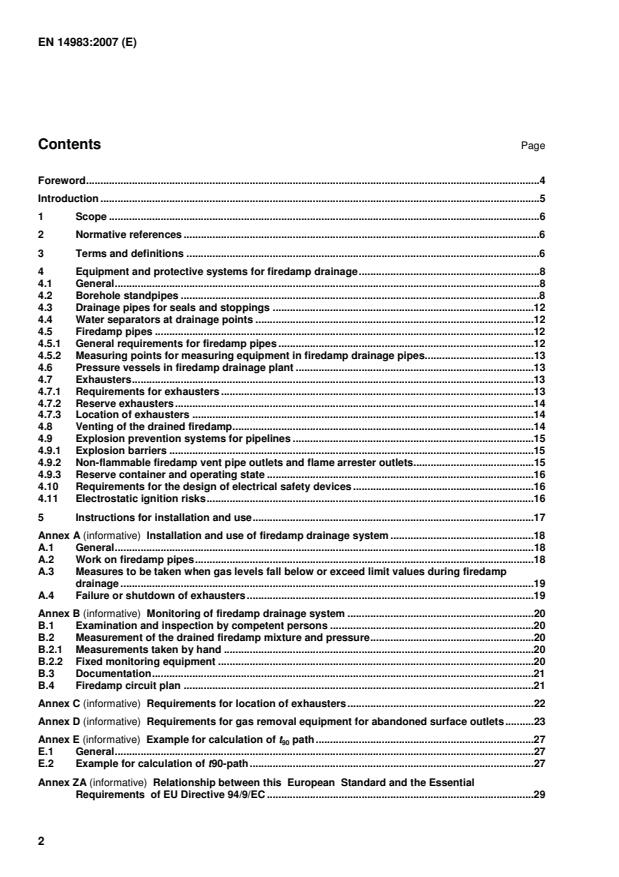
Installation and use of firedamp drainage system.18 A.1 General.18 A.2 Work on firedamp pipes.18 A.3 Measures to be taken when gas levels fall below or exceed limit values during firedamp drainage.19 A.4 Failure or shutdown of exhausters.19 Annex B (informative)
Monitoring of firedamp drainage system.20 B.1 Examination and inspection by competent persons.20 B.2 Measurement of the drained firedamp mixture and pressure.20 B.2.1 Measurements taken by hand.20 B.2.2 Fixed monitoring equipment.20 B.3 Documentation.21 B.4 Firedamp circuit plan.21 Annex C (informative)
Requirements for location of exhausters.22 Annex D (informative)
Requirements for gas removal equipment for abandoned surface outlets.23 Annex E (informative)
Example for calculation of t90 path.27 E.1 General.27 E.2 Example for calculation of t90-path.27 Annex ZA (informative)
Relationship between this
European
Standard and the Essential Requirements
of EU Directive 94/9/EC.29
Figures Figure 1 —
Example of connection of roof borehole to collector pipe when measurement and control are accessible.9 Figure 2 — Example of connection of roof borehole to collector pipe when measurement and control are not accessible.10 Figure 3 — Example of connection of floor borehole to collector pipe when measurement and control are accessible.11 Figure 4 — Example of connection of floor borehole to collector pipe when measurement and control are not accessible.12 Figure 5 — Example of explosion prevention system for pipelines with one firedamp vent pipe.15 Figure D.1 — Passive gas removal equipment (Type II).25 Figure D.2 — Passive gas removal equipment (Type III).26 Figure E.1 — Schematic arrangement of a t90-path.28 Tables Table D.1 — Requirements for gas removal equipment for abandoned surface outlets.24 Table ZA.1 — Correspondence between the European Standard and Directive 94/9/EC.29
In the mining industry, firedamp is drained from the underground workings of gassy mines, from boreholes and abandoned mine workings to ensure that mine workers are not exposed to the risks associated with the occurrence of an explosive atmosphere at their place of work. In this case, the explosion risk results from unacceptable accumulations of firedamp occurring in the waste areas and cavities left in the in the rock strata after the coal has been extracted from the coal seam. In such cases, the need to drain these accumulations, and the complexity of the drainage system, depends on the amount of firedamp produced by the coal and the likelihood of it occurring in explosive quantities in the mine roadways and coal face. Examples of situations that might cause firedamp to move in dangerous concentrations from the waste area or cavities into the mine roadways: a breakdown of the mine ventilation system or a sudden reduction in the underground atmospheric pressure. National legislation in EU coal mining member countries requires workers to be withdrawn to a safe place if firedamp levels attain a specific nationally defined value in the general body of mine air. Firedamp drainage is therefore often used in gassy mines in an attempt to ensure that the concentration of firedamp in the general body of mine air is kept well below this critical level, even during abnormal situations such as those described above.
Once the accumulations of firedamp have been drained from the affected areas, it is usually discharged to the mine surface, but in some cases it is discharged into the mine return ventilation system. In systems where the firedamp is brought to the mine surface, it is discharged to the atmosphere through an earthed metallic discharge stack or pressurized and delivered to a utilisation system, such as a gas-fired boiler.
In abandoned mines, firedamp drainage is used
¾ to prevent gas pressure building up and gas issuing at the surface in an uncontrolled manner, and ¾ to protect workers at an adjacent nearby mine or ¾ to allow it to be utilized, for example by burning it in a gas-fired boiler to produce heat or to generate electricity.
EN 1710:2005, Equipment and components intended for use in potentially explosive atmospheres in underground mines EN 1333, Flanges and their joints — Pipework components — Definition and selection of PN EN 12874, Flame arresters — Performance requirements, test methods and limits for use EN 13237:2003, Potentially explosive atmospheres — Terms and definitions for equipment and protective systems intended for use in potentially explosive atmospheres
prEN 15089, Explosion isolation systems prEN 61024-1, Protection of structures against fire, explosion and life hazards EN 61508 (all parts), Functional safety of electrical/electronic/programmable electronic safety-related systems 3 Terms and definitions For the purposes of this document, the terms and definitions given in EN 1127-2:2002 and EN 13237:2003 and the following apply:
3.1 electrostatic leakage resistance electrical resistance measured between an object and earth
3.2 active explosion isolation system system which is designed to be activated by a detector and control and indicating equipment (CIE) which are inherent parts of the system and stop explosions from travelling through pipelines or limit destructive effects of the explosion
[prEN 15089:2004, 3.12.1]
3.3 starting by-pass temporary and specific by-passing of a safety device when starting the exhauster of a firedamp drainage plant
3.4 design pressure pd pressure at the top of each chamber of the pressure equipment chosen for the derivation of the calculation pressure of each component2
[EN 764-1:2004, 3.10]
3.5 pressure pressure relative to atmospheric pressure, i.e. gauge pressure. As a consequence, vacuum is designated by a negative value
[EN 764-1:2004, 3.3]
3.6 flame arrester device fitted to the opening of an enclosure or to the connecting pipework of a system of enclosures and whose intended function is to allow flow, but prevent the transmission of flame
NOTE This device should not be confused with a fire barrier, which is ineffective in case of explosion.
[EN 13237:2003, 3.41]
3.7 firedamp any potentially explosive mixture of flammable gases naturally occurring, which may form a hazardous mixture when combined with air
NOTE As firedamp mainly consists of methane, in mining practice, the terms “firedamp” and “methane” are frequently used as synonyms.
[EN 1127-2:2003, 3.1]
3.8 firedamp collector pipe gas pipes connected directly to one or more boreholes or gas drainage points
3.9 firedamp mains pipe gas pipes connected to more than one gas collector pipe
3.10 extinguishing system system that is used to discharge suppressant agent to extinguish flame and keep it from propagating into the vent pipe
3.11 technically leaktight made in such a way that no changes in gas composition occur.
NOTE 1 Gas pipes, items of plant and equipment, including all detachable and non-detachable connections can be technically leaktight. NOTE 2
The term “technically leaktight” means that diffusion through statically stressed seals can occur.
3.12 t90-path distance between the monitoring position and the shut-off device
NOTE This distance depends on the measured gas/air mixture, taking account of the velocity of flow, the response time (according to EN 61779-1) of the measurement device, the tripping time and the closing time of the rapid shut-off device; the response time is the time taken to achieve 90% of the final indication.
4 Equipment and protective systems for firedamp drainage 4.1 General Electrical and mechanical equipment used in firedamp drainage shall not pose an explosion risk. For this reason: ¾ equipment used in the firedamp drainage systems where flammable gas is likely to occur shall be explosion protected either Group I Category M1 or M2, or, if on the surface, Group II Category 1 or 2; ¾ where measuring equipment is in direct contact with firedamp/air concentration within the explosive range (e.g. the purity measuring instruments), it shall be category M1 ignition protected. In surface installations, Group II, Category 1 equipment may be used; ¾ the drainage system shall have a facility to allow it to be shut down, usually automatically, where the concentration of extracted firedamp in the pipework reaches a prescribed limit, taking into account the response time of the monitoring equipment and the t90-path (see Annex E). NOTE 1 Care is needed during start-up of the firedamp drainage system when the pipework will be full of air and will at some stage pass through the explosive range. NOTE 2 Normally, the explosive range for firedamp/air mixtures is specified within a range of about 5 % by volume to
15 % by volume methane. Automatic shut down usually takes place when a methane concentration reaches a level of approx. 22 % by volume. 4.2 Borehole standpipes Standpipes shall be made in such a way that devices (Y- or T-pieces) for the insertion of borehole probes can be attached to them. The standpipe shall have connection facilities to allow it to be connected, it shall be made in such a way and arranged so that no reduction in cross-section occurs, and should contain a suitable facility for measuring the volume flow and vacuum pressure where the boreholes are accessible for measuring and taking firedamp samples, e.g. a measuring section (see Figures 1 to 4).
Key d
Diameter 1
Borehole standpipe 2
Flexible hose suitable for the required flow and pressure 3
T-piece 4
Connection for water separator 5
Facility for measurements 6
Facility for measurements 7
Measuring section 8
Collector pipe 9
Shut off device Figure 1 —
Example of connection of roof borehole to collector pipe when measurement and control are accessible
Key 1
Borehole standpipe 2
Flexible hose suitable for the required flow and pressure 3
Collector pipe 4
Shut-off device 5
Suitable connection for collector pipe Figure 2 — Example of connection of roof borehole to collector pipe when measurement and control are not accessible
Key d
Diameter 1
Borehole standpipe 2
Flexible hose suitable for the required flow and pressure 3
T-piece 4
Connection for water separator 5
Facility for measurements 6
Facility for measurements 7
Measuring section 8
Shut-off device 9
Collector pipe
Figure 3 — Example of connection of floor borehole to collector pipe when measurement and control are accessible
Key 1
Borehole standpipe 2
Flexible hose suitable for the required flow and pressure 3 Collector pipe 4
Shut-off device 5
Suitable connection for collector pipe 6
Water separator Figure 4 — Example of connection of floor borehole to collector pipe when measurement and control are not accessible 4.3 Drainage pipes for seals and stoppings When firedamp drainage pipes are installed in seals and stoppings to drain methane, pipes shall be of sufficient diameter, equipped with devices for controlling firedamp flows and be monitored in accordance with 4.2. The requirements of 4.2 are to be applied accordingly for gas measuring devices in seals and stoppings. 4.4 Water separators at drainage points Where water is a problem, water separators should be provided between the drainage points and the measuring sections. These separators shall be made in such a way that they can separate any water that collects in the gas pipe without allowing the admission of the ambient atmosphere. 4.5 Firedamp pipes 4.5.1 General requirements for firedamp pipes Firedamp pipes and their fittings (e.g. shut-off devices, controls, borehole connections) shall comply at least with the nominal pressure stage PN 6 (see EN 1333). This strength rating is sufficient provided that the permissible operating pressure in the gas drainage plant, based on the design of the exhauster and/or regulating equipment, does not exceed 0,3 bar. Firedamp pipes shall only be fitted with pipe connections which are deemed suitable and necessary for operation and control purposes. Shut-off devices shall be provided in firedamp pipes in such a way that each branch pipe can be shut off independently. With the exception of the drainage points, all pipes shall be manufactured exclusively from materials suitable for the transportation of methane underground.
Where exhausters operate below 0,5 bar pressure, they shall be tested in accordance with the manufacturer's requirements. Exhausters shall be fitted with a temperature limiting device at the gas exit side according to the maximum permissible operating temperature recommended by the manufacturer, unless other technical measures can be used to prevent the permissible operating temperatures from being exceeded. The limiting device shall be adjusted so that the maximum permissible compression temperature specified by the manufacturer cannot be exceeded. Fluid-ring exhausters shall be monitored so that they are shut down automatically and immediately in the event of fluid deficiency. At the same time as this shut-down, an audible and visual warning signal shall also be emitted at the permanently manned position (see A.4). Exhausters (e.g. rotary compressors, fluid-ring exhausters and discharge nozzles) and pipe mains shall be designed so that a sufficient vacuum is available at each firedamp drainage point. Where practicable, exhausters shall be fitted additionally with:
...