

EN 15089:2009
(Main)Explosion isolation systems
- Abstract
This European Standard describes the general requirements for explosion isolation systems. An explosion isolation system is a protective system, which prevents an explosion pressure wave and a flame or only a flame from propagating via connecting pipes or ducts into other parts of apparatus or plant areas. This European Standard specifies methods for evaluating the efficacy of the various explosion isolation systems, and methods for evaluating design tools for such explosion isolation systems when applying these in practice.
This European Standard also sets out the criteria for alternative test methods and interpretation means to validate the efficacy of explosion isolations.
It covers e.g.:
a) general requirements for the explosion isolation components;
b) evaluating the effectiveness of an explosion isolation system;
c) evaluating design tools for explosion isolation systems.
This European Standard is applicable only to the use of explosion isolation systems that are intended for avoiding explosion propagation between interconnected enclosures, in which an explosion may result as a consequence of ignition of an explosive mixtures e.g., dust-air mixtures, gas-(vapour-)air mixtures, dust-, gas-(vapour-)air mixtures and mists.
In general explosion isolation systems are not designed to prevent the transmission of fire or burning powder either of which can initiate an explosion in downstream plant items. It is necessary to take this situation into account in risk assessments.
This European Standard is only applicable for gas and dust explosions of chemically stable substances and mixtures of these (flame propagating at subsonic velocity).
This European Standard is not applicable for explosions of materials listed below, or for mixtures containing some of those materials:
i) chemically unstable substances that are liable to decompose;
ii) explosive substances;
iii) pyrotechnic substances.
- Status
- Published
- Publication Date
- 24-Mar-2009
- Withdrawal Date
- 29-Sep-2009
- Current Stage
- 9093 - Decision to confirm - Review Enquiry
- Start Date
- 22-Nov-2013
- Completion Date
- 22-Nov-2013
- Directive
- 2014/34/EU - Directive 2014/34/EU Of The European Parliament And Of The Council of 26 February 2014 on the harmonisation of the laws of the Member States relating to equipment and protective systems intended for use in potentially explosive atmospheres (recast)OJ Ref: C, C 126, HARMONIZIRAN OJ Date: 08-Apr-2016
94/9/EC - Equipment and protective systems intended for use in potentially explosive atmospheres (ATEX)OJ Ref: C, C 97 OJ Date: 16-Apr-2010


Overview - EN 15089:2009 (CEN)
EN 15089:2009 is a European (CEN) standard that defines general requirements and test methods for explosion isolation systems. It covers systems intended to prevent propagation of explosion pressure waves and flames through connecting pipes and ducts between interconnected enclosures. The standard applies to gas and dust explosions of chemically stable substances with subsonic flame propagation and sets criteria to validate isolation efficacy and design tools. It also supports essential requirements of relevant EU directives (see Annex ZA).
Key topics and technical requirements
- Scope and exclusions: Applicable to dust-air, gas-(vapour)-air mixtures and mists. Not applicable to chemically unstable substances, explosive or pyrotechnic materials, or to flame arresters (see EN 12874).
- Types of isolation: Defines active (sensor + control + actuation) and passive isolation systems.
- Component requirements:
- Detection devices (optical, pressure, other actuation)
- Indicating equipment (IE) and Control and Indicating Equipment (CIE), including safety integrity considerations
- Explosion isolation devices: fast-acting isolation valves, extinguishing barriers, rotary valves, diverters, interlocked double valves
- System design: Guidance on integrating isolation with other explosion protection techniques (venting, suppression, explosion-resistant design) and on designing installation distances and closing times.
- Testing and validation: Specifies experimental evaluation and reporting, organized into Test Modules A, B and C:
- Module A - explosion resistance testing
- Module B - flameproof testing
- Module C - functional testing (for passive and active devices)
- Information for use and marking: Requirements for documentation, user instructions and product marking.
Practical applications and users
EN 15089 is relevant for professionals involved in explosion safety, including:
- Process and safety engineers designing dust- and gas-handling systems
- Manufacturers of explosion isolation equipment (valves, diverters, extinguishers)
- System integrators and plant operators implementing explosion protection strategies
- Notified bodies and conformity assessors verifying compliance with EU directives
- Risk assessors selecting appropriate protective measures for interconnected enclosures
Use cases include prevention of explosion propagation between silos, reactors, ducts, cyclones, conveying lines and other interconnected enclosures in chemical, pharmaceutical, food, and bulk-handling industries.
Related standards
Normative references and complementary standards to consult:
- EN 12874 (flame arresters)
- EN 13237 (terms/definitions)
- EN 13673-1 / -2 (gas explosion characteristics)
- EN 14034-1 / -2 (dust explosion characteristics)
- EN 14373 (explosion suppression)
Keywords: EN 15089, explosion isolation systems, explosion protection, active isolation, passive isolation, explosion isolation valve, dust explosions, gas explosions, CEN standard.
Relations
- Effective Date
- 28-Jan-2026
- Effective Date
- 28-Jan-2026
- Effective Date
- 28-Jan-2026
- Effective Date
- 28-Jan-2026
- Effective Date
- 28-Jan-2026
- Effective Date
- 28-Jan-2026
- Effective Date
- 28-Jan-2026
- Effective Date
- 28-Jan-2026
- Effective Date
- 28-Jan-2026
- Effective Date
- 28-Jan-2026
- Effective Date
- 28-Jan-2026
- Effective Date
- 28-Jan-2026
- Referred By
CEN/TR 16829:2016+AC:2019 - Fire and explosion prevention and protection for bucket elevators - Effective Date
- 28-Jan-2026
- Effective Date
- 28-Jan-2026
- Referred By
EN 16020:2011 - Explosion diverters - Effective Date
- 28-Jan-2026
Get Certified
Connect with accredited certification bodies for this standard

CIS Institut d.o.o.
Personal Protective Equipment (PPE) certification body. Notified Body NB-2890 for EU Regulation 2016/425 PPE.

Kiwa BDA Testing
Building and construction product certification.
Kmetijski inštitut Slovenije
Agricultural Institute of Slovenia. Soil testing, plant health, agricultural product analysis.
Sponsored listings
Frequently Asked Questions
EN 15089:2009 is a standard published by the European Committee for Standardization (CEN). Its full title is "Explosion isolation systems". This standard covers: This European Standard describes the general requirements for explosion isolation systems. An explosion isolation system is a protective system, which prevents an explosion pressure wave and a flame or only a flame from propagating via connecting pipes or ducts into other parts of apparatus or plant areas. This European Standard specifies methods for evaluating the efficacy of the various explosion isolation systems, and methods for evaluating design tools for such explosion isolation systems when applying these in practice. This European Standard also sets out the criteria for alternative test methods and interpretation means to validate the efficacy of explosion isolations. It covers e.g.: a) general requirements for the explosion isolation components; b) evaluating the effectiveness of an explosion isolation system; c) evaluating design tools for explosion isolation systems. This European Standard is applicable only to the use of explosion isolation systems that are intended for avoiding explosion propagation between interconnected enclosures, in which an explosion may result as a consequence of ignition of an explosive mixtures e.g., dust-air mixtures, gas-(vapour-)air mixtures, dust-, gas-(vapour-)air mixtures and mists. In general explosion isolation systems are not designed to prevent the transmission of fire or burning powder either of which can initiate an explosion in downstream plant items. It is necessary to take this situation into account in risk assessments. This European Standard is only applicable for gas and dust explosions of chemically stable substances and mixtures of these (flame propagating at subsonic velocity). This European Standard is not applicable for explosions of materials listed below, or for mixtures containing some of those materials: i) chemically unstable substances that are liable to decompose; ii) explosive substances; iii) pyrotechnic substances.
This European Standard describes the general requirements for explosion isolation systems. An explosion isolation system is a protective system, which prevents an explosion pressure wave and a flame or only a flame from propagating via connecting pipes or ducts into other parts of apparatus or plant areas. This European Standard specifies methods for evaluating the efficacy of the various explosion isolation systems, and methods for evaluating design tools for such explosion isolation systems when applying these in practice. This European Standard also sets out the criteria for alternative test methods and interpretation means to validate the efficacy of explosion isolations. It covers e.g.: a) general requirements for the explosion isolation components; b) evaluating the effectiveness of an explosion isolation system; c) evaluating design tools for explosion isolation systems. This European Standard is applicable only to the use of explosion isolation systems that are intended for avoiding explosion propagation between interconnected enclosures, in which an explosion may result as a consequence of ignition of an explosive mixtures e.g., dust-air mixtures, gas-(vapour-)air mixtures, dust-, gas-(vapour-)air mixtures and mists. In general explosion isolation systems are not designed to prevent the transmission of fire or burning powder either of which can initiate an explosion in downstream plant items. It is necessary to take this situation into account in risk assessments. This European Standard is only applicable for gas and dust explosions of chemically stable substances and mixtures of these (flame propagating at subsonic velocity). This European Standard is not applicable for explosions of materials listed below, or for mixtures containing some of those materials: i) chemically unstable substances that are liable to decompose; ii) explosive substances; iii) pyrotechnic substances.
EN 15089:2009 is classified under the following ICS (International Classification for Standards) categories: 13.230 - Explosion protection. The ICS classification helps identify the subject area and facilitates finding related standards.
EN 15089:2009 has the following relationships with other standards: It is inter standard links to EN 14373:2021+A1:2025, EN 13237:2024, EN 15967:2022, EN 14034-2:2006+A1:2011, EN 12874:2001, EN 1127-2:2014, CEN/TR 16829:2016, EN 14491:2012, EN 16447:2014, EN 12779:2015, EN 16985:2018, EN 1127-1:2011, CEN/TR 16829:2016+AC:2019, EN 14983:2007, EN 16020:2011. Understanding these relationships helps ensure you are using the most current and applicable version of the standard.
EN 15089:2009 is associated with the following European legislation: EU Directives/Regulations: 2014/34/EU, 94/9/EC; Standardization Mandates: M/BC/CEN/92/46. When a standard is cited in the Official Journal of the European Union, products manufactured in conformity with it benefit from a presumption of conformity with the essential requirements of the corresponding EU directive or regulation.
EN 15089:2009 is available in PDF format for immediate download after purchase. The document can be added to your cart and obtained through the secure checkout process. Digital delivery ensures instant access to the complete standard document.
Standards Content (Sample)
2003-01.Slovenski inštitut za standardizacijo. Razmnoževanje celote ali delov tega standarda ni dovoljeno.Explosionsentkopplungs-SystemeSysteme d'Explosion IsolationExplosion Isolation Systems13.230Varstvo pred eksplozijoExplosion protectionICS:Ta slovenski standard je istoveten z:EN 15089:2009SIST EN 15089:2009en,fr,de01-julij-2009SIST EN 15089:2009SLOVENSKI
STANDARD
EUROPEAN STANDARDNORME EUROPÉENNEEUROPÄISCHE NORMEN 15089March 2009ICS 13.230 English VersionExplosion isolation systemsSystème d'isolation d'explosionExplosions-EntkopplungssystemeThis European Standard was approved by CEN on 7 February 2009.CEN members are bound to comply with the CEN/CENELEC Internal Regulations which stipulate the conditions for giving this EuropeanStandard the status of a national standard without any alteration. Up-to-date lists and bibliographical references concerning such nationalstandards may be obtained on application to the CEN Management Centre or to any CEN member.This European Standard exists in three official versions (English, French, German). A version in any other language made by translationunder the responsibility of a CEN member into its own language and notified to the CEN Management Centre has the same status as theofficial versions.CEN members are the national standards bodies of Austria, Belgium, Bulgaria, Cyprus, Czech Republic, Denmark, Estonia, Finland,France, Germany, Greece, Hungary, Iceland, Ireland, Italy, Latvia, Lithuania, Luxembourg, Malta, Netherlands, Norway, Poland, Portugal,Romania, Slovakia, Slovenia, Spain, Sweden, Switzerland and United Kingdom.EUROPEAN COMMITTEE FOR STANDARDIZATIONCOMITÉ EUROPÉEN DE NORMALISATIONEUROPÄISCHES KOMITEE FÜR NORMUNGManagement Centre:
Avenue Marnix 17,
B-1000 Brussels© 2009 CENAll rights of exploitation in any form and by any means reservedworldwide for CEN national Members.Ref. No. EN 15089:2009: ESIST EN 15089:2009
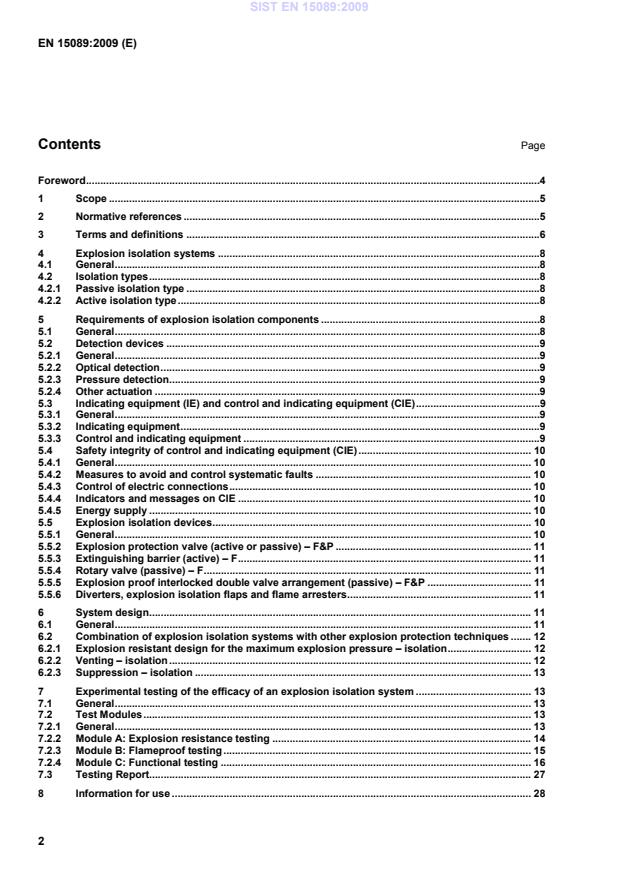
Verification of design methods . 30 A.1 General . 30 A.2 Design on the basis of an interpretation of test results . 31 A.3 Mathematical model . 32 Annex ZA (informative)
Relationship between this
European
Standard and the Essential Requirements of EU Directive 94/9/EC . 35 Bibliography . 37 Figures Figure 1 — Test arrangement for pressure resistance testing and high-pressure flame proof testing . 15 Figure 2 — Test arrangement for flameproof testing . 16 Figure 3 — Test arrangement for functional testing for passive explosion protection valves . 17 Figure 4 — Test arrangement for functional testing for active isolation valves . 20 Figure 5 — Test arrangement for functional testing for extinguishing barriers . 23 Figure 6 — Test arrangement for functional testing for rotary valves . 26 Figure A.1 — Example of interpolating the minimum and maximum distance of an active explosion valve for enclosure volumes between 1 m³ to 10 m³, triggering device: pressure detection on the enclosure (pa = 0,1 bar) . 31 Figure A.2 — Effect of ignition location, detection system and K-value on minimum installation distance . 33 Tables Table 1 — Type of modules as a function of type of isolation device . 14 Table 2 — Location of ignition source for verification/determination of the minimum installation distance . 19 Table 3 — Location of ignition source to be used for verification/determination of the minimum installation distance . 21 Table 4 — Location of ignition source to be used for verification/determination of the minimum installation distance using flame detection only . 24 Table A.1 — Important criteria, which can influence the design/installation distance of an isolation device. 30 Table ZA — Correspondence between this European Standard and Directive 94/9/EC . 35
1 Scope This European Standard describes the general requirements for explosion isolation systems. An explosion isolation system is a protective system, which prevents an explosion pressure wave and a flame or only a flame from propagating via connecting pipes or ducts into other parts of apparatus or plant areas. This European Standard specifies methods for evaluating the efficacy of the various explosion isolation systems, and methods for evaluating design tools for such explosion isolation systems when applying these in practice. This European Standard also sets out the criteria for alternative test methods and interpretation means to validate the efficacy of explosion isolations. It covers e.g.: a) general requirements for the explosion isolation components; b) evaluating the effectiveness of an explosion isolation system; c) evaluating design tools for explosion isolation systems. This European Standard is applicable only to the use of explosion isolation systems that are intended for avoiding explosion propagation between interconnected enclosures, in which an explosion may result as a consequence of ignition of an explosive mixtures e.g., dust-air mixtures, gas-(vapour-)air mixtures, dust-, gas-(vapour-)air mixtures and mists. In general explosion isolation systems are not designed to prevent the transmission of fire or burning powder either of which can initiate an explosion in downstream plant items. It is necessary to take this situation into account in risk assessments. This European Standard is only applicable for gas and dust explosions of chemically stable substances and mixtures of these (flame propagating at subsonic velocity). This European Standard is not applicable for explosions of materials listed below, or for mixtures containing some of those materials: i) chemically unstable substances that are liable to decompose; ii) explosive substances; iii) pyrotechnic substances. This European Standard does not cover flame arresters. For these devices refer to EN 12874. 2 Normative references The following reference documents are indispensable for the application of this document. For dated references, only the edition cited applies. For undated references, the latest edition of the referenced document (including any amendments) applies. EN 12874:2001, Flame arresters – Performance requirements, test methods and limits for use EN 13237, Potentially explosive atmospheres – Terms and definitions for equipment and protective systems intended for use in potentially explosive atmospheres EN 13673-1, Determination of the maximum explosion pressure and the maximum rate of pressure rise of gases and vapours – Part 1: Determination of the maximum explosion pressure SIST EN 15089:2009
7.2.2 Module A: Explosion resistance testing If an explosion resistance testing is necessary the following shall be used: a) Test arrangement: Install the device according to Figure 1. The explosive atmosphere can be of any type, provided the pressure generated is sufficient to test the device‘s required explosion resistance. b) Test assignment/records: The maximum allowable explosion overpressure to be specified for each individual device; recorded test pressure at least 10 % above design pressure or the average of three tests to be 100 %. c) Number of tests: 1 for each size as a minimum. d) Evaluation: Permanent deformation is allowed provided the isolation device does not fail in its function and will not give rise to dangerous effects to the surrounding. SIST EN 15089:2009
Key 1 Location of ignition source (Z1) 2 Pressure transducer (Pt) 3 isolation device Figure 1 — Test arrangement for explosion resistance testing and flame transmission testing at high pressure conditions 7.2.3 Module B: Flame transmission test The testing of the isolation device according to Figure 1 or according to Figure 2 is specified by the intended use. a) Test according to Figure 1 (High pressure conditions): It shall be proven that the isolation device when exposed to high pressures and a flame simultaneously will stop a flame from propagating. 1) Testing: i) Test arrangement: See 7.2.2. ii) Test assignment/records: The presence of flame outside of the device (enclosure) shall be recorded. iii) Number of tests: Minimum 2 per device; smallest and largest size for devices constructed in the same way (with respect to the safe gap, sealing, thickness of the material etc.). If the number of sizes constructed in the same way exceed 5, an additional testing of a size (middle of range) is needed. iv) Evaluation: No explosion flame detection recorded outside of the enclosure at the position of the explosion isolation device. The explosion isolation device can be applied for any explosive atmosphere having a maximum experimental safe gap (MESG) equal to or larger than the explosive atmosphere used for testing. SIST EN 15089:2009
Key 1 location of ignition source (Z1) 5 Foil cover
2 Pressure transducer (Pt)
3 Flame transducer (Ft) L1 Length of pipe: L1 ≥ 20 × DN 4 isolation device L2 Length of pipe: L2 ≥ 1 m Figure 2 — Test arrangement for flame transmission test b) Test according to Figure 2 (Low pressure conditions): It shall be proven that the isolation device when tested in a long pipe will stop a flame from propagating along the ductwork. 1) Testing: i) Test arrangement: Device mounted in standard position between flanges of a long pipe (see Figure 2). Device is set in the closed position; ignition source close to the device (about one diameter). The pipe is filled with appropriate fuel air-mixture (typically propane) on both sides of the device. A foil covers both ends of the pipe. ii) Test assignment/records: The presence of flame before and after the device shall be recorded. It is recommended to measure also the pressure before and after the device. iii) Number of tests: Minimum 2 per device; smallest and largest size for devices constructed in the same way (with respect to the safe gap, sealing, thickness of the material etc.). If the number of sizes constructed in the same way exceeds 5, an additional testing of a size (middle of range) is needed. iv) Evaluation:
No explosion flame detection recorded on the isolated side of the explosion isolation device. The explosion isolation can be applied for any explosive atmosphere having a maximum experimental safe gap (MESG) equal to or larger than the explosive atmosphere used for testing. 7.2.4 Module C: Functional testing 7.2.4.1 General The main objective of the functional testing is the determination/verification of the minimum/maximum installation distance of the isolation device dependent on the method of the detection and to assess the efficacy of the device/system as an explosion isolation device/system according to the intended use as specified by the manufacturer. SIST EN 15089:2009
Key 1 Location of ignition source, Z1, 50% 6 Foil cover with low opening pressure (< 0,1 bar) 2 Location of ignition source, Z2, 10% 7 camera
3 Location of ignition source, Z3, 90% 8 passive explosion protection valve 4 Pressure transducer (Pt) L Installation distance 5 Flame transducer (Ft) Figure 3 — Test arrangement for functional testing for passive explosion protection valves c) Measuring technique The following parameters shall be measured: 1) Pressure, minimum one transducer (Pt) in the enclosure and one directly in front of the explosion isolation device and one after, in case a pipe downstream of the explosion isolation device is used. This transducer shall be mounted with a maximum distance of 100 mm from the connecting flange. 2) Flame, minimum one detector (Ft) at the beginning of the pipe with a maximum distance of 100 mm from the connecting flange and one in front and after the explosion isolation device if a pipe downstream is used with a maximum distance of 100 mm from the connecting flange. 3) Alternatively, two cameras can be used instead of a flame detector in the downstream pipe. SIST EN 15089:2009
The higher value found for the test conditions to be used for verification/determination of the minimum installation distance shall be used as the minimum installation distance. The maximum installation distance shall be determined by varying the distance from the enclosure to the isolation device until the pressures are equal to the resistance of the device determined under Module A. The tests shall be performed with an explosive atmosphere with Kmax and location of ignition source far from the pipe inlet Z3 (90 %). SIST EN 15089:2009
for design for the maximum explosion overpressure pred,max for venting or suppression NOTE The ignition source locations Z1, Z2 and Z3 are all located on the axis trough the connected pipeline. Z1 is located at a distance of
...