

EN 289:2004+A1:2008
(Main + Amendment)Plastics and rubber machines - Presses - Safety requirements
- Abstract
This document specifies the essential safety requirements for hydraulic presses, including toggle and hydro-mechanic ones, with a vertical closing movement more than 6 mm for the moulding of plastics and/or rubber.
This document covers both compression moulding (see 3.1.1) and transfer moulding (see 3.1.2).
All hazards listed in clause 4 are covered by this document.
The following machines are excluded:
- injection moulding machines (see EN 201);
- presses for curing pneumatic tyres;
- presses for curing inner tubes and curing bags;
- hydraulic presses as covered by EN 693;
- mechanical presses as covered by EN 692;
- thermoforming machines (see EN 12409);
- RIM machines (see EN 1612-1 and EN 1612-2).
The safety requirements for the additional hazards arising from the interaction between presses and ancillary equipment especially loading and unloading devices are specified. The safety requirements for the ancillary equipment itself are not specified.
This document does not cover:
- the requirements of Directive 94/9/CE concerning equipment and protective systems intended for use in potentially explosive atmospheres;
- requirements for the design of exhaust ventilation systems.
This document is not applicable to presses manufactured before the date of publication of this document by CEN.
- RIM machines (see EN 1612-1 and EN 1612-2).
The safety requirements for the additional hazards arising from the interaction between presses and ancillary equipment especially loading and unloading devices are specified. The safety requirements for the ancillary equipment itself are not specified.
This document does not cover:
- the requirements of Directive 94/9/CE concerning equipment and protective systems intended for use in potentially explosive atmospheres;
- requirements for the design of exhaust ventilation systems.
This document is not applicable to presses manufactured before the date of publication of this document by CEN.
- Status
- Withdrawn
- Publication Date
- 01-Jul-2008
- Withdrawal Date
- 06-Oct-2026
- Technical Committee
- CEN/TC 145 - Rubber and plastics machines - Safety
- Drafting Committee
- CEN/TC 145/WG 2 - Compression moulding machines - Safety
- Current Stage
- 9960 - Withdrawal effective - Withdrawal
- Start Date
- 18-Jun-2014
- Completion Date
- 07-Oct-2026
- Directive
- 2006/42/EC - Directive 2006/42/EC of the European Parliament and of the Council of 17 May 2006 on machinery, and amending Directive 95/16/EC (recast)OJ Ref: C, C 214 OJ Date: 08-Sep-2009
98/37/EC - MachineryOJ Ref: C, C 22 OJ Date: 28-Jan-2009

Relations
- Effective Date
- 19-Jan-2023
- Effective Date
- 14-Aug-2010
- Effective Date
- 09-Feb-2026
- Effective Date
- 09-Feb-2026
- Effective Date
- 09-Feb-2026
- Effective Date
- 09-Feb-2026
- Effective Date
- 28-Jan-2026
- Effective Date
- 28-Jan-2026
- Effective Date
- 28-Jan-2026
- Effective Date
- 28-Jan-2026
- Effective Date
- 28-Jan-2026
- Effective Date
- 28-Jan-2026
- Effective Date
- 28-Jan-2026
- Effective Date
- 28-Jan-2026
- Effective Date
- 28-Jan-2026
Get Certified
Connect with accredited certification bodies for this standard

DIN CERTCO
DIN Group product certification.

Smithers Quality Assessments
US management systems and product certification.
Sponsored listings
Frequently Asked Questions
EN 289:2004+A1:2008 is a standard published by the European Committee for Standardization (CEN). Its full title is "Plastics and rubber machines - Presses - Safety requirements". This standard covers: This document specifies the essential safety requirements for hydraulic presses, including toggle and hydro-mechanic ones, with a vertical closing movement more than 6 mm for the moulding of plastics and/or rubber. This document covers both compression moulding (see 3.1.1) and transfer moulding (see 3.1.2). All hazards listed in clause 4 are covered by this document. The following machines are excluded: - injection moulding machines (see EN 201); - presses for curing pneumatic tyres; - presses for curing inner tubes and curing bags; - hydraulic presses as covered by EN 693; - mechanical presses as covered by EN 692; - thermoforming machines (see EN 12409); - RIM machines (see EN 1612-1 and EN 1612-2). The safety requirements for the additional hazards arising from the interaction between presses and ancillary equipment especially loading and unloading devices are specified. The safety requirements for the ancillary equipment itself are not specified. This document does not cover: - the requirements of Directive 94/9/CE concerning equipment and protective systems intended for use in potentially explosive atmospheres; - requirements for the design of exhaust ventilation systems. This document is not applicable to presses manufactured before the date of publication of this document by CEN. - RIM machines (see EN 1612-1 and EN 1612-2). The safety requirements for the additional hazards arising from the interaction between presses and ancillary equipment especially loading and unloading devices are specified. The safety requirements for the ancillary equipment itself are not specified. This document does not cover: - the requirements of Directive 94/9/CE concerning equipment and protective systems intended for use in potentially explosive atmospheres; - requirements for the design of exhaust ventilation systems. This document is not applicable to presses manufactured before the date of publication of this document by CEN.
This document specifies the essential safety requirements for hydraulic presses, including toggle and hydro-mechanic ones, with a vertical closing movement more than 6 mm for the moulding of plastics and/or rubber. This document covers both compression moulding (see 3.1.1) and transfer moulding (see 3.1.2). All hazards listed in clause 4 are covered by this document. The following machines are excluded: - injection moulding machines (see EN 201); - presses for curing pneumatic tyres; - presses for curing inner tubes and curing bags; - hydraulic presses as covered by EN 693; - mechanical presses as covered by EN 692; - thermoforming machines (see EN 12409); - RIM machines (see EN 1612-1 and EN 1612-2). The safety requirements for the additional hazards arising from the interaction between presses and ancillary equipment especially loading and unloading devices are specified. The safety requirements for the ancillary equipment itself are not specified. This document does not cover: - the requirements of Directive 94/9/CE concerning equipment and protective systems intended for use in potentially explosive atmospheres; - requirements for the design of exhaust ventilation systems. This document is not applicable to presses manufactured before the date of publication of this document by CEN. - RIM machines (see EN 1612-1 and EN 1612-2). The safety requirements for the additional hazards arising from the interaction between presses and ancillary equipment especially loading and unloading devices are specified. The safety requirements for the ancillary equipment itself are not specified. This document does not cover: - the requirements of Directive 94/9/CE concerning equipment and protective systems intended for use in potentially explosive atmospheres; - requirements for the design of exhaust ventilation systems. This document is not applicable to presses manufactured before the date of publication of this document by CEN.
EN 289:2004+A1:2008 is classified under the following ICS (International Classification for Standards) categories: 83.200 - Equipment for the rubber and plastics industries. The ICS classification helps identify the subject area and facilitates finding related standards.
EN 289:2004+A1:2008 has the following relationships with other standards: It is inter standard links to EN 289:2004, EN 289:2014, EN 60204-1:1997, EN 60529:1991, EN 61496-1:1997, EN 61496-3:2001, EN ISO 3747:2000, EN ISO 14122-1:2001, EN 294:1992, EN ISO 11204:1995, EN ISO 14122-2:2001, EN 999:1998, EN 982:1996, EN 1088:1995, EN 1760-2:2001. Understanding these relationships helps ensure you are using the most current and applicable version of the standard.
EN 289:2004+A1:2008 is associated with the following European legislation: EU Directives/Regulations: 2006/42/EC, 98/37/EC; Standardization Mandates: M/079, M/396. When a standard is cited in the Official Journal of the European Union, products manufactured in conformity with it benefit from a presumption of conformity with the essential requirements of the corresponding EU directive or regulation.
EN 289:2004+A1:2008 is available in PDF format for immediate download after purchase. The document can be added to your cart and obtained through the secure checkout process. Digital delivery ensures instant access to the complete standard document.
Standards Content (Sample)
2003-01.Slovenski inštitut za standardizacijo. Razmnoževanje celote ali delov tega standarda ni dovoljeno.Stroji za predelavo gume in plastike - Stiskalnice - Varnostne zahteveKunststoff- und Gummimaschinen - Pressen - SicherheitsanforderungenMachines pour les matières plastiques et le caoutchouc - Presses - Prescriptions de sécuritéPlastics and rubber machines - Presses - Safety requirements83.200Oprema za gumarsko industrijo in industrijo polimernih materialovEquipment for the rubber and plastics industries25.120.10Kovaški stroji. Stiskalnice. ŠkarjeForging equipment. Presses. ShearsICS:Ta slovenski standard je istoveten z:EN 289:2004+A1:2008SIST EN 289:2004+A1:2008en,fr01-oktober-2008SIST EN 289:2004+A1:2008SLOVENSKI
STANDARD
EUROPEAN STANDARD NORME EUROPÉENNE EUROPÄISCHE NORM
EN 289:2004+A1
July 2008 ICS 83.200 Supersedes EN 289:2004English Version
Plastics and rubber machines - Presses - Safety requirements
Machines pour les matières plastiques et le caoutchouc - Presses - Prescriptions de sécurité
Kunststoff- und Gummimaschinen - Pressen - Sicherheitsanforderungen This European Standard was approved by CEN on 16 April 2004 and includes Amendment 1 approved by CEN on 6 June 2008.
CEN members are bound to comply with the CEN/CENELEC Internal Regulations which stipulate the conditions for giving this European Standard the status of a national standard without any alteration. Up-to-date lists and bibliographical references concerning such national standards may be obtained on application to the CEN Management Centre or to any CEN member.
This European Standard exists in three official versions (English, French, German). A version in any other language made by translation under the responsibility of a CEN member into its own language and notified to the CEN Management Centre has the same status as the official versions.
CEN members are the national standards bodies of Austria, Belgium, Bulgaria, Cyprus, Czech Republic, Denmark, Estonia, Finland, France, Germany, Greece, Hungary, Iceland, Ireland, Italy, Latvia, Lithuania, Luxembourg, Malta, Netherlands, Norway, Poland, Portugal, Romania, Slovakia, Slovenia, Spain, Sweden, Switzerland and United Kingdom.
EUROPEAN COMMITTEE FOR STANDARDIZATION
COMITÉ EUROPÉEN DE NORMALISATION EUROPÄISCHES KOMITEE FÜR NORMUNG
Management Centre: rue de Stassart, 36
B-1050 Brussels © 2008 CEN All rights of exploitation in any form and by any means reserved worldwide for CEN national Members. Ref. No. EN 289:2004+A1:2008: ESIST EN 289:2004+A1:2008
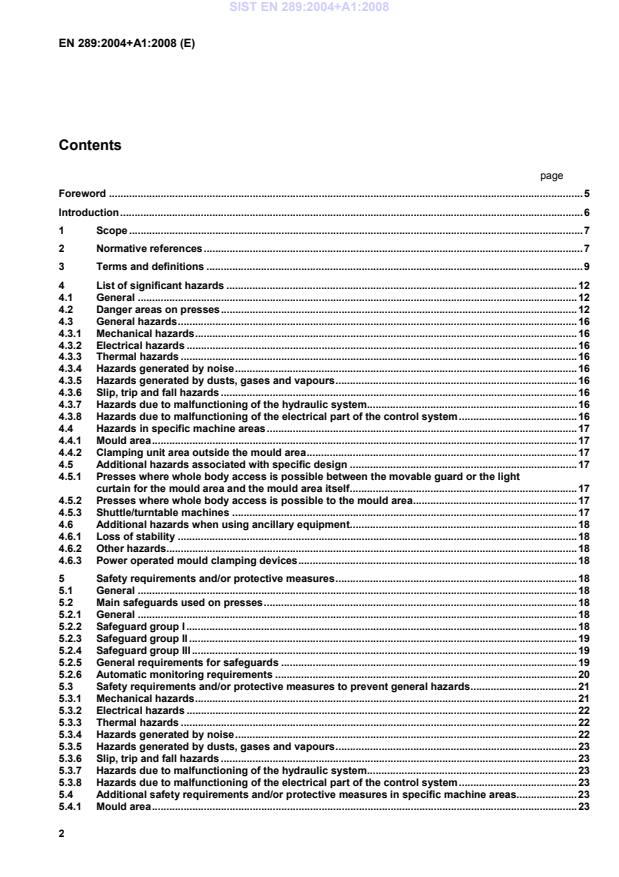
Movable interlocking guard type I.36 A.1 Description.36 A.2 Interlocking function.36 A.3 Quality of the components.37 Annex B (normative)
Movable interlocking guard type II.38 B.1 Description.38 B.2 Interlocking function.38 B.3 Quality of the components.39 Annex C (normative)
Movable interlocking guard type III.40 C.1 Movable interlocking guard with three position detectors.40 C.1.1 Description.40 C.1.2 Interlocking function.40 C.1.3 Quality of the components.41 C.1.4 Monitoring requirements.41 C.2 Movable interlocking guard with two position detectors.41 C.2.1 Description.41 C.2.2 Interlocking function.42 C.2.3 Quality of the components.42 C.2.4 Monitoring requirements.42 Annex D (normative)
Electro-sensitive protective equipment in the form of a light curtain.43 D.1 Description.43 D.2 Mode of operation of the light curtain.43 SIST EN 289:2004+A1:2008
Two-hand control device.45 E.1 Description.45 E.2 Mode of operation of the two hand control.45 E.3 Monitoring requirements.46 Annex F (normative)
Noise test code.47 F.1 Introduction.47 F.2 Measurement of the A-weighted emission sound pressure level at the operator’s or other specified positions.47 F.3 Determination of the A-weighted sound power level.47 F.4 Installation and mounting conditions for noise measurement.47 F.5 Operating conditions.48 F.6 Information to be recorded and reported.48 F.6.1 General.48 F.6.2 General data.48 F.6.3 Technical data of the press.48 F.6.4 Standards.49 F.6.5 Mounting and operating conditions.49 F.6.6 Acoustic data.49 F.7 Declaration and verification of noise emission values.49 Annex G (normative)
Use of proportional valves for the platen movement.50 G.1 Design.50 G.2 Mode of operation.50 Annex H (normative)
Additional requirements for the second shutoff device in Figure C.1.51 Annex ZA (informative)
Relationship between this European Standard and the Essential Requirements of EU Directives Machinery Directive 98/37/EC.52 Annex ZB (informative)
!!!!Relationship between this European Standard and the Essential Requirements of EU Directive 2006/42/EC"""".53 Bibliography.54
The start and finish of text introduced or altered by amendment is indicated in the text by tags ! ". The annexes A, B, C, D, E, F, G and H are normative. According to the CEN/CENELEC Internal Regulations, the national standards organizations of the following countries are bound to implement this European Standard: Austria, Belgium, Bulgaria, Cyprus, Czech Republic, Denmark, Estonia, Finland, France, Germany, Greece, Hungary, Iceland, Ireland, Italy, Latvia, Lithuania, Luxembourg, Malta, Netherlands, Norway, Poland, Portugal, Romania, Slovakia, Slovenia, Spain, Sweden, Switzerland and the United Kingdom. SIST EN 289:2004+A1:2008
1 Scope This document specifies the essential safety requirements for hydraulic presses, including toggle and hydro-mechanic ones, with a vertical closing movement more than 6 mm for the moulding of plastics and/or rubber. This document covers both compression moulding (see 3.1.1) and transfer moulding (see 3.1.2). All hazards listed in clause 4 are covered by this document. The following machines are excluded: injection moulding machines (see EN 201); presses for curing pneumatic tyres; presses for curing inner tubes and curing bags; hydraulic presses as covered by EN 693; mechanical presses as covered by EN 692; thermoforming machines (see EN 12409); RIM machines (see EN 1612-1 and EN 1612-2). The safety requirements for the additional hazards arising from the interaction between presses and ancillary equipment especially loading and unloading devices are specified. The safety requirements for the ancillary equipment itself are not specified. This document does not cover: the requirements of Directive 94/9/CE concerning equipment and protective systems intended for use in potentially explosive atmospheres; requirements for the design of exhaust ventilation systems. This document is not applicable to presses manufactured before the date of publication of this document by CEN. 2 Normative references This European Standard incorporates by dated or undated reference, provisions from other publications. These normative references are cited at the appropriate places in the text, and the publications are listed hereafter. For dated references, subsequent amendments to or revisions of any of these publications apply to this European Standard only when incorporated in it by amendment or revision. For undated references the latest edition of the publication referred to applies (including amendments). EN 294:1992, Safety of machinery – Safety distances to prevent danger zones being reached by the upper limbs EN 418:1992, Safety of machinery – Emergency stop equipment, functional aspects – Principles for design EN 563:1994, Safety of machinery – Temperatures of touchable surfaces – Ergonomics data to establish temperature limit values for hot surfaces EN 574:1996, Safety of machinery – Two hand control devices – Functional aspects – Principles for design SIST EN 289:2004+A1:2008
EN ISO 14122-1:2001, Safety of machinery – Permanent means of access to machinery – Part 1: Choice of a fixed means of access between two levels (ISO 14122-1:2001) EN ISO 14122-2:2001, Safety of machinery – Permanent means of access to machinery – Part 2: Working platforms and walkways (ISO 14122-2:2001) EN ISO 14122-3:2001, Safety of machinery – Permanent means of access to machinery – Part 3: Stairs, stepladders and guard-rails (ISO 14122-3:2001) EN ISO 14122-4:2004, Safety of machinery – Permanent means of access to machinery – Part 4: Fixed ladders (ISO 14122-4:2004) 3 Terms and definitions For the purposes of this European Standard, the terms and definitions given in EN 1070:1998 and the following apply. 3.1 press machine for the discontinuous production of moulded parts from plastics or rubber compounds which essentially consists of one or more clamping units, drive and control systems and possibly ancillary equipment (see 3.5)
3.1.1 compression moulding process in which the moulding material is placed into the open mould. When the press is closed, the moulding process is carried out under the influence of pressure with or without heat (see Figures 1 and 2). This process may be used as well for laminating sheets or plates
Figure 1 — Press for compression moulding shown with mould open and loaded with moulding material
Figure 2 — Press for compression moulding shown with mould closed and moulding material formed into shape
3.1.2 transfer moulding process in which the moulding material is fed into a separate cavity (transfer cavity) in the mould and is pressed into the moulding cavity by the pressure of the transfer plunger. The movement of the transfer plunger is obtained either directly by the closing movement of the mould (see Figures 3 and 4) or via a separate cylinder (see Figures 5 and 6)
NOTE If the moulding material is injected into the closed mould through a nozzle, see EN 201.
Figure 3 — Press for transfer moulding shown with moulding material in transfer cavity
Figure 4 — Press for transfer moulding shown with moulding material fed into the moulding cavity
Figure 5 — Press for transfer moulding shown with separate cylinder and with moulding material in transfer cavity SIST EN 289:2004+A1:2008
Figure 6 — Press for transfer moulding shown with separate cylinder and with moulding material fed into the moulding cavity 3.2 mould area zone between the platens
3.3 clamping unit the part of the press comprising fixed and mobile platens and associated drive mechanism.
3.4 shuttle/turntable machine press designed to contain one or more moulds attached to a table. The table indexes the mould(s) by a sliding or rotary motion between the loading/unloading station and the moulding position
3.5 ancillary equipment equipment which interacts with the press, e.g. loading and unloading devices (including heating stations, sliding tables, robots, plasticizing units) and power operated mould clamping devices
4 List of significant hazards 4.1 General This clause lists the significant hazards associated with presses. This document differentiates between: general hazards; hazards in specific machine areas; additional hazards associated with specific design; additional hazards when using ancillary equipment. NOTE The numbering system of the safety requirements and/or measures in clause 5 corresponds with the numbering system of the significant hazards in clause 4. 4.2 Danger areas on presses The principal danger areas are shown in Figures 7, 8 and 9. SIST EN 289:2004+A1:2008
Key 1 Mould area 2 Floor level Figure 7 — Example of the mould area on a large frame construction downstroking press, shown without mould and with electrosensitive protective equipment. SIST EN 289:2004+A1:2008
Key 1 Mould area 2 Ejector mechanism 3 Loading device 4 Unloading device 5 Above mobile platen 6 Cores 7 Hot mould and platens Figure 8 — Examples of danger areas on a frame construction downstroking press, shown with mould and without protective devices SIST EN 289:2004+A1:2008
Key 1 Mould area 2 Under mobile platen 3 Hot moulds and platens Figure 9— Examples of danger areas on a column construction upstroking press (also applicable to multi-daylight presses), shown without protective devices SIST EN 289:2004+A1:2008
Injuries to the eyes or skin due to unintended release of fluids under pressure from hydraulic, pneumatic or heat conditioning systems and in particular from flexible hoses and their connections with pressures higher than 5 MPa. 4.3.2 Electrical hazards Electric shock or burns due to direct or indirect contact with live conductive parts.
4.3.3 Thermal hazards Burns due to the operating temperatures of the hoses and fittings of the heat conditioning systems.
4.3.4 Hazards generated by noise Hazards from high noise levels resulting for example in hearing impairment, tinnitus, tiredness, stress, loss of balance or awareness, interference with speech communications or with the perception of acoustic signals.
4.3.5 Hazards generated by dusts, gases and vapours Hazards from contact with or inhalation of dusts, gases and vapours harmful to health:
during placement of the material into the mould; during curing or vulcanising of the article in the mould; after the mould is opened.
4.3.6 Slip, trip and fall hazards Injury caused by slipping, tripping or falling from designated elevated working positions on the press and associated means of access which are an integral part of the press.
4.3.7 Hazards due to malfunctioning of the hydraulic system 4.3.8 Hazards due to malfunctioning of the electrical part of the control system SIST EN 289:2004+A1:2008
intentional or unintentional closing movement of the platen; movements of cores and ejectors and their drive mechanisms (if the design of the parts makes such movements dangerous).
4.4.1.2 Thermal hazards Burns and/or scalds due to operating temperatures of:
the moulds and the platens; heating elements of the moulds; material in the moulds or released from the moulds.
4.4.2 Clamping unit area outside the mould area Mechanical hazards of crushing and/or shearing and/or impact:
due to movement of the drive mechanism of the platen; where the guard for the mould area allows access above the mobile platen for a downstroking press and underneath the mobile platen for an upstroking press during the opening movement of the platen; due to movements of core and ejector drive mechanisms; due to platen movements by gravity on upstroking presses. 4.5 Additional hazards associated with specific design 4.5.1 Presses where whole body access is possible between the movable guard or the light curtain for the mould area and the mould area itself Mechanical hazards of crushing and/or shearing if operators can stand in that area.
4.5.2 Presses where whole body access is possible to the mould area Mechanical hazards of crushing and/or shearing if operators can enter the mould area.
4.5.3 Shuttle/turntable machines Mechanical hazards of crushing and/or shearing and/or impact and/or drawing-in caused by the movements of the table.
4.6.2 Other hazards Additional hazards or decreased level of protection caused by interaction between the press and ancillary equipment.
4.6.3 Power operated mould clamping devices Mechanical hazards of crushing and/or shearing and/or impact caused by:
movements of the mould clamping devices; falling of the mould or parts of the mould due to failure of the power supply or due to unintentional declamping or unsuccessful clamping. 5 Safety requirements and/or protective measures 5.1 General Machinery shall comply with the safety requirements and/or protective measures of this clause.
In addition, the machine shall be designed according to the principles of EN ISO 12100 for relevant but not significant hazards, which are not dealt with by this document (e.g. sharp edges). The machine shall be so designed that it is only possible to move the platen for setting operations with guards closed and/or protective devices in operation. The emergency stop equipment shall be in accordance with category 0 of EN 418:1992 when an uncontrolled stop (see 3.56 of EN 60204-1:1997) provides the shortest stopping time without creating additional hazards. In other cases, category 1 shall be applied. An emergency stop actuator shall be positioned within reach of any workplace which may be occupied by an operator.
Additional emergency stop actuators may be necessary in the case where whole body access to a danger area is possible (see 5.5.1 and 5.5.2). See 7.1.3. 5.2 Main safeguards used on presses 5.2.1 General Apart from fixed guards, the main safeguards used on presses belong to three groups. The classification system described in this sub-clause is based on the integrity of the devices and the associated control system. The groups do not indicate the suitability of any device for a particular application; the selection of the appropriate safeguard groups according to the risk assessment for particular hazards is given in 5.3 to 5.6. 5.2.2 Safeguard group I This group comprises: SIST EN 289:2004+A1:2008
electro-sensitive protective equipment according to type 2 of EN 61496-1:1997, in the form of a light curtain; two-hand control device according to type lllB of EN 574:1996; pressure sensitive mat, floor or edge according to EN 1760-1:1997 or EN 1760-2:2001 meeting the requirements of category 2 or 3 of EN 954-1:1996; scanner according to EN 61496-3:2001 meeting the requirements of category 3 of EN 954-1:1996; other presence detecting device meeting the requirements of at least category 2 of EN 954-1:1996. 5.2.4 Safeguard group III This group comprises: movable interlocking guard meeting the requirements of type III according to annex C of this standard or category 4 of EN 954-1:1996; electro-sensitive protective equipment according to type 4 of EN 61496-1:1997 and meeting the requirements of annex D of this standard or category 4 of EN 954-1:1996; two-hand control device according to type III C of EN 574:1996 and meeting the requirements of annex E of this standard or category 4 of EN 954-1:1996. 5.2.5 General requirements for safeguards 5.2.5.1 Guards Guards shall be designed in accordance with EN 953:1997. They shall preferably be mounted on or close to the press. Safety distances for guards shall be in accordance with EN 294:1992, Table 1 and/or 4. Movable interlocking guards shall be positioned such that when the guard is opened the dangerous movement has come to a stop before access to the danger zone is possible. 5.2.5.2 Electro-sensitive protective equipment in the form of light curtains The light curtain shall become effective as soon as the press is switched on. The positioning of the light curtain shall take into account the formulas given in EN 999:1998. SIST EN 289:2004+A1:2008
5.2.5.4 Hold-to run control devices Where a hold-to-run control device associated with speed reduction of the dangerous movement is permitted, the maximum value of the reduced speed shall be achieved by design of the control circuit and not through an adjustable device. However, below this maximum value, the speed may be adjustable.
5.2.5.5 Pressure sensitive m
...