

ASTM E1854-19
(Practice)Standard Practice for Ensuring Test Consistency in Neutron-Induced Displacement Damage of Electronic Parts
General Information
- Abstract
SIGNIFICANCE AND USE
4.1 This practice was written primarily to guide test participants in establishing, identifying, maintaining, and using suitable environments for conducting high quality neutron tests. Its development was motivated, in large measure, because inadequate controls in the neutron-effects-test process have, in some past instances, resulted in exposures that have differed by factors of three or more from irradiation specifications. A radiation test environment generally differs from the environment in which the electronics must operate (the operational environment); therefore, a high quality test requires not only the use of a suitable radiation environment, but also control and compensation for contributions to damage that differ from those in the operational environment. In general, the responsibility for identifying suitable test environments to accomplish test objectives lies with the sponsor/user/tester and test specialist part of the team, with the assistance of an independent validator, if available. The responsibility for the establishment and maintenance of suitable environments lies with the facility operator/dosimetrist and test specialist, again with the possible assistance of an independent validator. Additional guidance on the selection of an irradiation facility is provided in Practice F1190.
4.2 This practice identifies the tasks that must be accomplished to ensure a successful high quality test. It is the overall responsibility of the sponsor or user to ensure that all of the required tasks are complete and conditions are met. Other participants provide appropriate documentation to enable the sponsor or user to make that determination.
4.3 The principal determinants of a properly conducted test are: (1) the radiation test environment shall be well characterized, controlled, and correlated with the specified irradiation levels; (2) damage produced in the electronic materials and devices is caused by the desired, specified component of the environment...
SCOPE
1.1 This practice sets forth requirements to ensure consistency in neutron-induced displacement damage testing of silicon and gallium arsenide electronic piece parts. This requires controls on facility, dosimetry, tester, and communications processes that affect the accuracy and reproducibility of these tests. It provides background information on the technical basis for the requirements and additional recommendations on neutron testing.
1.2 Methods are presented for ensuring and validating consistency in neutron displacement damage testing of electronic parts such as integrated circuits, transistors, and diodes. The issues identified and the controls set forth in this practice address the characterization and suitability of the radiation environments. They generally apply to reactor sources, accelerator-based neutron sources, such as 14-MeV DT sources, and 252Cf sources. Facility and environment characteristics that introduce complications or problems are identified, and recommendations are offered to recognize, minimize or eliminate these problems. This practice may be used by facility users, test personnel, facility operators, and independent process validators to determine the suitability of a specific environment within a facility and of the testing process as a whole. Electrical measurements are addressed in other standards, such as Guide F980. Additional information on conducting irradiations can be found in Practices E798 and F1190. This practice also may be of use to test sponsors (organizations that establish test specifications or otherwise have a vested interest in the performance of electronics in neutron environments).
1.3 Methods for the evaluation and control of undesired contributions to damage are discussed in this practice. References to relevant ASTM standards and technical reports are provided. Processes and methods used to arrive at the appropriate test environments and specification levels f...
- Status
- Published
- Publication Date
- 30-Sep-2019
- Technical Committee
- E10 - Nuclear Technology and Applications
Buy Documents
ASTM E1854-19 - Standard Practice for Ensuring Test Consistency in Neutron-Induced Displacement Damage of Electronic Parts
REDLINE ASTM E1854-19 - Standard Practice for Ensuring Test Consistency in Neutron-Induced Displacement Damage of Electronic Parts
Overview
ASTM E1854-19 is the international standard practice developed by ASTM International for ensuring test consistency in neutron-induced displacement damage of electronic parts. This practice provides comprehensive requirements and recommendations for achieving accurate and reproducible neutron radiation testing of silicon and gallium arsenide electronic components, covering displacement damage mechanisms. By addressing controls on facilities, dosimetry, personnel roles, and communication processes, ASTM E1854-19 helps reduce inconsistencies and errors that have previously led to significant deviations from irradiation specifications.
This standard is critical for industries involved in nuclear technology, aerospace, defense, and semiconductor testing, where robust and repeatable neutron radiation testing of electronic devices is required.
Key Topics
- Test Consistency: Establishes detailed criteria for performing and controlling neutron irradiation tests on electronic parts to achieve high reproducibility and comparability.
- Radiation Environment Characterization: Provides guidelines for selecting, characterizing, and validating neutron sources and irradiation environments (such as reactors, accelerator-based sources, and 252Cf sources).
- Functional Responsibilities: Defines clear roles for sponsors, users, facility operators, dosimetry groups, test specialists, and independent validators to ensure comprehensive oversight and documentation.
- Dosimetry and Monitoring: Describes requirements for proper dosimetry, including activation foils, spectrum sensors, and gamma-ray dose detectors with calibrations traceable to NIST standards.
- Damage Equivalence: Emphasizes the importance of determining 1-MeV equivalent displacement damage and ensuring that results are transferable across different test facilities by using standardized damage functions and spectrum analysis.
- Uncertainty Evaluation: Recommends assessing uncertainties in spectrum, neutron fluence, and gamma dose to accurately evaluate the effects on device under test (DUT) performance.
- Documentation and Auditability: Requires comprehensive documentation at all stages to support traceability, reproducibility, and regulatory compliance.
Applications
ASTM E1854-19 is widely used for:
- Testing and Qualifying Electronic Devices: Essential for manufacturers and users of integrated circuits, transistors, and diodes, particularly those destined for environments such as nuclear reactors and space, where exposure to neutron radiation may impact device reliability.
- Radiation Hardness Assurance: Vital for organizations that need to establish neutron displacement damage thresholds to qualify or screen parts for mission-critical applications.
- Facility and Process Audits: Allows facility operators, independent validators, and sponsors to assess the adequacy and consistency of neutron test processes through procedural compliance and documentation review.
- Research and Development: Supports R&D in new semiconductor materials and device architectures by providing a consistent framework for neutron irradiation experiments and comparative analysis.
- Supply Chain Assurance: Used by system integrators, regulators, and procuring authorities to verify that electronic components meet specified radiation hardness requirements, facilitating confidence in the supply chain.
Related Standards
For effective implementation and comprehensive test consistency in neutron-induced displacement damage testing, ASTM E1854-19 should be used alongside related ASTM standards, including:
- ASTM E722 - Practice for Characterizing Neutron Fluence Spectra in Terms of Equivalent Monoenergetic Fluence
- ASTM E261 - Practice for Determining Neutron Fluence by Radioactivation Techniques
- ASTM E1855 - Test Method for Use of 2N2222A Silicon Bipolar Transistors as Neutron Spectrum Sensors
- ASTM E798 & ASTM F1190 - Practices for Irradiations at Accelerator-Based Neutron Sources and Neutron Irradiation of Unbiased Electronic Components
- ASTM F980 - Guide for Measurement of Rapid Annealing of Neutron-Induced Displacement Damage in Silicon Devices
- ASTM E668 - Practice for Application of Thermoluminescence Dosimetry (TLD) Systems
Referencing these standards in conjunction with ASTM E1854-19 ensures comprehensive and consistent protocols for neutron-induced displacement damage testing in electronic parts, meeting the highest standards for accuracy, reproducibility, and documentation in radiation effects testing.
Relations
- Effective Date
- 01-Oct-2019
- Effective Date
- 01-Jan-2024
- Effective Date
- 01-Jul-2020
- Effective Date
- 01-Jul-2020
- Effective Date
- 01-Jul-2020
- Effective Date
- 01-Mar-2020
- Effective Date
- 01-Mar-2020
- Effective Date
- 01-Nov-2019
- Effective Date
- 01-Oct-2019
- Refers
ASTM E704-19 - Standard Test Method for Measuring Reaction Rates by Radioactivation of Uranium-238 - Effective Date
- 01-Oct-2019
- Effective Date
- 01-Oct-2019
- Refers
ASTM E705-18 - Standard Test Method for Measuring Reaction Rates by Radioactivation of Neptunium-237 - Effective Date
- 01-Dec-2018
- Effective Date
- 01-Dec-2018
- Effective Date
- 01-Jun-2018
- Effective Date
- 01-Jun-2018
Buy Documents
ASTM E1854-19 - Standard Practice for Ensuring Test Consistency in Neutron-Induced Displacement Damage of Electronic Parts
REDLINE ASTM E1854-19 - Standard Practice for Ensuring Test Consistency in Neutron-Induced Displacement Damage of Electronic Parts
Get Certified
Connect with accredited certification bodies for this standard

IMP NDT d.o.o.
Non-destructive testing services. Radiography, ultrasonic, magnetic particle, penetrant, visual inspection.
Inštitut za kovinske materiale in tehnologije
Institute of Metals and Technology. Materials testing, metallurgical analysis, NDT.
Q Techna d.o.o.
NDT and quality assurance specialist. 30+ years experience. NDT personnel certification per ISO 9712, nuclear and thermal power plant inspections, QA/
Sponsored listings
Frequently Asked Questions
ASTM E1854-19 is a standard published by ASTM International. Its full title is "Standard Practice for Ensuring Test Consistency in Neutron-Induced Displacement Damage of Electronic Parts". This standard covers: SIGNIFICANCE AND USE 4.1 This practice was written primarily to guide test participants in establishing, identifying, maintaining, and using suitable environments for conducting high quality neutron tests. Its development was motivated, in large measure, because inadequate controls in the neutron-effects-test process have, in some past instances, resulted in exposures that have differed by factors of three or more from irradiation specifications. A radiation test environment generally differs from the environment in which the electronics must operate (the operational environment); therefore, a high quality test requires not only the use of a suitable radiation environment, but also control and compensation for contributions to damage that differ from those in the operational environment. In general, the responsibility for identifying suitable test environments to accomplish test objectives lies with the sponsor/user/tester and test specialist part of the team, with the assistance of an independent validator, if available. The responsibility for the establishment and maintenance of suitable environments lies with the facility operator/dosimetrist and test specialist, again with the possible assistance of an independent validator. Additional guidance on the selection of an irradiation facility is provided in Practice F1190. 4.2 This practice identifies the tasks that must be accomplished to ensure a successful high quality test. It is the overall responsibility of the sponsor or user to ensure that all of the required tasks are complete and conditions are met. Other participants provide appropriate documentation to enable the sponsor or user to make that determination. 4.3 The principal determinants of a properly conducted test are: (1) the radiation test environment shall be well characterized, controlled, and correlated with the specified irradiation levels; (2) damage produced in the electronic materials and devices is caused by the desired, specified component of the environment... SCOPE 1.1 This practice sets forth requirements to ensure consistency in neutron-induced displacement damage testing of silicon and gallium arsenide electronic piece parts. This requires controls on facility, dosimetry, tester, and communications processes that affect the accuracy and reproducibility of these tests. It provides background information on the technical basis for the requirements and additional recommendations on neutron testing. 1.2 Methods are presented for ensuring and validating consistency in neutron displacement damage testing of electronic parts such as integrated circuits, transistors, and diodes. The issues identified and the controls set forth in this practice address the characterization and suitability of the radiation environments. They generally apply to reactor sources, accelerator-based neutron sources, such as 14-MeV DT sources, and 252Cf sources. Facility and environment characteristics that introduce complications or problems are identified, and recommendations are offered to recognize, minimize or eliminate these problems. This practice may be used by facility users, test personnel, facility operators, and independent process validators to determine the suitability of a specific environment within a facility and of the testing process as a whole. Electrical measurements are addressed in other standards, such as Guide F980. Additional information on conducting irradiations can be found in Practices E798 and F1190. This practice also may be of use to test sponsors (organizations that establish test specifications or otherwise have a vested interest in the performance of electronics in neutron environments). 1.3 Methods for the evaluation and control of undesired contributions to damage are discussed in this practice. References to relevant ASTM standards and technical reports are provided. Processes and methods used to arrive at the appropriate test environments and specification levels f...
SIGNIFICANCE AND USE 4.1 This practice was written primarily to guide test participants in establishing, identifying, maintaining, and using suitable environments for conducting high quality neutron tests. Its development was motivated, in large measure, because inadequate controls in the neutron-effects-test process have, in some past instances, resulted in exposures that have differed by factors of three or more from irradiation specifications. A radiation test environment generally differs from the environment in which the electronics must operate (the operational environment); therefore, a high quality test requires not only the use of a suitable radiation environment, but also control and compensation for contributions to damage that differ from those in the operational environment. In general, the responsibility for identifying suitable test environments to accomplish test objectives lies with the sponsor/user/tester and test specialist part of the team, with the assistance of an independent validator, if available. The responsibility for the establishment and maintenance of suitable environments lies with the facility operator/dosimetrist and test specialist, again with the possible assistance of an independent validator. Additional guidance on the selection of an irradiation facility is provided in Practice F1190. 4.2 This practice identifies the tasks that must be accomplished to ensure a successful high quality test. It is the overall responsibility of the sponsor or user to ensure that all of the required tasks are complete and conditions are met. Other participants provide appropriate documentation to enable the sponsor or user to make that determination. 4.3 The principal determinants of a properly conducted test are: (1) the radiation test environment shall be well characterized, controlled, and correlated with the specified irradiation levels; (2) damage produced in the electronic materials and devices is caused by the desired, specified component of the environment... SCOPE 1.1 This practice sets forth requirements to ensure consistency in neutron-induced displacement damage testing of silicon and gallium arsenide electronic piece parts. This requires controls on facility, dosimetry, tester, and communications processes that affect the accuracy and reproducibility of these tests. It provides background information on the technical basis for the requirements and additional recommendations on neutron testing. 1.2 Methods are presented for ensuring and validating consistency in neutron displacement damage testing of electronic parts such as integrated circuits, transistors, and diodes. The issues identified and the controls set forth in this practice address the characterization and suitability of the radiation environments. They generally apply to reactor sources, accelerator-based neutron sources, such as 14-MeV DT sources, and 252Cf sources. Facility and environment characteristics that introduce complications or problems are identified, and recommendations are offered to recognize, minimize or eliminate these problems. This practice may be used by facility users, test personnel, facility operators, and independent process validators to determine the suitability of a specific environment within a facility and of the testing process as a whole. Electrical measurements are addressed in other standards, such as Guide F980. Additional information on conducting irradiations can be found in Practices E798 and F1190. This practice also may be of use to test sponsors (organizations that establish test specifications or otherwise have a vested interest in the performance of electronics in neutron environments). 1.3 Methods for the evaluation and control of undesired contributions to damage are discussed in this practice. References to relevant ASTM standards and technical reports are provided. Processes and methods used to arrive at the appropriate test environments and specification levels f...
ASTM E1854-19 is classified under the following ICS (International Classification for Standards) categories: 19.080 - Electrical and electronic testing; 31.020 - Electronic components in general. The ICS classification helps identify the subject area and facilitates finding related standards.
ASTM E1854-19 has the following relationships with other standards: It is inter standard links to ASTM E1854-13, ASTM F980-16(2024), ASTM E668-20, ASTM E1250-15(2020), ASTM E265-15(2020), ASTM E1018-20, ASTM E1018-20e1, ASTM E393-19, ASTM E722-19, ASTM E704-19, ASTM E944-19, ASTM E705-18, ASTM E263-18, ASTM E1297-18, ASTM E844-18. Understanding these relationships helps ensure you are using the most current and applicable version of the standard.
ASTM E1854-19 is available in PDF format for immediate download after purchase. The document can be added to your cart and obtained through the secure checkout process. Digital delivery ensures instant access to the complete standard document.
Standards Content (Sample)
This international standard was developed in accordance with internationally recognized principles on standardization established in the Decision on Principles for the
Development of International Standards, Guides and Recommendations issued by the World Trade Organization Technical Barriers to Trade (TBT) Committee.
Designation: E1854 − 19
Standard Practice for
Ensuring Test Consistency in Neutron-Induced
Displacement Damage of Electronic Parts
This standard is issued under the fixed designation E1854; the number immediately following the designation indicates the year of
original adoption or, in the case of revision, the year of last revision.Anumber in parentheses indicates the year of last reapproval.A
superscript epsilon (´) indicates an editorial change since the last revision or reapproval.
1. Scope systems are beyond the scope of this practice; however, the
process for determining the 1-MeV equivalent displacement
1.1 This practice sets forth requirements to ensure consis-
specifications from operational environment neutron spectra
tency in neutron-induced displacement damage testing of
should employ the methods and parameters described herein.
silicon and gallium arsenide electronic piece parts. This re-
Some important considerations and recommendations are ad-
quires controls on facility, dosimetry, tester, and communica-
dressed in Appendix X1 (Nonmandatory information).
tions processes that affect the accuracy and reproducibility of
thesetests.Itprovidesbackgroundinformationonthetechnical 1.4 The values stated in SI units are to be regarded as
basis for the requirements and additional recommendations on standard. No other units of measurement are included in this
neutron testing. standard.
1.5 This standard does not purport to address all of the
1.2 Methods are presented for ensuring and validating
safety concerns, if any, associated with its use. It is the
consistency in neutron displacement damage testing of elec-
responsibility of the user of this standard to establish appro-
tronic parts such as integrated circuits, transistors, and diodes.
priate safety, health, and environmental practices and deter-
The issues identified and the controls set forth in this practice
mine the applicability of regulatory limitations prior to use.
address the characterization and suitability of the radiation
1.6 This international standard was developed in accor-
environments. They generally apply to reactor sources,
dance with internationally recognized principles on standard-
accelerator-based neutron sources, such as 14-MeV DT
ization established in the Decision on Principles for the
sources, and Cf sources. Facility and environment charac-
Development of International Standards, Guides and Recom-
teristics that introduce complications or problems are
mendations issued by the World Trade Organization Technical
identified, and recommendations are offered to recognize,
Barriers to Trade (TBT) Committee.
minimize or eliminate these problems. This practice may be
used by facility users, test personnel, facility operators, and
2. Referenced Documents
independent process validators to determine the suitability of a
specificenvironmentwithinafacilityandofthetestingprocess
2.1 The ASTM standards listed below present methods for
as a whole. Electrical measurements are addressed in other ensuring proper determination of neutron spectra and fluences,
standards, such as Guide F980. Additional information on gamma-ray doses, and damage in silicon and gallium arsenide
conducting irradiations can be found in Practices E798 and devices.The proper use of these standards is the responsibility
F1190. This practice also may be of use to test sponsors of the radiation metrology or dosimetry organization affiliated
(organizations that establish test specifications or otherwise with facility operations. The references listed in each standard
have a vested interest in the performance of electronics in are also relevant to all participants as background material for
neutron environments). testing consistency.
1.3 Methods for the evaluation and control of undesired 2.2 ASTM Standards:
contributions to damage are discussed in this practice. Refer- E170Terminology Relating to Radiation Measurements and
ences to relevant ASTM standards and technical reports are Dosimetry
provided. Processes and methods used to arrive at the appro- E181Test Methods for Detector Calibration andAnalysis of
priatetestenvironmentsandspecificationlevelsforelectronics Radionuclides
E261Practice for Determining Neutron Fluence, Fluence
Rate, and Spectra by Radioactivation Techniques
This practice is under the jurisdiction of ASTM Committee E10 on Nuclear
Technology and Applicationsand is the direct responsibility of Subcommittee
E10.07 on Radiation Dosimetry for Radiation Effects on Materials and Devices. For referenced ASTM standards, visit the ASTM website, www.astm.org, or
Current edition approved Oct. 1, 2019. Published October 2019. Originally contact ASTM Customer Service at service@astm.org. For Annual Book of ASTM
approved in 1996. Last previous edition approved in 2013 as E1854–13. DOI: Standards volume information, refer to the standard’s Document Summary page on
10.1520/E1854-19. the ASTM website.
Copyright © ASTM International, 100 Barr Harbor Drive, PO Box C700, West Conshohocken, PA 19428-2959. United States
E1854 − 19
E262Test Method for Determining Thermal Neutron Reac- E1855Test Method for Use of 2N2222A Silicon Bipolar
tion Rates and Thermal Neutron Fluence Rates by Radio- Transistors as Neutron Spectrum Sensors and Displace-
ment Damage Monitors
activation Techniques
E2005Guide for Benchmark Testing of Reactor Dosimetry
E263Test Method for Measuring Fast-Neutron Reaction
in Standard and Reference Neutron Fields
Rates by Radioactivation of Iron
E2450Practice for Application of CaF (Mn) Thermolumi-
E264Test Method for Measuring Fast-Neutron Reaction 2
nescence Dosimeters in Mixed Neutron-Photon Environ-
Rates by Radioactivation of Nickel
ments
E265Test Method for Measuring Reaction Rates and Fast-
F980 Guide for Measurement of Rapid Annealing of
Neutron Fluences by Radioactivation of Sulfur-32
Neutron-Induced Displacement Damage in Silicon Semi-
E393Test Method for Measuring Reaction Rates byAnaly-
conductor Devices
sis of Barium-140 From Fission Dosimeters
F1190Guide for Neutron Irradiation of Unbiased Electronic
E481Test Method for Measuring Neutron Fluence Rates by
Components
Radioactivation of Cobalt and Silver
E482Guide for Application of Neutron Transport Methods
3. Functional Responsibilities
for Reactor Vessel Surveillance
3.1 The following terms are used to identify key roles and
E496Test Method for Measuring Neutron Fluence and
responsibilities in the process of reactor testing of electronics.
3 4
Average Energy from H(d,n) He Neutron Generators by
Some participants may perform more than one role, and the
Radioactivation Techniques
relationship among the participants may differ from test
E523Test Method for Measuring Fast-Neutron Reaction
program to test program and from facility to facility.
Rates by Radioactivation of Copper
3.2 Sponsor—Individual or organization requesting the test
E526Test Method for Measuring Fast-Neutron Reaction
resultsandultimatelyresponsibleforthetestspecificationsand
Rates by Radioactivation of Titanium
use of the results (for example, a system developer or procur-
E666Practice for CalculatingAbsorbed Dose From Gamma
ing activity). Test sponsors should consider the objectives of
or X Radiation
the test and the issues raised in this practice.They shall clearly
E668 Practice for Application of Thermoluminescence-
communicate to the user the test requirements, including
Dosimetry (TLD) Systems for Determining Absorbed
specific test methods.
DoseinRadiation-HardnessTestingofElectronicDevices
3.3 User—Generally, the individual or team who contracts
E704Test Method for Measuring Reaction Rates by Radio-
fortheuseofthefacility,specifiesthecharacteristicsneededto
activation of Uranium-238
accomplish the test objectives, and makes sure that the docu-
E705Test Method for Measuring Reaction Rates by Radio-
mentationofthetestparametersiscomplete.Ifthetestsponsor
activation of Neptunium-237
does not communicate clear requirements and sufficient infor-
E720Guide for Selection and Use of Neutron Sensors for
mation to fully interpret them, the user shall communicate to
Determining Neutron Spectra Employed in Radiation-
the sponsor, prior to the test, the assumptions made and any
Hardness Testing of Electronics
limitations of applicability of test data because of these
E721Guide for Determining Neutron Energy Spectra from
assumptions. This may require consultation with a test
Neutron Sensors for Radiation-Hardness Testing of Elec-
specialist, who may be internal or external to the user organi-
tronics
zation. Facility users also should consider the objectives of
E722PracticeforCharacterizingNeutronFluenceSpectrain
their tests and the issues raised in this practice. The user may
Terms of an Equivalent Monoenergetic Neutron Fluence
also conduct the tests. The user shall communicate the
for Radiation-Hardness Testing of Electronics
environmental, procedural (including specific test methods, if
E798Practice for Conducting Irradiations at Accelerator-
any) and reporting requirements to the other participants
Based Neutron Sources
including the tester, the facility operators, and the test special-
E844Guide for Sensor Set Design and Irradiation for
ist.
Reactor Surveillance
3.4 Facility Organization—The group responsible for pro-
E944Guide for Application of Neutron Spectrum Adjust-
viding the radiation environment. The facility organization
ment Methods in Reactor Surveillance
shall provide pre-test communication to the user on facility
E1018Guide for Application of ASTM Evaluated Cross
capabilities, cautions, and limitations, as well as dosimetry
Section Data File
capabilities, characteristics of the test environment, and test
E1249Practice for Minimizing Dosimetry Errors in Radia-
consistency issues unique to the facility and/or test station
tionHardnessTestingofSiliconElectronicDevicesUsing
within the facility. If there is no independent validator, the
Co-60 Sources
facility shall also be required to provide the user with docu-
E1250Test Method forApplication of Ionization Chambers
mentation on the controls, calibrations, and validation tests,
to Assess the Low Energy Gamma Component of
which verify its suitability for the proposed tests. Post-test, the
Cobalt-60 Irradiators Used in Radiation-Hardness Testing
facility shall report dosimetry results, relevant operational
of Silicon Electronic Devices parameters, and any occurrences that might affect the test
E1297Test Method for Measuring Fast-Neutron Reaction
results. The radiation facility and test station used in the test
Rates by Radioactivation of Niobium shall meet the criteria specified in Section 5.
E1854 − 19
3.5 Dosimetry Group—Individual or team providing data of nicate to each other the tasks that must be accomplished and
record on dose, dose rate, neutron fluence, and spectra. the conditions that must be met. Criteria for determining and
maintaining the suitability of neutron radiation environments
3.6 Test Specialist—Individual providing radiation test ex-
for1-MeVequivalentdisplacementdamagetestingofelectron-
pertise. This individual may identify the appropriate damage
ics parts are presented in Section 5. Mandatory requirements
function(s) and may fold them with neutron spectra to
for test consistency in neutron displacement damage testing of
determine/predict damage and damage ratios. This individual
electronic parts are presented in Section 5. Additional back-
may also provide information on experiment limitations, cus-
ground material on neutron testing and important consider-
tom configurations that are advantageous, and interpretation of
ations for gamma dose and dose rate effects are presented in
dosimetry results.
(non-mandatory) Appendix X1 and Appendix X2, but compli-
3.7 Validator—Independent person who may be responsible
ance is not required.
forverifyingeitherthesuitabilityoftheradiationenvironment,
4.4 Some neutron tests are performed with a specific end
the quality of the radiation test including the electrical
application for the electronics in mind. Others are performed
measurements, or the radiation hardness of the electronic part
merely to ensure that a 1-MeV-equivalent-displacement-
production line.
damage-specification level is met. The issues and controls
presented in this practice are necessary and sufficient to ensure
4. Significance and Use
consistency in the latter case. They are necessary, but may not
4.1 This practice was written primarily to guide test partici-
be sufficient, when the objective is to determine device
pants in establishing, identifying, maintaining, and using suit-
performance in an operational environment. In either case, a
ableenvironmentsforconductinghighqualityneutrontests.Its
corollaryconsistencyrequirementisthattestresultsobtainedat
development was motivated, in large measure, because inad-
a suitable facility can be replicated within suitable precision at
equate controls in the neutron-effects-test process have, in
any other suitable facility.
somepastinstances,resultedinexposuresthathavedifferedby
4.4.1 An objective of radiation effects testing of electronic
factors of three or more from irradiation specifications. A
devices is often to predict device performance in operational
radiation test environment generally differs from the environ-
environments from the data that is obtained in the test
ment in which the electronics must operate (the operational
environments. If the operational and test environments differ
environment); therefore, a high quality test requires not only
materially from each other, then damage equivalence method-
theuseofasuitableradiationenvironment,butalsocontroland
ologies are required in order to make the required correspon-
compensation for contributions to damage that differ from
dences.ThisprocessisshownschematicallyinFig.1.Thepart
those in the operational environment. In general, the responsi-
of the process (A, in Fig. 1) that establishes the operational
bility for identifying suitable test environments to accomplish
neutron environments required to select the appropriate
test objectives lies with the sponsor/user/tester and test spe-
1-MeV-equivalent specification level, or levels, is beyond the
cialist part of the team, with the assistance of an independent
scope of this practice. However, if a neutron spectrum is used
validator, if available. The responsibility for the establishment
to set a 1 MeV equivalent fluence specification level, it is
and maintenance of suitable environments lies with the facility
important that the process (B, in Fig. 1) be consistent with this
operator/dosimetrist and test specialist, again with the possible
practice. Damage equivalence methodologies must address all
assistance of an independent validator.Additional guidance on
of the important contributors to damage in the operational and
the selection of an irradiation facility is provided in Practice
test environments or the objectives of the test may not be met.
F1190.
In the mixed neutron-gamma radiation fields produced by
nuclear reactors, most of the permanent damage in solid-state
4.2 This practice identifies the tasks that must be accom-
semiconductor devices results from displacement damage pro-
plished to ensure a successful high quality test. It is the overall
duced by fast neutrons through primary knock-on atoms and
responsibility of the sponsor or user to ensure that all of the
required tasks are complete and conditions are met. Other
participants provide appropriate documentation to enable the
sponsor or user to make that determination.
4.3 The principal determinants of a properly conducted test
are: (1) the radiation test environment shall be well
characterized, controlled, and correlated with the specified
irradiation levels; (2) damage produced in the electronic
materials and devices is caused by the desired, specified
component of the environment and can be reproduced at any
othersuitablefacility;and(3)thedamagecorrespondingtothe
specification level derived from radiation environments in
which the electronics must operate can be predicted from the
damage produced by the test environment. In order to ensure
that these requirements are met, system developers, procurers,
users, facility operators, and test personnel must collectively
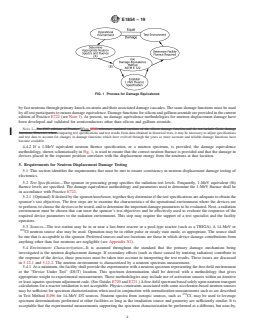
meet all of the essential requirements and effectively commu- FIG. 1 Process for Damage Equivalence
E1854 − 19
their associated damage cascades. The same damage functions 5.4.1 At a minimum, the facility shall provide the experi-
must be used by all test participants to ensure damage menter with a neutron spectrum representing the free-field
equivalence. Damage functions for silicon and gallium ar- environment at the “Device Under Test” (DUT) location. This
senideareprovidedinthecurrenteditionofPracticeE722(see spectrum determination shall be derived with a methodology
Note 1).At present, no damage equivalence methodologies for that gives appropriate weight to experimental measurements.
neutron displacement damage have been developed and vali- These methodologies may include use of activation sensors
dated for semiconductors other than silicon and gallium within an iterative or least-squares spectrum adjustment code.
arsenide. (See Guides E720 and E721.) A free-field spectrum based
solely upon neutron transport calculations for a reactor irradia-
NOTE 1—When comparing test specifications and test results from data
tionisnotacceptable.Physicsconstraintsassociatedwithsome
obtainedinhistoricaltests,itmaybenecessarytoadjustspecificationsand
accelerator-based neutron sources may be sufficient for spec-
test data to account for changes in damage functions which have evolved
through the years as more accurate and reliable damage functions have
trum characterization when used in conjunction with normal-
become available.
ization measurements such as are described in Test Method
E496 for 14-MeV DT sources. Neutron spectra from isotopic
4.4.2 If a 1-MeV equivalent neutron fluence specification,
sources, such as Cf, may be used to leverage spectrum
or a neutron spectrum, is provided, the damage equivalence
determinations performed at other facilities as long as the
methodology, shown schematically in Fig. 1, is used to ensure
irradiation source and geometry are sufficiently similar. It is
thatthecorrectneutronfluenceisprovidedandthatthedamage
acceptable that the experimental measurements supporting the
in devices placed in the exposure position correlates with the
spectrum characterization be performed at a different, but
displacement energy from the neutrons at that location.
near-by, location rather than the characterized position, as long
as one can use calculations to relate the sensor response
5. Requirements for Neutron Displacement Damage
between the characterized position and the location where the
Testing
sensorsarefieldedandiftheanalysisisaccompaniedbyahigh
5.1 Thissectionidentifiestherequirementsthatmustbemet
fidelity assessment of the calculated ratio of the sensor re-
to ensure consistency in neutron displacement damage testing
sponse in the two positions.
of electronics.
5.4.1.1 If the fixtures used by the experimenter significantly
5.2 Test Specification—The sponsor or procuring group
perturbthefree-fieldenvironmentthatwascharacterizedbythe
specifies the radiation test levels. Frequently, 1-MeV equiva- facility,thentheexperimentershallberesponsibleforproperly
lent (Si) fluence levels are specified. The damage equivalence
relating the irradiation environment impacting the device-
methodology and parameters used to determine the 1-MeV under-test to the freefield radiation environment characteriza-
fluence shall be in accordance with Practice E722.
tion that is provided by the facility.
5.2.1 (Optional) If desired by the sponsor/user/tester, to-
NOTE2—Thedeterminationofthespectrumatalocationwithinornear
gether they determine if the test specifications are adequate to
an experimental fixture that perturbs the free-field spectrum is often best
obtain the sponsor’s test objectives. The first steps are to
accomplished by calculations. Calculations alone may be sufficient in
these cases as long as the calculational methodology and modeling have
examine the characteristics of the operational environment
been validated by comparison with measurements for the free-field
where the devices are to perform, to choose the devices to be
(unperturbed) case. Experimental validation of any calculations is always
tested,andtodeterminetheimportantdamageparameterstobe
desirable, but is not always practical. The use of dosimetry sensors is
evaluated. Next, a radiation environment must be chosen that
discussed in Test Methods E181, E262, E393, E481, E523, E526, E704,
can meet the sponsor’s test objectives and be effectively used E705, and E1297, Practice E261, and Guide E844.
to evaluate the responses of the required device parameters to
5.4.2 For the determination of the spectrum, the sensor set
theradiationenvironment.Thisstepmayrequirethesupportof
must be sensitive over the energy range within which the
a test specialist and the facility operators.
device under test is sensitive. In particular, the sensor set shall
include a sensor with significant response in the 10-keV to
5.3 Sources—The test station may be in or near a fast-burst
1-MeV energy region. Sensors with energy responses in this
reactororapool-typereactor(suchasaTRIGA).A14-MeVor
235 239
regionincludetheboron-coveredfissionfoils, Uand Pu,
Cf neutron source also may be used. Operation may be in
as well as the Np fission foil. In addition, niobium through
either pulse or steady state mode, as appropriate. The source
93 93m
the reaction Nb(n,n') Nb can be useful, although its very
shallbeonethatisacceptabletothesponsor.Preferredsources
long half-life of about 16 years usually results in a very low
and test locations are those in which device damage contribu-
activity. In the absence of fission foils, silicon devices can be
tionsfromanythingotherthanfastneutronsarenegligible(see
used effectively as spectrum sensors responsive within this
Appendix X1).
energy range. It is suggested that both fission foils and silicon
5.4 Environment Characterization—It is assumed through-
devices be used for mutual confirmation (1,2).
out the standard that the primary damage mechanism being
5.4.3 Toprovideinformationneededtoaccountforpossible
investigated is the neutron displacement damage. If secondary
gamma-ray effects on the DUT, the facility shall provide a
effects (such as those caused by ionizing radiation) contribute
measure of the gamma-ray dose to the silicon or gallium
to the response of the device, these processes must be taken
into account in interpreting the test results. These issues are
discussed in 5.12.1 and 5.12.2. The neutron environment is
The boldface numbers in parentheses refer to a list of references at the end of
characterized by a neutron spectrum measurement. this practice.
E1854 − 19
diodes) to displacement damage cancels out.
arsenide device. The selected gamma-ray sensor shall have
been demonstrated to have a low neutron sensitivity. The
5.6 Reference Environment—If a reference environment is
gamma-ray detector response shall be traceable to NIST
used for the calibration of the PHI1 monitors used in 5.5, this
standards. One common gamma dose sensor with low neutron
reference neutron field shall be either a standard fast neutron
sensitivity is a CaF :Mn thermoluminescent detector (TLD).
benchmark field (4) or a reference neutron benchmark field
LiF TLDs (even LiF TLDs with an enriched Li component)
(see GuideE2005 and the definitions of “standard neutron
are more sensitive to thermal neutrons than CaF and should
field” and “reference neutron field” in Terminology E170)
only be used with care in fast burst reactors (FBR) and should
designated for neutron effects testing in semiconductors. Ref-
be avoided in reactors with a significant thermal neutron
erence benchmark fields that may be designated for this
fluence rate. Both radiochromic films and alanine show a high
application are generated by bare fast-fission reactors, either in
neutron sensitivity due to proton recoil in the hydrogeneous
anin-corecavityorinanearbyleakageenvironmentthatisnot
dosimeter material, and are thus not recommended as gamma
substantially modified by room-return neutrons. The relevant
sensors for mixed neutron/gamma reactor environments.
neutronfieldparametersmustbeestablishedbycalculationand
spectrummeasurementinthemannerdescribedinGuideE721,
5.5 Damage Equivalence—The facility shall provide, at
and, in addition, must be experimentally verified within an
15-month intervals or less, experimental confirmation that the
interval no longer than five years and the basis for the
equivalent fluence is consistent with that predicted by the
experimental verification documented and made available by
facility-provided spectrum.The emphasis here is on the stabil-
facility users.
ity and consistency of the neutron field since the time of the
spectrumcharacterization.Onewaythatthismaybedoneisby
5.7 Delivery of the Characterization Information—The user
demonstratingthatthedisplacementdamage,asmeasuredwith
is responsible for ensuring that he receives the information
calibrated silicon (or GaAs) device, is equal to that calculated
about the test environment needed to evaluate the response of
from the spectrum that is attributed to the test environment.
his DUT. The facility shall be prepared to supply a validated
The device used for this demonstration of the equivalence of
neutron spectrum and associated gamma-ray dose for each test
the1-MeVdamageisreferredtoasaPHI1monitor.Thedevice
environment. The identification and characterization of other
calibration could be an irradiation in a reference neutron
secondary effects and conditions that might affect the DUTare
environment,see5.6,orareferencecalibrationcanbeobtained
also necessary. The facility should be prepared to provide
by irradiating the device within the same time period (not
uncertainty information about neutron spectrum, neutron
necessarily in the same irradiation) as when the baseline
fluence, and ionizing dose so that the user can evaluate the
experimentallysupportedspectrumcharacterizationreferenced
effect of these uncertainties on the response of the DUT. This
in 5.4 was performed. Two devices appropriate to this
information generally reduces to an evaluation of uncertainties
application, because of extensive investigations of their
in the integral parameters such as Φ , the neutron
eq,1-MeV,mat
responses, are 2N2222A transistors (see Test Method E1855)
fluence-to-gamma-ray dose ratio, the fluence greater than 3
and DN-156 diodes (3). The neutron-induced displacement
MeV, the silicon hardness parameter (defined in Practice
damage changes the gain of the transistors in amounts in-
E722), the ratio of the fluence greater than 10 keV to the
versely proportional to the 1-MeV equivalent fluence, Φ
eq,1-
fluence greater than 3 MeV, and the ratio of the total fluence to
MeV,mat. In the diodes, the forward voltage increases with
the fluence greater than 3 MeV.
fluence in a reproducible, but nonlinear, way (The shape of the
calibration curve is the same for all of the diodes.) The 5.8 Controls and Auditability—The facility (including the
reference source FBRs) must provide written assurance that an
environmentisconsideredtobesatisfactorilycharacterizedfor
electronic parts testing if the ratio of theΦ damage adequate radiation environment characterization has been
eq,1-MeV,mat
58 58
performed, that it meets the environment characterization
valuetoareferencemonitor,suchasthe Ni(n,p) Coactivity
obtained from the simultaneous irradiation of a nickel foil is requirements in 5.4 and 5.5, and that the environment has not
changed (except for the possible alteration by the test object
within 10% of that predicted using the spectrum and fluence
reported by the test facility for that location (see Note 3). itself) between the time of the most recent characterization
(which was used in the supporting documentation) and the test
Another acceptable way to demonstrate this stability and
consistency of the neutron field is to irradiate a subset of time. To guard against unaccounted for changes:
sensorsthatwereusedinthebaselineexperimentallysupported
5.8.1 The facility shall have adequate in-house procedures
spectrum characterization (see 5.4) and demonstrate the con-
for monitoring changes in the reactor configuration between
sistency in the ratio of the sensor response values to a
the time at which the experiment takes place and the time the
58 58
reference/monitor reaction, such as Ni(n,p) Co, with the
environment characterization took place.
values obtained during the baseline spectrum characterization.
5.8.2 The facility shall confirm in writing that the current
The subset of sensors used must be one that includes sensors
environment delivered to the user/tester does not deviate
with good energy coverage over the range of neutron energies
significantly from the environment at which the damage
that are important to the displacement damage metric of
verification and spectral determination were performed.
interest, typically between 10 keV and 5 MeV.
5.8.3 The facility shall employ a process to inform facility
NOTE 3—The damage measurements discussed here are all ratio
staff responsible for interfacing with users/testers, internal test
measurements in reference and test environments taken with the same
specialists, and dosimetry specialists of changes that may
PHI1 monitor. Therefore the damage constant that relates the change in
reciprocal gain for 2N2222 transistors (or forward voltage for DN-156 impact test consistency.
E1854 − 19
5.8.4 Appropriate neutron and gamma ray monitors shall be other components of the environment, these responses must
included with the DUT on each exposure. alsobecharacterizedforthedeliveredenvironment.Secondary
effects are discussed in 5.12.1 and 5.12.2.
5.9 Dosimetry Equipment—The dosimetry group shall have
5.11.1 It is recommended that the tester use a test environ-
at a minimum:
ment that approximates the operational environment to avoid
5.9.1 Appropriate activation foil counting and gamma dose
surprises, especially if a new semiconductor technology is
readout equipment with calibrations traceable to NIST.
being tested. Alternatively, a free-field or neutron-enhanced
5.9.2 Fast neutron threshold activation reactions such as
32 54 58
fast burst reactor environment may be used to minimize
S(n,p), Fe(n,p), or Ni(n,p) shall be used to monitor the
unwanted contributors to damage in a neutron displacement
neutron fluence. These reactions are recommended because of
damage test. A neutron-enhanced environment is produced by
their relatively high cross sections and convenient half-lives.
shielding the DUT from gamma-rays by using a high atomic
5.9.3 Suitable gamma dose sensors shall be used to monitor
the gamma-ray dose discussed in Practice E666. If thermolu- number material as a shield. If environment-modifying mate-
rials are used, then separate gamma-ray tests may be required
minescence dosimeters are selected as the gamma sensor,
Practice E668 provides useful information on the calibration so that the contributing damage factors can be determined. If
and use of TLDs in gamma environments. Practice E2450 gammafilters,suchasleadorbismuth,surroundthetestobject,
provides useful information on the use of TLDs in mixed the neutron spectrum will be modified and must be determined
neutron and gamma ray fields. The sensor selected to monitor for that configuration.
the gamma environment should have a demonstrated low
5.11.2 It is the user/tester’s responsibility to make certain
neutron sensitivity. CaF :Mn TLDs are an appropriate sensor
2 that the proper response functions are used for the DUT, but it
for application in most mixed neutron/gamma ray fields.
is the responsibility of the facility or test specialist to make
5.9.4 Calibrated silicon devices may be used as spectrum
certain that the correct 1-MeV fluence is ascribed to the
sensors and 1-MeV equivalent fluence monitors. If silicon
free-field environment.
devices are used as monitors, then an appropriate device
5.12 Device Testing—This subsection deals primarily with
parameter reader must be available along with an oven for
the testing of the DUTs and with the considerations that must
annealing treatments.
be made beyond the basic characterization and maintenance of
NOTE 4—Although the dosimetry group is usually associated with the
the test environment.
facility,inordertoensurecontinuityofenvironmentcharacterization,itis
5.12.1 Secondary Gamma-Ray Effects—It is the primary
often advantageous for the user to add his own dosimetry so that he can
more readily monitor consistency with the local dosimetry and the results responsibility of the user (with assistance of a test specialist, if
obtained at other test facilities.
desired) to account for the secondary effects that influence
5.10 Damage Correlations—For neutron displacement device performance. The most important potential contributor
damage equivalence, either the 1-MeV(Si) equivalent fluence to secondary-damage effects is the prompt gamma-ray fluence
or the 1-MeV(GaAs) equivalent fluence must be provided. rateassociatedwiththefissionneutron-generationprocess.The
Alternatively, a neutron spectrum may be provided and the inclusion of gamma sensors in the dosimeter packages allows
corresponding 1-MeV equivalent fluence specification can be the potential gamma-ray effects to be evaluated, provided the
determined using Practice E722. The damage equivalence response of the DUT to gamma rays is determined separately.
methodologyinthispracticehasbeenvalidatedforbothsilicon The response of the DUT to gamma dose shall be determined
and gallium arsenide by demonstrating that equal damage is
separately using a pure gamma calibrated source such as Co
achieved for the same 1-MeV equivalent fluence even in or Cs. Frequently encountered gamma-ray effects are dis-
neutron environments having very different energy distribu-
cussed further in Appendix X1. The contribution of gamma
tions (5,6). The spectrum at the test facility exposure location rays is usually not significant for fast burst reactor tests, unless
must also be parameterized into a 1-MeV equivalent fluence,
something that enhances the gamma field is nearby. Guidance
Φ , using the same practice. By providing the fortheuseofTLDsingammafieldsisfoundinPracticeE668.
eq,1-MeV,mat
specified Φ in the test environment, the desired damage is
Practice E2450 describes a procedure for measuring gamma-
produced and test consistency is achieved if all other contri-
ray absorbed dose in CaF (Mn) TLDs exposed to mixed
butions to the damage are accounted for or are negligible. The
neutron-photon environments.
damageequivalencemethodologyisfullydescribedinPractice
5.12.2 Other Secondary Effects—Other potential contribu-
E722. It is essential that the proper damage function for the
tors to measured DUT performance include displacement
device be used, and accurate spectra for the environments be
damage annealing (which can actually aid in device perfor-
determined.
mance recovery), the temperature at which the device perfor-
mance is tested device electrical currents to which the device
5.11 Test Device Response Function—Decisions must be
madetodeterminetheappropriateresponsemechanismsinthe has been exposed between the time of the neutron irradiation
and the time at which the device performance is tested, and
DUT.Afterthedamagemechanismshavebeendetermined,the
correct response functions can be used to calculate the deliv- displacements caused by recoil atoms resulting from thermal
neutron capture in trace contaminants and dopants in the
ered damage level. The latest functions from Practice E722
shall be used for neutron displacement damage functions. electronic parts. For example, boron is frequently used as a
dopant in silicon parts and high energy recoil alpha particles
Validated damage functions for other semiconductor materials
are likely to become available later. If the DUT responds to can result from these thermal neutron interactions. Gamma
E1854 − 19
dose enhancement effects can be induced in devices at inter- 5.13 Test Documentation—The user, with the assistance of
faces between materials with dissimilar atomic number. Dose the other participants, is responsible for making certain that all
enhancement effects are discussed in Practice E1249 and Test
the tasks listed above (in 5.1 – 5.12) are accomplished and
Method E1250. documented.The additional user tasks that must be carried out
5.12.3 Measurements for the DUT Environment—The neu-
and documented are DUT performance measurements. If
tron fluence used for device irradiation shall be obtained by
necessary,thesponsormayrequirethepredictionofthedevice
measuring the amount of radioactivity induced by a fast-
responses in the operational environments based on the test
32 54
neutronthresholdactivationreaction,suchas S(n,p), Fe(n,
results.
p), or Ni(n,p), in a monitor foil which is irradiated at the
5.13.1 In the usual mode of operation, as discussed in 5.7,
same time and co-located with the device. A standard method
the facility operator is responsible for providing,
for converting the measured radioactivity to neutron fluence in
characterizing, and reporting on the test environment (the
the specific monitor foil employed in a neutron environment is
neutron spectrum, fluence, and gamma-ray dose during the
given in Test Methods E263, E264, and E265.As discussed in
test). Such characterizations are to be based on measurements
5.4, the conversion of the foil radioactivity into a neutron
traceable to NIST. The facility operator and test specialist
fluence requires a knowledge of the neutron spectrum incident
evaluate the test specifications with respect to the capabilities
onthefoil.Ifthespectrumisnotknown,itshallbedetermined
of the facility and provide the documentation on the certified
by use of Guide E720 or E721 or Practice E722 or their
environments that are available to the user. Facility changes
equivalent.
possibly affecting the test spectrum that have been made since
5.12.4 Thedeterminationof(1)thespectrumshapefromthe
thelastspectrumcharacterizationshallbedocumented,andthe
environment characterization, and (2) the magnitude of the
documentation made available to the user. More reliability is
1-MeV fluence (derived from the spectrum) with the fluence
achieved if the characterization measurements and the test
monitor, completes the characterization of the neutron envi-
measurements are both made with the same dosimetry system
ronment for the test. The user is cautioned that if the neutron
and procedures, but this is not mandatory.
spectrum is perturbed, the fluence monitor may no longer
provide an accurate measure of the 1-MeV fluence.Additional
6. Keywords
guidanceonthedeterminationofaneutronspectrumbythefoil
6.1 electronics testing; neutron-induced damage; nuclear
activation method can be found in Guides E482 and E1018,
and Practice E944. test reactors; test consistency; 1 MeV-equivalence
APPENDIXES
(Nonmandatory Information)
X1. RECOMMENDATIONS FOR ENSURING TEST CONSISTENCY
X1.1 This appendix provides additional in-depth discus- process uses a limited set of long half-life foils, silicon
sionsandmakesrecommendationsrelatedtotherequiredtasks transistor monitors, and TLD dosimeters that are exposed in
inSection5.Thisexpansionofcontextleadstosomerepetition the test environment and read at the validating agency’s
in order to preserve continuity. Ideally, all one needs to do is dosimetry laboratory.
certify that the 1-MeV equivalent fluences in the two environ-
X1.2.1 The user may wish to contract a validator to take on
ments are the same. The problems in practice are: (1) the
other tasks such as the following: verifying either the suitabil-
neutron environments may not be accurately characterized as
ity of the radiation facility, the quality of the radiation test
to spectral shape or fluence; (2) there may be additional
including the electrical measurements, or the radiation hard-
significant contributors to damage; and (3) there may be
ness of the electronic part production line. The responsibility
process faults. This appendix provides recommendations that
includes confirmation that the requirements of this practice
maybeusedbytestparticipantstofacilitateimplementationof
assigned to the facility organization (and external support
the requirements and shed light on the bases for them.
groups, if used) are met and adequately documented. The
documentation may include written procedures for calibration,
X1.2 It is useful to have in place a validation process that is
independent of both the user and the facility that provides the operation, maintenance, hardware and software configuration
control of dosimetry systems, procedures for ensuring the
test environment. It is not practical to make independent
validation mandatory. Nevertheless, a spectrum and 1 MeV- desiredenvironmentsareobtained,andproceduresfortracking
parts from door to door within the facility. Upon request, the
equivalentfluencevalidationmethodologyhasbeendeveloped
and validated (2) so that determination of suitability of test validator should provide documentation as to the suitability of
environments by an independent agency is possible. The thetestenvironment(s)tousersandtothefacilityorganization.
E1854 − 19
X1.3 The Neutron Spectra sible?Goldfoilsareparticularlyvulnerableandshouldbeused
in a dilute form (<0.2% by weight); otherwise, one must
X1.3.1 The spectrum should be determined with an accu-
anticipate making corrections for self shielding.
racy sufficient to ensure that the derived 1-MeV equivalent
X1.3.1.4 Expertise and experience in using at least one of
fluence is known to 610% relative to the reference environ-
the currently accepted spectrum adjustment codes such as
ments discussed in 5.6 using the damage function and 1-MeV
SAND-II, LSL-M2, STAY’SL or FERRET are necessary for
normalization in Practice E722.The uncertainty in the damage
the proper interpretation of the activity sensor data (7-13).The
responsefunctionitselfisnotincludedinthis10%uncertainty,
use of SAND-II and LSL-M2 is discussed in Guide E721 for
butitisassumedthatallusersusetheresponsefunctionslisted
application in transient radiation effects on electronics (TREE)
inPracticeE722.Althoughothermeansofdeterminingneutron
tests.
spectra are available, only the multiple-response-function-
sensor-method (usually called the foil activation method) is
X1.3.2 Testing can be greatly simplified if the neutron
discussed here. Other methods for determining equivalent
spectrum shape in the test environment can be customized so
fluences are mentioned in X1.6.3. Because the method is
that it is the same as that in the operational environment. It is
discussed thoroughly in Guides E720 and E721, the reader is
always good practice to use a test environment that is as close
referred to those standards for the full details.
as possible to the operational environment because the uncer-
X1.3.1.1 Use a large number (>15 if possible) of spectrum
tainties introduced in relating them will then be minimized.
sensors, with good spectrum coverage and well-established
Fast burst reactors are often the best choice for TREE testing
response functions. Reactions with well-established sensitivi-
because the spectrum shape approximates that of many speci-
ties have been evaluated for consistency with sets of reactions
fied operational environments. In addition, for free-field expo-
with overlapping sensitivities. See Guides E720 and E721 for
sures the gamma-ray induced permanent damage is usually
reactionsandreferencestorecommendedcrosssectionsforuse
small compared to that induced by the neutrons. If possible,
with activation foils. The set of sensors should have sensitivi-
chooseatestenvironmentwithahighneutron-to-gammaratio,
ties that cover a neutron energy range that is broader than the
Φ /γ, so that corrections for gamma-ray effects
eq,1-MeV,mat
energyrangetowhichtheDUTsaresensitive.Inthecasewhen
either are not significant or can be applied easily.
a laboratory has no access to fission foils such as U and
NOTE X1.1—In a reactor environment, if the Φ /γ ratio is
Pu, there
...
This document is not an ASTM standard and is intended only to provide the user of an ASTM standard an indication of what changes have been made to the previous version. Because
it may not be technically possible to adequately depict all changes accurately, ASTM recommends that users consult prior editions as appropriate. In all cases only the current version
of the standard as published by ASTM is to be considered the official document.
Designation: E1854 − 13 E1854 − 19
Standard Practice for
Ensuring Test Consistency in Neutron-Induced
Displacement Damage of Electronic Parts
This standard is issued under the fixed designation E1854; the number immediately following the designation indicates the year of
original adoption or, in the case of revision, the year of last revision. A number in parentheses indicates the year of last reapproval. A
superscript epsilon (´) indicates an editorial change since the last revision or reapproval.
1. Scope
1.1 This practice sets forth requirements to ensure consistency in neutron-induced displacement damage testing of silicon and
gallium arsenide electronic piece parts. This requires controls on facility, dosimetry, tester, and communications processes that
affect the accuracy and reproducibility of these tests. It provides background information on the technical basis for the requirements
and additional recommendations on neutron testing.
1.2 Methods are presented for ensuring and validating consistency in neutron displacement damage testing of electronic parts
such as integrated circuits, transistors, and diodes. The issues identified and the controls set forth in this practice address the
characterization and suitability of the radiation environments. They generally apply to reactor sources, accelerator-based neutron
sources, such as 14-MeV DT sources, and Cf sources. Facility and environment characteristics that introduce complications or
problems are identified, and recommendations are offered to recognize, minimize or eliminate these problems. This practice may
be used by facility users, test personnel, facility operators, and independent process validators to determine the suitability of a
specific environment within a facility and of the testing process as a whole. Electrical measurements are addressed in other
standards, such as Guide F980. Additional information on conducting irradiations can be found in Practices E798 and F1190. This
practice also may be of use to test sponsors (organizations that establish test specifications or otherwise have a vested interest in
the performance of electronics in neutron environments).
1.3 Methods for the evaluation and control of undesired contributions to damage are discussed in this practice. References to
relevant ASTM standards and technical reports are provided. Processes and methods used to arrive at the appropriate test
environments and specification levels for electronics systems are beyond the scope of this practice; however, the process for
determining the 1-MeV equivalent displacement specifications from operational environment neutron spectra should employ the
methods and parameters described herein. Some important considerations and recommendations are addressed in Appendix X1
(Nonmandatory information).
1.4 The values stated in SI units are to be regarded as standard. No other units of measurement are included in this standard.
1.5 This standard does not purport to address all of the safety concerns, if any, associated with its use. It is the responsibility
of the user of this standard to establish appropriate safety safety, health, and healthenvironmental practices and determine the
applicability of regulatory limitations prior to use.
1.6 This international standard was developed in accordance with internationally recognized principles on standardization
established in the Decision on Principles for the Development of International Standards, Guides and Recommendations issued
by the World Trade Organization Technical Barriers to Trade (TBT) Committee.
2. Referenced Documents
2.1 The ASTM standards listed below present methods for ensuring proper determination of neutron spectra and fluences,
gamma-ray doses, and damage in silicon and gallium arsenide devices. The proper use of these standards is the responsibility of
the radiation metrology or dosimetry organization affiliated with facility operations. The references listed in each standard are also
relevant to all participants as background material for testing consistency.
2.2 ASTM Standards:
This practice is under the jurisdiction of ASTM Committee E10 on Nuclear Technology and Applicationsand is the direct responsibility of Subcommittee E10.07 on
Radiation Dosimetry for Radiation Effects on Materials and Devices.
Current edition approved June 1, 2013Oct. 1, 2019. Published July 2013October 2019. Originally approved in 1996. Last previous edition approved in 20072013 as
E1854E1854 – 13. - 07. DOI: 10.1520/E1854-13.10.1520/E1854-19.
For referenced ASTM standards, visit the ASTM website, www.astm.org, or contact ASTM Customer Service at service@astm.org. For Annual Book of ASTM Standards
volume information, refer to the standard’s Document Summary page on the ASTM website.
Copyright © ASTM International, 100 Barr Harbor Drive, PO Box C700, West Conshohocken, PA 19428-2959. United States
E1854 − 19
E170 Terminology Relating to Radiation Measurements and Dosimetry
E181 Test Methods for Detector Calibration and Analysis of Radionuclides
E261 Practice for Determining Neutron Fluence, Fluence Rate, and Spectra by Radioactivation Techniques
E262 Test Method for Determining Thermal Neutron Reaction Rates and Thermal Neutron Fluence Rates by Radioactivation
Techniques
E263 Test Method for Measuring Fast-Neutron Reaction Rates by Radioactivation of Iron
E264 Test Method for Measuring Fast-Neutron Reaction Rates by Radioactivation of Nickel
E265 Test Method for Measuring Reaction Rates and Fast-Neutron Fluences by Radioactivation of Sulfur-32
E393 Test Method for Measuring Reaction Rates by Analysis of Barium-140 From Fission Dosimeters
E481 Test Method for Measuring Neutron Fluence Rates by Radioactivation of Cobalt and Silver
E482 Guide for Application of Neutron Transport Methods for Reactor Vessel Surveillance
3 4
E496 Test Method for Measuring Neutron Fluence and Average Energy from H(d,n) He Neutron Generators by Radioactivation
Techniques
E523 Test Method for Measuring Fast-Neutron Reaction Rates by Radioactivation of Copper
E526 Test Method for Measuring Fast-Neutron Reaction Rates by Radioactivation of Titanium
E666 Practice for Calculating Absorbed Dose From Gamma or X Radiation
E668 Practice for Application of Thermoluminescence-Dosimetry (TLD) Systems for Determining Absorbed Dose in
Radiation-Hardness Testing of Electronic Devices
E704 Test Method for Measuring Reaction Rates by Radioactivation of Uranium-238
E705 Test Method for Measuring Reaction Rates by Radioactivation of Neptunium-237
E720 Guide for Selection and Use of Neutron Sensors for Determining Neutron Spectra Employed in Radiation-Hardness
Testing of Electronics
E721 Guide for Determining Neutron Energy Spectra from Neutron Sensors for Radiation-Hardness Testing of Electronics
E722 Practice for Characterizing Neutron Fluence Spectra in Terms of an Equivalent Monoenergetic Neutron Fluence for
Radiation-Hardness Testing of Electronics
E798 Practice for Conducting Irradiations at Accelerator-Based Neutron Sources
E844 Guide for Sensor Set Design and Irradiation for Reactor Surveillance
E944 Guide for Application of Neutron Spectrum Adjustment Methods in Reactor Surveillance
E1018 Guide for Application of ASTM Evaluated Cross Section Data File
E1249 Practice for Minimizing Dosimetry Errors in Radiation Hardness Testing of Silicon Electronic Devices Using Co-60
Sources
E1250 Test Method for Application of Ionization Chambers to Assess the Low Energy Gamma Component of Cobalt-60
Irradiators Used in Radiation-Hardness Testing of Silicon Electronic Devices
E1297 Test Method for Measuring Fast-Neutron Reaction Rates by Radioactivation of Niobium
E1855 Test Method for Use of 2N2222A Silicon Bipolar Transistors as Neutron Spectrum Sensors and Displacement Damage
Monitors
E2005 Guide for Benchmark Testing of Reactor Dosimetry in Standard and Reference Neutron Fields
E2450 Practice for Application of CaF (Mn) Thermoluminescence Dosimeters in Mixed Neutron-Photon Environments
F980 Guide for Measurement of Rapid Annealing of Neutron-Induced Displacement Damage in Silicon Semiconductor Devices
F1190 Guide for Neutron Irradiation of Unbiased Electronic Components
3. Functional Responsibilities
3.1 The following terms are used to identify key roles and responsibilities in the process of reactor testing of electronics. Some
participants may perform more than one role, and the relationship among the participants may differ from test program to test
program and from facility to facility.
3.2 Sponsor—Individual or organization requiringrequesting the test results and ultimately responsible for the test specifications
and use of the results (for example, a system developer or procuring activity). Test sponsors should consider the objectives of the
test and the issues raised in this practice. They shall clearly communicate to the user the test requirements, including specific test
methods.
3.3 User—Generally, the individual or team who contracts for the use of the facility, specifies the characteristics needed to
accomplish the test objectives, and makes sure that the documentation of the test parameters is complete. If the test sponsor does
not communicate clear requirements and sufficient information to fully interpret them, the user shall communicate to the sponsor,
prior to the test, the assumptions made and any limitations of applicability of test data because of these assumptions. This may
require consultation with a test specialist, who may be internal or external to the user organization. Facility users also should
consider the objectives of their tests and the issues raised in this practice. The user may also conduct the tests. The user shall
communicate the environmental, procedural (including specific test methods, if any) and reporting requirements to the other
participants including the tester, the facility operators, and the test specialist.
E1854 − 19
3.4 Facility Organization—The group responsible for providing the radiation environment. The facility organization shall
provide pre-test communication to the user on facility capabilities, cautions, and limitations, as well as dosimetry capabilities,
characteristics of the test environment, and test consistency issues unique to the facility and/or test station within the facility. If
there is no independent validator, the facility shall also be required to provide the user with documentation on the controls,
calibrations, and validation tests, which verify its suitability for the proposed tests. Post-test, the facility shall report dosimetry
results, relevant operational parameters, and any occurrences that might affect the test results. The radiation facility and test station
used in the test shall meet the criteria specified in Section 5.
3.5 Dosimetry Group—Individual or team providing data of record on dose, dose rate, neutron fluence, and spectra.
3.6 Test Specialist—Individual providing radiation test expertise. This individual may identify the appropriate damage
function(s) and may fold them with neutron spectra to determine/predict damage and damage ratios. This individual may also
provide information on experiment limitations, custom configurations that are advantageous, and interpretation of dosimetry
results.
3.7 Validator—Independent person who may be responsible for verifying either the suitability of the radiation environment, the
quality of the radiation test including the electrical measurements, or the radiation hardness of the electronic part production line.
4. Significance and Use
4.1 This practice was written primarily to guide test participants in establishing, identifying, maintaining, and using suitable
environments for conducting high quality neutron tests. Its development was motivated, in large measure, because inadequate
controls in the neutron-effects-test process have, in some past instances, resulted in exposures that have differed by factors of three
or more from irradiation specifications. A radiation test environment generally differs from the environment in which the
electronics must operate (the operational environment); therefore, a high quality test requires not only the use of a suitable radiation
environment, but also control and compensation for contributions to damage that differ from those in the operational environment.
In general, the responsibility for identifying suitable test environments to accomplish test objectives lies with the sponsor/user/
tester and test specialist part of the team, with the assistance of an independent validator, if available. The responsibility for the
establishment and maintenance of suitable environments lies with the facility operator/dosimetrist and test specialist, again with
the possible assistance of an independent validator. Additional guidance on the selection of an irradiation facility is provided in
Practice F1190.
4.2 This practice identifies the tasks that must be accomplished to ensure a successful high quality test. It is the overall
responsibility of the sponsor or user to ensure that all of the required tasks are complete and conditions are met. Other participants
provide appropriate documentation to enable the sponsor or user to make that determination.
4.3 The principal determinants of a properly conducted test are: (1) the radiation test environment shall be well characterized,
controlled, and correlated with the specified irradiation levels; (2) damage produced in the electronic materials and devices is
caused by the desired, specified component of the environment and can be reproduced at any other suitable facility; and (3) the
damage corresponding to the specification level derived from radiation environments in which the electronics must operate can be
predicted from the damage produced by the test environment. In order to ensure that these requirements are met, system
developers, procurers, users, facility operators, and test personnel must collectively meet all of the essential requirements and
effectively communicate to each other the tasks that must be accomplished and the conditions that must be met. Criteria for
determining and maintaining the suitability of neutron radiation environments for 1-MeV equivalent displacement damage testing
of electronics parts are presented in Section 5. Mandatory requirements for test consistency in neutron displacement damage testing
of electronic parts are presented in Section 5. Additional background material on neutron testing and important considerations for
gamma dose and dose rate effects are presented in (non-mandatory) Appendix X1 and Appendix X2, but compliance is not
required.
4.4 Some neutron tests are performed with a specific end application for the electronics in mind. Others are performed merely
to ensure that a 1-MeV-equivalent-displacement-damage-specification level is met. The issues and controls presented in this
practice are necessary and sufficient to ensure consistency in the latter case. They are necessary, but may not be sufficient, when
the objective is to determine device performance in an operational environment. In either case, a corollary consistency requirement
is that test results obtained at a suitable facility can be replicated within suitable precision at any other suitable facility.
4.4.1 An objective of radiation effects testing of electronic devices is often to predict device performance in operational
environments from the data that is obtained in the test environments. If the operational and test environments differ materially from
each other, then damage equivalence methodologies are required in order to make the required correspondences. This process is
shown schematically in Fig. 1. The part of the process (A, in Fig. 1) that establishes the operational neutron environments required
to select the appropriate 1-MeV-equivalent specification level, or levels, is beyond the scope of this practice. However, if a neutron
spectrum is used to set a 1 MeV equivalent fluence specification level, it is important that the process (B, in Fig. 1) be consistent
with this practice. Damage equivalence methodologies must address all of the important contributors to damage in the operational
and test environments or the objectives of the test may not be met. In the mixed neutron-gamma radiation fields produced by
nuclear reactors, most of the permanent damage in solid-state semiconductor devices results from displacement damage produced
E1854 − 19
FIG. 1 Process for Damage Equivalence
by fast neutrons through primary knock-on atoms and their associated damage cascades. The same damage functions must be used
by all test participants to ensure damage equivalence. Damage functions for silicon and gallium arsenide are provided in the current
edition of Practice E722 (see Note 1). At present, no damage equivalence methodologies for neutron displacement damage have
been developed and validated for semiconductors other than silicon and gallium arsenide.
NOTE 1—Pre-1993 editions of Practice When E722 reference outdated versions of the silicon damage function and do not include GaAs damage
functions. However, when comparing test specifications and test results from data obtained in historical tests, it may be necessary to adjust specifications
and test data to account for changes in damage functions which have evolved through the years as more accurate and reliable damage functions have
become available.
4.4.2 If a 1-MeV equivalent neutron fluence specification, or a neutron spectrum, is provided, the damage equivalence
methodology, shown schematically in Fig. 1, is used to ensure that the correct neutron fluence is provided and that the damage in
devices placed in the exposure position correlates with the displacement energy from the neutrons at that location.
5. Requirements for Neutron Displacement Damage Testing
5.1 This section identifies the requirements that must be met to ensure consistency in neutron displacement damage testing of
electronics.
5.2 Test Specification—The sponsor or procuring group specifies the radiation test levels. Frequently, 1-MeV equivalent (Si)
fluence levels are specified. The damage equivalence methodology and parameters used to determine the 1-MeV fluence shall be
in accordance with Practice E722.
5.2.1 (Optional) If desired by the sponsor/user/tester, together they determine if the test specifications are adequate to obtain the
sponsor’s test objectives. The first steps are to examine the characteristics of the operational environment where the devices are
to perform, to choose the devices to be tested, and to determine the important damage parameters to be evaluated. Next, a radiation
environment must be chosen that can meet the sponsor’s test objectives and be effectively used to evaluate the responses of the
required device parameters to the radiation environment. This step may require the support of a test specialist and the facility
operators.
5.3 Sources—The test station may be in or near a fast-burst reactor or a pool-type reactor (such as a TRIGA). A 14-MeV or
Cf neutron source also may be used. Operation may be in either pulse or steady state mode, as appropriate. The source shall
be one that is acceptable to the sponsor. Preferred sources and test locations are those in which device damage contributions from
anything other than fast neutrons are negligible (see Appendix X1).
5.4 Environment Characterization—It is assumed throughout the standard that the primary damage mechanism being
investigated is the neutron displacement damage. If secondary effects (such as those caused by ionizing radiation) contribute to
the response of the device, these processes must be taken into account in interpreting the test results. These issues are discussed
in 5.12.1 and 5.12.2. The neutron environment is characterized by a neutron spectrum measurement.
5.4.1 At a minimum, the facility shall provide the experimenter with a neutron spectrum representing the free-field environment
at the “Device Under Test” (DUT) location. This spectrum determination shall be derived with a methodology that gives
appropriate weight to experimental measurements. These methodologies may include use of activation sensors within an iterative
or least-squares spectrum adjustment code. (See Guides E720 and E721.) A free-field spectrum based solely upon neutron transport
calculations for a reactor irradiation is not acceptable. Physics constraints associated with some accelerator-based neutron sources
may be sufficient for spectrum characterization when used in conjunction with normalization measurements such as are described
in Test Method E496 for 14-MeV DT sources. Neutron spectra from isotopic sources, such as Cf, may be used to leverage
spectrum determinations performed at other facilities as long as the irradiation source and geometry are sufficiently similar. It is
acceptable that the experimental measurements supporting the spectrum characterization be performed at a different, but near-by,
E1854 − 19
location rather than the characterized position, as long as one can use calculations to relate the sensor response between the
characterized position and the location where the sensors are fielded and if the analysis is accompanied by a high fidelity
assessment of the calculated ratio of the sensor response in the two positions.
5.4.1.1 If the fixtures used by the experimenter significantly perturb the free-field environment that was characterized by the
facility, then the experimenter shall be responsible for properly relating the irradiation environment impacting the device-under-test
to the freefield radiation environment characterization that is provided by the facility.
NOTE 2—The determination of the spectrum at a location within or near an experimental fixture that perturbs the free-field spectrum is often best
accomplished by calculations. Calculations alone may be sufficient in these cases as long as the calculational methodology and modeling have been
validated by comparison with measurements for the free-field (unperturbed) case. Experimental validation of any calculations is always desirable, but is
not always practical. The use of dosimetry sensors is discussed in Test Methods E181, E262, E393, E481, E523, E526, E704, E705, and E1297, Practice
E261, and Guide E844.
5.4.2 For the determination of the spectrum, the sensor set must be sensitive over the energy range within which the device
under test is sensitive. In particular, the sensor set shall include a sensor with significant response in the 10-keV to 1-MeV energy
235 239 237
region. Sensors with energy responses in this region include the boron-covered fission foils, U and Pu, as well as the Np
93 93m
fission foil. In addition, niobium through the reaction Nb(n,n') Nb can be useful, although its very long half-life of about 16
years usually results in a very low activity. In the absence of fission foils, silicon devices can be used effectively as spectrum
sensors responsive within this energy range. It is suggested that both fission foils and silicon devices be used for mutual
confirmation (1,2).
5.4.3 To provide information needed to account for possible gamma-ray effects on the DUT, the facility shall provide a measure
of the gamma-ray dose to the silicon or gallium arsenide device. The selected gamma-ray sensor shall have been demonstrated to
have a low neutron sensitivity. The gamma-ray detector response shall be traceable to NIST standards. One common gamma dose
sensor with low neutron sensitivity is a CaF :Mn thermoluminescent detector (TLD). LiF TLDs (even LiF TLDs with an enriched
Li component) are more sensitive to thermal neutrons than CaF and should only be used with care in fast burst reactors (FBR)
and should be avoided in reactors with a significant thermal neutron fluence rate. Both radiochromic films and alanine show a high
neutron sensitivity due to proton recoil in the hydrogeneous dosimeter material, and are thus not recommended as gamma sensors
for mixed neutron/gamma reactor environments.
5.5 Damage Equivalence—The facility shall provide, at 15-month intervals or less, experimental confirmation that the
equivalent fluence is consistent with that predicted by the facility-provided spectrum. The emphasis here is on the stability and
consistency of the neutron field since the time of the complete spectrum characterization. One way that this may be done is by
demonstrating that the displacement damage, as measured with calibrated silicon (or GaAs) device, is equal to that calculated from
the spectrum that is attributed to the test environment. The device used for this demonstration of the equivalence of the 1-MeV
damage is referred to as a PHI1 monitor. The device calibration could be an irradiation in a reference neutron environment, see
5.6, or a reference calibration can be obtained by irradiating the device within the same time period (not necessarily in the same
irradiation) as when the baseline experimentally supported spectrum characterization referenced in 5.4 was performed. Two
devices appropriate to this application, because of extensive investigations of their responses, are 2N2222A transistors (see Test
Method E1855) and DN-156 diodes (3). The neutron-induced displacement damage changes the gain of the transistors in amounts
inversely proportional to the 1-MeV equivalent fluence, Φ . In the diodes, the forward voltage increases with fluence
1eq, 1-MeV, mat
in a reproducible, but nonlinear, way (The shape of the calibration curve is the same for all of the diodes.) The environment is
considered to be satisfactorily characterized for electronic parts testing if the ratio of the Φ damage value to a reference
1eq, 1-MeV, mat
58 58
monitor, such as the Ni(n,p) Co activity obtained from the simultaneous irradiation of a nickel foil is within 10 % of that
predicted using the spectrum and fluence reported by the test facility for that location (see Note 3). Another acceptable way to
demonstrate this stability and consistency of the neutron field is to irradiate a subset of sensors that were used in the baseline
experimentally supported spectrum characterization (see 5.4) and demonstrate the consistency in the ratio of the sensor response
58 58
values to a reference/monitor reaction, such as Ni(n,p) Co, with the values obtained during the baseline spectrum
characterization. The subset of sensors used must be one that includes sensors with good energy coverage over the range of neutron
energies that are important to the displacement damage metric of interest, typically between 10 keV and 5 MeV.
NOTE 3—The damage measurements discussed here are all ratio measurements in reference and test environments taken with the same PHI1 monitor.
Therefore the damage constant that relates the change in reciprocal gain for 2N2222 transistors (or forward voltage for DN-156 diodes) to displacement
damage cancels out.
5.6 Reference Environment—If a reference environment is used for the calibration of the PHI1 monitors used in 5.5, this
reference neutron field shall be either a standard fast neutron benchmark field (4) or a reference neutron benchmark field (see
Guide E2005 and the definitions of “standard neutron field” and “reference neutron field” in Terminology E170) designated for
neutron effects testing in semiconductors. Reference benchmark fields that may be designated for this application are generated
by bare fast-fission reactors, either in an in-core cavity or in a nearby leakage environment that is not substantially modified by
room-return neutrons. The relevant neutron field parameters must be established by calculation and spectrum measurement in the
The boldface numbers in parentheses refer to a list of references at the end of this practice.
E1854 − 19
manner described in Guide E721, and, in addition, must be experimentally verified within an interval no longer than five years and
the basis for the experimental verification documented and made available by facility users.
5.7 Delivery of the Characterization Information—The user is responsible for ensuring that he receives the information about
the test environment needed to evaluate the response of his DUT. The facility shall be prepared to supply a validated neutron
spectrum and associated gamma-ray dose for each test environment. The identification and characterization of other secondary
effects and conditions that might affect the DUT are also necessary. The facility should be prepared to provide uncertainty
information about neutron spectrum, neutron fluence, and ionizing dose so that the user can evaluate the effect of these
uncertainties on the response of the DUT. This information generally reduces to an evaluation of uncertainties in the integral
parameters such as Φ , the neutron fluence-to-gamma-ray dose ratio, the fluence greater than 3 MeV, the silicon
1eq, 1-MeV, mat
hardness parameter (defined in Practice E722), the ratio of the fluence greater than 10 keV to the fluence greater than 3 MeV, and
the ratio of the total fluence to the fluence greater than 3 MeV.
5.8 Controls and Auditability—The facility (including the reference source FBRs) must provide written assurance that an
adequate radiation environment characterization has been performed, that it meets the environment characterization requirements
in 5.4 and 5.5, and that the environment has not changed (except for the possible alteration by the test object itself) between the
time of the most recent characterization (which was used in the supporting documentation) and the test time. To guard against
unaccounted for changes:
5.8.1 The facility shall have adequate in-house procedures for monitoring changes in the reactor configuration between the time
at which the experiment takes place and the time the environment characterization took place.
5.8.2 The facility shall confirm in writing that the current environment delivered to the user/tester does not deviate significantly
from the environment at which the damage verification and spectral determination were performed.
5.8.3 The facility shall employ a process to inform facility staff responsible for interfacing with users/testers, internal test
specialists, and dosimetry specialists of changes that may impact test consistency.
5.8.4 Appropriate neutron and gamma ray monitors shall be included with the DUT on each exposure.
5.9 Dosimetry Equipment—The dosimetry group shall have at a minimum:
5.9.1 Appropriate activation foil counting and gamma dose readout equipment with calibrations traceable to NIST.
32 54 58
5.9.2 Fast neutron threshold activation reactions such as S(n,p), Fe(n,p), or Ni(n,p) shall be used to monitor the neutron
fluence. These reactions are recommended because of their relatively high cross sections and convenient half-lives.
5.9.3 Suitable gamma dose sensors shall be used to monitor the gamma-ray dose discussed in Practice E666. If thermolumi-
nescence dosimeters are selected as the gamma sensor, Practice E668 provides useful information on the calibration and use of
TLDs in gamma environments. Practice E2450 provides useful information on the use of TLDs in mixed neutron and gamma ray
fields. The sensor selected to monitor the gamma environment should have a demonstrated low neutron sensitivity. CaF :Mn TLDs
are an appropriate sensor for application in most mixed neutron/gamma ray fields.
5.9.4 Calibrated silicon devices may be used as spectrum sensors and 1-MeV equivalent fluence monitors. If silicon devices are
used as monitors, then an appropriate device parameter reader must be available along with an oven for annealing treatments.
NOTE 4—Although the dosimetry group is usually associated with the facility, in order to ensure continuity of environment characterization, it is often
advantageous for the user to add his own dosimetry so that he can more readily monitor consistency with the local dosimetry and the results obtained
at other test facilities.
5.10 Damage Correlations—For neutron displacement damage equivalence, either the 1-MeV(Si) equivalent fluence or the
1-MeV(GaAs) equivalent fluence must be provided. Alternatively, a neutron spectrum may be provided and the corresponding
1-MeV equivalent fluence specification can be determined using Practice E722. The damage equivalence methodology in this
practice has been validated for both silicon and gallium arsenide by demonstrating that equal damage is achieved for the same
1-MeV equivalent fluence even in neutron environments having very different energy distributions (5,6). The spectrum at the test
facility exposure location must also be parameterized into a 1-MeV equivalent fluence, Φ , using the same practice. By
1eq, 1-MeV, mat
providing the specified Φ in the test environment, the desired damage is produced and test consistency is achieved if all other
contributions to the damage are accounted for or are negligible. The damage equivalence methodology is fully described in Practice
E722. It is essential that the proper damage function for the device be used, and accurate spectra for the environments be
determined.
5.11 Test Device Response Function—Decisions must be made to determine the appropriate response mechanisms in the DUT.
After the damage mechanisms have been determined, the correct response functions can be used to calculate the delivered damage
level. The latest functions from Practice E722 shall be used for neutron displacement damage functions. Validated damage
functions for other semiconductor materials are likely to become available later. If the DUT responds to other components of the
environment, these responses must also be characterized for the delivered environment. Secondary effects are discussed in 5.12.1
and 5.12.2.
5.11.1 It is recommended that the tester use a test environment that approximates the operational environment to avoid surprises,
especially if a new semiconductor technology is being tested. Alternatively, a free-field or neutron-enhanced fast burst reactor
environment may be used to minimize unwanted contributors to damage in a neutron displacement damage test. A
neutron-enhanced environment is produced by shielding the DUT from gamma-rays with a high-Z by using a high atomic number
E1854 − 19
material as a shield. If environment-modifying materials are used, then separate gamma-ray tests may be called for required so that
the contributing damage factors can be determined. If gamma filters, such as lead or bismuth, surround the test object, the neutron
spectrum will be modified and must be determined for that configuration.
5.11.2 It is the user/tester’s responsibility to make certain that the proper response functions are used for the DUT, but it is the
responsibility of the facility or test specialist to make certain that the correct 1-MeV fluence is ascribed to the free-field
environment.
5.12 Device Testing—This subsection deals primarily with the testing of the DUTs and with the considerations that must be
made beyond the basic characterization and maintenance of the test environment.
5.12.1 Secondary Gamma-Ray Effects—It is the primary responsibility of the user (with assistance of a test specialist, if desired)
to account for the secondary effects that influence device performance. The most important potential contributor to secondary-
damage effects is the prompt gamma-ray fluence rate associated with the fission neutron-generation process. The inclusion of
gamma sensors in the dosimeter packages allows the potential gamma-ray effects to be evaluated, provided the response of the
DUT to gamma rays is determined separately. The response of the DUT to gamma dose shall be determined separately using a pure
60 137
gamma calibrated source such as Co or Cs. Frequently encountered gamma-ray effects are discussed further in Appendix X1.
The contribution of gamma rays is usually not significant for fast burst reactor tests, unless something that enhances the gamma
field is nearby. Guidance for the use of TLDs in gamma fields is found in Practice E668. Practice E2450 describes a procedure
for measuring gamma-ray absorbed dose in CaF (Mn) TLDs exposed to mixed neutron-photon environments.
5.12.2 Other Secondary Effects—Other potential contributors to measured DUT performance include displacement damage
annealing (which can actually aid in device performance recovery), the temperature and device electrical currents at which the
device performance is tested device electrical currents to which the device has been exposed between the time of the neutron
irradiation and the time at which the device performance is tested, and displacements caused by recoil atoms resulting from thermal
neutron capture in trace contaminants and dopants in the electronic parts. For example, boron is frequently used as a dopant in
silicon parts and high energy recoil alpha particles can result from these thermal neutron interactions. Gamma dose enhancement
effects can be induced in devices at interfaces between materials with dissimilar atomic number. Dose enhancement effects are
discussed in Practice E1249 and Test Method E1250.
5.12.3 Measurements for the DUT Environment—The neutron fluence used for device irradiation shall be obtained by measuring
32 54 58
the amount of radioactivity induced by a fast-neutron threshold activation reaction, such as S(n,p), Fe(n,p), or Ni(n,p)Ni(n,
p), in a monitor foil which is irradiated at the same time and co-located with the device. A standard method for converting the
measured radioactivity to neutron fluence in the specific monitor foil employed in a neutron environment is given in Test Methods
E263, E264, and E265. As discussed in 5.4, the conversion of the foil radioactivity into a neutron fluence requires a knowledge
of the neutron spectrum incident on the foil. If the spectrum is not known, it shall be determined by use of Guide E720 or E721
or Practice E722 or their equivalent.
5.12.4 The determination of (1) the spectrum shape from the environment characterization, and (2) the magnitude of the 1-MeV
fluence (derived from the spectrum) with the fluence monitor, completes the characterization of the neutron environment for the
test. The user is cautioned that if the neutron spectrum is perturbed, the fluence monitor may no longer provide an accurate measure
of the 1-MeV fluence. Additional guidance on the determination of a neutron spectrum by the foil activation method can be found
in Guides E482 and E1018, and Practice E944.
5.13 Test Documentation—The user, with the assistance of the other participants, is responsible for making certain that all the
tasks listed above (in 5.1 – 5.12) are accomplished and documented. The additional user tasks that must be carried out and
documented are DUT performance measurements. If necessary, the sponsor may require the prediction of the device responses in
the operational environments based on the test results.
5.13.1 In the usual mode of operation, as discussed in 5.7, the facility operator is responsible for providing, characterizing, and
reporting on the test environment (the neutron spectrum, fluence, and gamma-ray dose during the test). Such characterizations are
to be based on measurements traceable to NIST. The facility operator and test specialist evaluate the test specifications with respect
to the capabilities of the facility and provide the documentation on the certified environments that are available to the user. Facility
changes possibly affecting the test spectrum that have been made since the last spectrum characterization shall be documented, and
the documentation made available to the user. More reliability is achieved if the characterization measurements and the test
measurements are both made with the same dosimetry system and procedures, but this is not mandatory.
6. Keywords
6.1 electronics testing; neutron-induced damage; nuclear test reactors; test consistency ; consistency; 1 MeV-equivalence
E1854 − 19
APPENDIXES
(Nonmandatory Information)
X1. RECOMMENDATIONS FOR ENSURING TEST CONSISTENCY
X1.1 This appendix provides additional in-depth discussions and makes recommendations related to the required tasks in Section
5. This expansion of context leads to some repetition in order to preserve continuity. Ideally, all one needs to do is certify that the
1-MeV equivalent fluences in the two environments are the same. The problems in practice are: (1) the neutron environments may
not be accurately characterized as to spectral shape or fluence; (2) there may be additional significant contributors to damage; and
(3) there may be process faults. This appendix provides recommendations that may be used by test participants to facilitate
implementation of the requirements and shed light on the bases for them.
X1.2 It would be very useful for all concerned is useful to have in place a validation process that is independent of both the user
and the facility that provides the test environment. It is not practical to make independent validation mandatory. Nevertheless, a
spectrum and 1 MeV-equivalent fluence validation methodology has been developed and validated (2) so that determination of
suitability of test environments by an independent agency is possible. The process uses a limited set of long half-life foils, silicon
transistor monitors, and TLD dosimeters that are exposed in the test environment and read at the validating agency’s dosimetry
laboratory.
X1.2.1 The user may wish to contract a validator to take on other tasks such as the following: verifying either the suitability of
the radiation facility, the quality of the radiation test including the electrical measurements, or the radiation hardness of the
electronic part production line. The responsibility includes confirmation that the requirements of this practice assigned to the
facility organization (and external support groups, if used) are met and adequately documented. The documentation may include
written procedures for calibration, operation, maintenance, hardware and software configuration control of dosimetry systems,
procedures for ensuring the desired environments are obtained, and procedures for tracking parts from door to door within the
facility. Upon request, the validator should provide documentation as to the suitability of the test environment(s) to users and to
the facility organization.
X1.3 The Neutron Spectra
X1.3.1 The spectrum should be determined with an accuracy sufficient to ensure that the derived 1-MeV equivalent fluence is
known to 6 10 % 610 % relative to the reference environments discussed in 5.6 using the damage function and 1-MeV
normalization in Practice E722. The uncertainty in the damage response function itself is not included in this 10 % uncertainty,
but it is assumed that all users use the response functionfunctions listed in Practice E722. Although other means of determining
neutron spectra are available, only the multiple-response-function-sensor-method (usually called the foil activation method) is
discussed here. Other methods for determining equivalent fluences are mentioned in X1.6.3. Because the method is discussed
thoroughly in Guides E720 and E721, the reader is referred to those standards for the full details.
X1.3.1.1 Use a large number (> 15 (>15 if possible) of spectrum sensors, with good spectrum coverage and well-established
response functions. Reactions with well established well-established sensitivities have been evaluated for consistency with sets of
reactions with overlapping sensitivities. See Guides E720 and E721 for reactions and references to recommended cross sections
for use with activation foils. The set of sensors should have sensitivities that cover a neutron energy range that is broader than the
energy range to which the DUTs are sensitive. Coverage beyond that range permits interpolation to interior points rather than
235 239
extrapolation. In the case when a laboratory has no access to fission foils such as U and Pu, there tends to be a critical gap
in sensor set response between 100 keV and 2 MeV. A silicon DUT may have on the order of 70 % of its response in this range
in a pool-type reactor environment. In this case, sensitivity in that range can be obtained by using calibrated silicon bipolar
transistors (1) or DN-156 diodes
...