

ASTM E704-19
(Test Method)Standard Test Method for Measuring Reaction Rates by Radioactivation of Uranium-238
General Information
- Abstract
SIGNIFICANCE AND USE
5.1 Refer to Practice E261 for a general discussion of the determination of fast-neutron fluence rate with fission detectors.
5.2 238U is available as metal foil, wire, or oxide powder (see Guide E844). It is usually encapsulated in a suitable container to prevent loss of, and contamination by, the 238U and its fission products.
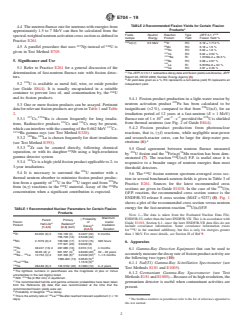
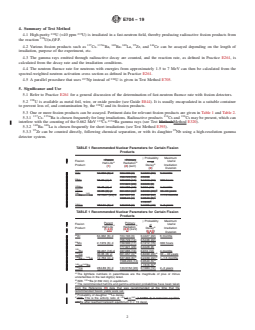
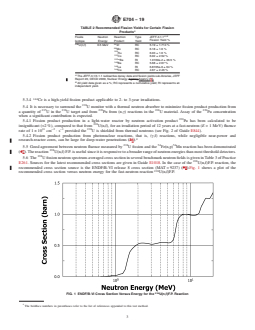
5.3 One or more fission products can be assayed. Pertinent data for relevant fission products are given in Table 1 and Table 2. (A) The lightface numbers in parentheses are the magnitude of plus or minus uncertainties in the last digit(s) listed.(B) With 137mBa (2.552 min) in equilibrium.(C) The recommended half-life and gamma emission probabilities have been taken from the Reference (3) data that was recommended at the time that the recommended fission yields were set.(D) Probability of daughter 140La decay.(E) This is the activity ratio of 140La/140Ba after reached transient equilibrium (t ≥ 19 days). (A) The JEFF-3.1/3.1.1 radioactive decay data and fission yields sub-libraries, JEFF Report 20, OECD 2009, Nuclear Energy Agency (5).(B) All yield data given as a %; RC represents a cumulative yield; RI represents an independent yield.
5.3.1 137Cs-137mBa is chosen frequently for long irradiations. Radioactive products 134Cs and 136Cs may be present, which can interfere with the counting of the 0.662 MeV 137Cs-137mBa gamma rays (see Test Method E320).
5.3.2 140Ba-140La is chosen frequently for short irradiations (see Test Method E393).
5.3.3 95Zr can be counted directly, following chemical separation, or with its daughter 95Nb using a high-resolution gamma detector system.
5.3.4 144Ce is a high-yield fission product applicable to 2- to 3-year irradiations.
5.4 It is necessary to surround the 238U monitor with a thermal neutron absorber to minimize fission product production from a quantity of 235U in the 238U target and from 239Pu from (n,γ) reactions in the 238U material. Assay of the 239Pu concentration when a signif...
SCOPE
1.1 This test method covers procedures for measuring reaction rates by assaying a fission product (F.P.) from the fission reaction 238U(n,f)F.P.
1.2 The reaction is useful for measuring neutrons with energies from approximately 1.5 to 7 MeV and for irradiation times up to 30 to 40 years, provided that the analysis methods described in Practice E261 are followed.
1.3 Equivalent fission neutron fluence rates as defined in Practice E261 can be determined.
1.4 Detailed procedures for other fast-neutron detectors are referenced in Practice E261.
1.5 The values stated in SI units are to be regarded as standard. No other units of measurement are included in this standard.
1.6 This standard does not purport to address all of the safety concerns, if any, associated with its use. It is the responsibility of the user of this standard to establish appropriate safety, health, and environmental practices and determine the applicability of regulatory limitations prior to use.
1.7 This international standard was developed in accordance with internationally recognized principles on standardization established in the Decision on Principles for the Development of International Standards, Guides and Recommendations issued by the World Trade Organization Technical Barriers to Trade (TBT) Committee.
- Status
- Published
- Publication Date
- 30-Sep-2019
- Technical Committee
- E10 - Nuclear Technology and Applications
- Drafting Committee
- E10.05 - Nuclear Radiation Metrology
Buy Documents
ASTM E704-19 - Standard Test Method for Measuring Reaction Rates by Radioactivation of Uranium-238
REDLINE ASTM E704-19 - Standard Test Method for Measuring Reaction Rates by Radioactivation of Uranium-238
Overview
ASTM E704-19, Standard Test Method for Measuring Reaction Rates by Radioactivation of Uranium-238, provides procedures for determining fast-neutron reaction rates using Uranium-238 (U-238) as a fission detector. This test method is widely used in nuclear technology and reactor surveillance to accurately measure neutron fluence rates in neutron energy ranges from approximately 1.5 MeV to 7 MeV. By quantifying specific fission products via radioactivation analysis, laboratories can obtain critical data for reactor dosimetry, nuclear safety, and materials testing over irradiation periods lasting from a few hours up to several decades.
Key Topics
Scope of Measurement
- Measures fast-neutron reaction rates by analyzing fission products from the U-238(n,f) reaction.
- Applicable for neutron energies from about 1.5 MeV to 7 MeV and long irradiation times (up to 30-40 years).
Sample Preparation
- U-238 is typically provided as high-purity metal foil, wire, or oxide powder.
- Encapsulation in suitable containers (e.g., brass, stainless steel, quartz) prevents contamination and product loss.
- Use of a thermal neutron absorber is necessary to minimize interference from U-235 and Pu-239 fission.
Fission Product Assay
- Commonly assayed products:
- Cs-137/Ba-137m (long irradiations)
- Ba-140/La-140 (short irradiations)
- Zr-95/Nb-95 (direct or post-chemical separation counting)
- Ce-144 (long-term monitoring, 2-3 years)
- The selection of product depends on experimental goals and irradiation duration.
- Commonly assayed products:
Detection Methods
- Gamma-ray spectroscopy (NaI(Tl) or high-resolution Ge detectors) is used to measure decay rates.
- Supporting equipment includes precision balances and, optionally, digital computers for analysis.
Calculation and Analysis
- Saturation activity and reaction rate are calculated from decay measurements, irradiation parameters, and referenced cross section data.
- Guidance for uncertainty assessment and results reporting is included.
Applications
Reactor Surveillance
- Measurement of fast-neutron fluence rates for reactor vessel monitoring and material degradation studies.
- Useful for lifetime assessment of reactor components and validation of neutron transport simulations.
Nuclear Dosimetry
- Benchmarking neutron fields in radiation environments to evaluate equipment exposure or radiation damage.
- Used in research reactors, power plant surveillance, and nuclear safeguards.
Calibration of Neutron Detectors
- Provides reference reaction rate data for calibrating other neutron detection systems, supporting nuclear instrumentation reliability.
Radiation Protection and Safety
- Supports compliance with regulatory requirements by quantifying neutron exposures in controlled environments.
Related Standards
- ASTM E261 - Practice for Determining Neutron Fluence, Fluence Rate, and Spectra by Radioactivation Techniques
- ASTM E844 - Guide for Sensor Set Design and Irradiation for Reactor Surveillance
- ASTM E181, E1005 - Test Methods for Detector Calibration and Analysis of Radionuclides
- ASTM E393 - Test Method for Measuring Reaction Rates by Analysis of Barium-140 From Fission Dosimeters
- ASTM E705 - Test Method for Measuring Reaction Rates by Radioactivation of Neptunium-237
- ASTM E1018 - Guide for Application of ASTM Evaluated Cross Section Data File
Practical Value
Utilizing ASTM E704-19 enables nuclear laboratories, power plants, and research facilities to precisely quantify fast-neutron fluxes, a cornerstone for ensuring the integrity and safety of nuclear installations. The standard’s robust methodology, reference data, and cross-referencing to related ASTM standards make it indispensable for routine surveillance, dosimetry calibration, and regulatory compliance in the nuclear sector.
Keywords: Uranium-238, fission product, reaction rate measurement, neutron fluence rate, gamma spectroscopy, fission dosimeter, ASTM E704-19, reactor surveillance, fast-neutron detector, nuclear radioactivation.
Relations
- Replaces
ASTM E704-13 - Standard Test Method for Measuring Reaction Rates by Radioactivation of Uranium-238 - Effective Date
- 01-Oct-2019
- Effective Date
- 01-Mar-2020
- Effective Date
- 01-Mar-2020
- Refers
ASTM E705-18 - Standard Test Method for Measuring Reaction Rates by Radioactivation of Neptunium-237 - Effective Date
- 01-Dec-2018
- Effective Date
- 01-Jun-2018
- Effective Date
- 01-Aug-2017
- Effective Date
- 01-Jun-2017
- Effective Date
- 01-Oct-2016
- Effective Date
- 15-Feb-2016
- Effective Date
- 01-Sep-2015
- Effective Date
- 01-Jul-2015
- Effective Date
- 01-Jun-2015
- Effective Date
- 15-Mar-2015
- Effective Date
- 15-Oct-2014
- Effective Date
- 01-Sep-2014
Buy Documents
ASTM E704-19 - Standard Test Method for Measuring Reaction Rates by Radioactivation of Uranium-238
REDLINE ASTM E704-19 - Standard Test Method for Measuring Reaction Rates by Radioactivation of Uranium-238
Get Certified
Connect with accredited certification bodies for this standard

DNV
DNV is an independent assurance and risk management provider.

Lloyd's Register
Lloyd's Register is a global professional services organisation specialising in engineering and technology.
DNV Energy Systems
Energy and renewable energy certification.
Sponsored listings
Frequently Asked Questions
ASTM E704-19 is a standard published by ASTM International. Its full title is "Standard Test Method for Measuring Reaction Rates by Radioactivation of Uranium-238". This standard covers: SIGNIFICANCE AND USE 5.1 Refer to Practice E261 for a general discussion of the determination of fast-neutron fluence rate with fission detectors. 5.2 238U is available as metal foil, wire, or oxide powder (see Guide E844). It is usually encapsulated in a suitable container to prevent loss of, and contamination by, the 238U and its fission products. 5.3 One or more fission products can be assayed. Pertinent data for relevant fission products are given in Table 1 and Table 2. (A) The lightface numbers in parentheses are the magnitude of plus or minus uncertainties in the last digit(s) listed.(B) With 137mBa (2.552 min) in equilibrium.(C) The recommended half-life and gamma emission probabilities have been taken from the Reference (3) data that was recommended at the time that the recommended fission yields were set.(D) Probability of daughter 140La decay.(E) This is the activity ratio of 140La/140Ba after reached transient equilibrium (t ≥ 19 days). (A) The JEFF-3.1/3.1.1 radioactive decay data and fission yields sub-libraries, JEFF Report 20, OECD 2009, Nuclear Energy Agency (5).(B) All yield data given as a %; RC represents a cumulative yield; RI represents an independent yield. 5.3.1 137Cs-137mBa is chosen frequently for long irradiations. Radioactive products 134Cs and 136Cs may be present, which can interfere with the counting of the 0.662 MeV 137Cs-137mBa gamma rays (see Test Method E320). 5.3.2 140Ba-140La is chosen frequently for short irradiations (see Test Method E393). 5.3.3 95Zr can be counted directly, following chemical separation, or with its daughter 95Nb using a high-resolution gamma detector system. 5.3.4 144Ce is a high-yield fission product applicable to 2- to 3-year irradiations. 5.4 It is necessary to surround the 238U monitor with a thermal neutron absorber to minimize fission product production from a quantity of 235U in the 238U target and from 239Pu from (n,γ) reactions in the 238U material. Assay of the 239Pu concentration when a signif... SCOPE 1.1 This test method covers procedures for measuring reaction rates by assaying a fission product (F.P.) from the fission reaction 238U(n,f)F.P. 1.2 The reaction is useful for measuring neutrons with energies from approximately 1.5 to 7 MeV and for irradiation times up to 30 to 40 years, provided that the analysis methods described in Practice E261 are followed. 1.3 Equivalent fission neutron fluence rates as defined in Practice E261 can be determined. 1.4 Detailed procedures for other fast-neutron detectors are referenced in Practice E261. 1.5 The values stated in SI units are to be regarded as standard. No other units of measurement are included in this standard. 1.6 This standard does not purport to address all of the safety concerns, if any, associated with its use. It is the responsibility of the user of this standard to establish appropriate safety, health, and environmental practices and determine the applicability of regulatory limitations prior to use. 1.7 This international standard was developed in accordance with internationally recognized principles on standardization established in the Decision on Principles for the Development of International Standards, Guides and Recommendations issued by the World Trade Organization Technical Barriers to Trade (TBT) Committee.
SIGNIFICANCE AND USE 5.1 Refer to Practice E261 for a general discussion of the determination of fast-neutron fluence rate with fission detectors. 5.2 238U is available as metal foil, wire, or oxide powder (see Guide E844). It is usually encapsulated in a suitable container to prevent loss of, and contamination by, the 238U and its fission products. 5.3 One or more fission products can be assayed. Pertinent data for relevant fission products are given in Table 1 and Table 2. (A) The lightface numbers in parentheses are the magnitude of plus or minus uncertainties in the last digit(s) listed.(B) With 137mBa (2.552 min) in equilibrium.(C) The recommended half-life and gamma emission probabilities have been taken from the Reference (3) data that was recommended at the time that the recommended fission yields were set.(D) Probability of daughter 140La decay.(E) This is the activity ratio of 140La/140Ba after reached transient equilibrium (t ≥ 19 days). (A) The JEFF-3.1/3.1.1 radioactive decay data and fission yields sub-libraries, JEFF Report 20, OECD 2009, Nuclear Energy Agency (5).(B) All yield data given as a %; RC represents a cumulative yield; RI represents an independent yield. 5.3.1 137Cs-137mBa is chosen frequently for long irradiations. Radioactive products 134Cs and 136Cs may be present, which can interfere with the counting of the 0.662 MeV 137Cs-137mBa gamma rays (see Test Method E320). 5.3.2 140Ba-140La is chosen frequently for short irradiations (see Test Method E393). 5.3.3 95Zr can be counted directly, following chemical separation, or with its daughter 95Nb using a high-resolution gamma detector system. 5.3.4 144Ce is a high-yield fission product applicable to 2- to 3-year irradiations. 5.4 It is necessary to surround the 238U monitor with a thermal neutron absorber to minimize fission product production from a quantity of 235U in the 238U target and from 239Pu from (n,γ) reactions in the 238U material. Assay of the 239Pu concentration when a signif... SCOPE 1.1 This test method covers procedures for measuring reaction rates by assaying a fission product (F.P.) from the fission reaction 238U(n,f)F.P. 1.2 The reaction is useful for measuring neutrons with energies from approximately 1.5 to 7 MeV and for irradiation times up to 30 to 40 years, provided that the analysis methods described in Practice E261 are followed. 1.3 Equivalent fission neutron fluence rates as defined in Practice E261 can be determined. 1.4 Detailed procedures for other fast-neutron detectors are referenced in Practice E261. 1.5 The values stated in SI units are to be regarded as standard. No other units of measurement are included in this standard. 1.6 This standard does not purport to address all of the safety concerns, if any, associated with its use. It is the responsibility of the user of this standard to establish appropriate safety, health, and environmental practices and determine the applicability of regulatory limitations prior to use. 1.7 This international standard was developed in accordance with internationally recognized principles on standardization established in the Decision on Principles for the Development of International Standards, Guides and Recommendations issued by the World Trade Organization Technical Barriers to Trade (TBT) Committee.
ASTM E704-19 is classified under the following ICS (International Classification for Standards) categories: 17.240 - Radiation measurements; 27.120.30 - Fissile materials and nuclear fuel technology. The ICS classification helps identify the subject area and facilitates finding related standards.
ASTM E704-19 has the following relationships with other standards: It is inter standard links to ASTM E704-13, ASTM E1018-20, ASTM E1018-20e1, ASTM E705-18, ASTM E844-18, ASTM E262-17, ASTM E170-17, ASTM E170-16a, ASTM E170-16, ASTM E170-15a, ASTM E1005-15, ASTM E261-15, ASTM E170-15, ASTM E170-14a, ASTM E170-14. Understanding these relationships helps ensure you are using the most current and applicable version of the standard.
ASTM E704-19 is available in PDF format for immediate download after purchase. The document can be added to your cart and obtained through the secure checkout process. Digital delivery ensures instant access to the complete standard document.
Standards Content (Sample)
This international standard was developed in accordance with internationally recognized principles on standardization established in the Decision on Principles for the
Development of International Standards, Guides and Recommendations issued by the World Trade Organization Technical Barriers to Trade (TBT) Committee.
Designation: E704 − 19
Standard Test Method for
Measuring Reaction Rates by Radioactivation of Uranium-
This standard is issued under the fixed designation E704; the number immediately following the designation indicates the year of
original adoption or, in the case of revision, the year of last revision.Anumber in parentheses indicates the year of last reapproval.A
superscript epsilon (´) indicates an editorial change since the last revision or reapproval.
1. Scope E181Test Methods for Detector Calibration andAnalysis of
Radionuclides
1.1 This test method covers procedures for measuring reac-
E261Practice for Determining Neutron Fluence, Fluence
tion rates by assaying a fission product (F.P.) from the fission
Rate, and Spectra by Radioactivation Techniques
reaction U(n,f)F.P.
E262Test Method for Determining Thermal Neutron Reac-
1.2 The reaction is useful for measuring neutrons with
tion Rates and Thermal Neutron Fluence Rates by Radio-
energies from approximately 1.5 to 7 MeV and for irradiation
activation Techniques
times up to 30 to 40 years, provided that the analysis methods
E320TestMethodforCesium-137inNuclearFuelSolutions
described in Practice E261 are followed.
by Radiochemical Analysis (Withdrawn 1993)
1.3 Equivalent fission neutron fluence rates as defined in
E393Test Method for Measuring Reaction Rates byAnaly-
Practice E261 can be determined.
sis of Barium-140 From Fission Dosimeters
E705Test Method for Measuring Reaction Rates by Radio-
1.4 Detailed procedures for other fast-neutron detectors are
activation of Neptunium-237
referenced in Practice E261.
E844Guide for Sensor Set Design and Irradiation for
1.5 The values stated in SI units are to be regarded as
Reactor Surveillance
standard. No other units of measurement are included in this
E944Guide for Application of Neutron Spectrum Adjust-
standard.
ment Methods in Reactor Surveillance
1.6 This standard does not purport to address all of the
E1005Test Method for Application and Analysis of Radio-
safety concerns, if any, associated with its use. It is the
metric Monitors for Reactor Vessel Surveillance
responsibility of the user of this standard to establish appro-
E1018Guide for Application of ASTM Evaluated Cross
priate safety, health, and environmental practices and deter-
Section Data File
mine the applicability of regulatory limitations prior to use.
1.7 This international standard was developed in accor-
3. Terminology
dance with internationally recognized principles on standard-
3.1 Definitions:
ization established in the Decision on Principles for the
Development of International Standards, Guides and Recom- 3.1.1 Refer to Terminology E170.
mendations issued by the World Trade Organization Technical
Barriers to Trade (TBT) Committee. 4. Summary of Test Method
238 235
4.1 High-purity U (<40 ppm U) is irradiated in a
2. Referenced Documents
fast-neutron field, thereby producing radioactive fission prod-
2.1 ASTM Standards:
ucts from the reaction U(n,f)F.P.
E170Terminology Relating to Radiation Measurements and
137 137m 140
Dosimetry 4.2 Various fission products such as Cs- Ba, Ba-
140 95 144
La, Zr, and Ce can be assayed depending on the length
of irradiation, purpose of the experiment, etc.
ThistestmethodisunderthejurisdictionofASTMCommitteeE10onNuclear
Technology and Applicationsand is the direct responsibility of Subcommittee
4.3 The gamma rays emitted through radioactive decay are
E10.05 on Nuclear Radiation Metrology.
counted, and the reaction rate, as defined in Practice E261,is
Current edition approved Oct. 1, 2019. Published October 2019. Originally
calculated from the decay rate and the irradiation conditions.
approved in 1984. Last previous edition approved in 2013 as E704–13. DOI:
10.1520/E0704-19.
For referenced ASTM standards, visit the ASTM website, www.astm.org, or
contact ASTM Customer Service at service@astm.org. For Annual Book of ASTM
Standards volume information, refer to the standard’s Document Summary page on The last approved version of this historical standard is referenced on
the ASTM website. www.astm.org.
Copyright © ASTM International, 100 Barr Harbor Drive, PO Box C700, West Conshohocken, PA 19428-2959. United States
E704 − 19
TABLE 2 Recommended Fission Yields for Certain Fission
4.4 Theneutronfluencerateforneutronswithenergiesfrom
A
Products
approximately 1.5 to 7 MeV can then be calculated from the
A,B
Fissile Neutron Reaction Type JEFF-3.1.1
spectral-weightedneutronactivationcrosssectionasdefinedin
Fission Yield %
Isotope Energy Product Yield
Practice E261.
238 95
U(n,f) 0.5 MeV Zr RC 5.19 ± 1.714 %
237 238 99
Mo RC 6.18 ± 1.6 %
4.5 A parallel procedure that uses Np instead of Uis
Ru RC 6.03 ± 1.6 %
given in Test Method E705.
Cs RC 6.02 ± 2.52 %
137m
Ba RI 1.0169e-2 ± 36.5 %
Ba RC 5.68 ± 2.67 %
5. Significance and Use
La RI 6.8165e-6 ± 64 %
5.1 Refer to Practice E261 for a general discussion of the
Ce RC 4.67 ± 2.46 %
A
determination of fast-neutron fluence rate with fission detec-
The JEFF-3.1/3.1.1 radioactive decay data and fission yields sub-libraries, JEFF
Report 20, OECD 2009, Nuclear Energy Agency (5).
tors.
B
All yield data given as a %; RC represents a cumulative yield; RI represents an
5.2 U is available as metal foil, wire, or oxide powder independent yield.
(see Guide E844). It is usually encapsulated in a suitable
container to prevent loss of, and contamination by, the U
and its fission products.
5.4.1 Fission product production in a light-water reactor by
neutron activation product Pu has been calculated to be
5.3 One or more fission products can be assayed. Pertinent
insignificant (<2%), compared to that from U(n,f), for an
dataforrelevantfissionproductsaregiveninTable1andTable
irradiation period of 12 years at a fast-neutron (E > 1 MeV)
2.
11 −2 −1 238
137 137m
fluencerateof1×10 cm ·s providedthe Uisshielded
5.3.1 Cs- Ba is chosen frequently for long irradia-
134 136
from thermal neutrons (see Fig. 2 of Guide E844).
tions. Radioactive products Cs and Cs may be present,
5.4.2 Fission product production from photonuclear
which can interfere with the counting of the 0.662 MeV Cs-
137m
reactions, that is, (γ,f) reactions, while negligible near-power
Ba gamma rays (see Test Method E320).
140 140
and research-reactor cores, can be large for deep-water pen-
5.3.2 Ba- La is chosen frequently for short irradiations
etrations (6).
(see Test Method E393).
5.3.3 Zr can be counted directly, following chemical
5.5 Good agreement between neutron fluence measured
238 54 54
separation, or with its daughter Nb using a high-resolution
by U fission and the Fe(n,p) Mn reaction has been dem-
gamma detector system.
onstrated (7). The reaction U(n,f) F.P. is useful since it is
5.3.4 Ceisahigh-yieldfissionproductapplicableto2-to
responsive to a broader range of neutron energies than most
3-year irradiations.
threshold detectors.
5.4 It is necessary to surround the U monitor with a
5.6 The U fission neutron spectrum-averaged cross sec-
thermal neutron absorber to minimize fission product produc-
tion in several benchmark neutron fields is given in Table 3 of
235 238 239
tion from a quantity of Uinthe U target and from Pu
Practice E261. Sources for the latest recommended cross
238 239
from (n,γ) reactions in the U material. Assay of the Pu
sections are given in Guide E1018. In the case of the U(n,
concentration when a significant contribution is expected.
f)F.P. reaction, the recommended cross section source is the
ENDF/B-VI release 8 cross section (MAT=9237) (8). Fig. 1
shows a plot of the recommended cross section versus neutron
energy for the fast-neutron reaction U(n,f)F.P.
TABLE 1 Recommended Nuclear Parameters for Certain Fission
Products
NOTE 1—The data is taken from the Evaluated Nuclear Data File,
Maximum
γ Probability ENDF/B-VI,ratherthanthelaterENDF/B-VII.Thisisinaccordancewith
Parent Primary
Fission of Useful
Guide E1018, Section 6.1, since the later ENDF/B-VII data files do not
A A
Half-Life Radiation
A
Product Irradiation
Decay
(1,2,3) (2,3) (keV) include covariance information. Some covariance information exists
(4,2,3) Duration
for U in the standard sublibrary, but this is only for energies greater
Zr 64.032 (6) d 724.193 (3) 0.4427 (22) 6 months
than 1 MeV. For more details, see Section H of Ref 9.
756.729 (12) 0.5438 (22)
Mo 2.7479 (6) d 739.500 (17) 0.1212 (15) 300 hours
6. Apparatus
777.921 (20) 0.0428 (8)
Ru 39.247 (13) d 497.085 (10) 0.910 (12) 4 months
6.1 Gamma-Ray Detection Equipment that can be used to
137 B B
Cs 30.05 (8) yr 661.657 (3) 0.8499 (20) 30 – 40 years
accuratelymeasurethedecayrateoffissionproductactivityare
140 140 C C
Ba − La 12.753 (4) d 537.303 (6) 0.2439 (22) 1–1.5 months
D
the following two types (10):
1596.203 (13) 0.9540 (5)
140 140 E
La/ Ba 1.1516 (5)
6.1.1 NaI(T1) Gamma-Ray Scintillation Spectrometer (see
Ce 284.89 (6) d 133.5152 (20) 0.1083 (12) 2–3 years
Test Methods E181 and E1005).
A
The lightface numbers in parentheses are the magnitude of plus or minus
6.1.2 Germanium Gamma-Ray Spectrometer (see Test
uncertainties in the last digit(s) listed.
B 137m
MethodsE181andE1005)—Becauseofitshighresolution,the
With Ba (2.552 min) in equilibrium.
C
The recommended half-life and gamma emission probabilities have been taken
germanium detector is useful when contaminant activities are
from the Reference (3) data that was recommended at the time that the
present.
recommended fission yields were set.
D 140
Probability
...
This document is not an ASTM standard and is intended only to provide the user of an ASTM standard an indication of what changes have been made to the previous version. Because
it may not be technically possible to adequately depict all changes accurately, ASTM recommends that users consult prior editions as appropriate. In all cases only the current version
of the standard as published by ASTM is to be considered the official document.
Designation: E704 − 13 E704 − 19
Standard Test Method for
Measuring Reaction Rates by Radioactivation of Uranium-
This standard is issued under the fixed designation E704; the number immediately following the designation indicates the year of
original adoption or, in the case of revision, the year of last revision. A number in parentheses indicates the year of last reapproval. A
superscript epsilon (´) indicates an editorial change since the last revision or reapproval.
1. Scope
1.1 This test method covers procedures for measuring reaction rates by assaying a fission product (F.P.) from the fission
reaction U(n,f)F.P.
1.2 The reaction is useful for measuring neutrons with energies from approximately 1.5 to 7 MeV and for irradiation times up
to 30 to 40 years.years, provided that the analysis methods described in Practice E261 are followed.
1.3 Equivalent fission neutron fluence rates as defined in Practice E261 can be determined.
1.4 Detailed procedures for other fast-neutron detectors are referenced in Practice E261.
1.5 The values stated in SI units are to be regarded as standard. No other units of measurement are included in this standard.
1.6 This standard does not purport to address all of the safety concerns, if any, associated with its use. It is the responsibility
of the user of this standard to establish appropriate safety safety, health, and healthenvironmental practices and determine the
applicability of regulatory limitations prior to use.
1.7 This international standard was developed in accordance with internationally recognized principles on standardization
established in the Decision on Principles for the Development of International Standards, Guides and Recommendations issued
by the World Trade Organization Technical Barriers to Trade (TBT) Committee.
2. Referenced Documents
2.1 ASTM Standards:
E170 Terminology Relating to Radiation Measurements and Dosimetry
E181 Test Methods for Detector Calibration and Analysis of Radionuclides
E261 Practice for Determining Neutron Fluence, Fluence Rate, and Spectra by Radioactivation Techniques
E262 Test Method for Determining Thermal Neutron Reaction Rates and Thermal Neutron Fluence Rates by Radioactivation
Techniques
E320 Test Method for Cesium-137 in Nuclear Fuel Solutions by Radiochemical Analysis (Withdrawn 1993)
E393 Test Method for Measuring Reaction Rates by Analysis of Barium-140 From Fission Dosimeters
E705 Test Method for Measuring Reaction Rates by Radioactivation of Neptunium-237
E844 Guide for Sensor Set Design and Irradiation for Reactor Surveillance
E944 Guide for Application of Neutron Spectrum Adjustment Methods in Reactor Surveillance
E1005 Test Method for Application and Analysis of Radiometric Monitors for Reactor Vessel Surveillance
E1018 Guide for Application of ASTM Evaluated Cross Section Data File
3. Terminology
3.1 Definitions:
3.1.1 Refer to Terminology E170.
This test method is under the jurisdiction of ASTM Committee E10 on Nuclear Technology and Applicationsand is the direct responsibility of Subcommittee E10.05 on
Nuclear Radiation Metrology.
Current edition approved June 1, 2013Oct. 1, 2019. Published July 2013October 2019. Originally approved in 1984. Last previous edition approved in 20082013 as
E704 – 08.E704 – 13. DOI: 10.1520/E0704-13.10.1520/E0704-19.
For referenced ASTM standards, visit the ASTM website, www.astm.org, or contact ASTM Customer Service at service@astm.org. For Annual Book of ASTM Standards
volume information, refer to the standard’s Document Summary page on the ASTM website.
The last approved version of this historical standard is referenced on www.astm.org.
Copyright © ASTM International, 100 Barr Harbor Drive, PO Box C700, West Conshohocken, PA 19428-2959. United States
E704 − 19
4. Summary of Test Method
238 235
4.1 High-purity U (<40 ppm U) is irradiated in a fast-neutron field, thereby producing radioactive fission products from
the reaction U(n,f)F.P.
137 137m 140 140 95 144
4.2 Various fission products such as Cs- Ba, Ba- La, Zr, and Ce can be assayed depending on the length of
irradiation, purpose of the experiment, etc.
4.3 The gamma rays emitted through radioactive decay are counted, and the reaction rate, as defined in Practice E261, is
calculated from the decay rate and the irradiation conditions.
4.4 The neutron fluence rate for neutrons with energies from approximately 1.5 to 7 MeV can then be calculated from the
spectral-weighted neutron activation cross section as defined in Practice E261.
237 238
4.5 A parallel procedure that uses Np instead of U is given in Test Method E705.
5. Significance and Use
5.1 Refer to Practice E261 for a general discussion of the determination of fast-neutron fluence rate with fission detectors.
5.2 U is available as metal foil, wire, or oxide powder (see Guide E844). It is usually encapsulated in a suitable container
to prevent loss of, and contamination by, the U and its fission products.
5.3 One or more fission products can be assayed. Pertinent data for relevant fission products are given in Table 1 and Table 2.
137 137m 134 136
5.3.1 Cs- Ba is chosen frequently for long irradiations. Radioactive products Cs and Cs may be present, which can
137 137m
interfere with the counting of the 0.662 MeV Cs- Ba gamma rays (see Test MethodsMethod E320).
140 140
5.3.2 Ba- La is chosen frequently for short irradiations (see Test Method E393).
95 95
5.3.3 Zr can be counted directly, following chemical separation, or with its daughter Nb using a high-resolution gamma
detector system.
TABLE 1 Recommended Nuclear Parameters for Certain Fission
Products
Maximum
γ Probability
Parent Primary
Fission Useful
of
A A
Half-Life Radiation
A
Product Irradiation
Decay
(1) (2) (keV)
(2)
Duration
Zr 64.032 (6) d 724.192 (4) 0.4427 (22) 6 months
756.725 (12) 0.5438
Mo 65.94 (1) h 739.500 (17) 0.1213 (22) 300 hours
777.921 (20) 0.0426 (8)
Ru 39.26 (2) d 497.085 (10) 0.910 (12) 4 months
137 B B
Cs 30.05 (8) yr 661.657 (3) 0.8499 (20) 30–40 years
140 140
Ba − La 12.7527 (23) d 537.261 (4) 0.2439 (22) 1–1.5 months
C
1596.21 (4) 0.9540 (8)
D
1.1515
Ce 284.91 (5) d 133.515 (2) 0.1109 (19) 2–3 years
TABLE 1 Recommended Nuclear Parameters for Certain Fission
Products
Maximum
γ Probability
Parent Primary
Fission of Useful
A A
Half-Life Radiation
A
Product Irradiation
Decay
(1,2,3) (2,3) (keV)
(4,2,3)
Duration
Zr 64.032 (6) d 724.193 (3) 0.4427 (22) 6 months
756.729 (12) 0.5438 (22)
Mo 2.7479 (6) d 739.500 (17) 0.1212 (15) 300 hours
777.921 (20) 0.0428 (8)
Ru 39.247 (13) d 497.085 (10) 0.910 (12) 4 months
137 B B
Cs 30.05 (8) yr 661.657 (3) 0.8499 (20) 30 – 40 years
140 140 C C
Ba − La 12.753 (4) d 537.303 (6) 0.2439 (22) 1–1.5 months
D
1596.203 (13) 0.9540 (5)
140 140 E
La/ Ba 1.1516 (5)
Ce 284.89 (6) d 133.5152 (20) 0.1083 (12) 2–3 years
A
The lightface numbers in parentheses are the magnitude of plus or minus
uncertainties in the last digit(s) listed.
B 137m
With Ba (2.552 min) in equilibrium.
C
The recommended half-life and gamma emission probabilities have been taken
from the Reference (3) data that was recommended at the time that the
recommended fission yields were set.
D 140
Probability of daughter La decay.
E 140 140
With This is the activity ratio of LaLa/ (1.67855 d) in transient equilibri-
um.Ba after reached transient equilibrium (t $ 19 days).
E704 − 19
TABLE 2 Recommended Fission Yields for Certain Fission
A
Products
A,B
Fissile Neutron Reaction Type JEFF-3.1.1
Fission Yield %
Isotope Energy Product Yield
238 95
U(n,f) 0.5 MeV Zr RC 5.19 ± 1.714 %
Mo RC 6.18 ± 1.6 %
Ru RC 6.03 ± 1.6 %
Cs RC 6.02 ± 2.52 %
137m
Ba RI 1.0169e-2 ± 36.5 %
Ba RC 5.68 ± 2.67 %
La RI 6.8165e-6 ± 64 %
Ce RC 4.67 ± 2.46 %
A
The JEFF-3.1/3.1.1 radioactive decay data and fission yields sub-libraries, JEFF
Report 20, OECD 2009, Nuclear Energy Agency.Agency (5).
B
All yield data given as a %; RC represents a cumulative yield; RI represents an
independent yield.
5.3.4 Ce is a high-yield fission product applicable to 2- to 3-year irradiations.
5.4 It is necessary to surround the U monitor with a thermal neutron absorber to minimize fission product production from
235 238 239 238 239
a quantity of U in the U target and from Pu from (n,γ) reactions in the U material. Assay of the Pu concentration
when a significant contribution is expected.
5.4.1 Fission product production in a light-water reactor by neutron activation product Pu has been calculated to be
insignificant (<2 %), compared to that from U(n,f), for an irradiation period of 12 years at a fast-neutron (E > 1 MeV) fluence
11 −2 −1 238
rate of 1 × 10 cm · s provided the U is shielded from thermal neutrons (see Fig. 2 of Guide E844).
5.4.2 Fission product production from photonuclear reactions, that is, (γ,f) reactions, while negligible near-power and
research-reactor cores, can be large for deep-water penetrations (36).
238 54 54
5.5 Good agreement between neutron fluence measured by U fission and the Fe(n,p) Mn reaction has been demonstrated
(47). The reaction U(n,f) F.P. is useful since it is responsive to a broader range of neutron energies than most threshold detectors.
5.6 The U fission neutron spectrum-averaged cross section in several benchmark neutron fields is given in Table 3 of Practice
E261. Sources for the latest recommended cross sections are given in Guide E1018. In the case of the U(n,f)F.P. reaction, the
recommended cross section source is the ENDF/B-VI release 8 cross section (MAT = 9237) (58).Fig. 1 shows a plot of the
recommended cross section versus neutron energy for the fast-neutron reaction U(n,f)F.P.
FIG. 1 ENDF/B-VI Cross Section Versus Energy for the U(n,f)F.P. Reaction
The boldface numbers in parentheses refer to the list of references appended to this test method.
E704 − 19
NOTE 1—The data is taken from the Evaluated Nuclear Data File, ENDF/B-VI, rather than the later ENDF/B-VII. Thi
...