

ASTM E481-23
(Practice)Standard Practice for Measuring Neutron Fluence Rates by Radioactivation of Cobalt and Silver
General Information
- Abstract
SIGNIFICANCE AND USE
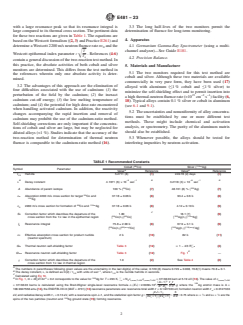
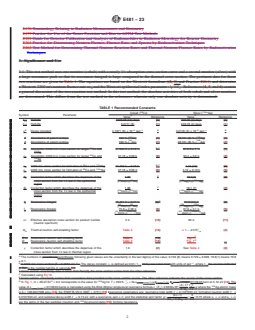
3.1 This practice uses one monitor (cobalt) with a nearly 1/v absorption cross-section curve and a second monitor (silver) with a large resonance peak so that its resonance integral is large compared to its thermal cross section. The pertinent data for these two reactions are given in Table 1. The equations are based on the Westcott formalism ((2, 3) and Practice E261) and determine a Westcott 2200 m/s neutron fluence rate nv0 and the Westcott epithermal index parameter . References (4-6) contain a general discussion of the two-reaction test method. In this practice, the absolute activities of both cobalt and silver monitors are determined. This differs from the test method in the references wherein only one absolute activity is determined. (A) The numbers in parentheses following given values are the uncertainty in the last digit(s) of the value; 0.729 (8) means 0.729 ± 0.008, 70.8(1) means 70.8 ± 0.1.(B) The decay constant, λ, is defined as ln(2) / t1/2 with units of sec–1, where t1/2 is the nuclide half-life in seconds.(C) Calculated using Eq 10.(D) In Fig. 1, Θ = 4ErkT/AΓ2 = 0.2 corresponds to the value for 109Ag for T = 293 K, ∑r = N0σr,max,T=0Kσr,max,T=0K = 31138.03 barn at 5.19 eV (13). The value of σr,max,T=0K = 31138.03 barns is calculated using the Breit-Wigner single-level resonance formula where the 109Ag atomic mass is A = 108.9047558 amu (14), the ENDF/B-VIII.0 (MAT = 4731) (13) resonance parameters are: resonance total width Γ = 0.1427333 eV, formation neutron width Γn = 0.0127333 eV, and radiative/decay width Γγ = 0.13 eV, with a resonance spin J=1, and the statistical spin factor where s1 = 1/2 and s2 = 1/2 are the spins of the two particles (neutron and 109Ag ground state (15)) forming resonance.
3.2 The advantages of this approach are the elimination of four difficulties associated with the use of cadmium: (1) the perturbation of the field by the cadmium; (2) the inexact cadmium cut-off energy; (3) the low melting temperature of cadmium; a...
SCOPE
1.1 This practice covers a suitable means of obtaining the thermal neutron fluence rate, or fluence, in nuclear reactor environments where the use of cadmium, as a thermal neutron shield as described in Test Method E262, is undesirable for reasons such as potential spectrum perturbations or due to temperatures above the melting point of cadmium.
1.2 The reaction 59Co(n,γ )60Co results in a well-defined gamma emitter having a half-life of 5.2711 years2 (8)3 (1).4 The reaction 109Ag(n,γ)110mAg results in a nuclide with a well-known, complex decay scheme with a half-life of 249.78 (2) days (1). Both cobalt and silver are available either in very pure form or alloyed with other metals such as aluminum. A reference source of cobalt in aluminum alloy to serve as a neutron fluence rate monitor wire standard is available from the National Institute of Standards and Technology (NIST) as Standard Reference Material (SRM) 953.5 The competing activities from neutron activation of other isotopes are eliminated, for the most part, by waiting for the short-lived products to die out before counting. With suitable techniques, thermal neutron fluence rate in the range from 108 cm−2·s−1 to 3 × 1015 cm−2·s−1 can be measured. Two calculational practices are described in Section 9 for the determination of neutron fluence rates. The practice described in 9.3 may be used in all cases. This practice describes a means of measuring a Westcott neutron fluence rate in 9.2 (Note 1) by activation of cobalt- and silver-foil monitors (see Terminology E170). For the Wescott Neutron Fluence Convention method to be applicable, the measurement location must be well moderated and be well represented by a Maxwellian low-energy distribution and an (1/E) epithermal distribution. These conditions are usually only met in positions surrounded by hydrogenous moderator without nearby strongly multiplying or absorbing materials.
Note 1: Westcott fluence rate ...
- Status
- Published
- Publication Date
- 31-May-2023
- Technical Committee
- E10 - Nuclear Technology and Applications
- Drafting Committee
- E10.05 - Nuclear Radiation Metrology
Buy Documents
ASTM E481-23 - Standard Practice for Measuring Neutron Fluence Rates by Radioactivation of Cobalt and Silver
REDLINE ASTM E481-23 - Standard Practice for Measuring Neutron Fluence Rates by Radioactivation of Cobalt and Silver
Overview
ASTM E481-23 is the internationally recognized standard practice for measuring neutron fluence rates by radioactivation of cobalt and silver. Developed by ASTM Committee E10 on Nuclear Technology and Applications, this practice provides a reliable means of determining the thermal neutron fluence rate or fluence in nuclear reactor environments, especially where the use of cadmium shielding (as described in ASTM E262) is undesirable.
Instead of cadmium, this method uses two different monitors–cobalt (with a nearly 1/v absorption cross-section) and silver (with a large resonance integral)–to assess neutron fluence rates effectively. By analyzing the activation of both cobalt and silver, practitioners can determine critical parameters such as the Westcott 2200 m/s neutron fluence rate and the epithermal index, which are essential for accurate nuclear reactor dosimetry.
Key Topics
Non-Cadmium Activation Analysis
This practice eliminates challenges associated with cadmium, such as spectrum perturbation, low melting point, and inexact cut-off energy. It is especially suitable in environments where these limitations would hinder accurate measurement.Dual Monitor Method (Cobalt and Silver)
- Cobalt: Exhibits a simple neutron capture and gamma emission, enabling quantification through its long-lived gamma activity.
- Silver: Its significant resonance integral makes it highly sensitive to epithermal neutrons, allowing for a detailed spectrum analysis.
Westcott Formalism
The method is grounded in the Westcott convention, which enables the calculation of both thermal and epithermal neutron components in mixed spectral environments.Measurement Range and Sensitivity
This technique covers a wide fluence rate range, from low-intensity reactor positions to areas with high neutron density, making it versatile for various research and operational scenarios.Sample Preparation and Analysis
- Cobalt and silver can be used in pure form or as alloys (commonly with aluminum).
- Proper encapsulation of monitor materials ensures measurement integrity in diverse reactor conditions.
- Gamma spectrometry (using detectors such as germanium or NaI(Tl)) provides precise readings of radioactivated samples.
Applications
Nuclear Reactor Dosimetry
Used to benchmark and monitor neutron flux in experimental and operational reactor cores, especially relevant for materials irradiation and neutron spectrum characterization.Research and Development
Supports the validation and calibration of neutron transport models, as well as applied research in nuclear materials science.Quality Assurance & Regulatory Compliance
Assists in maintaining compliance with safety and performance standards in nuclear facilities by providing reliable neutron fluence data.Long-term Monitoring
Thanks to the long half-life of activation products in cobalt and silver, this method allows retrospective analysis and tracking of neutron exposure over extended periods.
Related Standards
- ASTM E170: Terminology Relating to Radiation Measurements and Dosimetry
- ASTM E177: Use of the Terms Precision and Bias in ASTM Test Methods
- ASTM E181: Guide for Detector Calibration and Analysis of Radionuclides in Reactor Dosimetry
- ASTM E261: Practice for Determining Neutron Fluence, Fluence Rate, and Spectra by Radioactivation Techniques
- ASTM E262: Test Method for Determining Thermal Neutron Reaction Rates and Fluence Rates by Radioactivation
Practical Value
ASTM E481-23 offers a robust, cadmium-free approach for accurately measuring neutron fluence rates in reactor environments where conventional shielding is problematic. Its reliance on established activation analysis and the Westcott formalism ensures both precision and practicality. This standard is essential for professionals responsible for neutron dosimetry, reactor safety, and materials testing, providing data critical for reactor performance assessment, nuclear research, and regulatory compliance.
Keywords: neutron fluence rate, radioactivation, cobalt activation, silver activation, Westcott formalism, reactor dosimetry, ASTM E481, cadmium-free neutron monitoring, nuclear reactor measurement, activation analysis.
Relations
- Effective Date
- 01-Aug-2017
- Effective Date
- 01-Jun-2017
- Effective Date
- 01-Oct-2016
- Effective Date
- 15-Feb-2016
- Effective Date
- 01-Sep-2015
- Effective Date
- 01-Jun-2015
- Effective Date
- 15-Mar-2015
- Effective Date
- 15-Oct-2014
- Effective Date
- 01-Sep-2014
- Effective Date
- 01-May-2014
- Effective Date
- 01-May-2013
- Effective Date
- 01-Jan-2013
- Effective Date
- 01-Oct-2010
- Effective Date
- 01-Jun-2010
- Effective Date
- 01-Jan-2010
Buy Documents
ASTM E481-23 - Standard Practice for Measuring Neutron Fluence Rates by Radioactivation of Cobalt and Silver
REDLINE ASTM E481-23 - Standard Practice for Measuring Neutron Fluence Rates by Radioactivation of Cobalt and Silver
Get Certified
Connect with accredited certification bodies for this standard

DNV
DNV is an independent assurance and risk management provider.

Lloyd's Register
Lloyd's Register is a global professional services organisation specialising in engineering and technology.
DNV Energy Systems
Energy and renewable energy certification.
Sponsored listings
Frequently Asked Questions
ASTM E481-23 is a standard published by ASTM International. Its full title is "Standard Practice for Measuring Neutron Fluence Rates by Radioactivation of Cobalt and Silver". This standard covers: SIGNIFICANCE AND USE 3.1 This practice uses one monitor (cobalt) with a nearly 1/v absorption cross-section curve and a second monitor (silver) with a large resonance peak so that its resonance integral is large compared to its thermal cross section. The pertinent data for these two reactions are given in Table 1. The equations are based on the Westcott formalism ((2, 3) and Practice E261) and determine a Westcott 2200 m/s neutron fluence rate nv0 and the Westcott epithermal index parameter . References (4-6) contain a general discussion of the two-reaction test method. In this practice, the absolute activities of both cobalt and silver monitors are determined. This differs from the test method in the references wherein only one absolute activity is determined. (A) The numbers in parentheses following given values are the uncertainty in the last digit(s) of the value; 0.729 (8) means 0.729 ± 0.008, 70.8(1) means 70.8 ± 0.1.(B) The decay constant, λ, is defined as ln(2) / t1/2 with units of sec–1, where t1/2 is the nuclide half-life in seconds.(C) Calculated using Eq 10.(D) In Fig. 1, Θ = 4ErkT/AΓ2 = 0.2 corresponds to the value for 109Ag for T = 293 K, ∑r = N0σr,max,T=0Kσr,max,T=0K = 31138.03 barn at 5.19 eV (13). The value of σr,max,T=0K = 31138.03 barns is calculated using the Breit-Wigner single-level resonance formula where the 109Ag atomic mass is A = 108.9047558 amu (14), the ENDF/B-VIII.0 (MAT = 4731) (13) resonance parameters are: resonance total width Γ = 0.1427333 eV, formation neutron width Γn = 0.0127333 eV, and radiative/decay width Γγ = 0.13 eV, with a resonance spin J=1, and the statistical spin factor where s1 = 1/2 and s2 = 1/2 are the spins of the two particles (neutron and 109Ag ground state (15)) forming resonance. 3.2 The advantages of this approach are the elimination of four difficulties associated with the use of cadmium: (1) the perturbation of the field by the cadmium; (2) the inexact cadmium cut-off energy; (3) the low melting temperature of cadmium; a... SCOPE 1.1 This practice covers a suitable means of obtaining the thermal neutron fluence rate, or fluence, in nuclear reactor environments where the use of cadmium, as a thermal neutron shield as described in Test Method E262, is undesirable for reasons such as potential spectrum perturbations or due to temperatures above the melting point of cadmium. 1.2 The reaction 59Co(n,γ )60Co results in a well-defined gamma emitter having a half-life of 5.2711 years2 (8)3 (1).4 The reaction 109Ag(n,γ)110mAg results in a nuclide with a well-known, complex decay scheme with a half-life of 249.78 (2) days (1). Both cobalt and silver are available either in very pure form or alloyed with other metals such as aluminum. A reference source of cobalt in aluminum alloy to serve as a neutron fluence rate monitor wire standard is available from the National Institute of Standards and Technology (NIST) as Standard Reference Material (SRM) 953.5 The competing activities from neutron activation of other isotopes are eliminated, for the most part, by waiting for the short-lived products to die out before counting. With suitable techniques, thermal neutron fluence rate in the range from 108 cm−2·s−1 to 3 × 1015 cm−2·s−1 can be measured. Two calculational practices are described in Section 9 for the determination of neutron fluence rates. The practice described in 9.3 may be used in all cases. This practice describes a means of measuring a Westcott neutron fluence rate in 9.2 (Note 1) by activation of cobalt- and silver-foil monitors (see Terminology E170). For the Wescott Neutron Fluence Convention method to be applicable, the measurement location must be well moderated and be well represented by a Maxwellian low-energy distribution and an (1/E) epithermal distribution. These conditions are usually only met in positions surrounded by hydrogenous moderator without nearby strongly multiplying or absorbing materials. Note 1: Westcott fluence rate ...
SIGNIFICANCE AND USE 3.1 This practice uses one monitor (cobalt) with a nearly 1/v absorption cross-section curve and a second monitor (silver) with a large resonance peak so that its resonance integral is large compared to its thermal cross section. The pertinent data for these two reactions are given in Table 1. The equations are based on the Westcott formalism ((2, 3) and Practice E261) and determine a Westcott 2200 m/s neutron fluence rate nv0 and the Westcott epithermal index parameter . References (4-6) contain a general discussion of the two-reaction test method. In this practice, the absolute activities of both cobalt and silver monitors are determined. This differs from the test method in the references wherein only one absolute activity is determined. (A) The numbers in parentheses following given values are the uncertainty in the last digit(s) of the value; 0.729 (8) means 0.729 ± 0.008, 70.8(1) means 70.8 ± 0.1.(B) The decay constant, λ, is defined as ln(2) / t1/2 with units of sec–1, where t1/2 is the nuclide half-life in seconds.(C) Calculated using Eq 10.(D) In Fig. 1, Θ = 4ErkT/AΓ2 = 0.2 corresponds to the value for 109Ag for T = 293 K, ∑r = N0σr,max,T=0Kσr,max,T=0K = 31138.03 barn at 5.19 eV (13). The value of σr,max,T=0K = 31138.03 barns is calculated using the Breit-Wigner single-level resonance formula where the 109Ag atomic mass is A = 108.9047558 amu (14), the ENDF/B-VIII.0 (MAT = 4731) (13) resonance parameters are: resonance total width Γ = 0.1427333 eV, formation neutron width Γn = 0.0127333 eV, and radiative/decay width Γγ = 0.13 eV, with a resonance spin J=1, and the statistical spin factor where s1 = 1/2 and s2 = 1/2 are the spins of the two particles (neutron and 109Ag ground state (15)) forming resonance. 3.2 The advantages of this approach are the elimination of four difficulties associated with the use of cadmium: (1) the perturbation of the field by the cadmium; (2) the inexact cadmium cut-off energy; (3) the low melting temperature of cadmium; a... SCOPE 1.1 This practice covers a suitable means of obtaining the thermal neutron fluence rate, or fluence, in nuclear reactor environments where the use of cadmium, as a thermal neutron shield as described in Test Method E262, is undesirable for reasons such as potential spectrum perturbations or due to temperatures above the melting point of cadmium. 1.2 The reaction 59Co(n,γ )60Co results in a well-defined gamma emitter having a half-life of 5.2711 years2 (8)3 (1).4 The reaction 109Ag(n,γ)110mAg results in a nuclide with a well-known, complex decay scheme with a half-life of 249.78 (2) days (1). Both cobalt and silver are available either in very pure form or alloyed with other metals such as aluminum. A reference source of cobalt in aluminum alloy to serve as a neutron fluence rate monitor wire standard is available from the National Institute of Standards and Technology (NIST) as Standard Reference Material (SRM) 953.5 The competing activities from neutron activation of other isotopes are eliminated, for the most part, by waiting for the short-lived products to die out before counting. With suitable techniques, thermal neutron fluence rate in the range from 108 cm−2·s−1 to 3 × 1015 cm−2·s−1 can be measured. Two calculational practices are described in Section 9 for the determination of neutron fluence rates. The practice described in 9.3 may be used in all cases. This practice describes a means of measuring a Westcott neutron fluence rate in 9.2 (Note 1) by activation of cobalt- and silver-foil monitors (see Terminology E170). For the Wescott Neutron Fluence Convention method to be applicable, the measurement location must be well moderated and be well represented by a Maxwellian low-energy distribution and an (1/E) epithermal distribution. These conditions are usually only met in positions surrounded by hydrogenous moderator without nearby strongly multiplying or absorbing materials. Note 1: Westcott fluence rate ...
ASTM E481-23 is classified under the following ICS (International Classification for Standards) categories: 17.240 - Radiation measurements; 27.120.30 - Fissile materials and nuclear fuel technology. The ICS classification helps identify the subject area and facilitates finding related standards.
ASTM E481-23 has the following relationships with other standards: It is inter standard links to ASTM E262-17, ASTM E170-17, ASTM E170-16a, ASTM E170-16, ASTM E170-15a, ASTM E261-15, ASTM E170-15, ASTM E170-14a, ASTM E170-14, ASTM E177-14, ASTM E177-13, ASTM E262-13, ASTM E177-10, ASTM E170-10, ASTM E261-10. Understanding these relationships helps ensure you are using the most current and applicable version of the standard.
ASTM E481-23 is available in PDF format for immediate download after purchase. The document can be added to your cart and obtained through the secure checkout process. Digital delivery ensures instant access to the complete standard document.
Standards Content (Sample)
This international standard was developed in accordance with internationally recognized principles on standardization established in the Decision on Principles for the
Development of International Standards, Guides and Recommendations issued by the World Trade Organization Technical Barriers to Trade (TBT) Committee.
Designation: E481 − 23
Standard Practice for
Measuring Neutron Fluence Rates by Radioactivation of
Cobalt and Silver
This standard is issued under the fixed designation E481; the number immediately following the designation indicates the year of
original adoption or, in the case of revision, the year of last revision. A number in parentheses indicates the year of last reapproval. A
superscript epsilon (´) indicates an editorial change since the last revision or reapproval.
1. Scope (1/E) epithermal distribution. These conditions are usually only
met in positions surrounded by hydrogenous moderator with-
1.1 This practice covers a suitable means of obtaining the
out nearby strongly multiplying or absorbing materials.
thermal neutron fluence rate, or fluence, in nuclear reactor
`
environments where the use of cadmium, as a thermal neutron
NOTE 1—Westcott fluence rate 5v * n v dv
~ !
0 0
shield as described in Test Method E262, is undesirable for
1.3 The values stated in SI units are to be regarded as the
reasons such as potential spectrum perturbations or due to
standard, except in the case of nuclear data where the source
temperatures above the melting point of cadmium.
referenced units are retained in order to preserve the integrity
59 60
1.2 The reaction Co(n,γ ) Co results in a well-defined
of the referenced uncertainty values.
2 3 4
gamma emitter having a half-life of 5.2711 years (8) (1).
1.4 This standard does not purport to address all of the
109 110m
The reaction Ag(n,γ) Ag results in a nuclide with a
safety concerns, if any, associated with its use. It is the
well-known, complex decay scheme with a half-life of 249.78
responsibility of the user of this standard to establish appro-
(2) days (1). Both cobalt and silver are available either in very
priate safety, health, and environmental practices and deter-
pure form or alloyed with other metals such as aluminum. A
mine the applicability of regulatory limitations prior to use.
reference source of cobalt in aluminum alloy to serve as a
1.5 This international standard was developed in accor-
neutron fluence rate monitor wire standard is available from the
dance with internationally recognized principles on standard-
National Institute of Standards and Technology (NIST) as
ization established in the Decision on Principles for the
Standard Reference Material (SRM) 953. The competing
Development of International Standards, Guides and Recom-
activities from neutron activation of other isotopes are
mendations issued by the World Trade Organization Technical
eliminated, for the most part, by waiting for the short-lived
Barriers to Trade (TBT) Committee.
products to die out before counting. With suitable techniques,
8 −2 −1
thermal neutron fluence rate in the range from 10 cm ·s to
2. Referenced Documents
15 −2 −1
3 × 10 cm ·s can be measured. Two calculational practices 6
2.1 ASTM Standards:
are described in Section 9 for the determination of neutron
E170 Terminology Relating to Radiation Measurements and
fluence rates. The practice described in 9.3 may be used in all
Dosimetry
cases. This practice describes a means of measuring a Westcott
E177 Practice for Use of the Terms Precision and Bias in
neutron fluence rate in 9.2 (Note 1) by activation of cobalt- and
ASTM Test Methods
silver-foil monitors (see Terminology E170). For the Wescott
E181 Guide for Detector Calibration and Analysis of Radio-
Neutron Fluence Convention method to be applicable, the
nuclides in Radiation Metrology for Reactor Dosimetry
measurement location must be well moderated and be well
E261 Practice for Determining Neutron Fluence, Fluence
represented by a Maxwellian low-energy distribution and an
Rate, and Spectra by Radioactivation Techniques
E262 Test Method for Determining Thermal Neutron Reac-
tion Rates and Thermal Neutron Fluence Rates by Radio-
This practice is under the jurisdiction of ASTM Committee E10 on Nuclear
activation Techniques
Technology and Applications and is the direct responsibility of Subcommittee
E10.05 on Nuclear Radiation Metrology.
3. Significance and Use
Current edition approved June 1, 2023. Published July 2023. Originally approved
in 1973. Last previous edition approved in 2016 as E481 – 16. DOI: 10.1520/
3.1 This practice uses one monitor (cobalt) with a nearly 1/v
E0481-23.
absorption cross-section curve and a second monitor (silver)
One year is defined to be 365.242198 days (31 556 926 seconds) (1).
The value of uncertainty, in parentheses, refers to the corresponding last digits,
thus 14.958 (2) corresponds to 14.958 6 0.002.
4 6
The boldface numbers in parentheses refer to references listed at the end of this For referenced ASTM standards, visit the ASTM website, www.astm.org, or
test method. contact ASTM Customer Service at service@astm.org. For Annual Book of ASTM
Standard Reference Material 953 is available from National Institute of Standards volume information, refer to the standard’s Document Summary page on
Standards and Technology, U.S. Dept. of Commerce, Washington, DC 20234. the ASTM website.
Copyright © ASTM International, 100 Barr Harbor Drive, PO Box C700, West Conshohocken, PA 19428-2959. United States
E481 − 23
with a large resonance peak so that its resonance integral is 3.3 The long half-lives of the two monitors permit the
large compared to its thermal cross section. The pertinent data determination of fluence for long-term monitoring.
for these two reactions are given in Table 1. The equations are
4. Apparatus
based on the Westcott formalism ((2, 3) and Practice E261) and
determine a Westcott 2200 m/s neutron fluence rate nv and the
0 4.1 Germanium Gamma-Ray Spectrometer (using a multi-
T channel analyzer)—See Guide E181.
Westcott epithermal index parameter rΠ. References (4-6)
T
4.2 Precision Balance.
contain a general discussion of the two-reaction test method. In
this practice, the absolute activities of both cobalt and silver
5. Materials and Manufacture
monitors are determined. This differs from the test method in
5.1 The two monitors required for this test method are
the references wherein only one absolute activity is deter-
cobalt and silver. Although these two materials are available
mined.
commercially in very pure form, they have been used (17)
3.2 The advantages of this approach are the elimination of
alloyed with aluminum (≤1 % cobalt and ≤1 % silver) to
four difficulties associated with the use of cadmium: (1) the
minimize the self-shielding effect and to permit insertion into
15 −2 −1
perturbation of the field by the cadmium; (2) the inexact
a high thermal-neutron fluence rate (>10 cm ·s ) facility (6,
cadmium cut-off energy; (3) the low melting temperature of
18). Typical alloys contain 0.1 % silver or cobalt in aluminum
cadmium; and (4) the potential for high dose-rate encountered
(see 6.1 and 9.1).
when handling activated cadmium. In addition, the reactivity
5.2 The uncertainties and nonuniformity of alloy concentra-
changes accompanying the rapid insertion and removal of
tions must be established by one or more different test
cadmium may prohibit the use of the cadmium-ratio method.
methods. These might include chemical and activation
Self-shielding corrections are only important if the concentra-
analysis, or spectrometry. The purity of the aluminum matrix
tions of cobalt and silver are large, but may be neglected for
should also be established.
diluted alloys (<1 %). Studies indicate that the accuracy of the
two-reaction method for determination of thermal neutron 5.3 Whenever possible, the alloys should be tested for
fluence is comparable to the cadmium-ratio method (16). interfering impurities by neutron activation.
TABLE 1 Recommended Constants
60 110m
Cobalt ( Co) Silver ( Ag)
Symbol Parameter
A A
Value Reference Value Reference
t Half-life 5.2711 (8) (1) 249.78 (2) days (1)
1/2
B –9 –1 B –8 –1 B
λ Decay constant 4.1671 (6) × 10 sec 3.2118 (3) × 10 sec
59 109
A Abundance of parent isotope 100 % ( Co) (7) 48.161 (8) % ( Ag) (7)
σ Absorption 2200 m/s cross section for target Co and 37.18 ± 0.06 b (8) 93.4 ± 0.6 b (8)
a
Ag
60 110m
σ 2200 m/s cross section for formation of Co and Ag 37.18 ± 0.06 b (8) 4.12 ± 0.10 b (9)
C
S Correction factor which describes the departure of the 1.80 18.1 (7) (9)
59 60 109 110m
cross section from the 1/v law in the epithermal region [ Co(n,γ) Co] [ Ag(n,γ) Ag]
I Resonance integral 75.8 ± 2.00 b (8) 67.9 ± 3.1 b (9)
59 60(m+g) 109 110(m+g)
[ Co(n,γ) Co] [ Ag(n,γ) Ag]
σ Effective absorption cross section for product nuclide 2 b (10) 82 b (11)
(reactor spectrum)
G Thermal neutron self-shielding factor Table 3 (12) > 1 − 4/3 R^ (4)
th a
D
G' Resonance neutron self-shielding factor Table 3 (12) Fig. 1 —
res
g Correction factor which describes the departure of the 1.0 (2) See Table 4 (2)
cross section from 1/v law in thermal region
A
The numbers in parentheses following given values are the uncertainty in the last digit(s) of the value; 0.729 (8) means 0.729 ± 0.008, 70.8(1) means 70.8 ± 0.1.
B –1
The decay constant, λ, is defined as ln(2) / t with units of sec , where t is the nuclide half-life in seconds.
1/2 1/2
C
Calculated using Eq 10.
D 2 109
In Fig. 1, Θ = 4E kT/AΓ = 0.2 corresponds to the value for Ag for T = 293 K, ^ = N σ σ = 31138.03 barn at 5.19 eV (13). The value of σ
r r 0 r,max,T=0K r,max,T=0K r,max,T=0K
sA11d Γ Γ
n γ
6 109
= 31138.03 barns is calculated using the Breit-Wigner single-level resonance formula σ E 52.6039×10 · · ·g where the Ag atomic mass is A =
s d
γ 0 2
A ·E Γ·Γ
108.9047558 amu (14), the ENDF/B-VIII.0 (MAT = 4731) (13) resonance parameters are: resonance total width Γ = 0.1427333 eV, formation neutron width Γ = 0.0127333
n
s2J11d 3
1 1
eV, and radiative/decay width Γ = 0.13 eV, with a resonance spin J=1, and the statistical spin factor g5 5 50.75 where s = ⁄2 and s = ⁄2 are the
γ 1 2
s2s 11d·s2s 11d 2·2
1 2
spins of the two particles (neutron and Ag ground state (15)) forming resonance.
E481 − 23
5.4 The method of encapsulating the monitors for irradia-
s =
T
S , a factor which describes the departure of the
Œ
tion depends upon the characteristics of the facility in which
T
the measurements are to be made. The monitors have essen-
cross section from the 1/v law in the epithermal region,
tially the same chemical characteristics as pure aluminum;
including resonance effects, and
therefore, an environment in which aluminum would not be
r = a measure of the proportion of epithermal neutrons in
adversely affected would be generally satisfactory for the
the reactor spectrum.
alloys. However, the low mechanical strength of the monitors
More specifically:
requires, in many instances, that it be encapsulated or shielded
from physical disturbances by some type of container. Alumi- πμ
n
r 5 f (5)
Œ
num cans or tubing are satisfactory for many cases of interest, 4
but for hostile environments, stainless steel or vanadium may
where:
be preferable. Perturbation due to the presence of the container
f = fraction of the total density in the epithermal
must be accounted for, especially in the case of stainless steel.
distribution, and
The container should be constructed in such a manner that it
μ = a factor chosen to give the proper normalization to the
n
will not create a significant flux perturbation and that it may be
epithermal density distribution. A suitable factor for
opened easily, especially if the monitors must be removed
water moderated systems is 5 (2).
remotely.
6.2 Limitation of the Westcott Convention—Sufficient con-
6. Westcott Neutron Fluence Convention ditions for the applications of the Westcott convention are that:
Σ
6.1 The Westcott neutron fluence convention is designed a
,0.1 (6)
ξΣ
primarily for calculations involving reactions rather than those s
involving scattering or diffusion. It states that the reaction rate
and:
per atom present, R, is equal to the product of an effective cross
T
section, σˆ, with the Westcott neutron fluence φ = nv , where
w 0
,1.07 (7)
T
m
n = the neutron density, including both thermal and epithermal
−3
neutrons, cm , and v = 2200 m/s.
0 where:
Thus:
∑ = macroscopic absorption cross section averaged over all
a
materials affecting spectrum,
R 5 φ σˆ 5 nv σˆ (1)
w 0
ξ = average logarithmic energy decrement per collision,
The true equation for reaction rate is given by the equation:
∑ = macroscopic scattering cross section averaged over all
s
`
materials affecting spectrum,
R 5 n v vσ v dv (2)
* ~ ! ~ !
T = neutron temperature, K, and
T = temperature of the moderator, K.
m
where:
If, as a result of neutron captures (for example, in the fuel),
n(v) = neutron density per unit velocity,
Σ
a
v = neutron velocity, and
the quantity becomes too great or if the neutron tempera-
ξΣ
s
σ(v) = cross section for neutrons of velocity v.
ture T is too great relative to the moderator temperature T , the
m
Therefore, the effective cross section is defined by the
Maxwell spectrum hypothesis fails, the neutron energy spec-
equation:
trum must be determined, and the effective cross section
determined with this spectrum.
` n v vσ v
~ ! ~ !
σˆ 5 * dv (3)
nv
0 6.3 The conventional 2200 m/s thermal neutron-fluence
rate, φ , and the epithermal fluence-rate parameter, φ , as
0 e
The neutron spectrum assumed by Westcott has the form:
defined in Test Method E262, can be obtained from the
n(v) = n(1 − f)P (v) + n f P (v), where P and P are the
m e m e
Westcott neutron-fluence rate, φ , and the Westcott epithermal
w
Maxwellian and epithermal density distribution functions nor-
` `
T
malized so that: * P v dv5* P v dv51. The quantity f is the
~ ! ~ !
0 0
m e
index, rΠ, by means of Eq 8 and Eq 9:
T
fraction of the total density, n, in the epithermal distribution.
The epithermal distribution is assumed proportional to 1/E per
4r
φ 5 1 2 φ (8)
0 w
S D
unit energy interval. This distribution is terminated by a cut-off
=πμ
n
function at a suitable lower limit of energy. Based on the above
2 T
spectrum, one obtains the following relation for the effective
φ 5 rŒ φ (9)
e w
T
cross section:
=π
σˆ 5 σ g1rs (4)
~ ! 6.4 In Eq 8, it is necessary to estimate the neutron
T
where:
temperature, T, to obtain the value of r from the index rΠ.
T
σ = cross section of 2200 m/s neutrons,
Provided that the inequality (Eq 7) is satisfied, only a slight
g = a measure of the departure of the cross section from 1/v
error is introduced by assuming T = T , the moderator
m
dependence in the thermal region,
temperature.
E481 − 23
109 110m 110m A
TABLE 2 Gamma Radiations of Ag (1)
6.5 Although the Ag (n,λ)Ag S value in Table 1 is a
Energy of Gamma (keV) Intensity (%)
measured value, S can be calculated by the following equa-
1. 657.7600 (11) 94.38 (8)
tion:
2. 884.6781 (13) 74.0 (11)
'' 3. 937.485 (3) 34.51 (27)
2 I 2 I E
0 0 0
S 5 5 S 2 2g D (10) 4. 1384.2931 (20) 24.7 (5)
Œ
σ σ E
= 0 = 0 Cd 5. 763.9424 (17) 22.31 (9)
π π
6. 706.6760 (15) 16.49 (8)
7. 1505.0280 (20) 13.16 (16)
where:
8. 677.6217 (12) 10.56 (6)
"
I = reduced resonance integral excess over the 1/v cross
9. 818.0244 (18) 7.33 (4)
section value, cm , 10. 687.0091 (18) 6.45 (3)
11. 744.2753 (18) 4.71 (3)
σ = 2200 m/s cross-section value, cm ,
12. 1562.294 (18) 1.21 (3)
σ E
~ !
I =
`
*
resonance integral, dE
A
E
Cd
The number of parentheses following some given values is the uncertainty in the
E
E = 0.0253 eV, and
last digit(s) of the value: 0.729 (8) means 0.729 ± 0.008, 80.8 (1) means 70.8 ± 0.1.
E = 0.5 eV.
Cd
TABLE 3 Self-Shielding Factors for Cobalt Wires (12)
7. Determination of Effective Interaction Cross Sections
by Modeling Wire Cobalt
Diameter Content, G' (132 eV) G
res th
7.1 The effective interaction cross section, σ (E), for a
in. (mm) (mass %)
i
particular energy range from a lower energy bound, E , to an
0.050 (1.27) 0.104 1.00 1.00
li
0.050 (1.27) 0.976 0.95 ± 0.04 0.99 ± 0.01
upper energy bound, E , can be found using the tabulated
ui
0.001 (0.03) 100 0.81 ± 0.03 0.99 ± 0.02
energy-dependent cross secti
...
This document is not an ASTM standard and is intended only to provide the user of an ASTM standard an indication of what changes have been made to the previous version. Because
it may not be technically possible to adequately depict all changes accurately, ASTM recommends that users consult prior editions as appropriate. In all cases only the current version
of the standard as published by ASTM is to be considered the official document.
Designation: E481 − 16 E481 − 23
Standard Test Method Practice for
Measuring Neutron Fluence Rates by Radioactivation of
Cobalt and Silver
This standard is issued under the fixed designation E481; the number immediately following the designation indicates the year of
original adoption or, in the case of revision, the year of last revision. A number in parentheses indicates the year of last reapproval. A
superscript epsilon (´) indicates an editorial change since the last revision or reapproval.
1. Scope
1.1 This test method covers a suitable means of obtaining the thermal neutron fluence rate, or fluence, in well moderated nuclear
reactor environments where the use of cadmium, as a thermal neutron shield as described in Test Method E262, is undesirable
because of potential spectrum perturbations or of temperatures above the melting point of cadmium.
1.2 This test method describes a means of measuring a Westcott neutron fluence rate (Note 1) by activation of cobalt- and
59 60
silver-foil monitors (See Terminology E170). The reaction Co(n,γ ) Co results in a well-defined gamma emitter having a
2 109 110m
half-life of 1925.28 days (1). The reaction Ag(n,γ) Ag results in a nuclide with a complex decay scheme which is well
known and having a half-life of 249.76 days (1). Both cobalt and silver are available either in very pure form or alloyed with other
metals such as aluminum. A reference source of cobalt in aluminum alloy to serve as a neutron fluence rate monitor wire standard
is available from the National Institute of Standards and Technology (NIST) as Standard Reference Material 953. The competing
activities from neutron activation of other isotopes are eliminated, for the most part, by waiting for the short-lived products to die
9 −2 −1 15 −2 −1
out before counting. With suitable techniques, thermal neutron fluence rate in the range from 10 cm · s to 3 × 10 cm · s
can be measured. For this method to be applicable, the reactor must be well moderated and be well represented by a Maxwellian
low-energy distribution and an (1/E) epithermal distribution. These conditions are usually met in positions surrounded by
hydrogenous moderator without nearby strongly absorbing materials. Otherwise, the true spectrum must be calculated to obtain
effective activation cross sections over all energies.
`
*
NOTE 1—Westcott fluence rate 5v n~v!dv.
1.3 The values stated in SI units are to be regarded as the standard.
1.4 This standard does not purport to address all of the safety concerns, if any, associated with its use. It is the responsibility
of the user of this standard to establish appropriate safety and health practices and determine the applicability of regulatory
limitations prior to use.
2. Referenced Documents
2.1 ASTM Standards:
This test method practice is under the jurisdiction of ASTM Committee E10 on Nuclear Technology and Applications and is the direct responsibility of Subcommittee
E10.05 on Nuclear Radiation Metrology.
Current edition approved Oct. 1, 2016June 1, 2023. Published October 2016July 2023. Originally approved in 1973. Last previous edition approved in 20152016 as
E481 – 15.E481 – 16. DOI: 10.1520/E0481-16.10.1520/E0481-23.
The boldface numbers in parentheses refer to references listed at the end of this test method.
Standard Reference Material 953 is available from National Institute of Standards and Technology, U.S. Dept. of Commerce, Washington, DC 20234.
For referenced ASTM standards, visit the ASTM website, www.astm.org, or contact ASTM Customer Service at service@astm.org. For Annual Book of ASTM Standards
volume information, refer to the standard’s Document Summary page on the ASTM website.
Copyright © ASTM International, 100 Barr Harbor Drive, PO Box C700, West Conshohocken, PA 19428-2959. United States
E481 − 23
E170 Terminology Relating to Radiation Measurements and Dosimetry
E177 Practice for Use of the Terms Precision and Bias in ASTM Test Methods
E181 Guide for Detector Calibration and Analysis of Radionuclides in Radiation Metrology for Reactor Dosimetry
E261 Practice for Determining Neutron Fluence, Fluence Rate, and Spectra by Radioactivation Techniques
E262 Test Method for Determining Thermal Neutron Reaction Rates and Thermal Neutron Fluence Rates by Radioactivation
Techniques
3. Significance and Use
3.1 This test method uses one monitor (cobalt) with a nearly 1/v absorption cross-section curve and a second monitor (silver) with
a large resonance peak so that its resonance integral is large compared to the thermal cross section. The pertinent data for these
two reactions are given in Table 1. The equations are based on the Westcott formalism ((2, 3) and Practice E261) and determine
=
a Westcott 2200 m/s neutron fluence rate nv and the Westcott epithermal index parameter r T/T . References (4, 5, and 6) contain
0 0
a general discussion of the two-reaction test method. In this test method, the absolute activities of both cobalt and silver monitors
are determined. This differs from the test method in the references wherein only one absolute activity is determined.
TABLE 1 Recommended Constants
60 110m
Cobalt ( Co) Silver ( Ag)
Symbol Parameter
A A
Value Reference Value Reference
t Half-life 1925.28 (14) days (1) 249.76 (4) days (1)
1/2
t Half-life 5.2711 (8) (1) 249.78 (2) days (1)
1/2
B –9 –1 B –8 –1 B
λ Decay constant 4.1671 (6) × 10 sec 3.2118 (3) × 10 sec
59 109
A Abundance of parent isotope 100 % ( Co) (1) 48.161 (8) % ( Ag) (1)
59 109
A Abundance of parent isotope 100 % ( Co) (7) 48.161 (8) % ( Ag) (7)
59 B,C
σ Absorption 2200 m/s cross section for target Co and 37.233 b ± 0.16 % 91.0 b ± 1 % (7)
a
Ag
σ Absorption 2200 m/s cross section for target Co and 37.18 ± 0.06 b (8) 93.4 ± 0.6 b (8)
a
Ag
60 110m B,C
σ 2200 m/s cross section for formation of Co and Ag 37.233 b ± 0.16 % 4.12 (10) (8)
60 110m
σ 2200 m/s cross section for formation of Co and Ag 37.18 ± 0.06 b (8) 4.12 ± 0.10 b (9)
D
S Correction factor which describes the departure of the 1.80 18.1(7) (8)
59 60 109 110m
cross section from the 1/v law in the epithermal [ Co(n,γ) Co] [ Ag(n,γ) Ag]
region
C
S Correction factor which describes the departure of the 1.80 18.1 (7) (9)
59 60 109 110m
cross section from the 1/v law in the epithermal [ Co(n,γ) Co] [ Ag(n,γ) Ag]
region
E
I Resonance Integral 75.421 b ± 0.77 % (9) 67.9 (31) b (8)
59 60 109 110m
[ Co(n,γ) Co] [ Ag(n,γ) Ag]
I Resonance integral 75.8 ± 2.00 b (8) 67.9 ± 3.1 b (9)
59 60(m+g) 109 110(m+g)
[ Co(n,γ) Co] [ Ag(n,γ) Ag]
σ Effective absorption cross section for product nuclide 2 b (10) 82 b (11)
(reactor spectrum)
G Thermal neutron self-shielding factor Table 3 (12) > 1 − 4/3 R^ (4)
th a
F
G' Resonance neutron self-shielding factor Table 3 (12) Fig. 1
res
D
G' Resonance neutron self-shielding factor Table 3 (12) Fig. 1 —
res
g Correction factor which describes the departure of the 1.0 (2) See Table 4 (2)
cross section from 1/v law in thermal region
A
The numbers in parenthesisparentheses following given values are the uncertainty in the last digit(s) of the value; 0.729 (8) means 0.729 ± 0.008, 70.8(1) means 70.8
± 0.1.
B –1
A 2200 m/s cross section (E = 0.0253 eV, T = The decay constant, λ, is defined as ln(2) / t 20°C) was taken fromwith units of sec , where t the sources indicated
1/2 1/2
in Ref is the nuclide half-life in seconds.(9).
C
Cross section uncertainty data is taken from Ref (7), the cross section comes from the other reference.
C
Calculated using Eq 10.
E
Cross section uncertainty comes from covariance data provided in the cross section source. The other reference indicates the source of the cross section.
D 2 109
In Fig. 1, Θ = 4E kT/AΓ = 0.2 corresponds to the value for Ag for T = 293 K, ^ = N σ .σ σ= =29999 31138.03 barn at 5.19 eV (13). The
r r 0 r, maxr,max,T=0K r,max,T=0K r, max
sA11d Γ Γ
n γ
6 109
value of σ = 31138.03 barns is calculated using the Breit-Wigner single-level resonance formula σ E 52.6039×10 · · ·g where the Ag atomic mass
s d
r,max,T=0K γ 0 2
A ·E Γ·Γ
is A = 108.9047558 amu (14), the ENDF/B-VIII.0 (MAT = 4731) (13) .resonance parameters are: resonance total width Γ = 0.1427333 eV, formation neutron width Γ =
n
2J11 3
s d
1 1
0.0127333 eV, and radiative/decay width Γ = 0.13 eV, with a resonance spin J=1, and the statistical spin factor g5 5 50.75 where s = ⁄2 and s = ⁄2
γ 1 2
s2s 11d·s2s 11d 2·2
1 2
are the spins of the two particles (neutron and Ag ground state (15)) forming resonance.
E481 − 23
3.2 The advantages of this test method are the elimination of three difficulties associated with the use of cadmium: (1) the
perturbation of the field by the cadmium; (2) the inexact cadmium cut-off energy; (3) the low melting temperature of cadmium.
In addition, the reactivity changes accompanying the rapid insertion and removal of cadmium may prohibit the use of the
cadmium-ratio method. However, the self-shielding corrections remain important unless the concentrations of cobalt and silver are
small. Studies indicate that the accuracy of the two-reaction method for determination of thermal neutron fluence is comparable
to the cadmium-ratio method (14).
3.3 The long half-lives of the two monitors permit the determination of fluence for long-term monitoring.
4. Apparatus
4.1 NaI(Tl) or Germanium Gamma-Ray Spectrometer (using a multichannel analyzer)—For the NaI(Tl) technique and the
germanium technique, see Test Methods E181.
4.2 Precision Balance.
4.3 Digital Computer.
5. Materials and Manufacture
5.1 The two monitors required for this test method are cobalt and silver. Although these two materials are available commercially
in very pure form, they have been used (15) alloyed with aluminum (≤1 % cobalt and ≤1 % silver) to minimize the self-shielding
15 −2 −1
effect and to permit insertion into a high thermal-neutron fluence rate (>10 cm s ) facility (6, 16). Typical alloys contain 0.1 %
silver or cobalt in aluminum) see 6.1 and 8.1).
5.2 The uncertainties and nonuniformity of alloy concentrations must be established by one or more different test methods. These
might include chemical and activation analysis, or spectrometry. The purity of the aluminum matrix should also be established.
5.3 Whenever possible, the alloys should be tested for interfering impurities by neutron activation.
5.4 The method of encapsulating the monitors for irradiation depends upon the characteristics of the facility in which the
measurements are to be made. The monitors have essentially the same chemical characteristics as pure aluminum; therefore, an
environment in which aluminum would not be adversely affected would be generally satisfactory for the alloys. However, the low
mechanical strength of the monitors requires in many instances that it be encapsulated or shielded from physical disturbances by
some type of container. Aluminum cans or tubing are satisfactory for many cases of interest, but for hostile environments, stainless
steel or vanadium may be preferable. Perturbation due to the presence of the container must be accounted for, especially in the
case of stainless steel. The container should be constructed in such a manner that it will not create a significant flux perturbation
and that it may be opened easily, especially if the monitors must be removed remotely.
6. Westcott Neutron Fluence Convention
6.1 The Westcott neutron fluence convention is designed primarily for calculations involving reactions rather than those involving
scattering or diffusion. It states that the reaction rate per atom present, R, is equal to the product of an effective cross section, σˆ,
−3
with the Westcott neutron fluence φ = nv , where n = the neutron density, including both thermal and epithermal neutrons, cm ,
w 0
and v = 2200 m/s.
Thus:
R 5 φ σˆ 5 nv σˆ (1)
w 0
The true equation for reaction rate is given by the equation:
`
R 5 n~v!vσ~v!dv (2)
*
where:
n(v) = neutron density per unit velocity,
E481 − 23
v = neutron velocity, and
σ(v) = cross section for neutrons of velocity v.
Therefore, the effective cross section is defined by the equation:
`
σˆ 5 n v vσ v dv/nv (3)
* ~ ! ~ !
The neutron spectrum assumed by Westcott has the form: n(v) = n(1 − f)P (v) + nfP (v), where P and P are the Maxwellian
m e m e
`
`
and epithermal density distribution functions normalized so that: * P v dv5* P v dv51. The quantity f is the fraction of the total
~ ! ~ !
0 m 0 e
density, n, in the epithermal distribution. The epithermal distribution is assumed proportional to 1/E per unit energy interval. This
distribution is terminated by a cut-off function at a suitable lower limit of energy. Based on the above spectrum, one obtains the
following relation for the effective cross section:
σˆ 5 σ g1rs (4)
~ !
where:
σ = cross section of 2200 m/s neutrons,
g = a measure of the departure of the cross section from 1/v dependence in the thermal region,
s =
=
S T/T , a factor which describes the departure of the cross section from the 1/v law in the epithermal region, including
0 0
resonance effects, and
r = a measure of the proportion of epithermal neutrons in the reactor spectrum.
More specifically:
=
r 5 f πμ /4 (5)
n
where:
f = fraction of the total density in the epithermal distribution, and
μ = a factor chosen to give the proper normalization to the epithermal density distribution. A suitable factor for water
n
moderated systems is 5 (2).
6.2 Limitation of the Westcott Convention—Sufficient conditions for the applications of the Westcott convention are that:
/ξ ,0.1 (6)
(a (s
and:
T/T ,1.07 (7)
m
where:
∑ = macroscopic absorption cross section averaged over all materials affecting spectrum,
a
ξ = average logarithmic energy decrement per collision,
∑ = macroscopic scattering cross section averaged over all materials affecting spectrum,
s
T = neutron temperature, K, and
T = temperature of the moderator, K.
m
If as a result of neutron captures (for example, in the fuel) the quantity ∑ /ξ∑ becomes too great or if the neutron temperature
a s
T is too great relative to the moderator temperature T , the Maxwell spectrum hypothesis fails and the true spectrum must be
m
calculated and the effective cross section determined with this spectrum.
6.3 The conventional 2200 m/s thermal neutron-fluence rate, φ , and the epithermal fluence-rate parameter, φ , as defined in Test
0 e
Method E262, can be obtained from the Westcott neutron-fluence rate, φ , and the Westcott epithermal index, r =T/T , by means
w 0
of equations Eq 8 and Eq 9:
4 r
φ 5 12 φ (8)
0 w
S D
=πμ
n
2 T
φ 5 rŒ φ (9)
e w
T
=π
E481 − 23
6.4 In Eq 8, it is necessary to estimate the neutron temperature, T, in order to obtain the value of r from the index r=T/T . Provided
inequality (Eq 7) is satisfied, only slight error is introduced by assuming T = T , the moderator temperature.
m
109 110m
6.5 Although the Ag (n,λ)Ag S value in Table 1 is a measured value, S can be calculated by the following equation:
0 0
2 I" 2 I E
0 0 0
S 5 5 S 2 2gΠD (10)
σ σ E
0 0 Cd
=π =π
where:
I" = resonance integral excess over the 1/v cross section value, cm ,
σ = 2200 m/s cross-section value, cm ,
σ E
~ !
I =
`
resonance integral, * dE
E
Cd
E
E = 0.0253 eV, and
E = 0.55 eV.
Cd
7. Procedure
7.1 Decide on the size and shape of the monitors to be irradiated, taking into consideration the size and shape of the irradiation
space. The mass and exposure time are parameters which can be varied to obtain a desired disintegration rate for a given neutron
fluence rate level. To facilitate the convergence of the two activity equations for the fluence rate and the epithermal index, the
concentration of the alloys should be chosen so that the ratio of the disintegration rates is on the order of one.
7.2 Weigh the samples to a precision of 61.0 % (1S %) as defined in Practice E177.
7.3 Irradiate the samples for the predetermined time period. Record the power level and any changes in power during the
irradiation, the time at the beginning and end of the irradiation, and the relative position of the monitors in the irradiation facility.
7.4 A waiting period is necessary between termination of the exposure and start of counting when using Co-Al and Ag-Al
24 27
monitors. This allows the 0.62356 days (17) half-life Na which is formed by fast-neutron reactions on Al or by thermal-neutron
captures by Na impurities to decay below levels at which its radiations may cause interferences. It is sometimes advisable to
count the samples periodically and follow the decay of the portions of the activities due to the Na. The length of the waiting
period can be reduced by the use of a germanium detector.
110m 60
7.5 With the gamma-ray spectrometer, analyze the silver sample for Ag and the cobalt sample for Co. Obtain the net count
110m 60
rate in each full-energy gamma-ray peak of interest, that is, 657.7623 keV or 884.684 keV for Ag, 1332.501 keV for Co (see
110m
Test Methods E181). See Table 2 for gamma radiations of Ag.
8. Calculation
110m 60
8.1 Calculate the activities of Ag and Co in disintegrations per second.
8.2 A Westcott 2200 m/s neutron fluence rate, nv , or φ and the Westcott epithermal index parameter, r =T/T are related to the
0 w
measured activities of the silver and cobalt monitors by the following equation:
A 5 N λBFGσˆ φ t (11)
0 1 w i
where:
A = measured activity at the end of the exposure time, disintegrations/s,
59 109
N = number of target atoms of Co or Ag at start of irradiation,
−1
λ = disintegration constant of product nuclide, s ,
B = Self-absorption factor of the decay gamma ray in the monitor material,
F = burnup and decay correction factor,
G = self-shielding factor (see Eq 15, Table 3 and Fig. 1).
σˆ = Westcott’s effective absorption cross section for production of the product nuclide, cm ,
E481 − 23
110m A
TABLE 2 Gamma Radiations of Ag (18)
B B
Energy of Gamma (keV) Intensity (%)
1. 657.7600 (11) 95.61
2. 884.6781 (13) 75.00 (11)
3. 937.485 (3) 35.0 (3)
4. 1384.2931 (20) 25.1 (5)
5. 763.9424 (17) 22.60 (7)
6. 706.6760 (15) 16.69 (7)
7. 1505.0280 (20) 13.33 (15)
8. 677.6217 (12) 10.70 (5)
9. 818.0244 (18) 7.43 (4)
10. 687.0091 (18) 6.53 (3)
11. 744.2753 (18) 4.77 (3)
12. 1562.294 (18) 1.22 (3)
110m A
TABLE 2 Gamma Radiations of Ag (1)
Energy of Gamma (keV) Intensity (%)
1. 657.7600 (11) 94.38 (8)
2. 884.6781 (13) 74.0 (11)
3. 937.485 (3) 34.51 (27)
4. 1384.2931 (20) 24.7 (5)
5. 763.9424 (17) 22.31 (9)
6. 706.6760 (15) 16.49 (8)
7. 1505.0280 (20) 13.16 (16)
8. 677.6217 (12) 10.56 (6)
9. 818.0244 (18) 7.33 (4)
10. 687.0091 (18) 6.45 (3)
11. 744.2753 (18) 4.71 (3)
12. 1562.294 (18) 1.21 (3)
A
The number of parentheses following some given values is the uncertainty in the
last digit(s) of the value: 0.729 (8) means 0.729 ± 0.008, 80.8 (1) means 70.8 ± 0.1.
B
See Ref (17) for an alternate source of data.
TABLE 3 Self-Shielding Factors for Cobalt Wires (12)
Wire Cobalt
Diameter Content, G' (132 eV) G
res th
in. (mm) (mass %)
0.050 (1.27) 0.104 1.00 1.00
0.050 (1.27) 0.976 0.95 ± 0.04 0.99 ± 0.01
0.001 (0.03) 100 0.81 ± 0.03 0.99 ± 0.02
0.005 (0.13) 100 0.52 ± 0.02 0.97 ± 0.01
0.010 (0.25) 100 0.42 ± 0.02 0.94 ± 0.01
0.015 (0.38) 100 0.38 ± 0.01 0.92 ± 0.02
0.020 (0.51) 100 0.34 ± 0.01 0.90 ± 0.02
0.025 (0.64) 100 0.32 ± 0.01 0.88 ± 0.03
φ = a 2200 m/s neutron fluence rate in which n is the neutron density (including both thermal and epithermal neutrons) and
w
v is 2200 m/s, and
t = exposure time.
i
8.3 The self-absorption factor, if not known for the gamma rays being measured, can be approximated by the following equation
(20):
B.12 ~4/3!~μ R! (12)
a
where:
−1
μ = linear absorption coefficient in monitor, cm (21), and
a
R = radius of monitor wire, cm.
8.4 The burnup and decay correction factor is given by:
exp~2σˆ φ t ! 2 exp~2~λ1σˆ φ !t !
a w i 2 w i
F 5 (13)
λ1σˆ φ 2 σˆ φ t
~ !
2 w a w i
E481 − 23
FIG. 1 Resonance Self-Shielding Factor for Cylinders (θ = 0.2) as a Function of Radius × Macroscopic Absorption Cross Section at the
Peak of the Resonance, for Ag at 5.19 eV, σ = 29999 barn (13). Calculations used shielding curve for cylinders from (19).
γ,maxγ,max,T=0K
To convert σ to Σ , use Σ = N σ , where N is the number density of Ag atoms in the wire.
r r r 0 r 0
where:
σˆ = Westcott’s effective absorption cross section for target nuclide, cm , and
a
σˆ = Westcott’s effective absorption cross section for the product nuclide, cm .
8.5 The self-shielding factor is given by:
~ !
gG 1 r=T/T S G'
th 0 0 res
G 5 (14)
~ = !
g1 r T/T S
0 0
where:
g = correction factor which describes the departure of the cross section from the 1/v law in the thermal region (see Table 4
for silver “g” factors),
G = thermal neutron self-shielding factor,
th
G' = resonance neutron self-shielding factor,
res
r = a measure of the proportion of epithermal neutrons in the reactor spectrum,
T = neutron temperature, K,
T = 293.6 K, and
S = correction factor which describes the departure of the cross section from the 1/v law in the epithermal region.
8.6 Substituting the measured activities of the cobalt and the silver monitors into Eq 12 yields two nonlinear equations in the two
=
unknown parameters r T/T and φ .
0 w
8.7 PC software products such as MathCad and Mathematica can be programmed to solve these two nonlinear equations with
a variety of iterative solvers. A FORTRAN IV computer program, COAG2 (22), was written to solve these equations. The program
iterates until the epithermal index and the fluence values give calculated activities that are within 0.1 % of their measured values.
The constants, cross sections, and other measured values used in the program should be set equal to those listed in Table 1.
8.8 If the burnup corrections are negligible, that is, if the factor F, (Eq 14) is equal to (1−exp(−λt ))/λt , the equations can be solved
i i
in closed form. If the subscripts 1 and 2 refer to the two reactions (in either order) the parameters are calculated as follows:
R R g G g G
2 1 2 th2 1 th1
φ 5 2 / 2 (15)
S DS D
w
S G' σ S G' σ S G' S G'
02 res2 02 01 res1 01 02 res2 01 res1
E481 − 23
TABLE 4 “g” Factor for Silver
T (°C) g (Ag)
20 1.0044
40 1.0053
60 1.0062
80 1.0071
100 1.0080
120 1.0090
140 1.0099
160 1.0108
180 1.0117
200 1.0126
220 1.0136
240 1.0145
260 1.0154
280 1.0164
300 1.0173
330 1.0187
360 1.0201
390 1.0215
420 1.0230
450 1.0244
480 1.0258
510 1.0273
540 1.0287
570 1.0302
600 1.0316
640 1.0336
680 1.0356
720 1.0376
760 1.0395
800 1.0416
840 1.0436
880 1.0456
920 1.0476
960 1.0497
1000 1.0517
1060 1.0549
1120 1.0580
1180 1.0612
1240 1.0644
1300 1.0676
T g G g G R R R R
1 th1 2 th2 1 2 2 1
r 5 2 / 2 (16)
ΠS DS D
T S G' S G' g G σ g G σ S G' σ S G' σ
0 01 res1 02 res2 1 th1 01 2 th2 02 02 res2 02 01 res1 01
where:
R and R = the measured reaction rates per target atom = A/N λBFt
1 2 0 i
9. Precision and Bias
NOTE 2—Measurement uncertainty is described by a precision and bias statement in this standard. Another acceptable approach is to use Type A and B
uncertainty components (23, 24). This Type A/B uncertainty specification is now used in International Organization for Standardization (ISO) standards
and this approach can be expected to play a more prominent role in future uncertainty analyses.
9.1 There are several sources of errors that affect the precision of this test method. Random errors appear in the determination of
the weight percent and homogeneity of low concentrations of cobalt and silver alloyed with some other material such as aluminum,
the determination of the cobalt and silver activities after irradiation, and the measurement of cross sections and other related data.
These errors should not exceed 63 % (1 σ %), 63 % (1 σ %), and 65 % (1 σ %) as defined in Practice E177.
9.2 The bias due to trace impurities was calculated to be negligible. Self-shielding and the burnup of the product nuclide are
accounted for in the mathematical treatment. Self-shielding may become appreciable unless care is taken to minimize this effect
by the use of low concentrations of cobalt and silver in the alloy used, as very thin foils. The burnout of the product nuclide is
a very small effect unless the cross section is greatly in error.
E481 − 23
10. Keywords
10.1 activation; cobalt; dosimetry; foil; silver; thermal neutron
REFERENCES
(1) Nuclear Wallet Cards, compiled by Jagdish K. Tuli, National Nuclear Data Center, www.nndc.bnl.gov/wallet/wccurrent.html. The data presented here
reflects this database as of October 2011.
(2) Westcott, C. H., “Effective Cross Sections Values for Well-Moderated Thermal Reactor Spectra,” CRRP-960, November 1960.
(3) Westcott, C. H., Walker, W. H., and Alexander, T. K., A/Conf. 15/P/202 “Effective Cross Sections and Cadmium Ratios for the Neutron Spectra of
Thermal Reactors.”
(4) Hart, R. G., Bingham, C. B., and Miller, F. C., “Silver-109 as an Epithermal Index Monitor for Use with Cobalt Flux Monitors,” CRDC-1083, April
1962.
(5) Cabell, M. J., and Wilkins, M., “A Comparison of 240Pu and 109Ag as Epithermal Index Monitors for Long Irradiations,” AERE-R4866, April 1965.
(6) Cabell, M. J., and Wilkins, M., “Routine Use of the Silver-Cobalt Activity Ratio Method to Determine Epithermal Indices for Large Neutron Dose
Irradiations,” AERE-R5122, February 1966.
(7) Mughabghab, S. F., Neutron Cross Sections, Vol. 1: Neutron Resonance Parameters and Thermal Cross Sections, National Nuclear Data Center,
Brookhaven National Laboratory, Upton, NY, Academic Press Inc., 1984. This report was formerly known as BNL-325.
(8) Nakamura, S., Wada, H., Shcherbakov, O., Furutaka, K., Harada, H., and Katoh, T., “Measurement of the Thermal Neutron Capture Cross Section
and the Resonance Integral of the 109Ag (n,g)110mAg Reaction,” J. Nucl, Sci. and Technology, Vol 40, No. 3, March 2003 pp. 119 -124.
(9) Griffin, P. J., Kelly, J. G., Luera, T. F., VanDenberg, J SNL RML Recommended Dosimetry Cross Section Compendium, Sandia National Laboratories,
Albuquerque, NM, report SAND92-0094, November 1993.
(10) Hogg, C. H., and Weber, L. D., “Neutron Activation Cross Sections for the Cobalt-60 Isomers,” IN-1024, 1966.
(11) Goldberg, M. D., et al., “Neutron-Cross Sections,” Vol IIB, Z-41 to 60, BNL 325, 2nd Edition, Supplement No. 2, 1966.
(12) Eastwood, T. A., and Werner, R. D., “Resonance and Thermal Neutron Self-Shielding in Cobalt Foils and Wires,” Nuclear Science and Engineering,
Vol. 13, 1962, pp. 385–390.
(13) Evaluated Nuclear (reaction) Data File, ENDF/B-VII.0(2006) at http://www.nndc.bnl.gov/endf/, Brookhaven National Laboratory. The value of
29999 barns is calculated from the resonance parameters.
(14) Van der Meer, K., Delveau, C., and Kriener, B., “Is the Co/Ag method for the simultaneous determination of the thermal and epithermal neutron
flux reliable?” Proceedings of the 11th International Symposium on Reactor Dosimetry, in Reactor Dosimetry in the 21st Century, Wagermans et
al., Eds., World Scientific, 2003, pp. 186-193.
(15) Walz, K. F., and Weiss, A. M., Zeitschritt fuer Naturforschung, Vol 25a, 1971, p. 921.
(16) Kam, F. B. K., and Swanks, J. H., “Measurements of the Neutron Flux with the HFIR Target Region,” Transactions, Am. Nuclear Soc., Supplement
to Vol 12, October 1969.
E481 − 23
(17) Bé, M. M., Chechev, V. P., Dersch, R., Helene, O. A. M., Helmer, R. G., Herman, M., Hlavác, S., Marcinkowski, A., Molnár, G. L., Nichols, A.
L., Shcönfeld, E., Vanin, V. R., and Woods, M. J., Update of X Ray and Gamma Ray Decay Data Standards for Detector Calibration and Other
Applications, Vol. 1, Recommended Decay Data, High Energy Gamma Ray Standards and Angular Correlation Coefficients, Vienna: International
Atomic Energy Agency, 2007, ISBN 92-0-113606-4.
(18) Based on Evaluated Nuclear Structure Data File (ENSDF), a computer file of evaluated nuclear structure and radioactive decay data, which is
maintained by the National Nuclear Data Center (NNDC), Brookhaven National Laboratory (BNL), on behalf of The International Network for
Nuclear Structure Data Evaluation, which functions under the auspices of the Nuclear Data Section of the International Atomic Energy Agency
(IAEA). The data presented here reflects this database as of March 2014, http://www.nndc.bnl.gov/nudat2.
(19) Roe, G., M., KAPL-1241, 1954, The Absorption of Neutrons in Doppler Broadened Resonances.
(20) Eastwood, Neutron Flux Measurements with Cobalt, International Journal of Applied Radiation and Isotopes, Vol. 17, 1966, pp. 17-28.
(21) Hubbel, J. H., and Seltzer, S. M., Tables of X-Ray Mass Attenuation Coefficients and Mass-Energy-Absorption Coefficients (vers
...