

ASTM E264-19
(Test Method)Standard Test Method for Measuring Fast-Neutron Reaction Rates by Radioactivation of Nickel
General Information
- Abstract
SIGNIFICANCE AND USE
5.1 Refer to Guide E844 for the selection, irradiation, and quality control of neutron dosimeters.
5.2 Refer to Practice E261 for a general discussion of the determination of fast-neutron fluence rate with threshold detectors.
5.3 Pure nickel in the form of foil or wire is readily available, and easily handled.
5.4 58Co has a half-life of 70.85 (3) days (Refs (1) and (2))3 and emits a gamma ray with an energy of 810.7602 (20) keV (Refs (2) and (3)).
5.5 Competing activities 65Ni(2.5172 h) and 57Ni(35.9 (3) h (Ref (2)) are formed by the reactions 64Ni(n,γ) 65Ni, and 58Ni(n,2n)57Ni, respectively.
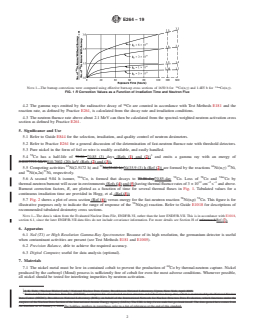
5.6 A second 9.04 h isomer, 58mCo, is formed that decays to 70.85-day 58Co. Loss of 58Co and 58mCo by thermal-neutron burnout will occur in environments (Refs (4) and (5) having thermal fluence rates of 3 × 1012 cm−2·s −1 and above. Burnout correction factors, R, are plotted as a function of time for several thermal fluxes in Fig. 1. Tabulated values for a continuous irradiation time are provided in Hogg, et al. (Ref (5))
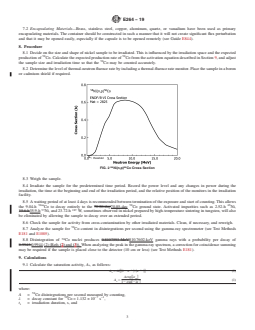
5.7 Fig. 2 shows a plot of cross section (Ref (6)) versus energy for the fast-neutron reaction 58Ni(n,p) 58Co. This figure is for illustrative purposes only to indicate the range of response of the 58Ni(n,p) reaction. Refer to Guide E1018 for descriptions of recommended tabulated dosimetry cross sections.
FIG. 2 58Ni(n,p)58Co Cross Section
Note 1: The data is taken from the Evaluated Nuclear Data File, ENDF/B-VI, rather than the later ENDF/B-VII. This is in accordance with E1018, section 6.1, since the later ENDF/B-VII data files do not include covariance information. For more details see Section H of Ref (7).
SCOPE
1.1 This test method covers procedures for measuring reaction rates by the activation reaction 58Ni(n,p)58Co.
FIG. 1 R Correction Values as a Function of Irradiation Time and Neutron Flux
Note 1: The burnup corrections were computed using effective burn-up cross sections of 1650 b for 58Co(n,γ) and 1.4E5 b for 58mCo(n,γ).
1.2 This activation reaction is useful for measuring neutrons with energies above approximately 2.1 MeV and for irradiation times up to about 200 days in the absence of high thermal neutron fluence rates, provided that the analysis methods described in Practice E261 are followed. If dosimeters are analyzed after irradiation periods longer than 200 days, the information inferred about the fluence during irradiation periods more than 200 days before the end of the irradiation should not be relied upon without supporting data from dosimeters withdrawn earlier.
1.3 With suitable techniques fission-neutron fluence rates densities above 107 cm−2·s −1 can be determined.
1.4 Detailed procedures for other fast-neutron detectors are referenced in Practice E261.
1.5 The values stated in SI units are to be regarded as standard. No other units of measurement are included in this standard.
1.6 This standard does not purport to address all of the safety concerns, if any, associated with its use. It is the responsibility of the user of this standard to establish appropriate safety, health, and environmental practices and determine the applicability of regulatory limitations prior to use.
1.7 This international standard was developed in accordance with internationally recognized principles on standardization established in the Decision on Principles for the Development of International Standards, Guides and Recommendations issued by the World Trade Organization Technical Barriers to Trade (TBT) Committee.
- Status
- Published
- Publication Date
- 31-Mar-2019
- Technical Committee
- E10 - Nuclear Technology and Applications
- Drafting Committee
- E10.05 - Nuclear Radiation Metrology
Buy Documents

ASTM E264-19 - Standard Test Method for Measuring Fast-Neutron Reaction Rates by Radioactivation of Nickel
REDLINE ASTM E264-19 - Standard Test Method for Measuring Fast-Neutron Reaction Rates by Radioactivation of Nickel
Overview
ASTM E264-19: Standard Test Method for Measuring Fast-Neutron Reaction Rates by Radioactivation of Nickel specifies a standardized procedure for determining fast-neutron reaction rates using the activation reaction of nickel, specifically through the transformation of Ni-58 to Co-58. This method is particularly valuable in environments where quantifying neutron fluence rates above approximately 2.1 MeV is required, such as in reactor surveillance, pressure vessel studies, and nuclear facility monitoring.
The standard is recognized for its practical application in neutron dosimetry due to the ready availability, ease of handling, and purity of nickel samples, which can be shaped as foils or wires. This test method is developed under the jurisdiction of ASTM Committee E10 on Nuclear Technology and Applications, ensuring alignment with international principles on standardization.
Key Topics
Nickel Activation: Utilizes the Ni-58(n,p)Co-58 reaction for measuring fast-neutron flux and reaction rates. The activation analysis depends on detecting gamma rays emitted by Co-58, with a characteristic energy of approximately 810.76 keV and a half-life of about 70.85 days.
Neutron Energy Range: The method is effective for neutrons with energies exceeding about 2.1 MeV, making it specifically pertinent in fast neutron fields.
Sample Preparation and Handling: Details the need for high purity, low-cobalt nickel produced by the carbonyl (Mond) process. Wire or foil formats are recommended, and samples must be tested for impurities that could interfere with results.
Irradiation and Measurement: The method specifies procedures for irradiation time (up to about 200 days), encapsulation, shielding, and the use of gamma-ray spectrometers for post-irradiation analysis.
Burnout and Competing Activities: Addresses corrections for thermal-neutron burnout and recognizes the formation of other isotopes (e.g., Ni-65, Ni-57, Co-58m) as secondary reactions. Correction factors (R) are provided for high thermal neutron fluence environments.
Data Analysis: Describes the calculation of saturation activity (A_s) and reaction rate, with guidance for reporting results and understanding precision and bias.
Applications
The ASTM E264-19 standard has widespread applications in:
- Nuclear Reactor Surveillance: Monitoring neutron flux in reactor pressure vessels to assess material exposure and integrity over time.
- Radiation Metrology: Fast-neutron dosimetry in research, safety analysis, and operational checks in nuclear facilities.
- Nuclear Materials Testing: Evaluating neutron-induced changes in materials used in nuclear environments, helping to inform longevity and safety standards.
- Shielding Verification: Assessing the performance of neutron shielding materials by measuring fast-neutron fluence at critical locations.
- Reactor Physics Research: Supporting operational and safety studies where neutron field characterization is essential.
Related Standards
ASTM E264-19 is frequently used in conjunction with other ASTM standards to provide comprehensive coverage in neutron dosimetry and measurement:
- ASTM E261: Practice for Determining Neutron Fluence, Fluence Rate, and Spectra by Radioactivation Techniques
- ASTM E844: Guide for Sensor Set Design and Irradiation for Reactor Surveillance
- ASTM E181: Test Methods for Detector Calibration and Analysis of Radionuclides
- ASTM E944: Guide for Application of Neutron Spectrum Adjustment Methods in Reactor Surveillance
- ASTM E1005: Test Method for Application and Analysis of Radiometric Monitors for Reactor Vessel Surveillance
- ASTM E1018: Guide for Application of ASTM Evaluated Cross Section Data File
Using ASTM E264-19 in alignment with these standards enhances the reliability and consistency of fast-neutron monitoring programs, supporting regulatory compliance and advancing best practices in nuclear science and engineering.
Relations
- Effective Date
- 01-Mar-2020
- Effective Date
- 01-Mar-2020
- Effective Date
- 01-Oct-2019
- Effective Date
- 01-Jun-2018
- Effective Date
- 01-Jun-2017
- Effective Date
- 01-Oct-2016
- Effective Date
- 15-Feb-2016
- Effective Date
- 01-Sep-2015
- Effective Date
- 01-Jul-2015
- Effective Date
- 01-Jun-2015
- Effective Date
- 15-Mar-2015
- Effective Date
- 15-Oct-2014
- Effective Date
- 01-Sep-2014
- Refers
ASTM E844-09(2014)e2 - Standard Guide for Sensor Set Design and Irradiation for Reactor Surveillance - Effective Date
- 01-Jun-2014
- Effective Date
- 01-Jun-2014
Buy Documents
ASTM E264-19 - Standard Test Method for Measuring Fast-Neutron Reaction Rates by Radioactivation of Nickel
REDLINE ASTM E264-19 - Standard Test Method for Measuring Fast-Neutron Reaction Rates by Radioactivation of Nickel
Get Certified
Connect with accredited certification bodies for this standard

DNV
DNV is an independent assurance and risk management provider.

Lloyd's Register
Lloyd's Register is a global professional services organisation specialising in engineering and technology.
DNV Energy Systems
Energy and renewable energy certification.
Sponsored listings
Frequently Asked Questions
ASTM E264-19 is a standard published by ASTM International. Its full title is "Standard Test Method for Measuring Fast-Neutron Reaction Rates by Radioactivation of Nickel". This standard covers: SIGNIFICANCE AND USE 5.1 Refer to Guide E844 for the selection, irradiation, and quality control of neutron dosimeters. 5.2 Refer to Practice E261 for a general discussion of the determination of fast-neutron fluence rate with threshold detectors. 5.3 Pure nickel in the form of foil or wire is readily available, and easily handled. 5.4 58Co has a half-life of 70.85 (3) days (Refs (1) and (2))3 and emits a gamma ray with an energy of 810.7602 (20) keV (Refs (2) and (3)). 5.5 Competing activities 65Ni(2.5172 h) and 57Ni(35.9 (3) h (Ref (2)) are formed by the reactions 64Ni(n,γ) 65Ni, and 58Ni(n,2n)57Ni, respectively. 5.6 A second 9.04 h isomer, 58mCo, is formed that decays to 70.85-day 58Co. Loss of 58Co and 58mCo by thermal-neutron burnout will occur in environments (Refs (4) and (5) having thermal fluence rates of 3 × 1012 cm−2·s −1 and above. Burnout correction factors, R, are plotted as a function of time for several thermal fluxes in Fig. 1. Tabulated values for a continuous irradiation time are provided in Hogg, et al. (Ref (5)) 5.7 Fig. 2 shows a plot of cross section (Ref (6)) versus energy for the fast-neutron reaction 58Ni(n,p) 58Co. This figure is for illustrative purposes only to indicate the range of response of the 58Ni(n,p) reaction. Refer to Guide E1018 for descriptions of recommended tabulated dosimetry cross sections. FIG. 2 58Ni(n,p)58Co Cross Section Note 1: The data is taken from the Evaluated Nuclear Data File, ENDF/B-VI, rather than the later ENDF/B-VII. This is in accordance with E1018, section 6.1, since the later ENDF/B-VII data files do not include covariance information. For more details see Section H of Ref (7). SCOPE 1.1 This test method covers procedures for measuring reaction rates by the activation reaction 58Ni(n,p)58Co. FIG. 1 R Correction Values as a Function of Irradiation Time and Neutron Flux Note 1: The burnup corrections were computed using effective burn-up cross sections of 1650 b for 58Co(n,γ) and 1.4E5 b for 58mCo(n,γ). 1.2 This activation reaction is useful for measuring neutrons with energies above approximately 2.1 MeV and for irradiation times up to about 200 days in the absence of high thermal neutron fluence rates, provided that the analysis methods described in Practice E261 are followed. If dosimeters are analyzed after irradiation periods longer than 200 days, the information inferred about the fluence during irradiation periods more than 200 days before the end of the irradiation should not be relied upon without supporting data from dosimeters withdrawn earlier. 1.3 With suitable techniques fission-neutron fluence rates densities above 107 cm−2·s −1 can be determined. 1.4 Detailed procedures for other fast-neutron detectors are referenced in Practice E261. 1.5 The values stated in SI units are to be regarded as standard. No other units of measurement are included in this standard. 1.6 This standard does not purport to address all of the safety concerns, if any, associated with its use. It is the responsibility of the user of this standard to establish appropriate safety, health, and environmental practices and determine the applicability of regulatory limitations prior to use. 1.7 This international standard was developed in accordance with internationally recognized principles on standardization established in the Decision on Principles for the Development of International Standards, Guides and Recommendations issued by the World Trade Organization Technical Barriers to Trade (TBT) Committee.
SIGNIFICANCE AND USE 5.1 Refer to Guide E844 for the selection, irradiation, and quality control of neutron dosimeters. 5.2 Refer to Practice E261 for a general discussion of the determination of fast-neutron fluence rate with threshold detectors. 5.3 Pure nickel in the form of foil or wire is readily available, and easily handled. 5.4 58Co has a half-life of 70.85 (3) days (Refs (1) and (2))3 and emits a gamma ray with an energy of 810.7602 (20) keV (Refs (2) and (3)). 5.5 Competing activities 65Ni(2.5172 h) and 57Ni(35.9 (3) h (Ref (2)) are formed by the reactions 64Ni(n,γ) 65Ni, and 58Ni(n,2n)57Ni, respectively. 5.6 A second 9.04 h isomer, 58mCo, is formed that decays to 70.85-day 58Co. Loss of 58Co and 58mCo by thermal-neutron burnout will occur in environments (Refs (4) and (5) having thermal fluence rates of 3 × 1012 cm−2·s −1 and above. Burnout correction factors, R, are plotted as a function of time for several thermal fluxes in Fig. 1. Tabulated values for a continuous irradiation time are provided in Hogg, et al. (Ref (5)) 5.7 Fig. 2 shows a plot of cross section (Ref (6)) versus energy for the fast-neutron reaction 58Ni(n,p) 58Co. This figure is for illustrative purposes only to indicate the range of response of the 58Ni(n,p) reaction. Refer to Guide E1018 for descriptions of recommended tabulated dosimetry cross sections. FIG. 2 58Ni(n,p)58Co Cross Section Note 1: The data is taken from the Evaluated Nuclear Data File, ENDF/B-VI, rather than the later ENDF/B-VII. This is in accordance with E1018, section 6.1, since the later ENDF/B-VII data files do not include covariance information. For more details see Section H of Ref (7). SCOPE 1.1 This test method covers procedures for measuring reaction rates by the activation reaction 58Ni(n,p)58Co. FIG. 1 R Correction Values as a Function of Irradiation Time and Neutron Flux Note 1: The burnup corrections were computed using effective burn-up cross sections of 1650 b for 58Co(n,γ) and 1.4E5 b for 58mCo(n,γ). 1.2 This activation reaction is useful for measuring neutrons with energies above approximately 2.1 MeV and for irradiation times up to about 200 days in the absence of high thermal neutron fluence rates, provided that the analysis methods described in Practice E261 are followed. If dosimeters are analyzed after irradiation periods longer than 200 days, the information inferred about the fluence during irradiation periods more than 200 days before the end of the irradiation should not be relied upon without supporting data from dosimeters withdrawn earlier. 1.3 With suitable techniques fission-neutron fluence rates densities above 107 cm−2·s −1 can be determined. 1.4 Detailed procedures for other fast-neutron detectors are referenced in Practice E261. 1.5 The values stated in SI units are to be regarded as standard. No other units of measurement are included in this standard. 1.6 This standard does not purport to address all of the safety concerns, if any, associated with its use. It is the responsibility of the user of this standard to establish appropriate safety, health, and environmental practices and determine the applicability of regulatory limitations prior to use. 1.7 This international standard was developed in accordance with internationally recognized principles on standardization established in the Decision on Principles for the Development of International Standards, Guides and Recommendations issued by the World Trade Organization Technical Barriers to Trade (TBT) Committee.
ASTM E264-19 is classified under the following ICS (International Classification for Standards) categories: 17.240 - Radiation measurements; 27.120.30 - Fissile materials and nuclear fuel technology. The ICS classification helps identify the subject area and facilitates finding related standards.
ASTM E264-19 has the following relationships with other standards: It is inter standard links to ASTM E1018-20e1, ASTM E1018-20, ASTM E944-19, ASTM E844-18, ASTM E170-17, ASTM E170-16a, ASTM E170-16, ASTM E170-15a, ASTM E1005-15, ASTM E261-15, ASTM E170-15, ASTM E170-14a, ASTM E170-14, ASTM E844-09(2014)e2, ASTM E844-09(2014)e1. Understanding these relationships helps ensure you are using the most current and applicable version of the standard.
ASTM E264-19 is available in PDF format for immediate download after purchase. The document can be added to your cart and obtained through the secure checkout process. Digital delivery ensures instant access to the complete standard document.
Standards Content (Sample)
This international standard was developed in accordance with internationally recognized principles on standardization established in the Decision on Principles for the
Development of International Standards, Guides and Recommendations issued by the World Trade Organization Technical Barriers to Trade (TBT) Committee.
Designation: E264 − 19
Standard Test Method for
Measuring Fast-Neutron Reaction Rates by Radioactivation
of Nickel
This standard is issued under the fixed designation E264; the number immediately following the designation indicates the year of
original adoption or, in the case of revision, the year of last revision.Anumber in parentheses indicates the year of last reapproval.A
superscript epsilon (´) indicates an editorial change since the last revision or reapproval.
This standard has been approved for use by agencies of the U.S. Department of Defense.
1. Scope 2. Referenced Documents
2.1 ASTM Standards:
1.1 This test method covers procedures for measuring reac-
58 58
E170Terminology Relating to Radiation Measurements and
tion rates by the activation reaction Ni(n,p) Co.
Dosimetry
1.2 Thisactivationreactionisusefulformeasuringneutrons
E181Test Methods for Detector Calibration andAnalysis of
withenergiesaboveapproximately2.1MeVandforirradiation
Radionuclides
times up to about 200 days in the absence of high thermal
E261Practice for Determining Neutron Fluence, Fluence
neutron fluence rates, provided that the analysis methods
Rate, and Spectra by Radioactivation Techniques
described in Practice E261 are followed. If dosimeters are
E844Guide for Sensor Set Design and Irradiation for
analyzed after irradiation periods longer than 200 days, the
Reactor Surveillance
information inferred about the fluence during irradiation peri-
E944Guide for Application of Neutron Spectrum Adjust-
odsmorethan200daysbeforetheendoftheirradiationshould
ment Methods in Reactor Surveillance
not be relied upon without supporting data from dosimeters
E1005Test Method for Application and Analysis of Radio-
withdrawn earlier.
metric Monitors for Reactor Vessel Surveillance
E1018Guide for Application of ASTM Evaluated Cross
1.3 With suitable techniques fission-neutron fluence rates
7 −2 −1 Section Data File
densities above 10 cm ·s can be determined.
3. Terminology
1.4 Detailed procedures for other fast-neutron detectors are
referenced in Practice E261.
3.1 Definitions:
3.1.1 Refer to Terminology E170.
1.5 The values stated in SI units are to be regarded as
standard. No other units of measurement are included in this
4. Summary of Test Method
standard.
4.1 High-purity nickel is irradiated in a neutron field,
58 58 58
1.6 This standard does not purport to address all of the
thereby producing radioactive Co from the Ni(n,p) Co
safety concerns, if any, associated with its use. It is the
activation reaction.
responsibility of the user of this standard to establish appro-
4.2 The gamma rays emitted by the radioactive decay of
priate safety, health, and environmental practices and deter-
Co are counted in accordance with Test Methods E181 and
mine the applicability of regulatory limitations prior to use.
the reaction rate, as defined by Practice E261, is calculated
1.7 This international standard was developed in accor-
from the decay rate and irradiation conditions.
dance with internationally recognized principles on standard-
4.3 The neutron fluence rate above about 2.1 MeVcan then
ization established in the Decision on Principles for the
be calculated from the spectral-weighted neutron activation
Development of International Standards, Guides and Recom-
cross section as defined by Practice E261.
mendations issued by the World Trade Organization Technical
Barriers to Trade (TBT) Committee.
5. Significance and Use
5.1 Refer to Guide E844 for the selection, irradiation, and
quality control of neutron dosimeters.
ThistestmethodisunderthejurisdictionofASTMCommitteeE10onNuclear
Technology and Applicationsand is the direct responsibility of Subcommittee
E10.05 on Nuclear Radiation Metrology. For referenced ASTM standards, visit the ASTM website, www.astm.org, or
Current edition approved April 1, 2019. Published May 2019. Originally contact ASTM Customer Service at service@astm.org. For Annual Book of ASTM
approved in 1965. Last edition approved in 2013 as E264–08(2013). DOI: Standards volume information, refer to the standard’s Document Summary page on
10.1520/E0264-19. the ASTM website.
Copyright © ASTM International, 100 Barr Harbor Drive, PO Box C700, West Conshohocken, PA 19428-2959. United States
E264 − 19
NOTE 1—The burnup corrections were computed using effective
burn-up cross sections of 1650 b for Co(n,γ) and 1.4E5 b for
58m
Co(n,γ).
FIG. 1R Correction Values as a Function of Irradiation Time and
Neutron Flux
58 58
FIG. 2 Ni(n,p) Co Cross Section
5.2 Refer to Practice E261 for a general discussion of the
determination of fast-neutron fluence rate with threshold de-
6.2 Precision Balance, able to achieve the required accu-
tectors. racy.
5.3 Pure nickel in the form of foil or wire is readily
6.3 Digital Computer, useful for data analysis (optional).
available, and easily handled.
7. Materials
58 3
5.4 Cohasahalf-lifeof70.85(3)days(Refs (1)and (2))
7.1 The nickel metal must be low in contained cobalt to
and emits a gamma ray with an energy of 810.7602 (20) keV
prevent the production of Co by thermal-neutron capture.
(Refs (2) and (3)).
Nickelproducedbythecarbonyl(Mond)processissufficiently
65 57
5.5 Competingactivities Ni(2.5172 h) and Ni(35.9(3)h
free of cobalt for even the most adverse conditions. Whenever
64 65
(Ref (2)) are formed by the reactions Ni(n,γ) Ni, and
possible, all nickel should be tested for interfering impurities
58 57
Ni(n,2n) Ni, respectively.
by neutron activation.
58m
5.6 Asecond9.04hisomer, Co,isformedthatdecaysto
7.2 Encapsulating Materials—Brass, stainless steel, copper,
58 58 58m
70.85-day Co. Loss of Co and Co by thermal-neutron
aluminum, quartz, or vanadium have been used as primary
burnout will occur in environments (Refs (4) and (5) having
encapsulating materials. The container should be constructed
12 −2 −1
thermal fluence rates of 3×10 cm ·s and above. Burnout
in such a manner that it will not create significant flux
correction factors, R, are plotted as a function of time for
perturbation and that it may be opened easily, especially if the
several thermal fluxes in Fig. 1. Tabulated values for a
capsule is to be opened remotely (see Guide E844).
continuous irradiation time are provided in Hogg, et al. (Ref
(5))
8. Procedure
5.7 Fig. 2 shows a plot of cross section (Ref (6)) versus
8.1 Decide on the size and shape of nickel sample to be
58 58
energy for the fast-neutron reaction Ni(n,p) Co.This figure
irradiated. This is influenced by the irradiation space and the
is for illustrative purposes only to indicate the range of
expected production of Co. Calculate the expected produc-
response of the Ni(n,p) reaction. Refer to Guide E1018 for
tion rate of Co from the activation equation described in
descriptions of recommended tabulated dosimetry cross sec-
Section 9, and adjust the sample size and irradiation time so
tions.
that the Co m
...
This document is not an ASTM standard and is intended only to provide the user of an ASTM standard an indication of what changes have been made to the previous version. Because
it may not be technically possible to adequately depict all changes accurately, ASTM recommends that users consult prior editions as appropriate. In all cases only the current version
of the standard as published by ASTM is to be considered the official document.
Designation: E264 − 08 (Reapproved 2013) E264 − 19
Standard Test Method for
Measuring Fast-Neutron Reaction Rates by Radioactivation
of Nickel
This standard is issued under the fixed designation E264; the number immediately following the designation indicates the year of
original adoption or, in the case of revision, the year of last revision. A number in parentheses indicates the year of last reapproval. A
superscript epsilon (´) indicates an editorial change since the last revision or reapproval.
This standard has been approved for use by agencies of the U.S. Department of Defense.
1. Scope
58 58
1.1 This test method covers procedures for measuring reaction rates by the activation reaction Ni(n,p) Co.
1.2 This activation reaction is useful for measuring neutrons with energies above approximately 2.1 MeV and for irradiation
times up to about 200 days in the absence of high thermal neutron fluence rates (for longer irradiations, see rates, provided that
the analysis methods described in Practice E261). are followed. If dosimeters are analyzed after irradiation periods longer than 200
days, the information inferred about the fluence during irradiation periods more than 200 days before the end of the irradiation
should not be relied upon without supporting data from dosimeters withdrawn earlier.
7 −2 −1
1.3 With suitable techniques fission-neutron fluence rates densities above 10 cm ·s can be determined.
1.4 Detailed procedures for other fast-neutron detectors are referenced in Practice E261.
1.5 The values stated in SI units are to be regarded as standard. No other units of measurement are included in this standard.
1.6 This standard does not purport to address all of the safety concerns, if any, associated with its use. It is the responsibility
of the user of this standard to establish appropriate safety safety, health, and healthenvironmental practices and determine the
applicability of regulatory limitations prior to use.
1.7 This international standard was developed in accordance with internationally recognized principles on standardization
established in the Decision on Principles for the Development of International Standards, Guides and Recommendations issued
by the World Trade Organization Technical Barriers to Trade (TBT) Committee.
2. Referenced Documents
2.1 ASTM Standards:
E170 Terminology Relating to Radiation Measurements and Dosimetry
E181 Test Methods for Detector Calibration and Analysis of Radionuclides
E261 Practice for Determining Neutron Fluence, Fluence Rate, and Spectra by Radioactivation Techniques
E844 Guide for Sensor Set Design and Irradiation for Reactor Surveillance
E944 Guide for Application of Neutron Spectrum Adjustment Methods in Reactor Surveillance
E1005 Test Method for Application and Analysis of Radiometric Monitors for Reactor Vessel Surveillance
E1018 Guide for Application of ASTM Evaluated Cross Section Data File
3. Terminology
3.1 Definitions:
3.1.1 Refer to Terminology E170.
4. Summary of Test Method
58 58 58
4.1 High-purity nickel is irradiated in a neutron field, thereby producing radioactive Co from the Ni(n,p) Co activation
reaction.
This test method is under the jurisdiction of ASTM Committee E10 on Nuclear Technology and Applicationsand is the direct responsibility of Subcommittee E10.05 on
Nuclear Radiation Metrology.
Current edition approved Jan. 1, 2013April 1, 2019. Published January 2013May 2019. Originally approved in 1965. Last edition approved in 20082013 as
E264 – 08.E264 – 08(2013). DOI: 10.1520/E0264-08R13.10.1520/E0264-19.
For referenced ASTM standards, visit the ASTM website, www.astm.org, or contact ASTM Customer Service at service@astm.org. For Annual Book of ASTM Standards
volume information, refer to the standard’s Document Summary page on the ASTM website.
Copyright © ASTM International, 100 Barr Harbor Drive, PO Box C700, West Conshohocken, PA 19428-2959. United States
E264 − 19
58 58m
NOTE 1—The burnup corrections were computed using effective burn-up cross sections of 1650 b for Co(n,γ) and 1.4E5 b for Co(n,γ).
FIG. 1 R Correction Values as a Function of Irradiation Time and Neutron Flux
4.2 The gamma rays emitted by the radioactive decay of Co are counted in accordance with Test Methods E181 and the
reaction rate, as defined by Practice E261, is calculated from the decay rate and irradiation conditions.
4.3 The neutron fluence rate above about 2.1 MeV can then be calculated from the spectral-weighted neutron activation cross
section as defined by Practice E261.
5. Significance and Use
5.1 Refer to Guide E844 for the selection, irradiation, and quality control of neutron dosimeters.
5.2 Refer to Practice E261 for a general discussion of the determination of fast-neutron fluence rate with threshold detectors.
5.3 Pure nickel in the form of foil or wire is readily available, and easily handled.
58 3
5.4 Co has a half-life of 70.86 70.85 (3) days (Refs (1) and (2)) and emits a gamma ray with an energy of
0.8107593-MeV.810.7602 (20) keV (Refs (2) and (3)).
65 57 64 65
5.5 Competing activities Ni(2.5172 h) and Ni(35.60 h) Ni(35.9 (3) h (Ref (2)) are formed by the reactions Ni(n,γ) Ni,
58 57
and Ni(n,2n) Ni, respectively.
58m 58 58 58m
5.6 A second 9.04 h isomer, Co, is formed that decays to 70.86-day70.85-day Co. Loss of Co and Co by
, 12 −2 −1
thermal-neutron burnout will occur in environments (Refs ( 4) and (5) having thermal fluence rates of 3 × 10 cm ·s and above.
Burnout correction factors, R, are plotted as a function of time for several thermal fluxes in Fig. 1. Tabulated values for a
continuous irradiation time are provided in Hogg, et al. (Ref (5))
58 58
5.7 Fig. 2 shows a plot of cross section (Ref (6)) versus energy for the fast-neutron reaction Ni(n,p) Co. This figure is for
illustrative purposes only to indicate the range of response of the Ni(n,p) reaction. Refer to Guide E1018 for descriptions of
recommended tabulated dosimetry cross sections.
NOTE 1—The data is taken from the Evaluated Nuclear Data File, ENDF/B-VI, rather than the later ENDF/B-VII. This is in accordance with E1018,
section 6.1, since the later ENDF/B-VII data files do not include covariance information. For more details see Section H of reference 8.Ref (7).
6. Apparatus
6.1 NaI (T1) or High Resolution Gamma-Ray Spectrometer. Because of its high resolution, the germanium detector is useful
when contaminant activities are present (see Test Methods E181 and E1005).
6.2 Precision Balance, able to achieve the required accuracy.
6.3 Digital Computer, useful for data analysis (optional).
7. Materials
7.1 The nickel metal must be low in contained cobalt to prevent the production of Co by thermal-neutron capture. Nickel
produced by the carbonyl (Mond) process is sufficiently free of cobalt for even the most adverse conditions. Whenever possible,
all nickel should be tested for interfering impurities by neutron activation.
J. K. Tulti, “Nuclear Wallet Cards,” National Nuclear Data Center, Brookhaven National Laboratory, Upton, New York, April 2005.
Evaluated Nuclear Structure Data File (ENSDF), a computer file of evaluated nuclear structure and radioactive decay data, which is maintained by the National Nuclear
Data Center (NNDC), Brookhaven National Laboratory (BNL), on behalf of the International Network for Nuclear Structure Data Evaluation, which functions under the
auspices of the Nuclear Data Section of the International Atomic Energy Agency (IAEA). The URL is http;//www.nndc.bnl.gov/nndc/ensdf. The data quoted here comes from
the database as of January 1, 2002.The boldface numbers in parentheses refer to a list of references at the end of this standard.
E264 − 19
7.2 Encapsulating Materials—Brass, stainless steel, copper, aluminum, quartz, or vanadium have been used as primary
encapsulating materials. The container should be constructed in such a manner that it will no
...