

ASTM E844-18
(Guide)Standard Guide for Sensor Set Design and Irradiation for Reactor Surveillance
General Information
- Abstract
SIGNIFICANCE AND USE
4.1 In neutron dosimetry, a fission or non-fission dosimeter, or combination of dosimeters, can be used for determining a fluence rate, fluence, or neutron spectrum in nuclear reactors. Each dosimeter is sensitive to a specific energy range, and, if desired, increased accuracy in a fluence-rate spectrum can be achieved by the use of several dosimeters each covering specific neutron energy ranges.
4.2 A wide variety of detector materials is used for various purposes. Many of these substances overlap in the energy of the neutrons which they will detect, but many different materials are used for a variety of reasons. These reasons include available analysis equipment, different cross sections for different fluence-rate levels and spectra, preferred chemical or physical properties, and, in the case of radiometric dosimeters, varying requirements for different half-life isotopes, possible interfering activities, and chemical separation requirements.
SCOPE
1.1 This guide covers the selection, design, irradiation, post-irradiation handling, and quality control of neutron dosimeters (sensors), thermal neutron shields, and capsules for reactor surveillance neutron dosimetry.
1.2 The values stated in SI units are to be regarded as standard. Values in parentheses are for information only.
1.3 This standard does not purport to address all of the safety concerns, if any, associated with its use. It is the responsibility of the user of this standard to establish appropriate safety, health, and environmental practices and determine the applicability of regulatory limitations prior to use.
1.4 This international standard was developed in accordance with internationally recognized principles on standardization established in the Decision on Principles for the Development of International Standards, Guides and Recommendations issued by the World Trade Organization Technical Barriers to Trade (TBT) Committee.
- Status
- Published
- Publication Date
- 31-May-2018
- Technical Committee
- E10 - Nuclear Technology and Applications
- Drafting Committee
- E10.05 - Nuclear Radiation Metrology
Overview
ASTM E844-18: Standard Guide for Sensor Set Design and Irradiation for Reactor Surveillance provides comprehensive guidance on the selection, design, irradiation, post-irradiation handling, and quality control of neutron dosimeters (sensors), thermal neutron shields, and capsules used for reactor surveillance dosimetry. Developed by ASTM International, this guide is essential for ensuring accurate and reliable neutron fluence measurements, which are critical for the ongoing assessment of nuclear reactors’ structural integrity and safety.
This standard addresses key elements for effective reactor surveillance, including the careful selection and preparation of detector materials, shield design, robust irradiation protocols, and stringent quality control practices. By following the recommendations in ASTM E844-18, users can enhance the reliability of their neutron dosimetry programs and comply with international best practices.
Key Topics
Selection of Neutron Dosimeters and Shields: Guidance on choosing appropriate dosimeter materials (such as radiometric monitors, helium accumulation monitors, and track recorders), based on the neutron energy range and required accuracy. The standard outlines the use of a variety of detector forms and alloys for optimal response and performance in different reactor conditions.
Design Considerations: Emphasis on designing dosimeters, shields, and capsules for safe handling, minimal self-shielding, and resilience in high-temperature environments. Covers important factors like dosimeter size, self-absorption, fission fragment loss, and burnup, all of which affect measurement accuracy.
Irradiation Procedures: Instructions on the placement and arrangement of dosimeters within reactors to ensure representative measurements of neutron fluence and spectrum. Highlights the significance of recording precise dosimeter locations and managing gradients in neutron fluence rates.
Post-Irradiation Handling: Procedures for safe recovery, cleaning, identification, and analysis of dosimeter materials after irradiation, including the use of specialized hot-cell equipment and protocols to prevent cross-contamination and loss.
Quality Control: Requirements for verifying dosimeter material purity, conducting impurity analyses, and maintaining accurate records. Recommends analytical techniques and highlights the importance of impurity correction to ensure the integrity of dosimetry results.
Applications
ASTM E844-18 is widely used in:
- Nuclear Reactor Surveillance: To monitor neutron exposure and assess the structural health of reactor vessels and components.
- Neutron Dosimetry Programs: For selecting and configuring sensor sets for fluence rate, fluence, or neutron spectrum characterization in research and power reactors.
- Regulatory Compliance: Assisting facility operators in meeting regulatory requirements for reactor monitoring and maintenance.
- Benchmarking and Quality Assurance: Ensuring neutron dosimetry experiments are conducted using standardized materials, methods, and analysis for reproducibility and reliability.
By adhering to this guide, reactor operators, nuclear safety professionals, and dosimetry specialists can minimize uncertainties in neutron monitoring, optimize sensor set configuration for diverse reactor environments, and uphold high standards for radiation measurement and safety.
Related Standards
ASTM E844-18 references and is complemented by several important ASTM standards in radiation measurements and neutron dosimetry, including:
- ASTM E170: Terminology Relating to Radiation Measurements and Dosimetry
- ASTM E261: Practice for Determining Neutron Fluence, Fluence Rate, and Spectra by Radioactivation Techniques
- ASTM E854: Test Method for Application and Analysis of Solid State Track Recorder Monitors
- ASTM E910: Test Method for Application and Analysis of Helium Accumulation Fluence Monitors
- ASTM E1005: Test Method for Application and Analysis of Radiometric Monitors
- ASTM E2956: Guide for Monitoring the Neutron Exposure of LWR Reactor Pressure Vessels
- ASTM E2005 / E2006: Guides for Benchmark Testing of Reactor Dosimetry
These related documents offer additional details and procedures for specific techniques and applications, supporting a comprehensive approach to reactor surveillance dosimetry as envisioned by ASTM E844-18.
Keywords: neutron dosimetry, reactor surveillance, sensor set design, neutron fluence, ASTM E844-18, radiation monitoring, dosimeter selection, quality control, nuclear reactor, irradiation procedures, thermal neutron shield, neutron spectrum, reactor pressure vessel.
Relations
- Replaces
ASTM E844-09(2014)e2 - Standard Guide for Sensor Set Design and Irradiation for Reactor Surveillance - Effective Date
- 01-Jun-2018
- Effective Date
- 01-Jun-2017
- Effective Date
- 01-Oct-2016
- Effective Date
- 15-Feb-2016
- Effective Date
- 01-Sep-2015
- Effective Date
- 01-Jul-2015
- Effective Date
- 01-Jun-2015
- Effective Date
- 15-Mar-2015
- Effective Date
- 15-Oct-2014
- Effective Date
- 01-Sep-2014
- Effective Date
- 01-Oct-2010
- Effective Date
- 01-Jun-2010
- Effective Date
- 01-Jun-2010
- Effective Date
- 01-Jan-2010
- Effective Date
- 01-Jan-2010
Get Certified
Connect with accredited certification bodies for this standard

BSMI (Bureau of Standards, Metrology and Inspection)
Taiwan's standards and inspection authority.
Sponsored listings
Frequently Asked Questions
ASTM E844-18 is a guide published by ASTM International. Its full title is "Standard Guide for Sensor Set Design and Irradiation for Reactor Surveillance". This standard covers: SIGNIFICANCE AND USE 4.1 In neutron dosimetry, a fission or non-fission dosimeter, or combination of dosimeters, can be used for determining a fluence rate, fluence, or neutron spectrum in nuclear reactors. Each dosimeter is sensitive to a specific energy range, and, if desired, increased accuracy in a fluence-rate spectrum can be achieved by the use of several dosimeters each covering specific neutron energy ranges. 4.2 A wide variety of detector materials is used for various purposes. Many of these substances overlap in the energy of the neutrons which they will detect, but many different materials are used for a variety of reasons. These reasons include available analysis equipment, different cross sections for different fluence-rate levels and spectra, preferred chemical or physical properties, and, in the case of radiometric dosimeters, varying requirements for different half-life isotopes, possible interfering activities, and chemical separation requirements. SCOPE 1.1 This guide covers the selection, design, irradiation, post-irradiation handling, and quality control of neutron dosimeters (sensors), thermal neutron shields, and capsules for reactor surveillance neutron dosimetry. 1.2 The values stated in SI units are to be regarded as standard. Values in parentheses are for information only. 1.3 This standard does not purport to address all of the safety concerns, if any, associated with its use. It is the responsibility of the user of this standard to establish appropriate safety, health, and environmental practices and determine the applicability of regulatory limitations prior to use. 1.4 This international standard was developed in accordance with internationally recognized principles on standardization established in the Decision on Principles for the Development of International Standards, Guides and Recommendations issued by the World Trade Organization Technical Barriers to Trade (TBT) Committee.
SIGNIFICANCE AND USE 4.1 In neutron dosimetry, a fission or non-fission dosimeter, or combination of dosimeters, can be used for determining a fluence rate, fluence, or neutron spectrum in nuclear reactors. Each dosimeter is sensitive to a specific energy range, and, if desired, increased accuracy in a fluence-rate spectrum can be achieved by the use of several dosimeters each covering specific neutron energy ranges. 4.2 A wide variety of detector materials is used for various purposes. Many of these substances overlap in the energy of the neutrons which they will detect, but many different materials are used for a variety of reasons. These reasons include available analysis equipment, different cross sections for different fluence-rate levels and spectra, preferred chemical or physical properties, and, in the case of radiometric dosimeters, varying requirements for different half-life isotopes, possible interfering activities, and chemical separation requirements. SCOPE 1.1 This guide covers the selection, design, irradiation, post-irradiation handling, and quality control of neutron dosimeters (sensors), thermal neutron shields, and capsules for reactor surveillance neutron dosimetry. 1.2 The values stated in SI units are to be regarded as standard. Values in parentheses are for information only. 1.3 This standard does not purport to address all of the safety concerns, if any, associated with its use. It is the responsibility of the user of this standard to establish appropriate safety, health, and environmental practices and determine the applicability of regulatory limitations prior to use. 1.4 This international standard was developed in accordance with internationally recognized principles on standardization established in the Decision on Principles for the Development of International Standards, Guides and Recommendations issued by the World Trade Organization Technical Barriers to Trade (TBT) Committee.
ASTM E844-18 is classified under the following ICS (International Classification for Standards) categories: 17.240 - Radiation measurements. The ICS classification helps identify the subject area and facilitates finding related standards.
ASTM E844-18 has the following relationships with other standards: It is inter standard links to ASTM E844-09(2014)e2, ASTM E170-17, ASTM E170-16a, ASTM E170-16, ASTM E170-15a, ASTM E1005-15, ASTM E261-15, ASTM E170-15, ASTM E170-14a, ASTM E170-14, ASTM E2006-10, ASTM E170-10, ASTM E2005-10, ASTM E261-10, ASTM E1005-10. Understanding these relationships helps ensure you are using the most current and applicable version of the standard.
ASTM E844-18 is available in PDF format for immediate download after purchase. The document can be added to your cart and obtained through the secure checkout process. Digital delivery ensures instant access to the complete standard document.
Standards Content (Sample)
This international standard was developed in accordance with internationally recognized principles on standardization established in the Decision on Principles for the
Development of International Standards, Guides and Recommendations issued by the World Trade Organization Technical Barriers to Trade (TBT) Committee.
Designation: E844 − 18
Standard Guide for
Sensor Set Design and Irradiation for Reactor Surveillance
This standard is issued under the fixed designation E844; the number immediately following the designation indicates the year of
original adoption or, in the case of revision, the year of last revision.Anumber in parentheses indicates the year of last reapproval.A
superscript epsilon (´) indicates an editorial change since the last revision or reapproval.
1. Scope E1018Guide for Application of ASTM Evaluated Cross
Section Data File
1.1 This guide covers the selection, design, irradiation,
E1214Guide for Use of Melt Wire Temperature Monitors
post-irradiation handling, and quality control of neutron do-
for Reactor Vessel Surveillance
simeters (sensors), thermal neutron shields, and capsules for
E2005Guide for Benchmark Testing of Reactor Dosimetry
reactor surveillance neutron dosimetry.
in Standard and Reference Neutron Fields
1.2 The values stated in SI units are to be regarded as
E2006GuideforBenchmarkTestingofLightWaterReactor
standard. Values in parentheses are for information only.
Calculations
1.3 This standard does not purport to address all of the
E2956Guide for Monitoring the Neutron Exposure of LWR
safety concerns, if any, associated with its use. It is the Reactor Pressure Vessels
responsibility of the user of this standard to establish appro-
3. Terminology
priate safety, health, and environmental practices and deter-
mine the applicability of regulatory limitations prior to use.
3.1 Definitions:
1.4 This international standard was developed in accor-
3.1.1 neutron dosimeter, sensor, monitor—a substance irra-
dance with internationally recognized principles on standard-
diated in a neutron environment for the determination of
ization established in the Decision on Principles for the
neutron fluence rate, fluence, or spectrum, for example: radio-
Development of International Standards, Guides and Recom-
metricmonitor(RM),solidstatetrackrecorder(SSTR),helium
mendations issued by the World Trade Organization Technical
accumulation fluence monitor (HAFM), damage monitor
Barriers to Trade (TBT) Committee.
(DM), temperature monitor (TM).
3.1.2 thermal neutron shield—a substance (that is,
2. Referenced Documents
cadmium, boron, gadolinium) that filters or absorbs thermal
2.1 ASTM Standards:
neutrons.
E170Terminology Relating to Radiation Measurements and
3.2 For definitions or other terms used in this guide, refer to
Dosimetry
Terminology E170.
E261Practice for Determining Neutron Fluence, Fluence
Rate, and Spectra by Radioactivation Techniques
4. Significance and Use
E854Test Method for Application and Analysis of Solid
4.1 In neutron dosimetry, a fission or non-fission dosimeter,
State Track Recorder (SSTR) Monitors for Reactor Sur-
or combination of dosimeters, can be used for determining a
veillance
fluence rate, fluence, or neutron spectrum in nuclear reactors.
E910Test Method for Application and Analysis of Helium
Each dosimeter is sensitive to a specific energy range, and, if
Accumulation Fluence Monitors for Reactor Vessel Sur-
desired, increased accuracy in a fluence-rate spectrum can be
veillance
achieved by the use of several dosimeters each covering
E1005Test Method for Application and Analysis of Radio-
specific neutron energy ranges.
metric Monitors for Reactor Vessel Surveillance
4.2 Awide variety of detector materials is used for various
purposes. Many of these substances overlap in the energy of
This guide is under the jurisdiction of ASTM Committee E10 on Nuclear
the neutrons which they will detect, but many different
Technology and Applicationsand is the direct responsibility of Subcommittee
materials are used for a variety of reasons. These reasons
E10.05 on Nuclear Radiation Metrology.
include available analysis equipment, different cross sections
CurrenteditionapprovedJune1,2018.PublishedJuly2018.Originallyapproved
ɛ2
fordifferentfluence-ratelevelsandspectra,preferredchemical
in 1981. Last previous edition approved in 2014 as E844–09(2014) . DOI:
10.1520/E0844-18.
or physical properties, and, in the case of radiometric
For referenced ASTM standards, visit the ASTM website, www.astm.org, or
dosimeters, varying requirements for different half-life
contact ASTM Customer Service at service@astm.org. For Annual Book of ASTM
isotopes, possible interfering activities, and chemical separa-
Standards volume information, refer to the standard’s Document Summary page on
the ASTM website. tion requirements.
Copyright © ASTM International, 100 Barr Harbor Drive, PO Box C700, West Conshohocken, PA 19428-2959. United States
E844 − 18
5. Selection of Neutron Dosimeters and Thermal Neutron that the total duration of the irradiation was short compared to
Shields the half life of the product nuclide.
5.1.6 If the fluence rate during the irradiation period is
5.1 Neutron Dosimeters:
variable, a valid monitor of the fluence rate variation at the
5.1.1 The choice of dosimeter material depends largely on
dosimeter location is essential. The validity of the fluence rate
the dosimetry technique employed, for example, radiometric
monitoring method should be demonstrated by transport cal-
monitors, helium accumulation monitors, track recorders, and
culations or other evidence.
damagemonitors.Atthepresenttime,thereisawidevarietyof
5.1.7 When the requirements of 5.1.6 are met, then the total
detectormaterialsusedtoperformneutrondosimetrymeasure-
irradiation period can be divided into a continuous series of
ments.Thesearegenerallyintheformoffoils,wires,powders,
periods during each of which φ is essentially constant. Equa-
and salts. The use of alloys is valuable for certain applications
tions that replace Eq 1 for this case are given in Practice E261.
such as (1) dilution of high cross-section elements, (2) prepa-
5.1.8 ForSSTRsandHAFMs,thesametypeofinformation
rationofelementsthatarenotreadilyavailableasfoilsorwires
as for radiometric monitors (that is, total number of reactions)
inthepurestate,and(3)preparationtopermitanalysisofmore
is provided.The difference being that the end products (fission
than one dosimeter material.
tracks or helium) requires no time-dependent corrections and
are therefore particularly valuable for long-term irradiations.
5.1.2 For neutron dosimeters, the reaction rates are usually
5.1.9 Fission detectors shall be chosen that have accurately
deduced from the absolute gamma-ray radioanalysis (there
known fission yields. Refer to Method E1005.
exist exceptions, such as SSTRs, HAFMs, damage monitors).
5.1.10 In thermal reactors the correction for neutron self
Therefore, the radiometric dosimeters selected must have
shielding can be appreciable for dosimeters that have highly
gamma-ray yields known with good accuracy (>98%). The
absorbing resonances (see 6.1.1).
half-life of the product nuclide must be long enough to allow
5.1.11 Dosimeters that produce activation or fission prod-
for time differences between the end of the irradiation and the
ucts (that are utilized for reaction rate determinations) with
subsequentcounting.RefertoMethodE1005fornucleardecay
half-lives that are short compared to the irradiation duration
and half-life parameters.
should not be used. Generally, radionuclides with half-lives
5.1.3 The neutron dosimeters should be sized to permit
lessthanthreetimestheirradiationdurationshouldbeavoided
accurate analysis. The range of high efficiency counting
unless there is little or no change in neutron spectral shape or
equipment over which accurate measurements can be per-
fluence rate with time.
formed is restricted to several decades of activity levels (5 to 7
5.1.12 Dosimeterswithhalf-livesasshortasonethirdofthe
decades for radiometric and SSTR dosimeters, 8 decades for
irradiation duration have been used in power reactor surveil-
HAFMs). Since fluence-rate levels at dosimeter locations can
lance when the power history in nearby reactor channels was
range over 2 or 3 decades in a given experiment and over 10
available in accordance with 5.1.6 and 5.1.7.
decades between low power and high power experiments, the
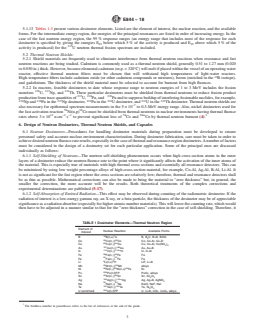
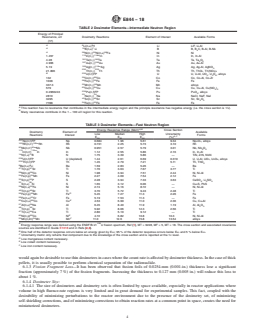
5.1.13 Tables 1-3 present various dosimeter elements.
proper sizing of dosimeter materials is essential to assure
Listed are the element of interest, the nuclear reaction, and the
accurate and economical analysis.
available forms. For the intermediate energy region, the ener-
5.1.4 The estimate of radiometric dosimeter activity levels
giesoftheprincipalresonancesarelistedinorderofincreasing
atthetimeofcountingincludeadjustmentsforthedecayofthe
energy. In the case of the fast neutron energy region, the 95%
product nuclide after irradiation as well as the rate of product
response ranges (an energy range that includes most of the
nuclide buildup during irradiation.The applicable equation for
response for each dosimeter is specified by giving the energies
such calculations is (in the absence of fluence-rate variations)
E belowwhich5%oftheactivityisproducedandE above
05 95
as follows:
2λt 2λt
1 2
A 5 N σ¯φα~1 2e !~e ! (1)
o
where:
TABLE 1 Dosimeter Elements—Thermal Neutron Region
A = expected disintegration rate (dps) for the prod-
Element of
Nuclear Reaction Available Forms
uct nuclide at the time of counting,
Interest
N = number of target element atoms, 10 7
o B B(n,α) Li B, B C, B-Al, B-Nb
59 60
φ = estimated fluence rate,
Co Co(n,γ) Co Co, Co-Al, Co-Zr
63 64
Cu Cu(n,γ) Cu Cu, Cu-Al, Cu(NO )
σ¯ = spectral averaged cross section, 3 2
197 198
Au Au(n,γ) Au Au, Au-Al
α = product of the nuclide fraction and (if appli-
115 116m
In In(n,γ) In In, In-Al
58 59
cable) of the fission yield,
Fe Fe(n,γ) Fe Fe
-λt
1 54 55
Fe Fe(n,γ) Fe Fe
(1−e ) = buildup of the nuclide during the irradiation
6 3
Li Li(n,α) H LiF, Li-Al
period, t ,
55 56
Mn Mn(n,γ) Mn alloys
-λt
e = decay after irradiation to the time of counting, 58 59 56
Ni Ni(n,γ) Ni(n,α) Fe Ni
t , and
Pu Pu(n,f)FP PuO , alloys
45 46
Sc Sc(n,γ) Sc Sc, Sc O
λ = decay constant for the product nuclide. 2 3
109 110m
Ag Ag(n,γ) Ag Ag, Ag-Al, AgNO
23 24
Na Na(n,γ) Na NaCl, NaF, NaI
5.1.5 Eq 1 should not be used for the analysis of dosimetry
181 182
Ta Ta(n,γ) Ta Ta, Ta O
2 5
measurements unless it is known that the fluence rate was
U (enriched) U(n,f)FP U, U-Al, UO ,U O , alloys
2 3 8
approximately constant over the duration of the irradiation, or
E844 − 18
TABLE 2 Dosimeter Elements—Intermediate Neutron Region
Energy of Principal
Resonance, eV Dosimetry Reactions Element of Interest Available Forms
(17)
A 6 3
Li(n,α) H Li LiF, Li-Al
A 10 7
B(n,α) Li B B, B C, B-Al, B-Nb
A 58 59 56
Ni(n,γ) Ni(n,α) Fe Ni Ni
115 116m
1.457 In(n,γ) In In In, In-Al
181 182
4.28 Ta(n,γ) Ta Ta Ta, Ta O
2 5
197 198
4.906 Au(n,γ) Au Au Au, Au-Al
109 110m
5.19 Ag(n,γ) Ag Ag Ag, Ag-Al, AgNO
232 233
21.806 Th(n,γ) Th Th Th, ThO , Th(NO )
2 3 4
B 235
U(n,f)FP U U, U-Al, UO ,U O , alloys
2 3 8
59 60
132 Co(n,γ) Co Co Co, Co-Al, Co-Zr
58 59
1038 Fe(n,γ) Fe Fe Fe
55 56
337.3 Mn(n,γ) Mn Mn alloys
63 64
579 Cu(n,γ) Cu Cu Cu, Cu-Al, Cu(NO )
3 2
0.2956243 Pu(n,f)FP Pu PuO , alloys
23 24
2810 Na(n,γ) Na Na NaCl, NaF, NaI
45 46
3295 Sc(n,γ) Sc Sc Sc, Sc O
2 3
54 55
7788 Fe(n,γ) Fe Fe Fe
A
This reaction has no resonance that contributes in the intermediate energy region and the principle resonance has negative energy (i.e. the cross section is 1/v).
B
Many resonances contribute in the 1 – 100 eV region for this reaction.
TABLE 3 Dosimeter Elements—Fast Neutron Region
A,B
Energy Response Range (MeV) Cross Section
Dosimetry Element of Available
Low Median High Uncertainty
Reactions Interest Forms
A,C
E E E (%)
05 50 95
Np(n,f)FP Np 0.684 1.96 5.61 9.34 Np O , alloys
2 3
103 103m
Rh(n,n') Rh Rh 0.731 2.25 5.73 3.10 Rh
93 93m
Nb(n,n') Nb Nb 0.951 2.57 5.79 3.01 Nb, Nb O
2 5
115 115m
In(n,n') In In 1.12 2.55 5.86 2.16 In, In-Al
14 11
N(n,α) B N 1.75 3.39 5.86 — TiN, ZrN, NbN
U(n,f)FP U (depleted) 1.44 2.61 6.69 0.319 U, U-Al, UO ,U O , alloys
3 3 8
Th(n,f)FP Th 1.45 2.79 7.21 5.11 Th, ThO
9 6
Be(n,α) Li Be 1.59 2.83 5.26 — Be
47 47
Ti(n,p) Sc Ti 1.70 3.63 7.67 3.77 Ti
58 58
Ni(n,p) Co Ni 1.98 3.94 7.51 2.44 Ni, Ni-Al
54 54
Fe(n,p) Mn Fe 2.27 4.09 7.54 2.12 Fe
32 32
S(n,p) P S 2.28 3.94 7.33 3.63 CaSO ,Li SO
4 2 4
32 29
S(n,α) Si S 1.65 3.12 6.06 — Cu S, PbS
58 55
Ni(n,α) Fe Ni 2.74 5.16 8.72 — Ni, Ni-Al
46 46
Ti(n,p) Sc Ti 3.70 5.72 9.43 2.48 Ti
56 56 D
Fe(n,p) Mn Fe 5.45 7.27 11.3 2.26 Fe
56 53
Fe(n,α) Cr Fe 5.19 7.53 11.3 — Fe
63 60 E
Cu(n,α) Co Cu 4.53 6.99 11.0 2.36 Cu, Cu-Al
27 24
Al(n,α) Na Al 6.45 8.40 11.9 1.19 Al, Al O
2 3
48 48
Ti(n,p) Sc Ti 5.92 8.06 12.3 2.56 Ti
47 44
Ti(n,α) Ca Ti 2.80 5.10 9.12 — Ti
60 60 E
Ni(n,p) Co Ni 4.72 6.82 10.8 10.3 Ni, Ni-Al
55 54 F
Mn(n,2n) Mn Mn 11.0 12.6 15.8 13.54 alloys
A 235
Energy response range was derived using the ENDF/B-VI U fission spectrum, Ref (1), MT = 9228, MF = 5, MT = 18. The cross section and associated covariance
sources are identified in Guide E1018 and in Refs (2,3).
B
One half of the detector response occurs below an energy given by E ; 95 % of the detector response occurs below E and 5 % below E .
50 95 05
C
Uncertainty metric only reflects that component due to the knowledge of the cross section and is reported at the 1σ level.
D
Low manganese content necessary.
E
Low cobalt content necessary.
F
Low iron content necessary.
which 5% of the activity is produced) for the U neutron filters must be chosen that will withstand high temperatures of
thermal fission spectrum are included.
light-water reactors. High-temperature filters include cadmium
oxide (or other cadmium compounds or mixtures), boron
5.2 Thermal Neutron Shields:
(enrichedinthe Bisotope),andgadolinium.Thethicknessof
5.2.1 Shield materials are frequently used to eliminate
the shield material must be selected to account for burnout
interference from thermal neutron reactions when resonance
from high fluences.
and fast neutron reactions are being studied. Cadmium is
5.2.2 Inreactors,feasibledosimeterstodatewhoseresponse
commonly used as a thermal neutron shield, generally 0.51 to
1.27 mm (0.020 to 0.050 in.) thick. However, because elemen- range to neutron energies of 1 to 3 MeV includes the fission
238 237 232
monitors U, Np, and Th. These particular dosimeters
tal cadmium (m.p. = 320°C) will melt if placed within the
vessel of an operating water reactor, effective thermal neutron must be shielded from thermal neutrons to reduce fission
E844 − 18
235 238
product production from trace quantities of U, Pu, 6.1.4 Dosimeter Size:
and Pu and to suppress buildup of interfering fissionable
6.1.4.1 The size of dosimeters and dosimetry sets is often
238 238 237
nuclides, for example, Np and Pu in the Np dosimeter,
limited by space available, especially in reactor applications
239 238 233 232
Pu in the U dosimeter, and Uinthe Th dosimeter.
where volume in high fluence-rate regions is very limited and
Thermal neutron shields are also necessary for epithermal
in great demand for experimental samples. This fact, coupled
−7
spectrum measurements in the 5×10 to 0.3-MeV energy
with the desirability of minimizing perturbations to the reactor
range. Also, nickel dosimeters used for the fast activation
environment due to the presence of the dosimetry set, of
58 58
reaction Ni(n,p) Comustbeshieldedfromthermalneutrons
minimizing self-shielding corrections, and of minimizing cor-
in nuclear environments having thermal fluence rates above
rections to obtain reaction rates at a common point in space,
12 −2 −1 58
3×10 n·cm ·s to prevent significant loss of Co and
creates the need for miniaturized dosimeters.
58m 3
Co by thermal neutron burnout (4).
6.1.4.2 Thelargerthedosimeter,thehigherthecountingrate
6. Design of Neutron Dosimeters, Thermal Neutron of the activated nuclide or the higher the amount of stable
product. This would be desirable in low fluence-rate regions,
Shields, and Capsules
but probably undesirable in high fluence rates for radiometric
6.1 Neutron Dosimeters—Procedures for handling dosim-
dosimeters, since the excessive count rate may result in
eter materials during preparation must be developed to ensure
dead-time losses. Excess activity may result in a radiation
personnel safety and accurate nuclear environment character-
hazard. Certain types of dosimeters (for example, HAFMs,
ization. During dosimeter fabrication, care must be taken in
foils, wires, and dissolvable samples) can be segmented or
ordertoachievedesiredneutronfluence-rateresults,especially
diluted prior to analysis. The lower limit on dosimeter size
in the case of thermal and resonance-region dosimeters. A
would be governed by a size that could be readily handled and
number of factors must be considered in the design of a
would not be easily lost or overlooked.
dosimetry set for each particular application. Some of the
6.1.5 Temperature—In high-power reactor irradiations, do-
principal ones are discussed individually as follows
...
This document is not an ASTM standard and is intended only to provide the user of an ASTM standard an indication of what changes have been made to the previous version. Because
it may not be technically possible to adequately depict all changes accurately, ASTM recommends that users consult prior editions as appropriate. In all cases only the current version
of the standard as published by ASTM is to be considered the official document.
´2
Designation: E844 − 09 (Reapproved 2014) E844 − 18
Standard Guide for
Sensor Set Design and Irradiation for Reactor Surveillance
This standard is issued under the fixed designation E844; the number immediately following the designation indicates the year of
original adoption or, in the case of revision, the year of last revision. A number in parentheses indicates the year of last reapproval. A
superscript epsilon (´) indicates an editorial change since the last revision or reapproval.
ε NOTE—Figures 1 and 2 were updated and editorial changes were made in September 2014.
ε NOTE—The title and Referenced Documents were udpated in May 2017.
1. Scope
1.1 This guide covers the selection, design, irradiation, post-irradiation handling, and quality control of neutron dosimeters
(sensors), thermal neutron shields, and capsules for reactor surveillance neutron dosimetry.
1.2 The values stated in SI units are to be regarded as standard. Values in parentheses are for information only.
1.3 This standard does not purport to address all of the safety problems,concerns, if any, associated with its use. It is the
responsibility of the user of this standard to establish appropriate safety safety, health, and healthenvironmental practices and
determine the applicability of regulatory limitations prior to use.
1.4 This international standard was developed in accordance with internationally recognized principles on standardization
established in the Decision on Principles for the Development of International Standards, Guides and Recommendations issued
by the World Trade Organization Technical Barriers to Trade (TBT) Committee.
2. Referenced Documents
2.1 ASTM Standards:
E170 Terminology Relating to Radiation Measurements and Dosimetry
E261 Practice for Determining Neutron Fluence, Fluence Rate, and Spectra by Radioactivation Techniques
E854 Test Method for Application and Analysis of Solid State Track Recorder (SSTR) Monitors for Reactor Surveillance
E910 Test Method for Application and Analysis of Helium Accumulation Fluence Monitors for Reactor Vessel Surveillance
E1005 Test Method for Application and Analysis of Radiometric Monitors for Reactor Vessel Surveillance
E1018 Guide for Application of ASTM Evaluated Cross Section Data File
E1214 Guide for Use of Melt Wire Temperature Monitors for Reactor Vessel Surveillance
E2005 Guide for Benchmark Testing of Reactor Dosimetry in Standard and Reference Neutron Fields
E2006 Guide for Benchmark Testing of Light Water Reactor Calculations
E2956 Guide for Monitoring the Neutron Exposure of LWR Reactor Pressure Vessels
3. Terminology
3.1 Definitions:
3.1.1 neutron dosimeter, sensor, monitor—a substance irradiated in a neutron environment for the determination of neutron
fluence rate, fluence, or spectrum, for example: radiometric monitor (RM), solid state track recorder (SSTR), helium accumulation
fluence monitor (HAFM), damage monitor (DM), temperature monitor (TM).
3.1.2 thermal neutron shield—a substance (that is, cadmium, boron, gadolinium) that filters or absorbs thermal neutrons.
3.2 For definitions or other terms used in this guide, refer to Terminology E170.
4. Significance and Use
4.1 In neutron dosimetry, a fission or non-fission dosimeter, or combination of dosimeters, can be used for determining a fluence
rate, fluence, or neutron spectrum in nuclear reactors. Each dosimeter is sensitive to a specific energy range, and, if desired,
increased accuracy in a fluence-rate spectrum can be achieved by the use of several dosimeters each covering specific neutron
energy ranges.
This guide is under the jurisdiction of ASTM Committee E10 on Nuclear Technology and Applicationsand is the direct responsibility of Subcommittee E10.05 on Nuclear
Radiation Metrology.
Current edition approved June 1, 2014June 1, 2018. Published July 2014July 2018. Originally approved in 1981. Last previous edition approved in 20092014 as
ɛ2
E844 – 09.E844 – 09(2014) . DOI: 10.1520/E0844-09R14E02.10.1520/E0844-18.
For referenced ASTM standards, visit the ASTM website, www.astm.org, or contact ASTM Customer Service at service@astm.org. For Annual Book of ASTM Standards
volume information, refer to the standard’s Document Summary page on the ASTM website.
Copyright © ASTM International, 100 Barr Harbor Drive, PO Box C700, West Conshohocken, PA 19428-2959. United States
E844 − 18
4.2 A wide variety of detector materials is used for various purposes. Many of these substances overlap in the energy of the
neutrons which they will detect, but many different materials are used for a variety of reasons. These reasons include available
analysis equipment, different cross sections for different fluence-rate levels and spectra, preferred chemical or physical properties,
and, in the case of radiometric dosimeters, varying requirements for different half-life isotopes, possible interfering activities, and
chemical separation requirements.
5. Selection of Neutron Dosimeters and Thermal Neutron Shields
5.1 Neutron Dosimeters:
5.1.1 The choice of dosimeter material depends largely on the dosimetry technique employed, for example, radiometric
monitors, helium accumulation monitors, track recorders, and damage monitors. At the present time, there is a wide variety of
detector materials used to perform neutron dosimetry measurements. These are generally in the form of foils, wires, powders, and
salts. The use of alloys is valuable for certain applications such as (1) dilution of high cross-section elements, (2) preparation of
elements that are not readily available as foils or wires in the pure state, and (3) preparation to permit analysis of more than one
dosimeter material.
5.1.2 For neutron dosimeters, the reaction rates are usually deduced from the absolute gamma-ray radioanalysis (there exist
exceptions, such as SSTRs, HAFMs, damage monitors). Therefore, the radiometric dosimeters selected must have gamma-ray
yields known with good accuracy (>98 %). The half-life of the product nuclide must be long enough to allow for time differences
between the end of the irradiation and the subsequent counting. Refer to Method E1005 for nuclear decay and half-life parameters.
5.1.3 The neutron dosimeters should be sized to permit accurate analysis. The range of high efficiency counting equipment over
which accurate measurements can be performed is restricted to several decades of activity levels (5 to 7 decades for radiometric
and SSTR dosimeters, 8 decades for HAFMs). Since fluence-rate levels at dosimeter locations can range over 2 or 3 decades in
a given experiment and over 10 decades between low power and high power experiments, the proper sizing of dosimeter materials
is essential to assure accurate and economical analysis.
5.1.4 The estimate of radiometric dosimeter activity levels at the time of counting include adjustments for the decay of the
product nuclide after irradiation as well as the rate of product nuclide buildup during irradiation. The applicable equation for such
calculations is (in the absence of fluence-rate perturbations)variations) as follows:
2λt 2λt
1 2
A 5 N σ¯φα 12e e (1)
~ !~ !
o
where:
A = expected disintegration rate (dps) for the product nuclide at the time of counting,
N = number of target element atoms,
o
φ = estimated fluence-rate density level,
φ = estimated fluence rate,
σ¯ = spectral averaged cross section,
α = product of the nuclide fraction and (if applicable) of the fission yield,
-λt
1 − e = buildup of the nuclide during the irradiation period, t ,
-λt
(1 − e ) = buildup of the nuclide during the irradiation period, t ,
-λt
e = decay after irradiation to the time of counting, t , and
λ = decay constant for the product nuclide.
5.1.5 Eq 1 should not be used for the analysis of dosimetry measurements unless it is known that the fluence rate was
approximately constant over the duration of the irradiation, or that the total duration of the irradiation was short compared to the
half life of the product nuclide.
5.1.6 If the fluence rate during the irradiation period is variable, a valid monitor of the fluence rate variation at the dosimeter
location is essential. The validity of the fluence rate monitoring method should be demonstrated by transport calculations or other
evidence.
5.1.7 When the requirements of 5.1.6 are met, then the total irradiation period can be divided into a continuous series of periods
during each of which φ is essentially constant. Equations that replace Eq 1 for this case are given in Practice E261.
5.1.8 For SSTRs and HAFMs, the same type of information as for radiometric monitors (that is, total number of reactions) is
provided. The difference being that the end products (fission tracks or helium) requires no time-dependent corrections and are
therefore particularly valuable for long-term irradiations.
5.1.9 Fission detectors shall be chosen that have accurately known fission yields. Refer to Method E1005.
5.1.10 In thermal reactors the correction for neutron self shielding can be appreciable for dosimeters that have highly absorbing
resonances (see 6.1.1).
5.1.11 Dosimeters that produce activation or fission products (that are utilized for reaction rate determinations) with half-lives
that are short compared to the irradiation duration should not be used. Generally, radionuclides with half-lives less than three times
the irradiation duration should be avoided unless there is little or no change in neutron spectral shape or fluence rate with time.
5.1.12 Dosimeters with half-lives as short as one third of the irradiation duration have been used in power reactor surveillance
when the power history in nearby reactor channels was available in accordance with 5.1.6 and 5.1.7.
E844 − 18
5.1.13 Tables 1-3 present various dosimeter elements. Listed are the element of interest, the nuclear reaction, and the available
forms. For the intermediate energy region, the energies of the principal resonances are listed in order of increasing energy. In the
case of the fast neutron energy region, the 95 % response ranges (an energy range that includes most of the response for each
dosimeter is specified by giving the energies E below which 5 % of the activity is produced and E above which 5 % of the
05 95
activity is produced) for the U neutron thermal fission spectrum are included.
5.2 Thermal Neutron Shields:
5.2.1 Shield materials are frequently used to eliminate interference from thermal neutron reactions when resonance and fast
neutron reactions are being studied. Cadmium is commonly used as a thermal neutron shield, generally 0.51 to 1.27 mm (0.020
to 0.050 in.) thick. However, because elemental cadmium (m.p. = 320°C) will melt if placed within the vessel of an operating water
reactor, effective thermal neutron filters must be chosen that will withstand high temperatures of light-water reactors.
High-temperature filters include cadmium oxide (or other cadmium compounds or mixtures), boron (enriched in the B isotope),
and gadolinium. The thickness of the shield material must be selected to account for burnout from high fluences.
5.2.2 In reactors, feasible dosimeters to date whose response range to neutron energies of 1 to 3 MeV includes the fission
238 237 232
monitors U, Np, and Th. These particular dosimeters must be shielded from thermal neutrons to reduce fission product
235 238 239
production from trace quantities of U, Pu, and Pu and to suppress buildup of interfering fissionable nuclides, for example,
238 238 237 239 238 233 232
Np and Pu in the Np dosimeter, Pu in the U dosimeter, and U in the Th dosimeter. Thermal neutron shields are
−7
also necessary for epithermal spectrum measurements in the 5 × 10 to 0.3-MeV energy range. Also, nickel dosimeters used for
58 58
the fast activation reaction Ni(n,p) Co must be shielded from thermal neutrons in nuclear environments having thermal fluence
12 −2 −1 58 58m 3
rates above 3 × 10 n·cm ·s to prevent significant loss of Co and Co by thermal neutron burnout (4).
6. Design of Neutron Dosimeters, Thermal Neutron Shields, and Capsules
6.1 Neutron Dosimeters—Procedures for handling dosimeter materials during preparation must be developed to ensure
personnel safety and accurate nuclear environment characterization. During dosimeter fabrication, care must be taken in order to
achieve desired neutron fluence-rate results, especially in the case of thermal and resonance-region dosimeters. A number of factors
must be considered in the design of a dosimetry set for each particular application. Some of the principal ones are discussed
individually as follows:
6.1.1 Self-Shielding of Neutrons—The neutron self-shielding phenomenon occurs when high cross-section atoms in the outer
layers of a dosimeter reduce the neutron fluence rate to the point where it significantly affects the activation of the inner atoms of
the material. This is especially true of materials with high thermal cross sections and essentially all resonance detectors. This can
be minimized by using low weight percentage alloys of high-cross-section material, for example, Co-Al, Ag-Al, B-Al, Li-Al. It
is not as significant for the fast region where the cross sections are relatively low; therefore, thermal and resonance detectors shall
be as thin as possible. Mathematical corrections can also be made to bring the material to “zero thickness” but, in general, the
smaller the correction, the more accurate will be the results. Both theoretical treatments of the complex corrections and
experimental determinations are published (5-17).
6.1.2 Self-Absorption of Emitted Radiation—This effect may be observed during counting of the radiometric dosimeter. If the
radiation of interest is a low-energy gamma ray, an X ray, or a beta particle, the thickness of the dosimeter may be of appreciable
significance as a radiation absorber (especially for higher atomic number materials). This will lower the counting rate, which would
then have to be adjusted in a manner similar to that for the “zero thickness” correction in the case of self-shielding. Therefore, it
TABLE 1 Dosimeter Elements—Thermal Neutron Region
Element of
Nuclear Reaction Available Forms
Interest
10 7
B B(n,α) Li B, B C, B-Al, B-Nb
59 60
Co Co(n,γ) Co Co, Co-Al, Co-Zr
63 64
Cu Cu(n,γ) Cu Cu, Cu-Al, Cu(NO )
3 2
197 198
Au Au(n,γ) Au Au, Au-Al
115 116m
In In(n,γ) In In, In-Al
58 59
Fe Fe(n,γ) Fe Fe
54 55
Fe Fe(n,γ) Fe Fe
6 3
Li Li(n,α) H LiF, Li-Al
55 56
Mn Mn(n,γ) Mn alloys
58 59 56
Ni Ni(n,γ) Ni(n,α) Fe Ni
Pu Pu(n,f)FP PuO , alloys
45 46
Sc Sc(n,γ) Sc Sc, Sc O
2 3
109 110m
Ag Ag(n,γ) Ag Ag, Ag-Al, AgNO
23 24
Na Na(n,γ) Na NaCl, NaF, NaI
181 182
Ta Ta(n,γ) Ta Ta, Ta O
2 5
U (enriched) U(n,f)FP U, U-Al, UO , U O , alloys
2 3 8
The boldface number in parentheses refers to the list of references at the end of the guide.
E844 − 18
TABLE 2 Dosimeter Elements—Intermediate Neutron Region
Energy of Principal
Resonance, eV Dosimetry Reactions Element of Interest Available Forms
(17)
A 6 3
Li(n,α) H Li LiF, Li-Al
A 10 7
B(n,α) Li B B, B C, B-Al, B-Nb
A 58 59 56
Ni(n,γ) Ni(n,α) Fe Ni Ni
115 116m
1.457 In(n,γ) In In In, In-Al
181 182
4.28 Ta(n,γ) Ta Ta Ta, Ta O
2 5
197 198
4.906 Au(n,γ) Au Au Au, Au-Al
109 110m
5.19 Ag(n,γ) Ag Ag Ag, Ag-Al, AgNO
232 233
21.806 Th(n,γ) Th Th Th, ThO , Th(NO )
2 3 4
B 235
U(n,f)FP U U, U-Al, UO , U O , alloys
2 3 8
59 60
132 Co(n,γ) Co Co Co, Co-Al, Co-Zr
58 59
1038 Fe(n,γ) Fe Fe Fe
55 56
337.3 Mn(n,γ) Mn Mn alloys
63 64
579 Cu(n,γ) Cu Cu Cu, Cu-Al, Cu(NO )
3 2
0.2956243 Pu(n,f)FP Pu PuO , alloys
23 24
2810 Na(n,γ) Na Na NaCl, NaF, NaI
45 46
3295 Sc(n,γ) Sc Sc Sc, Sc O
2 3
54 55
7788 Fe(n,γ) Fe Fe Fe
A
This reaction has no resonance that contributes in the intermediate energy region and the principle resonance has negative energy (i.e. the cross section is 1/v).
B
Many resonances contribute in the 1 – 100 eV region for this reaction.
TABLE 3 Dosimeter Elements—Fast Neutron Region
A,B
Energy Response Range (MeV) Cross Section
Dosimetry Element of Available
Low Median High Uncertainty
Reactions Interest Forms
A,C
E E E (%)
05 50 95
Np(n,f)FP Np 0.684 1.96 5.61 9.34 Np O , alloys
2 3
103 103m
Rh(n,n') Rh Rh 0.731 2.25 5.73 3.10 Rh
93 93m
Nb(n,n') Nb Nb 0.951 2.57 5.79 3.01 Nb, Nb O
2 5
115 115m
In(n,n') In In 1.12 2.55 5.86 2.16 In, In-Al
14 11
N(n,α) B N 1.75 3.39 5.86 — TiN, ZrN, NbN
U(n,f)FP U (depleted) 1.44 2.61 6.69 0.319 U, U-Al, UO , U O , alloys
3 3 8
Th(n,f)FP Th 1.45 2.79 7.21 5.11 Th, ThO
9 6
Be(n,α) Li Be 1.59 2.83 5.26 — Be
47 47
Ti(n,p) Sc Ti 1.70 3.63 7.67 3.77 Ti
58 58
Ni(n,p) Co Ni 1.98 3.94 7.51 2.44 Ni, Ni-Al
54 54
Fe(n,p) Mn Fe 2.27 4.09 7.54 2.12 Fe
32 32
S(n,p) P S 2.28 3.94 7.33 3.63 CaSO , Li SO
4 2 4
32 29
S(n,α) Si S 1.65 3.12 6.06 — Cu S, PbS
58 55
Ni(n,α) Fe Ni 2.74 5.16 8.72 — Ni, Ni-Al
46 46
Ti(n,p) Sc Ti 3.70 5.72 9.43 2.48 Ti
56 56 D
Fe(n,p) Mn Fe 5.45 7.27 11.3 2.26 Fe
56 53
Fe(n,α) Cr Fe 5.19 7.53 11.3 — Fe
63 60 E
Cu(n,α) Co Cu 4.53 6.99 11.0 2.36 Cu, Cu-Al
27 24
Al(n,α) Na Al 6.45 8.40 11.9 1.19 Al, Al O
2 3
48 48
Ti(n,p) Sc Ti 5.92 8.06 12.3 2.56 Ti
47 44
Ti(n,α) Ca Ti 2.80 5.10 9.12 — Ti
60 60 E
Ni(n,p) Co Ni 4.72 6.82 10.8 10.3 Ni, Ni-Al
55 54 F
Mn(n,2n) Mn Mn 11.0 12.6 15.8 13.54 alloys
A 235
Energy response range was derived using the ENDF/B-VI U fission spectrum, Ref (1), MT = 9228, MF = 5, MT = 18.
...