

ASTM E181-23
(Guide)Standard Guide for Detector Calibration and Analysis of Radionuclides in Radiation Metrology for Reactor Dosimetry
General Information
- Abstract
ABSTRACT
These methods cover general procedures for the calibration of radiation detectors and the analysis of radionuclides. For each individual radionuclide, one or more of these methods may apply. These methods are concerned only with specific radionuclide measurements. The chemical and physical properties of the radionuclides are beyond the scope of this standard. Among the measurement standards discussed are: the calibration and usage of germanium detectors, scintillation detector systems, scintillation detectors for simple and complex spectra, and counting methods such as beta particle counting, aluminum absorption curve, alpha particle counting, and liquid scintillation counting. For each of the methods, the scope, apparatus used, summary of methods, preparation of apparatus, calibration procedure, measurement of radionuclide, performance testing, sources of uncertainty, precautions and tests, and calculations are detailed.
SCOPE
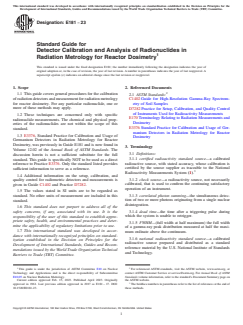
1.1 This guide covers general procedures for the calibration of radiation detectors and measurement for radiation metrology for reactor dosimetry. For any particular radionuclide, one or more of these methods may apply.
1.2 These techniques are concerned only with specific radionuclide measurements. The chemical and physical properties of the radionuclides are not within the scope of this standard.
1.3 E3376, Standard Practice for Calibration and Usage of Germanium Detectors in Radiation Metrology for Reactor Dosimetry, was previously in Guide E181 and is now found in Volume 12.02 of the Annual Book of ASTM Standards. The discussion herein is not a sufficient substitute for the full standard. This guide is specifically NOT to be used as a direct reference to Practice E3376. Only the standard listed provides sufficient information to serve as a reference.
1.4 Additional information on the setup, calibration, and quality control for radiometric detectors and measurements is given in Guide C1402 and Practice D7282.
1.5 The values stated in SI units are to be regarded as standard. No other units of measurement are included in this standard.
1.6 This standard does not purport to address all of the safety concerns, if any, associated with its use. It is the responsibility of the user of this standard to establish appropriate safety, health, and environmental practices and determine the applicability of regulatory limitations prior to use.
1.7 This international standard was developed in accordance with internationally recognized principles on standardization established in the Decision on Principles for the Development of International Standards, Guides and Recommendations issued by the World Trade Organization Technical Barriers to Trade (TBT) Committee.
- Status
- Published
- Publication Date
- 14-Feb-2023
- Technical Committee
- E10 - Nuclear Technology and Applications
- Drafting Committee
- E10.05 - Nuclear Radiation Metrology
Buy Documents
ASTM E181-23 - Standard Guide for Detector Calibration and Analysis of Radionuclides in Radiation Metrology for Reactor Dosimetry
REDLINE ASTM E181-23 - Standard Guide for Detector Calibration and Analysis of Radionuclides in Radiation Metrology for Reactor Dosimetry
Overview
ASTM E181-23 is a standard guide developed by ASTM International that outlines general procedures for the calibration of radiation detectors and the analysis of radionuclides specifically for radiation metrology in reactor dosimetry. This guide focuses on the accurate measurement of radioactivity from specific radionuclides, supporting applications where high precision and reliability are critical. The chemical and physical properties of radionuclides, as well as safety and regulatory guidance, are outside the scope of this document. Instead, the standard concentrates on best practices for the use and calibration of various detector systems and measurement approaches in nuclear science and engineering.
Key Topics
- Detector Calibration: Procedures for calibrating radiation detector systems, including germanium detectors and scintillation detectors, are provided. Proper calibration ensures measurement accuracy and system reliability.
- Spectroscopy Methods:
- Germanium Detectors: Guidance on calibrating and utilizing high-resolution germanium detectors, suited for detailed gamma-ray spectrometry.
- Scintillation Detector Systems: Procedures for sodium iodide (NaI(Tl)) and similar detector systems, applicable for gamma-ray measurements.
- Counting Methods: Support for several radionuclide analysis techniques, such as:
- Beta particle counting
- Aluminum absorption curve analysis
- Alpha particle counting
- Liquid scintillation counting
- Performance Testing: Recommendations for regular system checks (energy calibration, count rate reproducibility, resolution, and efficiency calibration) to maintain ongoing accuracy.
- Uncertainty Analysis: Identification of key sources of measurement uncertainty, including standard source calibration, detector efficiency, positioning reproducibility, and electronic performance.
- Corrective and Precautionary Measures: Guidance on minimizing and correcting issues such as random summing, dead time, and spectral interferences.
Applications
ASTM E181-23 is valuable in scenarios where quantitative radionuclide measurements are essential for nuclear safety, research, reactor operation, and compliance. Typical applications include:
- Reactor Dosimetry: Ensuring accurate neutron fluence and gamma dose measurements in reactor environments for safe operation and material irradiation studies.
- Nuclear Power Plant Monitoring: Facilitates routine monitoring and assessment of radiation fields and radionuclide inventories.
- Radiation Protection and Health Physics: Supports the development and validation of protocols for radiological protection, radiation safety assessments, and environmental monitoring.
- Research Laboratories: Used in nuclear physics, radiochemistry, and metrology laboratories for precise quantification of radioactive samples and calibration of measurement instrumentation.
- Quality Assurance: Provides a foundation for calibration and verification procedures required in regulated industries and for compliance with national and international measurement standards.
Related Standards
Several other ASTM standards and guidelines complement or reference ASTM E181-23, such as:
- ASTM E3376: Practice for Calibration and Usage of Germanium Detectors in Radiation Metrology for Reactor Dosimetry.
- ASTM C1402: Guide for High-Resolution Gamma-Ray Spectrometry of Soil Samples - provides additional setup, calibration, and quality control information for gamma spectrometry.
- ASTM D7282: Practice for Setup, Calibration, and Quality Control of Instruments Used for Radioactivity Measurements.
- ASTM E170: Terminology Relating to Radiation Measurements and Dosimetry - for definitions and technical terms.
- ASTM D7283: Test Method for Alpha and Beta Activity in Water by Liquid Scintillation Counting.
Summary
By following ASTM E181-23, professionals in radiation metrology and reactor dosimetry can achieve consistent, traceable, and accurate detection and analysis of radionuclides. This standard supports the integrity of nuclear measurements, enhances safety, and enables compliance with global best practices in reactor dosimetry. For optimal results, ASTM E181-23 should be used alongside other referenced ASTM standards and within a comprehensive quality management framework.
Keywords: ASTM E181-23, radiation detector calibration, radionuclide analysis, reactor dosimetry, gamma-ray spectroscopy, scintillation detectors, germanium detectors, radiation metrology, nuclear measurement standard, uncertainty analysis.
Relations
- Effective Date
- 01-Jun-2017
- Effective Date
- 01-Jun-2017
- Effective Date
- 01-Oct-2016
- Effective Date
- 15-Feb-2016
- Effective Date
- 01-Sep-2015
- Effective Date
- 15-Mar-2015
- Effective Date
- 15-Oct-2014
- Effective Date
- 01-Sep-2014
- Effective Date
- 01-Jun-2010
- Effective Date
- 15-Aug-2009
- Effective Date
- 15-Jun-2009
- Refers
ASTM C1402-04(2009) - Standard Guide for High-Resolution Gamma-Ray Spectrometry of Soil Samples - Effective Date
- 01-Jun-2009
- Effective Date
- 01-Nov-2008
- Effective Date
- 01-Jun-2008
- Effective Date
- 01-May-2008
Buy Documents
ASTM E181-23 - Standard Guide for Detector Calibration and Analysis of Radionuclides in Radiation Metrology for Reactor Dosimetry
REDLINE ASTM E181-23 - Standard Guide for Detector Calibration and Analysis of Radionuclides in Radiation Metrology for Reactor Dosimetry
Get Certified
Connect with accredited certification bodies for this standard

BSMI (Bureau of Standards, Metrology and Inspection)
Taiwan's standards and inspection authority.
Sponsored listings
Frequently Asked Questions
ASTM E181-23 is a guide published by ASTM International. Its full title is "Standard Guide for Detector Calibration and Analysis of Radionuclides in Radiation Metrology for Reactor Dosimetry". This standard covers: ABSTRACT These methods cover general procedures for the calibration of radiation detectors and the analysis of radionuclides. For each individual radionuclide, one or more of these methods may apply. These methods are concerned only with specific radionuclide measurements. The chemical and physical properties of the radionuclides are beyond the scope of this standard. Among the measurement standards discussed are: the calibration and usage of germanium detectors, scintillation detector systems, scintillation detectors for simple and complex spectra, and counting methods such as beta particle counting, aluminum absorption curve, alpha particle counting, and liquid scintillation counting. For each of the methods, the scope, apparatus used, summary of methods, preparation of apparatus, calibration procedure, measurement of radionuclide, performance testing, sources of uncertainty, precautions and tests, and calculations are detailed. SCOPE 1.1 This guide covers general procedures for the calibration of radiation detectors and measurement for radiation metrology for reactor dosimetry. For any particular radionuclide, one or more of these methods may apply. 1.2 These techniques are concerned only with specific radionuclide measurements. The chemical and physical properties of the radionuclides are not within the scope of this standard. 1.3 E3376, Standard Practice for Calibration and Usage of Germanium Detectors in Radiation Metrology for Reactor Dosimetry, was previously in Guide E181 and is now found in Volume 12.02 of the Annual Book of ASTM Standards. The discussion herein is not a sufficient substitute for the full standard. This guide is specifically NOT to be used as a direct reference to Practice E3376. Only the standard listed provides sufficient information to serve as a reference. 1.4 Additional information on the setup, calibration, and quality control for radiometric detectors and measurements is given in Guide C1402 and Practice D7282. 1.5 The values stated in SI units are to be regarded as standard. No other units of measurement are included in this standard. 1.6 This standard does not purport to address all of the safety concerns, if any, associated with its use. It is the responsibility of the user of this standard to establish appropriate safety, health, and environmental practices and determine the applicability of regulatory limitations prior to use. 1.7 This international standard was developed in accordance with internationally recognized principles on standardization established in the Decision on Principles for the Development of International Standards, Guides and Recommendations issued by the World Trade Organization Technical Barriers to Trade (TBT) Committee.
ABSTRACT These methods cover general procedures for the calibration of radiation detectors and the analysis of radionuclides. For each individual radionuclide, one or more of these methods may apply. These methods are concerned only with specific radionuclide measurements. The chemical and physical properties of the radionuclides are beyond the scope of this standard. Among the measurement standards discussed are: the calibration and usage of germanium detectors, scintillation detector systems, scintillation detectors for simple and complex spectra, and counting methods such as beta particle counting, aluminum absorption curve, alpha particle counting, and liquid scintillation counting. For each of the methods, the scope, apparatus used, summary of methods, preparation of apparatus, calibration procedure, measurement of radionuclide, performance testing, sources of uncertainty, precautions and tests, and calculations are detailed. SCOPE 1.1 This guide covers general procedures for the calibration of radiation detectors and measurement for radiation metrology for reactor dosimetry. For any particular radionuclide, one or more of these methods may apply. 1.2 These techniques are concerned only with specific radionuclide measurements. The chemical and physical properties of the radionuclides are not within the scope of this standard. 1.3 E3376, Standard Practice for Calibration and Usage of Germanium Detectors in Radiation Metrology for Reactor Dosimetry, was previously in Guide E181 and is now found in Volume 12.02 of the Annual Book of ASTM Standards. The discussion herein is not a sufficient substitute for the full standard. This guide is specifically NOT to be used as a direct reference to Practice E3376. Only the standard listed provides sufficient information to serve as a reference. 1.4 Additional information on the setup, calibration, and quality control for radiometric detectors and measurements is given in Guide C1402 and Practice D7282. 1.5 The values stated in SI units are to be regarded as standard. No other units of measurement are included in this standard. 1.6 This standard does not purport to address all of the safety concerns, if any, associated with its use. It is the responsibility of the user of this standard to establish appropriate safety, health, and environmental practices and determine the applicability of regulatory limitations prior to use. 1.7 This international standard was developed in accordance with internationally recognized principles on standardization established in the Decision on Principles for the Development of International Standards, Guides and Recommendations issued by the World Trade Organization Technical Barriers to Trade (TBT) Committee.
ASTM E181-23 is classified under the following ICS (International Classification for Standards) categories: 17.240 - Radiation measurements. The ICS classification helps identify the subject area and facilitates finding related standards.
ASTM E181-23 has the following relationships with other standards: It is inter standard links to ASTM C1402-17, ASTM E170-17, ASTM E170-16a, ASTM E170-16, ASTM E170-15a, ASTM E170-15, ASTM E170-14a, ASTM E170-14, ASTM E170-10, ASTM E170-09a, ASTM E170-09, ASTM C1402-04(2009), ASTM E170-08d, ASTM E170-08c, ASTM E170-08b. Understanding these relationships helps ensure you are using the most current and applicable version of the standard.
ASTM E181-23 is available in PDF format for immediate download after purchase. The document can be added to your cart and obtained through the secure checkout process. Digital delivery ensures instant access to the complete standard document.
Standards Content (Sample)
This international standard was developed in accordance with internationally recognized principles on standardization established in the Decision on Principles for the
Development of International Standards, Guides and Recommendations issued by the World Trade Organization Technical Barriers to Trade (TBT) Committee.
Designation: E181 − 23
Standard Guide for
Detector Calibration and Analysis of Radionuclides in
Radiation Metrology for Reactor Dosimetry
This standard is issued under the fixed designation E181; the number immediately following the designation indicates the year of
original adoption or, in the case of revision, the year of last revision. A number in parentheses indicates the year of last reapproval. A
superscript epsilon (´) indicates an editorial change since the last revision or reapproval.
1. Scope 2. Referenced Documents
1.1 This guide covers general procedures for the calibration
2.1 ASTM Standards:
of radiation detectors and measurement for radiation metrology
C1402 Guide for High-Resolution Gamma-Ray Spectrom-
for reactor dosimetry. For any particular radionuclide, one or
etry of Soil Samples
more of these methods may apply.
D7282 Practice for Setup, Calibration, and Quality Control
of Instruments Used for Radioactivity Measurements
1.2 These techniques are concerned only with specific
E170 Terminology Relating to Radiation Measurements and
radionuclide measurements. The chemical and physical prop-
Dosimetry
erties of the radionuclides are not within the scope of this
E3376 Standard Practice for Calibration and Usage of Ger-
standard.
manium Detectors in Radiation Metrology for Reactor
1.3 E3376, Standard Practice for Calibration and Usage of
Dosimetry
Germanium Detectors in Radiation Metrology for Reactor
Dosimetry, was previously in Guide E181 and is now found in
3. Terminology
Volume 12.02 of the Annual Book of ASTM Standards. The
3.1 Definitions:
discussion herein is not a sufficient substitute for the full
3.1.1 certified radioactivity standard source—a calibrated
standard. This guide is specifically NOT to be used as a direct
radioactive source, with stated accuracy, whose calibration is
reference to Practice E3376. Only the standard listed provides
certified by the source supplier as traceable to the National
sufficient information to serve as a reference.
Radioactivity Measurements System (1).
1.4 Additional information on the setup, calibration, and
3.1.2 check source—a radioactivity source, not necessarily
quality control for radiometric detectors and measurements is
calibrated, that is used to confirm the continuing satisfactory
given in Guide C1402 and Practice D7282.
operation of an instrument.
1.5 The values stated in SI units are to be regarded as
3.1.3 correlated photon summing—the simultaneous detec-
standard. No other units of measurement are included in this
tion of two or more photons originating from a single nuclear
standard.
disintegration.
1.6 This standard does not purport to address all of the
safety concerns, if any, associated with its use. It is the 3.1.4 dead time—the time after a triggering pulse during
which the system is unable to retrigger.
responsibility of the user of this standard to establish appro-
priate safety, health, and environmental practices and deter-
3.1.5 FWHM—(full width at half maximum) the full width
mine the applicability of regulatory limitations prior to use.
of a gamma-ray peak distribution measured at half the maxi-
1.7 This international standard was developed in accor-
mum ordinate above the continuum.
dance with internationally recognized principles on standard-
3.1.6 national radioactivity standard source—a calibrated
ization established in the Decision on Principles for the
radioactive source prepared and distributed as a standard
Development of International Standards, Guides and Recom-
reference material by the U.S. National Institute of Standards
mendations issued by the World Trade Organization Technical
and Technology.
Barriers to Trade (TBT) Committee.
1 2
This guide is under the jurisdiction of ASTM Committee E10 on Nuclear For referenced ASTM standards, visit the ASTM website, www.astm.org, or
Technology and Applications and is the direct responsibility of Subcommittee contact ASTM Customer Service at service@astm.org. For Annual Book of ASTM
E10.05 on Nuclear Radiation Metrology. Standards volume information, refer to the standard’s Document Summary page on
Current edition approved Feb. 15, 2023. Published April 2023. Originally the ASTM website.
approved in 1961. Last previous edition approved in 2017 as E181 – 17. DOI: The boldface numbers in parentheses refer to the list of references at the end of
10.1520/E0181-23. these methods.
Copyright © ASTM International, 100 Barr Harbor Drive, PO Box C700, West Conshohocken, PA 19428-2959. United States
E181 − 23
3.1.7 resolution, gamma ray—the measured FWHM, after continuum under the full-energy peak can be subtracted with-
background subtraction, of a gamma-ray peak distribution, out introducing unacceptable error (2). This technique applies
expressed in units of energy. to total spectrum counting and single-channel analyzer count-
ing.
3.2 Abbreviations:
5.1.2 Multichannel Analysis Counting for Complex Spectra
3.2.1 MCA—multichannel analyzer.
(see Section 9)—This technique applies to measurements that
3.2.2 SCA—single channel analyzer.
involve multiple nuclides, overlapping peaks, and those for
3.2.3 ROI—region of interest.
which the continuum under the full-energy peak cannot be
subtracted without introducing unacceptable error (3).
3.3 For other relevant terms, see Terminology E170.
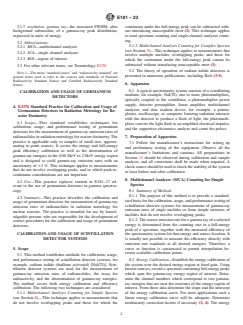
5.2 The theory of operation of sodium iodide detectors is
NOTE 1—The terms “standard source” and “radioactivity standard” are
presented in numerous publications, including Refs (3-5).
general terms used to refer to the sources and standards of National
Radioactivity Standard Source and Certified Radioactivity Standard
6. Apparatus
Source.
6.1 A typical spectrometry system consists of a scintillating
CALIBRATION AND USAGE OF GERMANIUM
medium; for example, NaI(Tl), one or more photomultipliers,
DETECTORS
optically coupled to the scintillator, a photomultiplier power
supply, detector preamplifier, linear amplifier, multichannel
4. E3376 Standard Practice for Calibration and Usage of
analyzer, and data readout device, for example, a printer,
Germanium Detectors in Radiation Metrology for Re-
plotter, oscilloscope, or computer. Ionizing radiation interacts
actor Dosimetry
with the detector to produce a flash of light, the photomulti-
4.1 Scope—This standard establishes techniques for
pliers convert the light flash to an amplified electrical impulse,
calibration, usage, and performance testing of germanium
and the supportive electronics analyze and count the pulses.
detectors for the measurement of gamma-ray emission rates of
radionuclides in radiation metrology for reactor dosimetry. The 7. Preparation of Apparatus
practice is applicable only to samples of small size, approxi-
7.1 Follow the manufacturer’s instructions for setting up
mating to point sources. It covers the energy and full-energy
and preliminary testing of the equipment. Observe all the
peak efficiency calibration as well as the determination of
manufacturer’s limitations and cautions. All preparations in
gamma-ray energies in the 0.06 MeV to 2 MeV energy region
Section 11 should be observed during calibration and sample
and is designed to yield gamma-ray emission rates with an
analysis, and all corrections shall be made when required. A
uncertainty of 63 %. This technique applies to measurements
check source should be used to check the stability of the system
that do not involve overlapping peaks, and in which peak-to-
at least before and after calibration.
continuum considerations are not important.
8. Multichannel Analyzer (MCA) Counting for Simple
4.2 Use—This practice replaces content in E181–17 rel-
Spectra
evant to the use of germanium detectors in gamma spectros-
copy. 8.1 Summary of Method:
8.1.1 The purpose of this method is to provide a standard-
4.3 Summary—This practice describes the calibration and
ized basis for the calibration, usage, and performance testing of
usage of germanium detectors for measurement of gamma-ray
scintillation detector systems for measurement of gamma-ray
emission rates of radionuclides in radiation metrology for
emission rates of single nuclides or from simple mixtures of
nuclear reactors. The practice is intended for use by knowl-
nuclides that do not involve overlapping peaks.
edgeable persons who are responsible for the development of
8.1.2 The source emission rate for a gamma ray of a selected
correct procedures for the calibration and usage of germanium
energy is determined from the counting rate in a full-energy
detectors.
peak of a spectrum, together with the measured efficiency of
CALIBRATION AND USAGE OF SCINTILLATION the spectrometry system for that energy and source location. It
DETECTOR SYSTEMS is usually not possible to measure the efficiency directly with
emission rate standards at all desired energies. Therefore, a
5. Scope curve or function is constructed to permit interpolation be-
tween available calibration points.
5.1 This method establishes methods for calibration, usage,
and performance testing of scintillation detector systems, for 8.2 Energy Calibration—Establish the energy calibration of
example, sodium iodide (thallium activated) [NaI(Tl)]. Scin- the system over the desired energy region at fixed gain. Using
tillation detector systems are used for the measurement of known sources, record a spectrum containing full-energy peaks
gamma-ray emission rates of radionuclides, the assay for which span the gamma-ray energy region of interest. Deter-
radioactivity, and the determination of gamma-ray energies. mine the channel numbers which correspond to two gamma-
The method covers both energy calibration and efficiency ray energies that are near the extremes of the energy region of
calibration. The following two techniques are considered: interest. From these data determine the slope and the intercept
5.1.1 Multichannel Analyzer Counting for Simple Spectra of the energy calibration curve. For most applications such a
(see Section 8)—This technique applies to measurements that linear energy calibration curve will be adequate. Determine
do not involve overlapping peaks and those for which the nonlinearity correction factors if necessary (3, 4). The energy
E181 − 23
calibration shall be determined for each amplifier gain or 8.4.7 Calculate the number of gamma rays emitted per unit
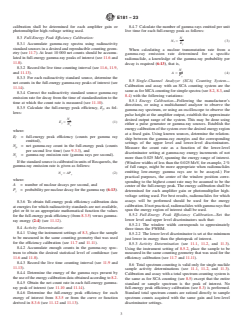
photomultiplier high-voltage setting used. live time for each full-energy peak as follows:
N
8.3 Full-Energy Peak Effıciency Calibration: p
N 5 (3)
γ
E
8.3.1 Accumulate gamma-ray spectra using radioactivity f
standard sources in a desired and reproducible counting geom-
When calculating a nuclear transmutation rate from a
etry (see 11.7). At least 10 000 net counts should be accumu-
gamma-ray emission rate determined for a specific
lated in full-energy gamma-ray peaks of interest (see 11.6 and
radionuclide, a knowledge of the gamma-ray probability per
11.8).
decay is required (6-13), that is,
8.3.2 Record the live time counting interval (see 11.6, 11.9,
N
γ
and 11.13).
A 5 (4)
P
γ
8.3.3 For each radioactivity standard source, determine the
8.5 Single-Channel Analyzer (SCA) Counting System—
net counts in the full-energy gamma-ray peaks of interest (see
Calibration and assay with an SCA counting system are the
11.14).
same as for MCA counting for simple spectra (see 8.2, 8.3, and
8.3.4 Correct the radioactivity standard source gamma-ray
8.4) with the following variations:
emission rate for decay from the time of standardization to the
8.5.1 Energy Calibration—Following the manufacturer’s
time at which the count rate is measured (see 11.10).
directions, or using a multichannel analyzer to observe the
8.3.5 Calculate the full-energy peak efficiency, E , as fol-
f
gamma-ray spectrum, or using an oscilloscope to observe the
lows:
pulse height at the amplifier output, establish the approximate
N
desired output range of the system. This may be done using
p
E 5 (1)
f
N
either a pulse generator or gamma-ray sources. Establish the
γ
energy calibration of the system over the desired energy region
where:
at a fixed gain. Using known sources, determine the relation-
E = full-energy peak efficiency (counts per gamma ray
f
ship between the gamma-ray energies and the corresponding
emitted),
settings of the upper level and lower-level discriminators.
N = net gamma-ray count in the full-energy peak (counts
p
Measure the count rate as a function of the lower-level
per second live time) (see 9.3.3), and
discriminator setting at gamma-ray energy increments of not
N = gamma-ray emission rate (gamma rays per second).
γ
more than 0.025 MeV, spanning the energy range of interest.
If the standard source is calibrated in units of Becquerels, the
(Window widths of less than the 0.025 MeV, for example, 2 %
gamma-ray emission rate is given as follows:
of full range, might be more appropriate when radionuclides
emitting low-energy gamma rays are to be assayed.) For
N 5 AP (2)
γ γ
practical purposes, the center of the window position corre-
where:
sponding to the highest count rate may be assumed to be the
A = number of nuclear decays per second, and
center of the full-energy peak. The energy calibration shall be
P = probability per nuclear decay for the gamma ray (6-13).
γ
determined for each amplifier gain or photomultiplier high-
voltage setting used. For best results, radionuclides for which
assays will be performed should be used for the energy
8.3.6 To obtain full-energy peak efficiency calibration data
calibration. If not practical, radionuclides with gamma rays that
at energies for which radioactivity standards are not available,
span the energy region of interest shall be used.
plot or fit to an appropriate mathematical function the values
8.5.2 Full-Energy Peak Effıciency Calibration—Set the
for the full-energy peak efficiency (from 8.3.5) versus gamma-
lower level and upper level discriminators such that:
ray energy (2-4) (see 11.12).
8.5.2.1 The window width corresponds to approximately
8.4 Activity Determination:
three times the FWHM.
8.4.1 Using the instrument settings of 8.3, place the sample
8.5.2.2 The lower level discriminator is set at the minimum
to be measured in the same counting geometry that was used
just lower in energy than the photopeak of interest.
for the efficiency calibration (see 11.7 and 11.11).
8.5.3 Activity Determination (see 11.1, 11.2, and 11.3).
8.4.2 Accumulate enough counts in the gamma-ray spec-
Using the instrument setting of 8.5.2, place the sample to be
trum to obtain the desired statistical level of confidence (see
measured in the same counting geometry that was used for the
11.6 and 11.8).
efficiency calibration (see 11.7 and 11.11).
8.4.3 Record the live time counting interval (see 11.9 and
8.6 Total spectrum counting is valid only for single nuclide
11.13).
sample activity determinations (see 11.1, 11.2, and 11.3).
8.4.4 Determine the energy of the gamma rays present by
Calibration and assay with a total spectrum counting system is
the use of the energy calibration data obtained according to 8.2.
the same as for SCA counting (see 8.5) except that the entire
8.4.5 Obtain the net count rate in each full-energy gamma-
standard or sample spectrum is the peak of interest. No
ray peak of interest (see 11.10 and 11.14).
full-energy peak efficiency calibration (see 8.3) is performed.
8.4.6 Determine the full-energy peak efficiency for each Standard total spectrum counts are ratioed directly to sample
energy of interest from 8.3.5 or from the curve or function spectrum counts acquired with the same gain and low-level
derived in 8.3.6 (see 11.12 and 11.13). discriminator settings.
E181 − 23
8.6.1 All Section 11 precautions apply. ambient background may be used as a single-nuclide radioac-
8.6.2 Obtain the net count rate for the standard and for the tivity standard in the determination of sample activity or
sample by subtracting the ambient background count rate from stripped from radioactivity standard source spectra (see 9.3.1)
the total count rates (see 11.10). using the ratio of live time counting intervals as the normal-
8.6.3 Calculate the activity of the sample by: ization factor.
9.3.4 Correct the radioactivity standard source activity to
C
A 5 (5)
the time at which the standard spectrum is acquired (see 11.10).
R
9.3.5 Assign identification codes or numbers to all photo-
where:
peaks of interest. Assign integer numbers of channels to
C = the net sample count rate (8.6.2), and
represent photopeak areas.
R = the net standard count rate (8.6.2) divided by the
9.3.6 To calibrate, divide the peak areas of the radioactivity
time-corrected (8.3.4) standard activity (see 11.1, 11.2,
standard source spectra desired in 9.3.5 by the decay-corrected
and 11.3).
standard activities derived in 9.3.4, for example, counts/
second·Becquerel.
9. Multichannel Analyzer (MCA) Counting for Complex
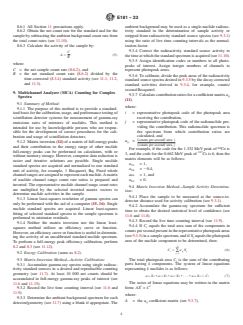
9.3.7 Calculate contribution ratios for a coefficient matrix a
ij
Spectra
(11).
9.1 Summary of Method:
where:
9.1.1 The purpose of this method is to provide a standard-
i = representative photopeak code of the photopeak area
ized basis for the calibration, usage, and performance testing of
receiving the contribution,
scintillation detector systems for measurement of gamma-ray
j = representative photopeak code of the radionuclide pro-
emissions rates of mixtures of nuclides. This method is
viding the contribution. This radionuclide spectrum is
intended for use by knowledgeable persons who are respon-
the spectrum from which contribution ratios are
sible for the development of correct procedures for the cali-
calculated, and
bration and usage of scintillation detectors.
~counts per second! area i
a =
9.1.2 Matrix inversion (14) of a matrix of full-energy peaks ij
~counts per second! area j
and their contribution to the energy range of other nuclide
For example, if the code for the 1.332 MeV peak of Co is
full-energy peaks can be performed on calculators, with or
3, and the code for the 0.662 MeV peak of Cs is 6, then the
without memory storage. However, computer data reduction is
matrix elements will be as follows:
easier and iterative solutions are possible. Single nuclide
a = 1,
standard spectra are acquired and normalized to one standard
a = ;0.4,
unit of activity, for example, 1 Becquerel, Bq. Fixed whole
a = 1, and
channel ranges are assigned to represent each nuclide. A matrix 66
a = 0.
of nuclide channel range count rate ratios is prepared and
inverted. The representative nuclide channel range count rates
9.4 Matrix Inversion Method—Sample Activity Determina-
are multiplied by the selected inverted matrix vectors to
tion:
determine nuclide activities in the sample.
9.4.1 Place the sample to be measured at the source-to-
9.1.3 Linear least-squares resolution of gamma spectra can
detector distance used for activity calibration (see 9.3.1).
only be performed with the aid of a computer (15, 16). Single
9.4.2 Accumulate the gamma-ray spectrum for sufficient
nuclide standard spectra are acquired. Linear least-squares
time to obtain the desired statistical level of confidence (see
fitting of selected standard spectra to the sample spectrum is
11.6 and 11.8).
performed to minimize residuals.
9.4.3 Record the live time counting interval (see 11.9).
9.1.4 Neither the matrix inversion nor the linear least-
9.4.4 If C equals the total area sum of the components in
i
squares method utilizes an efficiency curve or function.
counts per second present in the representative photopeak areas
However, an efficiency curve or function is useful in determin-
(see 9.3.5) in a sample spectrum, and if X equals the photopeak
j
ing the activity of an uncalibrated standard nuclide spectrum.
area of the nuclide component to be determined, then:
To perform a full-energy peak efficiency calibration, perform
k
8.2 and 8.3 (see 11.12).
C 5 a X (6)
i ij j
(
j51
9.2 Energy Calibration (same as 8.2).
The total photopeak area C is the sum of the contributing
9.3 Matrix Inversion Method—Activity Calibration:
i
9.3.1 Accumulate gamma-ray spectra using single radioac- parts having k components. The system of linear equations
representing k nuclides is as follows:
tivity standard sources in a desired and reproducible counting
geometry (see 11.7). At least 10 000 net counts should be
a X 1a X 1a X 1. . .1a X 5 C (7)
11 1 12 2 13 3 1k k 1
accumulated in full-energy gamma-ray peaks of interest (see
The series of linear equations may be written in the matrix
11.6 and 11.15).
t t
form: AX = C
9.3.2 Record the live time counting interval (see 11.6 and
11.9).
where:
9.3.3 Determine the ambient background spectrum for each
A = the a coefficient matrix (see 9.3.7),
ij
detector/geometry (see 11.7) using a blank if appropriate. The
E181 − 23
n
t
X = the transposed vector of unknown representative pho-
X 5 M S 1R (10)
i ( j ij i
topeak areas due to photopeaks j = 1, 2, 3 . k, and j51
t
C = the transposed vector of total representative areas from
where R represents the random uncertainty in the channel i
i
the sample spectrum.
counts and S is the count rate of the standard j in channel i. C
ij ij
t t t −1 t
is simply the product of M , the normalization factor, and S ,
9.4.5 The solution to the equation AX = C is X = A C
j ij
−1
where A is the inverse of matrix A. Note that i and j vectors the standard count rate.
representing photopeaks of nuclides not present in the sample
9.6 Linear Least-Squares Method—Sample Activity
−1
spectrum are eliminated from the larger matrices A and A
Determination—If the only uncertainty in this calculation is the
(see 9.3.3).
random uncertainty of the counts in a channel, R (see 8.5.3),
i
t
9.4.6 The sample nuclide activity equals X divided by the
then the least-squares technique can be used. This method
calibration factor (see 9.3.6).
estimates the parameters that minimize the weighted sum of the
squared difference between two sets of values. The usual case
~c/s!
j
Bq 5 (8)
j
has one set of values as observed data (X ) and another set of
c/s·Bq i
~ !
j
computed values:
9.5 Linear Least-Squares Method—Activity Calibration:
n
9.5.1 Accumulate gamma-ray spectra using single radioac-
M S (11)
S D
( j ij
j51
tivity standard sources in a desired and reproducible counting
geometry (see 11.7). At least 10 000 net counts should be
This translates to:
accumulated in the full-energy gamma-ray peaks of interest
n 2
(see 11.6 and 11.15). Minimize X 2 M S W (12)
S D
i ( j ij i
j51
9.5.2 Record the live time counting interval (see 11.6 and
where W is the weighing factor chosen to estimate the
11.9). i
variance of the counts in a channel. If the variance is estimated
9.5.3 Determine the ambient background spectrum for each
for each channel, the result is a set of linear simultaneous
detector/geometry (see 11.7) using a blank, if appropriate. The
equations (one for each nuclide of interest) that may be solved
ambient background spectrum shall be treated as a single
for the values of M . This solution is most easily derived by
j
nuclide, radioactivity standard in the determination of sample
using matrix techniques on a computer.
activity and shall be stripped from all single radioactivity
9.6.1 The sample nuclide activity equals the derived sample
standard source spectra (see 9.5.1) using the ratio of live time
count rate divided by the standard calibration factor:
counting intervals as the normalization factor.
c/s
9.5.4 Correct the radioactivity standard source activity to ~ !
Bq 5 (13)
c/s·Bq
the time at which the standard spectrum is acquired (see 11.10). ~ !
j
9.5.5 The resolution of a gamma spectrum into the concen-
10. Performance Testing
trations of its component radionuclides can be treated as a
curve-fitting problem by using least-squares techniques. The
10.1 The system energy calibration shall be checked on
basic assumption is that the sample spectrum can be described
each day of use with one or more check sources in the energy
by a linear combination of the gamma spectra of each
region of interest.
component obtained separately. This discussion is intended to
10.2 The system count rate reproducibility for at least one
present the least-squares approach in nonmathematical terms
long-lived radionuclide check source shall be checked on each
(5-16). The linear least-squares method assumes that the
day of use. Correction for radioactive decay of the source since
pulse-height spectrum to be analyzed consists of the summed
the original measurement shall be applied if more than 1 % of
contributions of n nuclides, each of which is represented as a
a half-life has expired.
pulse-height spectrum of k channels (see 11.15). This method
requires standard spectra representing the response of the 10.3 The efficiency calibration shall be checked at least
detector to gamma rays of the nuclides of interest (for semi-annually by using radioactivity standard sources of radio-
comparison, see 9.5.1, 9.5.2, and 9.5.3). The count rate in a nuclides with energies that span the energy region of interest.
sample spectrum due to standard j (j = 1 . n) in channel i (i =
10.4 The ambient background of the system shall be mea-
1 . k) will be C and the total count rate in channel i will be
ij
sured at least once a week. The ambient background should be
X . The expression:
i
checked at the beginning and ending of each day’s counting.
n
For best results the ambient background should be measured
X 5 C 1C 1C 1. . . 5 C (9)
~ !
i i1 i2 i3 ( ij
before and after each batch of samples.
j51
10.5 The resolution of the system shall be determined at the
accounts for all contributions to channel i.
time of initial installation and should be checked at least
9.5.5.1 To obtain quantitative results from resolving a
monthly.
spectrum, the quantity of nuclide j must be expressed in terms
of the standard for nuclide j. Therefore, a normalization factor 10.6 The results of all performance checks shall be recorded
M , the ratio of the activity of nuclide j in the unknown to the in such a way that deviations from the norm will be readily
j
value of nuclide j in the standard, must be included (see 9.5.4): observable. Appropriate action, which could include
E181 − 23
confirmation, repair, and recalibration as required, shall be where N is the observed count rate and t is the dead time
d
taken when the measured values fall outside the predetermined which can be experimentally determined, as described below,
limits. using the so-called “two-source method.” This gives, for
example, a correction of 1 % for a dead time of 10 μs and a
11. Precautions
−1
count rate of 1000 s . In this method three measurements are
11.1 Assay for a Radionuclide for Which No Radioactivity
taken, first of a source (say, source 1), second of source 1 and
Standard Is Commercially Available—A total-spectrum count-
another source (source 2), and finally of source 2 alone. From
ing system or a single-channel analyzer counting system shall
these measurements, the respective count rates N , N , and N
1 12 2
not be used for quantitative determinations of radionuclides for
are obtained, and one is able to write three equations:
which radioactivity standards are not commercially available.
N
Multichannel counting systems shall be used in such cases. N 5 (15)
1.0
1 2 N t
1 d
11.2 Determination of Gross Gamma Activity—The usage of
N
the gross gamma activity of a sample containing more than one N 1N 5 (16)
1.0 2.0
1 2 N t
12 d
gamma-emitting radionuclide as a quantitative tool is not an
N
acceptable practice. Relating of the gross gamma activity of a
N 5 (17)
2.0
1 2 N t
2 d
sample containing more than one gamma-emitting radionu-
clide to absolute quantities of specific radionuclides has no
where N and N are the respective dead-time-corrected
1.0 2.0
validity.
count rates for sources 1 and 2. The dead time t is determined
d
using the condition that the sum of N and N , obtained from
11.3 Assay of Mixtures of Radionuclides—A total-spectrum
1.0 2.0
Eq 15 and Eq 17, is equal to that obtained from Eq 16:
counting system or a single-channel analyzer counting system
1/2
shall not be used for attempted quantification of the radionu-
N
1 2 1 2 N 1N 2 N
F ~ !G
clides contained within a mixture. 1 2 12
N N
1 2
t 5 (18)
d
N
11.4 Thin-Window Detectors—When working with a thin-
window detector, one must be cautious about radionuclides
When making the measurements, it is important not to
emitting conversion electrons which have energies close to that
disturb source 1 when introducing source 2, and similarly,
of the gamma ray of interest. To avoid counting the conversion
when removing source 1, not to disturb source 2. For multi-
electrons in such detectors, insert a sufficient amount of
channel analyzer systems, the “live-time” feature is designed to
absorbing material between the source and the detector.
compensate for counting time lost during pulse processing, and
11.5 Simulated Sources—Simulated sources shall not be
a further correction for dead-time losses is usually not required.
used for energy calibration or efficiency calibration of scintil-
11.10 Correction for Decay During the Counting Period:
lation detector systems. Such sources may be used for checking
11.10.1 If the value of a full-energy peak counting rate is
the system count-rate reproducibility.
determined by a measurement that spans a significant fraction
11.6 High Count Rates—It is recommended that count rates
of a half-life, and the value is assigned to the beginning of the
be limited to less than 5000 counts per second at the amplifier
counting period, a multiplicative correction, F , must be
b
output. Random photon summing correction should not be
applied:
necessary if this recommendation is employed with amplifier
λt
time constants of less than 5 μs. F 5 (19)
b 2λt
1 2 e
11.7 Geometrical Positioning—The dependence of the mea-
where:
surement on the geometrical configuration and composition of
F = decay during count correction (count rate referenced
the sample container shall be taken into consideration in the b
to beginning of counting period),
calibration procedure. Positioning of sample containers within
t = elapsed counting time,
detector wells usually provides good positional reproducibility.
ln2
λ =
Positioning of sample containers on or above the surface of radionuclide decay constant , and
S D
T
1/2
detectors requires a method for reproducing the position. New T = radionuclide half-life.
1/2
calibrations shall be obtained for assaying for radionuclides in
t and T must be in the same units of time (F = 1.01 for
1/2 b
containers of different sizes or shapes.
t/T = 0.03).
1/2
11.8 Counting Statistics—The recommendation of 10 000 11.10.2 If under the same conditions the counting rate is
net counts is made for measurements of activities which are not assigned to the midpoint of the counting period, the multipli-
near the lower limit of detectability (LLD). For measurements cative correction F will be essentially 1 for t/T = 0.03 and
m 1/2
of activities near LLD see Refs (17, 18). 0.995 for t/T = 0.5. If it need be applied, the correction to be
1/2
used is:
11.9 Dead-Time Corrections—For a number of systems
there is internal dead-time compensation. However, for those λt
λt
F 5 e 2 (20)
m 2λt
systems that have no such compensation, the dead-time- 1 2 e
corrected count rate N is given by:
o
11.11 Counting Geometry—The source to be measured shall
N duplicate, as closely as possible, the calibration standards in all
N 5 (14)
o
1 2 Nt aspects (such as shape, physical and chemical characteristics,
d
E181 − 23
homogeneity, etc). The source-to-detector relationship shall be not require a correction of this magnitude. For example, Ca
59 144 187
the same for source and standard. Care shall be taken to avoid (1.297 MeV), Fe (1.292 MeV), Pr (2.186 MeV), W
deposition of source material on the surfaces of the sample (0.686 MeV), and Yb (0.396 MeV) require corrections
container. For multiphase samples, such as radon in radium between 0.990 and 0.998 when counted at 4 cm from a 65 cm
solution and krypton in saline solution, care shall be taken to detector.
carefully control the partitioning of the radioactivity between
11.14 Net Count Rate—When using multichannel analyzer
the gaseous and liquid phases (for example, by shaking just
systems, the appropriate continuum in the region of interest
prior to counting).
shall be subtracted from the ambient background spectrum and
11.12 Full-Energy Peak Effıciency versus Energy Function
from the sample spectrum. The difference of those two results
or Curve—The expression or curve showing the variation of
is the net sample count in the full-energy peak.
the full-energy peak efficiency with energy shall be determined
11.15 Comparative Standard Spectra—When using multi-
for a particular detector and shall be checked for changes with
channel analyzer counting methods for complex spectra, the
time as specified in this standard (see 8.3). There shall be a
standard spectra all must have identical energy gains and
minimum of three calibration points, approximately evenly
intercepts in order to be additive. Use of a check source (see
spaced, spanning the energy region of interest below 0.300
10.1) shall be used before and after the acquisition of every
MeV. Above 0.300 MeV, calibration points shall be obtained
standard spectrum and those spectra exhibiting shifts shall be
approximately every 0.250 MeV, spanning the energy region of
discarded. Unless the computer program performs gain and
interest. Full-energy peak efficiency calibrations below 0.100
intercept shifts, the same restrictions will apply to sample
MeV should be determined using a radioactivity standard of
spectra.
the radionuclide to be measured. A full-energy peak efficiency
calibration using the same radionuclides that are to be mea-
12. Sources of Uncertainty
sured should be made whenever possible and may provide the
only reliable full-energy peak efficiency calibration when a 12.1 Other than Poisson distribution uncertainties, the prin-
cipal sources of random uncertainty (and typical magnitudes)
radionuclide with cascade gamma rays is measured.
in scintillation detector measurements are:
11.13 Correlated Photon Summing Correction:
12.1.1 The calibration of the standard source, including
11.13.1 When another gamma ray or X-ray is emitted in
uncertainties introduced in using a standard radioactivity
cascade with the gamma ray being measured, in many cases a
solution, or aliquot thereof, to prepare another (working)
multiplicative correlated summing correction, C, must be
standard for counting (typically 63 %);
applied to the net full-energy peak count rate if the sample-to-
12.1.2 The reproducibility in determination of net full-
detector distance is 10 cm or less. The correction factor is
energy peak counts (typically 62 %);
expressed as:
12.1.3 The reproducibility of the positioning of the source
C 5 (21) relative to the detector and the source geometry (typically
n
Π 1 2 q ε
~ !
i i i
63 %);
where:
12.1.4 The accuracy with which the full-energy peak effi-
ciency at a given energy can be determined from the calibration
C = correlated summing correction to be applied to the
measured count rate, curve or function (typically 63 %—applies to single nuclide
n = number of gamma or X-rays in correlation with gamma samples only); and
ray of interest,
12.1.5 III-conditioned equations, those equations whose
i = identification of correlated photon,
solutions are sensitive to very small alterations in coefficient
q = fraction of the gamma ray of interest in correlation with
i
values, can cause the program to produce invalid results.
the ith photon, and
Certain combinations of nuclides having similar spectral
ε = total detection efficiency of ith correlated photon.
i
shapes or overlapping peaks can cause such a problem. These
Correlated summing correction factors for the primary instances are outside the context of this method.
60 88 46
gamma rays of radionuclides Co, Y, and Sc are approxi-
12.2 Possible sources of systematic uncertainty in scintilla-
mately 1.09 and 1.03 for a 65 cm detector at 1 cm and at 4 cm
tion detector measurements are listed below (see 11.11) (7):
sample-to-detector distances, respectively, and approximately
12.2.1 Scattering from the surroundings, including induced
1.01 for a 100 cm detector at a 10 cm sample-to-detector
X-ray emissions from lead shielding.
distance. The q must be obtained from the nuclear decay
i
12.2.2 Summing of coincident Compton events to give
scheme, while the ε , which are slowly varying functions of the
i
spurious pulses in the region of a full-energy peak of interest.
energy, can be measured or calculated (19-21).
12.2.3 Iodine K X-ray escape for low-energy photon
11.13.2 A similar correction must be applied when a weak
sources (2, 4).
gamma ray occurs in a decay scheme as an alternate decay
12.2.4 Variations in ambient radiation background (particu-
mode to two strong cascade gamma rays with energies that
larly for low-activity measurements).
total to that of the weak gamma ray (22). The correction is over
12.2.5 The presence of radionuclide impurities.
5 % for the 0.40 MeV gamma ray of Se when a source is
counted 10 cm from a 65 cm detector. Other common 12.2.6 Differences in attenuation due to differences in con-
radionuclides with similar-type decay schemes, however, do tainer wall thickness or material.
E181 − 23
12.2.7 Nonuniformity of the radioactivity distribution in the 15.6 Scaler.
sample.
15.7 Timer.
12.2.8 Timing, including errors in dead-time corrections.
12.2.9 Equipment malfunctions.
16. Preparation of Apparatus
12.2.10 The counting of beta particles, conversion
16.1 Follow the manufacturer’s recommendations for pre-
electrons, and bremsstrahlung which are energetic enough to
paring the detector for beta particle counting.
enter the NaI(Tl) crystal and add, in an unpredictable way, to
16.1.1 Devices such as proportional counters and Geiger-
the gamma-ray pulse-height spectrum.
Müller tubes operate on a voltage counting plateau. The
12.2.11 Random photon summing at high count rates (see
purchased detector is usually accompanied by a calibration
11.6).
curve indicating the operating voltage and threshold voltages.
12.2.12 Photomultiplier tube gain drift as a function of time
Using these voltage values as a guide, recalibrate the detector
or count rate.
prior to each series of tests. Repeat the calibration periodically
12.2.13 Gain shift caused by a changing magnetic field or
and every time a gas cylinder is changed (gas flow proportional
change in the orientation of the detector in a fixed magnetic
detector).
field.
16.1.2 Set the detector voltage to a value about 100 V below
COUNTING METHODS the threshold voltage indicated by the manufacturer.
16.1.3 Place a beta source in a counting position. If no
BETA PARTICLE COUNTING
counts are obtained on the scaler, increase the voltage in 50 V
steps until counts are obtained.
13. Scope
16.1.4 Plot the counts per minute obtained on the scaler as
13.1 This method establishes methods for the counting of
a function of the voltage. A curve should be obtained that has
beta particles having a maximum energy of 0.220 MeV or
a flat portion or plateau with a slope corresponding to the
greater. It is used primarily for the assay of radionuclide
manufacturer’s specifications. Set the operating voltage at one
products mounted on counting media. The residual solids are
third the length or 75 V above the low voltage end of the
expected to be less than 1 mg/cm .
plateau, whichever is less.
16.2 Prepare planchets to receive samples or standards, or
14. Summary of Method
both.
14.1 After evaporation or plating of the radionuclide solu-
16.2.1 New planchets are preferred but even these must be
tion on a commercially available beta-counting planchet or on
degreased with a solvent such as acetone. The planchets may
a rigidly mounted thin plastic film, total beta count rate is
also have to be passivated to reduce the chemical reaction with
measured with the beta counter. The absolute beta activity is
the sample media and to promote planchet surface wetting to
obtained by comparing the sample result with that obtained
achieve a speed source with minimum solids per unit area (see
from a known standard of the same nuclide prepared and
13.1).
counted in the identical manner.
16.2.2 If previously used planchets have been cleaned,
count each one prior to reuse to ensure all previous radioac-
15. Apparatus
tivity has been removed.
15.1 Beta Particle Detector—Any of the following may be
16.2.3 If film mounts are to be used, cement the film over a
used. Each has areas and counting applications where it may be
rigid frame. The frame must lay flat in the sample mount
more appropriate than an alternate choice. All detectors have
holder. Paper and most plastics are not suitable frame materi-
associated electronics:
2 als.
15.1.1 Thin window (≤3 mg/cm ) Geiger-Müller tube,
15.1.2 Organic scintillation phosphor with photomultiplier
17. Beta Counting Procedure
tube,
17.1 Choose an aliquot of sample that meets the following
15.1.3 Gas flow proportional detector,
maximum count rate criteria:
15.1.4 Inorganic scintillation phosphor (or phosphor sand-
wich) with photomultiplier tube, and
Detector type MeV/minute
15.1.5 Silicon semiconductor detector.
Organic 5 000
15.2 Beta-counting planchets or rigidly mounted thin plastic Geiger-Müller 10 000
Proportional 80 000
film. Plastic film minimizes backscatter that is not critical to
Phoswich 80 000
beta counting but is to the determination of absorption curves
Silicon semiconductor 18 000 000
(see Section 18).
where MeV/min is defined as the beta energy maxima in
15.3 Planchet holder capable of accurately reproducing the MeV detected per minute.
vertical and lateral position of a planchet.
17.2 Pipet an aliquot of sample solution onto the planchet or
15.4 Rigid sample positioning device that accepts either film mount.
planchet holders or plastic film mounts and accurately posi-
17.3 Dry the sample with an infrared lamp or other device
tions them in a reproducible geometry relative to the detector.
that will evaporate the sample liquid without spattering or
15.5 Shielding to reduce ambient background. running off the flat portion of the sample mount.
E181 − 23
17.4 When the sample mount has dried and cooled, place it
=G1B
σ 5 see Note 2 (25)
~ !
in the counter at a position that is reproducible and that does c
N
not exceed the count rate maxima in 17.1.
where:
17.5 Collect a total of at least 10 000 counts per mount.
σ = counting uncertainty,
c
Record the count time and calculate the sample count rate in
G = gross counts (not rate),
counts per minute. Duplicate sample mount count rates should
B = background counts, and
agree within 62 %.
N = net counts.
17.6 Prepare a standard mount(s) from a standard solution
18.5 For other sources of uncertainties, see Section 31.
of the same radionuclide having a known rate of disintegrations
per minute. Standards are available from the National Institute
ALUMINUM ABSORPTION CURVE
of Standards and Technology and commercial suppliers. Mount
the standard on the same material as the sample, count in the
19. Scope
same geometry, and determine the standard count rate.
19.1 This method establishes a method for determining the
17.7 Determine the ambient background of the counter by
approximate energies and intensities of beta particle spectra in
counting with a blank sample planchet or film in the same
radioactive sources. The method is intended to be used in the
geometry as the sample/standard. If planchets are reused (see
qualitative and quantitative determination of beta-emitting
16.2.2), the background that should be used is that obtained
impurities in such preparations as radiopharmaceuticals. It may
when counting the cleaned planchet prior to sample mounting.
also be used to determine beta energy and intensity levels of
Calculate the background count rate in counts per minute.
single radionuclide sources.
18. Calculations
20. Summary of Method
18.1 Correct the observed count rates of both standard and
20.1 When a radioactive source decays by beta emission,
sample for background and coincidence losses as follows:
the beta particles (electrons) are emitted with a distribution of
energies. Th
...
This document is not an ASTM standard and is intended only to provide the user of an ASTM standard an indication of what changes have been made to the previous version. Because
it may not be technically possible to adequately depict all changes accurately, ASTM recommends that users consult prior editions as appropriate. In all cases only the current version
of the standard as published by ASTM is to be considered the official document.
Designation: E181 − 17 E181 − 23
Standard Test Methods Guide for
Detector Calibration and Analysis of Radionuclides in
Radiation Metrology for Reactor Dosimetry
This standard is issued under the fixed designation E181; the number immediately following the designation indicates the year of
original adoption or, in the case of revision, the year of last revision. A number in parentheses indicates the year of last reapproval. A
superscript epsilon (´) indicates an editorial change since the last revision or reapproval.
1. Scope
1.1 These test methods cover general procedures for the calibration of radiation detectors and the analysis of radionuclides. For
each individual radionuclide, one or more of these methods may apply.
1.2 These test methods are concerned only with specific radionuclide measurements. The chemical and physical properties of the
radionuclides are not within the scope of this standard.
1.3 The measurement standards appear in the following order:
Sections
Spectroscopy Methods:
Calibration and Usage of Germa-
nium Detectors 3 – 12
Calibration and Usage of Scintillation
Detector Systems: 13 – 20
Calibration and Usage of Scintillation
Detectors for Simple Spectra 16
Calibration and Usage of Scintillation
Detectors for Complex Spectra 17
Counting Methods:
Beta Particle Counting 25-26
Aluminum Absorption Curve 27 – 31
Alpha Particle Counting 32 – 39
Liquid Scintillation Counting 40 – 48
1.4 Additional information on the set-up, calibration and quality control for radiometric detectors and measurements is given in
Guide C1402 and Practice D7282.
1.5 The values stated in SI units are to be regarded as standard. No other units of measurement are included in this standard.
1.6 This standard does not purport to address all of the safety problems, if any, associated with its use. It is the responsibility
of the user of this standard to establish appropriate safety and health practices and determine the applicability of regulatory
limitations prior to use.
1.7 This international standard was developed in accordance with internationally recognized principles on standardization
established in the Decision on Principles for the Development of International Standards, Guides and Recommendations issued
by the World Trade Organization Technical Barriers to Trade (TBT) Committee.
These test methods are This guide is under the jurisdiction of ASTM Committee E10 on Nuclear Technology and Applications. and is the direct responsibility of
Subcommittee E10.05 on Nuclear Radiation Metrology.
Current edition approved June 1, 2017Feb. 15, 2023. Published June 2017April 2023. Originally approved in 1961. Last previous edition approved in 20102017 as
E181 – 10.E181 – 17. DOI: 10.1520/E0181-17.10.1520/E0181-23.
Copyright © ASTM International, 100 Barr Harbor Drive, PO Box C700, West Conshohocken, PA 19428-2959. United States
E181 − 23
2. Referenced Document
2.1 ASTM Standards:
C1402 Guide for High-Resolution Gamma-Ray Spectrometry of Soil Samples
D7282 Practice for Setup, Calibration, and Quality Control of Instruments Used for Radioactivity Measurements
D7283 Test Method for Alpha and Beta Activity in Water By Liquid Scintillation Counting
E170 Terminology Relating to Radiation Measurements and Dosimetry
SPECTROSCOPY METHODS
3. Terminology
3.1 Definitions:
3.1.1 certified radioactivity standard source—a calibrated radioactive source, with stated accuracy, whose calibration is certified
by the source supplier as traceable to the National Radioactivity Measurements System (1).
3.1.2 check source—a radioactivity source, not necessarily calibrated, that is used to confirm the continuing satisfactory operation
of an instrument.
3.1.3 FWHM—(full width at half maximum) the full width of a gamma-ray peak distribution measured at half the maximum
ordinate above the continuum.
3.1.4 national radioactivity standard source—a calibrated radioactive source prepared and distributed as a standard reference
material by the U.S. National Institute of Standards and Technology.
3.1.5 resolution, gamma ray—the measured FWHM, after background subtraction, of a gamma-ray peak distribution, expressed
in units of energy.
3.2 Abbreviations:
3.2.1 MCA—Multichannel Analyzer.
3.2.2 SCA—Single Channel Analyzer.
3.2.3 ROI—Region-Of-Interest.
3.3 For other relevant terms, see Terminology E170.
3.4 correlated photon summing—the simultaneous detection of two or more photons originating from a single nuclear
disintegration.
3.5 dead time—the time after a triggering pulse during which the system is unable to retrigger.
NOTE 1—The terms “standard source” and “radioactivity standard” are general terms used to refer to the sources and standards of National Radioactivity
Standard Source and Certified Radioactivity Standard Source.
CALIBRATION AND USAGE OF GERMANIUM DETECTORS
4. Scope
4.1 This standard establishes methods for calibration, usage, and performance testing of germanium detectors for the measurement
For referenced ASTM standards, visit the ASTM website, www.astm.org, or contact ASTM Customer Service at service@astm.org. For Annual Book of ASTM Standards
volume information, refer to the standard’s Document Summary page on the ASTM website.
The boldface numbers in parentheses refer to the list of references at the end of these methods.
E181 − 23
of gamma-ray emission rates of radionuclides. It covers the energy and full-energy peak efficiency calibration as well as the
determination of gamma-ray energies in the 0.06 to 2-MeV energy region and is designed to yield gamma-ray emission rates with
an uncertainty of 63 % (see Note 2). This method applies primarily to measurements that do not involve overlapping peaks, and
in which peak-to-continuum considerations are not important.
2 2
NOTE 2—Uncertainty U is given at the 68 % confidence level; that is, U5= σ 11/3 δ where δ are the estimated maximum systematic uncertainties,
( (
i i i
and σ are the random uncertainties at the 68 % confidence level (2). Other methods of error analysis are in use (3, 4).
i
5. Apparatus
5.1 A typical gamma-ray spectrometry system consists of a germanium detector (with its liquid nitrogen cryostat, preamplifier, and
possibly a high-voltage filter) in conjunction with a detector bias supply, linear amplifier, multichannel analyzer, and data readout
device, for example, a printer, plotter, oscilloscope, or computer. Gamma rays interact with the detector to produce pulses which
are analyzed and counted by the supportive electronics system.
6. Summary of Methods
6.1 The purpose of these methods is to provide a standardized basis for the calibration and usage of germanium detectors for
measurement of gamma-ray emission rates of radionuclides. The method is intended for use by knowledgeable persons who are
responsible for the development of correct procedures for the calibration and usage of germanium detectors.
6.2 A source emission rate for a gamma ray of a selected energy is determined from the counting rate in a full-energy peak of a
spectrum, together with the measured efficiency of the spectrometry system for that energy and source location. It is usually not
possible to measure the efficiency directly with emission-rate standards at all desired energies. Therefore a curve or function is
constructed to permit interpolation between available calibration points.
7. Preparation of Apparatus
7.1 Follow the manufacturer’s instructions for setting up and preliminary testing of the equipment. Observe all of the
manufacturer’s limitations and cautions. All tests described in Section 12 should be performed before starting the calibrations, and
all corrections shall be made when required. A check source should be used to check the stability of the system at least before and
after the calibration.
8. Calibration Procedure
8.1 Energy Calibration—Determine the energy calibration (channel number versus gamma-ray energy) of the detector system at
a fixed gain by determining the channel numbers corresponding to full energy peak centroids from gamma rays emitted over the
full energy range of interest from multipeaked or multinuclide radioactivity sources, or both. Determine nonlinearity correction
factors as necessary (5).
8.1.1 Using suitable gamma-ray compilations (6-14), plot or fit to an appropriate mathematical function the values for peak
centroid (in channels) versus gamma energy.
8.2 Effıciency Calibration:
8.2.1 Accumulate an energy spectrum using calibrated radioactivity standards at a desired and reproducible source-to-detector
distance. At least 20 000 net counts should be accumulated in each full-energy gamma-ray peak of interest using National or
Certified Radioactivity Standard Sources, or both (see 12.1, 12.5, and 12.6).
8.2.2 For each standard source, obtain the net count rate (total count rate of region of interest minus the Compton continuum count
rate and, if applicable, the ambient background count rate within the same region) in the full-energy gamma-ray peak, or peaks,
using a tested method that provides consistent results (see 12.2, 12.3, and 12.4).
8.2.3 Correct the standard source emission rate for decay to the count time of 8.2.2.
8.2.4 Calculate the full-energy peak efficiency, E , as follows:
f
E181 − 23
N
p
E 5 (1)
f
N
γ
where:
E = full-energy peak efficiency (counts per gamma ray emitted),
f
N = net gamma-ray count in the full-energy peak (counts per second live time) (Note 3) (see 8.2.2), and
p
N = gamma-ray emission rate (gamma rays per second).
γ
NOTE 3—Any other unit of time is acceptable provided it is used consistently throughout.
8.2.5 There are many ways of calculating the net gamma-ray count. The method presented here is a valid, common method when
there are no interferences from photopeaks adjacent to the peak of interest, and when the continuum varies linearly from one side
of the peak to the other.
8.2.5.1 Other net peak area calculation methods can also be used for single peaks, and must be used when there is interference
from adjacent peaks, or when the continuum does not behave linearly. Other methods are acceptable, if they are used in a consistent
manner and have been verified to provide accurate results.
8.2.5.2 Using a simple model, the net peak area for a single peak can be calculated as follows:
N 5 G 2 B 2 I (2)
A s
where:
G = gross count in the peak region-of-interest (ROI) in the sample spectrum,
s
B = continuum, and
I = number of counts in the background peak (if there is no background peak, or if a background subtraction is not performed,
I = 0).
8.2.5.3 The net gamma-ray count, N is related to the net peak area as follows:
p
N
A
N 5 (3)
p
T
s
where T = spectrum live time.
s
8.2.5.4 The continuum, B, is calculated from the sample spectrum using the following equation (see Fig. 1):
N
B 5 B 1B (4)
~ !
1s 2s
2n
where:
N = number of channels in the peak ROI,
n = number of continuum channels on each side,
B = sum of counts in the low-energy continuum region in the sample spectrum, and
1s
B = sum of counts in the high-energy continuum region in the sample spectrum.
2 s
NOTE 4—These equations assume that the channels that are used to calculate the continuum do not overlap with the peak ROI, and are adjacent to it, or
have the same size gap between the two regions on both sides. A different equation must be used, if the gaps are of a different size.
The peaked background, I, is calculated from a separate background measurement using the following equation:
T
s
I 5 I (5)
b
T
b
where:
T = live time of the sample spectrum,
s
T = live time of the background spectrum, and
b
I = net background peak area in the background spectrum.
b
If a separate background measurement exists, the net background peak area is calculated from the following equation:
E181 − 23
I 5 G 2 B (6)
b b b
where:
G = sum of gross counts in the background peak region (of the background spectrum), and
b
B = continuum counts in the background peak region (of the background spectrum).
b
The continuum counts in the background spectrum are calculated from the following equation:
N
B 5 B 1B (7)
~ !
b 1b 2b
2n
where:
N = number of channels in the background peak ROI,
n = number of continuum channels on each side (assumed to be the same on both sides),
B = sum of counts in the low-energy continuum region in the background spectrum, and
1b
B = sum of counts in the high-energy continuum region in the background spectrum.
2b
8.2.5.5 If the standard source is calibrated in units of Becquerels, the gamma-ray emission rate is given by:
N 5 AP (8)
γ γ
where:
A = number of nuclear decays per second, and
P = probability per nuclear decay for the gamma ray (7-14).
γ
8.2.6 Plot, or fit to an appropriate mathematical function, the values for full-energy peak efficiency (determined in 8.2.4) versus
gamma-ray energy (see 12.5) (15-23).
9. Measurement of Gamma-Ray Emission Rate of the Sample
9.1 Place the sample to be measured at the source-to-detector distance used for efficiency calibration (see 12.6).
9.1.1 Accumulate the gamma-ray spectrum, recording the count duration.
9.1.2 Determine the energy of the gamma rays present by use of the energy calibration obtained under, and at the same gain as
8.1.
9.1.3 Obtain the net count rate in each full-energy gamma-ray peak of interest as described in 8.2.2.
9.1.4 Determine the full-energy peak efficiency for each energy of interest from the curve or function obtained in 8.2.5.
9.1.5 Calculate the number of gamma rays emitted per unit live time for each full-energy peak as follows:
N
p
N 5 (9)
γ
E
f
When calculating a nuclear transmutation rate from a gamma-ray emission rate determined for a specific radionuclide, a
knowledge of the gamma-ray probability per decay is required (7-14), that is,
N
γ
A 5 (10)
P
γ
9.1.6 Calculate the net peak area uncertainty as follows:
2 2
N T
s
S 5 G 1 B 1B 1 S (11)
ΠS D ~ ! S D ~ !
N s 1s 2s Ib
A
2n T
b
where:
N
S 5 G 1 B 1B (12)
ΠS D ~ !
Ib b 1b 2b
2n
E181 − 23
and
S = net peak area uncertainty (at 1σ confidence level),
NA
G = gross counts in the peak ROI of the sample spectrum,
s
G = gross counts in the peak ROI of the background spectrum,
b
N = number of channels in the peak ROI,
n = number of continuum channels on each side (assumed to be the same on both sides for these equations to be valid),
B = continuum counts left of the peak ROI in the sample spectrum,
1s
B = continuum counts right of the peak ROI in the sample spectrum,
2s
B = continuum counts left of the peak ROI in the background spectrum,
1b
B = continuum counts right of the peak ROI in the background spectrum,
2b
T = live time of the sample spectrum, and
s
T = live time of the background spectrum.
b
If there is no separate background measurement, or if no background subtract is performed, S = 0.
Ib
9.1.7 For other sources of error, see Section 11.
10. Performance Testing
10.1 The following system tests should be performed on a regularly scheduled basis (or, if infrequently used, preceding the use
of the system). The frequency for performing each test will depend on the stability of the particular system as well as on the
accuracy and reliability of the required results. Where health or safety is involved, much more frequent checking may be
appropriate. A range of typical frequencies for noncritical applications is given below for each test.
10.1.1 Check the system energy calibration (typically daily to semiweekly), using two or more gamma rays whose energies span
at least 50 % of the calibration range of interest. Correct the energy calibration, if necessary. Sample counting must be halted or
redone if the system energy calibration is found to be inadequate.
10.1.2 Check the system count rate reproducibility (typically daily to weekly) using at least one long-lived radionuclide. Correct
for radioactive decay if significant decay (>1 %) has occurred between checks.
10.1.3 Check the system resolution (typically weekly to monthly) using at least one gamma-ray emitting radionuclide (24).
10.1.4 Check the efficiency calibration (typically monthly to yearly) using a National or Certified Radioactivity Standard (or
Standards) emitting gamma rays of widely differing energies.
10.2 The results of all performance checks shall be recorded in such a way that deviations from the norm will be readily
observable. Appropriate action, which could include confirmation, repair, and recalibration as required, shall be taken when the
measured values fall outside the predetermined limits.
10.2.1 In addition, the above performance checks (see 10.1) should be made after an event (such as power failures or repairs)
which might lead to potential changes in the system.
11. Sources of Uncertainty
11.1 Other than Poisson-distribution uncertainties, the principal sources of uncertainty (and typical magnitudes) in this method are:
11.1.1 The calibration of the standard source, including uncertainties introduced in using a standard radioactivity solution, or
aliquot thereof, to prepare another (working) standard for counting (typically 63 %).
11.1.2 The reproducibility in the determination of net full-energy peak counts (typically 62 %).
11.1.3 The reproducibility of the positioning of the source relative to the detector and the source geometry (typically 63 %).
11.1.4 The accuracy with which the full-energy peak efficiency at a given energy can be determined from the calibration curve
or function (typically 63 %).
11.1.5 The accuracy of the live-time determinations and pile-up corrections (typically 62 %).
E181 − 23
12. Precautions and Tests
12.1 Random Summing and Dead Time:
12.1.1 Precaution—The shape and length of pulses used can cause a reduction in peak areas due to random summing of pulses
at rates of over a few hundred per second (25, 26). Sample count rates should be low enough to reduce the effect of random
summing of gamma rays to a level where it may be neglected, or one should use pile-up rejectors and live-time circuits, or
reference pulser techniques of verified accuracy at the required rates (27-33).
NOTE 5—Use of percent dead time to indicate whether random summing can be neglected may not be appropriate.
12.1.2 Test:
−1
12.1.2.1 If the maximum total count rate (above the amplifier noise level) ever used is less than 1000 s and the amplifier time
constant is less than 5 μs, this test need not be performed. Otherwise, accumulate a Co spectrum with a total count rate of less
than 1000 counts per second until at least 25 000 counts are collected in the 1.332 and 1.173 MeV full-energy peaks. A mixed
isotopic point source may be used. Record the counting live time. The source may be placed at any convenient distance from the
detector.
12.1.2.2 Evaluate the activity of Co utilizing first the full photon peak area at 1.332 MeV and then the area at 1.173 MeV,
including any methods employed to correct for pile-up and dead time losses.
60 57
12.1.2.3 Without moving the Co source, introduce a Co source, or any other source with no gamma rays emitted with an energy
greater than 0.662 MeV. Position the added source so that the highest count rate used for gamma-ray emission rate determinations
has been achieved.
12.1.2.4 Erase the first spectrum and accumulate another spectrum for the same length of time as in 12.1.2.1. The same live time
may be used, if the use of live time constitutes at least a part of the correction method.
12.1.2.5 Evaluate the activity of Co utilizing first the full photon peak area at 1.332 MeV and then the area at 1.173 MeV,
including any methods employed to correct for pile-up and dead time losses. For the correction method to be acceptable, the
resolution must not have increased beyond the range of the method and the corrected activity shall differ from those in 12.1.2.2
by no more than 2 % 1σ (67 % confidence level).
12.2 Peak Evaluation:
12.2.1 Precaution—Many methods (34-39) exist for specifying the full-energy peak area and removing the contribution of any
continuum under the peak. Within the scope of this standard, various methods give equivalent results if they are applied
consistently to the calibration standards and the sources to be measured, and if they are not sensitive to moderate amounts of
underlying continuum. A test of the latter point is a required part of this method.
12.2.2 Test:
12.2.2.1 Accumulate a spectrum from a mixed isotopic point source until at least 20 000 net counts are recorded in the peaks of
interest lower in energy than 0.662 MeV. The source may be placed at any convenient distance from the detector.
12.2.2.2 Determine the net peak areas of the peaks chosen in 12.2.2.1 with the method to be tested. Include any calculations
employed by the analysis method to be tested to correct for dead time losses, pile-up, and background contributions.
137 60
12.2.2.3 Without moving the mixed isotopic point source, introduce a Cs, Co, or any other source with no full energy photons
emitted with energies in the range 0.060 to 0.600 MeV so the continuum level of the spectrum in this range is increased 20 times.
12.2.2.4 Erase the first spectrum and accumulate another spectrum for the same live time as in 12.2.2.1, if the use of live time
constitutes at least a part of the correction method.
12.2.2.5 Determine the net peak areas of the same peaks chosen in 12.2.2.1 with the method to be tested. Include any calculations
employed by the analysis method to be tested to correct for dead time losses, pileup, and background contributions.
E181 − 23
12.2.2.6 The deviations of the 12.2.2.5 net peak areas from the 12.2.2.2 values shall be no more than 2 % 1σ (67 % confidence
level) for the evaluation method to be acceptable.
12.3 Correlated Photon Summing Correction:
12.3.1 When another gamma ray or X ray is emitted in cascade with the gamma ray being measured, in many cases a
multiplicative correlated summing correction, C, must be applied to the net full-energy-peak count rate if the sample-to-detector
distance is 10 cm or less. The correction factor is expressed as:
C 5 (13)
n
Π 12 q ε
~ !
i i i
where:
C = correlated summing correction to be applied to the measured count rate,
n = number of gamma or X rays in correlation with gamma ray of interest,
i = identification of correlated photon,
q = fraction of the gamma ray of interest in correlation with the ith photon, and
i
ε = total detection efficiency of ith correlated photon.
i
60 88 46
Correlated summing correction factors for the primary gamma rays of radionuclides Co, Y, Sc are approximately 1.09 and
3 3
1.03 for a 65-cm detector at 1 cm and at 4-cm sample-to-detector distances, respectively, and approximately 1.01 for a 100-cm
detector at a 10-cm sample-to-detector distance. The q must be obtained from the nuclear decay scheme, while the ε , which are
i i
slowly-varying functions of the energy, can be measured or calculated (40-42).
12.3.2 A similar correction must be applied when a weak gamma ray occurs in a decay scheme as an alternate decay mode to two
strong cascade gamma rays with energies that total to that of the weak gamma ray (43). The correction is over 5 % for the
75 3
0.40-MeV gamma ray of Se when a source is counted 10 cm from a 65-cm detector. Other common radionuclides with
47 59
similar-type decay schemes, however, do not require a correction of this magnitude. For example, Ca (1.297 MeV), Fe (1.292
144 187 175
MeV), Pr (2.186 MeV), W (0.686 MeV), and Yb (0.396 MeV) require corrections between 0.990 and 0.998 when counted
at 4 cm from a 65-cm detector.
12.4 Correction for Decay During the Counting Period:
12.4.1 If the value of a full-energy peak counting rate is determined by a measurement that spans a significant fraction of a
half-life, and the value is assigned to the beginning of the counting period, a multiplicative correction, F , must be applied,
b
λt
F 5 (14)
b 2λt
12 e
where:
F = decay during count correction (count rate referenced to beginning of counting period),
b
t = elapsed counting time,
ln2
λ =
radionuclide decay constant , and,
S D
T
1/2
T = radionuclide half-life.
1/2
t and T must be in the same units of time (F = 1.01 for t/T = 0.03).
1/2 b 1/2
12.4.2 If under the same conditions the counting rate is assigned to the midpoint of the counting period, the multiplicative
correction F will be essentially 1 for t/T = 0.03 and 0.995 for t/T = 0.5. If it need be applied, the correction to be used is:
m 1/2 1/2
λt
λt
F 5 e 2 (15)
2λt
m
12 e
12.5 Effıciency Versus Energy Function or Curve—The expression or curve showing the variation of efficiency with energy (see
Fig. 2 for an example) must be determined for a particular detector (15-23), and must be checked for changes with time as specified
in the standard. If the full energy range covered by this standard is to be used, calibrations should be made at least every 0.1 MeV
from 0.06 to 0.30 MeV, about every 0.2 MeV from 0.3 MeV to 1.4 MeV, and at least at one energy between 1.4 MeV and 2 MeV.
Radionuclides emitting two or more gamma rays with well-established relative gamma-ray probabilities may be used to better
E181 − 23
define the form of the calibration curve or function. A calibration with the same radionuclides that are to be measured should be
made whenever possible and may provide the only reliable calibration when a radionuclide with cascade gamma rays is measured
very close to the detector.
12.6 Source Geometry—A gamma ray undergoing even small-angle scattering is lost from the narrow full-energy peak, making
the full-energy peak efficiency sensitive to the source or container thickness and composition. For most accurate results, the source
to be measured must duplicate, as closely as possible, the calibration standards in all aspects (for example, shape, physical, and
chemical characteristics, etc.). If this is not practicable, appropriate corrections must be determined and applied.
12.6.1 If the source shape and detector distance remain constant, changes in composition are corrected as follows:
μx
A 5 A (16)
2μx
c o
12 e
where:
A = corrected number of nuclear decays per second,
c
A = observed number of nuclear decays per second,
o
cm
μ =
5 mass attenuation coefficient (44), and
g
x =
g· ·cm5 mass times path length divided by volume.
cm
12.6.2 If the source shape, composition, and detector distance remain constant, the attenuation of an interspersed absorber are
corrected as follows:
μx
A 5 A ·e (17)
c o
12.6.3 Distribution of the radioactive constituents in the sample must be the same as in the calibration standard. Care shall be taken
to avoid deposition of source material on the surfaces of the sample container. For multiphase samples, care shall be taken to
control the distribution of radiation among the phases (for example, by shaking just prior to counting). For liquid solutions
containing suspended material, filtration of the sample and separate counting of the filtrate and suspended activities may be
necessary. The use of liquid calibration standards is discouraged. If their use is necessary, they should be used immediately after
preparation and disposed to waste.
CALIBRATION AND USAGE OF SCINTILLATION DETECTOR SYSTEMS
13. Scope
13.1 This method establishes methods for calibration, usage, and performance testing of scintillation detector systems, for
example, sodium iodide (thallium activated) [NaI(Tl)]. Scintillation detector systems are used for the measurement of gamma-ray
emission rates of radionuclides, the assay for radioactivity, and the determination of gamma-ray energies. The method covers both
energy calibration and efficiency calibration. The following two techniques are considered:
13.2 Multichannel Analyzer Counting for Simple Spectra (see Section 16)—This technique applies to measurements that do not
involve overlapping peaks and those for which the continuum under the full-energy peak can be subtracted without introducing
unacceptable error (38). This technique applies to total spectrum counting and single-channel analyzer counting.
13.3 Multichannel Analysis Counting for Complex Spectra (see Section 15)—This technique applies to measurements that involve
multiple nuclides, overlapping peaks, and those for which the continuum under the full-energy peak cannot be subtracted without
introducing unacceptable error (45).
13.4 The theory of operation of sodium iodide detectors is presented in numerous publications, including Refs (45-47).
14. Apparatus
14.1 A typical spectrometry system consists of a scintillating medium; for example, NaI(Tl), one or more photomultipliers,
E181 − 23
optically coupled to the scintillator, a photomultiplier power supply, detector preamplifier, linear amplifier, multichannel analyzer,
and data readout device, for example, a printer, plotter, oscilloscope, or computer. Ionizing radiation interacts with the detector to
produce a flash of light, the photomultipliers convert the light flash to an amplified electrical impulse, and the supportive
electronics analyze and count the pulses.
15. Preparation of Apparatus
15.1 Follow the manufacturer’s instructions for setting up and preliminary testing of the equipment. Observe all the
manufacturer’s limitations and cautions. All preparations in Section 19 should be observed during calibration and sample analysis,
and all corrections shall be made when required. A check source should be used to check the stability of the system at least before
and after calibration.
16. Multichannel Analyzer (MCA) Counting for Simple Spectra
16.1 Summary of Method:
16.1.1 The purpose of this method is to provide a standardized basis for the calibration, usage, and performance testing of
scintillation detector systems for measurement of gamma-ray emission rates of single nuclides or from simple mixtures of nuclides
that do not involve overlapping peaks.
16.1.2 The source emission rate for a gamma ray of a selected energy is determined from the counting rate in a full-energy peak
of a spectrum, together with the measured efficiency of the spectrometry system for that energy and source location. It is usually
not possible to measure the efficiency directly with emission rate standards at all desired energies. Therefore, a curve or function
is constructed to permit interpolation between available calibration points.
16.2 Energy Calibration—Establish the energy calibration of the system over the desired energy region at fixed gain. Using known
sources, record a spectrum containing full-energy peaks which span the gamma-ray energy region of interest. Determine the
channel numbers which correspond to two gamma-ray energies that are near the extremes of the energy region of interest. From
these data determine the slope and the intercept of the energy calibration curve. For most applications such a linear energy
calibration curve will be adequate. Determine nonlinearity correction factors if necessary (45, 46). The energy calibration shall be
determined for each amplifier gain or photomultiplier high-voltage setting used.
16.3 Full-Energy-Peak Effıciency Calibration (see section 16.12):
16.3.1 Accumulate gamma-ray spectra using radioactivity standard sources in a desired and reproducible counting geometry (see
19.7). At least 10 000 net counts should be accumulated in full-energy gamma-ray peaks of interest (see 19.6 and 19.8).
16.3.2 Record the live time counting interval (see 19.6, 19.9, and 19.13).
16.3.3 For each radioactivity standard source determine the net counts in the full-energy gamma-ray peaks of interest (see 19.14).
16.3.4 Correct the radioactivity standard source gamma-ray emission rate for decay from the time of standardization to the time
at which the count rate is measured (see 19.10).
16.3.5 Calculate the full-energy peak efficiency, E , as follows:
f
N
p
E 5 (18)
f
N
γ
where:
E = full-energy peak efficiency (counts per gamma ray emitted),
f
N = net gamma-ray count in the full-energy peak (counts per second live time) (see 17.3.3), and
p
N = gamma-ray emission rate (gamma rays per second) (see Note 3).
γ
If the standard source is calibrated in units of becquerels, the gamma-ray emission rate is given as follows:
N 5 AP (19)
γ γ
E181 − 23
where:
A = number of nuclear decays per second, and
P = probability per nuclear decay for the gamma ray (7-14).
γ
16.3.6 To obtain full-energy peak efficiency calibration data at energies for which radioactivity standards are not available, plot
or fit to an appropriate mathematical function the values for the full-energy peak efficiency (from 16.3.5) versus gamma-ray energy
(38, 45, 46) (see 19.12). (See Fig. 1 for an example.)
16.4 Activity Determination:
16.4.1 Using the instrument settings of 16.3, place the sample to be measured in the same counting geometry that was used for
the efficiency calibration (see 20.7 and 20.11).
16.4.2 Accumulate enough counts in the gamma-ray spectrum to obtain the desired statistical level of confidence (see 19.6 and
19.8).
16.4.3 Record the live time counting interval (see 19.9 and 19.13).
16.4.4 Determine the energy of the gamma rays present by the use of the energy calibration data obtained according to 16.2.
16.4.5 Obtain the net count rate in each full-energy gamma-ray peak of interest (see 19.10 amd 19.14).
16.4.6 Determine the full energy peak efficiency for each energy of interest from 16.3.5 or from the curve or function derived in
16.3.6 (see 19.12 and 19.13).
16.4.7 Calculate the number of gamma rays emitted per unit live time for each full-energy peak as follows:
N
p
N 5 (20)
γ
E
f
When calculating a nuclear transmutation rate from a gamma-ray emission rate determined for a specific radionuclide, a
knowledge of the gamma-ray probability per decay is required (7-14), that is,
N
γ
A 5 (21)
P
γ
16.5 Single-Channel Analyzer (SCA) Counting System—Calibration and assay with an SCA counting system are the same as for
MCA counting for simple spectra (see 16.2, 16.3 and 16.4) with the following variations:
16.5.1 Energy Calibration—Following the manufacturer’s directions, or using a multichannel analyzer to observe the gamma-ray
spectrum, or using an oscilloscope to observe the pulse height at the amplifier output, establish the approximate desired output
range of the system. This may be done using either a pulse generator or gamma-ray sources. Establish the energy calibration of
the system over the desired energy region at a fixed gain. Using known sources, determine the relationship between the gamma-ray
energies and the corresponding settings of the upper level and lower level discriminators. Measure the count rate as a function of
the lower level discriminator setting at gamma-ray energy increments of not more than 0.025 MeV, spanning the energy range of
interest. (Window widths of less than the 0.025 MeV, for example, 2 % of full range, might be more appropriate when
radionuclides emitting low-energy gamma rays are to be assayed.) For practical purposes, the center of the window position
corresponding to the highest count rate may be assumed to be the center of the full-energy peak. The energy calibration shall be
determined for each amplifier gain or photomultiplier high-voltage setting used. For best results, radionuclides for which assays
will be performed should be used for the energy calibration. If not practical, radionuclides with gamma rays that span the energy
region of interest shall be used (see 20.5 and 20.6).
16.5.2 Full-Energy-Peak Effıciency Calibration—Set the lower level and upper level discriminators such that:
16.5.2.1 The window width corresponds to approximately three times the FWHM.
16.5.2.2 The lower level discriminator is set at the minimum just lower in energy than the photopeak of interest.
E181 − 23
16.5.3 Activity Determination (see 19.1, 19.2, and 20.3). Using the instrument setting of 16.5.2, place the sample to be measured
in the same counting geometry that was used for the efficiency calibration (see 19.7 and 19.11).
16.6 Total spectrum counting is valid only for single nuclide sample activity determinations (see 19.1, 19.2, and 20.3). Calibration
and assay with a total spectrum counting system is the same as for SCA counting (see 16.5) except that the entire standard or
sample spectrum is the peak of interest. No full-energy peak efficiency calibration (see 16.3) is performed. Standard total spectrum
counts are ratioed directly to sample spectrum counts acquired with the same gain and low-level discriminator settings.
16.6.1 All Section 19 precautions apply.
16.6.2 Obtain the net count rate for the standard and for the sample by subtracting the ambient background count rate from the
total count rates (see 19.10).
16.6.3 Calculate the activity of the sample by:
C
A 5 (22)
R
where:
C = the net sample count rate (16.6.2), and
R = the net standard count rate (16.6.2) divided by the time corrected (16.3.4) standard activity (see 19.1, 19.2, and 19.3).
17. Multichannel Analyzer (MCA) Counting for Complex Spectra
17.1 Summary of Method:
17.1.1 The purpose of this method is to provide a standardized basis for the calibration, usage, and performance testing of
scintillation detector systems for measurement of gamma-ray emissions rates of mixtures of nuclides. This method is intended for
use by knowledgeable persons who are responsible for the development of correct procedures for the calibration and usage of
scintillation detectors.
17.1.2 Matrix inversion (48) of a matrix of full-energy peaks and their contribution to the energy range of other nuclide full-energy
peaks can be performed on calculators, with or without memory storage. However, computer data reduction is easier and iterative
solutions are possible. Single nuclide standard spectra are acquired and normalized to one standard unit of activity, for example,
1 Becquerel, Bq. Fixed whole channel ranges are assigned to represent each nuclide. A matrix of nuclide channel range count rate
ratios is prepared and inverted. The representative nuclide channel range count rates are multiplied by the selected inverted matrix
vectors to determine nuclide activities in the sample.
17.1.3 Linear least squares resolution of gamma spectra can only be performed with the aid of a computer (49, 50). Single nuclide
standard spectra are acquired. Linear least squares fitting of selected standard spectra to the sample spectrum is performed to
minimize residuals.
17.1.4 Neither the matrix inversion nor the linear least square methods utilize an efficiency curve or function. However, an
efficiency curve or function is useful in determining the activity of an uncalibrated standard nuclide spectrum. To perform a
full-energy peak efficiency calibration, perform 16.2 and 16.3 (see 19.12).
17.2 Energy Calibration (same as 16.2).
17.3 Matrix Inversion Method—Activity Calibration:
17.3.1 Accumulate gamma-ray spectra using single radioactivity standard sources in a desired and reproducible counting geometry
(see 19.7). At least 10 000 net counts should be accumulated in full-energy gamma-ray peaks of interest (see 19.6 and 19.15).
17.3.2 Record the live time counting interval (see 19.6 and 19.9).
17.3.3 Determine the ambient background spectrum for each detector/geometry (see 19.7) using a blank if appropriate. The
E181 − 23
ambient background may be used as a single-nuclide radioactivity standard in the determination of sample activity or stripped from
radioactivity standard source spectra (see 17.3.1) using the ratio of live time counting intervals as the normalization factor.
17.3.4 Correct the radioactivity standard source activity to the time at which the standard spectrum is acquired (see 19.10).
17.3.5 Assign identification codes or numbers to all photopeaks of interest. Assign integer numbers of channels to represent
photopeak areas.
17.3.6 To calibrate, divide the peak areas of the radioactivity standard source spectra desired in 17.3.5 by the decay corrected
standard activities derived in 17.3.4, for example, counts/second· Becquerel.
17.3.7 Calculate contribution ratios for a coefficient matrix a (12)
ij
where:
i = representative photopeak code of the photopeak area receiving the contribution,
j = representative photopeak code of the radionuclide providing the contribution. This radionuclide spectrum is the spectrum
from which contribution ratios are calculated, and
counts per second area i
~ !
a =
ij
.
~counts per second!area j
60 137
For example, if the code for the 1.332 MeV peak of Co is 3, and the code for the 0.662 MeV peak of Cs is 6, then the matrix
elements will be as follows:
a = 1,
a = ;0.4,
a = 1, and
a = 0.
17.4 Matrix Inversion Method—Sample Activity Determination:
17.4.1 Place the sample to be measured at the source-to-detector distance used for activity calibration (see 17.3.1).
17.4.2 Accumulate the gamma-ray spectrum for sufficient time to obtain the desired statistical level of confidence (see 19.6 and
19.8).
17.4.3 Record the live time counting interval (see 19.9).
17.4.4 If C equals the total area sum of the components in counts per second present in the representative photopeak areas (see
i
17.3.5) in a sample spectrum, and if X equals the photopeak area of the nuclide component to be determined, then:
j
k
C 5 a X (23)
i ( ij j
j51
The total photopeak area C is the sum of the contributing parts having k components. The system of linear equations
i
representing k nuclides is as follows:
a X 1a X 1a X 1. . .1a X 5 C (24)
11 1 12 2 13 3 1k k 1
t t
The series of linear equations may be written in the matrix form: AX = C
where:
A = the a coefficient matrix (see 17.3.7),
ij
t
X = the transposed vector of unknown representative photopeak areas due to photopeaks j = 1, 2, 3 . k, and
t
C = the transposed vector of total representative areas from the sample spectrum.
t t t −1 t −1
17.4.5 The solution to the equation AX = C is X = A C where A is the inverse of matrix A. Note that i and j vectors
−1
representing photopeaks of nuclides not present in the sample spectrum are eliminated from the larger matrices A and A (see
17.3.3).
t
17.4.6 The sample nuclide activity equals X divided by the calibration factor (see 17.3.6).
E181 − 23
c/s
~ !
j
Bq 5 (25)
j
~c / s·Bq!
j
17.5 Linear Least Square Method—Activity Calibration:
17.5.1 Accumulate gamma-ray spectra using single radioactivity standard sources in a desired and reproducible counting geometry
(see 19.7). At least 10 000 net counts should be accumulated in the full-energy gamma-ray peaks of interest (see 19.6 and 19.15).
17.5.2 Record the live time counting interval (see 19.6 and 19.9).
17.5.3 Determine the ambient background spectrum for each detector/geometry (see 19.7) using a blank, if appropriate. The
ambient background spectrum shall be treated as a single nuclide, radioactivity standard in the determination of sample activity
and shall be stripped from all single radioactivity standard source spectra (see section 19.5.1) using the ratio of live time counting
intervals as the normalization factor.
17.5.4 Correct the radioactivity standard source activity to the time at which the standard spectrum is acquired (see 19.10).
17.5.5 The resolution of a gamma spectrum into the concentrations of its component radionuclides can be treated as a curve-fitting
problem by using least-squares techniques. The basic assumption is that the sample spectrum can be described by a linear
combination of the gamma spectra of each component obtained separately. This discussion is intended to present the least-squares
approach in nonmathematical terms (47-50). The linear least-squares method assumes that the pulse-height spectrum to be
analyzed consists of the summed contributions of n nuclides, each of which is represented as a pulse-height spectrum of k channels
(see 19.15). This method requires standard spectra representing the response of the detector to gamma rays of the nuclides of
interest (for comparison, see 17.5.1, 17.5.2 and 17.5.3). The count rat
...