

ASTM E523-21e1
(Test Method)Standard Test Method for Measuring Fast-Neutron Reaction Rates by Radioactivation of Copper
General Information
- Abstract
SIGNIFICANCE AND USE
5.1 Refer to Guide E844 for the selection, irradiation, and quality control of neutron dosimeters.
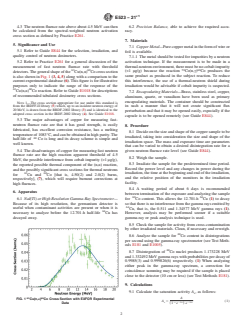
5.2 Refer to Practice E261 for a general discussion of the measurement of fast neutron fluence rate with threshold detectors. The general shape of the 63Cu(n,α) 60Co cross section is also shown in Fig. 1 (3, 4, 5) along with a comparison to the current experimental database (6). This figure is for illustrative purposes only to indicate the range of the response of the 63Cu(n,α)60Co reaction. Refer to Guide E1018 for descriptions of recommended tabulated dosimetry cross sections.
FIG. 1 63Cu(n,α)60Co Cross Section with EXFOR Experimental Data
Note 1: The cross section appropriate for use under this standard is from the IRDFF-II library (5) which, up to an incident neutron energy of 20 MeV, is drawn from the RRDF-2002 library (3) and is identical to the adopted cross section in the IRDF-2002 library (4). See Guide E1018.
5.3 The major advantages of copper for measuring fast-neutron fluence rate are that it has good strength, is easily fabricated, has excellent corrosion resistance, has a melting temperature of 1083°C, and can be obtained in high purity. The half-life of 60 Co is long and its decay scheme is simple and well known.
5.4 The disadvantages of copper for measuring fast neutron fluence rate are the high reaction apparent threshold of 4.5 MeV, the possible interference from cobalt impurity (>1 μg/g), the reported possible thermal component of the (n,α) reaction, and the possibly significant cross sections for thermal neutrons for 63Cu and 60Co [that is, 4.50(2) and 2.0(2) barns, respectively], (7), which will require burnout corrections at high fluences.
SCOPE
1.1 This test method covers procedures for measuring reaction rates by the activation reaction 63Cu(n,α) 60Co. The cross section for 60Co produced in this reaction increases rapidly with neutrons having energies greater than about 4.5 MeV. 60Co decays with a half-life of 5.2711(8)2 years (1)3,4 and emits two gamma rays having energies of 1.173228(3) and 1.332492(4) MeV (1). The isotopic content of natural copper is 69.174(20) % 63Cu and 30.826(20) % 65Cu (2). The neutron reaction, 63Cu(n,γ)64Cu, produces a radioactive product that emits gamma rays [1.34577(6) MeV (E1005)] which might interfere with the counting of the 60Co gamma rays.
1.2 With suitable techniques, fission-neutron fluence rates above 109 cm−2·s−1 can be determined. The 63Cu(n,α)60Co reaction can be used to determine fast-neutron fluences for irradiation times up to about 15 years, provided that the analysis methods described in Practice E261 are followed. If dosimeters are analyzed after irradiation periods longer than 15 years, the information inferred about the fluence during irradiation periods more than 15 years before the end of the irradiation should not be relied upon without supporting data from dosimeters withdrawn earlier.
1.3 Detailed procedures for other fast-neutron detectors are referenced in Practice E261.
1.4 This standard does not purport to address all of the safety concerns, if any, associated with its use. It is the responsibility of the user of this standard to establish appropriate safety, health, and environmental practices and determine the applicability of regulatory limitations prior to use.
1.5 This international standard was developed in accordance with internationally recognized principles on standardization established in the Decision on Principles for the Development of International Standards, Guides and Recommendations issued by the World Trade Organization Technical Barriers to Trade (TBT) Committee.
- Status
- Published
- Publication Date
- 31-Mar-2021
- Technical Committee
- E10 - Nuclear Technology and Applications
- Drafting Committee
- E10.05 - Nuclear Radiation Metrology

Overview
ASTM E523-21e1 is the Standard Test Method for Measuring Fast-Neutron Reaction Rates by Radioactivation of Copper, published by ASTM International. This standard outlines procedures for determining fast-neutron reaction rates using the radioactivation reaction of copper, specifically the ^63Cu(n,α)^60Co reaction. The method is widely recognized in the field of neutron dosimetry and nuclear reactor surveillance due to copper's favorable material properties and well-understood activation characteristics.
Measurement of fast-neutron reaction rates is essential for reactor monitoring, structural component integrity evaluations, and various research applications. The test method delivers reliable results for fluence rates above 10^9 cm^-2·s^-1 and irradiation periods up to approximately 15 years.
Key Topics
- Copper Activation Reaction: The method measures the rate of the ^63Cu(n,α)^60Co reaction, which is sensitive to fast neutrons (above approximately 4.5 MeV).
- Gamma Ray Measurement: After neutron activation, the appearance of radioactive ^60Co is detected via its gamma-ray emissions at energies of 1.173 and 1.332 MeV.
- Sample Preparation: High-purity copper (with minimal cobalt impurity) is required to avoid interference. Proper encapsulation and shielding are recommended when cobalt contamination is suspected.
- Procedure Steps:
- Selection and weighing of copper samples.
- Neutron irradiation, with documentation of time, position, and power levels.
- Post-irradiation cool-down period to reduce interference from short-lived isotopes.
- Gamma-ray spectrometry to quantify ^60Co activity.
- Calculation and Uncertainty: Reaction rates and neutron fluence are calculated from measured saturation activity, using established cross-section libraries (e.g., IRDFF-II, RRDF-2002). The standard emphasizes consideration of measurement precision and bias, and recommends referencing validated dosimetry cross-section data.
- Advantages and Limitations:
- Advantages: Copper is strong, corrosion resistant, available in high purity, and has a long ^60Co half-life and simple decay scheme.
- Limitations: The method's effectiveness is challenged by copper's high threshold energy, potential interference from cobalt impurities, and the need for corrections at high fluences due to thermal neutron reactions.
Applications
The methodologies detailed in ASTM E523-21e1 are crucial in a variety of domains where accurate fast-neutron dosimetry is required:
- Nuclear Reactor Surveillance: Monitoring neutron exposure in reactor pressure vessels and surrounding structures.
- Neutron Dosimetry: Providing precise and traceable measurements for neutron field characterization in experimental and operational facilities.
- Materials Testing: Evaluating neutron-induced changes in construction and research materials.
- Cross-Section Validation: Offering benchmark data for the qualification of neutron activation cross-section libraries used in nuclear data analysis.
- Long-term Irradiation Studies: Supporting research with reliable fluence measurement over extended operational periods.
This standard helps ensure the safety and effective management of nuclear installations by providing standardized, internationally recognized measurement techniques.
Related Standards
ASTM E523-21e1 references several associated documents that enhance its application and support broader compliance:
- ASTM E261 - Practice for Determining Neutron Fluence, Fluence Rate, and Spectra by Radioactivation Techniques
- ASTM E844 - Guide for Sensor Set Design and Irradiation for Reactor Surveillance
- ASTM E181 - Test Methods for Detector Calibration and Analysis of Radionuclides
- ASTM E1005 - Test Method for Application and Analysis of Radiometric Monitors for Reactor Vessel Surveillance
- ASTM E1018 - Guide for Application of ASTM Evaluated Cross Section Data File
- ASTM E170 - Terminology Relating to Radiation Measurements and Dosimetry
Compliance with ASTM E523-21e1 facilitates standardization and quality assurance for organizations involved in nuclear technology, safety, and metrology, ensuring reliability and international recognition in fast-neutron measurement and analysis.
Relations
- Effective Date
- 01-Mar-2020
- Effective Date
- 01-Mar-2020
- Effective Date
- 01-Oct-2019
- Effective Date
- 01-Jun-2018
- Effective Date
- 01-Jun-2017
- Effective Date
- 01-Oct-2016
- Effective Date
- 15-Feb-2016
- Effective Date
- 01-Sep-2015
- Effective Date
- 01-Jul-2015
- Effective Date
- 01-Jun-2015
- Effective Date
- 15-Mar-2015
- Effective Date
- 15-Oct-2014
- Effective Date
- 01-Sep-2014
- Refers
ASTM E844-09(2014)e2 - Standard Guide for Sensor Set Design and Irradiation for Reactor Surveillance - Effective Date
- 01-Jun-2014
- Effective Date
- 01-Jun-2014
Get Certified
Connect with accredited certification bodies for this standard

DNV
DNV is an independent assurance and risk management provider.

Lloyd's Register
Lloyd's Register is a global professional services organisation specialising in engineering and technology.
DNV Energy Systems
Energy and renewable energy certification.
Sponsored listings
Frequently Asked Questions
ASTM E523-21e1 is a standard published by ASTM International. Its full title is "Standard Test Method for Measuring Fast-Neutron Reaction Rates by Radioactivation of Copper". This standard covers: SIGNIFICANCE AND USE 5.1 Refer to Guide E844 for the selection, irradiation, and quality control of neutron dosimeters. 5.2 Refer to Practice E261 for a general discussion of the measurement of fast neutron fluence rate with threshold detectors. The general shape of the 63Cu(n,α) 60Co cross section is also shown in Fig. 1 (3, 4, 5) along with a comparison to the current experimental database (6). This figure is for illustrative purposes only to indicate the range of the response of the 63Cu(n,α)60Co reaction. Refer to Guide E1018 for descriptions of recommended tabulated dosimetry cross sections. FIG. 1 63Cu(n,α)60Co Cross Section with EXFOR Experimental Data Note 1: The cross section appropriate for use under this standard is from the IRDFF-II library (5) which, up to an incident neutron energy of 20 MeV, is drawn from the RRDF-2002 library (3) and is identical to the adopted cross section in the IRDF-2002 library (4). See Guide E1018. 5.3 The major advantages of copper for measuring fast-neutron fluence rate are that it has good strength, is easily fabricated, has excellent corrosion resistance, has a melting temperature of 1083°C, and can be obtained in high purity. The half-life of 60 Co is long and its decay scheme is simple and well known. 5.4 The disadvantages of copper for measuring fast neutron fluence rate are the high reaction apparent threshold of 4.5 MeV, the possible interference from cobalt impurity (>1 μg/g), the reported possible thermal component of the (n,α) reaction, and the possibly significant cross sections for thermal neutrons for 63Cu and 60Co [that is, 4.50(2) and 2.0(2) barns, respectively], (7), which will require burnout corrections at high fluences. SCOPE 1.1 This test method covers procedures for measuring reaction rates by the activation reaction 63Cu(n,α) 60Co. The cross section for 60Co produced in this reaction increases rapidly with neutrons having energies greater than about 4.5 MeV. 60Co decays with a half-life of 5.2711(8)2 years (1)3,4 and emits two gamma rays having energies of 1.173228(3) and 1.332492(4) MeV (1). The isotopic content of natural copper is 69.174(20) % 63Cu and 30.826(20) % 65Cu (2). The neutron reaction, 63Cu(n,γ)64Cu, produces a radioactive product that emits gamma rays [1.34577(6) MeV (E1005)] which might interfere with the counting of the 60Co gamma rays. 1.2 With suitable techniques, fission-neutron fluence rates above 109 cm−2·s−1 can be determined. The 63Cu(n,α)60Co reaction can be used to determine fast-neutron fluences for irradiation times up to about 15 years, provided that the analysis methods described in Practice E261 are followed. If dosimeters are analyzed after irradiation periods longer than 15 years, the information inferred about the fluence during irradiation periods more than 15 years before the end of the irradiation should not be relied upon without supporting data from dosimeters withdrawn earlier. 1.3 Detailed procedures for other fast-neutron detectors are referenced in Practice E261. 1.4 This standard does not purport to address all of the safety concerns, if any, associated with its use. It is the responsibility of the user of this standard to establish appropriate safety, health, and environmental practices and determine the applicability of regulatory limitations prior to use. 1.5 This international standard was developed in accordance with internationally recognized principles on standardization established in the Decision on Principles for the Development of International Standards, Guides and Recommendations issued by the World Trade Organization Technical Barriers to Trade (TBT) Committee.
SIGNIFICANCE AND USE 5.1 Refer to Guide E844 for the selection, irradiation, and quality control of neutron dosimeters. 5.2 Refer to Practice E261 for a general discussion of the measurement of fast neutron fluence rate with threshold detectors. The general shape of the 63Cu(n,α) 60Co cross section is also shown in Fig. 1 (3, 4, 5) along with a comparison to the current experimental database (6). This figure is for illustrative purposes only to indicate the range of the response of the 63Cu(n,α)60Co reaction. Refer to Guide E1018 for descriptions of recommended tabulated dosimetry cross sections. FIG. 1 63Cu(n,α)60Co Cross Section with EXFOR Experimental Data Note 1: The cross section appropriate for use under this standard is from the IRDFF-II library (5) which, up to an incident neutron energy of 20 MeV, is drawn from the RRDF-2002 library (3) and is identical to the adopted cross section in the IRDF-2002 library (4). See Guide E1018. 5.3 The major advantages of copper for measuring fast-neutron fluence rate are that it has good strength, is easily fabricated, has excellent corrosion resistance, has a melting temperature of 1083°C, and can be obtained in high purity. The half-life of 60 Co is long and its decay scheme is simple and well known. 5.4 The disadvantages of copper for measuring fast neutron fluence rate are the high reaction apparent threshold of 4.5 MeV, the possible interference from cobalt impurity (>1 μg/g), the reported possible thermal component of the (n,α) reaction, and the possibly significant cross sections for thermal neutrons for 63Cu and 60Co [that is, 4.50(2) and 2.0(2) barns, respectively], (7), which will require burnout corrections at high fluences. SCOPE 1.1 This test method covers procedures for measuring reaction rates by the activation reaction 63Cu(n,α) 60Co. The cross section for 60Co produced in this reaction increases rapidly with neutrons having energies greater than about 4.5 MeV. 60Co decays with a half-life of 5.2711(8)2 years (1)3,4 and emits two gamma rays having energies of 1.173228(3) and 1.332492(4) MeV (1). The isotopic content of natural copper is 69.174(20) % 63Cu and 30.826(20) % 65Cu (2). The neutron reaction, 63Cu(n,γ)64Cu, produces a radioactive product that emits gamma rays [1.34577(6) MeV (E1005)] which might interfere with the counting of the 60Co gamma rays. 1.2 With suitable techniques, fission-neutron fluence rates above 109 cm−2·s−1 can be determined. The 63Cu(n,α)60Co reaction can be used to determine fast-neutron fluences for irradiation times up to about 15 years, provided that the analysis methods described in Practice E261 are followed. If dosimeters are analyzed after irradiation periods longer than 15 years, the information inferred about the fluence during irradiation periods more than 15 years before the end of the irradiation should not be relied upon without supporting data from dosimeters withdrawn earlier. 1.3 Detailed procedures for other fast-neutron detectors are referenced in Practice E261. 1.4 This standard does not purport to address all of the safety concerns, if any, associated with its use. It is the responsibility of the user of this standard to establish appropriate safety, health, and environmental practices and determine the applicability of regulatory limitations prior to use. 1.5 This international standard was developed in accordance with internationally recognized principles on standardization established in the Decision on Principles for the Development of International Standards, Guides and Recommendations issued by the World Trade Organization Technical Barriers to Trade (TBT) Committee.
ASTM E523-21e1 is classified under the following ICS (International Classification for Standards) categories: 17.240 - Radiation measurements; 27.120.30 - Fissile materials and nuclear fuel technology. The ICS classification helps identify the subject area and facilitates finding related standards.
ASTM E523-21e1 has the following relationships with other standards: It is inter standard links to ASTM E1018-20e1, ASTM E1018-20, ASTM E944-19, ASTM E844-18, ASTM E170-17, ASTM E170-16a, ASTM E170-16, ASTM E170-15a, ASTM E1005-15, ASTM E261-15, ASTM E170-15, ASTM E170-14a, ASTM E170-14, ASTM E844-09(2014)e2, ASTM E844-09(2014)e1. Understanding these relationships helps ensure you are using the most current and applicable version of the standard.
ASTM E523-21e1 is available in PDF format for immediate download after purchase. The document can be added to your cart and obtained through the secure checkout process. Digital delivery ensures instant access to the complete standard document.
Standards Content (Sample)
This international standard was developed in accordance with internationally recognized principles on standardization established in the Decision on Principles for the
Development of International Standards, Guides and Recommendations issued by the World Trade Organization Technical Barriers to Trade (TBT) Committee.
´1
Designation: E523 − 21
Standard Test Method for
Measuring Fast-Neutron Reaction Rates by Radioactivation
of Copper
This standard is issued under the fixed designation E523; the number immediately following the designation indicates the year of
original adoption or, in the case of revision, the year of last revision.Anumber in parentheses indicates the year of last reapproval.A
superscript epsilon (´) indicates an editorial change since the last revision or reapproval.
ε NOTE—Fig. 2 was updated editorially in May 2021.
1. Scope 1.5 This international standard was developed in accor-
dance with internationally recognized principles on standard-
1.1 This test method covers procedures for measuring reac-
63 60 ization established in the Decision on Principles for the
tion rates by the activation reaction Cu(n,α) Co. The cross
60 Development of International Standards, Guides and Recom-
section for Co produced in this reaction increases rapidly
mendations issued by the World Trade Organization Technical
with neutrons having energies greater than about 4.5 MeV.
60 2 3,4 Barriers to Trade (TBT) Committee.
Codecayswithahalf-lifeof5.2711(8) years (1) andemits
two gamma rays having energies of 1.173228(3) and
2. Referenced Documents
1.332492(4)MeV (1).Theisotopiccontentofnaturalcopperis
63 65 2.1 ASTM Standards:
69.174(20)% Cu and 30.826(20) % Cu (2). The neutron
63 64
E170Terminology Relating to Radiation Measurements and
reaction, Cu(n,γ) Cu, produces a radioactive product that
Dosimetry
emits gamma rays [1.34577(6) MeV (E1005)] which might
E181Test Methods for Detector Calibration andAnalysis of
interfere with the counting of the Co gamma rays.
Radionuclides
1.2 With suitable techniques, fission-neutron fluence rates
E261Practice for Determining Neutron Fluence, Fluence
9 −2 −1 63 60
above 10 cm ·s can be determined. The Cu(n,α) Co
Rate, and Spectra by Radioactivation Techniques
reaction can be used to determine fast-neutron fluences for
E844Guide for Sensor Set Design and Irradiation for
irradiation times up to about 15 years, provided that the
Reactor Surveillance
analysis methods described in Practice E261 are followed. If
E944Guide for Application of Neutron Spectrum Adjust-
dosimetersareanalyzedafterirradiationperiodslongerthan15
ment Methods in Reactor Surveillance
years, the information inferred about the fluence during irra-
E1005Test Method for Application and Analysis of Radio-
diation periods more than 15 years before the end of the
metric Monitors for Reactor Vessel Surveillance
irradiation should not be relied upon without supporting data
E1018Guide for Application of ASTM Evaluated Cross
from dosimeters withdrawn earlier.
Section Data File
1.3 Detailed procedures for other fast-neutron detectors are
3. Terminology
referenced in Practice E261.
3.1 Definitions:
1.4 This standard does not purport to address all of the
3.1.1 Refer to Terminology E170.
safety concerns, if any, associated with its use. It is the
responsibility of the user of this standard to establish appro-
4. Summary of Test Method
priate safety, health, and environmental practices and deter-
4.1 High-purity copper (<1 ppm cobalt) is irradiated in a
mine the applicability of regulatory limitations prior to use.
neutron field, thereby producing radioactive Co from the
63 60
Cu(n,α) Co reaction.
This test method is under the jurisdiction ofASTM Committee E10 on Nuclear
Technology and Applicationsand is the direct responsibility of Subcommittee
4.2 The gamma rays emitted by the radioactive decay of
E10.05 on Nuclear Radiation Metrology. 60
Co are counted in accordance with Test Methods E181 and
Current edition approved April 1, 2021. Published April 2021. Originally
the reaction rate, as defined by Practice E261, is calculated
approved in 1976. Last previous edition approved in 2016 as E523–16. DOI:
10.1520/E0523-21E01. from the decay rate and irradiation conditions.
The lightface numbers in parentheses are the magnitude of plus or minus
uncertainties in the last digit(s) listed.
3 5
The boldface numbers in parentheses refer to a list of references at the end of For referenced ASTM standards, visit the ASTM website, www.astm.org, or
this standard. contact ASTM Customer Service at service@astm.org. For Annual Book of ASTM
For dosimetry purposes, a year is defined in accordance with BIPM (1) as 365 Standards volume information, refer to the standard’s Document Summary page on
242 198 days = 31 556 926 s; see Terminology E170. the ASTM website.
Copyright © ASTM International, 100 Barr Harbor Drive, PO Box C700, West Conshohocken, PA 19428-2959. United States
´1
E523 − 21
4.3 The neutron fluence rate above about 4.5 MeV can then 6.2 Precision Balance, able to achieve the required accu-
be calculated from the spectral-weighted neutron activation racy.
cross section as defined by Practice E261.
7. Materials
5. Significance and Use
7.1 Copper Metal—Purecoppermetalintheformofwireor
5.1 Refer to Guide E844 for the selection, irradiation, and
foil is available.
quality control of neutron dosimeters.
7.1.1 The metal should be tested for impurities by a neutron
activation technique. If the measurement is to be made in a
5.2 Refer to Practice E261 for a general discussion of the
thermal-neutronenvironment,theremustbenocobaltimpurity
measurement of fast neutron fluence rate with threshold
59 60
63 60
(<1 µg/g) because the reaction Co(n,γ) Co produces the
detectors.Thegeneralshapeofthe Cu(n,α) Cocrosssection
same product as produced in the subject reaction. To reduce
is also shown in Fig. 1 (3, 4, 5) along with a comparison to the
this interference, the use of a thermal-neutron shield during
current experimental database (6).This figure is for illustrative
irradiation would be advisable if cobalt impurity is suspected.
purposes only to indicate the range of the response of the
63 60
Cu(n,α) Co reaction. Refer to Guide E1018 for descriptions
7.2 Encapsulating Materials—Brass, stainless steel, copper,
of recommended tabulated dosimetry cross sections.
aluminum, quartz, or vanadium have been used as primary
encapsulating materials. The container should be constructed
NOTE 1—The cross section appropriate for use under this standard is
from the IRDFF-II library (5) which, up to an incident neutron energy of in such a manner that it will not create significant flux
20 MeV, is drawn from the RRDF-2002 library (3) and is identical to the
perturbation and that it may be opened easily, especially if the
adopted cross section in the IRDF-2002 library (4). See Guide E1018.
capsule is to be opened remotely (see Guide E844).
5.3 The major advantages of copper for measuring fast-
neutron fluence rate are that it has good strength, is easily
8. Procedure
fabricated, has excellent corrosion resistance, has a melting
8.1 Decide on the size and shape of the copper sample to be
temperatureof1083°C,andcanbeobtainedinhighpurity.The
irradiated, taking into consideration the size and shape of the
half-life of Co is long and its decay scheme is simple and
irradiation space. The mass and exposure time are parameters
well known.
that can be varied to obtain a desired disintegration rate for a
5.4 The disadvantages of copper for measuring fast neutron
given neutron fluence rate level (see Guide E844).
fluence rate are the high reaction apparent threshold of 4.5
8.2 Weigh the sample.
MeV, the possible interference from cobalt impurity (>1 µg/g),
8.3 Irradiate the sample for the predetermined time period.
the reported possible thermal component of the (n,α) reaction,
Record the power level and any changes in power during the
and the possibly significant cross sections for thermal neutrons
63 60
irradiation,thetimeatthebeginningandendoftheirradiation,
for Cu and Co [that is, 4.50(2) and 2.0(2) barns,
and the relative position of the monitors in the irradiation
respectively], (7), which will require burnout corrections at
facility.
high fluences.
8.4 A waiting period of about 6 days
...