

ASTM E1297-18
(Test Method)Standard Test Method for Measuring Fast-Neutron Reaction Rates by Radioactivation of Niobium
General Information
- Abstract
SIGNIFICANCE AND USE
5.1 Refer to Practice E261 for a general discussion of the determination of decay rates, reaction rates, and neutron fluence rates with threshold detectors (1-29).3 Refer to Practice E1006, Practice E185 and Guide E1018 for the use and application of results obtained by this test method.(30-32)
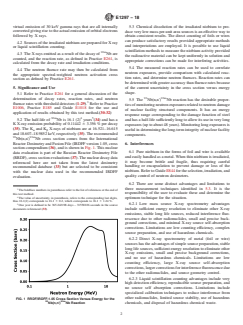
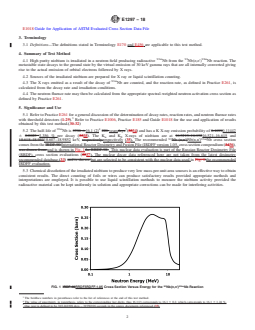
5.2 The half-life of 93mNb is 16.1 (2)4 years5(34) and has a K X-ray emission probability of 0.11442 ± 3.356 % per decay (35). The Kα and Kβ X-rays of niobium are at 16.521–16.615 and 18.607–18.9852 keV, respectively (35). The recommended 93Nb(n,n′)93mNb cross section comes from the International Reactor Dosimetry and Fusion File (IRDFF version 1.05, cross section compendium (36), and is shown in Fig. 1. This nuclear data evaluation is part of the Russian Reactor Dosimetry File (RRDF), cross section evaluations (37). The nuclear decay data referenced here are not taken from the latest dosimetry recommended database (33) but are selected to be consistent with the nuclear data used in the recommended IRDFF evaluation.
FIG. 1 RRDF/IRDFF-1.05 Cross Section Versus Energy for the 93Nb(n,n′) 93mNb Reaction
5.3 Chemical dissolution of the irradiated niobium to produce very low mass-per-unit area sources is an effective way to obtain consistent results. The direct counting of foils or wires can produce satisfactory results provided appropriate methods and interpretations are employed. It is possible to use liquid scintillation methods to measure the niobium activity provided the radioactive material can be kept uniformly in solution and appropriate corrections can be made for interfering activities.
5.4 The measured reaction rates can be used to correlate neutron exposures, provide comparison with calculated reaction rates, and determine neutron fluences. Reaction rates can be determined with greater accuracy than fluence rates because of the current uncertainty in the cross section versus energy shape.
5.5 The 93Nb(n,n′)93mNb reaction has the desirable properties o...
SCOPE
1.1 This test method describes procedures for measuring reaction rates by the activation reaction 93Nb(n,n′) 93mNb.
1.2 This activation reaction is useful for monitoring neutrons with energies above approximately 0.5 MeV and for irradiation times up to about 48 years (three half-lives), provided that the analysis methods described in Practice E261 are followed.
1.3 With suitable techniques, fast-neutron reaction rates for neutrons with energy distribution similar to fission neutrons can be determined in fast-neutron fluences above about 1016 cm−2. In the presence of high thermal-neutron fluence rates (>1012cm−2·s−1), the transmutation of 93mNb due to neutron capture should be investigated. In the presence of high-energy neutron spectra such as are associated with fusion and spallation sources, the transmutation of 93mNb by reactions such as (n,2n) may occur and should be investigated.
1.4 Procedures for other fast-neutron monitors are referenced in Practice E261.
1.5 Fast-neutron fluence rates can be determined from the reaction rates provided that the appropriate cross section information is available to meet the accuracy requirements.
1.6 The values stated in SI units are to be regarded as standard. No other units of measurement are included in this standard.
1.7 This standard does not purport to address all of the safety concerns, if any, associated with its use. It is the responsibility of the user of this standard to establish appropriate safety, health, and environmental practices and determine the applicability of regulatory limitations prior to use.
1.8 This international standard was developed in accordance with internationally recognized principles on standardization established in the Decision on Principles for the Development of International Standards, Guides and Recommendations issued by the World Trade Organization Technical Barriers to Trade (TBT) Committee.
- Status
- Published
- Publication Date
- 31-May-2018
- Technical Committee
- E10 - Nuclear Technology and Applications
- Drafting Committee
- E10.05 - Nuclear Radiation Metrology
Buy Documents
ASTM E1297-18 - Standard Test Method for Measuring Fast-Neutron Reaction Rates by Radioactivation of Niobium
REDLINE ASTM E1297-18 - Standard Test Method for Measuring Fast-Neutron Reaction Rates by Radioactivation of Niobium
Overview
ASTM E1297-18 is an international standard established by ASTM International that defines the methodology for measuring fast-neutron reaction rates using the radioactivation of niobium. This test method is especially significant for neutron fluence monitoring in nuclear facilities, providing a reliable way to assess exposure to fast neutrons through the activation reaction 93Nb(n,n′)93mNb. The method allows for the measurement of neutron exposures and fluence rates, which are critical parameters in reactor dosimetry, pressure vessel surveillance, and the long-term integrity assessment of nuclear reactor components.
The test method is aligned with global standards for nuclear metrology and integrates references to other key ASTM practices and guides, ensuring broad applicability and consistency within the nuclear science and engineering community.
Key Topics
- Activation Reaction: The standard focuses on the 93Nb(n,n′)93mNb reaction, a threshold reaction sensitive to fast neutrons, making niobium an effective dosimeter for neutron flux above 0.5 MeV.
- Measurement Techniques: Recommendations include chemical dissolution for low mass sources, direct counting of metal foils or wires, and liquid scintillation counting. Each method addresses different experimental requirements and practical considerations.
- Sample Preparation: Emphasizes the use of high-purity niobium, precise encapsulation, and careful handling of irradiated samples to ensure accuracy and minimize interference.
- Interference and Corrections: The standard outlines strategies for correcting measurement results due to self-attenuation, geometry effects, and interfering radionuclides like tantalum impurities or other activation products.
- Data Analysis: Provides equations and references for calculating reaction rates and correlating these with neutron fluence, referencing ASTM Practice E261 for decay rate and fluence rate analysis.
- Quality Assurance: Requires the use of SI units and adherence to rigorous health, safety, and regulatory practices in accordance with international guidelines.
Applications
- Nuclear Reactor Dosimetry: Widely used for monitoring neutron fluence and verifying reactor operating conditions, particularly in light water-moderated power reactor vessels.
- Materials Surveillance: Supports long-term structural integrity assessments by tracking neutron-induced damage to critical reactor components.
- Fusion and Spallation Source Monitoring: Applicable in high-energy neutron fields typical of research and experimental reactors, as well as in advanced fusion and particle accelerator environments.
- Calibration and Benchmark Testing: Useful for comparing experimental neutron exposure data with calculations or benchmark standards in the development and validation of reactor models.
- Research and Development: Provides methodologies for evaluating the performance of new materials or irradiation conditions and improving the accuracy of neutron metrology techniques.
Related Standards
For comprehensive implementation and compliance, ASTM E1297-18 should be used in conjunction with these related ASTM standards and practices:
- ASTM E261: Practice for Determining Neutron Fluence, Fluence Rate, and Spectra by Radioactivation Techniques
- ASTM E1006: Practice for Analysis and Interpretation of Physics Dosimetry Results from Test Reactor Experiments
- ASTM E185: Practice for Design of Surveillance Programs for Light-Water Moderated Nuclear Power Reactor Vessels
- ASTM E1018: Guide for Application of ASTM Evaluated Cross Section Data File
- ASTM E181, E1005: Test Methods for Detector Calibration and Radionuclide Analysis
- ASTM E262: Test Method for Determining Thermal Neutron Reaction Rates
By referencing and applying ASTM E1297-18 with these companion documents, users can ensure best practices in fast neutron dosimetry, reactor surveillance, and neutron metrology in nuclear science and engineering environments.
Keywords: neutron reaction rate, niobium activation, fast-neutron monitoring, reactor dosimetry, ASTM E1297-18, neutron fluence, nuclear power plant, pressure vessel surveillance, nuclear metrology, radioactivation, threshold detector.
Relations
- Effective Date
- 01-Jun-2018
- Effective Date
- 01-Apr-2022
- Effective Date
- 01-Mar-2020
- Effective Date
- 01-Mar-2020
- Effective Date
- 01-Oct-2019
- Effective Date
- 01-Jun-2018
- Effective Date
- 01-Oct-2017
- Effective Date
- 01-Oct-2017
- Effective Date
- 01-Aug-2017
- Effective Date
- 01-Jun-2017
- Effective Date
- 01-Oct-2016
- Effective Date
- 15-Feb-2016
- Effective Date
- 01-Sep-2015
- Effective Date
- 01-Jul-2015
- Effective Date
- 01-Jun-2015
Buy Documents
ASTM E1297-18 - Standard Test Method for Measuring Fast-Neutron Reaction Rates by Radioactivation of Niobium
REDLINE ASTM E1297-18 - Standard Test Method for Measuring Fast-Neutron Reaction Rates by Radioactivation of Niobium
Get Certified
Connect with accredited certification bodies for this standard

DNV
DNV is an independent assurance and risk management provider.

Lloyd's Register
Lloyd's Register is a global professional services organisation specialising in engineering and technology.
DNV Energy Systems
Energy and renewable energy certification.
Sponsored listings
Frequently Asked Questions
ASTM E1297-18 is a standard published by ASTM International. Its full title is "Standard Test Method for Measuring Fast-Neutron Reaction Rates by Radioactivation of Niobium". This standard covers: SIGNIFICANCE AND USE 5.1 Refer to Practice E261 for a general discussion of the determination of decay rates, reaction rates, and neutron fluence rates with threshold detectors (1-29).3 Refer to Practice E1006, Practice E185 and Guide E1018 for the use and application of results obtained by this test method.(30-32) 5.2 The half-life of 93mNb is 16.1 (2)4 years5(34) and has a K X-ray emission probability of 0.11442 ± 3.356 % per decay (35). The Kα and Kβ X-rays of niobium are at 16.521–16.615 and 18.607–18.9852 keV, respectively (35). The recommended 93Nb(n,n′)93mNb cross section comes from the International Reactor Dosimetry and Fusion File (IRDFF version 1.05, cross section compendium (36), and is shown in Fig. 1. This nuclear data evaluation is part of the Russian Reactor Dosimetry File (RRDF), cross section evaluations (37). The nuclear decay data referenced here are not taken from the latest dosimetry recommended database (33) but are selected to be consistent with the nuclear data used in the recommended IRDFF evaluation. FIG. 1 RRDF/IRDFF-1.05 Cross Section Versus Energy for the 93Nb(n,n′) 93mNb Reaction 5.3 Chemical dissolution of the irradiated niobium to produce very low mass-per-unit area sources is an effective way to obtain consistent results. The direct counting of foils or wires can produce satisfactory results provided appropriate methods and interpretations are employed. It is possible to use liquid scintillation methods to measure the niobium activity provided the radioactive material can be kept uniformly in solution and appropriate corrections can be made for interfering activities. 5.4 The measured reaction rates can be used to correlate neutron exposures, provide comparison with calculated reaction rates, and determine neutron fluences. Reaction rates can be determined with greater accuracy than fluence rates because of the current uncertainty in the cross section versus energy shape. 5.5 The 93Nb(n,n′)93mNb reaction has the desirable properties o... SCOPE 1.1 This test method describes procedures for measuring reaction rates by the activation reaction 93Nb(n,n′) 93mNb. 1.2 This activation reaction is useful for monitoring neutrons with energies above approximately 0.5 MeV and for irradiation times up to about 48 years (three half-lives), provided that the analysis methods described in Practice E261 are followed. 1.3 With suitable techniques, fast-neutron reaction rates for neutrons with energy distribution similar to fission neutrons can be determined in fast-neutron fluences above about 1016 cm−2. In the presence of high thermal-neutron fluence rates (>1012cm−2·s−1), the transmutation of 93mNb due to neutron capture should be investigated. In the presence of high-energy neutron spectra such as are associated with fusion and spallation sources, the transmutation of 93mNb by reactions such as (n,2n) may occur and should be investigated. 1.4 Procedures for other fast-neutron monitors are referenced in Practice E261. 1.5 Fast-neutron fluence rates can be determined from the reaction rates provided that the appropriate cross section information is available to meet the accuracy requirements. 1.6 The values stated in SI units are to be regarded as standard. No other units of measurement are included in this standard. 1.7 This standard does not purport to address all of the safety concerns, if any, associated with its use. It is the responsibility of the user of this standard to establish appropriate safety, health, and environmental practices and determine the applicability of regulatory limitations prior to use. 1.8 This international standard was developed in accordance with internationally recognized principles on standardization established in the Decision on Principles for the Development of International Standards, Guides and Recommendations issued by the World Trade Organization Technical Barriers to Trade (TBT) Committee.
SIGNIFICANCE AND USE 5.1 Refer to Practice E261 for a general discussion of the determination of decay rates, reaction rates, and neutron fluence rates with threshold detectors (1-29).3 Refer to Practice E1006, Practice E185 and Guide E1018 for the use and application of results obtained by this test method.(30-32) 5.2 The half-life of 93mNb is 16.1 (2)4 years5(34) and has a K X-ray emission probability of 0.11442 ± 3.356 % per decay (35). The Kα and Kβ X-rays of niobium are at 16.521–16.615 and 18.607–18.9852 keV, respectively (35). The recommended 93Nb(n,n′)93mNb cross section comes from the International Reactor Dosimetry and Fusion File (IRDFF version 1.05, cross section compendium (36), and is shown in Fig. 1. This nuclear data evaluation is part of the Russian Reactor Dosimetry File (RRDF), cross section evaluations (37). The nuclear decay data referenced here are not taken from the latest dosimetry recommended database (33) but are selected to be consistent with the nuclear data used in the recommended IRDFF evaluation. FIG. 1 RRDF/IRDFF-1.05 Cross Section Versus Energy for the 93Nb(n,n′) 93mNb Reaction 5.3 Chemical dissolution of the irradiated niobium to produce very low mass-per-unit area sources is an effective way to obtain consistent results. The direct counting of foils or wires can produce satisfactory results provided appropriate methods and interpretations are employed. It is possible to use liquid scintillation methods to measure the niobium activity provided the radioactive material can be kept uniformly in solution and appropriate corrections can be made for interfering activities. 5.4 The measured reaction rates can be used to correlate neutron exposures, provide comparison with calculated reaction rates, and determine neutron fluences. Reaction rates can be determined with greater accuracy than fluence rates because of the current uncertainty in the cross section versus energy shape. 5.5 The 93Nb(n,n′)93mNb reaction has the desirable properties o... SCOPE 1.1 This test method describes procedures for measuring reaction rates by the activation reaction 93Nb(n,n′) 93mNb. 1.2 This activation reaction is useful for monitoring neutrons with energies above approximately 0.5 MeV and for irradiation times up to about 48 years (three half-lives), provided that the analysis methods described in Practice E261 are followed. 1.3 With suitable techniques, fast-neutron reaction rates for neutrons with energy distribution similar to fission neutrons can be determined in fast-neutron fluences above about 1016 cm−2. In the presence of high thermal-neutron fluence rates (>1012cm−2·s−1), the transmutation of 93mNb due to neutron capture should be investigated. In the presence of high-energy neutron spectra such as are associated with fusion and spallation sources, the transmutation of 93mNb by reactions such as (n,2n) may occur and should be investigated. 1.4 Procedures for other fast-neutron monitors are referenced in Practice E261. 1.5 Fast-neutron fluence rates can be determined from the reaction rates provided that the appropriate cross section information is available to meet the accuracy requirements. 1.6 The values stated in SI units are to be regarded as standard. No other units of measurement are included in this standard. 1.7 This standard does not purport to address all of the safety concerns, if any, associated with its use. It is the responsibility of the user of this standard to establish appropriate safety, health, and environmental practices and determine the applicability of regulatory limitations prior to use. 1.8 This international standard was developed in accordance with internationally recognized principles on standardization established in the Decision on Principles for the Development of International Standards, Guides and Recommendations issued by the World Trade Organization Technical Barriers to Trade (TBT) Committee.
ASTM E1297-18 is classified under the following ICS (International Classification for Standards) categories: 27.120.01 - Nuclear energy in general. The ICS classification helps identify the subject area and facilitates finding related standards.
ASTM E1297-18 has the following relationships with other standards: It is inter standard links to ASTM E1297-08(2013), ASTM E456-13a(2022)e1, ASTM E1018-20e1, ASTM E1018-20, ASTM E944-19, ASTM E844-18, ASTM E456-13A(2017)e3, ASTM E456-13A(2017)e1, ASTM E262-17, ASTM E170-17, ASTM E170-16a, ASTM E170-16, ASTM E170-15a, ASTM E1005-15, ASTM E185-15e1. Understanding these relationships helps ensure you are using the most current and applicable version of the standard.
ASTM E1297-18 is available in PDF format for immediate download after purchase. The document can be added to your cart and obtained through the secure checkout process. Digital delivery ensures instant access to the complete standard document.
Standards Content (Sample)
This international standard was developed in accordance with internationally recognized principles on standardization established in the Decision on Principles for the
Development of International Standards, Guides and Recommendations issued by the World Trade Organization Technical Barriers to Trade (TBT) Committee.
Designation: E1297 − 18
Standard Test Method for
Measuring Fast-Neutron Reaction Rates by Radioactivation
of Niobium
This standard is issued under the fixed designation E1297; the number immediately following the designation indicates the year of
original adoption or, in the case of revision, the year of last revision.Anumber in parentheses indicates the year of last reapproval.A
superscript epsilon (´) indicates an editorial change since the last revision or reapproval.
1. Scope mendations issued by the World Trade Organization Technical
Barriers to Trade (TBT) Committee.
1.1 This test method describes procedures for measuring
93 93m
reaction rates by the activation reaction Nb(n,n') Nb.
2. Referenced Documents
1.2 This activation reaction is useful for monitoring neu-
2.1 ASTM Standards:
trons with energies above approximately 0.5 MeV and for
D1193Specification for Reagent Water
irradiation times up to about 48 years (three half-lives),
E170Terminology Relating to Radiation Measurements and
provided that the analysis methods described in Practice E261
Dosimetry
are followed.
E177Practice for Use of the Terms Precision and Bias in
ASTM Test Methods
1.3 With suitable techniques, fast-neutron reaction rates for
E181Test Methods for Detector Calibration andAnalysis of
neutrons with energy distribution similar to fission neutrons
Radionuclides
can be determined in fast-neutron fluences above about 10
−2
E185Practice for Design of Surveillance Programs for
cm . In the presence of high thermal-neutron fluence rates
12 −2 −1 93m
Light-Water Moderated Nuclear Power Reactor Vessels
(>10 cm ·s ), the transmutation of Nb due to neutron
E261Practice for Determining Neutron Fluence, Fluence
capture should be investigated. In the presence of high-energy
Rate, and Spectra by Radioactivation Techniques
neutron spectra such as are associated with fusion and spalla-
93m
E262Test Method for Determining Thermal Neutron Reac-
tion sources, the transmutation of Nb by reactions such as
tion Rates and Thermal Neutron Fluence Rates by Radio-
(n,2n) may occur and should be investigated.
activation Techniques
1.4 Procedures for other fast-neutron monitors are refer-
E456Terminology Relating to Quality and Statistics
enced in Practice E261.
E844Guide for Sensor Set Design and Irradiation for
1.5 Fast-neutron fluence rates can be determined from the
Reactor Surveillance
reaction rates provided that the appropriate cross section
E944Guide for Application of Neutron Spectrum Adjust-
information is available to meet the accuracy requirements.
ment Methods in Reactor Surveillance
E1005Test Method for Application and Analysis of Radio-
1.6 The values stated in SI units are to be regarded as
metric Monitors for Reactor Vessel Surveillance
standard. No other units of measurement are included in this
E1006Practice for Analysis and Interpretation of Physics
standard.
Dosimetry Results from Test Reactor Experiments
1.7 This standard does not purport to address all of the
E1018Guide for Application of ASTM Evaluated Cross
safety concerns, if any, associated with its use. It is the
Section Data File
responsibility of the user of this standard to establish appro-
priate safety, health, and environmental practices and deter-
3. Terminology
mine the applicability of regulatory limitations prior to use.
3.1 Definitions—The definitions stated in Terminology
1.8 This international standard was developed in accor-
E170 and E456 are applicable to this test method.
dance with internationally recognized principles on standard-
4. Summary of Test Method
ization established in the Decision on Principles for the
Development of International Standards, Guides and Recom-
4.1 High purity niobium is irradiated in a neutron field
93m 93 93m
producing radioactive Nb from the Nb(n,n') Nb reac-
tion. The metastable state decays to the ground state by the
ThistestmethodisunderthejurisdictionofASTMCommitteeE10onNuclear
Technology and Applicationsand is the direct responsibility of Subcommittee
E10.05 on Nuclear Radiation Metrology. For referenced ASTM standards, visit the ASTM website, www.astm.org, or
Current edition approved June 1, 2018. Published August 2018. Originally contact ASTM Customer Service at service@astm.org. For Annual Book of ASTM
approved in 1989. Last previous edition approved in 2013 as E1297–08(2013). Standards volume information, refer to the standard’s Document Summary page on
DOI: 10.1520/E1297-18. the ASTM website.
Copyright © ASTM International, 100 Barr Harbor Drive, PO Box C700, West Conshohocken, PA 19428-2959. United States
E1297 − 18
virtual emission of 30 keV gamma rays that are all internally 5.3 Chemical dissolution of the irradiated niobium to pro-
convertedgivingrisetotheactualemissionoforbitalelectrons duceverylowmass-per-unitareasourcesisaneffectivewayto
followed by X rays.
obtain consistent results. The direct counting of foils or wires
can produce satisfactory results provided appropriate methods
4.2 SourcesoftheirradiatedniobiumarepreparedforXray
and interpretations are employed. It is possible to use liquid
or liquid scintillation counting.
scintillation methods to measure the niobium activity provided
93m
4.3 TheXraysemittedasaresultofthedecayof Nbare
the radioactive material can be kept uniformly in solution and
counted, and the reaction rate, as defined in Practice E261,is
appropriate corrections can be made for interfering activities.
calculated from the decay rate and irradiation conditions.
5.4 The measured reaction rates can be used to correlate
4.4 The neutron fluence rate may then be calculated from
neutron exposures, provide comparison with calculated reac-
the appropriate spectral-weighted neutron activation cross
tion rates, and determine neutron fluences. Reaction rates can
section as defined by Practice E261.
bedeterminedwithgreateraccuracythanfluenceratesbecause
5. Significance and Use
of the current uncertainty in the cross section versus energy
shape.
5.1 Refer to Practice E261 for a general discussion of the
93 93m
determination of decay rates, reaction rates, and neutron
5.5 The Nb(n,n') Nb reaction has the desirable proper-
fluencerateswiththresholddetectors (1-29). RefertoPractice
tiesofmonitoringneutronexposuresrelatedtoneutrondamage
E1006, Practice E185 and Guide E1018 for the use and
of nuclear facility structural components. It has an energy
application of results obtained by this test method.(30-32)
response range corresponding to the damage function of steel
93m 4 5
5.2 The half-life of Nb is 16.1 (2) years (34) and has a andhasahalf-lifesufficientlylongtoallowitsuseinverylong
K X-ray emission probability of 0.11442 6 3.356 % per decay
exposures(uptoabout48years).Monitoringlongexposuresis
(35). The K and K X-rays of niobium are at 16.521–16.615
usefulindeterminingthelong-termintegrityofnuclearfacility
α β
and18.607–18.9852keV,respectively (35).Therecommended
components.
93 93m
Nb(n,n') Nb cross section comes from the International
ReactorDosimetryandFusionFile(IRDFFversion1.05,cross
6. Interferences
section compendium (36), and is shown in Fig. 1.This nuclear
6.1 Pure niobium in the forms of foil and wire is available
data evaluation is part of the Russian Reactor Dosimetry File
andeasilyhandledasametal.Whenthinniobiumisirradiated,
(RRDF),crosssectionevaluations (37).Thenucleardecaydata
it may become brittle and fragile, thus requiring careful
referenced here are not taken from the latest dosimetry
handling or encapsulation to prevent damage or loss of the
recommended database (33) but are selected to be consistent
niobium.RefertoGuideE844fortheselection,irradiation,and
with the nuclear data used in the recommended IRDFF
quality control of neutron dosimeters.
evaluation.
6.2 There are some distinct advantages and limitations to
three measurement techniques identified in 5.3.Itisthe
Theboldfacenumbersinparenthesesrefertothelistofreferencesattheendof
responsibility of the user to evaluate these and determine the
this test method.
The value of uncertainty, in parenthesis, refers to the corresponding last digits,
optimum technique for the situation.
thus 16.1(2) corresponds to 16.1 6 0.2, which corresponds to 16.1 6 1.24 %.
5 6.2.1 Low mass source X-ray spectrometry advantages
One year is defined to be 365.242198 days – 31556926 seconds in the source
documents referenced (33). include sufficient energy resolution to eliminate other X-ray
emissions, stable long life sources, reduced interference fluo-
rescence due to other radionuclides, small and precise back-
ground corrections, and minimal X-ray source self-absorption
corrections. Limitations are low counting efficiency, complex
source preparation, and use of hazardous chemicals.
6.2.2 Direct X-ray spectrometry of metal (foil or wire)
sourceshastheadvantagesofsimplesourcepreparation,stable
longlifesources,sufficientenergyresolutiontoeliminateother
X-ray emissions, small and precise background corrections,
and no use of hazardous chemicals. Limitations are low
counting efficiency, large X-ray source self-absorption
corrections,largercorrectionsforinterferencefluorescencedue
to the other radionuclides, and source geometry control.
6.2.3 Liquid scintillation counting advantages include very
high detection efficiency, reproducible source preparation, and
no source self absorption corrections. Limitations include
specialized calibration techniques to reduce interference from
other radionuclides, limited source stability, use of hazardous
FIG. 1 RRDF/IRDFF-1.05 Cross Section Versus Energy for the
93 93m
Nb(n,n') Nb Reaction chemicals, and disposal of hazardous chemical waste.
E1297 − 18
7. Apparatus size (usually between 0.5 and 1.5 cm diameter) that is
compatible with the activity concentration of the solution and
7.1 X-ray Spectrometer, using a Si(Li) detector or a Ge
the counting conditions.The paper should be able to absorb as
detector and a multichannel pulse-height analyzer. For more
much liquid as is necessary and not decompose from the acid.
information, refer to Test Methods E181 and E1005.
TFE-fluorocarbon rings with an inside diameter matching the
7.2 Precision Balance, able to achieve the required accu-
outside diameter of the filter paper disks so they fit together
racy.
with light contact.
7.3 Beakers, 50 mL polyethylene; pycnometer (weighing
8.8 Support and Cover Materials—Thin plastic film and
bottle),50mLpolyethylene;volumetricpipets,10µLto5mL.
plastic tape materials are useful to support and cover the filter
7.4 Gamma Ray Spectrometer, using a Ge detector and a
paper sources. They should be strong enough to contain the
multichannel pulse-height analyzer. Refer to Test Method sourcesandthinenoughtominimizeattenuationoftheXrays.
E181.
8.9 Source Holder—A source holder must be used to accu-
7.5 Liquid Scintillation Counter.
rately and reproducibly position the sources for the counting
geometry to be used. The source holder should be constructed
8. Reagents and Materials
of low density materials such as aluminum or plastic.
8.1 Purity of Reagents—Reagent grade chemicals shall be
8.10 Liquid Scintillation Materials—Vials,emulsionscintil-
used in all tests. Unless otherwise indicated, it is intended that
lant (xylene-based), chelating agent (di-2-ethylhexyl phos-
all reagents conform to the specifications of the Committee on
phoric acid).
Analytical Reagents of theAmerican Chemical Society, where
such specifications are available. Other grades may be used,
9. Procedure
provided it is first ascertained that the reagent is of sufficiently
high purity to permit its use without lessening the accuracy of 9.1 Determine the size and shape of the niobium sample
the determination. being irradiated. Consider the convenience in handling and
93m
available irradiation space. Ensure that sufficient Nb activ-
8.2 Purity of Water—Unless otherwise indicated, any water
ity will be produced to permit accurate radioassay. Typically,
used shall be understood to mean reagent water as defined by
samples of 0.2 to 20 mg of niobium may be used, but a
Type I of Specification D1193.
93m
preliminary calculation of the expected production of Nb
8.3 Hydrofluoric Acid—Concentrated (32M) hydrofluoric
will aid in selecting the appropriate mass for the irradiation.
acid (HF).
9.2 Accurately weigh the niobium sample being irradiated.
8.4 Nitric Acid—Concentrated (16M) nitric acid (HNO ).
9.3 Encapsulate the niobium sample so that it can be
8.5 Niobium Metal—The purity of the niobium is important
retrieved and identified following the irradiation. Record the
in that no impurities (such as tantalum) should be present to
sample identification, sample weight, and exact details of the
93m
produce long-lived radionuclides that interfere with the Nb
encapsulation. Shroud the niobium with neutron filter material
activity determination. To avoid problems from tantalum, the
if necessary. If the thermal-to-fast neutron fluence rate ratio is
niobium should have the lowest tantalum content possible.
high (greater than 5) or the tantalum impurity is high (greater
Niobium metal in the form of foil and wire with tantalum
than 10 ppm), use neutron filter materials, if possible.
content of about 5 ppm (parts per million) or less is obtainable
and can be used under most conditions. The niobium material 9.4 Irradiate the niobium samples. Keep an accurate record
should be tested for interfering radioactivity by neutron acti- of the irradiation history including neutron level versus time,
vation techniques. starting and ending time of the irradiation, and the periods
when the neutron level is zero. Record the spatial position of
8.6 Encapsulation Material—The encapsulation material
the sample in the irradiation facility.
(such as quartz, stainless steel, aluminum, etc.) should be
selected to prevent corrosion of the niobium during irradiation
9.5 After the irradiation, retrieve and identify the irradiated
and to be compatible with the irradiation environment and
sample. Take necessary precautions to avoid personnel over-
post-irradiation handling. If thermal and epithermal neutron
exposure to radiation and the spread of radioactive contamina-
filters or shrouds are used, these materials (such as cadmium,
tion.
tantalum, gadolinium, etc.) must also be compatible with the
9.6 A waiting time between the end of irradiation and the
encapsulation and irradiation environment.
92m 95
start of counting may be necessary to allow Nb or Nb, or
8.7 Analytical Paper—Analytical grade filter paper of uni-
both, to decay to an insignificant level. Check the samples for
form thickness (about 0.076 cm) and density (about 8 mg
activityfromcontaminationbyothermaterialsorreactions(see
−2
cm ). The paper can be cut or obtained precut to the desired
Test Method E262) and for any material adhering to the
sample. Check the weight of the sample. If necessary, clean
and reweigh the sample.
“Reagent Chemicals,American Chemical Society Specifications,”Am. Chemi-
cal Soc., Washington, DC. For suggestions on the testing of reagents not listed by
9.7 X-Ray Source Preparation and Counting:
theAmericanChemicalSociety,see“ReagentChemicalsandStandards,”byJoseph
9.7.1 If the metal is being dissolved and reduced to a low
Rosin, D. Van Nostrand Co., Inc., New York, NY, and the “United States
Pharmacopeia.” mass-per-unit area source, dissolve the sample by placing it in
E1297 − 18
93m
a preweighed 50 mL polyethylene or TFE-fluorocarbon (non- In this approach, the Nb emission rate may be compared to
wettable) beaker and adding enough concentrated hydrofluoric that of a fluence standard to produce a fluence relative to that
acidtocoverthesample(usuallyabout1to10mLofHF).Add ofthestandardandtheneutronfieldinwhichitwasirradiated.
concentrated nitric acid dropwise to start dissolution; as Fluence standards in the same form as the foils or wires are
dissolutionslows,addadditionaldropstomaintainacontrolled produced in standardized neutron fields. See Practice E261 for
slow rate of dissolution until the entire sample dissolves.After more information.
93m
dissolution is complete, bring the final volume of solution to 9.8.2 If foils are counted and compared to standard Nb
the desired amount by adding distilled water. Weigh the sources of different form and geometry, corrections for self
solution in the beaker if mass aliquoting is used.Apreweighed attenuationandgeometryarenecessary.Thesecorrectionsmay
polyethylene pycnometer (weighing bottle) is recommended be determined as described in Test Methods E181. The
for mass aliquoting. The ratio of the niobium mass to the geometry corrections are minimized if the source-to-detector
solution mass determines the concentration of niobium in the spacing is large.The geometry correction to account for a disk
solution. When transferring the solution from one container to sourcerelatedtoapointsourcewillbelessthan2%iftheratio
another, ensure that all of the solution is transferred by using ofthediskradiustothesource-to-detectordistanceislessthan
multiple rinses. Use accurately calibrated pipets if volumetric 0.2andtheratioofthedetectorradiustothesource-to-detector
aliquoting is performed. distanceislessthan0.4.TheX-rayattenuationcorrectionfora
0.1 mm thick, 0.63 cm diameter niobium metal foil is about a
9.7.2 Deposit the desired amount of the solution on a filter
factor of 1.9. Counting methods are described in 9.7.3.
paper disk surrounded by a TFE-fluorocarbon ring to produce
a counting source. Deposit the solution on the paper drop-by-
9.9 Whenthefluorescenceeffectof Taorotheractivityis
drop so the paper does not become saturated but is uniformly
not negligible in a niobium neutron monitor source, correction
wetted. The deposits are allowed to dry by evaporation of the
must be made. This correction is determined for the source
solvent. Gently remove the paper disk from the TFE-
geometry and niobium quantity being used by experimentally
fluorocarbon ring. Seal the sources between thin layers of
measuringtheKX-rayfluorescencerate-per-unit Taorother
plastic or plastic tape to
...
This document is not an ASTM standard and is intended only to provide the user of an ASTM standard an indication of what changes have been made to the previous version. Because
it may not be technically possible to adequately depict all changes accurately, ASTM recommends that users consult prior editions as appropriate. In all cases only the current version
of the standard as published by ASTM is to be considered the official document.
Designation: E1297 − 08 (Reapproved 2013) E1297 − 18
Standard Test Method for
Measuring Fast-Neutron Reaction Rates by Radioactivation
of Niobium
This standard is issued under the fixed designation E1297; the number immediately following the designation indicates the year of
original adoption or, in the case of revision, the year of last revision. A number in parentheses indicates the year of last reapproval. A
superscript epsilon (´) indicates an editorial change since the last revision or reapproval.
1. Scope
93 93m
1.1 This test method describes procedures for measuring reaction rates by the activation reaction Nb(n,n') Nb.
1.2 This activation reaction is useful for monitoring neutrons with energies above approximately 0.5 MeV and for irradiation
times up to about 30 years.48 years (three half-lives), provided that the analysis methods described in Practice E261 are followed.
1.3 With suitable techniques, fast-neutron reaction rates for neutrons with energy distribution similar to fission neutrons can be
16 −2 12 −2 −1
determined in fast-neutron fluences above about 10 cm . In the presence of high thermal-neutron fluence rates (>10 cm ·s ),
93m
the transmutation of Nb due to neutron capture should be investigated. In the presence of high-energy neutron spectra such as
93m
are associated with fusion and spallation sources, the transmutation of Nb by reactions such as (n,2n) may occur and should
be investigated.
1.4 Procedures for other fast-neutron monitors are referenced in Practice E261.
1.5 Fast-neutron fluence rates can be determined from the reaction rates provided that the appropriate cross section information
is available to meet the accuracy requirements.
1.6 The values stated in SI units are to be regarded as standard. No other units of measurement are included in this standard.
1.7 This standard does not purport to address all of the safety concerns, if any, associated with its use. It is the responsibility
of the user of this standard to establish appropriate safety safety, health, and healthenvironmental practices and determine the
applicability of regulatory limitations prior to use.
1.8 This international standard was developed in accordance with internationally recognized principles on standardization
established in the Decision on Principles for the Development of International Standards, Guides and Recommendations issued
by the World Trade Organization Technical Barriers to Trade (TBT) Committee.
2. Referenced Documents
2.1 ASTM Standards:
D1193 Specification for Reagent Water
E170 Terminology Relating to Radiation Measurements and Dosimetry
E177 Practice for Use of the Terms Precision and Bias in ASTM Test Methods
E181 Test Methods for Detector Calibration and Analysis of Radionuclides
E185 Practice for Design of Surveillance Programs for Light-Water Moderated Nuclear Power Reactor Vessels
E261 Practice for Determining Neutron Fluence, Fluence Rate, and Spectra by Radioactivation Techniques
E262 Test Method for Determining Thermal Neutron Reaction Rates and Thermal Neutron Fluence Rates by Radioactivation
Techniques
E456 Terminology Relating to Quality and Statistics
E844 Guide for Sensor Set Design and Irradiation for Reactor Surveillance
E944 Guide for Application of Neutron Spectrum Adjustment Methods in Reactor Surveillance
E1005 Test Method for Application and Analysis of Radiometric Monitors for Reactor Vessel Surveillance
E1006 Practice for Analysis and Interpretation of Physics Dosimetry Results from Test Reactor Experiments
This test method is under the jurisdiction of ASTM Committee E10 on Nuclear Technology and Applicationsand is the direct responsibility of Subcommittee E10.05 on
Nuclear Radiation Metrology.
Current edition approved Jan. 1, 2013June 1, 2018. Published January 2013August 2018. Originally approved in 1989. Last previous edition approved in 20082013 as
E1297 – 08.E1297 – 08(2013). DOI: 10.1520/E1297-08R13.10.1520/E1297-18.
For referenced ASTM standards, visit the ASTM website, www.astm.org, or contact ASTM Customer Service at service@astm.org. For Annual Book of ASTM Standards
volume information, refer to the standard’s Document Summary page on the ASTM website.
Copyright © ASTM International, 100 Barr Harbor Drive, PO Box C700, West Conshohocken, PA 19428-2959. United States
E1297 − 18
E1018 Guide for Application of ASTM Evaluated Cross Section Data File
3. Terminology
3.1 Definitions—The definitions stated in Terminology E170 and E456 are applicable to this test method.
4. Summary of Test Method
93m 93 93m
4.1 High purity niobium is irradiated in a neutron field producing radioactive Nb from the Nb(n,n') Nb reaction. The
metastable state decays to the ground state by the virtual emission of 30 keV gamma rays that are all internally converted giving
rise to the actual emission of orbital electrons followed by X rays.
4.2 Sources of the irradiated niobium are prepared for X ray or liquid scintillation counting.
93m
4.3 The X rays emitted as a result of the decay of Nb are counted, and the reaction rate, as defined in Practice E261, is
calculated from the decay rate and irradiation conditions.
4.4 The neutron fluence rate may then be calculated from the appropriate spectral-weighted neutron activation cross section as
defined by Practice E261.
5. Significance and Use
5.1 Refer to Practice E261 for a general discussion of the determination of decay rates, reaction rates, and neutron fluence rates
with threshold detectors (1-29). Refer to Practice E1006, Practice E185 and Guide E1018 for the use and application of results
obtained by this test method.(30-32)
93m 4 5
5.2 The half-life of Nb is 5730 616.1 (2) 220 yearsdays (3334) and has a K X-ray emission probability of 0.10990.11442
6 0.0025 3.356 % per decay (3335). The K and K X-rays of niobium are at 16.5213–16.15216.521–16.615 and
α β
93 93m
18.618–18.95318.607–18.9852 keV, respectively.respectively (35). The recommended Nb (n,n')Nb(n,n') Nb cross section
comes from the IRDF-90 International Reactor Dosimetry and Fusion File (IRDFF version 1.05, cross section compendium (3436),
was drawn from and is shown in Fig. 1the RRDF-98 . This nuclear data evaluation is part of the Russian Reactor Dosimetry File
(RRDF), cross section evaluations (3537). The nuclear decay data referenced here are not taken from the latest dosimetry
recommended database (33) and is shown but are selected to be consistent with the nuclear data used in Fig. 1.the recommended
IRDFF evaluation.
5.3 Chemical dissolution of the irradiated niobium to produce very low mass-per-unit area sources is an effective way to obtain
consistent results. The direct counting of foils or wires can produce satisfactory results provided appropriate methods and
interpretations are employed. It is possible to use liquid scintillation methods to measure the niobium activity provided the
radioactive material can be kept uniformly in solution and appropriate corrections can be made for interfering activities.
93 93m
FIG. 1 IRDF-90RRDF/IRDFF-1.05 Cross Section Versus Energy for the Nb(n,n') Nb Reaction
The boldface numbers in parentheses refer to the list of references at the end of this test method.
The value of uncertainty, in parenthesis, refers to the corresponding last digits, thus 16.1(2) corresponds to 16.1 6 0.2, which corresponds to 16.1 6 1.24 %.
One year is defined to be 365.242198 days – 31556926 seconds in the source documents referenced (33).
E1297 − 18
5.4 The measured reaction rates can be used to correlate neutron exposures, provide comparison with calculated reaction rates,
and determine neutron fluences. Reaction rates can be determined with greater accuracy than fluence rates because of the current
uncertainty in the cross section versus energy shape.
93 93m
5.5 The Nb(n,n') Nb reaction has the desirable properties of monitoring neutron exposures related to neutron damage of
nuclear facility structural components. It has an energy response range corresponding to the damage function of steel and has a
half-life sufficiently long to allow its use in very long exposures (up to about 4048 years). Monitoring long exposures is useful in
determining the long-term integrity of nuclear facility components.
6. Interferences
6.1 Pure niobium in the forms of foil and wire is available and easily handled as a metal. When thin niobium is irradiated, it
may become brittle and fragile, thus requiring careful handling or encapsulation to prevent damage or loss of the niobium. Refer
to Guide E844 for the selection, irradiation, and quality control of neutron dosimeters.
6.2 There are some distinct advantages and limitations to three measurement techniques identified in 5.3. It is the responsibility
of the user to evaluate these and determine the optimum technique for the situation.
6.2.1 Low mass source X-ray spectrometry advantages include sufficient energy resolution to eliminate other X-ray emissions,
stable long life sources, reduced interference fluorescence due to other radionuclides, small and precise background corrections,
and minimal X-ray source self-absorption corrections. Limitations are low counting efficiency, complex source preparation, and
use of hazardous chemicals.
6.2.2 Direct X-ray spectrometry of metal (foil or wire) sources has the advantages of simple source preparation, stable long life
sources, sufficient energy resolution to eliminate other X-ray emissions, small and precise background corrections, and no use of
hazardous chemicals. Limitations are low counting efficiency, large X-ray source self-absorption corrections, larger corrections for
interference fluorescence due to the other radionuclides, and source geometry control.
6.2.3 Liquid scintillation counting advantages include very high detection efficiency, reproducible source preparation, and no
source self absorption corrections. Limitations include specialized calibration techniques to reduce interference from other
radionuclides, limited source stability, use of hazardous chemicals, and disposal of hazardous chemical waste.
7. Apparatus
7.1 X-ray Spectrometer, using a Si(Li) detector or a Ge detector and a multichannel pulse-height analyzer. For more information,
refer to Test Methods E181 and E1005.
7.2 Precision Balance, able to achieve the required accuracy.
7.3 Beakers, 50 mL polyethylene; pycnometer (weighing bottle), 50 mL polyethylene; volumetric pipets, 10 μL to 5 mL.
7.4 Gamma Ray Spectrometer, using a Ge detector and a multichannel pulse-height analyzer. Refer to Test Method E181.
7.5 Liquid Scintillation Counter.
8. Reagents and Materials
8.1 Purity of Reagents—Reagent grade chemicals shall be used in all tests. Unless otherwise indicated, it is intended that all
reagents conform to the specifications of the Committee on Analytical Reagents of the American Chemical Society, where such
specifications are available. Other grades may be used, provided it is first ascertained that the reagent is of sufficiently high purity
to permit its use without lessening the accuracy of the determination.
8.2 Purity of Water—Unless otherwise indicated, any water used shall be understood to mean reagent water as defined by Type
I of Specification D1193.
8.3 Hydrofluoric Acid—Concentrated (32M) hydrofluoric acid (HF).
8.4 Nitric Acid—Concentrated (16M) nitric acid (HNO ).
8.5 Niobium Metal—The purity of the niobium is important in that no impurities (such as tantalum) should be present to produce
93m
long-lived radionuclides that interfere with the Nb activity determination. To avoid problems from tantalum, the niobium should
have the lowest tantalum content possible. Niobium metal in the form of foil and wire with tantalum content of about 5 ppm (parts
per million) or less is obtainable and can be used under most conditions. The niobium material should be tested for interfering
radioactivity by neutron activation techniques.
8.6 Encapsulation Material—The encapsulation material (such as quartz, stainless steel, aluminum, etc.) should be selected to
prevent corrosion of the niobium during irradiation and to be compatible with the irradiation environment and post-irradiation
“Reagent Chemicals, American Chemical Society Specifications,” Am. Chemical Soc., Washington, DC. For suggestions on the testing of reagents not listed by the
American Chemical Society, see “Reagent Chemicals and Standards,” by Joseph Rosin, D. Van Nostrand Co., Inc., New York, NY, and the “United States Pharmacopeia.”
E1297 − 18
handling. If thermal and epithermal neutron filters or shrouds are used, these materials (such as cadmium, tantalum, gadolinium,
etc.) must also be compatible with the encapsulation and irradiation environment.
−2
8.7 Analytical Paper—Analytical grade filter paper of uniform thickness (about 0.076 cm) and density (about 8 mg cm ). The
paper can be cut or obtained precut to the desired size (usually between 0.5 and 1.5 cm diameter) that is compatible with the
activity concentration of the solution and the counting conditions. The paper should be able to absorb as much liquid as is necessary
and not decompose from the acid. TFE-fluorocarbon rings with an inside diameter matching the outside diameter of the filter paper
disks so they fit together with light contact.
8.8 Support and Cover Materials—Thin plastic film and plastic tape materials are useful to support and cover the filter paper
sources. They should be strong enough to contain the sources and thin enough to minimize attenuation of the X rays.
8.9 Source Holder—A source holder must be used to accurately and reproducibly position the sources for the counting geometry
to be used. The source holder should be constructed of low density materials such as aluminum or plastic.
8.10 Liquid Scintillation Materials—Vials, emulsion scintillant (xylene-based), chelating agent (di-2-ethylhexyl phosphoric
acid).
9. Procedure
9.1 Determine the size and shape of the niobium sample being irradiated. Consider the convenience in handling and available
93m
irradiation space. Ensure that sufficient Nb activity will be produced to permit accurate radioassay. Typically, samples of 0.2
93m
to 20 mg of niobium may be used, but a preliminary calculation of the expected production of Nb will aid in selecting the
appropriate mass for the irradiation.
9.2 Accurately weigh the niobium sample being irradiated.
9.3 Encapsulate the niobium sample so that it can be retrieved and identified following the irradiation. Record the sample
identification, sample weight, and exact details of the encapsulation. Shroud the niobium with neutron filter material if necessary.
If the thermal-to-fast neutron fluence rate ratio is high (greater than 5) or the tantalum impurity is high (greater than 10 ppm), use
neutron filter materials, if possible.
9.4 Irradiate the niobium samples. Keep an accurate record of the irradiation history including neutron level versus time, starting
and ending time of the irradiation, and the periods when the neutron level is zero. Record the spatial position of the sample in the
irradiation facility.
9.5 After the irradiation, retrieve and identify the irradiated sample. Take necessary precautions to avoid personnel overexposure
to radiation and the spread of radioactive contamination.
92m 95
9.6 A waiting time between the end of irradiation and the start of counting may be necessary to allow Nb or Nb, or both,
to decay to an insignificant level. Check the samples for activity from contamination by other materials or reactions (see Test
Method E262) and for any material adhering to the sample. Check the weight of the sample. If necessary, clean and reweigh the
sample.
9.7 X-Ray Source Preparation and Counting:
9.7.1 If the metal is being dissolved and reduced to a low mass-per-unit area source, dissolve the sample by placing it in a
preweighed 50 mL polyethylene or TFE-fluorocarbon (non-wettable) beaker and adding enough concentrated hydrofluoric acid to
cover the sample (usually about 1 to 10 mL of HF). Add concentrated nitric acid dropwise to start dissolution; as dissolution slows,
add additional drops to maintain a controlled slow rate of dissolution until the entire sample dissolves. After dissolution is
complete, bring the final volume of solution to the desired amount by adding distilled water. Weigh the solution in the beaker if
mass aliquoting is used. A preweighed polyethylene pycnometer (weighing bottle) is recommended for mass aliquoting. The ratio
of the niobium mass to the solution mass determines the concentration of niobium in the solution. When transferring the solution
from one container to another, ensure that all of the solution is transferred by using multiple rinses. Use accurately calibrated pipets
if volumetric aliquoting is performed.
9.7.2 Deposit the desired amount of the solution on a filter paper disk surrounded by a TFE-fluorocarbon ring to produce a
counting source. Deposit the solution on the paper drop-by-drop so the paper does not become saturated but is uniformly wetted.
The deposits are allowed to dry by evaporation of the solvent. Gently remove the paper disk from the TFE-fluorocarbon ring. Seal
the sources between thin layers of plastic or plastic tape to contain the niobium. Mount the sources on the source holder for the
counting geometry being used. Determine and record the amount of niobium in each source.
9.7.3 Count the prepared sources using an X-ray spectrometer with either an Si(Li) or a Ge detector with a beryllium window
and designed to count X rays in the energy range between about 5 and 50 keV. Refer to Test Methods E181 and Practice E261.
It is assumed that the persons doing the counting are knowledgeable in the operation and use of the counting apparatus and the
handling and counting of X-ray sources.
93m
9.7.4 The Nb activity can be determined from the K X-ray emission rates by direct comparison to a certified standard of
93m
Nb prepared and counted under the same conditions. Alternatively, the detection efficiency for the spectrometer system may be
determined from other standardized K X-ray sources and applied to the counting of the unknown sources as described in Test
Methods E181 and Ref (8).
E1297 − 18
9.7.5 If the prepared sources contain significant and variable amounts of niobium relative to each other or to the standard source,
correction for self-attenuation may be necessary. These corrections can be determined as described in Test Methods E181. The
accuracy of these corrections will depend on the uniformity of the distribution of the niobium in the sources. If possible, sources
with less than 1 mg/cm of niobium should be prepared for counting to minimize the self-attenuation of the sources.
9.8 Comparison Counting:
93m
9.8.1 If direct counting of metal niobium foils or wires is being done by comparison with appropriate standard sources of Nb
in the same form and geometry as the unknown sources, or by comparison with certified standards and with appropriate corrections
made for geometry differences,
...