

ASTM C1210-21
(Guide)Standard Guide for Establishing a Measurement System Quality Control Program for Analytical Chemistry Laboratories Within Nuclear Industry
General Information
- Abstract
SIGNIFICANCE AND USE
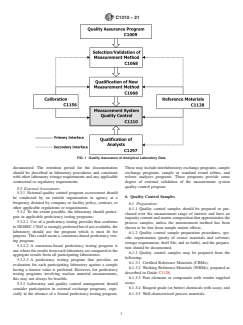
4.1 A laboratory quality assurance program is an essential program for laboratories within the nuclear industry. Guide C1009 provides guidance for establishing a quality assurance program for an analytical laboratory within the nuclear industry. This guide deals with the control of measurements aspect of the laboratory quality assurance program. Fig. 1 shows the relationship of measurement control with other essential aspects of a laboratory quality assurance program.
FIG. 1 Quality Assurance of Analytical Laboratory Data
4.2 The fundamental purposes of a measurement control program are to provide the with-use assurance (real-time control) that a measurement system is performing satisfactorily and to provide the data necessary to quantify measurement system performance. The with-use assurance is usually provided through the satisfactory analysis of quality control samples (reference value either known or unknown to the analyst). The data necessary to quantify measurement system performance is usually provided through the analysis of quality control samples or the duplicate analysis of process samples, or both. In addition to the analyses of quality control samples, the laboratory quality control program should address (1) the preparation and verification of standards and reagents, (2) data analysis procedures and documentation, (3) calibration and calibration procedures, (4) measurement method qualification, (5) analyst qualification, and (6) other general program considerations. Other elements of laboratory quality assurance also impact the laboratory quality control program. These elements or requirements include (1) chemical analysis procedures and procedure control, (2) records storage and retrieval requirements, (3) internal audit requirements, (4) organizational considerations, and (5) training/qualification requirements. To the extent possible, this standard will deal primarily with quality control requirements rather than overall quality assurance re...
SCOPE
1.1 This guide provides guidance for establishing and maintaining a measurement system quality control program. Guidance is provided for general program considerations, preparation of quality control samples, analysis of quality control samples, quality control data analysis, analyst qualification, measurement system calibration, measurement method qualification, and measurement system maintenance.
1.2 This guidance is provided in the following sections:
Section
General Quality Control Program Considerations
5
Quality Control Samples
6
Analysis of Quality Control Samples
7
Quality Control Data Analysis
8
Analyst Qualification
9
Measurement System Calibration
10
Qualification of Measurement Methods and Systems
11
Measurement System Maintenance
12
1.3 This international standard was developed in accordance with internationally recognized principles on standardization established in the Decision on Principles for the Development of International Standards, Guides and Recommendations issued by the World Trade Organization Technical Barriers to Trade (TBT) Committee.
- Status
- Published
- Publication Date
- 31-Jan-2021
- Technical Committee
- C26 - Nuclear Fuel Cycle
Buy Documents
ASTM C1210-21 - Standard Guide for Establishing a Measurement System Quality Control Program for Analytical Chemistry Laboratories Within Nuclear Industry
REDLINE ASTM C1210-21 - Standard Guide for Establishing a Measurement System Quality Control Program for Analytical Chemistry Laboratories Within Nuclear Industry
Overview
ASTM C1210-21: Standard Guide for Establishing a Measurement System Quality Control Program for Analytical Chemistry Laboratories Within Nuclear Industry provides comprehensive guidance for setting up and maintaining robust measurement system quality control programs in analytical chemistry laboratories operating within the nuclear sector. Developed by ASTM International, this standard supports laboratories in ensuring the reliability, accuracy, and traceability of analytical measurement results, which are vital for the safety and regulatory compliance in nuclear industry operations.
The guide focuses specifically on the measurement control aspect of laboratory quality assurance, supplementing general quality assurance frameworks such as ASTM C1009. It outlines procedures and considerations for quality control sample preparation, analysis, data evaluation, system calibration, analyst qualification, and measurement method validation.
Key Topics
- Quality Control Program Structure: Guidance on organizing and documenting an effective, internal quality control function, including the responsibilities of program administrators.
- Preparation and Use of Quality Control Samples: Recommendations for the preparation, labeling, documentation, and application of quality control samples (QCs), including certified reference materials and process materials.
- Measurement System Calibration: Requirements for calibration schedules, documentation, and handling of calibration failures or drift, ensuring metrological traceability and performance.
- Data Analysis and Control Limits: Procedures for statistical evaluation of QC data, establishing control limits, identifying out-of-control conditions, and documenting corrective actions to maintain measurement system integrity.
- Analyst and Method Qualification: Steps for qualifying laboratory analysts and analytical methods, ensuring personnel and systems consistently deliver results suitable for their intended purpose.
- Maintenance and Documentation: Best practices for documenting system maintenance, calibration, analyst qualifications, and retention of records in compliance with regulatory and laboratory policy.
- External Validation and Proficiency Testing: Importance of participation in proficiency testing programs and external assessments, enhancing confidence in measurement system performance.
Applications
ASTM C1210-21 is essential for:
- Analytical Chemistry Laboratories in the Nuclear Industry: Ensuring data quality, compliance with industry regulations, and reliable decision-making based on laboratory results.
- Quality Assurance Managers: Implementing comprehensive measurement control systems as part of a larger quality management system.
- Regulatory Compliance: Supporting adherence to international regulations and standards by documenting and qualifying measurement systems, analysts, and analysis methods.
- Proficiency Testing: Facilitating participation in interlaboratory comparisons and external proficiency tests to validate performance and identify areas for improvement.
- Instrument and System Calibration: Establishing traceable, repeatable calibration schedules and documentation to uphold integrity and credibility of laboratory results.
By establishing effective measurement control programs using this standard, laboratories enhance the confidence and reliability of analytical data critical to nuclear fuel cycle operations, safety monitoring, and regulatory reporting.
Related Standards
For a comprehensive quality control and assurance program, ASTM C1210-21 references and aligns with several related international and national standards, including:
- ASTM C1009: Guide for Establishing and Maintaining a Quality Assurance Program for Analytical Laboratories Within the Nuclear Industry
- ASTM C1068/C1156/C1128: Related guides for qualifying measurement methods and laboratory analysts
- ISO/IEC 17025: General requirements for the competence of testing and calibration laboratories
- ISO/IEC 17043: General requirements for proficiency testing
- ISO Guide 80: In-house preparation of quality control materials (QCMs)
- ANSI/ASQ B1, B2, B3: Quality control chart methodologies and analysis techniques
- ASTM E2554: Practice for estimating and monitoring measurement uncertainty using control charts
These standards together support a comprehensive approach to laboratory measurement system quality control and continuous improvement in the nuclear industry.
Keywords: ASTM C1210-21, measurement system quality control, analytical chemistry laboratory, nuclear industry, calibration, quality control samples, laboratory accreditation, data analysis, proficiency testing, method qualification.
Relations
- Effective Date
- 01-Jan-2024
- Effective Date
- 01-Sep-2018
- Effective Date
- 01-Jul-2018
- Effective Date
- 01-Apr-2018
- Effective Date
- 01-Apr-2018
- Effective Date
- 01-Feb-2015
- Effective Date
- 15-Jun-2014
- Effective Date
- 15-Jan-2014
- Effective Date
- 01-Jun-2013
- Effective Date
- 01-May-2013
- Effective Date
- 01-Apr-2013
- Effective Date
- 01-Jan-2013
- Effective Date
- 01-Jul-2012
- Effective Date
- 01-Jun-2011
- Effective Date
- 01-Jun-2011
Buy Documents
ASTM C1210-21 - Standard Guide for Establishing a Measurement System Quality Control Program for Analytical Chemistry Laboratories Within Nuclear Industry
REDLINE ASTM C1210-21 - Standard Guide for Establishing a Measurement System Quality Control Program for Analytical Chemistry Laboratories Within Nuclear Industry
Get Certified
Connect with accredited certification bodies for this standard

DNV
DNV is an independent assurance and risk management provider.

BSI Group
BSI (British Standards Institution) is the business standards company that helps organizations make excellence a habit.

Bureau Veritas
Bureau Veritas is a world leader in laboratory testing, inspection and certification services.
Sponsored listings
Frequently Asked Questions
ASTM C1210-21 is a guide published by ASTM International. Its full title is "Standard Guide for Establishing a Measurement System Quality Control Program for Analytical Chemistry Laboratories Within Nuclear Industry". This standard covers: SIGNIFICANCE AND USE 4.1 A laboratory quality assurance program is an essential program for laboratories within the nuclear industry. Guide C1009 provides guidance for establishing a quality assurance program for an analytical laboratory within the nuclear industry. This guide deals with the control of measurements aspect of the laboratory quality assurance program. Fig. 1 shows the relationship of measurement control with other essential aspects of a laboratory quality assurance program. FIG. 1 Quality Assurance of Analytical Laboratory Data 4.2 The fundamental purposes of a measurement control program are to provide the with-use assurance (real-time control) that a measurement system is performing satisfactorily and to provide the data necessary to quantify measurement system performance. The with-use assurance is usually provided through the satisfactory analysis of quality control samples (reference value either known or unknown to the analyst). The data necessary to quantify measurement system performance is usually provided through the analysis of quality control samples or the duplicate analysis of process samples, or both. In addition to the analyses of quality control samples, the laboratory quality control program should address (1) the preparation and verification of standards and reagents, (2) data analysis procedures and documentation, (3) calibration and calibration procedures, (4) measurement method qualification, (5) analyst qualification, and (6) other general program considerations. Other elements of laboratory quality assurance also impact the laboratory quality control program. These elements or requirements include (1) chemical analysis procedures and procedure control, (2) records storage and retrieval requirements, (3) internal audit requirements, (4) organizational considerations, and (5) training/qualification requirements. To the extent possible, this standard will deal primarily with quality control requirements rather than overall quality assurance re... SCOPE 1.1 This guide provides guidance for establishing and maintaining a measurement system quality control program. Guidance is provided for general program considerations, preparation of quality control samples, analysis of quality control samples, quality control data analysis, analyst qualification, measurement system calibration, measurement method qualification, and measurement system maintenance. 1.2 This guidance is provided in the following sections: Section General Quality Control Program Considerations 5 Quality Control Samples 6 Analysis of Quality Control Samples 7 Quality Control Data Analysis 8 Analyst Qualification 9 Measurement System Calibration 10 Qualification of Measurement Methods and Systems 11 Measurement System Maintenance 12 1.3 This international standard was developed in accordance with internationally recognized principles on standardization established in the Decision on Principles for the Development of International Standards, Guides and Recommendations issued by the World Trade Organization Technical Barriers to Trade (TBT) Committee.
SIGNIFICANCE AND USE 4.1 A laboratory quality assurance program is an essential program for laboratories within the nuclear industry. Guide C1009 provides guidance for establishing a quality assurance program for an analytical laboratory within the nuclear industry. This guide deals with the control of measurements aspect of the laboratory quality assurance program. Fig. 1 shows the relationship of measurement control with other essential aspects of a laboratory quality assurance program. FIG. 1 Quality Assurance of Analytical Laboratory Data 4.2 The fundamental purposes of a measurement control program are to provide the with-use assurance (real-time control) that a measurement system is performing satisfactorily and to provide the data necessary to quantify measurement system performance. The with-use assurance is usually provided through the satisfactory analysis of quality control samples (reference value either known or unknown to the analyst). The data necessary to quantify measurement system performance is usually provided through the analysis of quality control samples or the duplicate analysis of process samples, or both. In addition to the analyses of quality control samples, the laboratory quality control program should address (1) the preparation and verification of standards and reagents, (2) data analysis procedures and documentation, (3) calibration and calibration procedures, (4) measurement method qualification, (5) analyst qualification, and (6) other general program considerations. Other elements of laboratory quality assurance also impact the laboratory quality control program. These elements or requirements include (1) chemical analysis procedures and procedure control, (2) records storage and retrieval requirements, (3) internal audit requirements, (4) organizational considerations, and (5) training/qualification requirements. To the extent possible, this standard will deal primarily with quality control requirements rather than overall quality assurance re... SCOPE 1.1 This guide provides guidance for establishing and maintaining a measurement system quality control program. Guidance is provided for general program considerations, preparation of quality control samples, analysis of quality control samples, quality control data analysis, analyst qualification, measurement system calibration, measurement method qualification, and measurement system maintenance. 1.2 This guidance is provided in the following sections: Section General Quality Control Program Considerations 5 Quality Control Samples 6 Analysis of Quality Control Samples 7 Quality Control Data Analysis 8 Analyst Qualification 9 Measurement System Calibration 10 Qualification of Measurement Methods and Systems 11 Measurement System Maintenance 12 1.3 This international standard was developed in accordance with internationally recognized principles on standardization established in the Decision on Principles for the Development of International Standards, Guides and Recommendations issued by the World Trade Organization Technical Barriers to Trade (TBT) Committee.
ASTM C1210-21 is classified under the following ICS (International Classification for Standards) categories: 03.120.10 - Quality management and quality assurance; 27.120.01 - Nuclear energy in general. The ICS classification helps identify the subject area and facilitates finding related standards.
ASTM C1210-21 has the following relationships with other standards: It is inter standard links to ASTM C859-24, ASTM C1156-18, ASTM C1297-18, ASTM E2554-18, ASTM E2554-18e1, ASTM C1128-15, ASTM C859-14a, ASTM C859-14, ASTM C859-13a, ASTM C859-13, ASTM E2554-13, ASTM C1009-13, ASTM C1108-12, ASTM C1068-03(2011), ASTM C1297-03(2011). Understanding these relationships helps ensure you are using the most current and applicable version of the standard.
ASTM C1210-21 is available in PDF format for immediate download after purchase. The document can be added to your cart and obtained through the secure checkout process. Digital delivery ensures instant access to the complete standard document.
Standards Content (Sample)
This international standard was developed in accordance with internationally recognized principles on standardization established in the Decision on Principles for the
Development of International Standards, Guides and Recommendations issued by the World Trade Organization Technical Barriers to Trade (TBT) Committee.
Designation: C1210 − 21
Standard Guide for
Establishing a Measurement System Quality Control
Program for Analytical Chemistry Laboratories Within
Nuclear Industry
This standard is issued under the fixed designation C1210; the number immediately following the designation indicates the year of
original adoption or, in the case of revision, the year of last revision. A number in parentheses indicates the year of last reapproval. A
superscript epsilon (´) indicates an editorial change since the last revision or reapproval.
1. Scope C1108 Test Method for Plutonium by Controlled-Potential
Coulometry
1.1 This guide provides guidance for establishing and main-
C1128 Guide for Preparation of Working Reference Materi-
taining a measurement system quality control program. Guid-
als for Use in Analysis of Nuclear Fuel Cycle Materials
ance is provided for general program considerations, prepara-
C1156 Guide for Establishing Calibration for a Measure-
tion of quality control samples, analysis of quality control
ment Method Used to Analyze Nuclear Fuel Cycle Mate-
samples, quality control data analysis, analyst qualification,
rials
measurement system calibration, measurement method
C1297 Guide for Qualification of Laboratory Analysts for
qualification, and measurement system maintenance.
the Analysis of Nuclear Fuel Cycle Materials
1.2 This guidance is provided in the following sections:
E2554 Practice for Estimating and Monitoring the Uncer-
Section
tainty of Test Results of a Test Method Using Control
General Quality Control Program Considerations 5
Chart Techniques
Quality Control Samples 6
Analysis of Quality Control Samples 7 2.2 ANSI Standards:
Quality Control DataAnalysis 8
ANSI/ASQ B1 Guide for Quality Control Charts
Analyst Qualification 9
ANSI/ASQ B2 Control Chart Method of Analyzing Data
Measurement System Calibration 10
Qualification of Measurement Methods and Systems 11 ANSI/ASQB3 ControlChartMethodofControllingQuality
Measurement System Maintenance 12
During Production
1.3 This international standard was developed in accor-
2.3 ISO Standard:
dance with internationally recognized principles on standard-
ISO/IEC 17025 General requirements for the competence of
ization established in the Decision on Principles for the
testing and calibration laboratories
Development of International Standards, Guides and Recom-
ISO/IEC 17043 Conformity assessment — General require-
mendations issued by the World Trade Organization Technical
ments for proficiency testing
Barriers to Trade (TBT) Committee.
ISO Guide 80 Guidance for the in-house preparation of
quality control materials (QCMs)
2. Referenced Documents
2.1 ASTM Standards: 3. Terminology
C859 Terminology Relating to Nuclear Materials
3.1 For definitions of terms used in this guide but not
C1009 Guide for Establishing and Maintaining a Quality
defined herein, see Terminology C859.
Assurance Program forAnalytical LaboratoriesWithin the
3.2 Definitions:
Nuclear Industry
3.2.1 calibration, n—the set of operations that establishes,
C1068 Guide for Qualification of Measurement Methods by
under specified conditions, a metrologically traceable relation-
a Laboratory Within the Nuclear Industry
shipbetweenavaluemeasuredorindicatedbyaninstrumentor
system to a corresponding known value, typically derived from
This guide is under the jurisdiction ofASTM Committee C26 on Nuclear Fuel
appropriate reference standards or established physical con-
Cycle and is the direct responsibility of Subcommittee C26.08 on Quality
stants
Assurance, Statistical Applications, and Reference Materials.
Current edition approved Feb. 1, 2021. Published March 2021. Originally
approved in 1991. Last previous edition approved in 2018 as C1210 – 18. DOI:
10.1520/C1210-21. Available from American National Standards Institute (ANSI), 25 W. 43rd St.,
For referenced ASTM standards, visit the ASTM website, www.astm.org, or 4th Floor, New York, NY 10036, http://www.ansi.org.
contact ASTM Customer Service at service@astm.org. For Annual Book of ASTM Available from International Organization for Standardization (ISO), ISO
Standards volume information, refer to the standard’s Document Summary page on Central Secretariat, Chemin de Blandonnet 8, CP 401, 1214 Vernier, Geneva,
the ASTM website. Switzerland, https://www.iso.org.
Copyright ©ASTM International, 100 Barr Harbor Drive, PO Box C700, West Conshohocken, PA19428-2959. United States
C1210 − 21
3.2.1.1 Discussion—The calibration relationship can be ex- try. This guide deals with the control of measurements aspect
pressed by a statement, function, diagram or table. of the laboratory quality assurance program. Fig. 1 shows the
3.2.1.2 Discussion—Test Method C1108 is an example of relationship of measurement control with other essential as-
calibration using established physical constants. pects of a laboratory quality assurance program.
3.2.1.3 Discussion—Additional details on calibration re-
4.2 The fundamental purposes of a measurement control
quirements for measurement methods used for the nuclear fuel
program are to provide the with-use assurance (real-time
cycle can be found in Guide C1156.
control)thatameasurementsystemisperformingsatisfactorily
3.2.2 measurement method, n—Technique for determination
and to provide the data necessary to quantify measurement
of the presence, or quantity, or both, of one or more analytes in
system performance. The with-use assurance is usually pro-
a sample.
vided through the satisfactory analysis of quality control
samples (reference value either known or unknown to the
3.2.2.1 Discussion—A measurement method may utilize
analyst). The data necessary to quantify measurement system
chemicalreactions(suchastitrations),instrumentation(suchas
performanceisusuallyprovidedthroughtheanalysisofquality
aspectrometer),orboth.Anysamplepreparationrequiredprior
controlsamplesortheduplicateanalysisofprocesssamples,or
to the analysis is part of the measurement method.
both. In addition to the analyses of quality control samples, the
3.2.3 measurement system, n—set of all components used to
laboratory quality control program should address (1) the
produce an analytical result.
preparation and verification of standards and reagents, (2) data
3.2.3.1 Discussion—Components may include, for example,
analysis procedures and documentation, (3) calibration and
equipmentorinstrumentationusedtopreparesamples,perform
calibration procedures, (4) measurement method qualification,
the analytical measurement, perform any needed data
(5) analyst qualification, and (6) other general program con-
manipulations, and record results in printed or electronic form,
siderations.Otherelementsoflaboratoryqualityassurancealso
or both.
impact the laboratory quality control program. These elements
3.2.4 metrological traceability, n—property of a measure-
or requirements include (1) chemical analysis procedures and
ment result whereby the result can be related to a reference
procedure control, (2) records storage and retrieval
through a documented unbroken chain of calibrations, each
requirements, (3) internal audit requirements, (4) organiza-
contributing to the measurement uncertainty.
tional considerations, and (5) training/qualification require-
3.2.5 qualification, n—of a measurement method, a formal
ments. To the extent possible, this standard will deal primarily
process to provide a desired level of confidence that measure-
with quality control requirements rather than overall quality
mentmethodsusedwillproducedatasuitablefortheirintended
assurance requirements, which are addressed in Guide C1009.
use. C1068
4.3 Although this guide uses suggestive rather than pre-
3.2.5.1 Discussion—Qualification follows verification and
scriptive language (for example, “should” as opposed to
validation, and ensures that methods meet established criteria “shall”), the elements being addressed should not be inter-
prior to use and when placed into use.
preted as optional. An effective and comprehensive laboratory
3.2.6 quality control program, n—documented system of
quality control program should, at minimum, completely and
activities utilizing quality control samples and appropriate
adequately consider and include all elements listed in Section
acceptance criteria to ensure that measurement systems are
1 and in the corresponding referenced sections of this guide.
producing results that are suitable for their intended purpose.
5. General Quality Control Program Considerations
3.2.7 quality control sample, n—a sample used to verify and
monitor measurement system performance and reliability.
5.1 The quality control activities described in this guide are
3.2.7.1 Discussion—Quality control samples may include
intended for a quality control function which is internal to an
knowns, unknowns, blinds, blanks, duplicates, matrix spikes,
analytical chemistry laboratory. The quality control program
and so forth.
should have an administrator or manager working in concert
3.2.7.2 Discussion—Qualitycontrolsamplesmaybeusedto
with laboratory managers to produce cost effective measure-
estimate bias in the measurement system or analytical method.
ments of demonstrated and acceptable quality. The program
3.2.8 validation, n—of a measurement method, provision of manager should have the authority based on quality control
objective evidence that a given item fulfils specified require-
sample performance to disqualify analysts or measurement
mentswheretherequirementsareadequateforanintendeduse. systems, or to request or require additional quality control
ISO/IEC 17025
sample analyses. It is desirable for the quality control program
to have periodic internal assessments on a pre-determined
3.2.9 verification, n—of a measurement method, provision
schedule. These assessments should involve laboratory
of objective evidence that a given item fulfils specified
managers, the quality control manager, and laboratory custom-
requirements. ISO/IEC 17025
ers. The quality control program should be audited for proce-
dure compliance at periodic intervals by the quality assurance
4. Significance and Use
organization.
4.1 A laboratory quality assurance program is an essential
program for laboratories within the nuclear industry. Guide 5.2 Documentation—The analytical laboratory’s quality
C1009 provides guidance for establishing a quality assurance control program should be described in laboratory procedures
program for an analytical laboratory within the nuclear indus- andallmeasurementsystemqualitycontrolactivitiesshouldbe
C1210 − 21
FIG. 1 Quality Assurance of Analytical Laboratory Data
documented. The retention period for the documentation These may include interlaboratory exchange programs, sample
should be described in laboratory procedures and consistent exchange programs, sample or standard round robins, and
with other laboratory storage requirements and any applicable referee analyses programs. These programs provide some
contractual or regulatory requirements. degree of external validation of the measurement system
quality control program.
5.3 External Assessment:
5.3.1 External quality control program ascsessment should
6. Quality Control Samples
be conducted by an outside organization or agency at a
frequency dictated by company or facility policy, contract, or
6.1 Preparation:
other applicable regulations or requirements.
6.1.1 Quality control samples should be prepared or pur-
5.3.2 To the extent possible, the laboratory should partici-
chased over the measurement range of interest and have an
pate in applicable proficiency testing programs:
impurity content and matrix composition that approximates the
5.3.2.1 Use of a proficiency testing provider that conforms
process samples, unless the measurement method has been
to ISO/IEC 17043 is strongly preferred but if not available, the
shown to be free from sample matrix effects.
laboratory should use the program which is most fit for
6.1.2 Quality control sample preparation procedures, spe-
purpose. This could mean a consensus-based proficiency test-
cific requirements (purity of source materials and solvents;
ing program.
storage requirement; shelf life; and so forth), and the prepara-
5.3.2.2 A consensus-based proficiency testing program is
tion should be documented.
one where the results from each laboratory are compared to the
6.1.3 Quality control samples may be prepared from the
aggregate results from all participating laboratories.
following:
5.3.2.3 A proficiency testing program that provides an
6.1.3.1 Certified Reference Materials (CRMs);
evaluation for each participating laboratory against a sample
6.1.3.2 Working Reference Materials (WRMs), prepared as
having a known value is preferred. However, for proficiency
described in Guide C1128;
testing programs involving nuclear material measurements,
6.1.3.3 Pure elements or compounds with vendor supplied
this may not always be feasible.
assay;
5.3.3 Laboratory and quality control management should
6.1.3.4 Reagent grade (or better) chemicals with assay; and
consider participation in external exchange programs, espe-
cially in the absence of a formal proficiency testing program. 6.1.3.5 Well-characterized process materials.
C1210 − 21
6.2 Quality Control Samples: both functions can significantly increase the amount of data
available to model measurement systems.
6.2.1 When used for comparison to a reference value (such
as for calibration), exhibit metrological traceability to the
7.2 The frequency of analysis of quality control samples
Système International d’Unités (SI).
should be determined and described in laboratory procedures.
6.2.2 When used for statistical control of a measurement
The frequency should be a function of the stability of the
system, instrument performance checks, or determination of
measurement system.
operator variability, need not be metrologically traceable to the
7.3 Totheextentpossible,qualitycontrolsamplesshouldbe
SI. For these applications, quality control materials (QCM), as
representative of the samples that will be measured.
defined by ISO Guide 80, may be used.
7.4 Quality control samples should be subjected to the same
6.3 When quality control samples are prepared, the prepa-
ration procedure and data (mass, volume, etc.) should be analysis conditions as the actual samples.The condition should
be the same over the entire analysis sequence from sample
documented. Further, appropriate measurements should be
performed to verify the prepared value. aliquoting and preparation to data reduction.
7.4.1 When quality control samples are not subjected to a
6.4 The quality control samples should be characterized to
portion of the sample analysis sequence, sufficient documen-
establish their reference values when prepared from materials
tationshouldexisttodemonstratethattheportionofthesystem
with uncertain assays, or from process material, or when
that is not covered does not contribute significantly to the
smaller uncertainties are required on the samples than can be
measurement system bias and precision. The limitations that
obtained from the source materials.Arecord of the preparation
exists for not covering the entire sequence should be under-
procedure and data should be maintained. The characterization
stood and documented.
method or procedure, complete with calibration data and the
7.4.2 Even though sample aliquoting by mass or by volume
characterization analysis results, should be referenced or in-
may be included in the analysis of quality control samples, this
cluded in the preparation data.
function is so fundamental and common to nearly all measure-
6.5 Quality control samples should be prepared from a
ment systems that laboratories should maintain calibration and
different supplier lot from the standards used for calibration
quality control programs on balances and, if applicable, on
(see Guide C1156).
volumealiquotingandmeasuringdevices.Balanceandvolume
6.6 All quality control samples should be labeled with (1) aliquoting devices should be treated as measurement systems
the concentration, activity, abundance, etc. of the species of
or methods and should have calibration and quality control
interest, (2) solvent if other than water, (3) matrix, (4) date programs that satisfy the information contained in this guide
prepared, (5) identification of preparer, and (6) storage require-
and in Guide C1009.
ments or limitations.Alternately, QC samples should be coded
7.5 The analysis of qu
...
This document is not an ASTM standard and is intended only to provide the user of an ASTM standard an indication of what changes have been made to the previous version. Because
it may not be technically possible to adequately depict all changes accurately, ASTM recommends that users consult prior editions as appropriate. In all cases only the current version
of the standard as published by ASTM is to be considered the official document.
Designation: C1210 − 18 C1210 − 21
Standard Guide for
Establishing a Measurement System Quality Control
Program for Analytical Chemistry Laboratories Within the
Nuclear Industry
This standard is issued under the fixed designation C1210; the number immediately following the designation indicates the year of
original adoption or, in the case of revision, the year of last revision. A number in parentheses indicates the year of last reapproval. A
superscript epsilon (´) indicates an editorial change since the last revision or reapproval.
1. Scope
1.1 This standardguide provides guidance for establishing and maintaining a measurement system quality control program.
Guidance is provided for general program considerations, preparation of quality control samples, analysis of quality control
samples, quality control data analysis, analyst qualification, measurement system calibration, measurement method qualification,
and measurement system maintenance.
1.2 This guidance is provided in the following sections:
Section
General Quality Control Program Considerations 5
Quality Control Samples 6
Analysis of Quality Control Samples 7
Quality Control Data Analysis 8
Analyst Qualification 9
Measurement System Calibration 10
Measurement Method Qualification 11
Qualification of Measurement Methods and Systems 11
Measurement System Maintenance 12
1.3 This international standard was developed in accordance with internationally recognized principles on standardization
established in the Decision on Principles for the Development of International Standards, Guides and Recommendations issued
by the World Trade Organization Technical Barriers to Trade (TBT) Committee.
2. Referenced Documents
2.1 ASTM Standards:
C859 Terminology Relating to Nuclear Materials
C1009 Guide for Establishing and Maintaining a Quality Assurance Program for Analytical Laboratories Within the Nuclear
Industry
C1068 Guide for Qualification of Measurement Methods by a Laboratory Within the Nuclear Industry
C1108 Test Method for Plutonium by Controlled-Potential Coulometry
C1128 Guide for Preparation of Working Reference Materials for Use in Analysis of Nuclear Fuel Cycle Materials
This guide is under the jurisdiction of ASTM Committee C26 on Nuclear Fuel Cycle and is the direct responsibility of Subcommittee C26.08 on Quality Assurance,
Statistical Applications, and Reference Materials.
Current edition approved Nov. 1, 2018Feb. 1, 2021. Published December 2018March 2021. Originally approved in 1991. Last previous edition approved in 20122018 as
C1210 – 12.C1210 – 18. DOI: 10.1520/C1210-18.10.1520/C1210-21.
For referenced ASTM standards, visit the ASTM website, www.astm.org, or contact ASTM Customer Service at service@astm.org. For Annual Book of ASTM Standards
volume information, refer to the standard’s Document Summary page on the ASTM website.
Copyright © ASTM International, 100 Barr Harbor Drive, PO Box C700, West Conshohocken, PA 19428-2959. United States
C1210 − 21
C1156 Guide for Establishing Calibration for a Measurement Method Used to Analyze Nuclear Fuel Cycle Materials
C1297 Guide for Qualification of Laboratory Analysts for the Analysis of Nuclear Fuel Cycle Materials
E2554 Practice for Estimating and Monitoring the Uncertainty of Test Results of a Test Method Using Control Chart Techniques
2.2 ANSI Standards:
ANSI/ASQ B1 Guide for Quality Control Charts
ANSI/ASQ B2 Control Chart Method of Analyzing Data
ANSI/ASQ B3 Control Chart Method of Controlling Quality During Production
2.3 ISO Standard:
ISO/IEC 17025 General requirements for the competence of testing and calibration laboratories
ISO/IEC 17043 Conformity assessment — General requirements for proficiency testing
ISO Guide 80 Guidance for the in-house preparation of quality control materials (QCMs)
3. Terminology
3.1 For definitions of terms used in this guide but not defined herein, see Terminology C859.
3.2 Definitions:
3.2.1 calibration, n—the set of operations that establishes, under specified conditions, a metrologically traceable relationship
between a value measured or indicated by an instrument or system to a corresponding known value, typically derived from
appropriate reference standards or established physical constants
3.2.1.1 Discussion—
The calibration relationship can be expressed by a statement, function, diagram or table.
3.2.1.2 Discussion—
Test Method C1108 is an example of calibration using established physical constants.
3.2.1.3 Discussion—
Additional details on calibration requirements for measurement methods used for the nuclear fuel cycle can be found in Guide
C1156.
3.2.2 measurement method, n—Technique for determination of the presence, or quantity, or both, of one or more analytes in a
sample.
3.2.2.1 Discussion—
A measurement method may utilize chemical reactions (such as titrations), instrumentation (such as a spectrometer), or both. Any
sample preparation required prior to the analysis is part of the measurement method.
3.2.3 measurement system, n—set of all components used to produce an analytical result.
3.2.3.1 Discussion—
Components may include, for example, equipment or instrumentation used to prepare samples, perform the analytical
measurement, perform any needed data manipulations, and record results in printed or electronic form, or both.
3.2.4 metrological traceability, n—property of a measurement result whereby the result can be related to a reference through a
documented unbroken chain of calibrations, each contributing to the measurement uncertainty.
3.2.5 qualification, n—of a measurement method, a formal process to provide a desired level of confidence that measurement
methods used will produce data suitable for their intended use. C1068
3.2.5.1 Discussion—
Qualification follows verification and validation, and ensures that methods meet established criteria prior to use and when placed
into use.
3.2.6 quality control program, n—documented system of activities utilizing quality control samples and appropriate acceptance
criteria to ensure that measurement systems are producing results that are suitable for their intended purpose.
3.2.7 quality control sample, n—a sample used to verify and monitor measurement system performance and reliability.
Available from American National Standards Institute (ANSI), 25 W. 43rd St., 4th Floor, New York, NY 10036.10036, http://www.ansi.org.
Available from International Organization for Standardization (ISO), ISO Central Secretariat, Chemin de Blandonnet 8, CP 401, 1214 Vernier, Geneva, Switzerland,
https://www.iso.org.
C1210 − 21
3.2.7.1 Discussion—
Quality control samples may include knowns, unknowns, blinds, blanks, duplicates, matrix spikes, and so forth.
3.2.7.2 Discussion—
Quality control samples may be used to estimate bias in the measurement system or analytical method.
3.2.8 validation, n—of a measurement method, provision of objective evidence that a given item fulfils specified requirements
where the requirements are adequate for an intended use. ISO/IEC 17025
3.2.9 verification, n—of a measurement method, provision of objective evidence that a given item fulfils specified requirements.
ISO/IEC 17025
4. Significance and Use
4.1 A laboratory quality assurance program is an essential program for laboratories within the nuclear industry. Guide C1009
provides guidance for establishing a quality assurance program for an analytical laboratory within the nuclear industry. The basic
elements of a laboratory quality assurance program are organization, quality assurance program, training and qualification,
procedures, laboratory records, control of records, control of procurement, control of measuring equipment and materials, control
of measurements, and deficiencies and corrective actions. This guide deals with the control of measurements aspect of the
laboratory quality assurance program. Fig. 1 shows the relationship of measurement control with other essential aspects of a
laboratory quality assurance program.
4.2 The fundamental purposes of a measurement control program are to provide the with usewith-use assurance (real-time control)
that a measurement system is performing satisfactorily and to provide the data necessary to quantify measurement system
performance. The with usewith-use assurance is usually provided through the satisfactory analysis of quality control samples
(reference value either known or unknown to the analyst). The data necessary to quantify measurement system performance is
usually provided through the analysis of quality control samples or the duplicate analysis of process samples, or both. In addition
to the analyses of quality control samples, the laboratory quality control program should address (1) the preparation and verification
of standards and reagents, (2) data analysis procedures and documentation, (3) calibration and calibration procedures, (4)
FIG. 1 Quality Assurance of Analytical Laboratory Data
C1210 − 21
measurement method qualification, (5) analyst qualification, and (6) other general program considerations. Other elements of
laboratory quality assurance also impact the laboratory quality control program. These elements or requirements include (1)
chemical analysis procedures and procedure control, (2) records storage and retrieval requirements, (3) internal audit requirements,
(4) organizational considerations, and (5) training/qualification requirements. To the extent possible, this standard will deal
primarily with quality control requirements rather than overall quality assurance requirements.requirements, which are addressed
in Guide C1009.
4.3 Although this guide uses suggestive rather than prescriptive language (for example, “should” as opposed to “shall”), the
elements being addressed should not be interpreted as optional. An effective and comprehensive laboratory quality control program
should, at minimum, completely and adequately consider and include all elements listed in Section 1 and in the corresponding
referenced sections of this guide.
5. General Quality Control Program Considerations
5.1 The quality control activities described in this guide are intended for a quality control function which is internal to an analytical
chemistry laboratory. The quality control program should have an administrator or manager working in concert with laboratory
managers to produce cost effective measurements of demonstrated and acceptable quality. The program manager should have the
authority based on quality control sample performance to disqualify analysts or measurement systems, or to request or require
additional quality control sample analyses. It is desirable for the quality control program to have periodic internal assessments on
a pre-determined schedule. These assessments should involve laboratory managers, the quality control manager, and laboratory
customers. The quality control program should be audited for procedure compliance at periodic intervals by the quality assurance
organization.
5.2 Documentation—The analytical laboratory’s quality control program should be described in laboratory procedures and all
measurement system quality control activities should be documented. The retention period for the documentation should be
described in laboratory procedures and consistent with other laboratory storage requirements and any applicable contractual or
regulatory requirements.
5.3 External quality control program assessment should be conducted by an outside organization or agency at a frequency dictated
by company or facility policy, contract, or other applicable regulations or requirements. When possible, laboratory and quality
control management should involve laboratory measurement systems in external exchange programs, such as: interlaboratory
exchange programs, sample exchange programs, sample or standard round robins, and referee analyses programs. The programs
provide some degree of external verification or validation of the measurement system quality control program that is
desirable.External Assessment:
5.3.1 External quality control program ascsessment should be conducted by an outside organization or agency at a frequency
dictated by company or facility policy, contract, or other applicable regulations or requirements.
5.3.2 To the extent possible, the laboratory should participate in applicable proficiency testing programs:
5.3.2.1 Use of a proficiency testing provider that conforms to ISO/IEC 17043 is strongly preferred but if not available, the
laboratory should use the program which is most fit for purpose. This could mean a consensus-based proficiency testing program.
5.3.2.2 A consensus-based proficiency testing program is one where the results from each laboratory are compared to the aggregate
results from all participating laboratories.
5.3.2.3 A proficiency testing program that provides an evaluation for each participating laboratory against a sample having a
known value is preferred. However, for proficiency testing programs involving nuclear material measurements, this may not
always be feasible.
5.3.3 Laboratory and quality control management should consider participation in external exchange programs, especially in the
absence of a formal proficiency testing program. These may include interlaboratory exchange programs, sample exchange
programs, sample or standard round robins, and referee analyses programs. These programs provide some degree of external
validation of the measurement system quality control program.
6. Quality Control Samples
6.1 Preparation:
C1210 − 21
6.1.1 Quality control samples should be prepared or purchased over the measurement range of interest and have an impurity
content and matrix composition that approximates the process samples, unless the measurement method has been shown to be free
from sample matrix effects.
6.1.2 Quality control sample preparation procedures, specific requirements (purity of source materials and solvents; storage
requirement; shelf life; and so forth), and the preparation should be documented.
6.1.3 Quality control samples may be prepared from the following:
6.1.3.1 Certified Reference Materials (CRMs);
6.1.3.2 Working Reference Materials (WRMs), prepared as described in Guide C1128;
6.1.3.3 Pure elements or compounds with vendor supplied assay;
6.1.3.4 Reagent grade (or better) chemicals with assay; and
6.1.3.5 Well-characterized process materials.
C1210 − 21
6.2 Quality Control Samples:
6.2.1 When used for comparison to a reference value (such as for calibration), exhibit metrological traceability to the Système
International d’Unités (SI).
6.2.2 When used for statistical control of a measurement system, instrument performance checks, or determination of operator
variability, need not be metrologically traceable to the SI. For these applications, quality control materials (QCM), as defined by
ISO Guide 80, may be used.
6.3 When quality control samples are prepared, the preparation procedure and data (mass, volume, etc.) should be documented.
Further, appropriate measurements should be performed to verify the prepared value.
6.4 The quality control samples should be characterized to establish their reference values when prepared from materials with
uncertain assays, or from process material, or when smaller uncertainties are required on the samples than can be obtained from
the source materials. A record of the preparation procedure and data should be maintained. The characterization method or
procedure, complete with calibration data and the characterization analysis results, should be referenced or included in the
preparation data.
6.5 Quality control samples should be prepared from a different supplier lot from the standards used for calibration (see Guide
C1156).
6.6 All quality control samples should be labeled with (1) the concentration, activity, abundance, etc. of the species of interest,
(2) solvent if other than water, (3) matrix, (4) date prepared, (5) identification of preparer, and (6) storage requirements or
limitations. Alternately, QC samples should be coded in such a manner as to uniquely identify this same information.
6.7 All incoming chemicals and RMs should be labeled with a shelf life, acceptance date, or expiration date, if applicable.
7. Analysis of Quality Control Samples
7.1 The analysis of data from quality control samples provides a demonstration of measurement system performance and provides
the information necessary to quantify that performance over the portion of the system covered by the quality control samples. The
reference value of the quality control samples may be either known or unknown to the analyst.
7.1.1 The analysis of known quality control samples can provide a satisfactory bench demonstration of whether a system is in-
or out-of-control without the need for a computer based quality control program. In general, the data resulting from the analysis
of known quality control samples is not recommended for quantifying measurement system performance.
7.1.2 In general, the analysis of unknown quality control samples provides the data necessary to quantify measurement system
performance. The data resulting from the analysis of unknown quality control samples may also be used to provide the with
use
...