

ASTM C1156-18
(Guide)Standard Guide for Establishing Calibration for a Measurement Method Used to Analyze Nuclear Fuel Cycle Materials
General Information
- Abstract
SIGNIFICANCE AND USE
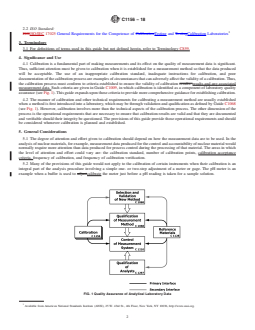
4.1 Calibration is a fundamental part of making measurements and its effect on the quality of measurement data is significant. Thus, sufficient attention must be given to calibration when it is established for a measurement method so that the data produced will be acceptable. The use of an inappropriate calibration standard, inadequate instructions for calibration, and poor documentation of the calibration process are examples of circumstances that can adversely affect the validity of a calibration. Thus, the calibration process must conform to criteria established to ensure the validity of calibration results and any associated measurement data. Such criteria are given in Guide C1009, in which calibration is identified as a component of laboratory quality assurance (see Fig. 1). This guide expands upon those criteria to provide more comprehensive guidance for establishing calibration.
FIG. 1 Quality Assurance of Analytical Laboratory Data
4.2 The manner of calibration and other technical requirements for calibrating a measurement method are usually established when a method is first introduced into a laboratory, which may be through validation and qualification as defined by Guide C1068 (see Fig. 1). However, calibration involves more than the technical aspects of the calibration process. The other dimension of the process is the operational requirements that are necessary to ensure that calibration results are valid and that they are documented and verifiable should their integrity be questioned. The provisions of this guide provide those operational requirements and should be considered whenever calibration is planned and established.
SCOPE
1.1 This guide provides the basis for establishing calibration for a measurement method typically used in an analytical chemistry laboratory analyzing nuclear materials. Guidance is included for such activities as preparing a calibration procedure, selecting a calibration standard, controlling calibrated equipment, and documenting calibration. The guide is generic and any required technical information specific for a given method must be obtained from other sources.
1.2 The guidance information is provided in the following sections:
Section
General Considerations
5
Calibration Procedure
6
Calibration Standard
7
Control of Calibrated Equipment
8
Documentation
9
Keywords
10
1.3 This standard does not purport to address all of the safety concerns, if any, associated with its use. It is the responsibility of the user of this standard to establish appropriate safety, health, and environmental practices and determine the applicability of regulatory limitations prior to use.
1.4 This international standard was developed in accordance with internationally recognized principles on standardization established in the Decision on Principles for the Development of International Standards, Guides and Recommendations issued by the World Trade Organization Technical Barriers to Trade (TBT) Committee.
- Status
- Published
- Publication Date
- 31-Aug-2018
- Technical Committee
- C26 - Nuclear Fuel Cycle
Buy Documents

ASTM C1156-18 - Standard Guide for Establishing Calibration for a Measurement Method Used to Analyze Nuclear Fuel Cycle Materials

REDLINE ASTM C1156-18 - Standard Guide for Establishing Calibration for a Measurement Method Used to Analyze Nuclear Fuel Cycle Materials
Overview
ASTM C1156-18: Standard Guide for Establishing Calibration for a Measurement Method Used to Analyze Nuclear Fuel Cycle Materials provides comprehensive guidance for calibrating analytical chemistry methods in laboratories engaged in the measurement of nuclear fuel cycle materials. Calibration is essential to ensuring the validity, accuracy, and quality of analytical data. This standard addresses best practices for developing calibration procedures, selecting appropriate reference standards, managing calibration equipment, and maintaining thorough documentation. By following this guide, laboratories can meet quality assurance requirements and produce reliable data for both operational control and regulatory compliance.
Key Topics
Calibration Essentials
- Emphasizes the importance of calibration in achieving accurate measurement results for nuclear material analysis.
- Discusses the negative impact of using inappropriate standards, incomplete calibration instructions, and inadequate documentation.
Calibration Procedures
- Outlines the need for a written calibration procedure, either as a standalone document or as part of a measurement method.
- Stresses the necessity of clear instructions, technical adequacy, management approval, and control of procedural revisions.
- Specifies required procedure content, including:
- Identification of equipment to be calibrated
- Description and treatment of calibration standards
- Frequency of calibration and verification
- Step-by-step calibration instructions
- Criteria for recalibration
Selection and Use of Calibration Standards
- Differentiates between certified reference materials (CRM) and working reference materials (WRM).
- Guides selection based on measurement requirements, traceability, availability, and stability.
- Highlights the need for proper preparation, handling, and storage to maintain the integrity of calibration standards.
Control of Calibrated Equipment
- Recommends unique identification of equipment requiring calibration and documentation of status through labeling or digital record systems.
- Advises on handling equipment to maintain calibration validity, managing out-of-calibration situations, and verifying calibration status when equipment is removed from service.
Documentation and Quality Assurance
- Underscores the role of comprehensive documentation in supporting measurements, ensuring traceability, and enabling historical review.
- Requires detailed calibration records, including personnel, methods, standards, data, and any actions related to out-of-calibration events.
Applications
Practical Uses in the Nuclear Industry
- Analytical laboratories responsible for nuclear fuel cycle materials benefit from robust calibration practices by generating high-quality measurement data used for:
- Nuclear material control and accountability
- Process control and optimization
- Meeting regulatory compliance and audit requirements
- The guidance applies to a variety of analytical measurement systems, from complex instrumentation to basic equipment such as pH meters.
- Organizations can improve laboratory quality assurance programs by integrating these calibration procedures and documentation standards.
Operational Value
- Enhances confidence in measurement results used in sensitive and regulated environments.
- Facilitates auditor and stakeholder verification of laboratory practices and data integrity.
- Supports compliance with international quality standards, such as ISO/IEC 17025, for laboratory accreditation.
Related Standards
ASTM C1156-18 directly references and aligns with several other important standards in the field of nuclear material analysis and laboratory quality assurance:
- ASTM C859: Terminology Relating to Nuclear Materials
- ASTM C1009: Guide for Establishing and Maintaining a Quality Assurance Program for Analytical Laboratories Within the Nuclear Industry
- ASTM C1068: Guide for Qualification of Measurement Methods by a Laboratory Within the Nuclear Industry
- ASTM C1128: Guide for Preparation of Working Reference Materials for Use in Analysis of Nuclear Fuel Cycle Materials
- ASTM C1210: Guide for Establishing a Measurement System Quality Control Program for Analytical Chemistry Laboratories Within the Nuclear Industry
- ASTM C1215: Guide for Preparing and Interpreting Precision and Bias Statements in Test Method Standards Used in the Nuclear Industry
- ASTM C1297: Guide for Qualification of Laboratory Analysts for the Analysis of Nuclear Fuel Cycle Materials
- ISO/IEC 17025: General requirements for the competence of testing and calibration laboratories
These documents collectively support laboratories in managing measurement quality and regulatory obligations. For more information, consult the relevant ASTM and ISO standards or visit www.astm.org.
Relations
- Effective Date
- 01-Sep-2018
- Effective Date
- 01-Jan-2024
- Effective Date
- 01-Jul-2018
- Effective Date
- 01-Jul-2018
- Effective Date
- 01-Feb-2015
- Effective Date
- 15-Jun-2014
- Effective Date
- 15-Jan-2014
- Effective Date
- 01-Jun-2013
- Effective Date
- 01-May-2013
- Effective Date
- 01-Jan-2013
- Effective Date
- 01-Jun-2012
- Effective Date
- 01-Jun-2012
- Effective Date
- 01-Jun-2011
- Effective Date
- 01-Jun-2011
- Effective Date
- 01-Nov-2010
Buy Documents
ASTM C1156-18 - Standard Guide for Establishing Calibration for a Measurement Method Used to Analyze Nuclear Fuel Cycle Materials
REDLINE ASTM C1156-18 - Standard Guide for Establishing Calibration for a Measurement Method Used to Analyze Nuclear Fuel Cycle Materials
Get Certified
Connect with accredited certification bodies for this standard

DNV
DNV is an independent assurance and risk management provider.

Lloyd's Register
Lloyd's Register is a global professional services organisation specialising in engineering and technology.
DNV Energy Systems
Energy and renewable energy certification.
Sponsored listings
Frequently Asked Questions
ASTM C1156-18 is a guide published by ASTM International. Its full title is "Standard Guide for Establishing Calibration for a Measurement Method Used to Analyze Nuclear Fuel Cycle Materials". This standard covers: SIGNIFICANCE AND USE 4.1 Calibration is a fundamental part of making measurements and its effect on the quality of measurement data is significant. Thus, sufficient attention must be given to calibration when it is established for a measurement method so that the data produced will be acceptable. The use of an inappropriate calibration standard, inadequate instructions for calibration, and poor documentation of the calibration process are examples of circumstances that can adversely affect the validity of a calibration. Thus, the calibration process must conform to criteria established to ensure the validity of calibration results and any associated measurement data. Such criteria are given in Guide C1009, in which calibration is identified as a component of laboratory quality assurance (see Fig. 1). This guide expands upon those criteria to provide more comprehensive guidance for establishing calibration. FIG. 1 Quality Assurance of Analytical Laboratory Data 4.2 The manner of calibration and other technical requirements for calibrating a measurement method are usually established when a method is first introduced into a laboratory, which may be through validation and qualification as defined by Guide C1068 (see Fig. 1). However, calibration involves more than the technical aspects of the calibration process. The other dimension of the process is the operational requirements that are necessary to ensure that calibration results are valid and that they are documented and verifiable should their integrity be questioned. The provisions of this guide provide those operational requirements and should be considered whenever calibration is planned and established. SCOPE 1.1 This guide provides the basis for establishing calibration for a measurement method typically used in an analytical chemistry laboratory analyzing nuclear materials. Guidance is included for such activities as preparing a calibration procedure, selecting a calibration standard, controlling calibrated equipment, and documenting calibration. The guide is generic and any required technical information specific for a given method must be obtained from other sources. 1.2 The guidance information is provided in the following sections: Section General Considerations 5 Calibration Procedure 6 Calibration Standard 7 Control of Calibrated Equipment 8 Documentation 9 Keywords 10 1.3 This standard does not purport to address all of the safety concerns, if any, associated with its use. It is the responsibility of the user of this standard to establish appropriate safety, health, and environmental practices and determine the applicability of regulatory limitations prior to use. 1.4 This international standard was developed in accordance with internationally recognized principles on standardization established in the Decision on Principles for the Development of International Standards, Guides and Recommendations issued by the World Trade Organization Technical Barriers to Trade (TBT) Committee.
SIGNIFICANCE AND USE 4.1 Calibration is a fundamental part of making measurements and its effect on the quality of measurement data is significant. Thus, sufficient attention must be given to calibration when it is established for a measurement method so that the data produced will be acceptable. The use of an inappropriate calibration standard, inadequate instructions for calibration, and poor documentation of the calibration process are examples of circumstances that can adversely affect the validity of a calibration. Thus, the calibration process must conform to criteria established to ensure the validity of calibration results and any associated measurement data. Such criteria are given in Guide C1009, in which calibration is identified as a component of laboratory quality assurance (see Fig. 1). This guide expands upon those criteria to provide more comprehensive guidance for establishing calibration. FIG. 1 Quality Assurance of Analytical Laboratory Data 4.2 The manner of calibration and other technical requirements for calibrating a measurement method are usually established when a method is first introduced into a laboratory, which may be through validation and qualification as defined by Guide C1068 (see Fig. 1). However, calibration involves more than the technical aspects of the calibration process. The other dimension of the process is the operational requirements that are necessary to ensure that calibration results are valid and that they are documented and verifiable should their integrity be questioned. The provisions of this guide provide those operational requirements and should be considered whenever calibration is planned and established. SCOPE 1.1 This guide provides the basis for establishing calibration for a measurement method typically used in an analytical chemistry laboratory analyzing nuclear materials. Guidance is included for such activities as preparing a calibration procedure, selecting a calibration standard, controlling calibrated equipment, and documenting calibration. The guide is generic and any required technical information specific for a given method must be obtained from other sources. 1.2 The guidance information is provided in the following sections: Section General Considerations 5 Calibration Procedure 6 Calibration Standard 7 Control of Calibrated Equipment 8 Documentation 9 Keywords 10 1.3 This standard does not purport to address all of the safety concerns, if any, associated with its use. It is the responsibility of the user of this standard to establish appropriate safety, health, and environmental practices and determine the applicability of regulatory limitations prior to use. 1.4 This international standard was developed in accordance with internationally recognized principles on standardization established in the Decision on Principles for the Development of International Standards, Guides and Recommendations issued by the World Trade Organization Technical Barriers to Trade (TBT) Committee.
ASTM C1156-18 is classified under the following ICS (International Classification for Standards) categories: 27.120.30 - Fissile materials and nuclear fuel technology. The ICS classification helps identify the subject area and facilitates finding related standards.
ASTM C1156-18 has the following relationships with other standards: It is inter standard links to ASTM C1156-03(2011), ASTM C859-24, ASTM C1215-18, ASTM C1297-18, ASTM C1128-15, ASTM C859-14a, ASTM C859-14, ASTM C859-13a, ASTM C859-13, ASTM C1009-13, ASTM C1215-92(2012)e1, ASTM C1210-12, ASTM C1068-03(2011), ASTM C1297-03(2011), ASTM C859-10b. Understanding these relationships helps ensure you are using the most current and applicable version of the standard.
ASTM C1156-18 is available in PDF format for immediate download after purchase. The document can be added to your cart and obtained through the secure checkout process. Digital delivery ensures instant access to the complete standard document.
Standards Content (Sample)
This international standard was developed in accordance with internationally recognized principles on standardization established in the Decision on Principles for the
Development of International Standards, Guides and Recommendations issued by the World Trade Organization Technical Barriers to Trade (TBT) Committee.
Designation: C1156 − 18
Standard Guide for
Establishing Calibration for a Measurement Method Used to
Analyze Nuclear Fuel Cycle Materials
This standard is issued under the fixed designation C1156; the number immediately following the designation indicates the year of
original adoption or, in the case of revision, the year of last revision. A number in parentheses indicates the year of last reapproval. A
superscript epsilon (´) indicates an editorial change since the last revision or reapproval.
1. Scope C1009 Guide for Establishing and Maintaining a Quality
Assurance Program forAnalytical LaboratoriesWithin the
1.1 Thisguideprovidesthebasisforestablishingcalibration
Nuclear Industry
for a measurement method typically used in an analytical
C1068 Guide for Qualification of Measurement Methods by
chemistry laboratory analyzing nuclear materials. Guidance is
a Laboratory Within the Nuclear Industry
included for such activities as preparing a calibration
C1128 Guide for Preparation of Working Reference Materi-
procedure, selecting a calibration standard, controlling cali-
als for Use in Analysis of Nuclear Fuel Cycle Materials
brated equipment, and documenting calibration. The guide is
C1210 Guide for Establishing a Measurement System Qual-
generic and any required technical information specific for a
ity Control Program for Analytical Chemistry Laborato-
given method must be obtained from other sources.
ries Within the Nuclear Industry
1.2 The guidance information is provided in the following
C1215 Guide for Preparing and Interpreting Precision and
sections:
Bias Statements in Test Method Standards Used in the
Section
Nuclear Industry
General Considerations 5
C1297 Guide for Qualification of Laboratory Analysts for
Calibration Procedure 6
the Analysis of Nuclear Fuel Cycle Materials
Calibration Standard 7
Control of Calibrated Equipment 8
2.2 ISO Standard:
Documentation 9
ISO/IEC 17025 General Requirements for the Competence
Keywords 10
of Testing and Calibration Laboratories
1.3 This standard does not purport to address all of the
safety concerns, if any, associated with its use. It is the
3. Terminology
responsibility of the user of this standard to establish appro-
3.1 For definitions of terms used in this guide but not
priate safety, health, and environmental practices and deter-
defined herein, refer to Terminology C859.
mine the applicability of regulatory limitations prior to use.
1.4 This international standard was developed in accor-
4. Significance and Use
dance with internationally recognized principles on standard-
4.1 Calibration is a fundamental part of making measure-
ization established in the Decision on Principles for the
Development of International Standards, Guides and Recom- ments and its effect on the quality of measurement data is
significant. Thus, sufficient attention must be given to calibra-
mendations issued by the World Trade Organization Technical
Barriers to Trade (TBT) Committee. tion when it is established for a measurement method so that
the data produced will be acceptable. The use of an inappro-
2. Referenced Documents
priate calibration standard, inadequate instructions for
2 calibration, and poor documentation of the calibration process
2.1 ASTM Standards:
are examples of circumstances that can adversely affect the
C859 Terminology Relating to Nuclear Materials
validity of a calibration. Thus, the calibration process must
conform to criteria established to ensure the validity of
calibration results and any associated measurement data. Such
This guide is under the jurisdiction ofASTM Committee C26 on Nuclear Fuel
criteria are given in Guide C1009, in which calibration is
Cycle and is the direct responsibility of Subcommittee C26.08 on Quality
Assurance, Statistical Applications, and Reference Materials identified as a component of laboratory quality assurance (see
Current edition approved Sept. 1, 2018. Published October 2018. Originally
Fig. 1).This guide expands upon those criteria to provide more
approved in 1990. Last previous edition approved in 2011 as C1156 – 03 (2011).
comprehensive guidance for establishing calibration.
DOI: 10.1520/C1156-18.
For referenced ASTM standards, visit the ASTM website, www.astm.org, or
contact ASTM Customer Service at service@astm.org. For Annual Book of ASTM
Standards volume information, refer to the standard’s Document Summary page on Available from American National Standards Institute (ANSI), 25 W. 43rd St.,
the ASTM website. 4th Floor, New York, NY 10036, http://www.ansi.org.
Copyright © ASTM International, 100 Barr Harbor Drive, PO Box C700, West Conshohocken, PA 19428-2959. United States
C1156 − 18
time period elapses to retain calibration. When a calibration
period is used, calibration verification should be used. A
calibration period might be defined in terms of weeks or
months, or defined as a run of a series of samples over a
relatively short period of time. In the latter case, calibration
verification could involve analyzing a standard periodically
during the sample run, for example, after every fifth sample.
5.4 Under no circumstances it is justifiable to use the results
of a calibration verification to adjust a pre-existing calibration.
More information regarding measurement control may be
found in Guide C1210.
5.5 When calibration is being planned and established, a
statistician should be consulted regarding the treatment of
calibration data, the frequency of calibration, the frequency of
calibration checks, and the criteria that determine when cali-
bration has been achieved (see Guide C1215).This is to ensure
that the calibration procedure is appropriate for the method and
that the uncertainty estimate for the method (as determined
during validation or qualification) remains valid.
5.6 The organizational responsibility and authority for cali-
FIG. 1 Quality Assurance of Analytical Laboratory Data
bration should be defined and documented. Normally, respon-
sibility for calibrating an individual method rests with the
analystusingthemethod.Iftheresponsibilityforcalibratingan
4.2 The manner of calibration and other technical require-
instrument or class of instruments is contracted to another
ments for calibrating a measurement method are usually
organization,thelaboratoryisstillresponsibleforensuringthat
established when a method is first introduced into a laboratory,
calibration requirements are being met by the organization
which may be through validation and qualification as defined
doing the calibration.
by Guide C1068 (see Fig. 1). However, calibration involves
more than the technical aspects of the calibration process. The
6. Calibration Procedure
other dimension of the process is the operational requirements
that are necessary to ensure that calibration results are valid
6.1 Calibrationshouldbeestablishedasawrittenprocedure.
and that they are documented and verifiable should their
The procedure should provide instructions for those perform-
integrity be questioned. The provisions of this guide provide
ing the calibration, and it should document the basis for
those operational requirements and should be considered
calibration,whichcanbeusedtosubstantiatethevalidityofthe
whenever calibration is planned and established.
calibration process, should that be required.
5. General Considerations
6.2 Preparation—Thecalibrationprocedurecanbeprepared
as a separate procedure from the one written for the measure-
5.1 The degree of attention and effort given to calibration
ment method or it can be a section of the method’s procedure
should depend on how the measurement data are to be used. In
as long as the provisions given in 6.3 are addressed. If the
the analysis of nuclear materials, for example, measurement
former approach is used, the applicable measurement method
data produced for the control and accountability of nuclear
should be clearly identified in the calibration procedure. The
material would normally require more attention than data
calibration procedure should be reviewed for technical ad-
produced for process control during the processing of that
equacy and approved by the appropriate level of management.
material. The areas in which the level of attention and effort
The provisions contained in the Procedure section of Guide
could vary are: the
...
This document is not an ASTM standard and is intended only to provide the user of an ASTM standard an indication of what changes have been made to the previous version. Because
it may not be technically possible to adequately depict all changes accurately, ASTM recommends that users consult prior editions as appropriate. In all cases only the current version
of the standard as published by ASTM is to be considered the official document.
Designation: C1156 − 03 (Reapproved 2011) C1156 − 18
Standard Guide for
Establishing Calibration for a Measurement Method Used to
Analyze Nuclear Fuel Cycle Materials
This standard is issued under the fixed designation C1156; the number immediately following the designation indicates the year of
original adoption or, in the case of revision, the year of last revision. A number in parentheses indicates the year of last reapproval. A
superscript epsilon (´) indicates an editorial change since the last revision or reapproval.
1. Scope
1.1 This guide provides the basis for establishing calibration for a measurement method typically used in an analytical chemistry
laboratory analyzing nuclear materials. Guidance is included for such activities as preparing a calibration procedure, selecting a
calibration standard, controlling calibrated equipment, and documenting calibration. The guide is generic and any required
technical information specific for a given method must be obtained from other sources.
1.2 The guidance information is provided in the following sections:
Section
General Considerations 4
General Considerations 5
Calibration Procedure 5
Calibration Procedure 6
Calibration Standard 6
Calibration Standard 7
Control of Calibrated Equipment 7
Control of Calibrated Equipment 8
Documentation 8
Documentation 9
Keywords 9
Keywords 10
1.3 This standard does not purport to address all of the safety concerns, if any, associated with its use. It is the responsibility
of the user of this standard to establish appropriate safety safety, health, and healthenvironmental practices and determine the
applicability of regulatory limitations prior to use.
1.4 This international standard was developed in accordance with internationally recognized principles on standardization
established in the Decision on Principles for the Development of International Standards, Guides and Recommendations issued
by the World Trade Organization Technical Barriers to Trade (TBT) Committee.
2. Referenced Documents
2.1 ASTM Standards:
C859 Terminology Relating to Nuclear Materials
C1009 Guide for Establishing and Maintaining a Quality Assurance Program for Analytical Laboratories Within the Nuclear
Industry
C1068 Guide for Qualification of Measurement Methods by a Laboratory Within the Nuclear Industry
C1128 Guide for Preparation of Working Reference Materials for Use in Analysis of Nuclear Fuel Cycle Materials
C1210 GuideC1210 Guide for Establishing a Measurement System Quality Control Program for Analytical Chemistry
Laboratories Within the Nuclear Industry
C1215 GuideC1215 Guide for Preparing and Interpreting Precision and Bias Statements in Test Method Standards Used in the
Nuclear Industry
C1297 GuideC1297 Guide for Qualification of Laboratory Analysts for the Analysis of Nuclear Fuel Cycle Materials
This guide is under the jurisdiction of ASTM Committee C26 on Nuclear Fuel Cycle and is the direct responsibility of Subcommittee C26.08 on Quality Assurance,
Statistical Applications, and Reference Materials
Current edition approved June 1, 2011Sept. 1, 2018. Published June 2011October 2018. Originally approved in 1990. Last previous edition approved in 20032011 as
C1156 – 03.C1156 – 03 (2011). DOI: 10.1520/C1156-03R11.10.1520/C1156-18.
For referenced ASTM standards, visit the ASTM website, www.astm.org, or contact ASTM Customer Service at service@astm.org. For Annual Book of ASTM Standards
volume information, refer to the standard’s Document Summary page on the ASTM website.
Copyright © ASTM International, 100 Barr Harbor Drive, PO Box C700, West Conshohocken, PA 19428-2959. United States
C1156 − 18
2.2 ISO Standard:
ISOISO/IEC 17025 General Requirements for the Competence of CalibrationTesting and TestingCalibration Laboratories
3. Terminology
3.1 For definitions of terms used in this guide but not defined herein, refer to Terminology C859.
4. Significance and Use
4.1 Calibration is a fundamental part of making measurements and its effect on the quality of measurement data is significant.
Thus, sufficient attention must be given to calibration when it is established for a measurement method so that the data produced
will be acceptable. The use of an inappropriate calibration standard, inadequate instructions for calibration, and poor
documentation of the calibration process are examples of circumstances that can adversely affect the validity of a calibration. Thus,
the calibration process must conform to criteria established to ensure the validity of calibration results. results and any associated
measurement data. Such criteria are given in Guide C1009, in which calibration is identified as a component of laboratory quality
assurance (see Fig. 1). This guide expands upon those criteria to provide more comprehensive guidance for establishing calibration.
4.2 The manner of calibration and other technical requirements for calibrating a measurement method are usually established
when a method is first introduced into a laboratory, which may be through validation and qualification as defined by Guide C1068
(see Fig. 1). However, calibration involves more than the technical aspects of the calibration process. The other dimension of the
process is the operational requirements that are necessary to ensure that calibration results are valid and that they are documented
and verifiable should their integrity be questioned. The provisions of this guide provide those operational requirements and should
be considered whenever calibration is planned and established.
5. General Considerations
5.1 The degree of attention and effort given to calibration should depend on how the measurement data are to be used. In the
analysis of nuclear materials, for example, measurement data produced for the control and accountability of nuclear material would
normally require more attention than data produced for process control during the processing of that material. The areas in which
the level of attention and effort could vary are: the calibration standard, number of calibration points, calibration acceptance
criteria, frequency of calibration, and frequency of calibration verification.
5.2 Many of the provisions of this guide would not apply to the calibration of certain instruments when their calibration is an
integral part of the analysis procedure involving a simple one- or two-step adjustment of a meter or gage. The pH meter is an
example when a buffer is used to adjustcalibrate the meter just before a pH reading is taken for a sample solution.
FIG. 1 Quality Assurance of Analytical Laboratory Data
Available from American National Standards Institute (ANSI), 25 W. 43rd St., 4th Floor, New York, NY 10036, http://www.ansi.org.
C1156 − 18
5.3 There are generally two approaches regarding frequency of calibration. In one case, the method is calibrated each time it
is used. In the other, calibration is established for a specified period of time, and the method must be recalibrated before that time
period elapses to retain calibration. When a calibration period is used, calibration verification should be used. A calibration period
might be defined in terms of weeks or months, or defined as a run of a series of samples over a relatively short period of time.
In the latter case, calibration verification could involve analyzing a standard periodically during the sample run, for example, after
every fifth sample.
5.4 Under no circumstances it is justifiable to use the results of a calibration verification to adjust a pre-existing calibration.
More information regarding measurement control may be found in Guide C1210.
5.5 When calibration is being planned and established, a statistician should be consulted regarding the treatment of calibration
data, the frequency of calibration, the frequency of calibration checks, and the criteria that determine when calibration has been
achieved (see Guide C1215 GuideC1215). This is to ensure that the calibration procedure is appropriate for the method and that
the uncertainty estimate for the method (as determined during validation or qualification) remains valid.
5.6 The organizational responsibility and authority for calibration should be defined and documented. Normally, responsibility
for calibrating an individual method rests with the analyst using the method. If the responsibility for calibrating an instrument or
class of instruments is contracted to a
...