

ASTM C1432-23
(Test Method)Standard Test Method for Determination of Impurities in Plutonium: Acid Dissolution, Ion Exchange Matrix Separation, and Inductively Coupled Plasma-Atomic Emission Spectroscopic (ICP/AES) Analysis
General Information
- Abstract
SIGNIFICANCE AND USE
5.1 This test method can be used on plutonium matrices in nitrate solutions.
5.2 This test method has been validated for all elements listed in Test Methods C757 except sulfur (S) and tantalum (Ta).
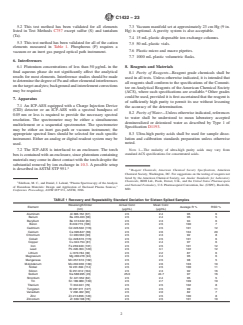
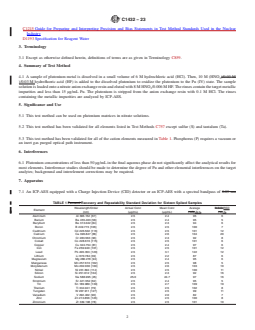
5.3 This test method has been validated for all of the cation elements measured in Table 1. Phosphorus (P) requires a vacuum or an inert gas purged optical path instrument.
SCOPE
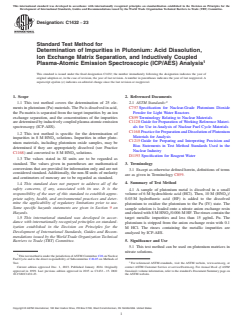
1.1 This test method covers the determination of 25 elements in plutonium (Pu) materials. The Pu is dissolved in acid, the Pu matrix is separated from the target impurities by an ion exchange separation, and the concentrations of the impurities are determined by inductively coupled plasma-atomic emission spectroscopy (ICP-AES).
1.2 This test method is specific for the determination of impurities in 8 M HNO3 solutions. Impurities in other plutonium materials, including plutonium oxide samples, may be determined if they are appropriately dissolved (see Practice C1168) and converted to 8 M HNO3 solutions.
1.3 The values stated in SI units are to be regarded as standard. The values given in parentheses are mathematical conversions that are provided for information only and are not considered standard. Additionally, the non-SI units of molarity and centimeters of mercury are to be regarded as standard.
1.4 This standard does not purport to address all of the safety concerns, if any, associated with its use. It is the responsibility of the user of this standard to establish appropriate safety, health, and environmental practices and determine the applicability of regulatory limitations prior to use. Some specific hazards statements are given in Section 9 on Hazards.
1.5 This international standard was developed in accordance with internationally recognized principles on standardization established in the Decision on Principles for the Development of International Standards, Guides and Recommendations issued by the World Trade Organization Technical Barriers to Trade (TBT) Committee.
- Status
- Published
- Publication Date
- 30-Nov-2023
- Technical Committee
- C26 - Nuclear Fuel Cycle
- Drafting Committee
- C26.05 - Methods of Test
Buy Documents
ASTM C1432-23 - Standard Test Method for Determination of Impurities in Plutonium: Acid Dissolution, Ion Exchange Matrix Separation, and Inductively Coupled Plasma-Atomic Emission Spectroscopic (ICP/AES) Analysis
REDLINE ASTM C1432-23 - Standard Test Method for Determination of Impurities in Plutonium: Acid Dissolution, Ion Exchange Matrix Separation, and Inductively Coupled Plasma-Atomic Emission Spectroscopic (ICP/AES) Analysis
Overview
ASTM C1432-23 is the internationally recognized standard test method for determining impurities in plutonium materials using acid dissolution, ion exchange matrix separation, and Inductively Coupled Plasma-Atomic Emission Spectroscopy (ICP-AES). Developed and maintained by ASTM, this standard ensures accurate and precise impurity quantification in plutonium, particularly relevant for nuclear-grade material used in the nuclear fuel cycle. The method is applicable primarily to plutonium matrices in nitrate solutions, requiring dissolution in acid and matrix separation before analytical detection.
This standard addresses analytical needs for quality control, regulatory compliance, and safety in nuclear environments. Laboratories implementing this method benefit from its proven validation for a suite of elements, contributing to reliability and consistency in trace impurity determination.
Key Topics
- Scope and Applicability
- Covers the determination of 25 trace elements in plutonium materials
- Specific to plutonium in 8 M nitric acid (HNO₃) solutions
- Validated for most cationic impurities, including all those listed in ASTM C757 (except sulfur and tantalum)
- Test Methodology
- Acid dissolution of plutonium sample
- Ion exchange separation to isolate impurities from plutonium matrix
- Quantitative analysis with ICP-AES technology
- Instrumentation
- Requires a high-resolution ICP-AES spectrometer (bandpass ≤ 0.05 nm)
- Optional use of vacuum or inert gas purge for specific elements (e.g., phosphorus)
- Calibration and Quality Assurance
- Involves the use of reference materials, multi-element spike solutions, and calibration standards
- Within-laboratory precision assessed through spiked recovery studies
- Safety and Handling
- Emphasizes strict safety protocols due to the radiological and chemical hazards associated with plutonium and acids
- Facility operators are responsible for compliance with safety, health, and environmental regulations
Applications
The ASTM C1432-23 test method is essential for:
- Quality Control of Nuclear Materials
- Ensures purity of plutonium dioxide and nuclear-grade plutonium metal, crucial for nuclear reactor fuel fabrication
- Regulatory Compliance
- Supports fulfillment of analytical requirements in international safeguards and safety programs
- Research and Development
- Implements trace impurity analysis in development of advanced nuclear fuels or material studies
- Waste Management and Decommissioning
- Identifies elemental contaminants before material recycling, long-term storage, or disposal
- Analytical Laboratories
- Provides a standardized procedure for laboratories specializing in radiochemical and spectroanalytical procedures
Related Standards
- ASTM C757 – Specification for Nuclear-Grade Plutonium Dioxide Powder for Light Water Reactors
- ASTM C758 – Test Methods for Analysis of Nuclear-Grade Plutonium Metal
- ASTM C759 – Test Methods for Analysis of Nuclear-Grade Plutonium Nitrate Solutions
- ASTM C1128 – Guide for Preparation of Working Reference Materials for Nuclear Fuel Cycle Materials
- ASTM C1168 – Practice for Preparation and Dissolution of Plutonium Materials for Analysis
- ASTM D1193 – Specification for Reagent Water
- ASTM C1215 – Guide for Preparing and Interpreting Precision and Bias Statements in Nuclear Industry Test Methods
- International Standards & WTO TBT – Developed in line with internationally recognized standardization principles
Practical Value
Implementing ASTM C1432-23 offers laboratories and nuclear facilities a robust, validated procedure for impurity determination in plutonium, essential for meeting stringent nuclear quality and safety standards. By enabling precise matrix separation and accurate multi-element analysis, it ensures reliable detection and quantification, supporting critical decision-making in the nuclear industry.
Relations
- Effective Date
- 01-Dec-2023
- Effective Date
- 01-Jan-2024
- Effective Date
- 15-Feb-2023
- Effective Date
- 01-Dec-2023
- Effective Date
- 01-Dec-2023
- Effective Date
- 01-Dec-2023
- Effective Date
- 01-Dec-2023
- Effective Date
- 01-Dec-2023
- Effective Date
- 01-Dec-2023
Buy Documents
ASTM C1432-23 - Standard Test Method for Determination of Impurities in Plutonium: Acid Dissolution, Ion Exchange Matrix Separation, and Inductively Coupled Plasma-Atomic Emission Spectroscopic (ICP/AES) Analysis
REDLINE ASTM C1432-23 - Standard Test Method for Determination of Impurities in Plutonium: Acid Dissolution, Ion Exchange Matrix Separation, and Inductively Coupled Plasma-Atomic Emission Spectroscopic (ICP/AES) Analysis
Get Certified
Connect with accredited certification bodies for this standard

DNV
DNV is an independent assurance and risk management provider.

Lloyd's Register
Lloyd's Register is a global professional services organisation specialising in engineering and technology.
DNV Energy Systems
Energy and renewable energy certification.
Sponsored listings
Frequently Asked Questions
ASTM C1432-23 is a standard published by ASTM International. Its full title is "Standard Test Method for Determination of Impurities in Plutonium: Acid Dissolution, Ion Exchange Matrix Separation, and Inductively Coupled Plasma-Atomic Emission Spectroscopic (ICP/AES) Analysis". This standard covers: SIGNIFICANCE AND USE 5.1 This test method can be used on plutonium matrices in nitrate solutions. 5.2 This test method has been validated for all elements listed in Test Methods C757 except sulfur (S) and tantalum (Ta). 5.3 This test method has been validated for all of the cation elements measured in Table 1. Phosphorus (P) requires a vacuum or an inert gas purged optical path instrument. SCOPE 1.1 This test method covers the determination of 25 elements in plutonium (Pu) materials. The Pu is dissolved in acid, the Pu matrix is separated from the target impurities by an ion exchange separation, and the concentrations of the impurities are determined by inductively coupled plasma-atomic emission spectroscopy (ICP-AES). 1.2 This test method is specific for the determination of impurities in 8 M HNO3 solutions. Impurities in other plutonium materials, including plutonium oxide samples, may be determined if they are appropriately dissolved (see Practice C1168) and converted to 8 M HNO3 solutions. 1.3 The values stated in SI units are to be regarded as standard. The values given in parentheses are mathematical conversions that are provided for information only and are not considered standard. Additionally, the non-SI units of molarity and centimeters of mercury are to be regarded as standard. 1.4 This standard does not purport to address all of the safety concerns, if any, associated with its use. It is the responsibility of the user of this standard to establish appropriate safety, health, and environmental practices and determine the applicability of regulatory limitations prior to use. Some specific hazards statements are given in Section 9 on Hazards. 1.5 This international standard was developed in accordance with internationally recognized principles on standardization established in the Decision on Principles for the Development of International Standards, Guides and Recommendations issued by the World Trade Organization Technical Barriers to Trade (TBT) Committee.
SIGNIFICANCE AND USE 5.1 This test method can be used on plutonium matrices in nitrate solutions. 5.2 This test method has been validated for all elements listed in Test Methods C757 except sulfur (S) and tantalum (Ta). 5.3 This test method has been validated for all of the cation elements measured in Table 1. Phosphorus (P) requires a vacuum or an inert gas purged optical path instrument. SCOPE 1.1 This test method covers the determination of 25 elements in plutonium (Pu) materials. The Pu is dissolved in acid, the Pu matrix is separated from the target impurities by an ion exchange separation, and the concentrations of the impurities are determined by inductively coupled plasma-atomic emission spectroscopy (ICP-AES). 1.2 This test method is specific for the determination of impurities in 8 M HNO3 solutions. Impurities in other plutonium materials, including plutonium oxide samples, may be determined if they are appropriately dissolved (see Practice C1168) and converted to 8 M HNO3 solutions. 1.3 The values stated in SI units are to be regarded as standard. The values given in parentheses are mathematical conversions that are provided for information only and are not considered standard. Additionally, the non-SI units of molarity and centimeters of mercury are to be regarded as standard. 1.4 This standard does not purport to address all of the safety concerns, if any, associated with its use. It is the responsibility of the user of this standard to establish appropriate safety, health, and environmental practices and determine the applicability of regulatory limitations prior to use. Some specific hazards statements are given in Section 9 on Hazards. 1.5 This international standard was developed in accordance with internationally recognized principles on standardization established in the Decision on Principles for the Development of International Standards, Guides and Recommendations issued by the World Trade Organization Technical Barriers to Trade (TBT) Committee.
ASTM C1432-23 is classified under the following ICS (International Classification for Standards) categories: 27.120.30 - Fissile materials and nuclear fuel technology. The ICS classification helps identify the subject area and facilitates finding related standards.
ASTM C1432-23 has the following relationships with other standards: It is inter standard links to ASTM C1432-15, ASTM C859-24, ASTM C859-23, ASTM C758-18, ASTM C759-18, ASTM C697-16, ASTM C1647-20, ASTM C698-16, ASTM C1637-21. Understanding these relationships helps ensure you are using the most current and applicable version of the standard.
ASTM C1432-23 is available in PDF format for immediate download after purchase. The document can be added to your cart and obtained through the secure checkout process. Digital delivery ensures instant access to the complete standard document.
Standards Content (Sample)
This international standard was developed in accordance with internationally recognized principles on standardization established in the Decision on Principles for the
Development of International Standards, Guides and Recommendations issued by the World Trade Organization Technical Barriers to Trade (TBT) Committee.
Designation: C1432 − 23
Standard Test Method for
Determination of Impurities in Plutonium: Acid Dissolution,
Ion Exchange Matrix Separation, and Inductively Coupled
Plasma-Atomic Emission Spectroscopic (ICP/AES) Analysis
This standard is issued under the fixed designation C1432; the number immediately following the designation indicates the year of
original adoption or, in the case of revision, the year of last revision. A number in parentheses indicates the year of last reapproval. A
superscript epsilon (´) indicates an editorial change since the last revision or reapproval.
1. Scope 2. Referenced Documents
1.1 This test method covers the determination of 25 ele- 2.1 ASTM Standards:
ments in plutonium (Pu) materials. The Pu is dissolved in acid, C757 Specification for Nuclear-Grade Plutonium Dioxide
the Pu matrix is separated from the target impurities by an ion Powder for Light Water Reactors
exchange separation, and the concentrations of the impurities C859 Terminology Relating to Nuclear Materials
are determined by inductively coupled plasma-atomic emission C1128 Guide for Preparation of Working Reference Materi-
spectroscopy (ICP-AES). als for Use in Analysis of Nuclear Fuel Cycle Materials
C1168 Practice for Preparation and Dissolution of Plutonium
1.2 This test method is specific for the determination of
Materials for Analysis
impurities in 8 M HNO solutions. Impurities in other pluto-
C1215 Guide for Preparing and Interpreting Precision and
nium materials, including plutonium oxide samples, may be
Bias Statements in Test Method Standards Used in the
determined if they are appropriately dissolved (see Practice
Nuclear Industry
C1168) and converted to 8 M HNO solutions.
D1193 Specification for Reagent Water
1.3 The values stated in SI units are to be regarded as
standard. The values given in parentheses are mathematical 3. Terminology
conversions that are provided for information only and are not
3.1 Except as otherwise defined herein, definitions of terms
considered standard. Additionally, the non-SI units of molarity
are as given in Terminology C859.
and centimeters of mercury are to be regarded as standard.
4. Summary of Test Method
1.4 This standard does not purport to address all of the
safety concerns, if any, associated with its use. It is the
4.1 A sample of plutonium metal is dissolved in a small
responsibility of the user of this standard to establish appro-
volume of 6 M hydrochloric acid (HCl). Then, 10 M (HNO )/
priate safety, health, and environmental practices and deter-
0.03 M hydrofluoric acid (HF) is added to the dissolved
mine the applicability of regulatory limitations prior to use.
plutonium to oxidize the plutonium to the Pu (IV) state. The
Some specific hazards statements are given in Section 9 on
sample solution is loaded onto a nitrate anion exchange resin
Hazards.
and eluted with 8 M HNO /0.006 M HF. The rinses contain the
1.5 This international standard was developed in accor-
target metallic impurities and less than 15 μg/mL Pu. The
dance with internationally recognized principles on standard-
plutonium is stripped from the anion exchange resin with 0.1
ization established in the Decision on Principles for the
M HCl. The rinses containing the metallic impurities are
Development of International Standards, Guides and Recom-
analyzed by ICP-AES.
mendations issued by the World Trade Organization Technical
5. Significance and Use
Barriers to Trade (TBT) Committee.
5.1 This test method can be used on plutonium matrices in
nitrate solutions.
This test method is under the jurisdiction of ASTM Committee C26 on Nuclear
Fuel Cycle and is the direct responsibility of Subcommittee C26.05 on Methods of
Test. For referenced ASTM standards, visit the ASTM website, www.astm.org, or
Current edition approved Dec. 1, 2023. Published January 2024. Originally contact ASTM Customer Service at service@astm.org. For Annual Book of ASTM
approved in 1999. Last previous edition approved in 2015 as C1432 – 15. DOI: Standards volume information, refer to the standard’s Document Summary page on
10.1520/C1432-23. the ASTM website.
Copyright © ASTM International, 100 Barr Harbor Drive, PO Box C700, West Conshohocken, PA 19428-2959. United States
C1432 − 23
5.2 This test method has been validated for all elements 7.3 Vacuum manifold set at approximately 23 cm Hg (9 in.
listed in Test Methods C757 except sulfur (S) and tantalum Hg) is optional. A gravity system is also acceptable.
(Ta).
7.4 15 mL plastic disposable ion exchange columns.
5.3 This test method has been validated for all of the cation
7.5 50 mL plastic vials.
elements measured in Table 1. Phosphorus (P) requires a
7.6 Plastic micro and macro pipettes.
vacuum or an inert gas purged optical path instrument.
7.7 1000 mL plastic volumetric flasks.
6. Interferences
6.1 Plutonium concentrations of less than 50 μg/mL in the 8. Reagents and Materials
final aqueous phase do not significantly affect the analytical
8.1 Purity of Reagents—Reagent grade chemicals shall be
results for most elements. Interference studies should be made
used in all tests. Unless otherwise indicated, it is intended that
to determine the degree of Pu and other elemental interferences
all reagents shall conform to the specifications of the Commit-
on the target analytes; background and interelement corrections
tee on Analytical Reagents of the American Chemical Society
may be required.
(ACS), where such specifications are available. Other grades
could be used, provided it is first ascertained that the reagent is
7. Apparatus
of sufficiently high purity to permit its use without lessening
7.1 An ICP-AES equipped with a Charge Injection Device
the accuracy of the determination.
(CID) detector or an ICP-AES with a spectral bandpass of
8.2 Purity of Water—Unless otherwise indicated, references
0.05 nm or less is required to provide the necessary spectral
to water shall be understood to mean laboratory accepted
resolution. The spectrometer may be either a simultaneous
demineralized or deionized water as described by Type 1 of
multielement or a sequential spectrometer. The spectrometer
Specification D1193.
may be either an inert gas-path or vacuum instrument; the
8.3 Ultra-high purity acids shall be used for sample disso-
appropriate spectral lines should be selected for each specific
lution and calibration standards preparation unless otherwise
instrument. Either an analog or digital readout system may be
noted.
used.
7.2 The ICP-AES is interfaced to an enclosure. The torch NOTE 1—The molarity of ultra-high purity acids may vary from
standard ACS specifications for concentrated acids.
box is contained with an enclosure, since plutonium containing
materials may come in direct contact with the torch despite the
substantial removal by ion exchange in 10.3. A possible setup
is described in ASTM STP 951.
Reagent Chemicals, American Chemical Society Specifications, American
Chemical Society, Washington, DC. For suggestions on the testing of reagents not
listed by the American Chemical Society, see Analar Standards for Laboratory
Chemicals, BDH Ltd., Poole, Dorset, U.K., and the United States Pharmacopeia
Edellson, M. C., and Daniel, J. Leland, “Plasma Spectroscopy of the Analysis
and National Formulary, U.S. Pharmacopeial Convention, Inc. (USPC), Rockville,
of Hazardous Materials: Design and Application of Enclosed Plasma Sources,”
MD.
Conference Proceedings, ASTM STP 951, ASTM, 1986.
TABLE 1 Recovery and Repeatability Standard Deviation for Sixteen Spiked Samples
Wavelength/Order Actual Conc Mean Conc
Element Average R % RSD %
(nm) (μg/mL) (μg/mL)
Aluminum Al 396.152 {67} 2.5 2.4 95 6
Barium Ba 455.403 {58} 2.5 2.4 95 5
Beryllium Be 313.042 {84} 2.5 2.3 94 6
Boron B 249.773 {106} 2.5 2.5 100 7
Cadmium Cd 226.502 {116} 2.5 2.5 101 12
Calcium Ca 396.847 {66} 2.5 2.6 104 20
Chromium Cr 283.563 {93} 2.5 2.3 92 8
Cobalt Co 228.616 {115} 2.5 2.5 101 6
Copper Cu 324.754 {81} 2.5 2.4 97 6
Iron Fe 259.940 {101} 2.5 2.5 101 12
Lead Pb 220.353 {120} 2.5 3.1 122 12
Lithium Li 670.784 {39} 2.5 2.2 87 6
Magnesium Mg 280.270 {94} 2.5 2.4 95 6
Manganese Mn 257.610 {102} 2.5 2.5 98 5
Molybdenum Mo 202.030 {130} 2.5 2.6 103 10
Nickel Ni 231.604 {114} 2.5 2.5 100 11
Silicon Si 251.612 {104} 2.5 2.3 92 16
Sodium Na 588.995 {45} 25.0 24.7 97 16
Strontium Sr 421.552 {62} 2.5 2.4 95 5
Tin Sn 189.989 {139} 2.5 2.7 109 19
Titanium Ti 334.941 {79} 2.5 2.5 102 8
Tungsten W 207.911 {127} 2.5 2.5 99 11
Vanadium V 292.402 {90} 2.5 2.0 82 7
Zinc Zn 213.856 {123} 2.5 2.5 100 8
Zirconium Zr 339.198 {78} 2.5 2.5 101 10
C1432 − 23
NOTE 2—All reagents are prepared and stored in polytetrafluoroethyl-
8.14.3 Calibration Stock Solution-5 (CSS-5), contains 500
ene (PTFE) containers.
μg/mL of Al, Ba, and Sr in 0.8 M HNO .
8.4 Hydrochloric Acid (HCl, 11.3 M), concentrated ultra- 8.14.4 Calibration Stock Solution-6 (CSS-6), contains 500
high purity HCl. μg/mL of Be, B, Cd, Ca, Cr, Co, Cu, Fe, Li, Mg, Mn, Ni, Pb,
V, and Zn in 0.8 M HNO .
8.5 Hydrochloric Acid (HCl, 6 M)—Add 531 mL of con-
centrated ultra-high purity HCl (11.3 M) to less than 450 mL of 8.15 Prepare the multielement impurity standards and
water and dilute to 1 L with water. blanks as described in 8.15.1 – 8.15.5. All calibration standard
solutions are stored in PTFE containers.
8.6 Hydrochloric Acid (HCl, 0.1 M)—Add 8.8 mL of
8.15.1 Calibration Standard One High (CAL 1 HI)—Pipette
concentrated ultra-high purity HCl (11.3 M) to water, while
20 mL each, of stock solutions CSS-3, and CSS-5 into a 1 L
stirring, and dilute to 1 L with water. (Reagent grade HCl can
volumetric flask. Dilute to 1 L with 8 M HNO /0.006 M HF.
be used in preparing this reagent.)
This standard solution contains the target analytes at a concen-
8.7 Hydrofluoric Acid (HF, 28.3 M), concentrated ultra-high
tration of 10 μg/mL.
purity HF.
8.15.2 Calibration Standard One Low (CAL 1 LO)—Pipette
8.8 Nitric Acid (HNO , 15.8 M), concentrated ultra-high 10 mL each, of stock solutions CSS-3, and CSS-5 into a 1 L
volumetric flask. Dilute to 1 L with 8 M HNO /0.006 M HF.
purity nitric acid.
This standard solution contains the target analytes at a concen-
8.9 Nitric Acid-Hydrofluoric Acid Mixture, 10 M HNO /
tration of 5 μg/mL.
0.03 M HF—Add 1 mL of concentrated ultra-high purity HF
8.15.3 Calibration Standard Two High (CAL 2 HI)—Pipette
(28.3 M) to water; using a plastic pipette, while stirring, add
20 mL each, of stock solutions CCS-2, and CSS-6 into a 1 L
633 mL concentrated ultra-high purity HNO (15.8 M) and
volumetric flask. Dilute to 1 L with 8 M HNO /0.006 M HF.
dilute to 1 L with water.
This standard solution contains the target analytes at a concen-
8.10 Nitric Acid-Hydrofluoric Acid Mixture, 8 M HNO /
tration of 10 μg/mL, except Na. Na is 100 μg/mL.
0.006 M HF—Add 0.21 mL of concentrated ultra-high purity
8.15.4 Calibration Standard Two Low (CAL 2 LO)—Pipette
HF (28.3 M) to water; using a plastic pipette, while stirring,
10 mL each, of stock solutions CCS-2, and CCS-6 into a 1 L
add 506 mL of concentrated ultra-high purity HNO (15.8 M)
volumetric flask. Dilute to 1 L with 8 M HNO /0.006 M HF.
and dilute to 1 L with water.
This standard solution contains the target analytes at a concen-
tration of 5 μg/mL, except Na. Na is 50 μg/mL.
8.11 Nitric Acid (HNO , 4 M)—Add 253 mL of concen-
8.15.5 Calibration Standard Blank (CAL BL)—This blank is
trated ultra-high purity nitric acid (15.8 M) to water, while
an 8 M HNO /0.006 M HF solution.
stirring, and dilute to 1 L with water.
8.12 Anion Exchange Resin, macroporous-1 (MP-1),
9. Hazards
200 mesh - 400 mesh, either nitrate form or chloride form, high
9.1 This standard involves work with nuclear materials. The
purity.
unique hazards and controls required to conduct the work
8.13 Stock Solutions, traceable to a national standard, of
contained in this standard from a safety, environmental, and
multielement spike solutions are available from a commercial
security standpoint is the responsibility of the facility
vendor. The stock solutions of multielement spike solutions
operators, in compliance with any applicable regulations. Any
can also be prep
...
This document is not an ASTM standard and is intended only to provide the user of an ASTM standard an indication of what changes have been made to the previous version. Because
it may not be technically possible to adequately depict all changes accurately, ASTM recommends that users consult prior editions as appropriate. In all cases only the current version
of the standard as published by ASTM is to be considered the official document.
Designation: C1432 − 15 C1432 − 23
Standard Test Method for
Determination of Impurities in Plutonium: Acid Dissolution,
Ion Exchange Matrix Separation, and Inductively Coupled
Plasma-Atomic Emission Spectroscopic (ICP/AES) Analysis
This standard is issued under the fixed designation C1432; the number immediately following the designation indicates the year of
original adoption or, in the case of revision, the year of last revision. A number in parentheses indicates the year of last reapproval. A
superscript epsilon (´) indicates an editorial change since the last revision or reapproval.
1. Scope
1.1 This test method covers the determination of 25 elements in plutonium (Pu) materials. The Pu is dissolved in acid, the Pu
matrix is separated from the target impurities by an ion exchange separation, and the concentrations of the impurities are
determined by inductively coupled plasma-atomic emission spectroscopy (ICP-AES).
1.2 This test method is specific for the determination of impurities in 8 M HNO solutions. Impurities in other plutonium materials,
including plutonium oxide samples, may be determined if they are appropriately dissolved (see Practice C1168) and converted to
8 M HNO solutions.
1.3 The values stated in SI units are to be regarded as standard. The values given in parentheses are mathematical conversions that
are provided for information only and are not considered standard. Additionally, the non-SI units of molarity and centimeters of
mercury are to be regarded as standard.
1.4 This standard does not purport to address all of the safety concerns, if any, associated with its use. It is the responsibility
of the user of this standard to establish appropriate safety and healthsafety, health, and environmental practices and determine
the applicability of regulatory limitations prior to use. Some specific hazards statements are given in Section 9 on Hazards.
1.5 This international standard was developed in accordance with internationally recognized principles on standardization
established in the Decision on Principles for the Development of International Standards, Guides and Recommendations issued
by the World Trade Organization Technical Barriers to Trade (TBT) Committee.
2. Referenced Documents
2.1 ASTM Standards:
C757 Specification for Nuclear-Grade Plutonium Dioxide Powder for Light Water Reactors
C758 Test Methods for Chemical, Mass Spectrometric, Spectrochemical, Nuclear, and Radiochemical Analysis of Nuclear-
Grade Plutonium Metal
C759 Test Methods for Chemical, Mass Spectrometric, Spectrochemical, Nuclear, and Radiochemical Analysis of Nuclear-
Grade Plutonium Nitrate Solutions
C859 Terminology Relating to Nuclear Materials
C1128 Guide for Preparation of Working Reference Materials for Use in Analysis of Nuclear Fuel Cycle Materials
C1168 Practice for Preparation and Dissolution of Plutonium Materials for Analysis
This test method is under the jurisdiction of ASTM Committee C26 on Nuclear Fuel Cycle and is the direct responsibility of Subcommittee C26.05 on Methods of Test.
Current edition approved June 1, 2015Dec. 1, 2023. Published July 2015January 2024. Originally approved in 1999. Last previous edition approved in 20082015 as
C1432 – 03 (2008).C1432 – 15. DOI: 10.1520/C1432-15.10.1520/C1432-23.
For referenced ASTM standards, visit the ASTM website, www.astm.org, or contact ASTM Customer Service at service@astm.org. For Annual Book of ASTM Standards
volume information, refer to the standard’s Document Summary page on the ASTM website.
Copyright © ASTM International, 100 Barr Harbor Drive, PO Box C700, West Conshohocken, PA 19428-2959. United States
C1432 − 23
C1215 Guide for Preparing and Interpreting Precision and Bias Statements in Test Method Standards Used in the Nuclear
Industry
D1193 Specification for Reagent Water
3. Terminology
3.1 Except as otherwise defined herein, definitions of terms are as given in Terminology C859.
4. Summary of Test Method
4.1 A sample of plutonium metal is dissolved in a small volume of 6 M hydrochloric acid (HCl). Then, 10 M (HNO )/0.03 M
)/0.03 M hydrofluoric acid (HF) is added to the dissolved plutonium to oxidize the plutonium to the Pu (IV) state. The sample
solution is loaded onto a nitrate anion exchange resin and eluted with 8 M HNO /0.006 M HF. The rinses contain the target metallic
impurities and less than 15 μg/mL Pu. The plutonium is stripped from the anion exchange resin with 0.1 M HCl. The rinses
containing the metallic impurities are analyzed by ICP-AES.
5. Significance and Use
5.1 This test method can be used on plutonium matrices in nitrate solutions.
5.2 This test method has been validated for all elements listed in Test Methods C757 except sulfur (S) and tantalum (Ta).
5.3 This test method has been validated for all of the cation elements measured in Table 1. Phosphorus (P) requires a vacuum or
an inert gas purged optical path instrument.
6. Interferences
6.1 Plutonium concentrations of less than 50 μg/mL in the final aqueous phase do not significantly affect the analytical results for
most elements. Interference studies should be made to determine the degree of Pu and other elemental interferences on the target
analytes; background and interelement corrections may be required.
7. Apparatus
7.1 An ICP-AES equipped with a Charge Injection Device (CID) detector or an ICP-AES with a spectral bandpass of 0.05 nm
TABLE 1 Percent Recovery and Repeatability Standard Deviation for Sixteen Spiked Samples
Wavelength/Order Actual Conc Mean Conc Average R.S.D.RSD
Element
(nm) (μg/mL) (μg/mL) (%R) R % (%) %
Aluminum Al 396.152 {67} 2.5 2.4 95 6
Barium Ba 455.403 {58} 2.5 2.4 95 5
Beryllium Be 313.042 {84} 2.5 2.3 94 6
Boron B 249.773 {106} 2.5 2.5 100 7
Cadmium Cd 226.502 {116} 2.5 2.5 101 12
Calcium Ca 396.847 {66} 2.5 2.6 104 20
Chromium Cr 283.563 {93} 2.5 2.3 92 8
Cobalt Co 228.616 {115} 2.5 2.5 101 6
Copper Cu 324.754 {81} 2.5 2.4 97 6
Iron Fe 259.940 {101} 2.5 2.5 101 12
Lead Pb 220.353 {120} 2.5 3.1 122 12
Lithium Li 670.784 {39} 2.5 2.2 87 6
Magnesium Mg 280.270 {94} 2.5 2.4 95 6
Manganese Mn 257.610 {102} 2.5 2.5 98 5
Molybdenum Mo 202.030 {130} 2.5 2.6 103 10
Nickel Ni 231.604 {114} 2.5 2.5 100 11
Silicon Si 251.612 {104} 2.5 2.3 92 16
Sodium Na 588.995 {45} 25.0 24.7 97 16
Strontium Sr 421.552 {62} 2.5 2.4 95 5
Tin Sn 189.989 {139} 2.5 2.7 109 19
Titanium Ti 334.941 {79} 2.5 2.5 102 8
Tungsten W 207.911 {127} 2.5 2.5 99 11
Vanadium V 292.402 {90} 2.5 2.0 82 7
Zinc Zn 213.856 {123} 2.5 2.5 100 8
Zirconium Zr 339.198 {78} 2.5 2.5 101 10
C1432 − 23
0.05 nm or less is required to provide the necessary spectral resolution. The spectrometer may be either a simultaneous
multielement or a sequential spectrometer. The spectrometer may be either an inert gas-path or vacuum instrument; the appropriate
spectral lines should be selected for each specific instrument. Either an analog or digital readout system may be used.
7.2 The ICP-AES is interfaced to an enclosure. The torch box is contained with an enclosure, since plutonium containing materials
may come in direct contact with the torch despite the substantial removal by ion exchange in 10.3. A possible setup is described
in ASTM STP 951.
7.3 Vacuum manifold set at approximately 23 cm Hg (9 in. Hg) is optional. A gravity system is also acceptable.
7.4 15 mL plastic disposable ion exchange columns.
7.5 50 mL plastic vials.
7.6 Plastic micro and macro pipettes.
7.7 1000 mL plastic volumetric flasks.
8. Reagents and Materials
8.1 Purity of Reagents—Reagent grade chemicals shall be used in all tests. Unless otherwise indicated, it is intended that all
reagents shall conform to the specifications of the Committee on Analytical Reagents of the American Chemical Society (ACS),
where such specifications are available. Other grades could be used, provided it is first ascertained that the reagent is of sufficiently
high purity to permit its use without lessening the accuracy of the determination.
8.2 Purity of Water—Unless otherwise indicated, references to water shall be understood to mean laboratory accepted
demineralized or deionized water as described by Type 1 of Specification D1193.
8.3 Ultra high Ultra-high purity acids shall be used for sample dissolution and calibration standards preparation unless otherwise
noted.
NOTE 1—The molarity of ultra high ultra-high purity acids may vary from standard ACS specifications for concentrated acids.
NOTE 2—All reagents are prepared and stored in polytetrafluoroethylene (PTFE) containers.
8.4 Hydrochloric Acid (HCl, 11.3 M),concentrated ultra high ultra-high purity HCl.
8.5 Hydrochloric Acid (HCl, 6 M)—Add 531 mL of concentrated ultra high ultra-high purity HCl (11.3 M) to less than 450 mL
of water and dilute to 1 L with water.
8.6 Hydrochloric Acid (HCl, 0.1 M)—Add 8.8 mL of concentrated ultra high ultra-high purity HCl (11.3 M) to water, while
stirring, and dilute to 1 L with water. (Reagent grade HCl can be used in preparing this reagent.)
8.7 Hydrofluoric Acid (HF, 28.3 M),concentrated ultra high ultra-high purity HF.
8.8 Nitric Acid (HNO , 15.8 M),concentrated ultra high ultra-high purity nitric acid.
Edellson, M. C., and Daniel, J. Leland, “Plasma Spectroscopy of the Analysis of Hazardous Materials: Design and Application of Enclosed Plasma Sources,” Conference
Proceedings, ASTM STP 951, ASTM, 1986.
Reagent Chemicals, American Chemical Society Specifications, American Chemical Society, Washington, DC. For suggestions on the testing of reagents not listed by
the American Chemical Society, see Analar Standards for Laboratory Chemicals, BDH Ltd., Poole, Dorset, U.K., and the United States Pharmacopeia and National
Formulary, U.S. Pharmacopeial Convention, Inc. (USPC), Rockville, MD.
C1432 − 23
8.9 Nitric Acid-Hydrofluoric Acid Mixture, 10 M HNO /0.03 M HF—Add 1 mL of concentrated ultra high ultra-high purity HF
(28.3 M) (28.3 M) to water; using a plastic pipette, while stirring, add 633 mL concentrated ultra high ultra-high purity HNO (15.8
M) and dilute to 1 L 1 L with water.
8.10 Nitric Acid-Hydrofluoric Acid Mixture, 8 M HNO /0.006 M HF—Add 0.21 mL of concentrated ultra high ultra-high purity
HF (28.3 M) to water; using a plastic pipette, while stirring, add 506 mL of concentrated ultra high ultra-high purity HNO (15.8
M) and dilute to 1 L with water.
8.11 Nitric Acid (HNO , 4 M)—Add 253 mL of concentrated ultra high ultra-high purity nitric acid (15.8 M) to water, while
stirring, and dilute to 1 L with water.
8.12 Anion Exchange Resin, macroporous-1 (MP-1), 200-400 200 mesh - 400 mesh, either nitrate form or chloride form, high
purity.
8.13 Stock Solutions, traceable to a national standard, of multielement spike solutions are available from a commercial vendor. The
stock solutions of multielement spike solutions can also be prepared in-house.
8.13.1 Spike Solution 1 (SS-1), contains 500 μg/mL of Al, Ba, Be, Ca, Li, Mg, Sr, and Na in 0.8 M HNO .
8.13.2 Spike Solution 2 (SS-2), contains 500 μg/mL of B, Mo, Si, Sn, Ti, W, and Zr in 0.8 M HNO .
8.13.3 Spike Solution 3 (SS-3), contains 500 μg/mL of Cd, Cr, Co, Cu, Fe, Pb, Mn, Ni, V, and Zn in 0.8 M HNO .
8.14 Stock Solutions, traceable to a national standard, of multielement impurity standards are available from a commercial vendor.
The stock solutions of multielement standards can also be prepared in-house.
8.14.1 Calibration Stock Solution-2 (CSS-2), contains 5000 μg/mL of Na in 0.8 M HNO .
8.14.2 Calibration Stock Solution-3 (CSS-3), contains 500 μg/mL of Mo, Si, Sn, Ti, W, and Zr in 0.3 M HNO /0.1 M HF.
8.14.3 Calibration Stock Solution-5 (CSS-5), contains 500 μg/mL of Al, Ba, and Sr in 0.8 M HNO .
8.14.4 Calibration Stock Solution-6 (CSS-6), contains 500 μg/mL of Be, B, Cd, Ca, Cr, Co, Cu, Fe, Li, Mg, Mn, Ni, Pb, V, and
Zn in 0.8 M HNO .
8.15 Prepare the multielement impurity standards and blanks as described in 8.15.1 – 8.15.5. All calibration standard solutions are
stored in PTFE containers.
8.15.1 Calibration Standard One High (CAL 1 HI)—Pipette 20 mL each, of stock solutions CSS-3, and CSS-5 into a 1 L
volumetric flask. Dilute to 1 L with 8 M HNO /0.006 M HF. This standard solution contains the target analytes at a concentration
of 10 μg/mL.
8.15.2 Calibration Standard One Low (CAL 1 LO)—Pipette 10 mL each, of stock solutions CSS-3, and CSS-5 into a 1 L
volumetric flask. Dilute to 1 L with 8 M HNO /0.006 M HF. This standard solution contains the target analytes at a concentration
of 5 μg/mL.
8.15.3 Calibration Standard Two High (CAL 2 HI)—Pipette 20 mL each, of stock solutions CCS-2, and CSS-6 into a 1 L
volumetric flask. Dilute to 1 L with 8 M HNO /0.006 M HF. This standard solution contains the ta
...