

ASTM C1428-18(2023)
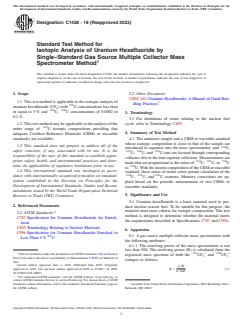
(Test Method)Standard Test Method for Isotopic Analysis of Uranium Hexafluoride by Single–Standard Gas Source Multiple Collector Mass Spectrometer Method
General Information
- Abstract
SIGNIFICANCE AND USE
5.1 Uranium hexafluoride is a basic material used to produce nuclear reactor fuel. To be suitable for this purpose, the material must meet criteria for isotopic composition. This test method is designed to determine whether the material meets the requirements described in Specifications C787 and C996.
SCOPE
1.1 This test method is applicable to the isotopic analysis of uranium hexafluoride (UF6) with 235U concentrations less than or equal to 5 % and 234U, 236U concentrations of 0.0002 to 0.1 %.
1.2 This test method may be applicable to the analysis of the entire range of 235U isotopic compositions providing that adequate Certified Reference Materials (CRMs or traceable standards) are available.
1.3 This standard does not purport to address all of the safety concerns, if any, associated with its use. It is the responsibility of the user of this standard to establish appropriate safety, health, and environmental practices and determine the applicability of regulatory limitations prior to use.
1.4 This international standard was developed in accordance with internationally recognized principles on standardization established in the Decision on Principles for the Development of International Standards, Guides and Recommendations issued by the World Trade Organization Technical Barriers to Trade (TBT) Committee.
- Status
- Published
- Publication Date
- 31-May-2023
- Technical Committee
- C26 - Nuclear Fuel Cycle
- Drafting Committee
- C26.05 - Methods of Test

Overview
ASTM C1428-18(2023): Standard Test Method for Isotopic Analysis of Uranium Hexafluoride by Single–Standard Gas Source Multiple Collector Mass Spectrometer Method is an internationally recognized standard developed by ASTM. This document provides a reliable testing method for determining the isotopic composition of uranium hexafluoride (UF₆). Since UF₆ is a fundamental material for the production of nuclear reactor fuel, ensuring that it meets specific isotopic criteria is vital for its intended use in the nuclear fuel cycle. The method outlined in ASTM C1428-18(2023) supports compliance with specifications such as ASTM C787 and ASTM C996, and is aligned with the WTO’s Technical Barriers to Trade (TBT) principles.
Key Topics
Isotopic Analysis of Uranium Hexafluoride
- Applicable to samples with ^235U concentrations ≤5% and ^234U, ^236U concentrations from 0.0002% to 0.1%.
- May be extended to wider ^235U composition ranges if suitable Certified Reference Materials (CRMs) or traceable standards are accessible.
Mass Spectrometry Methodology
- Utilizes a gas source multiple collector mass spectrometer to measure ion currents of the main uranium isotopes.
- Relies on memory corrections and calibration using CRMs with known isotope ratios.
Significance for Nuclear Fuel Production
- Accurate isotopic composition is essential to ensure UF₆ suitability for reactor fuel, supporting nuclear safety and performance.
- The test method serves decision-makers in material acceptance and regulatory compliance.
Safety and Good Laboratory Practice
- Recognizes the hazardous nature of UF₆ (radioactive, toxic, highly reactive) and the requirement for rigorous safety, health, and environmental protocols.
- Users must assess and manage laboratory risks and adhere to applicable regulatory controls.
Applications
ASTM C1428-18(2023) is indispensable in a variety of sectors within the nuclear industry, enabling:
Quality Assurance in Uranium Enrichment
- Verification that UF₆ meets isotopic enrichment criteria for nuclear reactors.
- Compliance with international and national regulatory standards for uranium products.
Nuclear Power Generation
- Supporting reactor operations by ensuring fuel inputs maintain required isotope concentrations.
- Mitigating proliferation risks through standardized assessment of uranium isotopic signatures.
Research and Development
- Facilitating precise isotopic studies for nuclear material science and innovation.
- Supporting development of advanced analytical techniques using mass spectrometry.
Regulatory Compliance and Traceability
- Documented analysis using CRMs provides transparency and traceability, promoting global trade and regulatory acceptance.
Related Standards
For comprehensive uranium analysis and fuel cycle applications, the following ASTM standards and references are closely related:
- ASTM C787 - Specification for Uranium Hexafluoride for Enrichment
- ASTM C996 - Specification for Uranium Hexafluoride Enriched to Less Than 5% ^235U
- ASTM C859 - Terminology Relating to Nuclear Materials
- USEC-651 - Uranium Hexafluoride: A Manual of Good Handling Practices
Practical Value
Implementing ASTM C1428-18(2023) ensures high-precision, standardized isotopic evaluation of uranium hexafluoride, supporting:
- Reliable nuclear fuel production
- International trade and regulatory compliance
- Safe and traceable nuclear material handling
- Advanced research in uranium isotope measurement
Accurate and consistent analysis of uranium isotopic composition is crucial for the safety, quality, and economic value of nuclear fuel and related materials. This standard provides laboratories, regulators, and industry stakeholders with a proven method for achieving these goals using gas source multiple collector mass spectrometry.
Relations
- Effective Date
- 01-Jan-2024
- Effective Date
- 01-Mar-2020
- Effective Date
- 01-Mar-2020
- Effective Date
- 01-Jul-2015
- Effective Date
- 01-Jul-2015
- Effective Date
- 15-Jun-2014
- Effective Date
- 15-Jan-2014
- Effective Date
- 01-Jun-2013
- Effective Date
- 01-May-2013
- Effective Date
- 01-Jun-2011
- Effective Date
- 01-Nov-2010
- Effective Date
- 01-Oct-2010
- Effective Date
- 01-Aug-2010
- Effective Date
- 01-Feb-2010
- Effective Date
- 15-Feb-2009
Get Certified
Connect with accredited certification bodies for this standard

DNV
DNV is an independent assurance and risk management provider.

Lloyd's Register
Lloyd's Register is a global professional services organisation specialising in engineering and technology.
DNV Energy Systems
Energy and renewable energy certification.
Sponsored listings
Frequently Asked Questions
ASTM C1428-18(2023) is a standard published by ASTM International. Its full title is "Standard Test Method for Isotopic Analysis of Uranium Hexafluoride by Single–Standard Gas Source Multiple Collector Mass Spectrometer Method". This standard covers: SIGNIFICANCE AND USE 5.1 Uranium hexafluoride is a basic material used to produce nuclear reactor fuel. To be suitable for this purpose, the material must meet criteria for isotopic composition. This test method is designed to determine whether the material meets the requirements described in Specifications C787 and C996. SCOPE 1.1 This test method is applicable to the isotopic analysis of uranium hexafluoride (UF6) with 235U concentrations less than or equal to 5 % and 234U, 236U concentrations of 0.0002 to 0.1 %. 1.2 This test method may be applicable to the analysis of the entire range of 235U isotopic compositions providing that adequate Certified Reference Materials (CRMs or traceable standards) are available. 1.3 This standard does not purport to address all of the safety concerns, if any, associated with its use. It is the responsibility of the user of this standard to establish appropriate safety, health, and environmental practices and determine the applicability of regulatory limitations prior to use. 1.4 This international standard was developed in accordance with internationally recognized principles on standardization established in the Decision on Principles for the Development of International Standards, Guides and Recommendations issued by the World Trade Organization Technical Barriers to Trade (TBT) Committee.
SIGNIFICANCE AND USE 5.1 Uranium hexafluoride is a basic material used to produce nuclear reactor fuel. To be suitable for this purpose, the material must meet criteria for isotopic composition. This test method is designed to determine whether the material meets the requirements described in Specifications C787 and C996. SCOPE 1.1 This test method is applicable to the isotopic analysis of uranium hexafluoride (UF6) with 235U concentrations less than or equal to 5 % and 234U, 236U concentrations of 0.0002 to 0.1 %. 1.2 This test method may be applicable to the analysis of the entire range of 235U isotopic compositions providing that adequate Certified Reference Materials (CRMs or traceable standards) are available. 1.3 This standard does not purport to address all of the safety concerns, if any, associated with its use. It is the responsibility of the user of this standard to establish appropriate safety, health, and environmental practices and determine the applicability of regulatory limitations prior to use. 1.4 This international standard was developed in accordance with internationally recognized principles on standardization established in the Decision on Principles for the Development of International Standards, Guides and Recommendations issued by the World Trade Organization Technical Barriers to Trade (TBT) Committee.
ASTM C1428-18(2023) is classified under the following ICS (International Classification for Standards) categories: 27.120.30 - Fissile materials and nuclear fuel technology. The ICS classification helps identify the subject area and facilitates finding related standards.
ASTM C1428-18(2023) has the following relationships with other standards: It is inter standard links to ASTM C859-24, ASTM C787-20, ASTM C996-20, ASTM C787-15, ASTM C996-15, ASTM C859-14a, ASTM C859-14, ASTM C859-13a, ASTM C859-13, ASTM C787-11, ASTM C859-10b, ASTM C996-10, ASTM C859-10a, ASTM C859-10, ASTM C859-09. Understanding these relationships helps ensure you are using the most current and applicable version of the standard.
ASTM C1428-18(2023) is available in PDF format for immediate download after purchase. The document can be added to your cart and obtained through the secure checkout process. Digital delivery ensures instant access to the complete standard document.
Standards Content (Sample)
This international standard was developed in accordance with internationally recognized principles on standardization established in the Decision on Principles for the
Development of International Standards, Guides and Recommendations issued by the World Trade Organization Technical Barriers to Trade (TBT) Committee.
Designation: C1428 − 18 (Reapproved 2023)
Standard Test Method for
Isotopic Analysis of Uranium Hexafluoride by
Single–Standard Gas Source Multiple Collector Mass
Spectrometer Method
This standard is issued under the fixed designation C1428; the number immediately following the designation indicates the year of
original adoption or, in the case of revision, the year of last revision. A number in parentheses indicates the year of last reapproval. A
superscript epsilon (´) indicates an editorial change since the last revision or reapproval.
1. Scope 2.2 Other Document:
USEC-651 Uranium Hexafluoride: A Manual of Good Han-
1.1 This test method is applicable to the isotopic analysis of
dling Practices
uranium hexafluoride (UF ) with U concentrations less than
234 236
or equal to 5 % and U, U concentrations of 0.0002 to
3. Terminology
0.1 %.
3.1 For definitions of terms relating to the nuclear fuel
1.2 This test method may be applicable to the analysis of the cycle, refer to Terminology C859.
entire range of U isotopic compositions providing that
4. Summary of Test Method
adequate Certified Reference Materials (CRMs or traceable
standards) are available. 4.1 The unknown sample and a CRM or traceable standard
whose isotopic composition is close to that of the sample are
1.3 This standard does not purport to address all of the
introduced in sequence into the mass spectrometer, and U,
safety concerns, if any, associated with its use. It is the
235 236 238
U, U, and U ions are focused through corresponding
responsibility of the user of this standard to establish appro-
collector slits to the four separate collectors. Measurements are
priate safety, health, and environmental practices and deter-
234 235 236
made that are proportional to the ratios of U, U, or U
mine the applicability of regulatory limitations prior to use.
to U. With the known composition of the CRM or traceable
1.4 This international standard was developed in accor-
standard, these ratios of molar ratios permit calculation of the
234 235 236
dance with internationally recognized principles on standard-
U, U, and U contents. Memory corrections are ap-
ization established in the Decision on Principles for the
plied based on the periodic measurement of two CRMs or
Development of International Standards, Guides and Recom-
traceable standards.
mendations issued by the World Trade Organization Technical
5. Significance and Use
Barriers to Trade (TBT) Committee.
5.1 Uranium hexafluoride is a basic material used to pro-
2. Referenced Documents
duce nuclear reactor fuel. To be suitable for this purpose, the
material must meet criteria for isotopic composition. This test
2.1 ASTM Standards:
method is designed to determine whether the material meets
C787 Specification for Uranium Hexafluoride for Enrich-
the requirements described in Specifications C787 and C996.
ment
C859 Terminology Relating to Nuclear Materials
6. Apparatus
C996 Specification for Uranium Hexafluoride Enriched to
235 6.1 A gas source multiple collector mass spectrometer with
Less Than 5 % U
the following attributes:
6.1.1 The resolving power of the mass spectrometer is not
less than 500. The resolving power (R) is calculated from the
1 235 + 238 +
This test method is under the jurisdiction of ASTM Committee C26 on Nuclear
registered mass spectrum of both the UF and UF
5 5
Fuel Cycle and is the direct responsibility of Subcommittee C26.05 on Methods of
isotopes as follows:
Test.
Current edition approved June 1, 2023. Published June 2023. Originally
a·M
approved in 1999. Last previous edition approved in 2018 as C1428 – 18. DOI: R 5 (1)
b·ΔM
10.1520/C1428-18R23.
For referenced ASTM standards, visit the ASTM website, www.astm.org, or
contact ASTM Customer Service at service@astm.org. For Annual Book of ASTM
Standards volume information, refer to the standard’s Document Summary page on Available from United States Enrichment Corporation, 6903 Rockledge Drive,
the ASTM website. Bethesda, MD 20817.
Copyright © ASTM International, 100 Barr Harbor Drive, PO Box C700, West Conshohocken, PA 19428-2959. United States
C1428 − 18 (2023)
SH X X SL
where: 0.0002 to 0.01 C /C #4,C /C #4; in concen-
234~236! 234~236! 234~236! 234~236!
SH X X SL
235 + 238 +
tration range 0.01 to 0.1 C /C #3,C /C #3.
a = distance between centers of the UF and UF
234~236! 234~236! 234~236! 234~236!
5 5
peaks,
238 +
b = peak width of the UF isotope (10 % valley), 9. Procedure
238 +
M = 333 − mass(u) UF , and
A typical sequence for the analytical determination is X, S,
235 +
ΔM = 3 = 333 − 330, 330 − mass(u) UF .
5 X, S, where X and S mean the introduction of the sample
and the CRM or traceable standard, respectively. Each intro-
6.1.2 The abundance sensitivity of the mass spectrometer is
−5
duction is followed by ion source evacuation before the next
specified as less than 1×10 as contribution of mass 333
238 + 236 +
( UF ) to mass 331 ( UF ). introduction. During each introduction, a simultaneous mea-
5 5
6.1.3 The four collectors have collector slits adjusted for surement of the four uranium isotopes occurs.
238 +
ions of masses 329, 330, 331, and 333. Ion currents are
The intensities of the UF ion beam for both sample and
amplified by four amplifiers, having noise level less than
CRM or traceable standard introduction shall not differ more
0.5 mV.
than 3 %. Adjustment is performed by pressure equalization
6.1.4 The ion beams are kept within the slits by an auto-
of the sample and standard in the inlet system.
matic beam positioner circuit.
The number of introductions per analytical sequence is de-
6.1.5 The pumping system of the mass spectrometer analy-
pendent on the precision required.
−8
ser tube shall maintain a pressure less than 5×10 torr with a
9.1 Attach sample containers containing the appropriate
sample flowing into the ion source.
sample, X, and standard, S, to the inlet system, and prepare
6.1.6 The memory correction factor of the mass spectrom-
eter as defined in 10.1 shall be consistent with the required both materials for introduction into the ion source as follows:
accuracy and precision, and shall not exceed 1.005.
9.1.1 Operate the appropriate valves to remove air en-
6.1.7 The sample inlet system shall be equipped with a
trapped in the connectors and to check that there are no leaks
manifold, including adjustable leak, and valves for introducing
in inlet system.
the sample and CRM or traceable standard in sequence and for
9.1.2 Freeze the UF by immersing the sample container
evacuating corresponding lines. The pumping system of the
(the unknown sample) into a mixture of water and ice.
−2
inlet system must maintain a pressure less than 2×10 torr by
9.1.3 Open the valve on the container to permit evacuation
evacuating.
of volatile impurities, and then close the valve.
7. Hazards
9.1.4 Remove the coolant from around the container and
allow the UF to return to room temperature.
7.1 Uranium hexafluoride (UF ) is radioactive, toxic, and 6
highly reactive especially with reducing substances and mois- 9.1.5 Repeat 9.1.2 – 9.1.4 for the CRM or traceable stan-
ture. Appropriate laboratory facilities, materials of dard.
construction, and techniques shall be utilized when handling
9.2 Operation of the Mass Spectrometer:
UF (see for example USEC-651).
9.2.1 Operate appropriate valves to admit the CRM or
7.2 When released to atmosphere, gaseous UF reacts with
traceable standard into the ion source.
moisture to produce HF gas and toxic UO F particulates. Use
2 2
9.2.2 Adjust the accelerating voltage or magnet current to
sufficient ventilation or respiratory protection to avoid breath-
234 + 235 + 236 + 238 +
focus the ion beams UF , UF , UF , and UF
ing fumes. Use appropriate personal protective equipment such 5 5 5 5
to their corresponding collectors. Adjust the mass spectrometer
as gloves, eye, and face protection. Consult the Safety Data
238 +
parameters to obtain the maximum UF ion current and
Sheet (SDS) for additional information.
maximum resolution.
238 +
8. Calibration and Standardization
9.2.3 Regulate the adjustable leak to obtai
...