

ASTM C992-20a
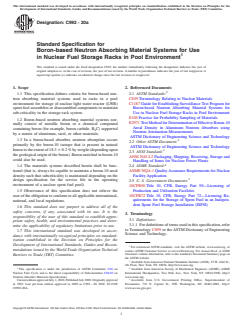
(Specification)Standard Specification for Boron-based Neutron Absorbing Material Systems for Use in Nuclear Fuel Storage Racks in Pool Environment
General Information
- Abstract
ABSTRACT
This specification defines essential criteria for all material combinations in boron-based neutron-absorbing material systems used for nuclear spent fuel storage racks in nuclear light water reactors, spent-fuel assemblies, or disassembled components. The boron-based neutron absorbing materials normally consist of metallic boron or a boron-containing boron compound supported by a matrix of aluminum, steel, or other materials. Material systems covered in this specification should always be capable of maintaining a B10 areal density that can support the required subcriticality depending on the design specification for service life.
SCOPE
1.1 This specification defines criteria for boron-based neutron absorbing material systems used in racks in a pool environment for storage of nuclear light water reactor (LWR) spent-fuel assemblies or disassembled components to maintain sub-criticality in the storage rack system.
1.2 Boron-based neutron absorbing material systems normally consist of metallic boron or a chemical compound containing boron (for example, boron carbide, B4C) supported by a matrix of aluminum, steel, or other materials.
1.3 In a boron-based absorber, neutron absorption occurs primarily by the boron-10 isotope that is present in natural boron to the extent of 18.3 ± 0.2 % by weight (depending upon the geological origin of the boron). Boron enriched in boron-10 could also be used.
1.4 The materials systems described herein shall be functional (that is, always be capable to maintain a boron-10 areal density such that subcriticality is maintained depending on the design specification for the service life in the operating environment of a nuclear spent fuel pool).
1.5 Observance of this specification does not relieve the user of the obligation to conform to all applicable international, national, and local regulations.
1.6 This standard does not purport to address all of the safety concerns, if any, associated with its use. It is the responsibility of the user of this standard to establish appropriate safety, health, and environmental practices and determine the applicability of regulatory limitations prior to use.
1.7 This international standard was developed in accordance with internationally recognized principles on standardization established in the Decision on Principles for the Development of International Standards, Guides and Recommendations issued by the World Trade Organization Technical Barriers to Trade (TBT) Committee.
- Status
- Published
- Publication Date
- 30-Jun-2020
- Technical Committee
- C26 - Nuclear Fuel Cycle
- Drafting Committee
- C26.03 - Neutron Absorber Materials Specifications
Buy Documents

ASTM C992-20a - Standard Specification for Boron-based Neutron Absorbing Material Systems for Use in Nuclear Fuel Storage Racks in Pool Environment

REDLINE ASTM C992-20a - Standard Specification for Boron-based Neutron Absorbing Material Systems for Use in Nuclear Fuel Storage Racks in Pool Environment
Overview
ASTM C992-20a is the international standard specification for boron-based neutron absorbing material systems used in nuclear fuel storage racks in pool environments. Issued by ASTM International, this standard defines the essential criteria for material systems designed to safely store spent nuclear fuel assemblies or disassembled components within light water reactors (LWR) pools. The focus is on utilizing boron or boron compounds, integrated into a suitable matrix such as aluminum or steel, to ensure reliable neutron absorption and maintain necessary subcriticality for the safe storage of nuclear materials over the intended service life.
Key Topics
Material System Composition
- Includes metallic boron or boron compounds (e.g., boron carbide, B4C) set in a matrix of aluminum, steel, or other compatible materials.
- Boron-10 isotope is the primary neutron absorber, either in natural or enriched form.
Performance Criteria
- Must maintain specified boron-10 areal density to support subcriticality for the storage system’s service life.
- Uniform distribution of boron-10 throughout the material is critical for effective neutron absorption.
Testing and Quality Assurance
- Accelerated and in-service tests are recommended to demonstrate durability and performance under anticipated operational conditions.
- Quality control extends from sampling of production batches to inspection of individual pieces for properties such as chemical composition, density, and cleanliness.
Purchasing and Documentation
- Purchasers must specify physical dimensions, required boron-10 content, mechanical properties, and environmental conditions.
- Manufacturers must provide comprehensive documentation of materials, chemical analyses, and test results as part of the certification process.
Marking, Packaging, and Shipping
- Items must be clearly marked and shipped in protective packaging to prevent damage and ensure traceability through the supply chain.
Applications
Spent Nuclear Fuel Storage
- Essential for the safe storage of LWR spent-fuel assemblies or disassembled nuclear components in pool environments found in nuclear power plants.
- Supports the critical function of maintaining subcriticality, thus preventing inadvertent nuclear chain reactions.
Neutron Absorption in Nuclear Facilities
- Used in materials and assemblies where neutron absorption is required to manage reactivity or ensure long-term safety.
Long-Term Storage Systems
- Appropriate for both newly designed and existing pool racks needing upgraded neutron absorption performance and compliance with international standards.
Regulatory Compliance and Audits
- Helps facilities meet international, national, and local nuclear safety regulations through standardized practices and documentation.
Related Standards
- ASTM C859: Terminology Relating to Nuclear Materials.
- ASTM C1187: Guide for Establishing Surveillance Test Programs for Boron-Based Neutron Absorbing Material Systems.
- ASTM E105: Practice for Probability Sampling of Materials.
- ASTM E2971: Test Method for Determination of Effective Boron-10 Areal Density in Aluminum Neutron Absorbers.
- ANSI N45.2.2: Packaging, Shipping, Receiving, Storage, and Handling of Items for Nuclear Power Plants.
- ASME NQA-1: Quality Assurance Requirements for Nuclear Facility Applications.
- US NRC 10 CFR 50 & 10 CFR 72: Licensing requirements for production, utilization, and storage facilities related to nuclear materials.
Keywords: ASTM C992-20a, boron-based neutron absorber, neutron absorbing material systems, nuclear fuel storage, spent fuel pool, boron-10 areal density, nuclear safety standards, subcriticality, LWR racks, nuclear materials testing.
Relations
- Effective Date
- 01-Jan-2024
- Effective Date
- 01-Jan-2020
- Effective Date
- 01-Jun-2015
- Effective Date
- 15-Jun-2014
- Effective Date
- 01-Jun-2014
- Effective Date
- 15-Jan-2014
- Effective Date
- 01-Jun-2013
- Effective Date
- 01-May-2013
- Effective Date
- 01-Nov-2010
- Effective Date
- 01-Oct-2010
- Effective Date
- 01-Aug-2010
- Effective Date
- 01-Feb-2010
- Effective Date
- 15-Feb-2009
- Effective Date
- 15-Sep-2008
- Effective Date
- 01-Jul-2007
Buy Documents
ASTM C992-20a - Standard Specification for Boron-based Neutron Absorbing Material Systems for Use in Nuclear Fuel Storage Racks in Pool Environment
REDLINE ASTM C992-20a - Standard Specification for Boron-based Neutron Absorbing Material Systems for Use in Nuclear Fuel Storage Racks in Pool Environment
Get Certified
Connect with accredited certification bodies for this standard

DNV
DNV is an independent assurance and risk management provider.

Lloyd's Register
Lloyd's Register is a global professional services organisation specialising in engineering and technology.
DNV Energy Systems
Energy and renewable energy certification.
Sponsored listings
Frequently Asked Questions
ASTM C992-20a is a technical specification published by ASTM International. Its full title is "Standard Specification for Boron-based Neutron Absorbing Material Systems for Use in Nuclear Fuel Storage Racks in Pool Environment". This standard covers: ABSTRACT This specification defines essential criteria for all material combinations in boron-based neutron-absorbing material systems used for nuclear spent fuel storage racks in nuclear light water reactors, spent-fuel assemblies, or disassembled components. The boron-based neutron absorbing materials normally consist of metallic boron or a boron-containing boron compound supported by a matrix of aluminum, steel, or other materials. Material systems covered in this specification should always be capable of maintaining a B10 areal density that can support the required subcriticality depending on the design specification for service life. SCOPE 1.1 This specification defines criteria for boron-based neutron absorbing material systems used in racks in a pool environment for storage of nuclear light water reactor (LWR) spent-fuel assemblies or disassembled components to maintain sub-criticality in the storage rack system. 1.2 Boron-based neutron absorbing material systems normally consist of metallic boron or a chemical compound containing boron (for example, boron carbide, B4C) supported by a matrix of aluminum, steel, or other materials. 1.3 In a boron-based absorber, neutron absorption occurs primarily by the boron-10 isotope that is present in natural boron to the extent of 18.3 ± 0.2 % by weight (depending upon the geological origin of the boron). Boron enriched in boron-10 could also be used. 1.4 The materials systems described herein shall be functional (that is, always be capable to maintain a boron-10 areal density such that subcriticality is maintained depending on the design specification for the service life in the operating environment of a nuclear spent fuel pool). 1.5 Observance of this specification does not relieve the user of the obligation to conform to all applicable international, national, and local regulations. 1.6 This standard does not purport to address all of the safety concerns, if any, associated with its use. It is the responsibility of the user of this standard to establish appropriate safety, health, and environmental practices and determine the applicability of regulatory limitations prior to use. 1.7 This international standard was developed in accordance with internationally recognized principles on standardization established in the Decision on Principles for the Development of International Standards, Guides and Recommendations issued by the World Trade Organization Technical Barriers to Trade (TBT) Committee.
ABSTRACT This specification defines essential criteria for all material combinations in boron-based neutron-absorbing material systems used for nuclear spent fuel storage racks in nuclear light water reactors, spent-fuel assemblies, or disassembled components. The boron-based neutron absorbing materials normally consist of metallic boron or a boron-containing boron compound supported by a matrix of aluminum, steel, or other materials. Material systems covered in this specification should always be capable of maintaining a B10 areal density that can support the required subcriticality depending on the design specification for service life. SCOPE 1.1 This specification defines criteria for boron-based neutron absorbing material systems used in racks in a pool environment for storage of nuclear light water reactor (LWR) spent-fuel assemblies or disassembled components to maintain sub-criticality in the storage rack system. 1.2 Boron-based neutron absorbing material systems normally consist of metallic boron or a chemical compound containing boron (for example, boron carbide, B4C) supported by a matrix of aluminum, steel, or other materials. 1.3 In a boron-based absorber, neutron absorption occurs primarily by the boron-10 isotope that is present in natural boron to the extent of 18.3 ± 0.2 % by weight (depending upon the geological origin of the boron). Boron enriched in boron-10 could also be used. 1.4 The materials systems described herein shall be functional (that is, always be capable to maintain a boron-10 areal density such that subcriticality is maintained depending on the design specification for the service life in the operating environment of a nuclear spent fuel pool). 1.5 Observance of this specification does not relieve the user of the obligation to conform to all applicable international, national, and local regulations. 1.6 This standard does not purport to address all of the safety concerns, if any, associated with its use. It is the responsibility of the user of this standard to establish appropriate safety, health, and environmental practices and determine the applicability of regulatory limitations prior to use. 1.7 This international standard was developed in accordance with internationally recognized principles on standardization established in the Decision on Principles for the Development of International Standards, Guides and Recommendations issued by the World Trade Organization Technical Barriers to Trade (TBT) Committee.
ASTM C992-20a is classified under the following ICS (International Classification for Standards) categories: 27.120.01 - Nuclear energy in general. The ICS classification helps identify the subject area and facilitates finding related standards.
ASTM C992-20a has the following relationships with other standards: It is inter standard links to ASTM C859-24, ASTM C1187-20, ASTM C1187-15, ASTM C859-14a, ASTM E2971-14, ASTM C859-14, ASTM C859-13a, ASTM C859-13, ASTM C859-10b, ASTM E105-10, ASTM C859-10a, ASTM C859-10, ASTM C859-09, ASTM C859-08, ASTM C1187-07. Understanding these relationships helps ensure you are using the most current and applicable version of the standard.
ASTM C992-20a is available in PDF format for immediate download after purchase. The document can be added to your cart and obtained through the secure checkout process. Digital delivery ensures instant access to the complete standard document.
Standards Content (Sample)
This international standard was developed in accordance with internationally recognized principles on standardization established in the Decision on Principles for the
Development of International Standards, Guides and Recommendations issued by the World Trade Organization Technical Barriers to Trade (TBT) Committee.
Designation:C992 −20a
Standard Specification for
Boron-based Neutron Absorbing Material Systems for Use
in Nuclear Fuel Storage Racks in Pool Environment
This standard is issued under the fixed designation C992; the number immediately following the designation indicates the year of
original adoption or, in the case of revision, the year of last revision. A number in parentheses indicates the year of last reapproval. A
superscript epsilon (´) indicates an editorial change since the last revision or reapproval.
1. Scope 2. Referenced Documents
1.1 This specification defines criteria for boron-based neu- 2.1 ASTM Standards:
tron absorbing material systems used in racks in a pool C859 Terminology Relating to Nuclear Materials
environment for storage of nuclear light water reactor (LWR) C1187 Guide for Establishing Surveillance Test Program for
spent-fuel assemblies or disassembled components to maintain Boron-based Neutron Absorbing Material Systems for
sub-criticality in the storage rack system. Use in Nuclear Fuel Storage Racks in Pool Environment
E105 Practice for Probability Sampling of Materials
1.2 Boron-based neutron absorbing material systems nor-
E2971 TestMethodforDeterminationofEffectiveBoron-10
mally consist of metallic boron or a chemical compound
Areal Density in Aluminum Neutron Absorbers using
containing boron (for example, boron carbide, B C) supported
Neutron Attenuation Measurements
by a matrix of aluminum, steel, or other materials.
ASTM Dictionary of Engineering Science and Technology
1.3 In a boron-based absorber, neutron absorption occurs
2.2 Other ASTM Document:
primarily by the boron-10 isotope that is present in natural
ASTM Dictionary of Engineering Science and Technology
borontotheextentof18.3 60.2 %byweight(dependingupon 3
2.3 ANSI Standard:
thegeologicaloriginoftheboron).Boronenrichedinboron-10
ANSI N45.2.2 Packaging, Shipping, Receiving, Storage and
could also be used.
Handling of Items for Nuclear Power Plants
1.4 The materials systems described herein shall be func-
2.4 ASME Standard:
tional (that is, always be capable to maintain a boron-10 areal
ASME NQA-1 QualityAssurance Requirements for Nuclear
density such that subcriticality is maintained depending on the
Facility Application
design specification for the service life in the operating
2.5 U. S. Government Documents:
environment of a nuclear spent fuel pool).
10CFR50 Title 10, CFR, Energy Part 50—Licensing of
Production and Utilization Facilities
1.5 Observance of this specification does not relieve the
10CFR72 Title 10, CFR, Energy Part 72—Licensing Re-
useroftheobligationtoconformtoallapplicableinternational,
quirements for the Storage of Spent Fuel in an Indepen-
national, and local regulations.
dent Spent Fuel Storage Installation (ISFSI)
1.6 This standard does not purport to address all of the
safety concerns, if any, associated with its use. It is the
3. Terminology
responsibility of the user of this standard to establish appro-
3.1 Definitions:
priate safety, health, and environmental practices and deter-
3.1.1 Fordefinitionsoftermsusedinthisspecification,refer
mine the applicability of regulatory limitations prior to use.
to Terminology C859 or theASTM Dictionary of Engineering
1.7 This international standard was developed in accor-
Science and Technology.
dance with internationally recognized principles on standard-
ization established in the Decision on Principles for the
Development of International Standards, Guides and Recom-
For referenced ASTM standards, visit the ASTM website, www.astm.org, or
mendations issued by the World Trade Organization Technical
contact ASTM Customer Service at service@astm.org. For Annual Book of ASTM
Standards volume information, refer to the standard’s Document Summary page on
Barriers to Trade (TBT) Committee.
the ASTM website.
Available fromAmerican National Standards Institute (ANSI), 25 W. 43rd St.,
4th Floor, New York, NY 10036, http://www.ansi.org.
1 4
This specification is under the jurisdiction of ASTM Committee C26 on Available from American Society of Mechanical Engineers (ASME), ASME
Nuclear Fuel Cycle and is the direct responsibility of Subcommittee C26.03 on International Headquarters, Two Park Ave., New York, NY 10016-5990, http://
Neutron Absorber Materials Specifications. www.asme.org.
Current edition approved July 1, 2020. Published July 2020. Originally approved Available from U.S. Government Printing Office, Superintendent of
in 1983. Last previous edition approved in 2020 as C992 – 20. DOI: 10.1520/ Documents, 732 N. Capitol St., NW, Washington, DC 20401-0001, http://
C0992-20A. www.access.gpo.gov.
Copyright © ASTM International, 100 Barr Harbor Drive, PO Box C700, West Conshohocken, PA 19428-2959. United States
C992−20a
3.2 Definitions of Terms Specific to This Standard: 4.2 The buyer shall specify the following material proper-
tiesandapplicabletolerancesoftheneutronabsorbingmaterial
3.2.1 accelerated testing, n—a procedure for investigating
system (this may include archive or in-service surveillance
the potential for long-term changes in physical properties or
coupons):
chemical composition of a material important to safety, caused
byasystemoperatingparametersuchastemperature,chemical 4.2.1 Total quantity of individual pieces required,
environment, or radiation. 4.2.2 Physicaldimensionsofeachindividualpiecerequired,
and may also include physical form limitations including
3.2.1.1 Discussion—The procedure uses a value of the
identified parameter that is outside the normal bound of the flatness, camber, bow, and so forth,
operating parameter being investigated, in order to (1) increase 4.2.3 Boron-10 isotopic content of the neutron absorbing
the rate of degradation, if any, (2) identify the operating limit material system expressed in terms of areal density.
for acceptable limit of the parameter, and (3) to provide Alternatively, the boron-10 content may be specified by mate-
information that might assist in interpreting the degradation rial density, the weight percent boron, minimum thickness, and
mechanism(s) involved. In this manner, the long-term behavior the minimum acceptable weight fraction of boron-10 in the
ofamaterialmaybesimulatedinanappreciablyshorterperiod boron,
of time. 4.2.4 Material for the components of the neutron absorbing
material system shall be in accordance with applicable speci-
3.2.2 areal density, n—for neutron absorber materials with
fications or standards,
flat parallel surfaces, the mass of boron-10 per unit area of a
4.2.5 Mechanical properties of the neutron absorbing mate-
sheet, which is equivalent to the mass of boron-10 per unit
rial system for structural requirements, as required, and
volume in the material multiplied by the thickness of the
4.2.6 Acceptance criteria for gas evolution, product
material in which that isotope is contained.
cleanliness, or other physical characteristics, if applicable.
3.2.3 buyer, n—the organization issuing the purchase order.
3.2.4 degradation, n—a change in a material property that
5. Material System Properties
lessens the original design functionality.
5.1 The boron-10 shall be uniformly distributed throughout
3.2.5 individual piece, n—a discrete section of neutron
the neutron absorbing material as defined in 7.3 and 8.1.4.
absorber material whose individual dimensions conform to
5.2 The neutron absorbing material system may contain, in
those in the purchase specification.
addition to the boron or boron compound, any matrix materials
3.2.6 irradiation, n—the incidence of neutron, gamma, and
necessary to maintain that boron in the state of specified
beta radiation from spent fuel assemblies on materials in a
uniformity and boron-10 areal density throughout the stipu-
water-filled spent fuel pool.
lated service life of the spent fuel storage system.
3.2.7 production batch, n—a group of neutron absorbing 5.2.1 The seller shall provide to the buyer a chemical
material pieces produced in a continuous production period, all analysis of the neutron absorbing material system, so that the
ofwhichcanbeshowntohavethesamechemi
...
This document is not an ASTM standard and is intended only to provide the user of an ASTM standard an indication of what changes have been made to the previous version. Because
it may not be technically possible to adequately depict all changes accurately, ASTM recommends that users consult prior editions as appropriate. In all cases only the current version
of the standard as published by ASTM is to be considered the official document.
Designation: C992 − 20 C992 − 20a
Standard Specification for
Boron-based Neutron Absorbing Material Systems for Use
in Nuclear Fuel Storage Racks in Pool Environment
This standard is issued under the fixed designation C992; the number immediately following the designation indicates the year of
original adoption or, in the case of revision, the year of last revision. A number in parentheses indicates the year of last reapproval. A
superscript epsilon (´) indicates an editorial change since the last revision or reapproval.
1. Scope
1.1 This specification defines criteria for boron-based neutron absorbing material systems used in racks in a pool environment
for storage of nuclear light water reactor (LWR) spent-fuel assemblies or disassembled components to maintain sub-criticality in
the storage rack system.
1.2 Boron-based neutron absorbing material systems normally consist of metallic boron or a chemical compound containing
boron (for example, boron carbide, B C) supported by a matrix of aluminum, steel, or other materials.
1.3 In a boron-based absorber, neutron absorption occurs primarily by the boron-10 isotope that is present in natural boron to
the extent of 18.3 6 0.2 % by weight (depending upon the geological origin of the boron). Boron enriched in boron-10 could also
be used.
1.4 The materials systems described herein shall be functional (that is, always be capable to maintain a boron-10 areal density
such that subcriticality is maintained depending on the design specification for the service life in the operating environment of a
nuclear spent fuel pool).
1.5 Observance of this specification does not relieve the user of the obligation to conform to all applicable international,
national, and local regulations.
1.6 This standard does not purport to address all of the safety concerns, if any, associated with its use. It is the responsibility
of the user of this standard to establish appropriate safety, health, and environmental practices and determine the applicability of
regulatory limitations prior to use.
1.7 This international standard was developed in accordance with internationally recognized principles on standardization
established in the Decision on Principles for the Development of International Standards, Guides and Recommendations issued
by the World Trade Organization Technical Barriers to Trade (TBT) Committee.
2. Referenced Documents
2.1 ASTM Standards:
C859 Terminology Relating to Nuclear Materials
C1187 Guide for Establishing Surveillance Test Program for Boron-based Neutron Absorbing Material Systems for Use in
Nuclear Fuel Storage Racks in Pool Environment
E105 Practice for Probability Sampling of Materials
E2971 Test Method for Determination of Effective Boron-10 Areal Density in Aluminum Neutron Absorbers using Neutron
Attenuation Measurements
ASTM Dictionary of Engineering Science and Technology
2.2 Other ASTM Document:
ASTM Dictionary of Engineering Science and Technology
2.3 ANSI Standard:
ANSI N45.2.2 Packaging, Shipping, Receiving, Storage and Handling of Items for Nuclear Power Plants
This specification is under the jurisdiction of ASTM Committee C26 on Nuclear Fuel Cycle and is the direct responsibility of Subcommittee C26.03 on Neutron Absorber
Materials Specifications.
Current edition approved Jan. 1, 2020July 1, 2020. Published February 2020July 2020. Originally approved in 1983. Last previous edition approved in 20162020 as
C992 – 16.C992 – 20. DOI: 10.1520/C0992-20.10.1520/C0992-20A.
For referenced ASTM standards, visit the ASTM website, www.astm.org, or contact ASTM Customer Service at service@astm.org. For Annual Book of ASTM Standards
volume information, refer to the standard’s Document Summary page on the ASTM website.
Available from American National Standards Institute (ANSI), 25 W. 43rd St., 4th Floor, New York, NY 10036, http://www.ansi.org.
Copyright © ASTM International, 100 Barr Harbor Drive, PO Box C700, West Conshohocken, PA 19428-2959. United States
C992 − 20a
2.4 ASME Standard:
ASME NQA-1 Quality Assurance Requirements for Nuclear Facility Application
2.5 U. S. Government Documents:
10CFR50 Title 10, CFR, Energy Part 50—Licensing of Production and Utilization Facilities
10CFR72 Title 10, CFR, Energy Part 72—Licensing Requirements for the Storage of Spent Fuel in an Independent Spent Fuel
Storage Installation (ISFSI)
3. Terminology
3.1 Definitions:
3.1.1 For definitions of terms used in this specification, refer to Terminology C859 or the ASTM Dictionary of Engineering
Science and Technology.
3.2 Definitions of Terms Specific to This Standard:
3.2.1 accelerated testing, n—a procedure for investigating the potential for long-term changes in physical properties or chemical
composition of a material important to safety, caused by a system operating parameter such as temperature, chemical environment,
or radiation.
3.2.1.1 Discussion—
The procedure uses a value of the identified parameter that is outside the normal bound of the operating parameter being
investigated, in order to (1) increase the rate of degradation, if any, (2) identify the operating limit for acceptable limit of the
parameter, and (3) to provide information that might assist in interpreting the degradation mechanism(s) involved. In this manner,
the long-term behavior of a material may be simulated in an appreciably shorter period of time.
3.2.2 areal density, n—for neutron absorber materials with flat parallel surfaces, the mass of boron-10 per unit area of a sheet,
which is equivalent to the mass of boron-10 per unit volume of boron-10 in the material multiplied by the thickness of the material
in which that isotope is contained.
3.2.3 buyer, n—the organization issuing the purchase order.
3.2.4 degradation, n—a change in a material property that lessens the original design functionality.
3.2.5 individual piece, n—a discrete section of neutron absorber material whose individual dimensions conform to those in the
purchase specification.
3.2.6 irradiation, n—the incidence of neutron, gamma, and beta radiation from spent fuel assemblies on materials in a
water-filled spent fuel pool.
3.2.7 production batch, n—a group of neutron absorbing material pieces produced in a continuous production period, all of
which can be shown to have the same chemical composition, physical, and nuclear properties within specification limits.
3.2.8 seller, n—the neutron absorbing system manufacturer.
3.2.9 service life, n—the period of time for which properties of the neutron absorbing material system are expected to remain
in compliance with the contract requirements which relate to material functionality.
3.2.10 supplier, n—any outside source of raw materials and services used by the seller.
4. Ordering Information
4.1 The buyer should specify a material for which there is documented evidence that the neutron absorbing material system is
capable of acceptable performance in the following environmental conditions to which the material is expected to be exposed:
4.1.1 Total service life of the neutron absorbing material system,
4.1.2 Maximum integrated irradiation over the total service life of the neutron absorbing material system, and
4.1.3 Environment of the fuel pool in which the neutron absorbing material system will be located, including consideration of
normal operation and effects of anticipated operational occurrences.
4.2 The buyer shall specify the following material properties and applicable tolerances of the neutron absorbing material system
(this may include archive or in-service surveillance coupons):
4.2.1 Total quantity of individual pieces required,
4.2.2 Physical dimensions of each individual piece required, and may also include physical form limitations including flatness,
camber, bow, and so forth,
Available from American Society of Mechanical Engineers (ASME), ASME International Headquarters, Two Park Ave., New York, NY 10016-5990, http://
www.asme.org.
Available from U.S. Government Printing Office, Superintendent of Documents, 732 N. Capitol St., NW, Washington, DC 20401-0001, http://www.access.gpo.gov.
...