

ASTM A340-23a
(Terminology)Standard Terminology of Symbols and Definitions Relating to Magnetic Testing
General Information
- Abstract
- Status
- Published
- Publication Date
- 30-Nov-2023
- Technical Committee
- A06 - Magnetic Properties
- Drafting Committee
- A06.92 - Terminology and Definitions
Overview
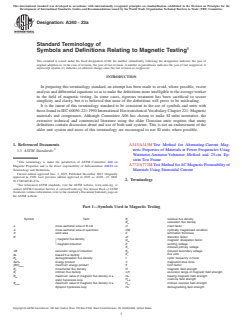
ASTM A340-23a: Standard Terminology of Symbols and Definitions Relating to Magnetic Testing is a fundamental international standard issued by ASTM International. Developed in accordance with globally recognized principles, this standard provides a comprehensive collection of terms, symbols, and definitions specifically for magnetic testing and measurement in the materials industry. The standard emphasizes clarity and accessibility by minimizing complex mathematical treatments, making it an essential reference for professionals involved in magnetic materials, magnetic measurement, and electromagnetic device development.
Key Topics
- Magnetic Testing Terminology: Standardization of symbols and definitions crucial to understanding and performing magnetic measurements.
- Units and Symbols: Consistent use of SI units is encouraged, while recognizing the presence of legacy Gaussian (cgs-emu) units in technical literature. Terms like tesla, oersted, gauss, and ampere-turn are clearly distinguished.
- Core Magnetic Properties:
- Magnetic flux density (B), magnetic field strength (H), and related measurements.
- Key properties such as coercive field strength, remanence, and saturation.
- Material Classification: Definitions for types of magnetic materials, including ferromagnetic, ferrimagnetic, antiferromagnetic, and diamagnetic materials.
- Measurement Methods: Descriptions of testing conditions such as cyclically magnetized condition (CM) and symmetrically cyclically magnetized condition (SCM).
- Magnetic Losses and Performance Metrics: Core loss, hysteresis loss, eddy current loss, and how these are quantified for device evaluation.
Applications
ASTM A340-23a is widely applied in industries where the magnetic characteristics of materials directly impact product performance, safety, and regulatory compliance. Practical uses include:
- Material Selection and Specification: Ensuring consistent terminology when specifying electrical steels, permanent magnet alloys, ferrites, and amorphous alloys for transformers, inductors, and motor cores.
- Test Methodology Alignment: Serving as a reference to improve repeatability, reproducibility, and comparability of magnetic test results by harmonizing nomenclature across laboratories and industries.
- Design and Quality Assurance: Supporting engineers and scientists in the accurate interpretation of test data for magnetic devices, leading to better-designed transformers, electronic components, and magnetic storage devices.
- Education and Training: Providing a standardized vocabulary for academic instruction and professional development in electromagnetism, materials science, and electrical engineering.
- Documentation and Compliance: Facilitating clear communication in technical papers, standards, regulatory filings, and product datasheets.
Related Standards
- IEC 60050-221:1990: International Electrotechnical Vocabulary for magnetic materials and components, referenced for consistency in terminology.
- ASTM A343/A343M: Test methods for alternating-current magnetic properties of materials at power frequencies.
- ASTM A772/A772M: Test methods for AC magnetic permeability of materials using sinusoidal current.
- Other ASTM Committee A06 Publications: Covering magnetic property measurement and specific materials testing protocols.
Practical Value
Adopting ASTM A340-23a ensures:
- Improved Communication: Common understanding across industries, research, and global supply chains.
- Enhanced Test Consistency: Confidence when interpreting test results and comparing performance data for materials and components.
- Regulatory Alignment: Conformance with international trade and technical barriers to trade (TBT) guidelines.
- Facilitated Innovation: A structured basis for research, development, and standardization of new magnetic materials and testing technologies.
Keywords: ASTM A340-23a, magnetic testing terminology, magnetic properties, magnetic measurement, symbols, definitions, magnetic materials, core loss, coercive field, SI units, cgs-emu units, materials science, standards.
Relations
- Effective Date
- 01-Dec-2023
- Effective Date
- 01-Dec-2023
- Effective Date
- 01-Dec-2023
- Effective Date
- 01-Dec-2023
- Effective Date
- 01-Dec-2023
- Effective Date
- 01-Dec-2023
- Effective Date
- 01-Dec-2023
- Effective Date
- 01-Dec-2023
- Effective Date
- 01-Dec-2023
- Effective Date
- 01-Dec-2023
- Effective Date
- 01-Dec-2023
- Effective Date
- 01-Dec-2023
- Effective Date
- 01-Dec-2023
- Effective Date
- 01-Dec-2023
- Effective Date
- 01-Dec-2023
Get Certified
Connect with accredited certification bodies for this standard

IMQ S.p.A. (Certification)
Italian electrical product certification.

SLG Prüf- und Zertifizierungs GmbH
German testing and certification body.

UL Solutions
Global safety science company with testing, inspection and certification.
Sponsored listings
Frequently Asked Questions
ASTM A340-23a is a standard published by ASTM International. Its full title is "Standard Terminology of Symbols and Definitions Relating to Magnetic Testing". This standard covers: Standard Terminology of Symbols and Definitions Relating to Magnetic Testing
Standard Terminology of Symbols and Definitions Relating to Magnetic Testing
ASTM A340-23a is classified under the following ICS (International Classification for Standards) categories: 29.030 - Magnetic materials. The ICS classification helps identify the subject area and facilitates finding related standards.
ASTM A340-23a has the following relationships with other standards: It is inter standard links to ASTM A340-23, ASTM A912/A912M-11(2019), ASTM A848-17, ASTM A697/A697M-13(2018), ASTM A876-17e1, ASTM A1126-23, ASTM F2978-20, ASTM A1086-20, ASTM A772/A772M-00(2022), ASTM A1013-00(2020), ASTM A932/A932M-01(2019), ASTM A1054-16(2022), ASTM A773/A773M-21, ASTM A726-18, ASTM A348/A348M-05(2021). Understanding these relationships helps ensure you are using the most current and applicable version of the standard.
ASTM A340-23a is available in PDF format for immediate download after purchase. The document can be added to your cart and obtained through the secure checkout process. Digital delivery ensures instant access to the complete standard document.
Standards Content (Sample)
This international standard was developed in accordance with internationally recognized principles on standardization established in the Decision on Principles for the
Development of International Standards, Guides and Recommendations issued by the World Trade Organization Technical Barriers to Trade (TBT) Committee.
Designation: A340 − 23a
Standard Terminology of
Symbols and Definitions Relating to Magnetic Testing
This standard is issued under the fixed designation A340; the number immediately following the designation indicates the year of
original adoption or, in the case of revision, the year of last revision. A number in parentheses indicates the year of last reapproval. A
superscript epsilon (´) indicates an editorial change since the last revision or reapproval.
INTRODUCTION
In preparing this terminology standard, an attempt has been made to avoid, where possible, vector
analysis and differential equations so as to make the definitions more intelligible to the average worker
in the field of magnetic testing. In some cases, rigorous treatment has been sacrificed to secure
simplicity and clarity, but it is believed that none of the definitions will prove to be misleading.
It is the intent of this terminology standard to be consistent in the use of symbols and units with
those found in IEC 60050-221:1990 International Electrotechnical Vocabulary Chapter 221: Magnetic
materials and components. Although Committee A06 has chosen to make SI units normative, the
extensive technical and commercial literature using the older Gaussian units requires that many
definitions contain discussion about and use of both unit systems. This is not an endorsement of the
older unit system and users of this terminology are encouraged to use SI units where possible.
1. Referenced Documents A343/A343M Test Method for Alternating-Current Mag-
netic Properties of Materials at Power Frequencies Using
1.1 ASTM Standards:
Wattmeter-Ammeter-Voltmeter Method and 25-cm Ep-
stein Test Frame
This terminology is under the jurisdiction of ASTM Committee A06 on
A772/A772M Test Method for AC Magnetic Permeability of
Magnetic Properties and is the direct responsibility of Subcommittee A06.92 on
Materials Using Sinusoidal Current
Terminology and Definitions.
Current edition approved Dec. 1, 2023. Published December 2023. Originally
approved in 1949. Last previous edition approved in 2023 as A340 – 23. DOI:
2. Terminology
10.1520/A0340-23A.
For referenced ASTM standards, visit the ASTM website, www.astm.org, or
contact ASTM Customer Service at service@astm.org. For Annual Book of ASTM
Standards volume information, refer to the standard’s Document Summary page on
the ASTM website.
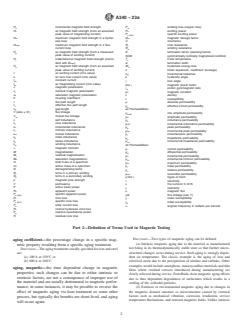
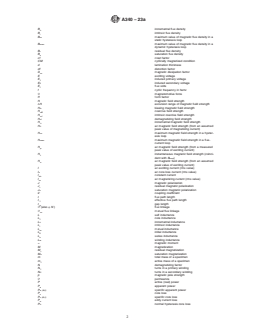
Part 1—Symbols Used in Magnetic Testing
Symbol Term B residual flux density
r
B saturation flux density
s
a cross-sectional area of B coil cf crest factor
A cross-sectional area of specimen CM cyclically magnetized condition
A' solid area d lamination thickness
B df distortion factor
magnetic flux density
D magnetic dissipation factor
m
H
magnetic induction E exciting voltage
E induced primary voltage
E induced secondary voltage
∆B excursion range of induction
B biased flux density E flux volts
f
b
f cyclic frequency in hertz
B demagnetization flux density
d
B H energy product ^ magnetomotive force
d d
(BH) maximum energy product ff form factor
max
H magnetic field strength
B incremental flux density
∆
B intrinsic flux density ∆H excursion range of magnetic field strength
i
H biasing magnetic field strength
B maximum value of magnetic flux density in a
m b
static hysteresis loop H coercive field strength
cB
H intrinsic coercive field strength
B maximum value of magnetic flux density in a
max cJ
dynamic hysteresis loop H demagnetizing field strength
d
Copyright © ASTM International, 100 Barr Harbor Drive, PO Box C700, West Conshohocken, PA 19428-2959. United States
A340 − 23a
H incremental magnetic field strength P winding loss (copper loss)
∆ w
H ac magnetic field strength (from an assumed P exciting power
L z
peak value of magnetizing current) P specific exciting power
z (B;f)
H maximum magnetic field strength in a hyster- Q magnetic storage factor
m
m
esis loop
5 reluctance
H maximum magnetic field strength in a flux- R core resistance
max
current loop
R winding resistance
w
H ac magnetic field strength (from a measured S lamination factor (stacking factor)
p
peak value of exciting current) SCM symmetrically cyclically magnetized condition
H instantaneous magnetic field strength (coinci- T Curie temperature
t c
dent with B ) w lamination width
max
H ac magnetic field strength (from an assumed
W hysteresis energy loss
z h
peak value of exciting current) linear expansion, coefficient (average)
α¯
I ac exciting current (rms value)
∆χ incremental tolerance
I ac core loss current (rms value)
c β hysteretic angle
I constant current
dc γ loss angle
I ac magnetizing current (rms value)
m cos γ magnetic power factor
J magnetic polarization
γ proton gyromagnetic ratio
p
J residual magnetic polarization
r μ magnetic constant
J saturation magnetic polarization
s δ density
k' coupling coefficient
κ susceptibility
! flux path length
μ absolute permeability
! effective flux path length
1 μ effective circuit permeability
e
! gap length
g ac Permeabilities:
+ (also φ N ) flux linkage
μ rms amplitude permeability
a,eff
+ mutual flux linkage
m μ amplitude permeability
a
L self inductance
μ inductance permeability
L
L core inductance
1 μ L incremental inductance permeability
∆
L incremental inductance
∆ μ peak permeability
p
L intrinsic inductance
i μ incremental peak permeability
∆p
L mutual inductance
m μ instantaneous permeability
i
L initial inductance
0 μ impedance permeability
z
L series inductance
s μ incremental impedance permeability
∆z
L winding inductance
w dc Permeabilities:
m magnetic moment
μ normal permeability
M magnetization
μ differential permeability
d
M residual magnetization
r μ incremental permeability
∆
M saturation magnetization
s μ incremental intrinsic permeability
∆i
m total mass of a specimen
μ maximum permeability
m
m active mass of a specimen
1 μ initial permeability
i
N demagnetizing factor
μ relative permeability
r
N turns in a primary winding
1 μ reversible permeability
rev
N turns in a secondary winding
2 μ'/cot γ figure of merit
p magnetic pole strength
ν reluctivity
3 permeance
π the numeric 3.1416
P active (real) power
ρ resistivity
P apparent power
a φ magnetic flux
P specific apparent power
a (B;f) φN flux linkage (see +)
P core loss
c χ mass susceptibility
P specific core loss
c (B;f) χ initial susceptibility
P eddy current loss
e ω angular frequency in radians per second
P normal hysteresis core loss
h
P reactive (quadrature) power
q
P residual core loss
r
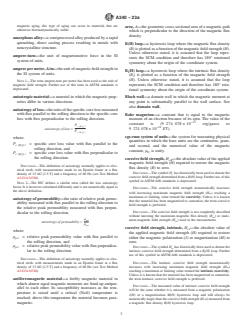
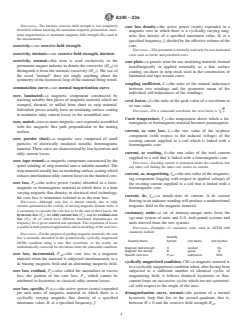
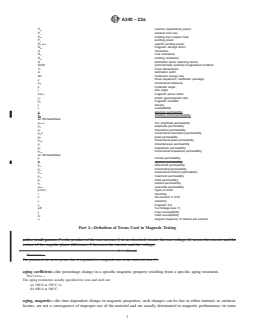
Part 2—Definition of Terms Used in Magnetic Testing
DISCUSSION—Two types of magnetic aging can be defined:
aging coefficient—the percentage change in a specific mag-
(a) Intrinsic magnetic aging due to the material as manufactured
netic property resulting from a specific aging treatment.
not being in its thermodynamically stable state so that further micro-
DISCUSSION—The aging treatments usually specified for iron and steel
structural changes occur during service. Such aging is strongly depen-
are:
dent on temperature. The classic example is the aging of iron and
(a) 100 h at 150°C or
electrical steels due to the precipitation of nitrides and carbides. Other
(b) 600 h at 100°C.
examples would include amorphous, nanocrystalline materials and thin
aging, magnetic—the time dependent change in magnetic
films where residual stresses introduced during manufacturing are
properties; such changes can be due to either intrinsic or
slowly relieved during service. Ferrofluids show magnetic aging effects
extrinsic factors, are not a consequence of improper use of
due to time dependent degradation of surfactants which results in a
the material and are usually detrimental to magnetic perfor-
settling of the colloidal particles.
mance; in some instances, it may be possible to reverse the (b) Extrinsic or environmental magnetic aging due to changes in
effect of magnetic aging via heat treatment or some other the magnetic domain structure or microstructure caused by external
factors such as mechanical vibration, corrosion, irradiation, service
process, but typically the benefits are short-lived, and aging
temperature fluctuations, and external magnetic fields. Unlike intrinsic
will occur again.
A340 − 23a
magnetic aging, this type of aging can occur in materials that are
area, A—the geometric cross-sectional area of a magnetic path
otherwise thermodynamically stable.
which is perpendicular to the direction of the magnetic flux
density.
amorphous alloy—a semiprocessed alloy produced by a rapid
quenching, direct casting process resulting in metals with
B(H) loop—a hysteresis loop where the magnetic flux density
noncrystalline structure.
(B) is plotted as a function of the magnetic field strength (H).
Unless otherwise stated, it is assumed that the loop repre-
ampere-turn—the unit of magnetomotive force in the SI
sents the SCM condition and therefore has 180° rotational
system of units.
symmetry about the origin of the coordinate system.
ampere per metre, A/m—the unit of magnetic field strength in
B (H) loop—a hysteresis loop where the intrinsic flux density
i
the SI system of units.
(B ) is plotted as a function of the magnetic field strength
i
(H). Unless otherwise stated, it is assumed that the loop
NOTE 1—The term ampere-turn per metre has been used as the unit of
magnetic field strength. Further use of this term in ASTM standards is represents the SCM condition and therefore has 180° rota-
deprecated.
tional symmetry about the origin of the coordinate system.
anisotropic material—a material in which the magnetic prop-
Bloch wall—a domain wall in which the magnetic moment at
erties differ in various directions.
any point is substantially parallel to the wall surface. See
also domain wall.
anisotropy of loss—the ratio of the specific core loss measured
with flux parallel to the rolling direction to the specific core
Bohr magneton—a constant that is equal to the magnetic
loss with flux perpendicular to the rolling direction. moment of an electron because of its spin. The value of the
−21
constant is (9 274 078 × 10 erg/gauss or
P
c ~B;f! l
−24
anisotropy of loss 5 9 274 078 × 10 J/T).
P
c ~B;f! t
cgs-emu system of units—the system for measuring physical
where:
quantities in which the base units are the centimetre, gram,
P = specific core loss value with flux parallel to the
c (B;f) l
and second, and the numerical value of the magnetic
rolling direction, and
constant, μ , is unity.
P = specific core loss value with flux perpendicular to
c (B;f) t
the rolling direction.
coercive field strength, H —the absolute value of the applied
cB
magnetic field strength (H) required to restore the magnetic
DISCUSSION—This definition of anisotropy normally applies to elec-
flux density (B) to zero.
trical steels with measurements made in an Epstein frame at a flux
DISCUSSION—The symbol H has historically been used to denote the
density of 15 kG [1.5 T] and a frequency of 60 Hz (see Test Method c
coercive field strength determined from a B(H) loop. Further use of this
A343/A343M).
symbol in ASTM A06 standards is deprecated.
NOTE 2—The IEC defines a similar term called the loss anisotropy
factor. It is however calculated differently and is not numerically equal to
DISCUSSION—The coercive field strength monotonically increases
the above definition.
with increasing maximum magnetic field strength (H ) reaching a
m
maximum or limiting value termed the coercivity. Unless it is known
anisotropy of permeability—the ratio of relative peak perme-
that the material has been magnetized to saturation, the term coercive
ability measured with flux parallel to the rolling direction to
field strength is preferred.
the relative peak permeability measured with flux perpen-
DISCUSSION—The coercive field strength is not completely described
dicular to the rolling direction.
without knowing the maximum magnetic flux density (B ) or maxi-
m
μ
prl mum magnetic field strength (H ) used in the measurement.
m
anisotropy of permeability 5
μ
prt
coercive field strength, intrinsic, H —the absolute value of
cJ
where:
the applied magnetic field strength (H) required to restore
μ = relative peak permeability value with flux parallel to
either the magnetic polarization (J) or magnetization (M) to
prl
the rolling direction, and
zero.
μ = relative peak permeability value with flux perpendicu-
prt DISCUSSION—The symbol H has historically been used to denote the
ci
lar to the rolling direction.
intrinsic coercive field strength determined from a B (H) loop. Further
i
use of this symbol in ASTM A06 standards is deprecated.
DISCUSSION—This definition of anisotropy normally applies to elec-
DISCUSSION—The intrinsic coercive field strength monotonically
trical steels with measurements made in an Epstein frame at a flux
increases with increasing maximum magnetic field strength (H )
density of 15 kG [1.5 T] and a frequency of 60 Hz (see Test Method
m
reaching a maximum or limiting value termed the intrinsic coercivity.
A343/A343M).
Unless it is known that the material has been magnetized to saturation,
antiferromagnetic material—a feebly magnetic material in the term intrinsic coercive field strength is preferred.
which almost equal magnetic moments are lined up antipar-
DISCUSSION—The measured value of intrinsic coercive field strength
allel to each other. Its susceptibility increases as the tem-
will be the same whether it is measured from a magnetic polarization
perature is raised until a critical (Neél) temperature is
J(H) or a magnetization M(H) hysteresis loop and will always be
reached; above this temperature the material becomes para-
numerically larger than the coercive field strength (H ) measured from
cB
magnetic. a magnetic flux density B(H) hysteresis loop.
A340 − 23a
DISCUSSION—The intrinsic coercive field strength is not completely
core loss density—the active power (watts) expended in a
described without knowing the maximum magnetic polarization, maxi-
magnetic core in which there is a cyclically varying mag-
mum magnetization or maximum magnetic field strength (H ) used in
m
netic flux density of a specified maximum value, B, at a
the measurement.
specified frequency, f, divided by the effective volume of the
core.
coercivity—see coercive field strength.
DISCUSSION—This parameter is normally used only for non-laminated
coercivity, intrinsic—see coercive field strength, intrinsic.
cores such as ferrite and powdered cores.
coercivity, normal—this term is used exclusively in the
core plate—a generic term for any insulating material, formed
permanent magnet industry to denote the coercivity (H ) to
cB metallurigically or applied externally as a thin surface
distinguish it from the intrinsic coercivity (H ). The use of
coating, on sheet or strip stock used in the construction of
cJ
the word “normal” does not imply anything about the
laminated and tape wound cores.
symmetry of the hysteresis loop of the material being tested.
coupling coefficient, k'—the ratio of the mutual inductance
commutation curve—see normal magnetization curve.
between two windings and the geometric mean of the
individual self-inductances of the windings.
core, laminated—a magnetic component constructed by
stacking suitably thin pieces of magnetic material which are
crest factor, cf—the ratio of the peak value of a waveform to
stamped, sheared, or milled from sheet or strip material.
its rms value.
Individual pieces usually have an insulating surface coating
=
DISCUSSION—For a sinusoidal waveform, the crest factor is 2.
to minimize eddy current losses in the assembled core.
Curie temperature, T —the temperature above which a fer-
c
core, mated—two or more magnetic core segments assembled
romagnetic or ferrimagnetic material becomes paramagnetic.
with the magnetic flux path perpendicular to the mating
current, ac core loss, I —the rms value of the in-phase
surface.
c
component (with respect to the induced voltage) of the
core, powder (dust)—a magnetic core comprised of small
exciting current supplied to a coil which is linked with a
particles of electrically insulated metallic ferromagnetic
ferromagnetic core.
material. These cores are characterized by low hysteresis and
current, ac exciting, I—the rms value of the total current
eddy current losses.
supplied to a coil that is linked with a ferromagnetic core.
core, tape-wound—a magnetic component constructed by the
DISCUSSION—Exciting current is measured under the condition that
spiral winding of strip material onto a suitable mandrel. The
any other coil linking the same core carries no current.
strip material usually has an insulating surface coating which
current, ac, magnetizing, I —the rms value of the magnetiz-
m
reduces interlaminar eddy current losses in the finished core.
ing component (lagging with respect to applied voltage) of
core loss, P —the active power (watts) absorbed in a ferro-
the exciting current supplied to a coil that is linked with a
c
magnetic or ferrimagnetic material in which there is a time
ferromagnetic core.
varying magnetic flux density; in electrical steel technology,
current, dc, I —a steady-state dc current. A dc current
dc
the core loss is sometimes referred to as the iron loss.
flowing in an inductor winding will produce a unidirectional
DISCUSSION—Although core loss is almost entirely due to eddy
magnetic field in the magnetic material.
currents generated in the vicinity of moving magnetic domain walls, it
is customary to consider the core loss to be the sum of three losses, the
customary units—a set of industry-unique units from the
hysteresis loss (P ), the eddy current loss (P ), and the residual core
h e
cgs-emu system of units and U.S. inch-pound systems and
loss (P ), all of which have different functional dependencies on
r
frequency for a given material and specimen. This separation of losses units derived from the two systems.
is useful in both practical applications and in modeling of the core loss.
DISCUSSION—Examples of customary units used in ASTM A06
standards include:
DISCUSSION—For the purpose of grading magnetic materials, the core
Quantity
loss is normally measured in the symmetrically cyclically magnetized
Quantity Name Symbol Unit Name Unit Symbol
(SCM) condition using a sine flux waveform, or the results are
mathematically corrected for deviations from the sinusoidal condition.
Magnetic field strength H oersted Oe
Magnetic flux density B gauss G
core loss, incremental, P —the core loss in a magnetic
c∆ Specific core loss P watt/pound W/lb
c(B;f)
material when the material is subjected simultaneously to a
cyclically magnetized condition, CM—a magnetic material is
dc biasing magnetic field and an alternating magnetic field.
in a cyclically magnetized condition when, after having been
core loss, residual, P —also called the anomalous or excess subjected to a sufficient number of identical cycles of
r
loss, the portion of the core loss, P , which cannot be magnetizing field, it follows identical hysteresis or flux-
c
attributed to hysteresis or classical eddy current losses. current loops on successive cycles which are not symmetri-
cal with respect to the origin of the axes.
core loss, specific, P —the active power (watts) expended
c(B;f)
per unit mass of magnetic material in which there is a demagnetization curve, normal—the portion of a normal
cyclically varying magnetic flux density of a specified hysteresis loop that lies in the second quadrant, that is,
maximum value, B, at a specified frequency, f. between H = 0 and the coercive field strength H .
cB
A340 − 23a
demagnetization curve, intrinsic—the portion of an intrinsic analysis or direct measurement E , E , E , and so forth are
1 2 3
hysteresis loop (either B , J or M vs H) that lies in the second the effective values of the pure sinusoidal harmonic compo-
i
quadrant, that is, between H = 0 and the intrinsic coercive nents of a distorted voltage waveform, then the distortion
field strength H . factor is the ratio of the root mean square of the second and
cJ
all higher harmonic components to the fundamental compo-
demagnetizing factor, N—the ratio of the self-demagnetizing
nent.
magnetic field strength to the magnetization (M). It is a
2 2 2 1/2
df 5 @E 1E 1E 1···# E
dimensionless quantity ranging in value from 0 to 1 and 2 3 4 1
DISCUSSION—There are no dc components (E ) in the distortion
depends on the specimen geometry, dimensions, and the
factor.
magnetic susceptibility of the material.
DISCUSSION—The demagnetizing factor has a single calculable value
domains, ferromagnetic—magnetized regions, either macro-
only when the sample is an ellipsoid (usually an ellipsoid of revolution)
scopic or microscopic in size, within ferromagnetic materi-
or has the value zero (for a closed uniform magnetic circuit). Approxi-
als. Each domain, in itself, is magnetized to magnetic
mate values are available as the result of calculations or measurements.
saturation at all times, and the saturation magnetization is
For demagnetization factors derived from measurements, one might
unidirectional within the domain.
encounter the symbols N for ballistic measurements, N for fluxmetric
b f
measurements, and N for magnetometric measurements. Additional
m
domain wall—a boundary region between two adjacent do-
descriptors, used less frequently, define the direction of measurement,
mains within which the orientation of the magnetic moment
that is, N , N , and N .
x y z
of one domain changes into a different orientation of the
demagnetizing field strength, H —a magnetic field strength
d
magnetic moment in the other domain.
applied in such a direction as to reduce the magnetic flux
density in a magnetized body. See demagnetization curve. eddy current—an electric current developed in a material as a
result of induced voltages developed in the material.
density, δ—the ratio of mass to volume of a material. In the
3 3
cgs-emu system of units, g/cm . In SI units, kg/m .
electrical steel—a term used commercially to designate strip
or sheet used in electrical applications and historically has
diamagnetic material—a material whose relative permeabil-
referred to flat-rolled, low-carbon steels or alloyed steels
ity is less than unity.
with silicon or aluminum, or both. Common types of
DISCUSSION—The intrinsic flux density, B , is oppositely directly to
i
electrical steels used in the industry are grain-oriented
the applied magnetic field strength H.
electrical steel, nonoriented electrical steel, and magnetic
disaccommodation—a time dependent change of magnetic
lamination steel.
properties, especially the initial permeability, that occurs
electrical steel, grain oriented—a flat-rolled silicon-iron alloy
after demagnetization of a magnetic material. This change is
usually containing approximately 3 % silicon, having en-
usually due to the motion of point defects such as vacancies
hanced magnetic properties in the direction of rolling and
and interstitial atoms, occurs over a time period measured in
normally used in transformer cores.
seconds or minutes, and is reversible by demagnetization. It
is a different phenomenon than magnetic aging which (a)
electrical steel, nonoriented—a flat-rolled silicon-iron or
typically involves the clustering of impurity atoms or pre-
silicon-aluminum-iron alloy containing 0.0 to 3.5 % silicon
cipitation of a new phase, (b) occurs over a much longer time
and 0.0 to 1.0 % aluminum and having similar core loss in
period (normally weeks or months at room temperature), and
all directions.
(c) the changes are not reversible by demagnetization.
emu—the notation emu is an indicator of electromagnetic
dissipation factor, magnetic, D —the tangent of the hyster-
m
units. When used in conjunction with magnetic moment, m,
etic angle that is equal to the ratio of the core loss current, I ,
c
it denotes units of ergs per oersted, erg/Oe. A moment of 1
to the magnetizing current, I . Thus:
m
erg/Oe is produced by a current of 10 amperes (1 abampere)
D 5 tan β 5 cot γ 5 I /I 5 ωL /R 5 I/Q
m c m 1 1 m flowing in a loop of area 1 cm . The work done to rotate a
DISCUSSION—This dissipation factor is also given by the ratio of the
moment of 1 erg/Oe from parallel to perpendicular in a
energy dissipated in the core per cycle of a periodic SCM excitation
uniform field of 1 Oe is 1 erg. The conversion to the SI units
(hysteresis and eddy current heat loss) to 2π times the maximum energy
of magnetic moment J/T (joule/tesla) or A m is given by:
stored in the core.
erg/Oe cgs 2 emu 10 amperes cm cgs 2 emu
~ ! ~ !
distortion, harmonic—the departure of any periodically vary-
[ 5 10 (1)
J/T ~SI! A m ~SI!
ing waveform from a pure sinusoidal waveform.
DISCUSSION—The distorted waveform that is symmetrical about the
Magnetization, M, the magnetic moment per unit volume,
3 3
zero amplitude axis and is most frequently encountered in magnetic
has units erg/(Oe-cm ), often expressed as emu/cm .
testing contains only the odd harmonic components, that is
fundamental, 3rd harmonic, 5th harmonic, and so forth. Nonsymmetri-
energy product—the product of the coordinate values of any
cal distorted waveforms must contain some even harmonic
point on a normal demagnetization curve. This is also called
components, in addition to the fundamental and, perhaps, some odd
the BH product. In the cgs-emu system of units the energy
harmonic components.
product is expressed in units of gauss-oersted. In the SI
distortion factor, df—a numerical measure of the distortion in system of units, the energy product is expressed in units of
any ac nonsinusoidal waveform. For example, if by Fourier joule per cubic metre.
A340 − 23a
DISCUSSION—Although the energy product is mathematically
flux density, biased, B —the value of the dc magnetic flux
b
negative, it is customary to express it as a positive number.
density around which cyclic flux density changes are occur-
ring in a magnetic material simultaneously subjected to both
energy-product curve, magnetic—the curve obtained by
a cyclic and a dc biasing field; the biased flux density is a
plotting the product of the corresponding coordinates, B and
d
function of the incremental magnetic field strength, H , and
∆
H , of points on the demagnetization curve as abscissa
d
is not determined by the normal magnetization curve.
against the magnetic flux density, B , as ordinates.
d
DISCUSSION—The maximum value of the energy product, (BH) ,
max
flux density, demagnetization, B —the magnetic flux density
d
corresponds to the maximum value of the external energy.
at any point on any normal demagnetization curve in a
DISCUSSION—The demagnetization curve is plotted to the left of the magnetic material.
vertical axis and usually the energy-product curve to the right.
DISCUSSION—Although it is customary to consider the demagnetiza-
tion curve to lie entirely within the second quadrant, there is an
energy product, maximum (BH) —for a given demagneti-
max
increasing tendency to continue the curve into the third quadrant when
zation curve, the maximum value of the energy product. The
measuring high coercivity permanent magnets.
maximum energy product is an important figure of merit for
flux density, incremental, B —one half the algebraic differ-
permanent magnets. ∆
ence of the extreme values of the magnetic flux density
equipment test level accuracy—(1) For a single test
during a cycle in a magnetic material that is subjected
equipment, using a large group of test specimens, the
simultaneously to a biasing magnetizing field and a sym-
average percentage of test deviation from the correct average
metrically cyclically varying magnetizing field; twice the
value. (2) The average percentage deviation from the aver-
incremental flux density is indicated by the symbol ∆B, thus:
age value obtained from similar tests, on the same test
B 5 ∆B/2
∆
specimen or specimens, when measured with a number of
other test equipments that have previously been proven to
flux density, intrinsic, B —the vector difference between the
i
have both suitable reproducibility of measurement and test magnetic flux density in a magnetic material and the
level, and whose calibrations and quality have general
magnetic flux density that would exist in a vacuum under the
acceptance for standardization purposes and where better influence of the same magnetic field strength when measure-
equipment for establishing the absolute accuracy of test is
ments are made using cgs-emu units. This is expressed by
not available. the equation:
B 5 B 2 H
exciting current, ac, I—see current, ac exciting. i
exciting voltage, E—the ac rms voltage across a winding
This term is not defined or used in the SI system of units
linking the flux of a magnetic core. The voltage across the
where the magnetic polarization (J) is instead used. The
winding equals that across the assumed parallel combination
use of the term intrinsic flux density should be restricted
of core inductance L , and core resistance, R .
1 1
to cgs-emu measurements.
feebly magnetic material—a material generally classified as
flux density, maximum—(1)B the maximum value of mag-
m
“nonmagnetic,” whose maximum normal permeability is
netic flux density, B, in a static hysteresis loop. The tip of this
less than 4.
loop has the coordinates B and H , which occur simulta-
m m
neously in time. (2)B the maximum value of magnetic
max
ferrimagnetic material—a material whose atomic magnetic
flux density, B, in a dynamic hysteresis loop. The tip of this
moments are both ordered and anti-parallel but being un-
loop has the coordinates B and H which may or may
max max
equal in magnitude produce a net magnetization in one
not occur simultaneously in time; B may occur later than
max
direction.
H (especially at low magnetic flux densities).
max
ferrite—a term referring to magnetic oxides in general, and
DISCUSSION—The maximum flux density is not synonymous with
especially to material having the formula M O Fe O , where saturation flux density (B ). It is a magnetic test parameter, not a
2 3 s
physical property.
M is a divalent metal ion or a combination of such ions.
Certain ferrites, magnetically “soft” in character, are useful
flux density, open circuit—the magnetic flux density that
for core applications at radio and higher frequencies because
remains in a magnetic material in an open magnetic circuit
of their advantageous magnetic properties and high volume
after the applied magnetic field strength is reduced to zero.
resistivity. Other ferrites, magnetically “hard” in character,
have desirable permanent magnet properties. flux density, remanent—the magnetic flux density that re-
mains in a magnetic material or magnetic circuit after the
ferromagnetic material—a material whose magnetic mo-
applied magnetic field strength is reduced to zero.
ments are ordered and parallel producing magnetization in
DISCUSSION—If there are no self-demagnetizing fields in the magnetic
one direction.
circuit, such as when the circuit is closed, the remanent flux density will
equal the residual flux density, B ; if self-demagnetizing fields are
r
figure of merit, magnetic, μ'/cot γ—the ratio of the real part of
present, such as in a circuit with a non-magnetic gap, the remanent flux
the complex relative permeability to the dissipation factor of
density will be less than the residual flux density.
a ferromagnetic material.
flux density, residual, B —the value of magnetic flux density
DISCUSSION—The figure of merit index of the magnetic efficiency of
r
the core in various ac electromagnetic devices. (B) corresponding to zero magnetic field strength (H) in a
A340 − 23a
symmetrically cyclically magnetized material not subject to gap length, ℓ —the distance that the flux transverses in the
g
a self-demagnetization field. central region of a gap in a core having an “air” (nonmag-
netic) gap in the flux path may be considered unity in the
DISCUSSION—The residual flux density is not completely described
without specifying either the maximum magnetic flux density or
gap.
maximum magnetic field strength used in the measurement. The
gauss (plural gausses), G—the unit of magnetic flux density
residual flux density will monotonically increase with increasing
applied magnetic field strength reaching a maximum or limiting value.
in the cgs-emu system of units. The gauss is equal to 1
−4
NOTE 3—This term replaces the historically used term residual maxwell per square centimetre or 10 tesla. See magnetic
induction.
flux density.
NOTE 4—The IEC uses the term remanent flux density instead of
residual flux density. The term remanent flux density is used in ASTM gilbert, Gb—the unit of magnetomotive force in the cgs-emu
standards to denote the magnetic flux density remaining in a magnetic
system of units. The gilbert is a magnetomotive force of
material or circuit when self-demagnetization fields are present.
4π/10 ampere-turns. See magnetomotive force.
flux linkage, +—the sum of all flux lines in a coil.
gyromagnetic ratio, proton, γ —the ratio of the magnetic
p
+ 5 φ 1φ 1φ 1···φ
moment of a hydrogen nucleus to its angular momentum.
1 2 3 N
DISCUSSION—The gyromagnetic ratio is used to calculate the mag-
where:
netic field from a measured resonance frequency when using the
φ = flux linking turn 1; nuclear magnetic resonance technique. The relationship is:
φ = flux linking turn 2, and so forth; and
B 5 ~2πf/γ ! gausses 5 ~2 π f / γ ! × 10 teslas
p p
φ = flux linking the Nth turn.
N
where:
DISCUSSION—When the coupling coefficient, k', is less than unity, the
f = resonance frequency in cycles per second (hertz) and
flux linkage equals the product of the average flux linking the turns and
γ = gyromagnetic ratio (the accepted value at present for
p
the total number of turns. When the coupling coefficient is equal to
4 −1 −1
water is 2.675 12 × 10 gauss s ).
unity, the flux linkage equals the product of the total flux linking the
coil and the total number of turns.
henry (plural henries), H—the unit of self- or mutual
inductance. The henry is the inductance of a circuit in which
flux linkage, mutual, + —the flux linkage existing between
m
a voltage of 1 V is induced by a uniform rate of change 1 A/s
two windings on a magnetic circuit. Mutual linkage is
in the circuit. Alternatively, it is the inductance of a circuit in
maximum when the coupling coefficient is unity.
which an electric current of 1 A/s produces a flux linkage of
flux path length, ℓ—the distance along a flux loop.
one weber turn (Wb turn) or 10 maxwell-turns. See
inductance, mutual, and inductance, self.
flux path length, effective, ℓ —the calculated length of the
flux paths in a magnetic core, which is used in the calcula-
hertz, Hz—the unit of cyclic frequency, f.
tions of certain magnetic parameters.
hysteresis energy loss, W —the energy expended in a single
h
flux volts, E —the voltage induced in a winding of a magnetic
excursion around a static B(H) loop. The energy dissipated is
f
component when the magnetic material is subjected to the integrated area enclosed by the loop and manifests itself
repeated magnetization under SCM or CM conditions.
as heat.
For the cgs-emu system of units, the hysteresis loss is
−8
E = 4.443 B A'Nf × 10 V (SCM excitation)
f max
expressed as:
E = 2.221 ∆ BA' Nf × 10 V (CM excitation)
f
E = 1.1107 E
f avg
W 5 rHdB
h
4π
which:
2 where:
A' = solid cross-sectional area of the core in cm ,
W = hysteresis loss, ergs/cm /cycle,
N = number of winding turns, and h
H = magnetic field strength, Oe, and
f = the frequency in hertz.
B = magnetic flux density, G.
form factor, ff—the ratio of the rms value of a periodically
For the SI system of units, the hysteresis loss is expressed as:
alternating quantity to its average absolute value.
W 5 rHdB (2)
h
DISCUSSION—For a sinusoidal variation, the form factor is:
where:
π/2=2 5 1.1107
W = hysteresis loss, J/m /cycle,
h
frequency, angular, ω—the number of radians per second H = magnetic field strength, A/m, and
B = magnetic flux density, T.
traversed by a rotating vector that represents any periodically
varying quantity.
hysteresis loop—a close curve obtained from measurements
DISCUSSION—Angular frequency, ω, is equal to 2π times the cyclic
on a ferromagnetic or ferrimagnetic material by plotting
frequency, f.
corresponding values of magnetic flux density (B), intrinsic
frequency, cyclic, f—the number of hertz (cycles/second) of a flux density (B ), magnetic polarization (J), or magnetization
i
periodic quantity. (M) on the vertical axis and magnetic field strength (H) on
A340 − 23a
the horizontal axis when the material is passing through a dinate system when measured in the SCM condition. His-
complete cycle of applied magnetic field strength. They are torically this term has been most often applied to a B(H) loop
commonly referred to as the B(H), B (H), J(H), and M(H) although its use is not restricted to this loop. This term is
i
loops respectively. seldom used today.
hysteresis loop, biased—an incremental hysteresis loop that
hysteresis loop, saturation—also called the major hysteresis
lies entirely in any one quadrant.
loop, it is the normal hysteresis loop obtained when the
DISCUSSION—In this case, both of the limiting values of H and B are
maximum applied magnetic field strength is sufficient to
in the same direction.
cause magnetic saturation of the material.
hysteresis loop, dynamic—a hysteresis loop obtained when
hysteresis loop, static—a hysteresis loop obtained when the
the measurement is conducted at a magnetic field strength
measurement is conducted at a magnetic field strength rate of
rate of change that is sufficiently high that eddy currents
change that is sufficiently slow that eddy currents do not
affect the loop shape. It is also commonly referred to as an
affect the loop shape. This is also commonly referred to as a
a-c hysteresis loop. It has been less commonly called a
d-c hysteresis loop.
flux-current loop.
DISCUSSION—The size and shape of a dynamic hysteresis loop for a
hysteresis loss, P —the active power (watts) absorbed in a
h
given maximum magnetic flux density depends on several factors such
ferromagnetic or ferrimagnetic material as a result of mag-
as the magnetizing waveform and frequency, specimen dimensions, and
netic hysteresis. It is equal to the product of the hysteresis
electrical resistivity. Knowledge of these factors is required to properly
energy loss W and frequency.
interpret the loop. h
hysteresis loop, dynamic, normal—the dynamic hysteresis
hysteresis loss, rotational—the active power (watts) absorbed
loop obtained when the magnetic material is symmetrically in a ferromagnetic or ferrimagnetic material when subjected
cyclically magnetized (that is, no dc bias present). to a constant magnetic field, the direction of which rotates
DISCUSSION—The area enclosed by the normal dynamic hysteresis
with respect to the material, either in a continuously cyclic or
loop is proportional to the core loss.
in a repeated oscillatory manner.
hysteresis loop, incremental—the hysteresis loop, nonsym-
hysteresis, magnetic—the property of a ferromagnetic or
metrical with respect to the axes, exhibited by a magnetic
ferrimagnetic material where the magnetic flux density (B),
material in a cyclically magnetized condition while under
magnetic polarization (J), and magnetization (M) depend on
the influence of a static (dc) biasing field.
the prior history of magnetization. It is due to a lag in these
DISCUSSION—The limiting values of H may have opposite polarity,
parameters with respect to the applied magnetic field
but definitely have different maximum absolute values. An incremental
strength resulting from magnetic domain behavior. It mani-
loop may be initiated at either some point on a normal hysteresis loop
or at some point on the normal magnetization curve. fests itself by irreversibility of magnetization (the param-
eters will have more than one possible value at a given
hysteresis loop, intrinsic—the B (H) and J(H) loops are often
i
magnetic field strength) and energy dissipation during the
referred to as intrinsic hysteresis loops since they represent
magnetization cycle.
the contribution of the magnetic material to the observed
magnetic flux density. That is the contribution of the
hysteretic angle, magnetic, β—the mean angle by which the
magnetic field strength (H) due to the applied magnetic field
fundamental component of exciting current leads the funda-
has been removed. In the cgs-emu system of units the
mental component of magnetizing current, I , in an inductor
m
relationship between B and B is given by:
i having a ferromagnetic core.
DISCUSSION—Because of hysteresis, the instantaneous value of the
B 5 B 2 H
i
hysteretic angle will vary during the cycle of SCM excitation. However,
In the SI system of units, the relationship between B and J
β is taken to be the mean effective value of this angle.
is given by:
inductance, core, L —the effective parallel circuit inductance
J 5 B 2 μ H
o
of a ferromagnetic core based upon a hypothetical nonresis-
tive path that is exclusively considered to carry the magne-
where μ denotes the magnetic constant. The difference
o
tizing current, I .
between the B(H) loop and the intrinsic hysteresis loop m
DISCUSSION—The product I ωL equals the quadrature power deliv-
is usually negligible for soft magnetic materials. For per- m 1
ered to the core.
manent magnet materials, the difference can be substan-
tial and both the B(H) loop and intrinsic hysteresis
inductance, incremental, L —the self-inductance of an elec-
∆
loop (B (H) or J(H) depending on the system of units)
i trical circuit when the ferromagnetic core has an ac cyclic
are used in magnetic system design and specification.
magnetization produced by specified values of both ac and
dc components of the exciting current.
hysteresis loop, minor—a hysteresis loop obtained when the
maximum applied magnetic field strength is less than that
inductance, initial, L —the limiting value of the core
required to cause magnetic saturation of the material. This
inductance, L reached in a ferromagnetic core when, under
loop can be either symmetrical or asymmetrical.
ac symmetrical cyclic excitation, the magnetizing current
hysteresis loop, normal—a hysteresis loop which has 180° has been progressively and gradually reduced from a com-
rotational symmetry with respect to the origin of the coor- paratively high value to a zero value.
A340 − 23a
DISCUSSION—Initial inductance may be obtained by highly sensitive
di/dt = time rate of change of the current.
ASTM bridge methods working in the range in which μ is a linear
L
function of H. A series of decreasing values of μ is measured and
DISCUSSION—If ferromagnetic material or eddy currents are present,
L
plotted versus corresponding values of magnetizing current, I (or
the self-inductance must be regarded as a function of the circuit current,
m
other suitable excitation parameter), and the data extrapolated to zero
its rate of change, and the magnetic history of the material. Thus:
excitation. See permeability, initial dynamic.
e 5 2 ~d ~Li! / dt! 5 2@L~di/dt!1i~dL/dt!#
inductance, intrinsic (ferric), L —that portion of the self-
i
inductance, series, L —the effective series ac self-inductance
s
inductance which is due to the intrinsic flux density in a
exhibited by an inductor having a ferromagnetic core and
ferromagnetic core.
subjected to an SCM excitation after the core has been
DISCUSSION—It is determined at a specified value of the magnetizing
demagnetized.
current.
DISCUSSION—The value of series inductance is a function of the level
inductance, mutual, L —the common property of two elec-
m
of excitation.
trical circuits that determines the flux linkage in one circuit
inductance, winding, L —the linear inductance of the mag-
(the secondary) produced by a given current in the other
w
netizing winding as a result of the flux caused by the ac
circuit (the primary). The mutual inductance, L , is defined
m
symmetrical cyclic magnetization exciting current, I. The
by the equation:
flux linking the winding is that flux outside of the ferromag-
L 5 + I
m 2 1
netic core material.
where:
induction, B—see magnetic induction (flux density).
+ = flux linkage in the secondary and
induction, biased—see flux density, biased.
I = current in the primary, assuming no current in the
induction, incremental—see flux density, incremental.
secondary.
induction, intrinsic—see flux density, intrinsic.
DISCUSSION—If + is in maxwell-turns and I is in amperes, then the
2 1
mutual inductance
...
This document is not an ASTM standard and is intended only to provide the user of an ASTM standard an indication of what changes have been made to the previous version. Because
it may not be technically possible to adequately depict all changes accurately, ASTM recommends that users consult prior editions as appropriate. In all cases only the current version
of the standard as published by ASTM is to be considered the official document.
Designation: A340 − 23 A340 − 23a
Standard Terminology of
Symbols and Definitions Relating to Magnetic Testing
This standard is issued under the fixed designation A340; the number immediately following the designation indicates the year of
original adoption or, in the case of revision, the year of last revision. A number in parentheses indicates the year of last reapproval. A
superscript epsilon (´) indicates an editorial change since the last revision or reapproval.
INTRODUCTION
In preparing this terminology standard, an attempt has been made to avoid, where possible, vector
analysis and differential equations so as to make the definitions more intelligible to the average worker
in the field of magnetic testing. In some cases, rigorous treatment has been sacrificed to secure
simplicity and clarity, but it is believed that none of the definitions will prove to be misleading.
It is the intent of this terminology standard to be consistent in the use of symbols and units with
those found in IEC 60050-221:1990 International Electrotechnical Vocabulary Chapter 221: Magnetic
materials and components. Although Committee A06 has chosen to make SI units normative, the
extensive technical and commercial literature using the older Gaussian units requires that many
definitions contain discussion about and use of both unit systems. This is not an endorsement of the
older unit system and users of this terminology are encouraged to use SI units where possible.
1. Referenced Documents
1.1 ASTM Standards:
A343/A343M Test Method for Alternating-Current Magnetic Properties of Materials at Power Frequencies Using Wattmeter-
Ammeter-Voltmeter Method and 25-cm Epstein Test Frame
A772/A772M Test Method for AC Magnetic Permeability of Materials Using Sinusoidal Current
2. Terminology
Part 1—Symbols Used in Magnetic Testing
Symbol Term
a cross-sectional area of B coil
A cross-sectional area of specimen
A' solid area
B
magnetic flux density
H
magnetic induction
∆B excursion range of induction
B biased flux density
b
B demagnetization flux density
d
B H energy product
d d
(BH) maximum energy product
max
This terminology is under the jurisdiction of ASTM Committee A06 on Magnetic Properties and is the direct responsibility of Subcommittee A06.92 on Terminology
and Definitions.
Current edition approved May 1, 2023Dec. 1, 2023. Published May 2023December 2023. Originally approved in 1949. Last previous edition approved in 20222023 as
A340 – 22.A340 – 23. DOI: 10.1520/A0340-23.10.1520/A0340-23A.
For referenced ASTM standards, visit the ASTM website, www.astm.org, or contact ASTM Customer Service at service@astm.org. For Annual Book of ASTM Standards
volume information, refer to the standard’s Document Summary page on the ASTM website.
Copyright © ASTM International, 100 Barr Harbor Drive, PO Box C700, West Conshohocken, PA 19428-2959. United States
A340 − 23a
B incremental flux density
∆
B intrinsic flux density
i
B maximum value of magnetic flux density in a
m
static hysteresis loop
B maximum value of magnetic flux density in a
max
dynamic hysteresis loop
B residual flux density
r
B saturation flux density
s
cf crest factor
CM cyclically magnetized condition
d lamination thickness
df distortion factor
D magnetic dissipation factor
m
E exciting voltage
E induced primary voltage
E induced secondary voltage
E flux volts
f
f cyclic frequency in hertz
^ magnetomotive force
ff form factor
H magnetic field strength
∆H excursion range of magnetic field strength
H biasing magnetic field strength
b
H coercive field strength
cB
H intrinsic coercive field strength
cJ
H demagnetizing field strength
d
H incremental magnetic field strength
∆
H ac magnetic field strength (from an assumed
L
peak value of magnetizing current)
H maximum magnetic field strength in a hyster-
m
esis loop
H maximum magnetic field strength in a flux-
max
current loop
H ac magnetic field strength (from a measured
p
peak value of exciting current)
H instantaneous magnetic field strength (coinci-
t
dent with B )
max
H ac magnetic field strength (from an assumed
z
peak value of exciting current)
I ac exciting current (rms value)
I ac core loss current (rms value)
c
I constant current
dc
I ac magnetizing current (rms value)
m
J magnetic polarization
J residual magnetic polarization
r
J saturation magnetic polarization
s
k' coupling coefficient
! flux path length
! effective flux path length
! gap length
g
+ (also φ N ) flux linkage
+ mutual flux linkage
m
L self inductance
L core inductance
L incremental inductance
∆
L intrinsic inductance
i
L mutual inductance
m
L initial inductance
L series inductance
s
L winding inductance
w
m magnetic moment
M magnetization
M residual magnetization
r
M saturation magnetization
s
m total mass of a specimen
m active mass of a specimen
N demagnetizing factor
N turns in a primary winding
N turns in a secondary winding
p magnetic pole strength
3 permeance
P active (real) power
P apparent power
a
P specific apparent power
a (B;f)
P core loss
c
P specific core loss
c (B;f)
P eddy current loss
e
P normal hysteresis core loss
h
A340 − 23a
P reactive (quadrature) power
q
P residual core loss
r
P winding loss (copper loss)
w
P exciting power
z
P specific exciting power
z (B;f)
Q magnetic storage factor
m
5 reluctance
R core resistance
R winding resistance
w
S lamination factor (stacking factor)
SCM symmetrically cyclically magnetized condition
T Curie temperature
c
w lamination width
W hysteresis energy loss
h
linear expansion, coefficient (average)
α¯
∆χ incremental tolerance
β hysteretic angle
γ loss angle
cos γ magnetic power factor
γ proton gyromagnetic ratio
p
μ magnetic constant
δ density
κ susceptibility
μ absolute permeability
μ effective circuit permeability
e
ac Permeabilities:
μ rms amplitude permeability
a,eff
μ amplitude permeability
a
μ inductance permeability
L
μ L incremental inductance permeability
∆
μ peak permeability
p
μ incremental peak permeability
∆p
μ instantaneous permeability
i
μ impedance permeability
z
μ incremental impedance permeability
∆z
dc Permeabilities:
μ normal permeability
μ absolute permeability
μ differential permeability
d
μ incremental permeability
∆
μ incremental intrinsic permeability
∆i
μ maximum permeability
m
μ initial permeability
i
μ relative permeability
r
μ reversible permeability
rev
μ'/cot γ figure of merit
ν reluctivity
π the numeric 3.1416
ρ resistivity
φ magnetic flux
φN flux linkage (see +)
χ mass susceptibility
χ initial susceptibility
ω angular frequency in radians per second
Part 2—Definition of Terms Used in Magnetic Testing
active (real) power, P—the product of the rms current, I, in an electrical circuit, the rms voltage, E, across the circuit, and the
cosine of the angular phase difference, θ between the current and the voltage.
P 5 EI cosθ
DISCUSSION—
The portion of the active power that is expended in a magnetic core is the total core loss, P .
c
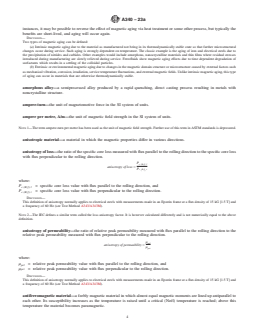
aging coefficient—the percentage change in a specific magnetic property resulting from a specific aging treatment.
DISCUSSION—
The aging treatments usually specified for iron and steel are:
(a) 100 h at 150°C or
(b) 600 h at 100°C.
aging, magnetic—the time dependent change in magnetic properties; such changes can be due to either intrinsic or extrinsic
factors, are not a consequence of improper use of the material and are usually detrimental to magnetic performance; in some
A340 − 23a
instances, it may be possible to reverse the effect of magnetic aging via heat treatment or some other process, but typically the
benefits are short-lived, and aging will occur again.
DISCUSSION—
Two types of magnetic aging can be defined:
(a) Intrinsic magnetic aging due to the material as manufactured not being in its thermodynamically stable state so that further microstructural
changes occur during service. Such aging is strongly dependent on temperature. The classic example is the aging of iron and electrical steels due to
the precipitation of nitrides and carbides. Other examples would include amorphous, nanocrystalline materials and thin films where residual stresses
introduced during manufacturing are slowly relieved during service. Ferrofluids show magnetic aging effects due to time dependent degradation of
surfactants which results in a settling of the colloidal particles.
(b) Extrinsic or environmental magnetic aging due to changes in the magnetic domain structure or microstructure caused by external factors such
as mechanical vibration, corrosion, irradiation, service temperature fluctuations, and external magnetic fields. Unlike intrinsic magnetic aging, this type
of aging can occur in materials that are otherwise thermodynamically stable.
amorphous alloy—a semiprocessed alloy produced by a rapid quenching, direct casting process resulting in metals with
noncrystalline structure.
ampere-turn—the unit of magnetomotive force in the SI system of units.
ampere per metre, A/m—the unit of magnetic field strength in the SI system of units.
NOTE 1—The term ampere-turn per metre has been used as the unit of magnetic field strength. Further use of this term in ASTM standards is deprecated.
anisotropic material—a material in which the magnetic properties differ in various directions.
anisotropy of loss—the ratio of the specific core loss measured with flux parallel to the rolling direction to the specific core loss
with flux perpendicular to the rolling direction.
P
c ~B;f! l
anisotropy of loss 5
P
c ~B;f! t
where:
P = specific core loss value with flux parallel to the rolling direction, and
c (B;f) l
P = specific core loss value with flux perpendicular to the rolling direction.
c (B;f) t
DISCUSSION—
This definition of anisotropy normally applies to electrical steels with measurements made in an Epstein frame at a flux density of 15 kG [1.5 T] and
a frequency of 60 Hz (see Test Method A343/A343M).
NOTE 2—The IEC defines a similar term called the loss anisotropy factor. It is however calculated differently and is not numerically equal to the above
definition.
anisotropy of permeability—the ratio of relative peak permeability measured with flux parallel to the rolling direction to the
relative peak permeability measured with flux perpendicular to the rolling direction.
μ
prl
anisotropy of permeability 5
μ
prt
where:
μ = relative peak permeability value with flux parallel to the rolling direction, and
prl
μ = relative peak permeability value with flux perpendicular to the rolling direction.
prt
DISCUSSION—
This definition of anisotropy normally applies to electrical steels with measurements made in an Epstein frame at a flux density of 15 kG [1.5 T] and
a frequency of 60 Hz (see Test Method A343/A343M).
antiferromagnetic material—a feebly magnetic material in which almost equal magnetic moments are lined up antiparallel to
each other. Its susceptibility increases as the temperature is raised until a critical (Neél) temperature is reached; above this
temperature the material becomes paramagnetic.
A340 − 23a
apparent power, P —the product (volt-amperes) of the rms exciting current and the applied rms terminal voltage in an electric
a
circuit containing inductive impedance. The components of this impedance as a result of the winding will be linear, while the
components as a result of the magnetic core will be nonlinear. The unit of apparent power is the volt-ampere, VA.
apparent power, specific, P —the value of the apparent power divided by the active mass of the specimen, that is,
a(B;f)
volt-amperes per unit mass. The values of voltage and current are those developed at a maximum value of cyclically varying
magnetic flux density B and specified frequency f.
area, A—the geometric cross-sectional area of a magnetic path which is perpendicular to the direction of the magnetic flux
density.
B(H) loop—a hysteresis loop where the magnetic flux density (B) is plotted as a function of the magnetic field strength (H).
Unless otherwise stated, it is assumed that the loop represents the SCM condition and therefore has 180° rotational symmetry
about the origin of the coordinate system.
B (H) loop—a hysteresis loop where the intrinsic flux density (B ) is plotted as a function of the magnetic field strength (H).
i i
Unless otherwise stated, it is assumed that the loop represents the SCM condition and therefore has 180° rotational symmetry
about the origin of the coordinate system.
Bloch wall—a domain wall in which the magnetic moment at any point is substantially parallel to the wall surface. See also
domain wall.
Bohr magneton—a constant that is equal to the magnetic moment of an electron because of its spin. The value of the constant
−21 −24
is (9 274 078 × 10 erg/gauss or 9 274 078 × 10 J/T).
cgs-emu system of units—the system for measuring physical quantities in which the base units are the centimetre, gram, and
second, and the numerical value of the magnetic constant, μ , is unity.
coercive field strength, H —the absolute value of the applied magnetic field strength (H) required to restore the magnetic flux
cB
density (B) to zero.
DISCUSSION—
The symbol H has historically been used to denote the coercive field strength determined from a B(H) loop. Further use of this symbol in ASTM A06
c
standards is deprecated.
DISCUSSION—
The coercive field strength monotonically increases with increasing maximum magnetic field strength (H ) reaching a maximum or limiting value
m
termed the coercivity. Unless it is known that the material has been magnetized to saturation, the term coercive field strength is preferred.
DISCUSSION—
The coercive field strength is not completely described without knowing the maximum magnetic flux density (B ) or maximum magnetic field strength
m
(H ) used in the measurement.
m
coercive field strength, intrinsic, H —the absolute value of the applied magnetic field strength (H) required to restore either
cJ
the magnetic polarization (J) or magnetization (M) to zero.
DISCUSSION—
The symbol H has historically been used to denote the intrinsic coercive field strength determined from a B (H) loop. Further use of this symbol in
ci i
ASTM A06 standards is deprecated.
DISCUSSION—
The intrinsic coercive field strength monotonically increases with increasing maximum magnetic field strength (H ) reaching a maximum or limiting
m
value termed the intrinsic coercivity. Unless it is known that the material has been magnetized to saturation, the term intrinsic coercive field strength
is preferred.
DISCUSSION—
The measured value of intrinsic coercive field strength will be the same whether it is measured from a magnetic polarization J(H) or a magnetization
M(H) hysteresis loop and will always be numerically larger than the coercive field strength (H ) measured from a magnetic flux density B(H)
cB
hysteresis loop.
A340 − 23a
DISCUSSION—
The intrinsic coercive field strength is not completely described without knowing the maximum magnetic polarization, maximum magnetization or
maximum magnetic field strength (H ) used in the measurement.
m
coercivity—see coercive field strength.
coercivity, intrinsic—see coercive field strength, intrinsic.
coercivity, normal—this term is used exclusively in the permanent magnet industry to denote the coercivity (H ) to distinguish
cB
it from the intrinsic coercivity (H ). The use of the word “normal” does not imply anything about the symmetry of the hysteresis
cJ
loop of the material being tested.
commutation curve—see normal magnetization curve.
core, laminated—a magnetic component constructed by stacking suitably thin pieces of magnetic material which are stamped,
sheared, or milled from sheet or strip material. Individual pieces usually have an insulating surface coating to minimize eddy
current losses in the assembled core.
core, mated—two or more magnetic core segments assembled with the magnetic flux path perpendicular to the mating surface.
core, powder (dust)—a magnetic core comprised of small particles of electrically insulated metallic ferromagnetic material.
These cores are characterized by low hysteresis and eddy current losses.
core, tape-wound—a magnetic component constructed by the spiral winding of strip material onto a suitable mandrel. The strip
material usually has an insulating surface coating which reduces interlaminar eddy current losses in the finished core.
core loss, P —the active power (watts) absorbed in a ferromagnetic or ferrimagnetic material in which there is a time varying
c
magnetic flux density; in electrical steel technology, the core loss is sometimes referred to as the iron loss.
DISCUSSION—
Although core loss is almost entirely due to eddy currents generated in the vicinity of moving magnetic domain walls, it is customary to consider the
core loss to be the sum of three losses, the hysteresis loss (P ), the eddy current loss (P ), and the residual core loss (P ), all of which have different
h e r
functional dependencies on frequency for a given material and specimen. This separation of losses is useful in both practical applications and in
modeling of the core loss.
DISCUSSION—
For the purpose of grading magnetic materials, the core loss is normally measured in the symmetrically cyclically magnetized (SCM) condition using
a sine flux waveform, or the results are mathematically corrected for deviations from the sinusoidal condition.
core loss, incremental, P —the core loss in a magnetic material when the material is subjected simultaneously to a dc biasing
c∆
magnetic field and an alternating magnetic field.
core loss, residual, P —also called the anomalous or excess loss, the portion of the core loss, P , which cannot be attributed
r c
to hysteresis or classical eddy current losses.
core loss, specific, P —the active power (watts) expended per unit mass of magnetic material in which there is a cyclically
c(B;f)
varying magnetic flux density of a specified maximum value, B, at a specified frequency, f.
core loss density—the active power (watts) expended in a magnetic core in which there is a cyclically varying magnetic flux
density of a specified maximum value, B, at a specified frequency, f, divided by the effective volume of the core.
DISCUSSION—
This parameter is normally used only for non-laminated cores such as ferrite and powdered cores.
A340 − 23a
core plate—a generic term for any insulating material, formed metallurigically or applied externally as a thin surface coating,
on sheet or strip stock used in the construction of laminated and tape wound cores.
coupling coefficient, k'—the ratio of the mutual inductance between two windings and the geometric mean of the individual
self-inductances of the windings.
crest factor, cf—the ratio of the peak value of a waveform to its rms value.
DISCUSSION—
For a sinusoidal waveform, the crest factor is =2.
Curie temperature, T —the temperature above which a ferromagnetic or ferrimagnetic material becomes paramagnetic.
c
current, ac core loss, I —the rms value of the in-phase component (with respect to the induced voltage) of the exciting current
c
supplied to a coil which is linked with a ferromagnetic core.
current, ac exciting, I—the rms value of the total current supplied to a coil that is linked with a ferromagnetic core.
DISCUSSION—
Exciting current is measured under the condition that any other coil linking the same core carries no current.
current, ac, magnetizing, I —the rms value of the magnetizing component (lagging with respect to applied voltage) of the
m
exciting current supplied to a coil that is linked with a ferromagnetic core.
current, dc, I —a steady-state dc current. A dc current flowing in an inductor winding will produce a unidirectional magnetic
dc
field in the magnetic material.
customary units—a set of industry-unique units from the cgs-emu system of units and U.S. inch-pound systems and units
derived from the two systems.
DISCUSSION—
Examples of customary units used in ASTM A06 standards include:
Quantity
Quantity Name Symbol Unit Name Unit Symbol
Magnetic field strength H oersted Oe
Magnetic flux density B gauss G
Specific core loss P watt/pound W/lb
c(B;f)
cyclically magnetized condition, CM—a magnetic material is in a cyclically magnetized condition when, after having been
subjected to a sufficient number of identical cycles of magnetizing field, it follows identical hysteresis or flux-current loops on
successive cycles which are not symmetrical with respect to the origin of the axes.
demagnetization curve, normal—the portion of a normal hysteresis loop that lies in the second quadrant, that is, between H
= 0 and the coercive field strength H .
cB
demagnetization curve, intrinsic—the portion of an intrinsic hysteresis loop (either B ,J or M vs H) that lies in the second
i
quadrant, that is, between H = 0 and the intrinsic coercive field strength H .
cJ
demagnetizing factor, N—the ratio of the self-demagnetizing magnetic field strength to the magnetization (M). It is a
dimensionless quantity ranging in value from 0 to 1 and depends on the specimen geometry, dimensions, and the magnetic
susceptibility of the material.
DISCUSSION—
The demagnetizing factor has a single calculable value only when the sample is an ellipsoid (usually an ellipsoid of revolution) or has the value zero
A340 − 23a
(for a closed uniform magnetic circuit). Approximate values are available as the result of calculations or measurements. For demagnetization factors
derived from measurements, one might encounter the symbols N for ballistic measurements, N for fluxmetric measurements, and N for
b f m
magnetometric measurements. Additional descriptors, used less frequently, define the direction of measurement, that is, N ,N , and N .
x y z
demagnetizing field strength, H —a magnetic field strength applied in such a direction as to reduce the magnetic flux density
d
in a magnetized body. See demagnetization curve.
3 3
density, δ—the ratio of mass to volume of a material. In the cgs-emu system of units, g/cm . In SI units, kg/m .
diamagnetic material—a material whose relative permeability is less than unity.
DISCUSSION—
The intrinsic flux density, B , is oppositely directly to the applied magnetic field strength H.
i
disaccommodation—a time dependent change of magnetic properties, especially the initial permeability, that occurs after
demagnetization of a magnetic material. This change is usually due to the motion of point defects such as vacancies and
interstitial atoms, occurs over a time period measured in seconds or minutes, and is reversible by demagnetization. It is a
different phenomenon than magnetic aging which (a) typically involves the clustering of impurity atoms or precipitation of a
new phase, (b) occurs over a much longer time period (normally weeks or months at room temperature), and (c) the changes
are not reversible by demagnetization.
dissipation factor, magnetic, D —the tangent of the hysteretic angle that is equal to the ratio of the core loss current, I , to
m c
the magnetizing current, I . Thus:
m
D 5 tan β5 cot γ5 I /I 5ωL /R 5 I/Q
m c m 1 1 m
DISCUSSION—
This dissipation factor is also given by the ratio of the energy dissipated in the core per cycle of a periodic SCM excitation (hysteresis and eddy current
heat loss) to 2π times the maximum energy stored in the core.
distortion, harmonic—the departure of any periodically varying waveform from a pure sinusoidal waveform.
DISCUSSION—
The distorted waveform that is symmetrical about the zero amplitude axis and is most frequently encountered in magnetic testing contains only the
odd harmonic components, that is fundamental, 3rd harmonic, 5th harmonic, and so forth. Nonsymmetrical distorted waveforms must contain some
even harmonic components, in addition to the fundamental and, perhaps, some odd harmonic components.
distortion factor, df—a numerical measure of the distortion in any ac nonsinusoidal waveform. For example, if by Fourier
analysis or direct measurement E , E , E , and so forth are the effective values of the pure sinusoidal harmonic components of
1 2 3
a distorted voltage waveform, then the distortion factor is the ratio of the root mean square of the second and all higher harmonic
components to the fundamental component.
2 2 2 1/2
df 5 E 1E 1E 1··· E
@ #
2 3 4 1
DISCUSSION—
There are no dc components (E ) in the distortion factor.
domains, ferromagnetic—magnetized regions, either macroscopic or microscopic in size, within ferromagnetic materials. Each
domain, in itself, is magnetized to magnetic saturation at all times, and the saturation magnetization is unidirectional within the
domain.
domain wall—a boundary region between two adjacent domains within which the orientation of the magnetic moment of one
domain changes into a different orientation of the magnetic moment in the other domain.
eddy current—an electric current developed in a material as a result of induced voltages developed in the material.
electrical steel—a term used commercially to designate strip or sheet used in electrical applications and historically has referred
to flat-rolled, low-carbon steels or alloyed steels with silicon or aluminum, or both. Common types of electrical steels used in
the industry are grain-oriented electrical steel, nonoriented electrical steel, and magnetic lamination steel.
A340 − 23a
electrical steel, grain oriented—a flat-rolled silicon-iron alloy usually containing approximately 3 % silicon, having enhanced
magnetic properties in the direction of rolling and normally used in transformer cores.
electrical steel, nonoriented—a flat-rolled silicon-iron or silicon-aluminum-iron alloy containing 0.0 to 3.5 % silicon and 0.0
to 1.0 % aluminum and having similar core loss in all directions.
emu—the notation emu is an indicator of electromagnetic units. When used in conjunction with magnetic moment, m, it denotes
units of ergs per oersted, erg/Oe. A moment of 1 erg/Oe is produced by a current of 10 amperes (1 abampere) flowing in a loop
of area 1 cm . The work done to rotate a moment of 1 erg/Oe from parallel to perpendicular in a uniform field of 1 Oe is 1 erg.
The conversion to the SI units of magnetic moment J/T (joule/tesla) or A m is given by:
erg/Oe ~cgs 2 emu! 10 amperes cm ~cgs 2 emu!
[ 5 10 (1)
J/T SI A m SI
~ ! ~ !
3 3
Magnetization, M, the magnetic moment per unit volume, has units erg/(Oe-cm ), often expressed as emu/cm .
energy product—the product of the coordinate values of any point on a normal demagnetization curve. This is also called the
BH product. In the cgs-emu system of units the energy product is expressed in units of gauss-oersted. In the SI system of units,
the energy product is expressed in units of joule per cubic metre.
DISCUSSION—
Although the energy product is mathematically negative, it is customary to express it as a positive number.
energy-product curve, magnetic—the curve obtained by plotting the product of the corresponding coordinates, B and H , of
d d
points on the demagnetization curve as abscissa against the magnetic flux density, B , as ordinates.
d
DISCUSSION—
The maximum value of the energy product, (BH) , corresponds to the maximum value of the external energy.
max
DISCUSSION—
The demagnetization curve is plotted to the left of the vertical axis and usually the energy-product curve to the right.
energy product, maximum (BH) —for a given demagnetization curve, the maximum value of the energy product. The
max
maximum energy product is an important figure of merit for permanent magnets.
equipment test level accuracy—(1) For a single test equipment, using a large group of test specimens, the average percentage
of test deviation from the correct average value. (2) The average percentage deviation from the average value obtained from
similar tests, on the same test specimen or specimens, when measured with a number of other test equipments that have
previously been proven to have both suitable reproducibility of measurement and test level, and whose calibrations and quality
have general acceptance for standardization purposes and where better equipment for establishing the absolute accuracy of test
is not available.
exciting current, ac, I—see current, ac exciting.
exciting power, rms, P —the product of the ac rms exciting current and the rms voltage induced in the exciting (primary)
z
winding on a magnetic core.
DISCUSSION—
This is the apparent volt-amperes required for the excitation of the magnetic core only. When the core has a secondary winding, the induced primary
voltage is obtained from the measured open-circuit secondary voltage multiplied by the appropriate turns ratio.
exciting power, specific, P —the value of the ac rms exciting power divided by the active mass of the specimen
z(B;f)
(volt-amperes/unit mass) taken at a specified maximum value of cyclically varying magnetic flux density B and at a specified
frequency f.
exciting voltage, E—the ac rms voltage across a winding linking the flux of a magnetic core. The voltage across the winding
equals that across the assumed parallel combination of core inductance L , and core resistance, R .
1 1
A340 − 23a
feebly magnetic material—a material generally classified as “nonmagnetic,” whose maximum normal permeability is less than
4.
ferrimagnetic material—a material whose atomic magnetic moments are both ordered and anti-parallel but being unequal in
magnitude produce a net magnetization in one direction.
ferrite—a term referring to magnetic oxides in general, and especially to material having the formula M O Fe O , where M
2 3
is a divalent metal ion or a combination of such ions. Certain ferrites, magnetically “soft” in character, are useful for core
applications at radio and higher frequencies because of their advantageous magnetic properties and high volume resistivity.
Other ferrites, magnetically “hard” in character, have desirable permanent magnet properties.
ferromagnetic material—a material whose magnetic moments are ordered and parallel producing magnetization in one
direction.
figure of merit, magnetic, μ'/cot γ—the ratio of the real part of the complex relative permeability to the dissipation factor of
a ferromagnetic material.
DISCUSSION—
The figure of merit index of the magnetic efficiency of the core in various ac electromagnetic devices.
flux density, biased, B —the value of the dc magnetic flux density around which cyclic flux density changes are occurring in
b
a magnetic material simultaneously subjected to both a cyclic and a dc biasing field; the biased flux density is a function of the
incremental magnetic field strength, H , and is not determined by the normal magnetization curve.
∆
flux density, demagnetization, B —the magnetic flux density at any point on any normal demagnetization curve in a magnetic
d
material.
DISCUSSION—
Although it is customary to consider the demagnetization curve to lie entirely within the second quadrant, there is an increasing tendency to continue
the curve into the third quadrant when measuring high coercivity permanent magnets.
flux density, incremental, B —one half the algebraic difference of the extreme values of the magnetic flux density during a
∆
cycle in a magnetic material that is subjected simultaneously to a biasing magnetizing field and a symmetrically cyclically
varying magnetizing field; twice the incremental flux density is indicated by the symbol ∆B, thus:
B 5∆B/2
∆
flux density, intrinsic, B —the vector difference between the magnetic flux density in a magnetic material and the magnetic flux
i
density that would exist in a vacuum under the influence of the same magnetic field strength when measurements are made using
cgs-emu units. This is expressed by the equation:
B 5 B 2 H
i
This term is not defined or used in the SI system of units
where the magnetic polarization (J) is instead used. The
use of the term intrinsic flux density should be restricted
to cgs-emu measurements.
flux density, maximum—(1)B the maximum value of magnetic flux density, B, in a static hysteresis loop. The tip of this loop
m
has the coordinates B and H , which occur simultaneously in time. (2)B the maximum value of magnetic flux density, B,
m m max
in a dynamic hysteresis loop. The tip of this loop has the coordinates B and H which may or may not occur simultaneously
max max
in time; B may occur later than H (especially at low magnetic flux densities).
max max
DISCUSSION—
The maximum flux density is not synonymous with saturation flux density (B ). It is a magnetic test parameter, not a physical property.
s
A340 − 23a
flux density, open circuit—the magnetic flux density that remains in a magnetic material in an open magnetic circuit after the
applied magnetic field strength is reduced to zero.
flux density, remanent—the magnetic flux density that remains in a magnetic material or magnetic circuit after the applied
magnetic field strength is reduced to zero.
DISCUSSION—
If there are no self-demagnetizing fields in the magnetic circuit, such as when the circuit is closed, the remanent flux density will equal the residual
flux density,B ; if self-demagnetizing fields are present, such as in a circuit with a non-magnetic gap, the remanent flux density will be less than the
r
residual flux density.
flux density, residual, B —the value of magnetic flux density (B) corresponding to zero magnetic field strength (H) in a
r
symmetrically cyclically magnetized material not subject to a self-demagnetization field.
DISCUSSION—
The residual flux density is not completely described without specifying either the maximum magnetic flux density or maximum magnetic field strength
used in the measurement. The residual flux density will monotonically increase with increasing applied magnetic field strength reaching a maximum
or limiting value.
NOTE 3—This term replaces the historically used term residual induction.
NOTE 4—The IEC uses the term remanent flux density instead of residual flux density. The term remanent flux density is used in ASTM standards to denote
the magnetic flux density remaining in a magnetic material or circuit when self-demagnetization fields are present.
flux linkage, +—the sum of all flux lines in a coil.
+ 5φ 1φ 1φ 1···φ
1 2 3 N
where:
φ = flux linking turn 1;
φ = flux linking turn 2, and so forth; and
φ = flux linking the Nth turn.
N
DISCUSSION—
When the coupling coefficient, k', is less than unity, the flux linkage equals the product of the average flux linking the turns and the total number of
turns. When the coupling coefficient is equal to unity, the flux linkage equals the product of the total flux linking the coil and the total number of turns.
flux linkage, mutual, + —the flux linkage existing between two windings on a magnetic circuit. Mutual linkage is maximum
m
when the coupling coefficient is unity.
flux path length, ℓ—the distance along a flux loop.
flux path length, effective, ℓ —the calculated length of the flux paths in a magnetic core, which is used in the calculations of
certain magnetic parameters.
flux volts, E —the voltage induced in a winding of a magnetic component when the magnetic material is subjected to repeated
f
magnetization under SCM or CM conditions.
−8
E = 4.443 B A'Nf × 10 V (SCM excitation)
f max
E = 2.221 ∆ BA' Nf × 10 V (CM excitation)
f
E = 1.1107 E
f avg
which:
A' = solid cross-sectional area of the core in cm ,
N = number of winding turns, and
f = the frequency in hertz.
A340 − 23a
form factor, ff—the ratio of the rms value of a periodically alternating quantity to its average absolute value.
DISCUSSION—
For a sinusoidal variation, the form factor is:
π/2=25 1.1107
frequency, angular, ω—the number of radians per second traversed by a rotating vector that represents any periodically varying
quantity.
DISCUSSION—
Angular frequency, ω, is equal to 2π times the cyclic frequency, f.
frequency, cyclic, f—the number of hertz (cycles/second) of a periodic quantity.
gap length, ℓ —the distance that the flux transverses in the central region of a gap in a core having an “air” (nonmagnetic) gap
g
in the flux path may be considered unity in the gap.
gauss (plural gausses), G—the unit of magnetic flux density in the cgs-emu system of units. The gauss is equal to 1 maxwell
−4
per square centimetre or 10 tesla. See magnetic flux density.
gilbert, Gb—the unit of magnetomotive force in the cgs-emu system of units. The gilbert is a magnetomotive force of 4π/10
ampere-turns. See magnetomotive force.
gyromagnetic ratio, proton, γ —the ratio of the magnetic moment of a hydrogen nucleus to its angular momentum.
p
DISCUSSION—
The gyromagnetic ratio is used to calculate the magnetic field from a measured resonance frequency when using the nuclear magnetic resonance
technique. The relationship is:
B 5 2πf/γ gausses 5 2 π f / γ ×10 teslas
~ ! ~ !
p p
where:
f = resonance frequency in cycles per second (hertz) and
4 −1 −1
γ = gyromagnetic ratio (the accepted value at present for water is 2.675 12 × 10 gauss s ).
p
henry (plural henries), H—the unit of self- or mutual inductance. The henry is the inductance of a circuit in which a voltage
of 1 V is induced by a uniform rate of change 1 A/s in the circuit. Alternatively, it is the inductance of a circuit in which an
electric current of 1 A/s produces a flux linkage of one weber turn (Wb turn) or 10 maxwell-turns. See inductance, mutual,
and inductance, self.
hertz, Hz—the unit of cyclic frequency, f.
hysteresis energy loss, W —the energy expended in a single excursion around a static B(H) loop. The energy dissipated is the
h
integrated area enclosed by the loop and manifests itself as heat.
For the cgs-emu system of units, the hysteresis loss is expressed as:
W 5 rHdB
h
4π
where:
W = hysteresis loss, ergs/cm /cycle,
h
H = magnetic field strength, Oe, and
B = magnetic flux density, G.
For the SI system of units, the hysteresis loss is expressed as:
W 5rHdB (2)
h
A340 − 23a
where:
W = hysteresis loss, J/m /cycle,
h
H = magnetic field strength, A/m, and
B = magnetic flux density, T.
hysteresis loop—a close curve obtained from measurements on a ferromagnetic or ferrimagnetic material by plotting
corresponding values of magnetic flux density (B), intrinsic flux density (B ), magnetic polarization (J), or magnetization (M)
i
on the vertical axis and magnetic field strength (H) on the horizontal axis when the material is passing through a complete cycle
of applied magnetic field strength. They are commonly referred to as the B(H), B (H),J(H), and M(H) loops respectively.
i
hysteresis loop, biased—an incremental hysteresis loop that lies entirely in any one quadrant.
DISCUSSION—
In this case, both of the limiting values of H and B are in the same direction.
hysteresis loop, dynamic—a hysteresis loop obtained when the measurement is conducted at a magnetic field strength rate of
change that is sufficiently high that eddy currents affect the loop shape. It is also commonly referred to as an a-c hysteresis loop.
It has been less commonly called a flux-current loop.
DISCUSSION—
The size and shape of a dynamic hysteresis loop for a given maximum magnetic flux density depends on several factors such as the magnetizing
waveform and frequency, specimen dimensions, and electrical resistivity. Knowledge of these factors is required to properly interpret the loop.
hysteresis loop, dynamic, normal—the dynamic hysteresis loop obtained when the magnetic material is symmetrically
cyclically magnetized (that is, no dc bias present).
DISCUSSION—
The area enclosed by the normal dynamic hysteresis loop is proportional to the core loss.
hysteresis loop, incremental—the hysteresis loop, nonsymmetrical with respect to the axes, exhibited by a magnetic material
in a cyclically magnetized condition while under the influence of a static (dc) biasing field.
DISCUSSION—
The limiting values of H may have opposite polarity, but definitely have different maximum absolute values. An incremental loop may be initiated at
either some point on a normal hysteresis loop or at some point on the normal magnetization curve.
hysteresis loop, intrinsic—the B (H) and J(H) loops are often referred to as intrinsic hysteresis loops since they represent the
i
contribution of the magnetic material to the observed magnetic flux density. That is the contribution of the magnetic field
strength (H) due to the applied magnetic field has been removed. In the cgs-emu system of units the relationship between B and
B is given by:
i
B 5 B 2 H
i
In the SI system of units, the relationship between B and J is given by:
J 5 B 2 μ H
o
where μ denotes the magnetic constant. The difference
o
between the B(H) loop and the intrinsic hysteresis loop
is usually negligible for soft magnetic materials. For per-
manent magnet materials, the difference can be substan-
tial and both the B(H) loop and intrinsic hysteresis
loop (B (H) or J(H) depending on the system of units)
i
are used in magnetic system design and specification.
hysteresis loop, minor—a hysteresis loop obtained when the maximum applied magnetic field strength is less than that required
to cause magnetic saturation of the material. This loop can be either symmetrical or asymmetrical.
hysteresis loop, normal—a hysteresis loop which has 180° rotational symmetry with respect to the origin of the coordinate
system when measured in the SCM condition. Historically this term has been most often applied to a B(H) loop although its use
is not restricted to this loop. This term is seldom used today.
A340 − 23a
hysteresis loop, saturation—also called the major hysteresis loop, it is the normal hysteresis loop obtained when the maximum
applied magnetic field strength is sufficient to cause magnetic saturation of the material.
hysteresis loop, static—a hysteresis loop obtained when the measurement is conducted at a magnetic field strength rate of
change that is sufficiently slow that eddy currents do not affect the loop shape. This is also commonly referred to as a d-c
hysteresis loop.
hysteresis loss, P —the active power (watts) absorbed in a ferromagnetic or ferrimagnetic material as a result of magnetic
h
hysteresis. It is equal to the product of the hysteresis energy loss W and frequency.
h
hysteresis loss, rotational—the active power (watts) absorbed in a ferromagnetic or ferrimagnetic material when subjected to
a constant magnetic field, the direction of which rotates with respect to the material, either in a continuously cyclic or in a
repeated oscillatory manner.
hysteresis, magnetic—the property of a ferromagnetic or ferrimagnetic material where the magnetic flux density (B), magnetic
polarization (J), and magnetization (M) depend on the prior history of magnetization. It is due to a lag in these parameters with
respect to the applied magnetic field strength resulting from magnetic domain behavior. It manifests itself by irreversibility of
magnetization (the parameters will have more than one possible value at a given magnetic field strength) and energy dissipation
during the magnetization cycle.
hysteretic angle, magnetic, β—the mean angle by which the fundamental component of exciting current leads the fundamental
component of magnetizing current, I , in an inductor having a ferromagnetic core.
m
DISCUSSION—
Because of hysteresis, the instantaneous value of the hysteretic angle will vary during the cycle of SCM excitation. However, β is taken to be the mean
effective value of this angle.
inductance, core, L —the effective parallel circuit inductance of a ferromagnetic core based upon a hypothetical nonresistive
path that is exclusively considered to carry the magnetizing current, I .
m
DISCUSSION—
The product I ωL equals the quadrature power delivered to the core.
m 1
inductance, incremental, L —the self-inductance of an electrical circuit when the ferromagnetic core has an ac cyclic
∆
magnetization produced by specified values of both ac and dc components of the exciting current.
inductance, initial, L —the limiting value of the core inductance, L reached in a ferromagnetic core when, under ac
0 1
symmetrical cyclic excitation, the magnetizing current has been progressively and gradually reduced from a co
...