

ASTM A773/A773M-21
(Test Method)Standard Test Method for Direct Current Magnetic Properties of Low Coercivity Magnetic Materials Using Hysteresigraphs
General Information
- Abstract
SIGNIFICANCE AND USE
5.1 Hysteresigraphs permit more rapid and efficient collection of data as compared to the point by point ballistic Test Methods A341/A341M and A596/A596M. The high measurement point density offered by computer-automated systems is often required for computer aided design of electrical components such as transformers, motors, and relays.
5.2 Hysteresigraphs are particularly desirable for testing of semi-hard and hard magnetic materials, where either the entire second quadrant (demagnetization curve) or entire hysteresis loop is of primary concern. Test Method A977/A977M describes the special requirements for accurate measurement of hard magnetic (permanent magnet) materials.
5.3 Hysteresigraphs are not recommended for measurement of initial permeability, µi, of materials with high magnetic permeability such as nickel-iron, amorphous, and nanocrystalline materials due to errors associated with integrator drift; in these cases, Test Method A596/A596M is a more appropriate method.
5.4 Provided the test specimen is representative of the bulk sample or lot, this test method is well suited for design, specification acceptance, service evaluation, and research and development.
SCOPE
1.1 This test method provides dc hysteresigraph procedures for the determination of basic magnetic properties of materials in the form of ring, spirally wound toroidal, link, double-lapped Epstein cores, or other standard shapes that may be cut, stamped, machined, or ground from cast, compacted, sintered, forged, or rolled materials. It includes tests for initial and normal magnetization curves and hysteresis loop determination taken under conditions of continuous sweep magnetization. Rate of sweep may be varied, either manually or automatically at different portions of the curves during measurement.
1.2 The equipment and procedures described in this test method are most suited for soft and semi-hard materials with intrinsic coercivity less than about 100 Oersteds [8 kA/M]. Materials with higher intrinsic coercivities should be tested according to Test Method A977/A977M.
1.3 The values and equations stated in customary (cgs-emu and inch-pound) or SI units are to be regarded separately as standard. Within this standard, SI units are shown in brackets. The values stated in each system may not be exact equivalents; therefore, each system shall be used independently of the other. Combining values from the two systems may result in nonconformance with this standard.
1.4 This standard does not purport to address all of the safety concerns, if any, associated with its use. It is the responsibility of the user of this standard to establish appropriate safety, health, and environmental practices and determine the applicability of regulatory limitations prior to use.
1.5 This international standard was developed in accordance with internationally recognized principles on standardization established in the Decision on Principles for the Development of International Standards, Guides and Recommendations issued by the World Trade Organization Technical Barriers to Trade (TBT) Committee.
- Status
- Published
- Publication Date
- 31-Jan-2021
- Technical Committee
- A06 - Magnetic Properties
- Drafting Committee
- A06.01 - Test Methods
Buy Documents
ASTM A773/A773M-21 - Standard Test Method for Direct Current Magnetic Properties of Low Coercivity Magnetic Materials Using Hysteresigraphs
REDLINE ASTM A773/A773M-21 - Standard Test Method for Direct Current Magnetic Properties of Low Coercivity Magnetic Materials Using Hysteresigraphs
Overview
ASTM A773/A773M-21, Standard Test Method for Direct Current Magnetic Properties of Low Coercivity Magnetic Materials Using Hysteresigraphs, establishes a test methodology for measuring the direct current (DC) magnetic properties of soft and semi-hard magnetic materials. This standard, developed by ASTM International, offers a streamlined and efficient process using hysteresigraphs compared to traditional point-by-point ballistic methods. By leveraging computer-automated measurement techniques, this method provides high-density data points, which support the precise characterization required for the design and specification of electrical components such as transformers, motors, and relays. The standard covers a variety of specimen forms, including rings, spirally wound toroids, and Epstein cores, typically made from cast, sintered, rolled, or machined materials.
Key Topics
Hysteresigraph Testing Advantages:
- Enables rapid and efficient collection of B-H loop data.
- Provides high measurement point density, crucial for computer-aided design.
- Suitable for soft and semi-hard magnetic materials with intrinsic coercivity < 100 Oersteds (8 kA/m).
Scope of Materials and Specimens:
- Applicable to a wide range of shapes: ring, toroidal, Epstein cores, links.
- Not recommended for materials with high magnetic permeability (e.g., nickel-iron) or high coercivity (use ASTM A977/A977M instead).
Measurement Focus:
- Determination of initial and normal magnetization curves.
- Hysteresis loop characterization under continuous magnetization sweep.
- Automated or manual sweep rates enable flexible measurement conditions.
Calibration and Equipment:
- Requires calibrated electronic integrators and current measurement equipment.
- Data is recorded with high precision, using analog or digital chart recorders or computers.
Limitations:
- Not designed for accurate initial permeability measurement of high permeability materials due to integrator drift.
- Suitability depends on appropriate specimen preparation and strict calibration.
Applications
Electrical Component Design:
- Used in the design and specification acceptance of transformers, electric motors, magnetic relays, and similar devices where magnetic material performance is critical.
- Supports rapid evaluation and selection of magnetic materials for R&D.
Quality Control and Procurement:
- Enables specification acceptance and service evaluation for bulk materials.
- Essential for manufacturers and suppliers of magnetic alloys in establishing material certification.
Research and Development:
- Provides a robust methodology for developing new magnetic materials or assessing changes in material processing.
Related Standards
- ASTM A341/A341M: Test Method for Direct Current Magnetic Properties of Soft Magnetic Materials Using D-C Permeameters and Point-by-Point Methods.
- ASTM A596/A596M: Test Method for DC Magnetic Properties Using the Ballistic Method and Ring Specimens.
- ASTM A977/A977M: Test Method for Magnetic Properties of High-Coercivity Permanent Magnet Materials Using Hysteresigraphs.
- ASTM A343/A343M: Test Method for Alternating-Current Magnetic Properties at Power Frequencies using Epstein Test Frame.
- ASTM A34/A34M: Practice for Sampling and Procurement Testing of Magnetic Materials.
- IEC 60404-4: Methods for Measurement of DC Magnetic Properties of Magnetically Soft Materials.
Practical Value
By adopting ASTM A773/A773M-21, laboratories and manufacturers obtain a reliable, efficient, and internationally recognized protocol for assessing the DC magnetic properties of low coercivity magnetic materials. The method's emphasis on automation and data density streamlines workflow in both production and research settings, driving higher quality, better design optimization, and more effective quality assurance in magnetic materials and electrical component industries.
Relations
- Effective Date
- 01-Dec-2023
- Effective Date
- 01-Jun-2020
- Effective Date
- 15-Oct-2019
- Effective Date
- 15-Jun-2019
- Effective Date
- 01-Apr-2019
- Effective Date
- 15-Feb-2019
- Effective Date
- 01-Jun-2018
- Effective Date
- 15-Oct-2017
- Effective Date
- 01-Jul-2017
- Effective Date
- 01-May-2016
- Effective Date
- 01-May-2016
- Effective Date
- 01-Oct-2015
- Effective Date
- 01-Oct-2014
- Effective Date
- 01-May-2014
- Effective Date
- 01-May-2013
Buy Documents
ASTM A773/A773M-21 - Standard Test Method for Direct Current Magnetic Properties of Low Coercivity Magnetic Materials Using Hysteresigraphs
REDLINE ASTM A773/A773M-21 - Standard Test Method for Direct Current Magnetic Properties of Low Coercivity Magnetic Materials Using Hysteresigraphs
Get Certified
Connect with accredited certification bodies for this standard

IMQ S.p.A. (Certification)
Italian electrical product certification.

SLG Prüf- und Zertifizierungs GmbH
German testing and certification body.

UL Solutions
Global safety science company with testing, inspection and certification.
Sponsored listings
Frequently Asked Questions
ASTM A773/A773M-21 is a standard published by ASTM International. Its full title is "Standard Test Method for Direct Current Magnetic Properties of Low Coercivity Magnetic Materials Using Hysteresigraphs". This standard covers: SIGNIFICANCE AND USE 5.1 Hysteresigraphs permit more rapid and efficient collection of data as compared to the point by point ballistic Test Methods A341/A341M and A596/A596M. The high measurement point density offered by computer-automated systems is often required for computer aided design of electrical components such as transformers, motors, and relays. 5.2 Hysteresigraphs are particularly desirable for testing of semi-hard and hard magnetic materials, where either the entire second quadrant (demagnetization curve) or entire hysteresis loop is of primary concern. Test Method A977/A977M describes the special requirements for accurate measurement of hard magnetic (permanent magnet) materials. 5.3 Hysteresigraphs are not recommended for measurement of initial permeability, µi, of materials with high magnetic permeability such as nickel-iron, amorphous, and nanocrystalline materials due to errors associated with integrator drift; in these cases, Test Method A596/A596M is a more appropriate method. 5.4 Provided the test specimen is representative of the bulk sample or lot, this test method is well suited for design, specification acceptance, service evaluation, and research and development. SCOPE 1.1 This test method provides dc hysteresigraph procedures for the determination of basic magnetic properties of materials in the form of ring, spirally wound toroidal, link, double-lapped Epstein cores, or other standard shapes that may be cut, stamped, machined, or ground from cast, compacted, sintered, forged, or rolled materials. It includes tests for initial and normal magnetization curves and hysteresis loop determination taken under conditions of continuous sweep magnetization. Rate of sweep may be varied, either manually or automatically at different portions of the curves during measurement. 1.2 The equipment and procedures described in this test method are most suited for soft and semi-hard materials with intrinsic coercivity less than about 100 Oersteds [8 kA/M]. Materials with higher intrinsic coercivities should be tested according to Test Method A977/A977M. 1.3 The values and equations stated in customary (cgs-emu and inch-pound) or SI units are to be regarded separately as standard. Within this standard, SI units are shown in brackets. The values stated in each system may not be exact equivalents; therefore, each system shall be used independently of the other. Combining values from the two systems may result in nonconformance with this standard. 1.4 This standard does not purport to address all of the safety concerns, if any, associated with its use. It is the responsibility of the user of this standard to establish appropriate safety, health, and environmental practices and determine the applicability of regulatory limitations prior to use. 1.5 This international standard was developed in accordance with internationally recognized principles on standardization established in the Decision on Principles for the Development of International Standards, Guides and Recommendations issued by the World Trade Organization Technical Barriers to Trade (TBT) Committee.
SIGNIFICANCE AND USE 5.1 Hysteresigraphs permit more rapid and efficient collection of data as compared to the point by point ballistic Test Methods A341/A341M and A596/A596M. The high measurement point density offered by computer-automated systems is often required for computer aided design of electrical components such as transformers, motors, and relays. 5.2 Hysteresigraphs are particularly desirable for testing of semi-hard and hard magnetic materials, where either the entire second quadrant (demagnetization curve) or entire hysteresis loop is of primary concern. Test Method A977/A977M describes the special requirements for accurate measurement of hard magnetic (permanent magnet) materials. 5.3 Hysteresigraphs are not recommended for measurement of initial permeability, µi, of materials with high magnetic permeability such as nickel-iron, amorphous, and nanocrystalline materials due to errors associated with integrator drift; in these cases, Test Method A596/A596M is a more appropriate method. 5.4 Provided the test specimen is representative of the bulk sample or lot, this test method is well suited for design, specification acceptance, service evaluation, and research and development. SCOPE 1.1 This test method provides dc hysteresigraph procedures for the determination of basic magnetic properties of materials in the form of ring, spirally wound toroidal, link, double-lapped Epstein cores, or other standard shapes that may be cut, stamped, machined, or ground from cast, compacted, sintered, forged, or rolled materials. It includes tests for initial and normal magnetization curves and hysteresis loop determination taken under conditions of continuous sweep magnetization. Rate of sweep may be varied, either manually or automatically at different portions of the curves during measurement. 1.2 The equipment and procedures described in this test method are most suited for soft and semi-hard materials with intrinsic coercivity less than about 100 Oersteds [8 kA/M]. Materials with higher intrinsic coercivities should be tested according to Test Method A977/A977M. 1.3 The values and equations stated in customary (cgs-emu and inch-pound) or SI units are to be regarded separately as standard. Within this standard, SI units are shown in brackets. The values stated in each system may not be exact equivalents; therefore, each system shall be used independently of the other. Combining values from the two systems may result in nonconformance with this standard. 1.4 This standard does not purport to address all of the safety concerns, if any, associated with its use. It is the responsibility of the user of this standard to establish appropriate safety, health, and environmental practices and determine the applicability of regulatory limitations prior to use. 1.5 This international standard was developed in accordance with internationally recognized principles on standardization established in the Decision on Principles for the Development of International Standards, Guides and Recommendations issued by the World Trade Organization Technical Barriers to Trade (TBT) Committee.
ASTM A773/A773M-21 is classified under the following ICS (International Classification for Standards) categories: 29.030 - Magnetic materials. The ICS classification helps identify the subject area and facilitates finding related standards.
ASTM A773/A773M-21 has the following relationships with other standards: It is inter standard links to ASTM A340-23a, ASTM A977/A977M-07(2020), ASTM A340-19b, ASTM A340-19a, ASTM A343/A343M-14(2019), ASTM A340-19, ASTM A340-18, ASTM A340-17a, ASTM A340-17, ASTM A340-16e1, ASTM A340-16, ASTM A340-15, ASTM A340-14, ASTM A343/A343M-14, ASTM A977/A977M-07(2013). Understanding these relationships helps ensure you are using the most current and applicable version of the standard.
ASTM A773/A773M-21 is available in PDF format for immediate download after purchase. The document can be added to your cart and obtained through the secure checkout process. Digital delivery ensures instant access to the complete standard document.
Standards Content (Sample)
This international standard was developed in accordance with internationally recognized principles on standardization established in the Decision on Principles for the
Development of International Standards, Guides and Recommendations issued by the World Trade Organization Technical Barriers to Trade (TBT) Committee.
Designation: A773/A773M − 21
Standard Test Method for
Direct Current Magnetic Properties of Low Coercivity
Magnetic Materials Using Hysteresigraphs
This standard is issued under the fixed designationA773/A773M; the number immediately following the designation indicates the year
of original adoption or, in the case of revision, the year of last revision.Anumber in parentheses indicates the year of last reapproval.
A superscript epsilon (´) indicates an editorial change since the last revision or reapproval.
1. Scope 2. Referenced Documents
2.1 ASTM Standards:
1.1 This test method provides dc hysteresigraph procedures
A34/A34MPractice for Sampling and Procurement Testing
for the determination of basic magnetic properties of materials
of Magnetic Materials
in the form of ring, spirally wound toroidal, link, double-
A340Terminology of Symbols and Definitions Relating to
lappedEpsteincores,orotherstandardshapesthatmaybecut,
Magnetic Testing
stamped, machined, or ground from cast, compacted, sintered,
A341/A341MTest Method for Direct Current Magnetic
forged, or rolled materials. It includes tests for initial and
Properties of Soft Magnetic Materials Using D-C Per-
normalmagnetizationcurvesandhysteresisloopdetermination
taken under conditions of continuous sweep magnetization. meametersandthePointbyPoint(Ballistic)TestMethods
A343/A343MTest Method for Alternating-Current Mag-
Rateofsweepmaybevaried,eithermanuallyorautomatically
at different portions of the curves during measurement. netic Properties of Materials at Power Frequencies Using
Wattmeter-Ammeter-Voltmeter Method and 25-cm Ep-
1.2 The equipment and procedures described in this test
stein Test Frame
method are most suited for soft and semi-hard materials with
A596/A596MTest Method for Direct-Current Magnetic
intrinsic coercivity less than about 100 Oersteds [8 kA/M].
Properties of Materials Using the Ballistic Method and
Materials with higher intrinsic coercivities should be tested
Ring Specimens
according to Test Method A977/A977M.
A977/A977MTestMethodforMagneticPropertiesofHigh-
1.3 The values and equations stated in customary (cgs-emu
Coercivity Permanent Magnet Materials Using Hyster-
and inch-pound) or SI units are to be regarded separately as
esigraphs
standard. Within this standard, SI units are shown in brackets.
E691Practice for Conducting an Interlaboratory Study to
Thevaluesstatedineachsystemmaynotbeexactequivalents;
Determine the Precision of a Test Method
therefore,eachsystemshallbeusedindependentlyoftheother.
2.2 Other:
Combiningvaluesfromthetwosystemsmayresultinnoncon-
IEC Publication 60404-4 Ed 2.2 – Part 4:Methods of
formance with this standard.
Measurement of d.c. Magnetic Properties of Magnetically
Soft Materials (2008)
1.4 This standard does not purport to address all of the
safety concerns, if any, associated with its use. It is the
3. Terminology
responsibility of the user of this standard to establish appro-
3.1 Definitions—The terms and symbols used in this test
priate safety, health, and environmental practices and deter-
method are defined in Terminology A340.
mine the applicability of regulatory limitations prior to use.
1.5 This international standard was developed in accor-
4. Summary of Test Method
dance with internationally recognized principles on standard-
4.1 A specimen is wound with a magnetizing winding (the
ization established in the Decision on Principles for the
primary winding) and a search winding (the secondary wind-
Development of International Standards, Guides and Recom-
ing) for measuring the change in flux. When a magnetizing
mendations issued by the World Trade Organization Technical
current, I, is applied to the primary winding, a magnetic field,
Barriers to Trade (TBT) Committee.
H, is produced in the coil. This in turn produces magnetic flux
1 2
This test method is under the jurisdiction of ASTM Committee A06 on For referenced ASTM standards, visit the ASTM website, www.astm.org, or
MagneticPropertiesandisthedirectresponsibilityofSubcommitteeA06.01onTest contact ASTM Customer Service at service@astm.org. For Annual Book of ASTM
Methods. Standards volume information, refer to the standard’s Document Summary page on
Current edition approved Feb. 1, 2021. Published February 2021. Originally the ASTM website.
approved in 1980. Last previous edition approved in 2014 as A773/A773M–14. Available from American National Standards Institute, 25 W. 43rd St., 4th
DOI: 10.1520/A0773_A0773M-21. Floor, New York, NY 10036.
Copyright © ASTM International, 100 Barr Harbor Drive, PO Box C700, West Conshohocken, PA 19428-2959. United States
A773/A773M − 21
FIG. 1 Block Diagram of Ring Test Apparatus
φ in the specimen and the changing flux induces a voltage in sion and digital integration techniques. The output voltage of
the secondary winding which is integrated with respect to time the integrator is given by:
using a fluxmeter. In specimens with uniform cross-sectional
E 5 edt (3)
area that do not contain air gaps, such as rings, all of the *
RC
magnetizingcurrentisusedtomagnetizethespecimen,andthe
where:
magnetic field strength, H, is proportional to I in accordance
with the following equation:
E = output voltage, V;
R = input resistance of the integrator in the secondary
H 5 KI (1)
circuit, Ω; and
where:
C = the feedback capacitance, F.
H = magnetic field strength, Oe [A/m];
By combining the two equations:
I = current in the magnetizing winding A; and
ERC φNK
K = constant determined by the number of primary turns,
φ 5 or E 5 (4)
K N RC
themagneticpathlengthofthespecimenandsystemof
units.
The instantaneous value of flux is thus proportional to the
4.1.1 The magnetic flux may be determined by integration
integrated voltage which can be recorded in various ways.
of the instantaneous electromotive force that is induced in the
4.1.2 Measurement of magnetic field strength and flux by
secondary winding when the flux is increased or decreased by
thehysteresigraphmethodisillustratedintheblockdiagramof
a varying H. The instantaneous voltage, e, is equal to:
Fig. 1. The system consists of a magnetizing power source, a
dφ
magnetizing current controller, an electronic flux integrator,
e52NK (2)
dt
and a data recorder. As magnetizing current is applied to the
or
primarywinding,avoltageproportionalto Iisproducedacross
1 thecurrentmeasuringresistorwhichisconnectedinserieswith
φ 5 edt
*
K N the primary winding. This voltage is proportional to the value
of H.
where:
4.1.3 Inthetestingofsoftmagneticmaterialsintheformof
dt = time differential,
wire, bars or rods, or materials which cannot be sufficiently
N = number of secondary turns,
−8
magnetized in ring form, or which are anisotropic, it is usually
K =10 for cgs-emu system, or K =1 for SI system, and
1 1
necessary to use a permeameter. This is shown in the block
e = instantaneous voltage in the secondary winging, V.
diagramofFig.2.Whenusingpermeameters,thevalueof Hin
The flux φ can be obtained if ∫edt can be determined. This
thegapisgenerallynotproportionalto Ithatflowsthroughthe
can be accomplished by several means, as described in ASTM
magnetizing winding of the yoke. In these cases, the value of
STP 526. (1) The most common method uses an electronic
H is determined by integration of the electromotive force that
integratorconsistingofanoperationalamplifierwithcapacitive
isinducedinan H-coil(orChattockpotentiometer)orfromthe
feedback. Some fluxmeters employ analog to digital conver-
signal developed by a Hall probe which is placed near the
specimen. When using an H-coil, the determination of H is
accomplished with an H integrator in exactly the same manner
The boldface numbers in parentheses refer to a list of references at the end of
this standard. asthatusedtodeterminefluxwiththe Bintegratordescribedin
A773/A773M − 21
FIG. 2 Block Diagram of Permeator Test Apparatus
4.1. When using a Hall sensor, the H values are determined about 0.01 Oe [0.8 A/m] up to about 1000 Oe [80 kA/m] or
from the voltage output which is linearized to be proportional more depending on the specimen dimensions, number of
to H. primary turns, available magnetizing power, and the ability to
remove heat generated in the primary winding. However, this
5. Significance and Use
test method has several important requirements. Unless the
inside diameter to outside diameter ratio or ring specimens is
5.1 Hysteresigraphs permit more rapid and efficient collec-
greater than 0.82, the magnetic field strength will be exces-
tion of data as compared to the point by point ballistic Test
sively nonuniform in the test material and the measured
Methods A341/A341M and A596/A596M. The high measure-
parameters cannot be represented as material properties. The
ment point density offered by computer-automated systems is
basic quality of materials having directionally sensitive prop-
often required for computer aided design of electrical compo-
erties cannot be tested satisfactorily with ring specimens.With
nents such as transformers, motors, and relays.
suchmaterialsitisnecessarytouseEpsteinspecimenscutwith
5.2 Hysteresigraphs are particularly desirable for testing of
their lengths in the direction of specific interest or to use long
semi-hard and hard magnetic materials, where either the entire
link-shaped or spirally wound toroidal core test specimens.
second quadrant (demagnetization curve) or entire hysteresis
The acceptable minimum width of strip used in such test
loop is of primary concern. Test Method A977/A977M de-
specimens varies with the material under test.At present, it is
scribes the special requirements for accurate measurement of
recommendedthatthegrain-orientedsiliconsteelsshouldhave
hard magnetic (permanent magnet) materials.
a strip width of at least 3 cm [30 mm]. When ring specimens
5.3 Hysteresigraphs are not recommended for measurement
are large, it is difficult to provide sufficient magnetizing turns
of initial permeability, µ, of materials with high magnetic
or current-carrying capacity to reach magnetic field strengths
i
permeability such as nickel-iron, amorphous, and nanocrystal-
above about 1000 Oe [80 kA/m]. In general, magnetic mate-
line materials due to errors associated with integrator drift; in
rials tend to have nonuniform properties throughout the body
these cases, Test Method A596/A596M is a more appropriate
ofthetestspecimens.Forthisreason,uniformlydistributedtest
method.
windingsanduniformspecimencross-sectionalareaarehighly
desirable to average nonuniform behavior.
5.4 Provided the test specimen is representative of the bulk
sample or lot, this test method is well suited for design,
6.2 When conducting permeameter tests on bars, rods, and
specification acceptance, service evaluation, and research and
otherappropriatespecimens,thistestmethodcoversarangeof
development.
magnetic field strengths from about 0.05 Oe [4 A/m] up to
about 20000 Oe [1600 kA/m] or more, depending on the
6. Interferences
specimengeometryandtheparticularpermeameter(measuring
6.1 Test methods using suitable ring-type specimens are the fixture) that is used. In general, the lower limit of magnetic
preferred methods for determining the basic magnetic proper-
ties of a material. When conducting tests on ring specimens,
thistestmethodcoversarangeofmagneticfieldstrengthsfrom Link-shaped specimens are defined in Practice A34/A34M.
A773/A773M − 21
TABLE 1 Permeameters Recommended for Use with
6.3 The standard Epstein frame as defined in A343/A343M
Hysteresigraphs
has an assumed magnetic path length of 94 cm [0.94 m]. This
may or may not be correct when conducting dc magnetic tests;
NOTE 1—Other permeameters may be suitable for use with dc hyster-
esigraphswhereappropriatemodificationsaremade.RefertoTestMethod
however, the user of this test method should use this value for
A341/A341M for other permeameters.
consistency of results.
Permeameter Magnetic Field Strength Range H Measurement
Device
Oe kA/m
7. Apparatus
Babbit (2, 3) 40/100 3.2/8 current, H coil
7.1 The apparatus shall consist of as many of the compo-
Fahy Simplex (4-6) 0.1/300 0.008/24 H coil
Fahy Simplex Super 100/2500 8/200 H coil
nents described in 7.2 – 7.8 as required to perform the tests.
H Adapter (6)
7.1.1 All apparatus used in this test method shall be cali-
IEC Type A 12/2500 1/200 H coil, Hall probe
brated against known standards to ensure the accuracy limits
IEC Type B 12/620 1/50 H coil
Isthmus (6, 7) 100/20 000 + 8/1600 + H coil, Hall probe
given below.
7.2 Balance or Scales:
field strength is determined by the area-turns of the H-coil (or
7.2.1 The balance or scales used to weigh the test specimen
the sensitivity of the Hall probe if it is used), the sensitivity of shall be capable of weighing to an accuracy of 60.2% of the
the integrator, and the sensitivities of the measuring and
measured value.
recording components. The upper limit in magnetic field 7.2.2 Themicrometerorcalipers,orboth,usedtodetermine
strength is determined by the type of permeameter appropriate
specimen dimensions for calculation of cross-sectional area
for the specimen, the power supply, and the heat generated in shallbecapableofmeasuringtoanaccuracyofatleast 60.1%
the yoke windings. Recommendations of the useful range of
of the measured value.
magneticfieldstrengthforthevariouspermeametersareshown
7.3 Magnetizing Power Source—The power source may
in Table 1.
range from batteries to regulated, low-ripple, protected, pro-
6.2.1 In general, permeameters do not produce a uniform
grammable power supplies. It shall have sufficient capacity to
magneticfieldineithertheaxialorradialdirectionsaroundthe
produce the maximum currents required for magnetization of
test specimen. The field gradients in both of these directions
the specimen under test.
will differ in the various permeameters. Also, the H-coils and
7.4 Magnetizing Current Controller—Instantaneous value
B-coils of the different permeameters are not identical in area,
of magnetizing current, and its rate of change, may be
in turns, or in length or identically located. Although test
controlled entirely manually by means of rheostats,
specimensarepreparedtohaveuniformphysicalcrosssection,
potentiometers, shunts, reversing switches, and so forth; semi-
theymaystillhaveundetectednonuniformmagneticproperties
automatically by means of variable-speed motors or sweep
radially or axially along the specimen length adjacent to the H
generators, and so forth; or entirely automatically by means of
or B coils. Some permeameters may also introduce clamping
rate sensors, and so forth. In all cases, components shall be
stresses into the test specimen. For these reasons test results
capable of carrying the required currents without overheating,
obtainedonatestspecimenwithonetypeofpermeametermay
and controls shall be of such design that the magnetizing
notcomparecloselywiththoseobtainedonthesamespecimen
current may be increased or decreased in a uniform manner.
from another permeameter type.
6.2.2 The limitation in the B measurement by this test
7.5 B Integrator—The B integrator shall be an electronic
methodisdeterminedbythenumberofsecondary(B)turnson
integrator with a full-scale accuracy of 60.5% or better. The
the specimen, the specimen cross-sectional area, the
integrator shall have a calibration traceable to a national
permeability, and the gain and drift of the fluxmeter and data
standards laboratory and should preferably have a calibration
recording device. In general, normal induction and hysteresis
self-check capability.
data may be determined from a flux linkage corresponding to
7.6 H Integrator (Optional)—The H integrator shall be an
−5
1000 Maxwell turns [10 Weber turns] to an upper magnetic
electronic integrator with a full-scale accuracy of 60.5% or
flux density that corresponds to the saturation magnetization.
better. The integrator shall have a calibration traceable to a
6.2.3 Some permeameters use compensation coils and re-
national standards laboratory and should preferably have a
quirecontinualadjustmentofthecurrentflowingthroughthese
calibration self-check capability. This integrator is only re-
coils. This may not be compatible with hysteresigraphs.
quired when testing using a permeameter and an inductive H
6.2.4 The magnetic test results, particularly for high perme-
sensor.
ability alloys such as nickel-iron alloys, may not exactly agree
with test results obtained by the ballistic methods, Test 7.7 Current Measuring Resistor—When the magnetic field
MethodsA341/A341MandA596/A596M.Forringspecimens, strength is to be determined from the magnetizing current, a
thisisduetotheinfluenceofeddycurrents,thedifferentnature non-inductive resistor with a low temperature coefficient of
of the magnetizing waveform between hysteresigraph and resistance shall be used. The resistor shall have a power rating
ballistic testing, and possible disaccommodation. For testing capable of handling the largest currents capable of being
using permeameters, residual magnetism of the yoke can be a produced by the power supply. Ideally, the resistor should be
significant source of error when measuring high permeability rated for two or more times the expected maximum power
materials,especiallywhentestingatlowappliedmagneticfield dissipation. The rated accuracy of the resistor shall be 60.5%
strengths. or better.
A773/A773M − 21
TABLE 2 Number of Test Strip
7.8 Data Recorder—The B and H values can be recorded
and displayed by either analog or digital X-Y chart recorders, Nominal Thickness Electrical Sheet Number of
Gage Number Strips
dataloggers, or computers. The recording device shall be in. mm
capable of resolving B or H values of 61% of the full-scale 0.0100 to 0.0250 0.254 to 0.635 32 to 24 12
0.0280 to 0.0435 0.711 to 1.105 23 to 19 8
value. For analog to digital converters, twelve-bit resolution or
0.0500 and over 1.270 and over 18 and thicker 4
higher is desirable.
8. Test Specimens for Ring and Epstein Strip
Measurements
8.8 For laminated ring and spirally wound cores, the speci-
8.1 The information in 8.2 – 8.9 covers the general case for
men cross-sectional area shall be computed from the mass,
specimens in which magnetic field strength is proportional to
magnetic path length, and density. For Epstein specimens, the
the magnetizing current, that is, H= kI.
specimen cross-sectional area shall be computed from the
8.2 When the test specimen represents a test lot of material, mass, physical length, and density.
sampling shall conform to the requirements of Practice A34/
8.9 When required for material properties development, the
A34M, unless superseded by a specification.
test specimen shall have received a stress relief or other heat
8.3 To qualify as a test specimen suitable for evaluation of treatment after specimen preparation. This heat treatment is
material properties, the effective ratio of mean diameter to subject to agreement between the producer and the user.
radialwidthshallbenotlessthan10to1(oraninsidediameter
9. Test Specimens for Permeameter Measurements
to outside diameter ratio not less than 0.82). When the test
specimen has a smaller ratio than the above requirement, the
9.1 The information in 9.2 – 9.9 covers the general case for
test data shall not be represented as material properties but
specimens that must be tested using a permeameter, and where
shall be called core properties because of nonuniform flux and
the magnetic field strength is not proportional to the magne-
field distribution.
tizing current.
8.4 When link, oval-shaped, or rectangular test specimen
9.2 When the test specimen represents a test lot of material,
forms are used, the requirements of 8.3 apply to the end or
sampling shall conform to the requirements of Practice A34/
cornersectionswherefluxcrowdingmayoccur.Whenstraight-
A34M, unless superseded by a specification.
sided test specimens are very long relative to the length of the
9.3 Test specimens in bar form may be of round, square, or
corner or end sections, they are suitable for basic material
rectangular cross-section. In some permeameters, the bar
properties evaluation with relatively unoriented materials,
specimen may be a half round or any shape having a uniform
provided the uncertainty in determination of true (effective)
cross-sectionalarea.Permeametersmusthaveagoodmagnetic
magnetic path length is less than 61% of the total magnetic
jointbetweentheendsofthetestspecimenandthepermeame-
path length. When this uncertainty in magnetic path length
ter yoke or pole faces. Generally, to achieve a good magnetic
(shortest or longest relative to the mean magnetic-path length)
joint, the test specimen must be of square or rectangular cross
exceeds 61%, the test values shall be reported as core
section and must be machined or ground to have straight and
properties and not basic material properties.
parallel surfaces. For permeameters using specimens butted to
8.5 Test specimen cores may be laminated, machined,
the pole tips, the specimen ends must be smooth and parallel.
spirallywound,orEpsteinspecimens.Themethodofselection
9.4 Where possible, test specimen cross-sectional area shall
forEpsteinspecimensisdescribedinAnnexA3ofTestMethod
be directly measured using calipers or micrometers. If not
A343/A343M.Whenthematerialistobetestedhalftransverse
possiblebecauseofcross-sectionalshapeorsurfaceroughness,
and half longitudinal, the material shall be cut into Epstein
then the cross-sectional area shall be determined from the
strips or square laminations of appropriate dimensional ratio.
mass, length, and density of the test specimen. For testing
8.6 Test specimens used for basic material evaluation shall
Epstein specimens in permeameters, the cross-sectional area
be cut, machined, ground, slit, or otherwise formed to have a
shall be determined from the mass, length, and density.
cross section that remains sufficiently uniform that its nonuni-
9.5 When the material is in flat-rolled form and is to be
formity will not materially affect the accuracy of establishing
evaluated as half transverse-half longitudinal, the test sample
and measuring magnetic flux density, B, or magnetic field
shall be sheared to have strip specimens in accordance with
strength, H, in the test specimen. It is recommended that the
Table 2 except that multiples of four are not required. When
cross-sectional not vary by more than 61% anywhere in the
flat-rolled material is to be evaluated in only one direction, the
magnetic path. The possible effects of mechanical preparation
test specimen shall conform to Table 2 or to the requirements
on the magnetic properties must be considered prior to testing.
for best test quality for the particular permeameter being used.
8.7 Laminated ring specimens or specimens of strain sensi-
For flat-rolled materials of thickness 0.0100 in. [0.254 mm] or
tive materials shall be enclosed by a nonmagnetic, nonconduc-
thinner, the test specimen cross-sectional area shall be not less
2 2 2
tive core box prior to applying the primary and secondary
than 0.310 in. [200 mm ] and not more than 0.620 in. [400
windingsunlessithasbeenestablishedbypriortestingthatthe
mm ].
test results are not materially affected.Air flux correction will
typically be required when core boxes are used if testing is to
be done at high magnetic field strengths. Densities of magnetic materials can be found in Practice A34/A34M.
A773/A773M − 21
9.6 When the test specimen for strip materials is to be half quoted accuracy of the recorder in use.The data recorder shall
transverseandhalflongitudinal,thepreferredmethodistotest be calibrated using standards traceable to a national standards
thetransversestripsasonespecimenandthelongitudinalstrips laboratory.
as another specimen. Mixing the specimens when significant
14. System Calibration Checks
anisotropy is present could result in unrealistic test results.
14.1 Due to the nature of measurement systems, it is not
9.7 For best testing accuracy, the length and size of the test
always possible to check the calibration of the individual
specimen must meet the requirements of the permeameter
components.Insomeinstances,attemptstodosomayvoidthe
being used. Generally, for most permeameters, a test specimen
equipment manufacturer’s warranty.Accordingly, it is strongly
length of 10 in. [254 mm] or more is required. Shorter
recommended that users of these measurement systems create
specimens with some permeameters require the use of pole-
or obtain a set of master specimens representative of the
pieceextensionsandmaycauseareductionintestingaccuracy.
magnetic materials routinely tested by them. These specimens
Other permeameters are designed for short specimens without
should be periodically tested to verify the overall functioning
loss of testing accuracy.
of the measurement system. The use of control charting
9.8 All test specimen forms shall be cut, machined, or
techniques is recommended. It is recommended but not re-
ground to have a uniform cross-sectional area along the active
quired that these master specimens be tested periodically by a
length of the test specimen. The cross-sectional area shall be
national standards laboratory or by using equipment whose
sufficiently uniform so that its nonuniformity does not materi-
calibration is traceable to a national standards laboratory.
ally affect the accuracy of establishing and measuring flux
density in the test specimen. It is recommended that the
15. Procedure
cross-sectional area not vary by more than 61% anywhere in
15.1 The following test procedure is representative of most
the magnetic path. The possible effects of mechanical prepa-
analog and digital hysteresigraphs. The details of some oper-
ration on the magnetic properties must be considered prior to
ating steps may vary with the particular make and model of
testing.
hysteresigraph. However, the general test procedures are simi-
9.9 When required for development of material properties,
lar in all units.The following procedure covers manual current
the test specimen shall receive a stress relief or other heat
sweeping, automatic current sweeping, and automatic current
treatmentafterpreparation.Thisannealissubjecttoagreement
sweeping with symmetrical tracing.
between the producer and the user.
15.2 Setup—The procedures of 15.2.1 – 15.2.6 should be
observed for all methods of current sweep.
10. Calibration of Integrator(s)
15.2.1 Before beginning a test, allow a minimum warm-up
10.1 Theintegrator(s)shallbecalibratedeitherbyanational
period for all apparatus and instrumentation as recommended
standards laboratory or using secondary standards traceable to
by the equipment manufacturer.
a national standards laboratory to ensure an integration accu-
15.2.2 Connect the specimen, observing polarity so that the
racy of at least 60.5%. Calibration may be accomplished by
firstquadrantofthehysteresisloopisbeingmeasuredoninitial
means of a certified Maxwell-turns generator, or volt-seconds
application of the magnetizing current. (It is imperative that
generator, or mutual inductor. The integrators may have
proper polarity be established before demagnetization of the
built-in volt-second sources that require periodic return to the
test specimen.) Some computer-controlled equipment auto-
equipment manufacturer for calibration.
matically corrects the polarity if it is reversed.
15.2.3 Before testing, demagnetize the specimen by estab-
11. Calibration of Current Measuring Resistor
lishing a magnetic field strength sufficiently large to reach a
11.1 In cases in which the magnetic field strength is
point well above the knee of the magnetization curve. Then,
proportional to the magnetizing current, such as in ring and while continuously cycling the magnetization between + and -
Epstein specimens, the resistance of the current measuring
polarity, slowly reduc
...
This document is not an ASTM standard and is intended only to provide the user of an ASTM standard an indication of what changes have been made to the previous version. Because
it may not be technically possible to adequately depict all changes accurately, ASTM recommends that users consult prior editions as appropriate. In all cases only the current version
of the standard as published by ASTM is to be considered the official document.
Designation: A773/A773M − 14 A773/A773M − 21
Standard Test Method for
Direct Current Magnetic Properties of Low Coercivity
Magnetic Materials Using Hysteresigraphs
This standard is issued under the fixed designation A773/A773M; the number immediately following the designation indicates the year
of original adoption or, in the case of revision, the year of last revision. A number in parentheses indicates the year of last reapproval.
A superscript epsilon (´) indicates an editorial change since the last revision or reapproval.
1. Scope
1.1 This test method provides dc hysteresigraph procedures (B-H loop methods) for the determination of basic magnetic properties
of materials in the form of ring, spirally wound toroidal, link, double-lapped Epstein cores, or other standard shapes that may be
cut, stamped, machined, or ground from cast, compacted, sintered, forged, or rolled materials. It includes tests for normal induction
initial and normal magnetization curves and hysteresis loop determination taken under conditions of continuous sweep
magnetization. Rate of sweep may be varied, either manually or automatically at different portions of the curves during
measurement.
1.2 The equipment and procedures described in this test method are most suited for soft and semi-hard materials with intrinsic
coercivity less than about 100 Oersteds [8 kA/M]. Materials with higher intrinsic coercivities should be tested according to Test
Method A977/A977M.
1.3 The values and equations stated in customary (cgs-emu and inch-pound) or SI units are to be regarded separately as standard.
Within this standard, SI units are shown in brackets. The values stated in each system may not be exact equivalents; therefore, each
system shall be used independently of the other. Combining values from the two systems may result in nonconformance with this
standard.
1.4 This standard does not purport to address all of the safety concerns, if any, associated with its use. It is the responsibility
of the user of this standard to establish appropriate safety safety, health, and healthenvironmental practices and determine the
applicability of regulatory limitations prior to use.
1.5 This international standard was developed in accordance with internationally recognized principles on standardization
established in the Decision on Principles for the Development of International Standards, Guides and Recommendations issued
by the World Trade Organization Technical Barriers to Trade (TBT) Committee.
2. Referenced Documents
2.1 ASTM Standards:
A34/A34M Practice for Sampling and Procurement Testing of Magnetic Materials
A340 Terminology of Symbols and Definitions Relating to Magnetic Testing
A341/A341M Test Method for Direct Current Magnetic Properties of Soft Magnetic Materials Using D-C Permeameters and the
Point by Point (Ballistic) Test Methods
This test method is under the jurisdiction of ASTM Committee A06 on Magnetic Properties and is the direct responsibility of Subcommittee A06.01 on Test Methods.
Current edition approved Oct. 1, 2014Feb. 1, 2021. Published October 2014February 2021. Originally approved in 1980. Last previous edition approved in 20092014 as
A773/A773MA773/A773M – 14.–01 (2009). DOI: 10.1520/A0773_A0773M-14.10.1520/A0773_A0773M-21.
For referenced ASTM standards, visit the ASTM website, www.astm.org, or contact ASTM Customer Service at service@astm.org. For Annual Book of ASTM Standards
volume information, refer to the standard’s Document Summary page on the ASTM website.
Copyright © ASTM International, 100 Barr Harbor Drive, PO Box C700, West Conshohocken, PA 19428-2959. United States
A773/A773M − 21
A343/A343M Test Method for Alternating-Current Magnetic Properties of Materials at Power Frequencies Using Wattmeter-
Ammeter-Voltmeter Method and 25-cm Epstein Test Frame
A596/A596M Test Method for Direct-Current Magnetic Properties of Materials Using the Ballistic Method and Ring Specimens
A977/A977M Test Method for Magnetic Properties of High-Coercivity Permanent Magnet Materials Using Hysteresigraphs
E691 Practice for Conducting an Interlaboratory Study to Determine the Precision of a Test Method
2.2 Other:
IEC Publication 60404-4 Ed 2.2 – Part 4: Methods of Measurement of d.c. Magnetic Properties of Magnetically Soft Materials
(2008)
3. Terminology
3.1 Definitions—The terms and symbols used in this test method are defined in Terminology A340.
4. Summary of Test Method
4.1 A specimen is wound with a magnetizing winding (the primary winding) and a search winding (the secondary winding) for
measuring the change in flux. When a magnetizing current, I, is applied to the primary winding, a magnetic field, H, is produced
in the coil. This in turn produces magnetic flux φ in the specimen and the changing flux induces a voltage in the secondary winding
which is integrated with respect to time using a fluxmeter. In specimens with uniform cross-sectional area that do not contain air
gaps, such as rings, all of the magnetizing current is used to magnetize the specimen, and the magnetic field strength, H, is
proportional to I in accordance with the following equation:
H 5 KI (1)
where:
H = magnetic field strength, Oe [A/m];
I = current in the magnetizing winding A; and
K = constant determined by the number of primary turns, the magnetic path length of the specimen and system of units.
4.1.1 The magnetic flux may be determined by integration of the instantaneous electromotive force that is induced in the secondary
winding when the flux is increased or decreased by a varying H. The instantaneous voltage, e, is equal to:
dφ
e 52NK (2)
dt
or
φ5 edt
*
K N
where:
dt = time differential,
N = number of secondary turns,
−8
K = 10 for cgs-emu system, or K = 1 for SI system, and
1 1
e = instantaneous voltage in the secondary winging, V.
The flux φ can be obtained if ∫edt can be determined. This can be accomplished by several means, as described in ASTM STP
526. (1) The most common method uses an electronic integrator consisting of an operational amplifier with capacitive feedback.
Some fluxmeters employ analog to digital conversion and digital integration techniques. The output voltage of the integrator is
given by:
E 5 edt (3)
*
RC
where:
E = output voltage, V;
R = input resistance of the integrator in the secondary circuit, Ω; and
Available from American National Standards Institute, 25 W. 43rd St., 4th Floor, New York, NY 10036.
The boldface numbers in parentheses refer to a list of references at the end of this standard.
A773/A773M − 21
FIG. 1 Block Diagram of Ring Test Apparatus
C = the feedback capacitance, F.
By combining the two equations:
ERC φNK
φ5 or E 5 (4)
K N RC
The instantaneous value of flux is thus proportional to the integrated voltage which can be recorded in various ways.
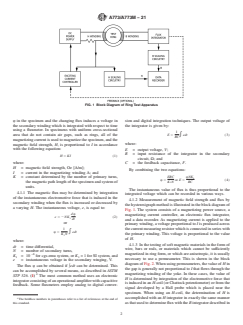
4.1.2 Measurement of magnetic field strength and flux by the hysteresigraph method is illustrated in the block diagram of Fig. 1.
The system consists of a magnetizing power source, a magnetizing current controller, an electronic flux integrator, and a data
recorder. As magnetizing current is applied to the primary winding, a voltage proportional to I is produced across the current
measuring resistor which is connected in series with the primary winding. This voltage is proportional to the value of H.
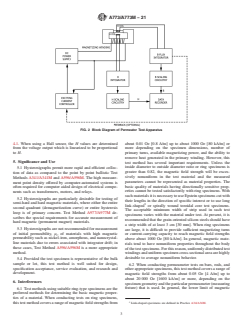
4.1.3 In the testing of soft magnetic materials in the form of wire, bars or rods, or materials which cannot be sufficiently
magnetized in ring form, or which are anisotropic, it is usually necessary to use a permeameter. This is shown in the block diagram
of Fig. 2. When using permeameters, the value of H in the gap is generally not proportional to I that flows through the magnetizing
winding of the yoke. In these cases, the value of H is determined by integration of the electromotive force that is induced in an
H-coil (or Chattock potentiometer) or from the signal developed by a Hall probe which is placed near the specimen. When using
an H-coil, the determination of H is accomplished with an H integrator in exactly the same manner as that used to determine flux
with the B integrator described in 4.1. When using a Hall sensor, the H values are determined from the voltage output which is
linearized to be proportional to H.
5. Significance and Use
5.1 Hysteresigraphs permit more rapid and efficient collection of normal induction and dc hysteresis (B-H loop) data as compared
to the point by point ballistic Test Methods A341/A341M and A596/A596M. The high measurement point density offered by
computer-automated systems is often required for computer aided design of electrical components such as transformers, motors,
and relays.
5.2 Hysteresigraphs are particularly desirable for testing of semihardsemi-hard and hard magnetic materials, where either the
entire second quadrant (demagnetization curve) or entire hysteresis loop is of primary concern. Test Method A977/A977M
describes the special requirements for accurate measurement of hard magnetic (permanent magnet) materials.
5.3 Hysteresigraphs are not recommended for measurement of initial permeability, μ , of materials with high magnetic
i
permeability such as nickel-iron, amorphous, and nanocrystalline materials due to errors associated with integrator drift; in these
cases, Test Method A596/A596M is a more appropriate method.
5.4 Provided the test specimen is representative of the bulk sample or lot, this test method is well suited for design, specification
acceptance, service evaluation, and research and development.
A773/A773M − 21
FIG. 2 Block Diagram of Permeator Test Apparatus
6. Interferences
6.1 Test methods using suitable ring-type specimens are the preferred methods for determining the basic magnetic properties of
a material. When conducting tests on ring specimens, this test method covers a range of magnetic field strengths from about 0.01
Oe [0.8 A/m] up to about 1000 Oe [80 kA/m] or more depending on the specimen dimensions, number of primary turns, available
magnetizing power, and the ability to remove heat generated in the primary winding. However, this test method has several
important requirements. Unless the inside diameter to outside diameter ratio or ring specimens is greater than 0.82, the magnetic
field strength will be excessively nonuniform in the test material and the measured parameters cannot be represented as material
properties. The basic quality of materials having directionally sensitive properties cannot be tested satisfactorily with ring
specimens. With such materials it is necessary to use Epstein specimens cut with their lengths in the direction of specific interest
or to use long link-shaped or spirally wound toroidal core test specimens. The acceptable minimum width of strip used in such
test specimens varies with the material under test. At present, it is recommended that the grain-oriented silicon steels should have
a strip width of at least 3 cm [30 mm]. When ring specimens are large, it is difficult to provide sufficient magnetizing turns or
current-carrying capacity to reach magnetic field strengths above about 1000 Oe [80 kA/m]. In general, magnetic materials tend
to have nonuniform properties throughout the body of the test specimens. For this reason, uniformly distributed test windings and
uniform specimen cross-sectional area are highly desirable to average nonuniform behavior.
6.2 When conducting permeameter tests on bars, rods, and other appropriate specimens, this test method covers a range of
magnetic field strengths from about 0.05 Oe [4 A/m] up to about 20 000 Oe [1600 kA/m] or more, depending on the specimen
geometry and the particular permeameter (measuring fixture) that is used. In general, the lower limit of magnetic field strength is
determined by the area-turns of the H coil -coil (or the sensitivity of the Hall probe if it is used), the sensitivity of the integrator,
and the sensitivities of the measuring and recording components. The upper limit in magnetic field strength is determined by the
type of permeameter appropriate for the specimen, the power supply, and the heat generated in the yoke windings.
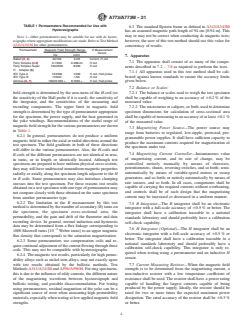
Recommendations of the useful range of magnetic field strength for the various permeameters are shown in Table 1.
6.2.1 In general, permeameters do not produce a uniform magnetic field in either the axial or radial directions around the test
specimen. The field gradients in both of these directions will differ in the various permeameters. Also, the H-coils and B-coils of
the different permeameters are not identical in area, in turns, or in length or identically located. Although test specimens are
prepared to have uniform physical cross section, they may still have undetected nonuniform magnetic properties radially or axially
along the specimen length adjacent to the H or B coils. Some permeameters may also introduce clamping stresses into the test
specimen. For these reasons test results obtained on a test specimen with one type of permeameter may not compare closely with
those obtained on the same specimen from another permeameter type.
Link-shaped specimens are defined in Practice A34/A34M.
A773/A773M − 21
TABLE 1 Permeameters Recommended for Use Withwith
Hysteresigraphs
NOTE 1—Other permeameters may be suitable for use with dc hyster-
esigraphs where appropriate modifications are made. Refer to Test Method
A341/A341M for other permeameters.
Permeameter Magnetic Field Strength Range H Measurement
Device
Oe kA/m
Babbit (2, 3) 40/100 3.2/8 current, H coil
Fahy Simplex (4-6) 0.1/300 0.008/24 H coil
Fahy Simplex Super 100/2500 8/200 H coil
H Adapter (6)
IEC Type A 12/2500 1/200 H coil, Hall probe
IEC Type B 12/620 1/50 H coil
Isthmus (6, 7) 100/20 000 + 8/1600 + H coil, Hall probe
6.2.2 The limitation in the B measurement by this test method is determined by the number of secondary (B) turns on the specimen,
the specimen cross-sectional area, the permeability, and the gain and drift of the fluxmeter and data recording device. In general,
−5
normal induction and hysteresis data may be determined from a flux linkage corresponding to 1000 Maxwell turns [10 Weber
turns] to an upper magnetic flux density that corresponds to the intrinsic saturation.saturation magnetization.
6.2.3 Some permeameters use compensation coils and require continual adjustment of the current flowing through these coils. This
may not be compatible with hysteresigraphs.
6.2.4 The magnetic test results, particularly for high permeability alloys such as nickel-iron alloys, may not exactly agree with test
results obtained by the ballistic methods, Test Methods A341/A341M and A596/A596M. For ring specimens, this is due to the
influence of eddy currents, the different nature of the magnetizing waveform between hysteresigraph and ballistic testing, and
possible disaccomodation.disaccommodation. For testing using permeameters, residual magnetism of the yoke can be a significant
source of error when measuring high permeability materials, especially when testing at low applied magnetic fields.field strengths.
6.3 The standard Epstein frame as defined in A343/A343M has an assumed magnetic path length of 94 cm [0.94 m]. This may
or may not be correct when conducting dc magnetic tests; however, the user of this test method should use this value for
consistency of results.
7. Apparatus
7.1 The apparatus shall consist of as many of the components described in 7.2 – 7.8 as required to perform the tests.
7.1.1 All apparatus used in this test method shall be calibrated against known standards to ensure the accuracy limits given below.
7.2 Balance or Scales:
7.2.1 The balance or scales used to weigh the test specimen shall be capable of weighing to an accuracy of 60.2 % of the
measured value.
7.2.2 The micrometer or calipers, or both, used to determine specimen dimensions for calculation of cross-sectional area shall be
capable of measuring to an accuracy of at least 60.1 % of the measured value.
7.3 Magnetizing Power Source—The power source may range from batteries to regulated, low-ripple, protected, programmable
power supplies. It shall have sufficient capacity to produce the maximum currents required for magnetization of the specimen under
test.
7.4 Magnetizing Current Controller—Instantaneous value of magnetizing current, and its rate of change, may be controlled
entirely manually by means of rheostats, potentiometers, shunts, reversing switches, and so forth; semiautomatically by means of
variable-speed motors or sweep generators, and so forth; or entirely automatically by means of rate sensors, and so forth. In all
cases, components shall be capable of carrying the required currents without overheating, and controls shall be of such design that
the magnetizing current may be increased or decreased in a uniform manner.
A773/A773M − 21
7.5 B Integrator—The B integrator shall be an electronic integrator with a full-scale accuracy of 60.5 % or better. The integrator
shall have a calibration traceable to a national standards laboratory and should preferably have a calibration self-check capability.
7.6 H Integrator (Optional)—The H integrator shall be an electronic integrator with a full-scale accuracy of 60.5 % or better. The
integrator shall have a calibration traceable to a national standards laboratory and should preferably have a calibration self-check
capability. This integrator is only required when testing using a permeameter and an inductive H sensor.
7.7 Current Measuring Resistor—When the magnetic field strength is to be determined from the magnetizing current, a
non-inductive resistor with a low temperature coefficient of resistance shall be used. The resistor shall have a power rating capable
of handling the largest currents capable of being produced by the power supply. Ideally, the resistor should be rated for two or more
times the expected maximum power dissipation. The rated accuracy of the resistor shall be 60.5 % or better.
7.8 Data Recorder—The B and H values can be recorded and displayed by either analog or digital X-Y chart recorders, dataloggers,
or computers. The recording device shall be capable of resolving B or H values of 61 % of the full-scale value. For analog to
digital converters, twelve-bit resolution or higher is desirable.
8. Test Specimens for Ring and Epstein Strip Measurements
8.1 The information in 8.2 – 8.9 covers the general case for specimens in which magnetic field strength is proportional to the
magnetizing current, that is, H = kI.
8.2 When the test specimen represents a test lot of material, sampling shall conform to the requirements of Practice A34/A34M,
unless superseded by a specification.
8.3 To qualify as a test specimen suitable for evaluation of material properties, the effective ratio of mean diameter to radial width
shall be not less than 10 to 1 (or an inside diameter to outside diameter ratio not less than 0.82). When the test specimen has a
smaller ratio than the above requirement, the test data shall not be represented as material properties but shall be called core
properties because of nonuniform flux and field distribution.
8.4 When link, oval-shaped, or rectangular test specimen forms are used, the requirements of 8.3 apply to the end or corner
sections where flux crowding may occur. When straight-sided test specimens are very long relative to the length of the corner or
end sections, they are suitable for basic material properties evaluation with relatively unoriented materials, provided the uncertainty
in determination of true (effective) magnetic path length is less than 61 % of the total magnetic path length. When this uncertainty
in magnetic path length (shortest or longest relative to the mean magnetic-path length) exceeds 61 %, the test values shall be
reported as core properties and not basic material properties.
8.5 Test specimen cores made from strip may be laminated, machined, spirally wound, or Epstein specimens. The method of
selection for Epstein specimens is described in Annex A3 of Test Method A343/A343M. When the material is to be tested half
transverse and half longitudinal, the material shall be cut into Epstein strips or square laminations of appropriate dimensional ratio.
8.6 Test specimens used for basic material evaluation shall be cut, machined, ground, slit, or otherwise formed to have a cross
section that remains sufficiently uniform that its nonuniformity will not materially affect the accuracy of establishing and measuring
magnetic flux density, B, or magnetic field strength, H, in the test specimen. It is recommended that the cross-sectional not vary
by more than 61 % anywhere in the magnetic path. The possible effects of mechanical preparation on the magnetic properties must
be considered prior to testing.
8.7 Laminated ring specimens or specimens of strain sensitive materials shall be enclosed by a nonmagnetic, nonconductive core
box prior to applying the primary and secondary windings unless it has been established by prior testing that the test results are
not materially affected. Air flux correction will typically be required when core boxes are used if testing is to be done at high
magnetic field strengths.
A773/A773M − 21
TABLE 2 Number of Test Strip
Nominal Thickness Electrical Sheet Number of
Gage Number Strips
in. mm
0.0100 to 0.0250 0.254 to 0.635 32 to 24 12
0.0280 to 0.0435 0.711 to 1.105 23 to 19 8
0.0500 and over 1.270 and over 18 and thicker 4
8.8 For laminated ring and spirally wound cores, the specimen cross-sectional area shall be computed from the mass, magnetic
path length, and density. For Epstein specimens, the specimen cross-sectional area shall be computed from the mass, physical
length, and density.
8.9 When required for material properties development, the test specimen shall have received a stress relief or other heat treatment
after specimen preparation. This heat treatment is subject to agreement between the producer and the user.
9. Test Specimens for Permeameter Measurements
9.1 The information in 9.2 – 9.9 covers the general case for specimens that must be tested using a permeameter, and where the
magnetic field strength is not proportional to the magnetizing current.
9.2 When the test specimen represents a test lot of material, sampling shall conform to the requirements of Practice A34/A34M,
unless superseded by a specification.
9.3 Test specimens in bar form may be of round, square, or rectangular cross-section. In some permeameters, the bar specimen
may be a half round or any shape having a uniform cross-sectional area. Permeameters must have a good magnetic joint between
the ends of the test specimen and the permeameter yoke or pole faces. Generally, to achieve a good magnetic joint, the test
specimen must be of square or rectangular cross section and must be machined or ground to have straight and parallel surfaces.
For permeameters using specimens butted to the pole tips, the specimen ends must be smooth and parallel.
9.4 Where possible, test specimen cross-sectional area shall be directly measured using calipers or micrometers. If not possible
because of cross-sectional shape or surface roughness, then the cross-sectional area shall be determined from the mass, length, and
density of the test specimen. For testing Epstein specimens in permeameters, the cross-sectional area shall be determined from the
mass, length, and density.
9.5 When the material is in flat-rolled form and is to be evaluated as half transverse-half longitudinal, the test sample shall be
sheared to have strip specimens in accordance with Table 2 except that multiples of four are not required. When flat-rolled material
is to be evaluated in only one direction, the test specimen shall conform to Table 2 or to the requirements for best test quality for
the particular permeameter being used. For flat-rolled materials of thickness 0.0100 in. [0.254 mm] or thinner, the test specimen
2 2 2 2
cross-sectional area shall be not less than 0.310 in. [200 mm ] and not more than 0.620 in. [400 mm ].
9.6 When the test specimen for strip materials is to be half transverse and half longitudinal, the preferred method is to test the
transverse strips as one specimen and the longitudinal strips as another specimen. Mixing the specimens when significant
anisotropy is present could result in unrealistic test results.
9.7 For best testing accuracy, the length and size of the test specimen must meet the requirements of the permeameter being used.
Generally, for most permeameters, a test specimen length of 10 in. [254 mm] or more is required. Shorter specimens with some
permeameters require the use of pole-piece extensions and may cause a reduction in testing accuracy. Other permeameters are
designed for short specimens without loss of testing accuracy.
9.8 All test specimen forms shall be cut, machined, or ground to have a uniform cross-sectional area along the active length of
the test specimen. The cross-sectional area shall be sufficiently uniform so that its nonuniformity does not materially affect the
Densities of magnetic materials can be found in Practice A34/A34M.
A773/A773M − 21
accuracy of establishing and measuring flux density in the test specimen. It is recommended that the cross-sectional area not vary
by more than 61 % anywhere in the magnetic path. The possible effects of mechanical preparation on the magnetic properties must
be considered prior to testing.
9.9 When required for development of material properties, the test specimen shall receive a stress relief or other heat treatment
after preparation. This anneal is subject to agreement between the producer and the user.
10. Calibration of Integrator(s)
10.1 The integrator(s) shall be calibrated either by a national standards laboratory or using secondary standards traceable to a
national standards laboratory to ensure an integration accuracy of at least 60.5 %. Calibration may be accomplished by means of
a certified Maxwell-turns generator, or volt-seconds generator, or mutual inductor. The integrators may have built-in volt-second
sources that require periodic return to the equipment manufacturer for calibration.
11. Calibration of Current Measuring Resistor
11.1 In cases in which the magnetic field strength is proportional to the magnetizing current, such as in ring and Epstein
specimens, the resistance of the current measuring resistor(s) shall be verified to be accurate to within 60.5 % of the stated value
when measured at the maximum current at which the resistor will be used when making tests.
12. Calibration of H-Coils and Hall Probes
12.1 The area-turns of H-coils shall be calibrated either by a national standards laboratory or using secondary standards traceable
to a national standards laboratory.
12.2 Hall Probes shall be calibrated using standards traceable to a national standards laboratory.
13. Calibration of Data Recorder
13.1 The various scales of the data recorder shall be calibrated by means of a verified voltage source to at least the quoted accuracy
of the recorder in use. The data recorder shall be calibrated using standards traceable to a national standards laboratory.
14. System Calibration Checks
14.1 Due to the nature of measurement systems, it is not always possible to check the calibration of the individual components.
In some instances, attempts to do so may void the equipment manufacturer’s warranty. Accordingly, it is strongly recommended
that users of these measurement systems create or obtain a set of master specimens representative of the magnetic materials
routinely tested by them. These specimens should be periodically tested to verify the overall functioning of the measurement
system. The use of control charting techniques is recommended. It is recommended but not required that these mastersmaster
specimens be tested periodically by a national standards laboratory or by using equipment whose calibration is traceable to a
national standards laboratory.
15. Procedure
15.1 The following test procedure is representative of most analog and digital hysteresigraphs. The details of some operating steps
may vary with the particular make and model of hysteresigraph. However, the general test procedures are similar in all units. The
following procedure covers manual current sweeping, automatic current sweeping, and automatic current sweeping with
symmetrical tracing.
15.2 Setup—The procedures of 15.2.1 – 15.2.6 should be observed for all methods of current sweep.
15.2.1 Before beginning a test, allow a minimum warm-up period for all apparatus and instrumentation as recommended by the
equipment manufacturer.
15.2.2 Connect the specimen, observing polarity so that the first quadrant of the hysteresis loop is being measured on initial
application of the magnetizing current. (It is imperative that proper polarity be established before demagnetization of the test
specimen.) Some computer controlled computer-controlled equipment automatically corrects the polarity if it is reversed.
A773/A773M − 21
15.2.3 Before testing, demagnetize the specimen by establishing a magnetic field strength sufficiently large to reach a point well
above the knee of the magnetization curve. Then, while continuously cycling the magnetization between + and - polarity, slowly
reduce the magnetizing current to zero. (In the demagnetization process, down-switching of voltage taps to reduce current may
result in current surges. It is advisable to select voltage sources and controls that have the ability to reduce current to a low value
without switching taps, preferably to a current level that does not exceed a value of 0.1 times the coercivity of the material.)
15.2.4 For the B measurement, set the B integrator range and scaling circuitry or software so that B is displayed or recorded, or
both, directly.
15.2.5 For the H measurement, select the appropriate current measuring resistor (current range) and set the scaling circuitry or
software so that H is displayed or recorded, or both, directly.
15.2.6 Before
...