

ASTM A977/A977M-07(2020)
(Test Method)Standard Test Method for Magnetic Properties of High-Coercivity Permanent Magnet Materials Using Hysteresigraphs
General Information
- Abstract
SIGNIFICANCE AND USE
4.1 This test method is suitable for magnet specification, acceptance, service evaluation, quality control in magnet production, research and development, and design.
4.2 When a test specimen is cut or fabricated from a larger magnet, the magnetic properties measured on it are not necessarily exactly those of the original sample, even if the material is in the same condition. In such instances, the test results must be viewed in context of part performance history.
4.3 Tests performed in general conformity to this test method and even on the same specimen, but using different test systems, may not yield identical results. The main source of discrepancies are variations between the different test systems in the geometry of the region surrounding the sample, such as, size and shape of the electromagnet pole caps (see Annex A1 and Appendix X1), air gaps at the specimen end faces, and especially the size and location of the measuring devices for H and B or for their corresponding flux values (Hall-effect probes, inductive sensing coils). Also important is the method of B calibration, for example, a volt-second calibration of the fluxmeter alone versus an overall system calibration using a physical reference sample. The method of B and H sensing should be indicated in test reports (see Section 9).
SCOPE
1.1 This test method covers how to determine the magnetic characteristics of magnetically hard materials (permanent magnets), particularly their initial magnetization, demagnetization, and recoil curves, and such quantities as the residual induction, coercive field strength, knee field, energy product, and recoil permeability. This test method is suitable for all materials processed into bulk magnets by any common fabrication technique (casting, sintering, rolling, molding, and so forth), but not for thin films or for magnets that are very small or of unusual shape. Uniformity of composition, structure, and properties throughout the magnet volume is necessary to obtain repeatable results. Particular attention is paid to the problems posed by modern materials combining very high coercivity with high saturation induction, such as the rare-earth magnets, for which older test methods (see Test Method A341/A341M) are unsuitable. An applicable international standard is IEC Publication 60404-5.
1.2 The magnetic system (circuit) in a device or machine generally comprises flux-conducting and nonmagnetic structural members with air gaps in addition to the permanent magnet. The system behavior depends on properties and geometry of all these components and on the operating temperature. This test method describes only how to measure the properties of the permanent magnet material. The basic test method incorporates the magnetic specimen in a magnetic circuit with a closed flux path. Test methods using ring samples or frames composed entirely of the magnetic material to be characterized, as commonly used for magnetically soft materials, are not applicable to permanent magnets.
1.3 This test method shall be used in conjunction with Practice A34/A34M.
1.4 The values and equations stated in customary (cgs-emu or inch-pound) or SI units are to be regarded separately as standard. Within this test method, SI units are shown in brackets except for the sections concerning calculations where there are separate sections for the respective unit systems. The values stated in each system may not be exact equivalents; therefore, each system shall be used independently of the other. Combining values from the two systems may result in nonconformance with this test method.
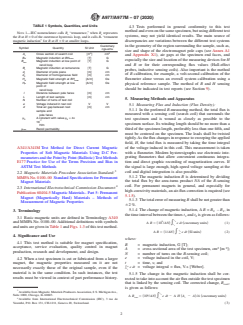
1.5 The names and symbols of magnetic quantities used in this test method, summarized in Table 1, are those generally accepted by the industry.
1.6 This test method is useful for magnet materials having Hci values between about 100 Oe and 35 kOe [8 kA/m and 2.8 MA/m], and Br values in the approximate range from 500 G to 20 kG [50 mT to...
- Status
- Published
- Publication Date
- 31-May-2020
- Technical Committee
- A06 - Magnetic Properties
- Drafting Committee
- A06.01 - Test Methods
Overview
ASTM A977/A977M-07(2020): Standard Test Method for Magnetic Properties of High-Coercivity Permanent Magnet Materials Using Hysteresigraphs provides guidance for measuring the magnetic characteristics of magnetically hard materials – primarily permanent magnets – utilizing hysteresigraphs. Published by ASTM International, this standard is vital for industries and laboratories that require reliable, repeatable testing of critical magnetic properties such as coercive field strength, residual induction, and initial magnetization curves. The standard is essential for magnet specification, acceptance, production quality control, product development, and research.
Key Topics
- Scope and Applicability: The test method details procedures for evaluating initial magnetization, demagnetization, and recoil curves, as well as determining values for key magnetic properties like residual induction (Br), coercive field strength (Hc), and energy product ((BH)max) in high-coercivity permanent magnets.
- Measurement Constraints: Emphasizes the importance of specimen geometry and uniformity-results may vary for thin films, unusually shaped specimens, or those lacking homogeneity.
- System Variability and Calibration: Addresses how different hysteresigraph systems, sample placement, and calibration methods (e.g., Hall-effect probes, inductive coils, fluxmeter calibration) can affect measurement results. Proper reporting of measurement methods is required for consistency.
- Referenced Magnetic Quantities and Units: The standard defines and utilizes internationally recognized symbols and units for magnetic measurement, ensuring clarity and uniformity across test reports.
- Quality Control: Supports evaluation for quality assurance, acceptance testing, and ongoing production control, helping organizations verify compliance with specified magnetic properties.
Applications
- Magnet Specification and Procurement: Used by manufacturers and purchasers to verify that permanent magnet materials meet required magnetic characteristics for specific applications.
- Service Evaluation and Product Design: Assists engineers in assessing magnet performance in service environments, informing product design decisions for optimal performance and reliability.
- Research and Development: Provides a reliable framework for systematically comparing novel materials, fabrication techniques (casting, sintering, molding, etc.), or effects of process variations.
- Industry Sectors: Applicable to producers of electric motors, generators, sensors, actuators, and any application where precision in magnetic properties of permanent magnets is critical.
- Regulatory and International Compliance: Helps organizations conform to globally recognized practices, facilitating international trade and interoperability.
Related Standards
To ensure comprehensive assessment of magnetic materials and accurate reporting, ASTM A977/A977M-07(2020) is intended for use alongside these key standards:
- ASTM A34/A34M: Practice for Sampling and Procurement Testing of Magnetic Materials.
- ASTM A340: Terminology of Symbols and Definitions Relating to Magnetic Testing.
- IEC 60404-5: International standard on methods for measuring the magnetic properties of magnetically hard (permanent magnet) materials.
- ASTM A341/A341M: Test Method for Properties of Soft Magnetic Materials, referenced for comparison but not suitable for high-coercivity magnets.
- MMPA No. 0100–00: Magnetic Materials Producers Association specifications for permanent magnet materials.
Practical Value
Adherence to ASTM A977/A977M-07(2020) ensures high reliability and comparability in the measurement of critical magnetic properties of permanent magnet materials, particularly rare-earth and other high-coercivity alloys. The standard enables standardized quality control, supports R&D, enhances marketability, and ensures regulatory compliance-all contributing to performance assurance in modern electromagnetic components and systems.
Relations
- Effective Date
- 01-Jun-2020
- Effective Date
- 01-Dec-2023
- Effective Date
- 15-Oct-2019
- Effective Date
- 15-Jun-2019
- Effective Date
- 15-Feb-2019
- Effective Date
- 01-Jun-2018
- Effective Date
- 15-Oct-2017
- Effective Date
- 01-Jul-2017
- Effective Date
- 01-May-2016
- Effective Date
- 01-May-2016
- Effective Date
- 01-Oct-2015
- Effective Date
- 01-Oct-2014
- Effective Date
- 01-May-2014
- Effective Date
- 01-May-2013
- Effective Date
- 01-Nov-2012
Get Certified
Connect with accredited certification bodies for this standard

IMQ S.p.A. (Certification)
Italian electrical product certification.

SLG Prüf- und Zertifizierungs GmbH
German testing and certification body.

UL Solutions
Global safety science company with testing, inspection and certification.
Sponsored listings
Frequently Asked Questions
ASTM A977/A977M-07(2020) is a standard published by ASTM International. Its full title is "Standard Test Method for Magnetic Properties of High-Coercivity Permanent Magnet Materials Using Hysteresigraphs". This standard covers: SIGNIFICANCE AND USE 4.1 This test method is suitable for magnet specification, acceptance, service evaluation, quality control in magnet production, research and development, and design. 4.2 When a test specimen is cut or fabricated from a larger magnet, the magnetic properties measured on it are not necessarily exactly those of the original sample, even if the material is in the same condition. In such instances, the test results must be viewed in context of part performance history. 4.3 Tests performed in general conformity to this test method and even on the same specimen, but using different test systems, may not yield identical results. The main source of discrepancies are variations between the different test systems in the geometry of the region surrounding the sample, such as, size and shape of the electromagnet pole caps (see Annex A1 and Appendix X1), air gaps at the specimen end faces, and especially the size and location of the measuring devices for H and B or for their corresponding flux values (Hall-effect probes, inductive sensing coils). Also important is the method of B calibration, for example, a volt-second calibration of the fluxmeter alone versus an overall system calibration using a physical reference sample. The method of B and H sensing should be indicated in test reports (see Section 9). SCOPE 1.1 This test method covers how to determine the magnetic characteristics of magnetically hard materials (permanent magnets), particularly their initial magnetization, demagnetization, and recoil curves, and such quantities as the residual induction, coercive field strength, knee field, energy product, and recoil permeability. This test method is suitable for all materials processed into bulk magnets by any common fabrication technique (casting, sintering, rolling, molding, and so forth), but not for thin films or for magnets that are very small or of unusual shape. Uniformity of composition, structure, and properties throughout the magnet volume is necessary to obtain repeatable results. Particular attention is paid to the problems posed by modern materials combining very high coercivity with high saturation induction, such as the rare-earth magnets, for which older test methods (see Test Method A341/A341M) are unsuitable. An applicable international standard is IEC Publication 60404-5. 1.2 The magnetic system (circuit) in a device or machine generally comprises flux-conducting and nonmagnetic structural members with air gaps in addition to the permanent magnet. The system behavior depends on properties and geometry of all these components and on the operating temperature. This test method describes only how to measure the properties of the permanent magnet material. The basic test method incorporates the magnetic specimen in a magnetic circuit with a closed flux path. Test methods using ring samples or frames composed entirely of the magnetic material to be characterized, as commonly used for magnetically soft materials, are not applicable to permanent magnets. 1.3 This test method shall be used in conjunction with Practice A34/A34M. 1.4 The values and equations stated in customary (cgs-emu or inch-pound) or SI units are to be regarded separately as standard. Within this test method, SI units are shown in brackets except for the sections concerning calculations where there are separate sections for the respective unit systems. The values stated in each system may not be exact equivalents; therefore, each system shall be used independently of the other. Combining values from the two systems may result in nonconformance with this test method. 1.5 The names and symbols of magnetic quantities used in this test method, summarized in Table 1, are those generally accepted by the industry. 1.6 This test method is useful for magnet materials having Hci values between about 100 Oe and 35 kOe [8 kA/m and 2.8 MA/m], and Br values in the approximate range from 500 G to 20 kG [50 mT to...
SIGNIFICANCE AND USE 4.1 This test method is suitable for magnet specification, acceptance, service evaluation, quality control in magnet production, research and development, and design. 4.2 When a test specimen is cut or fabricated from a larger magnet, the magnetic properties measured on it are not necessarily exactly those of the original sample, even if the material is in the same condition. In such instances, the test results must be viewed in context of part performance history. 4.3 Tests performed in general conformity to this test method and even on the same specimen, but using different test systems, may not yield identical results. The main source of discrepancies are variations between the different test systems in the geometry of the region surrounding the sample, such as, size and shape of the electromagnet pole caps (see Annex A1 and Appendix X1), air gaps at the specimen end faces, and especially the size and location of the measuring devices for H and B or for their corresponding flux values (Hall-effect probes, inductive sensing coils). Also important is the method of B calibration, for example, a volt-second calibration of the fluxmeter alone versus an overall system calibration using a physical reference sample. The method of B and H sensing should be indicated in test reports (see Section 9). SCOPE 1.1 This test method covers how to determine the magnetic characteristics of magnetically hard materials (permanent magnets), particularly their initial magnetization, demagnetization, and recoil curves, and such quantities as the residual induction, coercive field strength, knee field, energy product, and recoil permeability. This test method is suitable for all materials processed into bulk magnets by any common fabrication technique (casting, sintering, rolling, molding, and so forth), but not for thin films or for magnets that are very small or of unusual shape. Uniformity of composition, structure, and properties throughout the magnet volume is necessary to obtain repeatable results. Particular attention is paid to the problems posed by modern materials combining very high coercivity with high saturation induction, such as the rare-earth magnets, for which older test methods (see Test Method A341/A341M) are unsuitable. An applicable international standard is IEC Publication 60404-5. 1.2 The magnetic system (circuit) in a device or machine generally comprises flux-conducting and nonmagnetic structural members with air gaps in addition to the permanent magnet. The system behavior depends on properties and geometry of all these components and on the operating temperature. This test method describes only how to measure the properties of the permanent magnet material. The basic test method incorporates the magnetic specimen in a magnetic circuit with a closed flux path. Test methods using ring samples or frames composed entirely of the magnetic material to be characterized, as commonly used for magnetically soft materials, are not applicable to permanent magnets. 1.3 This test method shall be used in conjunction with Practice A34/A34M. 1.4 The values and equations stated in customary (cgs-emu or inch-pound) or SI units are to be regarded separately as standard. Within this test method, SI units are shown in brackets except for the sections concerning calculations where there are separate sections for the respective unit systems. The values stated in each system may not be exact equivalents; therefore, each system shall be used independently of the other. Combining values from the two systems may result in nonconformance with this test method. 1.5 The names and symbols of magnetic quantities used in this test method, summarized in Table 1, are those generally accepted by the industry. 1.6 This test method is useful for magnet materials having Hci values between about 100 Oe and 35 kOe [8 kA/m and 2.8 MA/m], and Br values in the approximate range from 500 G to 20 kG [50 mT to...
ASTM A977/A977M-07(2020) is classified under the following ICS (International Classification for Standards) categories: 29.030 - Magnetic materials. The ICS classification helps identify the subject area and facilitates finding related standards.
ASTM A977/A977M-07(2020) has the following relationships with other standards: It is inter standard links to ASTM A977/A977M-07(2013), ASTM A340-23a, ASTM A340-19b, ASTM A340-19a, ASTM A340-19, ASTM A340-18, ASTM A340-17a, ASTM A340-17, ASTM A340-16, ASTM A340-16e1, ASTM A340-15, ASTM A340-14, ASTM E177-14, ASTM E177-13, ASTM A34/A34M-06(2012). Understanding these relationships helps ensure you are using the most current and applicable version of the standard.
ASTM A977/A977M-07(2020) is available in PDF format for immediate download after purchase. The document can be added to your cart and obtained through the secure checkout process. Digital delivery ensures instant access to the complete standard document.
Standards Content (Sample)
This international standard was developed in accordance with internationally recognized principles on standardization established in the Decision on Principles for the
Development of International Standards, Guides and Recommendations issued by the World Trade Organization Technical Barriers to Trade (TBT) Committee.
Designation: A977/A977M − 07 (Reapproved 2020)
Standard Test Method for
Magnetic Properties of High-Coercivity Permanent Magnet
Materials Using Hysteresigraphs
This standard is issued under the fixed designationA977/A977M; the number immediately following the designation indicates the year
of original adoption or, in the case of revision, the year of last revision. A number in parentheses indicates the year of last reapproval.
A superscript epsilon (´) indicates an editorial change since the last revision or reapproval.
1. Scope brackets except for the sections concerning calculations where
there are separate sections for the respective unit systems. The
1.1 This test method covers how to determine the magnetic
values stated in each system may not be exact equivalents;
characteristics of magnetically hard materials (permanent
therefore,eachsystemshallbeusedindependentlyoftheother.
magnets), particularly their initial magnetization,
Combining values from the two systems may result in noncon-
demagnetization, and recoil curves, and such quantities as the
formance with this test method.
residual induction, coercive field strength, knee field, energy
product, and recoil permeability. This test method is suitable 1.5 The names and symbols of magnetic quantities used in
for all materials processed into bulk magnets by any common this test method, summarized in Table 1, are those generally
fabrication technique (casting, sintering, rolling, molding, and accepted by the industry.
so forth), but not for thin films or for magnets that are very
1.6 This test method is useful for magnet materials having
small or of unusual shape. Uniformity of composition,
H values between about 100 Oe and 35 kOe [8 kA/m and 2.8
ci
structure, and properties throughout the magnet volume is
MA/m], and B values in the approximate range from 500 G to
r
necessary to obtain repeatable results. Particular attention is
20 kG [50 mT to 2 T]. High-coercivity rare-earth magnet test
paid to the problems posed by modern materials combining
specimens may require much higher magnetizing fields than
very high coercivity with high saturation induction, such as the
iron-core electromagnets can produce. Such samples must be
rare-earth magnets, for which older test methods (see Test
premagnetized externally and transferred into the measuring
Method A341/A341M) are unsuitable. An applicable interna-
yoke. Typical values of the magnetizing fields, H , required
mag
tional standard is IEC Publication 60404-5.
for saturating magnet materials are shown in Table A2.1.
1.2 The magnetic system (circuit) in a device or machine
1.7 This standard does not purport to address all of the
generally comprises flux-conducting and nonmagnetic struc-
safety concerns, if any, associated with its use. It is the
tural members with air gaps in addition to the permanent
responsibility of the user of this standard to establish appro-
magnet. The system behavior depends on properties and
priate safety, health, and environmental practices and deter-
geometry of all these components and on the operating
mine the applicability of regulatory limitations prior to use.
temperature. This test method describes only how to measure
1.8 This international standard was developed in accor-
the properties of the permanent magnet material.The basic test
dance with internationally recognized principles on standard-
method incorporates the magnetic specimen in a magnetic
ization established in the Decision on Principles for the
circuitwithaclosedfluxpath.Testmethodsusingringsamples
Development of International Standards, Guides and Recom-
or frames composed entirely of the magnetic material to be
mendations issued by the World Trade Organization Technical
characterized, as commonly used for magnetically soft
Barriers to Trade (TBT) Committee.
materials, are not applicable to permanent magnets.
2. Referenced Documents
1.3 This test method shall be used in conjunction with
Practice A34/A34M.
2.1 ASTM Standards:
A34/A34M Practice for Sampling and Procurement Testing
1.4 The values and equations stated in customary (cgs-emu
of Magnetic Materials
or inch-pound) or SI units are to be regarded separately as
A340 Terminology of Symbols and Definitions Relating to
standard. Within this test method, SI units are shown in
Magnetic Testing
This test method is under the jurisdiction of ASTM Committee A06 on
MagneticPropertiesandisthedirectresponsibilityofSubcommitteeA06.01onTest
Methods. For referenced ASTM standards, visit the ASTM website, www.astm.org, or
CurrenteditionapprovedJune1,2020.PublishedJuly2020.Originallyapproved contact ASTM Customer Service at service@astm.org. For Annual Book of ASTM
in 1997. Last previous edition approved in 2013 as A977/A977M – 07 (2013). DOI: Standards volume information, refer to the standard’s Document Summary page on
10.1520/A0977_A0977M-07R20. the ASTM website.
Copyright © ASTM International, 100 Barr Harbor Drive, PO Box C700, West Conshohocken, PA 19428-2959. United States
A977/A977M − 07 (2020)
TABLE 1 Symbols, Quantities, and Units
4.3 Tests performed in general conformity to this test
methodandevenonthesamespecimen,butusingdifferenttest
NOTE 1—IEC nomenclature calls B “remanence,” when B represents
r r
systems, may not yield identical results. The main source of
the B at H = 0 of the outermost hysteresis loop, and it calls B “remanent
r
magnetic induction” for B at H = 0 at smaller loops.
discrepancies are variations between the different test systems
Customary in the geometry of the region surrounding the sample, such as,
Symbol Quantity SI Unit
cgs-emu
size and shape of the electromagnet pole caps (see Annex A1
2 2
A Cross section of search coil [m]cm
t
and Appendix X1), air gaps at the specimen end faces, and
B Magnetic induction at BH [T] G
d max
especially the size and location of the measuring devices for H
B Magnetic induction at low point of [T] G
rec
recoil loop and B or for their corresponding flux values (Hall-effect
B Magnetic induction at remanence [T] G
r
probes, inductive sensing coils). Also important is the method
d Diameter of pole piece [m] cm
l
of B calibration, for example, a volt-second calibration of the
d Diameter of homogeneous field [m] cm
H Magnetic field strength at BH [A/m] Oe
fluxmeter alone versus an overall system calibration using a
d max
H Magnetic field strength at low [A/m] Oe
p
physical reference sample. The method of B and H sensing
point of
should be indicated in test reports (see Section 9).
recoil loop
l Distance between pole faces [m] cm
l Length of test sample [m] cm
r
5. Measuring Methods and Apparatus
N Number of turns of test coil
e Voltage induced in test coil V V
5.1 Measuring Flux and Induction (Flux Density):
d Total air gap between test [m] cm
5.1.1 In the preferred B-measuring method, the total flux is
sample and
pole faces measured with a sensing coil (search coil) that surrounds the
µ A constant with value µ =4π
0 0
test specimen and is wound as closely as possible to the
-7
specimen surface. Its winding length should be no more than a
H/m
µ Recoil permability
third of the specimen length, preferably less than one fifth, and
rec
must be centered on the specimen. The leads shall be twisted
tightly.Asthefluxchangesinresponsetosweepingtheapplied
field, H, the total flux is measured by taking the time integral
A341/A341M Test Method for Direct Current Magnetic of the voltage induced in this coil. This measurement is taken
Properties of Soft Magnetic Materials Using D-C Per- with a fluxmeter. Modern hysteresigraphs use electronic inte-
meameters and the Point by Point (Ballistic)Test Methods grating fluxmeters that allow convenient continuous integra-
E177 Practice for Use of the Terms Precision and Bias in tion and direct graphic recording of magnetization curves. If
ASTM Test Methods the signal is large enough, high-speed voltage sampling at the
coil and digital integration is also possible.
2.2 Magnetic Materials Procedure Association Standard:
5.1.2 The magnetic induction B is determined by dividing
MMPANo. 0100–00 Standard Specifications for Permanent
the total flux by the area-turns product NA of the B-sensing
Magnet Materials
coil. For permanent magnets in general, and especially for
2.3 International Electrotechnical Commission Document:
high-coercivitymaterials,anair-fluxcorrectionisrequired(see
Publication 60404-5 Magnetic Materials– Part 5: Permanent
5.1.5).
Magnet (Magnetically Hard) Materials – Methods of
5.1.3 Thetotalerrorofmeasuring Bshallbenotgreaterthan
Measurement of Magnetic Properties
62%.
5.1.4 The change of magnetic induction, ∆ B = B – B,in
2 1
3. Terminology
thetimeintervalbetweenthetimes t and t isgivenasfollows:
1 2
3.1 Basic magnetic units are defined in Terminology A340
t
and MMPA No. 0100–00. Additional definitions with symbols ∆ B 5 10 /AN edt customary units (1)
~ ! * ~ !
t
and units are given in Table 1 and Figs. 1-3 of this test method.
t
∆ B 5 1/AN edt SI units (2)
~ ! * ~ !
t
4. Significance and Use
where:
4.1 This test method is suitable for magnet specification,
B = magnetic induction, G [T];
acceptance, service evaluation, quality control in magnet
2 2
A = cross-sectional area of the test specimen, cm [m ];
production, research and development, and design.
N = number of turns on the B-sensing coil;
e = voltage induced in the coil, V;
4.2 When a test specimen is cut or fabricated from a larger
t = time, s; and
magnet, the magnetic properties measured on it are not
t
*
edt = voltage integral = flux, V-s [Weber].
necessarily exactly those of the original sample, even if the t
material is in the same condition. In such instances, the test
5.1.5 The change in the magnetic induction shall be cor-
results must be viewed in context of part performance history.
rectedtotakeintoaccounttheairfluxoutsidethetestspecimen
that is linked by the sensing coil. The corrected change, B ,
corr
is given as follows:
Available from Magnetic Materials ProducersAssociation, 8 S. MichiganAve.,
t
Suite 1000, Chicago, IL 60603.
∆ B 5 ~10 /AN! edt 2 ∆ H ~A 2 A!/A ~customary units!
*
corr t
4 t
Available from International Electrotechnical Commission (IEC), 3 rue de
Varembé, P.O. Box 131, CH-1211, Geneva 20, Switzerland. (3)
A977/A977M − 07 (2020)
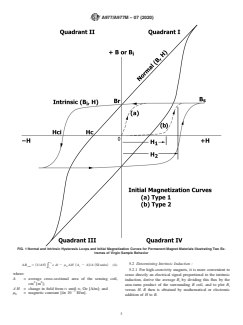
FIG. 1 Normal and Intrinsic Hysteresis Loops and Initial Magnetization Curves for Permanent Magnet Materials Illustrating Two Ex-
tremes of Virgin Sample Behavior
t
5.2 Determining Intrinsic Induction :
∆B 5 ~1/AN! edt 2 µ ∆H ~A 2 A!/A ~SI units! (4)
*
corr 0 t
t
5.2.1 For high-coercivity magnets, it is more convenient to
where:
sense directly an electrical signal proportional to the intrinsic
A = average cross-sectional area of the sensing coil, induction, derive the average B by dividing this flux by the
i
2 2
cm [m ];
area-turns product of the surrounding B coil, and to plot B
i
∆ H = change in field from t until t , Oe [A/m]; and
1 2 versus H. B then is obtained by mathematical or electronic
-7
µ = magnetic constant [4π 10 H/m].
addition of H to B.
A977/A977M − 07 (2020)
t
∆ B 5 ~10 / AN! * edt ~customary units! (5)
i
t
t
∆B 5 ~1/AN! * edt ~SI units! (6)
i
t
where:
B = intrinsic induction, G [T];
i
2 2
A = cross section of the test specimen, cm [m ]; and
N = number of turns on Coil 1 containing the test specimen.
5.2.3 The two-sensing-coil device shall lie totally within the
homogeneous field defined by Eq A1.1 and Eq A1.2. Test
specimens of lower-coercivity magnets having a range of
cross-sectional areas and shapes can then be measured with the
samecoildevice.Anarrangementofside-by-sidecoilsofequal
size is useful. Serious errors, however, are incurred when
measuring B this way on high-B or high/coercivity magnets,
i r
or both, at applied fields of about 10 kOe or more. The errors
are most severe for test specimens of short pole-to-pole length.
Local pole-piece saturation causes strong field inhomogene-
ities. The specimen then must fill the cross section of Coil 1,
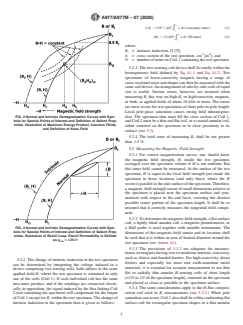
FIG. 2 Normal and Intrinsic Demagnetization Curves with Sym-
bols for Special Points of Interest and Definition of Salient Prop-
andCoil2mustbeathinandflatcoil,oracoaxialannularcoil,
erties. Illustration of Maximum Energy Product, Coercive Fields,
either centered on the specimen or in close proximity to its
and Definition of Knee Field
surface (see 5.3).
5.2.4 The total error of measuring B shall be not greater
i
than 62%.
5.3 Measuring the Magnetic Field Strength:
5.3.1 For correct magnetization curves, one should know
the magnetic field strength, H, inside the test specimen,
averaged over the specimen volume if H is not uniform. But
this inner field cannot be measured. At the surface of the test
specimen, H is equal to the local field strength just inside the
specimen in those locations (and only there) where the H
vectorisparalleltothesidesurfaceofthespecimen.Therefore,
a magnetic field strength sensor of small dimensions relative to
the specimen is placed near the specimen surface and sym-
metrical with respect to the end faces, covering the shortest
possible center portion of the specimen length. It shall be so
oriented that it correctly measures the tangential field compo-
nent.
5.3.2 To determine the magnetic field strength, a flat surface
coil, a tightly fitted annular coil, a magnetic potentiometer, or
FIG. 3 Normal and Intrinsic Demagnetization Curves with Sym-
a Hall probe is used together with suitable instruments. The
bols for Special Points of Interest and Definition of Salient Prop-
dimensions of the magnetic field sensor and its location shall
erties. Illustration of Recoil Loop. Recoil Permeability is Defined
be such that it is within an area of limited diameter around the
as µ = ∆B/∆H
rec
test specimen (see Annex A1).
5.3.3 The provisions of 5.3.2 are adequate for measure-
ments on magnets having low-to-moderate intrinsic coercivity,
such as Alnico and bonded ferrites. For high-coercivity, dense
5.2.2 The change of intrinsic induction in the test specimen
ferrites and especially for most rare earth-transition metal
can be determined by integrating the voltage induced in a
materials, it is essential for accurate measurement to use thin
device comprising two sensing coils, both subject to the same
flat or radially thin annular H-sensing coils of short length
applied field H, where the test specimen is contained in only
(<1/5 to 1/3 of the specimen length), centered on the specimen
one of the coils (Coil 1). If each individual coil has the same
and placed as close as possible to the specimen surface.
area-turns product, and if the windings are connected electri-
5.3.4 The same considerations apply to the H-flux compen-
cally in opposition, the signal induced by the flux linking Coil
2 (not containing the specimen) will compensate for the output sation coil used in B measurements (see 5.2.3.) When pole
i
saturation can occur, Coil 2 also shall be a thin conforming flat
of Coil 1 except for B within the test specimen. The change of
i
intrinsic induction in the specimen then is given as follows: surface coil for rectangular specimen shapes or a thin annular
A977/A977M − 07 (2020)
circuit for the (intrinsic) induction so as to achieve an approxi-
mately constant rate of change of B or B. Flexible sweep
i
control requires a power supply for the electromagnet that can
be programmed by an analog or digital electronic signal. For
greatest flexibility, the power supply should be bipolar.Typical
total recording times for a full hysteresis loop are between
about 30 s and 5 min. Integrator drift errors can be kept
acceptably small with reasonable operator care. The output
voltages of the integrators and a Hall-effect field meter, if used,
can be plotted directly with an analog x,y recorder, and salient
property values are determined from this plot. Alternatively,
the output voltages can be digitized, stored, and processed in a
FIG. 4 Illustration Regarding the Influence of Air Gaps at the End
Faces of the Test Specimen computer. Curves and calculated numerical values are then
displayed on a monitor and printed out with a plotter or printer.
coil closely surrounding a cyclindrical specimen, and the
6. Calibration
specimen essentially shall fill the open cross-sectional area of
the B–sensing Coil 1.
6.1 The subsystems of the hysteresigraph for measuring
5.3.5 To reduce other measurement errors, the air gaps
field and flux quantities must be calibrated from time to time.
between the flat ends of the test specimen and the pole pieces
Several alternative techniques are in common use. All ensure
shall be kept small, typically in the range 0.001 to 0.002 in.
comparable degrees of reproducibility, but they yield strongly
[0.025 to 0.050 mm] (see Fig. 4).
different absolute accuracy. The circuits for measuring flux
5.3.6 The magnetic field strength measuring system shall be
(induction or intrinsic induction) and the magnetizing field are
calibrated. Any temperature dependence of the measuring
usually calibrated independently. However, checking hyster-
instruments, (for example, Hall probes), must be taken into
esigraphs against each other by remeasuring demagnetization
account. The total error of measuring H shall be not greater
curves of reference magnets may link these two necessary
than 62%.
calibrations.
NOTE 1—The end faces of the test specimen should be in intimate
6.2 Magnetic Flux and Induction:
contact with the pole faces. There are always unavoidable small air gaps
6.2.1 Electronic fluxmeters are conveniently calibrated by
as a result of surface roughness, poor parallelism of sample or pole faces,
using one of the following four methods. An accuracy of
orintentionalshimmingtoprotectdelicatespecimensfromdeformationor
60.1 %isachievablebythemethodslistedin6.2.1.1–6.2.1.3.
crushing. These cause additional errors in the magnetic field strength
measurement and indirectly in the B measurements through air flux An error of 65 % must be expected from the method given in
i
compensation errors, even in the low H region.The maximum error in the
6.2.1.4. All these methods, however, calibrate only the elec-
field strength measurement, as a result of two symmetric gaps of length d
tronic integrating and indicating/recording instrument. They
(see Fig. 3) is approximately:
leave out the hysteresigraph’s sensing coils, which introduce
∆H/H 5 2 Bd/l H ~customary units! (7)
errors because of their location relative to test specimen and
r
electromagnet pole caps, and whose area-turns product can
∆H/H 5 2 Bd/µ l H ~SI units! (8)
0 r
change as the coils age or are abused. The specimen geometry
To keep the error 100 ∆ H/H < 1 % in the region of the
itself also affects the B calibration. Experience has shown
i
(BH) point, the gap thickness should be kept below the
max
discrepancies of up to 10 % between B measurements on
i
following values:
different hysteresigraphs due to uncorrected sense coil and
d = 0.00025 l for Alnico magnets,
r
other errors, even when calibrated with volt-second standards.
d = 0.005 l for hard ferrite magnets, and
r
The four fluxmeter calibration methods are:
d = 0.003 l for rare-earth magnets.
r
6.2.1.1 Use of a volt-second generator, consisting of a very
5.4 Plotting Magnetization and Demagnetization Curves: stable source of a well-measured dc voltage and a precision
timer. The level of this voltage and the length of time it is
5.4.1 Plotting of B, H curves or B, H curves is accom-
i
plished by combining one of the methods for magnetic field applied should be comparable to typical levels during a
magnetic loop measurement with the hysteresigraph.
strength measurement from 5.3 with a B-measuring method
i
from 5.2 or a B-measuring method from 5.1.Aschematic for a 6.2.1.2 Use of a mutual inductance standard, by switching
typical hysteresigraph system is shown in Fig. 5. on and off a primary current measured with a precision
5.4.2 Continuous Plotting of Magnetization Curves— ampere-meter. A known flux change is induced in the second-
Modern electronic integrators used in conjunction with induc- arywindingofthestandard,whichservesastheV-scalibration
tive sensors for B or B, and in some instruments also for H, signal in the fluxmeter circuit.
i
allow the continuous recording of magnetization, 6.2.1.3 Use of a search coil of precisely known area-turns,
demagnetization, and recoil curves. A wide range of field that is moved into or removed from region of a time-constant
sweep rates is possible. In the simplest but least desirable case, homogeneous field, which has been measured with a nuclear
the exciting current of the electromagnet may be varied magnetic resonance (NMR) gaussmeter. A rigidly constructed
linearly, or the field sweep rate may be held constant. Even magnetic circuit comprising a highly stable permanent magnet
better it may be controlled with feedback from the measuring with large iron pole pieces and a short air gap is a suitable field
A977/A977M − 07 (2020)
FIG. 5 Schematic Representation of a Typical Magnetic Hysteresigraph Test System
source for this. If it is well stabilized and shielded from calibrating. A magnetizing field of the magnitude required to
magnetic disturbances and physical abuse, it can continue to produce a known magnetization in the standard is applied, and
serve as a transfer standard after having once been calibrated
using the sensitivity potentiometers of the integrator or
by NMR.
recorder,the ydeflectiononthe x,yrecorderisadjustedtoyield
6.2.1.4 Use of the remanent induction flux, of a long,
a convenient scale factor for B. The known magnetization at
i
freestanding permanent magnet bar as a secondary standard.A
the applied field value, any temperature variation of this value,
close-fitting, short-search coil of exactly known turns count is
and the ratio of the cross-sectional areas of standard and test
placed in the center (neutral zone) of the much longer bar, the
specimen must be taken into account.
fluxmeter is zeroed and the coil removed to a field-free region
6.2.3 For measurements on high-B, high-H materials, and
ci
of space. Alternatively, the coil can be fixed and the magnet
specimens of short magnetic length, the relatively complex
removed. The reference magnet should be precision machined
calibration method of 6.2.2 yields better accuracy for B and B
i
from a material having a low temperature coefficient and high
than the seemingly absolute, volt-second-based fluxmeter cali-
chemical and flux stability, such as Alnico five or temperature
bration of 6.2.1. It takes into account most of the self-
compensated (Sm, Gd-Co)-based 2-17 magnets; it must be
demagnetizing effects, field and flux inhomogeneities as a
stabilized by magnetic and thermal cycling. Its average cross-
result of specimen shape and air gaps at sample end faces, and
sectional area must be known.
also pole-piece saturation effects, since many of these occur
6.2.2 The preferred method for calibrating the entire flux-
similarly with the nickel standard and the magnet test speci-
measuring subsystem (B or B circuits, comprising the sensing
i
men. Experience shows the error of B in this case to be <2 %
coilarrangement,integrator,andindicatingorrecordinginstru- i
intheappliedfieldrangeuptoabout10to12kOe[800to1000
ment) uses a physical standard of a shape and size similar to
kA/m].
that of the specimen to be characterized. Pure nickel is an
excellent reference material since nickel is magnetically soft
NOTE 2—Pure nickel and pure iron are mechanically very soft and can
and thus easily saturated, its saturation magnetization value
be easily deformed by pressure from the electromagnet pole pieces or
and temperature variation are well known, and nickel has a
other forces. Such standards must be carefully protected by nonmagnetic
saturation induction level in the range of most permanent
pole spacers of matched length. They should also be frequently inspected
magnets. Pure iron is sometimes used, especially when cali- and their dimensions carefully checked for evidence of abuse. The
approach to saturation of nickel is sensitive to mechanical strain. Nickel
brating to measure only permanent magnets with the highest
and iron should be stress-relief annealed before being used as magnetic
induction levels. The flux calibration standard is placed in the
flux reference standards.
air gap of the electromagnet, using the same pole and sensing-
coil geometry to be used in the measurement for which one is 6.3 Magnetic Field:
A977/A977M − 07 (2020)
6.3.1 The magnetic field sensor with associated instrumen- party can fully saturate it in their test system electromagnet; its
tation must be calibrated such that the total error in the system properties must show good temporal stability; the properties
is within 62 %. The method of calibration depends on the should not vary strongly with temperature around +23°C. It
nature of the field-strength sensor used. should be mechanically strong and insensitive to physical
abuse, and it should not corrode.Alnico five and several other
6.3.2 Hall-Effect Field Meters—These should be frequently
materials of the Alnico and Fe-Cr-Co families meet these
recalibrated by placing the Hall probe in the cavity of a
conditions. Ferrites are less suitable because of their brittleness
reference field source available from the instrument manufac-
turer and adjusting the electronic sensitivity controls to match and high-temperature coefficients. Most rare-earth magnets are
too difficult to saturate and some corrode too readily.
the meter indication to the stated reference field strength. Such
“standard magnets” comprise a stabilized permanent magnet in
7. Test Specimens
a small, rigidly constructed and shielded-iron circuit. They
produce a stated field in the 100 to 5000 Oe [8 to 400 kA/m] 7.1 The test specimens shall have a simple shape such as a
range and are indirectly calibrated against a highly accurate cylinder (to be magnetized in the axial direction) or a rectan-
NMR gaussmeter by their manufacturer. Hall meters can also gular prism. The maximum dimensions are determined by the
be calibrated more directly against NMR or an accurate electromagnet pole-cap dimensions and EqA1.1 and EqA1.2.
rotating-coil gaussmeter if a large-volume transfer magnet is The minimum specimen length should be 0.20 in. [5 mm]. The
available (see 6.2.1.3). end faces must be parallel to each other and perpendicular to
the magnetization axis. The sample cross section must be
6.3.3 Some Hall probes exhibit significant nonlinearity in
high fields. In this case, nominal field readings from a uniform over the specimen length, any variations being less
than1 %.Theseconditionsmayrequiregrindingofthesample.
linear-scale meter or voltage output should be corrected using
data, which the gaussmeter manufacturer normally supplies. The average cross section must be measured to within 60.5 %.
In the case of anisotropic material, the direction of magnetiza-
Attention must also be paid to the often strong temperature
dependence of the Hall-probe output. tion should be marked on the specimens.
6.3.4 Inductive H-Measuring Systems Using Sensing Coils
8. Procedure
and Integrators—The H coil may be placed in a large-volume,
8.1 Common Setup:
homogeneous and time-constant field of magnitude similar to
8.1.1 The following description of typical test procedures
the fields to be measured, for example, between 5 to 10 kOe
assumes that the compensated B–coil assembly,
...