

ASTM A596/A596M-21
(Test Method)Standard Test Method for Direct-Current Magnetic Properties of Materials Using the Point by Point (Ballistic) Method and Ring Specimens
General Information
- Abstract
SIGNIFICANCE AND USE
3.1 Test methods using suitable ring-type specimens4 are the preferred methods of determining the basic magnetic properties of a material caused by the absence of demagnetizing effects and are well suited for specification acceptance, service evaluation, and research and development.
3.2 Provided the test specimen is representative of the bulk material as is usually the case for thin strip and wire, this test is also suitable for design purposes.
3.3 When the test specimen is not necessarily representative of the bulk material such as a ring machined from a large forging or casting, the results of this test method may not be an accurate indicator of the magnetic properties of the bulk material. In such instances, the test results when viewed in context of past performance history will be useful for judging the suitability of the current material for the intended application.
SCOPE
1.1 This test method covers dc testing for the determination of basic magnetic properties of materials in the form of ring, toroidal, link, double-lapped Epstein cores, or other standard shapes which may be cut, stamped, machined, or ground from cast, compacted, sintered, forged, or rolled materials. It includes tests for determination of the normal magnetization curve and hysteresis loop taken under conditions of steep wavefront reversals of the direct-current magnetic field strength.
1.2 This test method shall be used in conjunction with Practice A34/A34M.
1.3 This test method is suitable for a testing range from very low magnetic field strength up to 200 or more Oe [15.9 or more kA/m]. The lower limit is determined by integrator sensitivity and the upper limit by heat generation in the magnetizing winding. Special techniques and short duration testing may extend the upper limit of magnetic field strength.
1.4 Testing under this test method is inherently more accurate than other methods. When specified dimensional or shape requirements are observed, the measurements are a good approximation to absolute properties. Test accuracy available is primarily limited by the accuracy of instrumentation. In most cases, equivalent results may be obtained using Test Method A773/A773M or the test methods of IEC Publication 60404-4.
1.5 This test method permits a choice of test specimen to permit measurement of properties in any desired direction relative to the direction of crystallographic orientation without interference from external yoke systems.
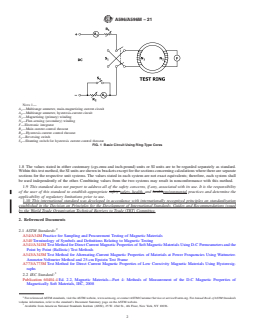
1.6 The symbols and abbreviated definitions used in this test method appear in Fig. 1 and Sections 5, 6, 9, and 10. For the official definitions see Terminology A340.
FIG. 1 Basic Circuit Using Ring-Type Cores
Note 1:
A1—Multirange ammeter, main-magnetizing current circuit
A2—Multirange ammeter, hysteresis-current circuit
N1—Magnetizing (primary) winding
N2—Flux-sensing (secondary) winding
F—Electronic integrator
R1—Main current control rheostat
R2—Hysteresis current control rheostat
S1—Reversing switch
S2—Shunting switch for hysteresis current control rheostat
1.7 Warning—Mercury has been designated by EPA and many state agencies as a hazardous material that can cause central nervous system, kidney, and liver damage. Mercury, or its vapor, may be hazardous to health and corrosive to materials. Caution should be taken when handling mercury and mercury-containing products. See the applicable product Material Safety Data Sheet (MSDS) for details and EPA’s website (http://www.epa.gov/mercury/faq.htm ) for additional information. Users should be aware that selling mercury or mercury-containing products, or both, in your state may be prohibited by state law.
1.8 The values stated in either customary (cgs-emu and inch-pound) units or SI units are to be regarded separately as standard. Within this test method, the SI units are shown in brackets except for the sections concerning calculations where there are separate sections fo...
- Status
- Published
- Publication Date
- 31-Jan-2021
- Technical Committee
- A06 - Magnetic Properties
- Drafting Committee
- A06.01 - Test Methods
Buy Documents
ASTM A596/A596M-21 - Standard Test Method for Direct-Current Magnetic Properties of Materials Using the Point by Point (Ballistic) Method and Ring Specimens
REDLINE ASTM A596/A596M-21 - Standard Test Method for Direct-Current Magnetic Properties of Materials Using the Point by Point (Ballistic) Method and Ring Specimens
Overview
ASTM A596/A596M-21: Standard Test Method for Direct-Current Magnetic Properties of Materials Using the Point by Point (Ballistic) Method and Ring Specimens establishes procedures for accurately determining the fundamental magnetic properties of ferromagnetic materials. Developed by ASTM, this test method utilizes direct-current (DC) ballistic measurements with ring, toroidal, Epstein cores, and related specimen types fabricated from various ferromagnetic materials. The approach is recognized for providing high-precision data through the minimization of demagnetizing effects, making it the benchmark for materials acceptance, service evaluation, research, and development.
Key Topics
- Specimen Types: The method applies to rings, toroidal forms, double-lapped Epstein cores, and other standard shapes produced from cast, rolled, forged, or sintered materials.
- Measurement Capabilities: The standard covers DC testing for both the normal magnetization curve and hysteresis loop determinations, under rapid field reversal conditions. This includes the assessment of flux density, magnetic field strength, coercive force, residual induction, and permeability.
- Applicability: Suitable for a wide field strength range from very low values up to 200 Oe (15.9 kA/m) or higher, depending on equipment capacities.
- Accuracy and Calibration: When specified dimensional and shape criteria are maintained, the test achieves a high degree of accuracy largely dependent on instrument quality. Electronic integrators and precise current control are emphasized.
- Data Reporting: The method outlines requirements for reporting specimen identification, dimensions, heat treatments, test conditions, and the specific magnetic properties measured.
- Safety Considerations: Special warnings regarding mercury use in switches are included, as mercury is hazardous and increasingly regulated.
Applications
This standard is essential in industries and research fields where reliable magnetic property data is required for:
- Material Specification Acceptance: Certifying that bulk materials meet magnetic property specifications for production and quality control.
- Service Evaluation: Investigating the long-term magnetic performance of materials under operational conditions.
- Design and Development: Supporting the engineering of magnetic components, such as transformers, inductors, and electrical machine cores by providing baseline magnetic characteristics.
- Research: Contributing to materials science studies aiming to develop new magnetic alloys or optimize existing compositions.
- Cross-Comparisons: Results are valuable for comparing materials' performance using equivalent international standards or alternative test methods, such as ASTM A773/A773M or IEC 60404-4.
- Bulk Material Representativeness: Particularly suitable for thin strip and wire; caution is required when testing specimens machined from large forgings or castings, as results may not fully represent the bulk material.
Related Standards
- ASTM A34/A34M: Practice for Sampling and Procurement Testing of Magnetic Materials (utilized in conjunction with this test method).
- ASTM A340: Terminology of Symbols and Definitions Relating to Magnetic Testing.
- ASTM A341/A341M: Test Method for DC Magnetic Properties of Soft Magnetic Materials Using DC Permeameters.
- ASTM A343/A343M: Test Method for AC Magnetic Properties Using 25-cm Epstein Test Frame.
- ASTM A773/A773M: Test Method for DC Magnetic Properties Using Hysteresigraphs.
- IEC 60404-4: International methods for measurement of DC magnetic properties on magnetically soft materials.
By adhering to ASTM A596/A596M-21, manufacturers, researchers, and engineers are equipped to generate accurate, repeatable DC magnetic property data essential for the design, evaluation, and certification of ferromagnetic materials across various electrical and electronic applications. This standard ensures global compatibility and confidence in magnetic material assessment.
Relations
- Effective Date
- 01-Dec-2023
- Effective Date
- 15-Oct-2019
- Effective Date
- 15-Jun-2019
- Effective Date
- 01-Apr-2019
- Effective Date
- 15-Feb-2019
- Effective Date
- 01-Jun-2018
- Effective Date
- 15-Oct-2017
- Effective Date
- 01-Jul-2017
- Effective Date
- 01-May-2016
- Effective Date
- 01-May-2016
- Effective Date
- 01-Oct-2015
- Effective Date
- 01-Oct-2014
- Effective Date
- 01-May-2014
- Effective Date
- 01-Nov-2012
- Effective Date
- 01-Oct-2011
Buy Documents
ASTM A596/A596M-21 - Standard Test Method for Direct-Current Magnetic Properties of Materials Using the Point by Point (Ballistic) Method and Ring Specimens
REDLINE ASTM A596/A596M-21 - Standard Test Method for Direct-Current Magnetic Properties of Materials Using the Point by Point (Ballistic) Method and Ring Specimens
Get Certified
Connect with accredited certification bodies for this standard

IMQ S.p.A. (Certification)
Italian electrical product certification.

SLG Prüf- und Zertifizierungs GmbH
German testing and certification body.

UL Solutions
Global safety science company with testing, inspection and certification.
Sponsored listings
Frequently Asked Questions
ASTM A596/A596M-21 is a standard published by ASTM International. Its full title is "Standard Test Method for Direct-Current Magnetic Properties of Materials Using the Point by Point (Ballistic) Method and Ring Specimens". This standard covers: SIGNIFICANCE AND USE 3.1 Test methods using suitable ring-type specimens4 are the preferred methods of determining the basic magnetic properties of a material caused by the absence of demagnetizing effects and are well suited for specification acceptance, service evaluation, and research and development. 3.2 Provided the test specimen is representative of the bulk material as is usually the case for thin strip and wire, this test is also suitable for design purposes. 3.3 When the test specimen is not necessarily representative of the bulk material such as a ring machined from a large forging or casting, the results of this test method may not be an accurate indicator of the magnetic properties of the bulk material. In such instances, the test results when viewed in context of past performance history will be useful for judging the suitability of the current material for the intended application. SCOPE 1.1 This test method covers dc testing for the determination of basic magnetic properties of materials in the form of ring, toroidal, link, double-lapped Epstein cores, or other standard shapes which may be cut, stamped, machined, or ground from cast, compacted, sintered, forged, or rolled materials. It includes tests for determination of the normal magnetization curve and hysteresis loop taken under conditions of steep wavefront reversals of the direct-current magnetic field strength. 1.2 This test method shall be used in conjunction with Practice A34/A34M. 1.3 This test method is suitable for a testing range from very low magnetic field strength up to 200 or more Oe [15.9 or more kA/m]. The lower limit is determined by integrator sensitivity and the upper limit by heat generation in the magnetizing winding. Special techniques and short duration testing may extend the upper limit of magnetic field strength. 1.4 Testing under this test method is inherently more accurate than other methods. When specified dimensional or shape requirements are observed, the measurements are a good approximation to absolute properties. Test accuracy available is primarily limited by the accuracy of instrumentation. In most cases, equivalent results may be obtained using Test Method A773/A773M or the test methods of IEC Publication 60404-4. 1.5 This test method permits a choice of test specimen to permit measurement of properties in any desired direction relative to the direction of crystallographic orientation without interference from external yoke systems. 1.6 The symbols and abbreviated definitions used in this test method appear in Fig. 1 and Sections 5, 6, 9, and 10. For the official definitions see Terminology A340. FIG. 1 Basic Circuit Using Ring-Type Cores Note 1: A1—Multirange ammeter, main-magnetizing current circuit A2—Multirange ammeter, hysteresis-current circuit N1—Magnetizing (primary) winding N2—Flux-sensing (secondary) winding F—Electronic integrator R1—Main current control rheostat R2—Hysteresis current control rheostat S1—Reversing switch S2—Shunting switch for hysteresis current control rheostat 1.7 Warning—Mercury has been designated by EPA and many state agencies as a hazardous material that can cause central nervous system, kidney, and liver damage. Mercury, or its vapor, may be hazardous to health and corrosive to materials. Caution should be taken when handling mercury and mercury-containing products. See the applicable product Material Safety Data Sheet (MSDS) for details and EPA’s website (http://www.epa.gov/mercury/faq.htm ) for additional information. Users should be aware that selling mercury or mercury-containing products, or both, in your state may be prohibited by state law. 1.8 The values stated in either customary (cgs-emu and inch-pound) units or SI units are to be regarded separately as standard. Within this test method, the SI units are shown in brackets except for the sections concerning calculations where there are separate sections fo...
SIGNIFICANCE AND USE 3.1 Test methods using suitable ring-type specimens4 are the preferred methods of determining the basic magnetic properties of a material caused by the absence of demagnetizing effects and are well suited for specification acceptance, service evaluation, and research and development. 3.2 Provided the test specimen is representative of the bulk material as is usually the case for thin strip and wire, this test is also suitable for design purposes. 3.3 When the test specimen is not necessarily representative of the bulk material such as a ring machined from a large forging or casting, the results of this test method may not be an accurate indicator of the magnetic properties of the bulk material. In such instances, the test results when viewed in context of past performance history will be useful for judging the suitability of the current material for the intended application. SCOPE 1.1 This test method covers dc testing for the determination of basic magnetic properties of materials in the form of ring, toroidal, link, double-lapped Epstein cores, or other standard shapes which may be cut, stamped, machined, or ground from cast, compacted, sintered, forged, or rolled materials. It includes tests for determination of the normal magnetization curve and hysteresis loop taken under conditions of steep wavefront reversals of the direct-current magnetic field strength. 1.2 This test method shall be used in conjunction with Practice A34/A34M. 1.3 This test method is suitable for a testing range from very low magnetic field strength up to 200 or more Oe [15.9 or more kA/m]. The lower limit is determined by integrator sensitivity and the upper limit by heat generation in the magnetizing winding. Special techniques and short duration testing may extend the upper limit of magnetic field strength. 1.4 Testing under this test method is inherently more accurate than other methods. When specified dimensional or shape requirements are observed, the measurements are a good approximation to absolute properties. Test accuracy available is primarily limited by the accuracy of instrumentation. In most cases, equivalent results may be obtained using Test Method A773/A773M or the test methods of IEC Publication 60404-4. 1.5 This test method permits a choice of test specimen to permit measurement of properties in any desired direction relative to the direction of crystallographic orientation without interference from external yoke systems. 1.6 The symbols and abbreviated definitions used in this test method appear in Fig. 1 and Sections 5, 6, 9, and 10. For the official definitions see Terminology A340. FIG. 1 Basic Circuit Using Ring-Type Cores Note 1: A1—Multirange ammeter, main-magnetizing current circuit A2—Multirange ammeter, hysteresis-current circuit N1—Magnetizing (primary) winding N2—Flux-sensing (secondary) winding F—Electronic integrator R1—Main current control rheostat R2—Hysteresis current control rheostat S1—Reversing switch S2—Shunting switch for hysteresis current control rheostat 1.7 Warning—Mercury has been designated by EPA and many state agencies as a hazardous material that can cause central nervous system, kidney, and liver damage. Mercury, or its vapor, may be hazardous to health and corrosive to materials. Caution should be taken when handling mercury and mercury-containing products. See the applicable product Material Safety Data Sheet (MSDS) for details and EPA’s website (http://www.epa.gov/mercury/faq.htm ) for additional information. Users should be aware that selling mercury or mercury-containing products, or both, in your state may be prohibited by state law. 1.8 The values stated in either customary (cgs-emu and inch-pound) units or SI units are to be regarded separately as standard. Within this test method, the SI units are shown in brackets except for the sections concerning calculations where there are separate sections fo...
ASTM A596/A596M-21 is classified under the following ICS (International Classification for Standards) categories: 29.030 - Magnetic materials; 29.100.10 - Magnetic components. The ICS classification helps identify the subject area and facilitates finding related standards.
ASTM A596/A596M-21 has the following relationships with other standards: It is inter standard links to ASTM A340-23a, ASTM A340-19b, ASTM A340-19a, ASTM A343/A343M-14(2019), ASTM A340-19, ASTM A340-18, ASTM A340-17a, ASTM A340-17, ASTM A340-16, ASTM A340-16e1, ASTM A340-15, ASTM A340-14, ASTM A343/A343M-14, ASTM A34/A34M-06(2012), ASTM A341/A341M-00(2011). Understanding these relationships helps ensure you are using the most current and applicable version of the standard.
ASTM A596/A596M-21 is available in PDF format for immediate download after purchase. The document can be added to your cart and obtained through the secure checkout process. Digital delivery ensures instant access to the complete standard document.
Standards Content (Sample)
This international standard was developed in accordance with internationally recognized principles on standardization established in the Decision on Principles for the
Development of International Standards, Guides and Recommendations issued by the World Trade Organization Technical Barriers to Trade (TBT) Committee.
Designation: A596/A596M − 21
Standard Test Method for
Direct-Current Magnetic Properties of Materials Using the
Point by Point (Ballistic) Method and Ring Specimens
This standard is issued under the fixed designationA596/A596M; the number immediately following the designation indicates the year
of original adoption or, in the case of revision, the year of last revision.Anumber in parentheses indicates the year of last reapproval.
A superscript epsilon (´) indicates an editorial change since the last revision or reapproval.
1. Scope central nervous system, kidney, and liver damage. Mercury, or
its vapor, may be hazardous to health and corrosive to
1.1 This test method covers dc testing for the determination
materials.Cautionshouldbetakenwhenhandlingmercuryand
of basic magnetic properties of materials in the form of ring,
mercury-containing products. See the applicable product Ma-
toroidal, link, double-lapped Epstein cores, or other standard
terial Safety Data Sheet (MSDS) for details and EPA’s website
shapes which may be cut, stamped, machined, or ground from
(http://www.epa.gov/mercury/faq.htm)foradditionalinforma-
cast, compacted, sintered, forged, or rolled materials. It in-
tion. Users should be aware that selling mercury or mercury-
cludes tests for determination of the normal magnetization
containingproducts,orboth,inyourstatemaybeprohibitedby
curve and hysteresis loop taken under conditions of steep
state law.
wavefront reversals of the direct-current magnetic field
strength. 1.8 The values stated in either customary (cgs-emu and
inch-pound) units or SI units are to be regarded separately as
1.2 This test method shall be used in conjunction with
standard. Within this test method, the SI units are shown in
Practice A34/A34M.
brackets except for the sections concerning calculations where
1.3 Thistestmethodissuitableforatestingrangefromvery
there are separate sections for the respective unit systems. The
lowmagneticfieldstrengthupto200ormoreOe[15.9ormore
values stated in each system are not exact equivalents;
kA/m]. The lower limit is determined by integrator sensitivity
therefore,eachsystemshallbeusedindependentlyoftheother.
and the upper limit by heat generation in the magnetizing
Combiningvaluesfromthetwosystemsmayresultinnoncon-
winding. Special techniques and short duration testing may
formance with this method.
extend the upper limit of magnetic field strength.
1.9 This standard does not purport to address all of the
1.4 Testing under this test method is inherently more accu-
safety concerns, if any, associated with its use. It is the
rate than other methods. When specified dimensional or shape
responsibility of the user of this standard to establish appro-
requirements are observed, the measurements are a good
priate safety, health, and environmental practices and deter-
approximationtoabsoluteproperties.Testaccuracyavailableis
mine the applicability of regulatory limitations prior to use.
primarily limited by the accuracy of instrumentation. In most
1.10 This international standard was developed in accor-
cases, equivalent results may be obtained using Test Method
dance with internationally recognized principles on standard-
A773/A773M or the test methods of IEC Publication 60404-4.
ization established in the Decision on Principles for the
Development of International Standards, Guides and Recom-
1.5 This test method permits a choice of test specimen to
mendations issued by the World Trade Organization Technical
permit measurement of properties in any desired direction
Barriers to Trade (TBT) Committee.
relative to the direction of crystallographic orientation without
interference from external yoke systems.
2. Referenced Documents
1.6 Thesymbolsandabbreviateddefinitionsusedinthistest
2.1 ASTM Standards:
method appear in Fig. 1 and Sections 5, 6, 9, and 10. For the
A34/A34MPractice for Sampling and Procurement Testing
official definitions see Terminology A340.
of Magnetic Materials
1.7 Warning—Mercury has been designated by EPA and
A340Terminology of Symbols and Definitions Relating to
many state agencies as a hazardous material that can cause
Magnetic Testing
A341/A341MTest Method for Direct Current Magnetic
This test method is under the jurisdiction of ASTM Committee A06 on
MagneticPropertiesandisthedirectresponsibilityofSubcommitteeA06.01onTest
Methods. For referenced ASTM standards, visit the ASTM website, www.astm.org, or
Current edition approved Feb. 1, 2021. Published February 2021. Originally contact ASTM Customer Service at service@astm.org. For Annual Book of ASTM
approved in 1969. Last previous edition approved in 2014 as A596/A596M–14. Standards volume information, refer to the standard’s Document Summary page on
DOI: 10.1520/A0596_A0596M-21. the ASTM website.
Copyright © ASTM International, 100 Barr Harbor Drive, PO Box C700, West Conshohocken, PA 19428-2959. United States
A596/A596M − 21
accurate indicator of the magnetic properties of the bulk
material. In such instances, the test results when viewed in
context of past performance history will be useful for judging
the suitability of the current material for the intended applica-
tion.
4. Interferences
4.1 This test method has several important requirements.
Unless adequate inside diameter to outside diameter ratios are
maintained in the test specimens, the magnetic field strength
will be excessively nonuniform throughout the test specimen
andthemeasuredparameterscannotberepresentedasmaterial
properties.
4.2 The basic quality of materials having directionally
sensitivepropertiescannotbetestedsatisfactorilywithringsor
laminations. With them it is necessary to use Epstein speci-
NOTE 1—
mens cut with their lengths in the direction of specific interest
A —Multirange ammeter, main-magnetizing current circuit
or to use long link-shaped or spirally wound toroidal core test
A —Multirange ammeter, hysteresis-current circuit
specimens whose long dimensions are similarly located. The
N —Magnetizing (primary) winding
N —Flux-sensing (secondary) winding
2 acceptableminimumwidthofstripusedinsuchtestspecimens
F—Electronic integrator
is also sensitive to the material under test. At present, it is
R —Main current control rheostat
believed that the grain-oriented silicon steels should have a
R —Hysteresis current control rheostat
strip width of at least 3 cm [30 mm].
S —Reversing switch
S —Shunting switch for hysteresis current control rheostat
4.3 Unlessringspecimensarelargeindiameter,itisdifficult
FIG. 1 Basic Circuit Using Ring-Type Cores
toprovideasufficientnumberofprimaryturnsneededtoreach
the highest magnetic field strength. In general, magnetic
Properties of Soft Magnetic Materials Using D-C Per-
materials tend to have nonuniform properties throughout the
meametersandthePointbyPoint(Ballistic)TestMethods
body of the test specimen; for this reason, uniformly distrib-
A343/A343MTest Method for Alternating-Current Mag-
uted test windings and uniform specimen cross-sectional area
netic Properties of Materials at Power Frequencies Using
are highly desirable to suppress nonuniform behavior to a
Wattmeter-Ammeter-Voltmeter Method and 25-cm Ep-
tolerable degree.
stein Test Frame
5. Apparatus
A773/A773MTest Method for Direct Current Magnetic
Properties of Low Coercivity Magnetic Materials Using
5.1 The apparatus shall consist of as many of the compo-
Hysteresigraphs
nents described in 5.2 – 5.10 as are required to perform the
2.2 IEC Standard:
desired test. The basic circuit is shown in Fig. 1.
Publication 60404-4Ed. 2.2, Magnetic Materials—Part 4:
5.2 Balance and Scales:
Methods of Measurement of the D-C Magnetic Properties
5.2.1 The balance used to weigh the test specimen shall be
of Magnetically Soft Materials, IEC, 2008
capable of weighing to an accuracy of better than 60.1% of
the specimen mass.
3. Significance and Use
5.2.2 The micrometer, caliper, or other length-measuring
3.1 Test methods using suitable ring-type specimens are
device used in the determination of magnetic path length and
the preferred methods of determining the basic magnetic
cross-sectional area shall be capable of measuring to an
properties of a material caused by the absence of demagnetiz-
accuracy of better than 60.1% of the measured values.
ing effects and are well suited for specification acceptance,
5.3 dc Power Supply—The preferred source of dc current is
service evaluation, and research and development.
ahigh-qualitylinearpowersupplyofeitherunipolarorbipolar
3.2 Provided the test specimen is representative of the bulk
operation. The power supply must exhibit high stability and
material as is usually the case for thin strip and wire, this test
very low ripple to achieve the most accurate results. Program-
is also suitable for design purposes.
mable bipolar operational amplifier power supplies have
3.3 Whenthetestspecimenisnotnecessarilyrepresentative
proven to be very satisfactory for this type of testing. Other
of the bulk material such as a ring machined from a large
stable sources of dc current such as storage batteries are
forgingorcasting,theresultsofthistestmethodmaynotbean
permitted.
5.4 Main-Current-Control Rheostat R —When nonpro-
Available fromAmerican National Standards Institute (ANSI), 25 W. 43rd St.,
grammable sources of dc current such as storage batteries are
4th Floor, New York, NY 10036.
used, rheostats must be used to control the current. These
Lloyd, M. G., “Errors in Magnetic Testing with Ring Specimens,” Technical
rheostatsmusthavesufficientpowerratingandheat-dissipating
News Bulletin, National Institute for Standards andTechnology,Vol 5, 1909, p. 435
(S108). capabilitytohandlethelargesttestcurrentwithoutundesirable
A596/A596M − 21
changes in resistance and, therefore, magnetizing current 6. Test Specimen
during conduct of the test.
6.1 When the test specimen represents a test lot of material,
its selection shall conform to the requirements of Practice
5.5 Hysteresis-Current-Control Rheostat R —The
A34/A34M or of an individual specification.
hysteresis-current-control rheostat, when required, must have
the same power rating and resistance as the main-current- 6.2 To qualify as a test specimen suitable for evaluation of
control rheostat. material properties the effective ratio of mean diameter to
radialwidthshallbenotlessthan10to1(oraninsidediameter
5.6 Main-Current Ammeter A —Measurement of the mag-
to outside diameter ratio not less than 0.82). When the test
netizing current can be accomplished with either a dc ammeter
specimen has smaller ratios than the above requirements, the
oracombinationofaprecisionshuntresistoranddcvoltmeter.
testresultsshouldnotberepresentedasmaterialpropertiesbut
The meters and shunt resistor, if used, must have an accuracy
should be called core properties because of nonuniform flux
of at least 0.25%. To improve test accuracy multirange digital
distribution.
ammeters or voltmeters are preferred. Autoranging capability
6.3 When link, oval-shaped, or rectangular test specimen
is desirable for convenience but is not essential for this test
forms are used, the requirements of 6.2 apply to the end or
method.Ifanalogmetersareused,therangesmustbesuchthat
corner sections where flux crowding occurs. When straight-
all test readings are made in the upper two thirds of the scale.
sided test specimens are very long relative to the length of the
5.7 Hysteresis-CurrentAmmeter,A —Thehysteresis-current corner or end sections, they are suitable for basic material
properties evaluation with relatively unoriented materials pro-
measuring system shall conform to the requirements in 5.6.In
vided the uncertainty in determination of true-path (effective)
general, a separate measuring system is not required since the
length is less than 5% of the total path length. When this
main current ammeter (A ) can also be used to measure the
uncertainty in path length (shortest or longest relative to the
hysteresis current.
mean-path length) exceeds 5%, the test values should be
5.8 Reversing Switch, S —Because of the low resistance
reported as core properties and not basic material properties.
nature of the magnetizing circuit, it is imperative that high
6.4 The test specimen may be constructed of solid,
quality switches be used. Changes in switch resistance upon
laminated,orstripmaterialsandinanyoftheshapesdescribed
reversal will cause deviation from the cyclically magnetized
in 1.1.
condition which, if excessive, will impair test accuracy and
6.5 Test specimen cores made from strip may be laminated,
precision. Experience has shown that mercury switches are the
machined, spirally wound, or Epstein specimens (the method
best suited for this application. Knife blade switches or
of selection for Epstein specimens is described inTest Method
mechanicalorelectricallyoperatedcontactorscanalsobeused
A343/A343M, Annex A3). When the material is to be tested
provided the requirement for uniform and equal contact resis-
half transverse and half longitudinal, the material shall be cut
tance can be maintained. Because of the presence of leakage
into Epstein strips or square laminations of adequate dimen-
currents in the open condition, solid state relays are not
sional ratio.
permitted. The difficulties inherent in the use of main current
6.6 Test specimens used for basic material evaluation shall
reversing switches can be minimized by use of linear power
be cut, machined, ground, slit, or otherwise formed to have a
supplies capable of accepting a remote programming signal.
cross section that remains sufficiently uniform that its nonuni-
Such power supplies are permitted provided that the magne-
formity will not materially affect the accuracy of establishing
tizingcurrentisequal(towithin0.1%)ineitherpolaritywhen
and measuring magnetic flux density, B, or magnetic field
testing in the SCM condition, current reversals can be con-
strength, H, in the test specimen.
ducted with no overshoot or oscillation and the magnetizing
current is truly zero for the zero current programming signal.
6.7 When required for material properties development, the
test specimen shall have received a stress relief or other heat
5.9 Hysteresis Switch, S (When Required)—This switch
treatment after preparation. This heat treatment is subject to
shall conform to requirements in 5.8.
agreement between manufacturer and purchaser, manufactur-
er’s recommendation, or the recommended heat treatment
5.10 Integrator, F—Because of their superior accuracy,
provided by the appropriate ASTM standard for the material.
stability, and ease of operation, electronic charge integrators
The heat treatment used shall be reported with the magnetic
are the preferred means of measuring magnetic flux. Integra-
test results.
tors using either operational amplifier and capacitor feedback
(analog integrator) or pulse counting are permitted. The accu-
7. Calibration of Integrator
racy of the integrator must be better than 1% full scale. If
analog display meters are used to read the value of flux, the
7.1 Practical operating experience has shown that provided
measurement should be made on the upper two thirds of the
a proper warmup period is allowed, electronic integrators
scale. Analog integrators must have drift adjust circuitry and
require infrequent calibration. Calibration is not an integral
−6
thedriftshouldnotexceed100Maxwell-turns[10 Wb-turns]
part of this test method.When calibration is required, it can be
per minute on the most sensitive range. It is also desirable that accomplished with either a mutual inductor or a volt-second
theintegratorhaveappropriatescalingcircuitrytopermitdirect
source.Becauseoftheirtraceabilitytothefundamentalunitsof
reading of either magnetic flux, φ, or magnetic flux density, B. voltage and time, volt-second sources are the preferred means
A596/A596M − 21
of calibration. The accuracy of either the mutual inductor or demagnetization is usually required before proceeding further
volt-second source must be better than the rated full-scale unless operating at very low flux densities.
accuracy of the integrator.
8.5 Electronic integrators do not determine magnetic flux
densities directly, rather the change in flux linkages (N ∆φ)is
8. Procedure
measured. This result is converted to changes in magnetic flux
density by division by the specimen cross-sectional area, A,
8.1 In Fig. 1, the dc power source supplies magnetizing
and number of secondary turns, N . To determine the actual
current measured by ammeter A or A . Rheostats R and R 2
1 2 1 2
value of magnetic flux density the starting or reference points
and switches S and S determine the magnitude and direction
1 2
must be known. In the case of normal magnetization curve
of the current as required by various operations. In general,
measurements, it is customary to zero the integrator and
three types of switching operations are required. One is
measure the change in flux density for a fully reversed change
reversal of magnetizing current direction without change in
in magnetizing current. In this instance, the true value of
magnitude as required for establishing a symmetrically cycli-
magnetic flux density is one half of the total change in
cally magnetized (SCM) condition. This is accomplished by
magnetic flux density. For hysteresis loop determination, the
throwing switch S from one side to the other. A second is
integrator is zeroed at the point of maximum magnetic flux
reduction of magnitude of magnetizing current without change
density. The resulting ch
...
This document is not an ASTM standard and is intended only to provide the user of an ASTM standard an indication of what changes have been made to the previous version. Because
it may not be technically possible to adequately depict all changes accurately, ASTM recommends that users consult prior editions as appropriate. In all cases only the current version
of the standard as published by ASTM is to be considered the official document.
Designation: A596/A596M − 14 A596/A596M − 21
Standard Test Method for
Direct-Current Magnetic Properties of Materials Using the
Ballistic Point by Point (Ballistic) Method and Ring
Specimens
This standard is issued under the fixed designation A596/A596M; the number immediately following the designation indicates the year
of original adoption or, in the case of revision, the year of last revision. A number in parentheses indicates the year of last reapproval.
A superscript epsilon (´) indicates an editorial change since the last revision or reapproval.
1. Scope
1.1 This test method covers dc ballistic testing for the determination of basic magnetic properties of materials in the form of ring,
toroidal, link, double-lapped Epstein cores, or other standard shapes which may be cut, stamped, machined, or ground from cast,
compacted, sintered, forged, or rolled materials. It includes tests for normal induction determination of the normal magnetization
curve and hysteresis loop taken under conditions of steep wavefront reversals of the direct-current magnetic field strength.
1.2 This test method shall be used in conjunction with Practice A34/A34M.
1.3 This test method is suitable for a testing range from very low magnetic field strength up to 200 or more Oe [15.9 or more
kA/m]. The lower limit is determined by integrator sensitivity and the upper limit by heat generation in the magnetizing winding.
Special techniques and short duration testing may extend the upper limit of magnetic field strength.
1.4 Testing under this test method is inherently more accurate than other methods. When specified dimensional or shape
requirements are observed, the measurements are a good approximation to absolute properties. Test accuracy available is primarily
limited by the accuracy of instrumentation. In most cases, equivalent results may be obtained using Test Method A773/A773M or
the test methods of IEC Publication 60404-4.
1.5 This test method permits a choice of test specimen to permit measurement of properties in any desired direction relative to
the direction of crystallographic orientation without interference from external yoke systems.
1.6 The symbols and abbreviated definitions used in this test method appear in Fig. 1 and Sections 5, 6, 9, and 10. For the official
definitions see Terminology A340. Note that the term flux density used in this document is synonymous with the term magnetic
induction.
1.7 Warning—WarningMercury—Mercury has been designated by EPA and many state agencies as a hazardous material that can
cause central nervous system, kidney, and liver damage. Mercury, or its vapor, may be hazardous to health and corrosive to
materials. Caution should be taken when handling mercury and mercury-containing products. See the applicable product Material
Safety Data Sheet (MSDS) for details and EPA’s website (http://www.epa.gov/mercury/faq.htm ) for additional information. Users
should be aware that selling mercury or mercury-containing products, or both, in your state may be prohibited by state law.
This test method is under the jurisdiction of ASTM Committee A06 on Magnetic Properties and is the direct responsibility of Subcommittee A06.01 on Test Methods.
Current edition approved May 1, 2014Feb. 1, 2021. Published June 2014February 2021. Originally approved in 1969. Last previous edition approved in 20092014 as
ε1
A596/A596M–95(2009)A596/A596M – 14. . DOI: 10.1520/A0596_A0596M-14.10.1520/A0596_A0596M-21.
Copyright © ASTM International, 100 Barr Harbor Drive, PO Box C700, West Conshohocken, PA 19428-2959. United States
A596/A596M − 21
NOTE 1—
A —Multirange ammeter, main-magnetizing current circuit
A —Multirange ammeter, hysteresis-current circuit
N —Magnetizing (primary) winding
N —Flux-sensing (secondary) winding
F—Electronic integrator
R —Main current control rheostat
R —Hysteresis current control rheostat
S —Reversing switch
S —Shunting switch for hysteresis current control rheostat
FIG. 1 Basic Circuit Using Ring-Type Cores
1.8 The values stated in either customary (cgs-emu and inch-pound) units or SI units are to be regarded separately as standard.
Within this test method, the SI units are shown in brackets except for the sections concerning calculations where there are separate
sections for the respective unit systems. The values stated in each system are not exact equivalents; therefore, each system shall
be used independently of the other. Combining values from the two systems may result in nonconformance with this method.
1.9 This standard does not purport to address all of the safety concerns, if any, associated with its use. It is the responsibility
of the user of this standard to establish appropriate safety safety, health, and healthenvironmental practices and determine the
applicability of regulatory limitations prior to use.
1.10 This international standard was developed in accordance with internationally recognized principles on standardization
established in the Decision on Principles for the Development of International Standards, Guides and Recommendations issued
by the World Trade Organization Technical Barriers to Trade (TBT) Committee.
2. Referenced Documents
2.1 ASTM Standards:
A34/A34M Practice for Sampling and Procurement Testing of Magnetic Materials
A340 Terminology of Symbols and Definitions Relating to Magnetic Testing
A341/A341M Test Method for Direct Current Magnetic Properties of Soft Magnetic Materials Using D-C Permeameters and the
Point by Point (Ballistic) Test Methods
A343/A343M Test Method for Alternating-Current Magnetic Properties of Materials at Power Frequencies Using Wattmeter-
Ammeter-Voltmeter Method and 25-cm Epstein Test Frame
A773/A773M Test Method for Direct Current Magnetic Properties of Low Coercivity Magnetic Materials Using Hysteresig-
raphs
2.2 IEC Standard:
Publication 60404-4 Ed. 2.2, Magnetic Materials—Part 4: Methods of Measurement of the D-C Magnetic Properties of
Magnetically Soft Materials, IEC, 2008
For referenced ASTM standards, visit the ASTM website, www.astm.org, or contact ASTM Customer Service at service@astm.org. For Annual Book of ASTM Standards
volume information, refer to the standard’s Document Summary page on the ASTM website.
Available from American National Standards Institute (ANSI), 25 W. 43rd St., 4th Floor, New York, NY 10036.
A596/A596M − 21
3. Significance and Use
3.1 Test methods using suitable ring-type specimens are the preferred methods of determining the basic magnetic properties of
a material caused by the absence of demagnetizing effects and are well suited for specification acceptance, service evaluation, and
research and development.
3.2 Provided the test specimen is representative of the bulk material as is usually the case for thin strip and wire, this test is also
suitable for design purposes.
3.3 When the test specimen is not necessarily representative of the bulk material such as a ring machined from a large forging or
casting, the results of this test method may not be an accurate indicator of the magnetic properties of the bulk material. In such
instances, the test results when viewed in context of past performance history will be useful for judging the suitability of the current
material for the intended application.
4. Interferences
4.1 This test method has several important requirements. Unless adequate inside diameter to outside diameter ratios are maintained
in the test specimens, the magnetic field strength will be excessively nonuniform throughout the test specimen and the measured
parameters cannot be represented as material properties.
4.2 The basic quality of materials having directionally sensitive properties cannot be tested satisfactorily with rings or laminations.
With them it is necessary to use Epstein specimens cut with their lengths in the direction of specific interest or to use long
link-shaped or spirally wound toroidal core test specimens whose long dimensions are similarly located. The acceptable minimum
width of strip used in such test specimens is also sensitive to the material under test. At present, it is believed that the grain-oriented
silicon steels should have a strip width of at least 3 cm [30 mm].
4.3 Unless ring specimens are large in diameter, it is difficult to provide a sufficient number of primary turns needed to reach the
highest magnetic field strength. In general, magnetic materials tend to have nonuniform properties throughout the body of the test
specimen; for this reason, uniformly distributed test windings and uniform specimen cross-sectional area are highly desirable to
suppress nonuniform behavior to a tolerable degree.
5. Apparatus
5.1 The apparatus shall consist of as many of the components described in 5.2 – 5.10 as are required to perform the desired test.
The basic circuit is shown in Fig. 1.
5.2 Balance and Scales:
5.2.1 The balance used to weigh the test specimen shall be capable of weighing to an accuracy of better than 60.1 % of the
specimen mass.
5.2.2 The micrometer, caliper, or other length-measuring device used in the determination of magnetic path length and
cross-sectional area shall be capable of measuring to an accuracy of better than 60.1 % of the measured values.
5.3 dc Power Supply—The preferred source of dc current is a high quality high-quality linear power supply of either unipolar or
bipolar operation. The power supply must exhibit high stability and very low ripple to achieve the most accurate results.
Programmable bipolar operational amplifier power supplies have proven to be very satisfactory for this type of testing. Other stable
sources of dc current such as storage batteries are permitted.
5.4 Main-Current-Control Rheostat R —When nonprogrammable sources of dc current such as storage batteries are used,
rheostats must be used to control the current. These rheostats must have sufficient power rating and heat-dissipating capability to
handle the largest test current without undesirable changes in resistance and, therefore, magnetizing current during conduct of the
test.
Lloyd, M. G., “Errors in Magnetic Testing with Ring Specimens,” Technical News Bulletin, National Institute for Standards and Technology, Vol 5, 1909, p. 435 (S108).
A596/A596M − 21
5.5 Hysteresis-Current-Control Rheostat R —The hysteresis-current-control rheostat, when required, must have the same power
rating and resistance as the main-current-control rheostat.
5.6 Main-Current Ammeter A —Measurement of the magnetizing current can be accomplished with either a dc ammeter or a
combination of a precision shunt resistor and dc voltmeter. The meters and shunt resistor, if used, must have an accuracy of at least
0.25 %. To improve test accuracy multirange digital ammeters or voltmeters are preferred. Autoranging capability is desirable for
convenience but is not essential for this test method. If analog meters are used, the ranges must be such that all test readings are
made in the upper two thirds of the scale.
5.7 Hysteresis-Current Ammeter, A —The hysteresis-current measuring system shall conform to the requirements in 5.6. In
general, a separate measuring system is not required since the main current ammeter (A ) can also be used to measure the hysteresis
current.
5.8 Reversing Switch, S —Because of the low resistance nature of the magnetizing circuit, it is imperative that high quality
switches be used. Changes in switch resistance upon reversal will cause deviation from the cyclically magnetized condition which,
if excessive, will impair test accuracy and precision. Experience has shown that mercury switches are the best suited for this
application. Knife blade switches or mechanical or electrically operated contactors can also be used provided the requirement for
uniform and equal contact resistance can be maintained. Because of the presence of leakage currents in the open condition, solid
state relays are not permitted. The difficulties inherent in the use of main current reversing switches can be minimized by use of
linear power supplies capable of accepting a remote programming signal. Such power supplies are permitted provided that the
magnetizing current is equal (to within 0.1 %) in either polarity when normal induction testing is conducted,testing in the SCM
condition, current reversals can be conducted with no overshoot or oscillation and the magnetizing current is truly zero for the zero
current programming signal.
5.9 Hysteresis Switch, S (When Required)—This switch shouldshall conform to requirements in 5.8.
5.10 Integrator, F—Because of their superior accuracy, stability, and ease of operation, electronic charge integrators are the
preferred means of measuring magnetic flux. Integrators using either operational amplifier and capacitor feedback (analog
integrator) or pulse counting are permitted. The accuracy of the integrator must be better than 1 % full scale. If analog display
meters are used to read the value of flux, the measurement should be made on the upper two thirds of the scale. Analog integrators
−6
must have drift adjust circuitry and the drift should not exceed 100 Maxwell-turns [10 Wb-turns] per minute on the most sensitive
range. It is also desirable that the integrator have appropriate scaling circuitry to permit direct reading of either flux (φ) or flux
density (magnetic flux, φ, or magnetic flux density, BB.).
6. Test Specimen
6.1 When the test specimen represents a test lot of material, its selection shall conform to the requirements of Practice A34/A34M
or of an individual specification.
6.2 To qualify as a test specimen suitable for evaluation of material properties the effective ratio of mean diameter to radial width
shall be not less than 10 to 1 (or an inside diameter to outside diameter ratio not less than 0.82). When the test specimen has smaller
ratios than the above requirements, the test results should not be represented as material properties but should be called core
properties because of nonuniform flux distribution.
6.3 When link, oval-shaped, or rectangular test specimen forms are used, the requirements of 6.2 apply to the end or corner
sections where flux crowding occurs. When straight-sided test specimens are very long relative to the length of the corner or end
sections, they are suitable for basic material properties evaluation with relatively unoriented materials provided the uncertainty in
determination of true-path (effective) length is less than 5 % of the total path length. When this uncertainty in path length (shortest
or longest relative to the mean-path length) exceeds 5 %, the test values should be reported as core properties and not basic material
properties.
6.4 The test specimen may be constructed of solid, laminated, or strip materials and in any of the shapes described in 1.1.
6.5 Test specimen cores made from strip may be laminated, machined, spirally wound, or Epstein specimens (the method of
A596/A596M − 21
selection for Epstein specimens is described in Test Method A343/A343M, Annex A3). When the material is to be tested half
transverse and half longitudinal, the material shall be cut into Epstein strips or square laminations of adequate dimensional ratio.
6.6 Test specimens used for basic material evaluation shall be cut, machined, ground, slit, or otherwise formed to have a cross
section that remains sufficiently uniform that its nonuniformity will not materially affect the accuracy of establishing and measuring
magnetic flux density, B, or magnetic field strength, H, in the test specimen.
6.7 When required for material properties development, the test specimen shall have received a stress relief or other heat treatment
after preparation. This heat treatment is subject to agreement between manufacturer and purchaser, manufacturer’s
recommendation, or the recommended heat treatment provided by the appropriate ASTM standard for the material. The heat
treatment used shall be reported with the magnetic test results.
7. Calibration of Integrator
7.1 Practical operating experience has shown that provided a proper warmup period is allowed, electronic integrators require
infrequent calibration. Calibration is not an integral part of this test method. When calibration is required, it can be accomplished
with either a mutual inductor or a volt-second source. Because of their traceability to the fundamental units of voltage and time,
volt-second sources are the preferred means of calibration. The accuracy of either the mutual inductor or volt-second source must
be better than the rated full-scale accuracy of the integrator.
8. Procedure
8.1 In Fig. 1, the dc power source supplies magnetizing current measured by ammeter A or A . Rheostats R and R and switches
1 2 1 2
S and S determine the magnitude and direction of the current as required by various operations. In general, three types of
1 2
switching operations are required in ballistic testing. required. One is reversal of magnetizing current direction without change ofin
magnitude as required for establishing a symmetrically cyclically magnetized condition and in normal induction tests. (SCM)
condition. This is accomplished by throwing switch S from one side to the other. A second is reduction of magnitude of
magnetizing current without change of direction.polarity. This operation is required to measure points on the hysteresis loop in the
first quadrant. This is done by opening switch S . The third operation combines reversal of magnetizing current directionpolarity
with a reduction in its magnitude. This operation is required to measure points on the hysteresis loop in the second and third
quadrants. Obtain this reversal and reduction by simultaneously throwing switch S from one side to the other and opening switch
S . Use care to be sure S is opened before S is reclosed for reversal. When determining the hysteresis loop, switches S and S
2 2 1 1 2
must be operated to traverse the loop in the same direction between successive measurements so as to preserve the cyclically
magnetized state of the test specimen.
8.2 Demagnetize the test specimen immediately before testing. To demagnetize with direct current, first establish a magnetic field
strength sufficiently large to cause the magnetic flux density in the specimen to reach a value greater than the knee of the normal
induction or magnetization curve. Then slowly reduce the magnetizing current to zero while simultaneously operating the reversing
switch at one half second or longer intervals. An auxillaryauxiliary circuit using a time de
...