

ASTM A341/A341M-16(2022)
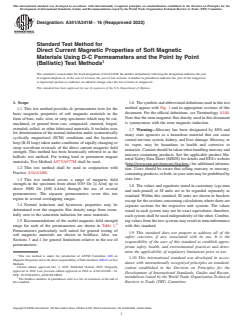
(Test Method)Standard Test Method for Direct Current Magnetic Properties of Soft Magnetic Materials Using D-C Permeameters and the Point by Point (Ballistic) Test Methods
General Information
- Abstract
SIGNIFICANCE AND USE
3.1 Permeameters require the use of yokes to complete the magnetic circuit and are therefore inherently less accurate than ring test methods. Refer to Test Method A596/A596M for further details on ring test methods. However, when testing certain shapes as bars or when magnetic field strength in excess of 200 Oe [16 kA/m] is required, permeameters are the only practical means of measuring magnetic properties.
3.2 This test method is suitable for specification acceptance, service evaluation, research and development and design.
3.3 When the test specimen is fabricated from a larger sample and is in the same condition as the larger sample, it may not exhibit magnetic properties representative of the original sample. In such instances the test results, when viewed in context of past performance history, will be useful for judging the suitability of the material for the intended application.
SCOPE
1.1 This test method provides dc permeameter tests for the basic magnetic properties of soft magnetic materials in the form of bars, rods, wire, or strip specimens which may be cut, machined, or ground from cast, compacted, sintered, forged, extruded, rolled, or other fabricated materials. It includes tests for determination of the normal induction under symmetrically cyclically magnetized (SCM) conditions and the hysteresis loop (B-H loop) taken under conditions of rapidly changing or steep wavefront reversals of the direct current magnetic field strength. This method has been historically referred to as the ballistic test method. For testing hard or permanent magnet materials, Test Method A977/A977M shall be used.
1.2 This test method shall be used in conjunction with Practice A34/A34M.
1.3 This test method covers a range of magnetic field strength in the specimen from about 0.05 Oe [4 A/m] up to above 5000 Oe [400 kA/m] through the use of several permeameters. The separate permeameters cover this test region in several overlapping ranges.
1.4 Normal induction and hysteresis properties may be determined over the magnetic flux density range from essentially zero to the saturation induction for most materials.
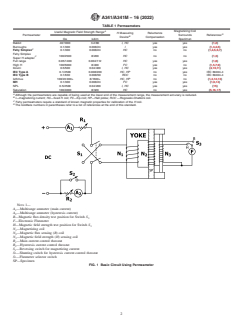
1.5 Recommendations of the useful magnetic field strength range for each of the permeameters are shown in Table 1.2 Permeameters particularly well suited for general testing of soft magnetic materials are shown in boldface. Also, see Sections 3 and 4 for general limitations relative to the use of permeameters.
1.6 The symbols and abbreviated definitions used in this test method appear with Fig. 1 and in appropriate sections of this document. For the official definitions, see Terminology A340. Note that the term magnetic flux density used in this document is synonymous with the term magnetic induction.
FIG. 1 Basic Circuit Using Permeameter
Note 1:
A1—Multirange ammeter (main current)
A2—Multirange ammeter (hysteresis current)
B—Magnetic flux density test position for Switch S3
F—Electronic Fluxmeter
H—Magnetic field strength test position for Switch S3
N1—Magnetizing coil
N2—Magnetic flux sensing (B) coil
N3—Magnetic field strength (H) sensing coil
R1—Main current control rheostat
R2—Hysteresis current control rheostat
S1—Reversing switch for magnetizing current
S2—Shunting switch for hysteresis current control rheostat
S3—Fluxmeter selector switch
SP—Specimen
1.7 Warning—Mercury has been designated by EPA and many state agencies as a hazardous material that can cause central nervous system, kidney, and liver damage. Mercury, or its vapor, may be hazardous to health and corrosive to materials. Caution should be taken when handling mercury and mercury-containing products. See the applicable product Material Safety Data Sheet (MSDS) for details and EPA’s website (http://www.epa.gov/mercury/faq.htm ) for additional information. Users should be aware that selling mercury or mercury-containing products, or both, in your state may be p...
- Status
- Published
- Publication Date
- 30-Sep-2022
- Technical Committee
- A06 - Magnetic Properties
- Drafting Committee
- A06.01 - Test Methods
Overview
ASTM A341/A341M-16(2022) outlines standardized methods for measuring the direct current (DC) magnetic properties of soft magnetic materials using DC permeameters and the point-by-point (ballistic) method. Developed by ASTM International, this standard serves as a key reference for evaluating the fundamental magnetic characteristics-such as normal induction and the magnetic hysteresis loop-of soft magnetic materials presented in forms like bars, rods, wires, or strips. The standard is widely recognized for supporting quality control, research, and service evaluation in industries where the magnetic behavior of materials is critical.
Key Topics
- Test Specimen Scope: Covers testing of soft magnetic materials fabricated by various processes, including casting, sintering, forging, extruding, or rolling. Applicable shapes include bars, rods, wires, and strips.
- Measurement Methods: Details the use of DC permeameters and the point-by-point (ballistic) test method to determine key magnetic properties:
- Normal induction under symmetrically cyclically magnetized conditions (SCM)
- Hysteresis (B-H loop) under rapidly changing or steep wavefront reversals of DC magnetic field strength
- Field Range: Supports measurement from approximately 0.05 Oe [4 A/m] up to above 5000 Oe [400 kA/m], depending on the permeameter used.
- Accuracy and Limitations: Notes that permeameters, due to the use of yokes, are less accurate than ring test methods but are the only practical choice for certain specimen shapes and higher field strengths (>200 Oe [16 kA/m]).
- Specimen Preparation: Addresses the need for consistent cross-sectional areas and the effect of specimen fabrication on test results.
- Safety: Contains warnings about handling hazardous materials (such as mercury) tied to some test apparatus.
Applications
ASTM A341/A341M-16(2022) provides practical value in several areas related to the magnetic characterization of materials:
- Quality Control & Specification Acceptance: Enables manufacturers and users to verify that soft magnetic materials meet specified magnetic performance requirements prior to use.
- Service Evaluation: Assists in assessing whether materials maintain their magnetic properties over time and under operating conditions.
- Research & Development: Offers a standardized approach for scientists and engineers to compare new materials or processing techniques on a consistent basis.
- Design: Supplies essential magnetic property data for designers working in fields such as electrical engineering, automotive manufacturing, transformer production, motor manufacturing, and magnetic sensing devices.
The standard is especially important when evaluating magnetic properties in non-ring-shaped specimens or when high field strength measurements are needed, which are not easily achievable with other test methods.
Related Standards
Professionals working with ASTM A341/A341M-16(2022) may also benefit from reviewing these related standards:
- ASTM A596/A596M: Test method for direct-current magnetic properties of materials using the point-by-point (ballistic) method and ring specimens-often referenced for higher accuracy requirements.
- ASTM A34/A34M: Practice for sampling and procurement testing of magnetic materials, used in conjunction with A341/A341M.
- ASTM A977/A977M: Applies to magnetic properties testing of hard or permanent magnet materials.
- IEC 60404-4: International standard for methods of measurement of DC magnetic properties of iron and steel.
- ASTM A340: Contains terminology and definitions related to magnetic testing.
Summary
ASTM A341/A341M-16(2022) is the authoritative standard for measuring DC magnetic properties of soft magnetic materials in non-ring geometries or when high field strengths are required. It underpins critical applications in design, manufacturing, quality control, and research across industries that depend on precise magnetic material performance. For those involved in material selection, evaluation, or development, adherence to this standard ensures reliable and comparable results.
Relations
- Effective Date
- 01-Dec-2023
- Effective Date
- 01-Jun-2020
- Effective Date
- 15-Oct-2019
- Effective Date
- 15-Jun-2019
- Effective Date
- 15-Feb-2019
- Effective Date
- 01-Jun-2018
- Effective Date
- 15-Oct-2017
- Effective Date
- 01-Jul-2017
- Effective Date
- 01-May-2016
- Effective Date
- 01-May-2016
- Effective Date
- 01-Oct-2015
- Effective Date
- 01-Oct-2014
- Effective Date
- 01-May-2013
- Effective Date
- 01-Nov-2012
- Refers
ASTM A340-03a(2011) - Standard Terminology of Symbols and Definitions Relating to Magnetic Testing - Effective Date
- 01-May-2011
Get Certified
Connect with accredited certification bodies for this standard

IMQ S.p.A. (Certification)
Italian electrical product certification.

SLG Prüf- und Zertifizierungs GmbH
German testing and certification body.

UL Solutions
Global safety science company with testing, inspection and certification.
Sponsored listings
Frequently Asked Questions
ASTM A341/A341M-16(2022) is a standard published by ASTM International. Its full title is "Standard Test Method for Direct Current Magnetic Properties of Soft Magnetic Materials Using D-C Permeameters and the Point by Point (Ballistic) Test Methods". This standard covers: SIGNIFICANCE AND USE 3.1 Permeameters require the use of yokes to complete the magnetic circuit and are therefore inherently less accurate than ring test methods. Refer to Test Method A596/A596M for further details on ring test methods. However, when testing certain shapes as bars or when magnetic field strength in excess of 200 Oe [16 kA/m] is required, permeameters are the only practical means of measuring magnetic properties. 3.2 This test method is suitable for specification acceptance, service evaluation, research and development and design. 3.3 When the test specimen is fabricated from a larger sample and is in the same condition as the larger sample, it may not exhibit magnetic properties representative of the original sample. In such instances the test results, when viewed in context of past performance history, will be useful for judging the suitability of the material for the intended application. SCOPE 1.1 This test method provides dc permeameter tests for the basic magnetic properties of soft magnetic materials in the form of bars, rods, wire, or strip specimens which may be cut, machined, or ground from cast, compacted, sintered, forged, extruded, rolled, or other fabricated materials. It includes tests for determination of the normal induction under symmetrically cyclically magnetized (SCM) conditions and the hysteresis loop (B-H loop) taken under conditions of rapidly changing or steep wavefront reversals of the direct current magnetic field strength. This method has been historically referred to as the ballistic test method. For testing hard or permanent magnet materials, Test Method A977/A977M shall be used. 1.2 This test method shall be used in conjunction with Practice A34/A34M. 1.3 This test method covers a range of magnetic field strength in the specimen from about 0.05 Oe [4 A/m] up to above 5000 Oe [400 kA/m] through the use of several permeameters. The separate permeameters cover this test region in several overlapping ranges. 1.4 Normal induction and hysteresis properties may be determined over the magnetic flux density range from essentially zero to the saturation induction for most materials. 1.5 Recommendations of the useful magnetic field strength range for each of the permeameters are shown in Table 1.2 Permeameters particularly well suited for general testing of soft magnetic materials are shown in boldface. Also, see Sections 3 and 4 for general limitations relative to the use of permeameters. 1.6 The symbols and abbreviated definitions used in this test method appear with Fig. 1 and in appropriate sections of this document. For the official definitions, see Terminology A340. Note that the term magnetic flux density used in this document is synonymous with the term magnetic induction. FIG. 1 Basic Circuit Using Permeameter Note 1: A1—Multirange ammeter (main current) A2—Multirange ammeter (hysteresis current) B—Magnetic flux density test position for Switch S3 F—Electronic Fluxmeter H—Magnetic field strength test position for Switch S3 N1—Magnetizing coil N2—Magnetic flux sensing (B) coil N3—Magnetic field strength (H) sensing coil R1—Main current control rheostat R2—Hysteresis current control rheostat S1—Reversing switch for magnetizing current S2—Shunting switch for hysteresis current control rheostat S3—Fluxmeter selector switch SP—Specimen 1.7 Warning—Mercury has been designated by EPA and many state agencies as a hazardous material that can cause central nervous system, kidney, and liver damage. Mercury, or its vapor, may be hazardous to health and corrosive to materials. Caution should be taken when handling mercury and mercury-containing products. See the applicable product Material Safety Data Sheet (MSDS) for details and EPA’s website (http://www.epa.gov/mercury/faq.htm ) for additional information. Users should be aware that selling mercury or mercury-containing products, or both, in your state may be p...
SIGNIFICANCE AND USE 3.1 Permeameters require the use of yokes to complete the magnetic circuit and are therefore inherently less accurate than ring test methods. Refer to Test Method A596/A596M for further details on ring test methods. However, when testing certain shapes as bars or when magnetic field strength in excess of 200 Oe [16 kA/m] is required, permeameters are the only practical means of measuring magnetic properties. 3.2 This test method is suitable for specification acceptance, service evaluation, research and development and design. 3.3 When the test specimen is fabricated from a larger sample and is in the same condition as the larger sample, it may not exhibit magnetic properties representative of the original sample. In such instances the test results, when viewed in context of past performance history, will be useful for judging the suitability of the material for the intended application. SCOPE 1.1 This test method provides dc permeameter tests for the basic magnetic properties of soft magnetic materials in the form of bars, rods, wire, or strip specimens which may be cut, machined, or ground from cast, compacted, sintered, forged, extruded, rolled, or other fabricated materials. It includes tests for determination of the normal induction under symmetrically cyclically magnetized (SCM) conditions and the hysteresis loop (B-H loop) taken under conditions of rapidly changing or steep wavefront reversals of the direct current magnetic field strength. This method has been historically referred to as the ballistic test method. For testing hard or permanent magnet materials, Test Method A977/A977M shall be used. 1.2 This test method shall be used in conjunction with Practice A34/A34M. 1.3 This test method covers a range of magnetic field strength in the specimen from about 0.05 Oe [4 A/m] up to above 5000 Oe [400 kA/m] through the use of several permeameters. The separate permeameters cover this test region in several overlapping ranges. 1.4 Normal induction and hysteresis properties may be determined over the magnetic flux density range from essentially zero to the saturation induction for most materials. 1.5 Recommendations of the useful magnetic field strength range for each of the permeameters are shown in Table 1.2 Permeameters particularly well suited for general testing of soft magnetic materials are shown in boldface. Also, see Sections 3 and 4 for general limitations relative to the use of permeameters. 1.6 The symbols and abbreviated definitions used in this test method appear with Fig. 1 and in appropriate sections of this document. For the official definitions, see Terminology A340. Note that the term magnetic flux density used in this document is synonymous with the term magnetic induction. FIG. 1 Basic Circuit Using Permeameter Note 1: A1—Multirange ammeter (main current) A2—Multirange ammeter (hysteresis current) B—Magnetic flux density test position for Switch S3 F—Electronic Fluxmeter H—Magnetic field strength test position for Switch S3 N1—Magnetizing coil N2—Magnetic flux sensing (B) coil N3—Magnetic field strength (H) sensing coil R1—Main current control rheostat R2—Hysteresis current control rheostat S1—Reversing switch for magnetizing current S2—Shunting switch for hysteresis current control rheostat S3—Fluxmeter selector switch SP—Specimen 1.7 Warning—Mercury has been designated by EPA and many state agencies as a hazardous material that can cause central nervous system, kidney, and liver damage. Mercury, or its vapor, may be hazardous to health and corrosive to materials. Caution should be taken when handling mercury and mercury-containing products. See the applicable product Material Safety Data Sheet (MSDS) for details and EPA’s website (http://www.epa.gov/mercury/faq.htm ) for additional information. Users should be aware that selling mercury or mercury-containing products, or both, in your state may be p...
ASTM A341/A341M-16(2022) is classified under the following ICS (International Classification for Standards) categories: 29.030 - Magnetic materials. The ICS classification helps identify the subject area and facilitates finding related standards.
ASTM A341/A341M-16(2022) has the following relationships with other standards: It is inter standard links to ASTM A340-23a, ASTM A977/A977M-07(2020), ASTM A340-19b, ASTM A340-19a, ASTM A340-19, ASTM A340-18, ASTM A340-17a, ASTM A340-17, ASTM A340-16, ASTM A340-16e1, ASTM A340-15, ASTM A340-14, ASTM A977/A977M-07(2013), ASTM A34/A34M-06(2012), ASTM A340-03a(2011). Understanding these relationships helps ensure you are using the most current and applicable version of the standard.
ASTM A341/A341M-16(2022) is available in PDF format for immediate download after purchase. The document can be added to your cart and obtained through the secure checkout process. Digital delivery ensures instant access to the complete standard document.
Standards Content (Sample)
This international standard was developed in accordance with internationally recognized principles on standardization established in the Decision on Principles for the
Development of International Standards, Guides and Recommendations issued by the World Trade Organization Technical Barriers to Trade (TBT) Committee.
Designation: A341/A341M − 16 (Reapproved 2022)
Standard Test Method for
Direct Current Magnetic Properties of Soft Magnetic
Materials Using D-C Permeameters and the Point by Point
(Ballistic) Test Methods
This standard is issued under the fixed designationA341/A341M; the number immediately following the designation indicates the year
of original adoption or, in the case of revision, the year of last revision.Anumber in parentheses indicates the year of last reapproval.
A superscript epsilon (´) indicates an editorial change since the last revision or reapproval.
This standard has been approved for use by agencies of the U.S. Department of Defense.
1. Scope 1.6 Thesymbolsandabbreviateddefinitionsusedinthistest
method appear with Fig. 1 and in appropriate sections of this
1.1 This test method provides dc permeameter tests for the
document. For the official definitions, see Terminology A340.
basic magnetic properties of soft magnetic materials in the
Notethatthetermmagneticfluxdensityusedinthisdocument
form of bars, rods, wire, or strip specimens which may be cut,
is synonymous with the term magnetic induction.
machined, or ground from cast, compacted, sintered, forged,
extruded, rolled, or other fabricated materials. It includes tests
1.7 Warning—Mercury has been designated by EPA and
fordeterminationofthenormalinductionundersymmetrically
many state agencies as a hazardous material that can cause
cyclically magnetized (SCM) conditions and the hysteresis
central nervous system, kidney, and liver damage. Mercury, or
loop (B-H loop) taken under conditions of rapidly changing or
its vapor, may be hazardous to health and corrosive to
steep wavefront reversals of the direct current magnetic field
materials.Cautionshouldbetakenwhenhandlingmercuryand
strength. This method has been historically referred to as the
mercury-containing products. See the applicable product Ma-
ballistic test method. For testing hard or permanent magnet
terial Safety Data Sheet (MSDS) for details and EPA’s website
materials, Test Method A977/A977M shall be used.
(http://www.epa.gov/mercury/faq.htm)foradditionalinforma-
1.2 This test method shall be used in conjunction with
tion. Users should be aware that selling mercury or mercury-
Practice A34/A34M.
containingproducts,orboth,inyourstatemaybeprohibitedby
state law.
1.3 This test method covers a range of magnetic field
strength in the specimen from about 0.05 Oe [4 A/m] up to
1.8 The values and equations stated in customary (cgs-emu
above 5000 Oe [400 kA/m] through the use of several
and inch-pound) or SI units are to be regarded separately as
permeameters. The separate permeameters cover this test
standard. Within this standard, SI units are shown in brackets
region in several overlapping ranges.
except for the sections concerning calculations where there are
1.4 Normal induction and hysteresis properties may be
separate sections for the respective unit systems. The values
determined over the magnetic flux density range from essen-
stated in each system may not be exact equivalents; therefore,
tially zero to the saturation induction for most materials.
each system shall be used independently of the other. Combin-
ingvaluesfromthetwosystemsmayresultinnonconformance
1.5 Recommendations of the useful magnetic field strength
with this standard.
range for each of the permeameters are shown in Table 1.
Permeameters particularly well suited for general testing of
1.9 This standard does not purport to address all of the
soft magnetic materials are shown in boldface. Also, see
safety concerns, if any, associated with its use. It is the
Sections 3 and 4 for general limitations relative to the use of
responsibility of the user of this standard to establish appro-
permeameters.
priate safety, health, and environmental practices and deter-
mine the applicability of regulatory limitations prior to use.
This test method is under the jurisdiction of ASTM Committee A06 on
1.10 This international standard was developed in accor-
MagneticPropertiesandisthedirectresponsibilityofSubcommitteeA06.01onTest
dance with internationally recognized principles on standard-
Methods.
Current edition approved Oct. 1, 2022. Published October 2022. Originally
ization established in the Decision on Principles for the
approved in 1969. Last previous edition approved in 2016 as A341/A341M–16.
Development of International Standards, Guides and Recom-
DOI: 10.1520/A0341_A0341M-16R22.
2 mendations issued by the World Trade Organization Technical
The boldface numbers in parentheses refer to a list of references at the end of
this standard. Barriers to Trade (TBT) Committee.
Copyright © ASTM International, 100 Barr Harbor Drive, PO Box C700, West Conshohocken, PA 19428-2959. United States
A341/A341M − 16 (2022)
TABLE 1 Permeameters
A
Magnetizing Coil
Useful Magnetic Field Strength Range
H Measuring Reluctance
D
Permeameter Surrounds References
B
Device Compensation
Oe kA/m Specimen
Babbit 40/1000 3.2/80 I, HC yes yes (1,2)
Burroughs 0.1/300 0.008/24 I yes yes (1,3,4,5)
C
Fahy Simplex 0.1/300 0.008/24 HC no no (1,4,5,6,7)
Fahy Simplex
100/2500 8/200 HC no no (1,3)
C
Super H adapter
Full range 0.05/1400 0.004/112 HC yes yes (1,8)
High H 100/5000 8/400 FC yes no (1,5,7,9)
Iliovici 0.5/500 0.04/400 I, HC yes yes (4,10,11)
IEC Type A 0.1/2500 0.008/200 HC, HP no yes IEC 60404-4
IEC Type B 0.1/630 0.008/50 RCC no no IEC 60404-4
Isthmus 100/20 000+ 8/1600+ HC, HP no no (1,4,12,13)
MH 0.1/300 0.008/24 FC yes yes (1,6,14)
NPL 0.5/2500 0.04/200 I, HC yes yes (15)
Saturation 100/4000 8/320 HC no yes (5,16,17)
A
Although the permeameters are capable of being used at the lower end of the measurement range, the measurement accuracy is reduced.
B
I—magnetizing current; HC—fixed H coil; FC—flip coil; HP—Hall probe; RCC —Rogowski-Chattock coil.
C
Fahy permeameters require a standard of known magnetic properties for calibration of the H coil.
D
The boldface numbers in parentheses refer to a list of references at the end of this standard.
NOTE 1—
A —Multirange ammeter (main current)
A —Multirange ammeter (hysteresis current)
B—Magnetic flux density test position for Switch S
F—Electronic Fluxmeter
H—Magnetic field strength test position for Switch S
N —Magnetizing coil
N —Magnetic flux sensing (B) coil
N —Magnetic field strength (H) sensing coil
R —Main current control rheostat
R —Hysteresis current control rheostat
S —Reversing switch for magnetizing current
S —Shunting switch for hysteresis current control rheostat
S —Fluxmeter selector switch
SP—Specimen
FIG. 1 Basic Circuit Using Permeameter
A341/A341M − 16 (2022)
2. Referenced Documents clamping strains into the test specimen. For the above reasons
3 test results obtained on a test specimen with one type per-
2.1 ASTM Standards:
meameter may not agree closely with those obtained on the
A34/A34MPractice for Sampling and Procurement Testing
same test specimen using another type of permeameter.
of Magnetic Materials
A340Terminology of Symbols and Definitions Relating to
5. Apparatus
Magnetic Testing
A596/A596MTest Method for Direct-Current Magnetic
5.1 Because of the differences in physical construction of
PropertiesofMaterialsUsingthePointbyPoint(Ballistic) the various permeameters listed in Table 1, no standard list of
Method and Ring Specimens
components is given. When used with a particular type of
A977/A977MTestMethodforMagneticPropertiesofHigh- permeameter, the components should conform to the general
Coercivity Permanent Magnet Materials Using Hyster-
requirementslistedbelow.Abasicschematicofapermeameter
esigraphs is shown in Fig. 1.
2.2 IEC Standard:
5.2 Permeameter—The particular permeameter used shall
Publication 60404-4,Ed. 2.2 Magnetic Materials – Part 4:
be of high quality construction. The yokes should be made of
Methods of Measurement of D.C. Magnetic Properties of
high permeability alloy such as oriented or nonoriented silicon
IronandSteel,IEC,1995PlusAmendments1in2000and
iron or nickel-iron alloy, although low carbon steel or iron is
2 in 2008
acceptable in certain instances.The preferred yoke dimensions
2.3 Other Documents:
are listed in the appended references (see Table 1). Deviations
NISTCircular No. 74, pg. 269
from these dimensions should be such that the yoke is
NISTScientific Paper 117, SPBTA
operating at or below the point of maximum permeability for
the highest test magnetic flux densities encountered. Yoke
3. Significance and Use
construction may consist of either stacked laminations or
stripwound C cores suitably bolted or adhesive bonded to-
3.1 Permeameters require the use of yokes to complete the
magnetic circuit and are therefore inherently less accurate than gether.
ring test methods. Refer to Test Method A596/A596M for
5.3 Power Supply—The magnetizing current shall be sup-
further details on ring test methods. However, when testing
plied by either storage batteries or dc power supplies. Linear
certainshapesasbarsorwhenmagneticfieldstrengthinexcess
power supplies have been found to be well suited for this use.
of 200 Oe [16 kA/m] is required, permeameters are the only
The source of dc current must be stable, have negligible ripple
practical means of measuring magnetic properties.
and be capable of quickly returning to the stable state after
3.2 Thistestmethodissuitableforspecificationacceptance, switching. When programmable power supplies are used,
service evaluation, research and development and design. either digital or analog programming signals are permissible
provided that equal but opposite polarity current cycling is
3.3 When the test specimen is fabricated from a larger
possible.
sampleandisinthesameconditionasthelargersample,itmay
5.4 Main-Current-ControlRheostats,R —Whenused,these
not exhibit magnetic properties representative of the original
sample. In such instances the test results, when viewed in rheostatsmusthavesufficientpowerratingandheat-dissipating
capacitytohandlethevoltageandlargesttestcurrentandmust
context of past performance history, will be useful for judging
the suitability of the material for the intended application. provide sufficient resistance to limit the test currents to those
required for the lowest magnetic field strength to be used.
4. Interferences
5.5 Hysteresis-Current-Control Rheostats, R —When used,
4.1 In general, permeameters do not maintain a uniform
these rheostats must have the same characteristics as the
magneticfieldineithertheaxialorradialdirectionsaroundthe
main-current control rheostats.
test specimen. The field gradients in both of these directions
5.6 Main-Current Ammeter, A —Magnetizing current mea-
willdifferinthevariouspermeameters.AlsotheH-sensingand
surement shall be conducted using a digital ammeter or
B-sensing coils of the different permeameters are not identical
combination of a digital voltmeter and precision current
in area, in turns, or in length or identically located. Although
sensing resistor with an overall accuracy of better than 0.25%
test specimens are prepared to have uniform physical cross
when the magnetic field strength will be determined from the
section, they may have undetected nonuniform magnetic prop-
current. In those permeameters where the magnetic field
erties radially or axially along the specimen length adjacent to
strength is determined by other means, such as Hall probes or
the H or B coils. Some permeameters may also introduce
H coils, lower accuracy analog instruments can be used. In
such permeameters, the ammeter is used to prevent excessive
currents from being applied and, based on past experience, to
For referenced ASTM standards, visit the ASTM website, www.astm.org, or
contact ASTM Customer Service at service@astm.org. For Annual Book of ASTM roughly establish the required magnetic field strength.
Standards volume information, refer to the standard’s Document Summary page on
5.7 Hysteresis-Current Ammeter, A —The requirements of
the ASTM website. 2
Available fromAmerican National Standards Institute (ANSI), 25 W. 43rd St., 5.6 shall apply. In general, a separate ammeter is not required.
4th Floor, New York, NY 10036.
5.8 Reversing Switch, S —When nonprogrammable dc cur-
Available from National Institute of Standards and Technology (NIST), 100 1
Bureau Dr., Stop 1070, Gaithersburg, MD 20899-1070, http://www.nist.gov. rent sources such as storage batteries are used, a current
A341/A341M − 16 (2022)
TABLE 2 Number of Test Strips
reversing switch is required. The reversing switch should be
either a high quality knife switch, mechanical or electrical Nominal Thickness Number of
in. mm Strips
solenoid-operatedcontractorsormercuryswitcheshavinghigh
0.0100 to 0.0250 0.254 to 0.635 12
current rating and the ability to maintain uniform contact
0.0280 to 0.0435 0.711 to 1.105 8
resistance of equal magnitude in both current directions. 0.0500 and over 1.27 and over 4
Switches with contact bounce or other multiple contacting
behavior on make or break must be avoided. Because of the
presence of leakage currents in the open condition, solid state
6.3 When the material is in flat-rolled form and is to be
relays are not permitted.
evaluated as half transverse-half longitudinal, the specimen
shall be sheared to have strips in accordance with Table 2
5.9 Hysteresis Switch, S —This single pole switch must
conform to the same requirements as the reversing Switch, S . exceptthatmultiplesoffourarenotrequired.Whenmaterialis
to be evaluated in one direction, it shall conform to this table
5.10 Fluxmeter, F—Because of their superior accuracy,
or to the requirements for best test quality in a particular
stability, and ease of operation, electronic fluxmeters shall be
permeameter. For strip and sheet less than 0.0100 in.
used to measure the magnetic flux density and, if an H-coil is
[0.254mm] in thickness, the cross-sectional area shall be not
used, the magnetic field strength. Fluxmeters using either
2 2
less than 0.31 in. [200 mm ] and not more than 0.62
operational amplifier and capacitor feedback (analog integra-
2 2
in. [400mm ].
tor) or analog to digital conversion and digital integration are
permitted. The accuracy of the fluxmeter must be better than 6.4 When the test specimen for strip materials is to be half
1% full scale. If analog display meters are used to read the transverseandhalflongitudinal,thepreferredmethodistotest
value of magnetic flux, the measurement should be made on thetransversestripsasonespecimenandthelongitudinalstrips
theuppertwo-thirdsofthescale.Analogfluxmetersmusthave as another specimen. Mixing the specimens when significant
drift adjust circuitry and the drift should not exceed 100max- magnetic anisotropy is present could result in unrealistic test
−6
well-turns [10 Wb-turns] per minute on the most sensitive results.
range. It is also desirable that the fluxmeter have appropriate
6.5 For full testing accuracy, the length and size of the test
scalingcircuitrytopermitdirectreadingofeithermagneticflux
specimen must meet the requirements of the permeameter
(φ) or magnetic flux density (B).
being used. Generally, for most permeameters, a test specimen
5.11 B Coils—Prewound fixed magnetic flux sensing coils length of 10 in. [0.25 m] or more is required. Shorter
areoftenused.Whenused,thecross-sectionalareaenclosedby specimens with some permeameters will require the use of
pole-piece extensions, and may cause a reduction in testing
the secondary winding and number of turns must each be
known to within 0.5%. accuracy. Other permeameters are designed for short speci-
mens without loss of testing accuracy.
5.12 Magnetic Field Strength Measuring Devices—Certain
permeameters do not or cannot use the magnetizing current to 6.6 All test specimen forms shall be cut, machined, or
determine the magnetic field strength accurately. Such per- ground to have a uniform cross-sectional area along the active
meameters instead use stationary H coils, flip coils, or Hall length of the test specimen. The cross-sectional area shall be
probes. When such devices are used, they shall be capable of sufficiently uniform so that its nonuniformity will not materi-
determiningthemagneticfieldstrengthtoaccuracyof1.0%or allyaffecttheaccuracyofestablishingandmeasuringmagnetic
better. flux density in the test sample.
6.7 When required for development of material properties
6. Test Specimens
the test specimen shall have received a stress relief or other
6.1 Test specimen area shall normally be determined from
heat treatment after preparation. This anneal is subject to
mass, length, and density as indicated in 9.1 and 10.1. When
agreement between producer and user; producer’s recommen-
thetestspecimenismachinedorgroundtohaveaverysmooth
dation; or the recommended heat treatment provided by the
surface, the physical dimensions obtained from micrometer
appropriate ASTM standard for the material. The heat treat-
measurements may be used to calculate the cross-sectional
ment used shall be reported with the test results as indicated in
area.
11.1.3.
6.2 Test specimens in bar form may be of round, square, or
7. Calibration
rectangular cross-sectional shape. In some permeameters the
bar specimen may be a half round or any shape having a 7.1 Fluxmeter—Practical operating experience has shown
uniform cross-sectional area. Certain permeameters must have that provided a proper warmup period is allowed, electronic
a good magnetic joint between the ends of the test specimen fluxmeters require infrequent calibration therefore calibration
and the permeameter yoke or pole faces. Pole shoes may be is not an integral part of this test method. When calibration is
necessary to create this joint. Generally, to achieve a good required, it can be accomplished with either a mutual inductor
magnetic joint, the test specimen must be of square or or a volt-second source. Because of their traceability to the
rectangular cross section and must be machined or ground to fundamental units of voltage and time, volt-second sources are
have straight and parallel surfaces. For permeameters using the preferred means of calibration. The accuracy of either the
specimens butted to pole pieces, the specimen ends must be mutual inductor or volt-second source must be better than the
smooth and parallel. rated full scale accuracy of the fluxmeter.
A341/A341M − 16 (2022)
7.2 Fixed B and H Coils—The effective area turns of such andopeningSwitchS .UsecaretobesureS isopenedbefore
2 2
search coils can be determined by comparison with a coil of S isclosedforreversal.Whendeterminingthehysteresisloop,
known area turns or by individual calibration in a series of Switches S and S mustbeoperatedtotraversetheloopinthe
1 2
known magnetizing fields. Such fields can be obtained using same direction between successive measurements so as to
either long solenoids electromagnets or appropriate Helmholtz preserve the cyclically magnetized state of the test specimen.
coil systems. 8.2.4 Theusualpracticeformeasuringthehysteresisloopis
tomeasurethefirstandsecondquadrantandassumesymmetry
7.3 Comparison Permeameters—Certain types of per-
to complete the construction of the loop.
meameters such as the Fahy permeameter require a standard
specimen of known magnetic properties to derive the relation-
8.3 Before testing, demagnetize the specimen in the per-
ship between field sensor output and true magnetic field meameterorbysomeotheracceptablemeans.Demagnetizeby
strength. In the absence of nationally recognized standard
first establishing a magnetic field strength sufficiently large to
specimens, a standard may be developed by mutual agreement cause the magnetic flux density in the test specimen to reach a
between producer and user, and if possible, a referee labora-
point well above the knee of the magnetization curve. Then
tory. while continuously operating the reversing switch at half-
second or longer intervals, slowly reduce the magnetizing
8. Procedure
current to zero in small increments. An auxiliary demagnetiz-
ing circuit using a time delay relay will make this operation
8.1 Many permeameters use a compensating system of
more reproducible and less tedious.
magnetizing coils to provide extra magnetomotive force to
overcomethereluctanceoftheyokesandjointsinthemagnetic
NOTE 1—Due to the inhomogeneous nature of permeameter magnetic
circuit. Hence, the detailed operation procedure will vary
circuits and the varying resolution of current control among different test
somewhat with the type of permeameter used. Detailed oper- systems, complete demagnetization of the test specimen (that is, B=0at
H = 0) is seldom achievable. Provided the residual induction (B)inthe
ating procedures can be found in the references appended to r
specimen after demagnetization is less than 20% of the lowest test
this test method. The procedure listed below is common to all
magnetic flux density, the specimen can be considered to be demagne-
types of permeameters.
tized.
8.2 In Fig. 1, the dc power source supplies testing current
8.4 Toobtainthemagneticfluxdensity(B)correspondingto
measured by ammeter A or A . Rheostats R and R and
1 2 1 2
a specific magnetic field strength (H), establish the proper
Switches S and S determine the magnitude and direction of
1 2 magneticfieldstrength(includingtheproperhysteresiscurrent
the current as required by various operations. In general, three
if appropriate), cycle the reversing switch several times to
kinds of switching operations are required.
establish the symmetrically cyclically magnetized (SCM)
8.2.1 The first operation is the reversal of the magnetizing
condition, zero the fluxmeter and execute the proper switching
current direction without change in its magnitude as required
procedure detailed in 8.2. The value of the magnetic flux or
for establishing a symmetrically cyclically magnetized condi-
magneticfluxdensitycanthenbecomputedfromthefluxmeter
tion used in determination of the normal induction curve. This
reading.Additional test points on the magnetization curve can
is done by throwing Switch S from one side to another.
be obtained without demagnetization if they are obtained in
Normally this current reversal is done several times until a
ascending order of B or H. Otherwise, it is necessary to
stablereadingonthefluxmeterisobtained.Sincethefluxmeter
demagnetize before additional testing. It is not necessary to
reads only the change in flux linkages or flux density depend-
demagnetize provided the maximum magnetic field strength is
ingonhowitisscaled,thisisthekeyswitchingoperationsince
well above the knee of the magnetization curve.
it establishes the reference point for all subsequent measure-
8.5 To obtain the magnetic field strength corresponding to a
ments of magnetic flux density and magnetic field strength.
specific magnetic flux density, a procedure similar to 8.4 is
8.2.2 The second operation is the reduction of the magni-
usedwiththeexceptionthatthemagneticfieldstrengthmustbe
tude of magnetizing current without change of direction. This
found by trial and error. If the specified magnetic flux density
isdonebyopeningSwitchS .Thisallowsforthemeasurement
is exceeded, demagnetization is usually required before pro-
of the first quadrant of the hysteresis loop. If the fluxmeter is
ceeding further unless operating at very low magnetic flux
zeroedbeforeopeningSwitchS andthefluxmeteriscalibrated
densities.
to read magnetic flux density for the specimen, the resulting
valueisthedifferencebetweenthemaximumfluxdensity
...